Normal view

Detection engineering in the AI era

9 July 2026 at 09:41

The conversation around AI-powered threats has focused heavily on the attacker side. What models can do, what vulnerabilities they can find, how fast they can chain exploits together. But the more important question for security practitioners is simpler and harder. Is your detection posture ready for what’s already happening?

AI has lowered the barrier to entry for sophisticated attacks. Threat actors don’t need to be experts to leverage LLMs for obfuscation, exploit development, or chaining attack steps that previously required deep manual skill. The speed and volume of attacks is increasing as a result. Detection engineering is part of how defenders respond. And most organizations are further behind than they realize, especially because many detection engineering programs live in their own siloed “ivory tower”, detached from the realities of what SOC analysts are handling. 

At Intezer, AI-powered detection engineering runs as part of a closed loop with automated, forensic triage and investigation. Every alert investigated across the environment feeds new signal back into detection logic, so coverage improves continuously instead of drifting between quarterly tuning cycles. Detection working in concert with triage and investigation is what a fully optimized security environment looks like against AI-powered attackers.

In this article, we’ll focus on how to improve detection engineering practices in general. 

Why your current detection posture isn’t keeping pace

The fundamental problem is that most detection programs were built for a world where attack volume was bounded by attacker expertise. That constraint is being removed. LLM-augmented attacks can move faster, produce more permutations, and adapt more readily to your environment than traditional campaigns. A detection posture built on static indicators and periodic tuning cycles can’t keep up.

There are three places this shows up in practice.

Covering one sub-technique doesn’t cover the technique

First, most organizations are only covering technique-level MITRE ATT&CK mappings, not sub-techniques. When you claim T1059 is covered because you have a rule for T1059.001, you’re exposing yourself to real risk hiding beneath that coverage number. Sub-techniques carry distinct behaviors that may exist in your environment and go completely undetected. High-level coverage scores look good in reports and obscure what’s actually happening. The risk lives at the sub-technique level.

IOCs are brittle indicators 

Second, IOC-based detections are becoming a liability at scale. IP addresses, file hashes, domains are valuable in incident response but brittle as primary detection logic. Their half-life is short, adversaries burn them readily, and maintaining a large list of active IOCs creates noise without proportionate signal. Organizations that lead with IOCs end up toggling rules on and off constantly, adding friction without improving coverage. The maintenance cost compounds without a meaningful security return.

Pulling logs is not the same as pulling useful logs

Third, telemetry that looks healthy often isn’t. A Windows Event ID 4688 without command-line logging enabled is an example. You’re paying to ingest it, it shows up in your coverage maps, but it provides no actionable data when something fires. Unmapped or broken telemetry creates the appearance of coverage where none actually exists. Before you write a new rule, validate that the data it depends on actually contains what you think it does.

What behavioral detection actually means in practice

Behavioral detections are built around what attackers do across a campaign, not what artifacts they happened to leave behind in a specific incident. Techniques, sequences, tool patterns, execution chains persist across campaigns, across threat actors, and even across malware families. A behavioral detection written well today has a much longer useful life than any IOC-based rule.

The shift to behavioral detection isn’t just a philosophy, it requires specific changes to how rules are built and maintained.

Score based detection

Score-based detection logic is one of the most underused approaches in enterprise SIEMs. If you’re running Splunk, Sumo Logic, or Cortex XDR, score-based rules let you assign weighted values to individual signals and alert when combinations cross a threshold. Individual signals that are weak in isolation, a process executing from an unusual path, a network connection to an uncommon destination, a scheduled task created outside business hours, become meaningful together. Noise goes down. True positive rate goes up. And the system stays tunable as your environment changes.

Permutation testing

Permutation testing is the other discipline most detection programs skip. LLMs make it straightforward to generate attack variants at volume. Defenders should be doing the same before releasing rules. If a detection rule only catches one specific implementation of a technique, an attacker using a slightly different toolchain or execution order will evade it. Testing rules against a range of permutations before production deployment closes gaps that post-deployment tuning will miss.

The detection engineering cycle has to get faster

The traditional cycle, write a rule, deploy it, wait for something to fire, tune reactively when it generates too many false positives, is too slow for the current threat environment. By the time you’ve finished tuning a rule for last quarter’s threat, new attack patterns are already in the wild.

The cycle needs to compress at every stage. Prototype rules should be tested in isolated environments before they reach production. Sandboxes and virtual machines can be spun up quickly in the same pipeline as rule development, giving you a controlled validation environment. Rules that are tuned before deployment don’t flood the SOC on their first day, and analysts who aren’t buried in false positives from new rules are analysts who can actually investigate real threats.

Continuous monitoring closes the loop. Every alert that fires, every verdict and every outcome feeds information back into the detection posture. Which rules are generating signal? Which ones are generating noise? Where are the coverage gaps that no existing rule addresses? Without this feedback loop, detection engineering becomes a periodic exercise rather than a continuously improving system.

A well integrated feedback loop investigates every single alert a detection creates, resolves false positives from critically important detections while continuously tuning the behavioral model to secure your organization and security detection pipeline.

Coverage benchmarks worth using

Coverage benchmarks help set realistic expectations and give teams a concrete target. Based on what we see across enterprise environments:

  • Less than 30% MITRE ATT&CK coverage is immature. Organizations in this range typically have out-of-the-box rules, minimal customization, and significant gaps across Initial Access, Execution, and Lateral Movement.
  • 30 to 45% represents a decent in-house SOC. Rules exist, there’s some customization, but detection engineering is not a dedicated discipline and tuning is reactive.
  • 45 to 60% is strong. Dedicated attention to detection posture, some behavioral logic, and active management of the detection lifecycle.
  • 60 to 70% is top-tier. Behavioral detection is primary, coverage is continuously maintained, and the feedback loop between investigation and detection is functioning.

Anything above 70% is usually inflated. Scores at this level typically reflect mapping sprawl across multiple MITRE versions, technique-level claims that obscure sub-technique gaps, or rules that are mapped but broken. Validate the underlying data before trusting the number.

The goal isn’t 100% coverage. That number isn’t achievable or meaningful. The goal is systematic, maintainable coverage of the techniques most relevant to your environment and your crown jewels, with the sub-technique depth to catch how those techniques are actually executed.

How AI changes things for attackers and defenders

Mythos focused attention on a specific capability and that is autonomous chaining of exploit steps that previously required human guidance at each stage. A skilled researcher can still walk an LLM through finding a vulnerability, reaching exploit code, and overtaking an instruction pointer, but that process requires human direction at each transition. What makes autonomous chaining meaningful is that it removes the human from the loop on the attacker side.

The detection engineering response isn’t a new category of rule. It’s the same disciplines applied with more rigor and at higher speed. Attackers using LLMs are still executing against endpoints, still writing to disk or running in memory, still making network connections, still creating processes. The behaviors are recognizable. What changes is the volume of variants and the speed at which new campaigns emerge.

Score-based logic handles volume well because it doesn’t require a rule per variant. Permutation testing handles new variants better than reactive tuning because gaps are found before deployment rather than after. Behavioral coverage handles campaign evolution better than IOC maintenance because the underlying techniques persist even as the tooling changes.

This is where an integrated model matters most. AI-powered detection engineering delivers the most value when it doesn’t operate in isolation, and at Intezer it runs on the same loop as automated triage and investigation. The platform investigates 100% of alerts across endpoint, identity, cloud, network, and SIEM, and every verdict feeds directly back into detection, surfacing noisy rules, broken telemetry, and coverage gaps as they happen rather than at the next review. Detection, triage, and investigation reinforcing one another is what produces a fully optimized security environment, one that keeps pace as attacker AI accelerates.

The organizations that fare best against AI-powered threats will be the ones that already had a functioning detection engineering program, one built on behavioral logic, continuous feedback, and validated telemetry, before the threat landscape changed. Catching up under pressure is possible, but it’s harder and slower than building the discipline now.

The attacker’s AI is getting faster. The detection engineering cycle should be too.

Learn more about Intezer’s AI-powered detection engineering.

The post Detection engineering in the AI era appeared first on Intezer.

Consider these factors when defining your email resilience strategy

Email remains the primary entry point for phishing, fraud, malware, and Business Email Compromise (BEC) attacks. While Microsoft 365 provides a strong foundation, organizations need additional layers of protection to defend against increasingly sophisticated threats

Introducing Custom Agents: Automate your SOC, your way

2 July 2026 at 14:29

Intezer already investigates 100% of your alerts and escalates fewer than 2% of them for human review. That part is handled.

The work does not stop there, though. Every SOC has its own routines wrapped around the investigation itself. The incident reports written in a particular format, the closure notes, the shift handoffs, the rules that decide who picks up which case. When we looked at how teams actually use AI Chat, our in-product investigation agent, more than a third of those conversations turned out to be the same repetitive tasks asked again and again. The same summaries. The same reports. The same closure notes.

Intezer’s AI SOC already runs agents around the clock to triage, investigate, and respond to your alerts on their own. Custom Agents is the next step. Now you can shape how that AI SOC works for your team. Add your own agents and automations on top of the ones Intezer runs out of the box, take more of the manual work off your analysts, and tailor the whole thing to the way your team actually operates.

Meet Custom Agents

Intezer ships with a set of agents and automations that handle triage, investigation, and response from day one. Custom Agents lets you build your own on top of them.

An agent is made up of three components:

  1. Your instructions
  2. A trigger
  3. The tools it is allowed to use

You describe what you want done in plain language, choose when it should run, and pick what it can touch. It then runs on its own inside your Intezer environment, on the same engine that powers our investigation Agent (Chat).

Build an agent in minutes

1. Tell it what to do, in plain language. Write the instructions the way you would brief a new analyst. “Every morning, review the open case queue, close the clear false positives per our playbook, and leave a handoff note on the rest.” That is an agent.

2. Choose when it runs. Three trigger types cover most workflows:

  • On a schedule: every day, week, or month. For example, a 9:00 report.
  • On an event: the moment a case is closed, a verdict is set, or an alert meets your conditions.
  • On demand: run it yourself, or call it from the API.

3. Give it the right tools. Agents work across your whole stack which includes Intezer’s built-in toolset plus the SIEM, EDR, and identity tools you have already connected, including CrowdStrike, SentinelOne, Splunk, Microsoft Sentinel, and Entra ID. They do more than summarize. They take action by updating, commenting on, closing cases, and emailing a finished report to your team.

See it in action

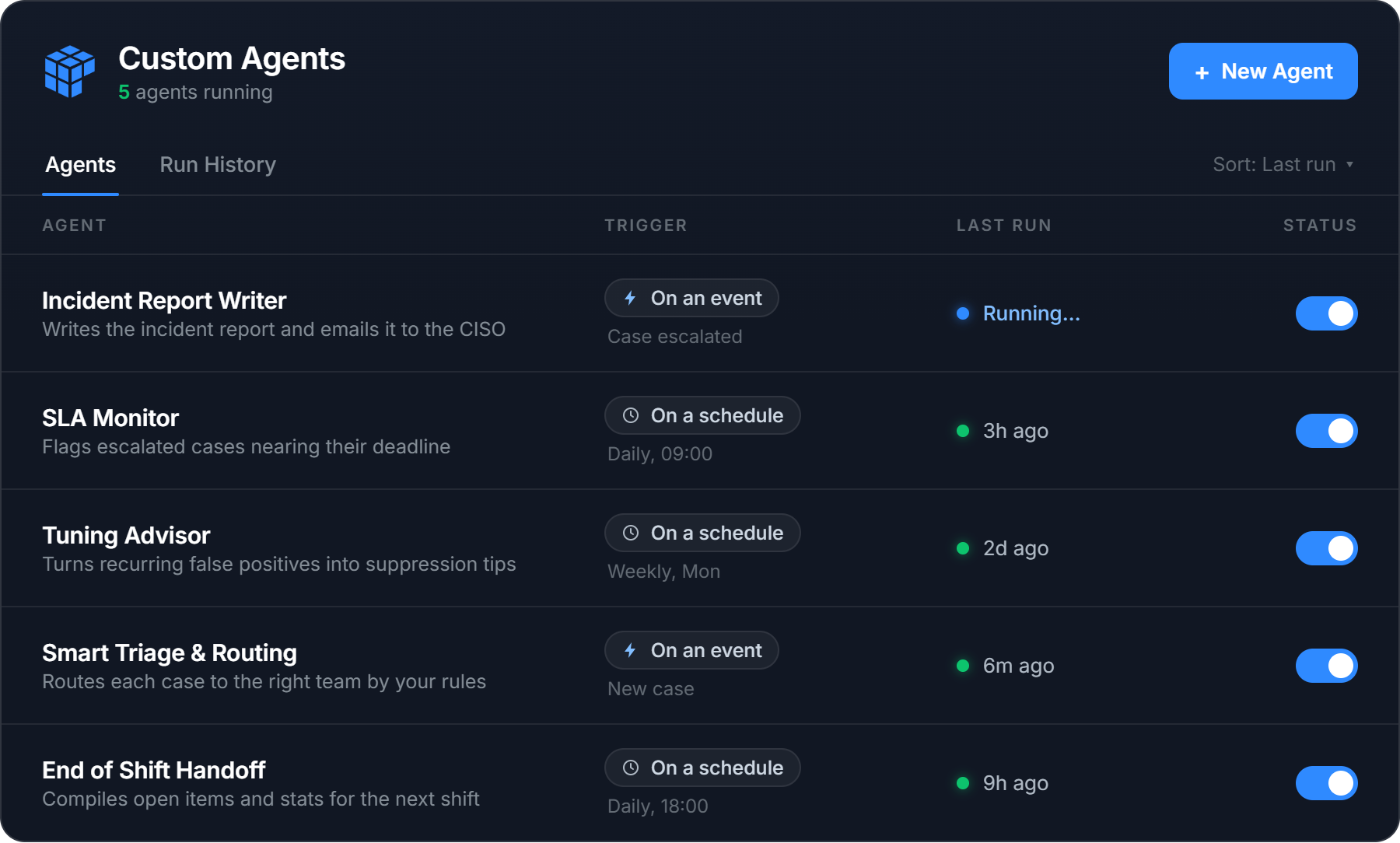
Take an Incident Report Writer agent illustrated above. We deliberately never shipped a single “Generate report” button, because no two teams want the same report. One team wants an executive summary up top, another wants the full timeline, another has a compliance format it has to match. So instead of a button, you put your format into the agent’s instructions, and it writes every report that way, every time.

The agent triggers on every escalated case an analyst has confirmed as a real threat. It reads the case, writes the report in your format, and emails it to your team’s inbox. The analyst makes the call. The paperwork writes itself.

That’s one agent. The point of Custom Agents is that you decide what they are.

Nothing runs blind

Security teams do not trust black boxes, and they are right not to. Custom Agents is built so you can see and control everything an agent does.

  • Every run is visible. You see the agent’s reasoning, every tool call and its result, and the final output. Each run is logged, and you can export it.
  • Test safely with Dry Run. Dry Run executes the agent for real but mocks every write action, so you can watch exactly what it would do before it does anything. Iterate on the instructions until it is right, then turn it on.
  • Guardrails are built in. Action tools are limited by design. An agent can only email active members of your organization, for example. It cannot reach outside your walls.
  • You stay in control. You choose which tools an agent gets, you review its output, and you can switch it off in one click.

This is how everything at Intezer works. AI executes, humans supervise. Custom Agents lets you decide what it executes.

What security teams are already building with it

We opened Custom Agents to a small group of alpha customers, and the best part has been watching what they build. Alongside the Incident Report Writer above, a few of the agents already running in production:

  • SLA Monitor (daily): a morning email listing every escalated case that has been sitting too long, so nothing critical slips past its deadline.


  • Tuning Advisor (weekly): takes the alerts your detection tools fired that Intezer judged to be false positives and turns them into suppression recommendations for the week ahead.


  • Threat Hunter (weekly): proactively sweeps your environment for the latest threats instead of waiting for an alert to fire. It pulls the new malware families, campaigns, and indicators Intezer is tracking, queries your connected SIEM and EDR for matches across historical data, and opens a case for anything it surfaces.


  • Smart Triage and Routing: for organizations with multiple entities, subsidiaries, and stakeholders, the agent reads each case and works out which team should own it, using your own escalation rules. It either leaves a comment with the routing, or assigns the case to the right analyst directly. Analysts stop digging through a separate list or knowledge base to figure out where a case goes.


  • End of Shift Handoff: built to match what a real SOC handover looks like. At the end of a shift the agent compiles the open items, the escalations still waiting for attention, the shift’s statistics, and any open system events or configuration issues, then writes the handoff so the next shift starts with the full picture.

The AI SOC, built for your team

We are on a mission to build the AI SOC the industry has been promised but never delivered. One that does the work and earns the trust to do it. It runs autonomously, around the clock. It works alongside the people who supervise it, not over their heads. And it is never a black box. You can always open it up, question what it did, and change how it behaves.

Custom Agents is central to that vision. Triage, investigation, and response come built in. Everything particular to how your team operates, you build yourself. Because the strongest security teams have always run on their own playbooks, their own logic, and their own standards, and an AI SOC should be no different. It should not ship the same to everyone. No two SOCs are the same, and no two should be.

That is the point of Custom Agents. You decide what they are.

Available now

Custom Agents is available now in beta to Intezer customers, and it is free during the beta period. This is the moment to build, test, and tell us what you want it to do next.

See what your SOC could hand off. Book a demo.

If you are already an Intezer customer, you will find it under Custom Agents in the top menu.

The post Introducing Custom Agents: Automate your SOC, your way appeared first on Intezer.

Stop Building a 2003 SOC with AI: A Modern People & Process Framework (Part 1)

29 June 2026 at 23:24

One particular aspect of an agentic or AI-powered SOC (but NOT “humanless SOC”) has bothered me over the last few months: specifically, the people and process side of such a SOC. If you recall my blog posts (part 1, part 2 and this video) about AI SOC readiness, I hinted at certain elements of a traditional process stack and legacy personnel profiles (both technical and leadership) that make AI adoption inside SOC incredibly difficult.

So we (me and Augusto Barros @ Prophet Security) want to create a modernized people and process framework for a SOC powered by AI and intelligent agents. Otherwise, what I am observing is a lot of “robotic horse pulls a buggy” kind of operations — where everything is kept exactly the same as it was in 2003, but “AI SOC” tools are simply tacked on to perform some of the tasks.

Gemini visual of old SOC with “AI SOC” tools

I believe that people and process components must change far more dramatically, and such changes are a critical requirement for achieving “step change” SOC with AI capabilities. Simply adding AI tools and Ai agents to a 2003-style SOC will produce, at best, marginal results. Things would get better, but not better enough to counter the feared “bad guy with AI.”

The SOAR Analogy

The analogy I want to use here is SOAR adoption from 10+ years ago. Back then, organizations simply shifted a few processes — or even just specific tasks — to a machine, and then kept the rest of their operations exactly the same. Because of that, I observed a lot of SOAR tools being used strictly for alert enrichment or for dealing with one specific, isolated type of alert, like phishing. To follow this analogy to the present day, I now frequently see an “AI SOC” being utilized only for EDR alerts or only for phishing alerts (wow, what a coincidence!)

A First-Principles Approach

What I really want to build is a first-principles approach to the specific personnel, skills, processes, and practices required to run a true agentic SOC in the late 2020s.

Now, if you prefer incremental change, that is OK, I won’t judge. However, you must be aware that the same principles caused organizations to struggle with cloud adoption. People often hear that “lift and shift” is bad. Most consultants will tell you that “lift and shift” is fine as a first step, but you eventually need to modernize and take more steps. Unfortunately, many organizations never make that second step. The same risk applies to the AI SOC. 2003 SOC + AI = somewhat better 2003 SOC.

BTW, many artifacts of the modern, engineering-powered SOC — which we covered in our now-famous ASO (Autonomic Security Operations) paper back in 2021s — apply here as well. In fact, if you recall, one of our core principles was: Humans build machines; machines do the work.

In the context of an agentic SOC, that evolves into:

Today, humans build the machines with the help of other machines, and then the machines do the heavy lifting.

So, our questions so far:

  • What do humans do in an agentic SOC?
  • What do entry-level humans do?
  • What SOC processes stay the same despite AI?
  • What SOC processes can just go and vanish (triage)?
  • What processes get handed to machines?
  • Are there new processes for humans?
  • What is the new human role for validation?
  • How do we check AI quality without fully redoing the work?
  • How SOC metrics must change due to AI and agents? (some ideas)
  • What do humans and machines do jointly? What does it mean, practically?
  • How to HITL in a SOC without breaking the humans or machines?
  • What is the effective mechanism for the human-to-AI feedback loop so that corrections actually improve future SOC performance?
  • Is “fully automated” detection engineering a realistic goal, or does the dependency on local, inconsistent environment context make it inherently a hybrid human-machine effort?
  • What do humans do before SOC (TI) and after SOC (IR)?
  • What is the first step to move from a legacy SOC to an agentic SOC?
  • Can we run legacy and agentic SOC structures in parallel during transition, or does this duplication create operational friction?
  • Is it easier to move from a modern non-AI SOC (aka “SOCless D&R”) to an AI SOC?

Looking Ahead

This blog post is just the first part of the series. My goal here is simply to collect the right questions we need to be asking, but I promise we will provide concrete answers in upcoming posts. This research is being undertaken together with my former colleague, Augusto Barros, now at Prophet Security

Related blogs:


Stop Building a 2003 SOC with AI: A Modern People & Process Framework (Part 1) was originally published in Anton on Security on Medium, where people are continuing the conversation by highlighting and responding to this story.

DMARC is now mandatory!

The email landscape has fundamentally changed — and in 2026, there is no ambiguity left:

DMARC is no longer optional. It is enforced.

Over the past two years, the world’s largest mailbox providers — Google, Yahoo, and Microsoft — have implemented strict authentication requirements. Today, any domain sending bulk email must have properly configured SPF, DKIM, and DMARC, or risk outright rejection. [mailcop.net], [redsift.com]

This shift marks the end of the “open email era” and the beginning of a trust-based ecosystem where authentication is mandatory.

Felons, Fraudsters Flog Offensive Cybersecurity Startup

8 July 2026 at 14:31

A cybersecurity startup dangling millions of dollars to acquire zero-day security vulnerabilities in popular software is run by a pair of far-right conspiracy theorists and convicted felons whose most recent ventures included fake intelligence companies and a now-defunct AI-based lobbying platform they operated under assumed names.

The X/Twitter account IRIS C2 (@C2IRIS) has gained more than 4,000 followers since its creation in January 2025, posting frequently about security vulnerabilities, AI and software exploits. IRIS C2 says it is a company in McLean, Va. that sells offensive cybersecurity capabilities.

The IRIS C2 website dangles the possibility of million-dollar payouts for exploits to attract talent.

“Our business model is this,” reads a pinned post on top of the IRIS C2 account on X. “Attract the very best vulnerability researchers and exploit developers in the world to join our company. This mostly revolves around junior engineers with raw talent/extremely high IQ. We don’t care if they have a college degree/industry experience.”

The website linked in that profile — irisc2[.]com — says the company is hiring for a number of open positions, and a recent post on its LinkedIn page enthuses about an overwhelming number of applications from potential employees. The website claims IRIS C2 is in the business of acquiring “zero-day exploits, individual primitives, partial chains, and full capabilities across all major platforms. Payouts range from $10,000 to $7 million depending on target, reliability, and operational value.”

The government contracting portal g2exchange.com reports that irisc2[.]com is operated by a business based in Virginia called Calvexa Group LLC. The “contact” link on the website for Calvexa Group — calvexagroup[.]com — forwards visitors to irisc2[.]com. G2Exchange shows that while Calvexa Group LLC is registered as a federal contractor, it does not appear to be working on any direct government contracts.

A search on the Arlington, Va. address listed in the incorporation records for Calvexa Group LLC finds the property is occupied by Jack Burkman, the 60-year-old founder and managing partner of the lobbying firm Burkman & Associates. When approached with questions about IRIS C2, Burkman referred further inquiries to his longtime associate, 28-year-old Jacob Wohl.

Jack Burkman (left) and Jacob Wohl, at a press conference in August 2020. Image: Wikipedia.

Burkman and Wohl have a storied history of creating fake intelligence companies and using them to spread false claims about and frame public figures, including fabricated sexual assault claims against then FBI director Robert Mueller, and Pete Buttigieg, then mayor of South Bend, Indiana and a Democratic candidate for the presidency. In 2019, Burkman and Wohl held press conferences falsely alleging extramarital affairs by Sen. Elizabeth Warren (D-Mass.) and then-2020 presidential candidate Kamala Harris.

In the wake of the 2020 presidential election, Wohl and Burkman were prosecuted by multiple U.S. states for making thousands of robocalls to residents of battleground states and disseminating false claims about mail-in ballots. They were indicted in Cleveland on 15 felony counts of orchestrating a robocall scheme aimed at suppressing the black vote in Detroit, and were sentenced in late 2025 to probation after their appeals to dismiss the charges were rejected.

In 2022, Wohl and Burkman both pleaded guilty to a single felony charge of telecommunications fraud in Ohio, and sentenced to a fine, probation, and community service. In March 2023, a judge in a New York civil case ruled that Wohl and Burkman had violated federal and state civil rights laws, and the two agreed to pay a $1 million settlement.

In June 2023, the Federal Communications Commission (FCC) imposed a $5.1 million fine against Wohl and Burkman for their robocall campaigns, at the time the largest fine ever sought by the FCC under the Telephone Consumer Protection Act.

Jacob “Jay” Wohl’s GitHub account.

By the age of 17, Wohl had started multiple investment firms, and cultivated the nickname “Wohl of Wall Street” after appearing on Fox News in 2015 to discuss his new hedge funds. In 2017, the Arizona Corporation Commission charged Wohl and his investment funds with 14 counts of securities fraud, and ordered him to pay $35,000 in restitution. In 2019, Wohl pleaded guilty in California to four felony counts of selling unregistered securities and was sentenced to two years of probation.

The market for previously unknown security vulnerabilities has always been populated by a colorful mix of researchers, academics, charlatans, clout-chasers and people actively involved in cybercrime communities. But the market for selling offensive security services to the U.S. government tends to be far more circumspect. Plenty of government contractors recruit vulnerability researchers and pay for the exclusive rights to novel software exploits, yet none of them do so quite as brazenly and openly as IRIS C2.

Recent posts from the Twitter/X account IRISC2 (@c2iris).

Indeed, KrebsOnSecurity was unaware of IRIS C2 until last month, when an attendee at a regional cybersecurity conference shared that Wohl and Calvexa Group were pestering people at the conference about selling their vulnerability research.

In an interview with KrebsOnSecurity, Wohl said Mr. Burkman was not involved in the day-to-day operations of IRIS C2. Wohl shared that IRIS C2 originally began as a penetration testing company, but shifted its focus recently to selling phone-hacking services to the government. Several times throughout the interview, Mr. Wohl mentioned working on federal government contracts, but when pressed for specifics said he was not at liberty to speak publicly about them.

Mr. Wohl said he does not have any formal education or training in computer science or information security, and that most of his knowledge on the matter is self-taught.

“I know more about tech than anyone,” Wohl bragged. “My background has always been extremely technical, and I’ve always been deeply into tech. People know me as someone who is able to create spectacularly exquisite capabilities that would make your head spin.”

Wohl said security researchers bring the company unique vulnerability findings “on a regular basis,” but that in many cases those findings are preliminary and not fully fleshed-out.

“Let’s say someone finds a flaw in a media decoder on a phone,” Wohl said. “A lot of times what we receive is an exploit primitive, where the idea is there but the [execution] needs work. You need that exploit to be stable and reliable, and that’s what we do.”

Wohl claims IRIS C2 has approximately 40 employees, although he said none of them are allowed to list their employment on LinkedIn for operational security reasons. In May, the author of the IRIS C2 account on X said that his girlfriend had no idea what he did for a living. But if IRIS C2 has any other employees, they may be similarly unaware of Mr. Wohl’s history of outright fabrications — or even his real name.

In September 2024, Politico reported that Burkman and Wohl were bragging about big companies supposedly buying services from their now-defunct company LobbyMatic, which claimed to use artificial intelligence to assist in political lobbying efforts. However, Politico found the pair were running the company using pseudonyms, with Wohl reportedly adopting the name “Jay Klein” and Burkman using the moniker “Bill Sanders.” Politico reported that two of the former LobbyMatic employees resigned after learning of their true identities, while other employees only learned after they had left the company.

Update, July 9, 9:44 a.m. ET: Several readers pointed our attention to a March 31 publication from journalist Molly White, which reported that Burkman and Wohl were paid a $300,000 retainer by a Canadian cryptocurrency fraudster wanted by the United States and several other countries for allegedly stealing $65 million from the crypto platforms KyberSwap and Indexed Finance. According to that report, the two were hired to pursue a “presidential pardon to avert a miscarriage of justice” on behalf of the accused hacker, who has not yet been convicted.

Scattered Spider Hackers Plead Guilty on Day 1 of Trial

23 June 2026 at 18:12

Two men pleaded guilty in the United Kingdom this week to criminal charges stemming from an August 2024 cyberattack that crippled Transport for London, the entity responsible for the public transport network in the Greater London area. The duo were key members of a prolific cybercrime group known as Scattered Spider, and their guilty pleas came on the first day of what was expected to be a six-week trial.

Owen Flowers (left) 18, and Thalha Jubair, 20. Image: UK National Crime Agency (NCA).

Thalha Jubair, 20, of East London and 18-year-old Owen Flowers of Walsall admitted conspiring to commit unauthorized acts against Transport for London computer systems and causing risk of serious damage to human welfare. According to a report from the BBC, Flowers alone admitted to being part of a conspiracy to hack into U.S. based healthcare providers SSM Health Care Corporation and Sutter Health in September 2024.

Jubair is also wanted by U.S. law enforcement agencies. In September 2025, prosecutors in New Jersey unsealed an indictment alleging Jubair and other Scattered Spider members committed computer fraud, wire fraud, and money laundering in relation to 120 computer network intrusions involving 47 U.S. entities between May 2022 and September 2025, and that the group’s victims paid at least $115 million in ransom payments.

In July 2025, KrebsOnSecurity reported that Flowers and Jubair were arrested in the United Kingdom in connection with Scattered Spider ransom attacks against the retailers Marks & Spencer and Harrods, and the British food retailer Co-op Group. Multiple sources familiar with those investigations said Flowers was the Scattered Spider member who anonymously gave interviews to the media in the days after the group’s September 2023 ransomware attacks disrupted operations at Las Vegas casinos operated by MGM Resorts and Caesars Entertainment.

According to prosecutors, Jubair co-ran a bustling Telegram channel called Star Chat, the home of a SIM-swapping group that used voice- and SMS-based phishing attacks to steal credentials from employees at the major wireless providers in the U.S. and U.K. The group would then use that access to sell a service that could redirect a target’s phone number to a device the attackers controlled and intercept the victim’s calls and text messages (including one-time codes for multi-factor authentication).

A receipt from Star Fraud Chat’s SIM-swapping service targeting a T-Mobile customer after the group gained access to internal T-Mobile employee tools. “Rocket Ace” was one of Jubair’s hacker handles, according to U.S. prosecutors.

New Jersey prosecutors also allege Jubair also was involved in a mass SMS phishing campaign during the summer of 2022 that stole single sign-on credentials from employees at hundreds of companies. That weeks-long SMS phishing campaign led to intrusions and data thefts at more than 130 organizations, including LastPassDoorDashMailchimpPlex and Signal.

KrebsOnSecurity reported last year that one of Jubair’s alter egos at age 15 was “Everlynn,” a hacker who sold fraudulent “emergency data requests” that used compromised police and government email addresses to demand subscriber data (e.g. username, IP/email address) from major tech companies, claiming the requests concerned urgent matters of life and death and could not wait for a court order.

In April 2026, 24-year-old British national and Scattered Spider member Tyler “Tylerb” Buchanan pleaded guilty to wire fraud conspiracy and aggravated identity theft for participating in the group’s SMS phishing spree in the summer of 2022. The government said Buchanan, Jubair and others used the credentials harvested in that phishing campaign to steal at least $8 million in cryptocurrency from victims throughout the United States. Buchanan is currently scheduled to be sentenced on October 2.

In August 2025, 20-year-old Scattered Spider member from Florida named Noah Michael Urban was sentenced to 10 years in federal prison and ordered to pay $13 million in restitution, after pleading guilty to charges of wire fraud and conspiracy.

The U.S. Department of Justice says three alleged Scattered Spider defendants indicted along with Buchanan still face charges, including Ahmed Hossam Eldin Elbadawy, 24, a.k.a. “AD,” of College Station, Texas; Evans Onyeaka Osiebo, 21, of Dallas, Texas; and Joel Martin Evans, 26, a.k.a. “joeleoli,” of Jacksonville, North Carolina.

Flowers and Jubair are slated to be sentenced in a London court on July 15, 2026.

Finding the “Goldilocks” Zone: A Practical Approach to Alert Triage

We're all petrified about missing a critical event or misclassifying an alert, but when we're talking about incident response (IR), there are often hundreds if not thousands of alerts to parse through. It's easy to get caught up with one alert because it feels "too hot" or maybe not spend enough time looking into something that initially seems "too cold."

The post Finding the “Goldilocks” Zone: A Practical Approach to Alert Triage appeared first on Black Hills Information Security, Inc..

Inside the Modern SOC: The 72-Minute Race

16 June 2026 at 01:00

Attackers can move from access to exfiltration in 72 minutes. Learn how modern SOC teams close the speed gap with Unit 42's AI-driven automation, threat hunting, MDR and Managed XSIAM.

The post Inside the Modern SOC: The 72-Minute Race appeared first on Unit 42.

Spring 2026 SOC 1, 2, and 3 reports are now available with 188 services in scope

1 June 2026 at 18:07

Amazon Web Services (AWS) is pleased to announce that the Spring 2026 System and Organization Controls (SOC) 1, 2, and 3 reports are now available. The reports cover 188 services over the 12-month period from April 1, 2025–March 31, 2026, giving customers a full year of assurance. These reports demonstrate our continuous commitment to adhering to the heightened expectations of cloud service providers.

Customers can download the Spring 2026 SOC 1 and 2 reports through AWS Artifact, a self-service portal for on-demand access to AWS compliance reports. Sign in to AWS Artifact in the AWS Management Console, or learn more at Getting Started with AWS Artifact. The SOC 3 report can be found on the AWS SOC Compliance Page and AWS Artifact.

AWS strives to continuously bring services into the scope of its compliance programs to help customers meet their architectural and regulatory needs. You can view the current list of services in scope on our Services in Scope page. As an AWS customer, you can reach out to your AWS account team if you have any questions or feedback about SOC compliance.

To learn more about AWS compliance and security programs, see AWS Compliance Programs.

If you have feedback about this post, submit comments in the Comments section below.


Baj Bajwa

Baj Bajwa

Baj is a Security Assurance Manager at AWS, where he leads the Global Third-Party Assurance product portfolio within the Compliance and Security Assurance (CSA) organization. He has over 15 years of experience in information security, compliance, and risk management, and holds a master’s degree in cybersecurity. Baj maintains CISSP, CISA, PMP, CCSK, GISF, and ICAgile certifications.

Tushar-Jain

Tushar Jain

Tushar is a Compliance Program Manager at AWS where he leads multiple security and privacy initiatives Tushar holds a Master of Business Administration from Indian Institute of Management Shillong, India and a Bachelor of Technology in electronics and telecommunication engineering from Marathwada University, India. He has over 14 years of experience in information security and holds CISM, CCSK and CSXF certifications.

Michael Murphy

Michael is a Compliance Program Manager at AWS where he leads multiple security and privacy initiatives. Michael has over 14 years of experience in information security and holds a master’s degree and a bachelor’s degree in computer engineering from Stevens Institute of Technology. He also holds CISSP, CRISC, CISA, and CISM certifications.

Atulsing Patil

Atulsing is a Compliance Program Manager at AWS and has over 28 years of consulting experience in information technology and information security management. Atulsing holds a Master of Science in Electronics degree and professional certifications such as CCSP, CISSP, CISM, CDPSE, ISO 42001 Lead Auditor, ISO 27001 Lead Auditor, HITRUST CSF, Archer Certified Consultant, and AWS CCP.

Jeff Cheung

Jeff is a Compliance Program Manager at AWS where he leads multiple security and privacy initiatives across business lines. Jeff has Bachelors degrees in Information Systems, and Economics from SUNY Stony Brook, and has over 20 years of experience in information security and assurance. Jeff has held professional certifications such as CISA, CISM, and PCI-QSA.

Noah Miller

Noah is a Compliance Program Manager at AWS and leads multiple security and privacy initiatives. Noah has 7 years of experience in information security. He has a master’s degree in Cybersecurity Risk Management and a bachelor’s degree in Informatics from Indiana University.

Will Black

Will is a Compliance Program Manager at AWS where he leads multiple security and compliance initiatives. Will has 10 years of experience in compliance and security assurance and holds a degree in Management Information Systems from Temple University. Additionally, he is a PCI Internal Security Assessor (ISA) for AWS and holds the CCSK and ISO 27001 Lead Implementer certifications.

Allen Beam

Allen is a Compliance Program Manager at AWS supporting third-party security and privacy compliance initiatives. He has over 10 years of experience in external IT security audits, security control design and implementation, and audit readiness and control deficiency remediation. He has a Bachelor’s Degree in Economics and Finance from James Madison University.

Ziv Wand

Ziv is a Compliance Program Manager at AWS and leads multiple security and privacy initiatives. Ziv has over 6 years of experience in information security assurance, external IT security audits, security control design and implementation, and audit readiness. He holds a Bachelor of Science in Management Information Systems from Binghamton University.

Shalini Mishra

Shalini is a Compliance Program Manager at AWS. She has over 10 years of experience leading end-to-end compliance programs across ISO, SOC, and cloud security frameworks, with deep expertise in third-party risk management and enterprise governance. Shalini holds a Master of Science degree in Information Systems and CRISC certification.

The Server Seizure That Affects Also Iran’s Cyber Operations

1 June 2026 at 10:55

On May 22, 2026, Dutch financial-crime investigators walked into data centers in Dronten and Schiphol-Rijk and seized approximately 800 servers. The target was WorkTitans B.V., a hosting provider that, on the surface, looked like any other internet infrastructure company. What investigators uncovered, however, was something far more significant: a ghost operation built on sanctioned infrastructure, quietly serving as the backbone for some of Iran’s most active cyber espionage campaigns. The story starts a year earlier. In May 2025, the European Union sanctioned Stark Industries, an internet service provider linked to Russian information-warfare operations. Rather than shutting down, the people behind […]

The post The Server Seizure That Affects Also Iran’s Cyber Operations appeared first on Check Point Blog.

Why and how to migrate to a Transit Gateway-attached AWS Network Firewall

29 May 2026 at 00:44

AWS Network Firewall now supports native attachment to AWS Transit Gateway. Customers commonly use Transit Gateway to route traffic from Amazon Virtual Private Cloud (Amazon VPC) networks to a centralized inspection VPC (a VPC dedicated to hosting firewall endpoints for traffic inspection) where their network firewall endpoints are deployed. This centralized deployment model reduces the need to have Network Firewall endpoints in each VPC, optimizing costs and providing a centralized point of network security control.

Customers deploying Network Firewall in a centralized deployment model using Transit Gateway have traditionally set up a dedicated inspection VPC with firewall subnets and managed the associated routing to direct traffic through the firewall. With native attachment, Network Firewall attaches directly to Transit Gateway, eliminating the need for the inspection VPC and enabling capabilities such as flexible cost allocation through Transit Gateway metering policies.

In this post, we explain what a Transit Gateway-attached network firewall is, the technical capabilities it unlocks, reasons to migrate to it, and how to perform the migration. For detailed step-by-step guidance on how to perform the migration using Terraform, AWS CloudFormation, or manually in the AWS Management Console, see the accompanying migration guide repository.

What is a Transit Gateway-attached network firewall?

A Transit Gateway-attached network firewall simplifies your network architecture by eliminating the need for a dedicated inspection VPC. Instead of creating an inspection VPC with firewall subnets and configuring the associated routing, you create your network firewall and specify which Transit Gateway instance you want to attach it to. AWS deploys the firewall endpoints into an AWS-managed VPC on your behalf. You don’t own or manage that VPC. From your perspective, the firewall appears as a Transit Gateway network function attachment that you route traffic to, similar to other Transit Gateway attachments.

Why migrate to a Transit Gateway-attached network firewall?

You might want to migrate to a Transit Gateway-attached network firewall for the following reasons:

  • Access to flexible cost allocation: With native attachment, you can use Transit Gateway metering policies to charge back account owners for traffic they send through the centralized firewall. Flexible cost allocation for Network Firewall traffic over a Transit Gateway is only available with a Transit Gateway-attached firewall. Without native attachment, you can only allocate Transit Gateway data processing charges, not the Network Firewall charges.
  • Reduced architectural complexity: You can eliminate the inspection VPC, leaving one less VPC to manage along with its associated routing tables and subnets.

Preparing for the change

Before migrating to a Transit Gateway-attached network firewall, gather the following information and keep these key considerations in mind.

Prerequisites

When you create your new Transit Gateway-attached network firewall, you will need:

  • Transit Gateway ID: The ID of the Transit Gateway instance you will attach your network firewall to.
  • Logging configuration: Create a new logging configuration (such as new Amazon CloudWatch log groups) for the new firewall. During migration, you will be running both firewalls simultaneously. Keeping the logs separate simplifies monitoring and troubleshooting each firewall during the migration period. After migration is complete, you can point the new firewall to your existing logging destinations.
  • Firewall policy: Create a new firewall policy for the new firewall rather than reusing your existing one. During the migration period, a separate policy lets you make changes to the new firewall’s policy without affecting the existing firewall while both are running simultaneously. After migration is complete, you can attach your existing production policy to the new firewall.

Key considerations

There are some important considerations to address while planning for this change.

  • Transit Gateway encryption: Check if you’re using Transit Gateway encryption support. If encryption is enabled and required for your security posture, native attachment to Network Firewall doesn’t currently support this capability. You will need to continue using your current firewall configuration.
  • NAT gateway Elastic IPs: If you need to maintain the same public IPs (for example, for partner allowlisting), plan for this during migration. For more information, see the Preserving your NAT gateway Elastic IPs during migration section later in this post.
  • Maintenance window: Plan to perform this migration during a dedicated maintenance window. Brief network outages will occur during parts of the process, such as when swapping Transit Gateway route table associations and replacing NAT gateways.

Performing the migration

Leave your existing Network Firewall setup unchanged while setting up the new Transit Gateway-attached firewall. With this approach, you can minimize potential downtime and test the new configuration before migrating production traffic.

The migration process varies depending on your current architecture. The following sections walk through the two most common centralized Network Firewall architectures and the high-level migration process for each. For detailed step-by-step guidance on how to perform the migration using Terraform, CloudFormation, or manually in the console, see the migration guide repository.

Architecture 1: Dedicated inspection VPC with separate egress VPC

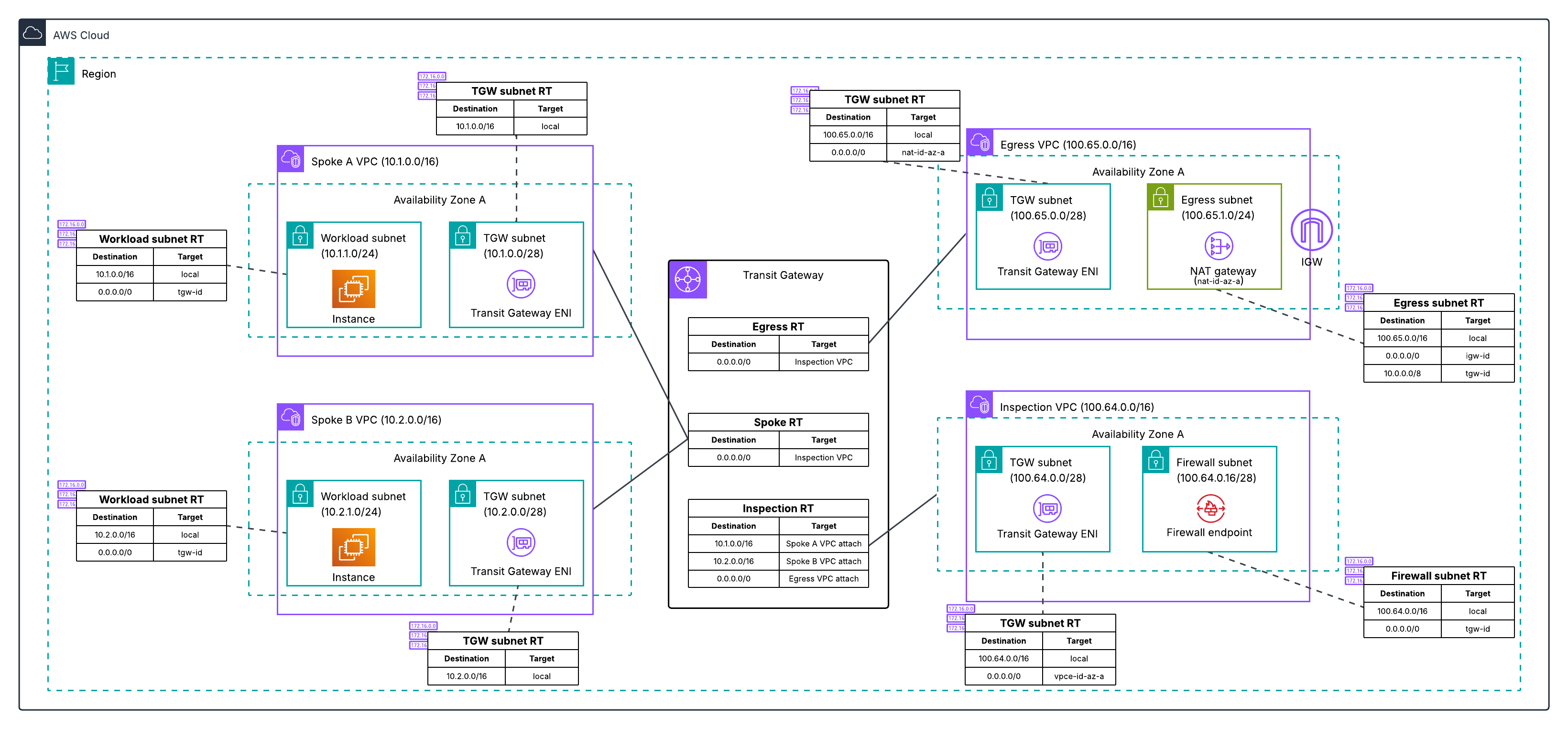
In this architecture, shown in the following diagram, you have a dedicated inspection VPC with your network firewall endpoints, and a separate dedicated egress VPC with your NAT gateways.

Figure 1: Centralized egress traffic inspection with Network Firewall and Transit Gateway, with inspection and egress separated into two VPCs.

Figure 1: Centralized egress traffic inspection with Network Firewall and Transit Gateway, with inspection and egress separated into two VPCs.

The high-level migration process for this architecture is:

  1. Deploy a new egress VPC with a temporary NAT gateway. Creating a new VPC lets you leave the existing deployment unchanged while working on the migration.
  2. Create your new network firewall with native attachment to your Transit Gateway.
  3. Configure three new Transit Gateway route tables to define the traffic path through the new firewall: an inspection route table (associated with the new firewall), an egress route table (associated with the new egress VPC), and a temporary migrated spoke route table (for testing individual spoke VPCs on the new path).
  4. Test the new firewall by moving a single spoke VPC to the new path. Verify connectivity and confirm the firewall is inspecting traffic by checking the alert logs for layer 7 (application layer) details. Layer 7 information in the alert logs indicates the firewall is seeing both directions of the traffic flow. If asymmetric routing were occurring, the firewall would only see one direction and would not be able to perform application-layer inspection, so the presence of layer 7 details confirms traffic is flowing symmetrically through the new firewall.
  5. Migrate the remaining spoke VPCs. You can migrate VPCs incrementally, or when you’re confident in the new firewall deployment, update the default route in your existing spoke route table to point to the new Network Firewall network function attachment, which moves all remaining spokes that share that route table at once.
  6. Optionally, preserve your original NAT gateway Elastic IPs by re-routing traffic back to your existing egress VPC (see Preserving your NAT gateway Elastic IPs during migration).
  7. Decommission old resources after you’ve verified that traffic is flowing correctly. Which VPCs you remove depends on whether you preserved your original EIPs (see Preserving your NAT gateway Elastic IPs during migration).
Figure 2: Post-migration architecture for Architecture 1, with the inspection VPC eliminated and traffic flowing through the Transit Gateway-attached Network Firewall to a dedicated egress VPC.

Figure 2: Post-migration architecture for Architecture 1, with the inspection VPC eliminated and traffic flowing through the Transit Gateway-attached Network Firewall to a dedicated egress VPC.

For the complete walkthrough of how to perform this migration:

Architecture 2: Combined inspection and egress VPC

In this architecture, shown in the following diagram, you have a single VPC that contains both your network firewall endpoints and your NAT gateways.

Figure 3: Centralized egress traffic inspection with Network Firewall and Transit Gateway, with inspection and egress combined in one VPC.

Figure 3: Centralized egress traffic inspection with Network Firewall and Transit Gateway, with inspection and egress combined in one VPC.

The migration process for this architecture follows the same high-level steps as Architecture 1.

  1. Deploy a new dedicated egress VPC with a temporary NAT gateway. Creating a new VPC lets you leave the existing deployment unchanged while working on the migration.
  2. Create your new network firewall with native attachment to your Transit Gateway.
  3. Configure three new Transit Gateway route tables to define the traffic path through the new firewall: an inspection route table, an egress route table, and a temporary migrated spoke route table.
  4. Test the new firewall by moving a single spoke VPC to the new path. Verify connectivity and confirm the firewall is inspecting traffic by checking the alert logs for layer 7 (application layer) details. Layer 7 information in the alert logs indicates the firewall is seeing both directions of the traffic flow. If asymmetric routing were occurring, the firewall would only see one direction and would not be able to perform application-layer inspection, so the presence of layer 7 details confirms traffic is flowing symmetrically through the new firewall.
  5. Migrate the remaining spoke VPCs. You can migrate VPCs incrementally, or once you are confident in the new firewall deployment, update the default route in your existing spoke route table to point to the new Network Firewall network function attachment, which moves all remaining spokes that share that route table at once.
  6. Optionally, preserve your original NAT gateway Elastic IPs by transferring them to the new egress VPC.
  7. Decommission the old combined VPC after you’ve verified that traffic is flowing correctly.
Figure 4: Post-migration architecture for Architecture 2, with the combined VPC eliminated and traffic flowing through the Transit Gateway-attached Network Firewall to a dedicated egress VPC.

Figure 4: Post-migration architecture for Architecture 2, with the combined VPC eliminated and traffic flowing through the Transit Gateway-attached Network Firewall to a dedicated egress VPC.

For the complete walkthrough of how to perform this migration, see:

Differences between the two migrations

Both architectures deploy the same new resources and use the same phased cutover approach. The differences are in the starting Transit Gateway routing structure (Architecture 1 has three route tables across two VPCs, Architecture 2 has two route tables in one VPC) and what you clean up at the end (two old VPCs instead of one). Both architectures converge to the same end state. For a detailed comparison, see the migration guide repository.

Minimizing downtime and testing your migration

Regardless of which architecture you’re migrating from, follow these best practices to minimize risk.

The migration guide repository includes starting architecture CloudFormation and Terraform templates for both architectures, so you can deploy the exact starting environment in a development or test account and run through the entire migration process before touching production.

Test before you migrate. Create your new Transit Gateway-attached firewall in parallel with your existing setup. Use a test VPC to validate the new configuration. Verify that logging is working correctly and that the firewall alert logs show layer 7 traffic details, which confirms there is no asymmetric routing. Test both allowed and blocked traffic scenarios before migrating production traffic.

Migrate in phases. Start with a single, non-critical workload VPC. Update only that VPC’s routes to use the new firewall attachment. Monitor and verify application behavior and performance with the application owner before proceeding. When planning your migration order, migrate spoke VPCs that have east-west traffic between each other at the same time. During the phased migration, spokes on different firewall paths will have their east-west traffic traverse two stateful firewalls. Because each stateful firewall independently tracks connection state, traffic that enters through one firewall and returns through another appears as untracked, causing the firewalls to drop or incorrectly handle the return traffic. When you’re confident in the new firewall deployment, you can update the default route in your existing spoke route table to point to the new firewall, which moves all remaining spokes that share that route table at once. Keep your old firewall configuration active until all traffic is migrated.

Prepare a rollback plan. Document your current route table configurations before making changes. Keep your existing firewall and inspection VPC active during migration. If issues arise, revert the route table changes to restore the previous configuration. Decommission old resources after you’ve verified applications are operating as expected.

Preserving your NAT gateway Elastic IPs during migration

An important consideration during migration is maintaining your existing NAT gateway Elastic IP addresses. Many organizations have these IPs allowlisted with external partners, third-party services, or in firewall rules. Changing these IPs would require coordination with multiple stakeholders and could disrupt business operations.

During migration, you need both your old and new deployments to operate simultaneously, so you can validate the new setup without impacting production traffic. This means creating temporary NAT gateways with temporary Elastic IPs in the new egress VPC.

After you’ve confirmed the new firewall deployment is stable and production traffic has been successfully migrated, you can restore your original Elastic IPs. The process differs depending on your architecture:

  • For Architecture 1 (separate inspection and egress VPCs), your existing egress VPC and its NAT gateways are independent of the inspection VPC being decommissioned. You can keep them by re-associating the existing egress VPC’s Transit Gateway attachment with the new egress route table and updating the inspection route table to route traffic there instead of the temporary egress VPC. This is a Transit Gateway routing change that takes seconds, doesn’t require deleting or creating any NAT gateways, and doesn’t increase in complexity with the number of Availability Zones. After the re-association, you delete the temporary egress VPC.
  • For Architecture 2 (combined inspection and egress VPC), the old VPC contains both the firewall endpoints and the NAT gateways. The simplest path is to decommission it and move the Elastic IPs to the new egress VPC. To do this, you delete the old NAT gateways to free the Elastic IPs, then create new NAT gateways in the new egress VPC with the original Elastic IPs. This requires a brief maintenance window while the new NAT gateways provision and must be repeated for each Availability Zone.

For the detailed step-by-step procedure, see the EIP preservation steps in the migration guide repository.

Conclusion

In this post, we explained what a Transit Gateway-attached network firewall is and how it differs from the traditional inspection VPC model, the reasons to migrate including reduced architectural complexity and flexible cost allocation, what to prepare before starting, and the high-level migration process for the two most common centralized inspection architectures. We also covered best practices for minimizing downtime, handling east-west traffic between spokes during phased migration, and preserving your existing NAT gateway Elastic IPs.

With a Transit Gateway-attached network firewall, AWS manages the firewall endpoints and the underlying VPC on your behalf, eliminating the inspection VPC from your architecture and enabling flexible cost allocation through Transit Gateway metering policies. The phased migration approach covered in this post lets you run both firewalls in parallel, validate the new path with a single spoke VPC, and cut over the rest of your traffic when you are ready.

For detailed step-by-step guidance using Terraform, CloudFormation, or the AWS Management Console for both architectures covered in this post, see the migration guide repository. The repository includes starting architecture templates so you can practice the full migration end-to-end in a test account before migrating your production environment.

If you have feedback about this post, submit comments in the Comments section below.


Frank Phillis

Frank Phillis

Frank is a Senior Solutions Architect (Security) at AWS. He enables customers to get their security architecture right. Frank specializes in cryptography, identity, and incident response. He’s the creator of the popular AWS Incident Response playbooks and regularly speaks at security events. When not thinking about tech, Frank can be found with his family, riding bikes, or making music.

Lawton Pittenger

Lawton Pittenger

Lawton is a Worldwide Security Specialist Solutions Architect at AWS, based in New York City. He specializes in helping customers design and implement effective network security controls. At AWS, he works with customers at scale and collaborates closely with service teams to drive continuous improvement in security services based on customer needs and feedback. Outside of work, his interests include skateboarding, snowboarding, and spending time in nature.

Bad Habits: An ANTISOC Operation

ANTISOC uses a mix of techniques from traditional penetration tests like red teams, cloud, web applications, externals, internals, and, of course, social engineering. We combine this mix of techniques with a wide-open scope, with the goal of going beyond what a typical pentest can discover.

The post Bad Habits: An ANTISOC Operation appeared first on Black Hills Information Security, Inc..

Same Problem, Different Angles: When Red Team and Blue Team Actually Talk to Each Other

There is a certain kind of conversation that doesn’t get written up in a post-mortem, doesn’t generate a ticket, and never makes it into an end-of-quarter report. It happens on the margins—at a conference, in a hallway, or, in this case, at 30,000 feet above sea level. It’s the conversation where two people who are solving the same problem from opposite ends of the table finally sit down next to each other.

The post Same Problem, Different Angles: When Red Team and Blue Team Actually Talk to Each Other appeared first on Black Hills Information Security, Inc..

Laurie Anderson Is Quoting Me

19 May 2026 at 13:00

Not by name, but Laurie Anderson quotes me in one of the tracks of her new album:

My favorite quote is from a cryptologist who said “If you think technology will solve your problems, you don’t understand technology and you don’t understand your problems.”

Also in interviews:

“Of course, it’s ridiculous, outrageous, blah, blah, blah,” Anderson says about the ad. ‘But, I mean, my favorite quote on this is from a cryptologist who said, ‘If you think technology will solve your problems, you don’t understand technology ­ and you don’t understand your problems.’ And I think I’m completely on board with that.”

People are telling me that she has been reciting this quote in performances for years. (I lost track of her since college and her 1981 hit “O Superman.”)

The origins of the quote is from Roger Needham:

If you think cryptography can solve your problem, you don’t understand your problem and you don’t understand cryptography.

I modified the quote in the preface to my 2000 book Secrets and Lies:

A few years ago I heard a quotation, and I am going to modify it here: If you think technology can solve your security problems, then you don’t understand the problems and you don’t understand the technology.

I can’t tell you why me in 2000 didn’t credit Needham by name. I should have.

I have used the quote pretty consistently since then. Somewhere along the line I dropped “security” from the phrase, and now say it more like Anderson quotes me:

If you think technology will solve your problem, you don’t understand your problem and you don’t understand technology.

I sometimes use singular and sometimes use plural. Sometimes I say “the problem” and “the technology.” But I think the quote flows better ending with just the word “technology.”

❌