Login
LoginICE Uses Graphite Spyware
22 April 2026 at 13:02
ICE has admitted that it uses spyware from the Israeli company Graphite.

ICE has admitted that it uses spyware from the Israeli company Graphite.
Grupo Seguritech is a Mexican surveillance company that is expanding into the US.
This is the third installment of a blog series reflecting on the global digital legacy of the 2011 Arab uprisings. You can read the first post here, and the second here.
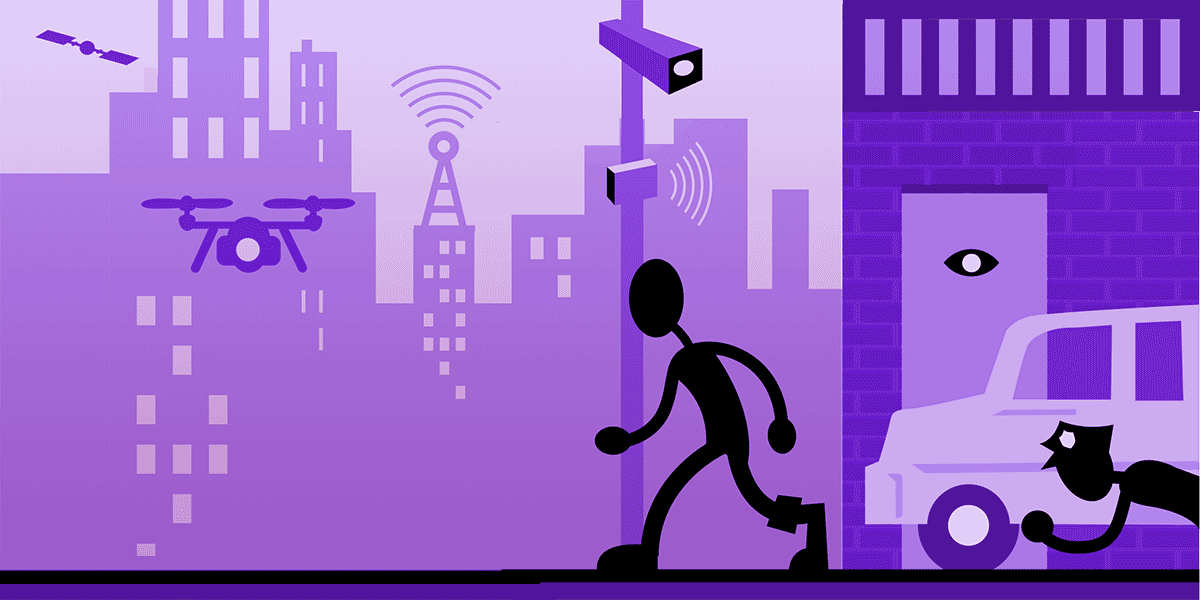
When people recall the 2011 uprisings across the Middle East and North Africa (MENA), they often picture crowded squares, raised phones, and the feeling that the internet had finally shifted the balance of power toward ordinary people. But the past decade and a half is also a story about how governments, companies, and platforms turned those same tools into the backbone of a powerful state surveillance apparatus.
For activists, journalists, everyday users, that means now living with a constant threat. The phone in your pocket, the platforms you organize on, and the systems you rely on for safety and connection can be weaponized at the flip of a switch. A global surveillance industry has treated repression by many MENA governments as a growth opportunity, and the tactics refined there now shape digital authoritarianism worldwide. This essay traces how that shift unfolded: security agencies upgraded older systems of repression with new surveillance tools and permanent monitoring infrastructure; cybercrime laws and mercenary spyware markets turned digital control into standard operating procedure; and biometrics, facial recognition, and ‘smart city’ projects laid the groundwork for AI‑driven surveillance that now shapes protests, borders, and everyday life far beyond the region.
Remembering the Arab Spring means seeing the events of 2011 as both a remarkable moment of movement history when people leveraged networked tools in their fight for freedom and the beginning of a long, grinding effort to turn those same tools into mechanisms of state control.
Long before Facebook and Twitter, regimes in countries like Egypt and Syria already knew how to crush dissent. They leaned on informant networks, physical surveillance, and wiretaps, backed by emergency laws that let security agencies monitor and detain critics with almost no restraint. Research on the use of surveillance technology in MENA shows that, even before the Arab Spring, states were layering early digital tools like internet monitoring, deep packet inspection, and interception centers on top of that older machinery of control.
At the same time, connectivity was racing ahead. Cheap smartphones and social media suddenly let people share information at scale, coordinate protests, and broadcast abuses in real time. In 2011, EFF described both the excitement around “Facebook revolutions” and the early signs that governments were scrambling to upgrade their capacity to watch and disorganize popular dissent.
After the uprisings, Western critics endlessly debated how much credit to give social media itself. While in the background, security agencies across several MENA states reached a much simpler conclusion: if networked communication can help topple a dictator, then they needed to embed themselves deep inside those networks. Analyses of the rise of digital authoritarianism in MENA show how quickly officials pivoted from being surprised by online organizing to building systems to monitor and pre‑empt it.
In the years after 2011, governments across the region poured money into tools that let them systematically watch what people said and did on major platforms. Foreign vendors set up monitoring centers and interception systems that let security agencies block tens of thousands of sites, scrape and analyze social media at scale, monitor activist pages and online communities, and track activists in real time. They built a new, pre‑emptive model of digital control, one that assumes the state should see as much as possible, as early as possible.
As we noted in 2011, exporting permanent surveillance infrastructure to already‑abusive governments doesn’t “modernize” public safety; it locks in an architecture of control that is primed to abuse dissidents, journalists, and marginalized communities.
After the uprisings, a number of governments also rewrote the rules that govern online life. Cybercrime laws, “fake news” provisions, and overbroad public‑order and ‘morality’ offences gave prosecutors and security agencies legal cover to act with impunity. Governments in Saudi Arabia, Tunisia, Jordan, and Egypt combined counterterrorism, cybercrime, defamation, and protest laws into a legal thicket designed to make online dissent feel dangerous and costly. Morality laws and cybercrime provisions are used to target queer and trans people based on identity and expression.
At the United Nations, a new global cybercrime convention now risks baking this logic into international law. The convention was adopted by the UN General Assembly in late 2024, despite serious human rights concerns raised by civil society. Echoing our partners, EFF warned at the time that the UN cybercrime draft convention remained too flawed to adopt and urged states to reject the draft language because it legitimized expansive surveillance powers and criminalized legitimate expression, security research, and everyday digital practices around the world. While on paper, these instruments gesture to “public safety” objectives, in practice they function as pathways for state security agencies to monitor, prosecute, and silence the communities most at risk. For state-targeted communities, that makes being visible online a calculated risk, not a neutral choice.
Criminal codes are only half the story; mercenary tech is the other. As governments worldwide looked for ways to outpace their critics, a parallel market emerged to help them infiltrate and take over devices. Companies like NSO Group marketed Pegasus and similar tools as off‑the‑shelf capabilities for governments that wanted to hack a target’s cellphones or other devices to read messages, turn on microphones, and monitor entire social networks while bypassing the courts.
In 2019, UN Special Rapporteur David Kaye called for a global moratorium on the sale and transfer of private surveillance tools until real, enforceable safeguards exist. Two years later, forensic work by Amnesty and media partners showed how the same spyware used to hack phones of Palestinian human‑rights defenders was used to surveil journalists, activists, lawyers, and political opponents across dozens of countries.
Regional groups responded by demanding an end to the sale of surveillance technology to autocratic governments and security agencies, arguing that you cannot keep selling “lawful intercept” tools into systems where law itself is an instrument of repression. Commercial spyware is at the center of digital repression, not at its margins. Surveillance vendors are not neutral suppliers. Safeguards remain weak, fragmented, or nonexistent in most of the countries buying these tools, yet vendors continue seeking new contracts and new militarized “use cases.” Put bluntly, the companies that design, market, and maintain these systems precisely because they enable this kind of control profit from (and help entrench) authoritarian power.
On top of this rapidly intensifying interception and spyware stack, governments and companies began layering biometrics and face recognition into everyday systems, creating pathways for bulk data collection, automated analysis, and risk profiling. In parts of MENA, national ID schemes, border and migration controls, and centralized biometric databases have been rolled out in environments with weak or captured data‑protection laws, making it easy to link people’s movements, services, and political activity to a single, persistent identifier.
Humanitarian programs are not exempt from this protocol. In Jordan, Syrian refugees have been required to submit iris scans and biometric data to access cash assistance and food, turning “consent” into a precondition for survival. When access to aid depends on enrollment in centralized biometric systems, any breach, misuse, or repurposing of that data can have severe, life‑altering consequences for people who have no realistic way to opt out. Investigations into surveillance‑tech firms complicit in abuses in MENA show that vendors profit from supplying biometric and surveillance tools for migration management and internal security, even when those tools are used in discriminatory or abusive ways.
Like elsewhere, mass surveillance technologies in MENA were first piloted on people who were already criminalized or made vulnerable by poverty. But their use quickly expanded from narrow, security‑framed deployments to routine use in city streets. As hardware sensors, cameras, and data storage got cheaper, “smart city” surveillance systems promised seamless security and services, and it became easier and less politically contentious to keep these systems running everywhere, all the time.
Unlike targeted hacking tools, these broad, city‑wide surveillance infrastructures erase any practical line between people under investigation and the broad public, normalizing bulk, indiscriminate monitoring of public space and everyday movement. In the Gulf, facial recognition and dense sensor networks are increasingly built into high‑profile “smart city” and mega‑project plans that lean heavily on biometric and AI‑driven monitoring. These are security‑first development projects where biometric and sensor infrastructures are designed from the outset to embed policing, migration control, and commercial tracking into the urban fabric. In this vision of the Gulf’s “smart city” future—often sold as seamless services and digital opportunity—“smart” is the branding, and pervasive monitoring is the operating principle.
EFF has consistently opposed government use of face recognition and biometric surveillance, in some instances calling for outright bans. In contexts that treat peaceful dissent as a security threat, embedding biometric surveillance into everyday infrastructure locks in a balance of power that favors militarized policing and state control. That infrastructure is now the starting point for a new set of risks. Surveillance systems built over the last decade are being repackaged as the foundation for a new generation of “AI‑enabled” defense and security products.
Companies that once focused on video management or perimeter security now advertise “defense applications” for AI‑driven situational awareness and threat detection, using computer‑vision models to scan camera feeds, compare against existing watchlists, and flag “suspicious” people or behaviors in real time. Drone and sensor platforms are being upgraded with embedded AI that tracks and classifies targets autonomously and with “drone‑based AI threat detection and intelligent situational awareness,” turning aerial surveillance into a continuous data feed for security agencies and militaries. In smart‑city and defense expos from the Gulf to Europe and North America, similar systems are marketed as neutral efficiency upgrades or tools to “protect critical infrastructure,” even where they are explicitly designed to scale up border enforcement, protest surveillance, and internal security operations.
As these systems are folded into AI‑driven defense products, the line between “civilian” infrastructure and militarized surveillance disappears, turning streets, borders, and aid sites into continuous input for security operations. That is the landscape that human rights and accountability efforts now have to confront.
The patterns established in heavily securitized MENA states after the Arab Spring now shape how states monitor and crush more recent uprisings, from Iran’s use of location data and facial recognition to track down protesters to long‑running crackdowns elsewhere in the region. This model of “digital authoritarianism” built on spyware, data‑hungry ID systems, platform control, and emergency‑style security laws has emerged everywhere from Latin America to Eastern Europe to here in the United States. As the new UN Cybercrime Convention moves toward implementation, its broad offences and surveillance powers risk turning this ad hoc toolkit into a formal template for cross‑border data‑sharing, repression, and an all‑purpose global surveillance instrument.
For people on the ground, none of this is theoretical. Human‑rights defenders, journalists, and ordinary users across the region face arrest, long prison sentences, and exile based on their digital traces. In that context, commercial spyware is not a marginal issue but part of the core machinery of repression. Pegasus has been used to hack journalists’ phones through zero‑click exploits and compromise human‑rights defenders and watchdog organizations themselves, including staff at Amnesty’s Pegasus Project partners and Human Rights Watch. These deployments give practical effect to the “cybercrime” and “terrorism” frameworks described earlier: person‑by‑person campaigns against particular communities, contacts, and networks, rather than “neutral,” generalized security measures.
Under these conditions, everyday security becomes a second job. People describe carrying multiple phones, keeping one for relatively “clean” uses and others for riskier conversations, splitting identities across platforms, using coded language, and moving their organizing off mainstream services when possible. Pushing this burden onto users is a political choice: states, platforms, and vendors could build systems that are safe by design; instead, they externalize risk to the people they watch and punish.
Even against that backdrop, civil society organizations have refused to capitulate to security agencies and vendors. Regional coalitions have demanded strict export controls and outright bans on selling intrusive surveillance tech to autocratic governments. Advocates have also pushed companies to do more than box‑ticking “due diligence.” Work with surveillance‑tech firms in the context of migration and border control has repeatedly shown that most are still far from serious human‑rights assessments, let alone willing to turn down these lucrative contracts.
Many of the same governments that have been critical of others on the issue of human rights have hosted or licensed companies that build these tools, in some cases buying similar capabilities for their own security agencies. European authorities, for instance, have investigated FinFisher’s export of spyware “made in Germany” to Turkey and other non‑EU governments. Meanwhile, the NSO Group has at least 22 Pegasus contracts with security and law‑enforcement agencies in 12 EU countries. This is a transnational industry, not a localized problem.
Against near impossible odds, people continue finding pathways to freedom. The global surveillance sector reinforces the same hierarchies and violence that people have found ways to survive for generations. Queer activists and others at the sharpest edges of this system have had to develop their own forms of resistance, including against biometric and data‑driven targeting. Encryption, circumvention tools, and security training are not silver bullets, but they remain essential for anyone trying to organize, document abuses, or simply exist online with a bit less risk. Resources like EFF’s Surveillance Self‑Defense are one piece of that ecosystem, alongside trainers and groups who have been doing this work on the ground for years.
The Arab Spring is often remembered through images of packed squares and hopeful tweets. But contending with its aftermath means confronting the surveillance architecture built in its shadow: laws that turn online speech into a crime, spyware and biometric systems that turn phones and faces into tracking beacons, and platform practices that routinely sacrifice the people most at risk. None of that is inevitable, and none of it is confined to one part of the world.
Accountability has to reach both governments and the companies that profit from arming them with these tools. That means pushing for far stronger limits on how surveillance tech is built, sold, and deployed; demanding meaningful transparency when these systems are used; and defending the tools people rely on to communicate and organize safely, including robust encryption and secure channels. It also means taking direction from the people and communities who have been navigating and resisting this landscape for years.
Surveillance itself is transnational: tools, playbooks, and data moves across borders as easily as money. And so we, too, continue our work, documenting abuses, sharing security knowledge, and collectively organizing against these violent systems.
This is the third installment of a blog series reflecting on the global digital legacy of the 2011 Arab uprisings. Read the rest of the series here.

A new report from 404 Media sheds light on how automated license plate readers (ALPRs) could be used beyond the press releases and glossy marketing materials put out by law enforcement agencies and ALPR vendors. In December 2025, Georgia State Patrol ticketed a motorcyclist for holding a cell phone in his hand. According to the report, the ticket read, “CAPTURED ON FLOCK CAMERA 31 MM 1 HOLDING PHONE IN LEFT HAND.”
If you’re thinking that this sounds outside of the scope of what ALPRs are supposed to do, you’re right. In November 2025, Flock Safety, the maker of the ALPR in question, wrote a post about how they definitely are in compliance with the Fourth Amendment to the U.S. Constitution. In this post, which highlighted what ALPRs are and what they are not, the company writes: “What it is not: Flock ALPR does not perform facial recognition, does not store biometrics, cannot be queried to find people, and is not used to enforce traffic violations.” (emphasis added)
Well, apparently their customers never got the memo and apparently the technology’s design does not explicitly prevent behavior the company officially and publicly disavows.
Or at least this used to be the case: Flock now lists six different companies providing traffic enforcement technology on its “Partner program” site. Public records also show that speed enforcement cameras have been connected to Flock's ALPR network.
EFF and other privacy advocates have long warned about mission creep when it comes to surveillance infrastructure. Police often swear that a piece of technology will only be used in a particular set of circumstances or to fight only the most serious crimes only to utilize it to fight petty crimes or watch protests.
We continue to urge cities, states, and even companies to end their relationship with Flock Safety because of the incompatibility between the mass surveillance it enables and its inability to protect civil liberties—including preventing mission creep.



Cybersecurity researchers have taken a close look at the inner workings of the Predator spyware, developed by the Cyprus-based company Intellexa. Rather than focusing on how the spyware initially infects a device, this latest research zooms in on how the malware behaves once a device has already been compromised.
The most fascinating discovery involves the mechanisms the Trojan uses to hide iOS camera and microphone indicators. By doing so, it can covertly spy on the infected user. In today’s post, we break down what Predator spyware actually is, how the iOS indicator system is designed to work, and how this malware manages to disable these indicators.
We previously took a deep dive into the most notorious commercial spyware out there in a dedicated feature — where we discussed the star of today’s post, Predator, among the others. You can check out that earlier post for a detailed review of this spyware, but for now, here’s a quick refresher on the essentials.
Predator was originally developed by a North Macedonian company named Cytrox. It was later acquired by the aforementioned Intellexa, a Cyprus-registered firm owned by a former Israeli intelligence officer — a truly international spy games collaboration.
Strictly speaking, Predator is the second half of a spyware duo designed to monitor iOS and Android users. The first component is named Alien; it’s responsible for compromising a device and installing Predator. As you might’ve guessed, these pieces of malware are named after the famous Alien vs. Predator franchise.
An attack using Intellexa’s software typically begins with a message containing a malicious link. When the victim clicks it, they’re directed to a site that leverages a chain of browser and OS vulnerabilities to infect the device. To keep things looking normal and avoid raising suspicion, the user is then redirected to a legitimate website.
Besides Alien, Intellexa offers several other delivery vehicles for landing Predator on a target’s device. These include the Mars and Jupiter systems, which are installed on the service provider’s side to infect devices through a man-in-the-middle attack.
Predator spyware for iOS comes packed with a wide array of surveillance tools. Most notably, it can record and transmit data from the device’s camera and microphone. Naturally, to keep the user from catching on to this suspicious activity, the system’s built-in recording indicators — the green and orange dots at the top of the screen — must be disabled. While it’s been known for some time that Predator could somehow hide these alerts, it’s only thanks to this research that we know how exactly it pulls it off.
To understand how Predator disables these indicators, we first need to look at how iOS handles them. Since the release of iOS 14 in 2020, Apple devices have alerted users whenever the microphone or camera is active by displaying an orange or green dot at the top of the screen. If both are running simultaneously, only the green dot is shown.

In iOS 14 and later, an orange dot appears at the top of the screen when the microphone is in use. Source
Just like other iOS user interface elements, recording indicators are managed by a process called SpringBoard, which is responsible for the device’s system-wide UI. When an app starts using the camera or microphone, the system registers the change in that specific module’s state. This activity data is then gathered by an internal system component, which passes the information to SpringBoard for processing. Once SpringBoard receives word that the camera or microphone is active, it toggles the green or orange dot on or off based on that data.

If the camera is in use (or both the camera and microphone are), a green dot appears. Source
From an app’s perspective, the process works like this: first, the app requests permission to access the camera or microphone through the standard iOS permission mechanism. When the app actually needs to use one or both of these modules, it calls the iOS system API. If the user has granted permission, iOS activates the requested module and automatically updates the status indicator. These indicators are strictly controlled by the operating system; third-party apps have no direct access to them.
Cybersecurity researchers analyzed a captured version of Predator and uncovered traces of multiple techniques used by the spyware’s creators to bypass built-in iOS mechanisms and disable recording indicators.
In the first approach — which appears to have been used during early development — the malware attempted to interfere with the indicators at the display stage right after SpringBoard received word that the camera or microphone was active. However, this method was likely deemed too complex and unreliable by the developers. As a result, this specific function remains in the Trojan as dead code — it’s never actually executed.
Ultimately, Predator settled on a simpler, more effective method that operates at the very level where the system receives data about the camera or microphone being turned on. To do this, Predator intercepts the communication between SpringBoard and the specific component responsible for collecting activity data from these modules.
By exploiting the specific characteristics of Objective-C — the programming language used to write the SpringBoard application — the malware completely blocks the signals indicating that the camera or microphone has been activated. As a result, SpringBoard never receives the signal that the module’s status has changed, so it never triggers the recording indicators.
Predator-grade spyware is quite expensive, and typically reserved for high-stakes industrial or state-sponsored espionage. On one hand, this means defending against such a high-tier threat is difficult — and achieving 100% protection is likely impossible. On the other hand, for these same reasons, the average user is statistically unlikely to be targeted.
However, if you’ve reason to believe you’re at risk from Predator or Pegasus-class spyware, here are a few steps you can take to make an attacker’s job much harder:
For a deeper dive into staying safe, check out security expert Costin Raiu’s post: Staying safe from Pegasus, Chrysaor and other APT mobile malware.
Curious about other ways your smartphone might be used to spy on you? Check out our related posts:

In a big win for protesters’ rights, the U.S. Court of Appeals for the Tenth Circuit overturned a lower court’s dismissal of a challenge to sweeping warrants to search a protester’s devices and digital data and a nonprofit’s social media data.
The case, Armendariz v. City of Colorado Springs, arose after a housing protest in 2021, during which Colorado Springs police arrested protesters for obstructing a roadway. After the demonstration, police also obtained warrants to seize and search through the devices and data of Jacqueline Armendariz Unzueta, who they claimed threw a bike at them during the protest. The warrants included a search through all of her photos, videos, emails, text messages, and location data over a two-month period, as well as a time-unlimited search for 26 keywords, including words as broad as “bike,” “assault,” “celebration,” and “right,” that allowed police to comb through years of Armendariz’s private and sensitive data—all supposedly to look for evidence related to the alleged simple assault. Police further obtained a warrant to search the Facebook page of the Chinook Center, the organization that spearheaded the protest, despite the Chinook Center never having been accused of a crime.
The district court dismissed the civil rights lawsuit brought by Armendariz and the Chinook Center, holding that the searches were justified and that, in any case, the officers were entitled to qualified immunity. The plaintiffs, represented by the ACLU of Colorado, appealed. EFF—joined by the Center for Democracy and Technology, the Electronic Privacy Information Center, and the Knight First Amendment Institute at Columbia University—wrote an amicus brief in support of that appeal.
In a 2-1 opinion, the Tenth Circuit reversed the district court’s dismissal of the lawsuit’s Fourth Amendment search and seizure claims. The court painstakingly picked apart each of the three warrants and found them to be overbroad and lacking in particularity as to the scope and duration of the searches. The court further held that in furnishing such facially deficient warrants, the officers violated “clearly established” law and thus were not entitled to qualified immunity. Although the court did not explicitly address the First Amendment concerns raised by the lawsuit, it did note the backdrop against how these searches were carried out, including animus by Colorado Springs police leading up to the housing protest.
It is rare for appellate courts to call into question any search warrants. It’s even rarer for them to deny qualified immunity defenses. The Tenth Circuit’s decision should be celebrated as a big win for protesters and anyone concerned about police immunity for violating people’s constitutional rights. The case is now remanded back to the district court to proceed—and hopefully further vindicate the privacy rights we all have in our devices and digital data.
(This appeared as an op-ed published February 12, 2026 in the San Jose Spotlight, written by Huy Tran (SIREN), Jeffrey Wang (CAIR-SFBA), and Jennifer Pinsof.)
As ICE and other federal agencies continue their assault on civil liberties, local leaders are stepping up to protect their communities. This includes pushing back against automated license plate readers, or ALPRs, which are tools of mass surveillance that can be weaponized against immigrants, political dissidents and other targets.
In recent weeks, Mountain View, Los Altos Hills, Santa Cruz, East Palo Alto and Santa Clara County have begun reconsidering their ALPR programs. San Jose should join them. This dangerous technology poses an unacceptable risk to the safety of immigrants and other vulnerable populations.
ALPRs are marketed to promote public safety. But their utility is debatable and they come with significant drawbacks. They don’t just track “criminals.” They track everyone, all the time. Your vehicle’s movements can reveal where you work, worship and obtain medical care. ALPR vendors like Flock Safety put the location information of millions of drivers into databases, allowing anyone with access to instantly reconstruct the public’s movements.
But “anyone with access” is far broader than just local police. Some California law enforcement agencies have used ALPR networks to run searches related to immigration enforcement. In other situations, purported issues with the system’s software have enabled federal agencies to directly access California ALPR data. This is despite the promises of ALPR vendors and clear legal prohibitions.
Communities are saying enough is enough. Just last week, police in Mountain View decided to turn off all of the city’s Flock cameras, following revelations that federal and other unauthorized agencies had accessed their network. The cameras will remain inactive until the City Council provides further direction.
Other localities have shut off the cameras for good. In January, Los Altos Hills terminated its contract with Flock following concerns about ICE. Santa Cruz severed relations with Flock, citing rising tensions with ICE. Most recently, East Palo Alto and Santa Clara County are reconsidering whether to continue their relationships with Flock, given heightened concern for the safety of immigrant communities.
California law prohibits local police from disclosing ALPR data to out-of-state or federal agencies. But at least 75 California police agencies were sharing these records out-of-state as recently as 2023. Just last year, San Francisco police allowed access to out-of-state agencies and 19 searches were related to ICE.
Even without direct access, ICE can exploit local ALPR systems. One investigation found more than 4,000 cases where police had made searches on behalf of federal law enforcement, including for immigration investigations.
Increasing the risk is that law enforcement routinely searches these networks without first obtaining a warrant. In San Jose, police aren’t required to have any suspicion of wrongdoing before searching ALPR databases, which contain a year’s worth of data representing hundreds of millions of records. In a little over a year, San Jose police logged more than 261,000 ALPR searches, or nearly 700 searches a day, all without a warrant.
Two nonprofit organizations, SIREN and CAIR California, represented by Electronic Frontier Foundation and the ACLU of Northern California, are currently suing to stop San Jose’s warrantless searches of ALPR data. But this is only the first step. A better solution is to simply turn these cameras off.
San Jose cannot afford delay. Each day these cameras remain active, they collect sensitive location data that can be misused to target immigrant families and violate fundamental freedoms. It is a risk materializing across California. City leaders must act now to shut down ALPR systems and make clear that public safety will not come at the expense of privacy, human dignity or community trust.
Amazon’s smart doorbell maker Ring has terminated a partnership with police surveillance tech company Flock Safety.
The post Amazon Scraps Partnership With Surveillance Company After Super Bowl Ad Backlash appeared first on SecurityWeek.
New York is contemplating a bill that adds surveillance to 3D printers:
New York’s 20262027 executive budget bill (S.9005 / A.10005) includes language that should alarm every maker, educator, and small manufacturer in the state. Buried in Part C is a provision requiring all 3D printers sold or delivered in New York to include “blocking technology.” This is defined as software or firmware that scans every print file through a “firearms blueprint detection algorithm” and refuses to print anything it flags as a potential firearm or firearm component.
I get the policy goals here, but the solution just won’t work. It’s the same problem as DRM: trying to prevent general-purpose computers from doing specific things. Cory Doctorow wrote about it in 2018 and—more generally—spoke about it in 2011.
Surveillance technology vendors, federal agencies, and wealthy private donors have long helped provide local law enforcement “free” access to surveillance equipment that bypasses local oversight. The result is predictable: serious accountability gaps and data pipelines to other entities, including Immigration and Customs Enforcement (ICE), that expose millions of people to harm.
The cost of “free” surveillance tools — like automated license plate readers (ALPRs), networked cameras, face recognition, drones, and data aggregation and analysis platforms — is measured not in tax dollars, but in the erosion of civil liberties.
The cost of “free” surveillance tools is measured not in tax dollars, but in the erosion of civil liberties.
The collection and sharing of our data quietly generates detailed records of people’s movements and associations that can be exposed, hacked, or repurposed without their knowledge or consent. Those records weaken sanctuary and First Amendment protections while facilitating the targeting of vulnerable people.
Cities can and should use their power to reject federal grants, vendor trials, donations from wealthy individuals, or participation in partnerships that facilitate surveillance and experimentation with spy tech.
If these projects are greenlit, oversight is imperative. Mechanisms like public hearings, competitive bidding, public records transparency, and city council supervision aid to ensure these acquisitions include basic safeguards — like use policies, audits, and consequences for misuse — to protect the public from abuse and from creeping contracts that grow into whole suites of products.
Clear policies and oversight mechanisms must be in place before using any surveillance tools, free or not, and communities and their elected officials must be at the center of every decision about whether to bring these tools in at all.
Here are some of the most common methods “free” surveillance tech makes its way into communities.
Police departments are regularly offered free access to surveillance tools and software through trials and pilot programs that often aren’t accompanied by appropriate use policies. In many jurisdictions, trials do not trigger the same requirements to go before decision-makers outside the police department. This means the public may have no idea that a pilot program for surveillance technology is happening in their city.
The public may have no idea that a pilot program for surveillance technology is happening in their city.
In Denver, Colorado, the police department is running trials of possible unmanned aerial vehicles (UAVs) for a drone-as-first-responder (DFR) program from two competing drone vendors: Flock Safety Aerodome drones (through August 2026) and drones from the company Skydio, partnering with Axon, the multi-billion dollar police technology company behind tools like Tasers and AI-generated police reports. Drones create unique issues given their vantage for capturing private property and unsuspecting civilians, as well as their capacity to make other technologies, like ALPRs, airborne.
We’ve seen cities decide not to fund a tool, or run out of funding for it, only to have a company continue providing it in the hope that money will turn up. This happened in Fall River, Massachusetts, where the police department decided not to fund ShotSpotter’s $90,000 annual cost and its frequent false alarms, but continued using the system when the company provided free access.
Police technology companies are developing more features and subscription-based models, so what’s “free” today frequently results in taxpayers footing the bill later.
In May 2025, Denver's city council unanimously rejected a $666,000 contract extension for Flock Safety ALPR cameras after weeks of public outcry over mass surveillance data sharing with federal immigration enforcement. But Mayor Mike Johnston’s office allowed the cameras to keep running through a “task force” review, effectively extending the program even after the contract was voted down. In response, the Denver Taskforce to Reimagine Policing and Public Safety and Transforming Our Communities Alliance launched a grassroots campaign demanding the city “turn Flock cameras off now,” a reminder that when surveillance starts as a pilot or time‑limited contract, communities often have to fight not just to block renewals but to shut the systems off.
Importantly, police technology companies are developing more features and subscription-based models, so what’s “free” today frequently results in taxpayers footing the bill later.
Police foundations and the wealthy have pushed surveillance-driven agendas in their local communities by donating equipment and making large monetary gifts, another means of acquiring these tools without public oversight or buy-in.
In Atlanta, the Atlanta Police Foundation (APF) attempted to use its position as a private entity to circumvent transparency. Following a court challenge from the Atlanta Community Press Collective and Lucy Parsons Labs, a Georgia court determined that the APF must comply with public records laws related to some of its actions and purchases on behalf of law enforcement.
In San Francisco, billionaire Chris Larsen has financially supported a supercharging of the city’s surveillance infrastructure, donating $9.4 million to fund the San Francisco Police Department’s (SFPD) Real-Time Investigation Center, where a menu of surveillance technologies and data come together to surveil the city’s residents. This move comes after the billionaire backed a ballot measure, which passed in March 2025, eroding the city’s surveillance technology law and allowing the SFPD free rein to use new surveillance technologies for a full year without oversight.
Federal grants and Department of Homeland Security funding are another way surveillance technology appears free to, only to lock municipalities into long‑term data‑sharing and recurring costs.
Through the Homeland Security Grant Program, which includes the State Homeland Security Program (SHSP) and the Urban Areas Security (UASI) Initiative, and Department of Justice programs like Byrne JAG, the federal government reimburses states and cities for "homeland security" equipment and software, including including law‑enforcement surveillance tools, analytics platforms, and real‑time crime centers. Grant guidance and vendor marketing materials make clear that these funds can be used for automated license plate readers, integrated video surveillance and analytics systems, and centralized command‑center software—in other words, purchases framed as counterterrorism investments but deployed in everyday policing.
Vendors have learned to design products around this federal money, pitching ALPR networks, camera systems, and analytic platforms as "grant-ready" solutions that can be acquired with little or no upfront local cost. Motorola Solutions, for example, advertises how SHSP and UASI dollars can be used for "law enforcement surveillance equipment" and "video surveillance, warning, and access control" systems. Flock Safety, partnering with Lexipol, a company that writes use policies for law enforcement, offers a "License Plate Readers Grant Assistance Program" that helps police departments identify federal and state grants and tailor their applications to fund ALPR projects.
Grant assistance programs let police chiefs fast‑track new surveillance: the paperwork is outsourced, the grant eats the upfront cost, and even when there is a formal paper trail, the practical checks from residents, councils, and procurement rules often get watered down or bypassed.
On paper, these systems arrive “for free” through a federal grant; in practice, they lock cities into recurring software, subscription, and data‑hosting fees that quietly turn into permanent budget lines—and a lasting surveillance infrastructure—as soon as police and prosecutors start to rely on them. In Santa Cruz, California, the police department explicitly sought to use a DHS-funded SHSP grant to pay for a new citywide network of Flock ALPR cameras at the city's entrances and exits, with local funds covering additional cameras. In Sumner, Washington, a $50,000 grant was used to cover the entire first year of a Flock system — including installation and maintenance — after which the city is on the hook for roughly $39,000 every year in ongoing fees. The free grant money opens the door, but local governments are left with years of financial, political, and permanent surveillance entanglements they never fully vetted.
The most dangerous cost of this "free" funding is not just budgetary; it is the way it ties local systems into federal data pipelines. Since 9/11, DHS has used these grant streams to build a nationwide network of at least 79–80 state and regional fusion centers that integrate and share data from federal, state, local, tribal, and private partners. Research shows that state fusion centers rely heavily on the DHS Homeland Security Grant Program (especially SHSP and UASI) to "mature their capabilities," with some centers reporting that 100 percent of their annual expenditures are covered by these grants.
Civil rights investigations have documented how this funding architecture creates a backdoor channel for ICE and other federal agencies to access local surveillance data for their own purposes. A recent report by the Surveillance Technology Oversight Project (S.T.O.P.) describes ICE agents using a Philadelphia‑area fusion center to query the city’s ALPR network to track undocumented drivers in a self‑described sanctuary city.
Ultimately, federal grants follow the same script as trials and foundation gifts: what looks “free” ends up costing communities their data, their sanctuary protections, and their power over how local surveillance is used.
The most important protection against "free" surveillance technology is to reject it outright. Cities do not have to accept federal grants, vendor trials, or philanthropic donations. Saying no to "free" tech is not just a policy choice; it is a political power that local governments possess and can exercise. Communities and their elected officials can and should refuse surveillance systems that arrive through federal grants, vendor pilots, or private donations, regardless of how attractive the initial price tag appears.
For those cities that have already accepted surveillance technology, the imperative is equally clear: shut it down. When a community has rejected use of a spying tool, the capabilities, equipment, and data collected from that tool should be shut off immediately. Full stop.
And for any surveillance technology that remains in operation, even temporarily, there must be clear rules: when and how equipment is used, how that data is retained and shared, who owns data and how companies can access and use it, transparency requirements, and consequences for any misuse and abuse.
“Free” surveillance technology is never free. Someone profits or gains power from it. Police technology vendors, federal agencies, and wealthy donors do not offer these systems out of generosity; they offer them because surveillance serves their interests, not ours. That is the real cost of “free” surveillance.
Amazon Ring’s Super Bowl ad offered a vision of our streets that should leave every person unsettled about the company’s goals for disintegrating our privacy in public.
In the ad, disguised as a heartfelt effort to reunite the lost dogs of the country with their innocent owners, the company previewed future surveillance of our streets: a world where biometric identification could be unleashed from consumer devices to identify, track, and locate anything — human, pet, and otherwise.
The ad for Ring’s “Search Party” feature highlighted the doorbell camera’s ability to scan footage across Ring devices in a neighborhood, using AI analysis to identify potential canine matches among the many personal devices within the network.
Amazon Ring already integrates biometric identification, like face recognition, into its products via features like "Familiar Faces,” which depends on scanning the faces of those in sight of the camera and matching it against a list of pre-saved, pre-approved faces. It doesn’t take much to imagine Ring eventually combining these two features: face recognition and neighborhood searches.
Ring’s “Familiar Faces” feature could already run afoul of biometric privacy laws in some states, which require explicit, informed consent from individuals before a company can just run face recognition on someone. Unfortunately, not all states have similar privacy protections for their residents.
Ring has a history of privacy violations, enabling surveillance of innocents and protestors, and close collaboration with law enforcement, and EFF has spent years reporting on its many privacy problems.
The cameras, which many people buy and install to identify potential porch pirates or get a look at anyone that might be on their doorstep, feature microphones that have been found to capture audio from the street. In 2023, Ring settled with the Federal Trade Commission over the extensive access it gave employees to personal customer footage. At that time, just three years ago, the FTC wrote: “As a result of this dangerously overbroad access and lax attitude toward privacy and security, employees and third-party contractors were able to view, download, and transfer customers’ sensitive video data for their own purposes.”
The company has made law enforcement access a regular part of its business. As early as 2016, the company was courting police departments through free giveaways. The company provided law enforcement warrantless access to people’s footage, a practice they claimed to cut off in 2024. Not long after, though, the company established partnerships with major police companies Axon and Flock Safety to facilitate the integration of Ring cameras into police intelligence networks. The partnership allows law enforcement to again request Ring footage directly from users. This supplements the already wide-ranging apparatus of data and surveillance feeds now available to law enforcement.
This feature is turned on by default, meaning that Ring owners need to go into the controls to change it. According to Amazon Ring’s instructions, this is how to disable the “search party” feature:
The addition of AI-driven biometric identification is the latest entry in the company’s history of profiting off of public safety worries and disregard for individual privacy, one that turbocharges the extreme dangers of allowing this to carry on. People need to reject this kind of disingenuous framing and recognize the potential end result: a scary overreach of the surveillance state designed to catch us all in its net.
Flock contracts have quietly spread to cities across the country. But Flock ALPR (Automated License Plate Readers) erode civil liberties from the moment they're installed. While officials claim these cameras keep neighborhoods safe, the evidence tells a different story. The data reveals how Flock has enabled surveillance of people seeking abortions, protesters exercising First Amendment rights, and communities targeted by discriminatory policing.
This is exactly why cities are saying no. From Austin to Cambridge to small towns across Texas, jurisdictions are rejecting Flock contracts altogether, proving that surveillance isn't inevitable—it's a choice.
Join EFF's Sarah Hamid and Andrew Crocker along with Reem Suleiman from Fight for the Future and Kate Bertash from Rural Privacy Coalition to explore what's happening as Flock contracts face growing resistance across the U.S. We'll break down the legal implications of the data these systems collect, examine campaigns that have successfully stopped Flock deployments, and discuss the real-world consequences for people's privacy and freedom. The conversation will be followed by a live Q&A.

This event will be live-captioned and recorded. EFF is committed to improving accessibility for our events. If you have any accessibility questions regarding the event, please contact events@eff.org.
EFF is dedicated to a harassment-free experience for everyone, and all participants are encouraged to view our full Event Expectations.
Want to make sure you don’t miss our next livestream? Here’s a link to sign up for updates about this series: eff.org/ECUpdates. If you have a friend or colleague that might be interested, please join the fight for your digital rights by forwarding this link: eff.org/EFFectingChange. Thank you for helping EFF spread the word about privacy and free expression online.
We hope you and your friends can join us live! If you can't make it, we’ll post the recording afterward on YouTube and the Internet Archive!
This is coming:
The Irish government is planning to bolster its police’s ability to intercept communications, including encrypted messages, and provide a legal basis for spyware use.

A newly discovered vulnerability named WhisperPair can turn Bluetooth headphones and headsets from many well-known brands into personal tracking beacons — regardless of whether the accessories are currently connected to an iPhone, Android smartphone, or even a laptop. Even though the technology behind this flaw was originally developed by Google for Android devices, the tracking risks are actually much higher for those using vulnerable headsets with other operating systems — like iOS, macOS, Windows, or Linux. For iPhone owners, this is especially concerning.
Connecting Bluetooth headphones to Android smartphones became a whole lot faster when Google rolled out Fast Pair, a technology now used by dozens of accessory manufacturers. To pair a new headset, you just turn it on and hold it near your phone. If your device is relatively modern (produced after 2019), a pop-up appears inviting you to connect and download the accompanying app, if it exists. One tap, and you’re good to go.
Unfortunately, it seems quite a few manufacturers didn’t pay attention to the particulars of this tech when implementing it, and now their accessories can be hijacked by a stranger’s smartphone in seconds — even if the headset isn’t actually in pairing mode. This is the core of the WhisperPair vulnerability, recently discovered by researchers at KU Leuven and recorded as CVE-2025-36911.
The attacking device — which can be a standard smartphone, tablet or laptop — broadcasts Google Fast Pair requests to any Bluetooth devices within a 14-meter radius. As it turns out, a long list of headphones from Sony, JBL, Redmi, Anker, Marshall, Jabra, OnePlus, and even Google itself (the Pixel Buds 2) will respond to these pings even when they aren’t looking to pair. On average, the attack takes just 10 seconds.
Once the headphones are paired, the attacker can do pretty much anything the owner can: listen in through the microphone, blast music, or — in some cases — locate the headset on a map if it supports Google Find Hub. That latter feature, designed strictly for finding lost headphones, creates a perfect opening for stealthy remote tracking. And here’s the twist: it’s actually most dangerous for Apple users and anyone else rocking non-Android hardware.
When headphones or a headset first shake hands with an Android device via the Fast Pair protocol, an owner key tied to that smartphone’s Google account is tucked away in the accessory’s memory. This info allows the headphones to be found later by leveraging data collected from millions of Android devices. If any random smartphone spots the target device nearby via Bluetooth, it reports its location to the Google servers. This feature — Google Find Hub — is essentially the Android version of Apple’s Find My, and it introduces the same unauthorized tracking risks as a rogue AirTag.
When an attacker hijacks the pairing, their key can be saved as the headset owner’s key — but only if the headset targeted via WhisperPair hasn’t previously been linked to an Android device and has only been used with an iPhone, or other hardware like a laptop with a different OS. Once the headphones are paired, the attacker can stalk their location on a map at their leisure — crucially, anywhere at all (not just within the 14-meter range).
Android users who’ve already used Fast Pair to link their vulnerable headsets are safe from this specific move, since they’re already logged in as the official owners. Everyone else, however, should probably double-check their manufacturer’s documentation to see if they’re in the clear — thankfully, not every device vulnerable to the exploit actually supports Google Find Hub.
The only truly effective way to fix this bug is to update your headphones’ firmware, provided an update is actually available. You can typically check for and install updates through the headset’s official companion app. The researchers have compiled a list of vulnerable devices on their site, but it’s almost certainly not exhaustive.
After updating the firmware, you absolutely must perform a factory reset to wipe the list of paired devices — including any unwanted guests.
If no firmware update is available and you’re using your headset with iOS, macOS, Windows, or Linux, your only remaining option is to track down an Android smartphone (or find a trusted friend who has one) and use it to reserve the role of the original owner. This will prevent anyone else from adding your headphones to Google Find Hub behind your back.
In January 2026, Google pushed an Android update to patch the vulnerability on the OS side. Unfortunately, the specifics haven’t been made public, so we’re left guessing exactly what they tweaked under the hood. Most likely, updated smartphones will no longer report the location of accessories hijacked via WhisperPair to the Google Find Hub network. But given that not everyone is exactly speedy when it comes to installing Android updates, it’s a safe bet that this type of headset tracking will remain viable for at least another couple of years.
Want to find out how else your gadgets might be spying on you? Check out these posts:
It all sounds pretty dystopian:
Inside a white stucco building in Southern California, video cameras compare faces of passersby against a facial recognition database. Behavioral analysis AI reviews the footage for signs of violent behavior. Behind a bathroom door, a smoke detector-shaped device captures audio, listening for sounds of distress. Outside, drones stand ready to be deployed and provide intel from above, and license plate readers from $8.5 billion surveillance behemoth Flock Safety ensure the cars entering and exiting the parking lot aren’t driven by criminals.
This isn’t a high-security government facility. It’s Beverly Hills High School.
The Baton Rouge Police Department announced this week that it will begin using a drone designed by military equipment manufacturer Lockheed Martin and Edge Autonomy, making it one of the first local police departments to use an unmanned aerial vehicle (UAV) with a history of primary use in foreign war zones. Baton Rouge is now one of the first local police departments in the United States to deploy an unmanned aerial vehicle (UAV) with such extensive surveillance capabilities — a dangerous escalation in the militarization of local law enforcement.
This is a troubling development in an already long history of local law enforcement acquiring and utilizing military-grade surveillance equipment. It should be a cautionary tale that prods communities across the country to be proactive in ensuring that drones can only be acquired and used in ways that are well-documented, transparent, and subject to public feedback.
Baton Rouge bought the Stalker VXE30 from Edge Autonomy, which partners with Lockheed Martin and began operating under the brand Redwire this week. According to reporting from WBRZ ABC2 in Louisiana, the drone, training, and batteries, cost about $1 million.
Baton Rouge Police Department officers stand with the Stalker VXE30 drone in a photo shared by the BRPD via Facebook.
All of the regular concerns surrounding drones apply to this new one in use by Baton Rouge:
However, the use of a military-grade drone hypercharges these concerns. Stalker VXE30's surveillance capabilities extend for dozens of miles, and it can fly faster and longer than standard police drones already in use.
“It can be miles away, but we can still have a camera looking at your face, so we can use it for surveillance operations," BRPD Police Chief TJ Morse told reporters.
Drone models similar to the Stalker VXE30 have been used in military operations around the world and are currently being used by the U.S. Army and other branches for long-range reconnaissance. Typically, police departments deploy drone models similar to those commercially available from companies like DJI, which until recently was the subject of a proposed Federal Communications Commission (FCC) ban, or devices provided by police technology companies like Skydio, in partnership with Axon and Flock Safety.
Additionally troubling is the capacity to add additional equipment to these drones: so-called “payloads” that could include other types of surveillance equipment and even weapons.
The Baton Rouge community must put policies in place that restrict and provide oversight of any possible uses of this drone, as well as any potential additions law enforcement might make.
EFF has filed a public records request to learn more about the conditions of this acquisition and gaps in oversight policies. We've been tracking the expansion of police drone surveillance for years, and this acquisition represents a dangerous new frontier. We'll continue investigating and supporting communities fighting back against the militarization of local police and mass surveillance. To learn more about the surveillance technologies being used in your city, please check out the Atlas of Surveillance.
Read more about how ICE has spent hundreds of millions of dollars on surveillance technology to spy on anyone—and potentially everyone—in the United States, and how to follow the Homeland Security Spending Trail..
ICE has been invading U.S. cities, targeting, surveilling, harassing, assaulting, detaining, and torturing people who are undocumented immigrants. They also have targeted people with work permits, asylum seekers, permanent residents (people holding “green cards”), naturalized citizens, and even citizens by birth. ICE has spent hundreds of millions of dollars on surveillance technology to spy on anyone—and potentially everyone—in the United States. It can be hard to imagine how to defend oneself against such an overwhelming force. But a few enterprising hackers have started projects to do counter surveillance against ICE, and hopefully protect their communities through clever use of technology.
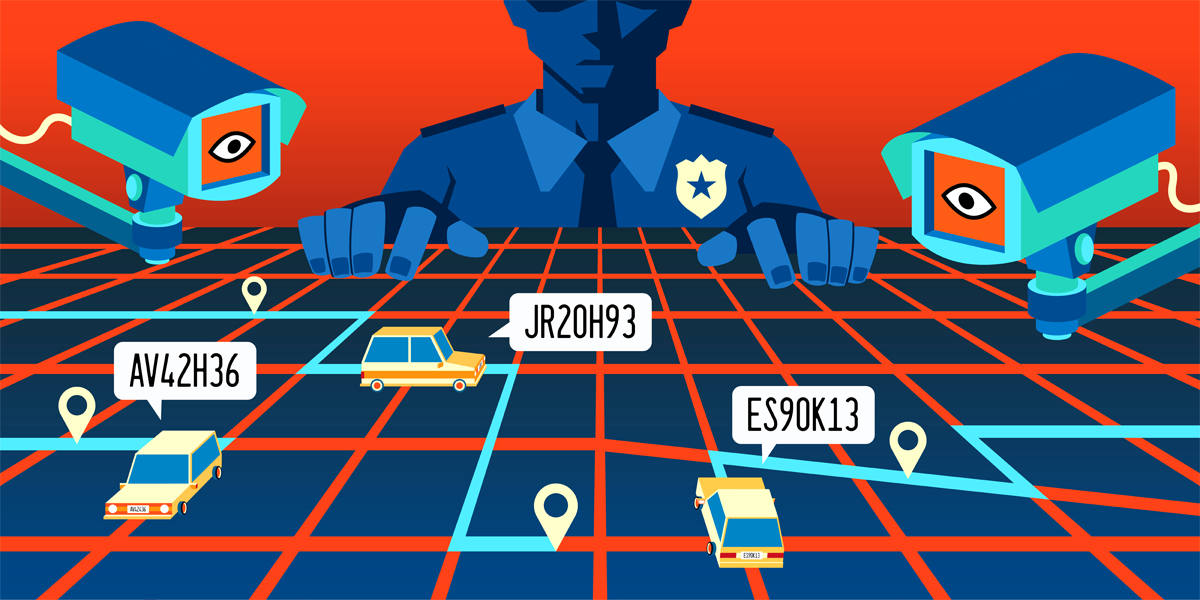
Let’s start with Flock, the company behind a number of automated license plate reader (ALPR) and other camera technologies. You might be surprised at how many Flock cameras there are in your community. Many large and small municipalities around the country have signed deals with Flock for license plate readers to track the movement of all cars in their city. Even though these deals are signed by local police departments, oftentimes ICE also gains access.
Because of their ubiquity, people are interested in finding out where and how many Flock cameras are in their community. One project that can help with this is the OUI-SPY, a small piece of open source hardware. The OUI-SPY runs on a cheap Arduino compatible chip called an ESP-32. There are multiple programs available for loading on the chip, such as “Flock You,” which allows people to detect Flock cameras and “Sky-Spy” to detect overhead drones. There’s also “BLE Detect,” which detects various Bluetooth signals including ones from Axon, Meta’s Ray-Bans that secretly record you, and more. It also has a mode commonly known as “fox hunting” to track down a specific device. Activists and researchers can use this tool to map out different technologies and quantify the spread of surveillance.
There’s also the open source Wigle app which is primarily designed for mapping out Wi-Fi, but also has the ability to make an audio alert when a specific Wi-Fi or Bluetooth identifier is detected. This means you can set it up to get a notification when it detects products from Flock, Axon, or other nasties in their vicinity.
One enterprising YouTuber, Benn Jordan, figured out a way to fool Flock cameras into not recording his license plate simply by painting some minor visual noise on his license plate. This is innocuous enough that any human will still be able to read his license plate, but it completely prevented Flock devices from recognizing his license plate as a license plate at the time. Some states have outlawed drivers obscuring their license plates, so taking such action is not recommended.
Jordan later went on to discover hundreds of misconfigured Flock cameras that were exposing their administrator interface without a password on the public internet. This would allow anyone with an internet connection to view a live surveillance feed, download 30 days of video, view logs, and more. The cameras pointed at parks, public trails, busy intersections, and even a playground. This was a massive breach of public trust and a huge mistake for a company that claims to be working for public safety.
Other hackers have taken on the task of open-source intelligence and community reporting. One interesting example is deflock.me and alpr.watch, which are crowdsourced maps of ALPR cameras. Much like the OUI-SPY project, this allows activists to map out and expose Flock surveillance cameras in their community.
There have also been several ICE reporting apps released, including apps to report ICE sightings in your area such Stop ICE Alerts, ICEOUT.org, and ICE Block. ICEBlock was delisted by Apple at the request of Attorney General Pam Bondi, a fact we are suing over. There is also Eyes Up, an app to securely record and archive ICE raids, which was taken down by Apple earlier this year.
Another interesting project documenting ICE and creating a trove of open-source intelligence is ICE List Wiki which contains info on companies that have contracts with ICE, incidents and encounters with ICE, and vehicles ICE uses.
People without programming knowledge can also get involved. In Chicago, people used whistles to warn their neighbors that ICE was present or in the area. Many people 3D-printed whistles along with instructional booklets to hand out to their communities, allowing a wider distribution of whistles and consequently earlier warnings for their neighbors.
Many hackers have started hosting digital security trainings for their communities or building web sites with security advice, including how to remove your data from the watchful eyes of the surveillance industry. To reach a broader community, trainers have even started hosting trainings on how to defend their communities and what to do in an ICE raid in video games, such as Fortnight.
There is also EFF’s own Rayhunter project for detecting cell-site simulators, about which we have written extensively. Rayhunter runs on a cheap mobile hotspot and doesn’t require deep technical knowledge to use.
It’s important to remember that we are not powerless. Even in the face of a domestic law enforcement presence with massive surveillance capabilities and military-esque technologies, there are still ways to engage in surveillance self-defense. We cannot give into nihilism and fear. We must continue to find small ways to protect ourselves and our communities, and when we can, fight back.
EFF is not affiliated with any of these projects (other than Rayhunter) and does not endorse them. We don’t make any statements about the legality of using any of these projects. Please consult with an attorney to determine what risks there may be.
Help protect digital privacy & free speech for everyone
Read more about how enterprising hackers have started projects to do counter surveillance against ICE, and learn how to follow the Homeland Security spending trail.
U.S. Immigration and Customs Enforcement (ICE) has a new budget under the current administration, and they are going on a surveillance tech shopping spree. Standing at $28.7 billion dollars for the year 2025 (nearly triple their 2024 budget) and at least another $56.25 billion over the next three years, ICE's budget would be the envy of many national militaries around the world. Indeed, this budget would put ICE as the 14th most well-funded military in the world, right between Ukraine and Israel.
There are many different agencies under U.S. Department of Homeland Security (DHS) that deal with immigration, as well as non-immigration related agencies such as Cybersecurity and Infrastructure Security Agency (CISA) and Federal Emergency Management Agency (FEMA). ICE is specifically the enforcement arm of the U.S. immigration apparatus. Their stated mission is to “[p]rotect America through criminal investigations and enforcing immigration laws to preserve national security and public safety.”
Of course, ICE doesn’t just end up targeting, surveilling, harassing, assaulting, detaining, and torturing people who are undocumented immigrants. They have targeted people on work permits, asylum seekers, permanent residents (people holding “green cards”), naturalized citizens, and even citizens by birth.
While the NSA and FBI might be the first agencies that come to mind when thinking about surveillance in the U.S., ICE should not be discounted. ICE has always engaged in surveillance and intelligence-gathering as part of their mission. A 2022 report by Georgetown Law’s Center for Privacy and Technology found the following:
With a budget for 2025 that is 10 times the size of the agency’s total surveillance spending over the last 13 years, ICE is going on a shopping spree, creating one of the largest, most comprehensive domestic surveillance machines in history.
The entire surveillance industry has been allowed to grow and flourish under both Democratic and Republican regimes. For example, President Obama dramatically expanded ICE from its more limited origins, while at the same time narrowing its focus to undocumented people accused of crimes. Under the first and second Trump administrations, ICE ramped up its operations significantly, increasing raids in major cities far from the southern border and casting a much wider net on potential targets. ICE has most recently expanded its partnerships with sheriffs across the U.S., and deported more than 1.5 million people cumulatively under the Trump administrations (600,000 of those were just during the first year of Trump’s second term according to DHS statistics), not including the 1.6 million people DHS claims have “self-deported.” More horrifying is that in just the last year of the current administration, 4,250 people detained by ICE have gone missing, and 31 have died in custody or while being detained. In contrast, 24 people died in ICE custody during the entirety of the Biden administration.
ICE also has openly stated that they plan to spy on the American public, looking for any signs of left-wing dissent against their domestic military-like presence. Acting ICE Director Todd Lyons said in a recent interview that his agency “was dedicated to the mission of going after” Antifa and left-wing gun clubs.
On a long enough timeline, any surveillance tool you build will eventually be used by people you don’t like for reasons that you disagree with.
On a long enough timeline, any surveillance tool you build will eventually be used by people you don’t like for reasons that you disagree with. A surveillance-industrial complex and a democratic society are fundamentally incompatible, regardless of your political party.
EFF recently published a guide to using government databases to dig up homeland security spending and compiled our own dataset of companies selling tech to DHS components. In 2025, ICE entered new contracts with several private companies for location surveillance, social media surveillance, face surveillance, spyware, and phone surveillance. Let’s dig into each.
One common surveillance tactic of immigration officials is to get physical access to a person’s phone, either while the person is detained at a border crossing, or while they are under arrest. ICE renewed an $11 million contract with a company called Cellebrite, which helps ICE unlock phones and then can take a complete image of all the data on the phone, including apps, location history, photos, notes, call records, text messages, and even Signal and WhatsApp messages. ICE also signed a $3 million contract with Cellebrite’s main competitor Magnet Forensics, makers of the Graykey device for unlocking phones. DHS has had contracts with Cellebrite since 2008, but the number of phones they search has risen dramatically each year, reaching a new high of 14,899 devices searched by ICE’s sister agency U.S. Customs and Border Protection (CBP) between April and June of 2025.
If ICE can’t get physical access to your phone, that won’t stop them from trying to gain access to your data. They have also resumed a $2 million contract with the spyware manufacturer, Paragon. Paragon makes the Graphite spyware, which made headlines in 2025 for being found on the phones of several dozen members of Italian civil society. Graphite is able to harvest messages from multiple different encrypted chat apps such as Signal and WhatsApp without the user ever knowing.
Our concern with ICE buying this software is the likelihood that it will be used against undocumented people and immigrants who are here legally, as well as U.S. citizens who have spoken up against ICE or who work with immigrant communities. Malware such as Graphite can be used to read encrypted messages as they are sent, other forms of spyware can also download files, photos, location history, record phone calls, and even discretely turn on your microphone to record you.
The most effective way to protect yourself from smartphone surveillance would be to not have a phone. But that’s not realistic advice in modern society. Fortunately, for most people there are other ways you can make it harder for ICE to spy on your digital life.
The first and easiest step is to keep your phone up to date. Installing security updates makes it harder to use malware against you and makes it less likely for Cellebrite to break into your phone. Likewise, both iPhone (Lockdown Mode) and Android (Advanced Protection) offer special modes that lock your phone down and can help protect against some malware.
The first and easiest step is to keep your phone up to date.
Having your phone’s software up to date and locked with a strong alphanumeric password will offer some protection against Cellebrite, depending on your model of phone. However, the strongest protection is simply to keep your phone turned off, which puts it in “before first unlock” mode and has been typically harder for law enforcement to bypass. This is good to do if you are at a protest and expect to be arrested, if you are crossing a border, or if you are expecting to encounter ICE. Keeping your phone on airplane mode should be enough to protect against cell-site simulators, but turning your phone off will offer extra protection against cell-site simulators and Cellebrite devices. If you aren’t able to turn your phone off, it’s a good idea to at least turn off face/fingerprint unlock to make it harder for police to force you to unlock your phone. While EFF continues to fight to strengthen our legal protections against compelling people to decrypt their devices, there is currently less protection against compelled face and fingerprint unlocking than there is against compelled password disclosure.
ICE has also spent $5 million to acquire at least two location and social media surveillance tools: Webloc and Tangles, from a company called Pen Link, an established player in the open source intelligence space. Webloc gathers the locations of millions of phones by gathering data from mobile data brokers and linking it together with other information about users. Tangles is a social media surveillance tool which combines web scraping with access to social media application programming interfaces. These tools are able to build a dossier on anyone who has a public social media account. Tangles is able to link together a person’s posting history, posts, and comments containing keywords, location history, tags, social graph, and photos with those of their friends and family. Penlink then sells this information to law enforcement, allowing law enforcement to avoid the need for a warrant. This means ICE can look up historic and current locations of many people all across the U.S. without ever having to get a warrant.
These tools are able to build a dossier on anyone who has a public social media account.
ICE also has established contracts with other social media scanning and AI analysis companies, such as a $4.2 million contract with a company called Fivecast for the social media surveillance and AI analysis tool ONYX. According to Fivecast, ONYX can conduct “automated, continuous and targeted collection of multimedia data” from all major “news streams, search engines, social media, marketplaces, the dark web, etc.” ONYX can build what it calls “digital footprints” from biographical data and curated datasets spanning numerous platforms, and “track shifts in sentiment and emotion” and identify the level of risk associated with an individual.
Another contract is with ShadowDragon for their product Social Net, which is able to monitor publicly available data from over 200 websites. In an acquisition document from 2022, ICE confirmed that ShadowDragon allowed the agency to search “100+ social networking sites,” noting that “[p]ersistent access to Facebook and Twitter provided by ShadowDragon SocialNet is of the utmost importance as they are the most prominent social media platforms.”
ICE has also indicated that they intend to spend between 20 and 50 million dollars on building and staffing a 24/7 social media monitoring office with at least 30 full time agents to comb every major social media website for leads that could generate enforcement raids.
For U.S. citizens, making your account private on social media is a good place to start. You might also consider having accounts under a pseudonym, or deleting your social media accounts altogether. For more information, check out our guide to protecting yourself on social media. Unfortunately, people immigrating to the U.S. might be subject to greater scrutiny, including mandatory social media checks, and should consult with an immigration attorney before taking any action. For people traveling to the U.S., new rules will soon likely require them to reveal five years of social media history and 10 years of past email addresses to immigration officials.
But it’s not just your digital habits ICE wants to surveil; they also want to spy on you in the physical world. ICE has contracts with multiple automated license plate reader (ALPR) companies and is able to follow the driving habits of a large percentage of Americans. ICE uses this data to track down specific people anywhere in the country. ICE has a $6 million contract through a Thomson Reuters subsidiary to access ALPR data from Motorola Solutions. ICE has also persuaded local law enforcement officers to run searches on their behalf through Flock Safety's massive network of ALPR data. CBP, including Border Patrol, also operates a network of covert ALPR systems in many areas.
ICE has also invested in biometric surveillance tools, such as face recognition software called Mobile Fortify to scan the faces of people they stop to determine if they are here legally. Mobile Fortify checks the pictures it takes against a database of 200 million photos for a match (the source of the photos is unknown). Additionally, ICE has a $10 million contract with Clearview AI for face recognition. ICE has also contracted with iris scanning company BI2 technologies for even more invasive biometric surveillance. ICE agents have also been spotted wearing Meta’s Ray-Ban video recording sunglasses.
ICE has acquired trucks equipped with cell-site simulators (AKA Stingrays) from a company called TechOps Specialty Vehicles (likely the cell-site simulators were manufactured by another company). This is not the first time ICE has bought this technology. According to documents obtained by the American Civil Liberties Union, ICE deployed cell-site simulators at least 466 times between 2017 and 2019, and ICE more than 1,885 times between 2013 and 2017, according to documents obtained by BuzzFeed News. Cell-site simulators can be used to track down a specific person in real time, with more granularity than a phone company or tools like Webloc can provide, though Webloc has the distinct advantage of being used without a warrant and not requiring agents to be in the vicinity of the person being tracked.
Taking public transit or bicycling is a great way to keep yourself off ALPR databases, but an even better way is to go to your local city council meetings and demand the city cancels contracts with ALPR companies, like people have done in Flagstaff, Arizona; Eugene, Oregon; and Denver, Colorado, among others.
If you are at a protest, putting your phone on airplane mode could help protect you from cell-site simulators and from apps on your phone disclosing your location, but might leave you vulnerable to advanced targeted attacks. For more advanced protection, turning your phone completely off protects against all radio based attacks, and also makes it harder for tools like Cellebrite to break into your phone as discussed above. But each individual will need to weigh their need for security from advanced radio based attacks against their need to document potential abuses through photo or video. For more information about protecting yourself at a protest, head over to SSD.
There is nothing you can do to change your face, which is why we need more stringent privacy laws such as Illinois’ Biometric Information Privacy Act.
Last but not least, ICE uses tools to combine and search all this data along with the data on Americans they have acquired from private companies, the IRS, TSA, and other government databases.
To search all this data, ICE uses ImmigrationOS, a system that came from a $30-million contract with Palantir. What Palantir does is hard to explain, even for people who work there, but essentially they are plumbers. Palantir makes it so that ICE has all the data they have acquired in one place so it’s easy to search through. Palantir links data from different databases, like IRS data, immigration records, and private databases, and enables ICE to view all of this data about a specific person in one place.
Palantir makes it so that ICE has all the data they have acquired in one place so it’s easy to search through.
The true civil liberties nightmare of Palantir is that they enable governments to link data that should have never been linked. There are good civil liberties reasons why IRS data was never linked with immigration data and was never linked with social media data, but Palantir breaks those firewalls. Palantir has labeled themselves as a progressive, human rights centric company historically, but their recent actions have given them away as just another tech company enabling surveillance nightmares.
Understanding the capabilities and limits of ICE and how to threat model helps you and your community fight back, remain powerful, and protect yourself.
One of the most important things you can do is to not spread rumors and misinformation. Rumors like “ICE has malware so now everyone's phones are compromised” or “Palantir knows what you are doing all the time” or “Signal is broken” don’t help your community. It’s more useful to spread facts, ways to protect yourself, and ways to fight back. For information about how to create a security plan for yourself or your community, and other tips to protect yourself, read our Surveillance Self-Defense guides.
One way to fight back against ICE is in the courts. EFF currently has a lawsuit against ICE over their pressure on Apple and Google to take down ICE spotting apps, like ICEBlock. We also represent multiple labor unions suing ICE over their social media surveillance practices.
We have also demanded the San Francisco Police Department stop sharing data illegally with ICE, and issued a statement condemning the collaboration between ICE and the malware provider Paragon. We also continue to maintain our Rayhunter project for detecting cell-site simulators.
Other civil liberties organizations are also suing ICE. ACLU has sued ICE over a subpoena to Meta attempting to identify the owner of an account providing advice to protestors, and another coalition of groups has thus far successfully sued the IRS to stop sharing taxpayer data with ICE.
We need to have a hard look at the surveillance industry. It is a key enabler of vast and untold violations of human rights and civil liberties, and it continues to be used by aspiring autocrats to threaten our very democracy. As long as it exists, the surveillance industry, and the data it generates, will be an irresistible tool for anti-democratic forces.
Help protect digital privacy & free speech for everyone
The New York City Wegman’s is collecting biometric information about customers.
404 Media has the story:
Unlike many of Flock’s cameras, which are designed to capture license plates as people drive by, Flock’s Condor cameras are pan-tilt-zoom (PTZ) cameras designed to record and track people, not vehicles. Condor cameras can be set to automatically zoom in on people’s faces as they walk through a parking lot, down a public street, or play on a playground, or they can be controlled manually, according to marketing material on Flock’s website. We watched Condor cameras zoom in on a woman walking her dog on a bike path in suburban Atlanta; a camera followed a man walking through a Macy’s parking lot in Bakersfield; surveil children swinging on a swingset at a playground; and film high-res video of people sitting at a stoplight in traffic. In one case, we were able to watch a man rollerblade down Brookhaven, Georgia’s Peachtree Creek Greenway bike path. The Flock camera zoomed in on him and tracked him as he rolled past. Minutes later, he showed up on another exposed camera livestream further down the bike path. The camera’s resolution was good enough that we were able to see that, when he stopped beneath one of the cameras, he was watching rollerblading videos on his phone.