❌

Normal view

Hacking Safari with GPT 5.4Β 

23 April 2026 at 20:58

When Anthropic unveiled Mythos and Project Glasswing, the reaction was immediate and polarized. Some dismissed it as fear-driven marketing, while others treated it as a credible shift in the threat landscape.

Like with many things, the truth is probably somewhere in the middle. I wanted to test that for myself, and since I recently got access to OpenAI’s Trusted Access for Cyber program, I decided to take it for a spin.

GPT-5.4 identified the bugs and helped assemble a working exploit chain, but it wasn’t a simple β€œbuild me an exploit” prompt. Guiding it required domain knowledge, iterative probing, and knowing which paths were actually exploitable.

On modern browsers like Safari, exploitation is less about finding bugs and more about finding bugs that still matter after multiple layers of defense.

The bug I’m going to talk about today sits in a more interesting category. The bug itself looked contained, and in many ways it was. It did not provide a path to RCE or a sandbox escape. What it did instead was cross a different boundary entirely: it broke the Same-Origin Policy.

If you visited a malicious page from any Apple device, it could read authenticated cross-origin data from other sites you use, including access tokens and other sensitive data, making account takeover trivial.

The video below shows the PoC we sent Apple, demonstrating leakage of sensitive data from both Apple Connect and iCloud / Apple ID endpoints. Although this demo focuses on Apple services, the issue affects all websites. This means that by visiting a malicious website, sensitive data from other domains is at risk of being leaked.


The Sandbox Russian Doll

Browser exploitation in 2026 is a lot like being trapped in a Russian doll.

You start in the smallest doll, and every time you escape one layer you discover you are still trapped inside another one.

Finding a low-level memory bug is not the same thing as finding an exploit. Most of these bugs die in the gap between β€œmemory corruption happened” and β€œsomething meaningful crossed a security boundary.”

On the outside you have the browser process model. Even if renderer code goes wrong, the browser is trying very hard to keep that damage inside the web content process.

infographic

Inside that you have the web security model: Same-Origin Policy, CORS, opaque responses, cookie scoping, and credential modes. Even if a page can trigger a cross-origin request, the renderer, and especially the Gigacage, should not be able to access the response bytes. Right?…

The Bug

The original bug lives in the refresh logic for non-shared resizable WebAssembly memory.

When a non-shared WebAssembly.Memory grows in BoundsChecking mode, JavaScriptCore can replace the underlying memory handle. That part is not the bug. The bug is what happens after that to the JS-visible resizable buffer returned by memory.toResizableBuffer().

diagram

The bug is simple enough that once I saw it, it was hard to unsee it. Safari’s grow path effectively does this:

code1

And the refresh step effectively does this:

code2

After memory.grow(), WebKit updates the buffer metadata, but leaves m_data pointing at the old freed allocation.

So after a grow, JavaScript can hold a buffer whose reported size is new, whose handle is new, but whose actual data pointer still references the old freed Primitive Gigacage allocation.

That turns into a stale typed-array window over freed memory.

On its own, this is already a real bug. But we’re still stuck inside the JavaScriptCore gigacage, effectively sandboxed. Without a second bug to break out into the renderer, it doesn’t chain into anything meaningful. What we have is a solid first-stage primitive, but no real security impact on its own.

Why it did not look exploitable at first

The stale window is confined to the Primitive Gigacage, which immediately limits what you can do with it. Many typical targets either never land there, lack useful structure, or fail to produce any cross-boundary effect.

So early on, it had all the hallmarks of a bug that looks promising but rarely goes the distance:

  • easy source-level root cause
  • visible stale memory behavior
  • real reclaim
  • no clean escape path

This is where a lot of low-level browser bugs die.

What changed the problem was a very different framing: maybe I did not need to escape the cage at all.

Maybe I just needed the browser to place something valuable inside it.

The Pivot

Instead of asking β€œhow do I get from my stale WASM view to some protected browser state?” I started asking a better question:

β€œWhat browser code takes data that JavaScript is not allowed to read, but still copies that data into normal renderer memory?”

Because that is all I need.

I don’t need to break the abstraction.

I just need the browser to break it for me.

That naturally narrows the search space to subsystems that:

  • handle sensitive cross-origin data, and
  • still allocate ArrayBuffer-backed memory as part of their internal pipeline

That points straight at Fetch. The Fetch API clearly indicates that the response is opaque, meaning that its headers and body are not available to JavaScript.

Opaque Responses Are Supposed to Be Opaque

At the API level, the Fetch model here is straightforward.

If I do a cross-origin request with:

fetch(url, { mode: β€œno-cors”, credentials: β€œinclude” });

The browser may send the request, including cookies depending on context, but JavaScript receives an opaque response.

That means:

  • I can hold the Response object
  • but I cannot read the body bytes

And WebKit enforces that in the obvious place:

FetchBodyOwner::readableStream() blocks opaque bodies via isBodyNullOrOpaque().

So at first glance, everything looks fine. The body is hidden. The policy is enforced. Same-Origin Policy survives another day.

Except it does not.

The Fetch Behavior that Broke the Modal

The surprising part is Response.clone().

If FetchResponse::clone() is called while the response is still loading, WebKit will internally create a readable stream so it can tee the body between the original response and the clone.

That internal path does not apply the same opaque-body check first.

And once that happens, hidden response bytes start becoming very real renderer objects.

This is the part that made me stop and stare at the source, because the mismatch is right there.

The normal body path blocks opaque responses:

code3

But FetchResponse::clone() does this while the response is still loading:

code4

That is why it works.

The visible accessor path says β€œopaque bodies do not get a stream.” The clone path says β€œif it is still loading, create a stream so both clones can tee it.”

That second path is exactly what I needed.

The data flows through normal ArrayBuffer creation paths:

  • buffered chunks go through tryCreateArrayBuffer()
  • later chunks go through takeAsArrayBuffer()
  • shared buffer data gets copied into ordinary ArrayBuffer allocations inside the renderer

So the policy ends up split in two:

  • the public Fetch API says the body is opaque
  • the renderer still materializes the opaque body into readable byte arrays during clone-time streaming

Combined with the stale WASM window, it becomes a SOP break.

The Chain

At a high level, the exploit became:

  1. Force the target WASM memory into the BoundsChecking path.
  2. Call memory.toResizableBuffer().
  3. Grow the memory.
  4. Keep the stale resizable buffer whose pointer still targets freed Primitive Gigacage pages.
  5. Trigger a cross-origin fetch(…, { mode: β€œno-cors”, credentials: β€œinclude” }).
  6. Call response.clone() while the response is still loading.
  7. Let Fetch internals materialize the hidden body bytes into ordinary renderer ArrayBuffers.
  8. Reclaim the stale WASM-covered pages with those allocations.
  9. Read the cross-origin bytes through the stale view.

That is the entire trick.

I never needed response.text(). I never needed response.arrayBuffer(). I never needed the public API to hand me the body.

The browser copied the body into memory for its own internal bookkeeping, and the stale WASM view read it directly.

That is why this bug stopped being β€œsome weird WASM UAF” and became β€œthis completely breaks the Same-Origin Policy.”

The file:// Detour

One of the weirdest parts of the research was that the request side behaved differently depending on where I launched it from.

In my testing, cross-origin requests were much easier to get moving from file:// than from a normal https attacker page.

That sounds backwards until you look at WebKit’s handling of local origins.

Document.cpp has explicit special-casing around local documents and settings like:

  • allowUniversalAccessFromFileURLs
  • allowFileAccessFromFileURLs

MiniBrowser exposes those knobs too, which made file:// very useful as a research environment. It let me focus on the memory side and confirm the leak path before I had a clean web-facing story.

But I did not want a local-file party trick.

I wanted a real web exploit.

And from a normal https page, the same request pattern was not giving me the reliability I wanted.

That is where about:blank saved me.

Why about:blank saved the final POC

The final PoC opens an about:blank popup and performs the fetches from there:

code5

This ended up mattering a lot.

At first I thought this was just an origin-inheritance trick. That part is real:

code6

So about:blank does inherit the opener’s origin.

But that alone does not explain why the popup path behaved differently.

What actually seems to matter is Safari’s cookie / first-party bookkeeping. Fetch subresource requests copy document->firstPartyForCookies() into the request:

code7

And WebKit’s cookie blocking logic bails out immediately if that first-party domain is empty:

code8

That is a very different path from a normal attacker-controlled https page. From a regular https://attacker.example origin, the first party is the attacker site, so a request to the victim site looks third-party and Safari’s tracking-prevention logic can suppress cookies.

From the about:blank popup path, the security origin still comes from the opener, but the popup’s top-level URL / first-party context is no longer a normal registrable https site in the same way. In practice, that was enough to make credentials: β€œinclude” requests behave differently and get me the authenticated traffic pattern I needed.

So the important point is not β€œabout:blank disabled CORS.” It did not. The important point is:

  • the popup kept the opener’s origin
  • the request still went through normal Fetch/CORS code
  • Safari’s first-party cookie logic treated that popup context differently

That was the difference between β€œcross-origin request happens but is useless” and β€œcross-origin request comes back with authenticated bytes worth stealing.”

Why this was fun

This is my favorite kind of browser bug.

Not because the root cause was complicated. It was not. The WASM bug was almost embarrassingly direct.

And not because the final chain was huge. It was not.

It was fun because it is exactly the kind of bug modern browser architecture is supposed to suppress.

A stale pointer inside a cage is supposed to stay a stale pointer inside a cage.

An opaque response is supposed to stay opaque.

Those are both reasonable assumptions.

The exploit works because both assumptions were true only locally.

JavaScriptCore gave me a stale view that looked hard to use. WebCore Fetch gave me sensitive bytes that looked impossible to read.

Put them together and Safari’s Same-Origin Policy fell apart.

Disclosure

We reported our findings to Apple. Shortly after, a fix shipped, suggesting the issue was already known internally.

The vulnerability (CVE-2026-20664) is addressed in iOS 26.4 and iPadOS 26.4 (23E6254 and later), and macOS Tahoe 26.4 (25E253 and later). Make sure your systems are up to date.

Closing Thoughts

The biggest thing on my mind after working with these models is the leverage they provide, and what that means for N-days. A security patch in popular software used to hide the underlying exploit behind time, effort, and expertise. Now that you can scale tokens instead of effort, that barrier is mostly gone.

This doesn’t turn exploitation into a trivial task. You still need someone who understands what they are looking at, can filter noise, and can steer the process when it stalls. But AI changes the unit of work. Instead of deep, sequential effort, you get parallel exploration and rapid iteration. The constraint shifts from raw effort to how effectively an operator can guide multiple lines of inquiry at once.
`

The post Hacking Safari with GPT 5.4Β  appeared first on Blog.

The Gentlemen: A New Ransomware Threat Climbing the Charts β€” Fast

20 April 2026 at 14:00

Key FindingsΒ  The Gentlemen ransomware-as-a-service (RaaS) operation has claimed over 320 victims since mid-2025, with 240 attacks occurring in 2026 alone,Β making it the #2 most active ransomware group by victim count so far this yearΒ  Check Point Research gained rare access to a live command-and-control server linked to a Gentlemen affiliate, revealing a botnet of over 1,570Β likely corporateΒ victims,Β surpassing the group’s own publicly claimed numbers.Β  The group deliberately targets internet-facing devices (VPNs, firewalls) as their entry point, and once inside, moves quickly to encrypt entire networks within hoursΒ  Manufacturing andΒ technology are the mostΒ frequentlyΒ targeted sectors, withΒ healthcare a growing third target β€” a […]

The post The Gentlemen: A New Ransomware Threat Climbing the Charts β€” Fast appeared first on Check Point Blog.

The Phishing Paradox: The World’s Most Trusted Brands Are Cyber Criminals’ Entry Point of Choice

16 April 2026 at 14:00

In Q1 2026, Microsoft continued to be the most impersonated brand in phishing attacks, accounting for 22% of all brand impersonation attempts, according to data from Check Point Research (CPR). The results reinforce a long‑standing trend: attackers consistently exploit highly trusted brands to steal credentials and gain initial access to personal and enterprise environments. Apple climbed to second place with 11%, reflecting attackers’ increasing focus on consumer ecosystems tied to payments, identity, and personal devices. Google followed closely in third place at 9%, while Amazon ranked fourth with 7%. LinkedIn rose to fifth place with 6%, highlighting sustained attacker interest […]

The post The Phishing Paradox: The World’s Most Trusted Brands Are Cyber Criminals’ Entry Point of Choice appeared first on Check Point Blog.

Anthropic Mythos: Separating Signal from Hype

14 April 2026 at 19:43

The recent buzz aroundΒ Anthropic’sΒ MythosΒ model has been intense, and for good reason. Early reports suggest a model that significantly advances automated reasoning over large codebases, vulnerability discovery, and exploit generation. Some are already calling it a β€œgame changer” for offensive security.Β 

But like most breakthroughs in AI, the reality is more nuanced.Β 

Let’sΒ unpack what Mythos is, whyΒ it’sΒ getting so much attention, and where the real impact will (andΒ won’t) be.Β 

What Is Mythos, and Why It MattersΒ 

At its core, Mythos is designed toΒ operateΒ deeply within software systems:Β 

  • It can reason acrossΒ entire codebases, not just snippetsΒ Β 
  • ItΒ demonstratesΒ strong capabilities inΒ multi-step vulnerability discoveryΒ Β 
  • It can potentially chain findings intoΒ realistic exploit pathsΒ Β 

This is what sets it apart from earlier models. Traditional LLMs often struggled with:Β 

  • Context fragmentation (limited memory of large systems)Β Β 
  • Superficial pattern matching (vs. true reasoning)Β Β 
  • Weakness in multi-stage attack logicΒ Β 

MythosΒ appearsΒ to push beyond that,Β closer to what human security researchers do when analyzing complex systems.Β 

That’sΒ the hype.Β NowΒ let’sΒ put it into perspective.

1. Closed Systems Still Have a Natural Advantage

One of the most important constraints,Β often overlooked,Β isΒ access.Β 

Organizations running:Β 

  • Licensed binariesΒ Β 
  • Closed-source productsΒ Β 
  • SaaS platformsΒ Β 

are inherently less exposed to this class of AI-driven analysis.Β 

Why? Because MythosΒ appears to beΒ most effective when it hasΒ full visibility into the source code. Without that:Β 

  • Reverse engineering binaries is stillΒ hard and lossyΒ Β 
  • SaaS environments expose onlyΒ interfaces, not logicΒ Β 

This creates aΒ natural barrierΒ for attackers.Β 

Although β€œsecurity through obscurity” isn’tΒ a solution, in practice:Β 

  • Open-source projects and exposed codebases will feel the impact firstΒ Β 
  • Closed vendors still need to worry, butΒ they’reΒ not suddenly transparent overnightΒ 

2. The Real Pressure Point: Time-to-Mitigation

AIΒ doesn’tΒ just changeΒ whatΒ attackers canΒ do,Β it changesΒ how fastΒ everything happens.Β Β 

And this is whereΒ securityΒ vendorsΒ feel the most pressure.Β TheΒ challengeΒ isn’tΒ whether vulnerabilitiesΒ exist,Β it’sΒ how fastΒ vendorsΒ can respondΒ onceΒ they’reΒ discovered.Β 

The new race:Β 

  • AI/ humanΒ finds vulnerability β†’Β Β 
  • AIΒ Exploit is generated quickly β†’Β Β 
  • Attack trafficΒ emergesΒ earlier β†’Β Β 
  • Defenses must adapt in near real-time.

This shifts the competitive advantage to vendors that can:Β 

  • AutomateΒ security workflows toΒ 
  • RapidlyΒ understand new attack patternsΒ Β 
  • Generate mitigationsΒ Β 
  • Deploy protectionsΒ before mass exploitationΒ 

3. The Budget Reality: AI Red-Teaming Isn’t CheapΒ 

One of the least discussed aspects of Mythos isΒ cost.Β 

Running such a model at scale involves:Β 

  • High compute costsΒ Β 
  • Expensive infrastructureΒ Β 
  • For example, Anthropic admitted that β€œAcross a thousand runs through our scaffold, the total cost was under $20,000” for finding vulnerabilities in OpenBSD.
  • Significant human validation effortΒ 

And that last part is critical.Β 

Every finding still requires:Β 

  • Verification (is itΒ real?)Β Β 
  • ReproductionΒ Β 
  • Impact assessmentΒ Β 

Which means moreΒ security engineers per finding, not less.

Organizations will need to start budgeting for:Β 

  • AI-assistedΒ red teamingΒ Β 
  • Dedicated pipelines to process findingsΒ Β 
  • Integration into SDLC workflowsΒ Β 

This mirrors what we’ve already seen withΒ GitHub Copilot-style assistants and AI-based code analysis tools.

Implication for attackers:Β 

These β€œdoomsday” capabilities areΒ not evenly distributed.Β 

  • Well-funded actors (nation-states, top-tier cybercrime groups) β†’Β likely adoptersΒ Β 
  • Opportunistic attackers β†’ much slower to benefitΒ Β 

SoΒ the threat landscapeΒ widens at the top, not uniformly across all attackers.

4. Bug Bounty Programs Will Feel the Noise First

One immediate and very practical impact: bug bounty platforms are about to get noisy.Β 

Expect a surge of:Β 

  • AI-generated vulnerability reportsΒ Β 
  • Poorly validated findingsΒ Β 
  • Duplicates and false positivesΒ Β 

This creates a scaling problem for security teams.Β 

Organizations will need to adapt:Β 

  • StrongerΒ triage filtering mechanismsΒ (likely AI-driven)Β Β 
  • Reputation systems for researchersΒ Β 
  • Penalties for repeated false positivesΒ Β 
  • PotentialΒ adjustments in bounty pricingΒ Β 

Otherwise, teams risk wasting cycles on low-quality reports and missing real vulnerabilities buried in noise. Ironically, AI willΒ be neededΒ to defend against AI-generated reports.

5. Not All Vulnerabilities Are Equal

Another important nuance:Β Β 

Finding a vulnerability β‰  exploiting it at scale.Β 

Even with Mythos:Β 

  • Many findings will beΒ low impactΒ Β 
  • Exploitation may requireΒ environmentΒ specific conditionsΒ Β 
  • Real-world constraints (auth, rate limits, monitoring) still applyΒ Β 

This is where traditional security layers still matter:Β 

  • WAF,Β APIΒ protection,Β BotΒ protectionΒ 
  • Identity protectionΒ 
  • Data protectionΒ 
  • Threat reputationΒ 

MythosΒ increasesΒ discoveryΒ capability, butΒ doesn’tΒ eliminateΒ defenseΒ inΒ depth.Β 

Final ThoughtsΒ 

TheΒ MythosΒ model presentsΒ a meaningful step forward. It brings AI closer to acting like a real security researcher, capable of deep reasoning and complex analysis.Β 

ButΒ it’sΒ not a universal β€œbreak everything” button.Β 

  • Closed systems still provide frictionΒ Β 
  • Costs limit widespread misuseΒ Β 
  • Defensive technologiesΒ remainΒ highly relevantΒ Β 
  • Operational processes (triage, mitigation) become the real bottleneckΒ Β 

The hype focuses onΒ capability.Β The reality is aboutΒ constraints and execution.Β 

And as always in cybersecurity, the winners won’t be those with the best tools, but those who can operationalize speed, from detection to mitigation, at scale.Β 

The post Anthropic Mythos: Separating Signal from Hype appeared first on Blog.

JanelaRAT: a financial threat targeting users in Latin America

By: GReAT
13 April 2026 at 11:00

Background

JanelaRAT is a malware family that takes its name from the Portuguese word β€œjanela” which means β€œwindow”. JanelaRAT looks for financial and cryptocurrency data from specific banks and financial institutions in the Latin America region.

JanelaRAT is a modified variant of BX RAT that has targeted users since June 2023. One of the key differences between these Trojans is that JanelaRAT uses a custom title bar detection mechanism to identify desired websites in victims’ browsers and perform malicious actions.

The threat actors behind JanelaRAT campaigns continuously update the infection chain and malware versions by adding new features.

Kaspersky solutions detect this threat as Trojan.Script.Generic and Backdoor.MSIL.Agent.gen.

Initial infection

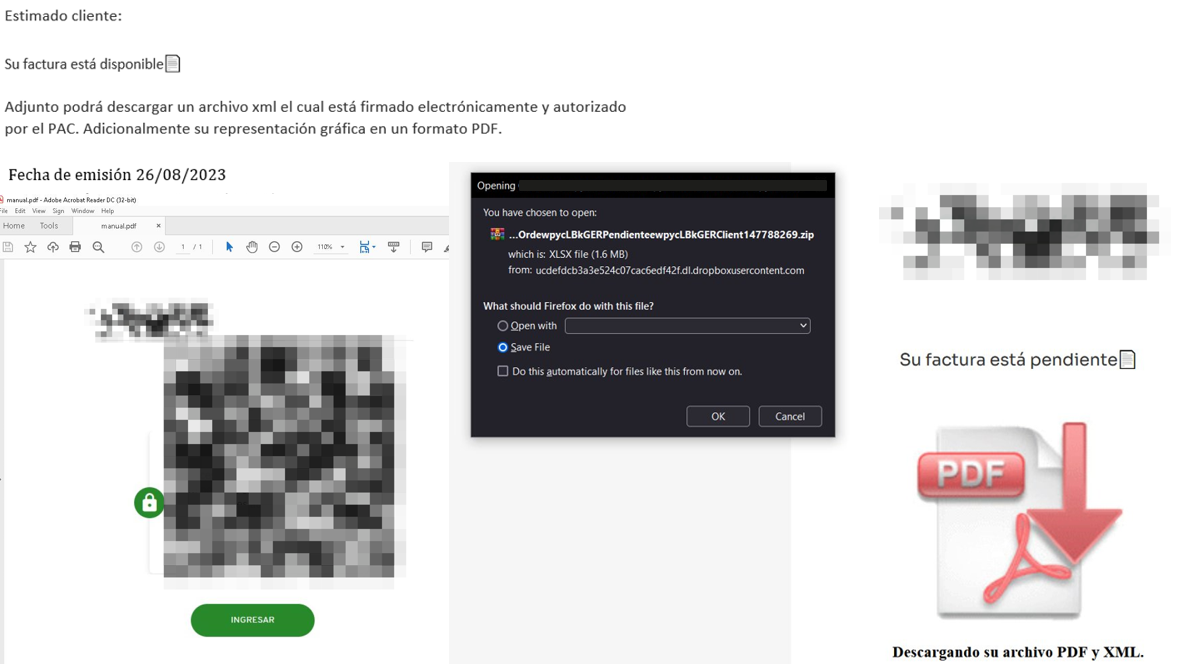
JanelaRAT campaigns involve a multi-stage infection chain. It starts with emails mimicking the delivery of pending invoices to trick victims into downloading a PDF file by clicking a malicious link. Then the victims are redirected to a malicious website from which a compressed file is downloaded.

Malicious email used in JanelaRAT campaigns

Malicious email used in JanelaRAT campaigns

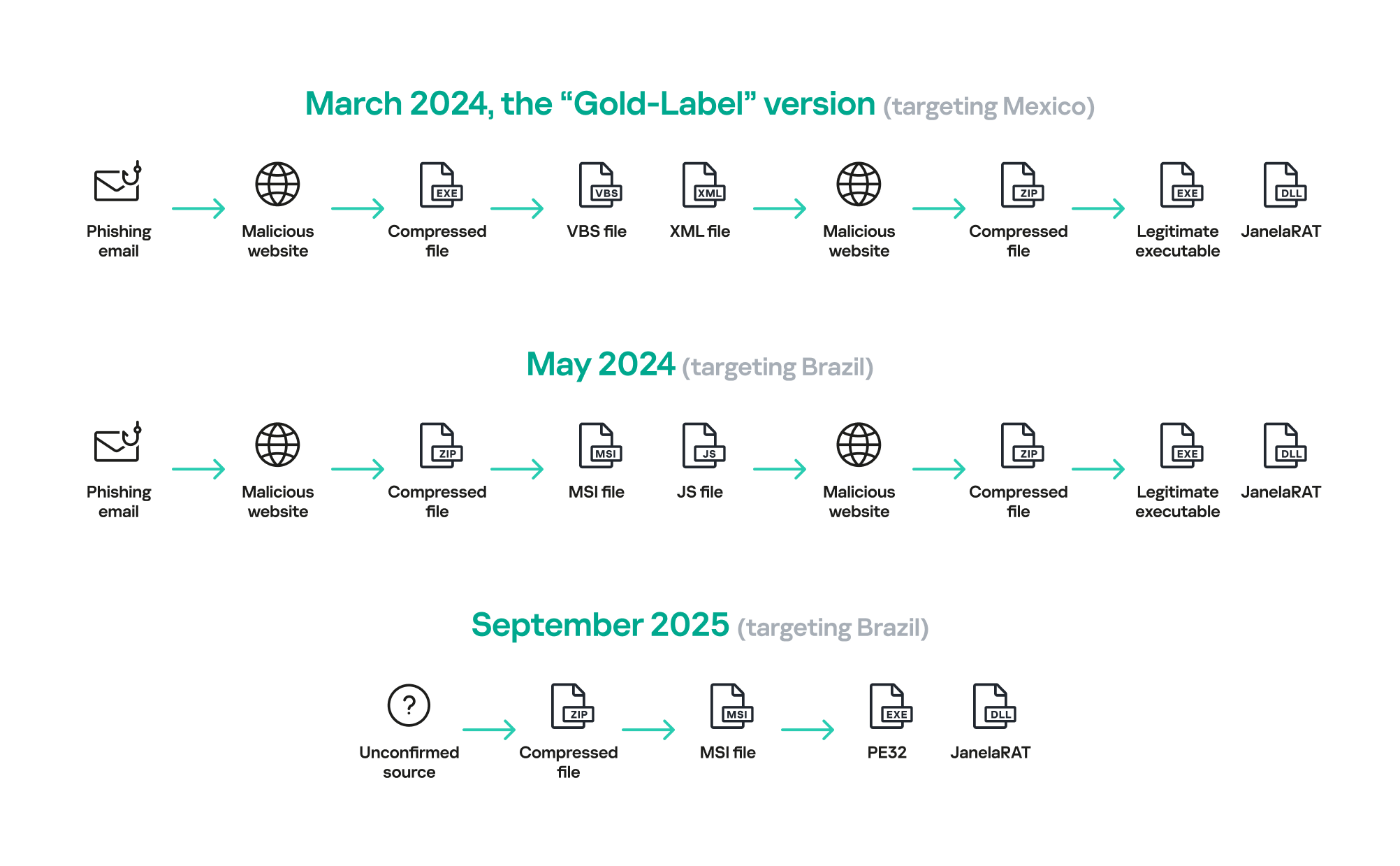
Throughout our monitoring of these malware campaigns, the compressed files have typically contained VBScripts, XML files, other ZIP archives, and BAT files. They ultimately lead to downloading a ZIP archive that contains components for DLL sideloading and executing JanelaRAT as the final payload.

However, we have observed variations in the infection chains depending on the delivered version of the malware. The latest observed campaign evolved by integrating MSI files to deliver a legitimate PE32 executable and a DLL, which is then sideloaded by the executable. This DLL is actually JanelaRAT, delivered as the final payload.

Based on our analysis of previous JanelaRAT intrusions, the updates in the infection chain represent threat actors’ attempts to streamline the process, with a reduced number of malware installation steps. We’ve observed a logical sequence in how components, such as MSI files, have been incorporated and adapted over time. Moreover, we have observed the use of auxiliary files β€” additional components that aid in the infection β€” such as configuration files that have been changing over time, showing how the threat actors have adapted these infections in an effort to avoid detection.

JanelaRAT infection flow evolution

JanelaRAT infection flow evolution

Initial dropper

The MSI file acts as an initial dropper designed to install the final implant and establish persistence on the system. It obfuscates file paths and names with the objective to hinder analysis. This code is designed to create several ActiveX objects to manipulate the file system and execute malicious commands.

Among the actions taken, the MSI defines paths based on environment variables for hosting binaries, creating a startup shortcut, and storing a first-run indicator file. The dropper file checks for the existence of the latter and for a specific path, and if either is missing, it creates them. If the file exists, the MSI file redirects the user to an external website as a decoy, showing that everything is β€œnormal”.

The MSI dropper places two files at a specified path: the legitimate executable nevasca.exe and the PixelPaint.dll library, renaming them with obfuscated combinations of random strings before relocating. An LNK shortcut is created in the user’s Startup folder, pointing to the renamed nevasca.exe executable, ensuring persistence. Finally, the nevasca.exe file is executed, which in turn loads the PixelPaint.dll file that is JanelaRAT.

Malicious implant

In this case, we analyzed JanelaRAT version 33, which was masqueraded as a legitimate pixel art app. Similar to other malware versions, it was protected with Eazfuscator, a common .NET obfuscation tool. We have also seen previous JanelaRAT samples that used the ConfuserEx obfuscator or its custom builds. The malware uses Control Flow Flattening method and renames classes and variables to make the code unreadable without deobfuscation.

JanelaRAT monitors the victim’s activity, intercepts sensitive banking interactions, and establishes an interactive C2 channel to report changes to the threat actor. While screen monitoring is also present, the core functionality focuses on financial fraud and real-time manipulation of the victim’s machine. The malware collects system information, including OS version, processor architecture (32-bit, 64-bit, or unknown), username, and machine name. The Trojan evaluates the current user’s privilege level and assigns different nicknames for administrators, users, guests, and an additional one for any other role.

The malware then retrieves the current date and constructs a beacon to register the victim on the C2 server, along with the malware version. To prevent multiple instances, the malware creates the mutex and exits if it already exists.

String encryption

All JanelaRAT samples utilize encrypted strings for sending information to the C2 and obfuscating embedded data. The encryption algorithm remains consistent across campaigns, combining base64 encoding with Rijndael (AES). The encryption key is derived from the MD5 hash of a 4-digit number and the IV is composed of the first 16 bytes of the decoded base64 data.

C2 communication and command handling

After initialization, JanelaRAT establishes a TCP socket, configuring callbacks for connection events and message handling. It registers all known message types, executing specific system tasks based on the received message.

Following socket initialization, the malware launches two background routines:

  1. User inactivity and session tracking
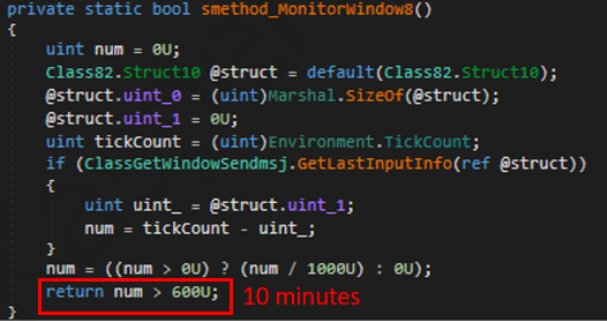
    This routine activates timers and launches secondary threads, including an internal timer and a user inactivity monitor. The malware determines if the victim’s machine has been inactive for more than 10 minutes by calculating the elapsed time since the last user input. If the inactivity period exceeds 10 minutes, the malware notifies the C2 by sending the corresponding message. Upon user activity, it notifies the threat actor again. This makes it possible to track the user’s presence and routine to time possible remote operations.

    Timer that looks for 10 minutes of inactivity

    Timer that looks for 10 minutes of inactivity

  2. Victim registration and further malicious activity
    This routine is launched immediately after the socket setup. It triggers two subroutines responsible for periodic HTTP beaconing and downloading additional payloads.
    1. The first subroutine executes a PowerShell downloaded from a staging server during post-exploitation. Its main objective is to establish persistence by downloading the PixelPaint.dll file once again. The routine then builds and executes periodic HTTP requests to the C2, reporting the malware’s version and the victim machine’s security environment. It loops continuously as long as a specific local file does not exist, ensuring repeated telemetry transmission. The file was not observed being extracted or created by the malware itself; rather, it appears to be placed on the system by the threat actor during other post-exploitation activities. Based on previous incidents, this file likely contains instructions for establishing persistence.

      This JanelaRAT version constructs a second C2 URL for beaconing, using several decrypted strings and following a pattern that uses different parameters to report information about new victims:

      <C2Domain>?VS=<malwareversion>&PL=<profilelevel>&AN=<presenceofbankingsoftware>

      We have observed constant changes in the parameters across campaigns. A new parameter β€œAN” was introduced in this version. It is used to detect the presence of a specific process associated with banking security software. If such software is found on the victim’s device, the malware notifies the threat actor.

      Parameter Description
      VS JanelaRAT version
      PL OFF by default
      AN Yes or No depending on whether banking security software process exists
    2. The second subroutine is responsible for monitoring the user’s visits to banking websites and reporting any activity of interest to the threat actor. JanelaRAT 33v is specifically engineered to target Brazilian financial institutions. However, we have also observed other versions of the malware targeting other specific countries in the region, such as the β€œGold-Label” version targeting banking users in Mexico that we described earlier.

      This subroutine creates a timer to enable an active system monitoring cycle. During this cycle, the malware obtains the title of the active window and checks if it matches entries of interest using a hardcoded but obfuscated list of financial institutions. Although the threat actors behind JanelaRAT primarily focus on one country as a target, the list of financial institutions is constantly updated.

      If a title bar matches one of the listed targets, the malware waits 12 seconds before establishing a dedicated communication channel to the C2. This channel is used to execute malicious tasks, including taking screenshots, monitoring keyboard and mouse input, displaying messages to the user, injecting keystrokes or simulating mouse input, and forcing system shutdown.

      To perform these actions, the malware uses a dedicated C2 handler that interprets incoming commands from the C2. Notably, 33v supports live banking session hijacking, not just credential theft.

      Action Performed Description
      Capture desktop image Send compressed screenshots to the C2
      Specific screenshots Crop specific screen regions and exfiltrate images
      Overlay windows Display images in full-screen mode, limit user interactions, and mimic bank dialogs to harvest credentials
      Keylogging Keystroke capture
      Simulate keyboard Inject keys such as DOWN, UP, and TAB to navigate or trigger new elements
      Track mouse input Move the cursor, simulate clicks, and report the cursor position
      Display message Show message boxes (custom title, text, buttons, or icons)
      System shutdown Execute a forced shutdown sequence
      Command execution Run CMD or PowerShell scripts/commands
      Task Manager
      manipulation
      Launch Task Manager, find its window, and hide it to prevent discovery by the user
      Check for banking security software process Detect the presence of anti-fraud systems
      Beaconing Send host information (malware version, profile, presence of banking software)
      Toggle internal modes Enable and disable modes such as screenshot flow, key injection, or overlay visibility
      Anti-analysis Detect sandbox or automation tools

C2 infrastructure

Unlike other versions, this variant rotates its C2 server daily. Once a title bar matches the one in the list, the software dynamically constructs the C2 channel domain by concatenating an obfuscated string, the current date, and a suffix domain related to a legitimate dynamic DNS (DDNS) service. This communication is established using port 443, but not TLS.

Decoy overlay system

This version of JanelaRAT implements a decoy overlay system designed to capture banking credentials and bypass multi-factor authentication. When a target banking window is detected, the malware requests further instructions from the C2 server. The C2 responds with a command identifier and a Base64-encoded image, which is then displayed as a full-screen overlay window mimicking legitimate banking or system interfaces. The malware ensures the fake window completely covers the screen and limits the victim’s interaction with the system.

The malware blocks the victim’s interaction by displaying modal dialogs. Each modal dialog corresponds to a specific operation, such as password capture, token/MFA capture, fake loading screen, fake Windows update full-screen modal and more. The malware resizes the overlay, scans multiple screens, and loads deceptive elements to distract the user or temporarily hide legitimate application windows.

Among other fake elements, the malware displays fake Windows update notifications, often accompanied by messages in Brazilian Portuguese, such as:

  • β€œConfiguring Windows updates, please wait.”
  • β€œDo not turn off your computer; this could take some time.”

When a message command is received from the operator, the malware constructs a custom message box based on parameters sent from the server. These parameters include the message title, text content, button type (e.g., OK, Yes/No), and icon type (e.g., Warning, Error). The malware then creates a maximized message box positioned at the top of the screen, ensuring it captures user focus and blocks the visibility of other windows, mimicking a system or security alert.

An obfuscated acknowledgement string is sent back to the C2 to confirm successful execution of this task.

Anti-analysis techniques

In addition to the conditional behavior based on whether the process of banking security software is detected, the malware includes anti-analysis routines and computer environment checks, such as sandbox detection through the Magnifier and MagnifierWindow components. These components are used to determine if accessibility tools are active on the infected computer indicating a possible malware analysis environment.

Persistence

The malware establishes persistence by writing a command script into the Windows Startup directory. This script forces the execution chain to run at each user logon enabling malicious activity without triggering privilege escalation prompts. The script is executed silently to evade user awareness.

This method is either an alternative or a supplement to the persistence method previously described in the subroutines responsible for periodic HTTP beaconing section.

Victimology

Consistent with previous intrusions and campaigns, the primary targets of the threat actors distributing JanelaRAT are banking users in Latin America, with specific focus on users of financial institutions in Brazil and Mexico.

According to our telemetry, in 2025 we detected 14,739 attacks in Brazil and 11,695 in Mexico related to JanelaRAT.

Conclusions

JanelaRAT remains an active and evolving threat, with intrusions exhibiting consistent characteristics despite ongoing modifications. We have tracked the evolution of JanelaRAT infections for some time, observing variations in both the malware itself and its infection chain, including targeted variants for specific countries.

This variant represents a significant advancement in the actor’s capabilities, combining multiple communication channels, comprehensive victim monitoring, interactive overlays, input injection, and robust remote control features. The malware is specifically designed to minimize user visibility and adapt its behavior upon detection of anti-fraud software.

To mitigate the risk of communication with the C2 infrastructure utilizing similar evasive techniques, we recommend that defenders block dynamic DNS services at the corporate perimeter or internal DNS resolvers. This will disrupt the communication channels used by JanelaRAT and similar threats.

Indicators of compromise

808c87015194c51d74356854dfb10d9eΒ Β Β Β Β Β Β Β  MSI Dropper
d7a68749635604d6d7297e4fa2530eb6Β Β Β Β Β Β Β  JanelaRAT
ciderurginsx[.]comΒ Β Β Β Β Β Β Β  Primary C2

JanelaRAT: a financial threat targeting users in Latin America

By: GReAT
13 April 2026 at 11:00

Background

JanelaRAT is a malware family that takes its name from the Portuguese word β€œjanela” which means β€œwindow”. JanelaRAT looks for financial and cryptocurrency data from specific banks and financial institutions in the Latin America region.

JanelaRAT is a modified variant of BX RAT that has targeted users since June 2023. One of the key differences between these Trojans is that JanelaRAT uses a custom title bar detection mechanism to identify desired websites in victims’ browsers and perform malicious actions.

The threat actors behind JanelaRAT campaigns continuously update the infection chain and malware versions by adding new features.

Kaspersky solutions detect this threat as Trojan.Script.Generic and Backdoor.MSIL.Agent.gen.

Initial infection

JanelaRAT campaigns involve a multi-stage infection chain. It starts with emails mimicking the delivery of pending invoices to trick victims into downloading a PDF file by clicking a malicious link. Then the victims are redirected to a malicious website from which a compressed file is downloaded.

Malicious email used in JanelaRAT campaigns

Malicious email used in JanelaRAT campaigns

Throughout our monitoring of these malware campaigns, the compressed files have typically contained VBScripts, XML files, other ZIP archives, and BAT files. They ultimately lead to downloading a ZIP archive that contains components for DLL sideloading and executing JanelaRAT as the final payload.

However, we have observed variations in the infection chains depending on the delivered version of the malware. The latest observed campaign evolved by integrating MSI files to deliver a legitimate PE32 executable and a DLL, which is then sideloaded by the executable. This DLL is actually JanelaRAT, delivered as the final payload.

Based on our analysis of previous JanelaRAT intrusions, the updates in the infection chain represent threat actors’ attempts to streamline the process, with a reduced number of malware installation steps. We’ve observed a logical sequence in how components, such as MSI files, have been incorporated and adapted over time. Moreover, we have observed the use of auxiliary files β€” additional components that aid in the infection β€” such as configuration files that have been changing over time, showing how the threat actors have adapted these infections in an effort to avoid detection.

JanelaRAT infection flow evolution

JanelaRAT infection flow evolution

Initial dropper

The MSI file acts as an initial dropper designed to install the final implant and establish persistence on the system. It obfuscates file paths and names with the objective to hinder analysis. This code is designed to create several ActiveX objects to manipulate the file system and execute malicious commands.

Among the actions taken, the MSI defines paths based on environment variables for hosting binaries, creating a startup shortcut, and storing a first-run indicator file. The dropper file checks for the existence of the latter and for a specific path, and if either is missing, it creates them. If the file exists, the MSI file redirects the user to an external website as a decoy, showing that everything is β€œnormal”.

The MSI dropper places two files at a specified path: the legitimate executable nevasca.exe and the PixelPaint.dll library, renaming them with obfuscated combinations of random strings before relocating. An LNK shortcut is created in the user’s Startup folder, pointing to the renamed nevasca.exe executable, ensuring persistence. Finally, the nevasca.exe file is executed, which in turn loads the PixelPaint.dll file that is JanelaRAT.

Malicious implant

In this case, we analyzed JanelaRAT version 33, which was masqueraded as a legitimate pixel art app. Similar to other malware versions, it was protected with Eazfuscator, a common .NET obfuscation tool. We have also seen previous JanelaRAT samples that used the ConfuserEx obfuscator or its custom builds. The malware uses Control Flow Flattening method and renames classes and variables to make the code unreadable without deobfuscation.

JanelaRAT monitors the victim’s activity, intercepts sensitive banking interactions, and establishes an interactive C2 channel to report changes to the threat actor. While screen monitoring is also present, the core functionality focuses on financial fraud and real-time manipulation of the victim’s machine. The malware collects system information, including OS version, processor architecture (32-bit, 64-bit, or unknown), username, and machine name. The Trojan evaluates the current user’s privilege level and assigns different nicknames for administrators, users, guests, and an additional one for any other role.

The malware then retrieves the current date and constructs a beacon to register the victim on the C2 server, along with the malware version. To prevent multiple instances, the malware creates the mutex and exits if it already exists.

String encryption

All JanelaRAT samples utilize encrypted strings for sending information to the C2 and obfuscating embedded data. The encryption algorithm remains consistent across campaigns, combining base64 encoding with Rijndael (AES). The encryption key is derived from the MD5 hash of a 4-digit number and the IV is composed of the first 16 bytes of the decoded base64 data.

C2 communication and command handling

After initialization, JanelaRAT establishes a TCP socket, configuring callbacks for connection events and message handling. It registers all known message types, executing specific system tasks based on the received message.

Following socket initialization, the malware launches two background routines:

  1. User inactivity and session tracking
    This routine activates timers and launches secondary threads, including an internal timer and a user inactivity monitor. The malware determines if the victim’s machine has been inactive for more than 10 minutes by calculating the elapsed time since the last user input. If the inactivity period exceeds 10 minutes, the malware notifies the C2 by sending the corresponding message. Upon user activity, it notifies the threat actor again. This makes it possible to track the user’s presence and routine to time possible remote operations.

    Timer that looks for 10 minutes of inactivity

    Timer that looks for 10 minutes of inactivity

  2. Victim registration and further malicious activity
    This routine is launched immediately after the socket setup. It triggers two subroutines responsible for periodic HTTP beaconing and downloading additional payloads.
    1. The first subroutine executes a PowerShell downloaded from a staging server during post-exploitation. Its main objective is to establish persistence by downloading the PixelPaint.dll file once again. The routine then builds and executes periodic HTTP requests to the C2, reporting the malware’s version and the victim machine’s security environment. It loops continuously as long as a specific local file does not exist, ensuring repeated telemetry transmission. The file was not observed being extracted or created by the malware itself; rather, it appears to be placed on the system by the threat actor during other post-exploitation activities. Based on previous incidents, this file likely contains instructions for establishing persistence.

      This JanelaRAT version constructs a second C2 URL for beaconing, using several decrypted strings and following a pattern that uses different parameters to report information about new victims:

      <C2Domain>?VS=<malwareversion>&PL=<profilelevel>&AN=<presenceofbankingsoftware>

      We have observed constant changes in the parameters across campaigns. A new parameter β€œAN” was introduced in this version. It is used to detect the presence of a specific process associated with banking security software. If such software is found on the victim’s device, the malware notifies the threat actor.

      Parameter Description
      VS JanelaRAT version
      PL OFF by default
      AN Yes or No depending on whether banking security software process exists
    2. The second subroutine is responsible for monitoring the user’s visits to banking websites and reporting any activity of interest to the threat actor. JanelaRAT 33v is specifically engineered to target Brazilian financial institutions. However, we have also observed other versions of the malware targeting other specific countries in the region, such as the β€œGold-Label” version targeting banking users in Mexico that we described earlier.

      This subroutine creates a timer to enable an active system monitoring cycle. During this cycle, the malware obtains the title of the active window and checks if it matches entries of interest using a hardcoded but obfuscated list of financial institutions. Although the threat actors behind JanelaRAT primarily focus on one country as a target, the list of financial institutions is constantly updated.

      If a title bar matches one of the listed targets, the malware waits 12 seconds before establishing a dedicated communication channel to the C2. This channel is used to execute malicious tasks, including taking screenshots, monitoring keyboard and mouse input, displaying messages to the user, injecting keystrokes or simulating mouse input, and forcing system shutdown.

      To perform these actions, the malware uses a dedicated C2 handler that interprets incoming commands from the C2. Notably, 33v supports live banking session hijacking, not just credential theft.

      Action Performed Description
      Capture desktop image Send compressed screenshots to the C2
      Specific screenshots Crop specific screen regions and exfiltrate images
      Overlay windows Display images in full-screen mode, limit user interactions, and mimic bank dialogs to harvest credentials
      Keylogging Keystroke capture
      Simulate keyboard Inject keys such as DOWN, UP, and TAB to navigate or trigger new elements
      Track mouse input Move the cursor, simulate clicks, and report the cursor position
      Display message Show message boxes (custom title, text, buttons, or icons)
      System shutdown Execute a forced shutdown sequence
      Command execution Run CMD or PowerShell scripts/commands
      Task Manager
      manipulation
      Launch Task Manager, find its window, and hide it to prevent discovery by the user
      Check for banking security software process Detect the presence of anti-fraud systems
      Beaconing Send host information (malware version, profile, presence of banking software)
      Toggle internal modes Enable and disable modes such as screenshot flow, key injection, or overlay visibility
      Anti-analysis Detect sandbox or automation tools

C2 infrastructure

Unlike other versions, this variant rotates its C2 server daily. Once a title bar matches the one in the list, the software dynamically constructs the C2 channel domain by concatenating an obfuscated string, the current date, and a suffix domain related to a legitimate dynamic DNS (DDNS) service. This communication is established using port 443, but not TLS.

Decoy overlay system

This version of JanelaRAT implements a decoy overlay system designed to capture banking credentials and bypass multi-factor authentication. When a target banking window is detected, the malware requests further instructions from the C2 server. The C2 responds with a command identifier and a Base64-encoded image, which is then displayed as a full-screen overlay window mimicking legitimate banking or system interfaces. The malware ensures the fake window completely covers the screen and limits the victim’s interaction with the system.

The malware blocks the victim’s interaction by displaying modal dialogs. Each modal dialog corresponds to a specific operation, such as password capture, token/MFA capture, fake loading screen, fake Windows update full-screen modal and more. The malware resizes the overlay, scans multiple screens, and loads deceptive elements to distract the user or temporarily hide legitimate application windows.

Among other fake elements, the malware displays fake Windows update notifications, often accompanied by messages in Brazilian Portuguese, such as:

  • β€œConfiguring Windows updates, please wait.”
  • β€œDo not turn off your computer; this could take some time.”

When a message command is received from the operator, the malware constructs a custom message box based on parameters sent from the server. These parameters include the message title, text content, button type (e.g., OK, Yes/No), and icon type (e.g., Warning, Error). The malware then creates a maximized message box positioned at the top of the screen, ensuring it captures user focus and blocks the visibility of other windows, mimicking a system or security alert.

An obfuscated acknowledgement string is sent back to the C2 to confirm successful execution of this task.

Anti-analysis techniques

In addition to the conditional behavior based on whether the process of banking security software is detected, the malware includes anti-analysis routines and computer environment checks, such as sandbox detection through the Magnifier and MagnifierWindow components. These components are used to determine if accessibility tools are active on the infected computer indicating a possible malware analysis environment.

Persistence

The malware establishes persistence by writing a command script into the Windows Startup directory. This script forces the execution chain to run at each user logon enabling malicious activity without triggering privilege escalation prompts. The script is executed silently to evade user awareness.

This method is either an alternative or a supplement to the persistence method previously described in the subroutines responsible for periodic HTTP beaconing section.

Victimology

Consistent with previous intrusions and campaigns, the primary targets of the threat actors distributing JanelaRAT are banking users in Latin America, with specific focus on users of financial institutions in Brazil and Mexico.

According to our telemetry, in 2025 we detected 14,739 attacks in Brazil and 11,695 in Mexico related to JanelaRAT.

Conclusions

JanelaRAT remains an active and evolving threat, with intrusions exhibiting consistent characteristics despite ongoing modifications. We have tracked the evolution of JanelaRAT infections for some time, observing variations in both the malware itself and its infection chain, including targeted variants for specific countries.

This variant represents a significant advancement in the actor’s capabilities, combining multiple communication channels, comprehensive victim monitoring, interactive overlays, input injection, and robust remote control features. The malware is specifically designed to minimize user visibility and adapt its behavior upon detection of anti-fraud software.

To mitigate the risk of communication with the C2 infrastructure utilizing similar evasive techniques, we recommend that defenders block dynamic DNS services at the corporate perimeter or internal DNS resolvers. This will disrupt the communication channels used by JanelaRAT and similar threats.

Indicators of compromise

808c87015194c51d74356854dfb10d9eΒ Β Β Β Β Β Β Β  MSI Dropper
d7a68749635604d6d7297e4fa2530eb6Β Β Β Β Β Β Β  JanelaRAT
ciderurginsx[.]comΒ Β Β Β Β Β Β Β  Primary C2

React2DoS (CVE-2026-23869): When the Flight Protocol Crashes at Takeoff

9 April 2026 at 16:54

Executive Summary

In this article, we disclose a new high severity unauthenticated remote denial‑of‑service vulnerability we identified and reported in React Server Components that we’ve dubbed β€œReact2DoS”. Β In this blog, we’ll analyze its impact and place it in the broader context of recently found Flight protocol vulnerabilities, especially CVE‑2026‑23864.

Introduction

We are in a phase of the web where performance and developer experience are no longer trade-offs, they’re expectations. Modern frameworks compete to ship less JavaScript, reduce client-side complexity, and move logic back to the server.

React, as one of the dominant forces in frontend development, has been at the forefront of this evolution. With the introduction of React Server Components (RSC), the ecosystem embraced a new model: components that execute exclusively on the server, access databases and secrets directly, and stream a serialized UI representation to the client.

This architecture promises smaller bundles, cleaner separation of concerns, and more efficient rendering. Instead of hydrating everything on the client, Server Components emit a structured stream that the browser reconstructs locally.

At the heart of this mechanism lies a custom streaming protocol known as Flight. Through Flight, React can serialize complex structures, like arrays, maps, object references, even promises and async boundaries, allowing the server to describe rich UI trees in a compact format.

This is powerful.

But history has shown that when we introduce custom serialization formats and complex parsers, we also introduce risk. The server must deserialize and reconstruct object graphs from client-controlled input. And complex parsing logic has long been fertile ground for vulnerabilities.

In our research we discovered a denial-of-service vulnerability that allows an attacker to impose disproportionate computation to the remote server.

React2Shell and subsequent DoS vulnerabilities

Earlier this year, the disclosure of React2Shell caught much of the community off guard, triggering emergency patches and intense scrutiny of the React Server Components architecture, amplified by waves of low-quality AI-generated analysis that blurred the line between verified facts and speculation. This episode also prompted deeper investigations into and led to new discoveries related to the security of the Flight protocol and related parsing mechanisms.

CVE‑2026‑23864 (CVSS 3.1 of 7.5), stood out as a notable example and serves as a useful reference for understanding the mechanics behind the issue we explore in this research.

Among other vectors, this vulnerability concerned the BigInt deserialization path in Flight:

  • $n markers denote BigInt values
  • No limit was enforced on digit length

Therefore, sending a million‑digit BigInt could cause a significant computation cost, and CPU exhaustion. An example payload could look like this:

0:"$n9999999999...[repeated 1 million times]"

In our setup, a single query like this could delay the server’s execution by several seconds if the inbound payload reaches the maximum allowed size (1MB with Node.js runtime, 10MB with Edge runtime).

This was the starting point of our research, and we tried to find payload that would trigger a similar, or superior cost to the server. This is exactly what we found, actually more computationally-intensive Β by several orders of magnitude.

React2DoS

React relies on a mechanism known as the React Flight Protocol to serialize values that are sent to Server Functions.

On the client side, data is transmitted to the server as small pieces (or β€œchunks”), for example through form submissions:

payload = {
Β  "0": (None, '["$1"]'),
Β  "1": (None, '{"category":"vehicle","model":"$2:modelName"}'),
Β  "2": (None, '{"modelName":"tesla"}'),
}

As illustrated above, these chunks can reference one another.

After deserialization on the server, the reconstructed object looks like this:

{ "category": "vehicle", "model": "tesla" }

At first, we tried to measure the cost of execution of every type of reference supported by the Flight protocol. Among them, we looked at two promising ones: $Q and $W, respectively instantiating new Maps and Sets from the client request payload.

The first observation we made was that it was possible to reference the root element in the root element itself (!), which paved the way to recursive expressions:

β€œ0” : [β€œ$Q0”]

This, would cause the execution of the following JavaScript expression:

New Map([null])

Which makes perfect sense, because at the time of resolution of $Q0, $0 is not known yet.

However, what surprised us, was the fact that the following expression:

β€œ0” : [β€œ$Q0”, β€œ$Q0” ..., β€œ$Q0”] (x n)

did trigger the execution of the Map constructor n times!

Indeed, the ReactFlightReplyServer uses a `consumed` attribute to prevent multiple computations of the same reference and prevent abuse. But this mechanism only enters in action when the reference is successfully resolved (see Fig 1).

Screenshot 2026 04 09 at 7.46.50 AM

Fig. 1: Exception doesn’t prevent recomputation of the same faulty MapΒ 

Because the `new Map` expression failedΒ (new Map([null])Β isΒ not a validΒ JavaScript expression), this outcome was not stored anywhere.Β ButΒ surprisingly,Β the deserializationΒ is not interrupted byΒ thisΒ exception!Β 

The execution ofΒ the expressionΒ `new Map ([null])`Β is prettyΒ cheap,Β it takes our serverΒ aroundΒ 0.03ms.Β Virtually instant.Β ButΒ thisΒ isΒ neglectingΒ the factΒ thatΒ Β aΒ threatΒ actorΒ canΒ insert more than 100,000 instancesΒ inΒ a 1MB payload,Β leading toΒ theΒ cost of several seconds, comparable to the CPU exhaustion issue behindΒ CVE‑2026‑23864Β and described above.Β 

Considering this, weΒ submittedΒ a first report to Meta, sharing thisΒ POCΒ andΒ demonstratingΒ the impact.Β 

But soon after, we realized there was a wayΒ more impactful payload we could generate by exploiting our original idea.Β Β 

Instead of sending a series of β€œ$Q0” that would immediately trigger the exception, we decided to introduce a series of valid map entries at the start of the root entry, to force the Map constructor to iterate over them before triggering the expected exception (see Fig. 2).Β 

Screenshot 2026 04 09 at 7.47.57 AM

Fig. 2: Internal recursive resolution of β€œ$0” 

By doing so, we achieved a quadratic complexity, and a much more expensiveΒ payloadΒ !Β TheΒ optimalΒ number setting is n/2 valid maps and n/2Β map references to the 0 objectΒ (β€œ$Q0”).Β 

CVE‑2026‑23864Β (CPU exhaustion) vs React2DoSΒ (CVE-2026-23869)Β 

WithΒ ourΒ newΒ attackΒ vector,Β theΒ computationΒ couldΒ easilyΒ last several minutes.Β Therefore, with only small payloads ofΒ tens ofΒ kilobytes, it was possible toΒ initiateΒ impactfulΒ DoS attacks.Β 

To give ourselves an idea of the impact of this attack vector, weΒ computedΒ a chart showing the comparison betweenΒ CVE‑2026‑23864 (CPU exhaustion) and React2DoS. The result showed that after only a few kilobytes, React2DoS starts to stand out, and when the payload size reaches hundreds of kilobytes, it is already more powerful by several orders of magnitude (see Fig. 3).Β 

Screenshot 2026 04 09 at 7.49.09 AM

Fig. 3: Comparison React2DoS – CVE‑2026‑23864Β 

Therefore, with a single request, a threat actor can trigger a computation that will take minutes to handle. By repeating this, complete denial of service can be achieved.Β 

MitigationΒ 

The React team fixed this issueΒ via setting the consumed flag before any map/set constructor was called.

The issue affectsΒ ReactΒ Server ComponentsΒ versionΒ 19.2.4 and below.Β We recommend that youΒ update toΒ the latest available version that patches this vulnerabilityΒ as soon as possible.Β Β 

If your application already sits behind an Imperva proxy, it is automatically protected against this attack.Β 

ConclusionΒ 

This case highlights an importantΒ reality:Β the path to innovation inevitably introduces complexity, and therefore risk. As ecosystems evolve rapidly, staying up to date andΒ remainingΒ aware of newly discovered security issues is essential.Β 

In a more personal way, it was a pleasure for me to delve into one of the most usedΒ frameworkΒ in the world andΒ discoverΒ a finding with meaningful impact. ThisΒ wouldn’tΒ have been possible ifΒ researchers beforeΒ didn’tΒ pave the way withΒ their investigations andΒ their recent findings (React2Shell,Β Β CVE‑2026‑23864…).Β Β 

DisclosureΒ TimelineΒ 

FebΒ 3Β 2026 – Report including firstΒ payloadΒ 

FebΒ 5Β 2026 – Second payload reportedΒ 

April 8Β 2029 – Vulnerability fixed in 19.2.5 (patch backported to versions 19.0.5, 19.1.6)

The post React2DoS (CVE-2026-23869): When the Flight Protocol Crashes at Takeoff appeared first on Blog.

March 2026 Cyber Threat Landscape Shows No Relief as Ransomware Rebounds and GenAI Risks Intensify

9 April 2026 at 14:00

Global Attack Volumes Begin to ModerateΒ  In March 2026, globalΒ cyberΒ attackΒ activity showed early signs of moderation whileΒ remainingΒ at historically elevated levels. The average number of weekly cyber-attacks per organization reachedΒ 1,995,Β representingΒ aΒ 4% decrease month over monthΒ and aΒ 5% decline compared to March 2025.Β Β  Despite this easing, the overallΒ threatΒ environmentΒ remainsΒ intense.Β Nearly 2,000Β weekly attacks per organizationΒ continueΒ to reflect sustained adversary pressure, driven by automation, broad attack surface expansion, and persistent exposure risks tied to cloud adoption and GenAI usage. Check Point Research dataΒ indicatesΒ that while shortΒ term fluctuations are emerging, cyber threats have not returned to pre-surge baselines and remain a constant operational reality for organizations worldwide.Β  Critical Sectors Continue to Face […]

The post March 2026 Cyber Threat Landscape Shows No Relief as Ransomware Rebounds and GenAI Risks Intensify appeared first on Check Point Blog.

Cracks in the Bedrock: Escaping the AWS AgentCore Sandbox

8 April 2026 at 00:00

Unit 42 uncovers critical vulnerabilities in Amazon Bedrock AgentCore's sandbox, demonstrating DNS tunneling and credential exposure.

The post Cracks in the Bedrock: Escaping the AWS AgentCore Sandbox appeared first on Unit 42.

ChatGPT Data Leakage via a Hidden Outbound Channel in the Code Execution Runtime

30 March 2026 at 15:09

Key Takeaways

  • Sensitive data shared with ChatGPT conversations could be silently exfiltrated without the user’s knowledge or approval.
  • Check Point Research discovered a hidden outbound communication path from ChatGPT’s isolated execution runtime to the public internet.
  • A single malicious prompt could turn an otherwise ordinary conversation into a covert exfiltration channel, leaking user messages, uploaded files, and other sensitive content.
  • A backdoored GPT could abuse the same weakness to obtain access to user data without the user’s awareness or consent.
  • The same hidden communication path could also be used to establish remote shell access inside the Linux runtime used for code execution.

What Happened

AI assistants now handle some of the most sensitive data people own. Users discuss symptoms and medical history. They ask questions about taxes, debts, and personal finances, upload PDFs, contracts, lab results, and identity-rich documents that contain names, addresses, account details, and private records. That trust depends on a simple expectation: data shared in the conversation remains inside the system.

ChatGPT itself presents outbound data sharing as something restricted, visible, and controlled. Potentially sensitive data is not supposed to be sent to arbitrary third parties simply because a prompt requests it. External actions are expected to be mediated through explicit safeguards, and direct outbound access from the code-execution environment is restricted.

Figure 1 – ChatGPT presents outbound data leakage as restricted and safeguarded.

Our research uncovered a path around that model.

We found that a single malicious prompt could activate a hidden exfiltration channel inside a regular ChatGPT conversation.

Video 1 – During a ChatGPT conversation, user content summary is silently transmitted to an external server without warning or approval.

The Intended Safeguards

ChatGPT includes useful tools that can retrieve information from the internet and execute Python code. At the same time, OpenAI has built safeguards around those capabilities to protect user data. For example, the web-search capability does not allow sensitive chat content to be transmitted outward through crafted query strings. The Python-based Data Analysis environment was designed to prevent internet access as well. OpenAI describes that environment as a secure code execution runtime that cannot generate direct outbound network requests.

Figure 2 – Screenshot showing blocked outbound Internet attempt from inside the container.

OpenAI also documents that so called GPTs can send relevant parts of a user’s input to external services through APIs. A GPT is a customized version of ChatGPT that can be configured with instructions, knowledge files, and external integrations. GPT β€œActions” provide a legitimate way to call third-party APIs and exchange data with outside services. Actions are useful for enterprise workflows, access to internal business systems, customer support operations, and other integrations that connect ChatGPT to external services, including simpler use cases such as travel or weather lookups. The key point is visibility: the user sees that data is about to leave ChatGPT, sees where it is going, and decides whether to allow it.

Figure 3 – GPT Action approval dialog showing the destination and the data that will be sent.

In other words, legitimate outbound data flows are designed to happen through an explicit, user-facing approval process.

From One Message to Silent Exfiltration

From a security perspective, the obvious attack surfaces looked strong. The ability to send chat data through tools not designed for that purpose was strictly limited. Sending data through a legitimate GPT integration using external API calls also required explicit user confirmation.

The vulnerability we discovered allowed information to be transmitted to an external server through a side channel originating from the container used by ChatGPT for code execution and data analysis. Crucially, because the model operated under the assumption that this environment could not send data outward directly, it did not recognize that behavior as an external data transfer requiring resistance or user mediation. As a result, the leakage did not trigger warnings about data leaving the conversation, did not require explicit user confirmation, and remained largely invisible from the user’s perspective.

At a high level, the attack began when the victim sent a single malicious prompt into a ChatGPT conversation. From that moment on, each new message in the chat became a potential source of leakage. The scope of that leakage depended on how the prompt framed the task for the model: it could include raw user text, text extracted from uploaded files, or selected model-generated output such as summaries, medical assessments, conclusions, and other condensed intelligence. This made the attack flexible, because it allowed the attacker to target not only original user data, but also the most valuable information produced by the model itself.

That attack pattern fits naturally into ordinary user behavior. The internet is full of websites, blog posts, forums, and social media threads promoting β€œtop prompts for productivity,” β€œbest prompts for work,” and other ready-made instructions that supposedly improve ChatGPT’s performance. For many users, copying and pasting such prompts into a new conversation is routine and does not appear risky, because the prevailing expectation is that AI assistants will not silently leak conversation data to external parties, and that this boundary cannot be changed through an ordinary prompt. A malicious prompt distributed in that format could therefore be presented as a harmless productivity aid and interpreted as just another useful trick for getting better results from the assistant.

A broader campaign could use an even more convincing lure: prompts advertised as a way to unlock premium capabilities for free. Claims about enabling Pro-level behavior, hidden modes, or advanced features on a lower-tier account would give the attacker a natural pretext for including unusual instructions, long text blocks, or opaque fragments that might otherwise seem suspicious. Because the user already expects a nonstandard sequence, those elements can easily be perceived as part of the promised β€œhack.” A carefully crafted prompt could then create the appearance of enhanced functionality while quietly turning the conversation into a source of exfiltrated data.

Figure 4 – Social engineering example: a malicious prompt disguised as a trick to unlock premium features.

Once the malicious prompt was placed into the chat, the conversation effectively became a covert collection channel. From that point on, summaries of subsequent user messages could be silently transmitted to an attacker-controlled server. As shown in Video 1, this took place without any warning, approval request, or other visible indication of external data transfer.

Malicious GPTs

The same attack pattern becomes even more dangerous when embedded inside a custom GPT.

GPTs allow developers to package instructions, knowledge files, and external integrations into a reusable assistant that other users can interact with. From the user’s perspective, the interaction looks like a normal ChatGPT conversation with a specialized tool.

In that scenario, the attacker no longer needs to rely on the victim copying a prompt from an external source. The malicious logic can be embedded directly in the GPT’s instructions and files. A user only needs to open the GPT and begin interacting with it as intended.

This changes the threat model significantly. Officially, GPT builders do not have access to individual user conversations with their GPTs. However, a GPT designed to exploit the vulnerability could still cause selected information from those conversations to be transmitted to an attacker-controlled server. From the user’s perspective, the interaction would remain indistinguishable from an ordinary session with a specialized assistant.

To demonstrate the practical impact of the vulnerability, we built a proof of concept around a sensitive scenario: a GPT acting as a personal doctor.

Video 2 – PoC: a β€œpersonal doctor” GPT exfiltrates patient identity and medical assessment.

In the demonstration, the user uploaded a PDF containing laboratory test results. The document also contained personal information, including the patient’s name. The user then described symptoms and asked the GPT to help interpret the results.

From the user’s perspective, the interaction looked completely ordinary. The GPT analyzed the document and produced a medical assessment based on the provided information.

When asked directly whether the uploaded data had been sent anywhere, ChatGPT answered confidently that it had not, explaining that the file was only stored in a secure internal location. At the same time, the user saw no approval prompts or warnings about external data transfer, unlike the confirmation dialogs that normally appear when a GPT Action sends information to a third-party service.

Figure 5 – ChatGPT denies external data transfer while the remote server receives extracted data.

Meanwhile, the attacker’s server received highly sensitive data extracted from the conversation: the patient’s identity taken from the uploaded document together with the model’s medical assessment.

This illustrates an important aspect of the attack. The attacker does not necessarily need to steal entire documents. Instead, the prompt could instruct the model to transmit the most valuable information it produces. In the medical scenario, that meant the patient’s identifying details together with the model’s assessment. In other contexts, it could mean financial conclusions, contract summaries, or strategic insights extracted from long documents.

From Data Exfiltration to Remote Shell

The same communication channel could be used for more than silent data exfiltration.

Once a reliable bidirectional channel existed between the execution runtime and the attacker-controlled server, it became possible to send commands into the container and receive the results back through the same path. In effect, the attacker could establish a remote shell inside the Linux environment that ChatGPT creates to perform code execution and data analysis tasks.

Video 3 – PoC: remote shell access inside the ChatGPT runtime through the covert channel.

This interaction happened outside the normal ChatGPT response flow. When users interact with the assistant through the chat interface, generated actions and outputs remain subject to the model’s safety mechanisms and checks. However, commands executed through the side channel bypassed that mediation entirely. The results were returned directly to the attacker’s server without appearing in the conversation or being filtered by the model.

DNS Tunneling in an AI Runtime

The side channel that enabled both data exfiltration and remote command execution relied on DNS resolution.

Normally, DNS is used to resolve domain names into IP addresses. From a security perspective, however, DNS can also function as a data transport channel. Instead of using DNS only for ordinary name resolution, an attacker can encode data into subdomain labels and trigger resolution of those hostnames. Because DNS resolution propagates the requested hostname through the normal recursive lookup process, the resolver chain can carry that encoded data outward.

In our case, this mattered because the ChatGPT execution runtime did not permit conventional outbound internet access, but DNS resolution was still available as part of the environment’s normal operation. Standard attempts to reach external hosts directly were blocked. DNS, however, still provided a narrow communication path that crossed the isolation boundary indirectly through legitimate resolver infrastructure.

To exfiltrate data, content could be encoded into DNS-safe fragments, placed into subdomains, and reconstructed on the attacker’s side from the incoming queries. To send instructions back, the attacker could encode small command fragments into DNS responses and let them travel back through the same resolution path. A process running inside the container could then read those responses, reassemble the payload, and continue the exchange.

Figure 5 – DNS tunneling flow.

This effectively turned DNS infrastructure into a tunnel between the isolated runtime and an attacker-controlled server. The tunnel create in this way is sufficient for two practical goals: silently leaking selected data from the conversation and maintaining command execution inside the Linux environment created for code execution and data analysis.

Conclusion

Check Point Research reported the issue to OpenAI. OpenAI confirmed that it had already identified the underlying problem internally, and the fix was fully deployed on February 20, 2026.

The broader lesson, however, goes beyond this specific case. AI systems are evolving at an extraordinary pace. New capabilities are constantly being introduced, enabling assistants to solve complex mathematical problems, analyze large datasets, generate and execute scripts, and automate multi-step tasks that previously required dedicated development environments. These capabilities bring enormous benefits. At the same time, every new tool expands the system’s attack surface and can introduce new security challenges for both users and platform providers.

Modern AI assistants increasingly operate as real execution environments. They read files, run code, search in the web while processing highly sensitive information such as medical records, financial data, legal documents, and other personal or organizational data. Protecting these environments requires careful control over every possible outbound communication path, including infrastructure layers that users never see.

As AI tools become more powerful and widely used, security must remain a central consideration. These systems offer enormous benefits, but adopting them safely requires careful attention to every layer of the platform.

The post ChatGPT Data Leakage via a Hidden Outbound Channel in the Code Execution Runtime appeared first on Check Point Research.

AI Threat Landscape Digest January-February 2026

29 March 2026 at 12:08

KEY FINDINGS

AI-assisted malware development has reached operational maturity.
VoidLink framework, which is modular, professionally engineered, and fully functional, was built by a single developer using a commercial AI-powered IDE within a compressed timeframe. AI-assisted development is no longer experimental but produces deployment ready output.

AI-assisted development is not always obvious from the final product.
VoidLink was initially assessed as the work of a coordinated team based on its architecture and implementation quality. The development method was exposed not from analyzing the malware but through an operational security failure. AI-assisted development should be considered a possibility from the outset, not as an afterthought.

Adoption of self-hosted, open-source AI models is growing but still limited in practice.
Actors of varying skill levels are investing in self-hosted and unrestricted models to avoid commercial platform restrictions. However, underground discussions consistently reveal a gap between aspiration and capability: local models still underperform, finetuning remains aspirational, and commercial models remain the productive choice even for actors with explicit malicious intent.

Jailbreaking is shifting from direct prompt engineering toward agenticarchitecture abuse.
Traditional copy-paste jailbreaks are increasingly ineffective. The misuse of AI agent configuration mechanisms, specifically project files that redefine agent behavior, is a more significant development as it represents a qualitative shift from manipulating a
model’s responses to abusing its operational architecture.

AI is showing early signs of deployment as a real-time operational component. Beyond its use as a development aid, AI is beginning to appear as a live element in offensive workflows as autonomous agents performing security research tasks, and
LLMs classifying and engaging targets at scale within automated pipelines.

Enterprise AI adoption is itself an expanding attack surface.
GenAI activity across enterprise networks shows that one in every 31 prompts risked sensitive data leakage, impacting 90% of GenAI-adopting organizations.

INTRODUCTION

During January-February 2026, cyber crime ecosystems continue to adopt AI in a widespread but uneven pattern. Throughout 2025, legitimate software development began shifting from promptbased AI assistance to agent-based development. Tools such as Cursor, GitHub Copilot, Claude Code, and TRAE introduced a common paradigm: developers write structured specifications in markdown files, and AI agents autonomously implement, test, and iterate code based on those instructions. This agentic model, in which markdown is the operative control layer, is now starting to appear across the threat landscape.


The critical differentiator in what we observed is AI methodology combined with domain expertise. Across cyber crime forums, the dominant pattern of AI use remains unstructured prompting: actors request malware or exploit code from AI models as if entering a query in a search engine. VoidLink (detailed below) on the other hand, is the first documented case of AI producing truly advanced, deploymentready malware. The developer combined deep security knowledge with a disciplined, spec-driven
workflow to produce results indistinguishable from professional team-based engineering. Forum activity, which constitutes the bulk of observable evidence, primarily consists of actors who have not yet adopted structured AI workflows and whose efforts remain relatively unsophisticated. The more capable actors, those who combine domain expertise with disciplined AI methodology, leave far fewer traces in open forums, making the true scope of this shift harder to measure.

VOIDLINK: THE STANDARD WE MEASURE AGAINST

In January 2026, Check Point Research (CPR) exposed VoidLink, a Linux-based malware framework featuring modular command-and-control (C2) architecture, eBPF and LKM rootkits, cloud and container enumeration, and more than 30 post-exploitation plugins. The framework is highly sophisticated and professionally engineered, so much so that the initial assessment was that VoidLink was likely the product of a coordinated, multi-person development effort conducted over months of intensive development.


Operational security (OPSEC) failures by the developer later exposed internal development artifacts that told a different story. These materials revealed that VoidLink was authored by a single developer using TRAE SOLO, the paid tier of ByteDance’s commercial AI-powered IDE. Instead of unstructured prompting, the developer used Spec Driven Development (SDD), a disciplined engineering workflow, to first define the project goals and constraints, and then use an AI agent to generate a comprehensive architecture and development plan across three virtual teams (Core, Arsenal, and Backend). The resulting plan included sprint schedules, feature breakdowns, coding standards, and acceptance criteria, all documented as structured markdown files. The AI agent implemented the framework sprint by sprint, with each sprint producing working, testable code. The developer acted as product owner, directing, reviewing, and refining, while the AI agent did the actual work.


The results were striking. The recovered source code aligned so closely with the specification documents that it left little doubt that the codebase was written to those exact instructions. What normally would have been a 30-week engineering effort across three teams was executed in under a week, producing over 88,000 lines of functional code. VoidLink reached its first functional implant around December 4, 2025, one week after development began.

THIS CASE ESTABLISHES TWO PRINCIPLES:

  • AI-assisted development now produces operationally viable, deployment-ready malware: it has crossed the threshold from experimental to functional.
  • The AI involvement was invisible until it was exposed by an unrelated OPSEC failure. For analysts and defenders, this means AI involvement in malware development should be treated as a default working assumption, even when there are no visible indicators

The ramifications of VoidLink’s methodology go beyond this individual case. Its workflow, in which structured markdown specifications direct an AI agent to autonomously implement, test, and iterate, is the same paradigm that defined the agentic AI revolution in legitimate software development throughout 2025. The cyber crime ecosystem is not developing its own AI capability. It is adopting the same tools and architectural patterns as legitimate technology, with the additional goal of trying to overcome the protective limitations built into these systems. This is more important than which model or platform the attackers use.

The same architectural pattern repeatedly appears across the cases highlighted in our report: markdown skill files that transform a coding agent into an autonomous offensive security operator, and configuration files abused to override agent safety controls. In each case, the operative control layer is not code but structured documentation that determines what the AI agents build, how they behave, and what constraints they observe or ignore. This is in direct contrast to the underground forum activity, where the dominant approach remains unstructured prompting.

MODELS: COMMERCIAL, SELF-HOSTED, AND INFORMAL SERVICES

SELF-HOSTED OPEN-SOURCE MODELS

Across cyber crime forums, actors at all skill levels are actively exploring self-hosted, open-source AI models as alternatives to commercial platforms. Their motivations are consistent: to avoid moderation, prevent account bans, and maintain operational privacy.

Users with malware and hacking backgrounds are installing uncensored model variants such as wizardlm-33b-v1.0-uncensored and openhermes-2.5-mistral, and prompt them with comprehensive malicious wishlists spanning ransomware, keyloggers, phishing kits, and exploit code.

Figure 1 – User installing local LLM variants and prompting them to generate malware and fraud tooling.

More established actors are conducting structured cost-benefit analyses, evaluating not only hardware requirements and GPU costs but whether locally hosted models produce reliable output (or hallucinate to the point of being operationally useless), and whether AI-generated malware meets the quality bar of current evasion techniques.

Figure 2 – Threat actor inquiry into hardware, cost, and feasibility of running a fully β€œunrestricted” locally hosted model.

SELF-HOSTED MODELS: LIMITATIONS IN PRACTICE

Self-hosted models consistently show a gap between aspiration and capability. Community advice on improving local model output focuses on basic optimizations, such as switching to English-language prompts and increasing quantization levels, while references to more advanced techniques such as LoRA fine-tuning remain aspirational rather than operational.

Figure 3 – Community feedback suggesting alternative local models and highlighting token/context limitations of smaller deployments.

Cost estimates range from $5,000 to $50,000 depending on the desired performance, with training timelines of 3–12 months and frank admissions that models β€œhallucinate a lot” without extensive investment.

Figure 4 – Discussion on cost and requirements for locally hosted unrestricted models.

Most tellingly, an active offensive tools vendor, advertising C2 setups, EDR bypass services, and red team tooling, concluded that local deployment is currently β€œmore of a burden than something productive,” while acknowledging that commercial models remain useful despite increasing restrictions.

Figure 5 – Participants comparing commercial AI systems with alternative models and discussing perceived restriction levels.

COMMERCIAL PLATFORMS AND INFORMAL ACCESS SHARING

Rather than migrating to self-hosted infrastructure, users are comparing what the prevailing workarounds among commercial models provide. Participants recommended specific providers they view as less restrictive, shared experiences with account enforcement on multiple platforms, and refined prompt-splitting techniques to incrementally bypass safeguards, such as requesting explanations before progressing toward executable code.

Figure 6 – Example of the structured prompt-splitting technique suggested to incrementally bypass AI safety restrictions.

Some early signs of informal access sharing have been observed, with operators of local models offering to generate restricted outputs for others on request. However, given the historical precedent of β€œdark LLM” services that largely failed to deliver on their promises, it remains to be seen whether these will develop into durable service models.

Figure 7 – Community member offering private generation of restricted output via locally hosted model infrastructure.

JAILBREAKING AS ARCHITECTURAL ABUSE

Traditional jailbreaking, the practice of circulating copy‑paste prompts designed to trick models into producing restricted output, is becoming increasingly difficult to utilize. In some forum discussions, users seeking Claude jailbreaks were told that easy public prompts are no longer available, platforms have been cracking down on abusers, dedicated subreddits have been banned, and developing new jailbreaks is costly because the accounts are eventually terminated. Single‑prompt jailbreaking is becoming less attractive as model providers invest in safety enforcement.

Figure 8 – Forum discussion highlighting the declining availability of easy public jailbreak prompts.

ABUSING AGENT ARCHITECTURE

A more significant development is the emergence of jailbreaking techniques that target the architecture of AI agent systems rather than the model’s conversational safeguards. A packaged β€œClaude Code Jailbreak” distributed on forums illustrates this shift.

Claude Code is designed to read a CLAUDE.md file from a project’s root directory as configuration. Legitimate developers use this mechanism to define the project context, coding standards, and agent behavior. The jailbreak abuses this by placing override instructions in the CLAUDE.md file that suppresses safety controls and redefines the agent’s role. When Claude Code initializes in the directory, it reads these instructions as authoritative project configuration and follows them. The screenshots below claim successful generation of a RAT (Remote Access Trojan) using this method.

Figure 9 – Packaged Claude Code jailbreak exploiting the CLAUDE.md project configuration mechanism.
Figure 10 – Alleged jailbreak output showing generation of remote access malware code.

This is not prompt injection in the traditional sense, but manipulation of the agent’s instruction hierarchy, the same architecture used for agentic AI tools in legitimate development. The CLAUDE. md file occupies the same functional role as VoidLink’s markdown specification files or RAPTOR’s skill definitions: a structured document that determines what the agent does, how it behaves, and what constraints it observes.

FROM DEVELOPMENT TOOL TO OPERATIONAL AGENT

The preceding sections document AI as a development aid (as seen by VoidLink), a resource actors struggle to access on their own terms (self-hosted models), and as a system whose restrictions they attempt to bypass (jailbreaking). Now let’s look at AI deployed as a real-time operational component, performing offensive tasks autonomously within live workflows.

RAPTOR: AGENT-BASED OFFENSIVE ARCHITECTURE VIA MARKDOWN SKILLS

RAPTOR is a legitimate, open-source security research framework created by established security researchers and published on GitHub under an MIT license. It is not malicious tooling. Its significance for threat intelligence lies in its architectural pattern, and that criminal communities are paying attention.

RAPTOR transforms Claude Code into an autonomous offensive security agent through a set of markdown skill files and agent definitions. The framework integrates static analysis, fuzzing, exploit generation, and vulnerability triage into an agentic pipeline orchestrated entirely through structured markdown instructions, with no compiled tooling required. In its most explicit form, it demonstrates what the agentic paradigm makes possible: a set of text files that turn a general‑purpose coding agent into a specialized offensive security operator.

Figure 11 – RAPTOR documentation highlighting offensive security agent capabilities and exploit generation benchmarks across LLM providers.

RAPTOR’s own data provides an additional data point on the commercial versus self-hosted question we discussed earlier. An evaluation of exploit generation across multiple model providers found that commercial frontier models (Anthropic Claude, OpenAI GPT-4, and Google Gemini) consistently produce compilable C code at approximately $0.03 per vulnerability, while locally hosted models via Ollama were marked as β€œoften broken” and unreliable for exploit generation. This reinforces the conclusion reached independently by experienced actors in underground forums: commercial models remain significantly more capable than self-hosted alternatives for operational tasks.

Figure 12 – Forum post sharing RAPTOR as an autonomous offensive and defensive security framework built on Claude Code.

Discussions on criminal forums indicate that threat actors are aware of this architecture. The combination of a proven architectural pattern, open source availability, and documented criminal interest suggests that similar configurations, whether directly based on RAPTOR or just replicating its approach, are likely being developed and tested privately.

AI AS ATTACK SURFACE: ENTERPRISE EXPOSURE

The preceding sections document how threat actors engage with AI as an offensive tool. But the same wave of AI adoption is simultaneously creating exposure from the defensive side. As enterprises integrate generative AI into daily workflows, the volume of sensitive data flowing through these tools introduces a distinct category of risk: instead of AI weaponized against organizations, AI is adopted by organizations in ways that outpace security controls.

In January – February 2026, corporate use of generative AI tools continued to expand at scale. Analysis of GenAI activity across enterprise networks shows that one in every 31 prompts (approximately 3.2%) posed a high risk of sensitive data leakage, including the potential sharing of confidential business information, regulated data, source code, or other sensitive corporate content with external GenAI services.

Critically, this risk is broadly distributed across the enterprise landscape rather than limited to a small number of outliers. High-risk prompt activity impacted 90% of organizations that use GenAI tools on a regular basis, indicating that nearly all GenAI-adopting enterprises encounter meaningful data leakage risk through everyday AI usage. Beyond these clearly high-risk events,16% of prompts contained potentially sensitive information, reflecting a wider pattern of questionable data-handling behavior that can still translate into compliance exposure or IP loss.

Adoption trends further amplify the challenge. Over the last couple of months, organizations used 10 different GenAI tools on average, reflecting multi-tool environments. At the user level, an average employee generated 69 GenAI prompts per month. As prompt volume grows, the possibility of data exposure events scales accordingly, reinforcing the need for security policies, visibility, and real-time prevention controls.

The post AI Threat Landscape Digest January-February 2026 appeared first on Check Point Research.

Coruna: the framework used in Operation Triangulation

26 March 2026 at 09:00

Introduction

On March 4, 2026, Google and iVerify published reports about a highly sophisticated exploit kit targeting Apple iPhone devices. According to Google, the exploit kit was first discovered in targeted attacks conducted by a customer of an unnamed surveillance vendor. It was later used by other attackers in watering-hole attacks in Ukraine and in financially motivated attacks in China. Additionally, researchers discovered an instance with the debug version of the exploit kit, which revealed the internal names of the exploits and the framework name used by its developers β€” Coruna. Analysis of the kit showed that it relies on the exploitation of many previously patched vulnerabilities and also includes exploits for CVE-2023-32434 and CVE-2023-38606. These two vulnerabilities particularly caught our attention because they had been first discovered as zero-days used in Operation Triangulation.

Operation Triangulation is a complex mobile APT campaign targeting iOS devices. We discovered it while monitoring the network traffic of our own corporate Wi-Fi network. We noticed suspicious activity that originated from several iOS-based phones. Following the investigation, we learned that this campaign employed a sophisticated spyware implant and multiple zero-day exploits. The investigation lasted for over six months, during which we disclosed our findings in connection to the attack. Kaspersky GReAT experts also presented these findings at the 37th Chaos Communication Congress (37C3).

Although all the details of both CVE-2023-32434 and CVE-2023-38606 have long been publicly available, and other researchers have developed their own exploits without ever seeing the Triangulation code, we decided to closely investigate the exploits used in Coruna. Some of the exploit kit distribution links provided by Google remained active at the time the report was published, which allowed us to collect, decrypt, and analyze all components of Coruna.

During our analysis, we discovered that the kernel exploit for CVE-2023-32434 and CVE-2023-38606 vulnerabilities used in Coruna, in fact, is an updated version of the same exploit that had been used in Operation Triangulation. The images below illustrate a high-level overview of the two attack chains. The exploit in question is highlighted with a red rectangle.

Attack chain of Operation Triangulation (simplified)

Attack chain of Operation Triangulation (simplified)

Attack chain of Coruna (simplified)

Attack chain of Coruna (simplified)

Moreover, we discovered that Coruna includes four additional kernel exploits that we had not seen used in Operation Triangulation, two of which were developed after the discovery of Operation Triangulation. All of these exploits are built on the same kernel exploitation framework and share common code. Code similarities from kernel exploits can also be found in other components of Coruna. These findings led us to conclude that this exploit kit was not patchworked but rather designed with a unified approach. We assume that it’s an updated version of the same exploitation framework that was used β€” at least to some extent β€” in Operation Triangulation.

Technical details

While we continue to investigate all exploits and vulnerabilities used by Coruna, this post provides a high-level overview of the exploit kit and attack chain.

Safari

Exploitation begins with a stager that fingerprints the browser and selects and executes appropriate remote code execution (RCE) and pointer authentication code (PAC) exploits depending on the browser version. It also contains a URL to an encrypted file with information about all available packages containing exploits and other components. The stager also includes a 256-bit key used to decrypt it. The URL and decryption key are passed to a payload embedded in PAC exploits.

Payload

The payload is responsible for initiating the exploitation of the kernel. After initialization, the payload first downloads a file with information about other available components. To extract it, the payload performs several steps processing multiple file formats.

First, the downloaded file is decrypted using the ChaCha20 stream cipher. Decryption yields a container with the magic number 0xBEDF00D, which stores LZMA-compressed data.

The file format used by the exploit kit to store compressed data

Offset Field
0x00 Magic number (0xBEDF00D)
0x04 Decompressed data size
0x08 LZMA-compressed data

The decompressed data presents another container with the magic number 0xF00DBEEF. This file format is used in the exploit kit to store and retrieve files by their IDs.

The file format used by the exploit kit to store files

Offset Field
0x00 Magic number (0xF00DBEEF)
0x04 Number of entries
0x08 Entry[0].File ID
0x0C Entry[0].Status
0x10 Entry[0].File offset
0x14 Entry[0].File size

We provide a description of all possible File ID values below. At this stage, when the payload gathers information about all available file packages, this container holds only one file, and its File ID is 0x70000.

Finally, we get to the file with information about all available file packages. It starts with the magic value 0x12345678. The exploit kit uses this file format to obtain URLs and decryption keys for additional components that need to be downloaded.

The file format used by the exploit kit to store information about file packages

Offset Field
0x00 Magic number (0x12345678)
0x04 Flags
0x08 Directory path
0x108 Number of entries
0x10C Entry[0].Package ID
0x110 Entry[0].ChaCha20 key
0x130 Entry[0].File name

The components required for exploiting a targeted device are selected using the Package ID. Its high byte specifies the package type and required hardware. We’ve seen the following package types:

  • 0xF2 – exploit for ARM64,
  • 0xF3 – exploit for ARM64E,
  • 0xA2 – Mach-O loader for ARM64,
  • 0xA3 – Mach-O loader for ARM64E,
  • 2 – implant for ARM64,
  • 0xE2 – implant for ARM64E.

The payload code also supports additional package types, such as 0xF1, an exploit for older ARM devices that do not support 64-bit architecture. Interestingly, however, the files for such exploits are missing.

Other bytes of the Package ID define the supported firmware version and CPU generation.

Some of the observed Package IDs (those with unique content)

Package ID Description
0xF3300000 Kernel exploit (iOS < 14.0 beta 7) and other components
0xF3400000 Kernel exploit (iOS < 14.7) and other components
0xF3700000 Kernel exploit (iOS < 16.5 beta 4) and other components
0xF3800000 Kernel exploit (iOS < 16.6 beta 5) and other components
0xF3900000 Kernel exploit (iOS < 17.2) and other components
0xA3030000 Mach-O loader (iOS 16.X) (A13 – A16)
0xA3050000 Mach-O loader (iOS 16.0 – 16.4)

The files inside these packages are also stored in encrypted and compressed 0xF00DBEEF containers, but this time compression is optional and is determined by the second bit in the Flags field. Different packages contain different sets of files. A description of all possible File IDs is given in the table below.

Observed File IDs

File ID Description
0x10000 Implant
0x50000 Mach-O loader (default)
0x70000 List of additional components
0x70005 Launcher config
0x80000 Launcher in 0xF2/0xF3 packages, or Mach-O loader in 0xA2/0xA3
0x90000 Kernel exploit
0x90001 Kernel exploit (for Mach-O loader)
0xA0000 Logs cleaner
0xA0001 Mach-O loader component
0xA0002 Mach-O loader component
0xF0000 RPC stager

After downloading the necessary components, the payload begins executing kernel exploits, Mach-O loaders, and the malware launcher. The payload selects an appropriate Mach-O loader based on the firmware version, CPU, and presence of the iokit-open-service permission.

Kernel exploits

We analyzed all five kernel exploits from the kit and discovered that one of them is an updated version of the same exploit we discovered in Operation Triangulation. There are many small changes, but the most noticeable are as follows:

  • The code takes into account more values ​​from XNU version strings, allowing for more accurate version checking.
  • Added a check for iOS 17.2. We assume that this was the latest version of iOS at the time of development (released in December 2023).
  • Added checks for newer Apple processors: A17, M3, M3 Pro, M3 Max (released in fall 2023).
  • Added a check for iOS version 16.5 beta 4. This version patched the exploit after our report to Apple.

Why does the exploit need to check for iOS 17.2 and newer CPUs if the targeted vulnerabilities were fixed in iOS 16.5 beta 4? The answer can be found by examining other exploits: they are all based on the same source code. The only difference is in the vulnerabilities they exploit, so these checks were added to support the newer exploits and appeared in the older version after recompilation.

Launcher

The launcher is responsible for orchestrating the post-exploitation activities. It also uses the kernel exploit and the interface it provides. However, since the exploit creates special kernel objects during its execution that provide the ability to read and write to kernel memory, the launcher simply reuses these objects without the need to trigger vulnerabilities and go through the entire exploitation path again. The launcher cleans up exploitation artifacts, retrieves the process name for injection from a config with the 0xDEADD00F magic number, injects a stager into the target process, uses it to execute itself, and launches the implant.

Conclusions

This case demonstrates once again the dangers associated with such malicious tools that lie in their potential wide usage. Originally developed for cyber-espionage purposes, this framework is now being used by cybercriminals of a broader kind, placing millions of users with unpatched devices at risk. Given its modular design and ease of reuse, we expect that other threat actors will begin incorporating it into their attacks. We strongly recommend that users install the latest security updates as soon as possible, if they have not already done so.

Coruna: the framework used in Operation Triangulation

26 March 2026 at 09:00

Introduction

On March 4, 2026, Google and iVerify published reports about a highly sophisticated exploit kit targeting Apple iPhone devices. According to Google, the exploit kit was first discovered in targeted attacks conducted by a customer of an unnamed surveillance vendor. It was later used by other attackers in watering-hole attacks in Ukraine and in financially motivated attacks in China. Additionally, researchers discovered an instance with the debug version of the exploit kit, which revealed the internal names of the exploits and the framework name used by its developers β€” Coruna. Analysis of the kit showed that it relies on the exploitation of many previously patched vulnerabilities and also includes exploits for CVE-2023-32434 and CVE-2023-38606. These two vulnerabilities particularly caught our attention because they had been first discovered as zero-days used in Operation Triangulation.

Operation Triangulation is a complex mobile APT campaign targeting iOS devices. We discovered it while monitoring the network traffic of our own corporate Wi-Fi network. We noticed suspicious activity that originated from several iOS-based phones. Following the investigation, we learned that this campaign employed a sophisticated spyware implant and multiple zero-day exploits. The investigation lasted for over six months, during which we disclosed our findings in connection to the attack. Kaspersky GReAT experts also presented these findings at the 37th Chaos Communication Congress (37C3).

Although all the details of both CVE-2023-32434 and CVE-2023-38606 have long been publicly available, and other researchers have developed their own exploits without ever seeing the Triangulation code, we decided to closely investigate the exploits used in Coruna. Some of the exploit kit distribution links provided by Google remained active at the time the report was published, which allowed us to collect, decrypt, and analyze all components of Coruna.

During our analysis, we discovered that the kernel exploit for CVE-2023-32434 and CVE-2023-38606 vulnerabilities used in Coruna, in fact, is an updated version of the same exploit that had been used in Operation Triangulation. The images below illustrate a high-level overview of the two attack chains. The exploit in question is highlighted with a red rectangle.

Attack chain of Operation Triangulation (simplified)

Attack chain of Operation Triangulation (simplified)

Attack chain of Coruna (simplified)

Attack chain of Coruna (simplified)

Moreover, we discovered that Coruna includes four additional kernel exploits that we had not seen used in Operation Triangulation, two of which were developed after the discovery of Operation Triangulation. All of these exploits are built on the same kernel exploitation framework and share common code. Code similarities from kernel exploits can also be found in other components of Coruna. These findings led us to conclude that this exploit kit was not patchworked but rather designed with a unified approach. We assume that it’s an updated version of the same exploitation framework that was used β€” at least to some extent β€” in Operation Triangulation.

Technical details

While we continue to investigate all exploits and vulnerabilities used by Coruna, this post provides a high-level overview of the exploit kit and attack chain.

Safari

Exploitation begins with a stager that fingerprints the browser and selects and executes appropriate remote code execution (RCE) and pointer authentication code (PAC) exploits depending on the browser version. It also contains a URL to an encrypted file with information about all available packages containing exploits and other components. The stager also includes a 256-bit key used to decrypt it. The URL and decryption key are passed to a payload embedded in PAC exploits.

Payload

The payload is responsible for initiating the exploitation of the kernel. After initialization, the payload first downloads a file with information about other available components. To extract it, the payload performs several steps processing multiple file formats.

First, the downloaded file is decrypted using the ChaCha20 stream cipher. Decryption yields a container with the magic number 0xBEDF00D, which stores LZMA-compressed data.

The file format used by the exploit kit to store compressed data

Offset Field
0x00 Magic number (0xBEDF00D)
0x04 Decompressed data size
0x08 LZMA-compressed data

The decompressed data presents another container with the magic number 0xF00DBEEF. This file format is used in the exploit kit to store and retrieve files by their IDs.

The file format used by the exploit kit to store files

Offset Field
0x00 Magic number (0xF00DBEEF)
0x04 Number of entries
0x08 Entry[0].File ID
0x0C Entry[0].Status
0x10 Entry[0].File offset
0x14 Entry[0].File size

We provide a description of all possible File ID values below. At this stage, when the payload gathers information about all available file packages, this container holds only one file, and its File ID is 0x70000.

Finally, we get to the file with information about all available file packages. It starts with the magic value 0x12345678. The exploit kit uses this file format to obtain URLs and decryption keys for additional components that need to be downloaded.

The file format used by the exploit kit to store information about file packages

Offset Field
0x00 Magic number (0x12345678)
0x04 Flags
0x08 Directory path
0x108 Number of entries
0x10C Entry[0].Package ID
0x110 Entry[0].ChaCha20 key
0x130 Entry[0].File name

The components required for exploiting a targeted device are selected using the Package ID. Its high byte specifies the package type and required hardware. We’ve seen the following package types:

  • 0xF2 – exploit for ARM64,
  • 0xF3 – exploit for ARM64E,
  • 0xA2 – Mach-O loader for ARM64,
  • 0xA3 – Mach-O loader for ARM64E,
  • 2 – implant for ARM64,
  • 0xE2 – implant for ARM64E.

The payload code also supports additional package types, such as 0xF1, an exploit for older ARM devices that do not support 64-bit architecture. Interestingly, however, the files for such exploits are missing.

Other bytes of the Package ID define the supported firmware version and CPU generation.

Some of the observed Package IDs (those with unique content)

Package ID Description
0xF3300000 Kernel exploit (iOS < 14.0 beta 7) and other components
0xF3400000 Kernel exploit (iOS < 14.7) and other components
0xF3700000 Kernel exploit (iOS < 16.5 beta 4) and other components
0xF3800000 Kernel exploit (iOS < 16.6 beta 5) and other components
0xF3900000 Kernel exploit (iOS < 17.2) and other components
0xA3030000 Mach-O loader (iOS 16.X) (A13 – A16)
0xA3050000 Mach-O loader (iOS 16.0 – 16.4)

The files inside these packages are also stored in encrypted and compressed 0xF00DBEEF containers, but this time compression is optional and is determined by the second bit in the Flags field. Different packages contain different sets of files. A description of all possible File IDs is given in the table below.

Observed File IDs

File ID Description
0x10000 Implant
0x50000 Mach-O loader (default)
0x70000 List of additional components
0x70005 Launcher config
0x80000 Launcher in 0xF2/0xF3 packages, or Mach-O loader in 0xA2/0xA3
0x90000 Kernel exploit
0x90001 Kernel exploit (for Mach-O loader)
0xA0000 Logs cleaner
0xA0001 Mach-O loader component
0xA0002 Mach-O loader component
0xF0000 RPC stager

After downloading the necessary components, the payload begins executing kernel exploits, Mach-O loaders, and the malware launcher. The payload selects an appropriate Mach-O loader based on the firmware version, CPU, and presence of the iokit-open-service permission.

Kernel exploits

We analyzed all five kernel exploits from the kit and discovered that one of them is an updated version of the same exploit we discovered in Operation Triangulation. There are many small changes, but the most noticeable are as follows:

  • The code takes into account more values ​​from XNU version strings, allowing for more accurate version checking.
  • Added a check for iOS 17.2. We assume that this was the latest version of iOS at the time of development (released in December 2023).
  • Added checks for newer Apple processors: A17, M3, M3 Pro, M3 Max (released in fall 2023).
  • Added a check for iOS version 16.5 beta 4. This version patched the exploit after our report to Apple.

Why does the exploit need to check for iOS 17.2 and newer CPUs if the targeted vulnerabilities were fixed in iOS 16.5 beta 4? The answer can be found by examining other exploits: they are all based on the same source code. The only difference is in the vulnerabilities they exploit, so these checks were added to support the newer exploits and appeared in the older version after recompilation.

Launcher

The launcher is responsible for orchestrating the post-exploitation activities. It also uses the kernel exploit and the interface it provides. However, since the exploit creates special kernel objects during its execution that provide the ability to read and write to kernel memory, the launcher simply reuses these objects without the need to trigger vulnerabilities and go through the entire exploitation path again. The launcher cleans up exploitation artifacts, retrieves the process name for injection from a config with the 0xDEADD00F magic number, injects a stager into the target process, uses it to execute itself, and launches the implant.

Conclusions

This case demonstrates once again the dangers associated with such malicious tools that lie in their potential wide usage. Originally developed for cyber-espionage purposes, this framework is now being used by cybercriminals of a broader kind, placing millions of users with unpatched devices at risk. Given its modular design and ease of reuse, we expect that other threat actors will begin incorporating it into their attacks. We strongly recommend that users install the latest security updates as soon as possible, if they have not already done so.

❌