Check Point is proud to integrate with NVIDIA DSX Air’s testing environment, enabling organizations to pre-validate their security aware AI data center designs before ever deploying their first piece of hardware in production to build and run their own AI. Testing AI Factory deployments end-to-end is challenging and can require complex multi-vendor orchestration. From compute to networking, orchestration, and security, ensuring integrations, configurations and automations perform as expected can become resource-intensive with so many factors at play. Now, organizations can perform large-scale cyber security validation testing before deploying AI Factories, using the NVIDIA DSX Air cloud-based simulation and validation platform. Why are Organizations Building Their […]
Nvidia gaat het mogelijk maken om vier DGX Spark-pc's aan elkaar te koppelen. Tot nu toe lag het maximum op twee. Door het koppelen van de Sparks wordt het geheugen van de apparaten samengevoegd, waardoor vier Sparks beschikken over een gedeeld werkgeheugen van 512GB.
Nvidia start binnenkort met de verkoop van zijn DGX Station, een 'supercomputer voor bij je bureau'. Dat kondigt de fabrikant aan tijdens zijn GPU Technology Conference. De DGX Station zou twintig keer zo snel zijn als de eerder uitgebrachte DGX Spark.
Nvidia heeft DLSS 5 aangekondigd, een nieuwe upscaler die onder meer details in gezichten invult met AI. Die neemt onder meer de belichting en kenmerken van de game mee bij het berekenen van details per frame.
Imagine a newspaper publisher announcing it will no longer allow libraries to keep copies of its paper.
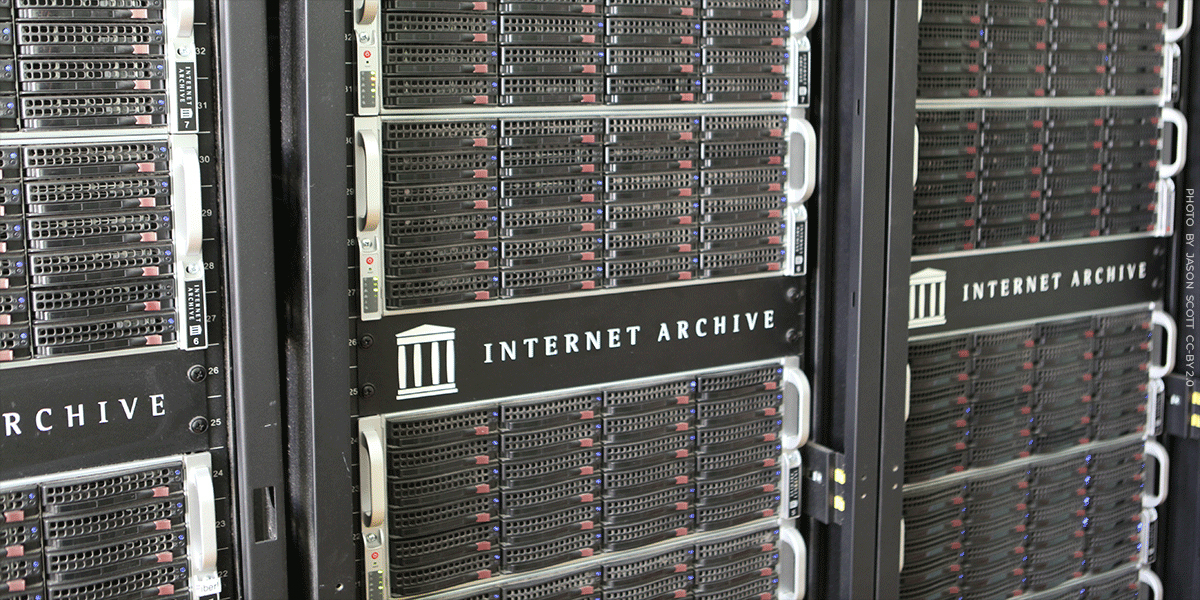
That’s effectively what’s begun happening online in the last few months. The Internet Archive—the world’s largest digital library—has preserved newspapers since it went online in the mid-1990s. The Archive’s mission is to preserve the web and make it accessible to the public. To that end, the organization operates the Wayback Machine, which now contains more than one trillion archived web pages and is used daily by journalists, researchers, and courts.
But in recent months The New York Times began blocking the Archivefrom crawling its website, using technical measures that go beyond the web’s traditional robots.txt rules. That risks cutting off a record that historians and journalists have relied on for decades. Other newspapers, including The Guardian, seem to be following suit.
For nearly three decades, historians, journalists, and the public have relied on the Internet Archive to preserve news sites as they appeared online. Those archived pages are often the only reliable record of how stories were originally published. In many cases, articles get edited, changed, or removed—sometimes openly, sometimes not. The Internet Archive often becomes the only source for seeing those changes. When major publishers block the Archive’s crawlers, that historical record starts to disappear.
The Times says the move is driven by concerns about AI companies scraping news content. Publishers seek control over how their work is used, and several—including the Times—are now suing AI companies over whether training models on copyrighted material violates the law. There’s a strong case that such training is fair use.
Whatever the outcome of those lawsuits, blocking nonprofit archivists is the wrong response. Organizations like the Internet Archive are not building commercial AI systems. They are preserving a record of our history. Turning off that preservation in an effort to control AI access could essentially torch decades of historical documentation over a fight that libraries like the Archive didn’t start, and didn’t ask for.
If publishers shut the Archive out, they aren’t just limiting bots. They’re erasing the historical record.
Archiving and Search Are Legal
Making material searchable is a well-established fair use. Courts have long recognized it’s often impossible to build a searchable index without making copies of the underlying material. That’s why when Google copied entire books in order to make a searchable database, courts rightly recognized it as a clear fair use. The copying served a transformative purpose: enabling discovery, research, and new insights about creative works.
The Internet Archive operates on the same principle. Just as physical libraries preserve newspapers for future readers, the Archive preserves the web’s historical record. Researchers and journalists rely on it every day. According to Archive staff, Wikipedia alone links to more than 2.6 million news articles preserved at the Archive, spanning 249 languages. And that’s only one example. Countless bloggers, researchers, and reporters depend on the Archive as a stable, authoritative record of what was published online.
The same legal principles that protect search engines must also protect archives and libraries. Even if courts place limits on AI training, the law protecting search and web archiving is already well established.
The Internet Archive has preserved the web’s historical record for nearly thirty years. If major publishers begin blocking that mission, future researchers may find that huge portions of that historical record have simply vanished. There are real disputes over AI training that must be resolved in courts. But sacrificing the public record to fight those battles would be a profound, and possibly irreversible, mistake.
Last week's cyberattack on medical technology giant Stryker was limited to its internal Microsoft environment and remotely wiped tens of thousands of employee devices. [...]
Gameontwikkelaar CD Projekt RED is van mening veranderd over de PlayStation 5 Pro. Bij de release twee jaar geleden zei de Cyberpunk-ontwikkelaar nog dat er geen speciale update zou komen, maar nu komt die er toch.
Een release in Nederland of België van de dubbel vouwbare smartphone Samsung Galaxy Z TriFold lijkt onwaarschijnlijker dan eerst. Het gerucht gaat namelijk dat Samsung gaat stoppen met de productie van de peperdure smartphone.
CISA warned U.S. government agencies to secure their Wing FTP Server instances against an actively exploited vulnerability that may be chained in remote code execution attacks. [...]
Ruim 60 procent van de websites van Nederlandse gemeenten deelt data met Google, zoals ip-adressen van bezoekers, voordat gebruikers toestemming hebben gegeven. Dat is illegaal. Het gaat onder meer om YouTube-embeds en Google Fonts.
Preparing for an OffSec certification exam is a technical and psychological journey. Here are some expert strategies to help during your OffSec exam prep!
As organizations adopt AI, security and governance remain core primitives for safe AI transformation and acceleration. After all, data leaders are aware of the notion that:
Your AI is only as good as your data.
Organizations are skeptical about AI transformation due to concerns of sensitive data oversharing and poor data quality. In fact, 86% of organizations lack visibility into AI data flows, operating in darkness about what information employees share with AI systems [1]. Compounding on this challenge, about 67% of executives are uncomfortable using data for AI due to quality concerns [2]. The challenges of data oversharing and poor data quality requires organizations to solve these issues seamlessly for the safe usage of AI. Microsoft Purview offers a modern, unified approach to help organizations secure and govern data across their entire data estate, in particular best in class integrations with M365, Microsoft Fabric, and Azure data estates, streamlining oversight and reducing complexity across the estate.
At FabCon Atlanta, we’re announcing new Microsoft Purview innovations for Fabric to help seamlessly secure and confidently activate your data for AI transformation. These updates span data security and data governance, granting Fabric users to both
Discoverrisks and prevent data oversharing in Fabric
Improve governance processes and data quality across their data estate
1. Discover risks and prevent data oversharing in Fabric
As data volume increases with AI usage, Microsoft Purview secures your data with capabilities such as Information Protection, Data Loss Prevention (DLP), Insider Risk Management (IRM), and Data Security Posture Management (DSPM). These capabilities work together to secure data throughout its lifecycle and now specifically for your Fabric data estate. Here are a few new Purview innovations for your Fabric estate:
Microsoft Purview DLP policies to prevent data leakage for Fabric Warehouse and KQL/SQL DBs
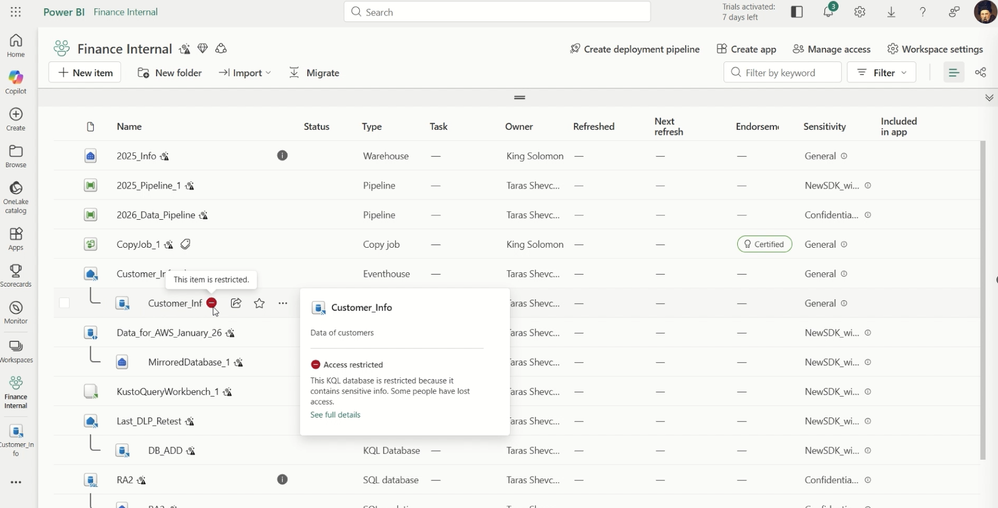
Now generally available, Microsoft Purview DLP policies allow Fabricadmins to prevent data oversharing in Fabric through policy tip triggering when sensitive data is detected in assets uploaded to Warehouses. Additionally, in preview, Purview DLP enables Fabric admins to restrict access to assets with sensitive data in KQL/SQL DBs and Fabric Warehouses to prevent data oversharing. This helps admins limit access to sensitive data detected in these data sources and data stores to just asset owners and allowed collaborators. These DLP innovations expand upon the depth and breadth of existing DLP policies to ensure sensitive data in Fabric is protected.
Figure 1. DLP restrict access preventing data oversharing of customer information stored in a KQL database.
Microsoft Purview Insider Risk Management (IRM) indicators for Lakehouse, IRM data theft quick policy for Fabric, and IRM pay-as-you-go usage report for Fabric
Microsoft Purview Insider Risk Management is now generally available for Microsoft Fabric extending its risk-detection capabilities to Microsoft Fabric lakehouses (in addition to Power BI which is supported today) by offering ready-to-use risk indicators based on risky user activities in Fabric lakehouses, such as sharing data from a Fabric lakehouse with people outside the organization . Additionally, IRM data theft policy is now generally available for security admins to create a data theft policy to detect Fabric data exfiltration, such as exporting Power BI reports. Also, organizations now have visibility into how much they are billed with the IRM pay-as-you-go usage report for Fabric, providing customers with an easy-to-use dashboard to track their consumption and predictability on costs.
Figure 2. IRM identifying risky user behavior when handling data in a Fabric Lakehouse.
Figure 3. Security admins can create a data theft policy to detect Fabric data exfiltration.
Figure 4. Security admins can check the pay-as-you-go usage (processing units) across different workloads and activities such as the downgrading of sensitivity labels of a lakehouse through the usage report.
Microsoft Purview for all Fabric Copilots and Agents
Microsoft Purview currently provides capabilities in preview for all Copilots and Agents in Fabric. Organizations can:
Discover data risks such as sensitive data in user prompts and responses and receive recommended actions to reduce these risks.
Detect and remediate oversharing risks with Data Risk Assessments on DSPM, that identify potentially overshared, unprotected, or sensitive Fabric assets, giving teams clear visibility into where data exposure exists and enabling targeted actions—like applying labels or policies—to reduce risk and ensure Fabric data is AI‑ready and governed by design.
Identify risky AI usage with Microsoft Purview Insider Risk Management to investigate risky AI usage, such as an inadvertent user who has neglected security best practices and shared sensitive data in AI.
Govern AI usage with Microsoft Purview Audit, Microsoft Purview eDiscovery, retention policies, and non-compliant usage detection.
Figure 5. Purview DSPM provides admins with the ability to discover data risks such as a user’s attempt to obtain historical data within a data agent in the Data Science workload in Fabric. DSPM subsequently provides actions to solve this risk.
Now that we’ve covered how Purview helps secure Fabric data and AI, the next focus is ensuring Fabric users can use that data responsibly.
2. Improve governance processes and data quality across their data estate
Once an organization’s data is secured for AI, the next challenge is ensuring consumers can easily find and trust the data needed for AI. This is where the Purview Unified Catalog comes in, serving as the foundation for enterprise data governance. Estate-wide data discovery provides a holistic view of the data landscape, helping prevent valuable data from being underutilized. Built-in data quality tools enable teams to measure, monitor, and remediate issues such as incomplete records, inconsistencies, and redundancies, ensuring decisions and AI outcomes are based on trusted, reliable data. Purview provides additional governance capabilities for all data consumers and governance teams and supplement those who utilize the Fabric OneLake catalog. Here are a few new innovations within the Purview Unified Catalog:
Publication workflows for data products and glossary terms
Now generally available, data owners can leverage Workflows in the Purview Unified Catalog to manage how data products and glossary terms are published. Customizable workflows enable governance teams to work faster to create a well curated catalog, specifically by ensuring that data products and glossary terms are published and governed responsibly. Data consumers can request access to data products and be reassured that the data is held to a certain governance standard by governance teams.
Figure 6. Customizing a Workflow for publishing a glossary term in your catalog.
Data quality for ungoverned assets in the Unified Catalog, including Fabric data
In the Unified Catalog, Data Quality for ungoverned data assets allows organizations to run data quality on data assets, including Fabric assets, without linking them to data products. This approach enables data quality stewards to run data quality at a faster speed and on greater scale, ensuring that their organizations can democratize high quality data for AI use cases.
Figure 7. Running data quality on data assets without it being associated with a data product.
Looking Forward
As organizations accelerate their AI ambitions, data security and governance become essential. Microsoft Purview and Microsoft Fabric deliver an integrated and unified foundation that enables organizations to innovate with confidence, ensuring data is protected, governed, and trusted for responsible AI activation.
We’re committed to helping you stay ahead of evolving challenges and opportunities as you unlock more value from your data. Explore these new capabilities and join us on the journey toward a more secure, governed, and AI‑ready data future.
Companies House, a British government agency that operates the registry for all U.K. companies, says its WebFiling service is back online after it was closed on Friday to fix a security flaw that exposed companies' information since October 2025. [...]
Apple heeft na meer dan vijf jaar zijn koptelefoon AirPods Max een specbump gegeven. De nieuwe koptelefoon heeft een H2-chip in plaats van een H1 en dat maakt onder meer gespreksdetectie en stemversterking mogelijk, zo zegt de fabrikant.
De Nederlandse boete voor Epic Games voor het oneerlijk aanzetten van kinderen tot aankopen in Fortnite is definitief. Epic heeft geen hoger beroep aangetekend tegen het besluit van de rechtbank Rotterdam daarover in januari.
In our eighth Cyberattack Series report, Microsoft Incident Response—the Detection and Response Team (DART)—investigates a recent identity-first, human-operated intrusion that relied less on exploiting software vulnerabilities and more on deception and legitimate tools. After a customer reached out for assistance in November 2025, DART uncovered a campaign built on persistent Microsoft Teams voice phishing (vishing), where a threat actor impersonated IT support and targeted multiple employees. Following two failed attempts, the threat actor ultimately convinced a third user to grant remote access through Quick Assist, enabling the initial compromise of a corporate device.
This case highlights a growing class of cyberattacks that exploit trust, collaboration platforms, and built-in tooling, and underscores why defenders must be prepared to detect and disrupt these techniques before they escalate. Read the full report to dive deeper into this vishing breach of trust.
What happened?
Once remote interactive access was established, the threat actor shifted from social engineering to hands-on keyboard compromise, steering the user toward a malicious website under their control. Evidence gathered from browser history and Quick Assist artifacts showed the user was prompted to enter corporate credentials into a spoofed web form, which then initiated the download of multiple malicious payloads. One of the earliest artifacts—a disguised Microsoft Installer (MSI) package—used trusted Windows mechanisms to sideload a malicious dynamic link library (DLL) and establish outbound command-and-control, allowing the threat actor to execute code under the guise of legitimate software.
Subsequent payloads expanded this foothold, introducing encrypted loaders, remote command execution through standard administrative tooling, and proxy-based connectivity to obscure threat actor activity. Over time, additional components enabled credential harvesting and session hijacking, giving the threat actor sustained, interactive control within the environment and the ability to operate using techniques designed to blend in with normal enterprise activity rather than trigger overt alarms.
Trust is the weak point: Threat actors increasingly exploit trust—not just software flaws—using social engineering inside collaboration platforms to gain initial access.1
How did Microsoft respond?
Given the growing pattern of identity-first intrusions that begin with collaboration-based social engineering, DART moved quickly to contain risk and validate scope. The team confirmed that the compromise originated from a successful Microsoft Teams voice phishing interaction and immediately prioritized actions to prevent identity or directory-level impact. Through focused investigation, we established that the activity was short-lived and limited in reach, allowing responders to concentrate on early-stage tooling and entry points to understand how access was achieved and constrained.
To disrupt the intrusion, DART conducted targeted eviction and applied tactical containment controls to protect privileged assets and restrict lateral movement. Using proprietary forensic and investigation tooling, the team collected and analyzed evidence across affected systems, validated that threat actor objectives were not met, and confirmed the absence of persistence mechanisms. These actions enabled rapid recovery while helping to ensure the environment was fully secured before declaring the incident resolved.
What can customers do to strengthen their defenses?
Human nature works against us in these cyberattacks. Employees are conditioned to be responsive, helpful, and collaborative, especially when requests appear to come from internal IT or support teams. Threat actors exploit that instinct, using voice phishing and collaboration tools to create a sense of urgency and legitimacy that can override caution in the moment.
To mitigate exposure, DART recommends organizations take deliberate steps to limit how social engineering attacks can propagate through Microsoft Teams and how legitimate remote access tools can be misused. This starts with tightening external collaboration by restricting inbound communications from unmanaged Teams accounts and implementing an allowlist model that permits contact only from trusted external domains. At the same time, organizations should review their use of remote monitoring and management tools, inventory what is truly required, and remove or disable utilities—such as Quick Assist—where they are unnecessary.
Together, these measures help shrink the attack surface, reduce opportunities for identity-driven compromise, and make it harder for threat actors to turn human trust into initial access, while preserving the collaboration employees rely on to do their work.
What is the Cyberattack Series?
In our Cyberattack Series, customers discover how DART investigates unique and notable attacks. For each cyberattack story, we share:
How the cyberattack happened.
How the breach was discovered.
Microsoft’s investigation and eviction of the threat actor.
Strategies to avoid similar cyberattacks.
DART is made up of highly skilled investigators, researchers, engineers, and analysts who specialize in handling global security incidents. We’re here for customers with dedicated experts to work with you before, during, and after a cybersecurity incident.
To learn more about DART capabilities, please visit our website, or reach out to your Microsoft account manager or Premier Support contact. To learn more about the cybersecurity incidents described above, including more insights and information on how to protect your own organization, download the full report.
To learn more about Microsoft Security solutions, visit our website. Bookmark the Security blog to keep up with our expert coverage on security matters. Also, follow us on LinkedIn (Microsoft Security) and X (@MSFTSecurity) for the latest news and updates on cybersecurity.
A log-injection vulnerability in the LibreChat RAG API, version 0.7.0, is caused by improper sanitization of user-supplied input written to system logs. An authenticated attacker can forge or manipulate log entries by inserting CRLF characters, compromising the integrity of audit records. This flaw may further enable downstream attacks if the tampered logs are processed or displayed by insecure log-management tools.
Description
LibreChat’s retrieval-augmented generation (RAG) application programming interface (API) is a specialized, asynchronous backend service developed with Python FastAPI and LangChain that facilitates document-based RAG through a file-level, ID-based indexing system. It operates by extracting and chunking text from user-uploaded files, generating high-dimensional embeddings via providers like OpenAI or local Ollama instances, and storing them in a PostgreSQL database equipped with the pgvector extension for efficient semantic search.
A log-injection vulnerability occurs when an application fails to properly sanitize or validate untrusted user input before including it in system log files, allowing an attacker to manipulate the integrity of the audit trail. By inserting line-feed or carriage-return (CRLF) characters in a POST request, specifically in the file_id parameter of the form data, an authenticated attacker can forge fake log entries.
Impact
By exploiting this vulnerability, an authenticated attacker can obfuscate malicious activity, misdirect forensic investigations, or impersonate other users. Furthermore, if the logs are later viewed through a web-based administrative console or an unsecure log-management tool, this vulnerability can escalate into secondary attacks such as cross-site scripting (XSS) or remote command execution.
Solution
Unfortunately, we were unable to reach the vendor to coordinate this vulnerability. Since a patch is unavailable, we can only offer mitigation strategies.
The following workarounds can help mitigate this vulnerability's impact on the targeted environment:
Sanitize input logs with a filter in the RAG ingest to prevent malicious data.
Disable the pgvector extension in PostgreSQL, if not in use.
Validate RAG output before passing it to other tools to prevent relaying of data that could lead to indirect prompt injection.
These recommendations are not mutually exclusive and can be implemented in combination to provide layered protection. By taking these steps, organizations can reduce their risk exposure until the vendor addresses the underlying vulnerabilities.
Acknowledgements
Thanks to Caio Bittencourt for coordinating the disclosure of this vulnerability. This document was written by Dr. Elke Drennan, CISSP.
Vendor Information
One or more vendors are listed for this advisory. Please reference the full report for more information.

 Login