❌

Normal view

EFF’s State Legislative Agenda to End ALPR Mass Surveillance

21 October 2026 at 19:52

Police agencies across the U.S. have deployed Automated License Plate Readers (ALPRs) to capture images of passing vehicles along with time, date, and GPS coordinates. While the technology itself isn’t new (ALPRs have existed in various forms for more than 50 years, and in the U.S. since 1998), the surveillance landscape has shifted dramatically. Rapid advances in artificial intelligence and national data sharing have transformed police ALPRs into an interconnected, nationwide tracking network. It is pitched to city councils by law enforcement and private vendors like Flock Safety, Motorola Solutions (Vigilant), and Axon as an essential tool for solving violent crime.

In reality, it is an inherently dangerous infrastructure of mass surveillance.

Since 2012, EFF has worked with others to expose the severe digital rights harms of ALPR systems. For example, we’ve recently documented how these camera networks allow law enforcement to search for immigrants, track peaceful protesters, target Romani communities, and track women seeking reproductive healthcare. Police also routinely use ALPRs for low-level matters like enforcing school residency requirements or investigating noise complaints. Many officers also use ALPR databases to stalk past romantic partners. Recent EFF analysis revealed officers using the system without legitimate justification—logging search reasons like "LOL" and "LMAO."

Understandably, the public backlash to police ALPR technology is accelerating, and state lawmakers across the country are taking action.

New Hampshire enacted the nation’s first state law on ALPR use in 2007, but technological advances and misconduct have driven even more recent legislative action. In 2026 alone, six states enacted laws that limit police use of ALPRs: Connecticut, Kentucky, New Jersey, New Mexico, Oregon and Washington.

This is a good start, but far more is needed. This blog presents a framework for state legislators who want to stop ALPR mass police surveillance:

  1. Just ban it. It is incompatible with a free society and cannot be fixed.
  2. In the absence of a flat ban, reduce its harms. Most importantly: limit police use of ALPRs to real-time comparison of passing plates to hotlists; require a warrant to place a plate on a hotlist; impose strict limits on the creation and use of those hotlists; and prohibit the storage of ALPR data (and thus prevent the subsequent search and disclosure of that data).
  3. In the absence of a prohibition on storing ALPR data, reduce its harms. Most importantly, place strict limits on police storage, search, and disclosure of ALPR data.
  4. Ban three especially dangerous police practices: placement of ALPRs near sensitive locations like hospitals; purchase of ALPR data; and use of ALPR data to try to predict crime.
  5. Require transparency about ALPR mass surveillance, including: a 30-day public notice before a city procures police ALPRs; a statewide registry of all police ALPRs; and regular, public audits and statistical reports about police usage.
  6. Ensure effective enforcement of all new ALPR restraints, including by means of a private right of action and the exclusionary rule.

These policy battles often unfold locally, so state legislators must ensure that state law is a regulatory floor, never a ceiling. State preemption should never force unwanted camera networks onto communities that have chosen to reject them. Local government must retain authority to enact full bans, deny funding, reject contracts, and decommission existing camera networks.

Table of Contents

A Note on Scope

As in our previous post on ALPR policy, our focus here is ALPR mass surveillance: the continuous dragnet collection and retention of location data on innocent drivers. Different issues are raised by automated traffic enforcement (ATE) systems, such as standalone red-light or speed cameras that solely photograph and ticket specific traffic violations, without building a searchable network about uninvolved drivers. As such, state laws against ALPR mass surveillance should not cover ATE. This is the approach in at least six states: Connecticut, Minnesota, North Carolina, Oregon, Virginia, and Washington. The most common approach is to exclude ATE from the law’s definition of “ALPR.”

Of course, ATE carries risks and demands legal restrictions too. This includes tight limits on data collection, retention, usage, and disclosure—all of which should be addressed in a different statute. Lawmakers must also actively guard against vendor efforts to piggyback mass surveillance tools onto ATE contracts.

The Gold Standard: Statewide Bans on ALPR Mass Surveillance

Statutory limits cannot make ALPR mass surveillance safe. Because the technology relies on the indiscriminate recording of every driver’s movements, the risks are baked into the system itself. Also, innocent motorists will be menaced by police due to false matches, bad actors will misuse location data, and sensitive personal movements will be exposed to broad government overreach. Promising harsher penalties for officer misuse cannot fix an inherently flawed architecture. Thus, state lawmakers should pursue a complete, statewide ban on ALPR mass surveillance.

First, lawmakers should prohibit all state-level law enforcement agencies from acquiring, retaining, accessing, or using ALPRs or any data derived from them.

Second, they must impose the same prohibition on county, municipal, and other local law enforcement agencies.

These prohibitions should require any agency ending an ALPR program (both state and local) to fully decommission the programs within a strict timeframe. This includes requiring agencies to: physically remove all camera hardware; revoke all user, network, and database access credentials; permanently delete all stored location data; and require vendor certification of compliance.

Third, ban the use of state funds for state or local agencies to acquire, maintain, or access ALPR systems. This must include direct appropriations, law enforcement grants, pass-through funds, and state-administered federal funds. In August 2026, Texas Governor Greg Abbott banned state agencies from spending public funds on Flock cameras.

Fourth, ban state and local agencies from installing or operating ALPRs on state-owned highways, roadways, or public properties. In August 2026, Florida’s Department of Transportation  ordered the removal of all ALPRs from the right-of-way on state highways within 30 days. The order revokes all previously approved permits to install ALPRs, and bars future permits.

An outright prohibition is the only effective way to eliminate this mass surveillance. This follows the lead of municipalities across the country that have already enacted bans. However, where there’s political resistance, state lawmakers might consider a moratorium that prevents further expansion of ALPR networks.

Strict Limits on Real-time Use of ALPRs

In the absence of a ban on police ALPR mass surveillance, state legislators must restrict ALPRs to real-time comparison of passing plates to hotlists. ALPR data is simply too dangerous for police to safely store, search, and disclose. An effective way to do this, as in New Hampshire, is to require deletion of ALPR data within three minutes after collection. That means no ALPR data is stored after comparison to a hotlist, and thus that no ALPR data about unmatched cars can be searched or disclosed.

A state legislature must also reduce the harms of police use of real-time ALPRs by strictly limiting the creation and use of law enforcement hotlists.

Limits on creating hotlists

Roughly speaking, there are two kinds of police hotlists. An agency might link its ALPRs to external hotlists created by another agency, such as the FBI’s National Crime Information Center (NCIC) or a state’s department of motor vehicles. Also, a police agency might link its ALPRs to its own internal hotlist, created by its own officers, of people under investigation. State legislators must strictly limit both.

First, limit the kinds of external hotlists that police agencies may link to. For example, ban police agencies from linking to the NCIC’s “immigration violator” hotlist, which ICE uses to hunt immigrants with the ALPRs operated by police agencies across the country.

Second, if a police agency links to external hotlists, require the agency to update that link every day. Otherwise, drivers may be detained even though they have been removed from the list. This is required by Montana, Nebraska, North Carolina, and Virginia.

Third, forbid officers from adding a plate on a hotlist, absent a warrant from a judge based on probable cause and particularity. Without this judicial check on police power, an officer stalked a potential romantic partner by placing her plate on a hotlist.

As with other laws requiring a warrant (such as the federal Wiretap Act), there should be an exception where: (1) there is an emergency involving immediate danger of death or serious bodily injury to a person; (2) there is no time to acquire a warrant; and (3) there are grounds upon which a warrant could be granted. This exception might apply, for example, when police have probable cause to believe a child has just been abducted. In such cases, the statute must require police to seek a warrant within 48 hours, and if it is denied, to immediately remove the plate from the hotlist.

Minnesota requires a warrant or an emergency to use ALPRs “to monitor or track an individual who is the subject of an active criminal investigation.” In Maine, an ALPR system may use only information based on reasonable suspicion.

Fourth, forbid officers from adding a plate to a hotlist, except in connection with a serious violent crime. This would include investigation of a murder but not pursuit of a traffic scofflaw.

Fifth, forbid officers from adding a plate on a hotlist based, in whole or in part, on: a person’s race, ethnicity, national origin, religion, immigration status, disability, sex, gender identity, or sexual orientation; their political beliefs, associations, or participation in First Amendment-protected activity; or their pursuit of reproductive, gender-affirming, or other health care. Connecticut and Washington forbid use of ALPR systems on these grounds, and Virginia forbids tracking a person based on their protected speech.

Sixth, require officers to log their entry of a plate into a hotlist. This must include the officer’s name and agency, the date of the entry, a narrative description of the reasons for the entry, any case numbers, and an upload of the warrant authorizing the entry. Oregon requires an officer to log “the specific law enforcement purpose of the entry,” and the officer’s name.

Limits on using hotlists

First, if the plate of a passing car does not match a hotlist, laws must require immediate deletion of all ALPR data about that car. New Hampshire state law requires deletion within three minutes. This is the most effective way to limit ALPRs to real-time identification of vehicles and drivers of interest to police, as opposed to amassing a dangerous database of the comings and goings of the entire driving public, available later for retrospective search by police.

Second, if the plate of a passing car does match a hotlist, then limit storage, search, and disclosure of its ALPR data to what is strictly necessary to the investigation that placed the car on the hotlist.

Third, require police officers, before stopping a car because of an apparent real-time match, to visually and independently confirm that the car’s plate number, plate issuing state, and other vehicle characteristics in fact do match the car on the hotlist. Many innocent motorists have been detained and menaced by police because of ALPR false positives. Confirmation is required by Kentucky, Montana, New Hampshire, Oregon, Virginia, and Washington.

Strict Limits on Storage, Search, and Disclosure of ALPR Data

Again, state legislatures should simply ban police use of ALPRs, or at least police storage of ALPR data. Third best is harm reduction through strict limits on storage, search, and disclosure of ALPR data.

Storage limits

First, limit the storage period for ALPR data to days, not months, and then require deletion. More than 99% of the drivers who pass an ALPR are not on a hotlist. Tracking their movements anyway, just in case they are later relevant to a police investigation, is criminalization of the entire driving population. Thus, four states already require deletion after 21 days: Connecticut, Maine, Virginia, and Washington. Even Flock has reduced its default retention period to seven days.

By “delete,” we mean permanently erase it, so it is impossible for anybody to access it again. It is not enough to merely store it in a way that makes it harder to access, such as archiving it, or transferring it from one database to another. In the words of the Virginia statute: “System data shall be purged … in such a manner that such data is destroyed and not recoverable.”

Second, limit the types of ALPR data that can be stored: just a photo of the plate, the AI-based read of the plate number, the date and time, and the location. Conversely, ban retention of photos of people in the car, and of features of the car beyond the plate as well as AI-based reads of those photos (respectively, “facial recognition” and “vehicle fingerprints”).

Many states have enacted such rules. New Hampshire bans ALPRs from “photographing or recording or producing images of the occupants of a motor vehicle.” Missouri bans integration of facial recognition into ALPR systems. New Hampshire and Montana limit ALPRs to “the sole purpose of recording and checking license plates.” Minnesota provides that “data collected by an [ALPR] must be limited to” plate numbers; date, time, and location; and pictures of plate, vehicle, and surrounding area.

Search limits

First, laws should ban “geofence” searches, which are searches in which police use ALPRs to identify all of the drivers present at a particular time and place, based on police claims that one of them might be the suspect they are looking for. Even a warrant cannot justify such general searches, because the Fourth Amendment requires warrants to “particularly” describe the person or car being investigated. These dragnet searches of stored ALPR data are the modern-day equivalent of the colonial-era “writs of assistance,” against which our founders fought a revolution to end.

Second, laws should forbid officers from searching stored ALPR data, unless they first acquire a warrant from a judge based on probable cause and particularity. The constant revelations of bad police searches of ALPR data demonstrate the need for—at the very least—judicial control over this dangerous surveillance technology. A federal judge in Oklahoma recently held that the constitution requires this judicial control, because ALPR mass surveillance invades reasonable expectations of privacy. EFF has filed lawsuits making this demand in California and Wisconsin, along with local ACLU affiliates: SIREN and CAIR-CA v. San Jose, and Wisconsin Council of Churches v. Milwaukee, Racine, Kenosha, and Green Bay.

Three states (Minnesota, Vermont, and Virginia) require reasonable suspicion of a crime before searching ALPR data, and a fourth state (California) requires this from its highway patrol. This is a step in the right direction, but not enough: the decider must be a judge, and the test must be probable cause.

Third, officers should be prohibited from searching stored ALPR data, unless they are investigating a serious violent crime. On the flip side, ban searches for immigrants, protesters, or traffic scofflaws.

Some states have moved in this direction. Missouri limits use of ALPR data “criminal justice” and “lifesaving efforts.” North Carolina bans its use for traffic enforcement. Connecticut bans its use based on race and other protected classes, to identify First Amendment activity, for immigration enforcement, or because of access to reproductive or gender-affirming health care. Idaho bans its use for political activity.

Fourth, police officers must be required to log their searches of stored ALPR data concerning a particular car. This must include the officer’s name and agency, the date and time of search, a narrative description of the reasons for search, any case numbers, and an upload of the warrant authorizing the search. The officer must write the narrative in their own words. A drop-down menu of reasons is no substitute, because it is too easy for officers to dodge an explanation of the actual reasons by clicking a pre-written “reason.”

Many states require officers to log their searches of ALPR data, including California, Connecticut, Idaho, Maryland, Missouri, Montana, New Hampshire, Oregon, and Virginia. In Virginia, this must include an officer’s documentation of both their “specific purpose” to search, and the “associated call for service or case number.”

Disclosure limits

The “disclosure” limits below must broadly address sharing from an agency that collected ALPR data to another entity. This includes an agency opening its database to access and search by another entity. It also includes an agency transferring data from its database to another entity’s database.

First, ban disclosure of ALPR data to any federal or out-of-state agency. Federal and out-of-state agencies often lack the necessary protections of the driving public. Connecticut forbids disclosures to the federal government or agencies in 46 states, unless they have a warrant. California forbids disclosures, unless otherwise permitted by law.

Second, ban disclosure of ALPR data to another agency, unless it follows all of the rules above for an agency’s search of its own data (that is, the ban on geofence searches, the requirement of a warrant, the limitation to investigation of serious violent crimes, and the requirement of an audit trail).

Some states have taken steps in this direction. Utah requires, as a condition of disclosure to a government entity or a defendant in a criminal case, a court order finding reasonable suspicion of crime. Washington forbids disclosure “except as required in a judicial proceeding.” Minnesota and Virginia require the disclosing agency to find reasonable suspicion. Minnesota and Connecticut forbid disclosure unless the receiving agency follows the rules applicable to the disclosing agency.

Third, place strict limits on participation in a multi-agency disclosure network, such as Flock or Vigilant. Connecticut forbids participation “in a system or network that shares” ALPR data, unless it requires all participants to affirm in writing that they will not use or re-disclose that state’s data except in compliance with that state’s laws. Connecticut also forbids “bulk” data disclosure, and Maryland forbids data “upload” to another agency.

Fourth, ban disclosure of ALPR data for purposes of investigating acts and statuses that are lawful in-state. Three states (Illinois, New Jersey, and New Mexico) forbid disclosure to investigate immigration status. Two states (Illinois and New Mexico) forbid disclosure in investigate healthcare that is lawful in-state. One state (New Mexico) forbids disclosure to investigate protected assembly, petition, and speech.

Fifth, ban any sale of ALPR data. Six states do this: Arkansas, Maryland, Oklahoma, Utah, Virginia, and Washington. California forbids its highway patrol from doing so. New Mexico forbids any disclosure to a private entity (or indeed to any non-law enforcement agency). Data brokers are a menace to privacy and other human rights.

Transparency

State lawmakers must ensure that the public has access to ample information about the ALPR mass surveillance in their communities. Many people will use this information to resist ALPRs.

First, state laws should require local governments to provide at least 30 days of public notice before spending funds, accepting grants or private donations, or entering into any contract or pilot program for ALPR technology. All proposed vendor contracts and funding sources must be publicly disclosed prior to approval. This helps local officials to exercise their procurement power to reject ALPRs.

Second, laws should mandate the creation of a centralized, public-facing state registry of all police agencies using ALPRs, and the specific locations of all police ALPRs. Sources like DeFlock and EFF’s Atlas of Surveillance include crowd-sourced maps of ALPR technologies, but they are not exhaustive. This was one of the provisions in Minnesota Minn. Stat. § 13.824, which in part, requires police agencies to notify the state within 10 days of installing any ALPR, and requires a state agency to aggregate this information and publish a master list of the locations of all ALPRs (unless a judge determines that disclosure of a particular ALPR’s location poses a genuine security risk).

Third, mandate regular, independent, public audits of agency ALPR use, access logs, and query justifications to ensure compliance with all applicable laws and policies. Five states (Idaho, Minnesota, Montana, Virginia, and Washington) require regular audits, ranging in frequency from monthly to biennial. Three states (Idaho, Maryland, and Washington) require audits of access logs. Minnesota requires an independent auditor and public access to the results.

Fourth, laws must require each agency operating an ALPR system to publish regular reports on its website detailing key operational metrics. Six states require such reports annually: Connecticut, Maryland, New Hampshire, New Mexico, and Vermont. Arkansas requires them twice per year, and Oregon requires them monthly. These states variously require reporting of: the number of ALPRs, and a list of the locations of fixed ALPRs; the number of hotlists used, and a list of them; the number of plates scanned; the number of apparent matches to hotlists, and how many were actual matches; the number plate reads stored; and the number of searches of stored data, broken down by the purpose and agency of search.

Finally, any new ALPR legislation must maintain a proper balance between transparency and privacy in the use of public record acts (PRAs) to obtain ALPR information. Public records and public scrutiny of ALPR programs have shown that people are harmed by these systems. So lawmakers should not cut off access to public records that document these abuses. For example, the public should have access to operational policies, audit logs, vendor communications, and aggregate statistics. EFF opposes blanket exemptions from PRAs that block public oversight of APRs—such as recent bills in states like Arizona. The better approach to protecting individual location privacy is a flexible, case-by-case balancing test already provided by many PRAs. Also, when a document contains both exempt and non-exempt information—like an audit log that contains both motorists’ plate numbers and officers’ search reasons—open records laws should require disclosure of the latter while withholding of the former.

Additional Restrictions

State lawmakers should adopt three additional bans to curtail the footprint of police ALPR surveillance.

First, ban the placement of ALPRs or the collection of ALPR data near healthcare facilities, immigration services, schools, places of worship, courthouses, food banks, and other sensitive locations. Washington and Connecticut do this.

Second, ban police from purchasing ALPR data. Utah and Washington do so. Also, prohibit police from acquiring ALPR data from a private entity, except by means of a warrant. Washington does so. Utah took a step in this direction, requiring a court order based on reasonable suspicion. Absent this type of rule, police evade limits on seizing data from third parties by simply purchasing it from brokers.

Third, ban police and their vendors from using ALPRs or stored ALPR data to power predictive policing technology. EFF opposes such technology and urges state legislatures to ban it. ALPR companies have been providing law enforcement clients with an “analytics” feature, which ingests data from across police agencies, and produces a report of alleged crime trends, hotspots, and corridors. State legislators should prohibit this dangerous use of ALPR systems and data.

Enforcement

A law without strong enforcement is just a piece of paper. EFF recommends three kinds of enforcement measures, all of which appear in existing ALPR statutes.

First, all privacy laws need a “private right of action,” meaning ordinary people can sue a police department that breaks the law. An excellent model appears in the federal Wiretap Act. It expressly authorizes a lawsuit by “any person” whose personal information is processed “in violation of” this law. Privacy harm is harm, and so a person should have their day in court, even if they cannot prove a collateral harm, such as physical injury or economic loss. Moreover, the Wiretap Act provides a full arsenal of remedies to a successful plaintiff, including injunctive and declaratory relief, liquidated and actual damages, and attorney fees.

At least three states enforce their ALPR statute with some version of a private right of action. These are good first steps but need improvement. Washington comes closest: it allows suit to enforce all ALPR rules and provides all remedies. Unfortunately, the plaintiff must prove “injury,” which may shut the courthouse doors to some people whose data is unlawfully processed. Connecticut allows suit by a person “aggrieved” by violation of some ALPR rules. But a person should be able to enforce all rules, and should not have to prove they were aggrieved. Oregon allows suit against a police vendor that “intentionally or with gross negligence” uses or discloses ALPR data in an unlawful manner. But this does not allow any suit against police, or even against a vendor that systematically violates the rules through ordinary negligence.

Second, privacy laws applicable to the police commonly ensure enforcement through the “exclusionary rule.” This means that if evidence is gathered in violation a privacy law, it must be excluded from court proceedings. This is sometimes called “suppression” or “inadmissibility.” The federal Wiretap Act has a strong version of this rule, clearly excluding evidence derived from violations of all rules. The so-called “good faith” exception has weakened many exclusionary rules, so ALPR statutes should expressly reject this exception (though some courts have interpreted some statutory exclusionary rules to have no good faith exception).

At least three states enforce their ALPR statute with some version of the exclusionary rule. Again, these are good first steps but need improvement:

  • Virginia comes closest: “Any evidence obtained as a result of a violation” of some of the ALPR rules “is not admissible.” A better rule would apply to all ALPR rules.
  • Connecticut provides that ALPR data “may be admissible … provided such data was collected or otherwise acquired or held or stored in accordance with the provisions of this section” (or obtained pursuant to warrant). A more clear exclusionary rule would “exclude evidence unlawfully processed,” as opposed to “admit evidence lawfully processed.” The exclusionary rule should also extend to data unlawfully used or disclosed (and not just to data unlawfully collected or stored).
  • Washington provides that information obtained from “a knowing violation” of some of the statute’s rules is “inadmissible.” But the exclusionary rule should apply to all substantive limits (not just some), and to all violations (not just knowing ones).

Third, police agencies and their private contractors that recurringly violate ALPR rules should be forbidden from using ALPRs at all. In New Hampshire, if an agency “repeated[ly]” violates the ALPR statute, the state department of justice may “seek an injunction banning [its] use” of ALPRs. In New Mexico, if a vendor “fails to comply with” that state’s ALPR law, it “may be subject to … suspension of authorization or termination of access.”

Some states impose workplace discipline or criminal penalties on officers who violate ALPR laws, including Connecticut, Idaho, and Missouri. This is no substitute for the three types of strong enforcement measures above. ALPRs are a systemic problem requiring institution-wide enforcement of legal constraints, and not just episodic sanctions against individual officers.

Conclusion

Mass surveillance ALPRs fundamentally threaten digital rights, making an outright statewide ban on police ALPRs the only effective way to fully protect privacy and safety.  The next best thing a legislature can do is limit ALPRs to real-time comparison of passing cars to hotlists, by banning storage of ALPR data beyond a few minutes. If a legislature allows storage, it must impose a tight deletion deadline (days and not months), and strict limits on search and disclosure. A legislature must also ensure transparency and enforcement. 

For convenience here is a concise list of EFF’s ALPR state legislative goals.
Court Agrees with EFF: Utah’s VPN Law Demands a Technical Impossibility

1 October 2026 at 21:57

When state lawmakers attempt to rewrite how the internet works, users rely on courts to recognize that laws can’t make technical impossibilities a reality. That’s why we were happy to see that a court has blocked Utah’s attempt to outlaw the privacy protections of Virtual Private Networks (VPNs). 

In a win for digital rights, a federal judge has issued a preliminary injunction blocking Utah’s SB 73, the state’s draconian anti-VPN age verification law. The decision comes as EFF submitted our comments to the Utah Department of Commerce, detailing how forcing platforms to detect and block privacy-preserving tools undermines user privacy and security worldwide while demanding the impossible.  

What SB 73 Does 

Signed into law earlier this year, SB 73 attempted to regulate adult websites by requiring them to block VPN users or to identify the physical location of visitors using them or similar tools that mask their network traffic. It even went so far as to prohibit websites from offering instructions on how to use a VPN to bypass these checks. This made Utah, to EFF’s knowledge, the first state in the nation to target the use of VPNs to avoid legally mandated age-verification gates. 

The Utah federal court halted enforcement of the law's VPN provisions last week, ruling that the law likely violates the U.S. Constitution’s prohibition on passing laws that significantly burden businesses and people outside Utah’s borders.  

SB 73 burdens the rights of all internet users outside of Utah because it requires adult websites to either know every visiting user’s physical location, and then block those in Utah, or to verify every visitor’s age just in case they might be in Utah. The law’s “actual-location provision in practice requires an entity to perform age verification services for every user visiting its site from any location because the entity would violate the law if even one of those users happened to be obfuscating,” the court wrote. The court essentially ruled that Utah has less-burdensome ways to prevent Utah minors from accessing adult websites than requiring all users in the world to comply with SB 73. 

Aylo’s lawsuit does not challenge SB 73’s provision prohibiting the websites covered by the law from sharing information about VPNs. 

The Legal Challenge 

This court order follows months of legal maneuvering.  

Initially set to go into effect in May 2026, SB 73 sparked an immediate constitutional challenge from Aylo, the parent company of major online adult platforms like Pornhub. In response to the lawsuit, Utah and Aylo initially agreed that the state would pause enforcement while the court considered the preliminary injunction request or until administrative rules setting specific compliance terms were finalized. Those proposed compliance rules (R152-78B, see Utah State Bulletin, page 6) were published by the Utah Department of Commerce’s Division of Consumer Protection on September 1st, and EFF submitted formal comments to the Department in opposition. According to the notice, the proposed rules could be effective as soon as October 8, 2026. However, Judge Barlow’s decision means that it cannot be enforced pending further action by the court. 

The Ruling 

EFF welcomes Judge Barlow’s ruling, which recognizes the fundamental disconnect between state legislation of the internet and how technology works. In his ruling, Judge Barlow noted that the statute requires a technical impossibility on pain of legal liability. “Aylo is correct that the statute, as amended, now essentially imposes strict liability for entities like it when it comes to determining the location of its websites’ users.” 

The court recognized that the problem is that SB 73 “requires entities like Aylo to geolocate its website users with perfection to avoid liability.” But, at the same time, the court acknowledged “that geolocation perfection is not presently possible.” 

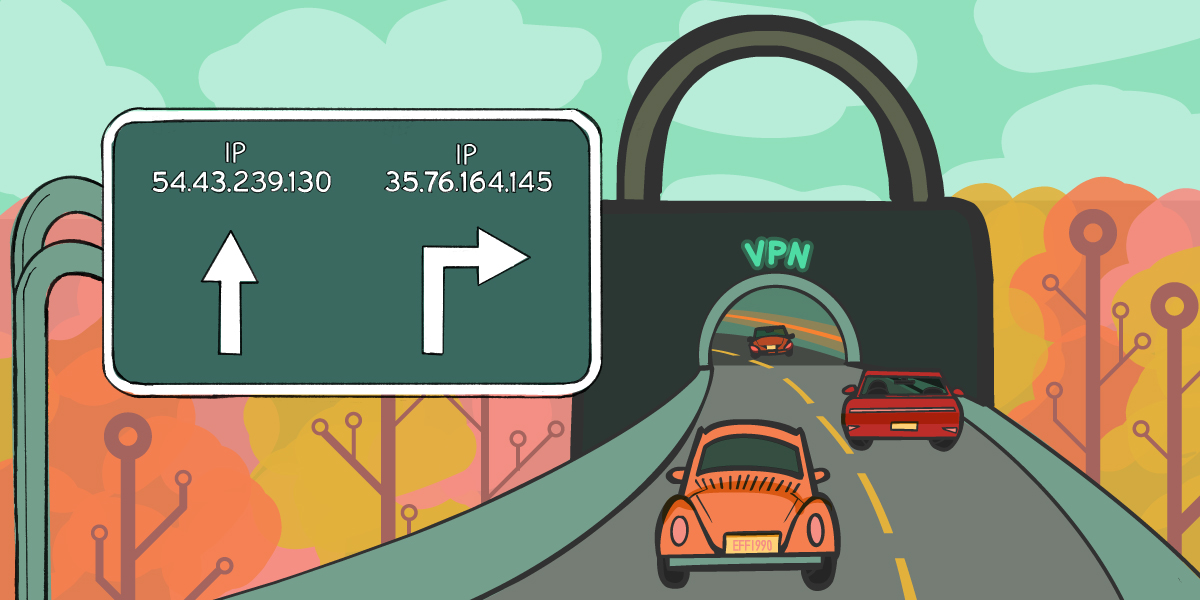
EFF explained this technical impossibility in our comment to the Department of Commerce. VPNs protect user privacy by routing web traffic through intermediary servers. Because destination websites only see the IP address of the VPN server, they have no reliable mechanism to tell whether a connection originates from Salt Lake City, Seattle, or Shanghai. So, under Utah's current statutory framework, platforms are left with an impossible choice: completely block all VPN traffic nationwide or withdraw access from Utah entirely. Judge Barlow agreed, asserting:  

Because the law requires perfection in the absence of perfect geolocation tools, Aylo would need to verify those 28 million users—whether located in Salt Lake City, Boston, New Orleans, Anchorage, or Honolulu—to ensure compliance and avoid liability.

The Rulemaking 

The administrative rules drafted by the state compelled commercial entities to implement "commercially reasonable geolocation obfuscation detection systems", which is a directive, we argue, that demands a technical impossibility.  

In our submission to the Utah Department of Commerce, EFF also detailed how these rules force an invasive data collection regime onto internet users everywhere. So, in response to internet users trying to avoid invasive data collection required by age-verification requirements, SB 73 requires even greater surveillance of internet users’ online activities. The Department’s suggested detection heuristics (like monitoring connection latency or device time zones) are notoriously unreliable and easily skewed by normal network conditions. This active surveillance inevitably leads to widespread misclassification, unwarranted access blocks, and severe impacts on users’ privacy far beyond Utah's borders.  

You can read EFF’s full comments to the Department of Commerce here. 

What Now? 

As we’ve said time and time again: the internet will always route around censorship. 

Mandating invasive tracking and punishing the use of essential security tools turns genuine privacy concerns into mere compliance theater and requires more state-mandated surveillance of internet users who rely on VPNs. As is the case in heavily censored regions, VPN services and obfuscation tools will simply adapt, making this framework fundamentally unsustainable.  

As we’ve said time and time again: the internet will always route around censorship. 

While Utah legislators have indicated they may attempt to revise the law during the next legislative session, the court's preliminary injunction sets an important precedent: state lawmakers should not weaponize age verification to force dragnet tracking or undermine essential security tools.  

As other states consider similar anti-VPN proposals, EFF will continue pushing back against these technically impossible mandates and defending users’ privacy and anonymity. Thus, we urge legislators and regulators to reject anti-privacy rules, prioritize real user security, and safeguard constitutional protections for all users. 

While the Country Rejects ALPR Mass Surveillance, SF Settles for Weak Safeguards

29 September 2026 at 23:30

San Francisco's decision to retain its use of Automated License Plate Reader (ALPR) surveillance cameras belies what we know about this spying technology tool: it endangers residents and threatens the privacy and civil liberties of our community. Based on what's in the city's press release and announcement, this policy will do nothing to stop actual harms.

We know innocent drivers will be stopped and menaced by officers because of erroneous matches. We know officers use Flock to stalk potential and past romantic partners. Data will be accessed by Immigration and Customs Enforcement (ICE) and used to deport immigrants. Promising greater penalties for such abuse will not end this. These are not isolated mistakes that another policy can fix. They are consequences of building a system that records everyone’s movements and makes them searchable by police. This is also not unique to a single vendor. From Flock Safety to Motorola to Axon—San Francisco must end its use of ALPRs.

We ultimately cannot rely on new protocols from city officials, and the City’s new policy is woefully inadequate. There is no warrant requirement to search stored ALPR data. An incident or computer-aided dispatch (CAD) number is not judicial authorization. Without a warrant requirement, officers can search stored location data without showing probable cause to a judge, and will. Without judicial control, officers will continue to search the data for abusive reasons. But a warrant requirement alone would not justify retaining the ALPR network: the community is demanding an end to the collection itself.

Additionally, the announced policies include no deadline to delete ALPR data, there is only a 30-day deadline to move data from the vendor’s servers to the city’s servers. City officials must understand that moving data is not deleting it. Whether Flock or SFPD stores the data, it remains a permanent record of where people drive, worship, work, organize, seek care, and spend time with others. Thus, the best practice is deletion. New Hampshire requires deletion in three minutes, and Flock itself has reduced the default retention time to seven days. San Francisco can and should do better.

Lastly, while transparency and documentation are important concepts, better audit logs are not the answer. They can expose abuse only after a search has occurred. They cannot undo the disclosure of someone’s movements or justify collecting everyone’s location data in the first place; especially when we are talking about people’s lives and civil liberties. The city's announced policy does not even require officers to state, in their own words, why they are searching the stored ALPR data—an accountability rule that has exposed abusive searches across the country.

San Francisco is behind many communities that have considered the tradeoffs of ALPR surveillance and made the right choice by ending their contracts. San Francisco must do the same.

EFF Statement on California Governor's Executive Order on AI

California Gov. Gavin Newsom's executive order is an opportunity for a needed, thoughtful conversation about artificial intelligence and its potential harms. Everyday Californians are feeling real anxiety about the risks of artificial intelligence, and as an organization that works to ensure technology empowers people, EFF welcomes this order as a way for the state of California to lead a much-needed dialogue that addresses these concerns. 

DONATE TO EFF

ensure ai serves people, not power

Nonetheless, the most immediate and current concerns with this technology are not about sci-fi scenarios concerning rogue super-intelligence. They are happening right now through biased algorithmic decision-making for employment or government benefits, AI-powered surveillance systems such as Flock cameras, and artificially inflated personalized pricing. People want state and federal leaders to act, and we urge Gov. Newsom to develop thoughtful policies to address those concerns. Today’s EO is a good start. 

To that end, EFF supports the focus on expanding the reporting requirements under SB 53 (2025) for loss-of-control incidents, alongside third-party investigations. We urge the administration to consider how to make these third-party investigations available for smaller developers. As the Government Operations Agency prepares its recommendations for the governor, we urge leaders to also realize that the effectiveness of kill switches in advanced AI systems remains an area of active research. As such, they should ensure that - as we’ve previously mentioned - any technology regulation targeting cybersecurity practices at AI labs must be careful, precise, and practical. Moreover, we also caution that government-controlled kill switches run the risk of being used as a form of retaliation against protected speech, as demonstrated by the Trump Administration’s retaliatory actions against Anthropic earlier this year.

Ultimately, true safety requires California to focus on concrete, immediate, and urgent harms of AI technologies by ensuring that algorithmic decision-making in both the government and private sectors respects people’s rights and well-being. We urge Gov. Newsom and the state of California to develop thoughtful policy in collaboration with those most at risk of harm to address these and other concerns.

The High Crime of “LMAO”: How Cops Are Treating Flock's Mass Surveillance As a Joke

14 September 2026 at 17:21

Here's a riddle: Why did a Goshen Police Department officer search 6,474 automated license plate reader (ALPR) networks, representing data from 82,413 cameras, on May 7, 2025? 

If your answer is "I don't know," it turns out you're 100% correct. The officer left the letters "idk" in the search field where cops are supposed to document the reason for the search.

When law enforcement and tech salespeople pitch ALPRs to city councils, they stick to a familiar script. They trumpet the technology, which is often provided by private companies like Flock Safety, Motorola Solutions, or Axon, as an essential tool for solving high-stakes crimes, such as car jacking, kidnapping, or murder.

But when you strip away the carefully curated talking points, the data continues to reveal a different (and frankly, ridiculous) story. An EFF analysis of ALPR search logs from Flock Safety systems shows that officers across the country are spying on drivers for completely nonsensical "reasons." Police are routinely searching the Flock database without providing any legitimate justification, making a mockery of our civil liberties by logging reasons like "LOL" (short for “laugh out loud”), "LMAO" (short for "laughing my ass off"), "sexy," and "idk" (short for “I don’t know”) to access sensitive ALPR location data.

And in some cases, officers are just mashing keyboard buttons rather than articulating the nature of their searches.

Flock Safety claims it has improved its system by requiring officers to select from a dropdown list of crimes before running a search–but that only makes it easier for officers to hide improper searches behind the veneer of uniformity. The system does not require proof that the dropdown reason actually matches the true purpose of the search. 

With no warrant requirements, limited guardrails, and deficient audit processes, ALPR databases have fostered a culture of unrestricted access to everyone’s location information. This culture of abuse has allowed police to treat a mass surveillance network like their own personal search engine, permitting the tracking of the movements of everyday citizens for low-level complaints, personal whims, and sometimes, seemingly, for the lols.

A Documented Culture of Abuse

ALPR misuse isn’t a new phenomenon; it has dominated headlines for more than a year. We already know that officers regularly abuse these systems to stalk past and potential romantic partners. We’ve seen ALPRs used to surveil protests, which can chill First Amendment-protected dissent, and seen officers try to use an ALPR system to track down a woman seeking an abortion.

Typically, we learn about these uses from documents called "network audits," which are long spreadsheets that document all the searches that run through an agency's system. It is not unusual for even a small agency to have a record of millions of searches from thousands of external agencies across the United States.

We’ve also uncovered horrific systemic profiling, with more than 80 law enforcement agencies using terms like "roma" and "g*psy" to target ethnic Romani people—often without any mention of a suspected crime. And when police aren’t using ALPRs for stalking or profiling, they routinely use them for extreme low-level investigations: verifying whether a student lives in a specific school zone, running employment background checks, following up on loud music complaints, or targeting a motorcyclist simply for holding a cell phone.

But somehow, it gets worse.

The Absurdity of Documented Search Reasons

EFF’s analysis of Flock Safety’s ALPR search data obtained through public records requests has uncovered a disturbing trend. In the absence of judicial oversight, officers are inputting ridiculously unserious terms to justify their searches. Here is just a snapshot of what police consider a "reason" to track someone’s vehicle:

Surveillance as a Joke

Audit logs sample

  • Barberton Police Department (Ohio) employees ran numerous searches between March 2024 and May 2026, listing “LOL” or “lol” as the reason.
  • Harris County Sheriff's Office (Texas) employees ran several searches between April and May 2026 listing “LOL” or “lol” as the case number.
  • Lake County Sheriff's Department (Ind.) employees ran searches in July 2025 for “LMAO.”
  • Richmond Police Department (Calif.) employees ran over multiple searches in November 2024 for “Hehe.”
  • Riverside County Sheriff's Department (Calif.) employees ran searches in 2024 for “Haha.”

"Don’t Know, Don’t Care" Approach

  • Kankakee County, Sheriff's Office (Ill.) employees ran searches (2023–2025) for “idk” or “idk lol.”
  • Goshen Police Department (Ind.) ran searches (May–June 2025) for “idk.”
  • Fishers Police Department (Ind.) ran searches in May 2025 for “blah.”
  • A Pasco Police Department (Wash.) employee searched for at least four different license plates, leaving "robbery i don't remember the case number leave me alone" in the reason field.
  • The San Diego Sheriff's Department (Calif.) ran searches in May 2025 with "idk" in the reason field. 
  • More than 30 agencies ran more than 6,300 searches with "TBD" (short for "To Be Determined") as the "reason." These included the Arizona Department of Public Safety, the Manteca Police Department (Calif.), and the Baton Rouge Police Department (La.). The Priceville Police Department (Ala.) alone ran 1,954 searches with reasons "TBD." 

Insults and Inappropriate Searches

  • Belton Police Department (Mo.) ran searches (Aug–Sept 2024) for “d*ckhead.”  (asterisk/redaction our own)
  • A Manteca Police Department (Ill.) employee ran searches in June 2024 for “sh*thead”  (asterisk/redaction our own)
  • A Norton Police Department (Mass.) employee ran searches in December 2024 for “Sexy.”
  • Corona Police Department (Calif.) employees ran searches (2023–2025) for “weird” or “WEIRD KID.”
  • Thornton Police Department (Colo.) employees ran several searches in October 2025 for “driving around being weird.”
  • A Columbus Police Department (Ohio) officer ran searches in 2023 for “idiot.”
  • A Michigan City Police Department Officer (Ind.) ran searches in June 2025 listing “f*ck this new search engine.” (asterisk/redaction our own)

Button Mashing 

Button mashing audit logs sample

One of the more alarming discoveries we found in the network audit data is a large number of "reasons" that appear to be nothing more than an officer mashing buttons. These typically involve a nonsensical long string of characters from the same line or area of the keyboard.

For example: 

  • An Eatonton Police Department (Ga.) employee ran searches with reasons such as HJKNUILH, uiokjk.kuj, GJLHBNMN, hjhbnmg, and iuohjk.
  • An Atlanta Police Department (Ga.) employee ran searches with asdfga as the reason. 
  • Bay County Sheriff's Office (Fla.) employees ran searches with reasons such as  ;'lkjh, /lkjh and lkjhg.
  • A Brown County Sheriff's Office (Wis.) employee ran searches with reasons such as gyghkkghghjkghjk, ggyjgyujdsrdghdfhjkghjghk, HJHJKLHLKHJK, hjjkjkhjkljk and JHLJKHHJKL.
  • A Lake County Sheriff's Office (Ohio) employee ran searches with reasons such as asdfg and ghjkl, and a second officer ran a series of searches that started off with "investigation" but then devolved into button mashing, including: 
    • Investigatafy, Investigatafyd, Investigatafydl, Investigatafydlh, investigatafydlhj, investigatafydlhji, investigatafyfdlhji, investigatafyfdlhjigkfgty, investigatafyfdlhjigkfgtyy, investigatafyfdlhjij, investigatafyfdlhjik, investigatafyfdlhjikf, investigatafyfdlhjikfg, investigatafyfdlhjikfgty, investigatafyfdlhjikfgy and investigatafyfdlhjiy.
  • A Moore Police Department (Okla.) ran searches with reasons such as jhjhjkhj, jhjkhjh, jhjkhjkh, jkhhkjhjk, Jkhjkhj, Jkhjkhjk, Jkhjkhjkh, jkhjkhkjh, jkjkhjkh, kjjkhjk, loiuiou, ukjhjkh and ulkuiou.
  • A Westlake Police Department (Ohio) employee ran searches with reasons such as fghjkl, ghjkl, and lkjhg.
  • A Kentucky State Police employee ran searches with reasons such as mhghjk, mhgnhjkj, nbvcxcvbn, nmbvcbnm, and sdfghj. 

It's hard to imagine a situation where these characters add up to a legitimate police code. However, it's easy to imagine an officer cutting corners with a text field they know no one is checking, especially if they are accessing the Flock Safety app from their phones while driving. 

How Police Departments Are Responding

When confronted with these flagrantly unserious searches, police departments offered a mix of bureaucratic deflections and excuses. 

In response to EFF’s request for comment, Thornton Police Department (Colo.) claimed the system didn't require officers to select from a defined list at the time, but it does today. They also audited the “driving around being weird” searches, claiming they were all actually for "legitimate public safety purposes." 

Other police departments we reached out to for comment shared the following: 

  • Richmond Police Department (Calif.) stated that the officers involved with the "Hehe" and "idk" searches were "counseled."
  • Corona Police Department (Calif.) noted that the employees searching for "WEIRD KID" are no longer employed by the city for unrelated reasons.
  • Columbus Police Department (Ohio) pointed to their union contract, stating their Inspector General only has jurisdiction to investigate incidents within the last 90 days, giving the officer who searched for "idiot" in 2023 a free pass.
  • Belton Police Department (Mo.) promised a "thorough investigation" of the "d*ckhead" searches through existing union and personnel policies.
  • Manteno Police Department (Ill.) said it will "review the searches and the circumstances surrounding them thoroughly" and "take whatever action is determined to be appropriate based on the facts and circumstances.”
  • Manteca Police Department (Calif.) said: "Since the beginning of 2026, our personnel have been directed that the reason field for ALPR searches must identify the law enforcement purpose for the search and that 'TBD' is not an acceptable entry." The spokesperson added: "The presence of 'TBD' in the reason field in prior searches should not, by itself, be interpreted to mean that the associated search was conducted without a legitimate law enforcement purpose or that reasonable suspicion was required." EFF has asked the agency to clarify whether it verified the hundreds of "TBD" searches were legitimate, and we will update this post with a response if we receive one. 
  • Fishers Police Department (Ind.) said that the detective that searched for “blah” has done so “when he has issues with the technology” and that the term “is used when he is actively using the technology to solve a criminal case, and the technology is not moving fast enough for him.” The department shared that “he has been told to use “test” in the future.”
  • The Cobb County Police Department (Ga.) acknowledged that "TBD" stood for "To Be Determined" and is no longer an acceptable search reason: "We have instituted a new policy that took place after the dates listed in your audit that now require, in addition to a criminal offense and a reason, a case number for any search conducted on FLOCK." 
  • The San Diego County Sheriff's Department says that it checked the cases where "idk" was used and determined "there was an active investigation associated with the searches." The department said that this was due to the reason field being optional at the time (which was true on a software level) but California law has required officers to document a purpose for accessing ALPR data since 2015. The sheriff's spokesperson says the reason field is now mandatory, and involves a dropdown menu. 

Other agencies did not respond to EFF’s requests for comment. We will update with responses as they are received.

The Cop Out of the Drop-Down Menu “Feature Update”

Under the guise of streamlining audit logs, in late 2025, Flock safety announced that they will be replacing the required, free-text search “reasons” with a pre-populated dropdown menu of generic offense categories. Since this update, officers are no longer required to type out why they are digging through a driver's movement history, and instead can select a pre-packaged option like "Traffic infraction" or “Other” in half a second. 

Replacing the requirement to articulate the reason for the search with one-click searches is a loss for transparency, but also may explain why audit logs including the searches we highlight in this piece significantly decreased since early 2026. 

The Punchline is Our Privacy

Two Flock cameras and a solar panel on a light pole.

Entries like these defeat transparency, undermine accountability, and entirely fail to satisfy what many jurisdictions require by law or policy: an actual reason for the search. And this keeps happening because police use ALPRs as a convenient shortcut around constitutional privacy safeguards. 

In other contexts, such as searches of cell phone location information, police have to go to a judge, demonstrate probable cause, and get a search warrant. But because laws and courts have not caught up with the pace of ALPR technology, police do not do the same before searching ALPR databases. Instead, they are given free rein to track a person’s movements without a sliver of judicial oversight.

As we mention in our piece about the use of ALPR surveillance for low-level investigations, if a police chief stood in front of a city council and asked for permission to install hundreds of cameras just so his officers could investigate the high crime of "haha," they would be laughed out of the room. The same could be said if an officer asked a judge to sign a warrant to track someone down for "LOL."

The fact that these searches were not only missed by the agency supervising the officer, but by the often thousands of other agencies whose systems were searched, demonstrates how agencies cannot be trusted to oversee themselves. 

Mass surveillance is incompatible with a free society, and especially so when the people with access to this data are treating it like a joke. This ALPR mass surveillance—the indiscriminate, continuous collection and retention of location data on every driver, regardless of suspicion—should not exist. But because it does, EFF continues to urge courts and state legislatures to immediately step in and impose strict, enforceable restrictions to rein in this abuse. At an absolute minimum, this means mandating rigid data deletion deadlines and an ironclad warrant requirement. 

If police want the power to track a person's movements, they must be required to convince a judge with evidence and probable cause. They should not be able to bypass the Constitution with a search for "haha."

Governor Newsom Signs Student-Backed Digital Literacy Bills Alongside Misguided Bans

11 September 2026 at 22:25

Governor Newsom signed a package of 12 bills yesterday aimed at “protecting children” online. One of them was AB 1709, which EFF has opposed this legislative session and serves as a functional ban on young people under 16 using social media. However, EFF supported two of the bills signed into law, AB 2071 and AB 2298, which require that children learn critical digital literacy and cybersecurity topics. The bills are an affirmative and constitutional way for the state to address valid concerns about young people’s internet use without violating their First Amendment rights.

Unlike blanket bans, A.B. 2071 and A.B. 2298 address online safety through education rather than prohibition. Young people rely on the internet not just for entertainment, but for civic engagement, education, self-expression, and community—especially vulnerable youth who may lack support in their physical surroundings. This is why real digital safety comes from preparation, not isolation. Research consistently shows that open, honest conversations about digital literacy and privacy with trusted adults are far more effective at protecting youth than restrictive censorship laws. Young people themselves recognize this need; in fact, A.B. 2071 was co-authored by a group of students actively seeking better resources to navigate their digital lives safely.

Education vs. Censorship 

A.B. 2071 and A.B. 2298 fill critical gaps in California’s school curricula by equipping students with actionable skills. A.B. 2071 integrates digital wellness into middle and high school health classes, teaching students how to identify unhealthy tech habits, protect their personal safety, and evaluate digital content—including AI-generated media—for credibility and bias. Meanwhile, A.B. 2298 adds cybersecurity concepts to recommended school curricula, teaching young people how to safeguard their personal data from online threats.

While the state’s turn toward social media bans remains a harmful and misguided policy direction, the passage and signing of A.B. 2071 and A.B. 2298 show there is a better way. Lawmakers must stop treating censorship as a quick fix and instead focus on constitutional, empowering solutions that give youth the tools they need to thrive online. 

Texas and Florida Step Back from ALPRs

2 September 2026 at 19:31

Within the last few days, two important state actions have dealt a big blow to automated license plate reader (ALPR) networks. This is just the latest proof of the growing tide of public opposition to mass surveillance. After years of successful grassroots battles to pull these cameras from local streets, bipartisan momentum is sweeping the country.

On August 28, Texas Governor Greg Abbott banned state agencies from spending public funds on Flock cameras. The order dropped just as The Texas Tribune prepared to publish an investigation revealing that a state agency had quietly funneled at least $30 million into building a sprawling surveillance network. 

Then on August 31, the Florida Department of Transportation (FDOT) issued a memo, announced by Governor Ron DeSantis, ordering the removal of all ALPRs from the right-of-way on state highways within 30 days. The order revokes all previously approved permits to install ALPRs, and bars transportation officials from issuing future permits. 

FDOT officials stated that “the recent exponential increase in deployments along our roadways, coupled with concerning reports of misuse, data privacy concerns, and surveillance schemes merit immediate action to preserve Floridians’ sovereignty and quality of life.” FDOT’s action has been followed by a surge of local governments in Florida canceling or pausing their vendor contracts.

Much more work remains. Many ALPRs in Florida are not on state highways, but sit on city streets, county roads, residential driveways, and shopping center parking lots—and FDOT's order doesn't touch any of them. Likewise, the Texas directive leaves local agencies free to use city, county, federal, and private funds to install cameras.

This week’s good news follows years of pushback from local advocates that has seen dozens of cities sever ties with surveillance companies. According to some metrics, during the last 30 days, an average of three localities per day has halted contracts with Flock. Other advocates have been resisting ALPRs in statehouses and court houses, and by blowing the whistle with investigative activism.

The moves in Florida and Texas also illustrate the power that the executive branch can wield to curtail mass surveillance with almost immediate results. We hope that the California Governor Gavin Newsom and the California Department of Transportation will take notice and initiate steps to curb this technology, starting with removing the ALPRs that U.S. Border Patrol and the Drug Enforcement Administration have installed on California highways.

EFF’s position remains: ALPR mass surveillance – the indiscriminate, continuous collection and retention of location data on every driver, regardless of suspicion – should not exist. This past week’s actions in Texas and Florida are good steps forward, but we are still far from the finish line. We will continue working alongside community groups to keep cameras off local streets, while urging judges and state lawmakers to impose enforceable restraints on this warrantless mass surveillance.

EFF to Governor Newsom: Veto California’s AB 1709

1 September 2026 at 01:37

The California legislature passed Assembly Bill 1709 (A.B. 1709) today, which functions as a sweeping ban on social media use for young people under the age of 16. This well-intentioned, but deeply flawed piece of legislation, cuts young people off from essential information and experiences, particularly harming vulnerable youth and marginalized groups who often find safety in supportive online communities they can't access offline. That’s why we’re urging Governor Gavin Newsom to veto the measure. 

Should the law go into effect in January, platforms would be prohibited from offering virtually every functional recommendation algorithm and basic input, such as who a user follows or what posts they like, to anyone under 16. These so-called "addictive features," are in reality the basic tools that online services use to identify what other user-generated content a particular user might want to see. Users also rely on these features to find audiences for their own speech, as well as community. By labeling these basic tools as "addictive," the bill relies on sweeping generalizations regarding the unsettled science of youth social media use. Because nearly every major service relies on automated feeds, the ultimate result is that young people under 16 will still be locked out of major digital services as they currently exist.  

A.B. 1709 is a massive privacy and free speech nightmare.

A.B. 1709 is a massive privacy and free speech nightmare. Denying young people access to digital forums (or stripping out the basic tools needed to navigate them) does nothing to make young people safer or healthier. Research shows that social media bans are ineffectual, and can be harmful when they deny young people opportunities to develop their own voices and perspectives, whether that means sharing art, practicing religion, or engaging in politics. 

Far from protecting children, the bill will also severely restrict access to constitutionally protected speech and push platforms to implement invasive age-verification methods, such as requiring government IDs or biometric scanning. Age-gating requirements will force everyone to give big tech companies even more personal information. To verify who can pass through online gates, companies will collect even more data, concentrating power in corporate hands rather than protecting users. This creates massive honeypots of sensitive personal data, severely damages online anonymity, and exposes users of all ages to heightened data breach risks. 

Finally, A.B. 1709 introduces legal confusion by creating provisions that conflict with already enacted legislation like A.B. 1043 and S.B. 976. Rather than offering regulatory clarity on already-passed laws, California will only end up spending valuable resources to defend a law bound to be tied up in court.  

For more details, you can read our full letter to the Governor here. 

Privacy on the Map (Part 2): Progress, Pitfalls, and the Fight for Enforceable Location Data Protections

31 August 2026 at 18:49

Regulating commercial location tracking has reached a turning point. Last year, we published our rubric for what comprehensive and protective location privacy laws should look like, outlining the baseline standards states should meet to shield individuals from pervasive location surveillance. Since then, state lawmakers across the country have begun responding to calls like these, with Connecticut, Maryland, New Jersey, Oregon, and Virginia enacting new consumer privacy restraints on an industry that profits off our physical movements.

Yet, even as these states move the ball forward to restrict location tracking, most of their laws leave significant gaps that still must be filled. Other states – and Congress – need to get into the game, too, and ensure protection of everyone.

Why Location Privacy Is Important

Imagine spending a couple of hours in a coffee shop, a friend's house, or a healthcare clinic, only to discover yourself under police investigation because your cell phone’s location data exposed your presence there.

This is the reality of geofence warrants for location data, the controversial surveillance technique recently scrutinized by the U.S. Supreme Court in Chatrie v. United States. Through geofencing, tech companies and law enforcement can map everyone who was present within a specific area over a certain window of time, inverting standard constitutional protections by turning every innocent bystander into a potential suspect. While the Supreme Court's ruling in Chatrie established that accessing location data via geofencing constitutes a Fourth Amendment search requiring constitutional protections, law enforcement demands via these warrants are only part of the problem. That same geolocation tracking is used by commercial data brokers operating in a largely unregulated market. These brokers regularly harvest, aggregate, and sell physical location data to anyone with a credit card (including government agencies, which are among their regular clients). Especially for individuals seeking reproductive or gender-affirming care, attending a protest, or visiting an immigration law clinic, this pervasive commercial location surveillance represents an immediate threat.

In Part 1 of this series, we urged lawmakers to protect people from the growing harms of location tracking tools across all areas of public life. The real-world consequences of this unregulated market impact us all. An anti-LGBTQ+ advocacy group spent millions of dollars buying app location data to track priests across multiple dioceses and used app-harvested location data to “out” a priest after purchasing his Grindr location signals. Privacy advocates posing as private investigators gained access to Locate X, a location-tracking tool developed by Babel Street, and demonstrated how the tool tracked a device traveling from Alabama, where abortion is banned, to an abortion clinic in Florida, where access is less restricted. Data brokers like Near Intelligence have sold precise location data of reproductive health clinic visitors directly to political groups. Location data has been used to locate U.S. military personnel in war zones. Law enforcement and private entities have also weaponized location tracking directly against political protesters: surveillance contractors and authorities have utilized location data derived from real-time bidding ad networks to track individuals attending demonstrations.

The unregulated sharing of location data has created an ever-larger funnel for data brokers to capture and monetize our movements. For example, a recent EFF investigation identified several advertising Software Development Kits (SDKs) in Android apps that by default collect and share users' location data whenever app-level location permissions are granted. These advertising libraries automatically feed users' location data into ad systems that location data brokers have used to track people. Because defaults direct real-world outcomes, app developers who fail to carefully scrutinize the third-party SDKs they use, and disable unnecessary data collection, could inadvertently expose their users’ movements to commercial data brokers.

State Legislative Progress

Last year, we outlined six essential core principles that any meaningful location privacy law must contain:

  • Strong definitions,
  • Clear rules,
  • Affirmation that all precise geolocation data is sensitive,
  • Empowerment of consumers through a strong private right of action,
  • Prohibition of “pay-for-privacy” schemes, and
  • Transparency through clear privacy policies.

While the bills we highlighted from California, Illinois, and Massachusetts are yet to pass into law, a new wave of state location privacy legislation has taken effect across Connecticut, Maryland, New Jersey, Oregon, and Virginia.

These five laws represent progress, and share two strong features.  First, all five of these states ban the sale of precise geolocation data. This will remove a strong incentive to collect and store this information in the first place. Other types of privacy laws have likewise banned the sale of sensitive types of data, like the Illinois Biometric Privacy Act (BIPA), which bans the sale of biometric information such as face scans.

Second, all five states broadly define the protected data to include all kinds of locations across the board within a particular distance of a person or their device, rather than protecting just narrowly-defined “sensitive” locations. This all-locations protection sets these laws apart from California’s A.B. 45 of 2025, for example, which only restricts location tracking within 1,850 feet of a family planning center. Protecting location data only near specific locations (like health care facilities) is insufficient: if an individual travels across state lines for care, a data broker can still track their route right up to the boundary of a protected zone and pick it up immediately upon departure, making it easy to infer their destination.

These five laws vary regarding whether, on top of the ban on sale, they require consent and/or minimization for other kinds of processing of precise geolocation data. Maryland’s Online Data Privacy Act (MODPA) requires strict minimization. Specifically, a data controller cannot collect, use, store, or disclose a consumer’s precise geolocation data (or other sensitive data) unless doing so is “strictly necessary to provide or maintain a specific product or service requested by [that] consumer.” Minimization is an important privacy protection because it imposes a duty where it belongs: on the company processing a person’s data. Maryland requires doubly strong minimization. First, the data processing must be “strictly necessary,” and not just “necessary,” or even worse, “reasonably necessary.” Second, the necessity of data processing must be tied to what the particular consumer requested, and not to what a generic customer might hypothetically have thought was reasonable, or the company’s own purposes, or whatever the company buried in its own long-winded legalese.

Connecticut requires both strong consent and weak minimization. Specifically, it forbids a data controller from collecting, using, storing, or disclosing a consumer’s precise geolocation data (among other sensitive data) “without first obtaining [that] consumer’s consent”. Connecticut has a strong definition of consent: “a clear affirmative act signifying freely given, specific, informed and unambiguous agreement,” which is absent from “agreement obtained through the use of dark patterns.” On top of this strong consent, Connecticut also requires a weak form of minimization: the data processing must be “reasonably necessary in relation to the purposes for which such sensitive data are processed”. But this does not weaken Connecticut’s strong consent rule.

New Jersey requires consent to collect, use, store, or disclose a person’s precise geolocation data (and other sensitive data).

Virginia protects location data with both minimization and consent, but only for one kind of people (known children) and only for one kind of data processing (collection). Under Virginia’s minimization rule, a data controller cannot collect such data from such people unless doing so “is reasonably necessary for the controller to provide an online service,” and in such cases, “only … for the time necessary” to do so. This would be a much stronger rule if the authors struck the modifier “reasonably” before the word “necessary,” or better yet, substituted the modifier “strictly.”

Beyond its ban on sale, Oregon does not limit the processing of precise geolocation data.

Gaps in Current Legislation

While these enacted bills mark steps in the right direction, major loopholes remain that leave users vulnerable.

The Enforcement Void: Why Every Law Needs a Private Right of Action

A privacy law without a Private Right of Action is a law "without teeth”.

None of these five state statutes expressly empower consumers to directly sue companies that violate their location privacy rights. Relying exclusively on state Attorneys General or specialized regulatory agencies creates a critical bottleneck, since no regulatory agency possesses the staffing or budget required to investigate every data privacy violation. Additionally, government enforcement priorities shift across administrations, leaving enforcement vulnerable to political pressures and corporate lobbying.

The best way to ensure effective enforcement is a free-standing, explicit Private Right of Action written directly into the privacy statute. Some legislative privacy proposals instead attempt to provide remedies by piggybacking on state laws against unfair, deceptive, or abusive practices (UDAP). But this is often hit-or-miss depending on each state’s specific UDAP law, including who must have what kind of injury to have standing to bring a private action, and the scope of remedies. For instance, while Maryland’s MODPA provides that a violation of the statute constitutes a banned UDAP, it appears that the new law’s enforcement mechanics were drafted in a way that provides only government enforcement through the Attorney General’s Consumer Protection Division, rather than granting consumers a private right of action.

Any a private right of action should come complete with statutory liquidated damages to remedy non-economic harm, and prohibitions against mandatory arbitration. This ensures that compliance isn't optional. Until corporate bad actors face direct accountability from the very people whose personal location data they unlawfully exploit, state privacy laws will rely on overworked regulators to police an industry that profits off our every move.

The "Pay-for-Privacy" Trap

Privacy is a fundamental right, not a luxury tier. So EFF opposes pay-for-privacy schemes, in which companies charge a higher price to people who exercise their privacy rights. To prevent these schemes, data privacy legislation must prohibit companies from retaliating against consumers who exercise their statutory privacy rights, including by charging a higher price. For example, if a statute bars a company from processing a person’s data absent their consent, and that person withholds consent, the statute must bar the company from responding by charging a higher price.

Unfortunately, all three of these states that require consent to process precise geolocation information (Connecticut, New Jersey, and Virginia) have only weakly limited pay-for-privacy schemes. While all three prohibit discrimination against customers who withhold consent, all three also have a wide loophole: for discount programs. To make matters worse, none of these three states prevent the discount programs from selling customer data to third parties. But people should not have to surrender their data privacy to join a discount club for regular customers. Thus, the far better approach is to eschew this loophole, as in the ban on pay-for-privacy in last year’s location data privacy bills in Illinois and Massachusetts.

These exceptions allow companies to charge higher prices or downgrade service quality for users who exercise their privacy rights. In practice, this converts privacy into a privilege for those who can afford it, forcing economically vulnerable communities to trade away their sensitive location movements in exchange for essential discounts or services.

Dark Patterns

Any law that requires consent also needs to ban company techniques that subvert consent. These are often called dark patterns, predatory design, and manipulative user interface (UI/UX) practices.

Connecticut’s definition of “consent” excludes “dark patterns,” as noted above. That state defines dark patterns as “a user interface designed or manipulated with the substantial effect of subverting or impairing user autonomy, decision-making, or choice,” including any practice that the FTC refers to as a dark pattern. Other consent-based privacy rules must do so, too.

Conclusion

The recent wave of state legislation demonstrates that momentum is building against location surveillance. However, state leaders must go further.

To build privacy protections that withstand corporate workaround attempts, future bills must apply to all locations universally, give individuals the legal standing to enforce their own rights in court, and fully prohibit pay-for-privacy. Until comprehensive data privacy legislation with real teeth is enacted nationwide, users can consult EFF's Surveillance Self-Defense Guide to learn practical steps for reducing location tracking on their personal devices.

EFF Joins 18 Civil Rights Organizations Calling on Governor Hochul to Reject the Stealth Crawler Prohibition Act

4 August 2026 at 01:25

EFF joined a group of 18 civil society organizations to send a letter encouraging New York Governor Kathy Hochul to veto Senate Bill 9934A, the New York Stealth Crawler Prohibition Act. The letter states:

While framed as a measure to protect local journalism, this legislation harms free expression and establishes a dangerous precedent by effectively deanonymizing and criminalizing automated access to the open web. By requiring all web crawlers to disclose their identity and explicit purpose, and by granting media outlets unchecked authority to obtain judicial subpoenas to unmask unidentified automated web traffic without any showing of misconduct or actual injury, this bill threatens digital privacy, compromises the foundational architecture of the internet, and will ultimately stifle the very independent journalism it seeks to protect.

As we’ve previously explained, so-called “stealth crawlers” are simply automated tools to access and collect public web data—without disclosing the user’s identity. Private crawlers like these facilitate all kinds of important work that benefits the public, including investigative reporting, academic research, cybersecurity protection, and EFF’s own Privacy Badger. As we illustrate in the letter: 

Anonymous crawling fuels important investigative journalism. For example, The Markup, a non-profit news site, used anonymous crawlers to investigate potentially anti-competitive practices by tech companies, such as Amazon’s tendency to prioritize Amazon brands and Amazon-exclusive products over competitors with higher ratings. The crawlers identified themselves as ordinary Firefox browsers to web servers, which allowed The Markup to understand how Amazon search results pages would appear to ordinary users. Similarly, ProPublica used an automated tool designed to simulate an ordinary Amazon customer to reveal that the site steered shoppers to more expensive products over cheaper alternatives. 

Anonymous web scraping is also crucial for cybersecurity professionals, who use automated tools to monitor the web for information that helps them protect against malicious attackers. Privacy tools, including EFF’s Privacy Badger, also crawl sites anonymously to identify trackers without compromising user privacy.

Laws like S9934A sweep far beyond AI, targeting anonymity rather than the real technical issue: overaggressive crawling that can overtax technological infrastructure. Unmasking crawlers won't fix these server strains, but it will chill vital public-interest research and compromise digital privacy. Addressing the harms of web scraping requires narrow technical solutions—not policies that give publishers veto power over the open web. This is why we are calling on Governor Hochul to veto S9934A.

You can read the full letter here. For a deeper dive into why crawlers and scrapers are vital for the open web, check out this blog post.

Amending AB 1709 Doesn’t Fix It: California’s Social Media Ban Still Threatens Free Speech and Privacy

31 July 2026 at 21:47

California lawmakers have amended A.B. 1709, but the core problem remains: the bill is still a ban on social media access for youth under 16, and it still threatens the privacy and First Amendment rights of all Californians.

Proponents of the bill may argue that the recent amendments represent a compromise, but a close look at the text shows no major changes. As the bill moves forward in the Senate, we must continue to urge lawmakers to vote NO.

Take Action: Tell Your Senator to OPPOSE A.B. 1709

A "Compromise" That Still Denies Access

Under the newly amended Section 22683, platforms are prohibited from offering "addictive features" to users under 16. A platform can allow a minor to keep an account only if it strips away these features, which include what the bill calls "addictive feeds," auto-play, and anything else the Attorney General designates in future rulemaking.

However, the bill defines "addictive feeds" so broadly that it covers virtually every functional recommendation algorithm. The bill applies this label to any presentation of user-generated content recommended "in whole or in part, on information provided by the user." That includes basic inputs like who a user follows, what posts they like, or their self-expressed interests. By calling these basic tools and features “addictive," the bill also makes broad conclusions about the unsettled science behind social media use, youth, and addiction.

Because almost every major social media service uses automated feeds to deliver content, the end result of AB 1709 remains the same: young people under 16 will be denied access to major social media services as they currently exist.

Even if a platform attempts to comply by stripping away recommendation systems for minors, this still violates the First Amendment. Recommendation systems are the primary tools that users rely on to find speech and disseminate their own. Forcing young people onto a stripped-down, dysfunctional version of social media burdens their constitutional right to access information and participate in public discourse.

AB 1709 Still Forces Invasive Age Verification

The amendments do not eliminate the privacy threats posed by age gating. Although the bill references the age-signaling framework in AB 1043, Section 22684 explicitly states that a covered platform "shall verify the age of a user” and makes platforms liable every time a person under 16 makes it through an age check. 

Because AB 1043 does not actually specify how verification should occur without requiring additional proof, AB 1709 will, in practice, force platforms to implement the strictest forms of age verification. To comply, platforms will likely require users to upload government-issued IDs or submit to biometric scanning. Forcing users to turn over their personal information will create massive honeypots of sensitive personal data, destroying online anonymity and exposing users of all ages to security breaches. And relying on biometric systems to verify users’ ages is problematic because the systems have historically had high error rates estimating ages across race and gender lines.

Take Action: Tell Your Senator to OPPOSE A.B. 1709

Lawmakers Must Reject AB 1709

The amendments to AB 1709 also introduce legal confusion, creating provisions that conflict with already enacted legislation like SB 976. Rather than providing clarity or protecting young people, AB 1709 creates a tangled regulatory scheme that sacrifices constitutional rights for political grandstanding.

Denying minors access to digital forums—or stripping those forums of the basic tools needed to navigate them—is censorship. California should not set a national precedent of cutting young people off from digital lifelines, communities, and speech.

We need to keep the pressure on as AB 1709 moves through the Senate. Contact your state senator today and tell them that minor tweaks to a bad bill do not make it good policy.

California Steps Back From Dangerous Expansion of its Age-Gating Law

15 July 2026 at 22:50

The California legislature has stepped back from a plan that would have expanded its age-gating law, removing language that could have compounded serious threats to users’ speech, privacy and security just to browse the internet. A.B. 1856, authored by Assemblymember Buffy Wicks, will now move forward through the legislature without its most problematic pieces.

EFF still believes the underlying law that A.B. 1856 amends, A.B. 1043, is unconstitutional. Signed into law in 2025 (and effective January of 2027), A.B. 1043 requires all operating systems and app stores to collect users’ ages, place them in various age brackets and then block young people from lawful speech and services depending on their age. We also believe that even though A.B. 1043 does not require age verification, the liability it creates for operating systems and app stores—including fining operating systems up to $7,500 per affected child for violating the law—will push those services to verify users’ ages. In practice, that could lead to more ID checks, more biometric scanning, more invasive data collection and risk of breach, and more barriers to adults’ and young people’s lawful speech.

However, we appreciate that the Legislature has abandoned its plan to expand this problematic age-gating  framework to browsers and websites. This would have significantly expanded this dangerous law before it even took effect. We thank the author and committee staff for recognizing these harms and not moving forward with this language. 

On top of that, EFF is pleased that an earlier amendment to A.B 1856 reduced the threat to the open-source community by exempting open-source operating systems. Given these changes, EFF has removed its opposition to A.B. 1856. We appreciate the author for listening to concerns from advocates, developers and others about the effect it would have on open-source development and also around expanding this problematic framework.

To be clear, we still believe the law passed last year threatens online anonymity, privacy, and security. A.B. 1043 is one of a troubling wave of proposals that encourage—or, in some cases, outright require—age verification. Our position on this is clear: no one should have to provide or verify their age to access the internet. Once users’ personal data is collected, it can easily be leaked, hacked, or misused. No matter the method, every age verification system demands that people hand over their sensitive and immutable personal information to link their offline identity to their online activity. That’s a bad deal for us all.

Age-gating mandates are reshaping the internet in ways that are invasive, dangerous, and deeply unnecessary. But users are not powerless! We can challenge these laws, protect our digital rights, and build a safer digital world for all internet users, no matter their ages. This resource hub can help—so explore, share, and join us in the fight for a better internet.

VICTORY: Meta Strips Facial Recognition Code From Smart Glasses App After Public Outcry

9 June 2026 at 01:32

Just days after a damning WIRED report exposed that Meta had quietly embedded facial recognition technology (FRT) code into millions of phones, the tech giant has quietly acquiesced in demands to reverse course.

Last week, researchers identified code in Meta AI, a companion app for its line of smart glasses, that could convert images of faces into unique biometric signatures to identify strangers in public. EFF’s Threat Lab verified these findings through static analysis, and reminded consumers to think twice before buying or using Meta’s surveillance glasses. 

Just as quietly as Meta embedded this code, the app’s June 5th app update appears to have quietly removed all those features and systems. Gone is the face-recognition technology, the code meant to trigger “Person recognized” alerts, and the machine learning models and databases  designed to detect, digitize, and store the biometric signatures of people users engage with.

When WIRED broke the news last week, Meta’s executives immediately went on the defensive. Yet, their actions speak louder than their tweets: less than 48 hours after the public caught wind of their plans, Meta quietly launched an update to scrub nearly all traces of the FRT system from their app.

But this quiet deletion of code does not equal a permanent change of heart. Meta previously used face recognition, and stopped only after it faced the legal and financial consequences. Now the company has refused to answer WIRED’s inquiries on whether it plans to bring the NameTag system back in the future, or what they did with any data they may have already collected during internal testing. 

There are billions of reasons not to turn Meta’s customers into a distributed surveillance machine. This whiplash behavior proves exactly why we cannot rely on the "good will" of Big Tech to protect our digital rights. We need robust, enforceable consumer privacy laws, complete with a private right of action that allows everyday people to sue companies that violate their biometric privacy.

While we won this round, Meta's FRT ambitions probably aren't going away. EFF will keep watching.

Age Verification is a Privacy Nightmare

28 May 2026 at 18:37

In the rush to block young people from certain parts of the internet, lawmakers are creating a privacy and security nightmare for everyone. This scenario is already playing out globally. Help us stop it and keep the web open and accessible for all.

JOIN EFF

Protect the web for everyone

Even with the best intentions, every online age verification scheme has the same result: users are forced to reveal sensitive personal information to third parties simply to access the web. Once that valuable data is centralized, it becomes an immediate target for leaks, hacks, and misuse. This isn’t hypothetical: it has already happened several times.

By age gating the web, we serve up a honeypot of private info ripe for bad actors. But you can help us stop this when you join EFF.

A person wears an EFF Claw Back member t-shirt on the left. A person on the right wears a black sweatshirt with the Privacy Badger mascot on the chest.

Support digital rights in EFF's new Claw Back member t-shirt and Privacy Badger Crewneck.

Thanks to our members, EFF is on the front lines fighting against online age gating and identity verification online. We’re working with lawmakers to pass better policies, educating the public, and fighting the wildfire of age verification proposals around the world. Now all we need is you.

🐝 No, It’s Not a Bug

We all want young people to be safe online, but we don’t need to trade everyone's digital rights to achieve it. These new restrictive mandates are used to justify government-led censorship and expanded surveillance. That's no accident.

Whether you trust today’s lawmakers or not, handing anyone keys to new forms of censorship and surveillance is a serious risk. Because history shows us that these powers are always abused. It’s time to demand better.

Join EFF today

Help us claw back your privacy

____________________

EFF is a member-supported U.S. 501(c)(3) organization. We've received top ratings from the nonprofit watchdog Charity Navigator since 2013! Your donation is tax-deductible as allowed by law.

More License Plate Reader Mission Creep: School Residency Verification, Background Checks, and Noise Complaints

26 May 2026 at 23:23

An EFF analysis of millions of searches of Flock Safety automated license plate reader (ALPR) data by police has uncovered a troubling pattern: in the absence of a warrant requirement to search ALPR databases, law enforcement agencies have moved beyond specific investigations to use these surveillance networks for virtually any whim.

Our findings suggest that the absence of a warrant requirement has fostered a culture of unrestricted access to sensitive location data, allowing agencies to leverage that data beyond the scope of specific criminal investigations.

As a refresher: Law enforcement agencies lease or purchase camera systems from Flock Safety and then mount them by the side of the road and at intersections to document every vehicle that passes, including the plate, make, model, color and distinguishing characteristics, along with the date, time and location of where it was seen. 

Law enforcement's talking points—often scripted by the company itself—trumpet their role in solving high-stakes crimes. But the data reveals a different story. What they're not saying is that ALPRs are also frequently used for extremely low-level investigations, such as verifying whether a student lives within a particular school zone. In some cases, police have even used this tech to conduct employment background checks and investigations into loud music complaints. Recently, a motorcyclist was even targeted for simply holding a cell phone while riding.

The reach of this ALPR surveillance is amplified by the nature of the indiscriminate sharing these technologies encourage. Most agencies choose to share broadly, often as part of a nationwide pool, making it common for a single city's system to be searched hundreds of thousands of times each month. By analyzing these "network audit logs," privacy advocates and journalists have uncovered evidence of the technology being used to surveil protesters, abortion-seekers, immigrants, and even ethnic Roma populations. 

While these high-profile abuses are shocking, the more mundane uses are also problematic, signaling a massive, unchecked mission creep that has turned an alleged “crime-fighting” tool into a universal tracker of everyone’s movements. 

Residency Checks

School systems in the U.S. conduct "residency verification" investigations of their parents or guardians to ensure enrolled children live in the district. To carry out these checks, some school districts have enlisted law enforcement officers for help, leveraging ALPR databases to track the comings and goings of families across the region. 

Buford City Schools in Georgia, which serves only about 6,000 students, illustrates the scale of this prying. Between January 2025 and March 2026, school police ran more than 375 searches where officers listed school residency verification, or simply "RV," as the reason for the search. That accounts for more than half of all ALPR searches in that period, and in those three months of 2026, three-quarters of all searches were related to residency verification. 

School officials stand by the searches. "[B]ecause Buford City Schools is a highly sought-after district, we experience ongoing challenges with residency fraud," a spokesperson told Appen Media, which shared the email with EFF. "Flock Safety is one of the tools we use to verify residency and protect the integrity of the Buford City School System for families who live within the district."

A search of ALPR data will show a lot more than whether a family lives within the right zone. In these Buford cases, officers ran some searches across more than 5,800 different networks nationwide. Every time a plate is searched, it can reveal personal information about a family: when they go to the doctor, when they go to worship, when they go out at night, and where they travel on vacation. None of that is the school district's business, and these searches are a huge invasion of privacy. 

While Buford was by the far the most prolific, it wasn't the only agency to run school residency checks. For example, Delhi Township Police Department (DTPD) in Ohio ran 35 searches related to students in five schools in a three-month period during spring 2025, and similarly stood by the practice, citing a warning given to parents that submitting a false statement of residency may be a felony. 

After EFF sent an inquiry to DTPD, the agency conducted a brief investigation and found that "these searches were not done to verify residency upon submission, but to investigate cases where it was believed the form was filled out with false information." DTPD did not say what kind of evidence was required to establish suspicion before an ALPR query, nor did it offer information on how many of these investigations turned out to be justified. 

However, the official told EFF: "in response to your inquiry, the department will be implementing a change to how these queries are documented in the Flock system and internally, to increase accountability and help avoid any confusion moving forward."

Other agencies that ran school residency searches include Cortland Police Department in Ohio and Lincoln Police Department in Alabama. Several agencies also ran searches with "residency," "residency investigation" or "residency verification" as the reason, but that could refer to a number of public services. These agencies include Ridgeland Police Department in Mississippi, Fairfield County Sheriff's Office in South Carolina, Manteno Police Department in Illinois, Illinois Department of Natural Resources, and Mora County Sheriff's Office in New Mexico. 

Background Checks

Few people would imagine that applying for a government job would open you up to an ALPR search. Yet, several law enforcement agencies ran searches through the Flock network related to employment. 

For example:

  • Jefferson County Sheriff's Office in Missouri ran six searches across 2,853 networks, documenting "employment" in the reason field.
  • Little Elm Police Department in Texas ran 10 searches across 6,306 networks, documenting "EMPLOYMENT" in the reason field.
  • Ridgeland Police Department in Mississippi ran two searches across more than 6,000 networks documenting "employment background inv" in the reason field.
  • Texas City Police Department, Texas ran three searches across 728 networks, documenting "pre employment background" in the reason field. 
  • Zion Police Department in Illinois ran a research across 585 networks documenting "Employee Background" in the reason field. 

Davidson Police Department in North Carolina logged a search listed as "Employment Background," but in response to an inquiry from EFF, the chief described this as "poor choice of words by our investigator." He further stated that the agency does not use ALPRs as part of employment background checks, but in this case, the agency shared that a potential violation of a protective order came to light during a background check, hence the reference to it in the search log.

In addition to the agencies mentioned, several agencies ran searches that simply referred to "background check" or "background checks," which could be related to employment or perhaps some other issue, such as a concealed weapons permit, for example. These include Avon Police Department in Indiana, Rockford Police Department in Illinois, San Bernardino County Sheriff's Office in California, and Seaford Police Department in Delaware.

Noise Complaints

Many people have probably been irritated at some point or another by a car blasting a deep bassline or even the infamous "whistle tip." Some may have even called the cops to complain about a neighbor’s house party. But that's a far cry from the types of serious crimes that Flock and its customers have claimed that the ALPR systems would be used to solve. 

Yet, EFF identified 26 agencies where officers felt it was appropriate to pry into a driver's life because of a noise complaint, ranging from house parties to loud exhausts to just "music": 

A table of agencies and their searches that relate to noise complaints.

Some of these agencies searched upwards of 6,500 networks’ cameras—the equivalent of launching a nationwide goose chase over a booming subwoofer or a busted muffler. 

When Mission Creep Is Just Plain Creepy

An observant reader of this report may have noticed that Ridgeland Police Department in Mississippi ran searches in all three of the categories we reported above.

However, after the city first installed the Flock Safety cameras, the then-police chief told the press that the technology helps solve cases that range from "theft to crimes of violence"—without disclosing that the range would extend much further.

When police and salespeople trot out cherry-picked cases to argue that a mass surveillance technology is an "important" tool,  they obfuscate that it's a convenient shortcut around due process. For serious crimes, police can already go through the standard legal process: making the case to a judge on why they should get a search warrant for location data, whether it's from cell phones or service providers. But police treat ALPR databases as if no such threshold exists, giving them free rein to track a person’s movements without a sliver of judicial oversight.

When police and salespeople trot out cherry-picked cases to argue that a mass surveillance technology is an "important" tool,  they obfuscate that it's a convenient shortcut around due process.

"This is the same as if I put a police officer on the side of the road with a pen and a notepad and he writes down every license plate number that drives by,” the former chief said, repeating a commonly circulated talking point. 

That rhetoric may sound reasonable if we were just talking about a single camera on a street corner, but Ridgeland now operates more than 50 cameras—the equivalent of one for every 500 residents—and maintains access to tens of thousands more. 

If the chief had stood in front of the city’s aldermen and asked for permission to search more than 20,000 cameras so his officers could investigate the high crime of "music," it’s quite unlikely that they would have been nodding their heads along. 

Ridgeland Police Department did not respond to EFF’s requests for comment.

The Science is Not Settled: How Weak Evidence is Fueling a National Push to Ban Social Media for Youth

13 May 2026 at 18:48

As statehouses ramp up for 2026, we’re seeing a familiar and concerning trend of lawmakers rushing to regulate the internet based on shockingly shaky science. From the California State Assembly to the Massachusetts and Minnesota legislatures, a wave of bills is crashing against the digital lives of young people, with proponents of these measures framing social media access as a "public health epidemic," or a "mental health crisis," even though we have yet to see any of the settled science that those labels usually invoke.

As a digital rights organization dedicated to the civil liberties of all users, EFF’s expertise lies in reminding lawmakers that young people enjoy largely the same free speech and privacy rights as adults. EFF is not a social science research shop, but we can read the emerging research. What that research shows is much more nuanced than what is claimed by those proposing to ban young people from social media, and it is clear that research and theories used to justify these sweeping bans is far from settled. The rush to ban access to digital platforms is being fueled by "pop psychology" narratives and a collection of statistically flawed studies that do not meet the rigorous standards required for such a massive infringement on youth autonomy and constitutional rights.

The Lie of A "Settled" Consensus

The current legislative push relies heavily on a specific, media-friendly narrative that the "great rewiring" of the adolescent brain is a proven fact. This theory suggests that smartphones and social media are the primary, if not sole, drivers of a global uptick in teen anxiety, depression, eating disorders, self harm, etc. While this narrative makes for a compelling airport-bookstore read, it quickly collapses under the scrutiny of the broader scientific community.

Independent researchers, including developmental psychologists from institutions like the University of California, Irvine, and Brown University, have repeatedly found that the evidence for such claims is mixed, blurry, and often contradictory. Large-scale meta-analyses covering dozens of countries have failed to show a consistent, measurable association between the rollout of social media and a decline in global well-being. In reality, we are seeing a classic case of what many of our middle school science teachers warned us about: "correlation" being sold as “causation."  

Additionally, the studies used to support these measures often fail to account for or exclude significant alternative explanations for rising teen anxiety and depression, such as the lasting impact of pandemic-era isolation, the persistent threat of school gun violence, and mounting economic or climate-related stress. By focusing narrowly on social media, these findings frequently overlook the broader societal factors that also impact youth mental health.

The Cult of the "Anxious" Expert

The current push for blanket social media bans relies almost exclusively on the work of Jonathan Haidt, particularly his book The Anxious Generation. While Haidt is an amiable and brilliant storyteller, he is not a clinical psychologist or a specialist in child development. He is a social psychologist who writes about moral psychology at a business school. Nonetheless, the book has made it to every Best Seller list, and with Haidt revered as an expert on podcasts with massive reach, like Oprah, Joe Rogan, Michelle Obama, and Trevor Noah—his message has been heard by a large subset of society, which primarily relies on: no smartphones or social media before age 16, phone-free schools, and more “unsupervised, real-world independence.”

To highlight Haidt’s reach when it comes to legislation banning social media: the California committee analysis for the proposed California social media ban mentions Haidt 20 times; the Governor of Utah promoted the book as a “must-read” months before signing the nation’s first social media ban; Haidt is cited in bill analysis for the bill banning social media in Florida; his work is mentioned in a federal bill aiming to ban phones in schools; and he provided formal testimony before the U.S. Senate Judiciary Committee (Subcommittee on Technology, Privacy, and the Law) in May 2022. 

While Haidt’s research has been paramount to legislation stripping millions of young people of their rights to expression and connection, his conclusions are not without challenge, and many experts in the field argue that the evidence is less than ironclad. 

The “Bad Science” Fueling Social Media Bans

While we can admit that Jonathan Haidt’s "great rewiring" theory makes for a gripping narrative, we cannot ignore that independent researchers and statisticians have identified significant flaws in the data used to justify it. Which means we are currently watching policymakers legislate blanket bans based on evidence that would be rejected in almost any other field of public health.

The reality is that research has consistently disproven the oft-assumed link between social media use and poor mental health in youth, and actually indicates that moderate internet use is a net positive for teens’ development, and negative outcomes are usually due to either lack of access or excessive use. In one major study of 100,000 adolescents, a “U-shaped association emerged where moderate social media use was associated with the best well-being outcomes, while both no use and highest use were associated with poorer well-being.” We also know that young people’s relationship with social media is complex, as it provides them essential spaces for civic engagement, identity exploration, and community building—particularly for LGBTQ+ and marginalized youth who may lack support in their physical environments. 

But again, the image Haidt presents in his book is increasingly at odds with the broader academic consensus. As mentioned, critics argue that the evidence for the mental health impacts of social media is mixed, blurry, and often misinterpreted. NYU statistics expert Aaron Brown, writing for Reason, notes that many of the studies in Haidt’s exhaustive reference list are statistically unreliable or fail to show a strong causal link. Prof. Candace Odgers, a leading voice in psychological science, explains the "selection effect" that legislators often ignore:

“Hundreds of researchers, myself included, have searched for the kind of large effects suggested by Haidt. Our efforts have produced a mix of no, small and mixed associations. Most data are correlative. When associations over time are found, they suggest not that social-media use predicts or causes depression, but that young people who already have mental-health problems use such platforms more often or in different ways from their healthy peers.”

This raises a fundamental question of legislative responsibility: If the science is not settled, how can legislators confidently declare a “public health crisis” to justify stripping away young people’s First Amendment rights? By bypassing the rigorous, nuanced findings of the scientific community in favor of a more convenient narrative, legislators are choosing emotion over evidence. Before imposing such draconian restrictions on young people’s access to information, policymakers have an obligation to do the heavy lifting: to dig into the actual research and listen to the experts who are sounding the alarm on oversimplified conclusions.

The Dangers of "Social Contagion" Narrative

Perhaps the most troubling aspect of Haidt’s crusade is its overlap with ideological rhetoric that pathologizes the identities of marginalized youth, and how that makes its way through efforts to ban social media for youth. A recurring theme in the literature favored by proponents of social media bans is the idea of "social contagion"—specifically regarding the rise in young people identifying as transgender or non-binary. Haidt dedicates an entire chapter of his book to this (ch.6, pt 3, p. 165), talking about “Why Social Media Harms Girls More Than Boys,” stating that: 

“The recent growth in diagnoses of gender dysphoria may also be related in part to social media trends, [...] the fact that gender dysphoria is now being diagnosed among many adolescents who showed no signs of it as children all indicate the social influence and sociogenic transmission may be at work as well.”

These harmful theories suggesting that social media is "infecting" young people with gender dysphoria are false and not supported by peer-reviewed clinical research. But by legitimizing "experts" who promote these debunked theories, legislators—especially those in states like California who pride themselves on being a sanctuary for LGBTQ+ youth—are inadvertently platforming the same rhetoric used in other states to ban gender affirming care for youth. This "social contagion" narrative is a tool of exclusion, not a scientific reality, and we must be wary of any "public health" argument that treats community-building and self-discovery among marginalized young people as a "purported mental illness" spread via TikTok.

A Better Path: Digital Wellness, Not Bans

Fortunately, there is a measured, evidence-based alternative already emerging. California's A.B. 2071, for instance, is a student-authored "digital wellness" bill that offers a measured, evidence-based alternative rather than prohibition. The bill advocates for a curriculum that teaches students how to manage algorithms, recognize cyberbullying, and regulate their own relationship with technology. Instead of trying to completely shield young people from social media, education-based approaches empower young people and have the benefit of providing skills that stay with a young person long after they leave the classroom. 

JustLeadershipUSA, a criminal justice organization, has a slogan that rings true in this instance too: “Those closest to the problem are closest to the solution.” So let’s start listening to what our young people are asking us for—more education—instead of imposing paternalistic, disempowering bans.

Legislating With Precision instead of Emotion 

Adolescent mental health struggles are a complex, multifaceted crisis. It is a crisis that has existed for as long as time, and has been driven by economic instability, the opioid epidemic, the threat of school violence, amongst other issues. To pin all of society's woes on a smartphone app is not just a scientific error; it is a policy failure that ignores the real, material needs of young people both online and off.

Legislators must stop legislating as "anxious parents" and start acting as measured policymakers. Because for some youth, social media platforms are a lifeline. UNICEF and other global human rights organizations have warned that age-related restrictions and blanket bans can backfire in three critical ways: isolating marginalized youth (like LGBTQ+ youth, students in rural areas, foster youth, or those with disabilities) who social media is often the only place they can find a supportive community; necessitating invasive mass collection of biometric data or government-issued IDs from all users, including adults; and pushing young people toward less-regulated, "darker" corners of the web where content moderation is non-existent and the risks of actual exploitation are significantly higher.

Legislators have a valid interest in protecting children, but that interest must be pursued through tailored, measured approaches. We cannot allow emotions or a collection of flawed data sets to justify a historic rollback of digital rights. 

Utah’s New Law Targeting VPNs Goes Into Effect May 6th

1 May 2026 at 01:33

Update, May 11, 2026: Utah has agreed to not enforce the VPN law until Sept. 3, 2026 after Aylo, the parent company of Pornhub.com, challenged the law in court.

For the last couple of years, we’ve watched the same predictable cycle play out across the globe: a state (or country) passes a clunky age-verification mandate, and, without fail, Virtual Private Network (VPN) usage surges as residents scramble to maintain their privacy and anonymity. We've seen this everywhere—from states like Florida, Missouri, Texas, and Utah, to countries like the United Kingdom, Australia, and Indonesia. 

Instead of realizing that mass surveillance and age gates aren't exactly crowd favorites, Utah lawmakers have decided that VPNs themselves are the real issue.

On May 6, 2026, Utah will become, to EFF’s knowledge, the first state in the nation to target the use of VPNs to avoid legally mandated age-verification gates. While advocates in states like Wisconsin successfully forced the removal of similar provisions due to constitutional and technical concerns, Utah is proceeding with a mandate that threatens to significantly undermine digital privacy rights. 

What the Bill Does

Formally known as the “Online Age Verification Amendments,” Senate Bill 73 (SB 73) was signed by Governor Spencer Cox on March 19, 2026. While the majority of the bill consists of provisions related to a 2% tax on revenues from online adult content that is set to take effect in October, one of the more immediate concerns for EFF is the section regulating VPN access, which goes into effect this coming Wednesday.

The VPN Provisions

The new law explicitly addresses VPN use in Section 14, which amends Section 78B-3-1002 of existing Utah statutes in two primary ways:

  1. Regulation based on physical location: Under the law, an individual is considered to be accessing a website from Utah if they are physically located there, regardless of whether they use a VPN, proxy server, or other means to disguise their geographic location.
  2. Ban on sharing VPN instructions: Commercial entities that host "a substantial portion of material harmful to minors" are now prohibited from facilitating or encouraging the use of a VPN to bypass age checks. This includes providing instructions on how to use a VPN or providing the means to circumvent geofencing.

By holding companies liable for verifying the age of anyone physically in Utah, even those using a VPN, the law creates a massive "liability trap." Just like we argued in the case of the Wisconsin bill, if a website cannot reliably detect a VPN user's true location and the law requires it to do so for all users in a particular state, then the legal risk could push the site to either ban all known VPN IPs, or to mandate age verification for every visitor globally. This would subject millions of users to invasive identity checks or blocks to their VPN use, regardless of where they actually live. 

JOIN EFF

HELP US STOP THESE VPN BILLS ACROSS THE COUNTRY

"Don't Ask, Don't Tell"

In practice, SB 73 is different from the Wisconsin proposal in that it stops short of a total VPN ban. Instead, it discourages using VPNs by imposing the liability described above and by muzzling the websites themselves from sharing information about VPNs. This raises significant First Amendment concerns, as it prevents platforms from providing basic, truthful information about a lawful privacy tool to their users. 

Unlike previous drafts seen in other states, SB 73 doesn't explicitly ban the use of a VPN. Under a "don't ask, don't tell" style of enforcement, websites likely only have an obligation to ask for proof of age if they actually learn that a user is physically in Utah and using a VPN. If a site doesn’t know a user is in Utah, their broader obligation to police VPNs remains murky. So, while SB 73 isn’t as extreme as the discarded Wisconsin proposal, it remains a dangerous precedent.

Technical Feasibility

Then there is also the question of technical feasibility: Blocking all known VPN and proxy IP addresses is a technical whack-a-mole that likely no company can win. Providers add new IP addresses constantly, and no comprehensive blocklist exists. Complying with Utah’s requirements would require impossible technical feats.

The internet is built to, and will always, route around censorship. If Utah successfully hampers commercial VPN providers, motivated users will transition to non-commercial proxies, private tunnels through cloud services like AWS, or residential proxies that are virtually indistinguishable from standard home traffic. These workarounds will emerge within hours of the law taking effect. Meanwhile, the collateral damage will fall on businesses, journalists, and survivors of abuse who rely on commercial VPNs for essential data security.

These provisions won't stop a tech-savvy teenager, but they certainly will impact the privacy of every regular Utah resident who just wants to keep their data out of the hands of brokers or malicious actors.

Uncharted Territory

Lawmakers have watched age-verification mandates fail and, instead of reconsidering the approach, have decided to wage war on privacy itself. As the Cato Institute states: 

“The point is that when an internet policy can be avoided by a relatively common technology that often provides significant privacy and security benefits, maybe the policy is the problem. Age verification regimes do plenty of damage to online speech and privacy, but attacking VPNs to try to keep them from being circumvented is doubling down on this damaging approach."

Attacks on VPNs are, at their core, attacks on the tools that enable digital privacy. Utah is setting a precedent that prioritizes government control over the fundamental architecture of a private and secure internet, and it won’t stop at the state’s borders. Regulators in countries outside the U.S. are still eyeing VPN restrictions, with the UK Children’s Commissioner calling VPNs a “loophole that needs closing” and the French Minister Delegate for Artificial Intelligence and Digital Affairs saying VPNs are “the next topic on my list” after the country enacted a ban on social media for kids under 15.

As this law goes into effect, we are entering uncharted territory. Lawmakers who can’t distinguish between a security tool and a "loophole" are now writing the rules for one of the most complex infrastructures on Earth. And we can assure that the result won't be a safer internet, only an increasingly less private one.

SUPPORT EFF  

BECOME AN EFF MEMBER TODAY

Rep. Finke Was Right: Age-Gating Isn’t About Kids, It’s About Control

12 March 2026 at 20:32

When Rep. Leigh Finke spoke last month before the Minnesota House Commerce Finance and Policy Committee to testify against HF1434, a broad-sweeping proposal to age-gate the internet, she began with something disarming: agreement.

“I want to support the basic part of this,” she said, the shared goal of protecting young people online. Because that is not controversial: everyone wants kids to be safe. But HF1434, Minnesota’s proposed age-verification bill, simply won’t “protect children.” It mandates that websites hosting speech that is protected by the First Amendment for both adults and young people to verify users’ identities, often through government IDs or biometric data. As we’ve discussed before, the bill’s definition of speech that lawmakers deem “harmful to minors” is notoriously broad—broad enough to sweep in lawful, non-pornographic speech about sexual orientation, sexual health, and gender identity.

Rep. Finke, an openly transgender lawmaker, next raised a point that her critics have since tried to distort: age-verification laws like the Minnesota bill are already being used to block young LGBTQ+ people from exercising their First Amendment rights to access information that may be educational, affirming, or life-saving. Referencing the Supreme Court case Free Speech Coalition v. Paxton, she noted that state attorneys general have been “almost jubilant” about the ability to use these laws to restrict queer youth from accessing content. “We know that ‘prurient interest’ could be for many people, the very existence of transgender kids,” she added, referring to the malleable legal standard that would govern what content must be age-gated under the law. 

But despite years’ worth of evidence to back her up, Finke has faced a wave of attacks from countless media outlets and religious advocacy groups for her statements. Rep. Finke’s testimony was repeatedly mischaracterized as not having young people’s best interests in mind, when really she was accurately describing the lived reality of LGBTQ+ youth and advocating in support of their access to vital resources and community.

In fact, this backlash proves her point. Beyond attempting to silence queer voices and to scare other legislators from speaking up against these laws, it reveals how age-verification mandates are part of a larger effort to give the government much greater control of what young people are allowed to say, read, or see online. 

Rep. Finke was also right that these proposals are bad policy; they prevent all young people from finding community online, and that they violate young people and adults' First Amendment rights.

Why FSC v. Paxton Matters

Rep. Finke was similarly right to bring up the Paxton case, because beyond the troubling Supreme Court precedent it produced, Texas’s age-verification law also drew eager support from an extraordinary number of amicus briefs from anti-LGBTQ organizations (some even designated hate groups by the Southern Poverty Law Center). 

In FSC v. Paxton, the Supreme Court gave Texas the green light to require age verification for sites where at least one-third of the content is sexual material deemed “harmful to minors,” which generally means explicit sexual content. This ruling, based on how young people do not have a First Amendment right to access explicit sexual content, allows states to enact onerous age-verification rules that will block adults from accessing lawful speech, curtail their ability to be anonymous, and jeopardize their data security and privacy. These are real and immense burdens on adults, and the Court was wrong to ignore them in upholding Texas’ law. 

But laws enacted by other states and Minnesota HF 1434 go further than the Texas statute. Rather than restricting young people from accessing sexual content, these proposals expand what the state deems “harmful to minors” to include any speech that may reference sex, sexuality, gender, and reproductive health. But young people have a First Amendment right to both speak on those topics and to access information online about them.

We will continue to fight against all online age restrictions, but bills like Minnesota’s HF 1434, which seek to restrict young people from accessing speech about their bodies, sexuality, and other truthful information, are especially pernicious.

EFF and Rep. Finke are on the same page here: age verification mandates create immense harm to our First Amendment rights, our right to privacy, as well as our online safety and security. These proposals also fully ignore the reality that LGBTQ young people often rely on the internet for information they cannot get elsewhere. 

But the Paxton case, and the coalition behind it, illustrates exactly how these laws can be weaponized. They weren’t there just to stand up for young people’s privacy online—they were there to argue that the state has a compelling interest in shielding minors from material that, in practice, often includes LGBTQ content. Ultimately, these groups would like to age-gate not just porn sites, but also any content that might discuss sex, sexuality, gender, reproductive health, abortion, and more.

Using Children as Props to Enact Censorship 

The coalition of organizations that filed amicus briefs in support of Texas’s age verification law tells us everything we need to know about the true intentions behind legislating access to information online: censorship, surveillance, and control. After all, if the race to age-gate the internet was purely about child safety, we would expect its strongest supporters to be child-development experts or privacy advocates. Instead, the loudest advocates are organizations dedicated to policing sexuality, attacking LGBTQ+ folks and reproductive rights, and censoring anything that doesn’t fit within their worldview.

Below are some of the harmful platforms that the organizations supporting the age-gating movement are advancing, and how their arguments echo in the attacks on Rep. Finke today:

Policing sexuality, bodily autonomy, and reproductive rights

Many of the organizations backing age-verification laws have spent decades trying to restrict access to accurate sexual health information and reproductive care.

Groups like Exodus Cry, for example, who filed a brief in support of the Texas AG in the SCOTUS case, frame pornography as part of a broader moral crisis. Founded by a “Christian dominionist” activist, Exodus Cry advocates for the criminalization of porn and sex work, and promotes a worldview that defines “sexual immorality” as any sexual activity outside marriage between one man and one woman. Its leadership describes the internet as a battleground in a “pornified world” that has to be reclaimed. Another brief in support of the age-verification law was filed by a group of organizations including the Public Advocate of the United States (an SPLC-designated hate group) and America’s Future. America’s Future is an organization that was formed to “revitalize the role of faith in our society” and fiercely advocates in favor of trans sports bans. 

These groups see age-verification laws as attractive solutions because they create a legal mechanism to wall off large swaths of content that merely mentions sex from not only young people but millions of adults, too.

Attacking LGBTQ+ Rights

Several of the most prominent legal advocates behind age-verification laws have also led the crusade against LGBTQ+ equality. The internet that these groups envision is one that heavily censors critical and even life-saving LGBTQ+ resources, community, and information. 

The Alliance Defending Freedom (ADF), for instance (which is another SPLC-designated hate group), built its reputation on litigation aimed at rolling back LGBTQ+ protections—including  allowing businesses to refuse service to same-sex couples, criminalizing same-sex relationships abroad, and restricting transgender rights. 

The internet that these groups envision is one that heavily censors critical and even life-saving LGBTQ+ resources, community, and information. 

Then there’s other groups like Them Before Us and Women’s Liberation Front, both of which submitted amici in support of the Texas Attorney General and are devoted to upending LGBTQ+ rights in the United States. Them Before Us says it’s “committed to putting the rights and well-being of children ahead of the desires and agendas of adults.” But it’s also running a campaign to “End Obergefell,” the 2015 Supreme Court case that upheld the right to same-sex marriage, and has been on the cutting edge of transphobic campaigning and pseudoscientific fearmongering about IVF and surrogacy. The Women’s Liberation Front, on the other hand, is an organization that has a long track record of supporting transphobic policies such as bathroom bills, bans on gender-affirming healthcare, and efforts to define “sex” strictly as the biological sex assigned at birth. 

Through cases like FSC v. Paxton, groups like these three continue to advance a vision of society that creates government mandates to enforce their worldviews over personal freedom, while hiding behind a shroud of concern for children’s safety. But when they also describe LGBTQ+ people as “evil” threats to children and run countless campaigns against their human rights, they are being clear about their intentions. This is why we continue to say: the impact of age verification measures goes beyond porn sites.

Expanding censorship beyond the internet into real-life public spaces

As we’ve said for years now, the push to age-gate the internet is part of a broader campaign to control what information people can access in public life both on- and offline. Many of the same organizations advancing these proposals claim to be acting on behalf of young people, but their arguments consistently use children as props to justify giving the government more control over speech and information.

Many of the organizations advocating for online age verification have also supported book bans, attacks on DEI policies and education, and efforts to remove LGBTQ+ materials from schools and libraries. Two of the organizations who supported the Texas Attorney General, Citizens Defending Freedom and Manhattan Institute, have led campaigns around the country to “abolish DEI” and ban classical books like “The Bluest Eye” by Toni Morrison from school libraries. These efforts are not different from the efforts to restrict access to the internet—they reflect a broader strategy to restrict access to ideas or information that these groups find objectionable. And they discourage free thought, inquiry, and the ability for people to decide how to live their lives. 

These campaigns rely on the same core argument, that certain ideas are inherently dangerous to young people and must therefore be restricted. But that framing misrepresents an important reality: if lawmakers genuinely want to address harms that young people experience online, they should start by listening to young people themselves. When EFF spoke directly with young people about their online experiences, they overwhelmingly rejected restrictions on their access to the internet and came back with nuanced and diverse perspectives. Once that principle—that certain ideas are inherently dangerous—is accepted, the internet, once a symbol of free expression, connection, creativity, and innovation, becomes the next logical target. 

Once that principle—that certain ideas are inherently dangerous—is accepted, the internet, once a symbol of free expression, connection, creativity, and innovation, becomes the next logical target. 

This also wouldn’t be the first time a vulnerable group is used as a prop to advance internet censorship laws. We’ve seen this playbook during the debate over FOSTA/SESTA, where many of the same advocates claimed to speak for trafficking victims/survivors and sex workers, while pushing legislation that ultimately censored online speech and harmed the very communities it invoked. It’s a familiar pattern: you invoke a vulnerable group, frame certain speech as a threat, and use that as a way to expand government control over the flow of information. And as we said in the fight against FOSTA: if lawmakers are serious about addressing harms to particular communities, they should start by talking to those communities. This means that lawmakers seeking to address online harms to young people should be talking to young people, not groups who claim their interests. 

Rep. Finke Was Not Radical. She Was Right.

The Paxton case, and the coalition backing age verification laws in the U.S., shows us exactly why the messaging around these laws draws superficial support from parents and lawmakers. But we’ve heard the quiet part said out loud before. Marsha Blackburn, a sponsor of the federal Kids Online Safety Act, has said that her goal with the legislation was to address what she called “the transgender” in society. When lawmakers and advocacy groups frame queer existence itself as a threat to young people, age-verification laws become ideological enforcement instead of regulatory policy.

When lawmakers and advocacy groups frame queer existence itself as a threat to young people, age-verification laws become ideological enforcement instead of regulatory policy.

In defending free speech, privacy, and the right of young people to access truthful information about themselves, Rep. Leigh Finke was not radical—she was right. She was warning that broad, ideologically driven laws will be used to erase, silence, and isolate young people under the banner of child protection. 

What’s at stake in the fight against age verification is not just a single bill in a single state, or even multiple states, for that matter. It’s about whether “protecting children” becomes a legal pretext for embedding government control over the internet to enforce specific moral and religious judgments—judgments that deny marginalized people access to speech, community, history, and truth—into law. 

And more people in public office need the courage of Rep. Finke to call this out.

EFF to Wisconsin Legislature: VPN Bans Are Still a Terrible Idea

18 February 2026 at 01:49

Update, February 25, 2026: In response to widespread pushback, Wisconsin lawmakers have removed the provision banning VPN services from S.B. 130 / A.B. 105. The bill now awaits Governor Tony Evers’ signature. While the removal of the VPN provision is a positive step, EFF continues to oppose the bill. Advocates and residents across Wisconsin are urged to maintain pressure and encourage Governor Evers to veto the bill.

Wisconsin’s S.B. 130 / A.B. 105 is a spectacularly bad idea.

It’s an age-verification bill that effectively bans VPN access to certain websites for Wisconsinites and censors lawful speech. We wrote about it last November in our blog “Lawmakers Want to Ban VPNs—And They Have No Idea What They're Doing,” but since then, the bill has passed the State Assembly and is scheduled for a vote in the State Senate tomorrow.

In light of this, EFF sent a letter to the entire Wisconsin Legislature urging lawmakers to reject this dangerous bill.

You can read the full letter here.

The short version? This bill both requires invasive age verification for websites that host content lawmakers might deem “sexual” and requires that those sites block any user that connects via a Virtual Private Network (VPN). VPNs are a basic cybersecurity tool used by businesses, universities, journalists, veterans, abuse survivors, and ordinary people who simply don’t want to broadcast their location to every website they visit.

As we lay out in the letter, Wisconsin’s mandate is technically unworkable. Websites cannot reliably determine whether a VPN user is in Wisconsin, a different state, or a different country. So, to avoid liability, websites are faced with an unfortunate choice: either resort to over-blocking IP addresses commonly associated with commercial VPNs, block all Wisconsin users’ access, or mandate nationwide restrictions just to avoid liability. 

The bill also creates a privacy nightmare. It pushes websites to collect sensitive personal data (e.g. government IDs, financial information, biometric identifiers) just to access lawful speech. At the same time, it broadens the definition of material deemed “harmful to minors” far beyond the narrow categories courts have historically allowed states to regulate. The definition goes far beyond the narrow categories historically recognized by courts (namely, explicit adult sexual materials) and instead sweeps in material that merely describes sex or depicts human anatomy. This approach invites over-censorship, chills lawful speech, and exposes websites to vague and unpredictable enforcement. That combination—mass data collection plus vague, expansive speech restrictions—is a recipe for over-censorship, data breaches, and constitutional overreach.

If you live in Wisconsin, now is the time for you to contact your State Senator and urge them to vote NO on S.B. 130 / A.B. 105. Tell them protecting young people online should not mean undermining cybersecurity, chilling lawful speech, and forcing residents to hand over their IDs just to browse the internet.

As we said last time: Our privacy matters. VPNs matter. And politicians who can't tell the difference between a security tool and a "loophole" shouldn't be writing laws about the internet.

Discord Voluntarily Pushes Mandatory Age Verification Despite Recent Data Breach

12 February 2026 at 22:18

Update February 25, 2026: Discord announced yesterday that it will delay the global rollout of its age verification system to the "second half of 2026", instead of March. The company also said it has announced stricter requirements for partners offering facial age estimation, including that the process must be entirely on-device— Discord said one of its initial partners, Persona, "did not meet that bar."

Discord has begun rolling out mandatory age verification and the internet is, understandably, freaking out.

At EFF, we’ve been raising the alarm about age verification mandates for years. In December, we launched our Age Verification Resource Hub to push back against laws and platform policies that require users to hand over sensitive personal information just to access basic online services. At the time, age gates were largely enforced in polities where it was mandated by law. Now they’re landing in platforms and jurisdictions where they’re not required.

Beginning in early March, users who are either (a) estimated by Discord to be under 18, or (b) Discord doesn't have enough information on, may find themselves locked into a “teen-appropriate experience.” That means content filters, age gates, restrictions on direct messages and friend requests, and the inability to speak in “Stage channels,” which are the large-audience audio spaces that power many community events. Discord says most adults may be sorted automatically through a new “age inference” system that relies on account tenure, device and activity data, and broader platform patterns. Those whose age isn’t estimated due to lack of information or who are estimated to not be adults will be asked to scan their face or upload a government ID through a third-party vendor if they want to avoid the default teen account restrictions.

We’ve written extensively about why age verification mandates are a censorship and surveillance nightmare. Discord’s shift only reinforces those concerns. Here’s why:

The 2025 Breach and What's Changed Since

Discord literally won our 2025 “We Still Told You So” Breachies Award. Last year, attackers accessed roughly 70,000 users’ government IDs, selfies, and other sensitive information after compromising Discord’s third-party customer support system.

To be clear: Discord is no longer using that system, which involved routing ID uploads through its general ticketing system for age verification. It now uses dedicated age verification vendors (k-ID globally and Persona for some users in the United Kingdom).

That’s an improvement. But it doesn’t eliminate the underlying potential for data breaches and other harms. Discord says that it will delete records of any user-uploaded government IDs, and that any facial scans will never leave users’ devices. But platforms are closed-source, audits are limited, and history shows that data (especially this ultra-valuable identity data) will leak—whether through hacks, misconfigurations, or retention mistakes. Users are being asked to simply trust that this time will be different.

Age Verification and Anonymous Speech

For decades, we’ve taught young people a simple rule: don’t share personal information with strangers online.

Age verification complicates that advice. Suddenly, some Discord users will now be asked to submit a government ID or facial scan to access certain features if their age-inference technology fails. Discord has said on its blog that it will not associate a user’s ID with their account (only using that information to confirm their age) and that identifying documents won’t be retained. We take those commitments seriously. However, users have little independent visibility into how those safeguards operate in practice or whether they are sufficient to prevent identification.

Even if Discord can technically separate IDs from accounts, many users are understandably skeptical, especially after the platform’s recent breach involving age-verification data. For people who rely on pseudonymity, being required to upload a face scan or government ID at all can feel like crossing a line.

Many people rely on anonymity to speak freely. LGBTQ+ youth, survivors of abuse, political dissidents, and countless others use aliases to explore identity, find support, and build community safely. When identity checks become a condition of participation, many users will simply opt out. The chilling effect isn’t only about whether an ID is permanently linked to an account; it’s about whether users trust the system enough to participate in the first place. When you’re worried that what you say can be traced back to your government ID, you speak differently—or not at all.

No one should have to choose between accessing online communities and protecting their privacy.

Age Verification Systems Are Not Ready for Prime Time

Discord says it is trying to address privacy concerns by using device-based facial age estimation and separating government IDs from user accounts, retaining only a user’s age rather than their identity documents. This is meant to reduce the risks associated with retaining and collecting this sensitive data. However, even when privacy safeguards are in place, we are faced with another problem: There is no current technology that is fully privacy-protective, universally accessible, and consistently accurate. Facial age estimation tools are notoriously unreliable, particularly for people of color, trans and nonbinary people, and people with disabilities. The internet has now proliferated with stories of people bypassing these facial age estimation tools. But when systems get it wrong, users may be forced into appeals processes or required to submit more documentation, such as government-issued IDs, which would exclude those whose appearance doesn’t match their documents and the millions of people around the world who don’t have government-issued identity documents at all.

Even newer approaches (things like age inference, behavior tracking, financial database checks, digital ID systems) expand the web of data collection, and carry their own tradeoffs around access and error. As we mentioned earlier, no current approach is simultaneously privacy-protective, universally accessible, and consistently accurate across all demographics. 

That’s the challenge: the technology itself is not fit for the sweeping role platforms are asking it to play.

That’s the challenge: the technology itself is not fit for the sweeping role platforms are asking it to play.

The Aftermath

Discord reports over 200 million monthly active users, and is one of the largest platforms used by gamers to chat. The video game industry is larger than movies, TV, and music combined, and Discord represents an almost-default option for gamers looking to host communities.

Many communities, including open-source projects, sports teams, fandoms, friend groups, and families, use Discord to stay connected. If communities or individuals are wrongly flagged as minors, or asked to complete the age verification process, they may face a difficult choice: submit to facial scans or ID checks, or accept a more restricted “teen” experience. For those who decline to go through the process, the result can mean reduced functionality, limited communication tools, and the chilling effects that follow. 

Most importantly, Discord did not have to “comply in advance” by requiring age verification for all users, whether or not they live in a jurisdiction that mandates it. Other social media platforms and their trade groups have fought back against more than a dozen age verification laws in the U.S., and Reddit has now taken the legal fight internationally. For a platform with as much market power as Discord, voluntarily imposing age verification is unacceptable. 

So You’ve Hit an Age Gate. Now What?

Discord should reconsider whether expanding identity checks is worth the harm to its communities. But in the meantime, many users are facing age checks today.

That’s why we created our guide, “So You’ve Hit an Age Gate. Now What?” It walks through practical steps to minimize risk, such as:

  • Submit the least amount of sensitive data possible.
  • Ask: What data is collected? Who can access it? How long is it retained?
  • Look for evidence of independent, security-focused audits.
  • Be cautious about background details in selfies or ID photos.

There is unfortunately no perfect option, only tradeoffs. And every user will have their own unique set of safety concerns to consider. Amidst this confusion, our goal is to help keep you informed, so you can make the best choices for you and your community.

In light of the harms imposed by age-verification systems, EFF encourages all services to stop adopting these systems when they are not mandated by law. And lawmakers across the world that are considering bills that would make Discord’s approach the norm for every platform should watch this backlash and similarly move away from the idea.

If you care about privacy, free expression, and the right to participate online without handing over your identity, now is the time to speak up.

Join us in the fight.

❌