
Normal view

The 7 CISO requirements for AI SOC in 2026

21 December 2025 at 14:52

I recently participated in a security leader roundtable hosted by Cybersecurity Tribe. During this session, I got to hear firsthand from security leaders at major organizations including BNP Paribas, the NFL, ION Group, and half a dozen other global enterprises.

Across industries and maturity levels, their priorities were remarkably consistent. When it comes to AI-powered SOC platforms, these are the seven capabilities every CISO is asking for.

1. Trust and traceability

If there was one theme that came up more than anything else, it was trust. Security leaders don’t want “mysterious” AI. They want transparency.

They repeatedly insisted that AI outputs must be auditable, explainable, and reproducible.
They need to show the work, for compliance auditors, for internal governance boards, and increasingly to address emerging legal and regulatory risk.

Black-box decisions won’t cut it. AI must generate evidence, not just conclusions.

2. Reduction of alert fatigue (operational efficiency)

Every leader I spoke with is wrestling with alert overload. Even mature SOCs are drowning in low-value notifications and pseudo-incidents.

A measurable reduction in alerts escalated to humans is now a top KPI for evaluating AI platforms. Leaders want an environment where analysts spend their time on exploitable, high-impact threats, not noise.

If AI can remove repetitive triage work, that’s not just helpful,  it’s transformational.

3. Contextual, risk-based prioritization (beyond CVSS)

No one wants yet another dashboard that nags them about high CVSS scores on systems nobody actually cares about.

CISOs want AI that can fuse:

  • Telemetry
  • Vulnerability data
  • Identity information
  • Business context (asset criticality, job role, data sensitivity, process impact)

The goal is prioritization that reflects real organizational risk, not arbitrary severity scores.

They want AI to tell them: This is the one alert that actually matters today and here’s why.”

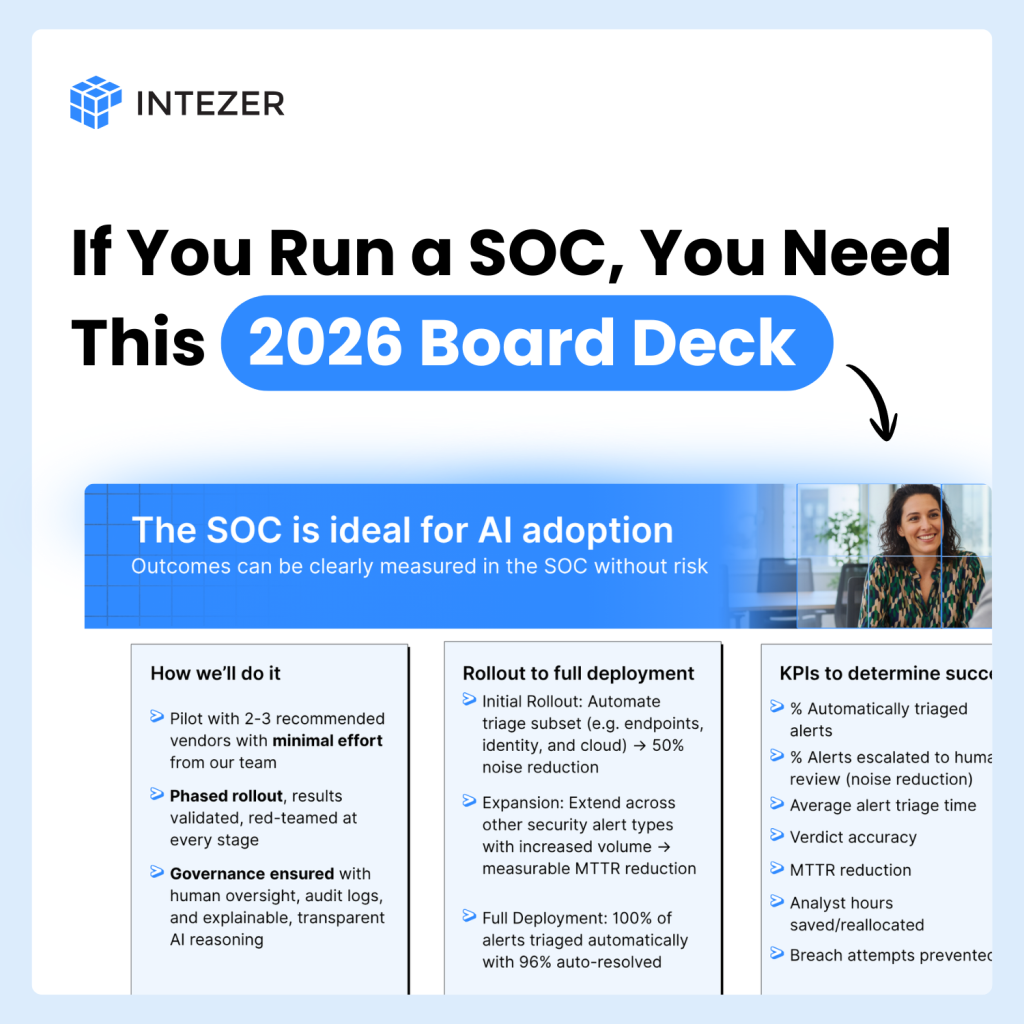
Get your editable copy of the one deck you need to pitch your board for 2026 AI SOC budget.

4. Safe automation with human-in-the-loop for high-impact actions

Most leaders are open to selective autonomous remediation, but only in narrow, well-defined, high-confidence scenarios.

For example:

  • Rapid ransomware containment
  • Isolation of clearly compromised endpoints
  • Automatic execution of repeatable hygiene tasks

But for broader or higher-impact actions, CISOs still want human review. The tone was clear:
AI should move fast where appropriate, but never at the expense of control.

5. Integration and practical telemetry coverage

Every leader emphasized that an AI platform is only as good as the data it can consume.

The must-have list included:

  • Cloud telemetry (AWS, Azure, GCP)
  • Identity providers (Okta, Entra ID, Ping)
  • EDR/XDR
  • SIEM logs
  • Ticketing/ITSM
  • Custom threat intelligence feeds

They don’t want a magical AI that promises answers without good data.
They want a connected system that can see across the entire environment.

6. Executive & board alignment with demonstrable ROI

CISOs aren’t implementing AI in a vacuum. Their boards and executive leadership teams are pressuring them from two very different angles:

  • Some are mandating AI adoption as a strategic priority.
  • Others are slowing everything down with extensive governance, risk, and compliance processes.

To navigate this dynamic, CISOs need clear, defensible ROI:

  • Reduced operating costs
  • Faster mean-time-to-respond
  • Fewer escalations
  • More predictable outcomes

AI without measurable value is no longer acceptable.
They need something they can put in front of the board and say, “Here’s the impact.”

7. Accountability and legal clarity

Before enterprises allow AI to autonomously take security actions, CISOs need a fundamental question answered:

“Who is accountable when the AI acts?”

This isn’t just a theoretical concern. It’s a gating requirement for adoption.

Until there is clear guidance on liability, responsibility, and governance, many organizations will keep AI on a tight leash.

Closing thoughts

Across all of these conversations, the message was consistent:
AI in the SOC is inevitable, but it must be safe, transparent, integrated, and measurable.

CISOs aren’t looking for science fiction. They’re looking for credible, operational AI that enhances their teams, strengthens their defenses, and aligns with business realities.

Read about why the best LLMs are not enough for the AI SOC.

The post The 7 CISO requirements for AI SOC in 2026 appeared first on Intezer.

Comprehensive Google SecOps migration checklist for CISOs and SOC leaders

10 December 2025 at 13:49

There’s a clear trend emerging with many organizations transitioning from legacy SIEMs to Google SecOps. While the Google SIEM platform is powerful, in our experience working with enterprise clients, that power only reveals itself when security leaders make three early decisions correctly:

  • Detection strategy: Whether to migrate existing rules or start fresh with a green-field approach.
  • Data onboarding: How to scale ingestion across multi-cloud environments without breaking pipelines.
  • Operating model: Building workflows that prevent “alert debt” from piling up on day one.

The strategic message is clear. Treat SIEM detection management with the same diligence you treat core security architecture, and augment your analysts with AI-powered triage so your humans can focus on higher-order investigations.

Here’s a practical checklist for discovery, migration, and operational success, designed for CISOs and SOC leaders evaluating a move to Google SecOps.

NOTE: This blog post is relevant to anyone considering a Chronicle SIEM migration as Google SecOps is the new Google branding for Chronicle.

The tl;dr version of the Google SIEM migration checklist 

PhaseKey focus
Pre-MigrationInventory, pain-point assessment, business justification
MigrationTool selection, data ingestion, rule/dashboard migration, Integration, governance & risk
Post-MigrationMeasurement of success, continuous improvement, cost optimisation, governance & reporting

Full Google SecOps migration checklist

Let’s dive into the details for each phase of the migration process.

Pre-migration checklist: Establishing the baseline

  1. Inventory current environment
    • Catalogue all data sources feeding Splunk: log types, volumes (GB/day), retention policies, on-prem vs cloud vs multi-cloud.
    • Map all current detections, dashboards, reports, playbooks, SOAR workflows.
    • Identify any compliance/regulatory retention obligations (audit logs, legal hold).
    • Establish current licensing costs, infrastructure (forwarders, indexers), staffing.
  2. Assess SIEM performance & pain points
    • Are you seeing cost escalation vs benefit (slower detection, high false positives, low automation)?
    • Is the SIEM struggling with data volume growth, scalability, multi-cloud telemetry?
    • Are SOC analysts spending more time on infrastructure/configuration than investigations?
    • Are you able to integrate newer requirements (cloud workloads, containers, IoT/OT, multi-cloud) effectively? This 451 Research report indicates many orgs run multiple SIEMs due to tool sprawl.
  3. Define business & security objectives
    • What do you hope to achieve? E.g., faster detection/response, lower cost, improved coverages, cloud alignment.
    • What are the key metrics: mean time to detect (MTTD), mean time to respond (MTTR), cost-per-alert, false positive rate, regulatory coverage, etc.
    • What is your target SOC maturity in e.g., 12-24 months? Are you planning a cloud-first strategy, heavier automation/AI, less on-prem infrastructure?
  4. Build the migration justification
    • Prepare a comparative TCO/ROI: legacy SIEM vs cloud-native. Google SecOps materials claim e.g., “ingest and analyse your data at Google speed and scale” and highlight cost benefit.
    • Understand what it will cost to migrate: re-write detections, dashboards, data flows, training, potential downtime.
    • Present risk assessment: What happens if you don’t migrate (risk of obsolete tool, scaling failure, cost spirals)? The “Great SIEM Migration” guide argues that legacy tools may become “dinosaurs”.

Migration-phase checklist: Executing the transition

  1. Select migration path & vendor/partner support
  2. Data ingestion, normalization & compatibility
    • Ensure: all of your log types/sources in Splunk are supported by the new platform. Google SecOps supports ingestion of Splunk CIM logs.
    • Plan for data mapping: Splunk field names, dashboards, custom fields → new schema.
    • Address historic data: Will you migrate archives? Will you keep Splunk as store-only? Community posts warn that mapping old archives can be complex.
    • Validate performance: test ingestion, query latency, retention policies on the new platform.
  3. Detection rules, dashboards, SOAR workflows
    • Catalogue existing detection rules, dashboards, SOAR playbooks in Splunk.
    • Determine which can be reused, which need rewriting. Ensure parity: detection coverage, mapping to MITRE ATT&CK, business use-cases. Splunk claims strong out-of-box detection library.
    • Build and test new rules/playbooks in Google SecOps; validate they meet or exceed current performance (MTTD, MTTR, false positives).
    • Ensure analyst training and new workflows are adopted: new UI, new query language, new incident-investigation flows (Google SecOps offers “Gemini in security operations” natural-language assistant).
  4. Integration & ecosystem fit
    • Ensure that Google SecOps integrates with your existing tool-stack (EDR, identity, network, cloud logs, SOAR, threat intel). Google advertises 300+ SOAR integrations.
    • Confirm multi-cloud/on-prem data ingestion: check vendor statements.
    • Validate APIs, custom connectors, forwarder architecture. Splunk vs Google SecOps comparison note: Splunk emphasizes hybrid flexibility.
  5. Governance, compliance & retention
    • Check how historic data will be retained, archived, accessed, both for compliance (audits/regulators) and investigations.
    • Confirm where the data resides (region/residency rules), encryption, access controls. Google SecOps claims to treat all data as first-party.
    • Align on SLAs, incident response metrics, roles & responsibilities.
    • Define cut-over strategy: Will Splunk be decommissioned or kept in read-only mode? Define freeze date, dual-runs, parallel operations.
  6. Risk management & business continuity
    • Define fallback/rollback plans: If the new platform fails, do you have the old SIEM in warm standby?
    • Monitor for data loss/misalignment during migration (NXLog warns of risks).
    • Communicate to stakeholders: SOC analysts, business units, auditors. Ensure training and change-management.
    • Set benchmarks and metrics: Time to detect/resolve in new platform vs old; cost per alert; staff utilisation; alert volumes; false positives.

Post-migration checklist: Optimizing & sustaining value

  1. Validate outcomes & measure success
    • Measure MTTD, MTTR, alert volumes, analyst productivity pre- and post-migration.
    • Compare actual cost savings vs business case.
    • Assess detection coverage: Are all critical use-cases still covered? Are any gaps emerging?
    • Run periodic health checks (some vendors like CardinalOps offer detection-rule health monitoring with MITRE ATT&CK coverage for Google SecOps).
  2. Continuous improvement & SOC maturity evolution
    • SOC maturity doesn’t stop at migration. Use freed-up resources to focus on advanced use-cases (threat hunting, proactive detection, automation, investigations).
    • Tune detection rules, remove noise, refine playbooks.
    • Leverage AI/natural-language features (Google SecOps touts “Gemini in security operations”).
    • Plan for future: hybrid/multi-cloud expansions, new telemetry sources, OT/IoT, supply-chain threats.
  3. Decommission legacy infrastructure & optimise cost
    • If the migration path included decommissioning the old SIEM (or reducing its role), ensure you turn off unneeded licences/infra.
    • Monitor the cost model of the new platform: ingestion volumes, retention policies—ensure you don’t inadvertently pay for excess.
    • Re-allocate resources: freed licences, server hardware, staff time — invest into SOC capability rather than maintenance.
  4. Governance, audit and stakeholder reporting
    • Update your SOC governance frameworks: incident-response playbooks, escalation paths, KPIs aligned with the new platform.
    • Communicate to board/executive leadership key outcomes: improved detection/response, cost rationalization, strategic alignment.
    • Ensure audit/compliance reports reflect the new tooling (document changes, validate controls).
    • Set up periodic reviews of tool performance, vendor roadmap, SOC maturity.

Final thoughts

Migrating to Google SecOps isn’t a simple platform swap, it’s a redesign of how your SOC operates. The upside: cost efficiency, scale, and automation can be immediate. The risks: migration complexity, content gaps, and operational disruption are real and must be managed deliberately.

As a CISO or SOC leader, treat this as a transformation program. Use the table and/or the full Checklist above to drive decisions; follow a strategic landing plan to sequence work; and anchor on the three non-negotiables outlined above:

  1. A clear detection strategy (migrate only if the value is there; rebuild the rest in YARA-L),
  2. Data onboarding at scale with a parser matrix and cost guardrails, and
  3. An operating model that prevents alert debt from day one through automation and measurable KPIs.

If you want help getting there faster, we can provide a SIEM jumpstart (curated + bespoke YARA-L rules, MITRE gap analysis and coverage, detection reviews, continuous improvement with Intezer engineers), a parser/ingestion plan for multi-cloud, and of course, Intezer Forensic AI SOC’s triage to meet on day-one, 100% alert coverage with full auditability so your analysts focus on the few cases that truly need their context and expertise.

Learn more about how Intezer can help you with your SecOps migration.

The post Comprehensive Google SecOps migration checklist for CISOs and SOC leaders appeared first on Intezer.

Why the “AI SOC Agent” narrative misses the point: The future is about security outcomes, not workflow augmentation

16 November 2025 at 17:50

tl;dr Greater productivity ≠ greater security outcomes. Kinda like why being able to accelerate from 0-60 MPH doesn’t help when the ice is cracking under your wheels.

And now, the full version.

AI SOC shouldn’t just “augment workflows”, that’s a productivity-locked perspective. The goal and the delivery capability that exists right now is to deliver full-scale enterprise triage of 100% of alerts with forensicly-accurate verdicts. That looks like streamlined triage, explainable verdicts, measurable accuracy, and operational resilience. There’s already an AI SOC platform that has operationalized what Gartner calls “emerging”.

While recent Gartner reports on “AI SOC Agents” and “SecOps Workflow Augmentation” succeed in elevating the conversation, they also reveal how incomplete that conversation still is. Both documents frame AI in the SOC as a promising but premature experiment, a toolset meant to make analysts more productive, not organizations more secure. That framing misses the point. AI isn’t about automation for automation’s sake; it’s about turning expert knowledge, data, context, and expertise into repeatable, scalable decision-making that covers every alert with confidence and context.

The bias in today’s AI SOC conversation

Gartner’s reports argue that AI SOC agents should be treated as “workflow augmentation tools” to reduce analyst fatigue and improve response efficiency. They recommend cautious adoption, structured pilots, and human-in-the-loop validation. Pragmatic? When LLMs are relied upon solely, sure. But the underlying assumption that enterprise-proven AI is not yet mature enough to deliver reliable outcomes is outdated.

In practice, this mindset anchors the market in productivity metrics, not security performance. It evaluates how efficiently teams work, not how effectively they defend. The focus stays on “mean time to detect” and “mean time to respond,” rather than the more critical questions:

  • Are ALL alerts being triaged?
  • Are verdicts, not just investigations, consistently accurate?
  • Are we actually reducing risk, not just improving the process?
  • Are alerts triaged in seconds & minutes for true containment & response?

That’s where the emerging class of true AI SOC platforms breaks away from the Gartner lens.

Workflow augmentation isn’t security

The distinction matters. Augmentation is an operational improvement; outcomes are a security transformation. Most vendors today build tools that accelerate investigation but still depend on human oversight for every meaningful decision. Those are SOAR 2.0 platforms: automation-centric, workflow-obsessed, and still fundamentally enrichment, not triage.

A true AI SOC, by contrast, triages every alert across the stack autonomously, determines a verdict with auditable reasoning, and escalates only when necessary, typically less than four percent of the time. This isn’t a co-pilot; it’s a teammate that already performs at the level of a seasoned analyst and identifies the needles without the haystack. This is incredible for the SOC analysts that are focused on looking at real alerts.

Security outcome execution is the critical requirement any true AI SOC should provide:

  • Resolve millions of alerts monthly across distributed environments with <4% escalation rates.
  • Deliver verdict accuracy above 97.7% through hybrid deterministic and AI reasoning.
  • Provide explainable decisions, validated by periodic human review and forensic evidence.
  • Uncover real threats in seconds & minutes, not hours.

This isn’t augmentation; it’s execution.

Read more about properly framing the AI SOC conversation.

The “emerging” technology that’s already operational

Gartner describes AI SOC agents as an “emerging technology” that promises to evolve beyond playbook-driven automation. The irony is that enterprise SOCs are already running on these systems today. Fortune 10 environments and thousands of organizations worldwide are triaging every single alert, not just the critical and high-severity ones, through AI that emulates human reasoning at scale.

These systems don’t “pilot” AI; they operationalize it. They deliver 24/7 SOC capability, instant triage, and consistent decision-making grounded in explainable logic, not black-box inference. They prove that an AI SOC is no longer a future-state concept. It’s production-grade infrastructure that’s rewriting what operational maturity means, and has been for years now.

The difference between Gartner’s caution and what’s happening in practice is simple: proof.

Measuring what actually matters

The reports fixate on efficiency → MTTD, MTTR, analyst satisfaction, but those metrics only tell half the story especially for antiquated SOCs. The next generation of AI SOCs defines success through security outcome metrics, including:

  1. Total alert coverage – Every alert analyzed, across all severities and sources.
  2. Verdict accuracy – The supermajority of decisions must be right, consistently and explainably.
  3. Escalation rate – Only the rarest cases should reach human review.
  4. Explainability – Every verdict is clearly backed by evidence: memory scans, forensic traces, and contextual reasoning.
  5. Feedback velocity – Every corrected verdict feeds back into the detection logic, closing the learning loop.

When you measure what truly matters, accuracy, coverage, trust, the difference between AI that “helps” and AI that defends becomes obvious.

Why “AI SOC Agent” ≠ “AI SOC Platform”

The reports conflate two very different things. An “AI SOC agent” is a single use case, an assistant. An “AI SOC platform” is a full operating model: triage, investigation, and response fused into a continuous feedback loop back to detection engineering. One optimizes efficiency; the other drives security transformation.

That’s the real inflection point the industry is standing at. SOCs that treat AI as a productivity booster will get marginal gains, which is a great thing for the industry. SOCs that rebuild around AI as a core operating principle will experience exponential gains with real risk reduction.

In other words: this isn’t about speeding up analysts, it’s about scaling their expertise across the entire alert surface.

From AI promise to proof

The challenge now isn’t technology, it’s perception. The AI SOC has already proven it can outperform legacy models built on manual triage and brittle playbooks. It has shown that full alert coverage, explainable verdicts, and continuous learning can coexist with human oversight and compliance.

The industry doesn’t need another year of pilots to “validate the promise.” It needs a new standard of performance.

The next evolution of the SOC will be measured not by how well it augments workflows, but by how confidently it can:

  • Detect and triage every signal.
  • Deliver verdicts with explainable evidence.
  • Quantify accuracy in measurable, repeatable terms.
  • Strengthen analyst trust through transparency.

That’s the AI SOC outcome model, here today.

Final thoughts

Gartner’s perspective is valuable for shaping the taxonomy of an emerging market. But the reality on the ground has already overtaken the research. The world doesn’t need another whitepaper on “potential.” It needs proof of performance, and it exists.

The future SOC isn’t augmented.

It’s autonomous, accurate, and accountable for strategic security outcomes that CISOs and leaders require, either now or in the next few months with the executive leadership push to operationalize AI.

The world’s largest enterprises today already benefit from the real market-defining traits of a forensic AI SOC.

To learn more about Intezer’s Forensic AI SOC platform, schedule a demo today!

The post Why the “AI SOC Agent” narrative misses the point: The future is about security outcomes, not workflow augmentation appeared first on Intezer.

❌