❌

Normal view

Turkish Crackdown On LGBTQ+ Organizations Threatens Freedom of Expression and Association

9 October 2026 at 16:22

EFF strongly condemns Turkey’s state-led discriminatory, oppressive attacks on feminist and LGBTQ+ organisations, media platforms, student groups, and rights defenders and activists within the country.

Since mid-September, access to the websites and social media accounts of a dozen organizations have been blocked by court order, while over 60 members and activists have been detained, their offices and homes raided, mobile phones, laptops and other digital devices seized, and judicial proceedings launched against them. 

These actions threaten the very existence of the LGBTQ+ organizations targeted, limiting their ability to carry out legitimate human rights work, deterring participation and support, and chilling the free speech rights of not just these groups, but any organization that even reports on LGBTQ+ oppression.

A little over a week ago, an Istanbul court shut down the website and social media accounts of T24, Turkey’s longest running independent digital news organization—which has covered government-backed campaigns against and earlier crackdowns on gay rights groups—alleging it had aired “LGBT propaganda” over the past year. 

It’s all part of Turkey’s efforts to portray LGBTQ+ groups and support networks for those living with HIV as criminal organizations that must be suppressed, purportedly to protect family values. Homosexuality is not illegal in Turkey (unlike Uganda, Nigeria, and Egypt, where it is criminalized), but LGBTQ+ organizations and activists have in recent years faced increased government oppression, including criminal proceedings on allegations related to obscenity and violations of Turkey’s Law on Associations, which regulates the activities of nonprofits.

In its new crackdown, the government is targeting LGBTQ+ groups’ websites and social media channels for alleged obscene posts accessible to children. Kaos GL, Turkey’s oldest gay rights organization, said investigations are being led by the Cyber Crimes Bureau of the Ankara Chief Public Prosecutor’s Office, which took members of its Board of Directors into custody, raided their homes, and searched the organization’s offices, where electronic devices were seized. 

According to Human Rights Watch, prosecutors in Istanbul said those targeted were suspected of “founding, leading, or being a member of a criminal organization,” as well as sex work and drug-related offenses. Publicly available law enforcement and judicial documents about the investigation reportedly don’t say which publications or posts are alleged to be obscene.

The prosecutor’s office launched an investigation of the organization and others under Article 226 of the Turkish Penal Code, which regulates the offense of “obscenity” (without clearly defining it), while the overall operation, dubbed “My Family is Safe” and launched as part of President Recep Tayyip Erdoğan’s “Decade of the Family” program, is being brought under Article 220 of the code. Justifying the crackdown by invoking family values and child safety suggests that the government is trying to enforce a moral code on society based on intolerance of and discrimination against LGBTQ+ people.

New Low for Turkey

Framing the activities of LGBTQ+ rights organizations as violations of organized crime provisions is a new low for Turkey, where free speech and press freedoms have long been under attack. The implication from these raids and investigations is that the organizations’ legitimate civil society work advocating for the rights of queer people—monitoring human rights violations, offering legal aid, running news portals, sponsoring cultural events such as symposiums and film screenings, publishing an online magazine and supporting LGBTQ+ refugees—is suspected of being criminal threatens the basic human rights of the LGBTQ+ community in Turkey.

These actions send a dangerous message to people and organizations exercising freedom of speech and association in support of queer people. Under the penal code, directing a criminal organization is punishable by five to ten years in prison, while merely being a member carries a sentence of two to five years. 

EFF joins hundreds of human, civil, LGBTQ+, and digital rights organizations around the world in calling for the immediate release of all those detained for exercising their rights to freedom of expression, association and legitimate human rights work, and the unblocking of all websites and social media accounts of affected organizations. 

For many LGBTQ+ individuals the world over, the internet can be a safer space for exploring identity, finding community, and seeking support. The anti-LGBTQ+ crackdown in Turkey is not happening in a vacuum—unfortunately we are seeing anti-LGBTQ+ bills restricting free expression and privacy, content moderation decisions that disproportionately impact LGBTQ+ users, and other forms of intolerance around the world. 

We urge international civil society and diplomatic partners to raise awareness of and to speak out against the crackdown, and to publicly show support for the legitimacy of Turkey’s LGBTQ+ organizations and the important work they do to ensure that queer people are safe and free.


Victory: Court, Using a New Test, Rules Embedding Links is Legal

16 September 2026 at 18:50

Courts have for two decades found that linking and embedding someone else’s web content, be it a photo, music, or an article, doesn’t violate copyright law–the entity that controls the server that hosts a copyrighted work, not the user or website that merely directs others to it, is directly liable if the content turns out to be infringing.

News publisher Emmerich Newspapers sought to convince the Fifth Circuit Court of Appeals to chart a new and dangerous course, arguing that an aggregator website that published links to its copyrighted articles was in effect “displaying” them and can be directly liable for infringement. EFF, along with several other public interest organizations and trade associations, filed a brief urging the court to follow multiple other circuits and reject that theory.

Fortunately, the Fifth Circuit Court of Appeals did just that. While it rejected the server test–the rule courts have used to determine copyright liability rests with whoever serves up the content–the court came to the same practical conclusion by focusing on who is responsible for transmitting content. 

Applying that test, the court found that pointing or directing a user’s browser to request and receive the copyright owner’s own copy residing on its computers does not involve transmitting or communicating the content. “Although we take different routes to get there, both the server test and the test we announce end up in a similar place: a website cannot transmit a work that it does not have,” the court said. 

We told the court that accepting Emmerich's theory would make the common act of embedding links a legally fraught activity, one that many websites might be unwilling to risk, which would seriously damage the internet as a tool for creating and disseminating ideas and knowledge,

We applaud the court’s decision–even though it applied a different test, it correctly concluded that a user linking pictures, video, or articles isn’t in charge of transmitting that content to the world. The user doesn’t control what’s located on the other end of the link—that’s up to the person who controls the server.

Emmerich also claimed linking violates the Digital Millennium Copyright Act (DMCA), arguing its URLs were copyright management information (CMI) and when the aggregator displayed Emmerich’s articles under its own URL, it tampered with Emmerich’s CMI, which violates the DMCA. 

Under that logic, unsuspecting internet users could face ruinous legal risk for doing something as simple as using a link shortener, particularly given potential statutory penalties of up to $25,000 per violation.  

In our brief, we told the court that URLs don’t necessarily equate to a copyrighted work or provide sufficient information about the nature of the underlying content, making it highly unlikely that anyone would expect a URL to contain CMI. Quoting EFF’s brief, the court concluded that URLs are first and foremost a locational reference tool and while it may be possible for a URL to contain CMI, the bar to that conclusion is high.

Overall, this was a good and sensible decision that will protect ordinary online expression, communication, and access to knowledge. Hopefully this issue is laid to rest at last.

Cops Play Hide and Seek About Using Spy Tech to Avoid Scrutiny and Bad PR

9 September 2026 at 22:09

Law enforcement agencies across the country are increasingly relying on spying technologies—automated license plate readers (ALPR), cell-site simulators, and facial recognition, to name a few--causing an outcry in many communities where people are rightly concerned about the threat to civil rights and civil liberties these tools present.

Some authorities are responding to these concerns by trying to hide what they’re doing. Police departments are telling officers not to mention ALPRs when stopping vehicles and concealing their use of ALPRs to avoid citizens’ public records requests. Concealing the use of unpopular spying tools isn’t anything particularly new for law enforcement—cops have been doing it for years—but it’s just as wrong now as it was 20 years ago.

These practices prevent the public from knowing about and questioning how agencies are spending taxpayer dollars on spying technologies and holding them accountable. This is especially troubling when many towns are signing contracts with Flock and other ALPR vendors with little to no public oversight. The practice also violates disclosure obligations, allows cops and prosecutors to hide their tactics from judges, and cheats defendants from being able to challenge the use of evidence gathered by spy tech from being used against them.

404 Media recently revealed that in its usage policy for Flock ALPR cameras, one county in Iowa tells police to keep them a secret when detaining people: “DO NOT MENTION ALPR USAGE TO THE OCCUPANTS OF THE VEHICLE,” the policy document reads. “DO NOT MENTION ALPR USAGE IN YOUR REPORT OR COMPLAINT UNLESS ABSOLUTELY NECESSARY.” If writing a report about an incident, police are told to say they used “county resources” in making a stop instead of acknowledging use of ALPRs.

In Houston, police officers are likewise instructed to “be as vague as permissible” about why they are using Flock because the searches they run on Flock’s surveillance system could be obtained via public records requests.

There is growing public alarm about the threat to civil liberties posed by ALPR cameras and reports of police abusing the tech by using it to spy on their exes. Some cities have the cameras covered up, and others are cancelling their use of ALPR networks. Two states have recently stepped back from ALPRs. This trend is certainly not lost on law enforcement agencies. Hiding the fact that they’re using ALPRs from Flock and other vendors is one way of avoiding scrutiny and bad PR.

But law enforcement and their spy tech vendors keeping people in the dark about the surveillance technologies trained on them predates the Flock backlash by decades. For example, AT&T built a powerful phone surveillance tool for police, called Hemisphere, in the mid 2000s, and the company required agencies not to use evidence gathered by Hemisphere in court unless there was no other admissible evidence. If evidence obtained through Hemisphere was used, police were required to recreate it through a traditional subpoena, a process they called “parallel construction.” We called it “evidence laundering.”

Likewise, police and prosecutors have taken far-reaching steps to hide from the public and courts their use of cell site simulators, also known as stingrays. Police have used these devices, which trick cell phones into connecting to them instead of phone towers to try locating suspects, to obtain people’s location data without a warrant by deceptively obtaining basic pen register orders from courts. Pen register orders are for obtaining call log data and police don’t need to prove they have probable cause to get one.

In Baltimore, for example, a judge concluded that law enforcement had used a standard pen register order to intentionally hide its use of a Stingray from the court in violation of its legal disclosure obligations, leading to a landmark 2015 privacy ruling that cops need a warrant to use the device.

That didn’t stop police from continuing to try to pull the wool over the eyes of courts and defense attorneys when they used stingrays, however. Prosecutors have accepted plea deals to hide their use of cell-site simulators and have even dropped cases rather than reveal information about their use of the technology. U.S. Marshalls have driven files hundreds of miles to thwart public records requests.

Fortunately, our commitment to shining a light on the use of surveillance tech is just as strong, if not stronger, than law enforcement’s quest to hide it. We’re working with privacy advocates and community groups to bring awareness about existing and emerging spy tools that threaten civil liberties and we’re encouraging policymakers and lawmakers to do more to restrain warrantless mass surveillance and stop it before it ever takes hold.  

If you're curious about whether your local police have contracts for ALPRS or other surveillance technologies, you can search EFF's Atlas of Surveillance.


An Explosion of Surveillance Towers is Coming to U.S. Borders, Costing Over $1 Billion

20 July 2026 at 21:25

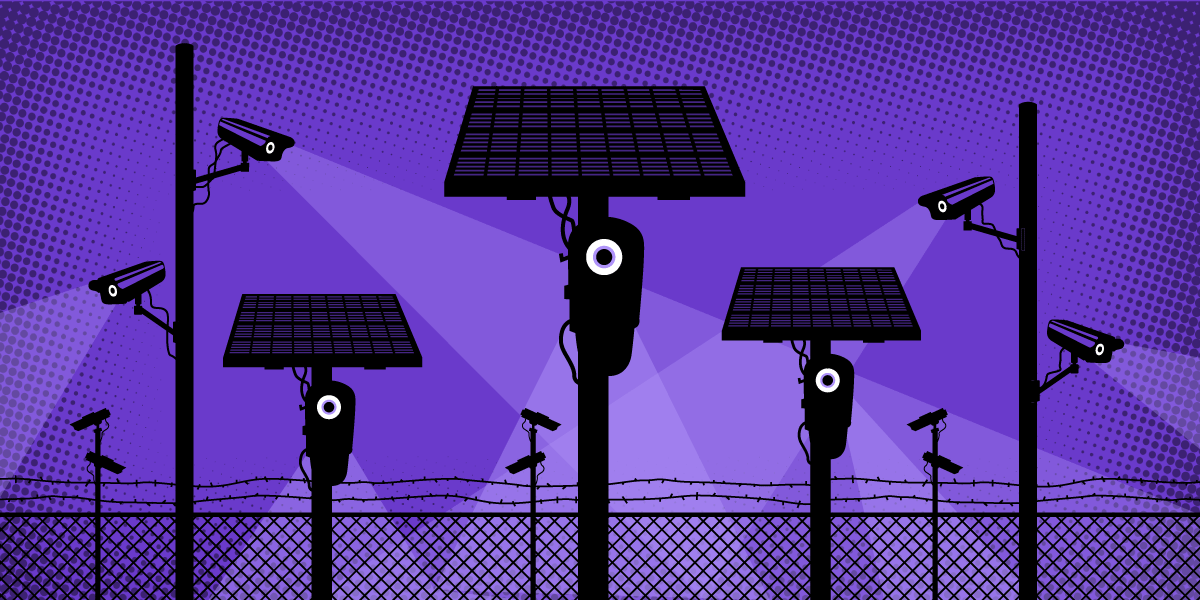
A new report from the Government Accounting Office reveals that the Department of Homeland Security (DHS) plans to nearly triple the number of surveillance towers along U.S. borders, from the current 830 to 2,300 by 2034.

DHS expects to expend $1 billion in taxpayer dollars for this dangerous expansion of a surveillance network indiscriminately trained on towns, school playgrounds, backyards, and vehicles—threatening the privacy and civil liberties of everyone in the border regions.

The towers are planned as part of DHS component Customs and Border Protection’s (CBP) Integrated Surveillance Tower (IST) program, which captures images of people and vehicles. The IST program operates autonomous surveillance towers, consisting of autonomous surveillance towers, consisting of AI-based systems using radar, thermal infrared and optical systems to track targets over long distances; integrated fixed towers, optimized for surveilling foot traffic and vehicles; and remote video surveillance systems, which can often be found very close to the border fence in Arizona, including residential neighborhoods where cameras are capable of spying on homes on both sides of the border. (For a description and photos of these technologies, see EFF’s updated guide to surveillance at the U.S.-Mexico Border.)

DHS expects to purchase more long-range autonomous towers and to upgrade existing towers with autonomous capabilities. The $1 billion comes from the so-called One Big Beautiful Act—a massive tax and spending law that President Trump signed in 2025, the report says.

The explosive expansion of border surveillance is a digital dumpster fire for human rights and civil liberties. It’s not just surveillance towers; drones, aerostats, surveillance vehicles, ground sensors, game cameras, and license plate readers are also part of the vast taxpayer-funded infrastructure that threatens all those who live, work, or seek refuge in the borderlands. This technology isn’t exclusive to U.S. federal agencies: it’s also deployed by state and local law enforcement, and even by governments on the Mexican side.

Since 2022, EFF has studied and mapped surveillance technology along the U.S.-Mexico border using public records research, open-source intelligence, and fact-finding trips, and created a handy interactive map to provide researchers and journalists with the tools they need to analyze the impact of U.S. border security policy. We have also documented the different types of surveillance technology in a zine, "Surveillance Technology at the U.S.-Mexico Border." We updated the publication earlier this year to help people identify the machinery of homeland security by adding more models of surveillance towers, newly deployed military tech, and a gallery of disguised trail cams and automated license plate readers.

EFF’s work includes defending the rights of individuals whose devices have been searched or seized upon entering the country; pushing back on the collection of biometric and social media identifiers; and developing digital security guidance for people crossing borders.

With the web of surveillance tech at the borders about to explode, EFF will continue to investigate and expose it and find ways to fight back with the communities that live in the shadow of this technological threat to human rights.

European Commission Chooses to Keep EU Users Locked Up Behind Big Tech’s Gates

9 July 2026 at 20:30

Users are always seeking more control over their social networking experience to make it better, whether to improve privacy or enhance flexibility. Interoperability between social networking platforms like Facebook and TikTok has so many benefits that solve those issues.  

Say you’re on multiple platforms because you have friends you follow on different networks, but you’ve decided to choose one platform with better privacy practices. With interoperability, you could switch and still interact with friends who remain on larger platforms. It could also enable independent apps with better privacy controls and more user choice. These are the untapped possibilities that could benefit users in the European Union under the 2022 Digital Markets Act (DMA).  

Yet, the European Commission, in its first review of the DMA, announced in April it had decided not to extend the DMA’s interoperability mandate to social networking and didn’t give a deadline or a timeline for enforcing that part of the Act. The Commission said “there is no clear demand” from users and businesses for social networking interoperability and, in any case, it’s too technically complex at the moment. Meanwhile, the Big Tech platforms that have been slow-walking interoperability over the last two years, erecting a myriad of hurdles for users seeking more freedom to choose other platforms, get a pass.

This is a huge disappointment and a missed opportunity by the Commission. Interoperability dismantles one of the biggest barriers faced by users who want to leave the tech giants’ platforms: the choice between changing to a platform you prefer or staying behind on a platform where all your friends, communities, and customers are.

The DMA, which went into force in 2024, aims to foster more choices for European Union users and encourage competition and innovation by forcing so-called gatekeeper platforms like Meta, Apple, and Google, to open their ecosystems to competitors. The regulation does a great deal to foster the integration of competing services and devices with the ecosystems of very large online platforms that act as gatekeepers. It even requires interoperability for messaging services, despite the significant technical and privacy challenges involved.

So, it’s odd that the Commission is using complexity as a shield against taking on social networking interoperability. The internet already runs on complex interoperable systems. Approaches like ActivityPub, the decentralized networking protocol behind the “Fediverse,” which gave rise to decentralized networks like Mastodon, already exist. The DMA shouldn’t mandate a specific protocol, but it can require meaningful interoperability outcomes.

The argument that there’s no real demand for social networking interoperability also falls flat. Users want the ability to move across platforms, choose the content they’d like to see from platforms, and not be tied down to a single platform. But there’s no way to get there—the platforms are doing little to open their social networking ecosystems. And now you have the DMA’s enforcer saying it’s not going to make them change. Demand for alternatives won’t materialize at scale until users see real progress towards interoperability, something the Commission has the power to do.

Having decided there’s little demand and too much complexity to proceed with mandating social networking interoperability, the Commission said it “will continue to monitor and assess how these services evolve.” This wait-and-see-posture only hurts users and strengthens and further entrenches Big Tech incumbents.

The DMA is supposed to center on the rights of technology users and be the pathway to an internet experience where you decide which software runs on your devices, where it’s easy to find the best products and services, and where you can leave a platform for a better one without forfeiting your social relationships.

Meanwhile, Big Tech is also resisting the DMA’s openness requirements. For example, Apple is supposed to be opening up iOS devices to rival app stores. Yet, the smartphone giant’s plan for opening its App Store levies junk fees and onerous conditions on app makers and is effectively impossible for any competitor to use.

It’s not just Apple pushing back against DMA enforcement. Meta's response is a “pay for privacy “system, in which users who do not consent to Meta’s surveillance will have to pay to use the service, or be blocked from it. Whether their plan complies with the DMA remains under review.

Nowhere in the DMA does it say social networking companies get to install a toll booth for users seeking to benefit from privacy rights the regulation grants them. The future EU Digital Fairness Act is another opportunity to protect users from such practices by declaring them unfair.

The Commission has responded to these developments with investigations, preliminary rulings, and fines. Meanwhile, users are missing out on greater choice and flexibility in how they communicate and connect online.  


EFF, TEDIC and CEJIL Challenge Secrecy in the Use of Face Recognition in Paraguay

25 June 2026 at 23:15

Seeking transparency and accountability in Paraguay’s use of facial recognition, EFF, the Association of Technology, Education, Development, Research, Communication (TEDIC), and the Centre for Justice and International Law (CEJIL) filed a complaint with the Inter-American Commission on Human Rights against the state for arbitrarily denying access to information about its implementation and use of the technology as a tool for mass surveillance that erodes people’s privacy rights. 

The case involves the Ministry of the Interior and National Police’s installation in 2019 of surveillance cameras with facial recognition technology in Asunción. Maricarmen Sequera, a lawyer and executive director of TEDIC, filed an information request with the ministry seeking details and protocols about the implementation and use of facial recognition systems and the personal data processing involved. 

The request sought information about, among other things, whether the state had conducted human rights or data protection impact assessments, as well as if it had developed measures and protocols for avoiding abuses, illicit uses of personal data, and other risks in the deployment of the facial recognition system.

The state denied most of the information requested, arguing that implementation details, protocols, and the processing of individuals' personal data were confidential security information. TEDIC contested the secrecy in courts, but the analyses lagged and ultimately sustained the denial of information. 

The petition filed last Friday (19) cites Inter-American standards upholding the public’s right to access information, particularly in relation to national security, that the Paraguayan authorities disregarded in denying TEDIC’s information request. The petition also argues that the refusal of information violated privacy and the right to informational self-determination.

The petition asks the Commission to recognize a violation of those rights and require the state to deliver the information requested. Further, the petition seeks an order compelling the state to adopt mandatory permanent mechanisms of active transparency regarding the acquisition, contracting, implementation, financing, functioning, and use of surveillance technologies by public bodies, especially those that incorporate processing of biometric data or artificial intelligence systems. 

It also asks the Commission to order the state to mandatory procedures for human rights impact assessments prior to acquiring and using surveillance technologies, particularly those that collect biometric data or use artificial intelligence.

The state’s lack of transparency in this case is not an isolated incident, both in Paraguay and in Latin America, where opacity in matters of security and surveillance is the unsettling rule. The situation gets worse with the increasing normalization of intrusive surveillance technologies by states in the region.

The Special Rapporteur for Freedom of Expression of the Inter-American Commission emphasized that states should disclose surveillance capabilities and contracts, and acknowledge state use of surveillance technologies at a meaningful level of detail, to facilitate essential public debate on the necessary limitations of surveillance in democratic societies and ensure compliance with international human rights law.

We hope that the Inter-American Commission upholds the robust safeguards in the Inter-American System and advances access to information and privacy rights in a case that can set a crucial precedent for the region.

DSA Human Rights Alliance Publishes Principles Calling for DSA Enforcement to Incorporate Global Perspectives

28 January 2026 at 08:16

The Digital Services Act (DSA) Human Rights Alliance has, since its founding by EFF and Access Now in 2021, worked to ensure that the European Union follows a human rights-based approach to platform governance by integrating a wide range of voices and perspectives to contextualise DSA enforcement and examining the DSA’s effect on tech regulations around the world.

As the DSA moves from legislation to enforcement, it has become increasingly clear that its impact depends not only on the text of the Act but also how it’s interpreted and enforced in practice. This is why the Alliance has created a set of recommendations to include civil society organizations and rights-defending stakeholders in the enforcement process. 

 The Principles for a Human Rights-Centred Application of the DSA: A Global Perspective, a report published this week by the Alliance, outlines steps the European Commission, as the main DSA enforcer, as well as national policymakers and regulators, should take to bring diverse groups to the table as a means of ensuring that the implementation of the DSA is grounded in human rights standards.

 The Principles also offer guidance for regulators outside the EU who look to the DSA as a reference framework and international bodies and global actors concerned with digital governance and the wider implications of the DSA. The Principles promote meaningful stakeholder engagement and emphasize the role of civil society organisations in providing expertise and acting as human rights watchdogs.

“Regulators and enforcers need input from civil society, researchers, and affected communities to understand the global dynamics of platform governance,” said EFF International Policy Director Christoph Schmon. “Non-EU-based civil society groups should be enabled to engage on equal footing with EU stakeholders on rights-focused elements of the DSA. This kind of robust engagement will help ensure that DSA enforcement serves the public interest and strengthens fundamental rights for everyone, especially marginalized and vulnerable groups.”

“As activists are increasingly intimidated, journalists silenced, and science and academic freedom attacked by those who claim to defend free speech, it is of utmost importance that the Digital Services Act's enforcement is centered around the protection of fundamental rights, including the right to the freedom of expression,” said Marcel Kolaja, Policy & Advocacy Director—Europe at Access Now. “To do so effectively, the global perspective needs to be taken into account. The DSA Human Rights Principles provide this perspective and offer valuable guidance for the European Commission, policymakers, and regulators for implementation and enforcement of policies aiming at the protection of fundamental rights.”

“The Principles come at the crucial moment for the EU candidate countries, such as Serbia, that have been aligning their legislation with the EU acquis but still struggle with some of the basic rule of law and human rights standards,” said Ana Toskic Cvetinovic, Executive Director for Partners Serbia. “The DSA HR Alliance offers the opportunity for non-EU civil society to learn about the existing challenges of DSA implementation and design strategies for impacting national policy development in order to minimize any negative impact on human rights.”

 The Principles call for:

◼ Empowering EU and non-EU Civil Society and Users to Pursue DSA Enforcement Actions

◼ Considering Extraterritorial and Cross-Border Effects of DSA Enforcement

◼ Promoting Cross-Regional Collaboration Among CSOs on Global Regulatory Issues

◼ Establishing Institutionalised Dialogue Between EU and Non-EU Stakeholders

◼ Upholding the Rule of Law and Fundamental Rights in DSA Enforcement, Free from Political Influence

◼ Considering Global Experiences with Trusted Flaggers and Avoid Enforcement Abuse

◼ Recognising the International Relevance of DSA Data Access and Transparency Provisions for Human Rights Monitoring

The Principles have been signed by 30 civil society organizations,researchers, and independent experts.

The DSA Human Right Alliance represents diverse communities across the globe to ensure that the DSA embraces a human rights-centered approach to platform governance and that EU lawmakers consider the global impacts of European legislation.


EFF to California Appeals Court: First Amendment Protects Journalist from Tech Executive’s Meritless Lawsuit

16 January 2026 at 22:22

EFF asked a California appeals court to uphold a lower court’s decision to strike a tech CEO’s lawsuit against a journalist that sought to silence reporting the CEO, Maury Blackman, didn’t like.

The journalist, Jack Poulson, reported on Maury Blackman’s arrest for felony domestic violence after receiving a copy of the arrest report from a confidential source. Blackman didn’t like that. So, he sued Poulson—along with Substack, Amazon Web Services, and Poulson’s non-profit, Tech Inquiry—to try and force Poulson to take his articles down from the internet.

Fortunately, the trial court saw this case for what it was: a classic SLAPP, or a strategic lawsuit against public participation. The court dismissed the entire complaint under California’s anti-SLAPP statute, which provides a way for defendants to swiftly defeat baseless claims designed to chill their free speech.

The appeals court should affirm the trial court’s correct decision.  

Poulson’s reporting is just the kind of activity that the state’s anti-SLAPP law was designed to protect: truthful speech about a matter of public interest. The felony domestic violence arrest of the CEO of a controversial surveillance company with U.S. military contracts is undoubtedly a matter of public interest. As we explained to the court, “the public has a clear interest in knowing about the people their government is doing business with.”

Blackman’s claims are totally meritless, because they are barred by the First Amendment. The First Amendment protects Poulson’s right to publish and report on the incident report. Blackman argues that a court order sealing the arrest overrides Poulson’s right to report the news—despite decades of Supreme Court and California Court of Appeals precedent to the contrary. The trial correctly rejected this argument and found that the First Amendment defeats all of Blackman’s claims. As the trial court explained, “the First Amendment’s protections for the publication of truthful speech concerning matters of public interest vitiate Blackman’s merits showing.”

The court of appeals should reach the same conclusion.

EU's New Digital Package Proposal Promises Red Tape Cuts but Guts GDPR Privacy Rights

4 December 2025 at 19:04

The European Commission (EC) is considering a “Digital Omnibus” package that would substantially rewrite EU privacy law, particularly the landmark General Data Protection Regulation (GDPR). It’s not a done deal, and it shouldn’t be.

The GDPR is the most comprehensive model for privacy legislation around the world. While it is far from perfect and suffers from uneven enforcement, complexities and certain administrative burdens, the omnibus package is full of bad and confusing ideas that, on balance, will significantly weaken privacy protections for users in the name of cutting red tape.

It contains at least one good idea: improving consent rules so users can automatically set consent preferences that will apply across all sites. But much as we love limiting cookie fatigue, it’s not worth the price users will pay if the rest of the proposal is adopted. The EC needs to go back to the drawing board if it wants to achieve the goal of simplifying EU regulations without gutting user privacy.

Let’s break it down. 

 Changing What Constitutes Personal Data 

 The digital package is part of a larger Simplification Agenda to reduce compliance costs and administrative burdens for businesses, echoing the Draghi Report’s call to boost productivity and support innovation. Businesses have been complaining about GDPR red tape since its inception, and new rules are supposed to make compliance easier and turbocharge the development of AI in the EU. Simplification is framed as a precondition for firms to scale up in the EU, ironically targeting laws that were also argued to promote innovation in Europe. It might also stave off tariffs the U.S. has threatened to levy, thanks in part to heavy lobbying from Meta and tech lobbying groups.  

 The most striking proposal seeks to narrow the definition of personal data, the very basis of the GDPR. Today, information counts as personal data if someone can reasonably identify a person from it, whether directly or by combining it with other information.  

 The proposal jettisons this relatively simple test in favor of a variable one: whether data is “personal” depends on what a specific entity says it can reasonably do or is likely to do with it. This selectively restates part of a recent ruling by the EU Court of Justice but ignores the multiple other cases that have considered the issue. 

 This structural move toward entity specific standards will create massive legal and practical confusion, as the same data could be treated as personal for some actors but not for others. It also creates a path for companies to avoid established GDPR obligations via operational restructuring to separate identifiers from other information—a change in paperwork rather than in actual identifiability. What’s more, it will be up to the Commission, a political executive body, to define what counts as unidentifiable pseudonymized data for certain entities.

Privileging AI 

In the name of facilitating AI innovation, which often relies on large datasets in which sensitive data may residually appear, the digital package treats AI development as a “legitimate interest,” which gives AI companies a broad legal basis to process personal data, unless individuals actively object. The proposals gesture towards organisational and technical safeguards but leave companies broad discretion.  

 Another amendment would create a new exemption that allows even sensitive personal data to be used for AI systems under some circumstances. This is not a blanket permission:  “organisational and technical measures” must be taken to avoid collecting or processing such data, and proportionate efforts must be taken to remove them from AI models or training sets where they appear. However, it is unclear what will count as an appropriate or proportionate measures.

Taken together with the new personal data test, these AI privileges mean that core data protection rights, which are meant to apply uniformly, are likely to vary in practice depending on a company’s technological and commercial goals.  

And it means that AI systems may be allowed to process sensitive data even though non-AI systems that could pose equal or lower risks are not allowed to handle it. 

A Broad Reform Beyond the GDPR

There are additional adjustments, many of them troubling, such as changes to rules on automated-decision making (making it easier for companies to claim it’s needed for a service or contract), reduced transparency requirements (less explanation about how users’ data are used), and revised data access rights (supposed to tackle abusive requests). An extensive analysis by NGO noyb can be found here.  

Moreover, the digital package reaches well beyond the GDPR, aiming to streamline Europe’s digital regulatory rulebook, including the e-Privacy Directive, cybersecurity rules, the AI Act and the Data Act. The Commission also launched “reality checks” of other core legislation, which suggests it is eyeing other mandates.

Browser Signals and Cookie Fatigue

There is one proposal in the Digital Omnibus that actually could simplify something important to users: requiring online interfaces to respect automated consent signals, allowing users to automatically reject consent across all websites instead of clicking through cookie popups on each. Cookie popups are often designed with “dark patterns” that make rejecting data sharing harder than accepting it. Automated signals can address cookie banner fatigue and make it easier for people to exercise their privacy rights. 

While this proposal is a step forward, the devil is in the details: First, the exact format of the automated consent signal will be determined by technical standards organizations where Big Tech companies have historically lobbied for standards that work in their favor. The amendments should therefore define minimum protections that cannot be weakened later. 

Second, the provision takes the important step of requiring web browsers to make it easy for users sending this automated consent signal, so they can opt-out without installing a browser add-on. 

However, mobile operating systems are excluded from this latter requirement, which is a significant oversight. People deserve the same privacy rights on websites and mobile apps. 

Finally, exempting media service providers altogether creates a loophole that lets them keep using tedious or deceptive banners to get consent for data sharing. A media service’s harvesting of user information on its website to track its customers is distinct from news gathering, which should be protected. 

A Muddled Legal Landscape

The Commission’s use of the "Omnibus" process is meant to streamline lawmaking by bundling multiple changes. An earlier proposal kept the GDPR intact, focusing on easing the record-keeping obligation for smaller businesses—a far less contentious measure. The new digital package instead moves forward with thinner evidence than a substantive structural reform would require, violating basic Better Regulation principles, such as coherence and proportionality.

The result is the opposite of  “simple.” The proposed delay of the high-risk requirements under the AI Act to late 2027—part of the omnibus package—illustrates this: Businesses will face a muddled legal landscape as they must comply with rules that may soon be paused and later revived again. This sounds like "complification” rather than simplification.

The Digital Package Is Not a Done Deal

Evaluating existing legislation is part of a sensible legislative cycle and clarifying and simplifying complex process and practices is not a bad idea. Unfortunately, the digital package misses the mark by making processes even more complex, at the expense of personal data protection. 

Simplification doesn't require tossing out digital rights. The EC should keep that in mind as it launches its reality check of core legislation such as the Digital Services Act and Digital Markets Act, where tidying up can too easily drift into a verschlimmbessern, the kind of well-meant fix that ends up resembling the infamous ecce homo restoration. 

❌