Normal view

We're Fighting Mass Surveillance Tech—and Winning

2 June 2026 at 18:41

EFF is on the front lines of the fight against tech-enabled tyranny, but we aren't alone. Our team depends on your help to fight back against the surveillance state.

JOIN EFF

People around the world are pushing back against the mass surveillance that undermines privacy and free expression for everyone. You can help during EFF's spring membership drive.

One of the people who joined the fight for digital rights is EFF client Will Freeman. Will created the website DeFlock.me to reveal the dangers of automated license plate readers (ALPRs)—cameras that collect location data on every vehicle they see and upload that to a massive nationwide police database. Deflock.me turns the tables by enlisting ordinary people to track the locations of tens of thousands of ALPR cameras.

But when the police spy-tech company Flock Safety went after Will's website with legal threats citing trademark law, he saw it for what it was: an attempt to silence critics and dim the light on mass surveillance.

The company will try everything it can to downplay the criticism, but EFF will be right there demanding accountability.

"I was totally unprepared to receive a cease & desist letter. I can see how most people would be bullied into submission by a threat like that. That's when I remembered Dave Maass from the EFF introduced himself via email several weeks before, so I reached out for help," Freeman says.

And that's when EFF stepped in. Recognizing DeFlock.me as a quintessential expression of grassroots advocacy and a form of criticism protected by the U.S. First Amendment, EFF's lawyers helped Will fight back. And the Big Surveillance Tech flinched.

But these battles against Flock's Spying tools rage on. In cities around the country, privacy advocates are pressuring officials to block or end contracts for ALPRs—and winning. The company will try everything it can to downplay the criticism, but EFF will be right there demanding accountability.

Two people wear EFF Claw Back member t-shirts. The front shows a cat swatting at spy cameras and the back says “Mass Surveillance” with red claw marks through it

Get the new Claw Back member t-shirt featuring a fierce feline swatting at community surveillance. You might empathize with him, but there’s a better way. Let’s end the law enforcement contracts, harmful practices, and twisted logic that enable mass spying in the first place.

"I'm really grateful the EFF was able to step in and help. Without them, free speech would be only for those wealthy enough to defend themselves against billion dollar companies. We've grown a lot since then and are expanding our efforts to expose and push back against mass surveillance on our streets," Freeman says.

Support the movement

stop mass surveillance tech today when you join EFF

____________________

EFF is a member-supported U.S. 501(c)(3) organization. We've received top ratings from the nonprofit watchdog Charity Navigator since 2013! Your donation is tax-deductible as allowed by law.

More License Plate Reader Mission Creep: School Residency Verification, Background Checks, and Noise Complaints

26 May 2026 at 23:23

An EFF analysis of millions of searches of Flock Safety automated license plate reader (ALPR) data by police has uncovered a troubling pattern: in the absence of a warrant requirement to search ALPR databases, law enforcement agencies have moved beyond specific investigations to use these surveillance networks for virtually any whim.

Our findings suggest that the absence of a warrant requirement has fostered a culture of unrestricted access to sensitive location data, allowing agencies to leverage that data beyond the scope of specific criminal investigations.

As a refresher: Law enforcement agencies lease or purchase camera systems from Flock Safety and then mount them by the side of the road and at intersections to document every vehicle that passes, including the plate, make, model, color and distinguishing characteristics, along with the date, time and location of where it was seen. 

Law enforcement's talking points—often scripted by the company itself—trumpet their role in solving high-stakes crimes. But the data reveals a different story. What they're not saying is that ALPRs are also frequently used for extremely low-level investigations, such as verifying whether a student lives within a particular school zone. In some cases, police have even used this tech to conduct employment background checks and investigations into loud music complaints. Recently, a motorcyclist was even targeted for simply holding a cell phone while riding.

The reach of this ALPR surveillance is amplified by the nature of the indiscriminate sharing these technologies encourage. Most agencies choose to share broadly, often as part of a nationwide pool, making it common for a single city's system to be searched hundreds of thousands of times each month. By analyzing these "network audit logs," privacy advocates and journalists have uncovered evidence of the technology being used to surveil protesters, abortion-seekers, immigrants, and even ethnic Roma populations

While these high-profile abuses are shocking, the more mundane uses are also problematic, signaling a massive, unchecked mission creep that has turned an alleged “crime-fighting” tool into a universal tracker of everyone’s movements. 

Residency Checks

School systems in the U.S. conduct "residency verification" investigations of their parents or guardians to ensure enrolled children live in the district. To carry out these checks, some school districts have enlisted law enforcement officers for help, leveraging ALPR databases to track the comings and goings of families across the region. 

Buford City Schools in Georgia, which serves only about 6,000 students, illustrates the scale of this prying. Between January 2025 and March 2026, school police ran more than 375 searches where officers listed school residency verification, or simply "RV," as the reason for the search. That accounts for more than half of all ALPR searches in that period, and in those three months of 2026, three-quarters of all searches were related to residency verification. 

School officials stand by the searches. "[B]ecause Buford City Schools is a highly sought-after district, we experience ongoing challenges with residency fraud," a spokesperson told Appen Media, which shared the email with EFF. "Flock Safety is one of the tools we use to verify residency and protect the integrity of the Buford City School System for families who live within the district."

A search of ALPR data will show a lot more than whether a family lives within the right zone. In these Buford cases, officers ran some searches across more than 5,800 different networks nationwide. Every time a plate is searched, it can reveal personal information about a family: when they go to the doctor, when they go to worship, when they go out at night, and where they travel on vacation. None of that is the school district's business, and these searches are a huge invasion of privacy. 

While Buford was by the far the most prolific, it wasn't the only agency to run school residency checks. For example, Delhi Township Police Department (DTPD) in Ohio ran 35 searches related to students in five schools in a three-month period during spring 2025, and similarly stood by the practice, citing a warning given to parents that submitting a false statement of residency may be a felony. 

After EFF sent an inquiry to DTPD, the agency conducted a brief investigation and found that "these searches were not done to verify residency upon submission, but to investigate cases where it was believed the form was filled out with false information." DTPD did not say what kind of evidence was required to establish suspicion before an ALPR query, nor did it offer information on how many of these investigations turned out to be justified. 

However, the official told EFF: "in response to your inquiry, the department will be implementing a change to how these queries are documented in the Flock system and internally, to increase accountability and help avoid any confusion moving forward."

Other agencies that ran school residency searches include Cortland Police Department in Ohio and Lincoln Police Department in Alabama. Several agencies also ran searches with "residency," "residency investigation" or "residency verification" as the reason, but that could refer to a number of public services. These agencies include Ridgeland Police Department in Mississippi, Fairfield County Sheriff's Office in South Carolina, Manteno Police Department in Illinois, Illinois Department of Natural Resources, and Mora County Sheriff's Office in New Mexico. 

Background Checks

Few people would imagine that applying for a government job would open you up to an ALPR search. Yet, several law enforcement agencies ran searches through the Flock network related to employment. 

For example:

  • Jefferson County Sheriff's Office in Missouri ran six searches across 2,853 networks, documenting "employment" in the reason field.
  • Little Elm Police Department in Texas ran 10 searches across 6,306 networks, documenting "EMPLOYMENT" in the reason field.
  • Ridgeland Police Department in Mississippi ran two searches across more than 6,000 networks documenting "employment background inv" in the reason field.
  • Texas City Police Department, Texas ran three searches across 728 networks, documenting "pre employment background" in the reason field. 
  • Zion Police Department in Illinois ran a research across 585 networks documenting "Employee Background" in the reason field. 

Davidson Police Department in North Carolina logged a search listed as "Employment Background," but in response to an inquiry from EFF, the chief described this as "poor choice of words by our investigator." He further stated that the agency does not use ALPRs as part of employment background checks, but in this case, the agency shared that a potential violation of a protective order came to light during a background check, hence the reference to it in the search log.

In addition to the agencies mentioned, several agencies ran searches that simply referred to "background check" or "background checks," which could be related to employment or perhaps some other issue, such as a concealed weapons permit, for example. These include Avon Police Department in Indiana, Rockford Police Department in Illinois, San Bernardino County Sheriff's Office in California, and Seaford Police Department in Delaware.

Noise Complaints

Many people have probably been irritated at some point or another by a car blasting a deep bassline or even the infamous "whistle tip." Some may have even called the cops to complain about a neighbor’s house party. But that's a far cry from the types of serious crimes that Flock and its customers have claimed that the ALPR systems would be used to solve. 

Yet, EFF identified 26 agencies where officers felt it was appropriate to pry into a driver's life because of a noise complaint, ranging from house parties to loud exhausts to just "music": 

A table of agencies and their searches that relate to noise complaints.

Some of these agencies searched upwards of 6,500 networks’ cameras—the equivalent of launching a nationwide goose chase over a booming subwoofer or a busted muffler. 

When Mission Creep Is Just Plain Creepy

An observant reader of this report may have noticed that Ridgeland Police Department in Mississippi ran searches in all three of the categories we reported above.

However, after the city first installed the Flock Safety cameras, the then-police chief told the press that the technology helps solve cases that range from "theft to crimes of violence"—without disclosing that the range would extend much further.

When police and salespeople trot out cherry-picked cases to argue that a mass surveillance technology is an "important" tool,  they obfuscate that it's a convenient shortcut around due process. For serious crimes, police can already go through the standard legal process: making the case to a judge on why they should get a search warrant for location data, whether it's from cell phones or service providers. But police treat ALPR databases as if no such threshold exists, giving them free rein to track a person’s movements without a sliver of judicial oversight.

When police and salespeople trot out cherry-picked cases to argue that a mass surveillance technology is an "important" tool,  they obfuscate that it's a convenient shortcut around due process.

"This is the same as if I put a police officer on the side of the road with a pen and a notepad and he writes down every license plate number that drives by,” the former chief said, repeating a commonly circulated talking point. 

That rhetoric may sound reasonable if we were just talking about a single camera on a street corner, but Ridgeland now operates more than 50 cameras—the equivalent of one for every 500 residents—and maintains access to tens of thousands more. 

If the chief had stood in front of the city’s aldermen and asked for permission to search more than 20,000 cameras so his officers could investigate the high crime of "music," it’s quite unlikely that they would have been nodding their heads along. 

Ridgeland Police Department did not respond to EFF’s requests for comment.

California Coastal Community Must Reject CBP's AI-Powered Surveillance Tower

24 April 2026 at 22:04

Customs and Border Protection (CBP) is seeking permission from the California city of San Clemente to install an Anduril Industries surveillance tower on a cliff that would allow for constant monitoring of entire coastal neighborhoods. 

The proposed tower is Anduril's Sentry, part of the Autonomous Surveillance Tower (AST) program. While CBP says it will primarily monitor the coastline for boats carrying migrants, it will actually be installed 1.5 miles inland, overlooking the bulk of the 62,000-resident city. By CBP's own public statement, the system–which combines video, radar, and computer vision–is "constantly scanning" for movement and identifying and tracking objects an AI algorithm decides are of interest. Depending on the model–the photos provided by CBP indicate it is a long range maritime model–the camera could see as far as nine miles, which would cover the entire city and potentially see as far as neighboring Dana Point.

Map of San Clemente showing 1.5 miles between the tower and the coast

"The AST utilize advanced computer vision algorithms to autonomously detect, identify, and track items of interest (IoI) as they transit through the towers field of view," CBP writes in a privacy threshold analysis. "The system can determine if an IoI is a human, animal, or vehicle without operator intervention. The system then generates and transmits an alert to operators with the location and images of the IoI for adjudication and response." 

On April 28, local residents and Oakland Privacy, a privacy- and anti-surveillance-focused citizens’ coalition, are holding a town hall to inform the public about the dangers of this technology. We urge people to attend to better understand what's at stake. 

"The planned deployment of an Anduril tower along a heavily used Orange County coastline 75 miles from the border demonstrates that the militarization of the border region is rapidly moving northwards and across the entire state," writes Oakland Privacy. 

City officials raised concerns about resident privacy and proposed that a lease agreement include a prohibition on surveilling neighborhoods. CBP rejected that proposal, instead saying that they would configure the tower to "avoid" scanning residential neighborhoods, but the system would remain capable of tracking human beings in residential areas. According to the staff report: 

In response to privacy concerns, CBP has stated the system would be configured to avoid scanning residential areas that fall into the scan viewshed, focusing the system on the marine environment. CBP has maintained the purpose of the system is specifically maritime surveillance, and the system would be singularly focused on offshore activities. However, there may be an instance in which there is an active smuggling event, detected by the system at sea, in which the subsequent smuggling event traverses through the residential neighborhoods. In such a case, the system may continue to track and monitor. To restrict this functionality would be contrary to the spirit and intent of the deployment. Therefore, they cannot make such a contractual obligation.

The Anduril towers retain a variety of data, including images and more. 

image of surveillance tower from public records

The proposed Anduril surveillance tower. Source: City of San Clemente

"The AST capture and retain imagery which occurs in plan view of the tower sites and is stored as an individual event with a unique event identified allowing replay of the event for further investigation or dismissal based on activity occurring," according to the private threshold analysis.

The document indicates a potential 30-day retention period for imagery, but then contradicts itself to say that data will be held indefinitely to train algorithms: "AST will also be maintaining learning training data, these records should not be deleted." This means that taxpayers would be paying for the privilege of having their data turned into fuel for Anduril's product.

In 2020 CBP said it would work with National Archives and Records Administration (NARA) to develop a retention schedule for training data (i.e., a timeline for deletion). However, when EFF filed a Freedom of Information Act (FOIA) with NARA, the agency said there were no records of these discussions. Likewise, CBP has not provided records in response to the FOIA request EFF filed with them seeking the same records. 

An Anduril surveillance tower at the borde fence with a Border Patrol vehicle.

Anduril Maritime Sentry in San Diego, where the border fence meets the ocean.

This would not be the first CBP tower placed along the coastline in California. EFF identified one in Del Mar, about 30 miles from the border, and another in San Diego County where the border fence meets the Pacific Ocean. CBP has also applied to place towers–although not necessarily the Anduril model–in or near several other coastal locations: Gaviota State Park, Refugio State Park, Vandenberg Air Force Base, Piedras Blancas and Point Vicente. The California coastline isn’t the only coastline dotted with surveillance towers. The Migrant Rights Network has also documented numerous Anduril towers along the southeast coast of England. Where the San Clemente tower would differ is that there is a substantial population between the tower and the beach, and because it's a 360-degree system, it can watch neighborhoods even further from the coast. 

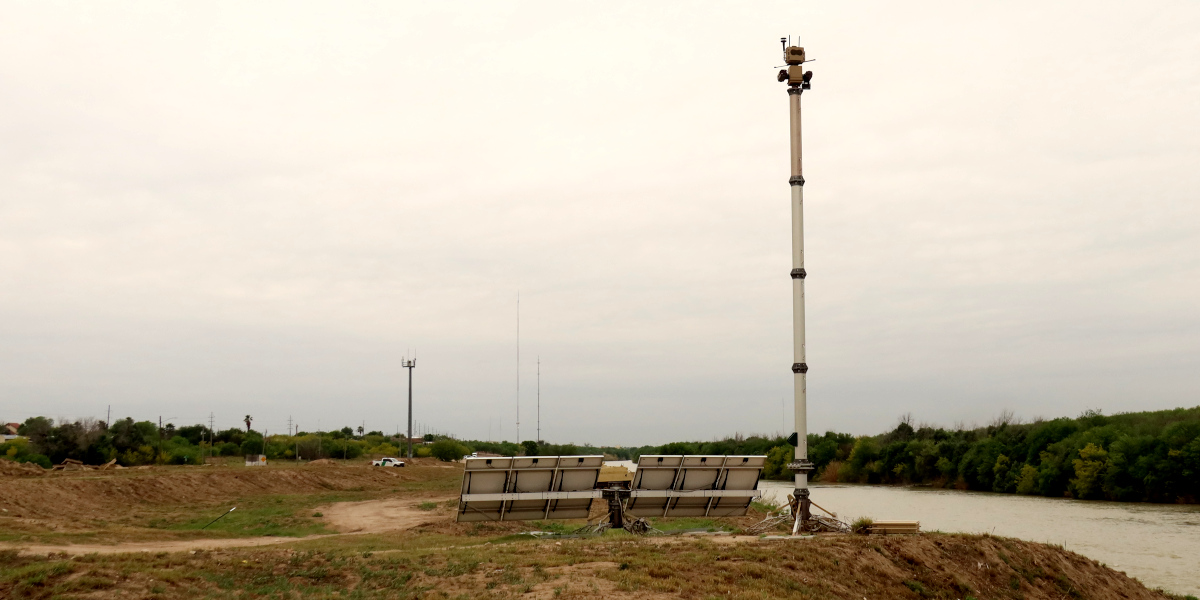
However, this won't be the first time an Anduril tower has been placed next to a community. EFF has documented numerous Anduril towers in public parks along the Rio Grande in Laredo and Roma, Texas. In Mission, Texas, an Anduril tower was placed outside an RV park: the tower could not even see the border without capturing data from the community. Because AI can swivel the cameras 360 degrees, two churches were within the "viewshed" of that tower. 

Click here to view EFF's ongoing map of CBP surveillance towers.

Many border surveillance towers are placed on city or county property, requiring a lease to be approved by the local governing body–as is the case with San Clemente. In 2024, EFF and Imperial Valley Equity and Justice organized an effort to fight the renewal of a Border Patrol's lease for a tower next to a public park. The coalition lost narrowly after a recall election ousted two officials who were critical of the lease.

CBP is rapidly increasing the number of towers at the border and beyond, recently announcing the potential to install 1,500 more towers in the next few years–more than tripling what we've documented so far–at a cost of more than $400 million to the public for maintenance alone. This is despite more than 20 years of government reports that have documented how tower-based systems are ineffective and wasteful.

It's time to fight back. 

Hot Off the Press: EFF's Updated Guide to Tech at the US-Mexico Border

13 April 2026 at 19:35

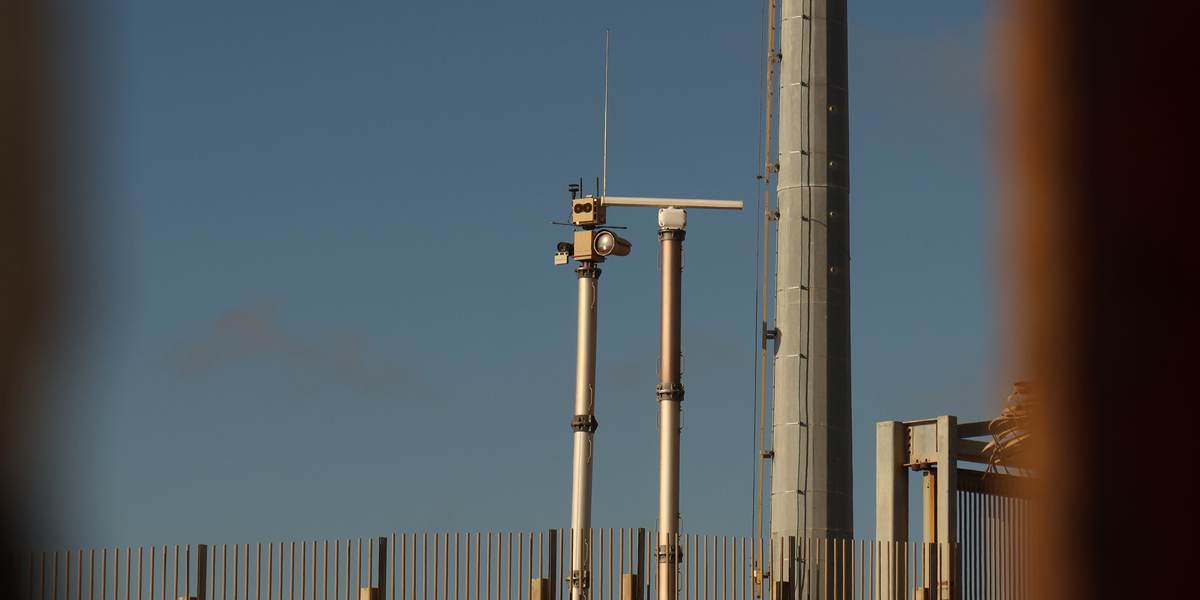
When people see Customs & Border Protection's giant, tethered surveillance blimp flying 20 miles outside of Marfa, Texas, lots of them confuse it with an art installation. Elsewhere along the U.S.-Mexico border, surveillance towers get mistaken for cell-phone towers. And that traffic barrel? It's actually a camera. That piece of rusted litter? That's a camera too.

Today we are publishing a major update to our zine, "Surveillance Technology at the U.S.-Mexico Border," the first since the second Trump administration began. To help people identify the machinery of homeland security, we've added more models of surveillance towers, newly deployed military tech, and a gallery of disguised trail cams and automated license plate readers.

You can get this 40-page, full-color guide through EFF's Shop or download a Creative-Commons licensed version here.

"The Battalion Search and Rescue always carries the Electronic Frontier Foundation’s zine in our desert rig," says James Holeman, who founded the humanitarian group that looks for human remains in remote parts of New Mexico and Arizona. "We’re finding new surveillance all the time, and without a resource like that, we wouldn't know what the hell we're looking at.”

The original version of the zine was distributed nearly exclusively to our allies in the borderlands—journalists, humanitarian aid workers, immigrant advocates—to help them better identify and report on the technology they discover on the ground. We only made a handful available in our online shop, and they went fast.

This time, we've printed enough for our broader EFF membership. Even if you don't live near the border, you can support our work uncovering how the U.S. Department of Homeland Security's technology threatens human rights by picking up a copy.

The zine is the culmination of a dozen trips to the border, where we hunted surveillance towers and other tech installations. We attended multiple border security conventions to collect promotional and technical materials directly from vendors. We filed public records requests, reviewed thousands of pages of docs, and analyzed satellite imagery of the entire 2,000-mile border several times over. Some of the images came from local allies, like geographer Dugan Meyer and Borderlands Relief Collective, who continue to share valuable intelligence on the changing landscape of border surveillance.

The update is available in English, with an updated Spanish version expected later this year. In the meantime, we have reprinted the original Spanish edition.

If you want to know more, a collection of EFF's broader work on border technology is available here. And if you're curious exactly where these technologies are located, you can check our ongoing map.

SUPPORT THIS WORK

The Foilies 2026

15 March 2026 at 16:41

Recognizing the Worst in Government Transparency 

The Foilies were written by EFF's Beryl Lipton, Dave Maass and Aaron Mackey and MuckRock's  Dillon Bergin, Kelly Kauffman and Anna Massoglia. Art by Shelby Criswell.

For the last six years, a class of journalism students at the University of Nevada, Reno, has kicked off each semester by filing their first Freedom of Information Act (FOIA) requests.

The assignment: Request copies of complaints sent to the Federal Communications Commission (FCC) about their favorite TV show, a local radio station, or a major broadcast event, such as the Grammys or the Super Bowl halftime show. The students are learning that the federal government and every state have laws establishing the public's right to request and receive public records. It's a bedrock principle of democracy: If a government belongs to the people, so do its documents. 

In the past, the FCC always provided records within a few weeks, if not days. But that changed in September when students requested consumer complaints filed against NPR and PBS stations to see if there was absolutely anything at all to merit defunding public media. Seven months later — crickets. 

Now the students are learning to persevere even when public officials demonstrate an utter disdain for transparency. And The Foilies are here for it. 

Established in 2015, The Foilies are an annual project by the Electronic Frontier Foundation and MuckRock to recognize the agencies, officials and contractors that thwart the public's right to know. We give out these tongue-in-cheek "awards" during Sunshine Week (March 15-21), a collective effort by media and advocacy organizations to highlight the importance of open government.  

This year, we've got a few "winners" whose behavior defies belief. 

But it's not all negative. Those same Reno students are also assigned to file public records requests for restaurant health inspections. This semester, the records started to show up in their inboxes within 20 minutes. 

If every agency followed Northern Nevada Public Health's example, we could sunset this Sunshine Week project. 

Quick links:

The Love Letters Award - Gov. Greg Abbott 

An illustration of Texas Gov. Greg Abbott holding up a redacted letter to Elon Musk.

Last spring, the office of Texas Gov. Greg Abbott withheld communications between himself and one of the state’s most powerful business figures, Elon Musk. The office claimed that the communications were exempt from public records law because they would reveal confidential legal and policy discussions, including how the state entices private companies to do business in Texas, or “intimate and embarrassing” information.

The claims were unelaborated boilerplate language based on exemptions in Texas’ public records law. But if you’re wondering what "intimate" and “embarrassing” exchanges Abbott and Elon Musk shared over email, you may be waiting a while. 

Last fall, the Office of the Texas Attorney General ordered Texas Gov. Greg Abbott’s office to release nearly 1,400 pages of communications between Abbott and Musk. About 1,200 of those pages were fully redacted–just sheets of gray obscuration. The records that were released don’t reveal much more than an invitation to a happy hour or a reminder of the next SpaceX launch.

The Surcharge, Eh? Award - Vancouver, B.C. 

Vancouver residents must now pay twice for public records. Despite taxes already funding the creation and storage of government records, the City Council approved charging people $10 Canadian (about $7.33 in the United States) every time they ask for “non-personal” public records.

Officials claim the fee is necessary to deter misuse and cover some administrative costs. The only people abusing anything, however, are the officials who imposed this tax on the public. The message Vancouver is sending is as crisp as a newly minted $10 note: Secrecy is a higher priority than public accountability.

The Shady Screenshot Award - Department of Homeland Security 

The Department of Homeland Security’s banner year of lawlessness included backsliding on its transparency obligations.

In response to a request from the nonprofit American Oversight, DHS stated that it was no longer automatically archiving text messages sent between officials. The department clarified that it had a new, and much worse, records retention policy. Instead of archiving officials’ text messages as the agency had done before, DHS now asks officials to take screenshots of any text messages conducting government business on their work phones. 

It’s hard to see the change as anything more than a giant middle finger to the public, especially because the Federal Records Act requires agencies to retain all records officials create while conducting their public duties, regardless of format. We won’t hold our breath waiting on DHS officials to dutifully press the volume and power button on their phones to record every text message they send and receive. 

The Discardment of Government Efficiency Award - DOGE 

As the Trump administration took over last year, there was a looming threat over government transparency: the so-called Department of Government Efficiency, also known as DOGE. 

Billionaire Elon Musk, soon to be the de facto leader of DOGE, proudly claimed “there should be no need for FOIA requests” and “all government data should be default public for maximum transparency.” What quickly became apparent was there may be no need for FOIA requests, because there may be no FOIA officers to fulfill those requests.

DOGE quickly went to work slashing through the federal government, including seizing control of the U.S. Institute of Peace. Part of the takeover included restricting access to the agency’s FOIA system and firing the employees responsible for fulfilling FOIA requests, according to a letter sent to Bloomberg reporter Jason Leopold. Meanwhile, when CNN filed a FOIA request with the Office of Personnel Management (OPM) for information about Musk and DOGE's security clearance, they were told: "Good luck with that," because the FOIA officers had been fired. 

DOGE also argued that its own records are exempt from FOIA under the Presidential Records Act, meaning records cannot be accessed until five years after President Donald Trump is out of office. 

While DOGE “doesn’t exist” anymore according to the OPM, there remains a lasting dark mark on the state of FOIA and records management. 

The Secret Eyes in the Sky Award - Chula Vista Police Department, Calif.

An illustration of a quadrotor drone with an eye and a badge.

In 2021, Arturo Castañares at La Prensa San Diego filed a request with the Chula Vista Police Department for copies of videos taken by drones responding to 911 calls as part of the city's "drone as first responder" program. One of the goals was to evaluate the technology’s efficacy and risks to civil liberties. 

The city worked overtime to maintain the secrecy of the footage at the same time officials publicly touted the drones as a revolution in policing. That’s some impressive trust-us-but-don’t-verify chutzpah.

The city argued that every second of every video recorded by its drones was categorically off limits because they were law enforcement investigative records. They even got a trial court to initially buy the argument.

But an appellate court ruled that the investigatory records exemption is more limited, shielding only drone footage that is part of a criminal investigation or evidence of a suspected crime. Footage of wildfires, car wrecks, wild animal sightings and the like are not criminal investigations and must be disclosed.

The California Supreme Court rejected both of CVPD's appeals and a trial court bench slapped the city for inaccurate and incomplete court filings. In the end, the city had to shell out north of $400,000 to its outside lawyers, and then paid Castañares’ lawyers more than $500,000 when he prevailed. 

So what were Chula Vista police hiding? A bunch of routine service calls, such as unverified reports of a vehicle fire and a vehicle collision.

Now, according to La Prensa's reporting, officials are trying to raid a public safety fund created by voters to reimburse the city for the cost of its ill-advised secrecy. 

The City of Darkness Award - Richmond, Va. 

Richmond’s creation of a new FOIA Library may seem like a step toward transparency, but there are questions about the city’s commitment after it left the same officials subject to records requests in charge of curating which records might be released.

Faced with a plan to post all of the city’s eligible public records released under Virginia’s “sunshine” law, the Richmond City Council instead opted to go with the mayor’s alternative proposal. That plan lets the mayor’s administration — the same one that might be the subject of those records — decide what’s worth posting to the library.

Instead of providing access to all public records that the city released under the Virginia Freedom of Information Act, the library will only contain a subset that officials believe meet certain criteria, including records that the administration deems "relevant" to city business or that would aid "accountability.” The city cites concerns that "transparency without context" might be too confusing for the average citizen. Forgive us for having more faith in Richmond residents than its leaders do.

The city’s secrecy shenanigans extend beyond the FOIA library.

In an ongoing legal battle, attorneys representing Richmond asked a judge to prohibit former city FOIA officer Connie Clay from filing FOIA requests seeking information about her firing, and sought a gag order to prevent her from talking about the case. Clay alleges she was fired for insisting the city comply with public records law, describing what she calls a “chaotic and mismanaged” and illegal FOIA request process. Rather than agree to a $250,000 settlement, Richmond has spent more than $633,000 in taxpayer funds on legal costs. The trial and the FOIA library launch are both slated for the summer of 2026. 

The Flock You Awards - Multiple Winners

 A police officer with dollar-sign sunglasses holding his hand out for money.

If you live in one of the 5,000 cities where surveillance vendor Flock Safety claims to have established relationships with local cops, you may have noticed the sudden installation of little black cameras on poles by the side of the road or at intersections. These are automated license plate readers (ALPRs), which document every vehicle that passes within view, including the license plate, color, make, model and other distinguishing characteristics. The images are fed to Flock's servers, and the company encourages police to share the images collected locally with law enforcement throughout the country. Each year, law enforcement agencies across the country conduct tens of millions of searches of each other's databases. 

In 2025, journalists and privacy advocates started filing public records requests with agencies to get spreadsheets called a "Network Audit," which shows every search, including who ran it and why. Accessing these audits uncovered abuse of the system including: investigating a woman who received an abortion, targeting immigrants, surveilling protesters, and running racist searches targeting Roma people

In response, some cities have terminated their contracts with Flock Safety. Other law enforcement agencies, and Flock itself, have gone a different direction: 

Taunton Police Department, Mass.: The police department told the ACLU of Massachusetts to cough up $1.8 million if the organization wanted its network audit logs–the highest public records fee we documented this year. The civil liberties group filed requests with agencies throughout the state for the audits, and most agencies handed over the spreadsheets for free and with little fanfare. Taunton, however, said it would take 20,000 hours to process the request, at $86.57 an hour. 

Orange County Sheriff's Department, Calif.: The Orange County Sheriff gave a number of reasons it wouldn't release the network audit logs in response to a public records request. The most inane (and misspelled one): It would "disincentive law enforcement from conducting such research." Aren't cops the ones who say if you’re not doing anything wrong, you've got nothing to hide? Well, well, well, how the tables have turned.

Flock Safety: The company responded to criticisms of its ALPR network by sending legal threats aimed at trying to silence its critics. First, the company used a bogus trademark claim to threaten DeFlock.me–a crowdsourced map of ALPR. (EFF represented its creator.) Then it hired a company to try to get the hosts of HaveIBeenFlocked.com, which hosts an interface for searching these network audits, to remove the site from the internet. 

The Database Deletion Award - Muneeb and Sohaib Akhter, formerly of Opexus

Brothers Muneeb and Sohaib Akhter are accused of essentially hitting delete on government data, destroying access to information contained in millions of records. 

The government hired a federal contractor called Opexus, which hosts data and provides services to dozens of federal agencies. The company employed the Akhter siblings, though in February 2025, Opexus learned about the brothers’ previous convictions for wire fraud and obstructing justice. Soon after, the company fired the pair. But, according to prosecutors, the two decided to double down on being wildly unsuited for administrative access to government records systems. 

The Akhters immediately turned around and retaliated “by accessing computers without authorization, issuing commands to prevent others from modifying the databases before deletion, deleting databases, stealing information, and destroying evidence of their unlawful activities," according to the U.S. Department of Justice.

The two have been accused of deleting 96 government databases, many of which contained FOIA records and sensitive investigative files. Their indictment alleges that a minute later, one brother queried an artificial intelligence tool for “how to clear system logs following the deletion of databases.” The brothers are also charged with stealing government records and conspiracy to commit computer fraud. 

The Brothers Akhter allegedly took mere moments to destroy untold amounts of information that belonged to the public. Though they could face decades in prison, the public may never know the extent of the damage.

Want more FOIA horror stories? Check out The Foilies archives!

The Homeland Security Spending Trail: How to Follow the Money Through U.S. Government Databases

6 January 2026 at 18:08

This guide was co-written by Andrew Zuker with support from the Heinrich Boell Foundation.

The U.S. government publishes volumes of detailed data on the money it spends, but searching through it and finding information can be challenging. Complex search functions and poor user interfaces on government reporting sites can hamper an investigation, as can inconsistent company profiles and complex corporate ownership structures. 

This week, EFF and the Heinrich Boell Foundation released an update to our database of vendors providing technology to components of the U.S. Department of Homeland Security (DHS), such as Immigration and Customs Enforcement (ICE) and Customs and Border Protections (CBP). It includes new vendor profiles, new fields, and updated data on top contractors, so that journalists and researchers have a jumping-off point for their own investigations.

Access the dataset through Google Sheets (Google's Privacy Policy applies) or download the Excel file here

This time we thought we would also share some of the research methods we developed while assembling this dataset.

This guide covers the key databases that store information on federal spending and contracts (often referred to as "awards"), government solicitations for products and services, and the government's "online shopping superstore," plus a few other deep-in-the-weeds datasets buried in the online bureaucracy. We have provided a step-by-step guide for searching these sites efficiently and help tips for finding information. While we have written this specifically with DHS agencies in mind, it should serve as a useful resource for procurement across the federal government. 


1. Procurement Sites: FPDS.gov and USASpending.gov

Federal Procurement Data System - fpds.gov

Update Jan. 30, 2026: In mid 2026, FPDS.gov's functions will be transferred to SAM.gov. More info here.

The Federal Procurement Data System (FPDS) is the best place to start for finding out what companies are working with DHS. It is the official system for tracking federal discretionary spending and contains current data on contracts with non-governmental entities like corporations and private businesses. Award data is up-to-date and includes detailed information on vendors and awards which can be helpful when searching the other systems. It is a little bit old-school, but that often makes it one of the easiest and quickest sites to search, once you get the hang of it, since it offers a lot of options for narrowing search parameters to specific agencies, vendors, classification of services, etc. 

How to Use FDPS
To begin searching Awards for a particular vendor, click into the “ezSearch” field in the center of the page, delete or replace the text “Google-like search to help you find federal contracts…” with a vendor name or keywords, and hit Enter to begin a new search. 

The EZ Search landing page for FPDS.gov

A new tab will open automatically with exact matches at the top. 

A page of results for Google's contracts with the federal government.

Four “Top 10” modules on the left side of the page link to top results in descending order: Department Full Name, Contracting Agency Name, Full Legal Business Name, and Treasury Account Symbol. These ranked lists help the user quickly narrow in on departments and agencies that vendors do business with. DHS may not appear in the “Top 10” results, which may indicate that the vendor hasn’t yet been awarded DHS or subagency contracts.

For example, if you searched the term “FLIR”, as in Teledyne FLIR who make infrared surveillance systems used along the U.S.-Mexico border, DHS is the 2nd result in the “Top 10: Department Full Name” box. 

FDPS.gov results for FLIR with the agency full name sidebar highlighted.

To see all DHS contracts awarded to the vendor, click “Homeland Security, Department of” from the “Top 10 Department Full Name” module. When the page loads, you will see the subcomponents of DHS (e.g., ICE, CBP, or the U.S. Secret Service) in the lefthand menu. You can click on each of those to drill down even further. You can also drill down by choosing a company. 

Sorting options can be found on the right side of the page which offer the ability to refine and organize search results. One of the most useful is "Date Signed," which will arrange the results in chronological order. 

FPDS.gov results for FLIR with the sort by sidebar highlighted

You don't have to search by a company name. You can also use a product keyword, such as "LPR" (license plate reader). However, because keywords are not consistently used by government agencies, you will need to try various permutations to gather the most data. 

Each click or search filter adds a new term to the search both in the main field at the top and in the Search Criteria module on the right. They can be deleted by clicking the X next to the term in this module or by removing the text in the main search field.

FPDS.gov results with the sidebar for deselecting terms highlighted with an arrow.

For each contract item, you can click "View" to see the specific details. However, these pages don't have permalinks, so you'll want to print-to-pdf if you need to retain a permanent copy of the record. 

Often the vendor brand name we know from their marketing or news media is not the same entity that is awarded government contracts. Foreign companies in particular rely on partnerships with domestic entities that are established federal contractors. If you can’t find any spending records for a vendor, search the web for information on the company including acquisitions, partnerships, licensing agreements, parent companies, and subsidiaries. It is likely that one of these types of related companies is the contract holder. 

USA Spending - usaspending.gov

The Federal Funding and Accountability Act (FFATA) of 2006 and the DATA Act of 2014 require the government to publish all spending records and contracts on a single, searchable public website, including agency-specific contracts, using unified reporting standards to ensure consistent, reliable, searchable data. This led to the creation of USA Spending (usaspending.gov). 

USA Spending is populated with data from multiple sources including the Federal Procurement Data System (fpds.gov) and the System for Awards Management (sam.gov - which we'll discuss in the next section). It also compiles Treasury Reports and data from the financial systems of dozens of federal agencies. We relied heavily on Awards data from these systems to verify vendor information including contracts with the DHS and its subagencies such as CBP and ICE. 

USA Spending has a more modern interface, but is often very slow with the information often hidden in expandable menus. In many ways it is duplicative of FPDS, but with more features, including the ability to bookmark individual pages. We often found ourselves using FPDS to quickly identify data, and then using the "Award ID" number to find the specific record within USA Spending. 

USA Spending also has some visualizations and ways to analyze data in chart form, which is not possible with the largely text-based FPDS. 

How to Use USA Spending

To begin searching for DHS awards, click on either “Search Award Data” on the navigation bar, or the blue “Start Searching Awards”button. 

The landing page of USA Spending with arrows pointing to the search links.

On the left of the Search page are a list of drop down menus with options. You can enter a vendor name as a keyword, or expand the “Recipient” menu if you know the full company name or their Unique Entity Identifier (UEI) number. Expand the “Agency Tab” and enter DHS which will bring up the Department of Homeland Security Option.

USA Spending page with arrows pointing to the key search filters.

In the example below, we entered “Palantir Technologies” as a keyword, and selected DHS in the Agency dropdown:

Search results showing Palantir contracts

For vendors with hundreds of contracts that return many pages of results, consider adding more filters to the search such as a specific time period or specifying a Funding Agency such as ICE or CBP. In this example, the filters “Palantir Technologies” and “DHS” returned 13 results (at the time of publication). It is important to note that the search results table is larger than what displays in that module. You can scroll down to view more Awards and scroll to the right to see much more information. 

Scroll down outside of that module to reveal more info including modules for Results by Category, Results over Time, and Results by Geography, all of which can be viewed as a list or graph. 

USA Spending page with graphs and charts

Once you've identified a contract, you can click the "Prime Award ID" to see the granular details for each time. 

From the search, you can also select just the agency to see all the contracts on file. Each agency also has its own page showing a breakdown for every fiscal year of how much money they had to spend and which components spent the most. For example, here's DHS's page.

2. Contracting Opportunities  - SAM.gov  

So far we've talked about how to track contracts and spending, but now let's take a step back and look at how those contracts come to be. The System for Award Management, SAM.gov, is the site that allows companies to see what products and services the government intends to buy so they can bid on the contract. But SAM.gov is also open to the public, which means you can see the same information, including a detailed scope of a project and sometimes even technical details. 

How to Use Sam.gov

SAM.gov does not require an account for its basic contracting opportunity searches, but you may want to create one in order to save the things you find and to receive keyword- or agency-based alerts via email when new items of interest are posted. 

First you will click "Search" in the menu bar, which will bring you to this page: 

Search page on Sam.gov

We recommend selecting both "Active" and "Inactive" in the Status menu. Contracts quickly go inactive, and besides, sometimes the contracts you are most interested in are several years old. 

If you are researching a particular technology such as unmanned aerial vehicles, you might just type "unmanned" in the Simple Search bar. That will bring up every solicitation with that keyword across the federal government.

One of the most useful features is filtering by agency, while leaving the keyword search blank. This will return a running list of an agency's calls for bids and related procurement activities. It is worth checking regularly. For example, here's what CBP's looks like on a given day: 

Sam.gov results for Customs and Border Patrol

If you click on an item, you should next scroll down to see if there are attachments. These tend to contain the most details. Specifically, you should look for the term "SOW," the abbreviation for "Statement of Work." For example, here are the attachments for a CBP contracting opportunity for "Cellular Covert Cameras": 

Links for attachments

The first document is the Statement of Work, which tells you the exact brand, model, and number of devices they want to acquire: 

Line items for hundreds of Hyperfire cameras and related components.

The attachments also included a "BNO Justification." BNO stands for "Brand Name Only," and this document explains in even more detail why CBP wants that specific product:

Explanation of why the government wants to purchase this particular model of camera.

If you see the terms "Sole Source" in a listing, that also means that an agency has decided that only one product meets its requirements and it will not open bidding to other companies. 

In addition to contracting, many agencies announce "Industry Day" events, usually virtual, that members of the public can join. This is a unique opportunity to listen in on what contractors are being told by government purchasing officials. The presentation slides are also often later uploaded to the SAM.gov page. Occasionally, the list of attendees will also be posted, and you'll find several examples of those lists in our dataset.

3. The Government's "Superstore" - gsaadvantage.gov

Another way to investigate DHS purchasing is by browsing the catalog of items and services immediately available to them. The General Services Administration operates GSA Advantage, which it describes as "the government's central online shopping superstore." The website's search is open, allowing members of the public to view any vendors' offerings–including both products and services– easily as they would with any online marketplace. 

For example, you could search for "license plate reader" and produce a list of available products: 

Search results that show a license plate reader for sale for $995.

If you click "Advanced Search," you can also isolate every product available from a particular manufacturer. For example, here are the results when you search for products available from Skydio, a drone manufacturer.

Search results for 50 Skydio drone-related products

If you switch from "Products" to "Services" you can export datasets for each company about their offerings. For example, if you search for "Palantir" you'll get results that look like this:

Search results with companies offering Palantir-related services.

This means all these companies are offering some sort of Palantir-related services. If you click "Matches found in Terms and Conditions," you'll download a PDF with a lot of details about what the company offers. 

For example, here's a a screengrab from Anduril's documentation

A menu of surveillance towers with prices.

If you click "Matches Found in Price List" you'll download a spreadsheet that serves as a blueprint of what the company offers, including contract personnel. Here's a snippet from Palantir's: 

A spreadsheet with prices for various Palantir services.

4. Other Resources

Daily Public Report of Covered Contract Awards - Maybe FPDS isn't enough for you and you want to know every day what contracts have been signed. Buried in the DHS website are links to a daily feed of all contracts worth $4 million or more. It's available in XML, JSON, CSV and XLSX formats. 

DHS Acquisition Planning Forecast System (APFS) - DHS operates a site for vendors to learn about upcoming contracts greater than $350,000. You can sort by agency at a granular level,  such as upcoming projects by ICE Enforcement & Removal Operations. This is one to check regularly for updates. 

Results for a proposed contract for open source intelligence

DHS Artificial Intelligence Use Case Inventory - Many federal agencies are required to maintain datasets of "AI Use Cases." DHS has broken these out for each of its subcomponents, including ICE and CBP. Advanced users will find the spreadsheet versions of these inventory more interesting. 

Use case summary for surveillance towers

NASA Solutions for Enterprise-Wide Procurement (SEWP) - SEWP is a way for agencies to fast track acquisition of "Information Technology, Communication and Audio Visual" products through existing contracts. The site provides an index of existing contract holders, but the somewhat buried "Provider Lookup" has a more comprehensive list of companies involved in this type of contracting, illustrating how the companies serve as passthroughs for one another. Relatedly, DHS's list of "Prime Contractors" shows which companies hold master contracts with the agency and its components. 

List of resellers of Palantir technology

TechInquiry - Techinquiry is a small non-profit that aggregates records from a wide variety of sources about tech companies, particularly those involved in government contracting. 

❌