❌

Normal view

EFF’s State Legislative Agenda to End ALPR Mass Surveillance

21 October 2026 at 19:52

Police agencies across the U.S. have deployed Automated License Plate Readers (ALPRs) to capture images of passing vehicles along with time, date, and GPS coordinates. While the technology itself isn’t new (ALPRs have existed in various forms for more than 50 years, and in the U.S. since 1998), the surveillance landscape has shifted dramatically. Rapid advances in artificial intelligence and national data sharing have transformed police ALPRs into an interconnected, nationwide tracking network. It is pitched to city councils by law enforcement and private vendors like Flock Safety, Motorola Solutions (Vigilant), and Axon as an essential tool for solving violent crime.

In reality, it is an inherently dangerous infrastructure of mass surveillance.

Since 2012, EFF has worked with others to expose the severe digital rights harms of ALPR systems. For example, we’ve recently documented how these camera networks allow law enforcement to search for immigrants, track peaceful protesters, target Romani communities, and track women seeking reproductive healthcare. Police also routinely use ALPRs for low-level matters like enforcing school residency requirements or investigating noise complaints. Many officers also use ALPR databases to stalk past romantic partners. Recent EFF analysis revealed officers using the system without legitimate justification—logging search reasons like "LOL" and "LMAO."

Understandably, the public backlash to police ALPR technology is accelerating, and state lawmakers across the country are taking action.

New Hampshire enacted the nation’s first state law on ALPR use in 2007, but technological advances and misconduct have driven even more recent legislative action. In 2026 alone, six states enacted laws that limit police use of ALPRs: Connecticut, Kentucky, New Jersey, New Mexico, Oregon and Washington.

This is a good start, but far more is needed. This blog presents a framework for state legislators who want to stop ALPR mass police surveillance:

  1. Just ban it. It is incompatible with a free society and cannot be fixed.
  2. In the absence of a flat ban, reduce its harms. Most importantly: limit police use of ALPRs to real-time comparison of passing plates to hotlists; require a warrant to place a plate on a hotlist; impose strict limits on the creation and use of those hotlists; and prohibit the storage of ALPR data (and thus prevent the subsequent search and disclosure of that data).
  3. In the absence of a prohibition on storing ALPR data, reduce its harms. Most importantly, place strict limits on police storage, search, and disclosure of ALPR data.
  4. Ban three especially dangerous police practices: placement of ALPRs near sensitive locations like hospitals; purchase of ALPR data; and use of ALPR data to try to predict crime.
  5. Require transparency about ALPR mass surveillance, including: a 30-day public notice before a city procures police ALPRs; a statewide registry of all police ALPRs; and regular, public audits and statistical reports about police usage.
  6. Ensure effective enforcement of all new ALPR restraints, including by means of a private right of action and the exclusionary rule.

These policy battles often unfold locally, so state legislators must ensure that state law is a regulatory floor, never a ceiling. State preemption should never force unwanted camera networks onto communities that have chosen to reject them. Local government must retain authority to enact full bans, deny funding, reject contracts, and decommission existing camera networks.

Table of Contents

A Note on Scope

As in our previous post on ALPR policy, our focus here is ALPR mass surveillance: the continuous dragnet collection and retention of location data on innocent drivers. Different issues are raised by automated traffic enforcement (ATE) systems, such as standalone red-light or speed cameras that solely photograph and ticket specific traffic violations, without building a searchable network about uninvolved drivers. As such, state laws against ALPR mass surveillance should not cover ATE. This is the approach in at least six states: Connecticut, Minnesota, North Carolina, Oregon, Virginia, and Washington. The most common approach is to exclude ATE from the law’s definition of “ALPR.”

Of course, ATE carries risks and demands legal restrictions too. This includes tight limits on data collection, retention, usage, and disclosure—all of which should be addressed in a different statute. Lawmakers must also actively guard against vendor efforts to piggyback mass surveillance tools onto ATE contracts.

The Gold Standard: Statewide Bans on ALPR Mass Surveillance

Statutory limits cannot make ALPR mass surveillance safe. Because the technology relies on the indiscriminate recording of every driver’s movements, the risks are baked into the system itself. Also, innocent motorists will be menaced by police due to false matches, bad actors will misuse location data, and sensitive personal movements will be exposed to broad government overreach. Promising harsher penalties for officer misuse cannot fix an inherently flawed architecture. Thus, state lawmakers should pursue a complete, statewide ban on ALPR mass surveillance.

First, lawmakers should prohibit all state-level law enforcement agencies from acquiring, retaining, accessing, or using ALPRs or any data derived from them.

Second, they must impose the same prohibition on county, municipal, and other local law enforcement agencies.

These prohibitions should require any agency ending an ALPR program (both state and local) to fully decommission the programs within a strict timeframe. This includes requiring agencies to: physically remove all camera hardware; revoke all user, network, and database access credentials; permanently delete all stored location data; and require vendor certification of compliance.

Third, ban the use of state funds for state or local agencies to acquire, maintain, or access ALPR systems. This must include direct appropriations, law enforcement grants, pass-through funds, and state-administered federal funds. In August 2026, Texas Governor Greg Abbott banned state agencies from spending public funds on Flock cameras.

Fourth, ban state and local agencies from installing or operating ALPRs on state-owned highways, roadways, or public properties. In August 2026, Florida’s Department of Transportation  ordered the removal of all ALPRs from the right-of-way on state highways within 30 days. The order revokes all previously approved permits to install ALPRs, and bars future permits.

An outright prohibition is the only effective way to eliminate this mass surveillance. This follows the lead of municipalities across the country that have already enacted bans. However, where there’s political resistance, state lawmakers might consider a moratorium that prevents further expansion of ALPR networks.

Strict Limits on Real-time Use of ALPRs

In the absence of a ban on police ALPR mass surveillance, state legislators must restrict ALPRs to real-time comparison of passing plates to hotlists. ALPR data is simply too dangerous for police to safely store, search, and disclose. An effective way to do this, as in New Hampshire, is to require deletion of ALPR data within three minutes after collection. That means no ALPR data is stored after comparison to a hotlist, and thus that no ALPR data about unmatched cars can be searched or disclosed.

A state legislature must also reduce the harms of police use of real-time ALPRs by strictly limiting the creation and use of law enforcement hotlists.

Limits on creating hotlists

Roughly speaking, there are two kinds of police hotlists. An agency might link its ALPRs to external hotlists created by another agency, such as the FBI’s National Crime Information Center (NCIC) or a state’s department of motor vehicles. Also, a police agency might link its ALPRs to its own internal hotlist, created by its own officers, of people under investigation. State legislators must strictly limit both.

First, limit the kinds of external hotlists that police agencies may link to. For example, ban police agencies from linking to the NCIC’s “immigration violator” hotlist, which ICE uses to hunt immigrants with the ALPRs operated by police agencies across the country.

Second, if a police agency links to external hotlists, require the agency to update that link every day. Otherwise, drivers may be detained even though they have been removed from the list. This is required by Montana, Nebraska, North Carolina, and Virginia.

Third, forbid officers from adding a plate on a hotlist, absent a warrant from a judge based on probable cause and particularity. Without this judicial check on police power, an officer stalked a potential romantic partner by placing her plate on a hotlist.

As with other laws requiring a warrant (such as the federal Wiretap Act), there should be an exception where: (1) there is an emergency involving immediate danger of death or serious bodily injury to a person; (2) there is no time to acquire a warrant; and (3) there are grounds upon which a warrant could be granted. This exception might apply, for example, when police have probable cause to believe a child has just been abducted. In such cases, the statute must require police to seek a warrant within 48 hours, and if it is denied, to immediately remove the plate from the hotlist.

Minnesota requires a warrant or an emergency to use ALPRs “to monitor or track an individual who is the subject of an active criminal investigation.” In Maine, an ALPR system may use only information based on reasonable suspicion.

Fourth, forbid officers from adding a plate to a hotlist, except in connection with a serious violent crime. This would include investigation of a murder but not pursuit of a traffic scofflaw.

Fifth, forbid officers from adding a plate on a hotlist based, in whole or in part, on: a person’s race, ethnicity, national origin, religion, immigration status, disability, sex, gender identity, or sexual orientation; their political beliefs, associations, or participation in First Amendment-protected activity; or their pursuit of reproductive, gender-affirming, or other health care. Connecticut and Washington forbid use of ALPR systems on these grounds, and Virginia forbids tracking a person based on their protected speech.

Sixth, require officers to log their entry of a plate into a hotlist. This must include the officer’s name and agency, the date of the entry, a narrative description of the reasons for the entry, any case numbers, and an upload of the warrant authorizing the entry. Oregon requires an officer to log “the specific law enforcement purpose of the entry,” and the officer’s name.

Limits on using hotlists

First, if the plate of a passing car does not match a hotlist, laws must require immediate deletion of all ALPR data about that car. New Hampshire state law requires deletion within three minutes. This is the most effective way to limit ALPRs to real-time identification of vehicles and drivers of interest to police, as opposed to amassing a dangerous database of the comings and goings of the entire driving public, available later for retrospective search by police.

Second, if the plate of a passing car does match a hotlist, then limit storage, search, and disclosure of its ALPR data to what is strictly necessary to the investigation that placed the car on the hotlist.

Third, require police officers, before stopping a car because of an apparent real-time match, to visually and independently confirm that the car’s plate number, plate issuing state, and other vehicle characteristics in fact do match the car on the hotlist. Many innocent motorists have been detained and menaced by police because of ALPR false positives. Confirmation is required by Kentucky, Montana, New Hampshire, Oregon, Virginia, and Washington.

Strict Limits on Storage, Search, and Disclosure of ALPR Data

Again, state legislatures should simply ban police use of ALPRs, or at least police storage of ALPR data. Third best is harm reduction through strict limits on storage, search, and disclosure of ALPR data.

Storage limits

First, limit the storage period for ALPR data to days, not months, and then require deletion. More than 99% of the drivers who pass an ALPR are not on a hotlist. Tracking their movements anyway, just in case they are later relevant to a police investigation, is criminalization of the entire driving population. Thus, four states already require deletion after 21 days: Connecticut, Maine, Virginia, and Washington. Even Flock has reduced its default retention period to seven days.

By “delete,” we mean permanently erase it, so it is impossible for anybody to access it again. It is not enough to merely store it in a way that makes it harder to access, such as archiving it, or transferring it from one database to another. In the words of the Virginia statute: “System data shall be purged … in such a manner that such data is destroyed and not recoverable.”

Second, limit the types of ALPR data that can be stored: just a photo of the plate, the AI-based read of the plate number, the date and time, and the location. Conversely, ban retention of photos of people in the car, and of features of the car beyond the plate as well as AI-based reads of those photos (respectively, “facial recognition” and “vehicle fingerprints”).

Many states have enacted such rules. New Hampshire bans ALPRs from “photographing or recording or producing images of the occupants of a motor vehicle.” Missouri bans integration of facial recognition into ALPR systems. New Hampshire and Montana limit ALPRs to “the sole purpose of recording and checking license plates.” Minnesota provides that “data collected by an [ALPR] must be limited to” plate numbers; date, time, and location; and pictures of plate, vehicle, and surrounding area.

Search limits

First, laws should ban “geofence” searches, which are searches in which police use ALPRs to identify all of the drivers present at a particular time and place, based on police claims that one of them might be the suspect they are looking for. Even a warrant cannot justify such general searches, because the Fourth Amendment requires warrants to “particularly” describe the person or car being investigated. These dragnet searches of stored ALPR data are the modern-day equivalent of the colonial-era “writs of assistance,” against which our founders fought a revolution to end.

Second, laws should forbid officers from searching stored ALPR data, unless they first acquire a warrant from a judge based on probable cause and particularity. The constant revelations of bad police searches of ALPR data demonstrate the need for—at the very least—judicial control over this dangerous surveillance technology. A federal judge in Oklahoma recently held that the constitution requires this judicial control, because ALPR mass surveillance invades reasonable expectations of privacy. EFF has filed lawsuits making this demand in California and Wisconsin, along with local ACLU affiliates: SIREN and CAIR-CA v. San Jose, and Wisconsin Council of Churches v. Milwaukee, Racine, Kenosha, and Green Bay.

Three states (Minnesota, Vermont, and Virginia) require reasonable suspicion of a crime before searching ALPR data, and a fourth state (California) requires this from its highway patrol. This is a step in the right direction, but not enough: the decider must be a judge, and the test must be probable cause.

Third, officers should be prohibited from searching stored ALPR data, unless they are investigating a serious violent crime. On the flip side, ban searches for immigrants, protesters, or traffic scofflaws.

Some states have moved in this direction. Missouri limits use of ALPR data “criminal justice” and “lifesaving efforts.” North Carolina bans its use for traffic enforcement. Connecticut bans its use based on race and other protected classes, to identify First Amendment activity, for immigration enforcement, or because of access to reproductive or gender-affirming health care. Idaho bans its use for political activity.

Fourth, police officers must be required to log their searches of stored ALPR data concerning a particular car. This must include the officer’s name and agency, the date and time of search, a narrative description of the reasons for search, any case numbers, and an upload of the warrant authorizing the search. The officer must write the narrative in their own words. A drop-down menu of reasons is no substitute, because it is too easy for officers to dodge an explanation of the actual reasons by clicking a pre-written “reason.”

Many states require officers to log their searches of ALPR data, including California, Connecticut, Idaho, Maryland, Missouri, Montana, New Hampshire, Oregon, and Virginia. In Virginia, this must include an officer’s documentation of both their “specific purpose” to search, and the “associated call for service or case number.”

Disclosure limits

The “disclosure” limits below must broadly address sharing from an agency that collected ALPR data to another entity. This includes an agency opening its database to access and search by another entity. It also includes an agency transferring data from its database to another entity’s database.

First, ban disclosure of ALPR data to any federal or out-of-state agency. Federal and out-of-state agencies often lack the necessary protections of the driving public. Connecticut forbids disclosures to the federal government or agencies in 46 states, unless they have a warrant. California forbids disclosures, unless otherwise permitted by law.

Second, ban disclosure of ALPR data to another agency, unless it follows all of the rules above for an agency’s search of its own data (that is, the ban on geofence searches, the requirement of a warrant, the limitation to investigation of serious violent crimes, and the requirement of an audit trail).

Some states have taken steps in this direction. Utah requires, as a condition of disclosure to a government entity or a defendant in a criminal case, a court order finding reasonable suspicion of crime. Washington forbids disclosure “except as required in a judicial proceeding.” Minnesota and Virginia require the disclosing agency to find reasonable suspicion. Minnesota and Connecticut forbid disclosure unless the receiving agency follows the rules applicable to the disclosing agency.

Third, place strict limits on participation in a multi-agency disclosure network, such as Flock or Vigilant. Connecticut forbids participation “in a system or network that shares” ALPR data, unless it requires all participants to affirm in writing that they will not use or re-disclose that state’s data except in compliance with that state’s laws. Connecticut also forbids “bulk” data disclosure, and Maryland forbids data “upload” to another agency.

Fourth, ban disclosure of ALPR data for purposes of investigating acts and statuses that are lawful in-state. Three states (Illinois, New Jersey, and New Mexico) forbid disclosure to investigate immigration status. Two states (Illinois and New Mexico) forbid disclosure in investigate healthcare that is lawful in-state. One state (New Mexico) forbids disclosure to investigate protected assembly, petition, and speech.

Fifth, ban any sale of ALPR data. Six states do this: Arkansas, Maryland, Oklahoma, Utah, Virginia, and Washington. California forbids its highway patrol from doing so. New Mexico forbids any disclosure to a private entity (or indeed to any non-law enforcement agency). Data brokers are a menace to privacy and other human rights.

Transparency

State lawmakers must ensure that the public has access to ample information about the ALPR mass surveillance in their communities. Many people will use this information to resist ALPRs.

First, state laws should require local governments to provide at least 30 days of public notice before spending funds, accepting grants or private donations, or entering into any contract or pilot program for ALPR technology. All proposed vendor contracts and funding sources must be publicly disclosed prior to approval. This helps local officials to exercise their procurement power to reject ALPRs.

Second, laws should mandate the creation of a centralized, public-facing state registry of all police agencies using ALPRs, and the specific locations of all police ALPRs. Sources like DeFlock and EFF’s Atlas of Surveillance include crowd-sourced maps of ALPR technologies, but they are not exhaustive. This was one of the provisions in Minnesota Minn. Stat. § 13.824, which in part, requires police agencies to notify the state within 10 days of installing any ALPR, and requires a state agency to aggregate this information and publish a master list of the locations of all ALPRs (unless a judge determines that disclosure of a particular ALPR’s location poses a genuine security risk).

Third, mandate regular, independent, public audits of agency ALPR use, access logs, and query justifications to ensure compliance with all applicable laws and policies. Five states (Idaho, Minnesota, Montana, Virginia, and Washington) require regular audits, ranging in frequency from monthly to biennial. Three states (Idaho, Maryland, and Washington) require audits of access logs. Minnesota requires an independent auditor and public access to the results.

Fourth, laws must require each agency operating an ALPR system to publish regular reports on its website detailing key operational metrics. Six states require such reports annually: Connecticut, Maryland, New Hampshire, New Mexico, and Vermont. Arkansas requires them twice per year, and Oregon requires them monthly. These states variously require reporting of: the number of ALPRs, and a list of the locations of fixed ALPRs; the number of hotlists used, and a list of them; the number of plates scanned; the number of apparent matches to hotlists, and how many were actual matches; the number plate reads stored; and the number of searches of stored data, broken down by the purpose and agency of search.

Finally, any new ALPR legislation must maintain a proper balance between transparency and privacy in the use of public record acts (PRAs) to obtain ALPR information. Public records and public scrutiny of ALPR programs have shown that people are harmed by these systems. So lawmakers should not cut off access to public records that document these abuses. For example, the public should have access to operational policies, audit logs, vendor communications, and aggregate statistics. EFF opposes blanket exemptions from PRAs that block public oversight of APRs—such as recent bills in states like Arizona. The better approach to protecting individual location privacy is a flexible, case-by-case balancing test already provided by many PRAs. Also, when a document contains both exempt and non-exempt information—like an audit log that contains both motorists’ plate numbers and officers’ search reasons—open records laws should require disclosure of the latter while withholding of the former.

Additional Restrictions

State lawmakers should adopt three additional bans to curtail the footprint of police ALPR surveillance.

First, ban the placement of ALPRs or the collection of ALPR data near healthcare facilities, immigration services, schools, places of worship, courthouses, food banks, and other sensitive locations. Washington and Connecticut do this.

Second, ban police from purchasing ALPR data. Utah and Washington do so. Also, prohibit police from acquiring ALPR data from a private entity, except by means of a warrant. Washington does so. Utah took a step in this direction, requiring a court order based on reasonable suspicion. Absent this type of rule, police evade limits on seizing data from third parties by simply purchasing it from brokers.

Third, ban police and their vendors from using ALPRs or stored ALPR data to power predictive policing technology. EFF opposes such technology and urges state legislatures to ban it. ALPR companies have been providing law enforcement clients with an “analytics” feature, which ingests data from across police agencies, and produces a report of alleged crime trends, hotspots, and corridors. State legislators should prohibit this dangerous use of ALPR systems and data.

Enforcement

A law without strong enforcement is just a piece of paper. EFF recommends three kinds of enforcement measures, all of which appear in existing ALPR statutes.

First, all privacy laws need a “private right of action,” meaning ordinary people can sue a police department that breaks the law. An excellent model appears in the federal Wiretap Act. It expressly authorizes a lawsuit by “any person” whose personal information is processed “in violation of” this law. Privacy harm is harm, and so a person should have their day in court, even if they cannot prove a collateral harm, such as physical injury or economic loss. Moreover, the Wiretap Act provides a full arsenal of remedies to a successful plaintiff, including injunctive and declaratory relief, liquidated and actual damages, and attorney fees.

At least three states enforce their ALPR statute with some version of a private right of action. These are good first steps but need improvement. Washington comes closest: it allows suit to enforce all ALPR rules and provides all remedies. Unfortunately, the plaintiff must prove “injury,” which may shut the courthouse doors to some people whose data is unlawfully processed. Connecticut allows suit by a person “aggrieved” by violation of some ALPR rules. But a person should be able to enforce all rules, and should not have to prove they were aggrieved. Oregon allows suit against a police vendor that “intentionally or with gross negligence” uses or discloses ALPR data in an unlawful manner. But this does not allow any suit against police, or even against a vendor that systematically violates the rules through ordinary negligence.

Second, privacy laws applicable to the police commonly ensure enforcement through the “exclusionary rule.” This means that if evidence is gathered in violation a privacy law, it must be excluded from court proceedings. This is sometimes called “suppression” or “inadmissibility.” The federal Wiretap Act has a strong version of this rule, clearly excluding evidence derived from violations of all rules. The so-called “good faith” exception has weakened many exclusionary rules, so ALPR statutes should expressly reject this exception (though some courts have interpreted some statutory exclusionary rules to have no good faith exception).

At least three states enforce their ALPR statute with some version of the exclusionary rule. Again, these are good first steps but need improvement:

  • Virginia comes closest: “Any evidence obtained as a result of a violation” of some of the ALPR rules “is not admissible.” A better rule would apply to all ALPR rules.
  • Connecticut provides that ALPR data “may be admissible … provided such data was collected or otherwise acquired or held or stored in accordance with the provisions of this section” (or obtained pursuant to warrant). A more clear exclusionary rule would “exclude evidence unlawfully processed,” as opposed to “admit evidence lawfully processed.” The exclusionary rule should also extend to data unlawfully used or disclosed (and not just to data unlawfully collected or stored).
  • Washington provides that information obtained from “a knowing violation” of some of the statute’s rules is “inadmissible.” But the exclusionary rule should apply to all substantive limits (not just some), and to all violations (not just knowing ones).

Third, police agencies and their private contractors that recurringly violate ALPR rules should be forbidden from using ALPRs at all. In New Hampshire, if an agency “repeated[ly]” violates the ALPR statute, the state department of justice may “seek an injunction banning [its] use” of ALPRs. In New Mexico, if a vendor “fails to comply with” that state’s ALPR law, it “may be subject to … suspension of authorization or termination of access.”

Some states impose workplace discipline or criminal penalties on officers who violate ALPR laws, including Connecticut, Idaho, and Missouri. This is no substitute for the three types of strong enforcement measures above. ALPRs are a systemic problem requiring institution-wide enforcement of legal constraints, and not just episodic sanctions against individual officers.

Conclusion

Mass surveillance ALPRs fundamentally threaten digital rights, making an outright statewide ban on police ALPRs the only effective way to fully protect privacy and safety.  The next best thing a legislature can do is limit ALPRs to real-time comparison of passing cars to hotlists, by banning storage of ALPR data beyond a few minutes. If a legislature allows storage, it must impose a tight deletion deadline (days and not months), and strict limits on search and disclosure. A legislature must also ensure transparency and enforcement. 

For convenience here is a concise list of EFF’s ALPR state legislative goals.
Require Police to Get a Warrant to Search ALPR Data

20 October 2026 at 01:28

This post was co-written by Andi Cao, an EFF legal intern.

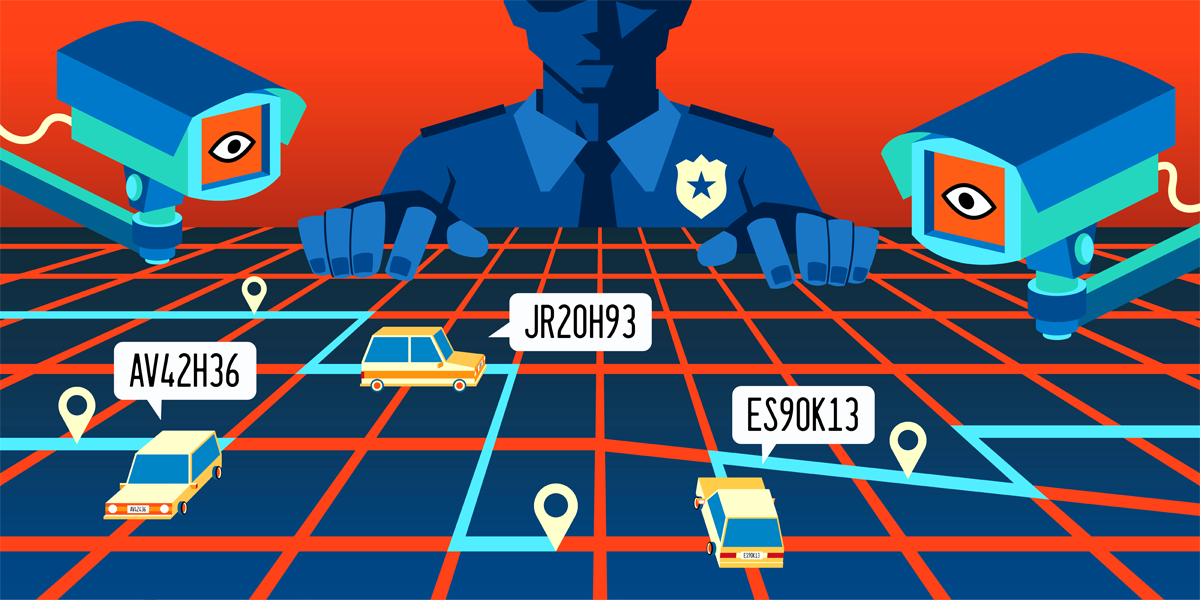
Automated license plate readers (ALPRs) are mass surveillance. They photograph every passing car and log where and when it was captured, building a searchable record of where nearly everyone drives. Cities should not buy them, and cities that already have them should shut them down.

Where these systems still operate, courts and state legislatures must reduce their harms by (among other things) requiring police to get a warrant before searching stored ALPR data. A warrant requirement would not make mass surveillance acceptable, but it would require police to justify a search to a judge before accessing records of people’s movements. Without this independent judicial check on police power, officers have been searching this data for improper reasons (many exposed by EFF) that violate our fundamental rights.

A warrant requires a judge to find probable cause and specificity—many warrantless police searches of ALPR data lack both. Officers have searched this data to profile Romani people, monitor protesters, investigate an abortion, find immigrants for deportation, track a man who complained about a deputy, stalk romantic partners, and even for no stated reason beyond “LMAO.” A warrant requirement would force law enforcement to justify these searches before accessing sensitive location records, not leave the people they target to discover and challenge the abuse after the harm is done.

What a Warrant Requires

Warrants are a check on police power. Before officers can search a person or their property, the Fourth Amendment requires them to convince a neutral judge, under oath, that probable cause exists, meaning a fair probability the search will turn up evidence of a crime. The warrant must also describe with particularity what will be searched, so police cannot go on a fishing expedition. Critically, the officer who wants to search is not the person who decides whether the search is justified.

That is why warrants are required for so many kinds of police surveillance. For example, police generally need a warrant to wiretap phone calls, to search the contents of a cell phone, and to obtain historical cell phone location records.

Stored ALPR data reveals sensitive information about the private details of our lives: where we go, when, and with whom. That’s why we believe police searches of stored ALPR data should also require a warrant. Earlier this month, a federal judge in Oklahoma agreed.

What Goes Wrong Without a Warrant: San Jose, California

San Jose demonstrates the harmful consequences of letting law enforcement search stored ALPR data without a warrant. EFF and the ACLU of Northern California represent SIREN and CAIR-California in a lawsuit challenging this practice.

The first problem is the sheer number of times that SJPD officers search stored ALPR data: 261,711 times between June 5, 2024, and June 17, 2025, about 692 searches a day. That scale is the result of having no warrant requirement, which would greatly reduce this kind of casual police surveillance.

Inevitably, officers abuse this unchecked power. In September, San Jose’s police chief disclosed an example from five months earlier: the department had fired an officer who used its ALPR system to track a woman who had accused his cousin of domestic violence, and then shared her location information with his cousin. The abusive search of stored ALPR data came to light only after the woman told police that her alleged assailant had implied he was tracking her.  A warrant requirement would have prevented this.

Of course, similar problems appear nationwide. For each example below, consider how things could have turned out differently if the officer had to put the reason for the search in a sworn warrant application and handed it to a judge.

Racial profiling of Romani people

More than 80 law enforcement agencies searched the Flock network using terms that unfairly stereotype Romani people, often without mentioning any crime. For example, the Grand Prairie (Texas) Police Department searched for “g*psy” six times using a Flock feature that identifies vehicles traveling together, in effect targeting a whole community without naming a crime.

No judge should sign that warrant. Ethnicity is not evidence of a crime, and a search aimed at an entire ethnic group is the opposite of particular: it targets people for who they are, not evidence that they committed a crime.

Surveillance of protesters

EFF found that more than 50 agencies ran hundreds of protest-related searches of ALPR data in 2025. For example, the Tempe (Arizona) Police Department ran three searches tied to the No Kings protest across 425 networks, with no identified crime.

This lacks probable cause and targets activity that is protected by the First Amendment.

Investigating an abortion

In 2025, a Texas sheriff’s office searched more than 83,000 Flock cameras, including cameras in Washington and Illinois, where abortion is legal, listing the reason as “had an abortion, search for female.” Records later obtained by EFF show deputies had opened a “death investigation” after the woman’s partner, who was later charged in connection with assaulting her, reported her self-managed abortion.

In a state where abortion is legal, a judge would not grant a warrant for a search like this.

Finding immigrants for deportation

San Francisco police let out-of-state agencies search the city’s ALPR data (which itself violates California law), and at least 19 of those searches were marked as related to ICE (though San Francisco is a sanctuary city). This problem is widespread. One investigation found more than 4,000 cases in which police departments around the country searched stored ALPR data on behalf of federal law enforcement, including for immigration investigations. Some agencies even connect their ALPR systems to an “Immigration Violator” hotlist populated by ICE, which includes plates tied to administrative warrants issued by ICE agents without any judge involved.

Here too, a judge in a state where police may not help enforce immigration law would not issue a warrant for these searches.

Retaliation against a critic

In May 2025, Navy veteran Napoleon Jones lawfully recorded a police traffic stop of another person in Sussex, Wisconsin. Jones alleges that a Waukesha County deputy retaliated by stopping and arresting him. He was released five hours later without citations or charges, and the deputy’s supervisor concluded the stop was illegal. Jones filed a complaint against the deputy the next day.

In the weeks that followed, officers reportedly ran more than 100 Flock searches against Jones, including some run by the deputy he had complained about. Deputies testified that a lieutenant ordered the searches in connection with Jones’s complaint.

No judge should authorize tracking a man for criticizing the police.

Stalking romantic partners

The Institute for Justice (IJ) has documented dozens of cases in which officers allegedly used ALPRs to track current, potential, and former romantic partners. For example, a Lufkin, Texas, officer was indicted on 100 felony counts after allegedly searching for his ex-girlfriend and people she knew more than 10,000 times. Likewise, a Milwaukee officer allegedly tracked a woman he was dating and her ex nearly 180 times over two months. IJ found that most of these cases surfaced only after victims reported the officer.

We hope that no officer would write “tracking the location of my ex-girlfriend” on a warrant application, and even if they did so, a judge would not authorize such a search.

Searches for “LMAO”

Sometimes officers do not even provide a real reason to search stored ALPR data. EFF found officers logging search reasons such as “LOL,” “LMAO,” “idk,” and random keyboard mashing. These entries are supposed to document why a search complies with an agency’s own use policies. A Goshen (Indiana) Police Department officer searched 6,474 networks, representing data from 82,413 cameras, with “idk” as the reason.

An officer who asked a judge for a warrant to track someone for “LMAO” would be laughed out of the courtroom.

The Solution

The best way to eliminate these abusive searches is to end ALPR mass surveillance. Where these systems remain, however, courts and state legislatures must require police to get a warrant before searching stored ALPR data. Warrants are the time-tested way to put an independent judicial check on police use of a dangerous surveillance technology. Officers must establish probable cause and specifically describe the proposed search before accessing the data, while existing exceptions for genuine emergencies still apply.

These protections must also cover real-time tracking. An ALPR “hotlist” is a list of license plates that trigger an alert when a camera spots a matching plate. Officers can stalk potential romantic partners by putting them on a hotlist, as a Florida deputy allegedly did with a woman he met on the set of a TV show. Thus, state legislators should require officers to get a warrant before putting a person on an ALPR hotlist (as well as a warrant to search stored ALPR data).

Resisting the Menace of Federal Data Consolidation

9 October 2026 at 23:46

In the past two years, the federal government has unlawfully consolidated data exposing our private information. 

This consolidation has been chaotic but generally came in three rolling waves: It started with DOGE, moved to agency-to-agency data sharing with ICE, and then attempted data-driven purges of state voter rolls.

We all deserve to live in a world where the data we use to pay our taxes, receive benefits, and vote is not combined and weaponized against us. The amalgamation of data leads to mistakes, abuses, and a lack of trust in institutions meant to protect us. Overall, it can chill our participation in society. This is particularly true for groups disfavored by this administration—especially immigrants and protesters.

Congress highlighted similar abuses—including the creation of enemies lists and snooping on activists and federal employees—following the McCarthy and Watergate eras. And the increasing use of computers to magnify those harms led Congress to pass a slate of protections like the federal Privacy Act of 1974.

The good news is that many people have stepped forward to resist the federal government’s unprecedented and unlawful data consolidations. Many groups, including EFF, have filed lawsuits to enforce our data privacy laws, and many states have, too. Legislators at the federal and state levels have worked to expose and oppose these surveillance programs. And many people have protested for their right to data privacy.

Existing data privacy protections have been essential in the past two years, but they can be improved. This should include: narrowing loopholes and increasing enforcement in existing laws, limiting the government’s purchase of data on the commercial market, and passing a comprehensive consumer privacy law.

Data Consolidation by DOGE

Starting on January 20, 2025, President Trump created DOGE—essentially renaming an existing agency originally meant to modernize government technology. Rather than engage in modernization, DOGE quickly obtained high-level access to sensitive databases across the government that store millions of people’s personal records—including at the Office of Personnel Management (OPM), the Social Security Administration, and the Treasury Department.

DOGE was staffed with people with little government or cybersecurity knowledge and who often had conflicts of interest. DOGE’s early aim was not always clear, aside from gaining “prompt access to all unclassified agency records” and the “sharing and consolidation” of those records.

The result? The indiscriminate firing of government employees and the decimation of important agencies that focused on consumer protection and foreign aid. It also resulted in clear misuses of data. For example, while working with DOGE at the Social Security Administration, one individual signed an outside agreement with an advocacy group with the aim of using SSA data to find evidence of alleged voter fraud and “overturn election results in certain States.”

DOGE’s data access and consolidation violated the federal Privacy Act, which limits the sharing and consolidation of government databases. Many groups stepped in to sue. For example, EFF and our co-counsel at Lex Lumina LLC and Democracy Defenders Fund, on behalf of two public employee unions (AFGE and AALJ), sued the OPM for unlawfully disclosing federal workers’ information to DOGE. After EFF and others secured early victories, the government sought to end the lawsuits by firing many DOGE agents and removing their access to records. A great deal of damage remains in need of a judicial remedy.

Data Consolidation by the Department of Homeland Security (DHS)

Even as DOGE’s influence diminished, federal agencies have attempted to share, compare, and seize large databases, in order to target immigrants. In some cases, they have succeeded. This happened with tax records at the IRS, Medicaid data from the Department of Health and Human Services (HHS), and public housing data from the Department of Housing and Urban Development. The Department of Agriculture also sought to collect databases regarding Supplemental Nutrition Assistance Programs (SNAP) from states.

Many groups have filed lawsuits to block this anti-immigrant-motivated data consolidation, alleging it violates privacy protection laws. EFF filed amicus briefs in support of two of these lawsuits: Centro de Trabajadores v. Bessent, which concerns IRS data; and California v. HHS, which concerns Medicaid data (and where we teamed up with EPIC and Protect Democracy). Most recently, states have stepped up to challenge the federal government’s attempted seizure, for immigration enforcement purposes, of state commercial driver’s license data held by the American Association of Motor Vehicle Administrators, a non-profit organization.

This data consolidation for immigration enforcement has also included government purchase of commercial products. This includes ICE’s purchase of commercial location data without a warrant, and its interest in “Big Data and Ad Tech providers.” ICE also has contracts with companies like Palantir, which help organize all the datasets the agency collects.

Data Consolidation for Voter Purges

The right to vote is fundamental to every democracy. That’s why EFF has long advocated for cybersecurity in voting systems, to make sure every vote is properly counted.

Voter purges are a longstanding threat to the right to vote. State and local officials regularly delete people from the voter registration rolls, often for bad reasons and without adequate notice. This has a disparate impact against people of color.

Now the federal government is trying to purge voters, too. To do so, it has consolidated our data in three ways. First, it is using an old data system called SAVE for a new purpose: checking voter eligibility. Second, it has seized voter information from states. Third, it has created a federal list of eligible voters.

As a direct result, people with a right to vote will be purged from voter rolls because of erroneous data. Others will be intimidated from voting or registering. And all registered voters suffer a violation of their data privacy rights: information collected for one purpose is being used against them for another purpose.

Expansion of SAVE

Since 1986, the federal government has operated SAVE, which stands for Systematic Alien Verification for Entitlements. It is not a database, but it facilitates easy access to databases. It is used to determine whether immigrants and naturalized citizens are eligible for various government benefits, such as food stamps.

In 2025, the federal government started using SAVE for a new purpose: checking voters’ eligibility. Further, SAVE now provides access to new databases and allows bulk searches. More than 60 million voters have been run through SAVE, and 21,000 were flagged as potential noncitizens who are ineligible to vote. Erroneous flags have caused purges of lawful voters – such as Anthony Nell.

A case called League of Women Voters v. DHS challenges this expansion of SAVE. The plaintiffs are represented by CREW, Democracy Forward, the Fair Elections Center, and EPIC. A federal judge held this program unlawful and set it aside. DHS appealed and asked for a stay of this order, and a federal appellate court denied the stay. Unfortunately, the U.S. Supreme Court granted the stay, exercising its controversial “shadow docket” authority by a six-to-three vote.

Federal employees in DHS’s “Fraud Detection and National Security Unit,” which ordinarily investigates alleged immigration fraud, have been re-assigned to examine voter eligibility. A whistleblower alleges that employees have been directed to go to state election agency websites, enter some of a voter’s personal information, and thereby access more of it. This may violate state laws requiring a person, before accessing a voter’s information, to attest they are that voter or have that voter’s authorization.

Federal Seizure of States’ Voter Information

Since 2025, the federal government has demanded that at least 48 states hand over their voter information. At least 16 states have complied. The federal government is running this information through SAVE, searching for voters to purge.

The federal government has sued 30 states for refusing to comply. So far, courts have dismissed 25 of these suits. There’s also a lawsuit against this data grab, titled Common Cause v. DOJ, brought by CREW, Protect Democracy, and the ACLU.

The New Federal Voter Eligibility List

In March 2026, President Trump issued an executive order requiring DHS to create a list of people who are U.S. citizens, aged 18 or older, and residents of the state. The order also requires DOJ to prosecute anyone, including state and local officials, who provides a ballot to a person who is not eligible to vote in federal elections.

In California v. Trump, 24 states allege that this executive order violates the Constitution’s separation of powers. A federal judge enjoined this program, and an appellate court denied a stay. But the U.S. Supreme Court by a six-to-three vote granted a stay, which allows the program to move forward. (By a seven-to-two vote, the Court denied a stay of an injunction against a different part of the same executive order, which concerned mail-in ballots.) Another legal challenge, titled EPIC v. USCIS, alleges that the new federal voter eligibility list violates the Privacy Act as well as the separation of powers.

Next Steps

It is encouraging to see so many people, groups, and states step forward to protect our data privacy from these unlawful waves of federal data consolidations. Still, more work remains. For example:

  • The Privacy Act of 1974 has proven a critical bulwark. But after a half century, it could use a refresh. For example, Congress should close its loopholes and expand its enforceability.
  • Law enforcement agencies must be prohibited from avoiding the Constitution’s warrant requirement by buying our personal data from brokers. For example, Congress should pass the “Fourth Amendment Is Not For Sale Act.”
  • We need a comprehensive consumer data privacy law, among other reasons to reduce the flood of our personal data that corporations provide to law enforcement agencies. Legislators should check out EFF’s “privacy first” framework.

In the meantime, there’s no time like the present to practice surveillance self-defense, like using strong passwords and disabling your phone’s ad identification.


While the Country Rejects ALPR Mass Surveillance, SF Settles for Weak Safeguards

29 September 2026 at 23:30

San Francisco's decision to retain its use of Automated License Plate Reader (ALPR) surveillance cameras belies what we know about this spying technology tool: it endangers residents and threatens the privacy and civil liberties of our community. Based on what's in the city's press release and announcement, this policy will do nothing to stop actual harms.

We know innocent drivers will be stopped and menaced by officers because of erroneous matches. We know officers use Flock to stalk potential and past romantic partners. Data will be accessed by Immigration and Customs Enforcement (ICE) and used to deport immigrants. Promising greater penalties for such abuse will not end this. These are not isolated mistakes that another policy can fix. They are consequences of building a system that records everyone’s movements and makes them searchable by police. This is also not unique to a single vendor. From Flock Safety to Motorola to Axon—San Francisco must end its use of ALPRs.

We ultimately cannot rely on new protocols from city officials, and the City’s new policy is woefully inadequate. There is no warrant requirement to search stored ALPR data. An incident or computer-aided dispatch (CAD) number is not judicial authorization. Without a warrant requirement, officers can search stored location data without showing probable cause to a judge, and will. Without judicial control, officers will continue to search the data for abusive reasons. But a warrant requirement alone would not justify retaining the ALPR network: the community is demanding an end to the collection itself.

Additionally, the announced policies include no deadline to delete ALPR data, there is only a 30-day deadline to move data from the vendor’s servers to the city’s servers. City officials must understand that moving data is not deleting it. Whether Flock or SFPD stores the data, it remains a permanent record of where people drive, worship, work, organize, seek care, and spend time with others. Thus, the best practice is deletion. New Hampshire requires deletion in three minutes, and Flock itself has reduced the default retention time to seven days. San Francisco can and should do better.

Lastly, while transparency and documentation are important concepts, better audit logs are not the answer. They can expose abuse only after a search has occurred. They cannot undo the disclosure of someone’s movements or justify collecting everyone’s location data in the first place; especially when we are talking about people’s lives and civil liberties. The city's announced policy does not even require officers to state, in their own words, why they are searching the stored ALPR data—an accountability rule that has exposed abusive searches across the country.

San Francisco is behind many communities that have considered the tradeoffs of ALPR surveillance and made the right choice by ending their contracts. San Francisco must do the same.

Cops Play Hide and Seek About Using Spy Tech to Avoid Scrutiny and Bad PR

9 September 2026 at 22:09

Law enforcement agencies across the country are increasingly relying on spying technologies—automated license plate readers (ALPR), cell-site simulators, and facial recognition, to name a few--causing an outcry in many communities where people are rightly concerned about the threat to civil rights and civil liberties these tools present.

Some authorities are responding to these concerns by trying to hide what they’re doing. Police departments are telling officers not to mention ALPRs when stopping vehicles and concealing their use of ALPRs to avoid citizens’ public records requests. Concealing the use of unpopular spying tools isn’t anything particularly new for law enforcement—cops have been doing it for years—but it’s just as wrong now as it was 20 years ago.

These practices prevent the public from knowing about and questioning how agencies are spending taxpayer dollars on spying technologies and holding them accountable. This is especially troubling when many towns are signing contracts with Flock and other ALPR vendors with little to no public oversight. The practice also violates disclosure obligations, allows cops and prosecutors to hide their tactics from judges, and cheats defendants from being able to challenge the use of evidence gathered by spy tech from being used against them.

404 Media recently revealed that in its usage policy for Flock ALPR cameras, one county in Iowa tells police to keep them a secret when detaining people: “DO NOT MENTION ALPR USAGE TO THE OCCUPANTS OF THE VEHICLE,” the policy document reads. “DO NOT MENTION ALPR USAGE IN YOUR REPORT OR COMPLAINT UNLESS ABSOLUTELY NECESSARY.” If writing a report about an incident, police are told to say they used “county resources” in making a stop instead of acknowledging use of ALPRs.

In Houston, police officers are likewise instructed to “be as vague as permissible” about why they are using Flock because the searches they run on Flock’s surveillance system could be obtained via public records requests.

There is growing public alarm about the threat to civil liberties posed by ALPR cameras and reports of police abusing the tech by using it to spy on their exes. Some cities have the cameras covered up, and others are cancelling their use of ALPR networks. Two states have recently stepped back from ALPRs. This trend is certainly not lost on law enforcement agencies. Hiding the fact that they’re using ALPRs from Flock and other vendors is one way of avoiding scrutiny and bad PR.

But law enforcement and their spy tech vendors keeping people in the dark about the surveillance technologies trained on them predates the Flock backlash by decades. For example, AT&T built a powerful phone surveillance tool for police, called Hemisphere, in the mid 2000s, and the company required agencies not to use evidence gathered by Hemisphere in court unless there was no other admissible evidence. If evidence obtained through Hemisphere was used, police were required to recreate it through a traditional subpoena, a process they called “parallel construction.” We called it “evidence laundering.”

Likewise, police and prosecutors have taken far-reaching steps to hide from the public and courts their use of cell site simulators, also known as stingrays. Police have used these devices, which trick cell phones into connecting to them instead of phone towers to try locating suspects, to obtain people’s location data without a warrant by deceptively obtaining basic pen register orders from courts. Pen register orders are for obtaining call log data and police don’t need to prove they have probable cause to get one.

In Baltimore, for example, a judge concluded that law enforcement had used a standard pen register order to intentionally hide its use of a Stingray from the court in violation of its legal disclosure obligations, leading to a landmark 2015 privacy ruling that cops need a warrant to use the device.

That didn’t stop police from continuing to try to pull the wool over the eyes of courts and defense attorneys when they used stingrays, however. Prosecutors have accepted plea deals to hide their use of cell-site simulators and have even dropped cases rather than reveal information about their use of the technology. U.S. Marshalls have driven files hundreds of miles to thwart public records requests.

Fortunately, our commitment to shining a light on the use of surveillance tech is just as strong, if not stronger, than law enforcement’s quest to hide it. We’re working with privacy advocates and community groups to bring awareness about existing and emerging spy tools that threaten civil liberties and we’re encouraging policymakers and lawmakers to do more to restrain warrantless mass surveillance and stop it before it ever takes hold.  

If you're curious about whether your local police have contracts for ALPRS or other surveillance technologies, you can search EFF's Atlas of Surveillance.


Texas and Florida Step Back from ALPRs

2 September 2026 at 19:31

Within the last few days, two important state actions have dealt a big blow to automated license plate reader (ALPR) networks. This is just the latest proof of the growing tide of public opposition to mass surveillance. After years of successful grassroots battles to pull these cameras from local streets, bipartisan momentum is sweeping the country.

On August 28, Texas Governor Greg Abbott banned state agencies from spending public funds on Flock cameras. The order dropped just as The Texas Tribune prepared to publish an investigation revealing that a state agency had quietly funneled at least $30 million into building a sprawling surveillance network. 

Then on August 31, the Florida Department of Transportation (FDOT) issued a memo, announced by Governor Ron DeSantis, ordering the removal of all ALPRs from the right-of-way on state highways within 30 days. The order revokes all previously approved permits to install ALPRs, and bars transportation officials from issuing future permits. 

FDOT officials stated that “the recent exponential increase in deployments along our roadways, coupled with concerning reports of misuse, data privacy concerns, and surveillance schemes merit immediate action to preserve Floridians’ sovereignty and quality of life.” FDOT’s action has been followed by a surge of local governments in Florida canceling or pausing their vendor contracts.

Much more work remains. Many ALPRs in Florida are not on state highways, but sit on city streets, county roads, residential driveways, and shopping center parking lots—and FDOT's order doesn't touch any of them. Likewise, the Texas directive leaves local agencies free to use city, county, federal, and private funds to install cameras.

This week’s good news follows years of pushback from local advocates that has seen dozens of cities sever ties with surveillance companies. According to some metrics, during the last 30 days, an average of three localities per day has halted contracts with Flock. Other advocates have been resisting ALPRs in statehouses and court houses, and by blowing the whistle with investigative activism.

The moves in Florida and Texas also illustrate the power that the executive branch can wield to curtail mass surveillance with almost immediate results. We hope that the California Governor Gavin Newsom and the California Department of Transportation will take notice and initiate steps to curb this technology, starting with removing the ALPRs that U.S. Border Patrol and the Drug Enforcement Administration have installed on California highways.

EFF’s position remains: ALPR mass surveillance – the indiscriminate, continuous collection and retention of location data on every driver, regardless of suspicion – should not exist. This past week’s actions in Texas and Florida are good steps forward, but we are still far from the finish line. We will continue working alongside community groups to keep cameras off local streets, while urging judges and state lawmakers to impose enforceable restraints on this warrantless mass surveillance.

EFF's Policy Position on ALPR Surveillance: Eliminate It and Reduce Its Harms

26 August 2026 at 19:44

Automated license plate readers (ALPRs) build a searchable map of everywhere a driver goes, fed into databases that police, ICE, and private vendors can query after the fact. Networked across a city, ALPRs are purpose-built to track everyone regardless of suspicion. ALPRs are not a surveillance tool that can be made safe with the right policy or feature update—they are irredeemably harmful.

EFF's position is that ALPR mass surveillance—the indiscriminate, continuous collection and retention of location data on every driver, regardless of suspicion—should not exist. Because it nonetheless does, EFF also urges courts and state legislatures to impose strict, enforceable restrictions, such as warrant requirements and deletion deadlines.

EFF's position is that ALPR mass surveillance—the indiscriminate, continuous collection and retention of location data on every driver, regardless of suspicion—should not exist. Because it nonetheless does, EFF also urges courts and state legislatures to impose strict, enforceable restrictions, such as warrant requirements and deletion deadlines. EFF applies every tool available to eliminate ALPR surveillance and the harm it enacts.

The Case Against ALPRs

A note about scope: This post addresses ALPR mass surveillance. It does not address the wider universe of automated traffic enforcement (ATE) such as conventional red light and speed cameras that solely ticket a specific violation, without retaining or networking data on uninvolved drivers. But lawmakers and purchasers should guard against efforts by vendors to piggyback on ATE contracts to market ALPR mass surveillance systems.

ALPRs are frequently marketed as a narrow tool for specific purposes, such as recovering stolen vehicles. But in practice, these sensors sweep up data on every driver who passes a camera, and store it in searchable databases. That indiscriminate collection and retention is precisely why ALPR-fed surveillance systems can be easily weaponized against immigrants, political dissidents, and other targeted communities as ICE and other federal agencies escalate their assault on civil liberties. There is no configuration of an ALPR network that eliminates this risk, because the risk is the mass surveillance itself, not a misuse of it.

Of course, ALPRs cause other predictable harms. Innocent drivers are recurringly arrested and menaced by police because of ALPR errors. Officers regularly abuse ALPR systems to stalk past and potential romantic partners. Creating any database of personal information—including ALPR surveillance databases—inherently creates risk of data theft and subsequent harm to data subjects. And ALPR surveillance of protests and targeting of activists chill participation in First Amendment-protected dissent. But even if these downstream harms could all be prevented (and they likely can’t), ALPRs would remain an intolerable form of mass surveillance.

Fighting on Every Front to Eliminate ALPR Surveillance

At the city level, EFF works with community members and decision makers to outright refuse ALPR purchasing. ALPRs are not inevitable. The same decision mechanisms used to facilitate runaway surveillance purchasing in U.S. localities can be turned against these systems to dismantle them.

EFF also pushes state legislatures to establish strict state-level limits on ALPR surveillance, such as data-deletion rules and use restrictions. Building such constraints into statute can mitigate the harms of existing ALPR systems.

In courts across the country, EFF files amicus briefs arguing that warrantless police searches of ALPR databases violate the Fourth Amendment. In California state court, EFF and the ACLU of Northern California are suing on behalf of two community groups, SIREN and CAIR-CA, arguing that the San Jose Police Department's practice of letting officers search stored plate data—to the tune of over 100,000 times a year—without a warrant violates the California Constitution. We’ve also sued to block California law enforcement from sharing ALPR data with federal and out-of-state agencies, in violation of a California statute.

A big part of EFF’s work is exposing the harms of ALPR surveillance. Our investigative team tirelessly collects information about how law enforcement uses ALPRs with public records requests, sues to enforce such requests, and publishes reports about them. We’ve also successfully lobbied for a State Auditor investigation of law enforcement’s use of ALPRs.

Coordinated Action Against Mass Surveillance

EFF practices integrated advocacy because all of these tools work best together. City refusals, statehouse restrictions, impact litigation, and investigative activism are different levers EFF pulls toward the same end: eliminating ALPR surveillance, and building the durable public power needed to keep it off our streets. A council vote against a Flock contract and a warrant argument in Santa Clara County Superior Court are both, at their core, the same fight: rejecting mass surveillance infrastructure outright, and using every venue available to eliminate its harmful presence and consequences.

Yes to California's Bill to Ban Surveillance Pricing

11 June 2026 at 21:56

Corporations harvest and monetize ever-growing amounts of our personal data, such as our browsing history and physical location. One bitter fruit of this poisonous tree is known as “surveillance pricing”: corporations offer the same product to two different people at two different prices, based on scrutiny of these people’s respective personal data.

Surveillance pricing is bad for privacy, equity, and price transparency. So EFF supports a California bill, S.B. 2564, which would ban this creepy practice.

How Surveillance Pricing Works

In 2025, the Federal Trade Commission (FTC) published a report about the practices of six companies that provide surveillance pricing services to hundreds of other companies, including grocery stores and apparel retailers. The report found that surveillance pricing draws upon customers’ browsing history, physical location, and shopping transaction history. Customers’ data can come from the vendor itself, from its surveillance pricing service provider, or from third-party data brokers. Customers are sorted into groups based on their personal data, as is done for targeted ads. As a result of surveillance pricing, a business might offer two customers different prices for the same product, based for example on whether they are a new parent, or whether they live near a business’s competitor.

As former FTC Chair Lina Khan explained:

Initial staff findings show that retailers frequently use people’s personal information to set targeted, tailored prices for goods and services – from a person’s location and demographics, down to their mouse movements on a webpage.

Unfortunately, the current FTC chair closed the FTC’s portal for public comments regarding surveillance pricing. Fortunately, the California Attorney General has initiated its own investigation of this practice.

Researchers have identified many examples of surveillance pricing:

  • The Princeton Review offered people who lived in some zip codes a higher price for test prep services, compared to people in other zip codes. As a result, Asians were twice as likely as non-Asians to be offered a higher price.
  • In a year-long study of tens of millions of rides in Chicago, Uber and Lyft offered a higher price for trips that ended in neighborhoods with high non-white populations.
  • Tindr offered older people (aged 30 to 49) higher prices for Tindr Plus, compared to younger people (aged 18-29).
  • Orbitz offered people who used Apple computers a higher price for hotel rooms, compared to people who used other types of computers.
  • Hotel booking sites offered people from San Francisco a higher price for hotel rooms, compared to people from other cities.
  • Target offered a higher price to people physically located at the store, compared to people located elsewhere.
  • Staples offered a higher price to customers who lived further from the company’s competitors, compared to customers who lived closer.

Why EFF Hates Surveillance Pricing

This practice is harmful in many ways. First, surveillance pricing invades our privacy.  Vendors offer us a price only after scrutinizing our personal data about what we’ve clicked online and where we’ve travelled offline. Moreover, surveillance pricing incentivizes all businesses to harvest as much of our personal data as possible. Some businesses will use it for their own surveillance pricing. Other businesses, which might not themselves use it this way, will sell it to data brokers, which in turn will sell it to others for use in surveillance pricing.

Second, surveillance pricing can disparately burden people of color and other vulnerable groups. For example, as described above, surveillance pricing led to Asian people paying more for test prep services, older people paying more for dating services, and people living in non-white neighborhoods paying more for a ride home.

Third, surveillance pricing is opaque. Many people don’t even know when they’ve been subjected to it. Those that do often cannot determine the unknown reasons for the price they’re offered. As a result, consumer advocates will be less able to publish meaningful price comparisons to help consumers make choices. And regulators will be less able to identify unlawful pricing practices.

Thus, EFF and many other groups object to surveillance pricing.

Its defenders sometimes argue that surveillance pricing benefits consumers because it can lead to lower prices. But while some consumers some of the time might get lower prices because of surveillance of their personal data, other consumers will get higher prices, as shown by the examples above. Some recent studies indicate there will be losers and winners based on factors like whether a consumer is willing or able to switch products. Who loses or wins also will turn on the accuracy of the underlying data – yet surveillance pricing is often based on false information.

In any event, both losers and winners of this price discrimination are harmed by surveillance. Privacy is a human right, not a property to be bought and sold on a market. For this reason, EFF has long opposed pay-for-privacy schemes, in which a company charges a higher price to a customer who refuses to submit to processing of their personal data. Thus, even if surveillance pricing sometimes leads to lower prices (and again, it often will not), we oppose it as just another way that corporations try to make customers pay for their privacy.

What the California Bill Would Do

The key term of California’s S.B. 2564 is short and sweet: “a retailer shall not engage in surveillance pricing.”

The banned practice is defined as: “[i] a customized price for a good for a specific consumer or group of consumers, [ii] based, in whole or in part, on personally identifiable information collected through electronic surveillance,” including if that information is “acquired from a third party.” In other words, “surveillance pricing” is a customized price based on personal information.

The bill has two enforcement methods. First, state and local government may bring enforcement actions, and seek all manner of remedies including monetary penalties. Second, individual consumers may bring their own enforcements lawsuits, and seek the remedies of an injunction and attorney fees. We are pleased the bill provides this private right of action, which is the most important method of enforcement (we’d be even more pleased if the private remedies included liquidated damages).

The bill has three exemptions where surveillance pricing is allowed:

  • First, for price differences “based solely on costs associated with providing the good to different consumers.”
  • Second, for a discount offered to a consumer who is taking steps to terminate a service.
  • Third, for a discount, conspicuously posted on a retailer’s website, that is uniformly available based on (1) criteria anyone can meet, such as signing up for a mailing list, (2) membership in a broadly defined group, such as seniors, or (3) participation in a loyalty program.

The bill’s author is California Assembly Member Chris Ward. Its co-sponsors are Consumer Reports and TechEquity. Its supporters include Consumer Federation, EPIC, Kapor Center Advocacy, Oakland Privacy, Privacy Rights Clearinghouse, labor unions, and other groups. The bill has advanced through the California Assembly and has arrived for consideration in the California Senate.

Why EFF Supports the California Bill

Surveillance pricing is just one part of a much larger problem: corporations maximizing their profits by invading our privacy. The all-too-common business model is to systematically harvest, collate, and store as much of our personal data as possible, and then monetize it through use and sale.

EFF’s general approach to this problem is a strong regulatory framework that we call “privacy first.” For example, laws should require businesses to “minimize” their data processing, meaning they must not collect, store, use, or disclose our data unless doing so is strictly necessary to give us what we asked for. Likewise, laws should require businesses to get our voluntary and informed opt-in consent before processing our data, buttressed by legal bans on coercive pay-for-privacy schemes and manipulative “dark patterns.”

A.B. 2564 is just a specific application of the minimization rule. Nobody who uses a web browser or a mobile app expects that, as a result, their clicks and footsteps will be funneled into personal dossiers, and later used by downstream businesses to offer a higher or lower price.

A.B. 2564 is also a specific application of the “no pay-for-privacy” rule. At its best, surveillance pricing is a corporate offer of a lower price in exchange for a consumer’s submission to surveillance of their personal data. This scheme encourages all people to surrender their privacy in exchange for a lower price. This is especially coercive for people with lower incomes, and thus carries the risk of creating a society of privacy “haves” and “have nots.” And swept into this supposed “bargain” is the potential for higher surveillance-based prices based on false information or erroneous inferences.

Surveillance pricing is very similar to online behavioral advertising, a business practice that EFF urges governments to ban. Both practices incentivize all businesses to collect as much of our personal data as possible, in order to later monetize it. Both practices lead some businesses to collate and store our data into dossiers about us for later use. Both practices use these surveillance-based dossiers to manipulate and limit our economic choices, by altering the advertisements and prices we see online. In the words of the FTC report discussed above: “Existing and common techniques used for targeted advertising can also be used for other forms of targeting prices.”

Absent a specific ban on surveillance pricing, as in A.B. 2564, it would be very difficult to protect the public from the many harms it causes. Corporate price-setting is increasingly opaque, making it difficult for consumers and regulators to determine whether a particular company set a particular price for a particular consumer based on their data, and if so, the particular data that it used. As a result, it would be very difficult in this context to enforce general laws requiring minimization or consent. Moreover, many such laws exempt how a business processes the data it directly collected from its own customers; for example, the California Consumer Privacy Act’s limits on “cross-context behavioral advertising” do not apply to how a business uses personal data it collected on its own website. Yet many practitioners of surveillance pricing (like Tindr) rely on such data.

Finally, there is little to no risk that A.B. 2564 will have unintended consequences that hurt internet users’ speech or technological innovation. The bill does not address any particular type of technology. It does not limit any collection, retention, or disclosure of personal data. It limits only one very narrow and easily defined use of data: use to set a customized price. And it has three broad exemptions.

In sum, EFF is proud to join with other groups in support of California’s A.B. 2564. You can read our support letter here.

Open Records Laws Reveal ALPRs’ Sprawling Surveillance. Now States Want to Block What the Public Sees.

30 April 2026 at 18:54

Reporters, community advocates, EFF, and others have used public records laws to reveal and counteract abuse, misuse, and fraudulent narratives around how law enforcement agencies across the country use and share data collected by automated license plate readers (ALPRs). EFF is alarmed by recent laws in several states that have blocked public access to data collected by ALPRs, including, in some cases, information derived from ALPR data. We do not support pending bills in Arizona and Connecticut that would block the public oversight capabilities that ALPR information offers.

Every state has laws granting members of the public the right to obtain records from state and local governments. These are often called “freedom of information acts” (FOIAs) or “public records acts” (PRAs). They are a powerful check by the people on their government, and EFF frequently advocates for robust public access and uses the laws to scrutinize government surveillance. 

But lawmakers across the country, often in response to public scrutiny of police ALPRs, are introducing or enacting measures aimed at excluding broad swaths of ALPR information from disclosure under these public records laws. This could include whole categories of important information: general information about the extent of law enforcement use; details on ALPR sharing across policing agencies; data on the number of license plate scans conducted, where they happened, and how many “hits” for license plates of interest actually occur; analyses on how many false matches or other errors occur; and images taken of individuals’ own vehicles. 

No thanks. Public records and public scrutiny of ALPR programs have shown that people are harmed by these systems and that retained ALPR data violates people’s privacy. In this moment, lawmakers should not be completely cutting off access to public records that document the abuses perpetuated by ALPRs. 

Transparency with privacy

To be sure, there are legitimate concerns about wholesale public disclosure of raw ALPR data. After all, many of the harms people experience from these systems are based on the government’s collection, retention, and use of this information. Public transparency rights should not exacerbate the privacy harms suffered by people subjected to ALPR surveillance. But many current proposals do not address legitimate privacy concerns in a measured way, much less seek to harmonize people’s privacy with the public’s right to know.

There is a better path to balancing privacy and transparency rights than outright bans or total disclosure. 

Any legislative proposal concerning public access to ALPR data must start with this reality: ALPR data is deeply revealing about where a person goes, and thus about what they are doing and who they are doing it with. That’s a reason why EFF opposes ALPRs. It is dangerous that the police have so much of our ALPR information. Even worse for our privacy would be for police to disclose our ALPR information to our bosses, political opponents, and ex-friends. Or to surveillance-oriented corporations that would use our ALPR information to send us targeted ads, or monetize it by selling it to the highest bidder.

On the other hand, EFF’s firsthand experience using public records from ALPR systems demonstrates the strong accountability value of public access to many kinds of ALPR data, including information like data-sharing reports and network audits. For example, in our “Data Driven” series, we used ALPR data-sharing and hit ratio reports to investigate the extent of ALPR data sharing between police departments and to analyze the number of ALPR scans that are ultimately associated with a crime-related vehicle. We have also identified racist uses of ALPR systems, ALPR surveillance of protestors, and ALPR tracking of a person who sought an abortion. Across the country, municipalities have been shutting down their contracts for ALPR use, often citing concerns with data sharing with federal and immigration agents. 

These records are not just informational—they are leverage. Communities, journalists, and local officials have used ALPR disclosures to block new deployments, refuse contract renewals, and terminate existing agreements with surveillance vendors whose practices proved too dangerous to continue. Without this evidentiary record, it is far harder for cities to exercise their procurement power to say no.

It is not always easy to harmonize transparency and privacy when one person wishes to use a public records law to obtain government records that reveal people’s personal information. The best approach is for public records laws to contain a privacy exemption that requires balancing, on a case-by-case basis, of the transparency benefits versus the privacy costs of disclosure. Many do. These provisions of public records laws already accommodate similar concerns about disclosing personal information of private individuals whose information the government may have collected, government employee’s private data, and other personal information. 

The balancing provisions in these laws are often flexible and allow for nuance. For example, if a government record contains a mix of information that does not reveal people’s private information and some that does, agencies and courts can disclose the non-private information while withholding the truly private information. This is often accomplished with blacking out, or redacting, the private information.

Applying this privacy-and-transparency balancing to ALPR records, it will often be appropriate for the government to disclose some information and withhold other information. Everybody should generally have access to records showing their own movements and other information captured by ALPRs, but the privacy protections in public records laws should foreclose a single person’s ability to get a copy of similar records about everyone else. And even with accessing your own data, there are complications with shared vehicles that should be considered when balancing privacy and transparency.

An example of where it may be appropriate to release unredacted data and images would be vehicles engaged in non-sensitive government business. For example, a member of the public might use ALPR scans of garbage trucks to identify gaps in service, which would not reveal private information. On other hand, it would be inappropriate to release the scans of a government social worker visiting their clients. 

Public records laws should allow a requester to obtain some ALPR information about government surveillance of everyone else, in a manner that accommodates the public transparency interest in disclosure and people’s privacy interests. For example, the best public records laws would disclose the times and places that plate data was collected, but not plate data itself. This can be done, for example, by an agency or court finding that disclosing aggregated and/or deidentified ALPR data protects the privacy or other interests of individuals captured within the data. The best laws recognize that aggregation or de-identification of databases are redactions in service of individual privacy (which responding agencies must do), and are not creating new public records (which responding agencies sometimes need not do). 

Likewise, in a government audit log of police searches of stored ALPR data, it will often be appropriate to disclose an officer’s investigative purposes to conduct a search, and the officer’s search terms – but not the search term if it is a license plate number. Many people do not want the world to know that they are under police investigation, and many public records laws generally limit the disclosure of such sensitive facts because of the reputational and privacy harm inherent in that disclosure.

Aggregate ALPR information about, for example, the amount of data collected and error rates can have important transparency value and impact government policy. Requiring the public release of that kind of data contributes to informed public discussion of how our policing agencies do their jobs. This kind of information has been used to study, critique, and provide oversight of ALPR use.

Thus, the wholesale exemption of ALPR information from disclosure under state public records laws would stymie the public’s ability to monitor how their government is using powerful and controversial surveillance technology. EFF cannot support such laws.

Blocking transparency

In Connecticut, SB 4 is a pending bill that would exclude, from that state’s public records law, information “gathered by” an ALPR or “created through an analysis of the information gathered by” an ALPR. This could ultimately harm individual civilians, who would have less ability to protect themselves from law enforcement that indiscriminately collect vehicle information. Other provisions of this bill would limit government use of ALPRs, and regulate data brokers.

In Arizona, SB 1111 would restrict public access to ALPR data “collected by” an ALPR. The bill would even make it a felony to access or use data from an ALPR (or disseminate it) in violation of this article, which apparently might apply to a member of the public who obtained ALPR data with a public records request. The bill’s author claims it adds “guardrails” for ALPR use.

Earlier this year, Washington state enacted a law that will exempt data “collected by” ALPRs from the state’s public records law. While “bona fide research” will still be a way for some people to obtain ALPR data, this may not include journalists and activists who analyze aggregate data to identify policy flaws. Notably, Washington courts found last year that information generated by ALPR, including images of an individual’s own vehicle, are public records; this new legislation will override that decision, blocking the ability for people to see what photos police have taken of their own vehicles. Other provisions of this new law will limit government use of ALPRs.

A year ago, Illinois’ HB 3339 ended use of that state’s public records law to obtain ALPR information used and collected by the Illinois State Police (ISP), including both information “gathered by an ALPR” and information “created from the analysis of data generated by an ALPR.” This Illinois language for just the ISP is very similar to what is now being considered in Connecticut for all state and local agencies. 

Sadly, the list goes on. Georgia exempted ALPR data (both “captured by or derived from” ALPRs) of any government agency from its open records law. Adding insult to injury, Georgia also made it a misdemeanor to knowingly request, use, or obtain law enforcement’s plate data for any purpose other than law enforcement. Maryland exempted “information gathered by” an ALPR from its public information act. Oklahoma exempted from its open records act the ALPR data “collected, retained or shared” by District Attorneys under that state’s Uninsured Vehicle Enforcement Program.

These laws and bills in seven states are an unwelcome national trend.

Next steps

We urge legislators to reject efforts to amend state public records laws to wholly exempt ALPR information. This would diminish meaningful oversight over these controversial technologies. Public disclosure of some ALPR information is important. 

There is a better approach for states that want to harmonize privacy and transparency in the context of ALPR data: 

  1. Open records laws should cover, and not exclude, information collected by ALPRs, and also any public records derived from that information.
  2. Open records laws should have a privacy exemption that applies to all records, including information collected or derived from ALPRs. That exemption should require a case-by-case balancing of the transparency benefits and privacy costs of disclosure. These provisions work best when agencies and courts can analyze the context of the particular records, the weight of the privacy interests and public interests at stake, and other specific facts to fashion the best balance between these competing values. 
  3. When a document contains both exempt and non-exempt information, open records laws should require disclosure of the latter and withholding of the former. The best public records laws allow agencies to black out, or redact, specific private information while disclosing non-private information in the same records, threading the privacy and transparency needle.
  4. Finally, in the context of a law enforcement ALPR database (including both data collected by ALPRs and audit logs of police searches of stored ALPR data), the law should permit agencies to disclose aggregated and/or deidentified data, while withholding personally identifiable data. Importantly, the law should recognize that the steps an agency takes to protect individual privacy in ALPR databases should not be construed as creating a new public record. 

FOIA balancing standards are one layer in a larger governance stack, and work best alongside strong guardrails on whether and how governments procure ALPR systems in the first place: public debate over vendor contracts, binding surveillance ordinances, strict data‑retention limits, and clear pathways to end ALPR programs entirely where the risks prove too great.

Yes to the “ICE Out of Our Faces Act”

5 February 2026 at 23:46

Immigration and Customs Enforcement (ICE) and Customs and Border Protection (CBP) have descended into utter lawlessness, most recently in Minnesota. The violence is shocking. So are the intrusions on digital rights and civil liberties. For example, immigration agents are routinely scanning faces of people they suspect of unlawful presence in the country – 100,000 times, according to the Wall Street Journal. The technology has already misidentified at least one person, according to 404 Media.

Face recognition technology is so dangerous that government should not use it at all—least of all these out-of-control immigration agencies.

To combat these abuses, EFF is proud to support the “ICE Out of Our Faces Act.” This new federal bill would ban ICE and CBP agents, and some local police working with them, from acquiring or using biometric surveillance systems, including face recognition technology, or information derived from such systems by another entity. This bill would be enforceable, among other ways, by a strong private right of action.

The bill’s lead author is Senator Ed Markey. We thank him for his longstanding leadership on this issue, including introducing similar legislation that would ban all federal law enforcement agencies, and some federally-funded state agencies, from using biometric surveillance systems (a bill that EFF also supported). The new “ICE Out of My Face Act” is also sponsored by Senator Merkley, Senator Wyden, and Representative Jayapal.

As EFF explains in the new bill’s announcement:

It’s past time for the federal government to end its use of this abusive surveillance technology. A great place to start is its use for immigration enforcement, given ICE and CBP’s utter disdain for the law. Face surveillance in the hands of the government is a fundamentally harmful technology, even under strict regulations or if the technology was 100% accurate. We thank the authors of this bill for their leadership in taking steps to end this use of this dangerous and invasive technology.

You can read the bill here, and the bill’s announcement here.

Protecting Our Right to Sue Federal Agents Who Violate the Constitution

5 February 2026 at 01:50

Federal agencies like Immigration and Customs Enforcement (ICE) and Customs and Border Protection (CBP) have descended into utter lawlessness, most recently in Minnesota. The violence is shocking. So are the intrusions on digital rights. For example, we have a First Amendment right to record on-duty police, including ICE and CBP, but federal agents are violating this right. Indeed, Alex Pretti was exercising this right shortly before federal agents shot and killed him. So were the many people who filmed agents shooting and killing Pretti and Renee Good – thereby creating valuable evidence that contradicts false claims by government leaders.

To protect our digital rights, we need the rule of law. When an armed agent of the government breaks the law, the civilian they injure must be made whole. This includes a lawsuit by the civilian (or their survivor) against the agent, seeking money damages to compensate them for their injury. Such systems of accountability encourage agents to follow the law, whereas impunity encourages them to break it.

Unfortunately, there is a gaping hole in the rule of law: when a federal agent violates the U.S. Constitution, it is increasingly difficult to sue them for damages. For these reasons, EFF supports new statutes to fill this hole, including California S.B. 747.

The Problem

In 1871, at the height of Reconstruction following the Civil War, Congress enacted a landmark statute empowering people to sue state and local officials who violated their constitutional rights. This was a direct response to state-sanctioned violence against Black people that continued despite the formal end of slavery. The law is codified today at 42 U.S.C. § 1983.

However, there is no comparable statute empowering people to sue federal officials who violate the U.S. Constitution.

So in 1971, the U.S. Supreme Court stepped into this gap, in a watershed case called Bivens v. Six Unknown FBI Agents. The plaintiff alleged that FBI agents unlawfully searched his home and used excessive force against him. Justice Brennan, writing for a six-Justice majority of the Court, ruled that “damages may be obtained for injuries consequent upon a violation of the Fourth Amendment by federal officials.”  He explained: “Historically, damages have been regarded as the ordinary remedy for an invasion of personal interests in liberty.” Further: “The very essence of civil liberty certainly consists of the right of every individual to claim the protection of the laws, whenever he receives an injury.”

Subsequently, the Court expanded Bivens in cases where federal officials violated the U.S. Constitution by discriminating in a workplace, and by failing to provide medical care in a prison.

In more recent years, however, the Court has whittled Bivens down to increasing irrelevance. For example, the Court has rejected damages litigation against federal officials who allegedly violated the U.S. Constitution by strip searching a detained person, and by shooting a person located across the border.

In 2022, the Court by a six-to-three vote rejected a damages claim against a Border Patrol agent who used excessive force when investigating alleged smuggling.  In an opinion concurring in the judgment, Justice Gorsuch conceded that he “struggle[d] to see how this set of facts differs meaningfully from those in Bivens itself.” But then he argued that Bivens should be overruled because it supposedly “crossed the line” against courts “assuming legislative authority.”

Last year, the Court unanimously declined to extend Bivens to excessive force in a prison.

The Solution

At this juncture, legislatures must solve the problem. We join calls for Congress to enact a federal statute, parallel to the one it enacted during Reconstruction, to empower people to sue federal officials (and not just state and local officials) who violate the U.S. Constitution.

In the meantime, it is heartening to see state legislatures step forward fill this hole. One such effort is California S.B. 747, which EFF is proud to endorse.

State laws like this one do not violate the Supremacy Clause of the U.S. Constitution, which provides that the Constitution is the supreme law of the land. In the words of one legal explainer, this kind of state law “furthers the ultimate supremacy of the federal Constitution by helping people vindicate their fundamental constitutional rights.” 

This kind of state law goes by many names. The author of S.B. 747, California Senator Scott Wiener, calls it the “No Kings Act.” Protect Democracy, which wrote a model bill, calls it the “Universal Constitutional Remedies Act.” The originator of this idea, Professor Akhil Amar, calls it a “converse 1983”: instead of Congress authorizing suit against state officials for violating the U.S. Constitution, states would authorize suit against federal officials for doing the same thing.

We call these laws a commonsense way to protect the rule of law, which is a necessary condition to preserve our digital rights. EFF has long supported effective judicial remedies, including support for nationwide injunctions and private rights of action, and opposition to qualified immunity.

We also support federal and state legislation to guarantee our right to sue federal agents for damages when they violate the U.S. Constitution.

❌