

❌

Normal view

Anatomy of a Cyber World Global Report 2026

25 March 2026 at 12:00

Kaspersky Security Services provide a comprehensive cybersecurity ecosystem, taking enterprise threat protection to another level. Services like Kaspersky Managed Detection and Response and Compromise Assessment allow for timely detection of threats and cyberattacks. SOC Consulting provides a practical approach ensuring the corporate infrastructure stays secured, while Incident Response is suited for timely remediation with a maximized recovery rate.
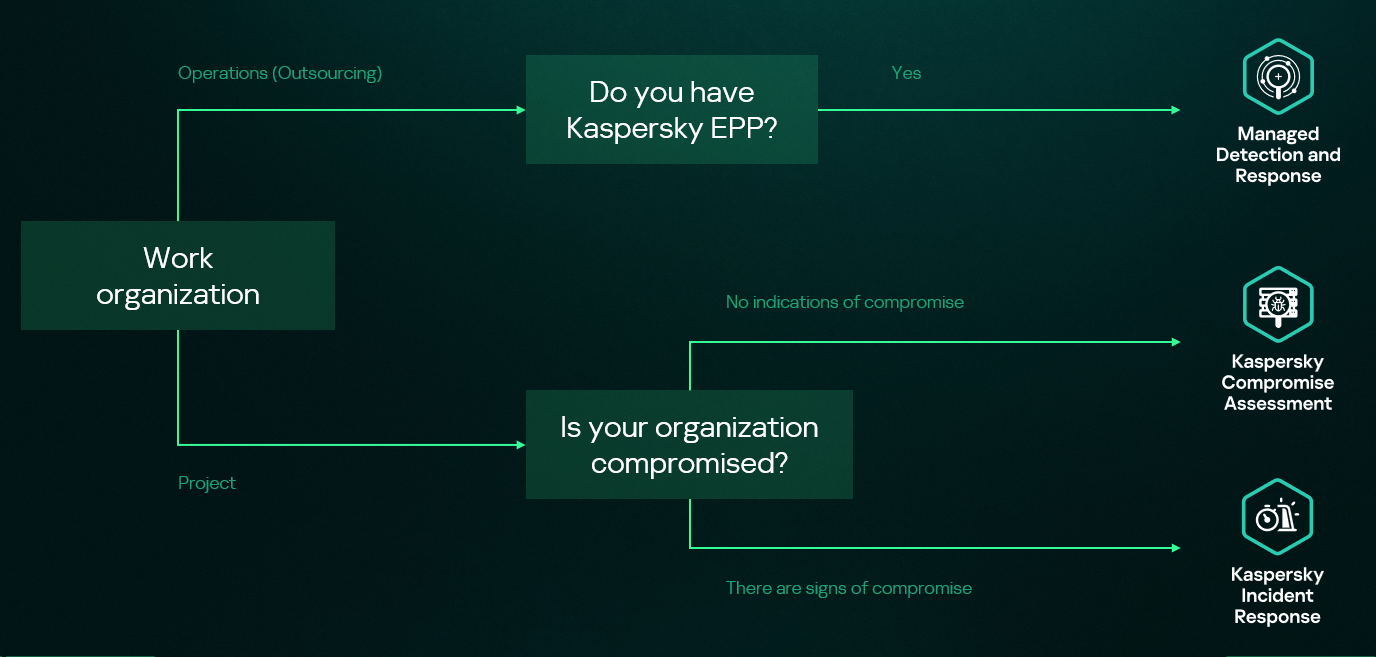
High-level overview of the MDR, IR and CA connection

High-level overview of the MDR, IR and CA connection

This new report brings together statistics across regions and industries from our Managed Detection and Response and Incident Response services, and for the first time, it also includes insights from our Compromise Assessment and SOC Consulting services β€” all to provide you with more comprehensive view of different aspects of corporate information security worldwide.

The scope of MDR and IR services

Provision of Kaspersky’s MDR and IR services follows a global approach. The majority of customers accounted for the CIS (34.7%), the Middle East (20.1%), and Europe (18.6%).
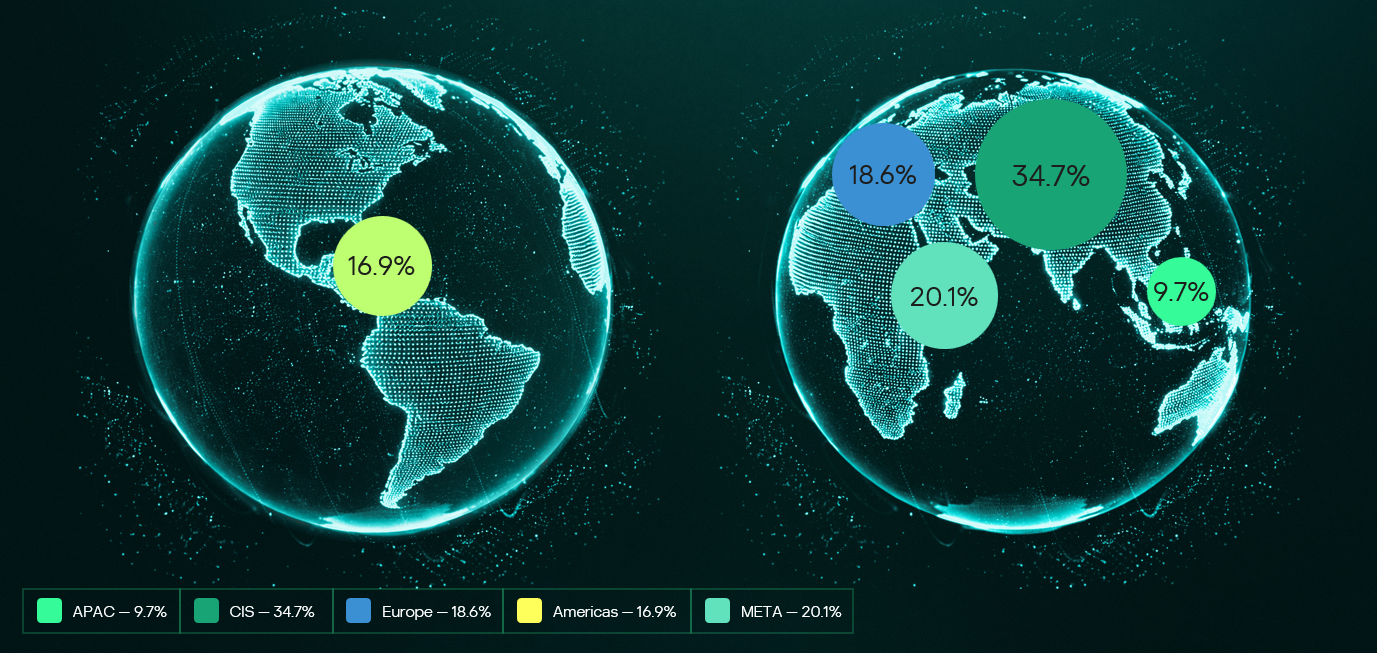
Distribution of customers by geographical region, 2025

Distribution of customers by geographical region, 2025

MDR telemetry

Following the previous year’s numbers, in 2025, the MDR infrastructure received and processed an average of 15,000 telemetry events per host every day, generating security alerts as a result. These alerts are first processed by AI-powered detection logic, after which Kaspersky SOC analysts handle them as required. Overall, a total of approximately 400,000 alerts were generated in 2025. After counting out false positives, 39,000 alerts were further investigated.
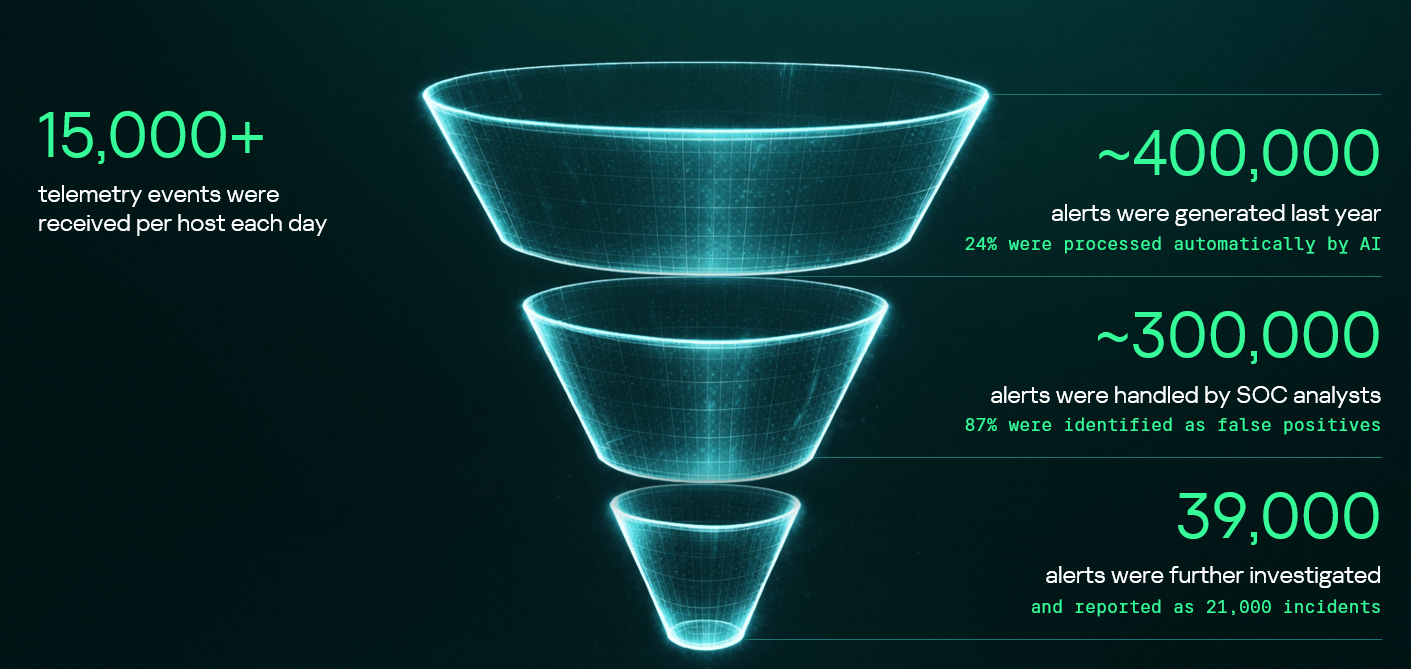
MDR telemetry statistics, 2025

MDR telemetry statistics, 2025

Incident statistics

The distribution of remediation requests by industry has slightly changed as compared to previous years’ pattern. Government (18.5%) and industrial (16.6%) organizations are still the most targeted industries in regards to cyberattacks that require incident response activities. However, this year, the IT sector saw a growth in the number of IR requests, eventually being placed third in the overall industry distribution rankings and thus replacing financial organizations, which were targeted less often than in 2024. This is equally true for smaller-scale attacks that can be contained and remediated through automated means β€” the only difference is that medium- and low-severity incidents are more often experienced by financial organizations.
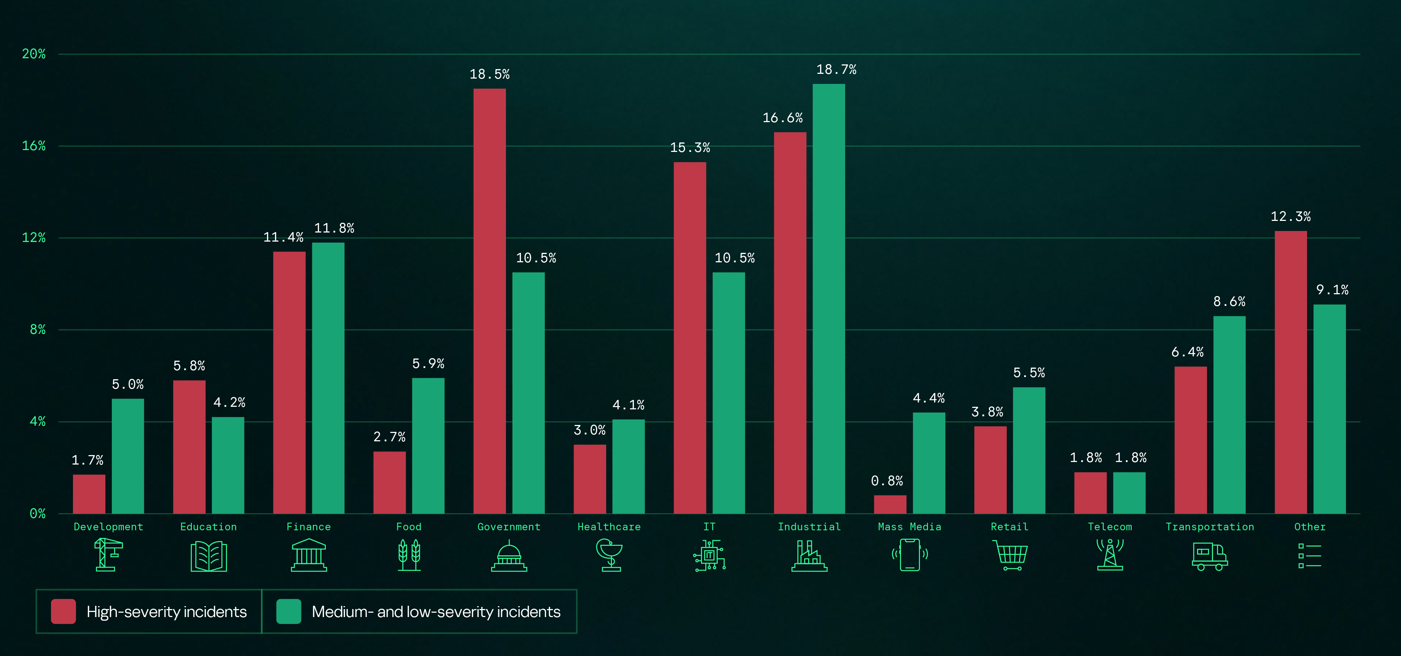
Distribution of all incidents by industry sector, 2025

Distribution of all incidents by industry sector, 2025

Key trends and statistics

This section presents key findings and trends in cyberattacks in 2025:

  • The number of high-severity incidents decreased, following a downward trend that we’ve been observing since 2021. The majority of those incidents account for APT attacks and red teaming exercises, which indicates two landscape trends. On the one hand, skilled adversaries make efforts to increase impact, while on the other, organizations spend more resources on probing their defense systems.
  • The most common vulnerabilities exploited in the wild were related to Microsoft products. Half of all identified CVEs led to remote code execution, notably without authentication in some cases.
  • Exploitation of public-facing applications, valid accounts, and trusted relationships remain the most popular initial vectors, and their overall share has increased, accounting to over 80% of all attacks in 2025. In particular, attacks through trusted relationships are evolving: their share has increased to 15.5% from 12.8% in 2024. They are also becoming more complex: for instance, we witnessed a case where adversaries had compromised more than two organizations in sequence to ultimately gain access to a third target.
  • Standard Windows utilities remain a popular LotL tool. Adversaries use those to minimize the risk of detection during delivery to a compromised system. The most popular LOLBins we observed in high-severity incidents were powershell.exe (14.4%), rundll32.exe (5.9%), and mshta.exe (3.8%). Among the most popular legitimate tools used in incidents we flag Mimikatz (14.3%), PowerShell (8.1%), PsExec (7.5%), and AnyDesk (7.5%).

The full 2026 Global Report provides additional information about cyberattacks, including real-world cases discovered by Kaspersky experts. We also describe SOC Consulting projects and Compromise Assessment requests. The report includes comprehensive analysis of initial attack vectors in correlation with the MITRE ATT&CK tactics and techniques and the full list of vulnerabilities that we detected during Incident Response engagements.

Anatomy of a Cyber World Global Report 2026

25 March 2026 at 12:00

Kaspersky Security Services provide a comprehensive cybersecurity ecosystem, taking enterprise threat protection to another level. Services like Kaspersky Managed Detection and Response and Compromise Assessment allow for timely detection of threats and cyberattacks. SOC Consulting provides a practical approach ensuring the corporate infrastructure stays secured, while Incident Response is suited for timely remediation with a maximized recovery rate.

High-level overview of the MDR, IR and CA connection

High-level overview of the MDR, IR and CA connection

This new report brings together statistics across regions and industries from our Managed Detection and Response and Incident Response services, and for the first time, it also includes insights from our Compromise Assessment and SOC Consulting services β€” all to provide you with more comprehensive view of different aspects of corporate information security worldwide.

The scope of MDR and IR services

Provision of Kaspersky’s MDR and IR services follows a global approach. The majority of customers accounted for the CIS (34.7%), the Middle East (20.1%), and Europe (18.6%).

Distribution of customers by geographical region, 2025

Distribution of customers by geographical region, 2025

MDR telemetry

Following the previous year’s numbers, in 2025, the MDR infrastructure received and processed an average of 15,000 telemetry events per host every day, generating security alerts as a result. These alerts are first processed by AI-powered detection logic, after which Kaspersky SOC analysts handle them as required. Overall, a total of approximately 400,000 alerts were generated in 2025. After counting out false positives, 39,000 alerts were further investigated.

MDR telemetry statistics, 2025

MDR telemetry statistics, 2025

Incident statistics

The distribution of remediation requests by industry has slightly changed as compared to previous years’ pattern. Government (18.5%) and industrial (16.6%) organizations are still the most targeted industries in regards to cyberattacks that require incident response activities. However, this year, the IT sector saw a growth in the number of IR requests, eventually being placed third in the overall industry distribution rankings and thus replacing financial organizations, which were targeted less often than in 2024. This is equally true for smaller-scale attacks that can be contained and remediated through automated means β€” the only difference is that medium- and low-severity incidents are more often experienced by financial organizations.

Distribution of all incidents by industry sector, 2025

Distribution of all incidents by industry sector, 2025

Key trends and statistics

This section presents key findings and trends in cyberattacks in 2025:

  • The number of high-severity incidents decreased, following a downward trend that we’ve been observing since 2021. The majority of those incidents account for APT attacks and red teaming exercises, which indicates two landscape trends. On the one hand, skilled adversaries make efforts to increase impact, while on the other, organizations spend more resources on probing their defense systems.
  • The most common vulnerabilities exploited in the wild were related to Microsoft products. Half of all identified CVEs led to remote code execution, notably without authentication in some cases.
  • Exploitation of public-facing applications, valid accounts, and trusted relationships remain the most popular initial vectors, and their overall share has increased, accounting to over 80% of all attacks in 2025. In particular, attacks through trusted relationships are evolving: their share has increased to 15.5% from 12.8% in 2024. They are also becoming more complex: for instance, we witnessed a case where adversaries had compromised more than two organizations in sequence to ultimately gain access to a third target.
  • Standard Windows utilities remain a popular LotL tool. Adversaries use those to minimize the risk of detection during delivery to a compromised system. The most popular LOLBins we observed in high-severity incidents were powershell.exe (14.4%), rundll32.exe (5.9%), and mshta.exe (3.8%). Among the most popular legitimate tools used in incidents we flag Mimikatz (14.3%), PowerShell (8.1%), PsExec (7.5%), and AnyDesk (7.5%).

The full 2026 Global Report provides additional information about cyberattacks, including real-world cases discovered by Kaspersky experts. We also describe SOC Consulting projects and Compromise Assessment requests. The report includes comprehensive analysis of initial attack vectors in correlation with the MITRE ATT&CK tactics and techniques and the full list of vulnerabilities that we detected during Incident Response engagements.

What to Know About the Notepad++ Supply-Chain Attack

26 February 2026 at 15:40

Blogs

Blog

What to Know About the Notepad++ Supply-Chain Attack

In this post we examine the mechanics of the CVE-2025-15556 supply-chain attack and provide actionable steps to secure your environment.

SHARE THIS:
Default Author Image
February 26, 2026

The cybersecurity community is still grappling with a sobering realization: one of the most ubiquitous tools in the developer’s toolkit, Notepad++, was hiding a critical vulnerability for over six months. Being so deeply embedded in daily workflows, many organizations did not realize they were vulnerable until a recent security update pulled back the curtain on a sophisticated Chinese state-sponsored campaign, dubbed β€œLotus Blossom.”

Investigations have confirmed that the issue wasn’t just a coding error, it was a compromise at the hosting provider level. This means that for much of 2025, even organizations that followed best practices were still potentially open to backdoors from Chinese advanced persistent threat (APT) groups. Here is what you need to know to secure your environment.

Understanding the Notepad++ Vulnerability (CVE-2025-15556)

The vulnerability, tracked as CVE-2025-15556 (VulnDB ID: 430205), exploits a critical flaw in the Notepad++ updater component, WinGUP. In versions prior to the February 2026 patch, the updater failed to verify the file integrity signatures of downloaded installers.

By exploiting this lack of verification, threat actors are able to:

  • Intercept legitimate update requests originating from WinGUp servers
  • Redirect traffic to malicious servers via Man-in-the-Middle (MitM) attacks or DNS cache poisoning
  • Deliver trojanized executables (disguised as update.exe) that appeared to be legitimate software patches

Leveraging this vulnerability, attackers have gained a persistent presence in high-value sectors. According to reports from Kaspersky, the impact has spanned government and telecommunications, critical infrastructure, and financial services.

How CVE-2025-15556 Works

The state-sponsored Lotus Blossom campaign was executed in three attack chains, between July and October 2025. Each phase evolved to evade detection by changing file sizes, IP addresses, and delivery methods.

PhaseTimeline (2025)Execution MethodPayload
Chain #1July – August1MB NSIS installer (update.exe)Multi-stage attack launching a Cobalt Strike beacon via ProShow.exe.
Chain #2September140KB NSIS installer (update.exe)Rotated C2 URLs to maintain stealth while dropping a Cobalt Strike beacon.
Chain #3OctoberBackdoor DeploymentDropped BluetoothService.exe, log.DLL, and shellcode to establish the Chrysalis backdoor.

Mapping CVE-2025-15556 to MITRE ATT&CK

Flashpoint has mapped Lotus Blossom TTPs (tactics, tools, and procedures) to the MITRE ATT&CK framework. Flashpoint analysts have identified the following techniques:

Execution

Technique TitleIDRecommendations
User Execution: Malicious FileT1204.002M1040: Behavior Prevention on Endpoint
M1038: Execution Prevention
M1017: User Training
Native APIT1106M1040: Behavior Prevention on Endpoint
M1038: Execution Prevention
Command and Scripting Interpreter: Windows Command ShellT1059.003M1038: Execution Prevention

Persistence

Technique TitleIDRecommendations
Hijack Execution Flow: DLLT1574.002M1013: Application Developer Guidance
M1047: Audit
M1038: Execution Prevention
M1044: Restrict Library Loading
M1051: Update Software
Boot or Logon Autostart Execution: Registry Run Keys / Startup FolderT1547.001*MITRE currently does not list any mitigation guidance to combat this attack technique.
Create or Modify System Process: Windows ServiceT1543.003M1047: Audit
M1040: Behavior Prevention on Endpoint
M1045: Code Signing
M1028: Operating System Configuration
M1018: User Account Management

Defense Evasion

Technique TitleIDRecommendations
MasqueradingT1036M1049: Antivirus/Antimalware
M1047: Audit
M1040: Behavior Prevention on Endpoint
M1045: Code Signing
M1038: Execution Prevention
M1022: Restrict File and Directory Permissions
M1018: User Account Management
M1017: User Training
Obfuscated Files or InformationT1027M1049: Antivirus/Antimalware
M1047: Audit
M1040: Behavior Prevention on Endpoint
M1017: User Training
Obfuscated Files or Information: Dynamic API ResolutionT1027.007*MITRE currently does not list any mitigation guidance to combat this attack technique.
Deobfuscate/Decode Files or InformationT1140*MITRE currently does not list any mitigation guidance to combat this attack technique.
Process InjectionT1055M1040: Behavior Prevention on Endpoint
M1026: Privileged Account Management
Reflective Code LoadingT1620*MITRE currently does not list any mitigation guidance to combat this attack technique.
Execution Guardrails: Mutual ExclusionT1480.002M1055: Do Not Mitigate
Indicator Removal: File DeletionT1070.004*MITRE currently does not list any mitigation guidance to combat this attack technique.

Discovery

Technique TitleIDRecommendations
File and Directory DiscoveryT1083*MITRE currently does not list any mitigation guidance to combat this attack technique.
Ingress Tool TransferT1105M1031: Network Intrusion Prevention

Collection

Technique TitleIDRecommendations
Data from Local SystemT1005M1057: Data Loss Prevention

Command and Control

Technique TitleIDRecommendations
Application Layer Protocol: Web ProtocolsT1071.001M1031: Network Intrusion Prevention
Encrypted ChannelT1573M1031: Network Intrusion Prevention
M1020: SSL/TLS Inspection

Exfiltration

Technique TitleIDRecommendations
Exfiltration Over C2 ChannelT1041M1057: Data Loss Prevention
M1031: Network Intrusion Prevention

Protecting Against CVE-2025-15556

Proactive defense requires not only reactive patching of CVE-2025-15556, but also active threat hunting using the TTPs identified by Flashpoint analysts. Flashpoint recommends the following actions:

  1. Immediate Update: Ensure all instances of Notepad ++ are updated to v8.9.1 or higher immediately. This version enforces the signature verification that was missing in previous releases.
  2. Audit System Paths: Scan for malicious file paths used for persistence.
  3. Network Defense: Monitor and block traffic to malicious domains.
  4. Endpoint Hardening: Implement Behavior Prevention on Endpoints (M1040) and Audit (M1047) to detect unauthorized registry run keys or new system services.

Outpace Threat Actors Using Flashpoint

Software trust is only as strong as the infrastructure behind it. As organizations respond to these recent updates, having best-in-class vulnerability intelligence and direct visibility into threat actor TTPs is the best defense.

Leveraging Flashpoint vulnerability intelligence, organizations can move beyond CVE and NVD, by gaining deeper technical analysis and MITRE ATT&CK mapping to defend against sophisticated threat actors. Request a demo to learn more.

Begin your free trial today.

The post What to Know About the Notepad++ Supply-Chain Attack appeared first on Flashpoint.

At Home Detection Engineering Lab for Beginners

| Niccolo Arboleda | Guest Author Niccolo Arboleda is a cybersecurity enthusiast and student at the University of Toronto. He is usually found in his home lab studying different cybersecurity […]

The post At Home Detection Engineering Lab for Beginners appeared first on Black Hills Information Security, Inc..

❌