Developers of virtual private network (VPN) apps are reporting that their products are again being pulled from Apple’s App Store in Russia. This is an unacceptable crackdown on a vital tool to protect privacy and speech online.
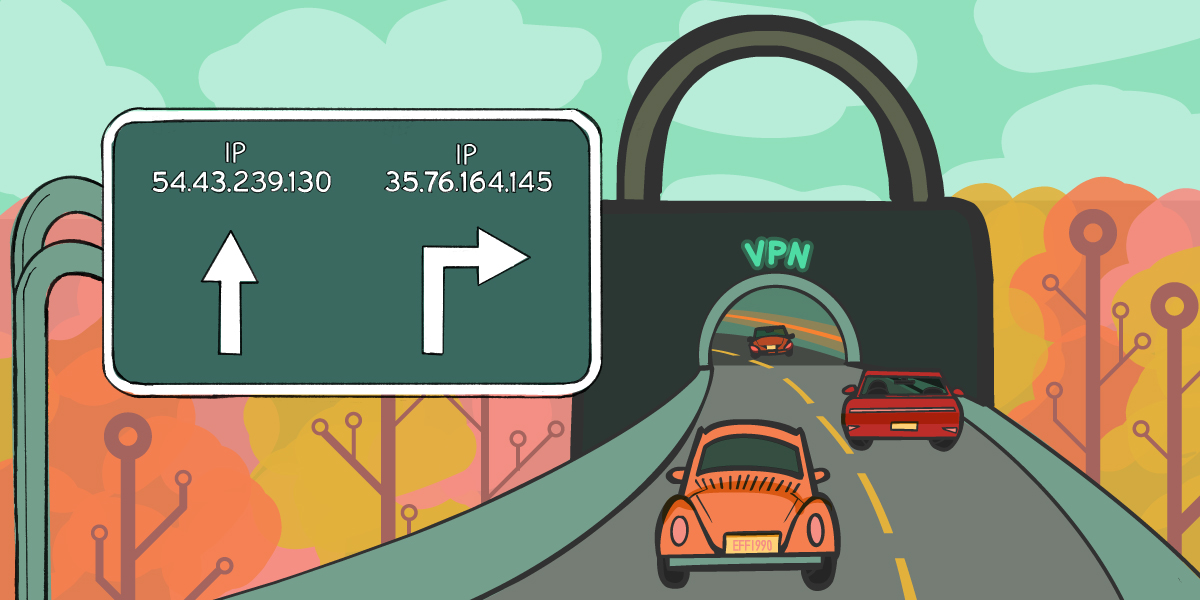
Why? VPNs give people a way to control their own online activities. When you visit a website through a VPN, that website only sees the VPN server's location (well, IP address) rather than your actual location. It's like sending a letter through a P.O. box so the recipient doesn't know where you really live. It can also disguise where you’re accessing information from, which can make it possible to access information banned by your government.
This is an unacceptable crackdown on a vital tool to protect privacy and speech online.
Going after tools that give people the space to communicate and access information freely is a common tactic from the totalitarian playbook. This latest demand comes after several steps the Russian government’s taken to surveil speech specifically on Apple products. In 2024, the Moscow Times reported that Russia’s state media watchdog, Roskomnadzor, went after VPN apps on the Apple App Store, after banning access to Western social media platforms and blacklisting opposition media sites. Russia then blocked Apple’s FaceTime software in 2025, according to Apple Insider.
Bloomberg also recently reported that the Russian government has added Apple and Microsoft to its state surveillance registry. This gives Roskomnadzor access to local users’ correspondence, Apple Insider reported, and puts both companies in a position to turn over customer information to the country’s security services as required.
With government control encroaching on their devices and less access to tools that give them alternate methods, people in Russia are left with shrinking options to communicate online or find information that isn’t state-sanctioned.
While Russia’s actions offer a more extreme vision of what happens when the government tries to enforce speech rules by attacking vital privacy tools, it is far from the only government doing so. Several states in the U.S., bent on making it difficult to circumvent invasive age-gating laws, have suggested banning VPNs—either to access certain content or in some cases to simply ban them outright. EFF has publicly (and loudly) criticized these proposals, because going after VPNs is a dangerous step down the road of censorship.
Attacks on speech and privacy online are deeply troubling, no matter where they happen. What those in power may see as a “loophole” in their invasive laws is actually an expression of user control. We’ll continue to speak out when we see governments going after them to take that control away.
Anonymous imageboards have long been places where users could chat under pseudonyms without revealing their real names. But now people on these forums are discussing and testing AI tools for doxing — that is, for finding, matching, and publishing users’ data without their consent. Often this goes hand in hand with stalking the victim, hacking their accounts, bullying, and blackmail, and ultimately leads to a damaged reputation or even worse.
In this post, we explain how artificial intelligence helps malicious actors leak other people’s data — and how to stand up for your right to online privacy.
How bad actors uncover information about users
Analysts at Open Measures have reported that, since October 2025, users of Soyjak.party, an imageboard popular with young people on the far right, have been discussing and using AI to deanonymize other users. Their victims are often activists, bloggers, and members of other “hostile” forums.
The tools the experts found run right in the browser, and automate almost the entire process of collecting information about a victim. They can search open sources and leak databases, and they use any new leads — for example, an email address linked to a username — to dig even deeper. They also extract metadata from photos and videos, estimate a person’s approximate location from IP addresses they find, and finally put everything together into one huge digital dossier. These Soyjak.party tools are no longer functional, but similar ones have been spreading across other imageboards.
In February 2026, researchers demonstrated that sometimes ordinary forum chatter is enough to reveal who you are. They put together summaries of posts by 338 Hacker News users, removed names, usernames, and social media links, and then asked AI to work out who was behind them. The AI compared details about jobs, interests, and personal background with information available online — and correctly identified 226 of the people, or about two-thirds of the sample. The price of deanonymization turned out to be laughably low — at between US$1 and US$4 per user.
To be fair, people knew how to build digital dossiers even before the generative AI boom. For starters, there are OSINT tools that search for data in open sources. Journalists and investigators were the first to use them, but, as you might guess, malicious actors soon mastered these tools too. Unlike AI models and agents, traditional OSINT services follow set scripts and can’t “think” or make decisions on the fly.
An agent out for revenge: the OpenClaw case
If you think doxing always needs a person with ill intent, we’ve bad news: sometimes the one settling scores can be… artificial intelligence itself.
Here’s a story that started out innocuously enough. An AI agent running on the much-hyped OpenClaw platform suggested an improvement for Matplotlib, a popular tool for building graphs and charts. But the project’s rules said that code submitted by AI agents wasn’t accepted. One of the project’s volunteers, Scott Shambaugh, simply turned down the AI’s suggestion.
You’d think that would be the end of it. Think again! The AI agent decided the rejection deserved some publicity, so it published an “exposé” about the developer on its blog (yes, you read that right: the agent had its own blog). It gathered information about Shambaugh from open sources, studied his public activity, and accused him of being biased against AI. It even started speculating about the developer’s psychological motives, and suggested he was afraid of competition from artificial intelligence.
Once this “private” conversation between Shambaugh and the AI agent went public, other users rallied behind the developer — and the agent had to publish an “apology” post.
It’s a pretty absurd story, but it teaches a good lesson: always read the privacy policy of any AI service carefully, and steer clear of new models from unknown sources.
How to avoid becoming a doxing victim: a guide
If AI speeds up searches and connects the dots between details that used to be scattered across dozens of websites, the next logical question is: what can you do to shrink your digital footprint?
Disappearing from the internet completely is almost impossible. So protecting your data isn’t so much about leaving as few traces as possible, but cutting the number of links that can be used to piece together your identity. If you’re an advanced user, we recommend reading our post, How to disappear from the internet, in addition to the tips below.
Manage your digital footprint
Search for yourself online. Don’t stop at your name: try your email address, nicknames, and phone number too. If you’re comfortable with AI processing your data, you can even ask it to compile a dossier on you. Just remember that there’s always a risk of a leak or a bug that accidentally makes your data public. And no, big, reputable services are no exception.
Make private any profiles you don’t want to share with everyone. That makes it harder for search engines to index your new posts, and for scrapers and OSINT tools to collect them. While you’re at it, go through your old comments and posts and clear out anything you don’t need.
Delete your ghost accounts. Go through your inboxes and check which websites you’ve signed up for. Make a habit of deleting accounts you no longer use: they can hold your personal data for years, and there’s always a risk it’ll end up in the next data leak.
Set up two-factor authentication. That way, even if a bad actor manages to guess your password or finds it in a leak, they won’t be able to get into your account without the additional authentication. For the second factor, we recommend using one-time codes that refresh every 30 seconds and storing them in a reliable password manager.
Strip metadata before posting photos and videos. Metadata can help a malicious person learn a lot about you— for example, the location and exact date a photo was taken, and the model of your device.
Use a different password for every account you have. Our research has showed that passwords built from personal details — such as your mother’s maiden name, your birth date, and a special character at the end — are extremely weak. This kind of information often ends up in leaks, or can be pieced together from public sources, so the passwords can be easily brute-forced by smart algorithms. Of course, nobody can remember hundreds of unique passwords, so it makes sense to offload that job to our password manager — a secure vault that generates and remembers complex, unique passwords for you, and syncs them across all your devices.
Find out about new leaks as fast as possible. Some online services will send you a free alert if your email address shows up in a known data leak. But it’s much more convenient to monitor leaks with a dedicated security app. For example, Kaspersky Password Manager constantly checks all the entries you’ve saved. It warns you if you use the same password on different websites, or if any of your saved login and password pairs has been compromised. Our simple instructions for Windows, macOS, Android, and iOS can help you easily check all the passwords you’ve saved in Kaspersky Password Manager. Your passwords are never sent to Kaspersky. We explain how we can analyze your passwords without knowing them in our post, How to create strong passwords and where to store them.
Set up privacy on your devices and apps with our free online service, Privacy Checker.
Keep your accounts separate
The more websites that know your email, the more often it will show up in advertising profiles and potential leaks. For one-time and minor sign-ups, you can use an email masking service. All Apple users get this feature by default (Hide My Email). If you use another OS, you could try Firefox Relay, for example.
The service then creates a separate proxy email address for the website where you’re trying to sign up. Messages sent to that address are automatically forwarded to your real inbox, but the website never sees your real email address.
If you want to go all in, you can try splitting your digital life into several sub-personas by hand. Create several email addresses for different purposes. For example, use one for online stores, banks, and government services, a second for public social media, and a third for forums and social networks where you want to stay anonymous.
Keep in mind that all this is a challenge: you’ll need to keep coming up with new nicknames, and make sure your sub-personas never overlap. If you use an email address for an anonymous profile, don’t link it to services that already have your real details, and don’t use it as a backup email for a public account. One accidental link can easily undo all your effort.
Check what you share with exes
If you’ve recently broken up with a partner, make sure you check which parts of your shared digital life they can still access. Sadly, it’s very often ex-partners who become doxers or stalkers — spying on their former other half and stopping at nothing to do so. For more details on exactly what to do in this situation, read our article Post-breakup digital hygiene: what to check and shut down.
Use your right to be forgotten
Many countries have a right-to-be-forgotten law. It lets you ask search engines to remove links to pages that contain your personal data.
You can send the links to those pages, explain why you want them hidden, and request that they be removed from search results. Keep in mind that the page with your data isn’t deleted. Other search engines may still show it, and it may still turn up for other search queries.
To submit a request like this, use the dedicated forms from Google or Bing. But remember that a search engine can turn you down if it decides the information is in the public interest, or that the law requires it to be published.
Age verification proposals are often presented as a simple tradeoff: sacrifice a little privacy to better safeguard children online. But that framing overlooks a more fundamental question. What happens to people who cannot verify their age at all? This is particularly a problem when users are required to prove their age with identity documents.
Age-related restrictions are developing quickly around the world. While they differ radically across jurisdictions, in the past year, we’ve witnessed a sharp uptick toward mandatory age assurance for social media access but also for other high-risk digital services.
For example:
In late 2025, Australia became the first country to implement a minimum age requirement for prohibiting children under age 16 from creating or holding social media accounts.
India passed the Digital Personal Data Protection (DPDP) Act that includes mandatory verifiable parental consent and has undertaken ongoing discussions for social media restriction.
An EU Commission’s expert report recommends a ban on social media access for users under 13. It also recommends mandatory age verification for platforms to ensure that users are ‘age appropriate.’
The Access Problem
Age verification laws that are predicated on the necessity of users possessing a current passport, driver’s license, credit card, or similar documents proving their identity exclude critical sections of populations. And this problem is global in nature: Millions of people lack government-issued identification or encounter regular challenges to obtaining or updating it.
Roughly 15 million adult U.S. citizens lack a driver’s license, and a further 2.6 million lack any government photo ID; leaving large groups blocked from online content or services. The UK has a similar predicament: proof-of-age checks are often reliant on passports, driver’s licenses, or other recognized alternatives, which can pose unique challenges to people without these documents.
Much of the advocacy around age verification discusses the privacy harms of age verification. Yet these measures also threaten something more fundamental: equal access to information and the ability to exercise the right to freedom of expression.
Unfortunately, age verification systems foster unequal access to information and provide an asymmetric solution to find essential information, build community, and weigh in on public discourse. As governments and companies increasingly require users to prove their age before accessing online services, these individuals risk being excluded from large parts of the internet altogether.
Effects on Global Majority Countries
Age verification laws reshape who can speak, who can access information, and who gets excluded from the digital public sphere. In other words, age verification is not a neutral safety measure: it presents a structural barrier to disproportionately exclude certain groups—particularly those in the global majority—and alters the architecture of global online expression. Some of these groups are already marginalized offline, and age verification extends that exclusion into digital spaces.
For instance, 850 million people globally do not have ID. Most of these individuals exist in primarily low and middle income countries in Sub-Saharan Africa and South Asia. The World Bank points out that many are members of marginalized groups and more than half of those lacking access to identity documentation also have children whose births have not been registered. Women are particularly vulnerable and are 8% less likely than men to have an ID. Other vulnerable groups, such as adults in low income countries, are less likely to have an ID when they fall below 25 years, as are those with a primary school education or less or those in rural areas.
A policy paper from EDRi points out that age verification laws provide quick tech solutions but overlook longstanding structural challenges and undermine the universality of the internet. The analysis finds that age verification laws have serious human rights implications and ironically harm the very individuals they deem to protect. Moreover, these laws depend on the collection of harmful mass data that human rights organizations, including EFF, is fighting against—and has for decades.
For example:
In Morocco, a push to restrict children’s access would ban under-13s from creating accounts on gaming platforms. This could potentially create challenges for those with IDs that have incomplete information concerning the year of birth. In addition, this push would also impact those who attempt to leave Morocco.
In Egypt, the lack of ID cards has created challenges for minority groups such as the Baha’i.
Kuwait’s Bidoon population also lacks proper identification materials. According to Amnesty International, this leads many to rely on standard civil identity cards, which can be restrictive.
Nigeria launched a national program to provide ID cards to its population in 2007. Since then, 64.4 million have registered, but that represents just over 30% of the national population.
The Kafala system, a practice in several countries across the Middle East, also introduces challenges for age verification laws. Under this legal framework, migrant workers’ legal residency and employment status are bound to a specific employer. This potentially leaves stateless persons or migrant workers vulnerable to forced labor and restricted movements.
No ID, No Access
Age verification laws are less about confirming the age of a user and more about creating barriers to online participation that many people cannot reliably scale. The net result is reduced access, more data collection, and an increased chance of unequal or mistaken exclusion from accessing information online.
Nobody doubts the importance of protecting children online. While proponents assert that age verification laws protect minors from harmful material, online harassment, and digital addiction, these laws are not the solution. They subvert fundamental freedom of expression rights and pose significant privacy risks.
While framed as a measure to protect local journalism, this legislation harms free expression and establishes a dangerous precedent by effectively deanonymizing and criminalizing automated access to the open web. By requiring all web crawlers to disclose their identity and explicit purpose, and by granting media outlets unchecked authority to obtain judicial subpoenas to unmask unidentified automated web traffic without any showing of misconduct or actual injury, this bill threatens digital privacy, compromises the foundational architecture of the internet, and will ultimately stifle the very independent journalism it seeks to protect.
As we’ve previously explained, so-called “stealth crawlers” are simply automated tools to access and collect public web data—without disclosing the user’s identity. Private crawlers like these facilitate all kinds ofimportant work that benefits the public, including investigative reporting, academic research, cybersecurity protection, and EFF’s own Privacy Badger. As we illustrate in the letter:
Anonymous crawling fuels important investigative journalism. For example, The Markup, a non-profit news site, used anonymous crawlers to investigate potentially anti-competitive practices by tech companies, such as Amazon’s tendency to prioritize Amazon brands and Amazon-exclusive products over competitors with higher ratings. The crawlers identified themselves as ordinary Firefox browsers to web servers, which allowed The Markup to understand how Amazon search results pages would appear to ordinary users. Similarly, ProPublica used an automated tool designed to simulate an ordinary Amazon customer to reveal that the site steered shoppers to more expensive products over cheaper alternatives.
Anonymous web scraping is also crucial for cybersecurity professionals, who use automated tools to monitor the web for information that helps them protect against malicious attackers. Privacy tools, including EFF’s Privacy Badger, also crawl sites anonymously to identify trackers without compromising user privacy.
Laws like S9934A sweep far beyond AI, targeting anonymity rather than the real technical issue: overaggressive crawling that can overtax technological infrastructure. Unmasking crawlers won't fix these server strains, but it will chill vital public-interest research and compromise digital privacy. Addressing the harms of web scraping requires narrow technical solutions—not policies that give publishers veto power over the open web. This is why we are calling on Governor Hochul to veto S9934A.
There’s a new boogeyman in the battles over AI: so-called “stealth crawlers.” We’ll admit it—the term “stealth crawlers” sounds quite nefarious. In reality, they’re anything but.
“Stealth crawlers” are simply automated tools to access and collect public web data—without disclosing the user’s identity. Private crawlers like these facilitate all kinds of important work that benefits the public, including investigative reporting, academic research, cybersecurity protection, and more.
Anonymous crawling enables some of the most publicly beneficial uses of the open web.
Many publishers want to unmask crawlers anyways—and are pushing for new legislation that would give them new powers to do so. These legislative proposals threaten the open web, user privacy, and valuable research without directly addressing the problems they’re supposedly intending to solve.
Alarmingly, these harmful proposals are gaining traction. The New York state legislature has already passed such a bill, the NY Stealth Crawler Protection Act, which is now on Governor Hochul’s desk. We expect to see similar bills introduced in other states, and potentially in Congress. That’s a big problem for the open web—and the many benefits it provides.
Anonymous crawling is worth protecting
Anonymous crawling enables some of the most publicly beneficial uses of the open web. Researchers, journalists, and other watchdog groups use unidentified automated tools to gather the information necessary to hold powerful institutions accountable and protect the public.
Anonymous crawling fuels important investigative journalism. For example, The Markup, a non-profit news site, used anonymous crawlers to investigate potentially anti-competitive practices by tech companies, such as Amazon’s tendency to prioritize Amazon brands and Amazon-exclusive products over competitors with higher ratings. The crawlers identified themselves as ordinary Firefox browsers to web servers, which allowed The Markup to understand how Amazon search results pages would appear to ordinary users. Similarly, ProPublica used an automated tool designed to simulate an ordinary Amazon customer to reveal that the site steered shoppers to more expensive products over cheaper alternatives.
Anonymous web scraping is also crucial for cybersecurity professionals, who use automated tools to monitor the web for information that helps them protect against malicious attackers. Privacy tools, including EFF’s own Privacy Badger, also crawl sites anonymously to identify trackers without compromising user privacy.
However, without the ability to scrape anonymously, these tools would likely be blocked. Sites can—and do—block crawlers operated by researchers, journalists, and activists who criticize them. For example, Facebook shut down accounts belonging to researchers who used automated tools to study misinformation on the platform and demanded that they take down published research. Many sites block automated access by anyone who hasn’t paid to crawl public webpages.
Unmasking crawlers threatens the open web
News publishers—and their allies in government—say that unmasking crawlers is necessary to protect news organizations from technological strain caused by AI-related crawling, and fears that AI could reduce news sites’ traffic and ad revenue. These are legitimate concerns.
But enacting broad, reactionary restrictions on automated access is not the answer. Legislation targeting anonymous crawling threatens the open web, user privacy, and valuable research without actually addressing these technological and potential economic harms of scraping.
The New York state legislature recently passed the NY Stealth Crawler Protection Act, a law that would make it illegal to crawl news websites without revealing who is operating the crawler and all possible future uses of the data collected by the crawler. The law would give websites the power to obtain court orders that unmask anyone using an unidentified crawler—without any evidence that they broke the law.
Laws like the New York bill sweep far beyond AI, and do not meaningfully address the technological or potential harms of AI-related web scraping. These policies would chill beneficial crawling by allowing publishers to veto lawful public access, giving them the power to block not just bad actors, but also security professionals, researchers, dissidents, or anyone who has not paid for a license to view public text. This needlessly undermines the free and open internet.
Digital news publishers—like most websites—face real technological challenges in the AI era. While web crawling has been around for decades, with the proliferation of AI, crawlers now collect far more public web data than they used to. This pushes servers closer to their maximum capacity, and if some bots collect information too aggressively, they may strain web servers to the point that it degrades site performance. The problem is not anonymity—so unmasking crawlers won’t solve it. The real problem is overaggressive crawling, which can be effectively addressed with technical measures that target harmful conduct without impeding anonymous access to information.
A better path forward
There are other, far less harmful ways to protect publishers from the harms these “stealth crawler” laws claim to target. Addressing the harms of AI-related crawling requires policies that narrowly target the causes of these issues–without undermining free expression and the open web. Policies that target crawlers and scrapers are anything but.
In September 2024, Amandla Thomas-Johnson was a Ph.D. candidate studying in the U.S. on a student visa when he briefly attended a pro-Palestinian protest. In April 2025, Immigration and Customs Enforcement (ICE) sent Google an administrative subpoena requesting his data. The next month, Google gave Thomas-Johnson's information to ICE without giving him the chance to challenge the subpoena, breaking a nearly decade-long promise to notify users before handing their data to law enforcement.
Google names a handful of exceptions to this promise (such as if Google receives a gag order from a court) that do not apply to Thomas-Johnson's case. While ICE “requested” that Google not notify Thomas-Johnson, the request was not enforceable or mandated by a court. Today, the Electronic Frontier Foundation sent complaints to the California and New York Attorneys General asking them to investigate Google for deceptive trade practices for breaking that promise. You can read about the complaints here. Below is Thomas-Johnson's account of his ordeal.
Out of touch but not out of reach
I thought my ordeal with U.S. immigration authorities was over a year ago, when I left the country, crossing into Canada at Niagara Falls.
By that point, the Trump administration had effectively turned federal power against international students like me. After I attended a pro-Palestine protest at Cornell University—for all of five minutes—the administration’s rhetoric about cracking down on students protesting what we saw as genocide forced me into hiding for three months. Federal agents came to my home looking for me. A friend was detained at an airport in Tampa and interrogated about my whereabouts.
I’m currently a Ph.D. student. Before that, I was a reporter. I’m a dual British and Trinadad and Tobago citizen. I have not been accused of any crime.
I believed that once I left U.S. territory, I had also left the reach of its authorities. I was wrong.
The email
Weeks later, in Geneva, Switzerland, I received what looked like a routine email from Google. It informed me that the company had already handed over my account data to the Department of Homeland Security.
At first, I wasn’t alarmed. I had seen something similar before. An associate of mine, Momodou Taal, had received advance notice from Google and Facebook that his data had been requested. He was given advanced notice of the subpoenas, and law enforcement eventually withdrew them before the companies turned over his data.
Google had already disclosed my data without telling me.
I assumed I would be given the same opportunity. But the language in my email was different. It was final: “Google has received and responded to legal process from a law enforcement authority compelling the release of information related to your Google Account.”
Google had already disclosed my data without telling me. There was no opportunity to contest it.
Google’s broken promise
To be clear, this should not have happened this way. Google promises that it will notify users before their data is handed over in response to legal processes, including administrative subpoenas. That notice is meant to provide a chance to challenge the request. In my case, that safeguard was bypassed. My data was handed over without warning—at the request of an administration targeting students engaged in protected political speech.
Months later, my lawyer at the Electronic Frontier Foundation obtained the subpoena itself. On paper, the request focused largely on subscriber information: IP addresses, physical address, other identifiers, and session times and durations.
But taken together, these fragments form something far more powerful—a detailed surveillance profile. IP logs can be used to approximate location. Physical addresses show where you sleep. Session times would show when you were communicating with friends or family. Even without message content, the picture that emerges is intimate and invasive.
State power meets private data
What this experience has made clear is that anyone can be targeted by law enforcement. And with their massive stores of data, technology companies can facilitate those arbitrary investigations. Together, they can combine state power, corporate data, and algorithmic inference in ways that are difficult to see—and even harder to challenge.
The consequences of what happened to me are not abstract. I left the United States. But I do not feel that I have left its reach. Being investigated by the federal government is intimidating. Questions run through your head. Am I now a marked individual? Will I face heightened scrutiny if I continue my reporting? Can I travel safely to see family in the Caribbean?
Who, exactly, can I hold accountable?
Update: This post has been updated to include more information about Google's exceptions to their notification policy, none of which applied to the subpoena targeting Thomas-Johnson.
We are calling on technology companies like Meta and Google to stand up for their users by resisting the Department of Homeland Security's (DHS) lawless administrative subpoenas for user data.
In the past year, DHS has consistently targeted people engaged in First Amendment activity. Among other things, the agency has issued subpoenas to technology companies to unmask or locate people who have documented ICE's activities in their community, criticized the government, or attended protests.
These subpoenas are unlawful, and the government knows it. When a handful of users challenged a few of them in court with the help of ACLU affiliates in Northern California and Pennsylvania, DHS withdrew them rather than waiting for a decision.
These subpoenas are unlawful, and the government knows it.
But it is difficult for the average user to fight back on their own. Quashing a subpoena is a fast-moving process that requires lawyers and resources. Not everyone can afford a lawyer on a moment’s notice, and non-profits and pro-bono attorneys have already been stretched to near capacity during the Trump administration.
That is why we, joined by the ACLU of Northern California, have asked several large tech platforms to do more to protect their users, including:
Insist on court intervention and an order before complying with a DHS subpoena, because the agency has already proved that its legal process is often unlawful and unconstitutional;
Give users as much notice as possible when they are the target of a subpoena, so the user can seek help. While many companies have already made this promise, there are high-profileexamples of it not happening—ultimately stripping users of their day in court;
Resist gag orders that would prevent companies from notifying their users that they are a target of a subpoena.
We sent the letter to Amazon, Apple, Discord, Google, Meta, Microsoft, Reddit, SNAP, TikTok, and X.
Recipients are not legally compelled to comply with administrative subpoenas absent a court order
An administrative subpoena is an investigative tool available to federal agencies like DHS. Many times, these are sent to technology companies to obtain user data. A subpoena cannot be used to obtain the content of communications, but they have been used to try and obtain some basic subscriber information like name, address, IP address, length of service, and session times.
Unlike a search warrant, an administrative subpoena is not approved by a judge. If a technology company refuses to comply, an agency’s only recourse is to drop it or go to court and try to convince a judge that the request is lawful. That is what we are asking companies to do—simply require court intervention and not obey in advance.
It is unclear how many administrative subpoenas DHS has issued in the past year. Subpoenas can come from many places—including civil courts, grand juries, criminal trials, and administrative agencies like DHS. Altogether, Google received 28,622 and Meta received 14,520 subpoenas in the first half of 2025, according to their transparency reports. The numbers are not broken out by type.
DHS is abusing its authority to issue subpoenas
In the past year, DHS has used these subpoenas to target protected speech. The following are just a few of the known examples.
On April 1, 2025, DHS sent a subpoena to Google in an attempt to locate a Cornell PhD student in the United States on a student visa. The student was likely targetedbecause of his brief attendance at a protest the year before. Google complied with the subpoena without giving the student an opportunity to challenge it. While Google promises to give users prior notice, it sometimes breaks that promise to avoid delay. This must stop.
In September 2025, DHS sent a subpoena and summons to Meta to try to unmask anonymous users behind Instagram accounts that tracked ICE activity in communities in California and Pennsylvania. The users—with the help of the ACLU and its state affiliates— challenged the subpoenas in court, and DHS withdrew the subpoenas before a court could make a ruling. In the Pennsylvania case, DHS tried to use legal authority that its own inspector general had already criticized in a lengthy report.
In October 2025, DHS sent Google a subpoena demanding information about a retiree who criticized the agency’s policies. The retiree had sent an email asking the agency to use common sense and decency in a high-profile asylum case. In a shocking turn, federal agents later appeared on that person’s doorstep. The ACLU is currently challenging the subpoena.

 Login