
Normal view

Secure agentic AI for your Frontier Transformation

9 March 2026 at 14:00

Today we shared the next step to make Frontier Transformation real for customers across every industry with Wave 3 of Microsoft 365 Copilot, Microsoft Agent 365, and Microsoft 365 E7: The Frontier Suite.

As our customers rapidly embrace agentic AI, chief information officers (CIOs), chief information security officers (CISOs), and security decision makers are asking urgent questions: How do I track and monitor all these agents? How do I know what they are doing? Do they have the right access? Can they leak sensitive data? Are they protected from cyberthreats? How do I govern them?

Agent 365 and Microsoft 365 E7: The Frontier Suite, generally available on May 1, 2026, are designed to help answer these questions and give organizations the confidence to go further with AI.

Agent 365—the control plane for agents

As organizations adopt agentic AI, growing visibility and security gaps can increase the risk of agents becoming double agents. Without a unified control plane, IT, security, and business teams lack visibility into which agents exist, how they behave, who has access to them, and what potential security risks exist across the enterprise. With Microsoft Agent 365 you now have a unified control plane for agents that enables IT, security, and business teams to work together to observe, govern, and secure agents across your organization—including agents built with Microsoft AI platforms and agents from our ecosystem partners—using new Microsoft Security capabilities built into their existing flow of work.

Here is what that looks like in practice:

As we are now running Agent 365 in production, Avanade has real visibility into agent activity, the ability to govern agent sprawl, control resource usage, and manage agents as identity-aware digital entities in Microsoft Entra. This significantly reduces operational and security risk, represents a critical step forward in operationalizing the agent lifecycle at scale, and underscores Microsoft’s commitment to responsible, production-ready AI.

—Aaron Reich, Chief Technology and Information Officer, Avanade

Key Agent 365 capabilities include:

Observability for every role

With Agent 365, IT, security, and business teams gain visibility into all Agent 365 managed agents in their environment, understand how they are used, and can act quickly on performance, behavior, and risk signals relevant to their role—from within existing tools and workflows.

  • Agent Registry provides an inventory of agents in your organization, including agents built with Microsoft AI platforms, ecosystem partner agents, and agents registered through APIs. This agent inventory is available to IT teams in the Microsoft 365 admin center. Security teams see the same unified agent inventory in their existing Microsoft Defender and Purview workflows.
  • Agent behavior and performance observability provides detailed reports about agent performance, adoption and usage metrics, an agent map, and activity details.
  • Agent risk signals across Microsoft Defender*, Entra, and Purview* help security teams evaluate agent risk—just like they do for users—and block agent actions based on agent compromise, sign-in anomalies, and risky data interactions. Defender assesses risk of agent compromise, Entra evaluates identity risk, and Purview evaluates insider risk. IT also has visibility into these risks in the Microsoft 365 admin center.
  • Security policy templates, starting with Microsoft Entra, automate collaboration between IT and security. They enable security teams to define tenant-wide security policies that IT leaders can then enforce in the Microsoft 365 admin center as they onboard new agents.

*These capabilities are in public preview and will continue to be on May 1.

Secure and govern agent access

Unmanaged agents may create significant risk, from accessing resources unchecked to accumulating excessive privileges and being misused by malicious actors. With Microsoft Entra capabilities included in Agent 365, you can secure agent identities and their access to resources.

  • Agent ID gives each agent a unique identity in Microsoft Entra, designed specifically for the needs of agents. With Agent ID, organizations can apply trusted access policies at scale, reduce gaps from unmanaged identities, and keep agent access aligned to existing organizational controls.
  • Identity Protection and Conditional Access for agents extend existing user policies that make real-time access decisions based on risks, device compliance from Microsoft Intune, and custom security attributes to agents working on behalf of a user. These policies help prevent compromise and help ensure that agents cannot be misused by malicious actors.
  • Identity Governance for agents enables identity leaders to limit agent access to only resources they need, with access packages that can be scoped to a subset of the users permissions, and includes the ability to audit access granted to agents.

Prevent data oversharing and ensure agent compliance

Microsoft Purview capabilities in Agent 365 provide comprehensive data security and compliance coverage for agents. You can protect agents from accessing sensitive data, prevent data leaks from risky insiders, and help ensure agents process data responsibly to support compliance with global regulations.

  • Data Security Posture Management provides visibility and insights into data risks for agents so data security admins can proactively mitigate those risks.
  • Information Protection helps ensure that agents inherit and honor Microsoft 365 data sensitivity labels so that they follow the same rules as users for handling sensitive data to prevent agent-led sensitive data leaks.
  • Inline Data Loss Prevention (DLP) for prompts to Microsoft Copilot Studio agents blocks sensitive information such as personally identifiable information, credit card numbers, and custom sensitive information types (SITs) from being processed in the runtime.
  • Insider Risk Management extends insider risk protection to agents to help ensure that risky agent interactions with sensitive data are blocked and flagged to data security admins.
  • Data Lifecycle Management enables data retention and deletion policies for prompts and agent-generated data so you can manage risk and liability by keeping the data that you need and deleting what you don’t.  
  • Audit and eDiscovery extend core compliance and records management capabilities to agents, treating AI agents as auditable entities alongside users and applications. This will help ensure that organizations can audit, investigate, and defensibly manage AI agent activity across the enterprise.
  • Communication Compliance extends to agent interactions to detect and enable human oversight of risky AI communications. This enables business leaders to extend their code of conduct and data compliance policies to AI communications.

Defend agents against emerging cyberthreats

To help you stay ahead of emerging cyberthreats, Agent 365 includes Microsoft Defender protections purpose-built to detect and mitigate specific AI vulnerabilities and threats such as prompt manipulation, model tampering, and agent-based attack chains.

  • Security posture management for Microsoft Foundry and Copilot Studio agents* detects misconfigurations and vulnerabilities in agents so security leaders can stay ahead of malicious actors by proactively resolving them before they become an attack vector.
  • Detection, investigation, and response for Foundry and Copilot Studio agents* enables the investigation and remediation of attacks that target agents and helps ensure that agents are accounted for in security investigations.
  • Runtime threat protection, investigation, and hunting** for agents that use the Agent 365 tools gateway, helps organizations detect, block, and investigate malicious agent activities.

Agent 365 will be generally available on May 1, 2026, and priced at $15 per user per month. Learn more about Agent 365.

*These capabilities are in public preview and will continue to be on May 1.

**This new capability will enter public preview in April 2026 and continue to be on May 1.

Microsoft 365 E7: The Frontier Suite

Microsoft 365 E7 brings together intelligence and trust to enable organizations to accelerate Frontier Transformation, equipping employees with AI across email, documents, meetings, spreadsheets, and business application surfaces. It also gives IT and security leaders the observability and governance needed to operate AI at enterprise scale.

Microsoft 365 E7 includes Microsoft 365 Copilot, Agent 365, Microsoft Entra Suite, and Microsoft 365 E5 with advanced Defender, Entra, Intune, and Purview security capabilities to help secure users, delivering comprehensive protection across users and agents. It will be available for purchase on May 1, 2026, at a retail price of $99 per user per month. Learn more about Microsoft 365 E7.

End-to-end security for the agentic era

Frontier Transformation is anchored in intelligence and trust, and trust starts with security. Microsoft Security capabilities help protect 1.6 million customers at the speed and scale of AI.1 With Agent 365, we are extending these enterprise-grade capabilities so organizations can observe, secure, and govern agents and delivering comprehensive protection across agents and users with Microsoft 365 E7.

Secure your Frontier Transformation today with Agent 365 and Microsoft 365 E7: The Frontier Suite. And join us at RSAC Conference 2026 to learn more about these new solutions and hear from industry experts and customers who are shaping how agents can be observed, governed, secured, and trusted in the real world.

To learn more about Microsoft Security solutions, visit our website. Bookmark the Security blog to keep up with our expert coverage on security matters. Also, follow us on LinkedIn (Microsoft Security) and X (@MSFTSecurity) for the latest news and updates on cybersecurity.


1Microsoft Fiscal Year 2026 Second Quarter Earnings Conference Call.

The post Secure agentic AI for your Frontier Transformation appeared first on Microsoft Security Blog.

Women’s History Month: Encouraging women in cybersecurity at every career stage

5 March 2026 at 18:00

Women’s History Month—and International Women’s Day on March 8, 2026—always gives me pause for reflection. It’s a moment to think about how far we’ve come and think about who we choose to uplift as we look ahead.

Throughout my career, I’ve been inspired by extraordinary women leaders—trailblazers who broke barriers, opened doors, and reshaped what leadership in technology looks like. But today, I want to shine a light on another group that inspires me just as deeply: women early in their careers—the builders, learners, and question-askers who are defining the future of cybersecurity and developing their skills in the era of AI.

These women are entering the field at a moment of unprecedented complexity. Cyberthreats are accelerating. AI is reshaping how we defend, detect, and respond. And the stakes—for trust, safety, and resilience—have never been higher.

That’s exactly why it has never been more critical to have a wide range of experiences and perspectives in our defender community.

Be Cybersmart

Help educate everyone in your organization with cybersecurity awareness resources and training curated by the security experts at Microsoft.

Get the Be Cybersmart Kit.

Why diversity of perspectives is not optional in cybersecurity

Cybersecurity is fundamentally about understanding people—how they behave, how they make decisions, how systems can be misused, and where harm can occur. That’s why diversity of perspectives, backgrounds, experiences, and people is a security imperative.

The ISACA paper titled “The Value of Diversity and Inclusion in Cybersecurity” concludes that cybersecurity teams lacking diversity are at greater risk of engaging in limited threat modeling, exhibiting reduced innovation, and making less robust decisions in complex security environments. At Microsoft Security, we recognize that the cyberthreats we encounter are as varied and multifaceted as humanity itself.

To stay ahead, our teams must reflect that diversity across gender, background, culture, discipline, and lived experience.

When teams bring different perspectives to the table,

  • They ask better questions;
  • They surface risks earlier;
  • They design systems that work for more people;
  • And they build security that is resilient by design.

The power of women early in career and beyond

Women early in their career bring something incredibly powerful to cybersecurity and AI: fresh perspective paired with fearless curiosity. Women bring empathy, clarity, systems thinking, and collaborative leadership that directly strengthen our ability to detect cyberthreats, understand human behavior, and build secure products that work for everyone.

This makes me think of my valued friend and colleague, Lauren Buitta, who is the founder and chief executive officer (CEO) of Girl Security. Lauren has been a tireless advocate for providing women early in career—especially those from underrepresented backgrounds, with the skills and confidence needed to enter security careers. She often says, “Security isn’t just a discipline—it’s empowerment through knowledge.” That philosophy extends to Girl Security’s work preparing the next generation to navigate and lead in an AI-powered world. Her efforts show us that nurturing curiosity early on can have lasting effects throughout life.

They challenge assumptions that may no longer hold. They ask “why” before accepting “how.” They’re often the first to notice gaps—in data, in design, in who is represented and who is missing. Supporting women at this stage isn’t just about equity. It’s about strengthening the future of security itself. These actions build a stronger, more resilient security ecosystem.

Building and cultivating pathways for the next generation

Investing in women early in their cybersecurity and AI security careers is essential. Early access to education, opportunity, and confidence building experiences helps more women see themselves in this field—and choose to stay.

But if we stop there, we shouldn’t be surprised when the numbers don’t move.  In fact, independent global analyses from the Global Cybersecurity Forum and Boston Consulting Group show that women represent just 24% of the cybersecurity workforce worldwide—a figure reinforced by LinkedIn’s real-time labor market data. What I’ve realized is this: To change outcomes, we have to cultivate women throughout their careers—from first exposure to technical mastery, from early roles to leadership, and from individual contributor to decisionmaker. Otherwise, we’ll continue to bring women into the field without creating the conditions that allow them to grow, advance, and remain.

That means pairing early career investment with sustained support, inclusive cultures, and everyday actions that reinforce belonging and opportunity over time.

Here are meaningful steps we can all take—not just to widen the pipeline, but to strengthen it end to end:

1. Share stories from a diverse set of role models at every career stage.
Representation fuels imagination. When women early in career see themselves reflected in cybersecurity, they’re more likely to enter the field. When women midcareer and in senior roles see paths forward, they’re more likely to stay and lead.

2. Reevaluate job descriptions at entry and beyond.
Rigid expectations or narrow definitions of technical expertise discourage qualified candidates from applying, and can also limit progression into advanced or leadership roles.

3. Invest in inclusive training and early career programs and sustain learning over time.
Accessible, hands-on learning builds confidence early. Continued upskilling, reskilling, and leadership development ensure women can evolve alongside rapidly changing security and AI technologies.

4. Volunteer with organizations driving cybersecurity and AI education.
Groups like Girl Security and Women in CyberSecurity (WiCyS) are changing outcomes for thousands of girls and women. Your time, mentorship, or sponsorship helps build momentum early—and reinforces pathways later. I welcome you to join Nicole Ford, Vice President Customer Security Officer at Microsoft, who will be hosting a leadership lunch at the WiCyS conference to discuss cultivating leaders for the future and though advocacy and sponsorship.

5. Partner with community groups offering mentorship and sponsorship opportunities.
Mentorship is one of the strongest predictors of early career success. Sponsorship—advocacy that opens doors to stretch roles, visibility, and advancement—is critical for long term progression.

6. Be an ally every day across the full career journey.
Introduce emerging talent to your networks. Encourage them to speak up. Create space for them to lead. Advocate for their ideas in rooms they aren’t in yet—especially as stakes and visibility increase.

Our commitment—and our opportunity

At Microsoft, our mission is to empower every person and every organization on the planet to achieve more. That starts by ensuring the next generation of cybersecurity and AI security professionals has equitable access to opportunity, education, and belonging.

This Women’s History Month, let’s celebrate not only the women who have led the way — but the women who are just getting started.

They’re actively shaping security today, not just influencing its future. Security is a team sport and we need everyone in this team because together, we can build a safer, more inclusive digital future for all.

To learn more about Microsoft Security solutions, visit our website. Bookmark the Security blog to keep up with our expert coverage on security matters. Also, follow us on LinkedIn (Microsoft Security) and X (@MSFTSecurity) for the latest news and updates on cybersecurity.

The post Women’s History Month: Encouraging women in cybersecurity at every career stage appeared first on Microsoft Security Blog.
80% of Fortune 500 use active AI Agents: Observability, governance, and security shape the new frontier

10 February 2026 at 17:00

Today, Microsoft is releasing the new Cyber Pulse report to provide leaders with straightforward, practical insights and guidance on new cybersecurity risks. One of today’s most pressing concerns is the governance of AI and autonomous agents. AI agents are scaling faster than some companies can see them—and that visibility gap is a business risk.1 Like people, AI agents require protection through strong observability, governance, and security using Zero Trust principles. As the report highlights, organizations that succeed in the next phase of AI adoption will be those that move with speed and bring business, IT, security, and developer teams together to observe, govern, and secure their AI transformation.

Agent building isn’t limited to technical roles; today, employees in various positions create and use agents in daily work. More than 80% of Fortune 500 companies today use AI active agents built with low-code/no-code tools.2 AI is ubiquitous in many operations, and generative AI-powered agents are embedded in workflows across sales, finance, security, customer service, and product innovation. 

With agent use expanding and transformation opportunities multiplying, now is the time to get foundational controls in place. AI agents should be held to the same standards as employees or service accounts. That means applying long‑standing Zero Trust security principles consistently:

  • Least privilege access: Give every user, AI agent, or system only what they need—no more.
  • Explicit verification: Always confirm who or what is requesting access using identity, device health, location, risk level.
  • Assume compromise can occur: Design systems expecting that cyberattackers will get inside.

These principles are not new, and many security teams have implemented Zero Trust principles in their organization. What’s new is their application to non‑human users operating at scale and speed. Organizations that embed these controls within their deployment of AI agents from the beginning will be able to move faster, building trust in AI.

The rise of human-led AI agents

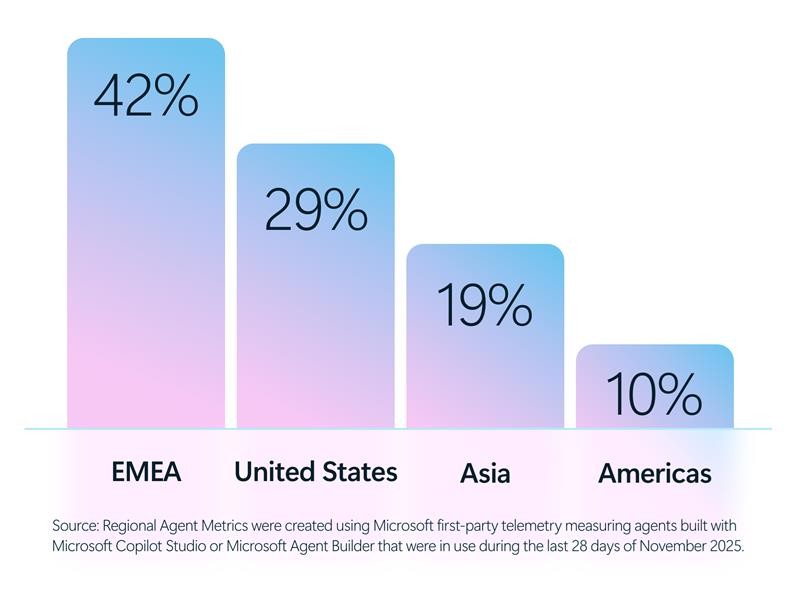
The growth of AI agents expands across many regions around the world from the Americas to Europe, Middle East, and Africa (EMEA), and Asia.

A graph showing the percentages of the regions around the world using AI agents.

According to Cyber Pulse, leading industries such as software and technology (16%), manufacturing (13%), financial institutions (11%), and retail (9%) are using agents to support increasingly complex tasks—drafting proposals, analyzing financial data, triaging security alerts, automating repetitive processes, and surfacing insights at machine speed.3 These agents can operate in assistive modes, responding to user prompts, or autonomously, executing tasks with minimal human intervention.

A graphic showing the percentage of industries using agents to support complex tasks.
Source: Industry Agent Metrics were created using Microsoft first-party telemetry measuring agents build with Microsoft Copilot Studio or Microsoft Agent Builder that were in use during the last 28 days of November 2025.

And unlike traditional software, agents are dynamic. They act. They decide. They access data. And increasingly, they interact with other agents.

That changes the risk profile fundamentally.

The blind spot: Agent growth without observability, governance, and security

Despite the rapid adoption of AI agents, many organizations struggle to answer some basic questions:

  • How many agents are running across the enterprise?
  • Who owns them?
  • What data do they touch?
  • Which agents are sanctioned—and which are not?

This is not a hypothetical concern. Shadow IT has existed for decades, but shadow AI introduces new dimensions of risk. Agents can inherit permissions, access sensitive information, and generate outputs at scale—sometimes outside the visibility of IT and security teams. Bad actors might exploit agents’ access and privileges, turning them into unintended double agents. Like human employees, an agent with too much access—or the wrong instructions—can become a vulnerability. When leaders lack observability in their AI ecosystem, risk accumulates silently.

According to the Cyber Pulse report, already 29% of employees have turned to unsanctioned AI agents for work tasks.4 This disparity is noteworthy, as it indicates that numerous organizations are deploying AI capabilities and agents prior to establishing appropriate controls for access management, data protection, compliance, and accountability. In regulated sectors such as financial services, healthcare, and the public sector, this gap can have particularly significant consequences.

Why observability comes first

You can’t protect what you can’t see, and you can’t manage what you don’t understand. Observability is having a control plane across all layers of the organization (IT, security, developers, and AI teams) to understand:  

  • What agents exist 
  • Who owns them 
  • What systems and data they touch 
  • How they behave 

In the Cyber Pulse report, we outline five core capabilities that organizations need to establish for true observability and governance of AI agents:

  • Registry: A centralized registry acts as a single source of truth for all agents across the organization—sanctioned, third‑party, and emerging shadow agents. This inventory helps prevent agent sprawl, enables accountability, and supports discovery while allowing unsanctioned agents to be restricted or quarantined when necessary.
  • Access control: Each agent is governed using the same identity‑ and policy‑driven access controls applied to human users and applications. Least‑privilege permissions, enforced consistently, help ensure agents can access only the data, systems, and workflows required to fulfill their purpose—no more, no less.
  • Visualization: Real‑time dashboards and telemetry provide insight into how agents interact with people, data, and systems. Leaders can see where agents are operating, understanding dependencies, and monitoring behavior and impact—supporting faster detection of misuse, drift, or emerging risk.
  • Interoperability: Agents operate across Microsoft platforms, open‑source frameworks, and third‑party ecosystems under a consistent governance model. This interoperability allows agents to collaborate with people and other agents across workflows while remaining managed within the same enterprise controls.
  • Security: Built‑in protections safeguard agents from internal misuse and external cyberthreats. Security signals, policy enforcement, and integrated tooling help organizations detect compromised or misaligned agents early and respond quickly—before issues escalate into business, regulatory, or reputational harm.

Governance and security are not the same—and both matter

One important clarification emerging from Cyber Pulse is this: governance and security are related, but not interchangeable.

  • Governance defines ownership, accountability, policy, and oversight.
  • Security enforces controls, protects access, and detects cyberthreats.

Both are required. And neither can succeed in isolation.

AI governance cannot live solely within IT, and AI security cannot be delegated only to chief information security officers (CISOs). This is a cross functional responsibility, spanning legal, compliance, human resources, data science, business leadership, and the board.

When AI risk is treated as a core enterprise risk—alongside financial, operational, and regulatory risk—organizations are better positioned to move quickly and safely.

Strong security and governance do more than reduce risk—they enable transparency. And transparency is fast becoming a competitive advantage.

From risk management to competitive advantage

This is an exciting time for leading Frontier Firms. Many organizations are already using this moment to modernize governance, reduce overshared data, and establish security controls that allow safe use. They are proving that security and innovation are not opposing forces; they are reinforcing ones. Security is a catalyst for innovation.

According to the Cyber Pulse report, the leaders who act now will mitigate risk, unlock faster innovation, protect customer trust, and build resilience into the very fabric of their AI-powered enterprises. The future belongs to organizations that innovate at machine speed and observe, govern and secure with the same precision. If we get this right, and I know we will, AI becomes more than a breakthrough in technology—it becomes a breakthrough in human ambition.

To learn more about Microsoft Security solutions, visit our website. Bookmark the Security blog to keep up with our expert coverage on security matters. Also, follow us on LinkedIn (Microsoft Security) and X (@MSFTSecurity) for the latest news and updates on cybersecurity.


1Microsoft Data Security Index 2026: Unifying Data Protection and AI Innovation, Microsoft Security, 2026.

2Based on Microsoft first‑party telemetry measuring agents built with Microsoft Copilot Studio or Microsoft Agent Builder that were in use during the last 28 days of November 2025.

3Industry and Regional Agent Metrics were created using Microsoft first‑party telemetry measuring agents built with Microsoft Copilot Studio or Microsoft Agent Builder that were in use during the last 28 days of November 2025.

4July 2025 multi-national survey of more than 1,700 data security professionals commissioned by Microsoft from Hypothesis Group.

Methodology:

Industry and Regional Agent Metrics were created using Microsoft first‑party telemetry measuring agents built with Microsoft Copilot Studio or Microsoft Agent Builder that were in use during the past 28 days of November 2025. 

2026 Data Security Index: 

A 25-minute multinational online survey was conducted from July 16 to August 11, 2025, among 1,725 data security leaders. 

Questions centered around the data security landscape, data security incidents, securing employee use of generative AI, and the use of generative AI in data security programs to highlight comparisons to 2024. 

One-hour in-depth interviews were conducted with 10 data security leaders in the United States and United Kingdom to garner stories about how they are approaching data security in their organizations. 

Definitions: 

Active Agents are 1) deployed to production and 2) have some “real activity” associated with them in the past 28 days.  

“Real activity” is defined as 1+ engagement with a user (assistive agents) OR 1+ autonomous runs (autonomous agents).  

The post 80% of Fortune 500 use active AI Agents: Observability, governance, and security shape the new frontier appeared first on Microsoft Security Blog.

❌