
Normal view

Implementing data governance on AWS: Automation, tagging, and lifecycle strategy – Part 2

16 January 2026 at 21:26

In Part 1, we explored the foundational strategy, including data classification frameworks and tagging approaches. In this post, we examine the technical implementation approach and key architectural patterns for building a governance framework.

We explore governance controls across four implementation areas, building from foundational monitoring to advanced automation. Each area builds on the previous one, so you can implement incrementally and validate as you go:

  • Monitoring foundation: Begin by establishing your monitoring baseline. Set up AWS Config rules to track tag compliance across your resources, then configure Amazon CloudWatch dashboards to provide real-time visibility into your governance posture. By using this foundation, you can understand your current state before implementing enforcement controls.
  • Preventive controls: Build proactive enforcement by deploying AWS Lambda functions that validate tags at resource creation time. Implement Amazon EventBridge rules to trigger real-time enforcement actions and configure service control policies (SCPs) to establish organization-wide guardrails that prevent non-compliant resource deployment.
  • Automated remediation: Reduce manual intervention by setting up AWS Systems Manager Automation Documents that respond to compliance violations. Configure automated responses that correct common issues like missing tags or improper encryption and implement classification-based security controls that automatically apply appropriate protections based on data sensitivity.
  • Advanced features: Extend your governance framework with sophisticated capabilities. Deploy data sovereignty controls to help ensure regulatory compliance across AWS Regions, implement intelligent lifecycle management to optimize costs while maintaining compliance, and establish comprehensive monitoring and reporting systems that provide stakeholders with clear visibility into your governance effectiveness.

Prerequisites

Before beginning implementation, ensure you have AWS Command Line Interface (AWS CLI) installed and configured with appropriate credentials for your target accounts. Set AWS Identity and Access Managment (IAM) permissions so that you can create roles, Lambda functions, and AWS Config rules. Finally, basic familiarity with AWS CloudFormation or Terraform will be helpful, because we’ll use CloudFormation throughout our examples.

Tag governance controls

Implementing tag governance requires multiple layers of controls working together across AWS services. These controls range from preventive measures that validate resources at creation to detective controls that monitor existing resources. This section describes each control type, starting with preventive controls that act as first line of defense.

Preventive controls

Preventive controls help ensure resources are properly tagged at creation time. By implementing Lambda functions triggered by AWS CloudTrail events, you can validate tags before resources are created, preventing non-compliant resources from being deployed:

# AWS Lambda function for preventive tag enforcement def enforce_resource_tags(event, context):     
	required_tags = ['DataClassification', 'DataOwner', 'Environment']          

	# Extract resource details from the event     
	resource_tags = 
event['detail']['requestParameters'].get('Tags', {})          

	# Validate required tags are present     
	missing_tags = [tag for tag in required_tags if tag not in resource_tags]          

	if missing_tags:
		# Send alert to security team
		# Log non-compliance for compliance reporting         
		raise Exception(f"Missing required tags: {missing_tags}")

	return {‘status’: ‘compliant’}

For complete, production-ready implementation, see Implementing Tag Policies with AWS Organizations and EventBridge event patterns for resource monitoring.

Organization-wide policy enforcement

AWS Organizations tag policies provide a foundation for consistent tagging across your organization. These policies define standard tag formats and values, helping to ensure consistency across accounts:

{   
    "tags": {     
        "DataClassification": {       
            "tag_key": {         
                "@@assign": "DataClassification"       
            },       
            "tag_value": {         
                "@@assign": ["L1", "L2", "L3"]       
            },       
            "enforced_for": {         
                "@@assign": [           
                    "s3:bucket",           
                    "ec2:instance",           
                    "rds:db",           
                    "dynamodb:table"         
                ]       
            }     
        }   
    } 
}

Detailed implementation guidance: Getting started with tag policies & Best practices for using tag policies

Tag-based access control

Tag-based access control gives you detailed permissions using attribute-based access control (ABAC). By using this approach, you can define permissions based on resource attributes rather than creating individual IAM policies for each use case:

{     
    "Version": "2012-10-17",     
    "Statement": [         
        {             
            "Effect": "Allow",             
            "Action": ["s3:GetObject", "s3:PutObject"],             
            "Resource": "*",             
            "Condition": {                 
                "StringEquals": {                     
                    "aws:ResourceTag/DataClassification": "L1",                     
                    "aws:ResourceTag/Environment": "Prod"                 
                }             
            }         
        }     
    ] 
}

Multi-account governance strategy

While implementing tag governance within a single account is straightforward, most organizations operate in a multi-account environment. Implementing consistent governance across your organization requires additional controls:

# This SCP prevents creation of resources without required tags 
OrganizationControls:   
	SCPPolicy:     
		Type: AWS::Organizations::Policy     
		Properties:       
			Content:         
				Version: "2012-10-17"         
				Statement:           
					- 	Sid: EnforceTaggingOnResources             
						Effect: Deny             
						Action:               
							- "ec2:RunInstances"               
							- "rds:CreateDBInstance"               
							- "s3:CreateBucket"             
						Resource: "*"             
						Condition:               
							'Null':                 
								'aws:RequestTag/DataClassification': true                 
								'aws:RequestTag/Environment': true

For more information, see implementation guidance for SCPs.

Integration with on-premises governance frameworks

Many organizations maintain existing governance frameworks for their on-premises infrastructure. Extending these frameworks to AWS requires careful integration and applicability analysis. The following example shows how to use AWS Service Catalog to create a portfolio of AWS resources that align with your on-premises governance standards.

# AWS Service Catalog portfolio for on-premises aligned resources 
ServiceCatalogIntegration:   
	Portfolio:     
		Type: AWS::ServiceCatalog::Portfolio     
		Properties:       
			DisplayName: Enterprise-Aligned Resources       
			Description: Resources that comply with existing governance framework       
			ProviderName: Enterprise IT   

# Product that maintains on-prem naming conventions and controls   
	CompliantProduct:     
		Type: AWS::ServiceCatalog::CloudFormationProduct     
		Properties:       
			Name: Compliant-Resource-Bundle       
			Owner: Enterprise Architecture       
			Tags:         
				- 	Key: OnPremMapping           
					Value: "EntArchFramework-v2"

Automating security controls based on classification

After data is classified, use these classifications to automate security controls and use AWS Config to track and validate that resources are properly tagged through defined rules that assess your AWS resource configurations, including a built-in required-tags rule. For non-compliant resources, you can use Systems Manager to automate the remediation process.

With proper tagging in place, you can implement automated security controls using EventBridge and Lambda. By using this combination, you can create a cost-effective and scalable infrastructure for enforcing security policies based on data classification. For example, when a resource is tagged as high impact, you can use EventBridge to trigger a Lambda function to enable required security measures.

def apply_security_controls(event, context):     
	resource_type = event['detail']['resourceType']     
	tags = event['detail']['tags']          

	if tags['DataClassification'] == 'L1':         
		# Apply Level 1 security controls         
		enable_encryption(resource_type)         
		apply_strict_access_controls(resource_type)         
		enable_detailed_logging(resource_type)     
	elif tags['DataClassification'] == 'L2':         
		# Apply Level 2 security controls         
		enable_standard_encryption(resource_type)         
		apply_basic_access_controls(resource_type)

This example automation applies security controls consistently, reducing human error and maintaining compliance. Code-based controls ensure policies match your data classification.

Implementation resources:

Data sovereignty and residency

Data sovereignty and residency requirements help you comply with regulations like GDPR. Such controls can be implemented to restrict data storage and processing to specific AWS Regions:

# Config rule for region restrictions 
AWSConfig:   
	ConfigRule:     
		Type: AWS::Config::ConfigRule     
		Properties:       
			ConfigRuleName: s3-bucket-region-check       
			Description: Checks if S3 buckets are in allowed regions       
			Source:         
				Owner: AWS         
				SourceIdentifier: S3_BUCKET_REGION       
			InputParameters:         
				allowedRegions:           
					- eu-west-1           
					- eu-central-1

Note: This example uses eu-west-1 and eu-central-1 because these Regions are commonly used for GDPR compliance, providing data residency within the European Union. Adjust these Regions based on your specific regulatory requirements and business needs. For more information, see Meeting data residency requirements on AWS and Controls that enhance data residence protection.

Disaster recovery integration with governance controls

While organizations often focus on system availability and data recovery, maintaining governance controls during disaster recovery (DR) scenarios is important for compliance and security. To implement effective governance in your DR strategy, start by using AWS Config rules to check that DR resources maintain the same governance standards as your primary environment:

AWSConfig:   
	ConfigRule:     
		Type: AWS::Config::ConfigRule     
		Properties:       
			ConfigRuleName: dr-governance-check       
			Description: Ensures DR resources maintain governance controls       
			Source:         
				Owner: AWS         
				SourceIdentifier: REQUIRED_TAGS       
			Scope:         
				ComplianceResourceTypes:           
					- "AWS::S3::Bucket"           
					- "AWS::RDS::DBInstance"           
					- "AWS::DynamoDB::Table"       
			InputParameters:         
				tag1Key: "DataClassification"         
				tag1Value: "L1,L2,L3"         
				tag2Key: "Environment"         
				tag2Value: "DR"

For your most critical data (classified as Level 1 in part 1 of this post), implement cross-Region replication while maintaining strict governance controls. This helps ensure that sensitive data remains protected even during failover scenarios:

Cross-Region:   
	ReplicationRule:     
		Type: AWS::S3::Bucket     
		Properties:       
			ReplicationConfiguration:         
				Role: !GetAtt ReplicationRole.Arn         
				Rules:           
					- 	Status: Enabled             
						TagFilters:               
							- 	Key: "DataClassification"                 
								Value: "L1"             
						Destination:               
							Bucket: !Sub "arn:aws:s3:::${DRBucket}"               
							EncryptionConfiguration:                 
								ReplicaKmsKeyID: !Ref DRKMSKey

Automated compliance monitoring

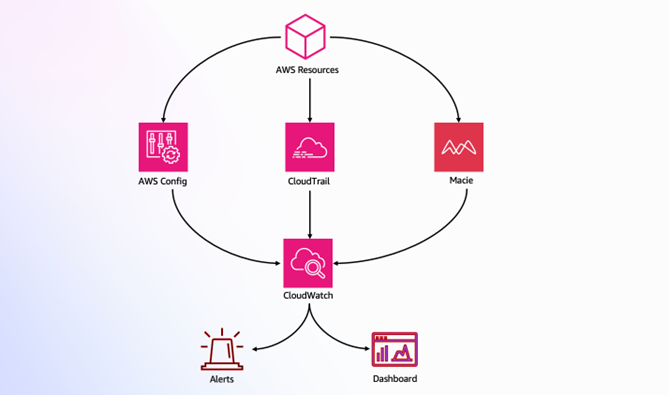
By combining AWS Config for resource compliance, CloudWatch for metrics and alerting, and Amazon Macie for sensitive data discovery, you can create a robust compliance monitoring framework that automatically detects and responds to compliance issues:

Figure 1: Compliance monitoring architecture

Figure 1: Compliance monitoring architecture

This architecture (shown in Figure 1) demonstrates how AWS services work together to provide compliance monitoring:

  • AWS Config, CloudTrail, and Macie monitor AWS resources
  • CloudWatch aggregates monitoring data
  • Alerts and dashboards provide real-time visibility

The following CloudFormation template implements these controls:

Resources:   
	EncryptionRule:     
		Type: AWS::Config::ConfigRule     
		Properties:       
			ConfigRuleName: s3-bucket-encryption-enabled       
			Source:         
				Owner: AWS         
				SourceIdentifier: 
S3_BUCKET_SERVER_SIDE_ENCRYPTION_ENABLED   

	MacieJob:     
		Type: AWS::Macie::ClassificationJob     
		Properties:       
			JobType: ONE_TIME       
			S3JobDefinition:         
				BucketDefinitions:           
				- 	AccountId: !Ref AWS::AccountId             
					Buckets:               
						- !Ref DataBucket       
				ScoreFilter:         
					Minimum: 75   

	SecurityAlarm:     
		Type: AWS::CloudWatch::Alarm     
		Properties:       
			AlarmName: UnauthorizedAccessAttempts       
			MetricName: UnauthorizedAPICount       
			Namespace: SecurityMetrics       
			Statistic: Sum       
			Period: 300       
			EvaluationPeriods: 1       
			Threshold: 3       
			AlarmActions:         
				- 	!Ref SecurityNotificationTopic       
			ComparisonOperator: GreaterThanThreshold

These controls provide real-time visibility into your security posture, automate responses to potential security events, and use Macie for sensitive data discovery and classification. For a complete monitoring setup, review List of AWS Config Managed Rules and Using Amazon CloudWatch dashboards.

Using AWS data lakes for governance

Modern data governance strategies often use data lakes to provide centralized control and visibility. AWS provides a comprehensive solution through the Modern Data Architecture Accelerator (MDAA), which you can use to help you rapidly deploy and manage data platform architectures with built-in security and governance controls. Figure 2 shows an MDAA reference architecture.

Figure 2: MDAA reference architecture

Figure 2: MDAA reference architecture

For detailed implementation guidance and source code, see Accelerate the Deployment of Secure and Compliant Modern Data Architectures for Advanced Analytics and AI.

Access patterns and data discovery

Understanding and managing access patterns is important for effective governance. Use CloudTrail and Amazon Athena to analyze access patterns:

SELECT   
	useridentity.arn,   
	eventname,   
	requestparameters.bucketname,   
	requestparameters.key,   
	COUNT(*) as access_count 
FROM cloudtrail_logs 
WHERE eventname IN ('GetObject', 'PutObject') 
GROUP BY 1, 2, 3, 4 
ORDER BY access_count DESC 
LIMIT 100;

This query helps identify frequently accessed data and unusual patterns in access behavior. These insights help you to:

  • Optimize storage tiers based on access frequency
  • Refine DR strategies for frequently accessed data
  • Identify of potential security risks through unusual access patterns
  • Fine-tune data lifecycle policies based on usage patterns

For sensitive data discovery, consider integrating Macie to automatically identify and protect PII across your data estate.

Machine learning model governance with SageMaker

As organizations advance in their data governance journey, many are deploying machine learning models in production, necessitating governance frameworks that extend to machine learning (ML) operations. Amazon SageMaker offers advanced tools that you can use to maintain governance over ML assets without impeding innovation.

SageMaker governance tools work together to provide comprehensive ML oversight:

  • Role Manager provides fine-grained access control for ML roles
  • Model Cards centralize documentation and lineage information
  • Model Dashboard offers organization-wide visibility into deployed models
  • Model Monitor automates drift detection and quality control

The following example configures SageMaker governance controls:

# Basic/High-level ML governance setup with role and monitoring SageMakerRole:   
	Type: AWS::IAM::Role   
	Properties:     
		# Allow SageMaker to use this role     
		AssumeRolePolicyDocument:       
			Statement:         
				- 	Effect: Allow           
					Principal:             
						Service: sagemaker.amazonaws.com           
					Action: sts:AssumeRole     
		# Attach necessary permissions     
		ManagedPolicyArns:       
				- 	arn:aws:iam::aws:policy/AmazonSageMakerFullAccess 

ModelMonitor:   
	Type: AWS::SageMaker::MonitoringSchedule   
	Properties:     
		# Set up hourly model monitoring     
		MonitoringScheduleName: hourly-model-monitor     
		ScheduleConfig:       
			ScheduleExpression: 'cron(0 * * * ? *)'  # Run hourly

This example demonstrates two essential governance controls: role-based access management for secure service interactions and automated hourly monitoring for ongoing model oversight. While these technical implementations are important, remember that successful ML governance requires integration with your broader data governance framework, helping to ensure consistent controls and visibility across your entire data and analytics ecosystem. For more information, see Model governance to manage permissions and track model performance.

Cost optimization through automated lifecycle management

Effective data governance isn’t just about security—it’s also about managing cost efficiently. Implement intelligent data lifecycle management based on classification and usage patterns, as shown in Figure 3:

Figure 3: Tag-based lifecycle management in Amazon S3

Figure 3: Tag-based lifecycle management in Amazon S3

Figure 3 illustrates how tags drive automated lifecycle management:

  • New data enters Amazon Simple Storage Service (Amazon S3) with the tag DataClassification: L2
  • Based on classification, the data starts in Standard/INTELLIGENT_TIERING
  • After 90 days, the data transitions to Amazon S3 Glacier storage for cost-effective archival
  • The RetentionPeriod tag (84 months) determines final expiration

Here’s the implementation of the preceding lifecycle rules:

LifecycleConfiguration:   
	Rules:     
		- 	ID: IntelligentArchive       
        	Status: Enabled       
            Transitions:         
				- 	StorageClass: INTELLIGENT_TIERING           
                	TransitionInDays: 0         
               	- 	StorageClass: GLACIER           
                	TransitionInDays: 90       
			Prefix: /data/       
			TagFilters:         
				- 	Key: DataClassification           
                	Value: L2     
   		- 	ID: RetentionPolicy       
        	Status: Enabled       
            ExpirationInDays: 2555  # 7 years       
            TagFilters:         
				- 	Key: RetentionPeriod           
                	Value: "84"  # 7 years in months

S3 Lifecycle automatically optimizes storage costs while maintaining compliance with retention requirements. For example, data initially stored in Amazon S3 Intelligent-Tiering automatically moves to Glacier after 90 days, significantly reducing storage costs while helping to ensure data remains available when needed. For more information, seeManaging the lifecycle of objects and Managing storage costs with Amazon S3 Intelligent-Tiering.

Conclusion

Successfully implementing data governance on AWS requires both a structured approach and adherence to key best practices. As you progress through your implementation journey, keep these fundamental principles in mind:

  • Start with a focused scope and gradually expand. Begin with a pilot project that addresses high-impact, low-complexity use cases. By using this approach, you can demonstrate quick wins while building experience and confidence in your governance framework.
  • Make automation your foundation. Apply AWS services such as Amazon EventBridge for event-driven responses, implement automated remediation for common issues, and create self-service capabilities that balance efficiency with compliance. This automation-first approach helps ensure scalability and consistency in your governance framework.
  • Maintain continuous visibility and improvement. Regular monitoring, compliance checks, and framework updates are essential for long-term success. Use feedback from your operations team to refine policies and adjust controls as your organization’s needs evolve.

Common challenges to be aware of:

  • Initial resistance to change from teams used to manual processes
  • Complexity in handling legacy systems and data
  • Balancing security controls with operational efficiency
  • Maintaining consistent governance across multiple AWS accounts and regions

For more information, implementation support, and guidance, see:

By following this approach and remaining mindful of potential challenges, you can build a robust, scalable data governance framework that grows with your organization while maintaining security, compliance, and efficient data operations.

If you have feedback about this post, submit comments in the Comments section below. If you have questions about this post, contact AWS Support.

Tushar Jain Omar Ahmed
Omar Ahmed is an Auto and Manufacturing Solutions Architect who specializes in analytics. Omar’s journey in cloud computing began as an AWS data center operations technician, where he developed hands on infrastructure expertise. Outside of work, he enjoys motorsports, gaming, and swimming.
Will Black Omar Mahmoud
Omar is a Solutions Architect helping small-medium businesses with their cloud journey. He specializes in Amazon Connect and next-gen developer services like Kiro. Omar began at AWS as a data center operations technician, gaining hands-on cloud infrastructure experience. Outside work, Omar enjoys gaming, hiking, and soccer.
Fritz Kunstler Changil Jeong
Changil Jeong is a Solutions Architect at Amazon Web Services (AWS) partnering with Independent software vendor customers on their cloud transformation journey, with strong interests in security. He joined AWS as an SDE apprentice before transitioning to SA. Previously served in the U.S. Army as a financial and budgeting analyst and worked at a large IT consulting firm as a SaaS security analyst.
Brian Ruf Paige Broderick
Paige Broderick is a Solutions Architect at Amazon Web Services (AWS) who works with Enterprise customers to help them achieve their AWS objectives. She specializes in cloud operations, focusing on governance and using AWS to develop smart manufacturing solutions. Outside of work, Paige is an avid runner and is likely training for her next marathon.

Implementing data governance on AWS: Automation, tagging, and lifecycle strategy – Part 1

16 January 2026 at 21:26

Generative AI and machine learning workloads create massive amounts of data. Organizations need data governance to manage this growth and stay compliant. While data governance isn’t a new concept, recent studies highlight a concerning gap: a Gartner study of 300 IT executives revealed that only 60% of organizations have implemented a data governance strategy, with 40% still in planning stages or uncertain where to begin. Furthermore, a 2024 MIT CDOIQ survey of 250 chief data officers (CDOs) found that only 45% identify data governance as a top priority.

Although most businesses recognize the importance of data governance strategies, regular evaluation is important to ensure these strategies evolve with changing business needs, industry requirements, and emerging technologies. In this post, we show you a practical, automation-first approach to implementing data governance on Amazon Web Services (AWS) through a strategic and architectural guide—whether you’re starting at the beginning or improving an existing framework.

In this two-part series, we explore how to build a data governance framework on AWS that’s both practical and scalable. Our approach aligns with what AWS has identified as the core benefits of data governance:

  • Classify data consistently and automate controls to improve quality
  • Give teams secure access to the data they need
  • Monitor compliance automatically and catch issues early

In this post, we cover strategy, classification framework, and tagging governance—the foundation you need to get started. If you don’t already have a governance strategy, we provide a high-level overview of AWS tools and services to help you get started. If you have a data governance strategy, the information in this post can assist you in evaluating its effectiveness and understanding how data governance is evolving with new technologies.

In Part 2, we explore the technical architecture and implementation patterns with conceptual code examples, and throughout both parts, you’ll find links to production-ready AWS resources for detailed implementation.

Prerequisites

Before implementing data governance on AWS, you need the right AWS setup and buy-in from your teams.

Technical foundation

Start with a well-structured AWS Organizations setup for centralized management. Make sure AWS CloudTrail and AWS Config are enabled across accounts—you’ll need these for monitoring and auditing. Your AWS Identity and Access Management (IAM) framework should already define roles and permissions clearly.

Beyond these services, you’ll use several AWS tools for automation and enforcement. The AWS service quick reference table that follows lists everything used throughout this guide.

Organizational readiness

Successful implementation of data governance requires clear organizational alignment and preparation across multiple dimensions.

  • Define roles and responsibilities. Data owners classify data and approve access requests. Your platform team handles AWS infrastructure and builds automation, while security teams set controls and monitor compliance. Application teams then implement these standards in their daily workflows.
  • Document your compliance requirements. List the regulations you must follow—GDPR, PCI-DSS, SOX, HIPAA, or others. Create a data classification framework that aligns with your business risk. Document your tagging standards and naming conventions so everyone follows the same approach.
  • Plan for change management. Get executive support from leaders who understand why governance matters. Start with pilot projects to demonstrate value before rolling out organization-wide. Provide role-based training and maintain up-to-date governance playbooks. Establish feedback mechanisms so teams can report issues and suggest improvements.

Key performance indicators (KPIs) to monitor

To measure the effectiveness of your data governance implementation, track the following essential metrics and their target objectives.

  • Resource tagging compliance: Aim for 95%, measured through AWS Config rules with weekly monitoring, focusing on critical resources and sensitive data classifications.
  • Mean time to respond to compliance issues: Target less than 24 hours for critical issues. Tracked using CloudWatch metrics with automated alerting for high-priority non-compliance events
  • Reduction in manual governance tasks: Target reduction of 40% in the first year. Measured through automated workflow adoption and remediation success rates.
  • Storage cost optimization based on data classification: Target 15–20% reduction through intelligent tiering and lifecycle policies, monitored monthly by classification level.

With these technical and organizational foundations in place, you’re ready to implement a sustainable data governance framework.

AWS services used in this guide – Quick reference

This implementation uses the following AWS services. Some are prerequisites, while others are introduced throughout the guide.

Category

Services

Description

Foundation

AWS Organizations

Multi-account management structure that enables centralized policy enforcement and governance across your entire AWS environment.

AWS Identity and Access Management (IAM)

Controls who can access what resources through roles, policies, and permissions—the foundation of your security model.

Monitoring and auditing

AWS CloudTrail

Records every API call made in your AWS accounts, creating a complete audit trail of who did what, when, and from where.

AWS Config

Continuously monitors resource configurations and evaluates them against rules you define (such as requiring that all S3 buckets much be encrypted). When it finds resources that don’t meet your rules, it flags them as non-compliant so you can fix them manually or automatically.

Amazon CloudWatch

Aggregates metrics, logs, and events from across AWS for real-time monitoring, dashboards, and automated alerting on governance non-compliance.

Automation and enforcement

Amazon EventBridge

Acts as a central notification system that watches for specific events in your AWS environment (such as when an S3 bucket has been created) and automatically triggers actions in response (such as by running a Lambda function to check if it has the required tags). Think of it as an if this happens, then do that automation engine.

AWS Lambda

Runs your governance code (tag validation, security controls, remediation) in response to events without managing servers.

AWS Systems Manager

Automates operational tasks across your AWS resources. In governance, it’s primarily used to automatically fix non-compliant resources—for example, if AWS Config detects an unencrypted database, Systems Manager can run a pre-defined script to enable encryption without manual intervention.

Data protection

Amazon Macie

Uses machine learning to automatically discover, classify, and protect sensitive data like personal identifiable information (PII) across your S3 buckets.

AWS Key Management Service (AWS KMS)

Manages encryption keys for protecting data at rest, essential for high-impact data classifications.

Analytics & Insights

Amazon Athena

Serverless query service that analyzes data in Amazon S3 using SQL—perfect for querying CloudTrail logs to understand access patterns.

Standardization

AWS Service Catalog

Creates catalogs of pre-approved, governance-compliant resources that teams can deploy through self-service.

ML Governance

Amazon SageMaker

Provides specialized tools for governing machine learning operations including model monitoring, documentation, and access control.

Understanding the data governance challenge

Organizations face complex data management challenges, from maintaining consistent data classification to ensuring regulatory compliance across their environments. Your strategy should maintain security, ensure compliance, and enable business agility through automation. While this journey can be complex, breaking it down into manageable components makes it achievable.

The foundation: Data classification framework

Data classification is a foundational step in cybersecurity risk management and data governance strategies. Organizations should use data classification to determine appropriate safeguards for sensitive or critical data based on their protection requirements. Following the NIST (National Institute of Standards and Technology) framework, data can be categorized based on the potential impact to confidentiality, integrity, and availability of information systems:

  • High impact: Severe or catastrophic adverse effect on organizational operations, assets, or individuals
  • Moderate impact: Serious adverse effect on organizational operations, assets, or individuals
  • Low impact: Limited adverse effect on organizational operations, assets, or individuals

Before implementing controls, establishing a clear data classification framework is essential. This framework serves as the backbone of your security controls, access policies, and automation strategies. The following is an example of how a company subject to the Payment Card Industry Data Security Standard (PCI-DSS) might classify data:

  • Level 1 – Most sensitive data:
    • Examples: Financial transaction records, customer PCI data, intellectual property
    • Security controls: Encryption at rest and in transit, strict access controls, comprehensive audit logging
  • Level 2 – Internal use data:
    • Examples: Internal documentation, proprietary business information, development code
    • Security controls: Standard encryption, role-based access control
  • Level 3 – Public data:
    • Examples: Marketing materials, public documentation, press releases
    • Security controls: Integrity checks, version, control

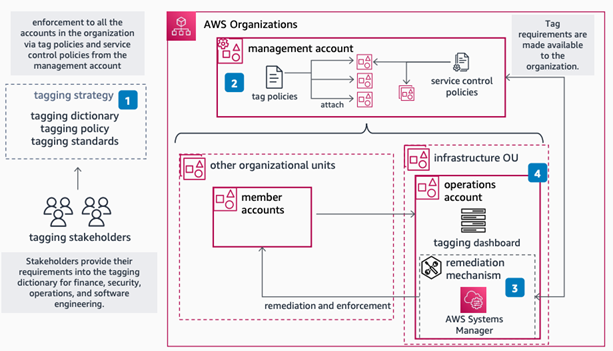
To help with data classification and tagging, AWS created AWS Resource Groups, a service that you can use to organize AWS resources into groups using criteria that you define as tags. If you’re using multiple AWS accounts across your organization, AWS Organizations supports tag policies, which you can use to standardize the tags attached to the AWS resources in an organization’s account. The workflow for using tagging is shown in Figure 1. For more information, see Guidance for Tagging on AWS.

Figure 1: Workflow for tagging on AWS for a multi-account environment

Figure 1: Workflow for tagging on AWS for a multi-account environment

Your tag governance strategy

A well-designed tagging strategy is fundamental to automated governance. Tags not only help organize resources but also enable automated security controls, cost allocation, and compliance monitoring.

Figure 2: Tag governance workflow

Figure 2: Tag governance workflow

As shown in Figure 2, tag policies use the following process:

  1. AWS validates tags when you create resources.
  2. Non-compliant resources trigger automatic remediation, while compliant resources deploy normally.
  3. Continuous monitoring catches variation from your policies.

The following tagging strategy enables automation:

{   
    "MandatoryTags": {     
        "DataClassification": ["L1", "L2", "L3"],     
        "DataOwner": "<Department/Team Name>",     
        "Compliance": ["PCI", "SOX", "GDPR", "None"],     
        "Environment": ["Prod", "Dev", "Test", "Stage"],     
        "CostCenter": "<Business Unit Code>"   
    },   
    "OptionalTags": {     
        "BackupFrequency": ["Daily", "Weekly", "Monthly"],     
        "RetentionPeriod": "<Time in Months>",     
        "ProjectCode": "<Project Identifier>",     
        "DataResidency": "<Region/Country>"   
    } 
}

While AWS Organizations tag policies provide a foundation for consistent tagging, comprehensive tag governance requires additional enforcement mechanisms, which we explore in detail in Part 2.

Conclusion

This first part of the two-part series established the foundational elements of implementing data governance on AWS, covering data classification frameworks, effective tagging strategies, and organizational alignment requirements. These fundamentals serve as building blocks for scalable and automated governance approaches. Part 2 focuses on technical implementation and architectural patterns, including monitoring foundations, preventive controls, and automated remediation. The discussion extends to tag-based security controls, compliance monitoring automation, and governance integration with disaster recovery strategies. Additional topics include data sovereignty controls and machine learning model governance with Amazon SageMaker, supported by AWS implementation examples.

If you have feedback about this post, submit comments in the Comments section below. If you have questions about this post, contact AWS Support.

Tushar Jain Omar Ahmed
Omar Ahmed is an Auto and Manufacturing Solutions Architect who specializes in analytics. Omar’s journey in cloud computing began as an AWS data center operations technician, where he developed hands on infrastructure expertise. Outside of work, he enjoys motorsports, gaming, and swimming.
Will Black Omar Mahmoud
Omar is a Solutions Architect helping small-medium businesses with their cloud journey. He specializes in Amazon Connect and next-gen developer services like Kiro. Omar began at AWS as a data center operations technician, gaining hands-on cloud infrastructure experience. Outside work, Omar enjoys gaming, hiking, and soccer.
Fritz Kunstler Changil Jeong
Changil Jeong is a Solutions Architect at Amazon Web Services (AWS) partnering with Independent software vendor customers on their cloud transformation journey, with strong interests in security. He joined AWS as an SDE apprentice before transitioning to SA. Previously served in the U.S. Army as a financial and budgeting analyst and worked at a large IT consulting firm as a SaaS security analyst.
Brian Ruf Paige Broderick
Paige Broderick is a Solutions Architect at Amazon Web Services (AWS) who works with Enterprise customers to help them achieve their AWS objectives. She specializes in cloud operations, focusing on governance and using AWS to develop smart manufacturing solutions. Outside of work, Paige is an avid runner and is likely training for her next marathon.

Threat and Vulnerability Management in 2026

16 January 2026 at 01:00

Key Takeaways:

  • Traditional vulnerability management tools can no longer keep up with the speed of modern exploitation—threat context is now mandatory.
  • Threat and Vulnerability Management (TVM) systems unify asset discovery, vulnerability data, and real-time external threat intelligence to prioritize real risk.
  • Static CVSS scores fail to reflect exploitation likelihood; intelligence-driven, dynamic risk scoring is essential in 2026.
  • Organizations that integrate vulnerability intelligence and attack surface intelligence reduce remediation time and security waste, enhancing detection and remediation while reducing alert fatigue.

Why Threat and Vulnerability Management Must Evolve in 2026

Security teams currently find themselves at a crossroads. Year over year, CVE volumes continue to surge higher and higher. Exploitation is faster, more automated, and more targeted, meaning attacks are growing in volume, velocity, and sophistication alike. As a result, security teams are expected to “patch faster” with fewer resources and can no longer realistically keep up with this ever-rising tide of threats.

Thanks to these forces, security teams have found themselves in a state of affairs in which vulnerability management has become an exercise in sheer volume, not risk. Day in and day out, teams are overwhelmed by alerts that lack real-world context, making it all but impossible to assess the actual degree of risk.

Thankfully, there is a solution. Threat-informed vulnerability management (TVM) has emerged to counteract this trend, enabling security teams to intelligently address weaponized vulnerabilities, zero-day exploits, and supply chain and cloud-native risk. All this comes along with much-needed relief from creeping alert-fatigue.

In 2026, effective cybersecurity programs will be defined not by how many vulnerabilities they detect but by how precisely they understand, prioritize, and neutralize real threats using intelligence-driven TVM systems.

The Core Problem: Alert Fatigue and Prioritization Failure

As it stands today, the explosion in disclosed vulnerabilities (CVEs) has outpaced humans’ abilities to triage and manage patching effectively. Today, the vast majority of organizations are incapable of remediating more than a fraction of the total identified issues affecting the ecosystem.

Traditionally, using a standard CVSS (Common Vulnerability Scoring System) was enough to overcome these challenges of prioritization. CVSS is an open, standardized framework used to assess the severity of security vulnerabilities by assigning a numerical score based on factors like exploitability, impact, and scope. Organizations use CVSS scores to prioritize remediation and compare vulnerabilities consistently across systems and vendors.

However, CVSS only measures theoretical severity, not exploitation likelihood. It misses critical pieces of context for prioritization decisions such as:

  • Is exploit code available?
  • Is the vulnerability actively exploited?
  • Are threat actors discussing or operationalizing it?

As a result, high-severity CVEs that pose little real-world risk continue to consume time and resources, leading us back once again to the issue of alert fatigue and the inability to effectively triage and patch the most pressing vulnerabilities.

At the same time, we are seeing modern organizations struggle with a “silo problem,” in which security, IT, and CTI (cyber threat intelligence) teams operate independently and with limited visibility and collaboration between one another. In many organizations, each of these teams ends up using different tools, establishing different priorities, sharing findings infrequently if at all, and adopting entirely different “risk languages” through which they understand, prioritize, and address threats.

Taken broadly, this leaves organizations woefully lacking a unified, intelligence-driven view of risk. Without this, many adopt a de facto policy of “patch everything”. And it comes with significant costs, including:

  • Operational drag and burnout
  • Delayed remediation of truly dangerous vulnerabilities
  • Increased business risk despite increased effort
  • Fractured security operations

Both individually, and in the aggregate, these side-effects come at a significant detriment to organizational security. And as the number and diversity of CVEs continues to expand, the greater that cost becomes. Moving forward, organizations must find a better way.

The Evolving Threat Landscape Demands a New Approach

Today’s ever-changing landscape means that organizations must evolve along with it or risk falling dangerously behind. The rise of rapidly weaponized vulnerabilities (i.e., known software weaknesses that have moved beyond disclosure and into active attacker use) reflects a fundamental shift in how quickly and deliberately adversaries turn CVEs into operational threats. Today, the gap between disclosure, proof-of-concept release, and active exploitation has collapsed from months to days (or even hours), driven largely by exploit marketplaces, automated scanning, and widely shared tooling.

Attackers increasingly prioritize vulnerabilities that are easy to exploit, broadly applicable across cloud services, edge devices, and common dependencies, and capable of delivering fast returns. Once weaponized, these vulnerabilities manifest not as theoretical risk but as active intrusion campaigns, ransomware operations, and opportunistic internet-wide exploitation, making threat context essential for distinguishing true danger from background noise.

At the same time that weaponization is accelerating, attack surfaces are expanding. The average attack surface today is expanding and fragmenting across hybrid and multi-cloud environments, all of which is worsened by SaaS sprawl, shadow IT, and third-party and supply chain exposure. In this environment, it is absolutely critical that security teams have a clear understanding of vulnerabilities vs. threats, and work to establish an integrated approach between the two.

In short, a vulnerability is a technical weakness, while a threat is an actor, campaign or event at work exploiting that weakness. In order to be truly effective, modern threat vulnerability management (TVM) systems must merge both concepts to reflect real risk and separate signal from noise.

What Is Threat and Vulnerability Management (TVM)?

Threat and Vulnerability Management (TVM) — also called Threat-Informed Vulnerability Management — is a continuous, intelligence-driven process that prioritizes remediation based on three core variables:

  • Active exploitation
  • Threat actor behavior
  • Asset criticality

TVM differs from traditional vulnerability management (VM) in a number of critical ways. Traditional VM relies on periodic scans, static severity scoring, and a largely reactive patching process. TVM, on the other hand, employs continuous monitoring, external threat intelligence enrichment, and close-loop remediation and validation.

This continuous, context-rich approach is foundational for modern security programs. Rather than inundating security teams with decontextualized CVEs and indiscriminate patching, modern TVM systems align security efforts with attacker reality. Reactive patching is replaced with proactive, risk-based decision-making, and as a result, organizations are able to reduce noise while simultaneously increasing the impact of their security operations.

The Five Core Pillars of Modern TVM Systems

As the speed and breadth of today’s threats continue to grow, traditional VM, being fundamentally reactive in nature, is no longer enough to keep up. In a world where vulnerabilities are exposed by the day, TVM offers much-needed efficiency, intelligence, and proactiveness. However, not all TVM systems are created equally. Here are five core pillars of effective modern TVM systems to help you evaluate and assess solutions on the market.

1. Continuous Asset Discovery & Inventory

Modern TVM systems are invaluable in that they provide full visibility across the entirety of an organization’s growing and fragmented attack surface. This includes external-facing assets, shadow IT, and cloud and SaaS environments alike. By providing continuous asset discovery and a timely, up-to-date inventory of one’s assets, TVM systems allow for real-time, comprehensive, attack-surface management.

Remember, you can’t defend what you can’t see. That’s why attack surface management (ASM) is a prerequisite for effective TVM. Without accurate, up-to-date asset inventories, vulnerability data is incomplete and misleading. Continuous discovery ensures defenders see their environment the way attackers do.

2. Vulnerability Assessment & Scoring

TVM goes beyond internal scanning tools to identify vulnerabilities exposed to the internet and reassess them continuously as environments change. This includes tracking misconfigurations, outdated services, and newly introduced exposure, not just known CVEs.

3. External Threat Context Enrichment

This is where TVM fundamentally diverges from legacy approaches. External threat intelligence enriches vulnerability data with insight from dark web and criminal forums, exploit marketplaces, malware telemetry, and active attack campaigns.

Vulnerabilities are mapped to known threat actors, active exploitation, and MITRE ATT&CK® techniques, ultimately transforming raw findings into actionable intelligence.

4. Risk-Based Prioritization (RBVM)

Risk-based vulnerability management prioritizes issues based on the probability of exploitation, asset importance, and threat actor interest. This shifts the focus from “most severe” to “most dangerous,” enabling teams to address the vulnerabilities that pose the greatest immediate risk to their organizations.

5. Automated Remediation & Verification

Modern TVM integrates directly with IT and SecOps workflows, pushing prioritized findings into ticketing and automation platforms. Just as importantly, it verifies remediation to confirm that patches were applied and exposure was actually reduced, creating a continuous feedback loop.

These five pillars of effective TVM systems come together to create a whole that is greater than the sum of its parts. These systems, unlike their predecessors, are designed to continuously monitor and triage real threats and vulnerabilities in context and ensure awareness and proactive mitigation without the risk of burn-out and alert fatigue.

Stop Patching Everything — Use Intelligence to Prioritize Real Risk

The scale of the CVE problem is overwhelming. Tens of thousands of vulnerabilities are disclosed each year, yet only a small fraction are ever exploited in the wild. Treating them all as equally urgent is not just inefficient — it’s dangerous.

Vulnerability intelligence changes the equation by tracking a CVE across its full lifecycle, from initial disclosure to weaponization, exploitation, and criminal adoption. This enables dynamic risk scoring that reflects real-world conditions rather than static assumptions.

Dynamic risk scoring incorporates evidence of active exploitation, availability of exploit code, dark web chatter, and threat actor interest. As conditions change, so does the risk score, ensuring prioritization remains aligned with attacker behavior.

The operational impact is significant. Security teams can focus remediation on the top 1% of vulnerabilities that pose immediate risk, respond faster, reduce operational cost, and strengthen overall security posture.

See Your Risk Like an Attacker: The Full Attack Surface View

In today’s threat landscape, security teams must recast the way they envision their roles. Rather than operating in a reactive, defensive manner at all times, security teams should think more like their adversaries, taking a complete view of their attack surface and leveraging modern tools and technologies to ensure intelligent, prioritized defenses. The following three key concepts will help you take on that mentality.

  1. The Visibility Gap: Unknown assets create unknown risk. Traditional scanners often miss orphaned domains, misconfigured cloud services, and forgotten infrastructure — precisely the assets attackers look for first.
  2. Attack Surface Intelligence Explained: Attack surface intelligence provides continuous mapping of domains, IPs, cloud assets, and external services. It identifies exposures attackers see before defenders do, enabling proactive remediation rather than reactive cleanup.
  3. Connecting the Dots with Vulnerability Tools: When integrated with vulnerability scanners like Qualys and Tenable, attack surface intelligence provides a unified, prioritized view of exposure. Intelligence-driven platforms serve as a single source of truth for risk decisions, enabling teams to connect vulnerabilities to real-world exposure and threat activity.

Three Strategic Recommendations for Security Leaders

Most organizations remain behind the curve in threat and vulnerability management. Knowing what we know now, there are three strategic steps security leaders can take to reclaim control.

1. Bridge the Gap Between Security and IT

Establish a shared, intelligence-driven risk language. Align SLAs with real-world risk rather than raw severity scores, ensuring remediation efforts focus on what matters most.

2. Embrace Automation and Workflow Integration

Push prioritized findings directly into platforms like ServiceNow and SOAR tools. Reducing manual handoffs accelerates remediation and minimizes delays.

3. Measure What Matters — Time-to-Remediate (TTR)

Shift KPIs toward time-to-remediate actively exploited vulnerabilities and reduction in exposure windows. These metrics demonstrate real ROI and security impact.

The Path Forward Is Threat-Informed: Strengthen Your Threat and Vulnerability Strategy

Volume-based vulnerability management is no longer viable. As we progress through 2026, threat context is not optional. It is foundational.

Future-ready security programs are intelligence-led, automation-enabled, and attacker-aware. Recorded Future sits at the center of this shift, providing the intelligence backbone required to move from reactive patching to proactive risk reduction.

Explore how Recorded Future Vulnerability Intelligence and Attack Surface Intelligence can help your organization transition from alert-driven vulnerability management to intelligence-driven risk reduction.

By unifying threat intelligence, vulnerability data, and attack surface visibility, organizations can reduce alert fatigue, prioritize what truly matters, and proactively harden defenses against real-world threats before attackers exploit them.

Frequently Asked Questions

What is the primary difference between a Vulnerability and a Threat?

A Vulnerability is a weakness or flaw in an asset (e.g., unpatched software, misconfiguration) that could be exploited. A Threat is a person, group, or event (e.g., a threat actor, a piece of malware) that has the potential to exploit that vulnerability to cause harm.

What is the biggest challenge facing traditional vulnerability management programs today?

The biggest challenge is alert fatigue and prioritization noise. Traditional programs generate an overwhelming number of vulnerabilities, often relying only on the technical severity score (like CVSS). This leads security teams to waste time patching low-risk flaws while critical, actively exploited vulnerabilities remain unaddressed.

Why is integrating external threat intelligence mandatory for TVM in 2026?

External threat intelligence provides real-time context on the threat landscape. These days, it’s mandatory because it allows security teams to identify which vulnerabilities are being actively exploited in the wild, have associated proof-of-concept (PoC) code, or are being discussed on the dark web, enabling true risk-based prioritization.

How does Recorded Future Vulnerability Intelligence help with prioritization?

Recorded Future Vulnerability Intelligence automatically assigns a dynamic Risk Score to every CVE by correlating it with real-time threat intelligence from across the internet, including evidence of active exploitation, malware associations, and dark web chatter. This lets teams instantly know if a vulnerability is a theoretical risk or an immediate, active threat requiring urgent attention.

What is Attack Surface Intelligence, and what role does it play in TVM?

Attack Surface Intelligence is the continuous process of identifying and monitoring all external-facing assets of an organization (like public IPs, domains, and cloud services). In TVM, it is crucial to ensure that vulnerabilities are not just identified on known assets, but also on shadow IT and unknown exposed systems that are most likely to be targeted by adversaries.

How does the TVM lifecycle differ from the traditional vulnerability management lifecycle?

While both involve Discovery, Assessment, and Remediation, the TVM lifecycle adds an explicit Threat Analysis step before prioritization. The modern TVM cycle is typically:

  • Identify Assets
  • Scan for Vulnerabilities
  • Enrich with Threat Context

❌