
Normal view

No One, Including Our Furry Friends, Will Be Safer in Ring's Surveillance Nightmare

10 February 2026 at 22:11

Amazon Ring’s Super Bowl ad offered a vision of our streets that should leave every person unsettled about the company’s goals for disintegrating our privacy in public.

In the ad, disguised as a heartfelt effort to reunite the lost dogs of the country with their innocent owners, the company previewed future surveillance of our streets: a world where biometric identification could be unleashed from consumer devices to identify, track, and locate anything — human, pet, and otherwise.

The ad for Ring’s “Search Party” feature highlighted the doorbell camera’s ability to scan footage across Ring devices in a neighborhood, using AI analysis to identify potential canine matches among the many personal devices within the network. 

Amazon Ring already integrates biometric identification, like face recognition, into its products via features like "Familiar Faces,” which depends on scanning the faces of those in sight of the camera and matching it against a list of pre-saved, pre-approved faces. It doesn’t take much to imagine Ring eventually combining these two features: face recognition and neighborhood searches. 

Ring’s “Familiar Faces” feature could already run afoul of biometric privacy laws in some states, which require explicit, informed consent from individuals before a company can just run face recognition on someone. Unfortunately, not all states have similar privacy protections for their residents. 

Ring has a history of privacy violations, enabling surveillance of innocents and protestors, and close collaboration with law enforcement, and EFF has spent years reporting on its many privacy problems.

The cameras, which many people buy and install to identify potential porch pirates or get a look at anyone that might be on their doorstep, feature microphones that have been found to capture audio from the street. In 2023, Ring settled with the Federal Trade Commission over the extensive access it gave employees to personal customer footage. At that time, just three years ago, the FTC wrote: “As a result of this dangerously overbroad access and lax attitude toward privacy and security, employees and third-party contractors were able to view, download, and transfer customers’ sensitive video data for their own purposes.”

The company has made law enforcement access a regular part of its business. As early as 2016, the company was courting police departments through free giveaways. The company provided law enforcement warrantless access to people’s footage, a practice they claimed to cut off in 2024. Not long after, though, the company established partnerships with major police companies Axon and Flock Safety to facilitate the integration of Ring cameras into police intelligence networks. The partnership allows law enforcement to again request Ring footage directly from users. This supplements the already wide-ranging apparatus of data and surveillance feeds now available to law enforcement. 

This feature is turned on by default, meaning that Ring owners need to go into the controls to change it. According to Amazon Ring’s instructions, this is how to disable the “search party” feature: 

  1. Open the Ring app to the main dashboard.
  2. Tap the menu (☰).
  3. Tap Control Center.
  4. Select Search Party.
  5. Tap Disable Search for Lost Pets. Tap the blue Pet icon next to "Search for Lost Pets" to turn the feature off for each camera. (You also have the option to "Disable Natural Hazards (Fire Watch)" and the option to tap the blue Flame icon next to Natural Hazards (Fire Watch) to turn the feature on or off for each camera.)

The addition of AI-driven biometric identification is the latest entry in the company’s history of profiting off of public safety worries and disregard for individual privacy, one that turbocharges the extreme dangers of allowing this to carry on. People need to reject this kind of disingenuous framing and recognize the potential end result: a scary overreach of the surveillance state designed to catch us all in its net.

Baton Rouge Acquires a Straight-Up Military Surveillance Drone

16 January 2026 at 21:30

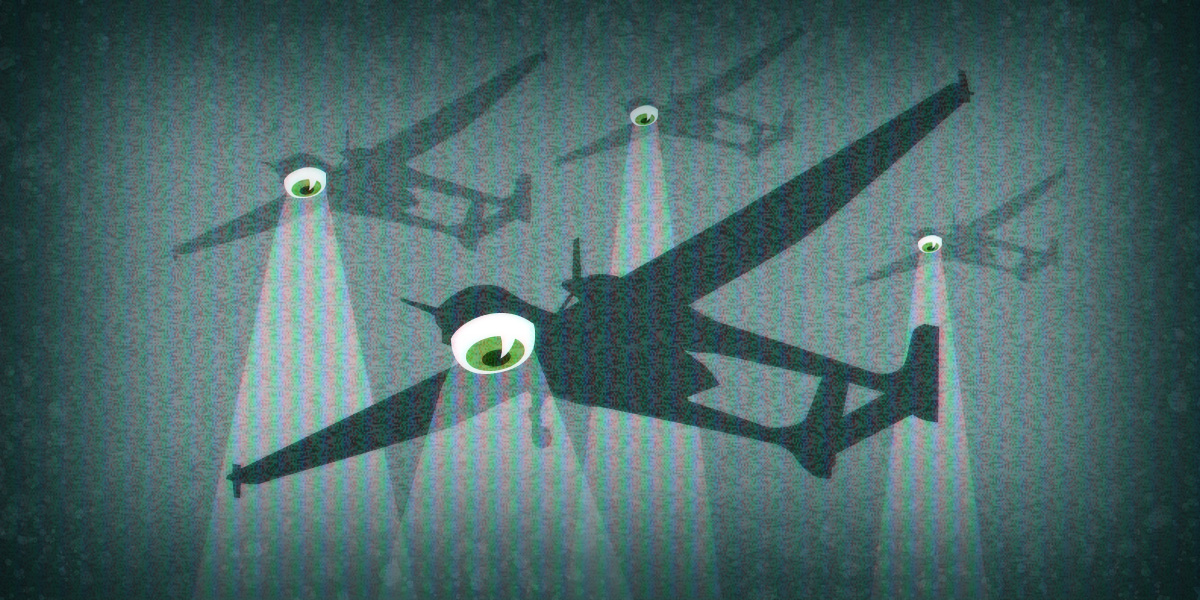
The Baton Rouge Police Department announced this week that it will begin using a drone designed by military equipment manufacturer Lockheed Martin and Edge Autonomy, making it one of the first local police departments to use an unmanned aerial vehicle (UAV) with a history of primary use in foreign war zones. Baton Rouge is now one of the first local police departments in the United States to deploy an unmanned aerial vehicle (UAV) with such extensive surveillance capabilities — a dangerous escalation in the militarization of local law enforcement.

This is a troubling development in an already long history of local law enforcement acquiring and utilizing military-grade surveillance equipment. It should be a cautionary tale that prods  communities across the country to be proactive in ensuring that drones can only be acquired and used in ways that are well-documented, transparent, and subject to public feedback. 

Baton Rouge bought the Stalker VXE30 from Edge Autonomy, which partners with Lockheed Martin and began operating under the brand Redwire this week. According to reporting from WBRZ ABC2 in Louisiana, the drone, training, and batteries, cost about $1 million. 

Baton Rouge Police Department officers stand with the Stalker VXE30 drone in a photo shared by the BRPD via Facebook.

All of the regular concerns surrounding drones apply to this new one in use by Baton Rouge:

  • Drones can access and view spaces that are otherwise off-limits to law enforcement, including backyards, decks, and other areas of personal property.
  • Footage captured by camera-enabled drones may be stored and shared in ways that go far beyond the initial flight.
  • Additional camera-based surveillance can be installed on the drone, including automated license plate readers and the retroactive application of biometric analysis, such as face recognition.

However, the use of a military-grade drone hypercharges these concerns. Stalker VXE30's surveillance capabilities extend for dozens of miles, and it can fly faster and longer than standard police drones already in use. 

“It can be miles away, but we can still have a camera looking at your face, so we can use it for surveillance operations," BRPD Police Chief TJ Morse told reporters.

Drone models similar to the Stalker VXE30 have been used in military operations around the world and are currently being used by the U.S. Army and other branches for long-range reconnaissance. Typically, police departments deploy drone models similar to those commercially available from companies like DJI, which until recently was the subject of a proposed Federal Communications Commission (FCC) ban, or devices provided by police technology companies like Skydio, in partnership with Axon and Flock Safety

Additionally troubling is the capacity to add additional equipment to these drones: so-called “payloads” that could include other types of surveillance equipment and even weapons. 

The Baton Rouge community must put policies in place that restrict and provide oversight of any possible uses of this drone, as well as any potential additions law enforcement might make. 

EFF has filed a public records request to learn more about the conditions of this acquisition and gaps in oversight policies. We've been tracking the expansion of police drone surveillance for years, and this acquisition represents a dangerous new frontier. We'll continue investigating and supporting communities fighting back against the militarization of local police and mass surveillance. To learn more about the surveillance technologies being used in your city, please check out the Atlas of Surveillance.

Drone as First Responder Programs: 2025 in Review

29 December 2025 at 17:33

Drone as first responder (DFR) adoption really took off in 2025. Though the concept has been around since 2018, this year saw more normalization of the technology, its integration into more real-time crime center structures, and the implementation of automated deployment of drones.

A DFR program features a fleet of camera-equipped drones, which can range from just a couple to dozens or more. These are deployed from a launch pad in response to 911 calls and other calls for service, sometimes operated by a drone pilot or, increasingly, autonomously directed to the call location. The appeal is the promise of increased “situational awareness” for officers headed to a call. This video offers a short explanation of DFR, and for a list of all of the cities we know use drones, including DFR programs, check out EFF’s Atlas of Surveillance

Major Moves from the FAA and Forthcoming Federal Issues

In order to deploy a drone beyond where it can be seen, operators need to receive a waiver from the Federal Aviation Administration (FAA), and all DFR programs require this. Police departments and technology vendors have complained that the process takes too long, and in May, FAA finalized reworked requirements, leading to a flood of waiver requests. An FAA spokesperson reported that in the first two months of the new waiver process, it had approved 410 such waivers, already accounting for almost a third of the approximately 1,400 DFR waivers that had ever been granted.

The federal government made other major moves on the drone front this year. A month after the new waivers went to effect, President Trump issued an Executive Order with aspirations for advancing the country’s drone industry. And at the end of the year, one of the largest drone manufacturers in the world and one of the biggest purveyors of law enforcement drones, DJI, will be banned from launching new products in the U.S. unless the federal government conducts a security audit that was mandated by the National Defense Authorization Act. However, at the moment, it doesn’t seem like that audit will happen, and if it doesn’t, it won’t be surprising to see other drone manufacturers leveraging the ban to boost their own products. 

Automated Drone Deployment and Tech Integrations

Early iterations of drone use required a human operator, but this year, police drone companies began releasing automated flying machines that don’t require much human intervention at all. New models can rely on AI and automated directions to launch and direct a drone. 

This article is part of our Year in Review series. Read other articles about the fight for digital rights in 2025.

This was the year we saw DFR integrated with other tools and tech companies teamed up to bring even more powerful surveillance. Flock Safety added automated license plate readers (ALPR) to their drones. Axon and Skydio built on the partnership they launched in 2024. Drone manufacturer Brinc teamed up with Motorola Solutions on a DFR program. Drone company Paladin teamed up with a company called SkyeBrowse to add 3-D mapping of the environment to their list of features. 

DFR also is increasingly part of the police plans for real-time crime centers, meaning that the footage being captured by these flying cameras is being integrated into other streams and analyzed in ways that we’re still learning about. 

Transparency Around DFR Deployments

Transparency around adoption, use, and oversight is always crucial, particularly when it comes to police surveillance, and EFF has been tracking the growth of DFR programs across the country. We encourage you to use your local public records laws to investigate them further. Examples of the kinds of requests and the responsive documents people have already received — including flight logs, policies, and other information — can be found on MuckRock

The Problem with Drones

Flying cameras are bad enough. They can see and record footage from a special vantage point, capturing video of your home, your backyard, and your movements that should require clear policies around retention, audits, and use, including when the cameras shouldn’t be recording. We’re also seeing that additional camera analysis and other physical features that can be added (so-called “payloads”) — like thermal cameras and even tear gas — can make drones even more powerful and that police technology companies are encouraging DFR as part of surveillance packages.

It's important that next year we all advocate for, and enforce, standards in adopting and using these DFRs. Check the Atlas to see if they are used where you live and learn more about drones and other surveillance tools on EFF’s Street-Level Surveillance Hub.

This article is part of our Year in Review series. Read other articles about the fight for digital rights in 2025.

Axon Tests Face Recognition on Body-Worn Cameras

4 December 2025 at 01:00

Axon Enterprise Inc. is working with a Canadian police department to test the addition of face recognition technology (FRT) to its body-worn cameras (BWCs). This is an alarming development in government surveillance that should put communities everywhere on alert. 

As many as 50 officers from the Edmonton Police Department (EPD) will begin using these FRT-enabled BWCs today as part of a proof-of-concept experiment. EPD is the first police department in the world to use these Axon devices, according to a report from the Edmonton Journal

This kind of technology could give officers instant identification of any person that crosses their path. During the current trial period, the Edmonton officers will not be notified in the field of an individual’s identity but will review identifications generated by the BWCs later on. 

“This Proof of Concept will test the technology’s ability to work with our database to make officers aware of individuals with safety flags and cautions from previous interactions,” as well as “individuals who have outstanding warrants for serious crime,” Edmonton Police described in a press release, suggesting that individuals will be placed on a watchlist of sorts.

FRT brings a rash of problems. It relies on extensive surveillance and collecting images on individuals, law-abiding or otherwise. Misidentifications can cause horrendous consequences for individuals, including prolonged and difficult fights for innocence and unfair incarceration for crimes never committed. In a world where police are using real-time face recognition, law-abiding individuals or those participating in legal, protected activity that police may find objectionable — like protest — could be quickly identified. 

With the increasing connections being made between disparate data sources about nearly every person, BWCs enabled with FRT can easily connect a person minding their own business, who happens to come within view of a police officer, with a whole slew of other personal information. 

Axon had previously claimed it would pause the addition of face recognition to its tools due to concerns raised in 2019 by the company’s AI and Policing Technology Ethics Board. However, since then, the company has continued to research and consider the addition of FRT to its products. 

This BWC-FRT integration signals possible other FRT integrations in the future. Axon is building an entire arsenal of cameras and surveillance devices for law enforcement, and the company grows the reach of its police surveillance apparatus, in part, by leveraging relationships with its thousands of customers, including those using its flagship product, the Taser. This so-called “ecosystem” of surveillance technologyq includes the Fusus system, a platform for connecting surveillance cameras to facilitate real-time viewing of video footage. It also involves expanding the use of surveillance tools like BWCs and the flying cameras of “drone as first responder” (DFR) programs.

Face recognition undermines individual privacy, and it is too dangerous when deployed by police. Communities everywhere must move to protect themselves and safeguard their civil liberties, insisting on transparency, clear policies, public accountability, and audit mechanisms. Ideally, communities should ban police use of the technology altogether. At a minimum, police must not add FRT to BWCs.

❌