❌

Normal view

Our Lawsuit Against the Trump Administration’s Social Media Surveillance Moves Forward. Here’s What the Court Said.

15 October 2026 at 22:08

No one should have to choose between speaking freely and protecting their immigration status. Yet that’s precisely the choice the Trump administration’s mass surveillance of online speech forces on noncitizens living in the U.S.   

Last fall, we sued on behalf of three major labor unions to stop this surveillance program. And just this month, we won our first major ruling: A federal district court denied the government’s motion to dismiss our lawsuit. This means the case can move forward—a win for free speech and a critical step in protecting our First Amendment rights online. We’ve already explained why this is a big deal for our clients, so let's take a closer look at the court’s reasoning.  

Our Lawsuit 

 Since taking power, the Trump administration has used AI and other automated tools to broadly surveil the social media and online speech of visa and green card holders, with the goal of identifying and punishing people who express views it opposes. The government is targeting a broad range of views, including criticism of the Trump administration; support for Palestine or criticism of Israel; “rationalizing or making light of” Charlie Kirk’s murder; and anything nebulously “hostile” to American culture, founding principles, “traditional American views,” or “our way of life.”  

It has paired that surveillance with a public intimidation campaign. High-ranking officials have explicitly threatened to punish noncitizens for their online speech, then followed through with a series of terrifying viewpoint-driven enforcement actions. This has led to a significant chilling effect on speech, not just for noncitizens, but also for their families, coworkers, and friends. 

In response, three major labor unions—the United Auto Workers (UAW), the Communications Workers of America (CWA), and the American Federation of Teachers (AFT)—sued the Departments of State and Homeland Security alleging that this viewpoint-based surveillance program violates the First Amendment and the Administrative Procedure Act (APA).  The unions are represented by EFF, Muslim Advocates (MA), and the Media Freedom & Information Access Clinic (MFIA). 

The government moved to dismiss our lawsuit, arguing first that federal immigration law prevents federal district courts from hearing the case, and second, that the unions don’t have “standing” to sue. Judge Alvin K. Hellerstein of the Southern District of New York rejected both arguments and allowed the case to proceed. At this stage in the litigation, the court accepted all of the facts in our complaint as true and analyzed the law based on those facts. We will now prove these facts as the case proceeds. 

Federal Immigration Law Doesn’t Block Our Lawsuit 

 The government first argued that the court had no power to hear our case at all. It pointed to three provisions of the Immigration and Nationality Act (INA) that restrict when federal courts can review immigration matters. The district court disagreed and rejected each provision in turn. 

The first provision, 8 U.S.C. § 1252(b)(9), is often called the “zipper clause.” It bars federal courts from hearing challenges that arise from efforts to deport someone, except through review of an individual’s final removal order. The government claimed the zipper clause applies here because our lawsuit is really an effort to stop it from initiating adverse immigration actions. 

 The district court wholly rejected this argument. Relying on the Second Circuit’s decision in Ozturk v. Hyde, it held that the zipper clause bars only challenges to a particular individual’s removal proceedings, not a lawsuit like ours that challenges the constitutionality of the surveillance program itself. That the surveillance program might affect someone’s immigration proceeding down the line doesn’t turn our lawsuit into a removal challenge. 

 The court similarly rejected the government’s argument that § 1252(g) and § 1252(f)(1) prevent federal courts from hearing this case. Our suit, the court explained, “challenges the constitutionality of a government policy that is collateral to any active removal proceedings,” so § 1252(g) doesn’t apply. And § 1252(f)(1) only limits what kind of relief a court can give. So while the court may not be able to stop a particular person’s removal proceedings, it can still block “an unlawful surveillance program that suppresses free speech.” 

 The Unions Have Standing to Sue 

 To sue in federal court, a plaintiff must show that it has “standing” to bring its claims. This requires a plaintiff to show an “injury in fact” that is, among other things, “concrete.” That’s often a high bar in surveillance cases, where plaintiffs can’t easily see what the government is doing behind the scenes. And the Supreme Court has held that a person’s mere subjective fear of surveillance is too speculative to confer standing.  

Even so, our plaintiffs cleared the bar. The court held that the unions alleged concrete injuries, including a chill on members’ speech that is objectively reasonable, not just subjectively felt. It found that the unions had established standing in two ways: “organizational standing,” based on the unions’ own injuries, and “associational standing,” based on injuries the unions’ members have suffered. 

Organizational Standing 

The court first held that our plaintiffs had successfully alleged an injury to the unions themselves (injury was the only aspect of organizational standing the government disputed). The surveillance program has harmed the unions’ ability to carry out their core responsibilities, including “organizing their members and advocating for the unions’ goals.” The court made two key points: 

1. Unions Are Injured When Members Go Silent 

As we explained in our complaint, the surveillance program has caused members to step back from union leadership roles; stop participating in union activities online and in person; remove their names from union webpages; and avoid filling out bargaining surveys. Members who might otherwise spread the unions’ message and raise awareness of union issues are staying quiet, hampering the unions’ ability to organize. The court said this amounts to a concrete injury for purposes of standing. 

2. Surveillance Doesn’t Need to Target Pro-Union Speech  

 The court also rejected the government’s claim that members’ retreat from union activities was “essentially an overreaction,” because the surveillance doesn't target pro-union views. The court said this misunderstands the issue: “the question is whether the Government’s conduct would deter a person of ordinary firmness from engaging in protected activity, not whether the specific expression a member forgoes is itself among the viewpoints the Government disfavors.” 

Here, the surveillance program monitors noncitizens’ online activity indiscriminately, and members “cannot reliably predict which of their activities will be captured” and attributed to a disfavored viewpoint. What’s more, the court noted, the unions’ organizing often happens alongside the very advocacy the government is alleged to target, “including pro-Palestine and anti-ICE activism on college campuses.” That makes members’ retreat from union activity a foreseeable consequence of the program. 

Associational Standing  

 The court also held that the unions established associational standing to sue on behalf of their members. Of the three requirements for associational standing, the government challenged only two. It argued that members lacked sufficiently concrete injuries to sue in their own right, and that the claims aren’t “germane” to the unions’ purpose. 

The court disagreed and found associational standing for every claim but one: members’ right to receive information. That claim survives anyway, because the unions’ organizational standing covers it. Along the way, the court made several important rulings. 

 1. The Ongoing Surveillance Is a Present Injury 

 As a threshold matter, the government argued that our case is a “pre-enforcement challenge,” meaning we sued before the government actually punished anyone. That would trigger a different test, and the government argued we failed it because we hadn’t alleged a sufficiently imminent threat of prosecution. 

The court disagreed, explaining that “Plaintiffs’ allegations are of an ongoing surveillance program that is actively chilling the speech of their members and otherwise causing harm.” That chilling effect is a First Amendment injury even if there isn’t a direct prohibition on speech. And when government conduct is actively chilling speech right now, a challenge to it isn’t pre-enforcement. 

 2. Surveillance + Public Threats Reasonably Chills Speech 

 The court rejected the government’s argument that we alleged only a generalized, subjective, speculative fear of surveillance, explaining that “the chilling effect” of the program can “itself be an injury when the plaintiffs are surveilled.” Here, plaintiffs have alleged that their members are under active surveillance, which has had objective chilling effects on their speech. And the government is targeting certain disfavored viewpoints, making it “viewpoint discrimination” that is “presumptively unconstitutional.” 

The chill is also objectively reasonable, the court held, because the government has extensively publicized the surveillance program through public statements and social media posts, making clear that noncitizens who post disfavored views will be targeted for removal. Notably, the court agreed with us that the “threat of adverse immigration consequences, under a government whose harsh immigration crackdowns has been heavily publicized and reported on, is certainly enough to deter a person of ordinary firmness from the exercise of First Amendment rights.” This is a concrete injury sufficient for standing. 

3. Demanding Social Media Handles Also Causes Harm 

Under the surveillance program, applicants for certain immigration benefits must disclose all social media handles they have used during the preceding five years and, in some instances, maintain public social media accounts. The district court held that this too amounts to a First Amendment injury, undermining the rights to anonymity and freedom of association.  

The judge pointed to one CWA member we identified, a lawful permanent resident with a pending naturalization application who is subject to the five-year disclosure requirement. The member has deleted one social media account, set another to private, and removed past posts expressing disfavored views. These allegations, the court said, show an actual and objectively reasonable injury due to the government’s surveillance program.

4. General, Public Threats Can Still Be Coercive 

We also argued that the Trump administration is waging a campaign of coercive threats to suppress disfavored speech, which the First Amendment prohibits. The court agreed that this campaign can be an actionable injury of its own. 

Notably, the court held that it didn’t matter that the government’s statements were not specifically targeted at certain individuals, and were instead made on social media or to the public. In this case, the court explained, “the number, severity, and high-profile examples of action upon those threats are such that a reasonable person would perceive the communication as coercive.” 

That means it’s reasonable that the unions’ members “would, and did, limit their public speech on disfavored viewpoints” in response. That the threats were made to the general public “does not diminish this injury,” as the very purpose of the challenged surveillance program is to intimidate noncitizens into silence.  

5. Free Speech is Central to Union Functioning 

The court also found that the unions met the second prong of associational standing. It held that the unions’ interests in protecting their members’ rights to speak freely, organize, and advocate, are “germane” to the unions’ missions. The court put it plainly:

The freedom of Plaintiffs’ members to speak, associate, and appear publicly is not incidental to union work, but rather is the mechanism through which unions recruit, organize, communicate, and bargain. A program alleged to silence members and drive them from the unions’ rolls therefore strikes at the unions’ representational function itself.

Next Steps 

When the government surveils what people post online and threatens to punish them for their viewpoints, the result is exactly what our clients have experienced. Members have deleted their accounts, scrubbed posts, and withdrawn from union activities. 

The government must now answer our complaint and we will move forward with the discovery process, in which we anticipate getting more information from the government about its surveillance program. We look forward to continuing to prove our case. 

DHS Inspector General Finds That TSA is Not Properly Safeguarding Passenger Facial Recognition Data

14 October 2026 at 22:27

EFF legal intern Gabrielle Ladun was the principal author of this post. 

The Department of Homeland Security Office of Inspector General (DHS OIG) has published a summary of findings from its audit of the Transportation Security Administration’s (TSA) facial recognition technology. While the detailed findings are classified, the summary states that the OIG’s audit uncovered a “significant weakness” in the technology’s ability to protect the privacy of passenger data. This has massive privacy implications for the millions of passengers who travel and don’t opt out of the TSA’s biometric surveillance technology verification process. 

TSA uses facial comparison technology for identity verification of airline passengers. A camera takes a photo of passengers to verify that their provided identification matches their live photo. Although TSA states that it is “committed to protecting traveler privacy,” the audit highlights that this has not been the case.  

The OIG found that TSA’s Credential Authentication Technology 2’s (CAT-2) vendor “was able to access and extract sensitive passenger information, including driver’s license and passport images, during system troubleshooting and enhancements, without TSA’s knowledge.”  

The OIG further admonished the agency:  

TSA lacked clear policies, did not track when this data was extracted, could not verify that extracted information was properly deleted, and did not notify passengers when their biometric and biographic information may have been stored. As a result, although passenger information was generally protected during routine operations, weaknesses in vendor oversight created a risk that sensitive personal information could be retained or exposed. 

We hope the TSA will fix these issues. The OIG summary states: 

We issued one finding and three recommendations to strengthen controls, improve oversight, and ensure transparency and the proper handling of passenger data. TSA concurred with all three recommendations. Two recommendations are open and resolved, and one remains open and unresolved. 

Why EFF Opposes the Government’s Use of Facial Recognition Technology 

EFF has a long history of opposing governmental use of facial recognition technology. As the OIG’s audit underscores, this technology presents privacy risks associated with unsecured data, unauthorized access, and data breaches. The government’s use of this technology also creates a mass surveillance system and facilitates the creation of warrantless biometric records for unconsenting parties.  

The biometric data captured by this technology is not without errors. There have been multiple instances of law enforcement agencies using facial recognition technology to misidentify and arrest innocent individuals.  

Reminder: Opting Out of TSA Photos Is Possible 

Given that facial recognition technology is prone to mistakes, combined with the OIG’s audit revealing significant privacy weaknesses, it is imperative that travelers remember that opting out is possible. TSA’s own website emphasizes that travelers who wish to decline to have their photo taken for facial comparison can do so without any delay, disruption, or recourse.  

Considering the data protection weaknesses exposed by the OIG’s audit, EFF will continue to oppose this governmental system of mass surveillance and spread awareness to ensure that no one is forced to relinquish their biometric data without consent. 

As Federal Court Rules ALPRs are Mass Surveillance, EFF Gets Disappointing Ruling

13 October 2026 at 19:19

In an extremely disappointing ruling, a California trial court dismissed SIREN v. San Jose, our case challenging the city of San Jose’s warrantless searches of its vast stores of automated license plate reader (ALPR) data. EFF and the ACLU of Northern California represent SIREN and CAIR California, two non-profits that serve San Jose residents, in this case.

Make no mistake: We believe this ruling is wrong on the law, and we will appeal. The ruling ignores the importance of landmark rulings from the U.S. Supreme Court regarding the invasiveness of aggregating collected data on an individual over time, including one issued just months ago. It also severely underestimates the harm that ALPRs cause, in San Jose and around the country. 

San Jose’s ALPR surveillance system is inescapable. It blankets the city’s streets in nearly five hundred cameras that continuously photograph every car that passes by and retains the collected data for a month or longer. In our briefs, we argued that law enforcement officers who warrantlessly search the resulting ALPR database are violating the California Constitution’s ban on unreasonable searches and its guarantee of privacy. The court disagreed, explaining that based on one California appeals court case involving individual streetlight cameras, people do not have a reasonable expectation of privacy when driving on a public road. This is wrong. Networked ALPRs are not individual streetlight cameras. Their net effect of tracking and mapping cars as they travel reveals patterns of life, intimate relationships, and much more.

Fortunately, there are signs that the tide is turning against ALPRs in the courts. Just a day before the ruling in our case, a federal district court in Oklahoma called ALPRs “a type of indiscriminate mass surveillance” and decided that a law enforcement officer’s warrantless search of ALPR data violated the Fourth Amendment. The officer was observing traffic on an Oklahoma highway when he saw a woman driving a car with California plates. According to the court order, the officer began following the woman “for no apparent reason” other than her out of state plates. While following her, the officer decided to run the woman’s license plate number through Flock’s ALPR system – again, with no apparent reason other than her California plates. The Flock search returned at least 30 days of data, allowing the officer to track the car across at least three states, over the span of a month, from a single search.

The facts of this case demonstrate how ALPRs allow law enforcement to grab a breathtakingly vast sweep of information about a car (and the driver within) with no more effort than a Google search. It’s true that when a person drives on public roads, they can be observed, including by police. But as the Supreme Court has explained, we don’t expect law enforcement to be able to secretly track and store every movement our cars while we’re driving. The federal court in the Oklahoma case aptly illustrated this difference in societal expectations:

We might reasonably expect our friends and family to tell us something like: “Hey, I saw you out driving by the store last week.” But we do not expect people we know—let alone strangers, and especially not law enforcement—to randomly approach us to say: “Hey, I have been following your car for the last 30 days, and here is a detailed log of every place your vehicle has been with supporting photographic evidence. I am also going to share this information with law enforcement throughout the country so they know your whereabouts, too.

This decision is the first of its kind, and EFF will continue working to ensure that it is the first of many. Outside the courts, we’ve seen people across the country step up to reject ALPRs at the state and local level. EFF will continue challenging this technology on every front as well.

EFF to San Francisco Police: Drones are Powerful Surveillance Tools That Require a Robust Policy

28 September 2026 at 22:30

The San Francisco Police Department (SFPD) began regularly deploying drones two years ago and has since expanded their use in a way that has outpaced its documented policy and evaded existing local and state oversight of these devices. 

The department has a new proposed policy, which continues to be grossly inadequate in protecting privacy and civil liberties. At best, the draft policy continues the SFPD’s pattern of putting vague guardrails on a powerful surveillance tool, but at worst, if implemented, the policy could effectively usher in sweeping, non-targeted, and unspecified general surveillance over the city with few guardrails.

EFF has repeatedly opposed the unaccountable development of the SFPD’s drone program and recently sent a comment to the Police Commission, the local civilian oversight body, about the SFPD’s new proposed policy. 

The SFPD has been sidestepping oversight of its drones since 2024. In March 2024, San Francisco voters approved a heavily-funded, billionaire-backed measure, Proposition E, which sought to expand police access to surveillance technology. Among its impacts, Prop E removed drones from oversight required by the 2019 Surveillance Technology Ordinance. Nonetheless, in its haste to purchase drones after Prop E passed, the SFPD knowingly violated California’s AB 481, a state statute requiring law enforcement agencies to get approval from their local elected governing body before purchasing military equipment, including drones. Eventually the SFPD sought retroactive approval from the Board of Supervisors and, soon after, announced that it would be launching a drone-as-first-responder (DFR) program.

Now, San Francisco finally has an opportunity to update the SFPD’s guidance in a way that won’t quickly become stale, as has happened while the SFPD steadily increases the purposes for drone use. Though drones were initially identified as tools to use for specific actions such as vehicle pursuits and active criminal investigations, within a year, the SFPD expanded use cases to include patrol, i.e. unrelated to a specific incident. Along with this mission creep, the SFPD has also steadily and exponentially increased the number of drone flights, from roughly 350 deployments in 2024, to over 1,100 from January to August 2025, to over 3,500 in just the first five months of 2026.

The original draft of an updated policy brought by the SFPD to the local Police Commission, a civilian oversight body, earlier this month provided limited details and proposed allowing police to treat drone flights as an extension of their patrol abilities, paving the way for general surveillance, including of First Amendment-protected activity. The proposal received significant community pushback, and the San Francisco Public Defender’s Office authored a letter describing the policy’s shortcomings. That letter was signed by over a dozen local, state, and national groups, including EFF. 

Based on these concerns, the Police Commission deferred taking action until the SFPD addressed them. The SFPD then revised its proposed policy, but this, too, falls short of providing practical guidance to officers and protecting civil liberties, as the Public Defender’s Office identified in a follow-up letter signed by over 40 organizations, including EFF.

EFF’s additional comment to the Police Commission, in part, calls out the incredible gap in oversight of these ballooning drone flights and the immense data collection they facilitate:

The revised policy states that “[unmanned aerial vehicles] may be used as an asset in any situation in which a member may be deployed for a public safety response or when a member onviews criminal activity” but fails to define what is meant by a “public safety response.” The revised policy also provides a definition of “Drone as First Responders,” but it fails to provide any more detail about appropriate DFR deployment. Without appropriate safeguards around deployment and use, drones could be deployed to every call for service, even in situations that are ultimately deemed nonincidents, collecting data along the way that is then stored for 30 days. This type of general patrol could effectively become general surveillance, which SFPD acknowledges is an inappropriate use of their drones and yet is still possible under the vague terms of the current DGO. 

The Police Commission is set to consider the matter on October 14. You can read EFF’s full comment here.

EFF Statement on Meta Settlement

26 August 2026 at 18:34

Under this settlement, young users will now have less access to Meta products, and a lesser ability to exercise their rights to speak, access information and art and culture, associate and form communities, and play. The settlement also embeds age assurance into every product, mandating the collection of even more personal information from users of all ages; this enshrines Meta's harmful surveillance into law, and it will compromise users' privacy and anonymity while increasing their exposure to data breaches and government data requests. And the data minimization and security measures don’t keep states from using data collected under the agreement for other law enforcement purposes – which could include things like criminal investigations of abortions or gender-affirming care. 

EFF and Civil Society Groups Call on Nottinghamshire Police to Halt Live Face Recognition

21 August 2026 at 18:03

This week, EFF, along with Big Brother Watch, Defend Digital Me, Liberty, Open Rights Group, Race Equality First, Statewatch, and Stopwatch, wrote to Nottinghamshire Police Force in the UK raising concern about the proposed roll-out of live facial recognition technology (LFR), and called for its immediate halt.

In particular, the letter highlights six concerns:

LFR Is Not "Just Another Tool"

Nottinghamshire Police has stated that “facial recognition is just another tool to fight crime.” But LFR used in public spaces is an incredibly intrusive biometric mass surveillance technology that scans the faces of everyone who walks past the camera and takes biometric face prints. This is not just another tool, but a major escalation of surveillance that treats everyone as a suspect by default.

People Having "Nothing to Worry About" Does Not Hold to Scrutiny 

According to Nottinghamshire Police, “if you aren’t entering the city or county to commit crime then you have nothing to worry about.” However, many people have legitimate concerns about the normalisation of invasive technologies. So a public that cannot move around their towns and cities without being subjected to a biometric identity check may be less willing to seek medical care or legal advice, speak with journalists, act in a union, vote, protest, or express their gender, sexual or religious identity. 

Disproportionate Targeting With LFR

We are particularly concerned to learn that Nottinghamshire Police could deploy LFR to tackle low level crimes, such as youth behavior deemed anti-social, as part of Operation View. Reporting suggests that the force already possesses “a watchlist of young people believed to be causing the most problems,” including children as young as 11 years old. It would be highly disproportionate to deploy live facial recognition to tackle this behaviour. Many of these children are reportedly known to the police, and it is highly likely that there are more proportionate means for locating them. 

LFR Could Increase Social Problems

We are also concerned that Nottinghamshire Police has not adequately examined the distinct risks of using LFR to target children, including negative impacts on their behaviour and outcomes, risk of recidivism, and relationship with the police. Use of LFR could exacerbate behavioural problems in children and create an adversarial, rather than trusting, relationship with the police from a young age. 

Lack of Public Support 

Recent polling commissioned by Liberty indicated that 48% of people oppose scanning the faces of those walking on high streets when there is no suspected imminent threat. Furthermore, Opinium found that the majority of people oppose the use of facial recognition in schools. Likewise, a report by the London Policing Ethics Panel found that Londoners aged 16-24 were most likely to find the Metropolitan Police Service’s use of LFR unacceptable and most likely to stay away from events where LFR was in use.

On these grounds, Nottinghamshire Police must immediately halt their plans to use live facial recognition surveillance any further.

Read our full letter here. 

Hundreds of Drone-as-First-Responder Programs Could Soon Be Launched Across the Country

24 July 2026 at 00:00

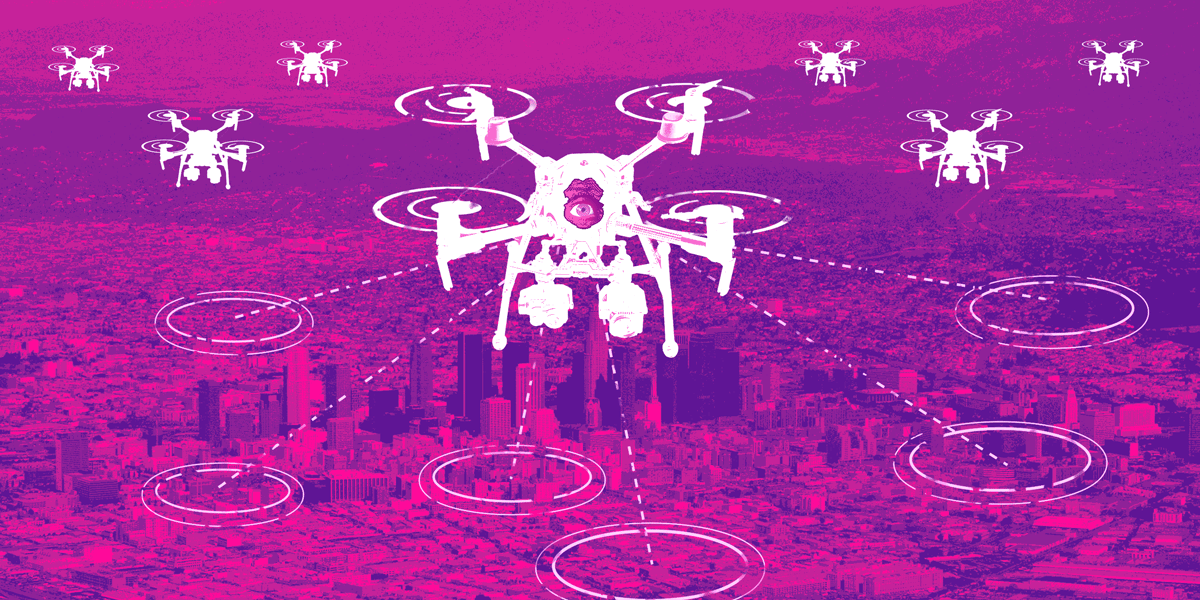
Police departments across the country are lining up to launch drone-as-first-responder (DFR) programs, and hundreds have cleared a necessary hurdle toward making deployment a reality, expanding aerial surveillance and data collection even in areas patrol officers typically can't reach.

As of February 2026, over 1,000 public safety agencies—including police, fire, and other emergency management agencies—had received Federal Aviation Administration (FAA) waivers needed to automate drone operations and launch a DFR program, according to a recent Freedom of Information Act (FOIA) release listing agencies that have obtained Part 91 waivers since the FAA streamlined and sped up the process in April 2025.

The changes led to a massive increase in the number of waivers issued. Only 976 DFR waivers had been granted since the first DFR program launched in 2018 through April 2025, according to an FAA representative. The agency issued more waivers between April 2025 and February 2026 than it had in the previous seven years combined.

A map illustrating the locations of police departments and other public safety agencies that have received Part 91 waivers, making it possible for them to launch drone-as-first-responder programs. (This map image links to Google Maps, which is governed by Google's privacy policy)

The new FAA process for waivers and the rush of police departments to obtain them signifies a shift in law enforcement's use of drones: from human-operated aerial surveillance to AI-based autonomous drone use. 

Typically, a drone operator is only permitted to fly in areas that can still be seen by the pilot, and that drone pilot needs to be certified under FAA Part 107. To fly drones “Beyond Visual Line of Sight” (BVLOS) requires additional approval from the FAA, as do flights above 200 feet, due to the risk of colliding with planes and other aircrafts. Without such approval, an officer could not pilot a drone from a desk inside a building and fly it to a call across the city because they could not possibly have line of sight on the drone. 

FAA rules for police drones also required a human operator to manually fly the device to a scene, but DFR technology has become a more common and more automated police technology. DFR programs increasingly rely on artificial intelligence to automate drone flights from launchpads placed around the city, often atop municipal buildings, and make it possible for one drone operator to “fly” multiple devices at once. Though not every police department that has received BVLOS has launched a DFR program yet, by going through this process, every department on this list has signified it has strong enough interest to clear the necessary regulatory hurdles.

Police departments and the companies that sell DFR equipment claim that these drones make it easier for officers to establish “situational awareness” of a scene before they arrive. Early drone adoption centered on similar claims, particularly related to high-risk situations like vehicular accidents or incidents involving an armed suspect. However, these kinds of situations may make up only a small portion of deployments, which often occur in response to low-risk calls for service related to unhoused people, mental health concerns, and loud music, as a Government Technology analysis of the system in Chula Vista, California, found. 

DFR programs have become important sources of revenue for companies like Flock Safety and Axon, the latter of which reported that its DFR platform has become one of the company’s fastest growing sectors. Axon is also known for products like the TASER and the Fusus camera system that lets police integrate viewing of public and private cameras. 

Footage from drone flights is streamed back to a police office, and it can be stored, shared, and analyzed like other video. Turning drone footage into fodder for automated license plate reader (ALPR) networks, for example, requires very little additional software, and Flock Safety was quietly able to turn its drones into “flying ALPRs” last year. 

The normalization of police DFR programs jeopardizes privacy in communities across the country. As flying cameras, drones can capture footage from areas typically inaccessible to a casual patrol officer—backyards, roofs, through windows—at distances that leave subjects of surveillance completely unaware of the spy in the sky. A recent leak of drone footage from the San Francisco Police Department illustrated the ease with which surreptitious drone flights could observe innocent individuals for minutes without them realizing it. EFF's Atlas of Surveillance contains a list of police departments with drones, including those with DFR programs.

While daytime DFR use grows, police departments are exploring other ways to expand overhead surveillance. In October 2024, the Campbell Police Department in California announced it had received the first FAA approval for BVLOS operations at night, claiming it was the “first to incorporate radar technology with electro-optical sensors to enhance airspace monitoring, enabling a single remote pilot to safely deploy drones both day and night.”  

As communities consider drone use, it’s crucial that they have a say in whether the program is acquired at all, not just how it's run once purchased. Throughout the process, police should be transparent with the community and comply with local regulations about its adoption.

Many cities provide portals that log the flight paths and reasons for each drone flight, often in real time, an important transparency practice. In California, under AB 481, police departments are required to provide advance notice of intent to acquire drones, establish policies before they’re procured, and provide annual updates on their uses—giving communities and city councils the opportunity, before any contract is signed, to weigh in or object to the acquisition itself. 

For police departments and communities considering drone use, clear policies on appropriate use, transparency around deployment, and regular re-evaluation—including the choice to discontinue a program that isn't working—are all vital for protecting people’s privacy and security. 

An Explosion of Surveillance Towers is Coming to U.S. Borders, Costing Over $1 Billion

20 July 2026 at 21:25

A new report from the Government Accounting Office reveals that the Department of Homeland Security (DHS) plans to nearly triple the number of surveillance towers along U.S. borders, from the current 830 to 2,300 by 2034.

DHS expects to expend $1 billion in taxpayer dollars for this dangerous expansion of a surveillance network indiscriminately trained on towns, school playgrounds, backyards, and vehicles—threatening the privacy and civil liberties of everyone in the border regions.

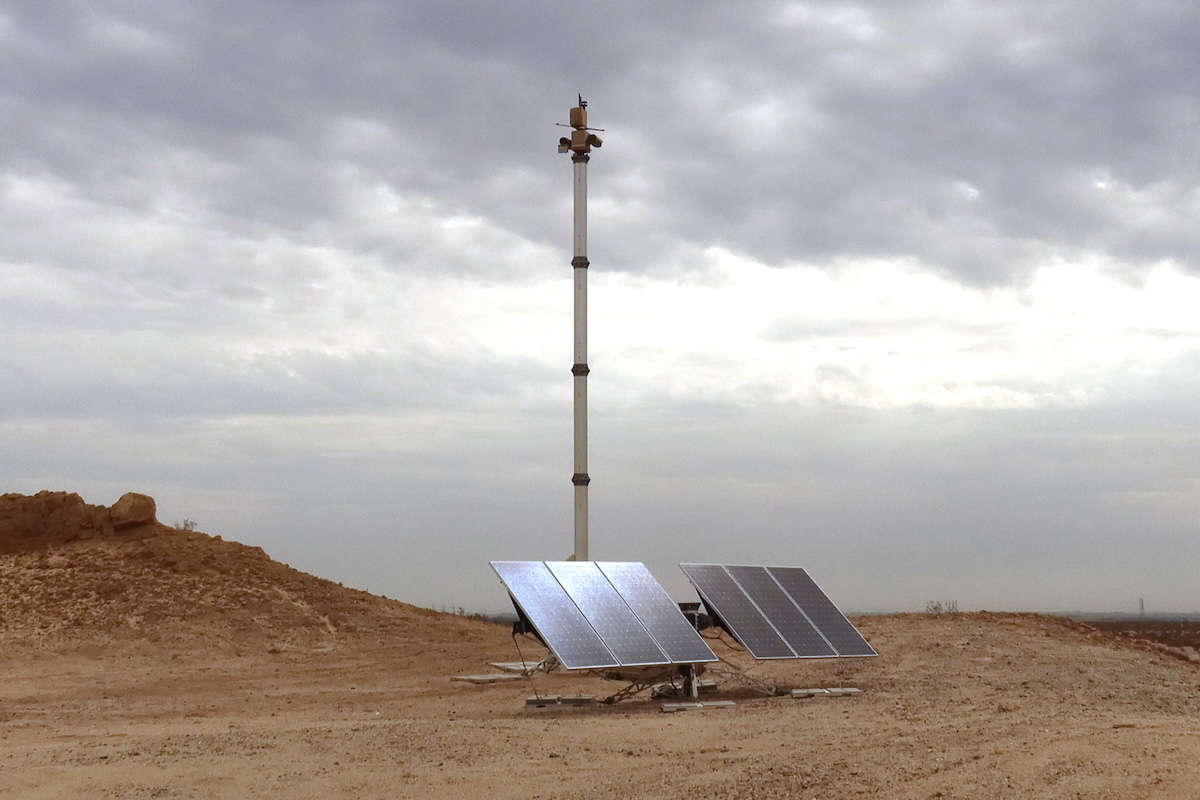
The towers are planned as part of DHS component Customs and Border Protection’s (CBP) Integrated Surveillance Tower (IST) program, which captures images of people and vehicles. The IST program operates autonomous surveillance towers, consisting of autonomous surveillance towers, consisting of AI-based systems using radar, thermal infrared and optical systems to track targets over long distances; integrated fixed towers, optimized for surveilling foot traffic and vehicles; and remote video surveillance systems, which can often be found very close to the border fence in Arizona, including residential neighborhoods where cameras are capable of spying on homes on both sides of the border. (For a description and photos of these technologies, see EFF’s updated guide to surveillance at the U.S.-Mexico Border.)

DHS expects to purchase more long-range autonomous towers and to upgrade existing towers with autonomous capabilities. The $1 billion comes from the so-called One Big Beautiful Act—a massive tax and spending law that President Trump signed in 2025, the report says.

The explosive expansion of border surveillance is a digital dumpster fire for human rights and civil liberties. It’s not just surveillance towers; drones, aerostats, surveillance vehicles, ground sensors, game cameras, and license plate readers are also part of the vast taxpayer-funded infrastructure that threatens all those who live, work, or seek refuge in the borderlands. This technology isn’t exclusive to U.S. federal agencies: it’s also deployed by state and local law enforcement, and even by governments on the Mexican side.

Since 2022, EFF has studied and mapped surveillance technology along the U.S.-Mexico border using public records research, open-source intelligence, and fact-finding trips, and created a handy interactive map to provide researchers and journalists with the tools they need to analyze the impact of U.S. border security policy. We have also documented the different types of surveillance technology in a zine, "Surveillance Technology at the U.S.-Mexico Border." We updated the publication earlier this year to help people identify the machinery of homeland security by adding more models of surveillance towers, newly deployed military tech, and a gallery of disguised trail cams and automated license plate readers.

EFF’s work includes defending the rights of individuals whose devices have been searched or seized upon entering the country; pushing back on the collection of biometric and social media identifiers; and developing digital security guidance for people crossing borders.

With the web of surveillance tech at the borders about to explode, EFF will continue to investigate and expose it and find ways to fight back with the communities that live in the shadow of this technological threat to human rights.

Victory! Flock Ends Rollout of Audio “Distress Detection” of Human Voices

17 July 2026 at 19:05

Reversing course, Flock Safety—the surveillance technology vendor most known for its extensive network of automated license plate readers—has announced that it will end a pilot for its acoustic gunshot detection devices to identify signs of “human distress.”

...public pressure can sometimes work to influence both companies and lawmakers that control a city’s purse strings to discontinue or divest from harmful products...

In October 2025, EFF warned the public that Flock was rolling out a new feature called “Distress Detection” that would be deployed through their acoustic gunshot detection devices (formerly known as Flock Raven, now called Audio Detection). This feature purported to use high-powered microphones scattered throughout a city to search for sounds of human distress, with original advertisements from the product indicating it would search for “screaming.” (Since the publication of our original blog post, Flock quietly amended the ad on this webpage to say “distress” instead of “screaming.”)

Now, Flock has published a blog post stating that “[a]fter careful consideration and community consultation, we decided to remove the feature.” Good riddance. 

We said it when the product was announced and we’ll say it again: this was a misguided and dangerous feature because of the civil liberties concerns it poses, the possibility it could summon armed police to every loud interaction happening on the street, and because in several places this type of spying would be illegal under state eavesdropping laws. 

We were not quiet about this potential new feature. Flock even mentioned our concern about Distress Detection in an attempt to rebut our opposition to the mass surveillance their products enable.

The suspension of Distress Detection, however, does not mean that these high-powered microphones are now magically safe or beyond our concern. Acoustic gunshot detection is still a dangerous and often highly inaccurate technology that has resulted in real world harm, as in Chicago where it resulted in police shooting at children lighting fireworks. As Flock itself states, “No acoustic system is perfect, and we don't claim otherwise.” But police response to a situation where they believe guns are actively in use seems like a pretty high-stakes situation to be making, selling, and deploying technology known to be imperfect. Flock’s devices also listen for more than just gunshots. Their marketing materials admit to be listening for “community disruption,” which includes “non-violent” threats like car sideshows and fireworks. 

Flock’s failed attempt to roll out Distress Detection teaches us a few important lessons about the current state of police surveillance. First, we should not assume that just because these companies are large and well-funded, that does not ensure that they are complying with local privacy laws before floating new products to customers. Second, companies roll out and police adopt invasive technology under the justification that it will be used to address our society’s very worst crimes. However, both the companies and police will leverage deployed surveillance infrastructure to introduce new uses without necessarily seeking the consent or approval of the public. Gunshot detecting microphones eventually being used to listen for screaming is exactly the type of mission creep that we’ve seen happen with other pieces of surveillance technology, including Flock’s license plate readers. Finally, gun violence is too serious and complex of an issue to purport to solve with one flawed piece of technology. It has become too easy for police and cities to listen to the fancy marketing pitches of tech companies claiming they’re going to solve all crime instead of doing the hard work of addressing the root causes of societal issues. And, in the meantime, that technology creates more problems and hazards for the communities they blanket in police surveillance. 

As we’ve also seen with people across the country pushing back on Flock license plate reader contracts in their communities, public pressure can sometimes work to influence both companies and lawmakers that control a city’s purse strings to discontinue or divest from harmful products. Flock’s decision to end “Distress Detection” for human voices is a win.  

How the Watch Dogs Video Game Series Mirrored and Predicted Real-World Digital Rights Issues

17 July 2026 at 17:01

When Ubisoft's Watch Dogs 2 was released in 2016, it was a headtrip for those of us working on digital-rights issues in the Bay Area. During the day, I'd fight tech-authoritarianism from EFF's San Francisco offices and then, at night, I'd fight tech-authoritarianism in an uncanny simulation of San Francisco from my home gaming console.  

Watch Dogs 2 is an open-world video game that follows a hacktivist collective called Dedsec as they take on surveillance tech and discriminatory AI systems that are being controlled by tech bros, government contractors, and corrupt cops. The game's missions often felt like they were ripped from the pages of EFF's Deeplinks blog.  

EFF’s mission is defending civil liberties in the digital world, and we do that with activists, technologists, and lawyers. If you've ever dreamt of joining Dedsec, you should definitely join us as a member.  

 Join the movement to Take Back CTRL.  

In fact, we've even got the same merch aesthetic. I cosplayed as the lead character, Marcus, at Dragon Con, and no one even knew I was in costume. 

Dave (left) as Marcus takes a selfie with a Wrench cosplayer at Dragon Con 2018.

To commemorate Watch Dog 2's 10th anniversary, I'll be speaking on a panel at San Diego Comic-Con reflecting on how the game predicted tech issues we're facing today. Organized by Mia Ginae of The Mighty Hostess and Black in Gaming, we've got voice actors Ruffin Prentiss lll and Shawn Baichoo, cinematic producer Timmy Fisher, and music producer Hudson Mohawke, who did the soundtrack, with Mia Ginae moderating. That's at 3:15 PM on Friday, July 24 in room 6BCF. 

Watch Dogs 2 panel at San Diego Comic-Con

But not everyone can get to Comic-Con and I certainly have more to say that can fit in. So here are a few ways where Watch Dogs 2 mirrored our work back then and foresaw what we're facing today.

Check out our full San Diego Comic Schedule, including panels and a meet-up. 

Insecure Surveillance Cameras 

One of the signature gameplay elements of the Watch Dogs series is the ability for your character to hack into nearby security cameras from your phone and use that to gain a strategic advantage over hostile adversaries. 

About a year before, that's exactly the issue that we were working on. EFF Technologist Cooper Quintin and I used the service Shodan to identify a slew of automated license plate readers (ALPRs) that Louisiana police had left unprotected on the internet. We found that the controls were open to anyone to manipulate and, just like in the game, you could watch the live video feeds.

Shodan screencap of unprotected ALPR feeds

We didn't use the data to acquire a skill point or collectible outfit. Instead, we forced police agencies to lock down their equipment and then used what we learned to persuade then Gov. Bobby Jindal to veto a bill that would have created a new statewide surveillance dragnet.  

This issue still persists today. Most recently, security researchers Benn Jordan and Jon “GainSec” Gaines, and the award-winning journalists at 404 Media, uncovered how at least 60 pan-tilt-zoom cameras from the vendor Flock Safety were left exposed online.

Cell-Site Simulators 

In Watch Dogs 2 there's a mission called "Stolen Signals," in which Marcus and his best friend Wrench are trying to locate "stingrays," police devices that gather nearby cell-phone data by masquerading as legit cellular towers. We call these "cell-site simulators" (CSSs) and they're are an extremely alarming mass surveillance technology that allows police to track individual users through their phone identifiers. We've long advocated that this should require a search warrant.   

Like Dedsec, we also had initiated a project to do the exact same thing. And in true Dedsec fashion, we also gave it a pop-culture name: Crocodile Hunter, an homage to wildlife expert Steve Irwin, who had famously died after a stingray attack.  

But while Marcus was running around Telegraph Hill, staff technologist Cooper Quintin and I were running around downtown San Francisco, testing out our own device for detecting suspicious cell phone towers during Salesforce's annual Dreamforce conference. And while we didn't find a CSS that day, we did find a mobile surveillance tower that a start-up had set up for the event.

Cooper Quintin, EFF's own "Wrench," testing out Crocodile Hunter at Dreamforce

Cooper Quintin, EFF's own 'Wrench,' testing out Crocodile Hunter at Dreamforce

Today, that project has evolved into Rayhunter, which allows anyone to use a cheap mobile hotspot to detect the type of cellular anomalies associated with CSSs. We're proud to say that now there's a whole international Dedsec-style network of researchers using this technology to look for surveillance at protests, at the border, and in metropolitan areas.  

Security Robots 

Throughout the game, Marcus encounters a number of autonomous pickle-shaped security robots wandering the city. At one point, Wrench reprograms one to become "Wrench Jr," a bona fide member of the Dedsec team.  

In real life, these robots are made by a company called Knightscope, and EFF started shining light on them in 2020-2021, when they were first being deployed by companies and government agencies.

A Knightscope robot patrols a casino parking lot in Reno, Nevada.

Today, law enforcement is pursuing weaponized robots and drones, and EFF is at the forefront to stop this dystopian reality. In fact, in December 2022, we successfully fought for San Francisco to ban the police department from weaponizing drones. In 2024, New York Police Department also retired its subway robot.

A Citywide Surveillance "Operating System" 

In the Watch Dog series, one of the ominous developments is CTOS 2.0 (Central Operating System 2.0). Through this system, Blume, a government contractor, tries to collect a massive amount of data through citywide sensors and infrastructure, and to combine all that data into one unified—and totally insecure—analytics system.  

At the time we'd only just begun to see this idea floated, with a limited number of cities trying tools like Palantir's Gotham to manage data.  

Today, it is a frighteningly competitive market, particularly when it comes to law enforcement surveillance. For example, both Axon and Flock Safety are trying to offer products that integrate with every function of policing that sound like CTOs. In fact, Flock Safety product is literally titled, "Flock OS."

Fusus demonstrated at a police chief's conference.

Meanwhile, Axon's camera networking product, "Fusus," sounds like it came straight from the Watch Dogs' writers room. Fusus allows for central live-streaming of all types of surveillance cameras in a city, including body-worn cameras, which was another prediction from the Watch Dog series that came true.  

EFF has been part of many local battles to reject Flock and Axon surveillance systems, and we've also advocated against recent efforts at the federal level to consolidate government data.  

Join the Fight Against Authoritarian Tech 

Watch Dogs 2's protagonists aren't just the merry band of core hackers: It's a distributed movement spread across the region and social media. The sequel, Watch Dogs Legion, is even designed so that every single person in the city of London is a potential playable Dedsec member, ready to take on tech tyranny with whatever skills they have.  

That's also our philosophy: If you use tech, if you're affected by tech, this is your fight. And it's time to take back control. 

There are a lot of ways to do this. You can become a member by donating. You can contact public officials through our Action Center. You can join the thousands of volunteers who are helping gather data on surveillance through our Atlas of Surveillance project. You can also hunt cell-site simulators with us—and help improve our code—through the Rayhunter project.  

And just like Watch Dogs 2, this is a game we can win if we work together.

Victory! Supreme Court Says Constitution Protects People’s Location Data

29 June 2026 at 19:25

You have an expectation of privacy in location data that reveals your movements in the physical world, and even short-term surveillance of these movements is a search subject to the Fourth Amendment, the U.S. Supreme Court ruled today in Chatrie v. United States.  

The case involved geofence warrants, a form of dragnet surveillance police have used to vacuum up location data from electronic devices of people who happen to be in the vicinity of a crime. EFF had joined the American Civil Liberties Union, the ACLU of Virginia, and the Center on Privacy & Technology at Georgetown Law in filing an amicus brief in the case. 

JOIN EFF

The decision in Chatrie is important: It is the first digital surveillance decision by the Court since its landmark 2018 ruling Carpenter v. United States, which involved prolonged tracking of people’s movements using cell phone location data. The new case expands that ruling by confirming that even shorter-term surveillance of location data can constitute a search because it can still reveal “private matters,” including “a wealth of detail about a person’s familial, political, professional, religious, and sexual associations.”  

The case is also important because the Court also recognized the records generated by the apps on a user’s phone—records we necessarily share with third-party tech company—are a user’s “own” and require Fourth Amendment protection. This is true, regardless of whether those records are “emails, documents, photographs, [ ] calendars” or location data. This will likely have broad implications for data generated by other apps on our phones, even if we click “agree” to sharing that data with third-party tech companies.  

Geofence warrants don’t name a suspect or a specific individual or device the way typical warrants do. Instead, they compel companies—almost always Google—to provide information on every electronic device in a given area during a given time period. This creates a high risk of suspicion falling on innocent people and can reveal sensitive and private information about where individuals have traveled in the past. 

Geofence warrants are the digital equivalent of police going person to person, home to home, without suspicion that any device holder has a connection to a crime. This turns innocent bystanders into suspects, just for being in the wrong place at the wrong time.  

In Chatrie, a 2019 geofence warrant compelled Google to search the accounts of all its hundreds of millions of users to see if any one of them was within a radius police drew around a Northern Virginia crime scene. This area amounted to several football fields in size and encompassed numerous homes, businesses, and a church. 

A federal district court in Virginia in 2022 held that the geofence warrant plainly violated  the Fourth Amendment. If the police want to get information on every device in the area, they must also establish probable cause to search every person in the area, the court said. The judge noted the government lacked particularized probable cause as to every individual within the geofence, which swept up innocent people and covered over 70,000 square meters in a busy area. 

The decision set an important precedent in finding the warrant overbroad and unconstitutional and was later followed by a 2024 federal Fifth Circuit Court of Appeals ruling holding that geofence warrants are “categorically prohibited by the Fourth Amendment.” However, the Chatrie lower court allowed the government to use the evidence it obtained because it relied on the warrant in “good faith.” A much divided en banc panel of the U.S. Court of Appeals for the Fourth Circuit in 2025 affirmed this “good faith” finding in the lower court’s opinion. 

Google in 2023 announced changes to how it stores location data, with the effect of eventually making it impossible for the company to respond to geofence warrants. Since July 2025, mass geofence searches of Google users’ location data have not been possible.  

However, Google is not the only company collecting location data, nor the only way for police to access mass amounts of data on people with no connection to a crime. As we’ve written about extensively, data brokers collect and aggregate location data from many different apps on our phones and provide that data to police. And police can use “cell tower dump” warrants to get access to data on everyone within range of specific cell towers. Suspicionless searches like these drag a net through vast swaths of information in hopes of identifying previously unknown suspects—ensnaring innocent bystanders along the way. 

Chatrie could have wide-ranging implications beyond location data as well. The Supreme Court affirmed that app data is subject to the Fourth Amendment, because users “reasonably view” it as their own and reasonably expect it “to be shielded from the ‘inquisitive eyes’ of the government.” Justice Gorsuch, in an opinion concurring in the judgment, called location data a user’s “personal property,” no different from myriad other “effects” explicitly protected by the text of the Fourth Amendment.  As the Court concluded, “the point of carrying smartphones is to use what is on them,” so the Fourth Amendment has to protect more than just location data generated by the act of carrying the phone itself. 

The Court ultimately did not decide whether the particular warrant at issue in Chatrie was “reasonable” or whether the “good faith” doctrine applied. The case now heads back to the Fourth Circuit Court of Appeals to address these questions.  

But regardless of how the Fourth Circuit rules on remand, this Chatrie opinion will shape how lower courts address police access to location and other data going forward. We look forward to citing Chatrie to press future courts to recognize broad Fourth Amendment protections for user data.

Lawmakers Must Act Now to Prevent Armed Police Drones

26 June 2026 at 17:22

This is not science fiction. It’s not premature. If towns, cities, states, or the federal government want to act to rein in the emergence of armed police drones and robots, we have precious little time. In the absence of substantial regulation around when and how domestic law enforcement in the United States can deploy force using drones, the companies that markets technology to law enforcement have been moving. It’s past time concerned people take notice. Cities should not procure weaponized drones or robots, and multi-purpose drones and robots should be restricted from causing harm. 

Since 2021, EFF has been advocating against the use of armed robots or drones by law enforcement. This call has become more urgent as companies are moving in to take advantage of the lax regulatory landscape.

This month, two disturbing developments raised concerns that we might be on the verge of a larger trend of drone militarization. The first is that the CEO of Skydio, one of the most prolific vendors of police drones in the United States, signaled that the company has a more permissive attitude toward arming their drones in some contexts than many people expected. When asked on a podcast about the public perception that the company had restrictions around letting the military arm their drones, CEO Adam Bry said, “This is an area where I’ve gotten some things wrong. We said some things previously that led folks externally and internally to believe that, for example, we would prevent the military from putting weapons on our drones […] It’s very easy to sit back in a Silicon Valley office and think that we’re very smart, that we know the technology, and the idea of using it for X, Y, or Z thing seems evil or bad, so we’re going to write a policy or ban people from doing it. I think that’s ultimately misguided.”

Simply put: he is signaling that Skydio will not implement restrictions on their customers’ use of their devices. 

Bry was specifically asked about the military arming drones but the question reveals a disturbing truth: whether police arm drones domestically is currently based more on the internal ethical commitments of companies than it is any laws created by elected officials. Combining Skydio’s huge amount of police contracts, including supplying entire fleets for Drone as First Responders (DFR) programs, and the tendency of military technologies like surveillance aerostats to get redeployed on U.S. soil, creates a real recipe for the emergence of armed police drones. 

The other piece on the chess board to keep our eye on is the introduction of weaponized drones as a tool of school safety. A company called Campus Guardian Angel will run pilot programs in schools in Georgia and Florida in Fall 2026 to introduce drones that are designed to swarm, distract, crash into, and even shoot irritants at potential school shooters. This comes just years after a large national backlash that got the large police tech company Axon to pause its development of drones armed with tasers as a solution to school shootings. 

Although it may be obvious to some people, it’s worth saying again: antagonizing an active shooter with a small drone is a dangerous idea. In chaotic situations, deploying physical harm via drone is likely to get bystanders or good samaritans hurt by accident. It is also unproven that this technology will work to distract or deter an actual school shooter–especially when the demonstrations we see online revolve around crashing drones into stationary mannequins in pristine, controlled conditions. Another important question: What would happen if a potential shooter shoots at the small moving drone and endangers the people fleeing behind it? After all, in the demonstrations we’ve seen it is unclear if these drones have the ability to see what is behind them.  This is an unproven and potentially dangerous method of combating the very serious problem of gun violence in schools, and it’s one that helps to normalize armed drones as a solution to other policing problems as well. 

These developments also mean It’s not enough to follow San Francisco’s lead, which became the first city to change its policy regarding how robots could be used in order to ban police from using deadly force via robots in 2022. A robust and effective policy must include both drones and robots (not one or the other), and it has to explicitly prevent drones and robots from deploying any body harm — including deadly force and less-lethal measures like kinetic strikes, pepper spray, rubber bullets, or tasers. In addition, cities and states should not procure weaponized drones and robots. 

Since 2021, EFF has been advocating against the use of armed robots or drones by law enforcement. This call has become more urgent as companies are moving in to take advantage of the lax regulatory landscape. We cannot continue to rely solely on the good will of companies that make their money selling technology to police departments to protect us from dangerous police technology. Lawmakers need to act now. 

Are Your Local Police Using Flock Safety ALPRs to Scan for Immigrants?

25 June 2026 at 18:00

When a car passes an automated license plate reader (ALPR), its plate is captured and instantly compared against a list of vehicles that police are actively looking for or that police have identified for real-time surveillance. These are called “hotlists,” and EFF has learned that one used by agencies across the country targets immigrants on behalf of Immigration and Customs Enforcement (ICE). 

Agencies using Flock Safety ALPR systems commonly allow the plates their cameras collect to be compared against the FBI's National Crime Information Center (NCIC) hotlists. These hotlists are broken into "topics," such as "Gang or Suspected Terrorist," "Stolen Vehicle," and "Missing Person." 

Flock Safety told EFF via email: "Local agencies add/remove license plates from the NCIC list. The FBI curates the NCIC list, and pushes it out to local agencies. Once the list leaves the FBI, they do not see any agency alerts. They only see when a local agency adds or removes plates from the list."

But one list is different: The "Immigration Violator" hotlist is populated exclusively by ICE, and it is the only agency authorized to enter or maintain records in this system, according to the NCIC operator manual. It includes license plates associated with administrative warrants, which are issued by ICE agents without judicial review. The manual further describes the data:

The Immigration Violator File contains records on criminal aliens who have been deported for drug trafficking, firearms trafficking, or serious violent crimes and on foreign-born individuals who have violated some section of the Immigration and Nationality Act.

And: 

If the ICE has reasonable grounds to believe that the subject may be operating a particular vehicle or a vehicle bearing a particular license plate, the vehicle and/or license data may be included in the record.

Buried in the Flock Safety administrative interface, there is a drop-down menu where agencies select which NCIC topics to subscribe to. If Immigration Violator is selected, the local agency will receive an alert that a vehicle ICE is looking for has been sighted. According to Flock Safety, ICE itself does not get an alert, although the local agency may contact ICE to let them know. Many agencies also participate or collaborate with immigration enforcement (through, for example, 287(g) agreements) and may take steps to stop a vehicle based on one of these alerts. 

In many places, using ALPRs for immigration enforcement is against city or state law–or at minimum, against agency policy. But using this hotlist is immigration enforcement. 

For example, Sparks Police Department's ALPR transparency portal lists immigration enforcement among the "prohibited uses." Yet, records show Sparks utilizes ICE's Immigration Violator hotlist.

Many agencies publicly acknowledge using NCIC hotlists, but don't publish which ones. So, EFF filed public records requests with agencies around the country to figure how to identify at least which agencies may be using the Immigration Violator hotlist. Here are links to the documents from the 13 agencies that have responded so far. 

Agencies with the Immigration Violators Hotlist Enabled

Agencies Using NCIC Hotslists, But Immigration Violators Is Disabled

Knowing whether your agency has this box checked isn't just useful information—it's the kind of evidence that can change how officials vote when a contract comes up for renewal. So, how can you find out if your local agency is using the Immigration Violator list? It takes some digging, and you may not be successful. But here's what has worked for us in some instances. 

STEP 1: Conduct background research. 

The first questions you want to try to answer are: 

  • Does your local agency use Flock Safety ALPRs, and if so, 
  • Are they using NCIC hotlists? 

To answer the first question, here are two sites to try: 

  • AtlasofSurveillance.org - This is an EFF project to catalog the technologies law enforcement agencies use. You can search for your agency to see if they use ALPR.

A result from the Atlas of Surveillance

  • EyesonFlock.com  - This site includes an index of every agency that maintains a Flock Safety "Transparency Portal." These portals often disclose what hotlists an agency uses. You'll want to look for your agency, then click the outbound link to their transparency portal, if they have one. 

A screengrab of the Eyes on Flock interface

Once you're on the transparency portal, you'll want to look for two things. 

  • Is "immigration enforcement" a prohibited use? If it is, you might find that the agency is violating its own policies. 

Prohibited uses section of a Flock Safety transparency report

  • Does the agency list "NCIC" as one of its hot lists? 

Hotlists alerted on screengrab

Not all agencies disclose this information, so even if you don't find anything, you can move on to these next steps. 

STEP 2: File a public records request. 

Every state has a law that allows the public to request information from the government. This can often be done by emailing the police department or sheriff’s office, using the agency's online public records portal. You can usually find these emails or portals quickly online by searching for the agency's website and contact information. You can also subscribe to a service like MuckRock, which is how we filed these requests. 

We have developed language to request the hotlist topics. It doesn't always work, due to differences in how agencies interpret public records laws, but it is still worth a shot. 

Note: This is template language. A Google doc version is available here (Google's Privacy Policy applies). 

To Whom It May Concern:

Pursuant to the [INSERT LOCAL PUBLIC RECORDS LAW - FIND THAT HERE], I hereby request the following information:

- The NCIC topics that the agency has selected.

Within the Flock Safety ALPR administrative controls for hotlists, there is an NCIC drop-down menu to allow an agency to choose which NCIC "Topics" it will alert on. For example, "Gang or Suspected Terrorist" or "Missing Person." 

You may provide this as a print out or a screen grab, or simply copy-paste the selected items. If you'd prefer to do a full CSV export, that is also acceptable but may take more effort.

I leave the format at your discretion, but I would prefer to use as little of your agency's resources as possible for this request. You can see an example here: https://www.documentcloud.org/documents/28277589-20260414084201725/

The requested documents will be made available to the general public, and this request is not being made for commercial purposes.

In the event that there are fees, I would be grateful if you would inform me of the total charges in advance of fulfilling my request. I would prefer the request filled electronically, by e-mail attachment if available or CD-ROM if not.

Thank you in advance for your anticipated cooperation in this matter. Please do not hesitate to contact me with any questions at [CONTACT DETAILS].

Sincerely,

[Your Name]

STEP 3: Wait for a response.

Depending on the agency and the state law, it may take anywhere from days to weeks to receive a response. 

If the agency provides the records, they might look something like this: 

A screengrab of a list of NCIC hotlist topics

If "Immigration Violator" is checked, then yes–police are scanning vehicles for immigration enforcement. 

You can then put this information to work, sharing it with local reporters or bringing it directly to city officials who have the authority to modify, restrict, or cancel your agency's Flock contract. This is especially important if the agency has the box checked but also claims ALPR data is not used for immigration enforcement. Government officials like easy fixes, and "uncheck the box" is about as easy as it gets. But remember: If that's where it stops, the infrastructure for immigration surveillance stays fully intact, and the system is one policy, personnel change, or error away from being switched back on.

In many cases, you will not receive records. The agency may claim it's protected under legal exemptions or that it is not actually a public record under state law. For example, we received rejections from the Abington Police Department in Massachusetts and the Akron Police Department in Ohio.

If that happens, push back politely. You can explain that many other agencies across the country have produced this information and that it would greatly help inform the public. You can try contacting the police department's public information officer. Another option is alerting local press that the agency is refusing to disclose basic information about a public surveillance system, shutting residents out of decisions about how that system is being used. If you have the resources and time, you may also consider litigating a denial or lack of response.

You can also email your city council or board of supervisors member. Explain why this matters: The law enforcement agency may be facilitating immigration enforcement in secret, potentially in violation of its own policies. Ask them to use their oversight authority to demand answers from the agency, including pressing the vendor directly. Elected officials hold real leverage here: In most cities, either the council or the city manager controls the contract, and both are accountable to the public. If your agency's contract is up for renewal—or if a new pilot program is on the horizon—this is exactly the kind of information that should be part of that public debate before officials sign anything.

While we have filed dozens of these requests, we need locals to help gather even more. Drop us a line with the records you receive (or don't) at aos@eff.org. 

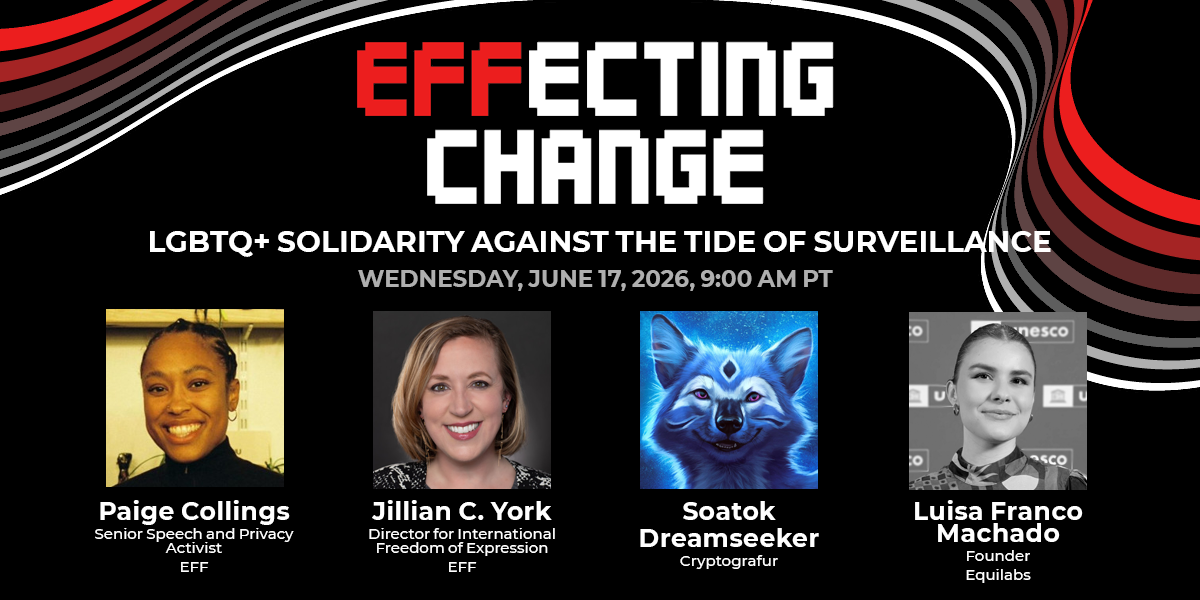
EFFecting Change: LGBTQ+ Solidarity Against the Tide of Surveillance

16 June 2026 at 01:35

LGBTQ+ communities are facing an escalating wave of censorship and targeted surveillance, but we can push back through mutual solidarity. Join us live to learn how safer virtual spaces get built, how platform policies and government pressure are reshaping the digital landscape, and what platform accountability actually looks like. Our panel will share ideas for direct action and concrete strategies you can bring back to your community. Whether you’re an activist, an ally, or just paying attention, this conversation is for you. Join the livestream online followed by live Q&A.

EFFecting Change Livestream Series:
LGBTQ+ Solidarity Against the Tide of Surveillance
Wednesday, June 17th
9:00 am - 10:00 am Pacific - Check Local Time
Livestream followed by Q&A

RSVP Today
This event is LIVE and FREE!


About the Speakers

Paige Collings
As a lawyer, digital policy activist and community organizer, Paige works to dismantle systems of oppression and advance collective liberation. Her work focuses on highlighting how state surveillance and corporate restrictions stifle marginalized communities and perpetuate historic injustices and harm. She has worked with activists across the globe to facilitate systemic change by speaking truth to power and creating spaces for alternative imaginations; and her writing on digital justice has been featured in Wired, Politico, Teen Vogue, the Daily Beast and more.

Jillian C. York
Jillian is EFF's Director for International Freedom of Expression, based in London. Her work examines state and corporate censorship and its impact on culture and human rights, with a focus on historically marginalized communities. At EFF, she organizes coalitions, writes about and researches topics related to freedom of expression, leads the Speaking Freely interview series, and contributes to various other areas of the organization's work. Jillian is the author of Silicon Values: The Future of Free Speech Under Surveillance Capitalism (Verso, 2021), a contributor to several academic volumes, and has written for MIT Technology Review, The Guardian, and WIRED, among others. She is also a visiting professor at the College of Europe Natolin in Warsaw, and a regular speaker at global events.

Soatok Dreamseeker
Soatok Dreamseeker is a gay furry security engineer. He blogs about applied cryptography on his blog, Dhole Moments, and is developing key transparency to enable end-to-end encryption on the Fediverse. His puns are 100% whole groan.

Luísa Franco Machado
Luísa Franco Machado is an award-winning international expert in digital rights and data justice. She has also been a technical advisor in data governance and AI ethics for governments, NGOs, and international organizations worldwide, including the UN, OECD.AI, GIZ, and others. Luísa has carried on policy research at the London School of Economics and Political Science (LSE) and Sciences Po Paris on the intersection between technology and socio-economic development. In 2022, the United Nations recognized them as a global Young Leader for the Sustainable Development Goals (SDGs) among more than 6,500 advocates. In 2025 she was featured in Apolitical's Government AI 100 list as a rising star.

VICTORY: Meta Strips Facial Recognition Code From Smart Glasses App After Public Outcry

9 June 2026 at 01:32

Just days after a damning WIRED report exposed that Meta had quietly embedded facial recognition technology (FRT) code into millions of phones, the tech giant has quietly acquiesced in demands to reverse course.

Last week, researchers identified code in Meta AI, a companion app for its line of smart glasses, that could convert images of faces into unique biometric signatures to identify strangers in public. EFF’s Threat Lab verified these findings through static analysis, and reminded consumers to think twice before buying or using Meta’s surveillance glasses. 

Just as quietly as Meta embedded this code, the app’s June 5th app update appears to have quietly removed all those features and systems. Gone is the face-recognition technology, the code meant to trigger “Person recognized” alerts, and the machine learning models and databases  designed to detect, digitize, and store the biometric signatures of people users engage with.

When WIRED broke the news last week, Meta’s executives immediately went on the defensive. Yet, their actions speak louder than their tweets: less than 48 hours after the public caught wind of their plans, Meta quietly launched an update to scrub nearly all traces of the FRT system from their app.

But this quiet deletion of code does not equal a permanent change of heart. Meta previously used face recognition, and stopped only after it faced the legal and financial consequences. Now the company has refused to answer WIRED’s inquiries on whether it plans to bring the NameTag system back in the future, or what they did with any data they may have already collected during internal testing. 

There are billions of reasons not to turn Meta’s customers into a distributed surveillance machine. This whiplash behavior proves exactly why we cannot rely on the "good will" of Big Tech to protect our digital rights. We need robust, enforceable consumer privacy laws, complete with a private right of action that allows everyday people to sue companies that violate their biometric privacy.

While we won this round, Meta's FRT ambitions probably aren't going away. EFF will keep watching.

Move Fast, Surveil Things

4 June 2026 at 22:08

Update, June 8, 2026: Following widespread public scrutiny and WIRED’s critical reporting, Meta has stripped the unactivated facial recognition code from its latest Meta AI app update.

Meta has deployed facial recognition code to millions of their always-on surveillance glasses, according to new reporting by Wired. EFF’s Threat Lab was able to confirm that the facial recognition code is present through static analysis of the application. 

This dangerous new Meta functionality stores faceprints as a series of 2,048 numbers uniquely representing the positioning of a person’s facial features. When this feature is activated, it will convert every new face in the sightlines of the surveillance glasses into a series of numbers, and compare it to all the existing faceprints in the user’s database.

Wired and EFF confirmed that the code is present and active, though not yet exposed to consumers. Another researcher confirmed that when they manually added a face to the app database by connecting the phone to a computer in debug mode and issuing a few commands, the glasses would subsequently detect that face when it came into view. 

Meta has already paid $650 million to settle a BIPA lawsuit challenging mass facial recognition of every photo posted to its platform, a feature which it has since shut down. 

Despite the billions of reasons not to, Meta seems to have created the capacity to turn their customers into a distributed surveillance machine. This is just one more reason to think twice before buying or using Meta’s surveillance glasses. 

Considering that Meta previously wrote in an internal document that they want to launch facial recognition “during a dynamic political environment where many civil society groups that we would expect to attack us would have their resources focused on other concerns," this invasive new feature doesn't come as a surprise. But Meta's surveillance plans won't escape public scrutiny that easily, and we'll be watching if this feature is rolled out to the public. 

More License Plate Reader Mission Creep: School Residency Verification, Background Checks, and Noise Complaints

26 May 2026 at 23:23

An EFF analysis of millions of searches of Flock Safety automated license plate reader (ALPR) data by police has uncovered a troubling pattern: in the absence of a warrant requirement to search ALPR databases, law enforcement agencies have moved beyond specific investigations to use these surveillance networks for virtually any whim.

Our findings suggest that the absence of a warrant requirement has fostered a culture of unrestricted access to sensitive location data, allowing agencies to leverage that data beyond the scope of specific criminal investigations.

As a refresher: Law enforcement agencies lease or purchase camera systems from Flock Safety and then mount them by the side of the road and at intersections to document every vehicle that passes, including the plate, make, model, color and distinguishing characteristics, along with the date, time and location of where it was seen. 

Law enforcement's talking points—often scripted by the company itself—trumpet their role in solving high-stakes crimes. But the data reveals a different story. What they're not saying is that ALPRs are also frequently used for extremely low-level investigations, such as verifying whether a student lives within a particular school zone. In some cases, police have even used this tech to conduct employment background checks and investigations into loud music complaints. Recently, a motorcyclist was even targeted for simply holding a cell phone while riding.

The reach of this ALPR surveillance is amplified by the nature of the indiscriminate sharing these technologies encourage. Most agencies choose to share broadly, often as part of a nationwide pool, making it common for a single city's system to be searched hundreds of thousands of times each month. By analyzing these "network audit logs," privacy advocates and journalists have uncovered evidence of the technology being used to surveil protesters, abortion-seekers, immigrants, and even ethnic Roma populations. 

While these high-profile abuses are shocking, the more mundane uses are also problematic, signaling a massive, unchecked mission creep that has turned an alleged “crime-fighting” tool into a universal tracker of everyone’s movements. 

Residency Checks

School systems in the U.S. conduct "residency verification" investigations of their parents or guardians to ensure enrolled children live in the district. To carry out these checks, some school districts have enlisted law enforcement officers for help, leveraging ALPR databases to track the comings and goings of families across the region. 

Buford City Schools in Georgia, which serves only about 6,000 students, illustrates the scale of this prying. Between January 2025 and March 2026, school police ran more than 375 searches where officers listed school residency verification, or simply "RV," as the reason for the search. That accounts for more than half of all ALPR searches in that period, and in those three months of 2026, three-quarters of all searches were related to residency verification. 

School officials stand by the searches. "[B]ecause Buford City Schools is a highly sought-after district, we experience ongoing challenges with residency fraud," a spokesperson told Appen Media, which shared the email with EFF. "Flock Safety is one of the tools we use to verify residency and protect the integrity of the Buford City School System for families who live within the district."

A search of ALPR data will show a lot more than whether a family lives within the right zone. In these Buford cases, officers ran some searches across more than 5,800 different networks nationwide. Every time a plate is searched, it can reveal personal information about a family: when they go to the doctor, when they go to worship, when they go out at night, and where they travel on vacation. None of that is the school district's business, and these searches are a huge invasion of privacy. 

While Buford was by the far the most prolific, it wasn't the only agency to run school residency checks. For example, Delhi Township Police Department (DTPD) in Ohio ran 35 searches related to students in five schools in a three-month period during spring 2025, and similarly stood by the practice, citing a warning given to parents that submitting a false statement of residency may be a felony. 

After EFF sent an inquiry to DTPD, the agency conducted a brief investigation and found that "these searches were not done to verify residency upon submission, but to investigate cases where it was believed the form was filled out with false information." DTPD did not say what kind of evidence was required to establish suspicion before an ALPR query, nor did it offer information on how many of these investigations turned out to be justified. 

However, the official told EFF: "in response to your inquiry, the department will be implementing a change to how these queries are documented in the Flock system and internally, to increase accountability and help avoid any confusion moving forward."

Other agencies that ran school residency searches include Cortland Police Department in Ohio and Lincoln Police Department in Alabama. Several agencies also ran searches with "residency," "residency investigation" or "residency verification" as the reason, but that could refer to a number of public services. These agencies include Ridgeland Police Department in Mississippi, Fairfield County Sheriff's Office in South Carolina, Manteno Police Department in Illinois, Illinois Department of Natural Resources, and Mora County Sheriff's Office in New Mexico. 

Background Checks

Few people would imagine that applying for a government job would open you up to an ALPR search. Yet, several law enforcement agencies ran searches through the Flock network related to employment. 

For example:

  • Jefferson County Sheriff's Office in Missouri ran six searches across 2,853 networks, documenting "employment" in the reason field.
  • Little Elm Police Department in Texas ran 10 searches across 6,306 networks, documenting "EMPLOYMENT" in the reason field.
  • Ridgeland Police Department in Mississippi ran two searches across more than 6,000 networks documenting "employment background inv" in the reason field.
  • Texas City Police Department, Texas ran three searches across 728 networks, documenting "pre employment background" in the reason field. 
  • Zion Police Department in Illinois ran a research across 585 networks documenting "Employee Background" in the reason field. 

Davidson Police Department in North Carolina logged a search listed as "Employment Background," but in response to an inquiry from EFF, the chief described this as "poor choice of words by our investigator." He further stated that the agency does not use ALPRs as part of employment background checks, but in this case, the agency shared that a potential violation of a protective order came to light during a background check, hence the reference to it in the search log.

In addition to the agencies mentioned, several agencies ran searches that simply referred to "background check" or "background checks," which could be related to employment or perhaps some other issue, such as a concealed weapons permit, for example. These include Avon Police Department in Indiana, Rockford Police Department in Illinois, San Bernardino County Sheriff's Office in California, and Seaford Police Department in Delaware.

Noise Complaints

Many people have probably been irritated at some point or another by a car blasting a deep bassline or even the infamous "whistle tip." Some may have even called the cops to complain about a neighbor’s house party. But that's a far cry from the types of serious crimes that Flock and its customers have claimed that the ALPR systems would be used to solve. 

Yet, EFF identified 26 agencies where officers felt it was appropriate to pry into a driver's life because of a noise complaint, ranging from house parties to loud exhausts to just "music": 

A table of agencies and their searches that relate to noise complaints.

Some of these agencies searched upwards of 6,500 networks’ cameras—the equivalent of launching a nationwide goose chase over a booming subwoofer or a busted muffler. 

When Mission Creep Is Just Plain Creepy

An observant reader of this report may have noticed that Ridgeland Police Department in Mississippi ran searches in all three of the categories we reported above.

However, after the city first installed the Flock Safety cameras, the then-police chief told the press that the technology helps solve cases that range from "theft to crimes of violence"—without disclosing that the range would extend much further.

When police and salespeople trot out cherry-picked cases to argue that a mass surveillance technology is an "important" tool,  they obfuscate that it's a convenient shortcut around due process. For serious crimes, police can already go through the standard legal process: making the case to a judge on why they should get a search warrant for location data, whether it's from cell phones or service providers. But police treat ALPR databases as if no such threshold exists, giving them free rein to track a person’s movements without a sliver of judicial oversight.

When police and salespeople trot out cherry-picked cases to argue that a mass surveillance technology is an "important" tool,  they obfuscate that it's a convenient shortcut around due process.

"This is the same as if I put a police officer on the side of the road with a pen and a notepad and he writes down every license plate number that drives by,” the former chief said, repeating a commonly circulated talking point. 

That rhetoric may sound reasonable if we were just talking about a single camera on a street corner, but Ridgeland now operates more than 50 cameras—the equivalent of one for every 500 residents—and maintains access to tens of thousands more. 

If the chief had stood in front of the city’s aldermen and asked for permission to search more than 20,000 cameras so his officers could investigate the high crime of "music," it’s quite unlikely that they would have been nodding their heads along. 

Ridgeland Police Department did not respond to EFF’s requests for comment.

Digital Hopes, Real Power: How the Arab Spring Fueled a Global Surveillance Boom

8 April 2026 at 10:22

This is the third installment of a blog series reflecting on the global digital legacy of the 2011 Arab uprisings. You can read the first post here, and the second here.

When people recall the 2011 uprisings across the Middle East and North Africa (MENA), they often picture crowded squares, raised phones, and the feeling that the internet had finally shifted the balance of power toward ordinary people. But the past decade and a half is also a story about how governments, companies, and platforms turned those same tools into the backbone of a powerful state surveillance apparatus.

For activists, journalists, everyday users, that means now living with a constant threat. The phone in your pocket, the platforms you organize on, and the systems you rely on for safety and connection can be weaponized at the flip of a switch. A global surveillance industry has treated repression by many MENA governments as a growth opportunity, and the tactics refined there now shape digital authoritarianism worldwide. This essay traces how that shift unfolded: security agencies upgraded older systems of repression with new surveillance tools and permanent monitoring infrastructure; cybercrime laws and mercenary spyware markets turned digital control into standard operating procedure; and biometrics, facial recognition, and ‘smart city’ projects laid the groundwork for AI‑driven surveillance that now shapes protests, borders, and everyday life far beyond the region. 

Remembering the Arab Spring means seeing the events of 2011 as both a remarkable moment of movement history when people leveraged networked tools in their fight for freedom and the beginning of a long, grinding effort to turn those same tools into mechanisms of state control.

Old‑School Repression, New‑School Tools

Long before Facebook and Twitter, regimes in countries like Egypt and Syria already knew how to crush dissent. They leaned on informant networks, physical surveillance, and wiretaps, backed by emergency laws that let security agencies monitor and detain critics with almost no restraint. Research on the use of surveillance technology in MENA shows that, even before the Arab Spring, states were layering early digital tools like internet monitoring, deep packet inspection, and interception centers on top of that older machinery of control.

At the same time, connectivity was racing ahead. Cheap smartphones and social media suddenly let people share information at scale, coordinate protests, and broadcast abuses in real time. In 2011, EFF described both the excitement around “Facebook revolutions” and the early signs that governments were scrambling to upgrade their capacity to watch and disorganize popular dissent.

After the uprisings, Western critics endlessly debated how much credit to give social media itself. While in the background, security agencies across several MENA states reached a much simpler conclusion: if networked communication can help topple a dictator, then they needed to embed themselves deep inside those networks. Analyses of the rise of digital authoritarianism in MENA show how quickly officials pivoted from being surprised by online organizing to building systems to monitor and pre‑empt it.

In the years after 2011, governments across the region poured money into tools that let them systematically watch what people said and did on major platforms. Foreign vendors set up monitoring centers and interception systems that let security agencies block tens of thousands of sites, scrape and analyze social media at scale, monitor activist pages and online communities, and track activists in real time. They built a new, pre‑emptive model of digital control, one that assumes the state should see as much as possible, as early as possible.

As we noted in 2011, exporting permanent surveillance infrastructure to already‑abusive governments doesn’t “modernize” public safety; it locks in an architecture of control that is primed to abuse dissidents, journalists, and marginalized communities.

Domestic Lawfare and Cyber-Mercenaries

After the uprisings, a number of governments also rewrote the rules that govern online life. Cybercrime laws, “fake news” provisions, and overbroad public‑order and ‘morality’ offences gave prosecutors and security agencies legal cover to act with impunity. Governments in Saudi Arabia, Tunisia, Jordan, and Egypt combined counterterrorism, cybercrime, defamation, and protest laws into a legal thicket designed to make online dissent feel dangerous and costly. Morality laws and cybercrime provisions are used to target queer and trans people based on identity and expression.​

At the United Nations, a new global cybercrime convention now risks baking this logic into international law. The convention was adopted by the UN General Assembly in late 2024, despite serious human rights concerns raised by civil society. Echoing our partners, EFF warned at the time that the UN cybercrime draft convention remained too flawed to adopt and urged states to reject the draft language because it legitimized expansive surveillance powers and criminalized legitimate expression, security research, and everyday digital practices around the world. While on paper, these instruments gesture to “public safety” objectives, in practice they function as pathways for state security agencies to monitor, prosecute, and silence the communities most at risk. For state-targeted communities, that makes being visible online a calculated risk, not a neutral choice.​​

Criminal codes are only half the story; mercenary tech is the other. As governments worldwide looked for ways to outpace their critics, a parallel market emerged to help them infiltrate and take over devices. Companies like NSO Group marketed Pegasus and similar tools as off‑the‑shelf capabilities for governments that wanted to hack a target’s cellphones or other devices to read messages, turn on microphones, and monitor entire social networks while bypassing the courts. 

In 2019, UN Special Rapporteur David Kaye called for a global moratorium on the sale and transfer of private surveillance tools until real, enforceable safeguards exist. Two years later, forensic work by Amnesty and media partners showed how the same spyware used to hack phones of Palestinian human‑rights defenders was used to surveil journalists, activists, lawyers, and political opponents across dozens of countries. 

Regional groups responded by demanding an end to the sale of surveillance technology to autocratic governments and security agencies, arguing that you cannot keep selling “lawful intercept” tools into systems where law itself is an instrument of repression. Commercial spyware is at the center of digital repression, not at its margins. Surveillance vendors are not neutral suppliers. Safeguards remain weak, fragmented, or nonexistent in most of the countries buying these tools, yet vendors continue seeking new contracts and new militarized “use cases.” Put bluntly, the companies that design, market, and maintain these systems precisely because they enable this kind of control profit from (and help entrench) authoritarian power.

Biometrics, Facial Recognition, and AI‑Powered Surveillance Cities

On top of this rapidly intensifying interception and spyware stack, governments and companies began layering biometrics and face recognition into everyday systems, creating pathways for bulk data collection, automated analysis, and risk profiling. In parts of MENA, national ID schemes, border and migration controls, and centralized biometric databases have been rolled out in environments with weak or captured data‑protection laws, making it easy to link people’s movements, services, and political activity to a single, persistent identifier.​

Humanitarian programs are not exempt from this protocol. In Jordan, Syrian refugees have been required to submit iris scans and biometric data to access cash assistance and food, turning “consent” into a precondition for survival. When access to aid depends on enrollment in centralized biometric systems, any breach, misuse, or repurposing of that data can have severe, life‑altering consequences for people who have no realistic way to opt out. Investigations into surveillance‑tech firms complicit in abuses in MENA show that vendors profit from supplying biometric and surveillance tools for migration management and internal security, even when those tools are used in discriminatory or abusive ways.​

Like elsewhere, mass surveillance technologies in MENA were first piloted on people who were already criminalized or made vulnerable by poverty. But their use quickly expanded from narrow, security‑framed deployments to routine use in city streets. As hardware sensors, cameras, and data storage got cheaper, “smart city” surveillance systems promised seamless security and services, and it became easier and less politically contentious to keep these systems running everywhere, all the time.​

Unlike targeted hacking tools, these broad, city‑wide surveillance infrastructures erase any practical line between people under investigation and the broad public, normalizing bulk, indiscriminate monitoring of public space and everyday movement. In the Gulf, facial recognition and dense sensor networks are increasingly built into high‑profile “smart city” and mega‑project plans that lean heavily on biometric and AI‑driven monitoring. These are security‑first development projects where biometric and sensor infrastructures are designed from the outset to embed policing, migration control, and commercial tracking into the urban fabric. In this vision of the Gulf’s “smart city” future—often sold as seamless services and digital opportunity—“smart” is the branding, and pervasive monitoring is the operating principle.​​

EFF has consistently opposed government use of face recognition and biometric surveillance, in some instances calling for outright bans. In contexts that treat peaceful dissent as a security threat, embedding biometric surveillance into everyday infrastructure locks in a balance of power that favors militarized policing and state control. That infrastructure is now the starting point for a new set of risks. Surveillance systems built over the last decade are being repackaged as the foundation for a new generation of “AI‑enabled” defense and security products. 

Companies that once focused on video management or perimeter security now advertise “defense applications” for AI‑driven situational awareness and threat detection, using computer‑vision models to scan camera feeds, compare against existing watchlists, and flag “suspicious” people or behaviors in real time. Drone and sensor platforms are being upgraded with embedded AI that tracks and classifies targets autonomously and with “drone‑based AI threat detection and intelligent situational awareness,” turning aerial surveillance into a continuous data feed for security agencies and militaries. In smart‑city and defense expos from the Gulf to Europe and North America, similar systems are marketed as neutral efficiency upgrades or tools to “protect critical infrastructure,” even where they are explicitly designed to scale up border enforcement, protest surveillance, and internal security operations.

As these systems are folded into AI‑driven defense products, the line between “civilian” infrastructure and militarized surveillance disappears, turning streets, borders, and aid sites into continuous input for security operations. That is the landscape that human rights and accountability efforts now have to confront.

Templates of Control, Networks of Resistance

The patterns established in heavily securitized MENA states after the Arab Spring now shape how states monitor and crush more recent uprisings, from Iran’s use of location data and facial recognition to track down protesters to long‑running crackdowns elsewhere in the region. This model of “digital authoritarianism” built on spyware, data‑hungry ID systems, platform control, and emergency‑style security laws has emerged everywhere from Latin America to Eastern Europe to here in the United States. As the new UN Cybercrime Convention moves toward implementation, its broad offences and surveillance powers risk turning this ad hoc toolkit into a formal template for cross‑border data‑sharing, repression, and an all‑purpose global surveillance instrument.

For people on the ground, none of this is theoretical. Human‑rights defenders, journalists, and ordinary users across the region face arrest, long prison sentences, and exile based on their digital traces. In that context, commercial spyware is not a marginal issue but part of the core machinery of repression. Pegasus has been used to hack journalists’ phones through zero‑click exploits and compromise human‑rights defenders and watchdog organizations themselves, including staff at Amnesty’s Pegasus Project partners and Human Rights Watch. These deployments give practical effect to the “cybercrime” and “terrorism” frameworks described earlier: person‑by‑person campaigns against particular communities, contacts, and networks, rather than “neutral,” generalized security measures.

Under these conditions, everyday security becomes a second job. People describe carrying multiple phones, keeping one for relatively “clean” uses and others for riskier conversations, splitting identities across platforms, using coded language, and moving their organizing off mainstream services when possible. Pushing this burden onto users is a political choice: states, platforms, and vendors could build systems that are safe by design; instead, they externalize risk to the people they watch and punish.

Even against that backdrop, civil society organizations have refused to capitulate to security agencies and vendors. Regional coalitions have demanded strict export controls and outright bans on selling intrusive surveillance tech to autocratic governments. Advocates have also pushed companies to do more than box‑ticking “due diligence.” Work with surveillance‑tech firms in the context of migration and border control has repeatedly shown that most are still far from serious human‑rights assessments, let alone willing to turn down these lucrative contracts.

Many of the same governments that have been critical of others on the issue of human rights have hosted or licensed companies that build these tools, in some cases buying similar capabilities for their own security agencies. European authorities, for instance, have investigated FinFisher’s export of spyware “made in Germany” to Turkey and other non‑EU governments. Meanwhile, the NSO Group has at least 22 Pegasus contracts with security and law‑enforcement agencies in 12 EU countries. This is a transnational industry, not a localized problem.

Against near impossible odds, people continue finding pathways to freedom. The global surveillance sector reinforces the same hierarchies and violence that people have found ways to survive for generations. Queer activists and others at the sharpest edges of this system have had to develop their own forms of resistance, including against biometric and data‑driven targeting. Encryption, circumvention tools, and security training are not silver bullets, but they remain essential for anyone trying to organize, document abuses, or simply exist online with a bit less risk. Resources like EFF’s Surveillance Self‑Defense are one piece of that ecosystem, alongside trainers and groups who have been doing this work on the ground for years.​

Defending the Future of Digital Dissent

The Arab Spring is often remembered through images of packed squares and hopeful tweets. But contending with its aftermath means confronting the surveillance architecture built in its shadow: laws that turn online speech into a crime, spyware and biometric systems that turn phones and faces into tracking beacons, and platform practices that routinely sacrifice the people most at risk. None of that is inevitable, and none of it is confined to one part of the world.

Accountability has to reach both governments and the companies that profit from arming them with these tools. That means pushing for far stronger limits on how surveillance tech is built, sold, and deployed; demanding meaningful transparency when these systems are used; and defending the tools people rely on to communicate and organize safely, including robust encryption and secure channels. It also means taking direction from the people and communities who have been navigating and resisting this landscape for years.

Surveillance itself is transnational: tools, playbooks, and data moves across borders as easily as money. And so we, too, continue our work, documenting abuses, sharing security knowledge, and collectively organizing against these violent systems.

​This is the third installment of a blog series reflecting on the global digital legacy of the 2011 Arab uprisings. Read the rest of the series here.

Traffic Violation! License Plate Reader Mission Creep Is Already Here

26 March 2026 at 21:19

A new report from 404 Media sheds light on how automated license plate readers (ALPRs) could be used beyond the press releases and glossy marketing materials put out by law enforcement agencies and ALPR vendors. In December 2025, Georgia State Patrol ticketed a motorcyclist for holding a cell phone in his hand. According to the report, the ticket read, “CAPTURED ON FLOCK CAMERA 31 MM 1 HOLDING PHONE IN LEFT HAND.” 

If you’re thinking that this sounds outside of the scope of what ALPRs are supposed to do, you’re right. In November 2025, Flock Safety, the maker of the ALPR in question, wrote a post about how they definitely are in compliance with the Fourth Amendment to the U.S. Constitution. In this post, which highlighted what ALPRs are and what they are not, the company writes: “What it is not: Flock ALPR does not perform facial recognition, does not store biometrics, cannot be queried to find people, and is not used to enforce traffic violations.” (emphasis added)

Well, apparently their customers never got the memo and apparently the technology’s design does not explicitly prevent behavior the company officially and publicly disavows. 

Or at least this used to be the case: Flock now lists six different companies providing traffic enforcement technology on its “Partner program”  site. Public records also show that speed enforcement cameras have been connected to Flock's ALPR network. 

EFF and other privacy advocates have long warned about mission creep when it comes to surveillance infrastructure. Police often swear that a piece of technology will only be used in a particular set of circumstances or to fight only the most serious crimes only to utilize it to fight petty crimes or watch protests.  

We continue to urge cities, states, and even companies to end their relationship with Flock Safety because of the incompatibility between the mass surveillance it enables and its inability to protect civil liberties—including preventing mission creep.

Victory! Tenth Circuit Finds Fourth Amendment Doesn’t Support Broad Search of Protesters’ Devices and Digital Data

27 February 2026 at 07:03

In a big win for protesters’ rights, the U.S. Court of Appeals for the Tenth Circuit overturned a lower court’s dismissal of a challenge to sweeping warrants to search a protester’s devices and digital data and a nonprofit’s social media data.

The case, Armendariz v. City of Colorado Springs, arose after a housing protest in 2021, during which Colorado Springs police arrested protesters for obstructing a roadway. After the demonstration, police also obtained warrants to seize and search through the devices and data of Jacqueline Armendariz Unzueta, who they claimed threw a bike at them during the protest. The warrants included a search through all of her photos, videos, emails, text messages, and location data over a two-month period, as well as a time-unlimited search for 26 keywords, including words as broad as “bike,” “assault,” “celebration,” and “right,” that allowed police to comb through years of Armendariz’s private and sensitive data—all supposedly to look for evidence related to the alleged simple assault. Police further obtained a warrant to search the Facebook page of the Chinook Center, the organization that spearheaded the protest, despite the Chinook Center never having been accused of a crime.

The district court dismissed the civil rights lawsuit brought by Armendariz and the Chinook Center, holding that the searches were justified and that, in any case, the officers were entitled to qualified immunity. The plaintiffs, represented by the ACLU of Colorado, appealed. EFF—joined by the Center for Democracy and Technology, the Electronic Privacy Information Center, and the Knight First Amendment Institute at Columbia University—wrote an amicus brief in support of that appeal.

In a 2-1 opinion, the Tenth Circuit reversed the district court’s dismissal of the lawsuit’s Fourth Amendment search and seizure claims. The court painstakingly picked apart each of the three warrants and found them to be overbroad and lacking in particularity as to the scope and duration of the searches. The court further held that in furnishing such facially deficient warrants, the officers violated “clearly established” law and thus were not entitled to qualified immunity. Although the court did not explicitly address the First Amendment concerns raised by the lawsuit, it did note the backdrop against how these searches were carried out, including animus by Colorado Springs police leading up to the housing protest.

It is rare for appellate courts to call into question any search warrants. It’s even rarer for them to deny qualified immunity defenses. The Tenth Circuit’s decision should be celebrated as a big win for protesters and anyone concerned about police immunity for violating people’s constitutional rights. The case is now remanded back to the district court to proceed—and hopefully further vindicate the privacy rights we all have in our devices and digital data.

❌