Normal view

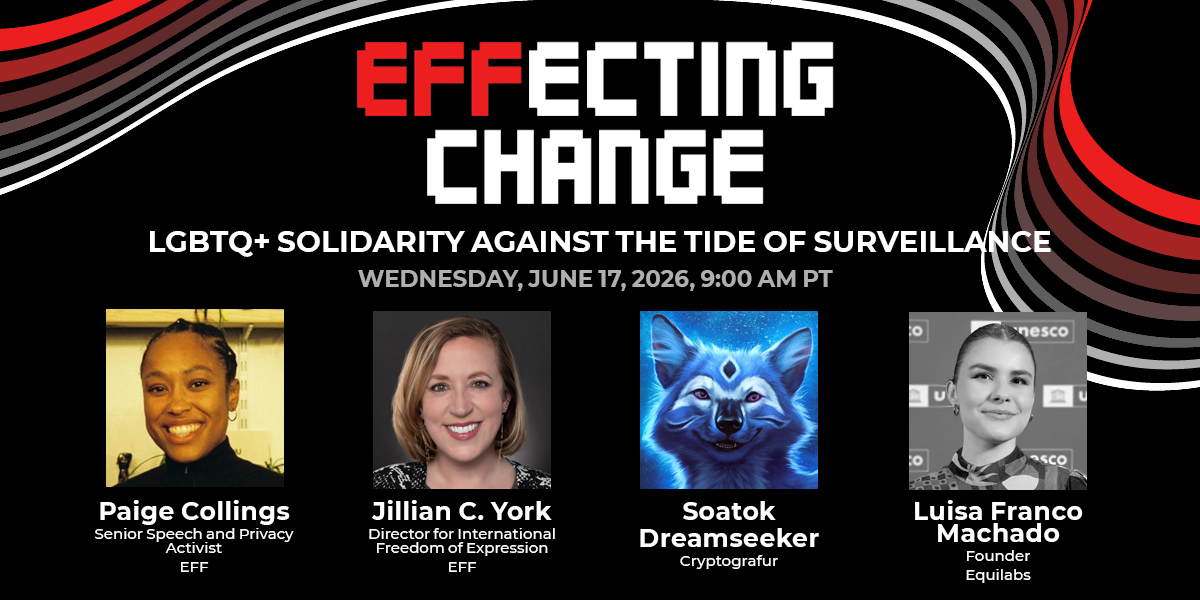
EFFecting Change: LGBTQ+ Solidarity Against the Tide of Surveillance

16 June 2026 at 01:35

LGBTQ+ communities are facing an escalating wave of censorship and targeted surveillance, but we can push back through mutual solidarity. Join us live to learn how safer virtual spaces get built, how platform policies and government pressure are reshaping the digital landscape, and what platform accountability actually looks like. Our panel will share ideas for direct action and concrete strategies you can bring back to your community. Whether you’re an activist, an ally, or just paying attention, this conversation is for you. Join the livestream online followed by live Q&A.

EFFecting Change Livestream Series:
LGBTQ+ Solidarity Against the Tide of Surveillance
Wednesday, June 17th
9:00 am - 10:00 am Pacific - Check Local Time
Livestream followed by Q&A

RSVP Today
This event is LIVE and FREE!


About the Speakers

Paige Collings
As a lawyer, digital policy activist and community organizer, Paige works to dismantle systems of oppression and advance collective liberation. Her work focuses on highlighting how state surveillance and corporate restrictions stifle marginalized communities and perpetuate historic injustices and harm. She has worked with activists across the globe to facilitate systemic change by speaking truth to power and creating spaces for alternative imaginations; and her writing on digital justice has been featured in Wired, Politico, Teen Vogue, the Daily Beast and more.

Jillian C. York
Jillian is EFF's Director for International Freedom of Expression, based in London. Her work examines state and corporate censorship and its impact on culture and human rights, with a focus on historically marginalized communities. At EFF, she organizes coalitions, writes about and researches topics related to freedom of expression, leads the Speaking Freely interview series, and contributes to various other areas of the organization's work. Jillian is the author of Silicon Values: The Future of Free Speech Under Surveillance Capitalism (Verso, 2021), a contributor to several academic volumes, and has written for MIT Technology Review, The Guardian, and WIREDamong others. She is also a visiting professor at the College of Europe Natolin in Warsaw, and a regular speaker at global events.

Soatok Dreamseeker
Soatok Dreamseeker is a gay furry security engineer. He blogs about applied cryptography on his blog, Dhole Moments, and is developing key transparency to enable end-to-end encryption on the Fediverse. His puns are 100% whole groan.

Luísa Franco Machado
Luísa Franco Machado is an award-winning international expert in digital rights and data justice. She has also been a technical advisor in data governance and AI ethics for governments, NGOs, and international organizations worldwide, including the UN, OECD.AI, GIZ, and others. Luísa has carried on policy research at the London School of Economics and Political Science (LSE) and Sciences Po Paris on the intersection between technology and socio-economic development. In 2022, the United Nations recognized them as a global Young Leader for the Sustainable Development Goals (SDGs) among more than 6,500 advocates. In 2025 she was featured in Apolitical's Government AI 100 list as a rising star.

Yes to California's Bill to Ban Surveillance Pricing

11 June 2026 at 21:56

Corporations harvest and monetize ever-growing amounts of our personal data, such as our browsing history and physical location. One bitter fruit of this poisonous tree is known as “surveillance pricing”: corporations offer the same product to two different people at two different prices, based on scrutiny of these people’s respective personal data.

Surveillance pricing is bad for privacy, equity, and price transparency. So EFF supports a California bill, S.B. 2564, which would ban this creepy practice.

How Surveillance Pricing Works

In 2025, the Federal Trade Commission (FTC) published a report about the practices of six companies that provide surveillance pricing services to hundreds of other companies, including grocery stores and apparel retailers. The report found that surveillance pricing draws upon customers’ browsing history, physical location, and shopping transaction history. Customers’ data can come from the vendor itself, from its surveillance pricing service provider, or from third-party data brokers. Customers are sorted into groups based on their personal data, as is done for targeted ads. As a result of surveillance pricing, a business might offer two customers different prices for the same product, based for example on whether they are a new parent, or whether they live near a business’s competitor.

As former FTC Chair Lina Khan explained:

Initial staff findings show that retailers frequently use people’s personal information to set targeted, tailored prices for goods and services – from a person’s location and demographics, down to their mouse movements on a webpage.

Unfortunately, the current FTC chair closed the FTC’s portal for public comments regarding surveillance pricing. Fortunately, the California Attorney General has initiated its own investigation of this practice.

Researchers have identified many examples of surveillance pricing:

  • The Princeton Review offered people who lived in some zip codes a higher price for test prep services, compared to people in other zip codes. As a result, Asians were twice as likely as non-Asians to be offered a higher price.
  • In a year-long study of tens of millions of rides in Chicago, Uber and Lyft offered a higher price for trips that ended in neighborhoods with high non-white populations.
  • Tindr offered older people (aged 30 to 49) higher prices for Tindr Plus, compared to younger people (aged 18-29).
  • Orbitz offered people who used Apple computers a higher price for hotel rooms, compared to people who used other types of computers.
  • Hotel booking sites offered people from San Francisco a higher price for hotel rooms, compared to people from other cities.
  • Target offered a higher price to people physically located at the store, compared to people located elsewhere.
  • Staples offered a higher price to customers who lived further from the company’s competitors, compared to customers who lived closer.

Why EFF Hates Surveillance Pricing

This practice is harmful in many ways. First, surveillance pricing invades our privacy.  Vendors offer us a price only after scrutinizing our personal data about what we’ve clicked online and where we’ve travelled offline. Moreover, surveillance pricing incentivizes all businesses to harvest as much of our personal data as possible. Some businesses will use it for their own surveillance pricing. Other businesses, which might not themselves use it this way, will sell it to data brokers, which in turn will sell it to others for use in surveillance pricing.

Second, surveillance pricing can disparately burden people of color and other vulnerable groups. For example, as described above, surveillance pricing led to Asian people paying more for test prep services, older people paying more for dating services, and people living in non-white neighborhoods paying more for a ride home.

Third, surveillance pricing is opaque. Many people don’t even know when they’ve been subjected to it. Those that do often cannot determine the unknown reasons for the price they’re offered. As a result, consumer advocates will be less able to publish meaningful price comparisons to help consumers make choices. And regulators will be less able to identify unlawful pricing practices.

Thus, EFF and many other groups object to surveillance pricing.

Its defenders sometimes argue that surveillance pricing benefits consumers because it can lead to lower prices. But while some consumers some of the time might get lower prices because of surveillance of their personal data, other consumers will get higher prices, as shown by the examples above. Some recent studies indicate there will be losers and winners based on factors like whether a consumer is willing or able to switch products. Who loses or wins also will turn on the accuracy of the underlying data – yet surveillance pricing is often based on false information.

In any event, both losers and winners of this price discrimination are harmed by surveillance. Privacy is a human right, not a property to be bought and sold on a market. For this reason, EFF has long opposed pay-for-privacy schemes, in which a company charges a higher price to a customer who refuses to submit to processing of their personal data. Thus, even if surveillance pricing sometimes leads to lower prices (and again, it often will not), we oppose it as just another way that corporations try to make customers pay for their privacy.

What the California Bill Would Do

The key term of California’s S.B. 2564 is short and sweet: “a retailer shall not engage in surveillance pricing.”

The banned practice is defined as: “[i] a customized price for a good for a specific consumer or group of consumers, [ii] based, in whole or in part, on personally identifiable information collected through electronic surveillance,” including if that information is “acquired from a third party.” In other words, “surveillance pricing” is a customized price based on personal information.

The bill has two enforcement methods. First, state and local government may bring enforcement actions, and seek all manner of remedies including monetary penalties. Second, individual consumers may bring their own enforcements lawsuits, and seek the remedies of an injunction and attorney fees. We are pleased the bill provides this private right of action, which is the most important method of enforcement (we’d be even more pleased if the private remedies included liquidated damages).

The bill has three exemptions where surveillance pricing is allowed:

  • First, for price differences “based solely on costs associated with providing the good to different consumers.”
  • Second, for a discount offered to a consumer who is taking steps to terminate a service.
  • Third, for a discount, conspicuously posted on a retailer’s website, that is uniformly available based on (1) criteria anyone can meet, such as signing up for a mailing list, (2) membership in a broadly defined group, such as seniors, or (3) participation in a loyalty program.

The bill’s author is California Assembly Member Chris Ward. Its co-sponsors are Consumer Reports and TechEquity. Its supporters include Consumer Federation, EPIC, Kapor Center Advocacy, Oakland Privacy, Privacy Rights Clearinghouse, labor unions, and other groups. The bill has advanced through the California Assembly and has arrived for consideration in the California Senate.

Why EFF Supports the California Bill

Surveillance pricing is just one part of a much larger problem: corporations maximizing their profits by invading our privacy. The all-too-common business model is to systematically harvest, collate, and store as much of our personal data as possible, and then monetize it through use and sale.

EFF’s general approach to this problem is a strong regulatory framework that we call “privacy first.” For example, laws should require businesses to “minimize” their data processing, meaning they must not collect, store, use, or disclose our data unless doing so is strictly necessary to give us what we asked for. Likewise, laws should require businesses to get our voluntary and informed opt-in consent before processing our data, buttressed by legal bans on coercive pay-for-privacy schemes and manipulative “dark patterns.”

A.B. 2564 is just a specific application of the minimization rule. Nobody who uses a web browser or a mobile app expects that, as a result, their clicks and footsteps will be funneled into personal dossiers, and later used by downstream businesses to offer a higher or lower price.

A.B. 2564 is also a specific application of the “no pay-for-privacy” rule. At its best, surveillance pricing is a corporate offer of a lower price in exchange for a consumer’s submission to surveillance of their personal data. This scheme encourages all people to surrender their privacy in exchange for a lower price. This is especially coercive for people with lower incomes, and thus carries the risk of creating a society of privacy “haves” and “have nots.” And swept into this supposed “bargain” is the potential for higher surveillance-based prices based on false information or erroneous inferences.

Surveillance pricing is very similar to online behavioral advertising, a business practice that EFF urges governments to ban. Both practices incentivize all businesses to collect as much of our personal data as possible, in order to later monetize it. Both practices lead some businesses to collate and store our data into dossiers about us for later use. Both practices use these surveillance-based dossiers to manipulate and limit our economic choices, by altering the advertisements and prices we see online. In the words of the FTC report discussed above: “Existing and common techniques used for targeted advertising can also be used for other forms of targeting prices.”

Absent a specific ban on surveillance pricing, as in A.B. 2564, it would be very difficult to protect the public from the many harms it causes. Corporate price-setting is increasingly opaque, making it difficult for consumers and regulators to determine whether a particular company set a particular price for a particular consumer based on their data, and if so, the particular data that it used. As a result, it would be very difficult in this context to enforce general laws requiring minimization or consent. Moreover, many such laws exempt how a business processes the data it directly collected from its own customers; for example, the California Consumer Privacy Act’s limits on “cross-context behavioral advertising” do not apply to how a business uses personal data it collected on its own website. Yet many practitioners of surveillance pricing (like Tindr) rely on such data.

Finally, there is little to no risk that A.B. 2564 will have unintended consequences that hurt internet users’ speech or technological innovation. The bill does not address any particular type of technology. It does not limit any collection, retention, or disclosure of personal data. It limits only one very narrow and easily defined use of data: use to set a customized price. And it has three broad exemptions.

In sum, EFF is proud to join with other groups in support of California’s A.B. 2564. You can read our support letter here.

LGBT Q&A: We’re Back With Season 2! 

11 June 2026 at 13:20

Last June during Pride, we launched a new initiative—LGBT Q&A—where we answered your most pressing queer-related digital rights questions on EFF’s Instagram and TikTok accounts. No question was too big or too small! You asked us things like what pictures to use on dating apps; how to remove your name from internet searches; why homophobic content doesn't get removed after you report it; and how to stay safe at Pride marches.

And this year, we’re doing it all again. 

Both online and offline, LGBTQ+ individuals and the fight for queer liberation are under threat; and the need for guidance and protection from prying eyes and oppressive structures is increasingly pertinent. This is particularly true for those of us who face consequences when intimate details around gender or sexual identities are revealed without consent. 

But we know that it can feel overwhelming to even start thinking about how you can protect yourself online in the face of these issues. That's why this Pride, we’re answering all your digital rights questions. 

How to submit your questions?

  • If you would like to remain anonymous and away from social platforms, you can submit questions via this secure link
  • Head to EFF’s Reddit or the r/LGBTQ subreddit and submit your questions underneath the posts. 
  • Your questions can also be submitted under the linked posts on EFF’s Instagram and TikTok, as well as on our stories where you can submit questions directly. 
  • If you prefer Mastodon and Bluesky, comment your questions under the linked posts. 

As always, we will not engage with comments that discriminate against marginalized groups, including the LGBTQ+ community.

We’re here to help build an online space where you get to decide what aspects of yourself you share with others, how you present to the world, and what things you keep private. Join us to make the internet private, safe, and full of pride.

Internet Age Gates Are a Growing Global Threat

5 June 2026 at 21:28

The internet is an essential resource for young people and adults to access information, explore community, and find themselves—both inside countries and across continents. Yet governments around the world continue to introduce and implement legislation requiring all online users to verify their ages before accessing the digital space. In some cases, politicians are going further, putting forth proposals to ban social media for younger users.  

In late 2025, Australia’s government rolled out the first complete ban on users under 16 from having social media accounts. In this sweeping regime, platforms are required to introduce age assurance tools to block under-16s, demonstrate that they have taken “reasonable steps” to deactivate accounts used by under-16s, and prevent any new accounts being created, or face fines of up to 49.5 million Australian dollars ($32 million USD). The 10 banned platforms—Instagram, Facebook, Threads, Snapchat, YouTube, TikTok, Kick, Reddit, Twitch, and X—have each said they’ll comply with the legislation, which led to young people losing access to their accounts overnight. Reddit is currently challenging the law in Australian courts on constitutional grounds. Recent research notes how the ban is preventing teenagers from accessing news in the country. 

In the United Kingdom, rules took effect in mid-2025 under the Online Safety Act that require all online services available in the country to assess whether they host content considered harmful to children; if so, these services must introduce age checks to prevent children from accessing such content. Online services are also required to change their algorithms and moderation systems to ensure that content defined as harmful, like violent imagery, is not shown to young people. 

This approach is reckless, short-sighted, and we’ve already seen it introduce more harm to the young people that it is trying to protect. The UK’s scramble to find an effective age verification method shows us that there isn't one, and we’ve spent years urging UK politicians to abandon any measures that require platforms to collect data or remove privacy protections around users’ identities. 

Earlier this year, Indonesia’s Communications and Digital Affairs Minister, Meutya Hafid, announced that users under 16 would have their accounts on “high risk” platforms deactivated from 28 March. The platforms subject to this ban are YouTube, TikTok, Facebook, Instagram, Threads, X, Bigo Live, and Roblox; with Hafid noting how this policy would make Indonesia “the first non-Western country to delay children's access to digital spaces according to age.”

Similarly, the Malaysian government has recently pushed forward with plans to ban users under 16 from having accounts on social media platforms with at least 8 million users in Malaysia, including Facebook, Instagram, TikTok, and YouTube. Users under the age of 16 are being told to download or transfer their data from these platforms in one month before the restrictions are applied. Platforms failing to comply with the ban may face penalties of up to $2.5 million USD.

In Latin America, Brazil approved a new law in 2025 establishing that providers of information technology products and services directed to children and teenagers, or likely to be accessed by them, must conduct age checks when their products and services offer risks to underage users. Regulation requires age assurance for products and services that are not allowed for children and adolescents in accordance with Brazilian legislation. App stores and operating systems are required to provide age signals for other providers. 

While the law is already in force, full compliance with its obligations is expected for early 2027, after the approval of further regulations and a transition period, and the authority responsible for enforcing the law is the Brazilian National Data Protection Agency. The list of concerns regarding the implementation of the law include: the wide scope of products and services that may fall within age-check obligations, how these obligations can affect non-proprietary operating systems and free software projects, and how effective the law's crucial data protection safeguards will be in a context of likely widespread age checks for accessing content online.

Similarly, the European Union has taken large steps towards mandatory age verification that could undermine privacy, expression, and participation rights for everyone. Politicians are promoting an EU-wide approach to age verification through its age verification “app,” which will be fully interoperable with the Digital Identity Wallet. While this mini-app has been announced as technically ready to be rolled out “for citizens to use,” it comes with its own realm of potential privacy and security concerns, such as long-term identifiers (which could result in tracking) and over-exposure of personal information. 

The European Commission also supports age verification in various legislative initiatives, from proposals that would allow or mandate companies to scan our communication (“Chat Control”) to non-binding guidelines of existing laws, such as the Digital Services Act. The EU Parliament, too, has proposed an EU digital minimum age of 16 for access to social media, a move that aligns with EU Commission’s president Ursula von der Leyen’s recent public support for measures inspired by Australia’s model. To all these initiatives EFF has provided one consistent response: mandatory age verification measures are not the right way to protect young people. 

These proposals restrict the fundamental rights of young people to speak to each other and to access information. They also force all internet users, not just those under a certain age, to upload private data—like a face scan or passport—in order to access a website or service. In considering the vast scope of privacy issues pertaining to the collection, storage, and sharing of this personal information, the problems of age verification in restricting free speech are compounded by these reckless and harmful approaches to verification. 

The problem of censorship and surveillance goes far beyond the borders of the internet. EFF continues to explore support for legislative and litigation challenges that recognize how these laws harm everyone’s rights to privacy, free expression and due process.

LGBT Q&A Season 1 Recap: Staying Safer Online

5 June 2026 at 19:01

Last year during LGBTQ+ Pride month, we launched an LGBT Q&A where we answered your most pressing digital rights questions on EFF’s Instagram and TikTok  accounts. 

Ahead of LGBT Q&A Season 2 launching next week, we’re posting a recap with some of the questions we answered. Check them out below.

  1. You wanted to know: How to stay safe when dating online.
  2. You asked: I'm a 17 year old trans woman and my address is public on the Internet. What steps can I take to mitigate this risk? 
  3. You wondered about: Tips for staying safe at Budapest Pride.
  4. You questioned: Why does homophobic content I report on social media not get removed?  
  5. You asked: What pictures are safe to use on dating apps?
  6. You wanted to know: Is it safe to have gay, trans, and Palestinian flags in my bio? 

We’re here to help build an online space where you get to decide what aspects of yourself you share with others, how you present to the world, and what things you keep private. Join us to make the internet private, safe, and full of pride.

EFF Testifies to Congress on Protecting Americans’ Rights from Government AI

4 June 2026 at 22:52

Governments must not adopt emerging and powerful AI technologies without also adopting strong and clear safeguards to protect Constitutional rights, EFF Senior Policy Analyst Dr. Matthew Guariglia testified today to the House Homeland Security Subcommittee on Cybersecurity and Infrastructure Protection. 

During the hearing on “The AI Security Landscape: How Frontier Models, Agentic AI, and AI Coding Tools Are Reshaping Cybersecurity and Critical Infrastructure Resilience,” he explained that the use of generative AI for the purposes of mass government surveillance would supercharge unconstitutional violations of civil liberties. He also highlighted how government secrecy, in addition to the black box of for-profit proprietary technology, prevents the public and lawmakers from knowing when AI models make mistakes, including errors that seriously impact the cybersecurity of critical infrastructure and the lives of individuals.  

“AI also has a track record of getting things wrong—from false citations on legal briefs to a major AI mistake that sent DHS recruits to the field without proper training. There are likely more consequential examples that we do not even know about because of classification that would prevent a more thorough accounting," he said in his opening remarks.

play
Privacy info. This embed will serve content from youtube.com


“At this level the question is not how do we rein in AI, it’s how do we rein in the agencies that would unleash AI on the American public,” Matthew said in response to a question by Subcommittee Ranking Member Delia Ramirez, D-Ill.  

You can read his full testimony as prepared here. 

More License Plate Reader Mission Creep: School Residency Verification, Background Checks, and Noise Complaints

26 May 2026 at 23:23

An EFF analysis of millions of searches of Flock Safety automated license plate reader (ALPR) data by police has uncovered a troubling pattern: in the absence of a warrant requirement to search ALPR databases, law enforcement agencies have moved beyond specific investigations to use these surveillance networks for virtually any whim.

Our findings suggest that the absence of a warrant requirement has fostered a culture of unrestricted access to sensitive location data, allowing agencies to leverage that data beyond the scope of specific criminal investigations.

As a refresher: Law enforcement agencies lease or purchase camera systems from Flock Safety and then mount them by the side of the road and at intersections to document every vehicle that passes, including the plate, make, model, color and distinguishing characteristics, along with the date, time and location of where it was seen. 

Law enforcement's talking points—often scripted by the company itself—trumpet their role in solving high-stakes crimes. But the data reveals a different story. What they're not saying is that ALPRs are also frequently used for extremely low-level investigations, such as verifying whether a student lives within a particular school zone. In some cases, police have even used this tech to conduct employment background checks and investigations into loud music complaints. Recently, a motorcyclist was even targeted for simply holding a cell phone while riding.

The reach of this ALPR surveillance is amplified by the nature of the indiscriminate sharing these technologies encourage. Most agencies choose to share broadly, often as part of a nationwide pool, making it common for a single city's system to be searched hundreds of thousands of times each month. By analyzing these "network audit logs," privacy advocates and journalists have uncovered evidence of the technology being used to surveil protesters, abortion-seekers, immigrants, and even ethnic Roma populations

While these high-profile abuses are shocking, the more mundane uses are also problematic, signaling a massive, unchecked mission creep that has turned an alleged “crime-fighting” tool into a universal tracker of everyone’s movements. 

Residency Checks

School systems in the U.S. conduct "residency verification" investigations of their parents or guardians to ensure enrolled children live in the district. To carry out these checks, some school districts have enlisted law enforcement officers for help, leveraging ALPR databases to track the comings and goings of families across the region. 

Buford City Schools in Georgia, which serves only about 6,000 students, illustrates the scale of this prying. Between January 2025 and March 2026, school police ran more than 375 searches where officers listed school residency verification, or simply "RV," as the reason for the search. That accounts for more than half of all ALPR searches in that period, and in those three months of 2026, three-quarters of all searches were related to residency verification. 

School officials stand by the searches. "[B]ecause Buford City Schools is a highly sought-after district, we experience ongoing challenges with residency fraud," a spokesperson told Appen Media, which shared the email with EFF. "Flock Safety is one of the tools we use to verify residency and protect the integrity of the Buford City School System for families who live within the district."

A search of ALPR data will show a lot more than whether a family lives within the right zone. In these Buford cases, officers ran some searches across more than 5,800 different networks nationwide. Every time a plate is searched, it can reveal personal information about a family: when they go to the doctor, when they go to worship, when they go out at night, and where they travel on vacation. None of that is the school district's business, and these searches are a huge invasion of privacy. 

While Buford was by the far the most prolific, it wasn't the only agency to run school residency checks. For example, Delhi Township Police Department (DTPD) in Ohio ran 35 searches related to students in five schools in a three-month period during spring 2025, and similarly stood by the practice, citing a warning given to parents that submitting a false statement of residency may be a felony. 

After EFF sent an inquiry to DTPD, the agency conducted a brief investigation and found that "these searches were not done to verify residency upon submission, but to investigate cases where it was believed the form was filled out with false information." DTPD did not say what kind of evidence was required to establish suspicion before an ALPR query, nor did it offer information on how many of these investigations turned out to be justified. 

However, the official told EFF: "in response to your inquiry, the department will be implementing a change to how these queries are documented in the Flock system and internally, to increase accountability and help avoid any confusion moving forward."

Other agencies that ran school residency searches include Cortland Police Department in Ohio and Lincoln Police Department in Alabama. Several agencies also ran searches with "residency," "residency investigation" or "residency verification" as the reason, but that could refer to a number of public services. These agencies include Ridgeland Police Department in Mississippi, Fairfield County Sheriff's Office in South Carolina, Manteno Police Department in Illinois, Illinois Department of Natural Resources, and Mora County Sheriff's Office in New Mexico. 

Background Checks

Few people would imagine that applying for a government job would open you up to an ALPR search. Yet, several law enforcement agencies ran searches through the Flock network related to employment. 

For example:

  • Jefferson County Sheriff's Office in Missouri ran six searches across 2,853 networks, documenting "employment" in the reason field.
  • Little Elm Police Department in Texas ran 10 searches across 6,306 networks, documenting "EMPLOYMENT" in the reason field.
  • Ridgeland Police Department in Mississippi ran two searches across more than 6,000 networks documenting "employment background inv" in the reason field.
  • Texas City Police Department, Texas ran three searches across 728 networks, documenting "pre employment background" in the reason field. 
  • Zion Police Department in Illinois ran a research across 585 networks documenting "Employee Background" in the reason field. 

Davidson Police Department in North Carolina logged a search listed as "Employment Background," but in response to an inquiry from EFF, the chief described this as "poor choice of words by our investigator." He further stated that the agency does not use ALPRs as part of employment background checks, but in this case, the agency shared that a potential violation of a protective order came to light during a background check, hence the reference to it in the search log.

In addition to the agencies mentioned, several agencies ran searches that simply referred to "background check" or "background checks," which could be related to employment or perhaps some other issue, such as a concealed weapons permit, for example. These include Avon Police Department in Indiana, Rockford Police Department in Illinois, San Bernardino County Sheriff's Office in California, and Seaford Police Department in Delaware.

Noise Complaints

Many people have probably been irritated at some point or another by a car blasting a deep bassline or even the infamous "whistle tip." Some may have even called the cops to complain about a neighbor’s house party. But that's a far cry from the types of serious crimes that Flock and its customers have claimed that the ALPR systems would be used to solve. 

Yet, EFF identified 26 agencies where officers felt it was appropriate to pry into a driver's life because of a noise complaint, ranging from house parties to loud exhausts to just "music": 

A table of agencies and their searches that relate to noise complaints.

Some of these agencies searched upwards of 6,500 networks’ cameras—the equivalent of launching a nationwide goose chase over a booming subwoofer or a busted muffler. 

When Mission Creep Is Just Plain Creepy

An observant reader of this report may have noticed that Ridgeland Police Department in Mississippi ran searches in all three of the categories we reported above.

However, after the city first installed the Flock Safety cameras, the then-police chief told the press that the technology helps solve cases that range from "theft to crimes of violence"—without disclosing that the range would extend much further.

When police and salespeople trot out cherry-picked cases to argue that a mass surveillance technology is an "important" tool,  they obfuscate that it's a convenient shortcut around due process. For serious crimes, police can already go through the standard legal process: making the case to a judge on why they should get a search warrant for location data, whether it's from cell phones or service providers. But police treat ALPR databases as if no such threshold exists, giving them free rein to track a person’s movements without a sliver of judicial oversight.

When police and salespeople trot out cherry-picked cases to argue that a mass surveillance technology is an "important" tool,  they obfuscate that it's a convenient shortcut around due process.

"This is the same as if I put a police officer on the side of the road with a pen and a notepad and he writes down every license plate number that drives by,” the former chief said, repeating a commonly circulated talking point. 

That rhetoric may sound reasonable if we were just talking about a single camera on a street corner, but Ridgeland now operates more than 50 cameras—the equivalent of one for every 500 residents—and maintains access to tens of thousands more. 

If the chief had stood in front of the city’s aldermen and asked for permission to search more than 20,000 cameras so his officers could investigate the high crime of "music," it’s quite unlikely that they would have been nodding their heads along. 

Ridgeland Police Department did not respond to EFF’s requests for comment.

Microsoft Took a Step Toward Human Rights Accountability. Google and Amazon (and Others) Should Pay Attention!

19 May 2026 at 23:03

For years, civil society organizations, workers, journalists, and human rights experts have warned that major technology companies risk enabling grave human rights abuses when they provide cloud computing, AI, and surveillance infrastructure to governments implicated in violations of international and humanitarian law. While many companies pay lip service to evaluating customers and contracts for human rights implications (lip service Exhibit A: Palantir!), too often those processes fail to provide any meaningful accountability when their standards are not met or are simply ignored. But recent developments at Microsoft suggest that accountability for failing to uphold the human rights standards that a company itself sets, even if incomplete, is possible. 

According to recent reporting, Microsoft’s Israel chief has departed amid an escalating ethical controversy surrounding the company’s business relationships with the Israeli Ministry of Defense. The move follows months of scrutiny, internal dissent, and sustained pressure from inside the organization along with press and civil society, especially after a report by The Guardian revealed that Microsoft technologies were used in systems connected to mass surveillance and military targeting operations in Gaza in ways that appeared to violate Microsoft’s own standards. This did not happen overnight.

In September 2025, Microsoft reportedly suspended certain services after initial investigations raised serious concerns about how its cloud and AI infrastructure may have been used. That alone distinguished Microsoft from many of its peers. Rather than simply dismissing mounting concerns or hiding behind vague claims of neutrality, Microsoft appeared to recognize that providing technology in conflict settings creates real human rights responsibilities. Now, after additional investigation and continued public scrutiny, it appears the company has taken another step, one that should send a strong signal to others that violating Microsoft’s human rights commitments could cost you your job. This is important. 

There is still much more Microsoft should do, of course. The company has yet to fully disclose the scope of its findings, explain exactly which services were suspended, or clarify what safeguards remain in place to prevent its technologies from contributing to human rights abuses in the future. We shouldn’t have to infer the connection between this employment action and the company’s investigation. 

Just prior to reports that Microsoft had fired its Israel Country General Manager, EFF joined Access Now, Amnesty International, Fight for the Future, and 7amleh in a joint May 7, 2026 letter to Microsoft leadership calling on the company to publicly release the findings of its investigation, suspend business relationships tied to serious human rights abuses, and implement meaningful safeguards to prevent its technologies from contributing to further harm. The letter detailed allegations regarding Microsoft’s reported provision of Azure cloud and AI services to Israeli military and intelligence units involved in surveillance and targeting operations, while also pressing the company to take concrete human rights due diligence measures going forward. Those demands remain urgent, even as Microsoft appears to be taking some of the steps we urged.

But even as we push for more, it is important to recognize when a company takes steps in the right direction. Because this is what it means to put human rights commitments into practice. It means acknowledging that human rights policies are not just branding exercises or transparency reports. It means accepting that companies providing cloud infrastructure and AI services have responsibilities when credible evidence emerges that their technologies may be enabling violations of international law. And it means taking concrete action when those risks become known.

The allegations facing Microsoft are serious. Human rights organizations and investigative reporting have documented claims that Microsoft Azure services were used by Israeli military and intelligence units to process large-scale surveillance data, support AI-assisted targeting systems, and sustain military cloud infrastructure during the war in Gaza. The concerns raised extend beyond ordinary business risk; they implicate potential complicity in violations of international humanitarian and human rights law.

Faced with these allegations, Microsoft could have chosen the path many tech companies take: deny everything, attack critics, suppress worker dissent, and continue business as usual. Instead, the company appears to have begun responding to the evidence.

Technology companies are not powerless bystanders. Cloud providers and AI companies make choices every day about who gets access to their infrastructure, under what conditions, and with what oversight. When companies claim to uphold human rights principles, those commitments should have operational consequences. Too many companies, in both international and domestic policing contexts, provide technology to institutions that violate people’s human rights and civil liberties, then fall back on the claim that they are merely providing a service that their customers can use how they see fit. This is an ethical failing that falls short of most companies’ publicly expressed commitments. Microsoft’s recent actions suggest that sustained public pressure, worker organizing, investigative journalism, and civil society advocacy can force even the world’s largest technology companies to respond.

Google and Amazon should especially see this as a clear example to follow. Both companies also provide services to the Israeli Ministry of Defense and have faced years of criticism over those contracts and services, including from EFF. Yet neither has demonstrated the level of responsiveness or accountability that Microsoft has shown. If Microsoft can suspend services, investigate allegations, and make leadership changes amid mounting evidence and ethical concerns, then other cloud giants can no longer pretend that meaningful action is impossible.

The technology industry has spent years insisting that ethics and human rights matter. The real test has always been whether those principles survive when profits, government contracts, and geopolitical pressure are on the line. Microsoft’s recent steps are not the end of that story, but they may mark the beginning of what real accountability can look like.

We’re looking at you, Amazon and Google. If Microsoft can do it, why can’t you?

We Must Not Normalize Digital Surveillance Abuses. EFF’s New Guide Underlines Concrete Steps to Fight Back.

18 May 2026 at 19:15

Poor accountability, feeble control mechanisms, and insufficient legal frameworks have led to systematic human rights violations in the Americas, with no consistent remedy or reparation to victims. What's needed is to materialize essential guarantees and measures to combat repeated surveillance abuses in the region. To help build a path for solutions, EFF launches the guide Tackling Arbitrary Digital Surveillance in the Americas, adding to our extensive work leveraging human rights norms to confront state privacy violations.

The document compiles privacy, data protection, and access to information guarantees established within the Inter-American Human Rights System to provide concrete, actionable guidance to governments in the Americas to curb the vicious cycle of state digital surveillance abuses. It outlines the safeguards and institutional measures necessary to protect individuals and details rules, parameters, and standards to overcome current pernicious practices and trends. 

As concerns over national and public security intensify, countries in the region seem to increasingly normalize the pervasiveness of digital surveillance technologies and their arbitrary use by security forces as a distorted form of protection. However, no actual protection can arise from arbitrary surveillance. 

When public security, intelligence, and law enforcement agencies neglect or harm settled rights in the name of national security or public order, they too become a threat. Tolerating rights violations creates the dire situation that the Freedom of Expression Special Rapporteur of the Inter-American Commission on Human Rights thoroughly analyzed in his report about the serious impacts of digital surveillance on freedom of expression in the Americas.

The great majority of states in Latin America have ratified the American Convention on Human Rights. As such, the parameters and rules our new guide describes stem directly from their obligations before international human rights law. State agents and institutions must take the necessary measures to make them a reality.

As EFF’s guide points out, states must implement clear and precise legal frameworks that:

  • define surveillance powers and limitations;
  • ensure all surveillance measures pursue legitimate aims without discriminatory ends;
  • subject interference with privacy to rigorous necessity and proportionality analysis;
  • require prior judicial authorization for digital surveillance measures;
  • maintain detailed records of surveillance operations;
  • establish independent civilian oversight institutions with technical expertise and enforcement powers;
  • guarantee individuals' right to informational self-determination and proper notification; and
  • provide effective remedies and reparation for victims of surveillance abuses.

States must also put in place the institutional processes and structures to give effect to these legal guarantees. As we stress in the document, States that embrace the guide’s recommendations will not only comply with their international obligations, but will also build more resilient, rights-respecting security architectures capable of addressing genuine threats without sacrificing the freedoms they exist to protect. 

Civil society leaders, activists, legal experts, public defenders, oversight institutions, and state officials committed to human rights must gather and ramp up the fight against the normalization of digital surveillance abuses in the Americas. We hope that EFF’s new guide can serve as a crucial tool in strengthening this fight, one that we have joined since our early days.

Help EFF Solve an Issue That's Bigger than Creepy Ads

13 May 2026 at 19:10

Millions of people around the world use EFF's Privacy Badger. This browser extension blocks the hidden trackers that twist your web browsing into a commodity for Big Tech, advertisers, scammers, and data brokers. But did you know that we’re trying to solve an issue that’s even bigger than creepy ads and user profiling? You can help.

JOIN EFF

Online tracking isn't just creepy and unethical. It also enables government surveillance. Widespread commercial surveillance and weak privacy laws allow data brokers to harvest your data and sell it to law enforcement agencies including the FBI, CBP, and ICE. The government exploits this system to buy sensitive information about you that they would ordinarily need a warrant to collect, like your location over time

With your help, EFF is fighting back. Our team is working to enact stronger laws to uphold your privacy. We’re advocating for consumer rights in the courts. We’re investigating how these technologies affect our communities. And we’re cutting off surveillance advertising at the source with tools like Privacy Badger for everyone. You can support this work as an EFF member.

End Mass Surveillance

Privacy is a human right because it gives you a fundamental measure of security and freedom. That is why we at EFF focus on your ability to have private conversations and interact with the world using technologies that you choose. But when tools that many of us must rely on serve corporate surveillance, they also feed government surveillance. We owe it to ourselves to fight the mass spying used to control and intimidate people. Let’s do this.

A person wearing a black sweatshirt with an embroidered Privacy Badger mascot on the chest over the characters for ‘privacy” in Traditional Chinese.

For a limited time, you can join EFF as a monthly or one-time donor and pick up a new Privacy Badger Crewneck sweatshirt. The embroidered Privacy Badger mascot appears above Traditional Chinese for "privacy” because human rights are universal.

You can also get a set of puffy stickers as a token of thanks. Our little Ghostie protects privacy in Arabic, English, Japanese, Persian, Russian, and Spanish.

Claw Back! This year’s member t-shirt is hot off the press featuring an orange cat swatting at the street-level surveillance equipment multiplying in our communities. You might empathize with him, but there’s a better way. Let’s end the law enforcement contracts, harmful practices, and twisted logic that enable mass spying in the first place.

You can support our mission for technology in the public interest today. Join the movement and become an EFF member.

____________________

EFF is a member-supported U.S. 501(c)(3) organization. We've received top ratings from the nonprofit watchdog Charity Navigator since 2013! Your donation is tax-deductible as allowed by law.

Broken Promises: RIP Instagram’s End-to-End Encrypted DMs

13 May 2026 at 00:11

Last week, Instagram ended its opt-in, and therefore rarely used, end-to-end encryption feature. Years after publicly promising to provide the privacy protections of end-to-end encryption across its platforms by default, it instead gave up on that technical challenge. Now, we've all lost an option for safer conversations on one of the biggest social media platforms in the world.

In an announcement in 2023, Meta bragged about how it had successfully encrypted Messenger, and teased that Instagram was in progress. Even before then, they’d talked about how important encryption was in Messenger and Instagram in a white paper published in 2022, stating: 

We want people to have a trusted private space that’s safe and secure, which is why we’re taking our time to thoughtfully build and implement e2ee by default across Messenger and Instagram DMs.

So where did the reversal come from? In a statement, Meta claimed that, “Very few people were opting in to end-to-end encrypted messaging in DMs.” This isn’t all that surprising, as turning it on was an optional four-step process that few people knew about. Defaults matter, and Meta’s choice to blame people for failing to opt into this feature is proof of how much. In that same statement, the company pointed people to WhatsApp for access to encrypted messaging. Yet if Meta truly wanted people to have a trusted private space to communicate, it would meet them everywhere they are: on WhatsApp, on Messenger, and on Instagram.

But at least Meta was straightforward about the fact that it will not continue to support or work on this feature. That's rare. Most tech company promises aren’t broken explicitly, they just remain undelivered long enough to be forgotten. 

This is particularly disappointing as other companies take even bigger swings, like Google and Apple working together to implement end-to-end encryption over Rich Communication Services (RCS), and Signal’s continued work to make its app simpler and easier to use for everyone.

Meta abandoning this principle is disheartening, especially as we are still waiting for other promised features from the company, like end-to-end encryption in Facebook Messenger group messages. Instead of blaming users for not using these sorts of features and then abandoning the promise of delivery, Meta—and other tech companies—should start by enabling strong privacy protective features by default.

Victory! End-to-End Encrypted RCS Comes to Apple and Android Chats

12 May 2026 at 18:48

This week, Apple released iOS 26.5, an update that supports end-to-end encryption for Rich Communication Services (RCS), meaning conversations between Android and iPhone will soon be encrypted in the default chat apps. This has been a long time coming, and is a welcome delivery on a promise both Google and Apple made.

With this update, conversations that take place between Apple’s Messages app and Google Messages on Android will be end-to-end encrypted by default, as long as the carrier supports both RCS and encrypted messages (you can find a list of carriers here). RCS messages are a replacement for SMS, and in 2024 Apple started supporting it, making for a marked improvement in the quality of images and other media shared between Android and iPhones. 

Now, those conversations can also benefit from the increased privacy and security that end-to-end encryption offers, making it so neither Google, Apple, nor the cellular carriers have access to the contents of messages. This feature comes courtesy of both Apple and Google supporting the GSMA RCS Universal Profile 3.0, which implements the Messaging Layer Security protocol for encryption. Metadata will likely still be collected and stored for these conversations, making alternatives like Signal still a better option for many conversations. Likewise, if you back up those conversations to the cloud, they may be stored unencrypted unless you enable Advanced Data Protection on iOS (Google Messages end-to-end encrypts the text of messages in backups, but not the media, so we’d like to see a similar offering as ADP on Android). Still, this is a significant step forward for the privacy of millions of conversations worldwide.

End-to-end encrypted RCS messaging is still marked as beta on Apple devices, likely because the rollout is dependent on carriers as well as the Android phone running the most recent version of Google Messages. 

It might take some time before you get this feature in your chats and until you do, remember that the conversations are not protected with end-to-end encryption. But once everyone in the conversation is on the right software version and the carrier support is implemented, you will see a lock icon and the text, “Encrypted” at the top of the conversation for any chats you have over RCS, as seen here:

We applaud Apple and Google for getting this across the finish line and Encrypting It Already! More companies should take these sorts of difficult but necessary steps to protect the privacy of our conversations and our data.

Canada’s Bill C-22 Is a Repackaged Version of Last Year’s Surveillance Nightmare

11 May 2026 at 22:18

Last year, the Canadian government pushed Bill C-2, which would erode Canadian digital rights in the name of “border security.” The bill was so bad it didn’t even make it to committee because of the backlash from the privacy community. Now, the spring’s worst sequel, Bill C-22, aka The Lawful Access Act, is trying it again.

As with most sequels, Bill C-22 makes some tweaks to problematic elements, but largely retains the same problems. The bill forces digital services, which could include telecoms, messaging apps, and more, to record and retain metadata for a full year, and expands information sharing with foreign governments, including the United States. Metadata can reveal a lot about who you communicate with, where you go, and when you do so. Expanding the collection of metadata would require companies to store even more information about their users than they already do, providing an incentive for bad actors to access that information. 

Worst of all, Bill C-22 erodes the privacy of millions by providing a mechanism for the Minister of Public Safety to demand companies create a backdoor to their services to provide law enforcement access to data, as long as these mandates don’t introduce a “systemic vulnerability.” These widespread surveillance backdoors would likely facilitate even more data breaches than we see already. The bill also bans companies from even revealing the existence of these orders publicly.

The definitions of both “systemic vulnerabilities” and “encryption” are not clear enough in C-22, leaving wiggle room for the government to demand that companies circumvent encryption. And the overbroad definitions in the bill can include apps as well as operating systems. Canadian officials have made it clear they believe it’s possible to add surveillance without introducing systemic vulnerabilities, which is just not true. Surveillance of encrypted communications is fundamentally a systemic vulnerability.

This resembles what happened in the UK last year, when the government demanded that Apple implement this type of backdoor into its optional Advanced Data Protection feature, which then forced Apple to revoke the feature for its UK users instead of complying with the request. To this day, UK users still do not have access to this powerful, privacy-protective feature that provides stronger protections for data stored in iCloud. Both Meta and Apple are concerned that C-22 would give the Canadian governments similar powers, and both companies have come out against the bill. The U.S. House Judiciary and Foreign Affairs committees also sent a joint letter to Canada’s Minister of Public Safety highlighting the concern around backdoors into encrypted systems.

The dangers of these sorts of backdoors are not theoretical. In 2024, the Salt Typhoon hack took advantage of a system built by Internet Service Providers to give law enforcement access to user data. When you build these systems, hackers will come.

Canadians deserve strong privacy protections, transparency into how companies handle user data, and clear safeguards around encrypted data. Bill C-22 provides none of that, instead reaching further into the digital pockets of tech companies to build broad lawful access mechanisms.

Further reading

EFF Stands in Solidarity With RightsCon and the Global Digital Rights Community

11 May 2026 at 19:37

When governments shut down spaces for dialogue, dissent, and collective organizing, the damage extends far beyond a single event. The abrupt cancellation of RightsCon 2026—the world’s largest annual global digital rights conference—is not just a logistical disruption for thousands of researchers, journalists, technologists, and activists—it is part of a growing global pattern of shrinking civic space and increasing hostility toward free expression and independent civil society.

Just days before the conference was set to begin and as participants had begun to arrive in Lusaka, organizers announced that RightsCon would no longer proceed in Zambia or online after mounting political pressure and demands that would have excluded vulnerable communities and constrained discussion. The U.N.’s World Press Freedom Day, which was set to take place just prior to the conference, was scaled down in light of the events, and its press freedom prize ceremony postponed to a later date.

RightsCon has long served as one of the few truly global convenings where civil society groups, grassroots organizers, technologists, and policymakers can meet on equal footing to confront some of the most urgent human rights challenges of the digital age—from censorship and surveillance to internet shutdowns, platform accountability, and the safety of marginalized communities online. EFF has had a presence at RightsCon since its inception in 2011, and had planned to meet with and learn from international partners and present our work during several sessions in Lusaka.

The cancellation is especially devastating because of what RightsCon represents. For many advocates—particularly those from the global majority—it is not merely another conference. It is a rare opportunity to build solidarity across borders, form lasting partnerships, learn from other regions’ experiences, secure funding and support for local work, and ensure that the people most impacted by digital repression have a seat at the table. Holding the event in southern Africa carried particular significance, promising to elevate regional voices and strengthen local digital rights networks.

What happened in Zambia sends a chilling message. According to organizers and multiple reports, the pressure surrounding the event included Chinese government demands to exclude Taiwanese participants and moderate discussions around politically sensitive topics. At a moment when governments around the world are increasingly restricting protest, targeting journalists, cutting funds for human rights work, banning young people from online communities, censoring speech, and criminalizing civil society activity, the cancellation of RightsCon reflects the broader erosion of democratic space online and offline.

Organizations from the digital rights community have spoken out forcefully against the government’s cancellation of the conference, making clear that these attacks on civic participation will not pass unnoticed. Access Now described the decision as evidence of “the far reach of transnational repression targeting civil society.” Index on Censorship’s response warned that the move represents a dangerous escalation in attempts to suppress open dialogue, while IFEX rightly described the cancellation as a blow not just to one conference, but to freedom of expression and assembly everywhere.

We are also heartened to see statements from members of the international community—including Tabani Moyo, who spoke about the impact on the southern African community, and Taiwanese participant Shin Yang, who emphasized the importance of preserving spaces where marginalized communities can safely organize and speak—underscoring that attempts to silence civil society only reinforce the importance of defending open, global spaces for organizing and debate.

Even as this cancellation represents a serious setback, it is important to remember that the digital rights community has always adapted under pressure. Around the world, advocates continue to organize in increasingly difficult environments, finding new ways to connect, collaborate, and resist censorship and repression. Upcoming events like the Global Gathering and FIFAfrica—both of which EFF plans to attend—will bring together members of the community to tackle tough issues. And in the meantime, groups from all over the world are working together to incorporate global perspectives into platform regulations, oppose age verification laws, protect against surveillance, and fight internet shutdowns, among many other efforts.

RightsCon itself emerged from a recognition that defending human rights in the digital age requires international solidarity—and that need has not disappeared.

The conversations that were supposed to happen in Lusaka will continue elsewhere: in community spaces, online gatherings, encrypted chats, and future convenings yet to come. Governments may close venues, restrict participation, or attempt to narrow the boundaries of acceptable speech, but they cannot erase the global movement working to defend a free and open internet.

RightsCon will not go on in Zambia, but we remain heartened and inspired by the strength of the global digital rights community, stand with them in solidarity, and look forward to seeing our allies at the next RightsCon and other upcoming events.

Congress Narrowed the GUARD Act, But Serious Problems Remain

9 May 2026 at 01:24

Following criticism, lawmakers have narrowed the GUARD Act, a bill aimed at restricting minors’ access to certain AI systems. The earlier version could have applied broadly to nearly every AI-powered chatbot or search tool. The amended bill focuses more narrowly on so-called “AI companions”—conversational systems designed to simulate emotional or interpersonal interactions with users. 

That change does address some of the broadest concerns raised about the original proposal, though some questions about the bill’s reach remain. Bottom line: the revised bill still creates serious problems for privacy, online speech, and parental choice.

TAKE ACTION

Tell Congress: oppose the guard act

The new GUARD Act still requires companies offering AI companions to implement burdensome age-verification systems tied to users’ real-world identities. Even parents who specifically want their teenagers to use these systems would still face significant hurdles. A family might decide that a conversational AI tool helps an isolated teenager practice social interaction, or engage in harmless creative roleplay. A parent deployed in the military might set up a persistent AI storyteller for a younger child. Under the revised bill, those users could still face mandatory age checks tied to sensitive personal or financial information before they or their children can use these services.

The revised bill also leaves important definitions unclear while sharply increasing penalties for developers and companies that get those judgments wrong. Congress narrowed the GUARD Act. But it is still trying to solve a complicated social problem with vague legal standards, heavy liability, and privacy-invasive verification systems.

Intrusive Age-Verification Remains In The Bill

The revised GUARD Act still requires companies offering AI companions to verify that users are adults through a “reasonable age verification” system. The bill allows a broader set of verification methods than the earlier version, but they are still tied to a user’s real-world identity—such as financial records, or age-verified accounts for a mobile operating system or app store. 

That approach still raises serious privacy and access concerns. Millions of Americans do not have current government ID, accounts at major banks, or stable access to the kinds of digital identity systems the bill contemplates. Even for those who do, requiring identity-linked verification to access online speech tools creates real risks for privacy, anonymity, and data security. Many people are rightly creeped out by age-verification systems, and may simply forgo using these services rather than compromise their privacy and security.

The revised definition of “AI companion” is also narrower than before, but it’s unclear at the margins. The bill now focuses on systems that “engage in interactions involving emotional disclosures” from the user, or present a “persistent identity, persona or character.” 

EFF appreciates that the authors recognized that the prior definition could reach a variety of AI systems that are not chatbots, including internet search engines. But the narrowed definition could be read to also apply to a variety of chat tools that are not AI companions. For example, many modern online conversational systems increasingly recognize and respond to users’ emotions. Customer service systems, including completely human-powered ones that existed long before AI chatbots, have long been designed to recognize frustration and respond empathetically. As conversational AI becomes more emotionally responsive, a customer service chatbot’s efforts to empathize may sweep it within the bill’s definition. 

Bigger Penalties, Bigger Incentives To Restrict Access

The revised bill also sharply increases penalties. Instead of $100,000 per violation, companies—including small developers—can face fines of up to $250,000 per violation, enforced by both federal and state officials.

That kind of liability creates incentives to over-restrict access, especially for minors. Smaller developers, in particular, may decide it is safer to block younger users entirely, disable conversational features, or avoid developing certain tools at all, rather than risk severe penalties under vague standards.

The concerns driving this bill are real. Some AI systems have engaged in troubling interactions with vulnerable users, including minors. But the right answer to that is targeted enforcement against bad actors, and privacy laws that protect us all. The revised GUARD Act instead responds with a privacy-invasive system that burdens the right to speak, read, and interact online.

Congress did improve this bill, but EFF’s core speech, privacy, and security issues remain.

TAKE ACTION

Tell Congress: oppose the guard act

Free Signal Guide

8 May 2026 at 19:23

EFF friend Guy Kawasaki* has written a book: Everybody Has Something to Hide: Why and How to Use Signal to Preserve Your Privacy, Security, and Well-Being. This guide is now available in Spanish and English as an ebook in the EPUB format that you can download here. Take a look and consider sharing it with anyone who you know who uses (or should use) Signal. 

And don't forget: EFF has two short guides on using Signal on our Surveillance Self-Defense site. An intro How to Use Signal guide, and a guide on Managing Signal Groups. 

Everybody Has Something to Hide: Why and How to Use Signal to Preserve Your Privacy, Security, and Well-Being courtesy of Guy Kawasaki. 

*Guy Kawasaki is an EFF donor.

The SECURE Data Act is Not a Serious Piece of Privacy Legislation

6 May 2026 at 16:38

The federal SECURE Data Act is not a serious consumer privacy bill, and its provisions—if enacted—would be a retreat from already insufficient state protections.

Republicans on the House Energy and Commerce Committee released a draft of the bill late last month without bipartisan support. The bill is weaker than congressional proposals in prior years, as well as most of the 21 state consumer privacy laws already on the books.

The bill could wipe out hundreds of  state privacy protections.

Most troubling for EFF: the bill would preempt dozens, if not hundreds, of state laws that regulate related topics, and it would not allow consumers to sue to protect their own rights (commonly called a private right of action). And it comes nowhere close to banning online behavioral advertising—a practice that fuels technology companies’ always increasing hunt for personal data.

The bill also suffers from many other flaws including weak opt-out defaults, inadequate data minimization requirements, and large definitional loopholes for companies.

Key Provisions

The bill would give consumers some rights to take action to control their personal data— like access, correction, deletion, and limited portability. These rights have become standard in all data privacy proposals in recent years.

The bill would also require companies to obtain your consent before processing your sensitive data, or using any of your personal data for a previously undisclosed purpose. Absent your consent, a company couldn’t do these things.

Further, the bill would allow you to opt out of (1) targeted third-party advertising, (2) the sale of your personal data, and (3) profiling of you that has a legal, healthcare, housing, or employment effect. Unfortunately, a company could keep doing these invasive things to you, unless you opted out.

The bill would also require data brokers that make at least 50 percent of their profits from the sale of personal data to register in a public database maintained by the Federal Trade Commission (FTC).

Preemption of Too Many State Laws

Federal privacy laws should allow states to build ever stronger rights on top of the federal floor. Many federal privacy laws allow this, including the Health Insurance Portability and Accountability Act, the Video Privacy Protection Act, and the Electronic Communications Privacy Act.

The SECURE Data Act would not do that. Instead, it would wipe out dozens, if not hundreds, of existing state privacy protections. Section 15 of the bill would preempt any “law, rule, regulation, requirement, standard, or other provision [that] relates to the provisions of this Act.” This would kill the 21 state consumer privacy laws passed in the past few years. These state bills aren’t strong enough, but they are still better than this federal proposal. For example, California maintains a data broker deletion tool and requires companies to comply with automatic opt-out signals—including one that is built into EFF’s Privacy Badger.

Because the SECURE Data Act has provisions that relate to data privacy and security, it could preempt all 50 state data breach laws and many others. It could also preempt state laws related to specific pieces of sensitive data, like bans on the sale of biometric or location information. Some states like California have constitutional provisions that protect an individual’s right to privacy, which can be enforced against companies. That constitutional provision, as well as state privacy torts, could also be in danger if this bill passed.

No Private Enforcement, A New Cure Period, and Vague Security Powers

Strong consumer privacy laws should allow consumers to take companies to court to defend their own rights. This is essential because regulators do not have the resources to catch every violation, and federal consumer enforcement agencies have been gutted during the current administration.

The SECURE Data Act does not have a private right of action. The FTC, along with state attorneys general, have primary enforcement authority. The law also gives companies 45 days to “cure” any violation with no penalty after they are caught.

Moreover, Section 8 of the bill creates a vaguely defined self-regulatory scheme in which companies can apply to be audited by an “independent organization” that will apply a “code of conduct.” Following this code of conduct would give companies a presumption that they are complying with the law. This provision is an implicit acknowledgement that the bill does not provide regulators with any new resources to enforce new protections.

Section 9 of the bill would give the Secretary of Commerce broad power to “take any action necessary and appropriate to support the international flow of personal data,” including assessing “security interests of the United States.” The scope of this amorphous provision is unclear, but it likely does not belong in a consumer protection bill.

Weak Privacy Defaults

Your online privacy should not depend on whether you have the time, patience, and knowledge to navigate a website and turn off invasive tracking. Good privacy laws build in data minimization requirements—meaning there should be a default standard that prevents companies from processing your data for purposes that are not needed to provide you with the service you asked for.

The SECURE Data Act puts the burden on you to opt out of invasive company practices, like targeted third-party advertising, the sale of your personal data, and profiling. The bill at least requires companies to obtain your consent before processing your sensitive data (like selling your precise location). These consent requirements, however, are often an invitation for companies to trick you into clicking a button to give away your rights in hard-to-read policies. Indeed, few people would knowingly agree to let a company sell their personal data to a broker who turns around and sells it to the government.

Section 3 of the bill uses the term “data minimization,” but it is done in name only. The provision does not limit a company’s processing of data to only what is necessary to provide the customer with the good or service they asked for. Instead, the provision limits processing of data to only what a company “disclosed to the customer”—meaning if it is in the confusing privacy policy that nobody reads, it is okay.

And the bill would not even allow you to restrict certain uses of your data. As companies seek more data for AI systems, many internet users do not want their private personal data to be used to train those models. However, the bill makes clear that “nothing in this Act may be construed to restrict” a company from collecting, using, or retaining your data to “develop” or “improve” a new technology.

Other Flawed Definitions and Loopholes

The bill has numerous loopholes that technology companies would exploit if the bill were to become law. Below is just a sampling:

  • Government contractors: Under Section 13(b)(2), government contractors are exempt from the bill, which could be wrongly interpreted to exempt certain data brokers from sale restrictions when those sales are made to the government. This type of exemption could benefit surveillance companies like Clearview AI, which previously argued it was exempt from Illinois’ strict biometric law using a similar contractor exception. This is likely not the authors’ intention, since the definition of sale includes those made “to a government entity.”
    Sale definition: The definition in Section 16(28) is defined too narrowly. A sale should mean any exchange for monetary “or other valuable” consideration, as in some other privacy laws.
  • Biometric information definition: The definition in Section 16(4) excludes data generated from a photo or video, and the definition excludes face scans not meant to “identify a specific individual.” This could be wrongly interpreted to allow biometric identification from security camera footage, or biometric use for sentiment or demographic analysis.
  • Personal data definition: The definition in Section 16(21) exempts “de-identified data” from the definition of personal data, which could allow companies to do anything with de-identified data because that data is not protected by the law. The problem with de-identified data is that many times it is not.
  • Deletion requests: With regard to data that a company obtained from a third-party, Section 2(d)(5) would treat a consumer’s deletion request merely as an opt-out request. And even if a customer requested deletion, a company might be able to retain the data for research purposes under section 11(a)(9)(A).
  • Profiling definition: Under the definition in Section 16(25), companies could profile so long as the profiling is not “solely automated.” The flimsiest human review would exempt highly automated profiling.

Congress is long overdue to enact a strong comprehensive consumer data privacy law, and we have sketched what it should look like. But the SECURE Data Act is woefully inadequate. In fact, it would cause even more corporate surveillance of our personal information, by wiping out state laws that are more protective than this federal bill. Even worse, this bill would block state legislatures from protecting their residents from the privacy threats of tomorrow that are unforeseeable today. 

EFF and 18 Organizations Urge UK Policymakers to Prioritize Addressing the Roots of Online Harm

5 May 2026 at 12:41

EFF joins 18 organizations in writing a letter to UK policymakers urging them to address the root causes of online harm—rather than undermining the open web through blunt restrictions.

The coalition, which includes Mozilla, Tor Project, and Open Rights Group, warns that proposed measures following the passage of the Children’s Wellbeing and Schools Bill risk fundamentally reshaping the internet in harmful ways. Chief among these proposals are sweeping age-gating requirements and access restrictions that would apply not only to young people, but effectively to all users.

While framed as efforts to protect children online, these policies rely heavily on age assurance technologies that are either inaccurate, privacy-invasive, or both. As the letter notes, mandating such systems across a wide range of services—from social media and video games to VPNs and even basic websites—would force users to verify their identity simply to access the web. This creates serious risks, including expanded surveillance, data breaches, and the erosion of anonymity.

Beyond privacy concerns, the signatories argue that these measures threaten the core architecture of the open internet. Age-gating at scale could fragment the web into a patchwork of restricted jurisdictions, limit access to information, and entrench the dominance of powerful gatekeepers like app stores and platform ecosystems. In doing so, policymakers risk weakening the very qualities—interoperability, accessibility, and openness—that have made the internet a global public resource.

The letter also emphasizes what’s missing from the current policy approach: meaningful efforts to address the underlying drivers of online harm. Many digital platforms are designed to maximize engagement and profit through pervasive data collection and targeted advertising, often at the expense of user safety and autonomy. Rather than imposing access bans, the coalition calls on UK policymakers to hold companies accountable for these systemic practices and to prioritize user rights by design.

Importantly, the signatories highlight that the internet remains a vital space for young people: offering access to information, support networks, and opportunities for expression that may not exist offline. Policies that restrict access risk cutting off these lifelines without meaningfully reducing harm.

The message is clear: protecting users online requires more than heavy-handed restrictions. It demands thoughtful, rights-respecting policies that tackle the business models and design choices driving harm, while preserving the open, global nature of the web.

EFF Submission to UK Consultation on Digital ID

4 May 2026 at 20:35

Last September, the United Kingdom’s Prime Minister Keir Starmer announced plans to introduce a new digital ID scheme in the country. The scheme aims to make it easier for people to prove their identities by creating a virtual ID on personal devices with information like names, date of birth, nationality or residency status, and a photo to verify their right to live and work in the country. 

Since then, EFF has joined UK-based civil society organizations in urging the government to reconsider this proposal. In one joint letter from December, ahead of Parliament’s debate around a petition signed by 2.9 million people calling for an end to the government’s plans to roll out a national digital ID, EFF and 12 other civil society organizations wrote to politicians in the country urging MPs to reject the Labour government’s proposal.

Nevertheless, politicians have continued to explore ways to build out a digital ID system in the country, often fluctuating between different ideas and conceptualisations for such a scheme. In their search for clarity, the government launched a consultation, Making public services work for you with your digital identity,’ seeking views on a proposed national digital ID system in the UK. 

EFF submitted comments to this consultation, focusing on six interconnected issues:

  1. Mission creep
  2. Infringements on privacy rights 
  3. Serious security risks
  4. Reliance on inaccurate and unproven technologies
  5. Discrimination and exclusion
  6. The deepening of entrenched power imbalances between the state and the public.

Even the strongest recommended safeguards cannot resolve these issues, and the fundamental core problem that a mandatory digital ID scheme that shifts power dramatically away from individuals and toward the state. They are pursued as a technological solution to offline problems but instead allow the state to determine what you can access, not just verify who you are, by functioning as a key to opening—or closing—doors to essential services and experiences. 

No one should be coerced—technically or socially—into a digital system in order to participate fully in public life. It is essential that the UK government listen to people in the country and say no to digital ID. 

Read our submission in full here.

Getting Digital Fairness Right: EFF's Recommendations for the EU's Digital Fairness Act

4 May 2026 at 17:33

Digital Fairness in the EU

The next few years will be decisive for EU digital policymaking. With major laws like the Digital Services Act, the Digital Markets Act, and the AI Act now in place, the EU is entering an enforcement era that will show whether these rules are rights-respecting or drift toward overreach and corporate control. With the proposed EU’s Digital Fairness Act (DFA), the Commission is now turning to increasingly visible risks for users, such as dark patterns and exploitative personalization. Its “Digital Fairness Fitness Check” makes clear that existing consumer rules need updating to reflect how digital markets operate today.

But not all proposed solutions point in the right direction. Regulators are already flirting with measures that rely on expanded surveillance, such as age verification mandates—surface-level fixes that risk undermining fundamental rights while offering little more than a false sense of protection.

For EFF, digital fairness means addressing the root causes of harm, not requiring platforms to exert more control over their users. It means safeguarding privacy, freedom of expression, and the rights of users and developers.

If the DFA is to make a real difference, it must tackle structural imbalances. Lawmakers should focus on two interlocking principles. First, prioritize privacy. Reforms should address harms driven by surveillance-based business models, alongside deceptive design practices that impair informed choices. Second, strengthen user sovereignty, which is also a necessary precondition for European digital sovereignty more broadly. Strengthening user sovereignty means taking measures that address user lock-in, coercive contract terms, and manipulative defaults that limit users’ ability to freely choose how they use digital products and services.

Together, these principles would support the EU’s objectives of consistent consumer protection, fair markets, and a more coherent legal framework. If implemented properly, the EU could address power imbalances and build trust in Europe’s digital economy.

Ban Dark Patterns

Dark patterns are practices that impair users’ ability to make informed and autonomous decisions. Many companies deploy these tactics through interface design to steer choices and influence behavior. Their impact goes beyond poor consumer decisions. Dark patterns push users to share personal data they would not otherwise disclose and undermine autonomy by making alternatives harder to access.

The DFA should address this by clearly prohibiting misleading interfaces that distort user choice in commercial contexts. While the Digital Services Act introduced a definition, it only partially bans such practices and leaves gaps across existing consumer law rules. The DFA should close these gaps by, at the very least, introducing explicit prohibitions and clearer enforcement rules, without resorting to design mandates.

Tackle Commercial Surveillance

At the core of digital unfairness lies the pervasive collection and use of personal data. Surveillance and profiling drive many of the harms regulators are trying to address, from dark patterns to exploitative personalization. The DFA should tackle these incentives directly by reducing reliance on surveillance-based business models. These practices are fundamentally incompatible with privacy and fairness, and they distort digital markets by rewarding data exploitation rather than quality of service. At a minimum, the DFA should address unfair profiling and surveillance advertising by strengthening privacy rights and banning pay-for-privacy schemes. Users should not have to trade their data or pay extra to avoid being tracked. Accordingly, the DFA should support the recognition of automated privacy signals by web browsers and mobile operating systems, which give users a better way to reject tracking and exercise their rights. Practices that override such signals through banners or interface design should be considered unfair.

Addressing surveillance and profiling also protects children, since many online harms are tied to the collection and exploitation of their data. Systems that serve ads or curate content often rely on intrusive profiling practices, raising concerns about privacy and fairness, particularly when applied to minors. Rather than turning to invasive age verification, the focus should be on limiting data use by default.

Strengthen User Sovereignty

There is a major gap in how EU law addresses user autonomy in digital markets: many digital products and services still restrict what people can do with what they pay for through opaque or one-sided licensing terms, technical protection measures, and remote controls. These mechanisms increasingly limit lawful use, modification, or access after purchase, allowing providers to revoke access, disable functionalities, or degrade performance over time. In practice, this turns ownership into a conditional rental.

Consumers must be able to use and resell digital goods without hidden limitations and with clear licensing terms. Too often, technical and contractual lock-ins, including remote lockouts and unilateral restrictions on functionality, erode that control. Recent legal reforms show that progress is possible. Rules such as those under the Digital Markets Act have begun to curb technical and contractual barriers and promote user choice. However, many restrictions persist.

The DFA must address these practices by targeting unfair post-sale restrictions and strengthening users’ ability to control and switch services. This means setting clear limits on unfair terms and misleading practices, alongside robust transparency on how digital services function over time. It should also strengthen interoperability and support user control, allowing people to access third-party applications and to let trusted applications act on their behalf, reducing lock-in and expanding meaningful choice in how users interact with digital services.

❌