Login
Login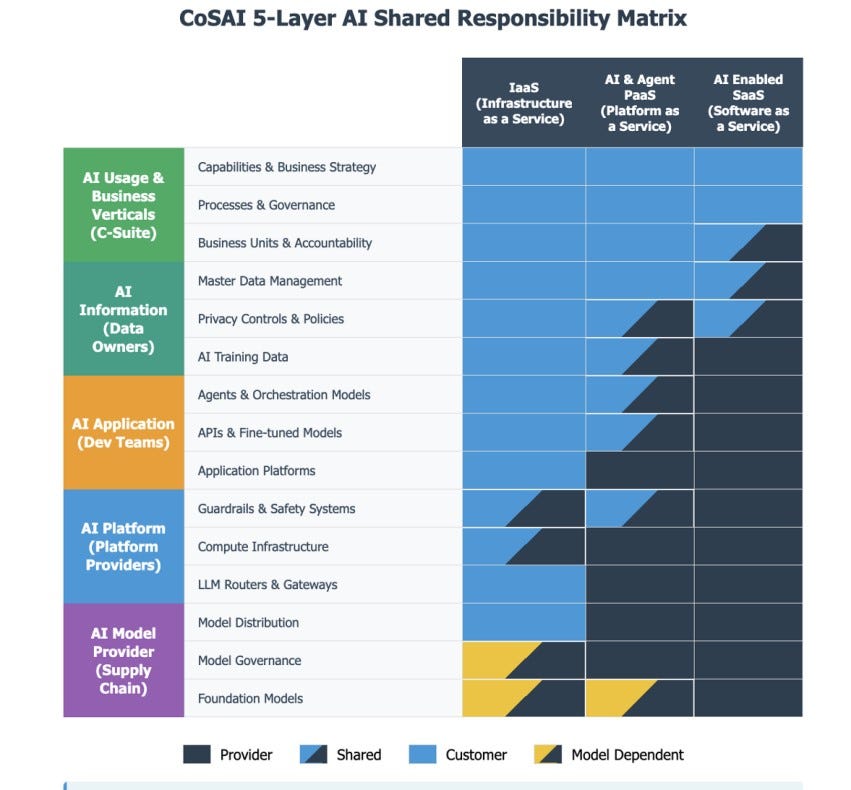


From Cloud to Chaos: Defining Shared Responsibility for AI Security
For 15 years (!), many of us who have touched cloud security have struggled with the shared responsibility model for cloud security. As with many “cyber things,” the theory is simple. Multiple vendors, consulting firms, and industry bodies have published deceptively clear matrices that depict exactly who is doing what for cloud security.
Everyone likes to present trivial cases: for example, the cloud provider is entirely responsible for the physical security of the data center, while the client is responsible for the application they just built and deployed within that cloud provider’s IaaS. In reality, many of the edge cases continue to cause pain to a lot of organizations.
Ok, so none of this is fundamentally new. However, in recent years, similar and more complex - dare I say sinister?- questions have emerged: What does shared responsibility look like for AI security?
Those who haven’t studied this topic in depth might assume there is no difference. Yet, there are fascinating, critical differences between shared responsibility for AI security and traditional cloud security, along with older related challenges like the shared security of outsourcing (that predate cloud).
Add AI with its probabilistic behaviors, untrusted user inputs, and nested vendor dependencies -and that finger-pointing cycle doesn’t just continue, it scales exponentially. When a customer-facing chatbot goes off the rails, the model provider blames your prompt engineering, the platform provider claims infrastructure isolation worked perfectly, and your internal application team swears it’s an upstream model limitation…
Put simply, what are the top 3 differences between shared responsibility for AI vs cloud? In my opinion:
- A Broader Spectrum of Risk: The range of harms and risks we must consider is much wider. Shared responsibility for AI security frequently touches upon safety, privacy, ethical use, and the unique risk surfaces that emerge specifically in conversations about AI.
- The Multi-Party Supply Chain: AI security is typically far more multi-party than traditional cloud security. For instance, one company builds the foundational model, another company fine-tunes it, a third party builds a Retrieval-Augmented Generation (RAG) architecture for you, and yet another party builds the consumer-facing application.
- Non-deterministic Behavior: Unlike traditional cloud infrastructure where secure configurations yield predictable, deterministic outcomes, AI systems are non-deterministic. Because outputs can vary significantly based on user inputs, customers bear increased responsibility for implementing robust guardrails, continuous monitoring, and input/output filtering.
Early attempts to create a logical foundation for AI shared security responsibility produced some answers — and more questions.
In light of this being a tricky problem, here I really want to focus on one thing — a post-incident scenario. While shared responsibility covers numerous use cases (and numerous sources of confusion…), let’s examine a fairly straightforward situation: I am an enterprise end-user company that uses (maybe builds, maybe tunes, etc) AI in some form, then something blows up (digitally, as this is not IoT/ICS security blog). So:
- Who takes a loss vs who is to blame?
- Do I blame the model creator? The application developer? The model hosting platform? Or do I ultimately blame myself?
If you recall, many early challenges with the cloud shared responsibility model began with customers trying to blame the provider, only to discover they were actually at fault in the end. We tried to change this dynamic by introducing a “shared fate” model. While that specific terminology has seemingly fallen out of favor lately, the underlying philosophy remains: providers can probably do more to make AI usage inherently secure.
I was recently involved with a CoSAI (Coalition for Secure AI) working group to develop a paper covering the shared responsibility framework for AI security. As others on the team humorously pointed out, my voice was one of the loudest calling for the paper to be kept simple, crisp, and highly usable. You can judge based on the final result whether we succeeded.

We recently wrapped up and approved Version 1.0 of the CoSAI AI Shared Responsibility Framework (AI SRF) through the Coalition for Secure AI and OASIS Open. The core mission here wasn’t to build more abstract compliance theater, but to solve a practical, glaring operational pain point: Who actually owns what when an AI system fails?
Under the CoSAI framework, accountability traces down the stack with absolute clarity:
- The AI Model Provider (L5) is accountable for the base model’s inherent susceptibility to prompt injection and must document those boundaries explicitly within the model card.
- The Cloud/Platform Provider (L4) is accountable for the blast-radius containment, ensuring infrastructure-level tenant process isolation held firm during the exploitation.
- The Application Developer (L3) is accountable for failing to enforce application-level guardrails, input filtering, and localized data access controls that allowed the chatbot to hit the PII repository in the first place.
- The Deploying Organization (L1/L2) is accountable for the ultimate governance failure: they did not properly classify the data or restrict the chatbot’s system-level access boundaries before pushing it live.
Also, the paper included a phased Implementation Playbook in the document to give security teams a somewhat specific path forward:
- Phase 1 (Days 1–30): Map your entire AI system inventory and cross-reference vendor contracts against these five layers to highlight immediate responsibility gaps.
- Phase 2 (Days 31–90): Establish a cross-layer governance committee and formally update vendor procurement contracts with clean, explicit accountability matrices.
- Phase 3 (12 Months): Run layer-specific tabletop simulations to stress-test your incident response playbooks before an actual threat actor tests them for you.
Fun quotes:
- “Ambiguous ownership is a growing liability for Al system deployments.” [A.C. — filed under ‘no shit, Sherlock’]
- “Without explicitly assigned owners for detection, containment, and remediation, teams default to the finger-pointing cycle” [A.C. — this will get worse, then MUCH worse, then eventually better…]
- “The framework turns ‘whose fault is this?’ into ‘which layer’s controls failed, and who owns remediation for each?’” [A.C. — this is beautifully, I probably wrote this :-)]
- “There should be exactly one accountable party per component to prevent overlaps.” [A.C. — ideal world called, it wants its problem back! Real world picked up and said ‘get lost’]
- “Clear accountability eliminates finger-pointing during incidents” [A.C. — clear evidence that Captain Obvious is alive!]
More seriously, read the paper!
In the end, I hope this work enlightens people on just how complex this problem truly is. This paper is definitely not a silver bullet that solves everything overnight; we have years of discussions and evolving challenges ahead of us down this path. However, I think this paper serves as an excellent first step. Please make sure to check out the resources listed at the end of the paper as well (a lot of gems there!)
Related blogs:
- Who’s Responsible When AI Goes Wrong? A New Framework Aims to Answer That Question
- Where Does Shared Responsibility Model for Security Breaks in the Real World?
- No Snow, No Flakes: Pondering Cloud Security Shared Responsibility, Again!
- EP203 Cloud Shared Responsibility: Beyond the Blame Game with Rich Mogull
- EP145 Cloud Security: Shared Responsibility, Shared Fate, Shared Faith?
- Who Does What In Cloud Threat Detection?
- The Cloud Shared Irresponsibilities Model
From Cloud to Chaos: Defining Shared Responsibility for AI Security was originally published in Anton on Security on Medium, where people are continuing the conversation by highlighting and responding to this story.