❌

Normal view

“I Don’t Need a SIEM, I Have Ollama!” (Yes, You Do!)

5 November 2026 at 23:27

Warning: this blog is an experiment. The idea for a blog came from a real conversation I had with somebody. The content is researched, debated, refined, “hardened” by a Gemini skill I created (using Gemini 4 Argon). Then Claude Opus 5.5 performed a peer review, and tore some parts to shreds. Then rewrote them. And then I very lightly edited it, and tuned a few jokes. I replaced a food fight joke with a pillow fight joke, specifically. Let me know if this sucks, and I will stop. Promise!

—

A security peer recently shared a proposal they had just heard in the wild: instead of paying for a SIEM, why not load several days of raw log data into a locally run open-weights model, ask it “what looks risky?”, and review whatever the model highlights?

No SIEM ingest tax! No cloud token bills! No SIEM license fees! No writing correlation rules! No tuning anomaly detection! Just a gaming GPU under a desk and pure, artisanal AI-native vibes. Ahhh, magic!

Gemini illustration

Wait. Really?

My first instinct, forged by 24 years of staring at logs since I first met a SIM in January 2002, was to laugh, pour a drink, and move on. Surely everyone knows this is a terrible idea, right? Right?!

Wrong.

If an engineer, an IT director, or a cost-cutting CFO pitches “local LLM as a poor man’s SIEM” in your organization, you cannot just roll your eyes and mutter “hallucinations.” People keep inventing this idea for real reasons. SIEM ingest pricing still hurts: some vendor cost explainer works out 5 TB per day at $2 to $4 per GB as $3.6 to $7.3 million a year on ingestion alone. Detection engineering is still hard work. And yes the AI hype machine has spent two years promising executives that models can “reason over any unstructured data.”

So let’s dissect why dumping a week of raw logs into a local model breaks four basic laws of “operational physics”, and then carve out the narrow 10% where a local model does help with logs. The short version fits on a sticker: the LLM writes the parser, it never runs as the parser. And the twist is that the problem here is “raw,” not “local.”

Token Arithmetic and Naive Chunking (Or: How Big Do You Think 7 Days of Logs Is?!)

Let’s start with grade-school arithmetic, because clearly nobody pitching this architecture has ever opened a calculator…

Forget the enterprise. Take a tiny environment, a single server rack generating a measly 1 GB of raw text logs per day. Seven days of logs is 7 GB of text, or roughly 1.75 billion tokens at 4 characters per token. That is generous, since IP addresses, GUIDs and hex strings tokenize worse than English (Wow, really? Yes, really — at least Claude thinks so! He would know, right?)

Now look at that “free” 8B or 70B parameter model on your GPU workstation. Its usable context window, before the KV cache devours your VRAM and the fans sound like a Boeing 747 on takeoff, is maybe 32K to 128K tokens. You are shoving 1.75 billion tokens through a 128K keyhole, which is about 13,700 full context windows. Painful enough yet?

Well, it gets worse. Assume your box reads a generous 2,000 tokens per second (benchmark your own, I’ll wait). Reading those 1.75 billion tokens takes about 10 days. You need 10 days to read 7 days of logs, so you never catch up! Scale that to the 5 TB per day example above and it is about 20 years of GPU time for each day of logs. Hilarity ensues! Replacing a deterministic stream processor with a token-by-token text predictor is like replacing your municipal water pipes with a guy carrying a silver espresso spoon from a well 10 miles away.

“Fine, Anton,” the DIY enthusiast says, “we’ll chunk the logs into 2,000-line batches and loop the local model over them all weekend!” Or we will get a bigger boat… eh… server rack to run the model.

Chunking naively, by just loading the data in batches, fails hilariously. Here is how:

  • Attack chains get cut. The phish on Tuesday lands in one batch, the lateral movement on Thursday lands thousands of batches later, and no prompt ever sees both. Each batch gets judged alone.
  • Merging the summaries does not bring the signal back. By the time you summarize the summaries, the one quiet line was already dropped in round one. So “naive+” fails as well.
  • Position inside the batch matters. Liu et al.’s “Lost in the Middle” found that models do best when the relevant information sits at the start or end of a long context and degrade sharply in the middle. They tested question answering and key-value retrieval, not logs, but picture a quiet privilege escalation on line 1,482 of your batch. Worst seat in the house.

Researchers keep running into this. Cai, Ryan and Karie note that iterative approach is limited by context capacity and that map-reduce style summarization is computationally heavy (and requires some luck). Even so, that is a proof of concept on up to 20,000 rows per dataset, and they say enterprise volumes remain to be validated.

So smarter chunking exists (reminder: it is not magic, in this area nothing truly is): parse, cluster, then retrieve by entity and time. At that point you are building the first half of a SIEM. Congratulations!

As I wrote in The Ancient Art of SIEM, cost pain is eternal and only the currency changes. In 2003 you ran out of hardware, in 2015 you ran out of cloud budget, and in 2026 you run out of tokens and VRAM.

The Input-Centric Time Machine: Back to 2002 Batch Review

Notice the most revealing phrase in this idea: “load 1 to 7 days of log data… and then review what the model highlights.”

That is not real-time detection. That is batch-mode log archeology! When intruders can go from initial access to data theft in hours (soon: minutes for some incidents), reviewing a week of logs in a batch means you are running a weekly book club about how you got breached last Wednesday. But hey … is your SIEM faster? Well, it should be!

Worse, asking an LLM to “highlight what looks risky” violates the most important lesson of two decades of detection engineering. In Output-driven SIEM, 13 years later, I revisited my favorite 2011 mental model: think about what you want to see at the output before you collect, and AI does not change this. Asking a model to “find risk” in raw logs with zero detection engineering is the ultimate input-centric anti-pattern. It failed with ML in mid-2010s, and LLM is not different (in this regard).

Now, about determinism. The lazy objection is “the answers change on every run,” and a sharp engineer will reply “so pin the seed.” Fair enough! Run-to-run randomness is an engineering problem: Thinking Machines got 80 unique completions out of 1,000 at temperature 0, then 1,000 identical ones after fixing their kernels. But is it actually bad? Maybe if you run 5 times, you will find 2x more “fun” things. But hey … also probably at least 5x more noise.

The harder test is stability. Take the same 48 hours of domain controller logs, shuffle the order or change one irrelevant line, and run it again. Given what we learned, I would bet real money the verdict moves. Well-crafted SIEM rule does not care what order the lines arrive in.

Zero Local Context Equals Hallucinated Risk

Why can’t a local model tell an active nation-state intrusion from Tuesday’s messy IT administration? Because raw logs do not contain your organizational reality! Shocking, eh?

A raw syslog or CloudTrail line says that svc_deploy_04 logged into prod-db-02 at 3:14 AM from an internal jump host and ran an encoded PowerShell script. Is that a five-alarm breach or the legacy billing batch job that Bob in accounting wrote in 2017 and nobody dares to touch? This is a dated example, on purpose. Insert your own fun example involving a shadow AI agent!

In Part 3 of the Stop Building a 2003 SOC series, I argued that the #1 reason AI fails in the SOC is the absence of Context as Code: machine-readable, owned, and expiring knowledge of your assets, business processes, and weird administrative exceptions. In Part 2, we warned about automation bias: humans reviewing plausible, well-written machine verdicts approve them.

Also, the test from Can AI Let You Jump SOC Maturity Levels? applies here: does this exist because someone had to spend time, or because someone had to learn something about us? Writing a parser is a time cost. Knowing about Bob’s job is a learning cost, and no model downloaded from the internet has paid it.

Feed raw logs into a naked local LLM with no CMDB enrichment, no threat intel, no identity graph, and no 90-day baseline, and its only source of “context” is its pre-trained weights. So it flags every scary-looking word (ERROR, DENIED, admin, root, failed) and writes you a convincing fictional thriller about your own network.

The Confused Deputy Trap: When the Attacker Prompts Your “SIEM” via User-Agent

Now put on an attacker hat for 30 seconds. What is a log file?

A log file is untrusted, attacker-influenced input. Every public-facing web server, SSH daemon, API gateway, and email relay faithfully records whatever string an outsider sends in an HTTP User-Agent, a failed username field, or a JSON payload.

Log processors have been attacked through logged strings before (hi, Log4Shell!), but that was a bug you could patch. In a raw-log-to-LLM setup there is no parser boundary to patch, because instructions and data share one channel. You just handed the attacker write access to your detection engine’s prompt!

Summaries are also scary, BTW. Pandey and Bhujang found that the classic “ignore all instructions” override failed completely against the one model they tested, but context manipulation reached 96% success on summarization with no defenses and 38% even with constrained output.

In How to Solve the Mystery of AI Defense in Depth (and my October 2026 collaboration with Usman Chaudhary, The Model Has Preferences, but the Harness Got Controls), I emphasized that a model’s statistical preferences are never a security boundary, and only a deterministic harness is. Feed unparsed logs straight into a local LLM with no harness, and any kid with curl can blind your review or flood your team with fabricated critical alerts…

The Problem Is “Raw,” Not “Local”

Let’s be fair to the local crowd, because they have a point.

  • Local solves a real problem. Logs are full of secrets, PII and internal hostnames. Not shipping them to a third-party API is a legitimate reason to want a model on your own hardware. It also — theoretically — eliminates an endless stream of unpredictable token costs flowing to a frontier model provider.
  • Small models are not the villain. In the same paper, a structured design called Aida (separate agents for investigating, challenging and judging, working through a SIEM) used open-weight Qwen3.5 9B and it was workable for the task they had.
  • “What about an agent querying a log store?” Now we are talking! The model forms a question, a database searches 7 days of logs deterministically, and the model reads a small result. That is a very different architecture, and it needs parsed data, a query engine, detections to start from, retention and access control. Sound familiar?

So keep your local model if you want it. What is missing from this proposal is the SIEM…

The Raw-Logs-to-Local-LLM Delusion Matrix

For explaining this to an enthusiastic colleague (or a budget-slashing executive) without starting a pillow fight:

Wait, Is a Local LLM Good for Anything in Log Land? (The 10% Where It Shines!)

I am a constructive cynic, not a Luddite (At least Gemini 4 Argon thinks so!). As I noted in the SOC maturity post, AI can jump the artifacts, and parsers are on that list (with caveats for tricky log sources). So point your local model at logs as an engineering sidecar, not an ingestion engine:

  • Writing the parser, not being the parser. Instead of feeding 50 million lines from a weird legacy mainframe into an LLM, feed 20 sample lines and ask for a regex, OCSF mapping, or pipeline rule. The LLM writes the code once, and deterministic CPU code parses the 50 million lines at wire speed. This mostly works, I swear.
  • Post-trigger micro-slice investigation. Once a rule or EDR alert fires on a specific host and 15-minute window, pull 200 pre-filtered, enriched log lines and ask the model for a timeline. Those lines still contain attacker strings, so treat the summary as untrusted and let the model request actions only from a closed list.
  • Ad-hoc query translation. Translate an analyst’s question into KQL, SPL, or SQL, so the database searches 7 days of logs deterministically. This also mostly works, but some YMMV.

The Lean Team Reality

What if you are the CISO of a regional insurer or hospital with a small security team, a hybrid stack, strict state regulators, and an MDR provider? When an engineer or cost-conscious VP suggests “let’s dump our noisy firewall logs into a local Ollama box,” they aren’t trying to sabotage your SOC. They have a log source that is too expensive to send to the SIEM, and they want a free way to “keep an eye on it.” Here is how to solve that without a science project:

  • Don’t use a GPU box as a poor man’s data lake. Route a noisy source to cheap, searchable object storage, or strip verbose fields in a pipeline before ingest. This is my old two-tier answer (a SIEM plus a broad, cheap log store), and it has aged well.
  • Hold your MDR to the same standard. When they brag at the next QBR about “AI-powered log analysis,” ask whether deterministic detections run first or whether it is an LLM wrapper over unparsed telemetry. This point alone is worth the price of reading this blog (A.C. — this is me, not AI)
  • Channel the DIY energy. Give your smart engineer 50 anonymized lines from your gnarliest legacy application and ask for three high-signal filter rules you can deploy in your real pipeline.

Action Items for Security Leaders

Is there anything you need to actually do?

  • Run a napkin token audit on any AI log proposal (Monday morning). Before the demo starts, ask: “How many GB per day is the raw source, how fast does the model read, and what deterministic step selects the tiny slice that reaches a context window?” If the answer is “we’ll just load it in batches,” kill the project on the spot. It’s this “just” word.
  • Fix ingest pain with tiering (30-day play). If this idea surfaced because a log source is too expensive for your SIEM, solve that: drop repetitive keepalive chatter, route compliance-only logs to cheap storage, and keep output-driven security data in your detection tier.
  • Make “the LLM writes the parser, never runs as the parser” a standard (architecture play) — that is, if you write parsers at all. Allow LLMs at design time (parsers, mappings, queries from small samples) and at post-alert time (small, bounded, enriched slices), but not as the runtime ingestion or anomaly engine over raw logs. Put it in your MDR requirements too… otherwise they will keep whining that it takes 7 weeks to integrate a log source forever.
  • Test your existing AI log workflows for prompt injection (60-day play). If your SOC or MDR summarizes anything containing attacker-controlled strings, test it in your next purple-team exercise. Do not stop at a naive “ignore instructions” canary, because passing that proves little. Try persona and context-rewriting payloads, plus payloads split across lines.

So, Do You Need a SIEM?

Call it a SIEM or call it a pile of parsers, a query engine, detections and retention. You need those things, and a GPU under a desk does not replace them. By all means run a model next to them, I promise it will be fun!

The part that worries me most is how this fails. A detection rule that misses can be tested, tuned, and re-run. A model that misses hands you a nice summary, and nobody knows what was not in it. As I said in September, skipped maturity used to fail loudly, and now it fails quietly.

We had 23 years of progress, and the best practice is still “have a plan and don’t ingest garbage.” That goes for your context window too.

[A.C. — note to self: this is v6 skill]


“I Don’t Need a SIEM, I Have Ollama!” (Yes, You Do!) was originally published in Anton on Security on Medium, where people are continuing the conversation by highlighting and responding to this story.

So Is Your SOC AI-Ready? Part 3: API or Die Audit!

19 August 2026 at 19:13

This is Part 3 of the AI-ready SOC series (Part 1, Part 2), and it is focused on validating readiness for pillars #1 (SOC Data Foundations) and #4 (Modern SOC Technology Stack). Specifically, it is about the audit I promised in Part 2:

“The ‘API or Die’ Data Audit: You need to audit every critical data source to ensure it has a robust, well-documented API. An ‘enthusiastic’ AI agent will query your systems at a frequency no human ever could. If your CMDB or logging tier can’t handle the load, the agent won’t just fail; it might unintentionally DoS your internal infrastructure.”

Steampunk SOC again!

BTW, I now have too many blog series, so let me deconflict this here:

Series 1 Focused on assessing your overall SOC readiness for AI arrival:

Series 2 Focused on changes to people /process side of SOC during AI arrival:

Anyhow, back to the topic

Why This Audit, Why Now?

If we’ve learned anything from the last decade of SOC evolution, it’s that manual is the enemy of scale. Remember toil? When you introduce AI agents into your workflow, they don’t “click buttons” in a UI like a human analyst — they consume APIs (and use CLI like humans, I guess). Yes, agents can screen-scrape and click around, but you probably don’t want to burn GPU cycles teaching a frontier model to navigate your SIEM’s 2009-vintage web UI (not a joke, I saw this happen!). But, yes, that’s a party trick, not an architecture.

If your telemetry sources have weak, poorly documented, limited-capability, or aggressively rate-limited APIs, your expensive AI agent is essentially a Formula 1 driver stuck in a traffic jam behind a horse buggy. It has the horsepower (Ha! I got a pun! Take that, Tim) to win, but it has nowhere to go.

And here is the scarier version: a human analyst queries a SIEM maybe 10 times an hour. An AI agent might query it 100 times in 30 seconds to correlate one alert (agents looove to brute force, as we all know). Multiply by a batch of alerts during an incident, and your “AI SOC transformation” becomes a self-inflicted DoS on your own EDR, GRC, or CMDB (if you have that thing). Fun times!

So before you buy the shiny agentic thing, audit your primary telemetry and context sources (EDR, NDR, cloud logs, identity, CMDB, ticketing, etc.) with cold, cruel eyes (Claude wrote this, I am sure its eyes are very cold…). Here is how.

So before you buy the shiny agentic thing, audit your primary telemetry and context sources (EDR, NDR, cloud logs, identity, CMDB, ticketing, etc.) with cold, cruel eyes (Claude wrote this, I am sure its eyes are very cold …). Here is how.

Phase 0: The “Cold Eyes” Inventory

Don’t just list your tools; list your data paths.

  • The goal: Identify every system an analyst touches during a typical investigation (SIEM, EDR, CMDB, identity, DHCP logs, ticketing, that one Wiki page everybody swears by, etc.).
  • The test: If an analyst has to “swivel-chair” — copy-paste from one tab to another because there is no integration — that is a Priority 1 gap. Whatever the human bridges manually, the agent cannot cross at all.
  • The how: Start by interviewing your SOC / D&R analysts and shadowing them during a real investigation. Review SIEM/EDR query logs to see which systems are consistently touched. Check SSO/IAM logs to see where they authenticate. Scan your internal wiki or shared drives to identify those “secret” cheat sheets or side-tools they rely on. If they are swivel-chairing (hi, 1990s SOC!), you will find the proof in their browser history or their documented SOPs.

Now run every item on that list through the five tests below.

Test 1: Connectivity & Accessibility (The “Can I Even Get There?” Test)

An AI agent needs a direct, programmatic path to the data. If a human has to “export a CSV”, “log into a separate portal”, or, worse, “Slack another human”, that data source is dead to the AI (agent UI scraping is doable, but sad and not scalable or reliable).

  • Machine-readable documentation: Does the tool have a public (or well-documented internal) REST/gRPC API, or an MCP server? If the only way to learn the API is “emailing a support engineer,” you’ve already failed. (And no, MCP is not magic — it’s a protocol, not a personality transplant for your legacy tool.)
  • Modern authentication: Does it support secure, programmatic auth (OAuth2, OIDC, scoped API keys, workload identity)? If it requires a “service account” with a static password and no MFA, congratulations, your AI enablement project just became a security liability. Remember vulnerability scanners that wanted an admin password for all systems back in the 2000s to do authenticated scanning?
  • Network pathing: Can your AI orchestration layer — wherever the agent actually lives — reach the endpoint without weeks of firewall hair-pulling? This seems trivial for 2026, but I assure you it is anything but. And also: if this is too easy, perhaps you have a 1990s flat network?

Test 2: Performance & Throughput (The “Agentic Load” Stress Test)

This is where most “legacy” security tools break, and where you must test before an incident tests it for you.

  • Concurrency limits: What is the maximum number of concurrent API requests the tool allows? If the answer is “one,” your agent is going to be very lonely. Keep in mind, agents like to swarm (OK, yours may not yet, but this is coming).
  • Rate limiting: When exactly do the “429 Too Many Requests” errors start flying? Or, worse, the response is there, but the data is 1–99% incomplete? Will your threat intel provider cut you off the moment an agent starts enriching a batch of 23000 IPs because it, well, felt like it? Find the burst capacity of your stack now, on your terms. Don’t wait until you need it.
  • Response latency: Measure time-to-first-byte on realistic queries. If a simple process tree query takes 45 seconds, your agent times out, retries, times out again… and your MTTR goes up… if you are lucky. Or, something else breaks, if you are not. “Multi-hour data queries” (hi again, the 1990s!) are an automatic fail here.

Test 3: Data Quality & Schema (The “Context Fidelity” Test)

Having an API is step one. Having useful data at the end of it is step two. AI agents are only as smart as the context they can read when they need it — GIGO is still law! BTW, the agentic spin on GIGO is of course being “confidently wrong.”

  • Structured output: Does the API return JSON or YAML? If your legacy ticketing system returns a 2MB “stream of consciousness” text (well, text-ish) blob, your AI will burn tokens (and, thus, your money) just trying to find the root cause. Force structured entry at the source (yes, this is the case management revamp from Part 2, and yes, this is painful and not fun at all).
  • Schema stability: Is the API versioned? If the vendor silently renames src_ip to source_address, your agent logic breaks instantly and quietly (OK, this is not fair, a smarter model will in fact figure this one out… but it will cost ya!). Quiet breakage in a SOC is the worst kind.
  • Joinable fields: Does the telemetry include correlation keys (cloud_instance_id, user_sid, asset IDs) so the agent can pivot to the next tool without guessing? Agents that guess entity resolution are agents that hallucinate incidents…

Test 4: Functional Depth (The “Can It Actually Do Work?” Test)

An AI-ready API shouldn’t just be for reading data; eventually it is for taking action — with the human/agent handoff lines you drew in Part 2 firmly in place. Due to vulnerability apocalypse fears, a lot of vendors started to promise automatic remediation, and guess what? This means needing APIs to act on systems.

  • Read/write balance: Can the API perform response actions — isolate a host, disable a user, update a rule? Read-only APIs give you an AI-powered observer, not an AI-augmented SOC of the future.
  • Granular scoping: Can you give the agent least-privilege access? “Read all logs” but “isolate only these subnets”? If the tool’s permission model is “admin or nothing,” that’s a hard stop for autonomy.
  • Server-side filtering: Does the API support filtering at the source (?status=active&severity=high)? If the agent must pull 10,000 records to find 5, you’re paying token tax on the vendor’s laziness. But hey, somebody is getting rich…

Test 5: The Auth & Agent Identity Layer

Agents need keys — and keys need governance. Free wisdom from the 2010s, I guess. The 1990s are finally over!

  • The audit question: Do you have a centralized way to manage API credentials and identities for your agents — as workload identities with registration, ownership, rotation, and revocation? Let me guess … mmmm … the answer is ‘no’?
  • The risk: “Shadow AI” starts the day a helpful analyst hands their personal API key to an LLM to “help out.” Your audit must define how agents authenticate, how permissions are scoped, and who owns each agent identity (yes, really). If you can’t answer “which agent did this and on whose behalf?”, you are not ready for an agentic SOC.

The “Agentic Readiness” Scorecard

For every primary tool, assign a score:

  • Level 1 — The Dinosaur: No API. UI-only. (Status: replace, or accept it’s invisible to your AI. Or suffer and pay for scraping the UI “agentically”)
  • Level 2 — The Relic: Basic API, poorly documented, slow, falls over under load. (Status: high risk)
  • Level 3 — The Standard: Decent REST API and docs, but read-mostly, limited response capabilities. (Status: usable with additional tools?)
  • Level 4 — The Modernist: Robust, fast, versioned APIs with real write capabilities and granular RBAC. (Status: AI-ready)
  • Level 5 — The Agent-First: Native agentic support (MCP, high concurrency, agent-aware auth, feedback loops). (Status: the gold standard, and yes, these exist in 2026)

Where You Arrive: The Binary Map

When you finish, you shouldn’t have a “nice-to-have” list. You should have a binary map:

  1. Machine-ready: API is fast, documented, structured, and scoped. Your agents can use it.
  2. Legacy debt: No API, or a brittle one. These sources are invisible to your AI.

And here’s the uncomfortable conclusion: if a data source is invisible to your machine, it should probably not be part of your modern detection strategy. We are moving to a world where “if it isn’t via API, it didn’t happen.” By the way, those living in organizations with modern IT stacks are surprised this is even an issue worth discussing. But, I assure you, it is…

This audit is also, not coincidentally, foundational work for an engineering-led SOC and ASO: the same API-first plumbing that feeds your agents feeds your detection-as-code pipelines, your metrics (pillar #5!), and your humans too. Fix it once, win three times.

So: which of your “critical” tools is actually an API-less paperweight? Name and shame (or just vent) in the comments!

Related blogs and podcasts:


So Is Your SOC AI-Ready? Part 3: API or Die Audit! was originally published in Anton on Security on Medium, where people are continuing the conversation by highlighting and responding to this story.
Received — 23 July 2026 ⏭ Anton on Security

Beyond the Vulnerability Apocalypse: Scaling Your Basics and Vulnerability Management

23 July 2026 at 21:40

Developed together with Usman Chaudhary @ Google for Public Sector (his post)

Let’s call it what some in the industry are calling it: the vulnerability apocalypse. For years, finding vulnerabilities was slow, expensive, specialized work. LLMs made it cheap — in its first weeks, one frontier model surfaced more than 23,000 issues across a thousand open-source projects, including a 27-year-old flaw in OpenBSD found for under $20,000 in compute. And when finding bugs gets cheap, attackers find more of them — and likely exploit more of them, faster than defenders can patch. This isn’t hypothetical: Google’s threat intelligence team has already reported the first zero-day exploit built with AI, caught being used in the wild. The deluge is real, and it’s here.

Breaking the Patch Sound Barrier: Your Vulnerability Remediation Will Not Keep Up With AI Exploit…

Since Mythos, AI-powered defenses have emerged just as fast: autonomous agents that find and fix vulnerabilities in source code, tools that rewrite code to eliminate whole classes of bugs, frontier models utilized by defenders.

But here’s what gets lost in the arms race: the fundamentals are more important now than they have ever been. When you can’t out-find or out-patch the machines, what saves you is the boring, durable work done well — knowing your environment, limiting how far a break-in can spread, fixing root causes. AI raises the ceiling on both attack and defense; it doesn’t change what good defense is made of. And defending against AI-speed attacks doesn’t always require AI — sometimes it just requires the fundamentals, done well at scale.

One new note to add. Recent incidents like this made some people state that “basics don’t matter, machines will find a way.” To me it means that basics do matter, but consistency and scale are MUCH more critical. After all, and this is a silly example, no machine can find a buffer overflow if you code in Rust. And, yes, sadly, this means you need to be “near perfect”, but hey good news — with the same machines you can. So this is not a boring “do the basics please” post, this is a reminder that you need to scale them with AI.

Why the urgency is real (and different this time)

Why act now, if you’ve heard “do the fundamentals” for twenty years? Because the gap between discovery and exploitation is effectively gone — according to some sources, high-severity flaws are now exploited within hours, sometimes before a public proof-of-concept exists, and the damage is material, widespread, and accelerating.

A program that assumes days or weeks to respond was built for a world that no longer exists. The fundamentals — visibility, segmentation, process — are what absorb the shock when patching inevitably falls behind. And this holds whether AI capabilities jump or improve gradually: the actions needed today are largely the same.

AI made finding vulnerabilities cheap. The attackers noticed. The answer isn’t panic — it’s the fundamentals done well at scale.

Breaking the Patch Sound Barrier Part 2: So Is The Apocalypse Coming and What Is It?

Start by reverse-engineering the impossible

Before any playbook, one exercise — because it does more to find your real gaps than any framework will.

Imagine you could patch any vulnerability within 15 minutes of its release, as if by magic. Now work backwards: what would have had to be true? You’d need to know instantly what you run and where it’s exposed. You’d need testing so automated that a fix ships safely in minutes. You’d need no legacy that resists change, and an architecture built to absorb it. You’d need to have already eliminated whole classes of bugs, so there were fewer to patch at all.

You will never hit 15 minutes across the environment — legacy systems guarantee it. But the gap between that fantasy and your reality is the most honest map you will ever get of where your program breaks. Every item in the playbook below is something that this exercise surfaces.

The Playbook: Fundamentals at AI Scale and Speed

Each of these is written as what to do and how to actually get it done — because the advice-to-adoption gap is where most programs die.

Kinda sort framework but high level, for sure

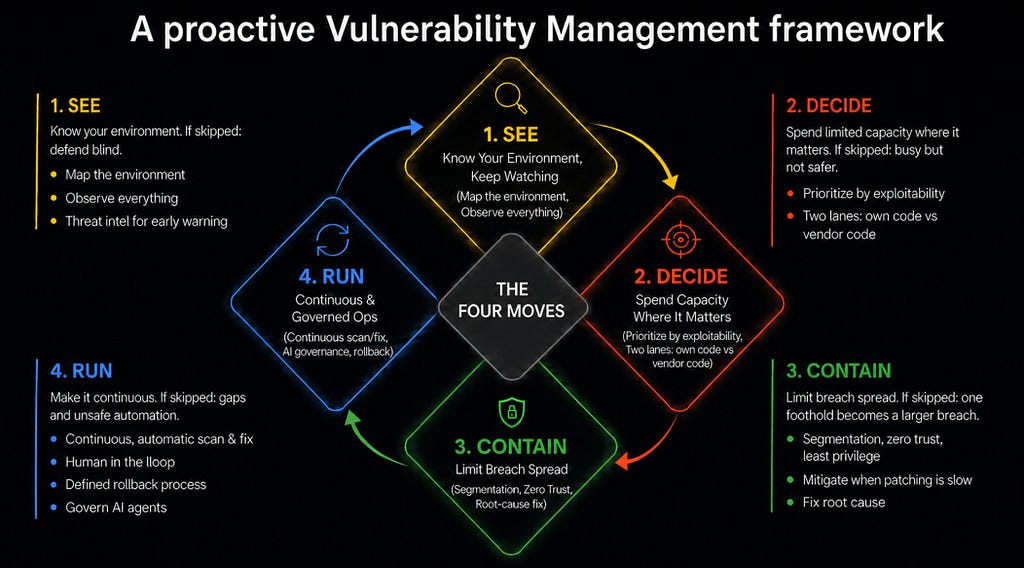
The four moves: SEE → DECIDE → CONTAIN → RUN

  1. SEE — know your environment, and keep watching
  • The play: Map your environment (configuration graph) — what you run, what’s exposed to the internet, and how far one compromise can spread. Then keep watching: observability across your own environment, and threat intelligence for the outside view, so you know the moment a bug in vendor software starts being exploited in the wild.
  • The advantage: The graph pays for itself immediately — dead code, unused open-source packages, and forgotten internet-facing servers you can simply remove — and it’s the asset list every other move depends on. Threat intel buys you early warning: you hear a vendor bug is being exploited when it’s announced, not when it hits you, so a compensating control can be in place before an attacker arrives.
  • If you skip it: You defend blind — the breach starts at the asset you didn’t know you owned, and you learn about it from someone else.

2. DECIDE — spend your limited capacity where it matters

  • The play: Prioritize by real exploitability, not raw severity — a “medium” on an internet-facing service one hop from customer data beats a “critical” on an isolated internal box (recently chains of Lows and Mediums were used in real compromises as well). Run two lanes: your own code you can fix, refactor, or rewrite; vendor code you can’t touch, so that lane is compensating controls and faster detection.
  • The advantage: Your finite capacity goes to the few findings that could actually hurt you — and every flaw gets a response you can execute: a fix where you can, a shield where you can’t.
  • If you skip it: Busy but not safer — capacity burned on findings no attacker could reach while the one exploitable path stays open, and months of exposure waiting on a vendor patch you could have mitigated in days.

3. CONTAIN — make sure one bug can’t become a breach

  • The play: Segmentation splits the environment so a foothold in one place can’t reach the rest. Zero trust and least privilege make every person, service, and AI agent prove each request — and grant only the access it needs. When you can’t patch fast, mitigate: block the exploit path or take the exposed component offline. And when the same bug class keeps returning from the same code, fix the root cause — rewrite memory-unsafe components in a memory-safe language instead of patching the same flaw forever.
  • The advantage: One exploited bug stays a contained incident instead of a company-wide breach — and containment keeps working even when patching can’t keep up.
  • If you skip it: One bug becomes the whole environment — the first agentic ransomware ran its entire chain through doors these basics would have closed — and unfixed root causes bring the same bug class back every quarter.

4. RUN — make it continuous, and govern what runs it

  • The play: Make scanning and fixing continuous and automatic, not quarterly — with the process defined before you accelerate: human-in-the-loop approval before fixes ship, a tested rollback path for when one goes wrong, and every AI agent wrapped in identity, least privilege, and human review from day one.
  • The advantage: Machine-speed remediation that’s safe to run — and the whole playbook becomes a daily operating discipline instead of a one-time project.
  • If you skip it: Quarterly scans mean months of exposure between runs; automation without approvals and rollback breaks production at machine speed; and an ungoverned agent becomes your newest insider threat.

None of these are new controls. What’s new is the bar. AI changed the speed and scale of the attacks, so the fundamentals have to run faster than they used to and cover everything with no exceptions.

The hard part isn’t technical

Every move above lands on someone else’s roadmap. Many are already on them, some for years. Segmentation changes how infrastructure operates; a continuous fix pipeline changes how developers ship; rewriting memory-unsafe components costs engineering quarters. Expect pushback — not because those teams don’t care about security, but because you’re asking to spend their time against their goals.

Three things buy the political capital: bring evidence, not mandates — the configuration graph and real exploitability data argue better than any policy memo; co-own the fix — show the risk and the trade-off, then let engineering own the how, because a rewrite they choose ships and a rewrite they’re ordered into stalls; and give leadership one number tying the work to risk reduced, so the effort defends itself at budget time.

Mandates breed quiet workarounds. Shared evidence and shared credit create movement.

The frontier agrees:

Anthropic, having surfaced the scale of the problem with Mythos, has focused on the fix: an automated pipeline that investigates, validates, and patches code vulnerabilities — delivered through Claude Code — with human review before anything ships.

Google frames it as AI threat defense: using AI across the whole vulnerability management lifecycle — finding, fixing, detecting, responding — wrapped in a framework and human review. The emphasis is on managing the end-to-end process, not any single tool.

OpenAI focuses on cyber-focused models — such as the GPT-5.6 series (including the Sol model) — which are designed to assist defenders with vulnerability identification, red teaming, and security validation, shifting the approach toward high-reasoning, specialized models capable of handling complex security tasks.

Different bets, same conclusion: none of them claims AI fixes vulnerability management for you — every one wraps the capability in process and human review.

The real reckoning

The vulnerability deluge is real, whatever you call it: AI made finding bugs cheap, and cheap discovery means more exploitation and more damage. But the reckoning isn’t that AI broke defense — it’s that the fundamentals matter more than they ever have. Use AI to find, to fix, and to move faster than you thought possible. But map your environment, limit how far a break-in can spread, fix the root causes, and keep a human on the decisions that matter.

Get the fundamentals right — that was always the strategy; now it’s the only one. Which of these is your program most under-invested in? That’s the conversation worth having…

P.S. This came out a bit too high-level, but this is admittedly for the high level audience…

Further reading and sources:


Beyond the Vulnerability Apocalypse: Scaling Your Basics and Vulnerability Management was originally published in Anton on Security on Medium, where people are continuing the conversation by highlighting and responding to this story.
Received — 11 July 2026 ⏭ Anton on Security

From Cloud to Chaos: Defining Shared Responsibility for AI Security

2 July 2026 at 19:26

For 15 years (!), many of us who have touched cloud security have struggled with the shared responsibility model for cloud security. As with many “cyber things,” the theory is simple. Multiple vendors, consulting firms, and industry bodies have published deceptively clear matrices that depict exactly who is doing what for cloud security.

Everyone likes to present trivial cases: for example, the cloud provider is entirely responsible for the physical security of the data center, while the client is responsible for the application they just built and deployed within that cloud provider’s IaaS. In reality, many of the edge cases continue to cause pain to a lot of organizations.

Ok, so none of this is fundamentally new. However, in recent years, similar and more complex - dare I say sinister?- questions have emerged: What does shared responsibility look like for AI security?

Those who haven’t studied this topic in depth might assume there is no difference. Yet, there are fascinating, critical differences between shared responsibility for AI security and traditional cloud security, along with older related challenges like the shared security of outsourcing (that predate cloud).

Add AI with its probabilistic behaviors, untrusted user inputs, and nested vendor dependencies -and that finger-pointing cycle doesn’t just continue, it scales exponentially. When a customer-facing chatbot goes off the rails, the model provider blames your prompt engineering, the platform provider claims infrastructure isolation worked perfectly, and your internal application team swears it’s an upstream model limitation…

Put simply, what are the top 3 differences between shared responsibility for AI vs cloud? In my opinion:

  1. A Broader Spectrum of Risk: The range of harms and risks we must consider is much wider. Shared responsibility for AI security frequently touches upon safety, privacy, ethical use, and the unique risk surfaces that emerge specifically in conversations about AI.
  2. The Multi-Party Supply Chain: AI security is typically far more multi-party than traditional cloud security. For instance, one company builds the foundational model, another company fine-tunes it, a third party builds a Retrieval-Augmented Generation (RAG) architecture for you, and yet another party builds the consumer-facing application.
  3. Non-deterministic Behavior: Unlike traditional cloud infrastructure where secure configurations yield predictable, deterministic outcomes, AI systems are non-deterministic. Because outputs can vary significantly based on user inputs, customers bear increased responsibility for implementing robust guardrails, continuous monitoring, and input/output filtering.

Early attempts to create a logical foundation for AI shared security responsibility produced some answers — and more questions.

In light of this being a tricky problem, here I really want to focus on one thing — a post-incident scenario. While shared responsibility covers numerous use cases (and numerous sources of confusion…), let’s examine a fairly straightforward situation: I am an enterprise end-user company that uses (maybe builds, maybe tunes, etc) AI in some form, then something blows up (digitally, as this is not IoT/ICS security blog). So:

  • Who takes a loss vs who is to blame?
  • Do I blame the model creator? The application developer? The model hosting platform? Or do I ultimately blame myself?

If you recall, many early challenges with the cloud shared responsibility model began with customers trying to blame the provider, only to discover they were actually at fault in the end. We tried to change this dynamic by introducing a “shared fate” model. While that specific terminology has seemingly fallen out of favor lately, the underlying philosophy remains: providers can probably do more to make AI usage inherently secure.

I was recently involved with a CoSAI (Coalition for Secure AI) working group to develop a paper covering the shared responsibility framework for AI security. As others on the team humorously pointed out, my voice was one of the loudest calling for the paper to be kept simple, crisp, and highly usable. You can judge based on the final result whether we succeeded.

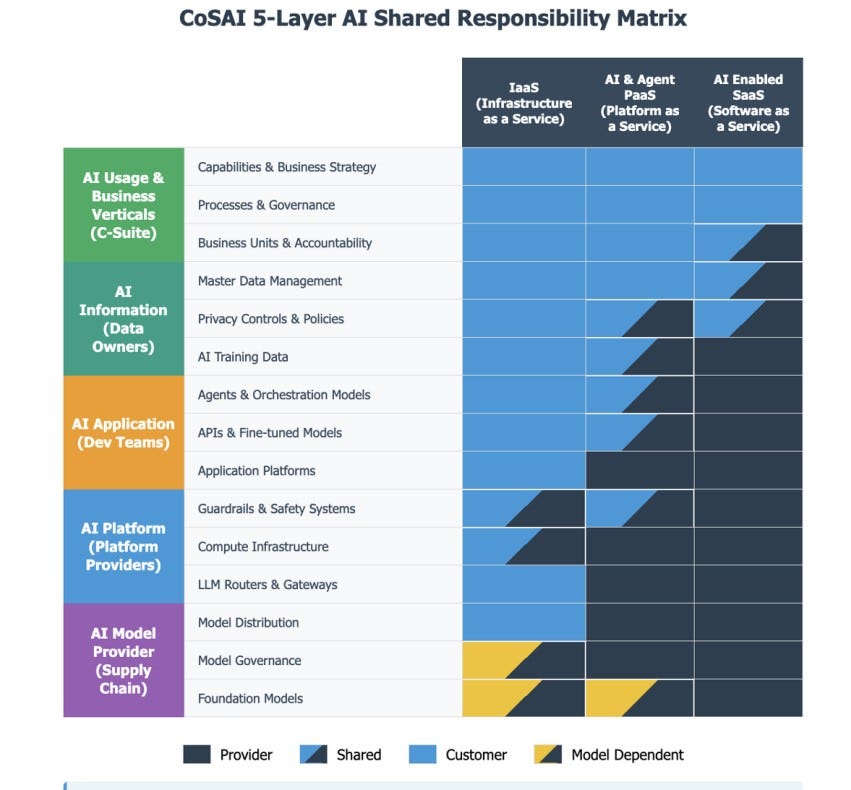
CoSAI matrix

We recently wrapped up and approved Version 1.0 of the CoSAI AI Shared Responsibility Framework (AI SRF) through the Coalition for Secure AI and OASIS Open. The core mission here wasn’t to build more abstract compliance theater, but to solve a practical, glaring operational pain point: Who actually owns what when an AI system fails?

Under the CoSAI framework, accountability traces down the stack with absolute clarity:

  • The AI Model Provider (L5) is accountable for the base model’s inherent susceptibility to prompt injection and must document those boundaries explicitly within the model card.
  • The Cloud/Platform Provider (L4) is accountable for the blast-radius containment, ensuring infrastructure-level tenant process isolation held firm during the exploitation.
  • The Application Developer (L3) is accountable for failing to enforce application-level guardrails, input filtering, and localized data access controls that allowed the chatbot to hit the PII repository in the first place.
  • The Deploying Organization (L1/L2) is accountable for the ultimate governance failure: they did not properly classify the data or restrict the chatbot’s system-level access boundaries before pushing it live.
Layers

Also, the paper included a phased Implementation Playbook in the document to give security teams a somewhat specific path forward:

  1. Phase 1 (Days 1–30): Map your entire AI system inventory and cross-reference vendor contracts against these five layers to highlight immediate responsibility gaps.
  2. Phase 2 (Days 31–90): Establish a cross-layer governance committee and formally update vendor procurement contracts with clean, explicit accountability matrices.
  3. Phase 3 (12 Months): Run layer-specific tabletop simulations to stress-test your incident response playbooks before an actual threat actor tests them for you.

Fun quotes:

  • “Ambiguous ownership is a growing liability for Al system deployments.” [A.C. — filed under ‘no shit, Sherlock’]
  • “Without explicitly assigned owners for detection, containment, and remediation, teams default to the finger-pointing cycle” [A.C. — this will get worse, then MUCH worse, then eventually better…]
  • “The framework turns ‘whose fault is this?’ into ‘which layer’s controls failed, and who owns remediation for each?’” [A.C. — this is beautifully, I probably wrote this :-)]
  • “There should be exactly one accountable party per component to prevent overlaps.” [A.C. — ideal world called, it wants its problem back! Real world picked up and said ‘get lost’]
  • “Clear accountability eliminates finger-pointing during incidents” [A.C. — clear evidence that Captain Obvious is alive!]

More seriously, read the paper!

In the end, I hope this work enlightens people on just how complex this problem truly is. This paper is definitely not a silver bullet that solves everything overnight; we have years of discussions and evolving challenges ahead of us down this path. However, I think this paper serves as an excellent first step. Please make sure to check out the resources listed at the end of the paper as well (a lot of gems there!)

Related blogs:


From Cloud to Chaos: Defining Shared Responsibility for AI Security was originally published in Anton on Security on Medium, where people are continuing the conversation by highlighting and responding to this story.

Received — 9 March 2026 ⏭ Anton on Security

My Really Fun RSA 2026 Presentations!

9 March 2026 at 23:28

This blog is perhaps a little bit more like an ad, so if you don’t want to check the ads, consider not reading it.

a very cyber image (Gemini)

But this year at RSA 2026, I’m speaking on three topics: securing AI, using AI for SOC, and sharing lessons about how Google applies AI and other technologies to D&R.

Here are these 3 fun things!

First, I’m doing a presentation on governing shadow AI agents. Believe it or not, this presentation was created mostly before OpenClaw became a thing (but updated for it!). So you may be surprised how well the content aged (think wine!) Attend this if you are struggling with shadow AI, specifically shadow agents at work.

Shadow Agents: A Pragmatist’s Guide to Governing Unsanctioned AI — [STR-W08]

  • Wednesday, Mar 25 1:15 PM — 2:05 PM PDT

It is not the APT! The new threat is the “shadow AI agents” employees already use for work, leaking data and making decisions. Banning them is a losing game. This session will offer a better way: turn this organic behavior into a catalyst for secure progress. Learn to discover, assess, and channel unsanctioned agents into a formal strategy that empowers a team rather than force it underground.

The second is probably the most detailed discussion about how we use AI for detection and response at Google. You probably read our blogs and listen to our talks (especially this), but this time we are revealing a lot more interesting details about the machinery and also how we arrived at the state we’re in. I promise you this will be fun! And detailed too.

This Is How We Do It: Building AI Agents for Cybersecurity and Defense — [PART3-M07]

  • Monday, Mar 23 2:20 PM — 3:10 PM PDT

Presenters will share the playbook for building and scaling AI agents in cybersecurity. Attendees will learn four core lessons: Building trust with the team, prioritizing real problems, measuring value, and establishing solid governance foundations for the agentic SOC.

Finally, the third isn’t a presentation but a discussion that would help you understand the real state of AI in security operations / SOC. This would not be about the slides, but about sharing lessons on what works and what doesn’t.

AI in SecOps: Sharing Lessons Learned for Adoption Maturity — [CXN-R05]

  • Thursday, Mar 26 12:20 PM — 1:10 PM PDT

Attendees in this peer-led discussion will share stories from the AI-powered SOC trenches. Explore real adoption journeys from manual processes to autonomous agents. Share practical use cases on analyst retraining, workflow auditing, malware analysis, remediation automation, RAG pipelines and more. Trade notes on what’s working, what’s breaking, trust gaps, AI hallucinations, and career redesign.

All in all, join me for securing AI and Shadow Agents, learning from Google about detection and response, and comparing the state of practice of AI in the SOC.

See you there!

P.S. Yes, we will also be podcasting from the show.

Related:

RSA 2025: AI’s Promise vs. Security’s Past — A Reality Check”


My Really Fun RSA 2026 Presentations! was originally published in Anton on Security on Medium, where people are continuing the conversation by highlighting and responding to this story.

❌