
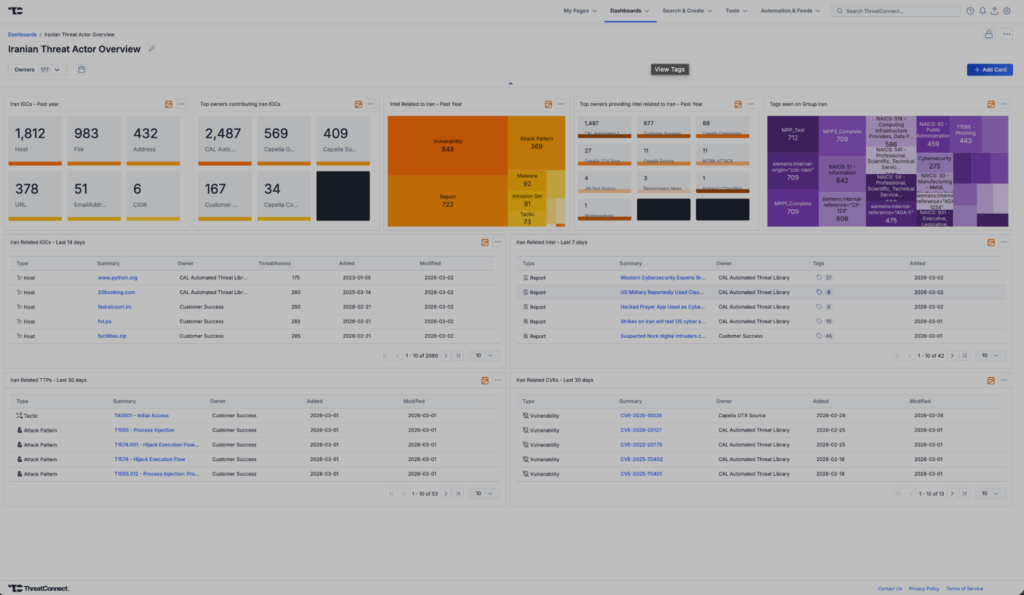
Normal view

Iranian Conflict Intelligence Dashboard Immediately Available for ThreatConnect

6 March 2026 at 15:00

The escalation of geopolitical tensions specifically focused on the Iranian Conflict over the last days of February 2026 has intensified the significant cyber and physical security risks to organizations globally. 

With threat activity emanating from advanced Iranian state-sponsored actors, aligned hacktivist collectives, and opportunistic criminal groups, security teams must remain agile, informed, and proactive. 

The Iranian Conflict Intelligence Dashboard has been updated to equip defenders with timely, high-fidelity intelligence that specifically reflects the dynamic threat environment shaped by this high-profile regional conflict with a heightened focus on Iran-linked activity.

Key Threat Actor Groups & Campaign Themes Tracked Include:

  • IRGC-affiliated Cyber Units (e.g., APT33, APT34, APT39, APT42): Tracking activity from primary state-sponsored groups.
  • Proxies and Ideological Hacktivist Actors: Monitoring activity from groups like CyberAv3ngers, APT IRAN, Handala Hack, Lulzsec, Dark Storm Team, GhostSec, Cyber Islamic Resistance, and others aligned with Iranian strategic interests.
  • Coordinated Influence and Disinformation Campaigns.
  • OT and Critical Infrastructure Targeting Efforts, particularly those targeting Israeli and Western assets.

Rather than tracking isolated threats, the –Iranian Conflict Intelligence Dashboard dashboard provides strategic context and operational detail across the broader cyber conflict spectrum, enabling faster detection, response, and mitigation.

Key Benefits:

  • Conflict-Centric Intelligence Aggregation – Centralized indicators of compromise (IOCs), TTPs, and threat insights related to Iranian-linked campaigns, sourced from open source intelligence (OSINT), premium threat feeds, and internal telemetry.
  • Live Threat Environment Tracking – Monitors shifts in activity across major adversary groups, cyber incidents, defacements, DDoS campaigns, and geopolitical events fueling escalation.
  • Accelerated Incident Response – Enriched and correlated intelligence to support triage, prioritization, and response activities during periods of elevated tension or retaliatory operations.
  • Custom Visualization & Analysis – Interactive dashboards featuring timeline analysis, actor overlap matrices, infrastructure clustering, and geographic threat origination maps.
  • ThreatConnect Automation Integration – Seamless correlation with existing ThreatConnect adversary profiles, intrusion sets, and signature-based alerts to identify high-risk overlaps with organizational environments.

Leveraging this dashboard allows security teams to anticipate conflict-related threats, understand attacker motivations, and tailor defenses to emerging risks as the Iranian cyber conflict evolves.

Specific Intelligence Focus: Iranian Malware List

  • APT42: tamecat, tabbycat, vbrevshell, powerpost, brokeyolk, chairsmack, asyncrat
  • APT34: powbat, powruner, bondupdater
  • APT33: shapeshift, dropshot, turnedup, nanocore, netwire, alfa shell
  • Other Related Malware: Gh0st Rat, quasarrat, amadey, bittersweet, cointoss, lateop

Specific Intelligence Focus: Iranian ICS Targets

ICS Systems Likely to be targeted by Iranian threat actors (based on analysis like the Censys report):

  • “Unitronics” or (“Vision” AND (PLC OR HMI))
  • “Tridium” or “Niagara”
  • “Orpak” or “SiteOmat”
  • “red lion”

Dashboard Components Include:

  1. Indicators linked to state-sponsored and proxy cyber operations.
  2. Threat groups aligned to Iranian strategic cyber interests.
  3. Reports and advisories referencing the conflict, regional escalations, or actor-attributed activity.
  4. Campaign tracking with attribution timelines, victimology insights, and strategic objectives.
  5. MITRE ATT&CK techniques used by affiliated groups, mapped to known incidents.
  6. Keyword and tag intelligence trends across conflict-related reporting.
  7. Infrastructure associations (e.g., shared IPs, domains, malware hashes).
  8. Actor and alias mapping, including cross-reference to public and private sector intelligence.
  9. Vulnerabilities linked to recent Iran intelligence activity.

Screen Capture of Iranian Conflict Intelligence Dashboard

Lead Contributor – Adrian Dela Cruz , Customer Success Engineer

To gain access to the Iranian Conflict Intelligence Dashboard, please reach out to your Customer Success team or reach out to us through our contact form.

The dashboard is also available here, and can be added manually to your ThreatConnect instance.

The post Iranian Conflict Intelligence Dashboard Immediately Available for ThreatConnect appeared first on ThreatConnect.

From Noise to Signal: Crafting TI-Informed Detections for Real Security Value

3 March 2026 at 15:00

A Practical Guide for MSSPs to Turn Alert Noise into Defensible Security Outcomes

Managed Security Service Providers (MSSPs) generate an enormous volume of alerts every day. Yet many MSSP customers still ask the same question: “What did this actually protect us from?”

This gap between alert activity and perceived security value has become one of the biggest challenges facing modern MSSPs. As environments grow more complex and adversaries more targeted, detection strategies built on generic signals and static rules increasingly fall short.

The issue isn’t a lack of data. It’s a lack of context.

The Detection Value Gap Facing Modern MSSPs

Most MSSPs are not struggling because they lack detections. They’re struggling because those detections don’t consistently map to real-world risk.

Common symptoms of this include:

  • High alert volume with low investigative confidence
  • SIEM dashboards that show activity, but not threat intent
  • Off-the-shelf threat intelligence feeds that surface indicators without explanation
  • Detection tuning performed without visibility into customer-specific threats

In many cases, alerts fire without answering the questions customers care about most:

  • Who is likely behind this activity?
  • Is this attacker relevant to my industry?
  • Does this behavior indicate a real attack path?
  • Why should this alert take priority over others?

When those questions go unanswered, MSSPs end up delivering noise instead of signal — undermining trust and obscuring the true value of their services.

What is Threat Intelligence-Informed Detection?

Threat intelligence-informed detection is the practice of engineering and prioritizing security alerts based on a deep, systematic understanding of real-world adversary behavior.

Rather than relying on indicators — such as file hashes, domains, or IP addresses that attackers can quickly change — this approach focuses on the Tactics, Techniques, and Procedures (TTPs) adversaries use to achieve their goals. While indicators expire, attacker behavior tends to remain consistent over time.

For MSSPs, this shift is critical. Customers don’t benefit from alerts that simply confirm something happened. They need detections that explain what an attacker is trying to do, why it matters, and how likely it is to impact their environment.

Threat intelligence–informed detection prioritizes alerts that reflect real attacker intent, enabling MSSPs to deliver clearer signals, stronger prioritization, and more defensible security outcomes.

Traditional Detection vs. Threat-Informed Detection 

Traditional Detection Threat-Informed Detection
Reactive: Responds to any generic suspicious activity. Proactive: Engineers detections to stop known adversary methods.
Volume-Focused: Alerts on all known bad indicators (IOCs). Context-Focused: Alerts on high-fidelity behaviors tied to risk.
Tool-Centric: Relies on whatever rules come “out of the box.” Intelligence-Driven: Customizes rules based on current threat intel.


The Threat-Informed Detection Operating Model
In practice, threat intelligence–informed detection relies on a structured operating model that connects intelligence, detections, and validation. Most threat-informed detection programs use the MITRE ATT&CK framework to map detection coverage against known adversary techniques.

This allows MSSPs to:

  • Identify which attacker behaviors are covered
  • Highlight gaps in detection
  • Communicate detection strategy clearly to customers and stakeholders

ATT&CK provides a shared vocabulary that ties intelligence, detections, and reporting together.

Common Detection Methodologies Used by MSSPs

Most MSSPs rely on a combination of detection methodologies, each with distinct strengths and limitations.

Threat Intelligence–Informed Detection
TI-informed detection is anchored in adversary tradecraft and real-world TTPs. It’s proactively aligned to known attack patterns and enables clear prioritization and explanation of alerts. It’s advantageous for MSSPs, because it scales across customers while preserving contextual relevance.

Alert-Driven Detection
Alert-driven detection is triggered by individual events or signatures and is focused on incident response and alert closure. However, it provides limited visibility into attacker intent or campaign context — often results in high alert volume with inconsistent value.

Behavioral Detection
Behavioral detection identifies anomalies based on deviations from baseline behavior and is commonly powered by machine learning. It’s an effective methodology for unknown threats, but it can be difficult to explain and tune at scale.

Exposure-Led Detection
Exposure-led detection prioritizes structural weaknesses and misconfigurations by modeling potential attack paths and choke points. It’s a valuable methodology for prevention and risk modeling, but it’s less effective for detecting active adversary campaigns.

Methodology Focus Approach
Threat-Informed Adversary TTPs Proactive; uses frameworks like MITRE ATT&CK
Alert-Driven Isolated signals Reactive; focuses on incident closure
Behavioral Internal anomalies Baseline-driven; uses ML to spot deviations
Exposure-Led Structural weakness Logical; models paths and configuration “choke points”


Why Threat-Informed Detection is the Most Effective Approach for MSSPs

Threat intelligence–informed detection is widely considered the gold standard for mature security programs because it aligns detection coverage with how breaches actually occur.

Key advantages include:

  • Focus on tactics most commonly used against a given industry
  • Reduced noise through relevance-based prioritization
  • Stronger links between detections and business risk
  • More defensible allocation of security resources

For MSSPs, this approach ensures that time, tooling, and analyst effort are invested where they matter most — without overreacting or underinvesting.

Operationalizing Threat Intelligence–Informed Detections at Scale

To deliver threat-informed detections consistently, MSSPs need intelligence that is:

  • Curated, not raw
  • Risk-weighted, not flat
  • Tailored to each customer’s industry and environment

This requires:

  • Feeding SIEMs with intelligence aligned to active adversary campaigns
  • Maintaining consistent detection logic across customers
  • Scaling personalization without increasing analyst workload
  • Preserving clear explanations for every alert generated

How ThreatConnect Enables Intelligence-Informed Detection

ThreatConnect helps MSSPs operationalize threat intelligence–informed detection by aligning intelligence, detections, and customer context.

With ThreatConnect, MSSPs can:

  • Deliver curated, risk-weighted indicators tailored to each customer
  • Align SIEM detections with adversary TTPs and active campaigns
  • Provide clear rationale behind every alert
  • Reduce irrelevant alerts while improving detection fidelity

Rather than adding more data, ThreatConnect helps MSSPs deliver actionable intelligence that supports confident decisions.

MSSP Business Outcomes

  • Reduce False Positives — 43% information technology (IT) professionals say that more than 40% of their alerts are false positives. Intelligence-informed detections reduce noise by prioritizing indicators tied to real attacker behavior.
  • Stronger QBR and Executive Conversations — Demonstrate that you flagged an attack campaign targeting their industry, before impact.
  • Improved SIEM ROI — Customers gain higher signal-to-noise ratios, greater confidence in detections, and clear evidence that their SIEM investment is delivering value.

Moving from Alert Volume to Security Value

Detection effectiveness is no longer defined by how many alerts fire, but by how clearly those alerts map to real-world threats. Threat intelligence–informed detection allows MSSPs to prioritize the threats that matter most, communicate security value with clarity and confidence, and build long-term trust with customers.

For a deeper look at how modern MSSPs are scaling intelligence-driven services, explore Modern MSSP Services Powered by ThreatConnect.

The post From Noise to Signal: Crafting TI-Informed Detections for Real Security Value appeared first on ThreatConnect.

Prioritizing Vulnerabilities That Actually Matter

25 February 2026 at 15:00

Why Vulnerability Prioritization Breaks Down for MSSPs — and How the Best Are Fixing It

When 95% of organizations are falling short of response time best practices, MSSPs who can consistently reduce mean time to respond (MTTR) don’t just improve security outcomes — they win and retain customers.

But faster response doesn’t come from more alerts, feeds, or dashboards alone. It comes from operationalizing how MSSPs prioritize vulnerabilities that actually matter.

The real differentiator for modern MSSPs is not how many vulnerabilities they detect. It’s how effectively they surface, prioritize, and justify the vulnerabilities that pose real risk right now.

And that’s where many providers struggle. Vulnerability prioritization is uniquely difficult for MSSPs — and most traditional approaches were never designed with service providers in mind.

What Vulnerability Prioritization Actually Means for MSSPs

For MSSPs, vulnerability prioritization is the process of deciding which vulnerabilities across many client environments should be addressed first to reduce real risk, not just theoretical severity.

Unlike internal security teams that prioritize for one environment, MSSPs must prioritize:

  • Across multiple clients
  • At massive scale
  • With incomplete business context
  • Under contractual, SLA, and liability constraints

And the data reflects the strain:

When prioritization breaks down, the impact is immediate. MTTR increases. Analysts drown in noise. And customers lose confidence that their MSSP understands what truly puts their business at risk.

Why Strong Vulnerability Prioritization Is a Force Multiplier for MSSPs

When done well, vulnerability prioritization becomes more than a security function — it becomes a business advantage.

Real Risk Reduction (Not Just Cleaner Dashboards)
Strong prioritization shifts the focus away from raw vulnerability counts and toward attack likelihood and impact. Instead of chasing every high-severity CVE, MSSPs can focus remediation on:

  • Vulnerabilities that are actively exploited
  • Exposed attack paths that increase breach likelihood
  • Assets attackers actually care about

The result? Fewer “we patched everything and still got breached” moments and more meaningful risk reduction.

Stronger Client Trust and Retention
Clients can quickly recognize the difference between noise and insight. Well-prioritized findings are relevant, actionable, and clearly grounded in the client’s environment. 

Good prioritization signals maturity. It tells customers, “This MSSP understands our risk — not just our tools.” That credibility is hard to win, and easy to lose.

Defensible, Explainable Remediation Focus
MSSPs are constantly asked to justify why certain vulnerabilities were escalated or deprioritized. Strong prioritization creates: 

  • Audit-friendly decision trails
  • Clear narratives for executives and boards
  • Confidence that remediation efforts were focused where they mattered most

Where Vulnerability Prioritization Most Often Fails for MSSPs

Vulnerability prioritization is essential to reducing MTTR, yet for MSSPs it frequently collapses in execution. Time and again, two common pitfalls derail prioritization and turn urgency into noise.

Overreliance on CVSS
CVSS scores are easy to automate, scale and explain, which is why they’re so widely used. But on their own, they ignore:

  • Exploit availability
  • Asset exposure
  • Business impact
  • Compensating controls

The result is high-severity noise, misaligned urgency, and growing client fatigue.

Missing or Broken Context
You can’t prioritize effectively without knowing: 

  • What an asset does
  • Who owns it
  • Whether it’s internet-facing
  • How it fits into an attack path

Many MSSPs inherit bad CMDBs, incomplete inventories, or inconsistent tagging. When context collapses, prioritization collapses with it — no matter how good your tooling looks on paper.

The Core Challenges of Vulnerability Prioritization for MSSPs

  • Alert Overload and Noisy Data
    MSSPs operate under a constant firehose: thousands of vulnerabilities, duplicate findings from overlapping tools, and CVEs that look critical but pose little real risk. Most prioritization frameworks assume clean, normalized data. MSSPs rarely have that luxury. Analysts spend more time sorting noise than reducing risk.
  • Lack of Business Context at Scale
    MSSPs often lack visibility into revenue-critical systems, crown-jewel assets, and existing compensating controls. Without this context, prioritization defaults to severity scores, and decision-making becomes defensive rather than risk-based.
  • One-Size-Fits-All Scoring Doesn’t Work
    MSSP clients can vary dramatically:
    • Regulated vs. unregulated
    • Cloud-native vs. legacy environments 
    • Security-mature vs. security-constrained teams

One-size-fits-all scoring might be scalable, but it doesn’t capture the context of your client base. MSSPs are constantly forced to choose between accuracy and efficiency.

  • Exploit Intelligence Is Hard to Operationalize
    Even with good threat intel, exploitability changes rapidly and correlating intel to specific environments is messy. Without environmental context, threat intel becomes just another feed — not a prioritization signal.
  • Client Remediation Capacity Is Limited
    The uncomfortable truth is that clients can’t fix everything. Patch windows are narrow, ops teams are stretched thin, and downtime is expensive. MSSPs must prioritize not only what is most risky, but what is realistically fixable. Most tools ignore this reality.
  • Proving Value to Clients
    Clients don’t care that you reduced “critical vulnerabilities by 43%.” They do care about what would have hurt them, what they avoided, and what actually changed their risk posture. Poor prioritization makes value invisible — even when teams are working hard.

Rethinking Vulnerability Prioritization: What MSSPs Actually Need

MSSPs don’t need another severity score or raw feed. They need correlation, context, and clarity. Effective prioritization must connect:

  • CVEs → exploitability
  • Exploits → threat actor behavior
  • Threats → customer exposure

Only then can MSSPs confidently answer the question customers care about most: “What should we fix first — and why?”

How ThreatConnect Approaches Vulnerability Prioritization Differently

ThreatConnect takes a fundamentally different approach to vulnerability prioritization — one purpose-built for MSSPs.

From Generic Scores to Business-Relevant Insight
ThreatConnect goes beyond CVSS to deliver vulnerability insights tailored to each customer’s environment. Each CVE is correlated with:

  • Real-world exploitability
  • Active threat actor behavior
  • Known exposure within the customer’s environment

From Volume to Precision
Instead of overwhelming customers with lists of hundreds of vulnerabilities, MSSPs can deliver prioritized precision: “Here are the 3 you need to patch now — and why”. This shift enables faster MTTR, more confident remediation, and clearer client communication.

Built for MSSP Scale
ThreatConnect is designed to support:

  • Repeatable prioritization logic
  • Context-aware insights without manual tuning
  • Multiple customers environments without sacrificing quality or margin

Vulnerability Prioritization Is the Difference Between Noise and Value

MSSPs don’t win by finding more vulnerabilities. They win by helping customers fix the right ones. For MSSPs looking to modernize services, reduce MTTR, and scale without burning out analysts, vulnerability prioritization isn’t optional — it’s foundational.

Download Modern MSSP Services Powered by ThreatConnect to learn how leading MSSPs are evolving beyond detection into true risk reduction.

The post Prioritizing Vulnerabilities That Actually Matter appeared first on ThreatConnect.

❌