
Normal view

Received — 20 May 2026 Microsoft Security Blog

Exposing Fox Tempest: A malware-signing service operation

Fox Tempest is a financially motivated threat actor that operates a malware-signing-as-a-service (MSaaS)  used by other cybercriminals to more effectively distribute malicious code, including ransomware. The threat actor abuses Microsoft Artifact Signing to generate short-lived, fraudulent code-signing certificates to appear legitimately signed, allowing malware to evade security controls.

Fox Tempest has created over a thousand certificates and established hundreds of Azure tenants and subscriptions to support its operations. Microsoft has revoked over one thousand code signing certificates attributed to Fox Tempest. In May 2026, Microsoft’s Digital Crimes Unit (DCU), with support from industry partner Resecurity, disrupted Fox Tempest’s MSaaS offering, targeting the infrastructure and access model that enables its broader criminal use.

Microsoft Threat Intelligence observed Fox Tempest’s operations enabling the deployment of Rhysida ransomware by threat actors such as Vanilla Tempest, as well as the distribution of other malware families including Oyster, Lumma Stealer, and Vidar. The consistency, scale, and downstream impact of the resulting attack activity demonstrate that Fox Tempest is a vital operator within the broader cybercrime ecosystem.

In this blog, we examine how Fox Tempest’s MSaaS operation functioned and how it enabled the delivery of trusted, signed malware across the cybercrime ecosystem. We also provide Microsoft Defender detections, indicators of compromise (IOCs), and mitigation recommendations to help organizations identify and disrupt similar activity.

Fox Tempest’s role and impact

Fox Tempest doesn’t directly target victims but instead provides supporting services that enable ransomware operations by other threat actors. Microsoft Threat Intelligence has tracked Fox Tempest since September 2025. Microsoft Threat Intelligence has linked the actor to various ransomware groups including Vanilla Tempest, Storm-0501, Storm-2561, and Storm-0249, who have all leveraged Fox Tempest-signed malware in active intrusions. Malware delivery in these attacks have included use of legitimate purchased advertisements, malvertising, and SEO poisoning.

Storm-2561 SEO poisoning

Fake VPN clients steal credentials ›

Cryptocurrency analysis associated with Fox Tempest has identified clear links tying the actor to ransomware affiliates responsible for delivering several prominent ransomware families, including INC, Qilin, Akira, and others, with observed proceeds in the millions. Based on the scale of the MSaaS offering, Microsoft Threat Intelligence assesses that Fox Tempest is a well-resourced group handling infrastructure creation, customer relations, and financial transactions.

The downstream impact of these operations has resulted in attacks against a broad range of industry sectors, including healthcare, education, government, and financial services, impacting organizations globally including, but not limited to the United States, France, India, and China.

Fox Tempest’s malware signing as a service infrastructure

Fox Tempest’s MSaaS capability was available through the website signspace[.]cloud, a now defunct service that was disrupted by DCU, which enabled other threat actors to fraudulently obtain short-lived Microsoft-issued certificates that were valid for only 72 hours, obtained through Artifact Signing (previously named Azure Trusted Signing). This use of short-life certificates from a trusted source allowed malware and ransomware to masquerade as legitimate software (like AnyDesk, Teams, Putty, and Webex) to bypass security controls, significantly increasing the likelihood of execution and successful delivery. Fox Tempest offered this MSaaS capability to the ransomware ecosystem since at least May 2025.

To obtain legitimate signed certificates through Artifact Signing, the requestor must pass detailed identify validation processes in keeping with industry standard verifiable credentials (VC), which suggests the threat actor very likely used stolen identities based in the United States and Canada to masquerade as a legitimate entity and obtain the necessary digital credentials for signing. The SignSpace website was built on Artifact Signing and enabled secure file signing through an admin panel and user page, leveraging Azure subscriptions, certificates, and a structured database for managing users and files. A GitHub repository, called code‑signing‑service, included configuration files and technical details that directly linked it to the infrastructure behind signspace[.]cloud.

The signspace[.]cloud service has two unique modeling groupings: the admin and the customers. The admin is responsible for maintaining the tooling, account creation, and infrastructure, while the customers provide files to be fraudulently code signed. Customers who accessed the service could upload malicious files to be signed using Fox Tempest-controlled certificates.

Below are examples of the signspace[.]cloud portal as seen by Fox Tempest’s customers:

SignSpace sign-in portal with fields to input a username and password to login
Figure 1. Fox Tempest’s SignSpace sign-in portal
Code signing service upload page depicting a blue button to upload files, another blue button to sign the file, and an empty file history table
Figure 2. Fox Tempest’s SignSpace code signing service upload page

In February 2026, Microsoft Threat Intelligence observed a notable shift in Fox Tempest’s operational infrastructure. Fox Tempest transitioned to providing customers with pre-configured virtual machines (VMs) hosted on US-based virtual private server provider Cloudzy’s infrastructure, allowing threat actors to upload their malicious files directly to Fox Tempest‑controlled environments and receive signed binaries in return. This infrastructure evolution reduced friction for customers, improved operational security for Fox Tempest, and further streamlined the delivery of malicious but trusted, signed malware at scale. Microsoft’s Digital Crimes Unit (DCU) disrupted this infrastructure and continues to partner with Cloudzy to identify and disrupt related infrastructure.

Below is an example of the Fox Tempest-provided VM environment as seen by customers:

Screenshot of Remote Desktop Connection interface showing login prompt and security warning. Warning highlights unverified remote computer identity and certificate errors, with options to view certificate, connect anyway, or cancel connection.
Figure 3. Accessing VM provided by Fox Tempest

Inside the VM, Fox Tempest provided files that are used to sign code:

  • The first file, metadata.json, was a configuration file that pointed to an Azure‑hosted endpoint which also included the signing account and certificate profile.
  • The second file, test.js, is an example of a file provided by Fox Tempest that had been digitally signed to demonstrate their signing capabilities to customers.
  • The third file, PS code sample.txt, contains the PowerShell script they used to sign customer‑submitted files using certificates under Fox Tempest control.
Figure 4. Fox Tempest provided files
Screenshot of a digital certificate details window showing certificate purpose, issuer, and validity period. The certificate ensures software authenticity and protection against alteration, issued by Microsoft ID Verified CS EOC CA 01, valid from February 19 to February 22, 2026.
Figure 5. Fox Tempest provided certificate

Threat actors using Fox Tempest’s MSaaS offering paid thousands of dollars to get their malicious code signed, as shown below with the Google Form detailing the service’s pricing model. Actors filled out the form before being added to a queue to submit payment and gain access to a VM. The form (written in both English and Russian) asks the user to choose a selected plan from a price list of $5000 USD, $7500 USD, or $9000 USD, with a mention that higher paying plans receive priority in the queue sequence.

Screenshot of an online form for joining an EV Code Signing queue, featuring sections for selecting a pricing plan with three options ($8500, $7500, $9500), frequency of EV need, certificate validity duration, and forum account link. Form includes bilingual instructions in Russian and English, required fields marked with a red asterisk, and buttons for submitting or clearing the form.
Figure 6. Google form used by Fox Tempest
Screenshot of a subscription channel page promoting EV certificates for sale by SamCodeSign with 290 subscribers. Features a blue icon of a certificate with a key, a call-to-action button labeled "JOIN CHANNEL," and a message about certificate sale information and support contact.
Figure 7. Telegram used by Fox Tempest

Fox Tempest engaged directly with customers using a Telegram channel, EV Certs for Sale by SamCodeSign under the user account arbadakarba2000. All signing activity occurred using a Fox Tempest-provided email address associated with a very small number of IP addresses.

Case study: Fox Tempest enables Vanilla Tempest attacks

Vanilla Tempest began using Fox Tempest’s MSaaS service as early as June 2025. Through this service, Vanilla Tempest uploaded malicious payloads such as trojanized Microsoft Teams installers, which Fox Tempest would fraudulently signed to appear legitimate. Vanilla Tempest would then distribute these signed binaries through legitimately purchased advertisements that redirected users searching for Microsoft Teams to attacker‑controlled advertisements and fraudulent download pages.

Diagram illustrating a phishing attack flow involving fake Microsoft Teams installer downloads from fraudulent websites. Key components include labeled nodes for Fox Tempest and Vanila Tempest tools, user interaction steps, scheduled tasks, and deployment of a hybrid backdoor malware, with color-coded boxes highlighting different stages of the attack.
Figure 8. Vanilla Tempest and Fox Tempest attack chain

Victims were presented with a malicious MSTeamsSetup.exe in place of the legitimate client, reflecting a broader pattern of Vanilla Tempest frequently abusing trusted software brands to lure victims and establish initial access. Execution of the counterfeit installer resulted in the deployment of the Oyster backdoor (also known as Broomstick), a modular, multistage implant that establishes persistent remote access, initiates command‑and‑control (C2) communications, collects host‑level information, and enables the delivery of additional payloads. By masquerading as a widely deployed enterprise collaboration tool hiding behind a fraudulently signed binary, Vanilla Tempest’s Oyster payload was likely able to evade casual detection and blend into normal enterprise activity. In some observed cases, Vanilla Tempest also deployed Rhysida ransomware within victim environments using the same process.

Defending against Fox Tempest-enabled attacks

To defend against Fox Tempest tactics, techniques, and procedures (TTPs) and similar activity, Microsoft recommends the following mitigation measures:

Microsoft Defender detections

Microsoft Defender customers can refer to the list of applicable detections below. Microsoft Defender coordinates detection, prevention, investigation, and response across endpoints, identities, email, apps to provide integrated protection against attacks like the threat discussed in this blog.

Tactic Observed activity Microsoft Defender coverage 
PersistenceThreat actors distributed malware families including using Fox Tempest‑signed binariesMicrosoft Defender for Antivirus  
– Trojan:Win64/OysterLoader  
– Trojan:Win64/Oyster  
– Trojan:Win32/Malcert  
– Trojan:Win32/LummaStealer  
– Trojan:Win32/Vidar  
– Backdoor:Win32/Spyder  
– Trojan:Win32/Malgent  
– Trojan:Win64/Tedy  
– Trojan:Python/MuddyWater  
– Trojan:Win64/Fragtor  

Microsoft Defender for Endpoint
– Vanilla Tempest activity group
– User account created under suspicious circumstances
– New group added suspiciously
– New local admin added using Net commands – ‘LummaStealer’ malware was prevented
– ‘Malcert’ malware was prevented
– ‘Vidar’ malware was prevented  
ImpactAnalysis of Fox Tempest MSaaS identified links to the enablement of several ransomware familiesMicrosoft Defender for Antivirus
– Ransom:Win64/Rhysida
– Ransom:Win64/Inc
– Ransom:Win32/Qilin
– Ransom:Win32/BlackByte

Microsoft Defender for Endpoint
– Ransomware-linked threat actor detected
– ‘BlackByte’ ransomware was prevented
– ‘INC’ ransomware was prevented
– ‘Qilin’ ransomware was prevented
– ‘Rhysida’ ransomware was prevented
– A file or network connection related to a ransomware-linked emerging threat activity group detected  

Microsoft Security Copilot

Microsoft Security Copilot is embedded in Microsoft Defender and provides security teams with AI-powered capabilities to summarize incidents, analyze files and scripts, summarize identities, use guided responses, and generate device summaries, hunting queries, and incident reports.

Customers can also deploy AI agents, including the following Microsoft Security Copilot agents, to perform security tasks efficiently:

Security Copilot is also available as a standalone experience where customers can perform specific security-related tasks, such as incident investigation, user analysis, and vulnerability impact assessment. In addition, Security Copilot offers developer scenarios that allow customers to build, test, publish, and integrate AI agents and plugins to meet unique security needs.

Threat intelligence reports

Microsoft Defender XDR customers can use the following threat analytics reports in the Defender portal (requires license for at least one Defender XDR product) to get the most up-to-date information about the threat actor, malicious activity, and techniques discussed in this blog. These reports provide the intelligence, protection information, and recommended actions to prevent, mitigate, or respond to associated threats found in customer environments.

Microsoft Defender XDR threat analytics

Microsoft Security Copilot customers can also use the Microsoft Security Copilot integration in Microsoft Defender Threat Intelligence, either in the Security Copilot standalone portal or in the embedded experience in the Microsoft Defender portal to get more information about this threat actor.

Indicators of compromise

IndicatorTypeDescriptionFirst seenLast seen
signspace[.]cloudDomainAttacker-controlled domain hosting MSaaS2025-05-292026-05-05
dc0acb01e3086ea8a9cb144a5f97810d291020ceSignerSha-1Certificate2026-03-182026-05-11
7e6d9dac619c04ae1b3c8c0906123e752ed66d63SignerSha-1Certificate2026-03-212026-05-11
f0668ce925f36ff7f3359b0ea47e3fa243af13cd6ad9661dfccc9ff79fb4f1ccSHA-256File hash2026-03-192026-05-04
11af4566539ad3224e968194c7a9ad7b596460d8f6e423fc62d1ea5fc0724326SHA-256File hash2026-03-212026-05-07
f0a6b89ec7eee83274cd484cea526b970a3ef28038799b0a5774bb33c5793b55SHA-256File hash2026-03-122026-04-19

Learn more

For the latest security research from the Microsoft Threat Intelligence community, check out the Microsoft Threat Intelligence Blog.

To get notified about new publications and to join discussions on social media, follow us on LinkedIn, X (formerly Twitter), and Bluesky. To hear stories and insights from the Microsoft Threat Intelligence community about the ever-evolving threat landscape, listen to the Microsoft Threat Intelligence podcast.

The post Exposing Fox Tempest: A malware-signing service operation appeared first on Microsoft Security Blog.
Defense in depth for autonomous AI agents

Designing Secure Autonomous AI Agents with Defense in Depth

AI agents are moving beyond assistance and into action. Instead of generating content, they invoke tools, modify data, trigger workflows, and operate across systems with increasing autonomy. This shift changes the security problem fundamentally. When an agent can act autonomously, mistakes propagate faster, blast radius increases, and rollback becomes harder.

Security for agentic AI relies on defense in depth. What changes with autonomous agentic AI is where security decisions matter most. As autonomy increases, the center of gravity moves away from the model alone and toward how agents are assembled, constrained, and governed inside real applications. To build agentic AI applications that can be operated safely at scale, you need to deliberately design how agents are assembled, constrained, and governed within real applications. In return, you increase the likelihood of predictable behavior, controlled blast radius, and the confidence to deploy autonomy in production.

Defense in depth for agentic AI systems

Agentic AI systems are vulnerable to the existing security risks of software systems, and introduce new threat classes: agent hijacking, intent breaking, sensitive data leakage, supply chain compromise, and inappropriate reliance. Any weakness in permissions, data protection, or access control that exists today is amplified when an agent is added to the system.

A useful way to reason about agent security is through the following mitigation layers:

  • Model layer: Influences how the agent reasons through training data, fine-tuning, and refusal behaviors.
  • Safety system layer: Provides runtime protections such as content filtering, guardrails, logging, and observability.
  • Application layer: Defines what the agent can do and how it does it through application architecture, permissions, workflows, and escalation paths.
  • Positioning layer: Shapes how the system is presented to users through transparency documentation and UX disclosure.

Each layer reinforces the others, and no single layer is sufficient on its own. The model layer is probabilistic by nature. The safety system layer observes and intervenes at runtime. The positioning layer shapes perception. But for organizations building agentic AI applications, the application layer is the decisive one because it is the only layer builders fully control.  The application layer translates probabilistic model behavior into deterministic system outcomes. This is also where customers turn generic components into differentiated systems: two organizations can start with the same model and tools and end up with very different security outcomes depending on how they constrain agent behavior at this layer.

Why the application layer matters most when building agentic AI applications

Most organizations build agentic AI applications by combining off-the-shelf models, tools, and business data into systems that perform specific tasks. The application layer is where they decide which actions an agent is allowed to take, which tools and data it can access, how permissions are scoped and enforced, how failures are handled, and when humans must be involved.

Getting these decisions right requires thinking through several specific design patterns. Each one addresses a distinct failure mode. Together, they form the practical expression of defense in depth at the application layer.

Here are some recommended design patterns for building a more resilient application layer for your agents.

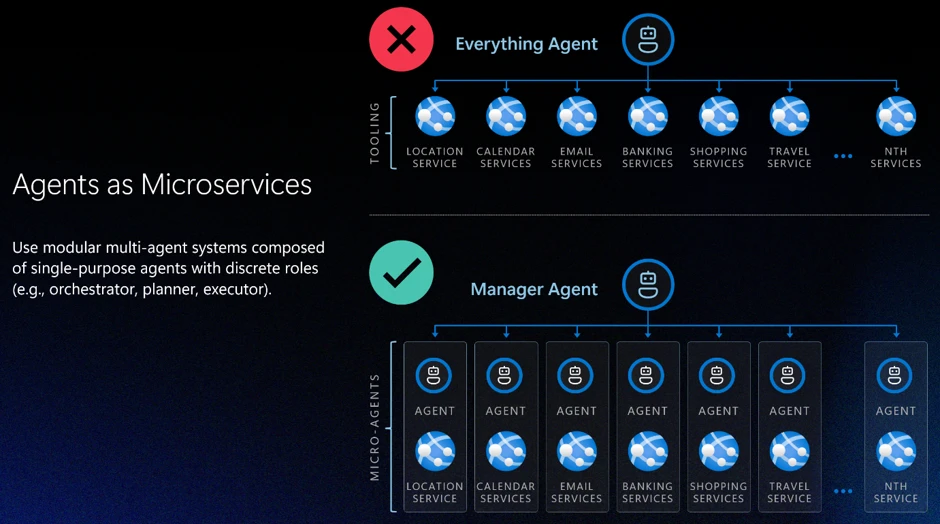
Pattern 1: Design agents like microservices

The most consequential application layer decision is action scope: how broadly you define an agent’s responsibilities. A common and dangerous failure mode is the “everything agent,” a single agent with broad permissions, many tools, and loosely defined responsibilities. Every additional tool expands the attack surface. Every ambiguous instruction increases the risk of error or task drift. As autonomy and tools increase, these risks compound quickly.

A more resilient approach is to design agents the way distributed systems have been designed for decades: as carefully scoped components with bounded capabilities. Agents should have isolated permissions, clear interfaces, and narrow responsibilities. More complex behaviors emerge from orchestration rather than from granting a single agent broad authority. Building agents like microservices, with constrained responsibilities and scoped permissions by design, is one of the most effective structural controls available at the application layer.

Pattern 2: Least permissions

Bounded scope defines what an agent is responsible for. Progressive permissioning governs what actions are permitted within that scope. As a rule, permissions should always start at zero (“zero trust”).

For safe design, no actions should be permitted by default. Actions are enabled explicitly, based on role and system needs. Least-privilege and zero-access principles apply to agents just as they do to human users.

Permissions granted loosely at design time become exploitable surfaces at runtime.

In practice, this means every tool call, data access, and external integration an agent can invoke should be the result of a deliberate authorization decision, not an implicit one. The question is not “should we restrict this?” but “have we explicitly permitted this?”

The general rule is to scope capabilities to the duration of a specific task. If task-based limits aren’t feasible, implement time-based limits. Task-focused permissions are preferred because they naturally “expire” when the task completes; temporal permissions help limit blast radius.

Pattern 3: Deterministic human-in-the-loop design

Even well-scoped, well-permissioned agents need a governance backstop for high-stakes decisions. Human-in-the-loop (HITL) review is often discussed as a trust mechanism: a way to keep humans informed. In agentic systems, it is better understood as a governance mechanism: a structural control that prevents agents from self-authorizing consequential actions.

The critical design mistake here is letting the model decide when human review is required. If escalation is left to probabilistic reasoning, an adversarial prompt or an ambiguous instruction can bypass review entirely. A model that reasons its way out of escalating is exhibiting exactly the behavior the escalation mechanism was supposed to catch.

In secure agentic systems:

  • HITL review ideally is enforced deterministically by the application layer, or orchestrator, not delegated to the model.
  • Escalation triggers are defined in code.
  • An orchestrator enforces HITL review triggers.
  • Intervention can occur mid-execution — including during tool calls — rather than only before or after an action completes.

This design removes ambiguity about when review is required, supports auditability for oversight and compliance, and ensures that as agents move toward greater autonomy, the separation between reasoning and enforcement remains intact.

Pattern 4: Agent identity as a security primitive

It is an unfortunate reality that human users are routinely over-permissioned (“give them access to everything”). To implement Pattern 1: Agents as Microservices and Pattern 2: Least permissions, agents must never have the same identity as the user. This sounds obvious, but it requires deliberate design: When an action is taken, you need to know if it was executed by the user, the agent was acting on its own behalf, or the agent acting on the user’s behalf. Each agent must be assigned a unique, verifiable identity which allows assignment of explicit and narrowly scoped permissions, lifecycle controls, and accountability.

Agent identity enables least-privilege enforcement, because you cannot scope permissions to a specific agent if you cannot distinguish that agent from other agents or a human user. It also enables lifecycle governance, because revocation actions won’t be invoked when many agents are affected. Finally, separate agent identity enables meaningful observability, because actions can be traced back to a specific agent rather than being attributed vaguely to “the system.”

 As enterprises manage agent sprawl (with more agents, more deployments, and even more integrations), identity clarity becomes operationally critical. Identity is not a feature you add later. It is a prerequisite for operating autonomous agents responsibly at scale, and it ties together every other application layer pattern: permissioning, escalation, and logging all depend on knowing which agent is acting.

How the Other Layers Reinforce ApplicationLayer Design

Focusing on the application layer does not diminish the importance of the other layers. Instead, it clarifies their roles.

  • The model layer – the model chosen to enable the application – shapes how an agent reasons, but remains probabilistic. It can be tuned toward safer behavior, but it cannot guarantee it.
  • The safety system layer – platform tools like content filters and groundedness detection – compensates for what models alone cannot prevent: it detects anomalies, filters harmful outputs, and fulfills the observability teams’ need to respond when something goes wrong.
  • The positioning layer – how the UI and UX explains that AI is in use, what it can do, and what it can’t do

Each layer addresses failure modes the others cannot fully cover. A strong safety system cannot compensate for an agent with unlimited scope. A well-tuned model cannot substitute for deterministic escalation triggers. The application layer is where the load-bearing decisions are made. The other layers make those decisions more resilient.

Designing for Secure Autonomy

The four patterns described here — agents as microservices, least permissions, deterministic human-in-the-loop design, and agent identity — are mutually reinforcing. Scope containment limits blast radius. Permissioning limits what a contained agent can do. Deterministic escalation ensures that neither scope nor permissions can be circumvented by adversarial input. Identity makes all of it auditable.

The application layer is where customers have the most power to shape how their agent behaves. It is where off‑the‑shelf models become real agentic AI applications. It is where security decisions shape both business value and risk. Defense in depth remains the right strategy. As agents take on more responsibility, the application layer becomes the place where that strategy succeeds or fails.

As organizations deploy more agentic AI systems, the question is not whether agents will make mistakes. They already have and will continue to. The question is whether those mistakes are minimized, identified, and contained. Secure autonomous agentic AI systems are achieved by designing systems where autonomy is bounded by architecture, permissions, identity, and deterministic oversight from the start.

To learn more about Microsoft Security solutions, visit our website. Bookmark the Security blog to keep up with our expert coverage on security matters. Also, follow us on LinkedIn (Microsoft Security) and X (@MSFTSecurity) for the latest news and updates on cybersecurity.

The post Defense in depth for autonomous AI agents appeared first on Microsoft Security Blog.

Accelerating detection engineering using AI-assisted synthetic attack logs generation

Logs and telemetry are the foundation of modern cybersecurity. They enable threat detection, incident response, forensic investigation, and compliance across endpoints, networks, and cloud environments. Yet, despite their importance, high‑quality security attack logs are notoriously difficult to collect, especially at scale. 

Real‑world security telemetry is often composed of repeated benign activity occurring across environments and with very rare malicious activity. Gathering, labeling, and maintaining datasets with real attack logs is costly and operationally challenging. It requires not only labeling malicious activities, but also fully reconstructing attack scenarios. These challenges significantly slow detection engineering and limit the quality of both the rule-based detection authoring and anomaly-detection approaches. 

In this post, we explore a different path: using AI to generate realistic, high‑fidelity synthetic security attack logs. By translating attacker behaviors, expressed as tactics, techniques, and procedures (TTPs)—directly into structured telemetry, we aim to accelerate detection development while preserving realism and security. 

Why is this work important for Microsoft Defender customers? 

For Microsoft Defender customers, this work is crucial because it directly addresses the challenge of obtaining high-quality, realistic security attack logs needed for effective threat detection and response. By leveraging AI-driven synthetic log generation, organizations can accelerate the development of detection rules and AI-based automation approaches, while ensuring privacy and reducing operational overhead. Synthetic logs enable customers to simulate a broader range of attack scenarios—including rare and emerging threats—without exposing sensitive data or relying on costly lab-based simulations. Ultimately, this approach enhances the agility and effectiveness of Microsoft Defender detection and response capabilities, helping customers stay ahead of evolving cyber threats. 

Why Synthetic Security Logs in addition to Lab Simulations? 

Synthetic data has been widely adopted in various fields as a privacy-conscious substitute for real data, and it offers even greater advantages in cybersecurity. It enables the creation of safe, shareable datasets that avoid exposure of sensitive customer information, allows simulation of rare or emerging attacks that are challenging to observe in real environments, accelerates the process of detection engineering and testing, and supports reproducible experiments for benchmarking and evaluation. 

While synthetic logs are not a replacement for all lab-based validation, they can complement lab simulations by speeding up early-stage detection design, testing, and coverage expansion. Traditionally, generating realistic attack telemetry requires executing real attacks in controlled lab environments. While accurate, this approach is slow, labor‑intensive, and difficult to scale. It also limits agility for the security teams responsible for defending our systems and delays the rollout of new threat detections into production. This blog examines whether AI-assisted synthetic log generation can provide similar fidelity, without the operational overhead of lab‑based attack execution. 

Core Idea: From TTPs to Logs

Attackers can abuse TTP through various actions that exploit different processes. At a high level, the proposed workflow consumes “TTP + Action” as input and produces structured security logs as output. 

Input: High‑level attacker TTPs from the MITRE ATT&CK framework [1], a widely used knowledge base of adversary tactics and techniques, and concrete attacker actions. See the example below. 

Tactic Technique Action 
Stealth T1202 – Indirect Command Execution  The attackers executed forfiles and obfuscated their actions using variable expansion of %PROGRAMFILES and hex characters (for example, 0x5d). They obfuscated the use of echo, open, read, find, and exec to extract file contents, then passed the output to a Python interpreter for execution. 

Output: Realistic log entries with correctly populated fields such as “Command Line”, “Process Name”, “Parent Process Name”, and other relevant telemetry fields. 

Goal: The goal is not to reproduce logs verbatim, but to generate realistic, semantically correct logs that would accurately trigger detections, mirroring real attacker behavior. 

Approaches for Synthetic Attack Log Generation

We explore three increasingly sophisticated techniques for generating logs. 

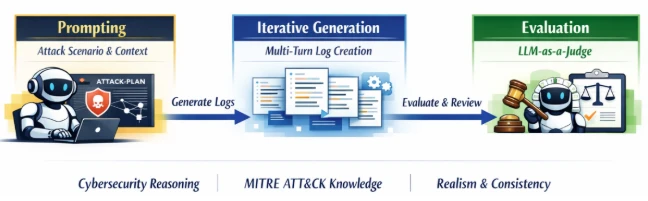
  1. Prompt‑Engineered Generation: Our baseline approach uses a series of carefully designed expert‑crafted prompts. The workflow comprises a structured, multi‑stage dialogue: 
    • Prompting: The model is given a detailed attack scenario and context. 
    • Iterative Generation: Logs are generated across multiple turns to maintain coherence. 
    • Evaluation: An independent large language model (LLM)-as-a-Judge assesses realism and consistency. 

As depicted in the following image, the prompts explicitly instruct the model to reason like a cybersecurity researcher, leverage MITRE ATT&CK knowledge, and produce coherent attack narratives. 

Diagram that shows a three-stage AI agent pipeline: prompting for attack scenarios,
iterative generation of logs, and LLM-as-a-Judge evaluation.
  1. Agentic Workflow-based GenerationWhile the first approach works well in simpler cases, it struggles with complex, multi‑stage scenarios. To address these limitations, we introduced an agentic workflow using three specialized agents focused on different tasks: 
    • Generator Agent: Produces an initial set of logs based on the input. 
    • Evaluator Agent: Reviews logs and provides structured feedback. 
    • Improver Agent: Suggests targeted refinements based on feedback. 

As depicted in the image below, these agents collaborate in an iterative loop (generate, evaluate, improve), allowing the system to correct errors, fill gaps, and refine details over multiple turns. This collaborative process significantly improves log completeness and fidelity, especially for complex attack chains. 

Diagram that shows a cyclical agentic workflow where generator, evaluator, and improver
agents collaborate to produce synthetic telemetry logs.
  1. Multi-Turn Reinforcement Learning with Verifiable Rewards: While the synthetic logs generated by the agentic workflow are often semantically correct, preserving key properties like parent‑child process relationships and event ordering, they still differ noticeably from real event logs, especially in process paths, command‑line arguments, service names and so on. This limits the usage of these logs to test detection efficacy; effective detection engineering requires reliably distinguishing benign activity from malicious behavior.  
    To address this challenge, we conduct experiments using Reinforcement Learning with Verifiable Rewards (RLVR). Instead of rigid rewards used by the evaluator agent in the previous agentic workflow approach, we use partial rewards to learn the policies as follows: 
    • We use an LLM‑as‑a‑Judge as follows to compare the synthesized data against ground‑truth logs.  
    • The model only awards partial rewards based on semantic alignment and imposes a penalty if the generated string is not an exact match of the ground-truth logs, producing a more context-aware and flexible reward signal to guide the learning process. 
    • The judge also produces reasoning, making evaluations transparent, and auditable. 
Diagram that shows the LLM-as-a-Judge evaluation comparing generated logs to ground
truth, issuing rewards or penalties to drive policy updates.

While this direction of research shows a lot of promise, it is heavily dependent on the amount of labeled training data. To address this limitation, we applied data augmentations, including: 

  • Paraphrasing attack narratives while preserving technical intent 
  • Perturbing parameters (e.g., replacing executable names with plausible alternatives, re-ordering flags, etc.) 

This allowed us to scale from hundreds to thousands of training examples. 

Evaluation Datasets

To ensure our approach generalizes across environments and attack types, we evaluated it on three complementary datasets: 

  1. Goal‑Driven (GD) Campaigns: These are tightly scoped datasets produced by repeatable attack simulations conducted by our threat researchers. GDs are built around a specific security objective (e.g., detecting credential dumping on Windows servers). They provide clean ground truth and well‑defined attacker actions. We used a total of 10 different GD executions to evaluate our approaches. 
  1. Security Datasets Project: An open‑source initiative [2] that provides malicious and benign datasets from multiple platforms, enabling broader evaluation and generalizability across different environments.  
  1. ATLASv2 Dataset: The ATLASv2 dataset [3] is comprised of Windows Security Auditing logs, Sysmon logs, Firefox logs, and Domain Name System (DNS) telemetry. These logs are generated across two Windows VMs by executing 10 multi‑stage attack scenarios and introducing realistic noise and cross‑host behaviors. We limited the evaluation of synthetic attack logs to malicious activity during the attack windows. 

Note: The external datasets from the Security Datasets Project and ATLASv2 are used strictly for research and validation of our log generation methods. These datasets are not used in the development, training, or deployment of any commercial products. 

Evaluation 

Methodology: We evaluated the prompt engineering and agentic workflow approach on the three datasets across multiple reasoning and non‑reasoning models, using recall as our primary metric. Recall measures the model’s ability to generate semantically relevant log instances (true positives) expected for a given attack scenario. Our LLM‑as‑a‑Judge performs flexible matching, focusing on: 

  • New process name 
  • Parent process name 
  • Command line semantics 

For example, a synthetic log containing “forfiles.exe” can successfully match a ground‑truth entry with the full path “D:\Windows\System32\forfiles.exe”

Key Results: The results in experimental evaluation demonstrate that prompt-only  approaches establish a baseline but show inconsistent performance. The agentic workflows deliver dramatic recall improvements across all datasets. Reasoning models, combined with agentic refinement, achieve the highest fidelity.  

Finally, our experiments training reinforcement learning approaches conclude that while it shows a significant promise, a substantial amount of labeled data will be required for the agent to learn effective policies to make the synthetic data identical to benign logs. 

Table 1 and Table 2 report the performance of the prompt-based and agentic workflow-based approaches, respectively. For reasoning models (o1, o3 and o3-mini), we report the recall values using a Medium reasoning effort. Overall, agentic collaboration emerges as the most effective technique for high‑quality synthetic attack logs generation. 

Table 1: Recall values for prompt-based log generation.
Table 2: Recall values for agentic workflow-based log generation.

Across the evaluation datasets we used, AI‑driven synthetic log generation shows strong potential to produce semantically meaningful logs from TTPs and attacker actions. It can capture multi‑event sequences, preserve parent‑child process relationships, and generate realistic command lines.

This capability can accelerate detection engineering by reducing dependence on costly lab setups and enabling rapid experimentation, without sacrificing realism or safety. Our early experiments with reinforcement learning with verifiable rewards also look promising and could improve verbatim alignment when sufficient training data is available. 

References

  • ATLASv2: ATLAS Attack Engagements, Version 2: 2401.01341 

This research is provided by Microsoft Defender Security Research with contributions from Raghav Batta and  members of Microsoft Threat Intelligence.

Learn more

For the latest security research from the Microsoft Threat Intelligence community, check out the Microsoft Threat Intelligence Blog.

To get notified about new publications and to join discussions on social media, follow us on LinkedInX (formerly Twitter), and Bluesky.

To hear stories and insights from the Microsoft Threat Intelligence community about the ever-evolving threat landscape, listen to the Microsoft Threat Intelligence podcast.

Review our documentation to learn more about our real-time protection capabilities and see how to enable them within your organization.   

The post Accelerating detection engineering using AI-assisted synthetic attack logs generation appeared first on Microsoft Security Blog.

❌