
Normal view

Received — 19 February 2026 Microsoft Security Blog

Unify now or pay later: New research exposes the operational cost of a fragmented SOC

17 February 2026 at 18:00

Security operations are entering a pivotal moment: the operating model that grew around network logs and phishing emails is now buckling under tool sprawl, manual triage, and threat actors that outpace defender capacity. New research from Microsoft and Omdia shows just how heavy the burden can be—security operations centers (SOCs) juggle double-digit consoles, teams manually ingest data several times a week, and nearly half of all alerts go uninvestigated. The result is a growing gap between cyberattacker speed and defender capacity. Read State of the SOC—Unify Now or Pay Later to learn how hidden operational pressures impact resilience—compelling evidence to why unification, automation, and AI-powered workflows are quickly becoming non-negotiables for modern SOC performance.

The forces pushing modern SOC operations to a breaking point

The report surfaces five specific operational pressures shaping the modern SOC—spanning fragmentation, manual toil, signal overload, business-level risk exposure, and detection bias. Separately, each data point is striking. But taken together, they reveal a more consequential reality: analysts spend their time stitching context across consoles and working through endless queues, while real cyberattacks move in parallel. When investigations stall and alerts go untriaged, missed signals don’t just hurt metrics—they create the conditions for preventable compromises. Let’s take a closer look at each of the five issues:

1. Fragmentation

Fragmented tools and disconnected data force analysts to pivot across an average of 10.9 consoles1 and manually reconstruct context, slowing investigations and increasing the likelihood of missed signals. These gaps compound when only about 59% of tools push data to the security information and event management (SIEM), leaving most SOCs manually ingesting data and operating with incomplete visibility.

2. Manual toil

Manual, repetitive data work consumes an outsized share of analyst capacity, with 66% of SOCs losing 20% of their week to aggregation and correlation—an operational drain that delays investigations, suppresses threat hunting, and weakens the SOC’s ability to reduce real risk.

3. Security signal overload

Surging alert volumes bury analysts in noise with an estimated 46% of alerts proving false positives and 42% going uninvestigated, overwhelming capacity, driving fatigue, and increasing the likelihood real cyberthreats slip through unnoticed.

4. Operational gaps

Operational gaps are directly translating into business disrupting incidents, with 91% of security leaders reporting serious events and more than half experiencing five or more in the past year—exposing organizations to financial loss, downtime, and reputational damage.

5. Detection bias

Detection bias keeps SOCs focused on tuning alerts for familiar cyberthreats—52% of positive alerts map to known vulnerabilities—leaving dangerous blind spots for emerging tactics, techniques, and procedures (TTPs). This reactive posture slows proactive threat hunting and weakens readiness for novel attacks even as 75% of security leaders worry the SOC is losing pace with new cyberthreats.

Read the full report for the deeper story, including chief information security officer (CISO)-level takeaways, expanded data, and the complete analysis behind each operational pressure, as well as insights that can help security professionals strengthen their strategy and improve real world SOC outcomes.

What CISOs can do now to strengthen resilience

Security leaders have a clear path to easing today’s operational strain: unify the environment, automate what slows teams down, and elevate identity and endpoint as a single control plane. The shift is already underway as forward-leaning organizations focus on high-impact wins—automating routine lookups, reducing noise, streamlining triage, and eliminating the fragmentation and manual toil that drain analyst capacity. Identity remains the most critical failure point, and leaders increasingly view unified identity to endpoint protection as foundational to reducing exposure and restoring defender agility. And as environments unify, the strength of the underlying graph and data lake becomes essential for connecting signals at scale and accelerating every defender workflow.

As AI matures, leaders are also looking for governable, customizable approaches—not black box automation. They want AI agents they can shape to their environment, integrate deeply with their SIEM, and extend across cloud, identity, and on-premises signals. This mindset reflects a broader operational shift: modern key performance indicators (KPIs) will improve only when tools, workflows, and investigations are unified, and automation frees analysts for higher value work.

The report details a roadmap for CISOs that emphasizes unifying signals, embedding AI into core workflows, and strengthening identity as the primary control point for reducing risk. It shows how leaders can turn operational friction into strategic momentum by consolidating tools, automating routine investigation steps, elevating analysts to higher value work, and preparing their SOCs for a future defined by integrated visibility, adaptive defenses, and AI-assisted decision making.

Chart your path forward

The pressures facing today’s SOCs are real, but the path forward is increasingly clear. As this report shows, organizations that take these steps aren’t just reducing operational friction—they’re building a stronger foundation for rapid detection, decisive response, and long-term readiness. Read State of the SOC—Unify Now or Pay Later for deeper guidance, expanded findings, and a phased roadmap that can help security professionals chart the next era of their SOC evolution.

To learn more about Microsoft Security solutions, visit our website. Bookmark the Security blog to keep up with our expert coverage on security matters. Also, follow us on LinkedIn (Microsoft Security) and X (@MSFTSecurity) for the latest news and updates on cybersecurity.


1The study, commissioned by Microsoft, was conducted by Omdia from June 25, 2025, to July 23, 2025. Survey respondents (N=300) included security professionals responsible for SOC operations at mid-market and enterprise organizations (more than 750 employees) across the United States, United Kingdom, and Australia and New Zealand. All statistics included in this post are from the study.

The post Unify now or pay later: New research exposes the operational cost of a fragmented SOC appeared first on Microsoft Security Blog.
Analysis of active exploitation of SolarWinds Web Help Desk

The Microsoft Defender Research Team observed a multi‑stage intrusion where threat actors exploited internet‑exposed SolarWinds Web Help Desk (WHD) instances to get an initial foothold and then laterally moved towards other high-value assets within the organization. However, we have not yet confirmed whether the attacks are related to the most recent set of WHD vulnerabilities disclosed on January 28, 2026, such as CVE-2025-40551 and CVE-2025-40536 or stem from previously disclosed vulnerabilities like CVE-2025-26399. Since the attacks occurred in December 2025 and on machines vulnerable to both the old and new set of CVEs at the same time, we cannot reliably confirm the exact CVE used to gain an initial foothold.

This activity reflects a common but high-impact pattern: a single exposed application can provide a path to full domain compromise when vulnerabilities are unpatched or insufficiently monitored. In this intrusion, attackers relied heavily on living-off-the-land techniques, legitimate administrative tools, and low-noise persistence mechanisms. These tradecraft choices reinforce the importance of Defense in Depth, timely patching of internet-facing services, and behavior-based detection across identity, endpoint, and network layers.

In this post, the Microsoft Defender Research Team shares initial observations from the investigation, along with detection and hunting guidance and security posture hardening recommendations to help organizations reduce exposure to this threat. Analysis is ongoing, and this post will be updated as additional details become available.

Technical details

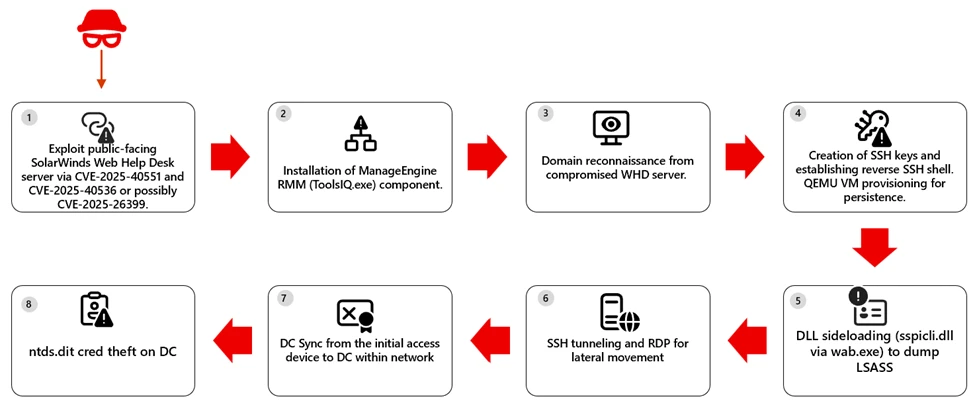
The Microsoft Defender Research Team identified active, in-the-wild exploitation of exposed SolarWinds Web Help Desk (WHD). Further investigations are in-progress to confirm the actual vulnerabilities exploited, such as CVE-2025-40551 (critical untrusted data deserialization) and CVE-2025-40536 (security control bypass) and CVE-2025-26399. Successful exploitation allowed the attackers to achieve unauthenticated remote code execution on internet-facing deployments, allowing an external attacker to execute arbitrary commands within the WHD application context.

Upon successful exploitation, the compromised service of a WHD instance spawned PowerShell to leverage BITS for payload download and execution:

On several hosts, the downloaded binary installed components of the Zoho ManageEngine, a legitimate remote monitoring and management (RMM) solution, providing the attacker with interactive control over the compromised system. The attackers then enumerated sensitive domain users and groups, including Domain Admins. For persistence, the attackers established reverse SSH and RDP access. In some environments, Microsoft Defender also observed and raised alerts flagging attacker behavior on creating a scheduled task to launch a QEMU virtual machine under the SYSTEM account at startup, effectively hiding malicious activity within a virtualized environment while exposing SSH access via port forwarding.

SCHTASKS /CREATE /V1 /RU SYSTEM /SC ONSTART /F /TN "TPMProfiler" /TR 		"C:\Users\\tmp\qemu-system-x86_64.exe -m 1G -smp 1 -hda vault.db -		device e1000,netdev=net0 -netdev user,id=net0,hostfwd=tcp::22022-:22"

On some hosts, threat actors used DLL sideloading by abusing wab.exe to load a malicious sspicli.dll. The approach enables access to LSASS memory and credential theft, which can reduce detections that focus on well‑known dumping tools or direct‑handle patterns. In at least one case, activity escalated to DCSync from the original access host, indicating use of high‑privilege credentials to request password data from a domain controller. In ne next figure we highlight the attack path.

Mitigation and protection guidance

  • Patch and restrict exposure now. Update WHD CVE-2025-40551, CVE-2025-40536 and CVE-2025-26399, remove public access to admin paths, and increase logging on Ajax Proxy.
  • Evict unauthorized RMM. Find and remove ManageEngine RMM artifacts (for example, ToolsIQ.exe) added after exploitation.
  • Reset and isolate. Rotate credentials (start with service and admin accounts reachable from WHD), and isolate compromised hosts.

Microsoft Defender XDR detections 

Microsoft Defender provides pre-breach and post-breach coverage for this campaign. Customers can rapidly identify vulnerable but unpatched WHD instances at risk using MDVM capabilities for the CVE referenced above and review the generic and specific alerts suggested below providing coverage of attacks across devices and identity.

TacticObserved activityMicrosoft Defender coverage
Initial AccessExploitation of public-facing SolarWinds WHD via CVE‑2025‑40551, CVE‑2025‑40536 and CVE-2025-26399.Microsoft Defender for Endpoint
– Possible attempt to exploit SolarWinds Web Help Desk RCE

Microsoft Defender Antivirus
– Trojan:Win32/HijackWebHelpDesk.A

Microsoft Defender Vulnerability Management
– devices possibly impacted by CVE‑2025‑40551 and CVE‑2025‑40536 can be surfaced by MDVM
Execution Compromised devices spawned PowerShell to leverage BITS for payload download and execution Microsoft Defender for Endpoint
– Suspicious service launched
– Hidden dual-use tool launch attempt – Suspicious Download and Execute PowerShell Commandline
Lateral MovementReverse SSH shell and SSH tunneling was observedMicrosoft Defender for Endpoint
– Suspicious SSH tunneling activity
– Remote Desktop session

Microsoft Defender for Identity
– Suspected identity theft (pass-the-hash)
– Suspected over-pass-the-hash attack (forced encryption type)
Persistence / Privilege EscalationAttackers performed DLL sideloading by abusing wab.exe to load a malicious sspicli.dll fileMicrosoft Defender for Endpoint
– DLL search order hijack
Credential AccessActivity progressed to domain replication abuse (DCSync)  Microsoft Defender for Endpoint
– Anomalous account lookups
– Suspicious access to LSASS service
– Process memory dump -Suspicious access to sensitive data

Microsoft Defender for Identity
-Suspected DCSync attack (replication of directory services)

Microsoft Defender XDR Hunting queries   

Security teams can use the advanced hunting capabilities in Microsoft Defender XDR to proactively look for indicators of exploitation.

The following Kusto Query Language (KQL) query can be used to identify devices that are using the vulnerable software:

1) Find potential post-exploitation execution of suspicious commands

DeviceProcessEvents 
| where InitiatingProcessParentFileName endswith "wrapper.exe" 
| where InitiatingProcessFolderPath has \\WebHelpDesk\\bin\\ 
| where InitiatingProcessFileName  in~ ("java.exe", "javaw.exe") or InitiatingProcessFileName contains "tomcat" 
| where FileName  !in ("java.exe", "pg_dump.exe", "reg.exe", "conhost.exe", "WerFault.exe") 
 
 
let command_list = pack_array("whoami", "net user", "net group", "nslookup", "certutil", "echo", "curl", "quser", "hostname", "iwr", "irm", "iex", "Invoke-Expression", "Invoke-RestMethod", "Invoke-WebRequest", "tasklist", "systeminfo", "nltest", "base64", "-Enc", "bitsadmin", "expand", "sc.exe", "netsh", "arp ", "adexplorer", "wmic", "netstat", "-EncodedCommand", "Start-Process", "wget"); 
let ImpactedDevices =  
DeviceProcessEvents 
| where isnotempty(DeviceId) 
| where InitiatingProcessFolderPath has "\\WebHelpDesk\\bin\\" 
| where ProcessCommandLine has_any (command_list) 
| distinct DeviceId; 
DeviceProcessEvents 
| where DeviceId in (ImpactedDevices | distinct DeviceId) 
| where InitiatingProcessParentFileName has "ToolsIQ.exe" 
| where FileName != "conhost.exe"

2) Find potential ntds.dit theft

DeviceProcessEvents
| where FileName =~ "print.exe"
| where ProcessCommandLine has_all ("print", "/D:", @"\windows\ntds\ntds.dit")

3) Identify vulnerable SolarWinds WHD Servers

 DeviceTvmSoftwareVulnerabilities 
| where CveId has_any ('CVE-2025-40551', 'CVE-2025-40536', 'CVE-2025-26399')

References

This research is provided by Microsoft Defender Security Research with contributions from Sagar Patil, Hardik Suri, Eric Hopper, and Kajhon Soyini.

Learn more   

Review our documentation to learn more about our real-time protection capabilities and see how to enable them within your organization.  

Learn more about securing Copilot Studio agents with Microsoft Defender 

Learn more about Protect your agents in real-time during runtime (Preview) – Microsoft Defender for Cloud Apps | Microsoft Learn

Explore how to build and customize agents with Copilot Studio Agent Builder  

The post Analysis of active exploitation of SolarWinds Web Help Desk appeared first on Microsoft Security Blog.

❌