❌

Normal view

Received — 29 September 2026 ⏭ Imperva Cyber Security Blog

New Remote DoS Attacks Against GraphQL Java

28 September 2026 at 18:24

Executive Summary 

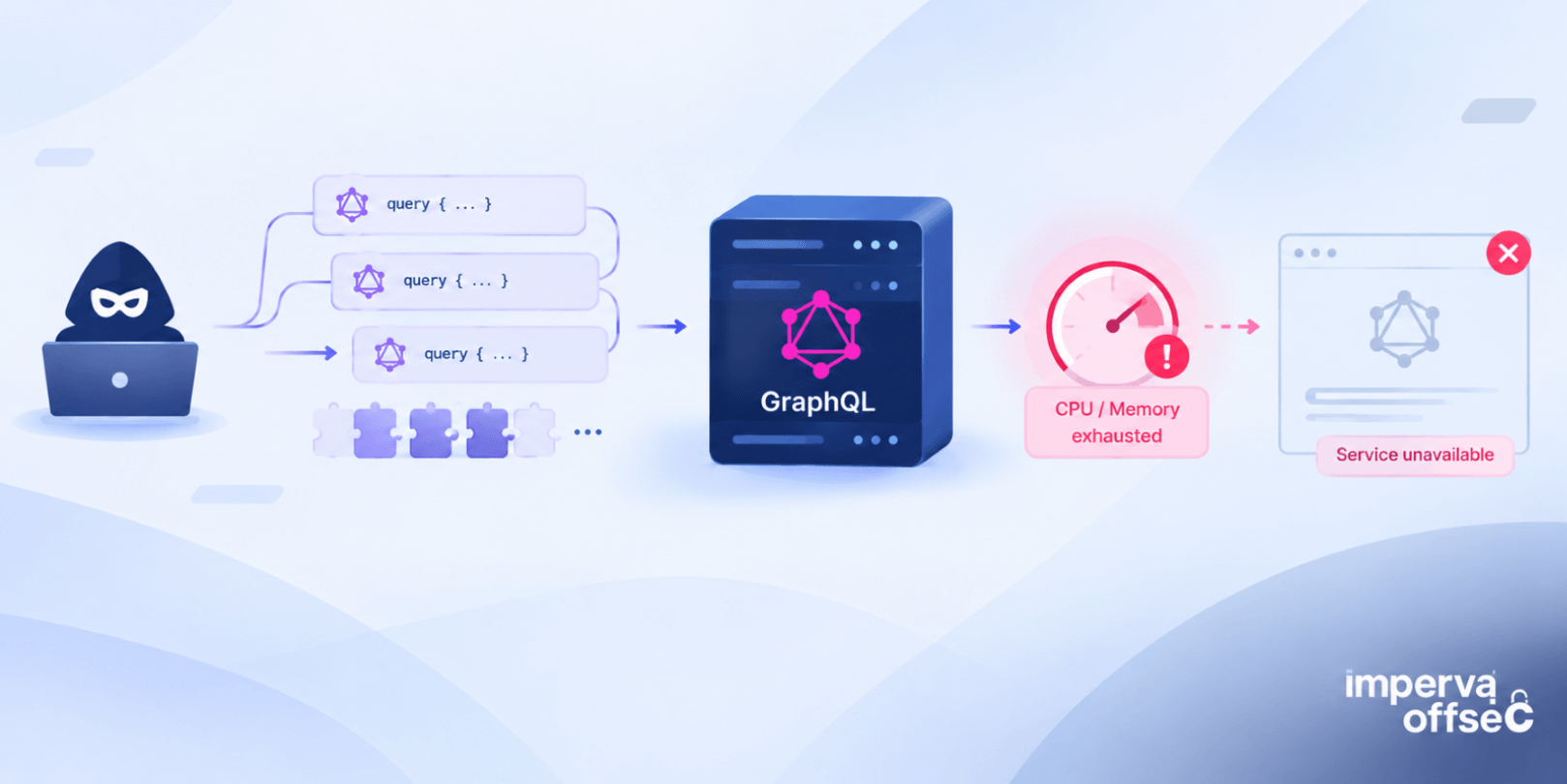
Imperva Threat Research identified a series of remote denial‑of‑service vulnerabilities in GraphQL Java, one of the most widely used libraries for GraphQL in the Java ecosystem. 

In this blog, we’ll deep dive into these vulnerabilities, analyze their impact, and provide recommendations to protect your environment. If your endpoints are protected by Imperva Web Application Firewall, your systems are already protected against these threats.  

Introduction 

GraphQL Java is the engine beneath Spring for GraphQL, Netflix DGS, and Atlassian’s own products. With over one million downloads per month and ten years of production use, it is a natural choice for any team building a GraphQL API on the JVM. 

Over the last few years, multiple types of DoS attacks have been identified across GraphQL implementations. These vulnerabilities can lead to either denial of service or, in cloud-billed environments, excessive cost consumption. In response, the industry converged on a set of protective controls, like depth limiting, query complexity budgets, and field count caps. Apollo added query cost analysis and depth limiting, GitHub meters its public GraphQL API by computed node cost, and GraphQL Java also introduced additional controls. 

However, these enhancements can leave blind spots earlier in the pipeline, before the server has even understood the request. 

The DoS attack we found live in the first half of the pipeline, where the query is parsed and validated, and therefore independent from the schema, the resolvers, and any backend logic.  

They were reported under GHSA-7p4r-9rcc-8vhv (still as draft) and fixed in versions 24.4, 25.1, and 26.1. Several products embedding the library were affected, including Adobe Experience Manager (AEM), Atlassian Confluence, and HAPI FHIR server, a widely used open-source implementation of the HL7 FHIR healthcare interoperability standard. 

Request Processing 

Screenshot 2026 09 23 at 8.36.15 PM

Fig. 1: GraphQL Processing High Level Pipeline 

GraphQL was built around a simple idea: “GraphQL queries mirror their response.” In other words, the client describes exactly the data it needs, while the server determines how to retrieve and resolve that data. The query is then sent to a GraphQL endpoint, where it goes through a series of processing steps before the response is returned: 

  • HTTP Request: The server receives the GraphQL query. 
  • Lexing: The query is broken down into tokens. 
  • Parsing: The tokens are turned into an Abstract Syntax Tree (AST) representing the query structure. 
  • Validation: The query is checked against the GraphQL schema and its rules. 
  • Execution: GraphQL invokes the appropriate resolvers to retrieve the requested data. 
  • JSON Response: The results are assembled and returned to the client. 

The distinction between these stages matters. A request can be rejected before execution because its syntax is invalid or because it does not match the schema. Only after passing these checks does GraphQL reach the resolvers, where the application and its underlying data sources are accessed. 

For security research, this pipeline provides a useful way to understand the attack surface. Each stage processes attacker-controlled input in a different way, making it important to understand not only what GraphQL does, but also when and where it does it. 

Parsing and Validation: A Closer Look 

Before a server decides what data to return, it must first decide whether the request makes sense. Parsing breaks the raw query text into an Abstract Syntax Tree. This involves: 

  • Resolving string literals: block strings go through a dedicated normalization routine that strips leading and trailing blank lines. 
  • Constructing AST nodes for every value encountered: numeric literals are converted to BigInteger or BigDecimal at this point. 

Validation walks the AST and checks it against the schema. This involves: 

  • Field and type checks: do the requested fields exist? Do the argument types match? 
  • Fragment validation: named fragments must not form cycles, directly or transitively 
  • Limit enforcement: in GraphQL Java 26.0, maxDepth and maxFieldsCount are checked here. 

Fragment Cycle Detection 

Validation is where fragment cycle detection takes place. Named fragments are GraphQL’s reuse mechanism. Instead of repeating the same selection set in multiple places, a client defines it once and references it with a spread: 

Screenshot 2026 09 28 at 9.19.01 AM

Fig. 2: Named Fragments in GraphQL 

Fragments can themselves spread other fragments. The spec allows arbitrary nesting, but it forbids cycles: if A spreads B and B spreads A, resolving either one requires resolving the other first. The execution engine would recurse indefinitely. The same applies to indirect cycles across any number of fragments. 

This check happens during validation, after parsing has produced the AST and before execution starts. At this point the server has a complete map of every named fragment in the document and every spread reference between them.  

Cycle detection is pretty straightforward: for each fragment, follow its spread references transitively and check whether any path leads back to the starting node. If it does, the document is rejected with a validation error and execution never starts. 

ValidateNoFragmentCycles is called once per FragmentDefinition in the document. Each call starts with a fresh HashMap. 

For each fragment, it calls buildTransitiveSpreads, a depth-first traversal that follows every spread reference outward, building up the set of fragments reachable from the starting node.  

The traversal tracks its current path in an ArrayList, and at each step calls ArrayList.contains to check whether the next node has already been visited.  

Worst Case Scenario 

We considered a document with the following chain of d fragments: 

Screenshot 2026 09 23 at 8.38.39 PM

Fig. 3: Malicious Payload Structure 

For each fragment, ValidateNoFragmentCycles starts a new traversal with a fresh HashMap. Since the traversal follows the entire chain, and ArrayList.contains iterates over the path of fragments visited so far, the cost of a single validation is O(d²).  

Screenshot 2026 09 23 at 8.39.14 PM

Fig. 4: Processing of the First Fragment 

Since this happens for all fragments, the overall complexity is O(d³), where d is the number of fragments in the document. Within the default 15,000-token limit, a single payload can contain up to around 1,800 fragments (~50 KB), which is sufficient to saturate a CPU core for several minutes at every request. 

Why existing GraphQL protections may not help 

Traditional GraphQL protections such as depth limits and field-count limits operate during validation. However, this attack specifically targets the validation step itself. Therefore, it hits before the protections can prevent the attack. 

Following the reception of our report, graphql-java released a patch that introduces memoization. Once a fragment has been explored, it is marked as done and never re-traversed again. The same malicious payload is processed in a few milliseconds instead. 

This finding was the most impactful, but it wasn’t the only one. 

Additional Remote DoS Vulnerabilities 

We identified the same underlying idea as one of the attack vectors previously identified in React Server Components (BigInt values, CVE-2026-23864), and another vector involving block string normalization routine, more impactful. Both fixed in 24.4, 25.1 and 26.1. 

HAPI FHIR Use Case 

HAPI FHIR is a Java server designed to store and serve medical data (patients, prescriptions, lab results) using the FHIR healthcare standard. Like many modern APIs, it exposes a GraphQL endpoint that clients can use to query this data.  

Internally, HAPI handles GraphQL requests with its own parser, written specifically for FHIR, which knows how to resolve medical resources. But when a client asks for introspection (a standard GraphQL feature that returns the full list of available queries and types) HAPI delegates directly to graphql-java.  

However, it’s possible to bypass HAPI’s custom FHIR resolver and route a non-introspection query straight to graphql-java. 

This delegation is triggered by a simple string check: it relies on the presence of the string `__schema` in the body.  

Therefore, simply starting the request with the following pattern (see Fig 5.) was enough. 

Screenshot 2026 09 23 at 8.40.46 PM

Fig. 5: bypass HAPI’s custom FHIR GraphQL resolver 

Tested on a fresh c7i.2xlarge instance, with the latest HAPI server with graphql enabled, a single request took 150 seconds of validation. A single wave of multiple small requests could lock the server entirely for several minutes and pin all 8 CPU cores at 100% for more than an hour. 

In this application, this attack vector could represent an alternative avenue for a threat actor lacking authorization to exfiltrate patient data (as HAPI’s authorization model governs GraphQL endpoint access and data read permissions independently), and still willing to cause impact. 

The attack surface is further widened by HAPI’s default CORS configuration (allows any origin, Access-Control-Allow-Origin: *). In environments where no additional network controls are in place, this means the attack could be triggered from a browser: a healthcare worker opening a malicious link while connected to the internal network is sufficient to take down the FHIR server for everyone. 

Who is Affected? 

An application is potentially exposed when: 

  • It uses an affected version of GraphQL Java;  
  • It accepts attacker-controlled GraphQL documents;  
  • The GraphQL endpoint is remotely reachable;  
  • No upstream control blocks the malicious request.  

Remediation 

The fixes are available in GraphQL Java versions 24.4, 25.1, and 26.1 via PRs #4440, #4441. 

For environments where an immediate upgrade is not possible: 

  • Restrict access to affected GraphQL endpoints to authenticated or otherwise trusted clients where the application permits it. 
  • Apply rate limiting and concurrency limits to restrict the number of GraphQL requests that can be processed simultaneously. 
  • Monitor CPU utilization and GraphQL request latency for unusual increases that may indicate resource-exhaustion attempts. 

If your endpoints are protected by Imperva Web Application Firewall, your systems are already protected against these threats. 

Conclusion 

As AI accelerates vulnerability discovery and exploitation, threat actors can increasingly scan a target environment in real time, identify weaknesses across its technology stack, and rapidly turn those findings into attacks. This reduces the time organizations must detect and remediate newly exposed vulnerabilities, making proactive and continuously enforced security controls increasingly important. 

Affected organizations should upgrade to a fixed release as soon as possible. Until patches can be applied, additional controls at the application and network layers can help reduce exposure and limit the impact of potential attacks. 

Imperva customers are protected against exploitation of these vulnerabilities. Imperva Threat Research will continue to monitor this threat and work to ensure that customers remain protected against emerging attack techniques targeting GraphQL and other widely deployed technologies. 

Timeline 

August 11 – We reported the security issue to GraphQL Java. 

August 19 – Report Acknowledged. 

August 23 – Fix released in versions 24.4, 25.1 and 26.1. 

The post New Remote DoS Attacks Against GraphQL Java appeared first on Blog.
From Debugging to Code Execution: RCE in Microsoft DevLabs’ DebugMCP?

Introduction 

AI-assisted development has crossed a threshold. The question is no longer whether your IDE communicates with an AI, it’s how deeply that AI is now wired into your local environment. The Model Context Protocol (MCP) is one of the plumbing behind this shift: a JSON-RPC-based protocol that lets AI assistants invoke tools running on your machine. From setting a breakpoint, to running tests, or launching a debugger… all from a chat window. 

DebugMCP is one of the extensions leading that charge. Published by Microsoft on GitHub, it exposes a local MCP server that gives any compatible AI agent (GitHub Copilot, Cline, Cursor, Codex, Windsurf, and others) direct control over the VS Code debugger. The value proposition is compelling: instead of pasting stack traces into a chat window and waiting for a suggestion, an AI agent can set breakpoints, step through code, inspect variables, and evaluate expressions autonomously.  

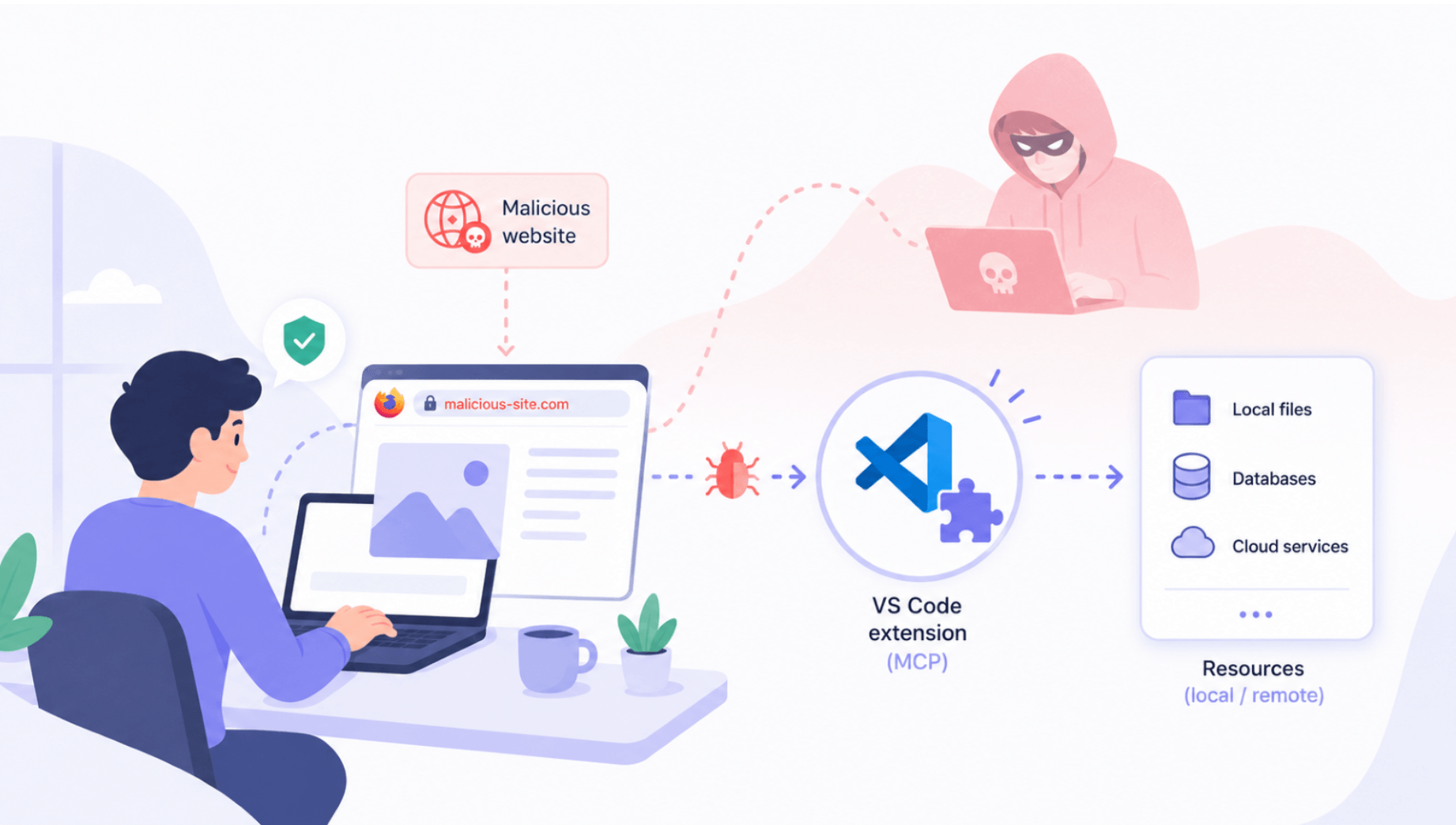
We identified and reported a critical security issue in version 1.1.4. A remote attacker who tricked a developer into visiting a malicious webpage could achieve arbitrary code execution on that developer’s machine, in the background, without any further user interaction (drive by).  

Following our report, the maintainers patched DebugMCP via commit 86776b2m. The fix was silently shipped (no version bump, no advisory) and is included in version 1.2.0 and later. We are publishing this report following the 90-day disclosure period. 

We recommend updating to the latest available version. 

Scope 

The exploitability of this weakness was amplified by the context in which the software evolves.  

Indeed, we’re talking about an opensource MCP server hosted on GitHub, that can be used as a standalone server. But this MCP server is also exposed as an extension in VSCode Marketplace, installable with a single click both in local endpoints, and in shared servers via systems like Github CodeSpaces, OpenVSCode Server, etc. 

From this single installation click, the server is automatically started and listening on port 3001 without authentication, opening the door to RCE. 

First, we’ll explore how this issue could be exploited from a surrounding compromised device, and we’ll then demonstrate how DNS rebinding could be exploited to trigger RCE via simply having a victim browse to a malicious site. 

Root Cause 

DNS Rebinding 

DNS Rebinding is a recurrent risk issue when it comes to MCP servers’ development (See our previous blogpost: Another Critical RCE Discovered in a Popular MCP Server).   

At the end of 2025, probably following a series of vulnerabilities identified in multiple MCP servers, Anthropic added an additional layer of security to prevent this risk (CVE-2025-66414) that adds a default security layer in most MCP server cases.  

Version 1.24.0 of modelcontextprotocol introduces createMcpExpressApp, a preconfigured express server instance that automatically registers validateHostHeader and validateOriginHeader. Together, these functions prevent the risk of DNS rebinding.  

However, the library still relies on maintainers to use header validation middleware functions in case of custom express configuration. And in the case of DebugMCP, this is lacking. 

That was the first node of our attack chain. 

Combined with the lack of host and origin definition and validation, the custom express server defined (identical to CVE-2025-53967), exposed the MCP tools far beyond the intended reach.  

But independently from the broad network exposure, an LLM could be tricked via indirect prompt injection to access a file outside VSCode workspace trust, and the fix produced by the maintainers doesn’t answer this question.

Uncontrolled File Path 

To further explore the attack chain, let’s review the tools exposed. 

The README lists the available tools, including: 

  • start_debugging: launches a debugging session for a given file path 
  • get_debugger_state: returns the current state of an active debugging session 
  • add_breakpoint / remove_breakpoint: manage breakpoints 
  • step_over / step_into / step_out: stepping controls 
  • get_variables: inspect local variables in the current stack frame 
  • evaluate_expression: evaluate an arbitrary expression in the debugger context 
  • continue_execution: resume execution

From reading the tool definitions, start_debugging jumped out immediately since it accepted a fileFullPath argument and instructs VS Code to launch a debugger session for that file. That’s a file execution primitive. 

But to obtain an efficient RCE chain, a few more steps were required. 

The UNC Path Primitive 

At first glance, because the vulnerability requires knowing the full path of an executable on the victim’s machine, it seems difficult to weaponize reliably in the wild. 

However, on Windows, the Universal Naming Convention (UNC) path format allows programs to reference files on network shares using paths of the form: 

\\SERVER\SHARE\path\to\file 

This feature enabled us to make DebugMCP pass the path to VS Code’s debugging infrastructure, which passed it to the Python launcher, which reached out to the attacker’s SMB share and loaded the file. The file executed under the victim’s user context. 

Screenshot 2026 09 23 at 8.22.07 PM

Fig. 1: SMB endpoint to fetch payload 

The proof-of-concept payload was intentionally benign: 

import os
os.system(“calc.exe”) 

After a few seconds, Calculator opened. The attacker’s code was running on the victim’s machine via a single HTTP request. 

At this point we had a working local exploit, if we could send one HTTP request to port 3001 with an attacker-controlled UNC path and get code execution.  

The remaining question was how to deliver that request from a remote attacker’s position to a victim’s localhost, across the same-origin policy that is supposed to make this impossible. 

Stateless MCP session 

One part of the answer lies in the MCP itself. You can find a detailed introduction to the protocol here. 

What matters here is one implementation detail that significantly reduced the attack complexity. 

MCP over HTTP is built on JSON-RPC 2.0. The protocol specification describes a lifecycle: a client must send an initialize request, receive the server’s capability response, then send an initialized notification (only after this handshake can tool calls be made). This sequence implies a minimum of two round-trips before any tool is invoked, and it gives a server the opportunity to establish authenticated session state. 

The MCP TypeScript SDK’s StreamableHTTPServerTransport enforces this lifecycle through a validateSession function called on every non-initialize request. The enforcement is conditional: 

Screenshot 2026 09 23 at 8.22.55 PM

Fig. 2: Stateless MCP mode 

When sessionIdGenerator is undefined, validateSession returns immediately without checking anything. The entire initialization lifecycle is bypassed. In DebugMCP v1.1.4, the transport was explicitly configured in stateless mode.  

The consequence for the attack chain is direct: a single no-cors HTTP request was sufficient to trigger the attack. 

Browser Local Network Protections 

However, there was a last ingredient we needed to incorporate to obtain a frictionless exploit. 

Indeed, Local Network Access’s aim is to protect users from cross-site request forgery (CSRF) attacks targeting routers and other devices on private networks, and to reduce the ability of sites to use these requests to fingerprint the user’s local network. 

Combined with the same-origin policy (that prevents a piece of JavaScript from one domain  and make cors requests to a different one and get the response), in modern browsers, there is a good chance a warning popup would be displayed and halt the execution of the malicious content if a threat actor tries to scan the local network.  

But DNS rebinding is a technique that can potentially circumvent this boundary by exploiting the way browsers cache DNS records. And as we explained earlier, DebugMCP doesn’t include MCP default mitigation added by Anthropic against this risk. 

Here is the attack flow: 

Screenshot 2026 09 23 at 8.24.01 PM

Fig. 3: Attack Flow 

The sequence unfolds in six steps: 

Step 1: Victim visits the page. The attacker’s domain resolves to the attacker’s public IP (Phase 1 DNS). The browser loads the initial page content.  

Step 2: DNS Rebinding. The domain was registered with a very short TTL: 1 to 2 seconds. Firefox enforces an internal minimum cache duration of ~60 seconds regardless of the declared TTL, so the page polls in a JavaScript loop until the entry expires and Firefox re-resolves the name: at which point the attacker’s DNS server returns 127.0.0.1. 

Step 3: Local Network Access. The attacker’s JavaScript, issues a fetch to http://evil.attacker.com:3001/mcp?transport=streamable_http. The browser considers this request same-origin and sends it. The DNS entry now points to 127.0.0.1, so the request arrives at the victim’s local DebugMCP server. 

Step 4: DebugMCP Execution. The request reaches the Microsoft DebugMCP server running locally on the victim’s machine. DebugMCP processes the request and triggers its Python launcher, which is responsible for starting the debugging workflow. 

Step 5: Malicious Payload Download. The Python launcher connects to a publicly accessible SMB share controlled by the attacker and downloads the malicious Python script onto the victim’s machine. 

Step 6: Code Execution. The launcher passes the downloaded script to the start_debugging() function. DebugMCP then executes the attacker-controlled payload, ultimately giving the attacker code execution on the victim’s machine. 

Demonstration 

Although the exploit triggers error messages in the VS Code console, the payload is still successfully executed. We used Firefox version 150.0.3, the latest at the time of our research. 

Note: After the research, Firefox enforced a Local Network Access Protections (version 153). This prevents the a request originating from a domain associated with a public IP to reach more private address networks. This recent feature, currently existing in Chrome and Firefox, isn’t yet generalized to all browsers.  

Impact 

The target is a developer. That means the compromised machine holds live credentials, source code, and trusted access to internal infrastructure. 

In practice: AWS keys, SSH keys, GitHub tokens in VS Code’s secret storage, active cloud CLI sessions, VPN tunnels open to the internal network, and push access to production branches would be likely available: a payload that runs as the developer inherits all of it silently. 

The delivery requires no interaction beyond visiting a page, it’s a drive-by attack. 

Recommendations 

Developers using this tool should update to the latest available version. The fix ships after 1.1.4 (version 1.2.0 and later).  

In addition, it’s recommended to regularly audit which servers are listening on loopback. 

Use authentication in your MCP servers and enforce governance to control which MCP server is running in your network and be able to remove it if necessary. 

Regarding MCP development more specifically: 

Use middleware that enforce validation (like createMcpExpressApp Since SDK v1.23.0). 

Validate file path inputs. Reject UNC paths and remote schemes before passing any path to an execution primitive. 

Disclosure Timeline 

  • May 19: Issue reported to Microsoft  
  • May 24: Fix shipped in commit 86776b2, released as version 1.2.0 
  • September 25: Public disclosure (this blogpost) 

Conclusion 

AI-assisted development is quietly rewriting the developer machine’s threat model. To give an agent useful capabilities, extensions expose local servers, wire in execution primitives, and grant broad access to the filesystem and the debugger.  

Each of these is a reasonable engineering decision on its own. Together, they turn the workstation into a dense collection of automation endpoints, and those same endpoints, built to be driven by a trusted agent, are equally drivable by an attacker who reaches them. The productivity story and the attack surface story are the same story. 

Developer environments are where source code, signing keys, pipeline credentials, and cloud sessions converge; compromising one is often a shorter path to production than attacking production directly.  

This vulnerability was not sophisticated. The techniques here are not new; what’s new is the rate at which capable, unvetted local servers are being deployed onto high-value machines, and the growing ability of AI agents to discover and chain weaknesses autonomously. 

The post From Debugging to Code Execution: RCE in Microsoft DevLabs’ DebugMCP? appeared first on Blog.

OWASP LLM Top 10 2026: Every Move Points the Same Direction

23 September 2026 at 19:14

This is Post 4 of a four-part series:
Post 1: Agentic AI Security: The Chatbot Era Is Over
Post 2: Generative AI Security: Why AI Needs a New Kind of Security
Post 3: The OWASP LLM Top 10 Was the Warm-Up: What Comes Next

The 2026 edition of the the OWASP Top 10 for LLM Applications, published by the OWASP GenAI Security Project on August 3, 2026, is easy to skim past. No entry was dropped and no new category was introduced, so at a glance it can read as housekeeping. It is worth a closer look than that. Eight of the ten entries changed position, and one was renamed and widened in scope, which changes what it asks of the teams working against it.

When a framework adds or drops entries, it is usually telling you the threat surface itself has changed. This edition did something more specific. The categories held, but their order was substantially revised and one of them grew, which suggests the original naming was sound while the relative priority had drifted from what teams were meeting in production. Read the movements together and a pattern shows up.

The short version: the OWASP Top 10 for LLM Applications 2026 kept all ten categories but moved eight of them. Excessive Agency climbed from LLM06 to LLM03, Unbounded Consumption from LLM10 to LLM06 and Misinformation from LLM09 to LLM07, while Improper Output Handling fell from LLM05 to LLM10. System Prompt Leakage was renamed Hidden Context Exposure and broadened to cover everything an application places in front of the model without the user seeing it.

What changed in the OWASP LLM Top 10 2026

The table below sets the 2026 order against the 2025 one, listed by 2026 rank.

2025 rank Entry 2026 rank Movement
LLM01 Prompt Injection LLM01 No change
LLM02 Sensitive Information Disclosure LLM02 No change
LLM06 Excessive Agency LLM03 Up 3
LLM03 Supply Chain LLM04 Down 1
LLM04 Data and Model Poisoning LLM05 Down 1
LLM10 Unbounded Consumption LLM06 Up 4
LLM09 Misinformation LLM07 Up 2
LLM07 Hidden Context Exposure LLM08 Down 1, renamed and widened from System Prompt Leakage
LLM08 Vector and Embedding Weaknesses LLM09 Down 1
LLM05 Improper Output Handling LLM10 Down 5

Prompt Injection and Sensitive Information Disclosure held first and second, which surprised nobody. Every other entry sits somewhere new, and the rest of this piece is about why the direction of those moves matters more than the individual rankings.

Excessive Agency and Unbounded Consumption: the climbers describe applications, not models

The two biggest climbers are the same kind of risk wearing different clothes. Excessive Agency is about what an application is permitted to do once a model is driving it: which tools it can call, which systems it can reach, how far one decision can travel before a human sees it. Unbounded Consumption is about what happens when that same application meets traffic engineered to abuse it, producing no malware and no traditional indicators, just an enormous bill. Neither is a property of the model. Both are properties of an application in production.

The biggest faller makes the same argument from the other end. Improper Output Handling dropped five places, and not because it stopped happening. It fell because it is the entry the industry already knew how to answer. Rendering untrusted output safely, refusing to execute what came back from an untrusted source, treating downstream consumers as a boundary: application security teams have been practicing that discipline for twenty years. The skill transferred. The novelty did not survive contact with people who already had the muscle.

Setting the renamed entry aside, the three entries that each slipped a place have something in common too. Supply Chain, Data and Model Poisoning, and Vector and Embedding Weaknesses are all risks you address before the application serves its first request, in procurement, in the training pipeline, in how the knowledge base was assembled and secured. They did not become less serious. They became less urgent relative to the things that only exist once the system is live.

Misinformation climbing two places fits once you ask who pays for it. A model that invents a refund policy is a quality problem in a lab and a liability problem in production, and a Canadian tribunal has already held Air Canada responsible for what its chatbot told a customer (Moffatt v. Air Canada, 2024). That entry did not move because models got worse. It moved because the consequences arrived.

Read together: the entries that climbed are the ones that only exist while the application is running. The entries that fell are handled before deployment, or handled by controls the industry already had.

From System Prompt Leakage to Hidden Context Exposure: the rename nobody is discussing

System Prompt Leakage became Hidden Context Exposure, and it is the most consequential edit in the document.

A system prompt is one specific thing: the instruction block sitting at the top of a conversation, defining the model’s role and its rules. Hidden context is everything else the application quietly places in front of the model without the user ever seeing it. Retrieved documents. Tool definitions. Prior turns held in memory. Configuration a developer assumed was private because no interface displays it.

The rename takes the entry from one field to an entire supply of runtime input, and it lands the same point the reordering makes. What the application feeds the model has become the attack surface. That is a materially bigger claim than the 2025 wording made, and any content or tooling still describing this entry as system prompt protection is now describing a fraction of it.

How to read an OWASP LLM Top 10 coverage claim, including ours

A reordering like this produces a wave of updated coverage claims, and some of them will describe protection across the whole list. Those claims are worth examining rather than accepting, and one question does most of the work: which control fires, inline, at runtime, for this specific entry?

Ask it of the entries that just fell. A poisoned model dependency arrives before a single request is served. At the moment of compromise there is no traffic to inspect, no prompt to score, no response to hold. Something does address that risk, but that something is a procurement process, a posture scan or a signed build pipeline. The same is true of a poorly governed vector store. These are real controls and they matter; they are simply not the same category of thing as a runtime control, and they usually sit with a different team and a different budget.

This is not a criticism of any product. It is the shape of the problem. Runtime protection covers runtime problems. When you meet a claim spanning all ten entries, the useful follow-up is to ask which of the ten are covered by inline enforcement, which by a scanner, which by a partner integration, and which by a policy document, and then to decide whether that composition is what you thought you were buying. A vendor who can answer that cleanly is telling you something about how they think. So is one who cannot.

Apply the same question to us. We would rather you did.

Where we stand against the 2026 order

Thales Imperva AI Application Security addresses five entries with runtime enforcement. In 2026 numbering, they are Prompt Injection (LLM01), Sensitive Information Disclosure (LLM02), Unbounded Consumption (LLM06), Hidden Context Exposure (LLM08) and Improper Output Handling (LLM10).

Two of those five moved this year, and the moves cut in opposite directions. Unbounded Consumption climbed four places, which raises the profile of a control we already ship. Improper Output Handling fell five, which lowers the profile of another one we already ship. Reporting the first without the second would be the kind of selective reading this piece is arguing against.

Two of those five are also where our next work lands, and they are connected. Hidden Context Exposure now covers tool definitions, and Excessive Agency is the question of what an application is permitted to do once a model is driving it. We are adding tool call guardrails that check whether the specific tool being called is permitted, and the tool definitions themselves are what we look at next. Today we detect and monitor tool calls. Checking them against what is allowed is the step after that, and it is better to say so plainly than to let a coverage table imply it already exists.

The other five entries need different tools, and we would rather name them than imply otherwise. Supply Chain and Data and Model Poisoning are build-time and procurement problems. Vector and Embedding Weaknesses belongs with the data security controls sitting in front of the retrieval pipeline. Misinformation is evaluation and grounding work. Excessive Agency is the one to watch: it is the entry moving fastest toward runtime, it is where the agentic controls across this whole category are heading, and at number three it is now the highest-ranked risk that most security programs have no inline answer for at all.

The list caught up with agentic AI

In a recent piece we argued that the LLM Top 10 had been the warm-up, and that the frameworks describing agentic and MCP risk had already been published while most security programs were still resourcing against the first list. The 2026 edition is that argument told from inside the framework itself.

Excessive Agency at number three is an agentic risk sitting near the top of an LLM list. Hidden Context Exposure is the retrieval and tool layer being named as attack surface. Neither entry is about a model producing text. Both are about a system taking action on the strength of what it was fed. The list has started describing applications that act, which is the same shift the newer frameworks were built for.

A practical exercise for this quarter: take the four entries that moved most, and for each one write down which control in your own environment would fire while the attack was in progress, not after it appeared in a report. The gaps in that list are what the 2026 reordering is pointing at.

Thales’s Imperva AI Application Security is purpose-built runtime protection for AI applications, agents, and the ecosystems behind them, deployable in-app, at the Imperva edge, or via API, standalone or as part of Imperva’s unified application security platform. Our white paper, Beyond the LLM Top 10, maps the agentic and MCP threat surface against the published frameworks.

Frequently asked questions about the OWASP LLM Top 10 2026

What changed in the OWASP Top 10 for LLM Applications 2026?

The 2026 edition, published by the OWASP GenAI Security Project on August 3, 2026, added and removed no categories. Eight of the ten entries changed position: Excessive Agency rose from LLM06 to LLM03, Unbounded Consumption from LLM10 to LLM06 and Misinformation from LLM09 to LLM07, while Improper Output Handling fell from LLM05 to LLM10. Prompt Injection (LLM01) and Sensitive Information Disclosure (LLM02) held their places, and System Prompt Leakage was renamed Hidden Context Exposure.

What is Hidden Context Exposure in the OWASP LLM Top 10?

Hidden Context Exposure (LLM08 in 2026) replaces System Prompt Leakage (LLM07 in 2025). It widens the entry from the system prompt alone to everything an application places in front of the model without the user seeing it: retrieved documents, tool definitions, prior turns held in memory and configuration a developer assumed was private.

Why did Excessive Agency move up to LLM03?

Excessive Agency describes what an application is permitted to do once a model is driving it: which tools it can call, which systems it can reach and how far one decision can travel before a human sees it. It climbed three places, from LLM06 to LLM03, as agentic applications that take actions moved into production.

Which OWASP LLM Top 10 risks can runtime protection address?

Runtime controls act on live traffic: prompts, responses and tool calls. Supply Chain and Data and Model Poisoning are build-time and procurement problems, Vector and Embedding Weaknesses belongs with data security controls in front of the retrieval pipeline, and Misinformation is evaluation and grounding work. When a vendor claims coverage of all ten entries, ask which are covered by inline enforcement, which by a scanner, which by a partner integration and which by a policy document.

Read more in our white paper: Beyond the LLM Top 10.

The post OWASP LLM Top 10 2026: Every Move Points the Same Direction appeared first on Blog.

❌