❌

Normal view

Received — 6 October 2026 ⏭ Imperva Cyber Security Blog

The Hidden DoS Vector in SQL Parsers

6 October 2026 at 08:09

SQL parsers are critical components of the modern data stack. They validate queries before they reach the database, transpile between dialects, and lint codebases for style violations. Increasingly, they also power AI-driven SQL generation in LLM-integrated data tools. 

Our research focused on two popular Python-based parsers: SQLGlot and SQLFluff, both with around 10k GitHub stars each. These libraries sit at the foundation of the data ecosystem, trusted by thousands of projects, and we believe the underlying issues are relevant to other parsers and other programming languages as well. 

But these parsers carry a hidden flaw. They are highly susceptible to resource exhaustion from seemingly “simple,” syntactically valid SQL queries. Not injection. Not malformed input. Just normal-looking SQL that happens to be shaped in the wrong way. 

In this post, we describe our findings of new vulnerabilities stemming from two root causes: Recursive Stack Overflow and Parser AST Object-Inflation. We show how these flaws cascade into downstream applications, giving concrete examples from several major projects we found vulnerable, with many more still to be explored. We then explain the underlying mechanics and conclude with practical fix suggestions for both parser maintainers and application developers. We reported every issue to the respective maintainers and contributed to the fixes that now ship upstream; the SQLFluff findings were assigned CVE-2026-46373 and CVE-2026-46374. 

The First Clue: A Query That Crashes the Interpreter 

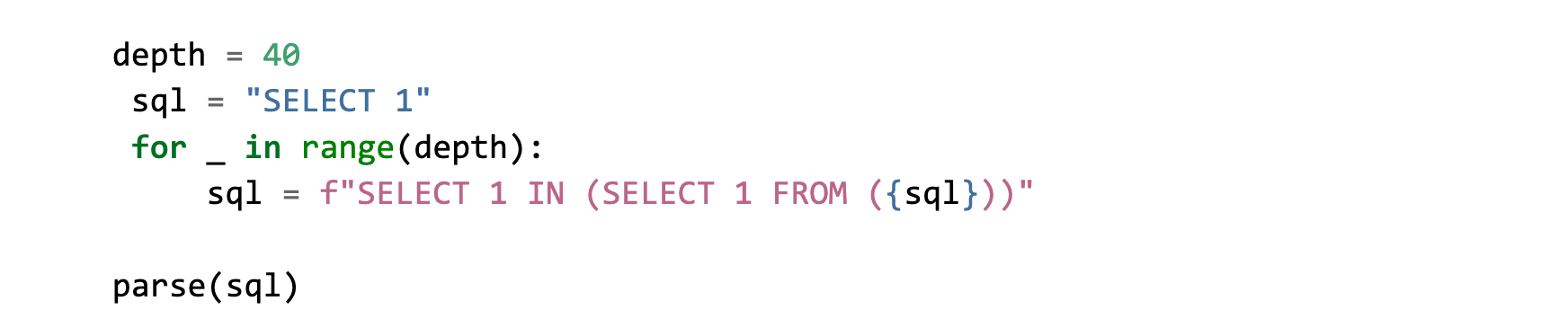
Our research began with a simple question: what happens when you feed a deeply nested query to a SQL parser? 

Screenshot 2026 10 05 at 2.36.42 PM

The answer: the Python interpreter crashes with a RecursionError. At higher concurrency, it segfaults. 

This isn’t a contrived edge case. The query is syntactically valid SQL. Any database would reject it for being absurd, but a parser’s job is to parse it – and both SQLGlot and SQLFluff attempt to do so without any depth limit. At 50+ levels of nesting, the recursive descent parser exhausts the call stack. 

The fix seems obvious in hindsight: enforce a maximum recursion depth (e.g., 30 levels) and abort gracefully. But neither parser does this. 

Going Wider: AST Object Inflation 

The recursion crash was just the beginning. As we explored further, we discovered a more insidious problem: AST amplification. 

SQL parsers work by converting raw SQL text into an Abstract Syntax Tree (AST) – a structured representation where each token (literal, identifier, operator, dot) becomes a Python object. These objects carry metadata: type information, position tracking, parent references. They’re heavyweight. 

The question became: what if we crafted a query that was short but produced an enormous number of AST nodes? 

Screenshot 2026 10 05 at 2.37.14 PM

The result was striking. In SQLGlot, a SQL string under 2MB in size demanded over 1.5GB of RAM to parse – roughly a 750x amplification ratio. SQLFluff showed the same pattern: at width=5000, it consumed over 1GB. 

This is the core vulnerability: each SQL token gets wrapped in a heavy Python object. A compact input with thousands of columns and deep expression chains generates millions of AST nodes, far exceeding what any reasonable container or server can handle. The process is killed by the OOM killer – or simply hangs until it starves out everything else on the machine. 

The Amplification Chain 

To see where the cost comes from, it helps to follow the input through each stage of parsing. The payload starts small, but every step multiplies it: tokenization splits the string into hundreds of thousands of pieces, AST construction wraps each one in a heavyweight Python object, and the resulting tree balloons into gigabytes of memory. The diagram below traces that roughly 750x expansion from a 2MB string to a 1.5GB+ footprint. 

Screenshot 2026 10 05 at 2.37.45 PM

The key insight is that object inflation is the root cause. It isn’t about the input being “large”, it’s about the multiplicative cost of turning each token into a rich object. A 2MB string is a perfectly normal payload by any standard. But the parser amplifies it by orders of magnitude. 

The Cascade: From Parser to Platform – Examples 

A vulnerability in a parser library is concerning on its own. But parsers don’t exist in isolation, they’re embedded deep in application stacks. When the parser crashes, the application may crash with it. 

We traced this cascade through several major projects. 

Apache Superset: Complete Service Outage 

Apache Superset (~75k stars) uses SQLGlot under the hood. Its SQL Lab feature allows authenticated users to write and execute queries. 

The weakness lives in the pre-execution phase. When a user submits a query through SQL Lab, Superset hands the raw SQL to SQLGlot for parsing and validation before it ever reaches the database and before any complexity checks are applied. There is no limit on query size, nesting depth, or AST node count at this boundary. An authenticated user with ordinary SQL Lab access is enough; the query never has to run. 

Depending on the payload size, the attack produces two distinct denial-of-service states: 

  • Memory exhaustion (OOM crash): Large payloads (roughly 5 MB and up) drive AST allocation past available system RAM. The worker is terminated with a SIGKILL and restarted, dropping in-flight requests. 
  • CPU/thread exhaustion (zombie hang): Moderate payloads (around 1.5 MB) don’t trip the OOM killer but saturate CPU and hold the GIL, so parsing never completes. The GIL (Global Interpreter Lock) is a mutex in CPython that lets only one thread execute Python bytecode at a time; a thread stuck in a long, pure-Python parse keeps the lock and starves every other thread in the process. Every user sees persistent timeouts while the worker is pinned. 

The attack is simple: authenticate as a normal user, then send a batch of concurrent requests to /api/v1/sqllab/execute/, each carrying a payload built from a large number of columns of a deeply nested x=x=x… expression. The number of columns determines which failure mode you hit: 

  • A wide payload (on the order of tens of thousands of columns) makes container memory climb steadily until the worker is killed within a few minutes, emitting the tell-tale log line: 
  • [ERROR] Worker (pid:14) was sent SIGKILL! Perhaps out of memory? 
  • A smaller payload hangs the server with consistent timeouts for all users without triggering the OOM killer. 

The exact thresholds depend on available memory – a 16 GB host behaves differently from a 4 GB container – but either way, a single authenticated user takes down SQL Lab, and the shared worker pool, for everyone. 

Dify: Plugin Framework Collapse 

Dify (~150k stars) Uses SQLGlot within its plugin ecosystem. We found two vulnerable plugins – db-client-node and dify-bigquery-plugin – and that the plugin framework’s architecture amplified the parser vulnerability into a system-wide failure. 

A large SQL payload (10,000 columns x 60 depth) executed through a workflow that triggers 5 concurrent database queries caused a 5GB RAM spike. This didn’t just kill the plugin – it destroyed the IPC bridge between Dify’s Go-based daemon and its Python workers. 

PluginDaemonInternalServerError: write |1: file already closed failed to write request 

The daemon lost track of healthy workers. The system entered a “Blackout” state for approximately 60 seconds, during which all tool calls across the entire framework returned errors – not just those involving the parser. 

SQLFluff Online: Backend Exhaustion via Missing Input Limit 

SQLFluff Online (source) exposes the parser through a web API. The frontend enforces a 3,000-character input limit. The backend does not. 

By sending a crafted payload directly to the /fluffed endpoint – bypassing the frontend – a single request consumed 2GB+ of RAM and saturated the CPU. The service locked up entirely. 

Pathway: OOM in the SQL Interface 

Pathway (~60k stars) uses SQLGlot internally and exposes a pw.sql interface that accepts user queries. We submitted a crafted query (10,000 columns x 70 depth) and watched memory grow unboundedly, consuming 8GB+ of RAM. The server was killed with OOMKilled: true and ExitCode: 137. Pathway produced no error or warning before the crash. 

The Bigger Picture: Parser Exhaustion 

The security community has spent decades hardening systems against SQL Injection, the manipulation of query structure to execute unauthorized commands. This is a different class of attack entirely. 

Parser Exhaustion doesn’t inject anything. It doesn’t exploit string concatenation or missing parameterization. The queries are syntactically valid. They would parse correctly on any SQL grammar. They just happen to be shaped in a way that overwhelms the parser’s resource consumption. 

This distinction matters because Parser Exhaustion bypasses many traditional defenses: 

  • Parameterized queries aren’t relevant for generated queries, where the whole structure is dynamic 
  • Input sanitization won’t catch it – there are no special characters to escape 
  • WAFs typically look for injection patterns, not resource-exhausting shapes 

As the industry moves toward automated SQL generation and LLM-integrated data tools, this attack surface grows. LLMs can generate arbitrarily complex SQL. If that SQL passes through a parser – for validation, linting, or transpilation – the parser becomes an attack vector. Not because the SQL is malicious in the traditional sense, but because it’s expensive. 

The parser is no longer just a utility. It’s a trust boundary. 

Practical Mitigations 

The good news: these vulnerabilities are straightforward to mitigate. Simple limits on recursion depth and AST size can harden parsers against this entire class of attack. 

At the Parser Level

1. Recursion depth limit: abort parsing if nesting exceeds a threshold:

Screenshot 2026 10 05 at 2.42.57 PM

2. AST node limit: count nodes during construction and abort if a threshold is exceeded: 

Screenshot 2026 10 05 at 2.43.08 PM

We reported both issues to the maintainers of SQLGlot and SQLFluff and contributed to the fixes. SQLGlot now enforces a configurable recursion/complexity limit during parsing (merged ahead of the v30.5.0 release), and SQLFluff adopted comparable guards. If you depend on either library, upgrade to a patched version and keep the default limits enabled. 

At the Application Level 

The bad news: not all parsers support limits. If the parser you use enforces a recursion or node limit, enabling it is the best way to mitigate these vulnerabilities. If it doesn’t, defend at the application level: 

  • Enforce input limits: reject queries before parsing based on cheap, pre-parse metrics: raw byte size, token count, nesting/parenthesis depth, and column count. These caps cost almost nothing to check and stop the pathological shapes before a single AST node is allocated. Apply them on the server, not just the client – the SQLFluff Online case shows that a frontend-only limit is trivially bypassed. 
  • Set execution timeouts for parsing operations: don’t let a single query consume a worker indefinitely 
  • Implement memory limits via container constraints (Docker –memory) to contain blast radius 
  • Rate limit query submissions, especially in multi-tenant environments
  • Isolate plugin execution: use network namespaces or sandboxed processes so a plugin crash doesn’t cascade 

Not Only SQL 

SQL parsers are not special. The root causes – unbounded recursion and object inflation – are properties of recursive-descent parsers in general. We found the same patterns in query languages built on entirely different grammars. 

Cypher (Neo4j) 

Neo4j’s Cypher query language (~17k stars) exhibits both failure modes: 

  • Deep nesting: A query with ~1,500+ nested parentheses, lists, or maps causes the connection to hang for 240 seconds before timing out. 
  • CPU exhaustion: Parsing exhibits quadratic time on long chains of AND/OR operators. A query with 30,000 chained operators takes 172+ seconds to parse, with a peak heap of ~1.3 GB and worker-thread starvation – a small input that pins a worker for minutes. 

GraphQL 

GraphQL (~20k stars) is the instructive counter-example: the spec supports a max_tokens limit, but whether it’s enforced by default varies by implementation. 

  • graphql-java – ships a sensible default 15,000-token limit. But even that budget is enough for ~1,800 fragments (~50 KB) to saturate CPU for several minutes on every request. A default limit helps, but the threshold still has to be tuned to resource cost, not just token count. For further reading, see our write-up on remote DoS attacks against graphql-java. 
  • graphql-js (no token limit by default) – a single unauthenticated POST expands a 6.9 MB payload into ~1.77 GB RSS (~256x amplification) and blocks the worker for ~14.6 s. Under –stack-size=65500 (common in production) it crashes outright. Confirmed against Apollo Server v5.5.1. 
  • graphql-core (Python, no token limit by default) – ~7 MB expands to ~2 GB RSS (~276x amplification), blocking the worker for ~23.4 s. A payload under 1 KB triggers a RecursionError at depth ~300. 

The takeaway: this is a parser-design problem, not a SQL problem. Any parser that turns untrusted text into a rich object tree without bounding depth or node count is exposed. 

Conclusion 

We disclosed vulnerabilities in SQLGlot, SQLFluff (CVE-2026-46373, CVE-2026-46374), and several downstream applications – all stemming from the same root cause: parsers that trust their input to be reasonable. Beyond reporting, we worked with both maintainer teams and contributed to the fixes that now ship upstream, so every project depending on these libraries benefits by upgrading. The fixes themselves are straightforward: depth limits, node counting, input size validation. But the lesson is broader. 

Parsers have quietly become critical infrastructure. They’re embedded in data platforms, CI/CD pipelines, AI agents, and production workflows. Yet they’ve historically been treated as safe, deterministic utilities that “just work.” Our findings show that even syntactically correct queries can be weaponized to dismantle the systems that depend on them. 

As the industry moves toward automated SQL generation and LLM-integrated data tools, the parser is no longer a passive utility – it’s an active attack surface. Hardening it requires the same discipline we apply to any other trust boundary: validate input, limit resource consumption, and assume that anything coming from outside the system is potentially adversarial. 

It’s time to move beyond SQL Injection. Welcome to Parser Exhaustion. 

The post The Hidden DoS Vector in SQL Parsers appeared first on Blog.
Received — 19 May 2026 ⏭ Imperva Cyber Security Blog

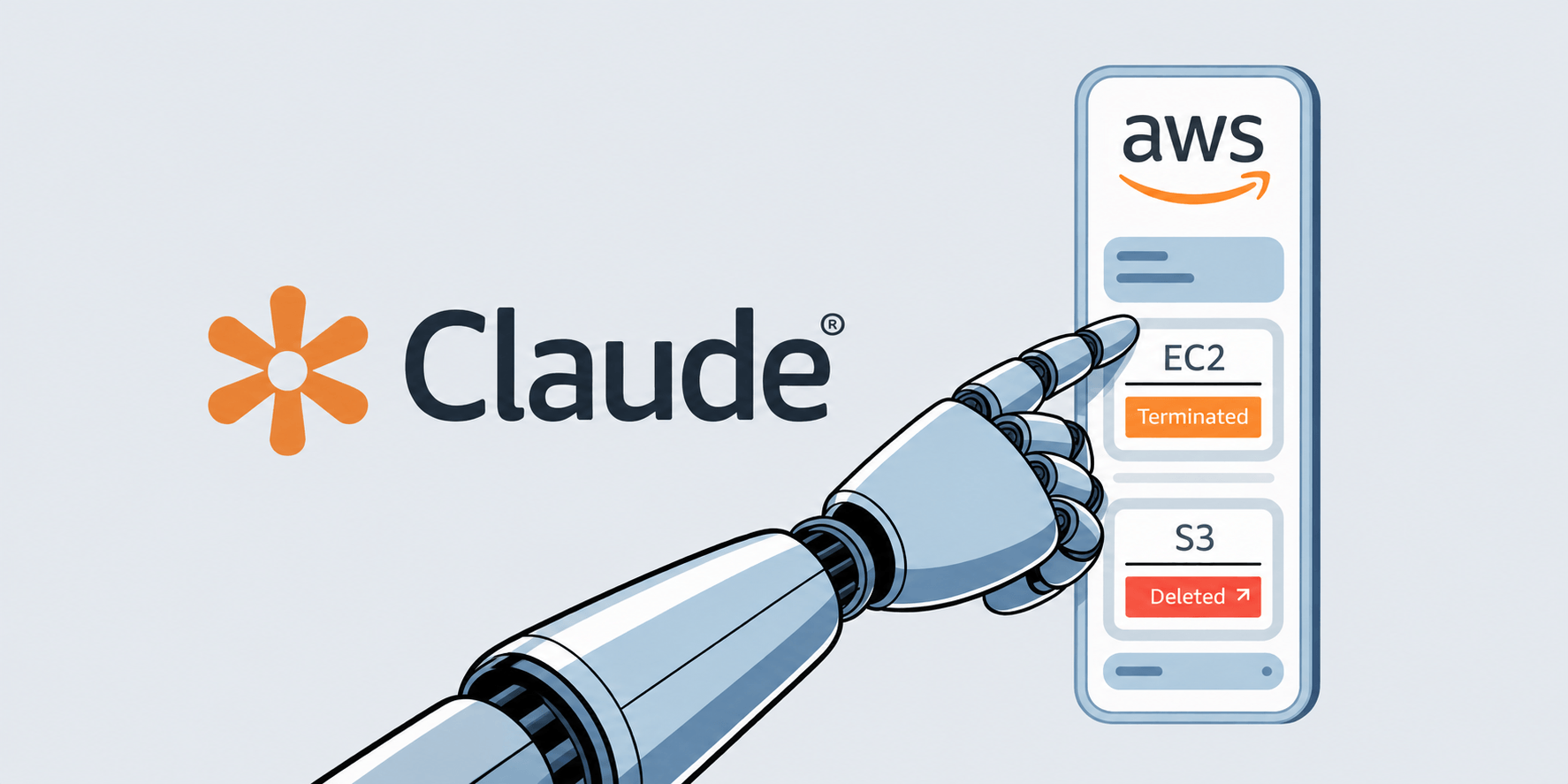
Using Bedrock with Claude Code? Your AWS Credentials Are Shared With Every Subprocess

14 May 2026 at 17:00

Many developers today are using Claude Code, with a growing portion running it through Amazon Bedrock. For enterprise teams, Bedrock offers major advantages: keeping data inside a VPC, leveraging AWS credits, and integrating with existing IAM controls, monitoring, and security policies. Bedrock adoption also grows significantly among larger organizations and enterprise environments – but this setup can also introduce security risks or unintended configuration mistakes in real-world usage. 

If you’re running Claude Code with AWS Bedrock, there’s something you need to know: the AWS credentials you configure for Bedrock don’t stay confined to Bedrock. They might be shared with every shell command, every MCP server, and every subprocess that Claude Code spawns. And depending on how those credentials are scoped, that could mean full access to your entire AWS account. 

The Problem in a Nutshell 

When you set up Claude Code for Bedrock, you store your AWS credentials in ~/.claude/settings.json: 

{ 
   "env": { 
     "AWS_ACCESS_KEY_ID": "...", 
     "AWS_SECRET_ACCESS_KEY": "...", 
     "AWS_DEFAULT_REGION": "us-east-1", 
     "CLAUDE_CODE_USE_BEDROCK": "1" 
   } 
} 

These environment variables get loaded into the Claude Code process. So far, so normal. The issue is that Unix processes inherit environment variables from their parent. Every time Claude Code runs a shell command, spawns an MCP server, or launches any subprocess, those child processes get your AWS credentials too. 

That means any AWS CLI command executed through Claude Code authenticates as your IAM principal. Not just for Bedrock, but for everything that principal has permissions to do. 

How This Goes Wrong in Practice 

The security boundary here is entirely on the IAM policy side, Claude Code itself applies no restriction. If your IAM user only has `AmazonBedrockLimitedAccess`, the blast radius is minimal. But in practice, credentials often have broader permissions than intended. None of the scenarios below require an attacker or a sophisticated exploit, they’re everyday mistakes that happen when AWS credentials are broader than they need to be. 

  1. Reusing your everyday IAM user

You already have an IAM user you use for daily development, like deploying lambdas, reading S3, or managing EC2 instances. Instead of creating a dedicated user for Claude Code, you drop those same credentials into settings.json because it’s faster. Now Claude Code has access to everything you do: production databases, customer data in S3, IAM itself. You meant to give it Bedrock access, but you actually gave it your entire AWS footprint. 

  1. Operating on the wrong environment

You’re working on a staging project, but the credentials in settings.json belong to your production account. You ask Claude Code to “delete the old test data from S3” or “terminate the idle instances.” Claude Code generates the right AWS CLI commands for the task, but runs them against production. There’s no visual indicator in Claude Code telling you which AWS account or environment is active. The approval prompt shows aws s3 rm, and you click accept because the command looks correct for what you asked. 

  1. Permissions drifting over time

You start with a tightly scoped IAM user for Bedrock only. Months later, someone on your team attaches AmazonS3ReadOnlyAccess for a one-off migration script and forgets to remove it. Then PowerUserAccess gets added during an incident for quick debugging. The Claude Code credentials silently gain more power over time, and nobody audits what it can actually do because “it’s just the Bedrock user.” 

  1. Shared credentials across a team

A team lead sets up an IAM user for Claude Code and shares the credentials in a wiki or Slack channel for the team to use. Now multiple developers are running Claude Code with the same identity. There’s no way to distinguish who did what in CloudTrail logs. If one developer’s session is compromised through prompt injection, the blast radius covers everyone using those credentials, and attribution is impossible. 

The Attack Scenarios 

This isn’t just a theoretical concern. There are several realistic ways this can go wrong: 

Accidental over-provisioning is the most likely scenario. A developer uses Claude Code normally, unaware that a “clean up old files” prompt could generate AWS CLI commands touching production S3 buckets or EC2 instances. 

Prompt injection is more targeted. An attacker plants malicious instructions in a repository file: a README, a config file, a code comment. When Claude Code reads the file, the injected instruction can influence it to generate AWS CLI commands that exfiltrate data or create backdoor access keys. The user sees an approval prompt but might not catch the malicious intent among legitimate-looking operations. 

Compromised MCP servers inherit the full environment as subprocesses. A malicious or supply-chain-compromised MCP server can silently make AWS API calls using your credentials. 

What You Should Do 

Scope your credentials tightly. The IAM user or role you configure for Claude Code should have the absolute minimum permissions needed, ideally only bedrock:InvokeModel* and related Bedrock actions. Audit what’s attached right now. You might be surprised. 

Consider using Bedrock API keys instead of IAM credentials. Claude Code supports AWS_BEARER_TOKEN_BEDROCK, which is inherently scoped to Bedrock operations. API keys can’t be used by the AWS CLI for non-Bedrock operations. This is the most effective mitigation available today and requires no infrastructure changes. 

Use temporary credentials. If you must use IAM credentials, prefer STS temporary credentials or SSO-based authentication over long-lived access keys. They at least limit the exposure window. 

Pay attention to shell command approval prompts. When Claude Code asks permission to run a command –  read it. Look for aws CLI commands that access services beyond what you’d expect. If you see aws s3, aws ec2, aws iam, or similar, think about whether that’s something you intended to allow. 

Audit your settings.json. Run aws sts get-caller-identity with the configured credentials and check what policies are attached to that principal. If the answer is anything broader than Bedrock access, tighten it. 

The Bigger Picture 

This is a classic example of the principle of least privilege being violated through environment inheritance, a well-understood Unix behavior that becomes a security issue when credentials meant for one purpose are implicitly available for all purposes. 

Claude Code’s shell command approval prompt provides some protection, but it’s a thin layer. Users lack context about which AWS credentials are active and what permissions they grant. Approval fatigue, the tendency to reflexively accept prompts after seeing enough of them, further erodes this safeguard. 

The ideal fix would be credential isolation: Bedrock credentials should be internal to Claude Code and never exposed to shell subprocesses through environment variables. Until that happens, and according to Anthropic, the responsibility falls on you to ensure your credentials are scoped as narrowly as possible. 

The post Using Bedrock with Claude Code? Your AWS Credentials Are Shared With Every Subprocess appeared first on Blog.

Received — 11 May 2026 ⏭ Imperva Cyber Security Blog

Your Redis Server Looks Fine. That’s the Problem.

6 May 2026 at 20:28

Introduction

There’s an automated attack circulating right now that breaks into unprotected Redis servers, takes over the underlying machine, and then carefully puts everything back the way it found it. It restores the database filename. It deletes the tools it used. It detaches from the connections it opened. When it’s done, the server looks healthy. Logs look normal. Nothing appears to be wrong.

Except there’s a new line in /root/.ssh/authorized_keys that wasn’t there before.

We discovered this attack recently targeting a single Redis honeypot. Attacks came from 10 distinct source IPs across six countries, and over 1,200 attack attempts were recorded in a single month. Our data-driven, AI-based honeypot enabled us to detect and analyze this activity in detail.

The Attack

Redis was never designed to face the internet directly. But people expose it: a misconfigured security group, a container with the wrong port mapping, a developer who needs it reachable for a quick test. The default configuration has no password. Port 6379, open to the world.

When our Redis honeypot instance was exposed, the first visitors arrived within minutes. They connected, ran INFO, read the version string, and disconnected. That’s it. They aren’t trying to break in. They’re taking a census- cataloging what’s out there, how old it is, whether it’s protected. Thousands of these scans happen every day across the internet, quiet and mechanical.

Then a second wave showed up. These bots tried something: config set dbfilename backup.db. It’s a test. If Redis accepts the command, it means the server will let you write files to arbitrary paths on the host machine’s disk. The bot doesn’t exploit this. It just records the address and leaves. It’s building a list for someone else.

Screenshot 2026 05 06 at 11.25.46 AM

The real attack came as a single connection that tried five different methods of compromise in rapid sequence. The whole thing took a few seconds. It opened with FLUSHDB to wipe the database and clear the slate, and then worked through the following tricks:

Cron injection: redirect Redis’s save directory to /var/spool/cron/, write a key whose value is a cron entry. Now the host downloads and runs a binary from a C2 server every minute, with a randomly generated filename to dodge signature detection.

Lua sandbox escape: a Debian/Ubuntu packaging decision dynamically linked Redis’s Lua interpreter against the system library, breaking the sandbox. One EVAL command loads io.popen, leading to full RCE. CVE-2022-0543 is four years old, yet still working.

SSH key planting: same file-writing trick, pointed at /root/.ssh/authorized_keys. One line, and the operator has root access forever.

Replication hijacking: SLAVEOF tells Redis to sync from the attacker’s server, which serves a malicious shared object disguised as a database dump. MODULE LOAD turns it into a Redis extension exposing system.exec. This trick leads to full RCE through Redis’s own replication protocol.

Direct execution: use that module to download and run the binary through the shell.

Five methods, one connection, a few seconds- but attackers don’t need all five to work. They just need one.

Then the connection did something unexpected. It started cleaning up.

SLAVEOF NO ONE
 system.exec "rm -rf /tmp/exp.so"
 MODULE UNLOAD system
 config set dbfilename dump.rdb

It detached from the rogue replication server. It deleted the malicious shared library from the disk. It unloaded the module from Redis. It restored the original database filename. Redis is often used for ephemeral data, like sessions, queues, and rate limits, so a cleared database might not even raise an alarm. It just looks like a restart.

The attack was optimized for staying hidden after breaking in. Every forensic trace is reversed. The only artifact left behind is an SSH public key, one line in a file that most administrators never read, indistinguishable from a legitimate entry. Even if you find the malware, kill the process, and delete the cron entry, the key is still there. Root access, on demand, forever. Or until someone manually audits authorized_keys, which is rare.

The Botnets

The SSH Key Operator: A sophisticated, single-operator attack that targets unprotected Redis servers. It attempts five different RCE methods. Over a single month, our single Redis honeypot recorded over 1,200 attack attempts from 10 distinct source IPs across six countries. The majority included RCE attempts: Lua sandbox exploits and replication hijacking aimed at arbitrary command execution on the host. Different C2 servers, different binary names, but the same sequence, the same Lua payload, the same SSH public key. One operator, rotating sources and randomizing filenames. The key is the only constant.

The traffic came in distinct waves. Baseline was roughly 15 to 20 attempts per day from two or three sources. Then, without warning, a wave would hit, with a single IP connecting hundreds of times in an afternoon, once every 69 seconds- in total, over 300 attempts in a few hours. We saw three to four waves per month, each lasting two to six hours, each from a different source IP. Then silence until the next wave.

Screenshot 2026 05 06 at 11.25.36 AM 1

MGLNDD Botnet: A separate operation that periodically connects to exposed Redis servers, sending a single command format (MGLNDD_54.147.241.42_6379) to perform a “roll call” – checking whether the Redis server is already part of their botnet. It operates from Azure VMs using AWS IP addresses, never repeating the same source twice.

The SSH key operator and the MGLNDD botnet share the same hunting ground but ignore each other completely. Two separate operations are working in the same territory. An exposed Redis port isn’t just targeted by an attacker, it’s targeted by an ecosystem.

Takeaway

The attack is silent. The window between “I’ll fix that config later” and the machine is silently compromised isn’t days or hours-it’s seconds. Everything looks fine afterward: the server is up, the application works, the dashboards are green. The only artifact is an SSH key, patient and persistent, waiting to be used.

What You Must Do:

  • Never expose Redis to the internet. Restrict access via security groups, firewalls, or VPCs.
  • Set a strong Redis password. The default has none.
  • Regularly audit /root/.ssh/authorized_keys for unfamiliar keys-attackers hide persistence here.
  • Keep Redis patched. CVE-2022-0543 still works after 4 years.
  • Monitor for suspicious commands: CONFIG SET, MODULE LOAD, FLUSHDB, SLAVEOF.
  • Use file integrity monitoring on /root/.ssh/authorized_keys to detect tampering.
  • Don’t trust green dashboards. Assume you’ve been breached until verified otherwise.

Imperva Data Security solutions provide comprehensive protection for your data against a wide range of threats. These offerings enable security teams to identify the location of sensitive information, monitor access patterns, and detect misuse promptly to facilitate timely response.

The post Your Redis Server Looks Fine. That’s the Problem. appeared first on Blog.

❌