Normal view

The Windows Registry Adventure #8: Practical exploitation of hive memory corruption

28 May 2025 at 09:00

Posted by Mateusz Jurczyk, Google Project Zero

In the previous blog post, we focused on the general security analysis of the registry and how to effectively approach finding vulnerabilities in it. Here, we will direct our attention to the exploitation of hive-based memory corruption bugs, i.e., those that allow an attacker to overwrite data within an active hive mapping in memory. This is a class of issues characteristic of the Windows registry, but universal enough that the techniques described here are applicable to 17 of my past vulnerabilities, as well as likely any similar bugs in the future. As we know, hives exhibit a very special behavior in terms of low-level memory management (how and where they are mapped in memory), handling of allocated and freed memory chunks by a custom allocator, and the nature of data stored there. All this makes exploiting this type of vulnerability especially interesting from the offensive security perspective, which is why I would like to describe it here in detail.

Similar to any other type of memory corruption, the vast majority of hive memory corruption issues can be classified into two groups: spatial violations (such as buffer overflows):
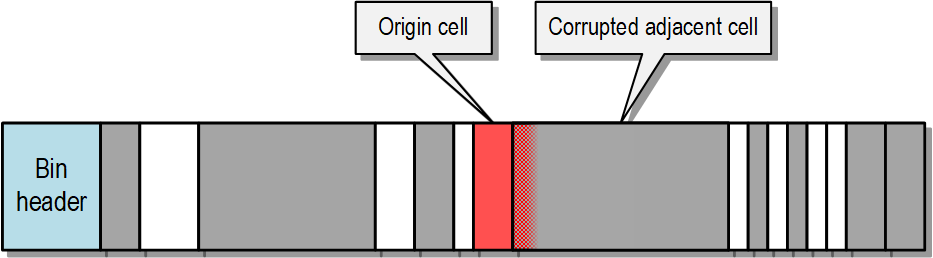
A diagram showing a corrupted memory cell overflowing an adjacent cell

and temporal violations, such as use-after-free conditions:
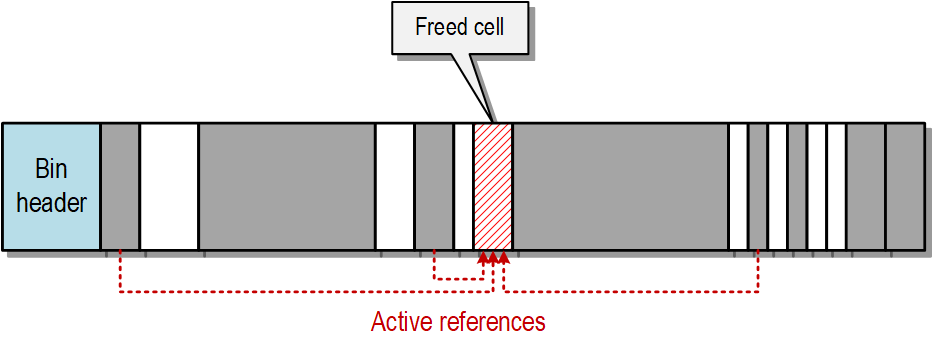
A diagram showing multiple invalid references to a freed cell

In this write up, we will aim to select the most promising vulnerability candidate and then create a step-by-step exploit for it that will elevate the privileges of a regular user in the system, from Medium IL to system-level privileges. Our target will be Windows 11, and an additional requirement will be to successfully bypass all modern security mitigations. I have previously presented on this topic at OffensiveCon 2024 with a presentation titled "Practical Exploitation of Registry Vulnerabilities in the Windows Kernel", and this blog post can be considered a supplement and expansion of the information shown there. Those deeply interested in the subject are encouraged to review the slides and recording available from that presentation.

Where to start: high-level overview of potential options

Let's start with a recap of some key points. As you may recall, the Windows registry cell allocator (i.e., the internal HvAllocateCell, HvReallocateCell, and HvFreeCell functions) operates in a way that is very favorable for exploitation. Firstly, it completely lacks any safeguards against memory corruption, and secondly, it has no element of randomness, making its behavior entirely predictable. Consequently, there is no need to employ any "hive spraying" or other similar techniques known from typical heap exploitation – if we manage to achieve the desired cell layout on a test machine, it will be reproducible on other computers without any additional steps. A potential exception could be carrying out attacks on global, shared hives within HKLM and HKU, as we don't know their initial state, and some randomness may arise from operations performed concurrently by other applications. Nevertheless, even this shouldn't pose a particularly significant challenge. We can safely assume that arranging the memory layout of a hive is straightforward, and if we have some memory corruption capability within it, we will eventually be able to overwrite any type of cell given some patience and experimentation.

The exploitation of classic memory corruption bugs typically involves the following steps:

  1. Initial memory corruption primitive
  2. ???
  3. ???
  4. ???
  5. Profit (in the form of arbitrary code execution, privilege escalation, etc.)

The task of the exploit developer is to fill in the gaps in this list, devising the intermediate steps leading to the desired goal. There are usually several such intermediate steps because, given the current state of security and mitigations, vulnerabilities rarely lead directly from memory corruption to code execution in a single step. Instead, a strategy of progressively developing stronger and stronger primitives is employed, where the final chain might look like this, for instance:
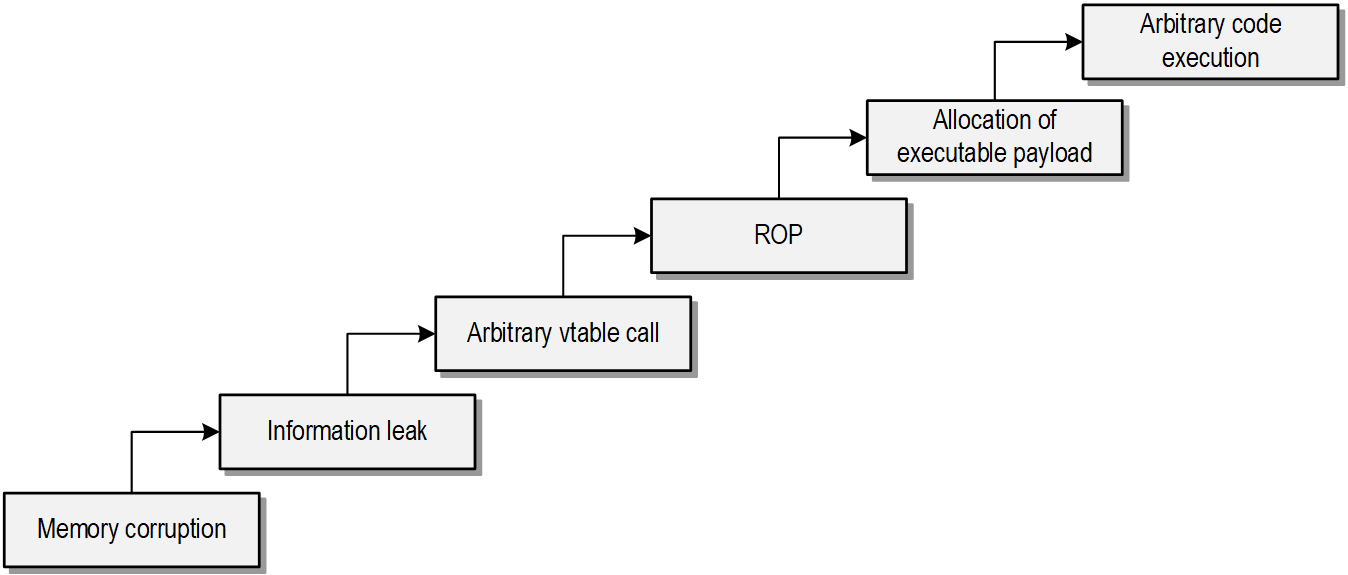
A flowchart depicting exploit development strategy, starting with "Memory corruption" which leads to "Information leak". This is followed by "Arbitrary vtable call", then "ROP" (Return-Oriented Programming). "ROP" leads to "Allocation of executable payload", which ultimately results in "Arbitrary code execution".

In this model, the second/third steps are achieved by finding another interesting object, arranging for it to be allocated near the overwritten buffer, and then corrupting it in such a way as to create a new primitive. However, in the case of hives, our options in this regard seem limited: we assume that we can fully control the representation of any cell in the hive, but the problem is that there is no immediately interesting data in them from an exploitation point of view. For example, the regf format does not contain any data that directly influences control flow (e.g., function pointers), nor any other addresses in virtual memory that could be overwritten in some clever way to improve the original primitive. The diagram below depicts our current situation:
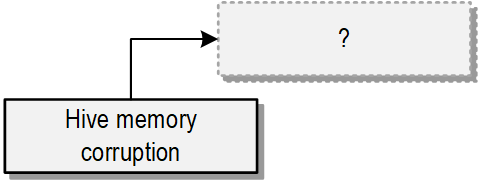
A diagram showing a box labeled "Hive memory corruption" with an arrow pointing to a second box with a dashed outline and a question mark inside, indicating an unknown next step resulting from hive memory corruption.

Does this mean that hive memory corruption is non-exploitable, and the only thing it allows for is data corruption in an isolated hive memory view? Not quite. In the following subsections, we will carefully consider various ideas of how taking control of the internal hive data can have a broader impact on the overall security of the system. Then, we will try to determine which of the available approaches is best suited for use in a real-world exploit.

Intra-hive corruption

Let's start by investigating whether overwriting internal hive data is as impractical as it might initially seem.

Performing hive-only attacks in privileged system hives

To be clear, it's not completely accurate to say that hives don't contain any data worth overwriting. If you think about it, it's quite the opposite – the registry stores a vast amount of system configuration, information about registered services, user passwords, and so on. The only issue is that all this critical data is located in specific hives, namely those mounted under HKEY_LOCAL_MACHINE, and some in HKEY_USERS (e.g., HKU\.Default, which corresponds to the private hive of the System user). To be able to perform a successful attack and elevate privileges by corrupting only regf format data (without accessing other kernel memory or achieving arbitrary code execution), two conditions must be met:

  1. The vulnerability must be triggerable solely through API/system calls and must not require binary control over the hive, as we obviously don't have that over any system hive.
  2. The target hive must contain at least one key with permissive enough access rights that allow unprivileged users to create values (KEY_SET_VALUE permission) and/or new subkeys (KEY_CREATE_SUB_KEY). Some other access rights might also be necessary, depending on the prerequisites of the specific bug.

Of the two points above, the first is definitely more difficult to satisfy. Many hive memory corruption bugs result from a strange, unforeseen state in the hive structures that can only be generated "offline", starting with full control over the given file. API-only vulnerabilities seem to be relatively rare: for instance, of my 17 hive-based memory corruption cases, less than half (specifically 8 of them) could theoretically be triggered solely by operations on an existing hive. Furthermore, a closer look reveals that some of them do not meet other conditions needed to target system hives (e.g., they only affect differencing hives), or are highly impractical, e.g., require the allocation of more than 500 GB of memory, or take many hours to trigger. In reality, out of the wide range of vulnerabilities, there are really only two that would be well suited for directly attacking a system hive: CVE-2023-23420 (discussed in the "Operating on subkeys of transactionally renamed keys" section of the report) and CVE-2023-23423 (discussed in "Freeing a shallow copy of a key node with CmpFreeKeyByCell").

Regarding the second issue – the availability of writable keys – the situation is much better for the attacker. There are three reasons for this:

  • To successfully carry out a data-only attack on a system key, we are usually not limited to one specific hive, but can choose any that suits us. Exploiting hive corruption in most, if not all, hives mounted under HKLM would enable an attacker to elevate privileges.
  • The Windows kernel internally implements the key opening process by first doing a full path lookup in the registry tree, and only then checking the required user permissions. The access check is performed solely on the security descriptor of the specific key, without considering its ancestors. This means that setting overly permissive security settings for a key automatically makes it vulnerable to attacks, as according to this logic, it receives no additional protection from its ancestor keys, even if they have much stricter access controls.
  • There are a large number of user-writable keys in the HKLM\SOFTWARE and HKLM\SYSTEM hives. They do not exist in HKLM\BCD00000000, HKLM\SAM, or HKLM\SECURITY, but as I mentioned above, only one such key is sufficient for successful exploitation.

To find specific examples of such publicly accessible keys, it is necessary to write custom tooling. This tooling should first recursively list all existing keys within the low-level \Registry\Machine and \Registry\User paths, while operating with the highest possible privileges, ideally as the System user. This will ensure that the process can see all the keys in the registry tree – even those hidden behind restricted parents. It is not worth trying to enumerate the subkeys of \Registry\A, as any references to it are unconditionally blocked by the Windows kernel. Similarly, \Registry\WC can likely be skipped unless one is interested in attacking differencing hives used by containerized applications. Once we have a complete list of all the keys, the next step is to verify which of them are writable by unprivileged users. This can be accomplished either by reading their security descriptors (using RegGetKeySecurity) and manually checking their access rights (using AccessCheck), or by delegating this task entirely to the kernel and simply trying to open every key with the desired rights while operating with regular user privileges. In either case, we should be ultimately able to obtain a list of potential keys that can be used to corrupt a system hive.

Based on my testing, there are approximately 1678 keys within HKLM that grant subkey creation rights to normal users on a current Windows 11 system. Out of these, 1660 are located in HKLM\SOFTWARE, and 18 are in HKLM\SYSTEM. Some examples include:

HKLM\SOFTWARE\Microsoft\CoreShell

HKLM\SOFTWARE\Microsoft\DRM

HKLM\SOFTWARE\Microsoft\Input\Locales          (and some of its subkeys)

HKLM\SOFTWARE\Microsoft\Input\Settings         (and some of its subkeys)

HKLM\SOFTWARE\Microsoft\Shell\Oobe

HKLM\SOFTWARE\Microsoft\Shell\Session

HKLM\SOFTWARE\Microsoft\Tracing                (and some of its subkeys)

HKLM\SOFTWARE\Microsoft\Windows\UpdateApi

HKLM\SOFTWARE\Microsoft\WindowsUpdate\UX

HKLM\SOFTWARE\WOW6432Node\Microsoft\DRM

HKLM\SOFTWARE\WOW6432Node\Microsoft\Tracing

HKLM\SYSTEM\Software\Microsoft\TIP             (and some of its subkeys)

HKLM\SYSTEM\ControlSet001\Control\Cryptography\WebSignIn\Navigation

HKLM\SYSTEM\ControlSet001\Control\MUI\StringCacheSettings

HKLM\SYSTEM\ControlSet001\Control\USB\AutomaticSurpriseRemoval

HKLM\SYSTEM\ControlSet001\Services\BTAGService\Parameters\Settings

As we can see, there are quite a few possibilities. The second key on the list, HKLM\SOFTWARE\Microsoft\DRM, has been somewhat popular in the past, as it was previously used by James Forshaw to demonstrate two vulnerabilities he discovered in 2019–2020 (CVE-2019-0881, CVE-2020-1377). Subsequently, I also used it as a way to trigger certain behaviors related to registry virtualization (CVE-2023-21675, CVE-2023-21748, CVE-2023-35357), and as a potential avenue to fill the SOFTWARE hive to its capacity, thereby causing an OOM condition as part of exploiting another bug (CVE-2023-32019). The main advantage of this key is that it exists in all modern versions of the system (since at least Windows 7), and it grants broad rights to all users (the Everyone group, also known as World, or S-1-1-0). The other keys mentioned above also allow regular users write operations, but they often do so through other, potentially more restricted groups such as Interactive (S-1-5-4), Users (S-1-5-32-545), or Authenticated Users (S-1-5-11), which may be something to keep in mind.

Apart from global system hives, I also discovered the curious case of the HKCU\Software\Microsoft\Input\TypingInsights key being present in every user's hive, which permits read and write access to all other users in the system. I reported it to Microsoft in December 2023 (link to report), but it was deemed low severity and hasn't been fixed so far. This decision is somewhat understandable, as the behavior doesn't have direct, serious consequences for system security, but it still can work as a useful exploitation technique. Since any user can open a key for writing in the user hive of any other user, they gain the ability to:

  • Fill the entire 2 GiB space of that hive, resulting in a DoS condition (the user and their applications cannot write to HKCU) and potentially enabling exploitation of bugs related to mishandling OOM conditions within the hive.
  • Write not just to the "TypingInsights" key in the HKCU itself, but also to any of the corresponding keys in the differencing hives overlaid on top of it. This provides an opportunity to attack applications running within app/server silos with that user's permissions.
  • Perform hive-based memory corruption attacks not only on system hives, but also on the hives of specific users, allowing for a more lateral privilege escalation scenario.


As demonstrated, even a seemingly minor weakness in the security descriptor of a single registry key can have significant consequences for system security.

In summary, attacking system hives with hive memory corruption is certainly possible, but requires finding a very good vulnerability that can be triggered on existing keys, without the need to load a custom hive. This is a good starting point, but perhaps we can find a more universal technique.

Abusing regf inconsistency to trigger kernel pool corruption

While hive mappings in memory are isolated and self-contained to some extent, they do not exist in a vacuum. The Windows kernel allocates and manages many additional registry-related objects within the kernel pool space, as discussed in blog post #6. These objects serve as optimization through data caching, and help implement certain functionalities that cannot be achieved solely through operations on the hive space (e.g., transactions, layered keys). Some of these objects are long-lived and persist in memory as long as the hive is mounted. Other buffers are allocated and immediately freed within the same syscall, serving only as temporary data storage. The memory safety of all these objects is closely tied to the consistency of the corresponding data within the hive mapping. After the kernel meticulously verifies the hive validity in CmCheckRegistry and related functions, it assumes that the registry hive's data maintains consistency with its own structure and associated auxiliary structures.

For a potential attacker, this means that hive memory corruption can be potentially escalated to some forms of pool corruption. This provides a much broader spectrum of options for exploitation, as there are a variety of pool allocations used by various parts of the kernel. In fact, I even took advantage of this behavior in my reports to Microsoft: in every case of a use-after-free on a security descriptor, I would enable Special Pool and trigger a reference to the cached copy of that descriptor on the pools through the _CM_KEY_CONTROL_BLOCK.CachedSecurity field. I did this because it is much easier to generate a reliably reproducible crash by accessing a freed allocation on the pool than when accessing a freed but still mapped cell in the hive. 

However, this is certainly not the only way to cause pool memory corruption by modifying the internal data of the regf format. Another idea would be, for example, to create a very long "big data" value in the hive (over ~16 KiB in a hive with version ≥ 1.4) and then cause _CM_KEY_VALUE.DataLength to be inconsistent with the _CM_BIG_DATA.Count field, which denotes the number of 16-kilobyte chunks in the backing buffer. If we look at the implementation of the internal CmpGetValueData function, it is easy to see that it allocates a paged pool buffer based on the former value, and then copies data to it based on the latter one. Therefore, if we set _CM_KEY_VALUE.DataLength to a number less than 16344 × (_CM_BIG_DATA.Count - 1), then the next time the value's data is requested, a linear pool buffer overflow will occur.

This type of primitive is promising, as it opens the door to targeting a much wider range of objects in memory than was previously possible. The next step would likely involve finding a suitable object to place immediately after the overwritten buffer (e.g., pipe attributes, as mentioned in this article from 2020), and then corrupting it to achieve a more powerful primitive like arbitrary kernel read/write. In short, such an attack would boil down to a fairly generic exploitation of pool-based memory corruption, a topic widely discussed in existing resources. We won't explore this further here, and instead encourage interested readers to investigate it on their own.

Inter-hive memory corruption

So far in our analysis, we have assumed that with a hive-based memory corruption bug, we can only modify data within the specific hive we are operating on. In practice, however, this is not necessarily the case, because there might be other data located in the immediate vicinity of our bin's mapping in memory. If that happens, it might be possible to seamlessly cross the boundary between the original hive and some more interesting objects at higher memory addresses using a linear buffer overflow. In the following sections, we will look at two such scenarios: one where the mapping of the attacked hive is in the user-mode space of the "Registry" process, and one where it resides in the kernel address space.

Other hive mappings in the user space of the Registry process

Mapping the section views of hives in the user space of the Registry process is the default behavior for the vast majority of the registry. The layout of individual mappings in memory can be easily observed from WinDbg. To do this, find the Registry process (usually the second in the system process list), switch to its context, and then issue the !vad command. An example of performing these operations is shown below.

0: kd> !process 0 0

**** NT ACTIVE PROCESS DUMP ****

PROCESS ffffa58fa069f040

    SessionId: none  Cid: 0004    Peb: 00000000  ParentCid: 0000

    DirBase: 001ae002  ObjectTable: ffffe102d72678c0  HandleCount: 3077.

    Image: System

PROCESS ffffa58fa074a080

    SessionId: none  Cid: 007c    Peb: 00000000  ParentCid: 0004

    DirBase: 1025ae002  ObjectTable: ffffe102d72d1d00  HandleCount: <Data Not Accessible>

    Image: Registry

[...]

0: kd> .process ffffa58fa074a080

Implicit process is now ffffa58f`a074a080

WARNING: .cache forcedecodeuser is not enabled

0: kd> !vad

VAD             Level         Start             End              Commit

ffffa58fa207f740  5        152e7a20        152e7a2f               0 Mapped       READONLY           \Windows\System32\config\SAM

ffffa58fa207dbc0  4        152e7a30        152e7b2f               0 Mapped       READONLY           \Windows\System32\config\DEFAULT

ffffa58fa207dc60  5        152e7b30        152e7b3f               0 Mapped       READONLY           \Windows\System32\config\SECURITY

ffffa58fa207d940  3        152e7b40        152e7d3f               0 Mapped       READONLY           \Windows\System32\config\SOFTWARE

ffffa58fa207dda0  5        152e7d40        152e7f3f               0 Mapped       READONLY           \Windows\System32\config\SOFTWARE

[...]

ffffa58fa207e840  5        152ec940        152ecb3f               0 Mapped       READONLY           \Windows\System32\config\SOFTWARE

ffffa58fa207b780  3        152ecb40        152ecd3f               0 Mapped       READONLY           \Windows\System32\config\SOFTWARE

ffffa58fa0f98ba0  5        152ecd40        152ecd4f               0 Mapped       READONLY           \EFI\Microsoft\Boot\BCD

ffffa58fa3af5440  4        152ecd50        152ecd8f               0 Mapped       READONLY           \Windows\ServiceProfiles\NetworkService\NTUSER.DAT

ffffa58fa3bfe9c0  5        152ecd90        152ecdcf               0 Mapped       READONLY           \Windows\ServiceProfiles\LocalService\NTUSER.DAT

ffffa58fa3ca3d20  1        152ecdd0        152ece4f               0 Mapped       READONLY           \Windows\System32\config\BBI

ffffa58fa2102790  6        152ece50        152ecf4f               0 Mapped       READONLY           \Users\user\NTUSER.DAT

ffffa58fa4145640  5        152ecf50        152ed14f               0 Mapped       READONLY           \Windows\System32\config\DRIVERS

ffffa58fa4145460  6        152ed150        152ed34f               0 Mapped       READONLY           \Windows\System32\config\DRIVERS

ffffa58fa412a520  4        152ed350        152ed44f               0 Mapped       READONLY           \Windows\System32\config\DRIVERS

ffffa58fa412c5a0  6        152ed450        152ed64f               0 Mapped       READONLY           \Users\user\AppData\Local\Microsoft\Windows\UsrClass.dat

ffffa58fa4e8bf60  5        152ed650        152ed84f               0 Mapped       READONLY           \Windows\appcompat\Programs\Amcache.hve

In the listing above, the "Start" and "End" columns show the starting and ending addresses of each mapping divided by the page size, which is 4 KiB. In practice, this means that the SAM hive is mapped at 0x152e7a20000 – 0x152e7a2ffff, the DEFAULT hive is mapped at 0x152e7a30000 – 0x152e7b2ffff, and so on. We can immediately see that all the hives are located very close to each other, with practically no gaps in between them.

However, this example does not directly demonstrate whether it's possible to place, for instance, the mapping of the SOFTWARE hive directly after the mapping of an app hive loaded by a normal user. The addresses of the system hives appear to be already determined, and there isn't much space between them to inject our own data. Fortunately, hives can grow dynamically, especially when you start writing long values to them. This leads to the creation of new bins and mapping them at new addresses in the Registry process's memory.

For testing purposes, I wrote a simple program that creates consecutive values of 0x3FD8 bytes within a given key. This triggers the allocation of new bins of exactly 0x4000 bytes: 0x3FD8 bytes of data plus 0x20 bytes for the _HBIN structure, 4 bytes for the cell size, and 4 bytes for padding. Next, I ran two instances of it in parallel on an app hive and HKLM\SOFTWARE, filling the former with the letter "A" and the latter with the letter "B". The result of the test was immediately visible in the memory layout:

0: kd> !vad

VAD             Level         Start             End              Commit

ffffa58fa67b44c0  8        15280000        152801ff               0 Mapped       READONLY           \Windows\System32\config\SOFTWARE

ffffa58fa67b5b40  7        15280200        152803ff               0 Mapped       READONLY           \Users\user\Desktop\test.dat

ffffa58fa67b46a0  8        15280400        152805ff               0 Mapped       READONLY           \Windows\System32\config\SOFTWARE

ffffa58fa67b6540  6        15280600        152807ff               0 Mapped       READONLY           \Users\user\Desktop\test.dat

ffffa58fa67b5dc0  8        15280800        152809ff               0 Mapped       READONLY           \Windows\System32\config\SOFTWARE

ffffa58fa67b4560  7        15280a00        15280bff               0 Mapped       READONLY           \Users\user\Desktop\test.dat

ffffa58fa67b6900  8        15280c00        15280dff               0 Mapped       READONLY           \Windows\System32\config\SOFTWARE

ffffa58fa67b5280  5        15280e00        15280fff               0 Mapped       READONLY           \Users\user\Desktop\test.dat

ffffa58fa67b5e60  8        15281000        152811ff               0 Mapped       READONLY           \Windows\System32\config\SOFTWARE

ffffa58fa67b7800  7        15281200        152813ff               0 Mapped       READONLY           \Users\user\Desktop\test.dat

ffffa58fa67b8de0  8        15281400        152815ff               0 Mapped       READONLY           \Windows\System32\config\SOFTWARE

ffffa58fa67b8840  6        15281600        152817ff               0 Mapped       READONLY           \Users\user\Desktop\test.dat

ffffa58fa67b8980  8        15281800        152819ff               0 Mapped       READONLY           \Windows\System32\config\SOFTWARE

[...]

What we have here are interleaved mappings of trusted and untrusted hives, each 2 MiB in length and tightly packed with 512 bins of 16 KiB each. Importantly, there are no gaps between the end of one mapping and the start of another, which means that it is indeed possible to use memory corruption within one hive to influence the internal representation of another. Take, for example, the boundary between the test.dat and SOFTWARE hives at address 0x15280400000. If we dump the memory area encompassing a few dozen bytes before and after this page boundary, we get the following result:

0: kd> db 0x15280400000-30

00000152`803fffd0  41 41 41 41 41 41 41 41-41 41 41 41 41 41 41 41  AAAAAAAAAAAAAAAA

00000152`803fffe0  41 41 41 41 41 41 41 41-41 41 41 41 41 41 41 41  AAAAAAAAAAAAAAAA

00000152`803ffff0  41 41 41 41 41 41 41 41-41 41 41 41 00 00 00 00  AAAAAAAAAAAA....

00000152`80400000  68 62 69 6e 00 f0 bf 0c-00 40 00 00 00 00 00 00  hbin.....@......

00000152`80400010  00 00 00 00 00 00 00 00-00 00 00 00 00 00 00 00  ................

00000152`80400020  20 c0 ff ff 42 42 42 42-42 42 42 42 42 42 42 42   ...BBBBBBBBBBBB

00000152`80400030  42 42 42 42 42 42 42 42-42 42 42 42 42 42 42 42  BBBBBBBBBBBBBBBB

00000152`80400040  42 42 42 42 42 42 42 42-42 42 42 42 42 42 42 42  BBBBBBBBBBBBBBBB

We can clearly see that the bytes belonging to both hives in question exist within a single, continuous memory area. This, in turn, means that memory corruption could indeed spread from one hive into the other. However, to successfully achieve this result, one would also need to ensure that the specific fragment of the target hive is marked as dirty. Otherwise, this memory page would be marked as PAGE_READONLY, which would lead to a system crash when attempting to write data, despite both regions being directly adjacent to each other.

After successfully corrupting data in a global, system hive, the remainder of the attack would likely involve either modifying a security descriptor to grant oneself write permissions to specific keys, or directly changing configuration data to enable the execution of one's own code with administrator privileges.

Attacking adjacent memory in pool-based hive mappings

Although hive file views are typically mapped in the user-mode space of the Registry process (which contains nothing else but these mappings), there are a few circumstances where this data is stored directly in kernel-mode pools. These cases are as follows:

  1. All volatile hives, which have no persistent representation as regf files on disk. Examples include the virtual hive rooted at \Registry, as well as the HKLM\HARDWARE hive.
  2. The entire HKLM\SYSTEM hive, including both its stable and volatile parts.
  3. All hives that have been recently created by calling one of the NtLoadKey* syscalls on a previously non-existent file, including newly created app hives.
  4. Volatile storage space of every active hive in the system.

The first point is not useful to a potential attacker because these types of hives do not grant unprivileged users write permissions. The second and third points are also quite limited, as they could only be exploited through memory corruption that doesn't require binary control over the input hive. However, the fourth point makes it possible to exploit vulnerabilities in any hive in the system, including app hives. This is because creating volatile keys does not require any special permissions compared to regular keys. Additionally, if we have a memory corruption primitive within one storage type, we can easily influence data within the other. For example, in the case of stable storage memory corruption, it is enough to craft a value for which the cell index _CM_KEY_VALUE.Data has the highest bit set, and thus points to the volatile space. From this point, we can arbitrarily modify regf structures located in that space, and directly read/write out-of-bounds pool memory by setting a sufficiently long value size (exceeding the bounds of the given bin). Such a situation is shown in the diagram below:
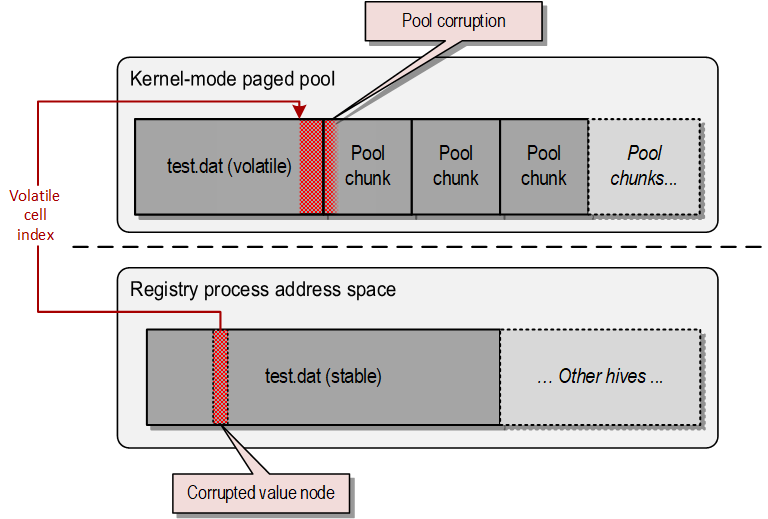
A diagram illustrating memory corruption, divided into two sections. The top section, labeled "Kernel-mode paged pool," shows a memory bar containing "test.dat (volatile)" followed by several "Pool chunk" blocks and a dotted "Pool chunks..." block. The pool chunks are showed being overflowed. The bottom section, labeled "Registry process address space," shows a memory bar with a small corrupted area at the beginning, followed by "test.dat (stable)" and a dotted "... Other hives ..." block. An arrow from a "Corrupted value node" label points to this red area. A red arrow labeled "Volatile cell index" connects the "Pool corruption" in the kernel-mode paged pool to the "Corrupted value node" in the registry process address space, indicating a relationship between the two corrupted areas.

This behavior can be further verified on a specific example. Let's consider the HKCU hive for a user logged into a Windows 11 system – it will typically have some data stored in the volatile storage due to the existence of the "HKCU\Volatile Environment" key. Let's first find the hive in WinDbg using the !reg hivelist command:

0: kd> !reg hivelist

---------------------------------------------------------------------------------------------------------------------------------------------

|     HiveAddr     |Stable Length|    Stable Map    |Volatile Length|    Volatile Map    |     BaseBlock     | FileName 

---------------------------------------------------------------------------------------------------------------------------------------------

[...]

| ffff82828fc1a000 |      ee000  | ffff82828fc1a128 |       5000    |  ffff82828fc1a3a0  | ffff82828f8cf000  | \??\C:\Users\user\ntuser.dat

[...]

As can be seen, the hive has a volatile space of 0x5000 bytes (5 memory pages). Let's try to find the second page of this hive region in memory by translating its corresponding cell index:

0: kd> !reg cellindex ffff82828fc1a000 80001000

Map = ffff82828fc1a3a0 Type = 1 Table = 0 Block = 1 Offset = 0

MapTable     = ffff82828fe6a000 

MapEntry     = ffff82828fe6a018 

BinAddress = ffff82828f096009, BlockOffset = 0000000000000000

BlockAddress = ffff82828f096000 

pcell:  ffff82828f096004

It is a kernel-mode address, as expected. We can dump its contents to verify that it indeed contains registry data:

0: kd> db ffff82828f096000

ffff8282`8f096000  68 62 69 6e 00 10 00 00-00 10 00 00 00 00 00 00  hbin............

ffff8282`8f096010  00 00 00 00 00 00 00 00-00 00 00 00 00 00 00 00  ................

ffff8282`8f096020  38 ff ff ff 73 6b 00 00-20 10 00 80 20 10 00 80  8...sk.. ... ...

ffff8282`8f096030  01 00 00 00 b0 00 00 00-01 00 04 88 98 00 00 00  ................

ffff8282`8f096040  a4 00 00 00 00 00 00 00-14 00 00 00 02 00 84 00  ................

ffff8282`8f096050  05 00 00 00 00 03 24 00-3f 00 0f 00 01 05 00 00  ......$.?.......

ffff8282`8f096060  00 00 00 05 15 00 00 00-dc be 84 0b 6c 21 35 39  ............l!59

ffff8282`8f096070  b9 d0 84 88 ea 03 00 00-00 03 14 00 3f 00 0f 00  ............?...

Everything looks good. At the start of the page, there is a bin header, and at offset 0x20, we see the first cell corresponding to a security descriptor ('sk'). Now, let's see what the !pool command tells us about this address:

0: kd> !pool ffff82828f096000

Pool page ffff82828f096000 region is Paged pool

*ffff82828f096000 : large page allocation, tag is CM16, size is 0x1000 bytes

                Pooltag CM16 : Internal Configuration manager allocations, Binary : nt!cm

We are dealing with a paged pool allocation of 0x1000 bytes requested by the Configuration Manager. And what is located right behind it?

0: kd> !pool ffff82828f096000+1000

Pool page ffff82828f097000 region is Paged pool

*ffff82828f097000 : large page allocation, tag is Obtb, size is 0x1000 bytes

                Pooltag Obtb : object tables via EX handle.c, Binary : nt!ob

0: kd> !pool ffff82828f096000+2000

Pool page ffff82828f098000 region is Paged pool

*ffff82828f098000 : large page allocation, tag is Gpbm, size is 0x1000 bytes

                Pooltag Gpbm : GDITAG_POOL_BITMAP_BITS, Binary : win32k.sys

The next two memory pages correspond to other, completely unrelated allocations on the pool: one associated with the NT Object Manager, and the other with the win32k.sys graphics driver. This clearly demonstrates that in the kernel space, areas containing volatile hive data are mixed with various other allocations used by other parts of the system. Moreover, this technique is attractive because it not only enables out-of-bound writes of controlled data, but also the ability to read this OOB data beforehand. Thanks to this, the exploit does not have to operate "blindly", but it can precisely verify whether the memory is arranged exactly as expected before proceeding with the next stage of the attack. With these kinds of capabilities, writing the rest of the exploit should be a matter of properly grooming the pool layout and finding some good candidate objects for corruption.

The ultimate primitive: out-of-bounds cell indexes

The situation is clearly not as hopeless as it might have seemed earlier, and there are quite a few ways to convert memory corruption in one's own hive space into taking control of other types of memory. All of them, however, have one minor flaw: they rely on prearranging a specific layout of objects in memory (e.g., hive mappings in the Registry process, or allocations on the paged pool), which means they cannot be said to be 100% stable or deterministic. The randomness of the memory layout carries the inherent risk that either the exploit simply won't work, or worse, it will crash the operating system in the process. For lack of better alternatives, these techniques would be sufficient, especially for demonstration purposes. However, I found a better method that guarantees 100% effectiveness by completely eliminating the element of randomness. I have hinted at or even directly mentioned this many times in previous blog posts in this series, and I am, of course, referring to out-of-bounds cell indexes.

As a quick reminder, cell indexes are the hive's equivalent of pointers: they are 32-bit values that allow allocated cells to reference each other. The translation of cell indexes into their corresponding virtual addresses is achieved using a special 3-level structure called a cell map, which resembles a CPU page table:
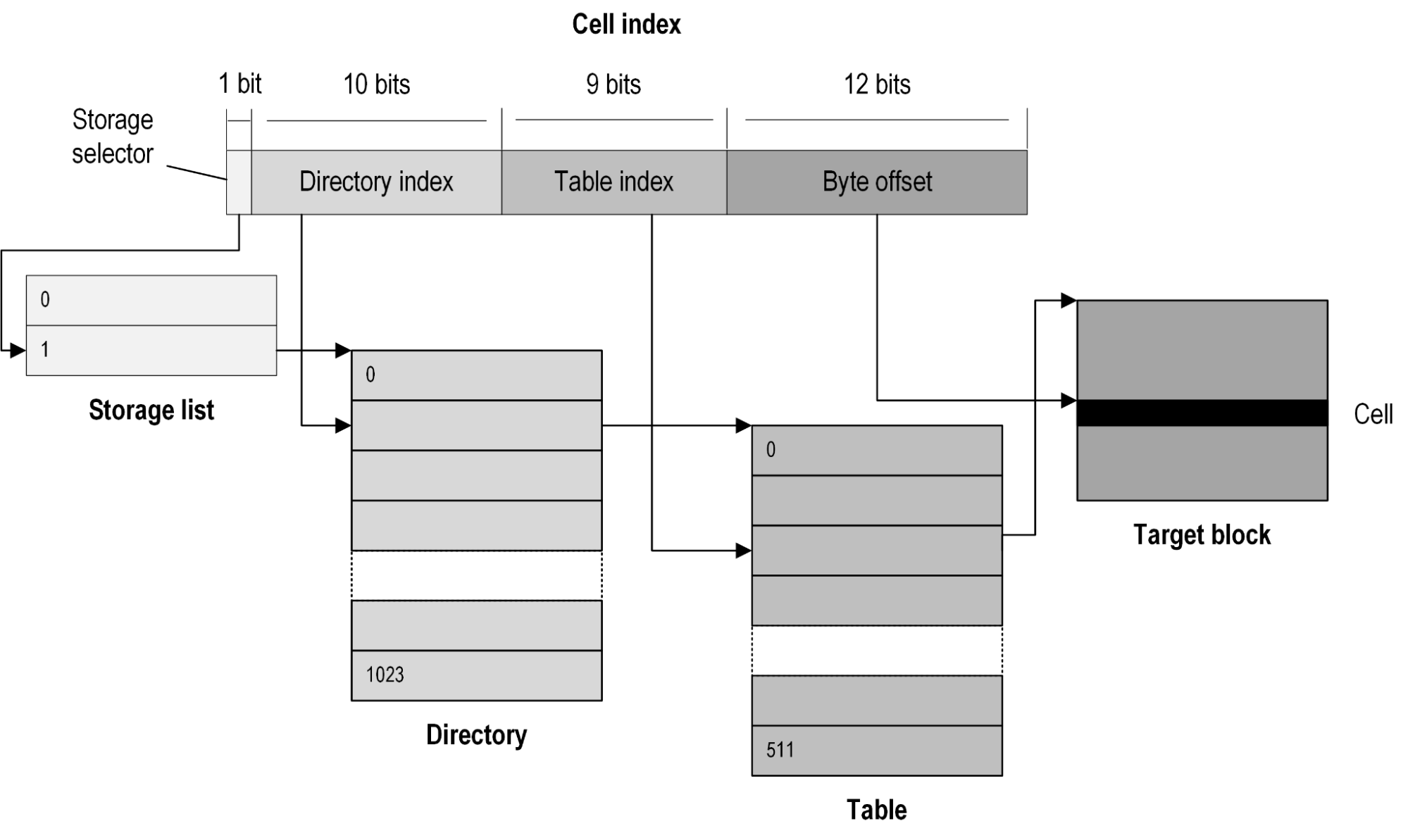
A diagram of a cell map

The C-like pseudocode of the internal HvpGetCellPaged function responsible for performing the cell map walk is presented below:

_CELL_DATA *HvpGetCellPaged(_HHIVE *Hive, HCELL_INDEX Index) {

  _HMAP_ENTRY *Entry = &Hive->Storage[Index >> 31].Map

                            ->Directory[(Index >> 21) & 0x3FF]

                            ->Table[(Index >> 12) & 0x1FF];

  return (Entry->PermanentBinAddress & (~0xF)) + Entry->BlockOffset + (Index & 0xFFF) + 4;

}

The structures corresponding to the individual levels of the cell map are _DUAL, _HMAP_DIRECTORY, _HMAP_TABLE and _HMAP_ENTRY, and they are accessible through the _CMHIVE.Hive.Storage field. From an exploitation perspective, two facts are crucial here. First, the HvpGetCellPaged function does not perform any bounds checks on the input index. Second, for hives smaller than 2 MiB, Windows applies an additional optimization called "small dir". In that case, instead of allocating the entire Directory array of 1024 elements and only using one of them, the kernel sets the _CMHIVE.Hive.Storage[...].Map pointer to the address of the _CMHIVE.Hive.Storage[...].SmallDir field, which simulates a single-element array. In this way, the number of logical cell map levels remains the same, but the system uses one less pool allocation to store them, saving about 8 KiB of memory per hive. This behavior is shown in the screenshot below:
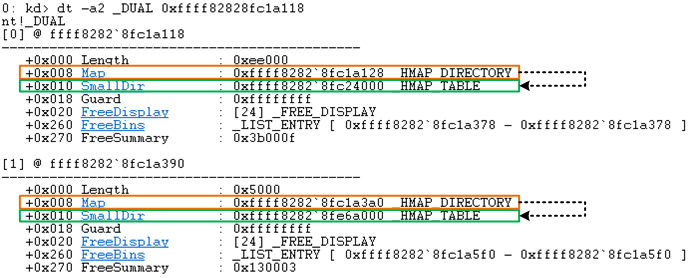
Screenshot

What we have here is a hive that has a stable storage area of 0xEE000 bytes (952 KiB) and a volatile storage area of 0x5000 bytes (20 KiB). Both of these sizes are smaller than 2 MiB, and consequently, the "small dir" optimization is applied in both cases. As a result, the Map pointers (marked in orange) point directly to the SmallDir fields (marked in green).

This situation is interesting because if the kernel attempts to resolve an invalid cell index with a value of 0x200000 or greater (i.e., with the "Directory index" part being non-zero) in the context of such a hive, then the first step of the cell map walk will reference the out-of-bounds Guard, FreeDisplay, etc. fields as pointers. This situation is illustrated in the diagram below:
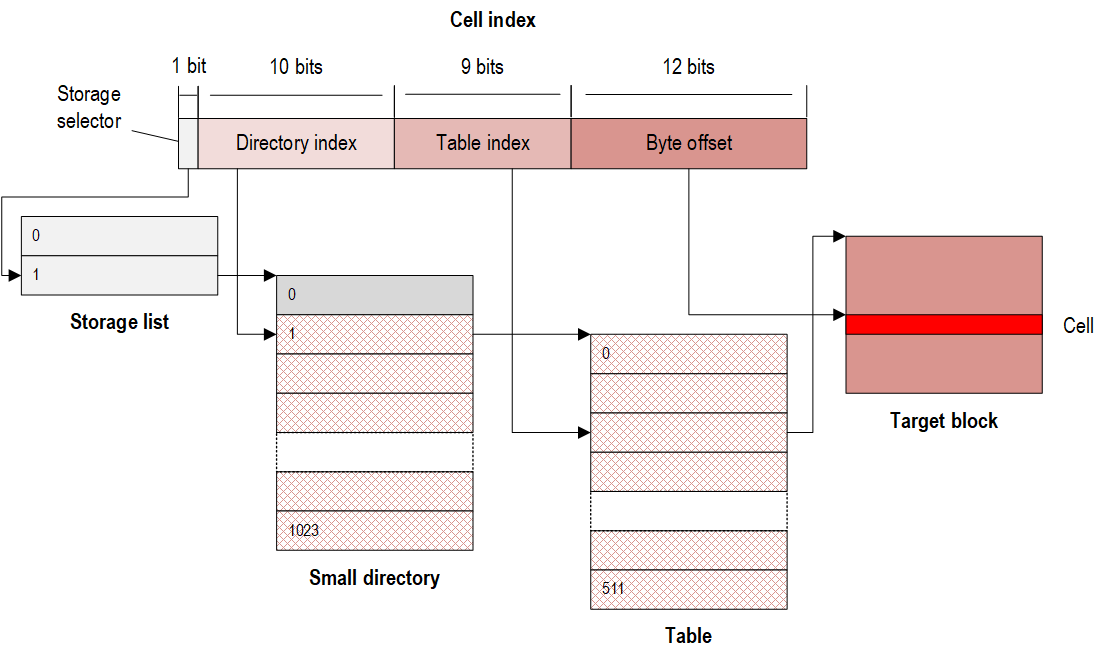
Diagram described above

In other words, by fully controlling the 32-bit value of the cell index, we can make the translation logic jump through two pointers fetched from out-of-bounds memory, and then add a controlled 12-bit offset to the result. An additional consideration is that in the first step, we reference OOB indexes of an "array" located inside the larger _CMHIVE structure, which always has the same layout on a given Windows build. Therefore, by choosing a directory index that references a specific pointer in _CMHIVE, we can be sure that it will always work the same way on a given version of the system, regardless of any random factors.

On the other hand, a small inconvenience is that the _HMAP_ENTRY structure (i.e., the last level of the cell map) has the following layout:

0: kd> dt _HMAP_ENTRY

nt!_HMAP_ENTRY

   +0x000 BlockOffset      : Uint8B

   +0x008 PermanentBinAddress : Uint8B

   +0x010 MemAlloc         : Uint4B

And the final returned value is the sum of the BlockOffset and PermanentBinAddress fields. Therefore, if one of these fields contains the address we want to reference, the other must be NULL, which may slightly narrow down our options.

If we were to create a graphical representation of the relationships between structures based on the pointers they contain, starting from _CMHIVE, it would look something like the following:
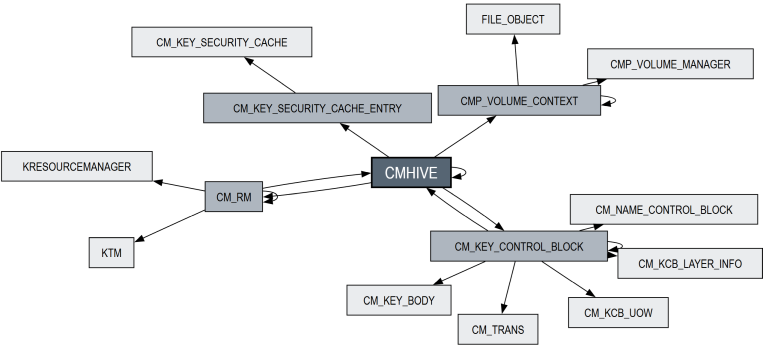
A diagram illustrating the relationships between various system components, with "CMHIVE" as the central element in a rectangular box. Several components interact directly with "CMHIVE": A box labeled "CM_KEY_SECURITY_CACHE_ENTRY" has an arrow pointing to "CMHIVE". A box labeled "CMP_VOLUME_CONTEXT" has a two-way arrow connecting it to "CMHIVE". A box labeled "CM_KEY_CONTROL_BLOCK" has a two-way arrow connecting it to "CMHIVE". A box labeled "CM_RM" has a two-way arrow connecting it to "CMHIVE". Other components are connected as follows: A box labeled "CM_KEY_SECURITY_CACHE" points to "CM_KEY_SECURITY_CACHE_ENTRY". A box labeled "FILE_OBJECT" points to "CMP_VOLUME_CONTEXT". A box labeled "CMP_VOLUME_MANAGER" has a two-way arrow with "CMP_VOLUME_CONTEXT". A box labeled "CM_NAME_CONTROL_BLOCK" has a two-way arrow with "CM_KEY_CONTROL_BLOCK". A box labeled "CM_KCB_LAYER_INFO" has a two-way arrow with "CM_KEY_CONTROL_BLOCK". "CM_KEY_CONTROL_BLOCK" points to boxes labeled "CM_KEY_BODY", "CM_TRANS", and "CM_KCB_UOW". A box labeled "KRESOURCEMANAGER" points to "CM_RM". A box labeled "KTM" points to "CM_RM".

The diagram is not necessarily complete, but it shows an overview of some objects that can be reached from _CMHIVE with a maximum of two pointer dereferences. However, it is important to remember that not every edge in this graph will be traversable in practice. This is because of two reasons: first, due the layout of the _HMAP_ENTRY structure (i.e. 0x18-byte alignment and the need for a 0x0 value being adjacent to the given pointer), and second, due to the fact that not every pointer in these objects is always initialized. For example, the _CMHIVE.RootKcb field is only valid for app hives (but not for normal hives), while _CMHIVE.CmRm is only set for standard hives, as app hives never have KTM transaction support enabled. So, the idea provides some good foundation for our exploit, but it does require additional experimentation to get every technical detail right.

Moving on, the !reg cellindex command in WinDbg is perfect for testing out-of-bounds cell indexes, because it uses the exact same cell map walk logic as HvpGetCellPaged, and it doesn't perform any additional bounds checks either. So, let's stick with the HKCU hive we were working with earlier, and try to create a cell index that points back to its _CMHIVE structure. We'll use the _CMHIVE → _CM_RM → _CMHIVE path for this. The first decision we need to make is to choose the storage type for this index: stable (0) or volatile (1). In the case of HKCU, both storage types are non-empty and use the "small dir" optimization, so we can choose either one; let's say volatile. Next, we need to calculate the directory index, which will be equal to the difference between the offsets of the _CMHIVE.CmRm and _CMHIVE.Hive.Storage[1].SmallDir fields:

0: kd> dx (&((nt!_CMHIVE*)0xffff82828fc1a000)->Hive.Storage[1].SmallDir)

(&((nt!_CMHIVE*)0xffff82828fc1a000)->Hive.Storage[1].SmallDir) : 0xffff82828fc1a3a0 [Type: _HMAP_TABLE * *]

    0xffff82828fe6a000 [Type: _HMAP_TABLE *]

0: kd> dx (&((nt!_CMHIVE*)0xffff82828fc1a000)->CmRm)

(&((nt!_CMHIVE*)0xffff82828fc1a000)->CmRm)                     : 0xffff82828fc1b038 [Type: _CM_RM * *]

    0xffff82828fdcc8e0 [Type: _CM_RM *]

In this case, it is (0xffff82828fc1b038 - 0xffff82828fc1a3a0) ÷ 8 = 0x193. The next step is to calculate the table index, which will be the offset of the _CM_RM.CmHive field from the beginning of the structure, divided by the size of _HMAP_ENTRY (0x18).

0: kd> dx (&((nt!_CM_RM*)0xffff82828fdcc8e0)->CmHive)

(&((nt!_CM_RM*)0xffff82828fdcc8e0)->CmHive)                 : 0xffff82828fdcc930 [Type: _CMHIVE * *]

    0xffff82828fc1a000 [Type: _CMHIVE *]

So, the calculation is (0xffff82828fdcc930 - 0xffff82828fdcc8e0) ÷ 0x18 = 3. Next, we can verify where the CmHive pointer falls within the _HMAP_ENTRY structure.

0: kd> dt _HMAP_ENTRY 0xffff82828fdcc8e0+3*0x18

nt!_HMAP_ENTRY

   +0x000 BlockOffset      : 0

   +0x008 PermanentBinAddress : 0xffff8282`8fc1a000

   +0x010 MemAlloc         : 0

The _CM_RM.CmHive pointer aligns with the PermanentBinAddress field, which is good news. Additionally, the BlockOffset field is zero, which is also desirable. Internally, it corresponds to the ContainerSize field, which is zero'ed out if no KTM transactions have been performed on the hive during this session – this will suffice for our example.

We have now calculated three of the four cell index elements, and the last one is the offset, which we will set to zero, as we want to access the _CMHIVE structure from the very beginning. It is time to gather all this information in one place; we can build the final cell index using a simple Python function:

>>> def MakeCellIndex(storage, directory, table, offset):

...     print("0x%x" % ((storage << 31) | (directory << 21) | (table << 12) | offset))

...

And then pass the values we have established so far:

>>> MakeCellIndex(1, 0x193, 3, 0)

0xb2603000

>>>

So the final out-of-bounds cell index pointing to the _CMHIVE structure of a given hive is 0xB2603000. It is now time to verify in WinDbg whether this magic index actually works as intended.

0: kd> !reg cellindex ffff82828fc1a000 b2603000

Map = ffff82828fc1a3a0 Type = 1 Table = 193 Block = 3 Offset = 0

MapTable     = ffff82828fdcc8e0 

MapEntry     = ffff82828fdcc928 

BinAddress = ffff82828fc1a000, BlockOffset = 0000000000000000

BlockAddress = ffff82828fc1a000 

pcell:  ffff82828fc1a004

Indeed, the _CMHIVE address passed as the input of the command was also printed in its output, which means that our technique works (the extra 0x4 in the output address is there to account for the cell size). If we were to insert this index into the _CM_KEY_VALUE.Data field, we would gain the ability to read from and write to the _CMHIVE structure in kernel memory through the registry value. This represents a very powerful capability in the hands of a local attacker.

Writing the exploit

At this stage, we already have a solid plan for how to leverage the initial primitive of hive memory corruption for further privilege escalation. It's time to choose a specific vulnerability and begin writing an actual exploit for it. This process is described in detail below.

Step 0: Choosing the vulnerability

Faced with approximately 17 vulnerabilities related to hive memory corruption, the immediate challenge is selecting one for a demonstration exploit. While any of these bugs could eventually be exploited with time and experimentation, they vary in difficulty. There is also an aesthetic consideration: for demonstration purposes, it would be ideal if the exploit's actions were visible within Regedit, which narrows our options. Nevertheless, with a significant selection still available, we should be able to identify a suitable candidate. Let's briefly examine two distinct possibilities.

CVE-2022-34707

The first vulnerability that always comes to my mind in the context of the registry is CVE-2022-34707. This is partly because it was the first bug I manually discovered as part of this research, but mainly because it is incredibly convenient to exploit. The essence of this bug is that it was possible to load a hive with a security descriptor containing a refcount very close to the maximum 32-bit value (e.g., 0xFFFFFFFF), and then overflow it by creating a few more keys that used it. This resulted in a very powerful UAF primitive, as the incorrectly freed cell could be subsequently filled with new objects and then freed again any number of times. In this way, it was possible to achieve type confusion of several different types of objects, e.g., by reusing the same cell subsequently as a security descriptor → value node → value data backing cell, we could easily gain control over the _CM_KEY_VALUE structure, allowing us to continue the attack using out-of-bounds cell indexes.

Due to its characteristics, this bug was also the first vulnerability in this research for which I wrote a full-fledged exploit. Many of the techniques I describe here were discovered while working on this bug. Furthermore, the screenshot showing the privilege escalation at the end of blog post #1 illustrates the successful exploitation of CVE-2022-34707. However, in the context of this blog post, it has one fundamental flaw: to set the initial refcount to a value close to overflowing the 32-bit range, it is necessary to manually craft the input regf file. This means that the target can only be an app hive, and thus we wouldn't be able to directly observe the exploitation in the Registry Editor. This would greatly reduce my ability to visually demonstrate the exploit, which is what ultimately led me to look for a better bug.

CVE-2023-23420

This brings us to the second vulnerability, CVE-2023-23420. This is also a UAF condition within the hive, but it concerns a key node cell instead of a security descriptor cell. It was caused by certain issues in the transactional key rename operation. These problems were so deep and affected such fundamental aspects of the registry that this and the related vulnerabilities CVE-2023-23421, CVE-2023-23422 and CVE-2023-23423 were fixed by completely removing support for transacted key rename operations.

In terms of exploitation, this bug is particularly unique because it can be triggered using only API/system calls, making it possible to corrupt any hive the attacker has write access to. This makes it an ideal candidate for writing an exploit whose operation is visible to the naked eye using standard Windows registry utilities, so that's what we'll do. Although the details of massaging the hive layout into the desired state may be slightly more difficult here than with CVE-2022-34707, it's nothing we can't handle. So let's get to work!

Step 1: Abusing the UAF to establish dynamically-controlled value cells

Let's start by clarifying that our attack will target the HKCU hive, and more specifically its volatile storage space. This will hopefully make the exploit a bit more reliable, as the volatile space resets each time the hive is reloaded, and there generally isn't much activity occurring there. The exploitation process begins with a key node use-after-free, and our goal is to take full control over the _CM_KEY_VALUE representation of two registry values by the end of the first stage (why two – we'll get to that in a moment). Once we achieve this goal, we will be able to arbitrarily set the _CM_KEY_VALUE.Data field, and thus gain read/write access to any chosen out-of-bounds cell index. There are many different approaches to how to achieve this, but in my proof-of-concept, I started with the following data layout:
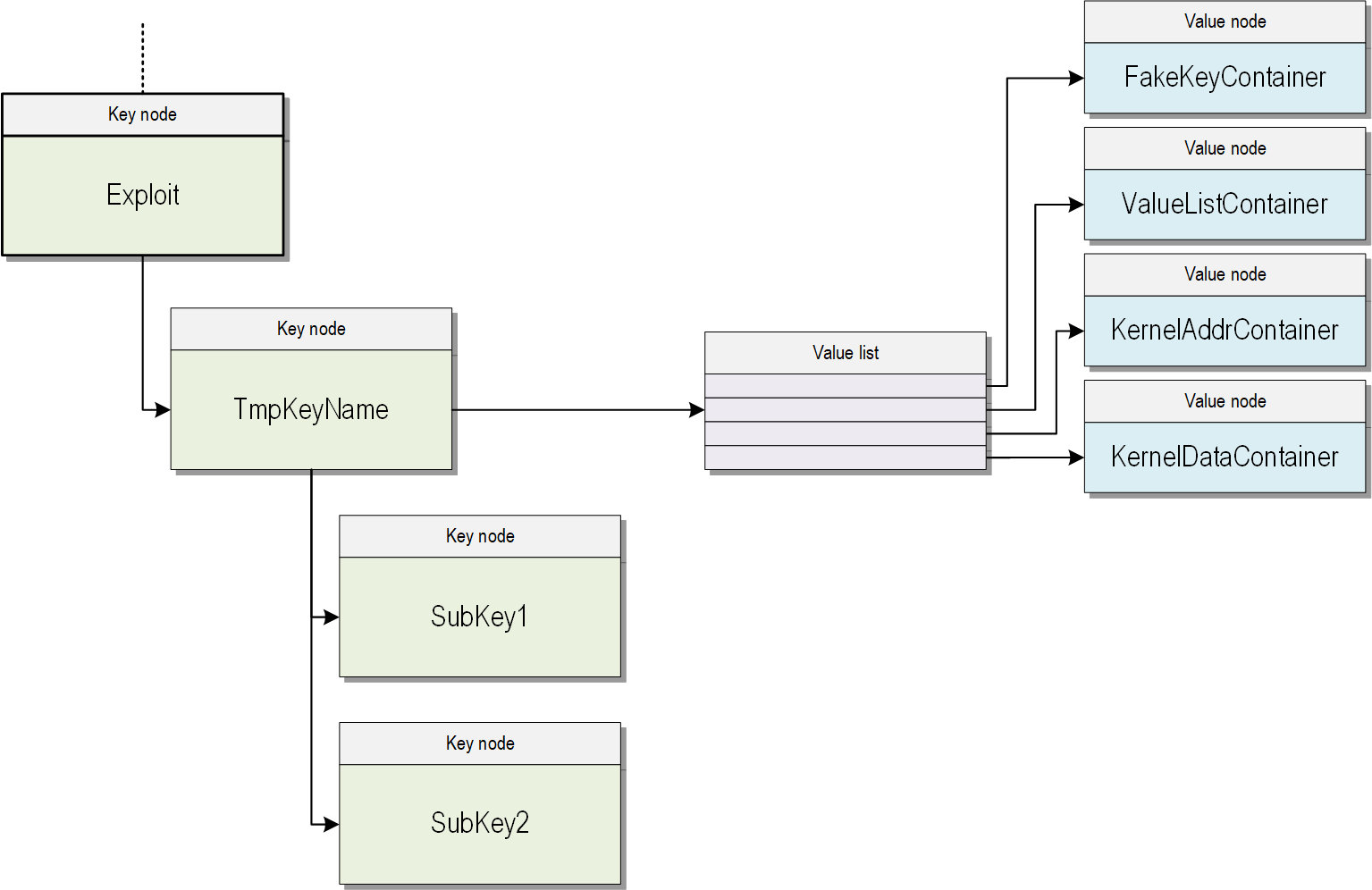
At the top left, a box labeled "Exploit" is designated as a "Key node," with a dotted line extending upwards from its "Key node" label. An arrow from "Exploit" points to a box labeled "TmpKeyName," also designated as a "Key node." From "TmpKeyName," two arrows point downwards to two separate "Key node" boxes: "SubKey1" and "SubKey2." Another arrow extends to the right from "TmpKeyName" to a vertically stacked group of four rectangular elements, collectively referred to as a "Value list" via a label to their left. From this "Value list," four separate arrows point to the right, each connecting to a distinct container box. Each of these container boxes has a "Value node" label above it: The first container is "FakeKeyContainer." The second is "ValueListContainer." The third is "KernelAddrContainer." The fourth is "KernelDataContainer."

At the top of the hierarchy is the HKCU\Exploit key, which is the root of the entire exploit subtree. Its only role is to work as a container for all the other keys and values we create. Below it, we have the "TmpKeyName" key, which is important for two reasons: first, it stores four values that will be used at a later stage to fill freed cells with controlled data (but are currently empty). Second, this is the key on which we will perform the "rename" operation, which is the basis of the CVE-2023-23420 vulnerability. Below it are two more keys, "SubKey1" and "SubKey2", which are also needed in the exploitation process for transactional deletion, each through a different view of their parent.

Once we have this data layout arranged in the hive, we can proceed to trigger the memory corruption. We can do it exactly as described in the original report in section "Operating on subkeys of transactionally renamed keys", and demonstrated in the corresponding InconsistentSubkeyList.cpp source code. In short, it involves the following steps:

  1. Creating a lightweight transaction by calling the NtCreateRegistryTransaction syscall.
  2. Opening two different handles to the HKCU\Exploit\TmpKeyName key within our newly created transaction.
  3. Performing a transactional rename operation on one of these handles, changing the name to "Scratchpad".
  4. Transactionally deleting the "SubKey1" and "SubKey2" keys, each through a different parent handle (one renamed, the other not).
  5. Committing the entire transaction by calling the NtCommitRegistryTransaction syscall.

After successfully executing these operations on a vulnerable system, the layout of our objects within the hive should change accordingly:
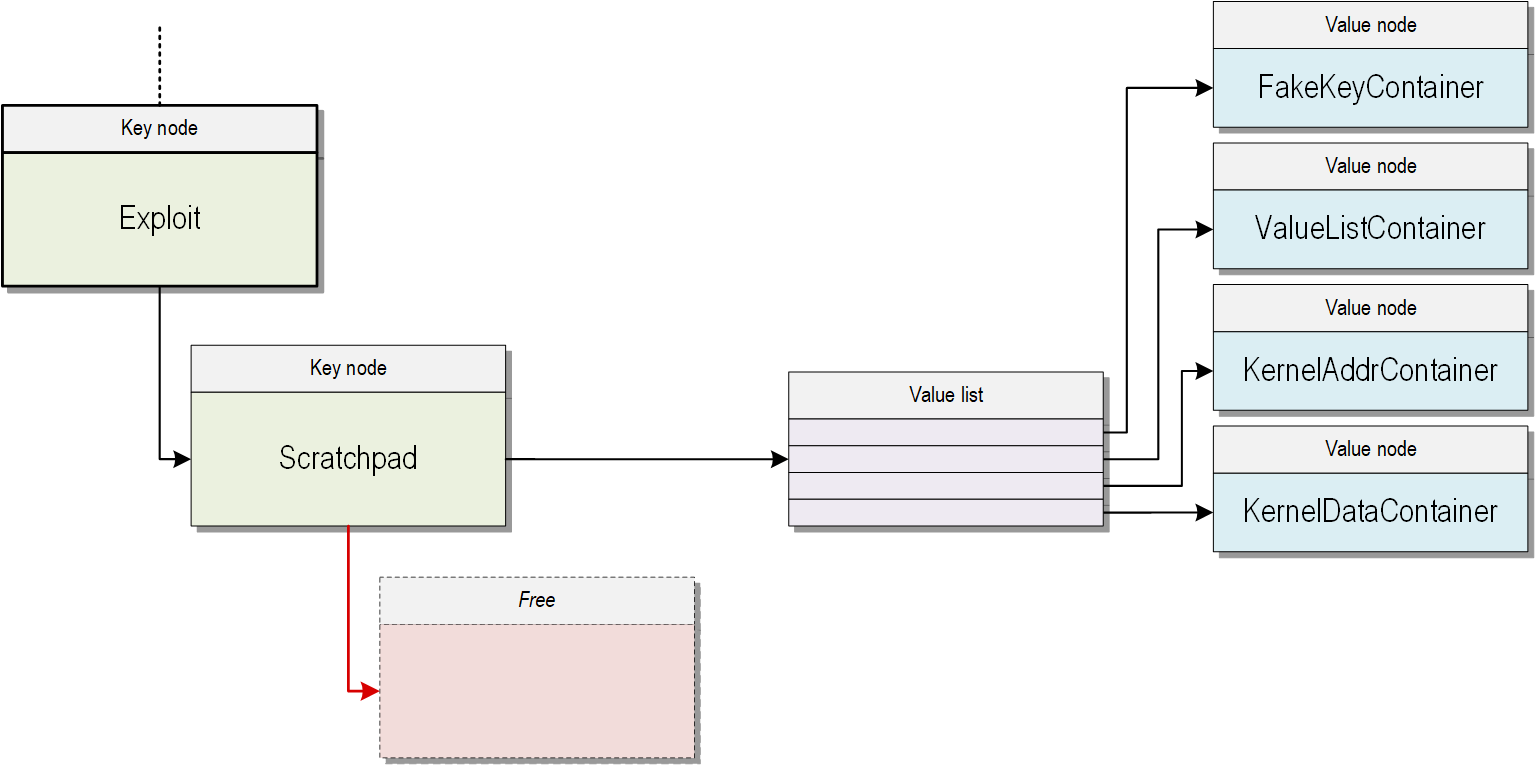
At the top left, a box labeled "Exploit" is designated as a "Key node," with a dotted line extending upwards from its "Key node" label. An arrow from "Exploit" points to a box labeled "Scratchpad," also designated as a "Key node." From "Scratchpad," a red arrow points downwards to a dashed-outline box labeled "Free." Another arrow extends to the right from "Scratchpad" to a vertically stacked group of four rectangular elements, collectively referred to as a "Value list" via a label to their left. From this "Value list," four separate arrows point to the right, each connecting to a distinct container box. Each of these container boxes has a "Value node" label above it: The first container is "FakeKeyContainer." The second is "ValueListContainer." The third is "KernelAddrContainer." The fourth is "KernelDataContainer."

We see that the "TmpKeyName" key has been renamed to "Scratchpad", and both its subkeys have been released, but the freed cell of the second subkey still appears on its parent's subkey list. At this point, we want to use the four values of the "Scratchpad" key to create our own fake data structure. According to it, the freed subkey will still appear as existing, and contain two values named "KernelAddr" and "KernelData". Each of the "Container" values is responsible for imitating one type of object, and the most crucial role is played by the "FakeKeyContainer" value. Its backing buffer must perfectly align with the memory previously associated with the "SubKey1" key node. The diagram below illustrates the desired outcome:
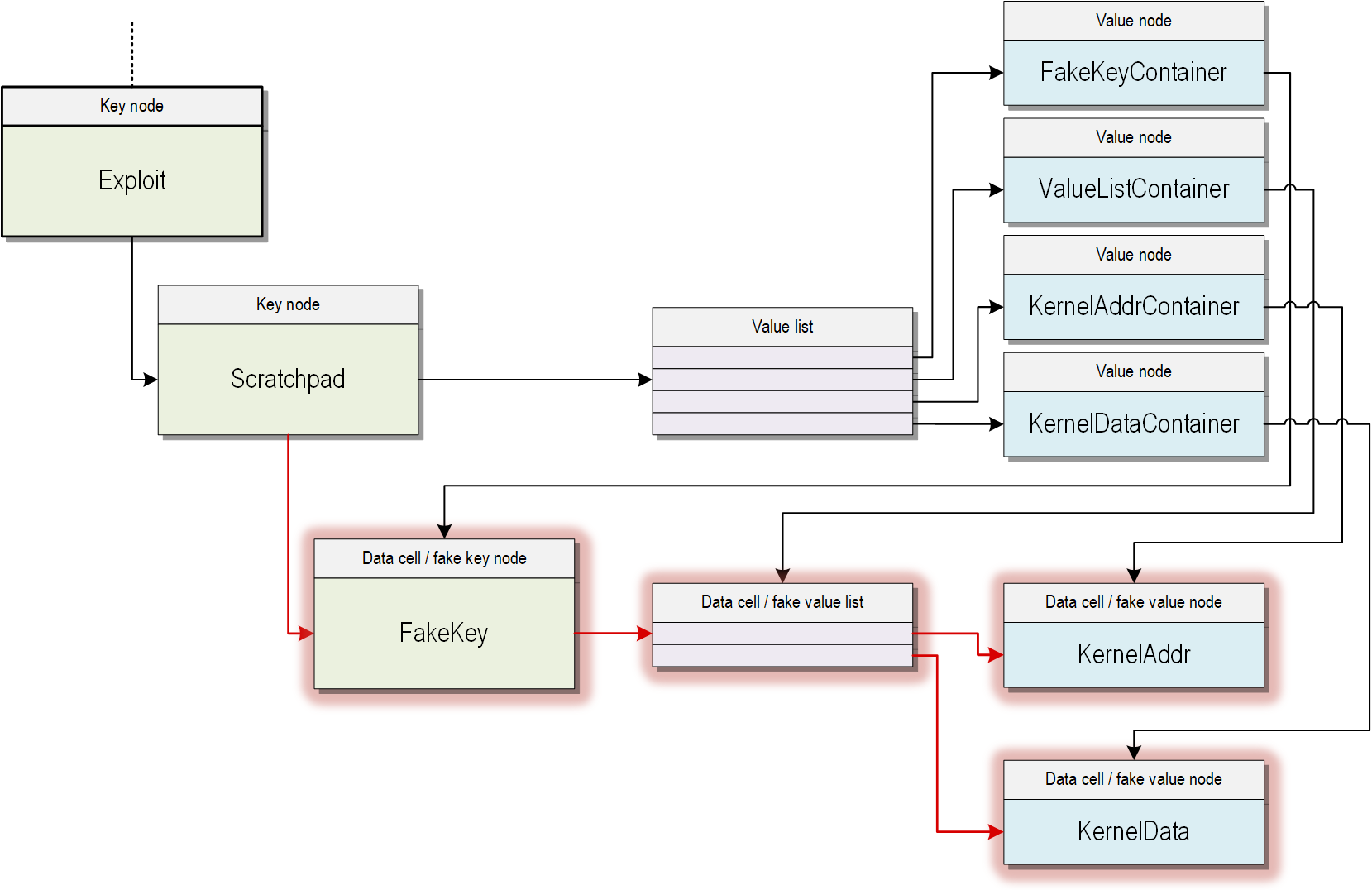
A diagram illustrates a complex data structure and flow, likely related to a system exploit. At the top left, a box labeled "Exploit," designated as a "Key node" with a dotted line extending upwards, points to a box labeled "Scratchpad," also a "Key node." "Scratchpad" points to the right to a vertically stacked group of four rectangular elements, labeled "Value list." This "Value list" has four arrows pointing to four "Value node" container boxes on the far right: "FakeKeyContainer," "ValueListContainer," "KernelAddrContainer," and "KernelDataContainer." An arrow extends downwards and to the right from "Scratchpad" to a box labeled "FakeKey," which is also designated as "Data cell / fake key node." From "FakeKey," an arrow points right to a stack of two horizontal elements labeled "Data cell / fake value list," and another thin arrow points upwards and right to "FakeKeyContainer." From the "Data cell / fake value list," its top element has an arrow pointing right to "KernelAddr" (labeled "Data cell / fake value node"), and its bottom element has an arrow pointing downwards and right to "KernelData" (labeled "Data cell / fake value node"). "KernelAddr" has a thin arrow pointing upwards and right to "KernelAddrContainer." "KernelData" has a thin arrow pointing upwards and right to "KernelDataContainer." A wavy line connects the right side of "KernelAddrContainer" to the left side of "KernelDataContainer," and another wavy line extends from the right side of "KernelDataContainer" off to the right.

All the highlighted cells contain attacker-controlled data, which represent valid regf structures describing the HKCU\Exploit\Scratchpad\FakeKey key and its two values. Once this data layout is achieved, it becomes possible to open a handle to the "FakeKey" using standard APIs such as RegOpenKeyEx, and then operate on arbitrary cell indexes through its values. In reality, the process of crafting these objects after triggering the UAF is slightly more complicated than just setting data for four different values and requires the following steps:

  1. Writing to the "FakeKeyContainer" value with an initial, basic representation of the "FakeKey" key. At this stage, it is not important that the key node is entirely correct, but it must be of the appropriate length, and thus precisely cover the freed cell currently pointed to by the subkey list of the "Scratchpad" key.
  2. Setting the data for the other three container values – again, not the final ones yet, but those that have the appropriate length and are filled with unique markers, so that they can be easily recognized later on.
  3. Launching an info-leak loop to find the three cell indexes corresponding to the data cells of the "ValueListContainer", "KernelAddrContainer" and "KernelDataContainer" values, as well as a cell index of a valid security descriptor. This logic relies on abusing the _CM_KEY_NODE.Class and _CM_KEY_NODE.ClassLength fields of the "FakeKey" to point them to the data in the hive that we want to read. Specifically, the ClassLength member is set to 0xFFC, and the Class member is set to indexes 0x80000000, 0x80001000, 0x80002000, ... in subsequent loop iterations. This enables a kind of "arbitrary hive read" primitive, and the reading can be achieved by calling the NtEnumerateKey syscall on the "Scratchpad" key with the KeyNodeInformation class, which returns, among other things, the class property for a given subkey. This way, we get all the information about the internal hive layout needed to construct the final form of each of the imitated cells.
  4. Using the above information to set the correct data for each of the four cells: the key node of the "FakeKey" key with a valid security descriptor and index to the value list, the value list itself, and the value nodes of "KernelAddr" and "KernelData". This makes "FakeKey" a full-fledged key as seen by Windows, but with all of its internal regf structures fully controlled by us.

If all of these steps are successful, we should be able to open the HKCU\Exploit\Scratchpad key in Regedit and see the current exploitation progress. An example from my test system is shown in the screenshot below. The extra "Filler" value is used to fill the space occupied by the old "TmpKeyName" key node freed during the rename operation. This is necessary so that the data of the "FakeKeyContainer" value correctly aligns with the freed cell of the "SubKey1" key, but I skipped this minor implementation detail in the above high-level description of the logic for the sake of clarity.
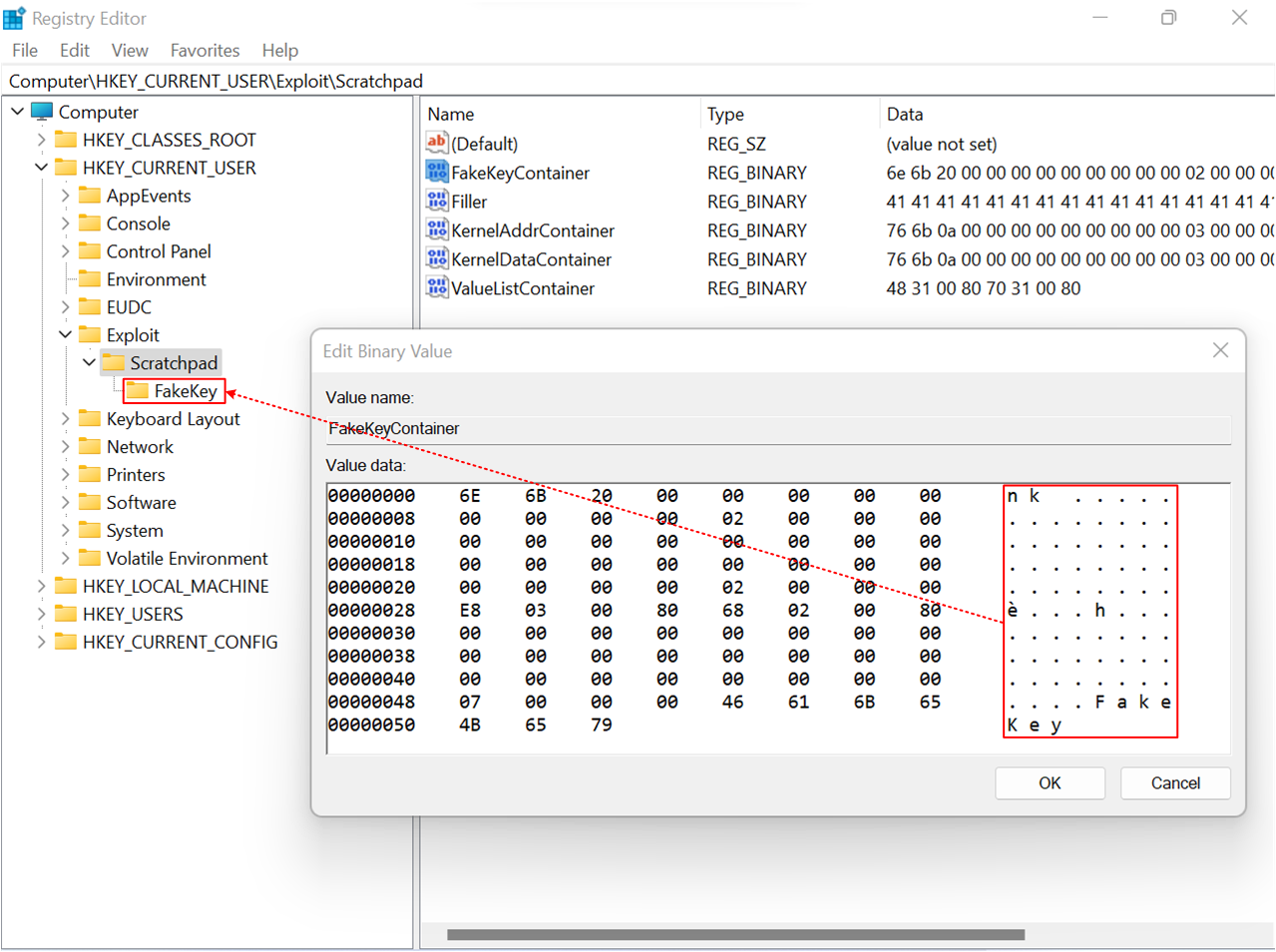
Example successful exploit

Step 2: Getting read/write access to the CMHIVE kernel object

Since we now have full control over some registry values, the next logical step would be to initialize them with a specially crafted OOB cell index and then check if we can actually access the kernel structure it represents. Let's say that we set the type of the "KernelData" value to REG_BINARY, its length to 0x100, and the data cell index to the previously calculated value of 0xB2603000, which should point back at the hive's _CMHIVE structure on the kernel pool. If we do this, and then browse to the "FakeKey" key in the Registry Editor, we will encounter an unpleasant surprise:

Bluescreen!

This is definitely not the result we expected, and something must have gone wrong. If we investigate the system crash in WinDbg, we will get the following information:

Break instruction exception - code 80000003 (first chance)

A fatal system error has occurred.

Debugger entered on first try; Bugcheck callbacks have not been invoked.

A fatal system error has occurred.

nt!DbgBreakPointWithStatus:

fffff800`8061ff20 cc              int     3

0: kd> !analyze -v

*******************************************************************************

*                                                                             *

*                        Bugcheck Analysis                                    *

*                                                                             *

*******************************************************************************

REGISTRY_ERROR (51)

Something has gone badly wrong with the registry.  If a kernel debugger

is available, get a stack trace. It can also indicate that the registry got

an I/O error while trying to read one of its files, so it can be caused by

hardware problems or filesystem corruption.

It may occur due to a failure in a refresh operation, which is used only

in by the security system, and then only when resource limits are encountered.

Arguments:

Arg1: 0000000000000001, (reserved)

Arg2: ffffd4855dc36000, (reserved)

Arg3: 00000000b2603000, depends on where Windows BugChecked, may be pointer to hive

Arg4: 000000000000025d, depends on where Windows BugChecked, may be return code of

        HvCheckHive if the hive is corrupt.

[...]

0: kd> k

 # Child-SP          RetAddr               Call Site

00 ffff828b`b100be68 fffff800`80763642     nt!DbgBreakPointWithStatus

01 ffff828b`b100be70 fffff800`80762e81     nt!KiBugCheckDebugBreak+0x12

02 ffff828b`b100bed0 fffff800`80617957     nt!KeBugCheck2+0xa71

03 ffff828b`b100c640 fffff800`80a874d5     nt!KeBugCheckEx+0x107

04 ffff828b`b100c680 fffff800`8089dfd5     nt!HvpReleaseCellPaged+0x1ec1a5

05 ffff828b`b100c6c0 fffff800`808a29be     nt!CmpQueryKeyValueData+0x1a5

06 ffff828b`b100c770 fffff800`808a264e     nt!CmEnumerateValueKey+0x13e

07 ffff828b`b100c840 fffff800`80629e75     nt!NtEnumerateValueKey+0x31e

08 ffff828b`b100ca70 00007ff8`242c4114     nt!KiSystemServiceCopyEnd+0x25

09 00000008`c747dc38 00000000`00000000     0x00007ff8`242c4114

We are seeing bugcheck code 0x51 (REGISTRY_ERROR), which indicates that it was triggered intentionally rather than through a bad memory access. Additionally, the direct caller of KeBugCheckEx is HvpReleaseCellPaged, a function that we haven't really mentioned so far in this blog post series.

To better understand what is actually happening here, we need to take a step back and look at the general scheme of cell operations as implemented in the Windows kernel. It typically follows a common pattern:

  _HV_GET_CELL_CONTEXT Context;

  //

  // Translate the cell index to virtual address

  //

  PVOID CellAddress = Hive->GetCellRoutine(Hive, CellIndex, &Context);

  //

  // Operate on the cell view using the CellAddress pointer

  //

  ...

  //

  // Release the cell

  //

  Hive->ReleaseCellRoutine(Hive, &Context)

There are three stages here: translating the cell index to a virtual address, performing operations on that cell, and releasing it. We are already familiar with the first two, and they are both obvious, but what is the release about? Based on a historical analysis of various Windows kernel builds, it turns out that in some versions, a get+release function pair was not only used for translating cell indexes to virtual addresses, but also to ensure that the memory view of the cell would not be accidentally unmapped between these two calls.

The presence or absence of the "release" function in consecutive Windows versions is shown below:

  • Windows NT 3.1 – 2000: ❌
  • Windows XP – 7: ✅
  • Windows 8 – 8.1: ❌
  • Windows 10 – 11: ✅

Let's take a look at the decompiled HvpReleaseCellPaged function from Windows 10, 1507 (build 10240), where it first reappeared after a hiatus in Windows 8.x:

VOID HvpReleaseCellPaged(_CMHIVE *CmHive, _HV_GET_CELL_CONTEXT *Context) {

  _HCELL_INDEX RealCell;

  _HMAP_ENTRY *MapEntry;

  RealCell = Context->Cell & 0xFFFFFFFE;

  MapEntry = HvpGetCellMap(&CmHive->Hive, RealCell);

  if (MapEntry == NULL) {

    KeBugCheckEx(REGISTRY_ERROR, 1, CmHive, RealCell, 0x291);

  }

  if ((Context->Cell & 1) != 0) {

    HvpMapEntryReleaseBinAddress(MapEntry);

  }

  HvpGetCellContextReinitialize(Context);

}

_HMAP_ENTRY *HvpGetCellMap(_HHIVE *Hive, _HCELL_INDEX CellIndex) {

  DWORD StorageType = CellIndex >> 31;

  DWORD StorageIndex = CellIndex & 0x7FFFFFFF;

  if (StorageIndex < Hive->Storage[StorageType].Length) {

    return &Hive->Storage[StorageType].Map

                                     ->Directory[(CellIndex >> 21) & 0x3FF]

                                     ->Table[(CellIndex >> 12) & 0x1FF];

  } else {

    return NULL;

  }

}

VOID HvpMapEntryReleaseBinAddress(_HMAP_ENTRY *MapEntry) {

  ExReleaseRundownProtection(&MapEntry->TemporaryBinRundown);

}

VOID HvpGetCellContextReinitialize(_HV_GET_CELL_CONTEXT *Context) {

  Context->Cell = -1;

  Context->Hive = NULL;

}

As we can see, the main task of HvpReleaseCellPaged and its helper functions was to find the _HMAP_ENTRY structure that corresponded to a given cell index, and then potentially call the ExReleaseRundownProtection API on the _HMAP_ENTRY.TemporaryBinRunDown field. This behavior was coordinated with the implementation of HvpGetCellPaged, which called ExAcquireRundownProtection on the same object. An additional side effect was that during the lookup of the _HMAP_ENTRY structure, a bounds check was performed on the cell index, and if it failed, a REGISTRY_ERROR bugcheck was triggered.

This state of affairs persisted for about two years, until Windows 10 1803 (build 17134). In that version, the code was greatly simplified: the TemporaryBinAddress and TemporaryBinRundown members were removed from _HMAP_ENTRY, and the call to ExReleaseRundownProtection was eliminated from HvpReleaseCellPaged. This effectively meant that there was no longer any reason for this function to retrieve a pointer to the map entry (as it was not used for anything), but for some unclear reason, this logic has remained in the code to this day. In most modern kernel builds, the auxiliary functions have been inlined, and HvpReleaseCellPaged now takes the following form:

VOID HvpReleaseCellPaged(_HHIVE *Hive, _HV_GET_CELL_CONTEXT *Context) {

  _HCELL_INDEX Cell = Context->Cell;

  DWORD StorageIndex = Cell & 0x7FFFFFFF;

  DWORD StorageType = Cell >> 31;

  if (StorageIndex >= Hive->Storage[StorageType].Length ||

      &Hive->Storage[StorageType].Map->Directory[(Cell >> 21) & 0x3FF]->Table[(Cell >> 12) & 0x1FF] == NULL) {

    KeBugCheckEx(REGISTRY_ERROR, 1, (ULONG_PTR)Hive, Cell, 0x267);

  }

  Context->Cell = -1;

  Context->BinContext = 0;

}

The bounds check on the cell index is clearly still present, but it doesn't serve any real purpose. Based on this, we can assume that this is more likely a historical relic rather than a mitigation deliberately added by the developers. Still, it interferes with our carefully crafted exploitation technique. Does this mean that OOB cell indexes are not viable because their use will always result in a forced BSoD, and we have to look for other privilege escalation methods instead?

As it turns out, not necessarily. Indeed, if the bounds check was located in the HvpGetCellPaged function, there wouldn't be much to discuss – a blue screen would always occur right before using any OOB index, completely neutralizing this idea's usefulness. However, as things stand, resolving such an index works without issues, and we can perform a single invalid memory operation before a crash occurs in the release call. In many ways, this sounds like a "pwn" task straight out of a CTF, where the attacker is given a memory corruption primitive that is theoretically exploitable, but somehow artificially limited, and the goal is to figure out how to cleverly bypass this limitation. Let's take another look at the if statement that stands in our way:

if (StorageIndex >= Hive->Storage[StorageType].Length || /* ... */) {

  KeBugCheckEx(REGISTRY_ERROR, 1, (ULONG_PTR)Hive, Cell, 0x267);

}

The index is compared against the value of the long-lived _HHIVE.Storage[StorageType].Length field, which is located at a constant offset from the beginning of the _HHIVE structure. On the Windows 11 system I tested, this offset is 0x118 for stable storage and 0x390 for volatile storage:

0: kd> dx (&((_HHIVE*)0)->Storage[0].Length)

(&((_HHIVE*)0)->Storage[0].Length)                 : 0x118

0: kd> dx (&((_HHIVE*)0)->Storage[1].Length)

(&((_HHIVE*)0)->Storage[1].Length)                 : 0x390

As we established earlier, the special out-of-bounds index 0xB2603000 points to the base address of the _CMHIVE / _HHIVE structure. By adding one of the offsets above, we can obtain an index that points directly to the Length field. Let's test this in practice:

0: kd> dx (&((nt!_CMHIVE*)0xffff810713f82000)->Hive.Storage[1].Length) 

(&((nt!_CMHIVE*)0xffff810713f82000)->Hive.Storage[1].Length)                  : 0xffff810713f82390

0: kd> !reg cellindex 0xffff810713f82000 0xB2603390-4

Map = ffff810713f823a0 Type = 1 Table = 193 Block = 3 Offset = 38c

MapTable     = ffff810713debe90 

MapEntry     = ffff810713debed8 

BinAddress = ffff810713f82000, BlockOffset = 0000000000000000

BlockAddress = ffff810713f82000 

pcell:  ffff810713f82390

So, indeed, index 0xB260338C points to the field representing the length of the volatile space in the HKCU hive. This is very good news for an attacker, because it means that they are able to neutralize the bounds check in HvpReleaseCellPaged by performing the following steps:

  1. Crafting a controlled registry value with a data index of 0xB260338C.
  2. Setting this value programmatically to a very large number, such as 0xFFFFFFFF, and thus overwriting the _HHIVE.Storage[1].Length field with it.
  3. During the NtSetValueKey syscall in step 2, when HvpReleaseCellPaged is called on index 0xB260338C, the Length member has already been corrupted. As a result, the condition checked by the function is not satisfied, and the KeBugCheckEx call never occurs.
  4. Since the _HHIVE.Storage[1].Length field is located in a global hive object and does not change very often (unless the storage space is expanded or shrunk), all future checks performed in HvpReleaseCellPaged against this hive will no longer pose any risk to the exploit stability.

To better realize just how close the overwriting of the Length field is to its use in the bounds check, we can have a look at the disassembly of the CmpSetValueKeyExisting function, where this whole logic takes place.

Dissasembly output

The technique works by a hair's breadth – the memmove and HvpReleaseCellPaged calls are separated by only a few instructions. Nevertheless, it works, and if we first perform a write to the 0xB260338C index (or equivalent) after gaining binary control over the hive, then we will be subsequently able to read from/write to any OOB indexes without any restrictions in the future.

For completeness, I should mention that after corrupting the Length field, it is worthwhile to set a few additional flags in the _HHIVE.HiveFlags field using the same trick as before. This prevents the kernel from crashing due to the unexpectedly large hive length. Specifically, the flags are (as named in blog post #6):

  • HIVE_COMPLETE_UNLOAD_STARTED (0x40): This prevents a crash during potential hive unloading in the CmpLateUnloadHiveWorker → CmpCompleteUnloadKey → HvHiveCleanup → HvpFreeMap → CmpFree function.
  • HIVE_FILE_READ_ONLY (0x8000): This prevents a crash that could occur in the CmpFlushHive → HvStoreModifiedData → HvpTruncateBins path.

Of course, these are just conclusions drawn from writing a demonstration exploit, so I don't guarantee that the above flags are sufficient to maintain system stability in every configuration. Nevertheless, repeated tests have shown that it works in my environment, and if we subsequently set the data cell index of the controlled value back to 0xB2603000, and the Type/DataLength fields to something like REG_BINARY and 0x100, we should be finally able to see the following result in the Registry Editor:
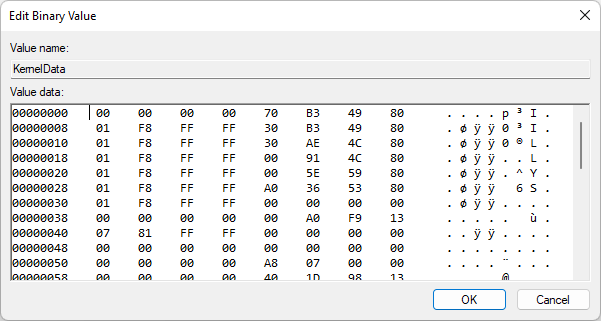
Result in registry editor

It is easy to verify that this is indeed a "live view" into the _CMHIVE structure in kernel memory:

0: kd> dt _HHIVE ffff810713f82000

nt!_HHIVE

   +0x000 Signature        : 0xbee0bee0

   +0x008 GetCellRoutine   : 0xfffff801`8049b370     _CELL_DATA*  nt!HvpGetCellPaged+0

   +0x010 ReleaseCellRoutine : 0xfffff801`8049b330     void  nt!HvpReleaseCellPaged+0

   +0x018 Allocate         : 0xfffff801`804cae30     void*  nt!CmpAllocate+0

   +0x020 Free             : 0xfffff801`804c9100     void  nt!CmpFree+0

   +0x028 FileWrite        : 0xfffff801`80595e00     long  nt!CmpFileWrite+0

   +0x030 FileRead         : 0xfffff801`805336a0     long  nt!CmpFileRead+0

   +0x038 HiveLoadFailure  : (null)

   +0x040 BaseBlock        : 0xffff8107`13f9a000 _HBASE_BLOCK

[...]

Unfortunately, the hive signature 0xBEE0BEE0 is not visible in the screenshot, because the first four bytes of the cell are treated as its size, and only the subsequent bytes as actual data. For this reason, the entire view of the structure is shifted by 4 bytes. Nevertheless, it is immediately apparent that we have gained direct access to function addresses within the kernel image, as well as many other interesting pointers and data. We are getting very close to our goal!

Step 3: Getting arbitrary read/write access to the entire kernel address space

At this point, we can both read from and write to the _CMHIVE structure through our magic value, and also operate on any other out-of-bounds cell index that resolves to a valid address. This means that we no longer need to worry about kernel ASLR, as _CMHIVE readily leaks the base address of ntoskrnl.exe, as well as many other addresses from kernel pools. The question now is how, with these capabilities, to execute our own payload in kernel-mode or otherwise elevate our process's privileges in the system. What may immediately come to mind based on the layout of the _CMHIVE / _HHIVE structure is the idea of overwriting one of the function pointers located at the beginning. In practice, this is less useful than it seems. As I wrote in blog post #6, the vast majority of operations on these pointers have been devirtualized, and in the few cases where they are still used directly, the Control Flow Guard mitigation is enabled. Perhaps something could be ultimately worked out to bypass CFG, but with the primitives currently available to us, I decided that this sounds more difficult than it should be.

If not that, then what else? Experienced exploit developers would surely find dozens of different ways to complete the privilege escalation process. However, I had a specific goal in mind that I wanted to achieve from the start. I thought it would be elegant to create an arrangement of objects where the final stage of exploitation could be performed interactively from within Regedit. This brings us back to the selection of our two fake values, "KernelAddr" and "KernelData". My goal with these values was to be able to enter any kernel address into KernelAddr, and have KernelData automatically—based solely on how the registry works—contain the data from that address, available for both reading and writing. This would enable a very unique situation where the user could view and modify kernel memory within the graphical interface of a tool available in a default Windows installation—something that doesn't happen very often. 🙂

The crucial observation that allows us to even consider such a setup is the versatility of the cell maps mechanism. In order for such an obscure arrangement to work, KernelData must utilize a _HMAP_ENTRY structure controlled by KernelAddr at the final stage of the cell walk. Referring back to the previous diagram illustrating the relationships between the _CMHIVE structure and other objects, this implies that if KernelAddr reaches an object through two pointer dereferences, KernelData must be configured to reach it with a single dereference, so that the second dereference then occurs through the data stored in KernelAddr.

In practice, this can be achieved as follows: KernelAddr will function similarly as before, pointing to an offset within _CMHIVE using a series of pointer dereferences:

  • _CMHIVE.CmRm → _CM_RM.Hive → _CMHIVE: for normal hives (e.g., HKCU).
  • _CMHIVE.RootKcb → _CM_KEY_CONTROL_BLOCK.KeyHive → _CMHIVE: for app hives.

For KernelData, we can use any self-referencing pointer in the first step of the cell walk. These are plentiful in _CMHIVE, due to the fact that there are many LIST_ENTRY objects initialized as an empty list.

The next step is to select the appropriate offsets and indexes based on the layout of the _CMHIVE structure, so that everything aligns with our plan. Starting with KernelAddr, the highest 20 bits of the cell index remain the same as before, which is 0xB2603???. The lower 12 bits will correspond to an offset within _CMHIVE where we will place our fake _HMAP_ENTRY object. This should be a 0x18 byte area that is generally unused and located after a self-referencing pointer. For demonstration purposes, I used offset 0xB70, which corresponds to the following fields:

_CMHIVE layout

_HMAP_ENTRY layout

+0xb70 UnloadEventArray : Ptr64 Ptr64 _KEVENT

+0x000 BlockOffset         : Uint8B

+0xb78 RootKcb          : Ptr64 _CM_KEY_CONTROL_BLOCK

+0x008 PermanentBinAddress : Uint8B

+0xb80 Frozen           : UChar

+0x010 MemAlloc            : Uint4B

On my test Windows 11 system, all these fields are zeroed out and unused for the HKCU hive, which makes them well-suited for acting as the _HMAP_ENTRY structure. The final cell index for the KernelAddr value will, therefore, be 0xB2603000 + 0xB70 - 0x4 = 0xB2603B6C. If we set its type to REG_QWORD and its length to 8 bytes, then each write to it will result in setting the _CMHIVE.UnloadEventArray field (or _HMAP_ENTRY.BlockOffset in the context of the cell walk) to the specified 64-bit number.

As for KernelData, we will use _CMHIVE.SecurityHash[3].Flink, located at offset 0x798, as the aforementioned self-referencing pointer. To calculate the directory index value, we need to subtract it from the offset of _CMHIVE.Hive.Storage[1].SmallDir and then divide by 8, which gives us: (0x798 - 0x3A0) ÷ 8 = 0x7F. Next, we will calculate the table index by subtracting the offset of the fake _HMAP_ENTRY structure from the offset of the self-referencing pointer and then dividing the result by the size of _HMAP_ENTRY: (0xB70 - 0x798) ÷ 0x18 = 0x29. If we assume that the 12-bit offset part is zero (we don't want to add any offsets at this point), then we have all the elements needed to compose the full cell index. We will use the MakeCellIndex helper function defined earlier for this purpose:

>>> MakeCellIndex(1, 0x7F, 0x29, 0)

0x8fe29000

So, the cell index for the KernelData value will be 0x8FE29000, and with that, we have all the puzzle pieces needed to assemble our intricate construction. This is illustrated in the diagram below:
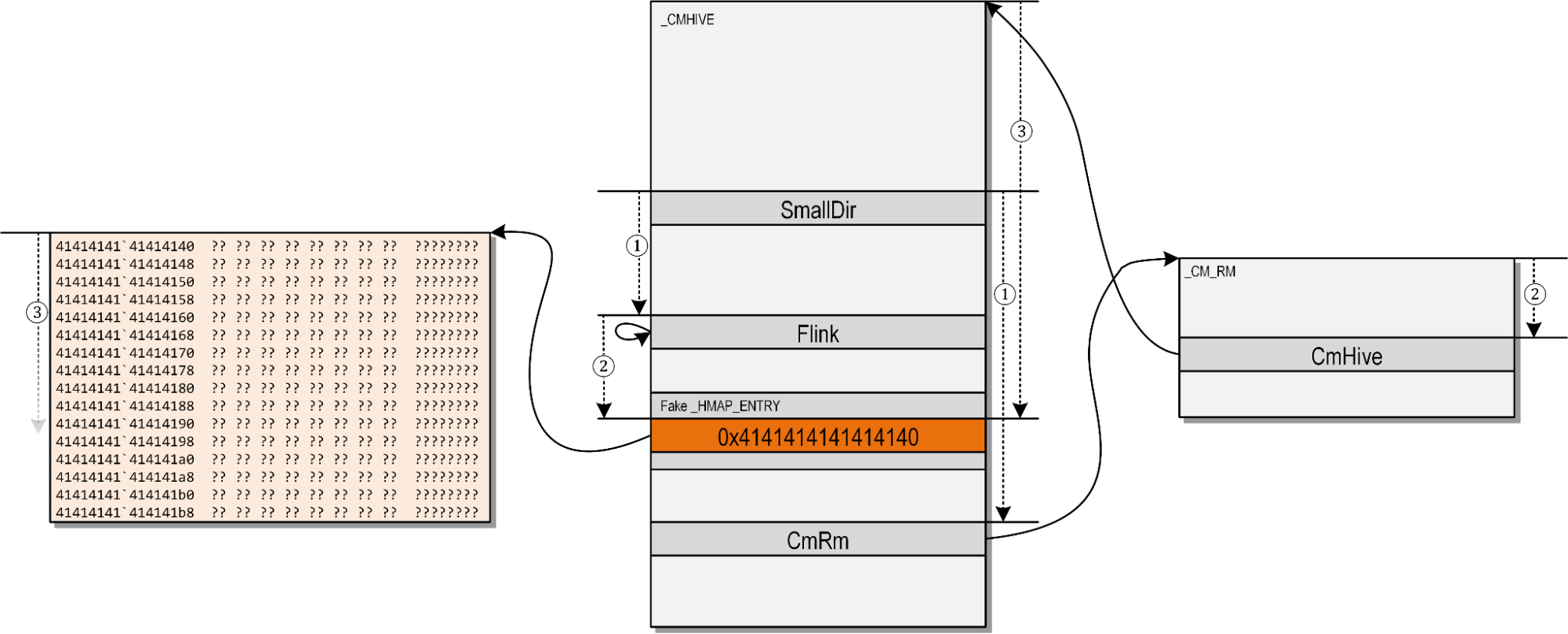
Diagram described below

The cell map walk for the KernelAddr value is shown on the right side of the _CMHIVE structure, and the cell map walk for KernelData is on the left. The dashed arrows marked with numbers ①, ②, and ③ correspond to the consecutive elements of the cell index (i.e., directory index, table index, and offset), while the solid arrows represent dereferences of individual pointers. As you can see, we successfully managed to select indexes where the data of one value directly influences the target virtual address to which the other one is resolved.

We could end this section right here, but there is one more minor issue I'd like to mention. As you may recall, the HvpGetCellPaged function ends with the following statement:

return (Entry->PermanentBinAddress & (~0xF)) + Entry->BlockOffset + (Index & 0xFFF) + 4;

Our current assumption is that the PermanentBinAddress and the lower 12 bits of the index are both zero, and BlockOffset contains the exact value of the address we want to access. Unfortunately, the expression ends with the extra "+4". Normally, this skips the cell size and directly returns a pointer to the cell's data, but in our exploit, it means we would see a view of the kernel memory shifted by four bytes. This isn't a huge issue in practical terms, but it doesn't look perfect in a demonstration.

So, can we do anything about this? It turns out, we can. What we want to achieve is to subtract 4 from the final result using the other controlled addends in the expression (PermanentBinAddress and BlockOffset). Individually, each of them has some limitations:

  • The PermanentBinAddress is a fully controlled 64-bit field, but only its upper 60 bits are used when constructing the cell address. This means we can only use it to subtract multiples of 0x10, but not exactly 4.
  • The cell offset is a 12-bit unsigned number, so we can use it to add any number in the 1–4095 range, but we can't subtract anything.

However, we can combine both of them together to achieve the desired goal. If we set PermanentBinAddress to 0xFFFFFFFFFFFFFFF0 (-0x10 in 64-bit representation) and the cell offset to 0xC, their sum will be -4, which will mutually reduce with the unconditionally added +4, causing the HvpGetCellPaged function to return exactly Entry->BlockOffset. For our exploit, this means one additional write to the _CMHIVE structure to properly initialize the fake PermanentBinAddress field, and a slight change in the cell index of the KernelData value from the previous 0x8FE29000 to 0x8FE2900C. If we perform all these steps correctly, we should be able to read and write arbitrary kernel memory via Regedit. For example, let's dump the data at the beginning of the ntoskrnl.exe kernel image using WinDbg:

0: kd> ? nt

Evaluate expression: -8781857554432 = fffff803`50800000

0: kd> db /c8 fffff803`50800004

fffff803`50800004  03 00 00 00 04 00 00 00  ........

fffff803`5080000c  ff ff 00 00 b8 00 00 00  ........

fffff803`50800014  00 00 00 00 40 00 00 00  ....@...

fffff803`5080001c  00 00 00 00 00 00 00 00  ........

fffff803`50800024  00 00 00 00 00 00 00 00  ........

fffff803`5080002c  00 00 00 00 00 00 00 00  ........

fffff803`50800034  00 00 00 00 00 00 00 00  ........

fffff803`5080003c  10 01 00 00 0e 1f ba 0e  ........

fffff803`50800044  00 b4 09 cd 21 b8 01 4c  ....!..L

fffff803`5080004c  cd 21 54 68 69 73 20 70  .!This p

fffff803`50800054  72 6f 67 72 61 6d 20 63  rogram c

fffff803`5080005c  61 6e 6e 6f 74 20 62 65  annot be

And then let's browse to the same address using our FakeKey in Regedit:
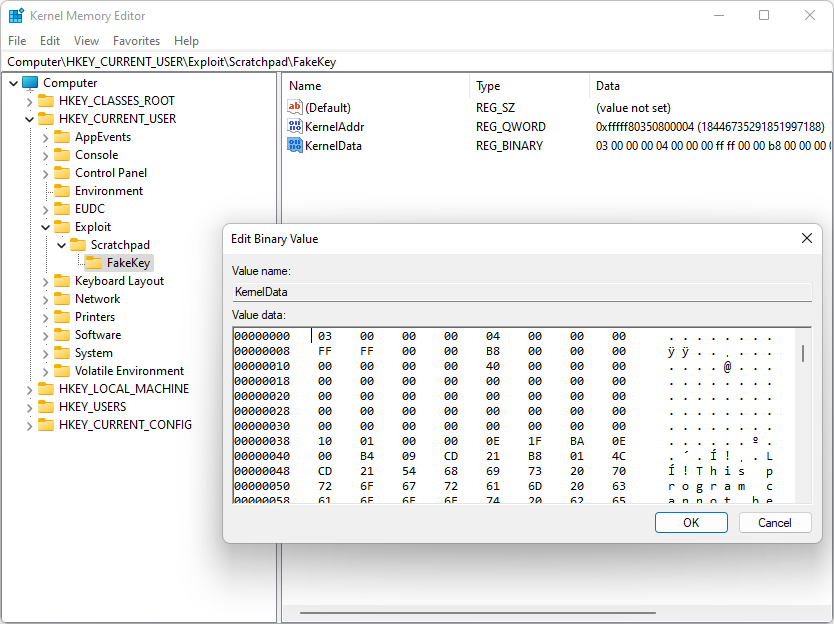
Fake key in registry editor

The data from both sources match, and the KernelData value displays them correctly without any additional offset. A keen observer will note that the expected "MZ" signature is not there, because I entered an address 4 bytes greater than the kernel image base. I did this because, even though we can "peek" at any virtual address X through the special registry value, the kernel still internally accesses address X-4 for certain implementation reasons. Since there isn't any data mapped directly before the ntoskrnl.exe image in memory, using the exact image base would result in a system crash while trying to read from the invalid address 0xFFFFF803507FFFFC.

An even more attentive reader will also notice that the exploit has jokingly changed the window title from "Registry Editor" to "Kernel Memory Editor", as that's what the program has effectively become at this point. 🙂

Step 4: Elevating process security token

With an arbitrary kernel read/write primitive and the address of ntoskrnl.exe at our disposal, escalating privileges is a formality. The simplest approach is perhaps to iterate through the linked list of all processes (made of _EPROCESS structures) starting from nt!KiProcessListHead, find both the "System" process and our own process on the list, and then copy the security token from the former to the latter. This method is illustrated in the diagram below.
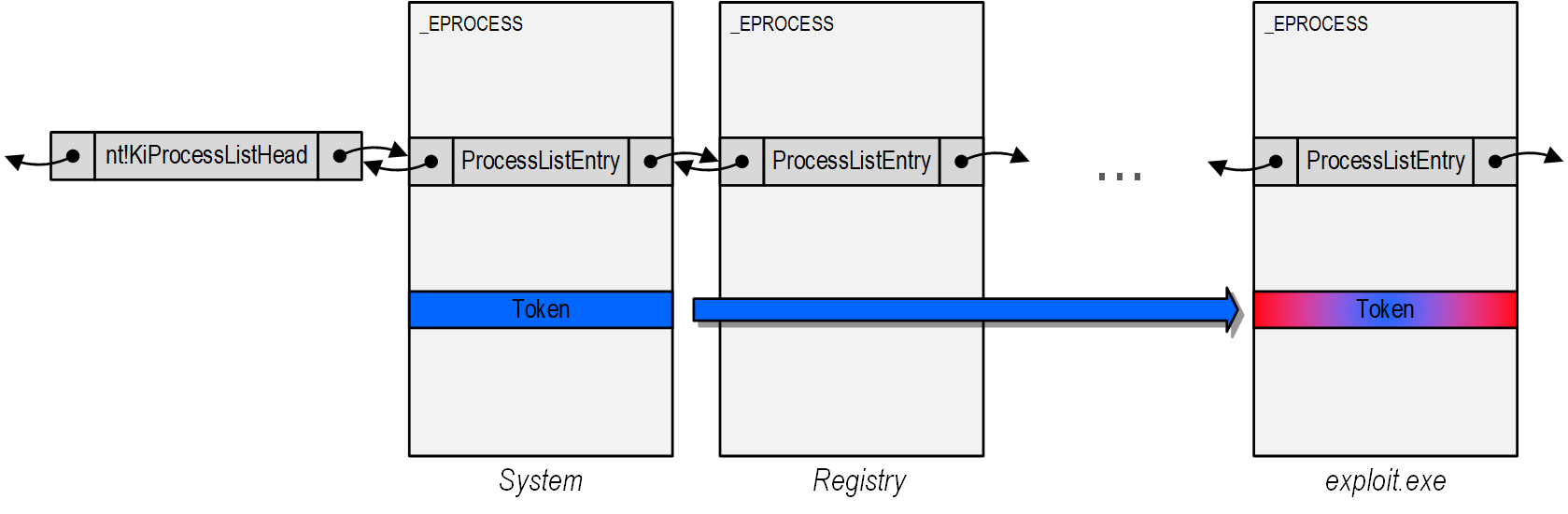
Diagram described above

This entire procedure could be easily performed programmatically, using only RegQueryValueEx and RegSetValueEx calls. However, it would be a shame not to take advantage of the fact that we can modify kernel memory through built-in Windows tools. Therefore, my exploit performs most of the necessary steps automatically, except for the final stage – overwriting the process security token. For that part, it creates a .reg file on disk that refers to our fake key and its two registry values. The first is KernelAddr, which points to the address of the security token within the _EPROCESS structure of a newly created command prompt, followed by KernelData, which contains the actual value of the System token. The invocation and output of the exploit looks as follows:

C:\Users\user\Desktop\exploits>Exploit.exe C:\users\user\Desktop\become_admin.reg

[+] Found kernel base address: fffff80350800000

[+] Spawning a command prompt...

[+] Found PID 6892 at address ffff8107b3864080

[+] System process: ffff8107ad0ed040, security token: ffffc608b4c8a943

[+] Exploit succeeded, enjoy!

C:\Users\user\Desktop\exploits>

Then, a new command prompt window appears on the screen. There, we can manually perform the final step of the attack, applying changes from the newly created become_admin.reg file using the reg.exe tool, thus overwriting the appropriate field in kernel memory and granting ourselves elevated privileges:
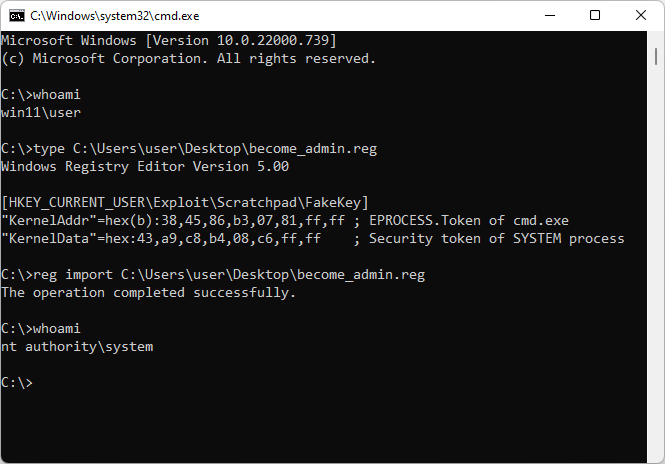
It works!

As we can see, the attack was indeed successful, and our cmd.exe process is now running as NT AUTHORITY\SYSTEM. A similar effect could be achieved from the graphical interface by double-clicking the .reg file and applying it using the Regedit program associated with this extension. This is exactly how I finalized my attack during the exploit demonstration at OffensiveCon 2024, which can be viewed in the recording of the presentation:

Final thoughts

Since we have now fully achieved our intended goal, we can return to our earlier, incomplete diagram, and fill it in with all the intermediate steps we have taken:
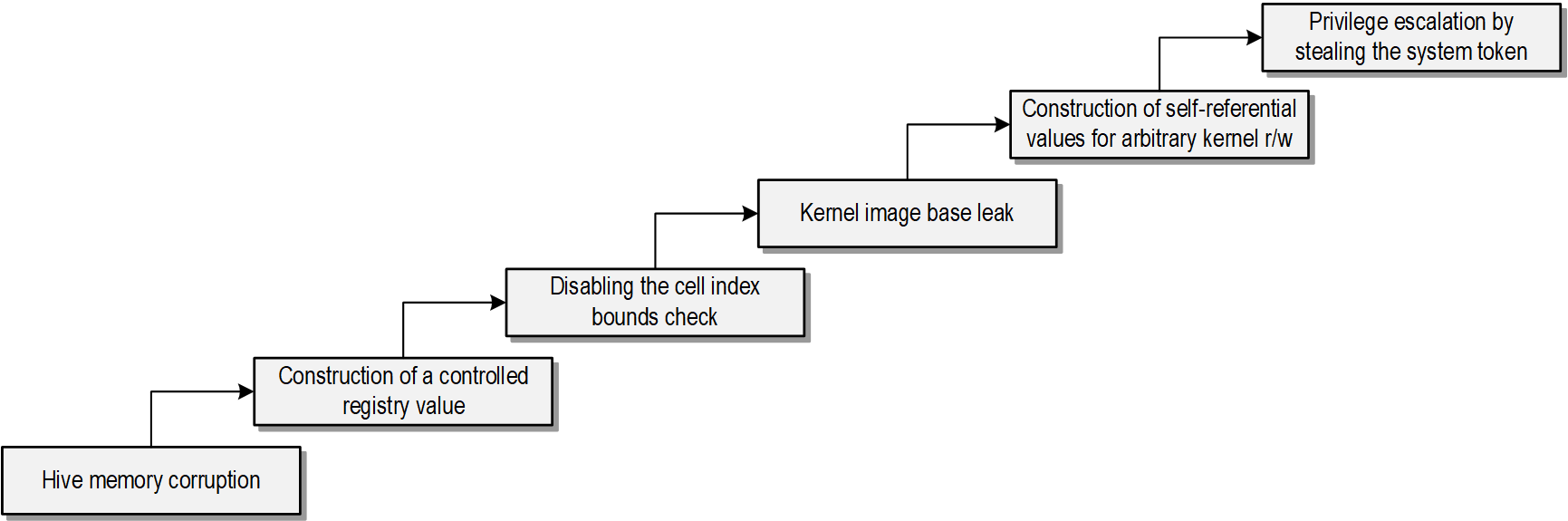
A flowchart illustrating a multi-step attack chain leading to privilege escalation. The process begins with “Hive memory corruption”, which leads to “Construction of a controlled registry value”. This enables “Disabling the cell index bounds check”, followed by a “Kernel image base leak”. The leak is then used for “Construction of self-referential values for arbitrary kernel r/w” (read/write), ultimately resulting in “Privilege escalation by stealing the system token”.

To conclude this blog post, I would like to share some final thoughts regarding hive-based memory corruption vulnerabilities.

Exploit mitigations

The above exploit shows that out-of-bounds cell indexes in the registry are a powerful exploitation technique, whose main strength lies in its determinism. Within a specific version of the operating system, a given OOB index will always result in references to the same fields of the _CMHIVE structure, which eliminates the need to use any probabilistic exploitation methods such as kernel pool spraying. Of all the available hive memory corruption exploitation methods, I consider this one to be the most stable and practical.

Therefore, it should come as no surprise that I would like Microsoft to mitigate this technique for the security of all Windows users. I already emphasized this in my previous blog post #7, but now the benefit of this mitigation is even more apparent: since the cell index bounds check is already present in HvpReleaseCellPaged, moving it to HvpGetCellPaged should be completely neutral in terms of system performance, and it would fully prevent the use of OOB indexes for any malicious purposes. I suggested this course of action in November 2023, but it hasn't been implemented by the vendor yet, so all the techniques described here still work at the time of publication.

False File Immutability

So far in this blog, we have mostly focused on a scenario where we can control the internal regf data of an active hive through memory corruption. This is certainly the most likely reason why someone would take control of registry structures, but not necessarily the only one. As I already mentioned in the previous posts, Windows uses section objects and their corresponding section views to map hive files into memory. This means that the mappings are backed by the corresponding files, and if any of them are ever evicted from memory (e.g., due to memory pressure in the system), they will be reloaded from disk the next time they are accessed. Therefore, it is crucial for system security to protect actively loaded hives from being simultaneously written to. This guarantee is achieved in the CmpOpenHiveFile function through the ShareAccess argument passed to ZwCreateFile, which takes a value of 0 or at most FILE_SHARE_READ, but never FILE_SHARE_WRITE. This causes the operating system to ensure that no application can open the file for writing as long as the handle remains open.

As I write these words, the research titled False File Immutability, published by Gabriel Landau in 2024, naturally comes to my mind. He effectively demonstrated that for files opened from remote network shares (e.g., via the SMB protocol), guarantees regarding their immutability may not be upheld in practice, as the local computer simply lacks physical control over it. However, the registry implementation is generally prepared for this eventuality: for hives loaded from locations other than the system partition, the HIVE_FILE_PAGES_MUST_BE_KEPT_LOCAL and VIEW_MAP_MUST_BE_KEPT_LOCAL flags are used, as discussed in blog post #6. These flags instruct the kernel to keep local copies of each memory page for such hives, never allowing them to be completely evicted and, as a result, having to be read again from remote storage. Thus, the attack vector seems to be correctly addressed.

However, during my audit of the registry's memory management implementation last year, I discovered two related vulnerabilities: CVE-2024-43452 and CVE-2024-49114. The second one is particularly noteworthy because, by abusing the Cloud Filter API functionality and its "placeholder files", it was possible to arbitrarily modify active hive files in the system, including those loaded from the C:\ drive. This completely bypassed the sharing access right checks and their associated security guarantees. With this type of issue, the hive corruption exploitation techniques can be used without any actual memory corruption taking place, by simply replacing the memory in question with controlled data. I believe that vulnerabilities of this class can be a real treat for bug hunters, and they are certainly worth remembering for the future.

Conclusion

Dear reader, if you've made it to the end of this blog post, and especially if you've read all the posts in this series, I'd like to sincerely congratulate you on your perseverance. 🙂 Through these write ups, I hope I've managed to document as many implementation details of the registry as possible; details that might otherwise have never seen the light of day. My goal was to show how interesting and internally complex this mechanism is, and in particular, what an important role it plays in the security of Windows as a whole. Thank you for joining me on this adventure, and see you next time!
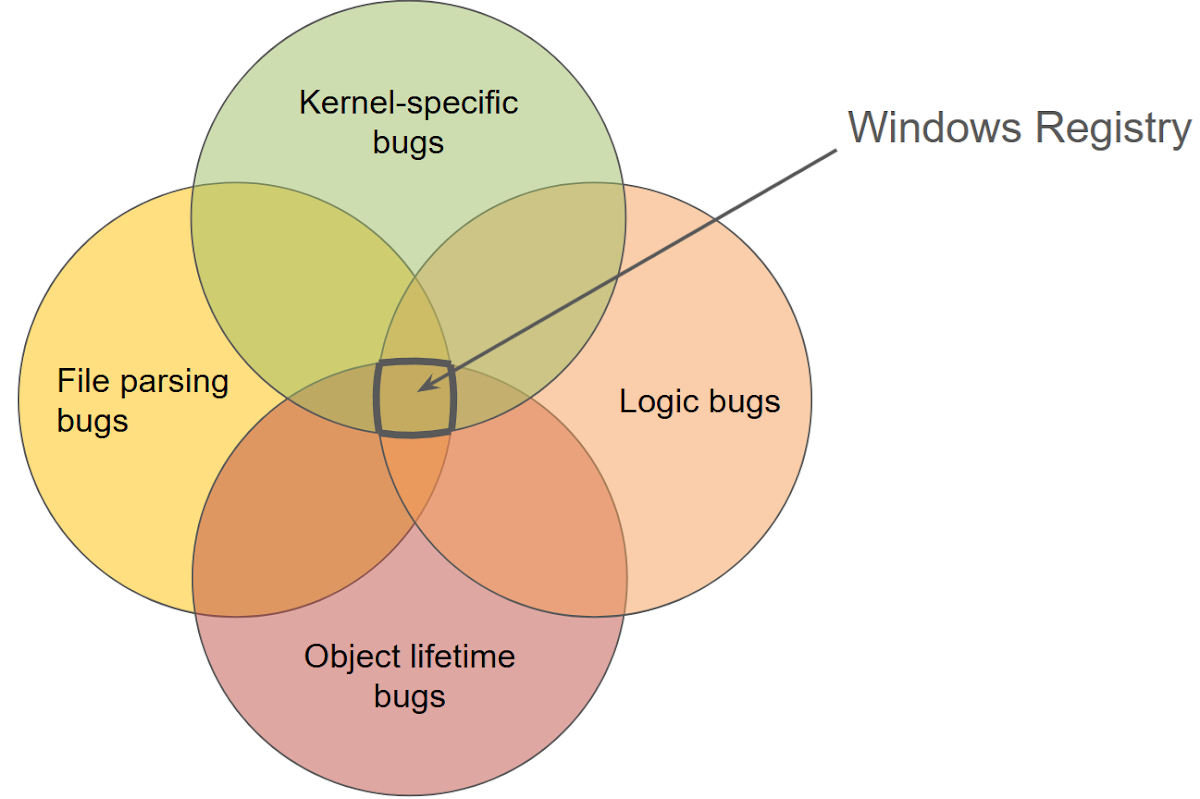
The Windows Registry Adventure #7: Attack surface analysis

23 May 2025 at 09:00

Posted by Mateusz Jurczyk, Google Project Zero

In the first three blog posts of this series, I sought to outline what the Windows Registry actually is, its role, history, and where to find further information about it. In the subsequent three posts, my goal was to describe in detail how this mechanism works internally – from the perspective of its clients (e.g., user-mode applications running on Windows), the regf format used to encode hives, and finally the kernel itself, which contains its canonical implementation. I believe all these elements are essential for painting a complete picture of this subsystem, and in a way, it shows my own approach to security research. One could say that going through this tedious process of getting to know the target unnecessarily lengthens the total research time, and to some extent, they would be right. On the other hand, I believe that to conduct complete research, it is equally important to answer the question of how certain things are implemented, as well as why they are implemented that way – and the latter part often requires a deeper dive into the subject. And since I have already spent the time reverse engineering and understanding various internal aspects of the registry, there are great reasons to share the information with the wider community. There is a lack of publicly available materials on how various mechanisms in the registry work, especially the most recent and most complicated ones, so I hope that the knowledge I have documented here will prove useful to others in the future.

In this blog post, we get to the heart of the matter, the actual security of the Windows Registry. I'd like to talk about what made a feature that was initially meant to be just a quick test of my fuzzing infrastructure draw me into manual research for the next 1.5 ~ 2 years, and result in Microsoft fixing (so far) 53 CVEs. I will describe the various areas that are important in the context of low-level security research, from very general ones, such as the characteristics of the codebase that allow security bugs to exist in the first place, to more specific ones, like all possible entry points to attack the registry, the impact of vulnerabilities and the primitives they generate, and some considerations on effective fuzzing and where more bugs might still be lurking.

Let's start with a quick recap of the registry's most fundamental properties as an attack surface:

  • Local attack surface for privilege escalation: As we already know, the Windows Registry is a strictly local attack surface that can potentially be leveraged by a less privileged process to gain the privileges of a higher privileged process or the kernel. It doesn't have any remote components except for the Remote Registry service, which is relatively small and not accessible from the Internet on most Windows installations.
  • Complex, old codebase in a memory-unsafe language: The Windows Registry is a vast and complex mechanism, entirely written in C, most of it many years ago. This means that both logic and memory safety bugs are likely to occur, and many such issues, once found, would likely remain unfixed for years or even decades.
  • Present in the core NT kernel: The registry implementation resides in the core Windows kernel executable (ntoskrnl.exe), which means it is not subject to mitigations like the win32k lockdown. Of course, the reachability of each registry bug needs to be considered separately in the context of specific restrictions (e.g., sandbox), as some of them require file system access or the ability to open a handle to a specific key. Nevertheless, being an integral part of the kernel significantly increases the chances that a given bug can be exploited.
  • Most code reachable by unprivileged users: The registry is a feature that was created for use by ordinary user-mode applications. It is therefore not surprising that the vast majority of registry-related code is reachable without any special privileges, and only a small part of the interface requires administrator rights. Privilege escalation from medium IL (Integrity Level) to the kernel is probably the most likely scenario of how a registry vulnerability could be exploited.
  • Manages sensitive information: In addition to the registry implementation itself being complex and potentially prone to bugs, it's important to remember that the registry inherently stores security-critical system information, including various global configurations, passwords, user permissions, and other sensitive data. This means that not only low-level bugs that directly allow code execution are a concern, but also data-only attacks and logic bugs that permit unauthorized modification or even disclosure of registry keys without proper permissions.
  • Not trivial to fuzz, and not very well documented: Overall, it seems that the registry is not a very friendly target for bug hunting without any knowledge of its internals. At the same time, obtaining the information is not easy either, especially for the latest registry mechanisms, which are not publicly documented and learning about them basically boils down to reverse engineering. In other words, the entry bar into this area is quite high, which can be an advantage or a disadvantage depending on the time and commitment of a potential researcher.

Security properties

The above cursory analysis seems to indicate that the registry may be a good audit target for someone interested in EoP bugs on Windows.  Let's now take a closer look at some of the specific low-level reasons why the registry has proven to be a fruitful research objective.

Broad range of bug classes

Due to the registry being both complex and a central mechanism in the system operating with kernel-mode privileges, numerous classes of bugs can occur within it. An example vulnerability classification is presented below:

  • Hive memory corruption: Every invasive operation performed on the registry (i.e., a "write" operation) is reflected in changes made to the memory-mapped view of the hive's structure. Considering that objects within the hive include variable-length arrays, structures with counted references, and references to other cells via cell indexes (hives' equivalent of memory pointers), it's natural to expect common issues like buffer overflows or use-after-frees.
  • Pool memory corruption: In addition to hive memory mappings, the Configuration Manager also stores a significant amount of information on kernel pools. Firstly, there are cached copies of certain hive data, as described in my previous blog post. Secondly, there are various auxiliary objects, such as those allocated and subsequently released within a single system call. Many of these objects can fall victim to memory management bugs typical of the C language.
  • Information disclosure: Because the registry implementation is part of the kernel, and it exchanges large amounts of information with unprivileged user-mode applications, it must be careful not to accidentally disclose uninitialized data from the stack or kernel pools to the caller. This can happen both through output data copied to user-mode memory and through other channels, such as data leakage to a file (hive file or related log file). Therefore, it is worthwhile to keep an eye on whether all arrays and dynamically allocated buffers are fully populated or carefully filled with zeros before passing them to a lower-privileged context.
  • Race conditions: As a multithreaded environment, Windows allows for concurrent registry access by multiple threads. Consequently, the registry implementation must correctly synchronize access to all shared kernel-side objects and be mindful of "double fetch" bugs, which are characteristic of user-mode client interactions.
  • Logic bugs: In addition to being memory-safe and free of low-level bugs, a secure registry implementation must also enforce correct high-level security logic. This means preventing unauthorized users from accessing restricted keys and ensuring that the registry operates consistently with its documentation under all circumstances. This requires a deep understanding of both the explicit documentation and the implicit assumptions that underpin the registry's security from the kernel developers. Ultimately, any behavior that deviates from expected logic, whether documented or assumed, could lead to vulnerabilities.
  • Inter-process attacks: The registry can serve as a security target, but also as a means to exploit flaws in other applications on the system. It is a shared database, and a local attacker has many ways to indirectly interact with more privileged programs and services. A simple example is when privileged code sets overly permissive permissions on its keys, allowing unauthorized reading or modification. More complex cases can occur when there is a race condition between key creation and setting its restricted security descriptor, or when a key modification involving several properties is not performed transactionally, potentially leading to an inconsistent state. The specifics depend on how the privileged process uses the registry interface.

If I were to depict the Windows Registry in a single Venn diagram, highlighting its various possible bug classes, it might look something like this:

A Venn diagram illustrates the intersection of different bug categories within the Windows Registry. Four overlapping circles represent Kernel-specific bugs, File parsing bugs, Object lifetime bugs, and Logic bugs. The central area where all circles overlap is highlighted, indicating vulnerabilities that combine all these bug types.

Manual reference counting

As I have mentioned multiple times, security descriptors in registry hives are shared by multiple keys, and therefore, must be reference counted. The field responsible for this is a 32-bit unsigned integer, and any situation where it's set to a value lower than the actual number of references can result in the release of that security descriptor while it's still in use, leading to a use-after-free condition and hive-based memory corruption. So, we see that it's absolutely critical that this refcounting is implemented correctly, but unfortunately, there are (or were until recently) many reasons why this mechanism could be prone to bugs:

  • Usually, a reference count is a construct that exists strictly in memory, where it is initialized with a value of 1, then incremented and decremented some number of times, and finally drops to zero, causing the object to be freed. However, with registry hives, the initial refcount values are loaded from disk, from a file that we assume is controlled by the attacker. Therefore, these values cannot be trusted in any way, and the first necessary step is to actually compare and potentially adjust them according to the true number of references to each descriptor. Even though this is done in theory, bugs can creep into this logic in practice (CVE-2022-34707, CVE-2023-38139).
  • For a long time, all operations on reference counts were performed by directly referencing the _CM_KEY_SECURITY.ReferenceCount field, instead of using a secure wrapper. As a result, none of these incrementations were protected against integer overflow. This meant that not only a too small, but also a too large refcount value could eventually overflow and lead to a use-after-free situation (CVE-2023-28248, CVE-2024-43641). This weakness was gradually addressed in various places in the registry code between April 2023 and November 2024. Currently, all instances of refcount incrementation appear to be secure and involve calling the special helper function CmpKeySecurityIncrementReferenceCount, which protects against integer overflow. Its counterpart for refcount decrementation is CmpKeySecurityDecrementReferenceCount.
  • It seems that there is a lack of clarity and understanding of how certain special types of keys, such as predefined keys and tombstone keys, behave in relation to security descriptors. In theory, the only type of key that does not have a security descriptor assigned to it is the exit node (i.e., a key with the KEY_HIVE_EXIT flag set, found solely in the virtual hive rooted at \Registry\), while all other keys do have a security descriptor assigned to them, even if it is not used for anything. In practice, however, there have been several vulnerabilities in Windows that resulted either from incorrect security refresh in KCB for special types of keys (CVE-2023-21774), from releasing the security descriptor of a predefined key without considering its reference count (CVE-2023-35356), or from completely forgetting the need for reference counting the descriptors of tombstone keys in the "rename" operation (CVE-2023-35382).
  • When the reference count of a security descriptor reaches zero and is released, this operation is irreversible. There is no guarantee that upon reallocation, the descriptor would have the same cell index, or even that it could be reallocated at all. This is crucial for multi-step operations where individual actions could fail, necessitating a full rollback to the original state. Ideally, releasing security descriptors should always be the final step, only when the kernel can be certain that the entire operation will succeed. A vulnerability exemplifying this is CVE-2023-21772, where the registry virtualization code first released the old security descriptor and then attempted to allocate a new one. If the allocation failed, the key was left without any security properties, violating a fundamental assumption of the registry and potentially having severe consequences for system memory safety.

Aggressive self-healing and recovery

As I described in blog post #5, one of the registry's most interesting features, which distinguishes it from many other file format implementations, is that it is self-healing. The entire hive loading process, from the internal CmCheckRegistry function downwards, is focused on loading the database at all costs, even if some corrupted fragments are encountered. Only if the file damage is so extensive that recovering any data is impossible does the entire loading process fail. Of course, given that the registry stores critical system data such as its basic configuration, and the lack of access to this data virtually prevents Windows from booting, this decision made a lot of sense from the system reliability point of view. It's probably safe to assume that it has prevented the need for system reinstallation on numerous computers, simply because it did not reject hives with minor damage that might have appeared due to random hardware failure.

However, from a security perspective, this behavior is not necessarily advantageous. Firstly, it seems obvious that upon encountering an error in the input data, it is simpler to unconditionally halt its processing rather than attempt to repair it. In the latter case, it is possible for the programmer to overlook an edge case – forget to reset some field in some structure, etc. – and thus instead of fixing the file, allow for another unforeseen, inconsistent state to materialize within it. In other words, the repair logic constitutes an additional attack surface, and one that is potentially even more interesting and error-prone than other parts of the implementation. A classic example of a vulnerability associated with this property is CVE-2023-38139.

Secondly, in my view, the existence of this logic may have negatively impacted the secure development of the registry code, perhaps by leading to a discrepancy between what it guaranteed and what other developers thought it had guaranteed. For example, in 1991–1993, when the foundations of the Configuration Manager subsystem were being created in their current form, probably no one considered hive loading a potential attack vector. At that time, the registry was used only to store system configuration, and controlled hive loading was privileged and required admin rights. Therefore, I suspect that the main goal of hive checking at that time was to detect simple data inconsistencies due to hardware problems, such as single bit flips. No one expected a hive to contain a complex, specially crafted multi-kilobyte data structure designed to trigger a security flaw. Perhaps the rest of the registry code was written under the assumption that since data sanitization and self-healing occurred at load time, its state was safe from that point on and no further error handling was needed (except for out-of-memory errors). Then, in Windows Vista, a decision was made to open access to controlled hive loading by unprivileged users through the app hive mechanism, and it suddenly turned out that the existing safeguards were not entirely adequate. Attackers now became able to devise data constructs that were structurally correct at the low level, but completely beyond the scope of what the actual implementation expected and could handle.

Finally, self-healing can adversely affect system security by concealing potential registry bugs that could trigger during normal Windows operation. These problems might only become apparent after a period of time and with a "build-up" of enough issues within the hive. Because hives are mapped into memory, and the kernel operates directly on the data within the file, there exists a category of errors known as "inconsistent hive state". This refers to a data structure within the hive that doesn't fully conform to the file format specification. The occurrence of such an inconsistency is noteworthy in itself and, for someone knowledgeable about the registry, it could be a direct clue for finding vulnerabilities. However, such instances rarely cause an immediate system crash or other visible side effects. Consider security descriptors and their reference counting: as mentioned earlier, any situation where the active number of references exceeds the reference count indicates a serious security flaw. However, even if this were to happen during normal system operation, it would require all other references to that descriptor to be released and then for some other data to overwrite the freed descriptor. Then, a dangling reference would need to be used to access the descriptor. The occurrence of all these factors in sequence is quite unlikely, and the presence of self-healing further decreases these chances, as the reference count would be restored to its correct value at the next hive load. This characteristic can be likened to wrapping the entire registry code in a try/except block that catches all exceptions and masks them from the user. This is certainly helpful in the context of system reliability, but for security, it means that potential bugs are harder to spot during system run time and, for the same reason, quite difficult to fuzz. This does not mean that they don't exist; their detection just becomes more challenging.

Unclear boundaries between hard and conventional format requirements

This point is related to the previous section. In the regf format, there are certain requirements that are fairly obvious and must be always met for a file to be considered valid. Likewise, there are many elements that are permitted to be formatted arbitrarily, at the discretion of the format user. However, there is a third category, a gray area of requirements that seem reasonable and probably would be good if they were met, but it is not entirely clear whether they are formally required. Another way to describe this set of states is one that is not generated by the Windows kernel itself but is still not obviously incorrect. From a researcher's perspective, it would be worthwhile to know which parts of the format are actually required by the specification and which are only a convention adopted by the Windows code.

We might never find out, as Microsoft hasn't published an official format specification and it seems unlikely that they will in the future. The only option left for us is to rely on the implementation of the CmpCheck* functions (CmpCheckKey, CmpCheckValueList, etc.) as a sort of oracle and assume that everything there is enforced as a hard requirement, while all other states are permissible. If we go down this path, we might be in for a big surprise, as it turns out that there are many logical-sounding requirements that are not enforced in practice. This could allow user-controlled hives to contain constructs that are not obviously problematic, but are inconsistent with the spirit of the registry and its rules. In many cases, they allow encoding data in a less-than-optimal way, leading to unexpected redundancy. Some examples of such constructs are presented below:

  • Values with duplicate names within a single key: Under normal conditions, only one value with a given name can exist in a key, and if there is a subsequent write to the same name, the new data is assigned to the existing value. However, the uniqueness of value names is not required in input hives, and it is possible to load a hive with duplicate values.
  • Duplicate identical security descriptors within a single hive: Similar to the previous point, it is assumed that security descriptors within a hive are unique, and if an existing descriptor is assigned to another key, its reference count is incremented rather than allocating a new object. However, there is no guarantee that a specially crafted hive will not contain multiple duplicates of the same security descriptor, and this is accepted by the loader.
  • Uncompressed key names consisting solely of ASCII characters: Under normal circumstances, if a given key has a name comprising only ASCII characters, it will always be stored in a compressed form, i.e., by writing two bytes of the name in each element of the _CM_KEY_NODE.Name array of type uint16, and setting the KEY_COMP_NAME flag (0x20) in _CM_KEY_NODE.Flags. However, once again, optimal representation of names is not required when loading the hive, and this convention can be ignored without issue.
  • Allocated but unused cells: The Windows registry implementation deallocates objects within a hive when they are no longer needed, making space for new data. However, the loader does not require every cell marked "allocated" to be actively used. Similarly, security descriptors with a reference count of zero are typically deallocated. However, until a November 2024 refactor of the CmpCheckAndFixSecurityCellsRefcount function, it was possible to load a hive with unused security descriptors still present in the linked list. This behavior has since been changed, and unused security descriptors encountered during loading are now automatically freed and removed from the list.

These examples illustrate the issue well, but none of them (as far as I know) have particularly significant security implications. However, there were also a few specific memory corruption vulnerabilities that stemmed from the fact that the registry code made theoretically sound assumptions about the hive structure, but they were not unenforced by the loader:

  • CVE-2022-37988: This bug is closely related to the fact that cells larger than 16 KiB are aligned to the nearest power of two in Windows, but this condition doesn't need to be satisfied during loading. This caused the shrinking of a cell to fail, even though it should always succeed in-place, "surprising" the client of the allocator and resulting in a use-after-free condition.
  • CVE-2022-37956: As I described in blog post #5, Windows has some logic to ensure that no leaf-type subkey list (li, lf, or lh) exceeds 511 or 1012 elements, depending on its specific type. If a list is expanded beyond this limit, it is automatically split into two lists, each half the original length. Another reasonable assumption is that the root index length would never approach the maximum value of _CM_KEY_INDEX.Count (uint16) under normal circumstances. This would require an unrealistically large number of subkeys or a very specific sequence of millions of key creations and deletions with specific names. However, it was possible to load a hive containing a subkey list of any of the four types with a length equal to 0xFFFF, and trigger a 16-bit integer overflow on the length field, leading to memory corruption. Interestingly, this is one of the few bugs that could be triggered solely with a single .bat file containing a long sequence of the reg.exe command executions.
  • CVE-2022-38037: In this case, the kernel code assumed that the hive version defined in the header (_HBASE_BLOCK.Minor) always corresponded to the type of subkey lists used in a given hive. For example, if the file version is regf 1.3, it should be impossible for it to contain lists in a format introduced in version 1.5. However, for some reason, the hive loader doesn't enforce the proper relationship between the format version and the structures used in it, which in this case led to a serious hive-based memory corruption vulnerability.

As we can see, it is crucial to differentiate between format elements that are conventions adopted by a specific implementation, and those actually enforced during the processing of the input file. If we encounter some code that makes assumptions from the former group that don't belong to the latter one, this could indicate a serious security issue.

Susceptibility to mishandling OOM conditions

Generally speaking, the implementation of any function in the Windows kernel is built roughly according to the following scheme:

NTSTATUS NtHighLevelOperation(...) {

  NTSTATUS Status;

  Status = HelperFunction1(...);

  if (!NT_SUCCESS(Status)) {

    //

    // Clean up...

    //

    return Status;

  }

  Status = HelperFunction2(...);

  if (!NT_SUCCESS(Status)) {

    //

    // Clean up...

    //

    return Status;

  }


  //

  // More calls...

  //

  return STATUS_SUCCESS;

}


Of course, this is a significant simplification, as real-world code contains keywords and constructs such as if statements, switch statements, various loops, and so on. The key point is that a considerable portion of higher-level functions call internal, lower-level functions specialized for specific tasks. Handling potential errors signalled by these functions is an important aspect of kernel code (or any code, for that matter). In low-level Windows code, error propagation occurs using the NTSTATUS type, which is essentially a signed 32-bit integer. A value of 0 signifies success (STATUS_SUCCESS), positive values indicate success but with additional information, and negative values denote errors. The sign of the number is checked by the NT_SUCCESS macro. During my research, I dedicated significant time to analyzing the error handling logic. Let's take a moment to think about the types of errors that could occur during registry operations, and the conditions that might cause them.

A common trait of all actions that modify data in the registry is that they allocate memory. The simplest example is the allocation of auxiliary buffers from kernel pools, requested through functions from the ExAllocatePool group. If there is very little available memory at a given point in time, one of the allocation requests may return the STATUS_INSUFFICIENT_RESOURCES error code, which will be propagated back to the original caller. And since we assume that we take on the role of a local attacker who has the ability to execute code on the machine, artificially occupying all available memory is potentially possible in many ways. So this is one way to trigger errors while performing operations on the registry, but admittedly not an ideal way, as it largely depends on the amount of RAM and the maximum pagefile size. Additionally, in a situation where the kernel has so little memory that single allocations start to fail, there is a high probability of the system crashing elsewhere before the vulnerability is successfully exploited. And finally, if several allocations are requested in nearby code in a short period of time, it seems practically impossible to take precise control over which of them will succeed and which will not.

Nonetheless, the overall concept of out-of-memory conditions is a very promising avenue for attack, especially considering that the registry primarily operates on memory-mapped hives using its own allocator, in addition to objects from kernel pools. The situation is even more favorable for an attacker due to the 2 GiB size limitation of each of the two storage types (stable and volatile) within a hive. While this is a relatively large value, it is achievable to occupy it in under a minute on today's machines. The situation is even easier if the volatile space that needs to be occupied, as it resides solely in memory and is not flushed to disk – so filling two gigabytes of memory is then a matter of seconds. It can be accomplished, for example, by creating many long registry values, which is a straightforward task when dealing with a controlled hive. However, even in system hives, this is often feasible. To perform data spraying on a given hive, we only need a single key granting us write permissions. For instance, both HKLM\Software and HKLM\System contain numerous keys that allow write access to any user in the system, effectively permitting them to fill it to capacity. Additionally, the "global registry quota" mechanism, implemented by the internal CmpClaimGlobalQuota and CmpReleaseGlobalQuota functions, ensures that the total memory occupied by registry data in the system does not exceed 4 GiB. Besides filling the entire space of a specific hive, this is thus another way to trigger out-of-memory conditions in the registry, especially when targeting a hive without write permissions. A concrete example where this mechanism could have been employed to corrupt the HKLM\SAM system hive is the CVE-2024-26181 vulnerability.

Considering all this, it is a fair assumption that a local attacker can cause any call to ExAllocatePool*, HvAllocateCell, and HvReallocateCell (with a length greater than the existing cell) to fail. This opens up a large number of potential error paths to analyze. The HvAllocateCell calls are a particularly interesting starting point for analysis, as there are quite a few of them and almost all of them belong to the attack surface accessible to a regular user:

A screenshot shows a debugger window titled xrefs to HvAllocateCell. The window lists numerous functions and their memory addresses under columns Direction, Type, Address, and Text. Nearly all entries show different system functions making a call to HvAllocateCell.

There are two primary reasons why focusing on the analysis of error paths can be a good way to find security bugs. First, it stands to reason that on regular computers used by users, it is extremely rare for a given hive to grow to 2 GiB and run out of space, or for all registry data to simultaneously occupy 4 GiB of memory. This means that these code paths are practically never executed under normal conditions, and even if there were bugs in them, there is a very small chance that they would ever be noticed by anyone. Such rarely executed code paths are always a real treat for security researchers.

The second reason is that proper error handling in code is inherently difficult. Many operations involve numerous steps that modify the hive's internal state. If an issue arises during these operations, the registry code must revert all changes and restore the registry to its original state (at least from the macro-architectural perspective). This requires the developer to be fully aware of all changes applied so far when implementing each error path. Additionally, proper error handling must be considered during the initial design of the control flow as well, because some registry actions are irreversible (e.g., freeing cells). The code must thus be structured so that all such operations are placed at the very end of the logic, where errors cannot occur anymore and successful execution is guaranteed.

One example of such a vulnerability is CVE-2023-23421, which boiled down to the following code:

NTSTATUS CmpCommitRenameKeyUoW(_CM_KCB_UOW *uow) {

  // ...

  if (!CmpAddSubKeyEx(Hive, ParentKey, NewNameKey) ||

      !CmpRemoveSubKey(Hive, ParentKey, OldNameKey)) {

    CmpFreeKeyByCell(Hive, NewNameKey);

    return STATUS_INSUFFICIENT_RESOURCES;

  }

  // ...

}


The issue here was that if the CmpRemoveSubKey call failed, the corresponding error path should have reversed the effect of the CmpAddSubKeyEx function in the previous line, but in practice it didn't. As a result, it was possible to end up with a dangling reference to a freed key in the subkey list, which was a typical use-after-free condition.

A second interesting example of this type of bug was CVE-2023-21747, where an out-of-memory error could occur during a highly sensitive operation, hive unloading. As there was no way to revert the state at the time of the OOM, the vulnerability was fixed by Microsoft by refactoring the CmpRemoveSubKeyFromList function and other related functions so that they no longer allocate memory from kernel pools and thus there is no longer a physical possibility of them failing.

Finally, I'll mention CVE-2023-38154, where the problem wasn't incorrect error handling, but a complete lack of it – the return value of the HvpPerformLogFileRecovery function was ignored, even though there was a real possibility it could end with an error. This is a fairly classic type of bug that can occur in any programming language, but it's definitely worth keeping in mind when auditing the Windows kernel.

Susceptibility to mishandling partial successes

The previous section discusses bugs in error handling where each function is responsible for reversing the state it has modified. However, some functions don't adhere to this operational model. Instead of operating on an "all-or-nothing" basis, they work on a best-effort basis, aiming to accomplish as much of a given task as possible. If an error occurs, they leave any changes made in place, e.g., because this result is still preferable to not making any changes. This introduces a third possible output state for such functions: complete success, partial success, and complete failure.

This might be problematic, as the approach is incompatible with the typical usage of the NTSTATUS type, which is best suited for conveying one of two (not three) states. In theory, it is a 32-bit integer type, so it could store the additional information of the status being a partial success, and not being unambiguously positive or negative. In practice, however, the convention is to directly propagate the last error encountered within the inner function, and the outer functions very rarely "dig into" specific error codes, instead assuming that if NT_SUCCESS returns FALSE, the entire operation has failed. Such confusion at the cross-function level may have security implications if the outer function should take some additional steps in the event of a partial success of the inner function, but due to the binary interpretation of the returned error code, it ultimately does not execute them.

A classic example of such a bug is CVE-2024-26182, which occurred at the intersection of the CmpAddSubKeyEx (outer) and CmpAddSubKeyToList (inner) functions. The problem here was that CmpAddSubKeyToList implements complex, potentially multi-step logic for expanding the subkey list, which could perform a cell reallocation and subsequently encounter an OOM error. On the other hand, the CmpAddSubKeyEx function assumed that the cell index in the subkey list should only be updated in the hive structures if CmpAddSubKeyToList fully succeeds. As a result, the partial success of CmpAddSubKeyToList could lead to a classic use-after-free situation. An attentive reader will probably notice that the return value type of the CmpAddSubKeyToList routine was BOOL and not NTSTATUS, but the bug pattern is identical.

Overall complexity introduced over time

One of the biggest problems with the modern implementation of the registry is that over the decades of developing this functionality, many changes and new features have been introduced. This has caused the level of complexity of its internal state to increase so much that it seems difficult to grasp for one person, unless they are a full-time registry expert that has worked on it full-time over a period of months or years. I personally believe that the registry existed in its most elegant form somewhere around Windows NT 3.1 – 3.51 (i.e. in the years 1993–1996). At the time, the mechanism was intuitive and logical for both developers and its users. Each object (key, value) either existed or not, each operation ended in either success or failure, and when it was requested on a particular key, you could be sure that it was actually performed on that key. Everything was simple, and black and white. However, over time, more and more shades of gray were being continuously added, departing from the basic assumptions:

  • The existence of predefined keys meant that every operation could no longer be performed on every key, as this special type of key was unsafe for many internal registry functions to use due to its altered semantics.
  • Due to symbolic links, opening a specific key doesn't guarantee that it will be the intended one, as it might be a different key that the original one points to.
  • Registry virtualization has introduced further uncertainty into key operations. When an operation is performed on a key, it is unclear whether the operation is actually executed on that specific key or redirected to a different one. Similarly, with read operations, a client cannot be entirely certain that it is reading from the intended key, as the data may be sourced from a different, virtualized location.
  • Transactions in the registry mean that a given state is no longer considered solely within the global view of the registry. At any given moment, there may also be changes that are visible only within a certain transaction (when they are initiated but not yet committed), and this complex scenario must be correctly handled by the kernel.
  • Layered keys have transformed the nature of hives, making them interdependent rather than self-contained database units. This is due to the introduction of differencing hives, which function solely as "patch diffs" and cannot exist independently without a base hive. Additionally, the semantics of certain objects and their fields have been altered. Previously, a key's existence was directly tied to the presence of a corresponding key node within the hive. Layered keys have disrupted this dependency. Now, a key with a key node can be non-existent if marked as a Tombstone, and a key without a corresponding key node can logically exist if its semantics are Merge-Unbacked, referencing a lower-level key with the same name.

Of course, all of these mechanisms were designed and implemented for a specific purpose: either to make life easier for developers/applications using the Registry API, or to introduce some new functionality that is needed today. The problem is not that they were added, but that it seems that the initial design of the registry was simply not compatible with them, so they were sort of forced into the registry, and where they didn't fit, an extra layer of tape was added to hold it all together. This ultimately led to a massive expansion of the internal state that needs to be maintained within the registry. This is evident both in the significant increase in the size of old structures (like KCB) and in the number of new objects that have been added over the years. But the most unfortunate aspect is that each of these more advanced mechanisms seems to have been designed to solve one specific problem, assuming that they would operate in isolation. And indeed, they probably do under typical conditions, but a particularly malicious user could start combining these different mechanisms and making them interact. Given the difficulty in logically determining the expected behavior of some of these combinations, it is doubtful that every such case was considered, documented, implemented, and tested by Microsoft.

The relationships between the various advanced mechanisms in the registry are humorously depicted in the image below:

An image from a Pirates of the Caribbean movie shows a standoff with characters pointing pistols at each other. Text labels overlay the scene, metaphorically linking pirate actions to Windows Registry concepts. These concepts include Predefined Keys, Layered Keys, Transactions, Symbolic Links, and Registry Virtualization.

Some examples of bugs caused by incorrect interactions between these mechanisms include CVE-2023-21675, CVE-2023-21748, CVE-2023-35356, CVE-2023-35357 and CVE-2023-35358.

Entry points

This section describes the entry points that a local attacker can use to interact with the registry and exploit any potential vulnerabilities.

Hive loading

Let's start with the operation of loading user-controlled hives. Since hive loading is only possible from disk (and not, for example, from a memory buffer), this means that to actually trigger this attack surface, the process must be able to create a file with controlled content, or at least a controlled prefix of several kilobytes in length. Regular programs operating at Medium IL generally have this capability, but write access to disk may be restricted for heavily sandboxed processes (e.g. renderer processes in browsers).

When it comes to the typical type of bugs that can be triggered in this way, what primarily comes to mind are issues related to binary data parsing, and memory safety violations such as out-of-bounds buffer accesses. It is possible to encounter more logical-type issues, but they usually rely on certain assumptions about the format not being sufficiently verified, causing subsequent operations on such a hive to run into problems. It is very rare to find a vulnerability that can be both triggered and exploited by just loading the hive, without performing any follow-up actions on it. But as CVE-2024-43452 demonstrates, it can still happen sometimes.

App hives

The introduction of Application Hives in Windows Vista caused a significant shift in the registry attack surface. It allowed unprivileged processes to directly interact with kernel code that was previously only accessible to system services and administrators. Attackers gained access to much of the NtLoadKey syscall logic, including hive file operations, hive parsing at the binary level, hive validation logic in the CmpCheckRegistry function and its subfunctions, and so on. In fact, of the 53 serious vulnerabilities I discovered during my research, 16 (around 30%) either required loading a controlled hive as an app hive, or were significantly easier to trigger using this mechanism.

It's important to remember that while app hives do open up a broad range of new possibilities for attackers, they don't offer exactly the same capabilities as loading normal (non-app) hives due to several limitations and specific behaviors:

  • They must be loaded under the special path \Registry\A, which means an app hive cannot be loaded just anywhere in the registry hierarchy. This special path is further protected from references by a fully qualified path, which also reduces their usefulness in some offensive applications.
  • The logic for unloading app hives differs from unloading standard hives because the process occurs automatically when all handles to the hive are closed, rather than manually unloading the hive through the RegUnLoadKeyW API or its corresponding syscall from the NtUnloadKey family.
  • Operations on app hive security descriptors are very limited: any calls to the RegSetKeySecurity function or RegCreateKeyExW with a non-default security descriptor will fail, which means that new descriptors cannot be added to such hives.
  • KTM transactions are unconditionally blocked for app hives.

Despite these minor restrictions, the ability to load arbitrary hives remains one of the most useful tools when exploiting registry bugs. Even if binary control of the hive is not strictly required, it can still be valuable. This is because it allows the attacker to clearly define the initial state of the hive where the attack takes place. By taking advantage of the cell allocator's determinism, it is often possible to achieve 100% exploitation success.

User hives and Mandatory User Profiles

Sometimes, triggering a specific bug requires both binary control over the hive and certain features that app hives lack, such as the ability to open a key via its full path. In such cases, an alternative to app hives exists, which might be slightly less practical but still allows for exploiting these more demanding bugs. It involves directly modifying one of the two hives assigned to every user in the system: the user hive (C:\Users\NTUSER.DAT mounted under \Registry\User\<SID>, or in other words, HKCU) or the user classes hive (C:\Users\AppData\Local\Microsoft\Windows\UsrClass.dat mounted under \Registry\User\<SID>_Classes). Naturally, when these hives are actively used by the system, access to their backing files is blocked, preventing simultaneous modification, which complicates things considerably. However, there are two ways to circumvent this problem.

The first scenario involves a hypothetical attacker who has two local accounts on the targeted system, or similarly, two different users collaborating to take control of the computer (let's call them users A and B). User A can grant user B full rights to modify their hive(s),  and then log out. User B then makes all the required binary changes to the hive and finally notifies user A that they can log back in. At this point, the Profile Service loads the modified hive on behalf of that user, and the initial goal is achieved.

The second option is more practical as it doesn't require two different users. It abuses Mandatory User Profiles, a system functionality that prioritizes the NTUSER.MAN file in the user's directory over the NTUSER.DAT file as the user hive, if it exists (it doesn't exist in the default system installation). This means that a single user can place a specially prepared hive under the NTUSER.MAN name in their home directory, then log out and log back in. Afterwards, NTUSER.MAN will be the user's active HKCU key, achieving the goal. However, the technique also has some drawbacks – it only applies to the user hive (not UsrClass.dat), and it is somewhat noisy. Once the NTUSER.MAN file has been created and loaded, there is no way to delete it by the same user, as it will always be loaded by the system upon login, effectively blocking access to it.

A few examples of bugs involving one of the two above techniques are CVE-2023-21675, CVE-2023-35356, and CVE-2023-35633. They all required the existence of a special type of key called a predefined key within a publicly accessible hive, such as HKCU. Even when predefined keys were still supported, they could not be created using the system API, and the only way to craft them was by directly setting a specific flag within the internal key node structure in the hive file.

Log file parsing: .LOG/.LOG1/.LOG2

One of the fundamental features of the registry is that it guarantees consistency at the level of interdependent cells that together form the structure of keys within a given hive. This refers to a situation where a single operation on the registry involves the simultaneous modification of multiple cells. Even if there is a power outage and the system restarts in the middle of performing this operation, the registry guarantees that all intermediate changes will either be applied or discarded. Such "atomicity" of operations is necessary in order to guarantee the internal consistency of the hive structure, which, as we know, is important to security. The mechanism is implemented by using additional files associated with the hive, where the intermediate state of registry modifications is saved with the granularity of a memory page (4 KiB), and which can be safely rolled forward or rolled back at the next hive load. Usually these are two files with the .LOG1 and .LOG2 extensions, but it is also possible to force the use of a single log file with the .LOG extension by passing the REG_HIVE_SINGLE_LOG flag to syscalls from the NtLoadKey family.

Internally, each LOG file can be encoded in one of two formats. One is the "legacy log file", a relatively simple format that has existed since the first implementation of the registry in Windows NT 3.1. Another one is the "incremental log file", a slightly more modern and complex format introduced in Windows 8.1 to address performance issues that plagued the previous version. Both formats use the same header as the normal regf format (the first 512 bytes of the _HBASE_BLOCK structure, up to the CheckSum field), with the Type field set to 0x1 (legacy log file on Windows XP and newer), 0x2 (legacy log file on Windows 2000 and older), or 0x6 (incremental log file). Further at offset 0x200, legacy log files contain the signature 0x54524944 ("DIRT") followed by the "dirty vector", while incremental log files contain successive records represented by the magic value 0x454C7648 ("HvLE").

These formats are well-documented in two unofficial regf documentations: GitHub: libyal/libregf and GitHub: msuhanov/regf.  Additional information can be found in the "Stable storage" and "Incremental logging" subsections of the Windows Internals (Part 2, 7th Edition) book and its earlier editions.

From a security perspective, it's important to note that LOG files are processed for app hives, so their handling is part of the local attack surface. On the other hand, this attack surface isn't particularly large, as it boils down to just a few functions that are called by the two highest-level routines: HvAnalyzeLogFiles and HvpPerformLogFileRecovery. The potential types of bugs are also fairly limited, mainly consisting of shallow memory safety violations. Two specific examples of vulnerabilities related to this functionality are CVE-2023-35386 and CVE-2023-38154.

Log file parsing: KTM logs

Besides ensuring atomicity at the level of individual operations, the Windows Registry also provides two ways to achieve atomicity for entire groups of operations, such as creating a key and setting several of its values as part of a single logical unit. These mechanisms are based on two different types of transactions: KTM transactions (managed by the Kernel Transaction Manager, implemented by the tm.sys driver) and lightweight transactions, which were designed specifically for the registry. Notably, lightweight transactions exist in memory only and are never written to disk, so they do not represent an attack vector during hive loading, because there is no file recovery logic.

KTM transactions are available for use in any loaded hive that doesn't have the REG_APP_HIVE and REG_HIVE_NO_RM flags. To utilize them, a transaction object must first be created using the CreateTransaction API. The resulting handle is then passed to the RegOpenKeyTransacted, RegCreateKeyTransacted, or RegDeleteKeyTransacted registry functions. Finally, the entire transaction is committed via CommitTransaction. Windows attempts to guarantee that active transactions that are caught mid-commit during a sudden system shutdown will be rolled forward when the hive is loaded again. To achieve this, the Windows kernel employs the Common Log File System interface to save serialized records detailing individual operations to the .blf files that accompany the main hive file. When a hive is loaded, the system checks for unapplied changes in these .blf files. If any are found, it deserializes the individual records and attempts to redo all the actions described within them. This logic is primarily handled by the internal functions CmpRmAnalysisPhase, CmpRmReDoPhase, and CmpRmUnDoPhase, as well as the functions surrounding them in the control flow graph.

Given that KTM transactions are never enabled for app hives, the possibility of an unprivileged user exploiting this functionality is severely limited. The only option is to focus on KTM log files associated with regular hives that a local user has some control over, namely the user hive (NTUSER.DAT) and the user classes hive (UsrClass.dat). If a transactional operation is performed on a user's HKCU hive, additional .regtrans-ms and .blf files appear in their home directory. Furthermore, if these files don't exist at first, they can be planted on the disk manually, and will be processed by the Windows kernel after logging out and logging back in. Interestingly, even when the KTM log files are actively in use, they have the read sharing mode enabled. This means that a user can write data to these logs by performing transactional operations, and read from them directly at the same time.

Historically, the handling of KTM logs has been affected by a significant number of security issues. Between 2019 and 2020, James Forshaw reported three serious bugs in this code: CVE-2019-0959, CVE-2020-1377, and CVE-2020-1378. Subsequently, during my research, I discovered three more: CVE-2023-28271, CVE-2023-28272, and CVE-2023-28293. However, the strangest thing is that, according to my tests, the entire logic for restoring the registry state from KTM logs stopped working due to code refactoring introduced in Windows 10 1607 (almost 9 years ago) and has not been fixed since. I described this observation in another report related to transactions, in a section called "KTM transaction recovery code". I'm not entirely sure whether I'm making a mistake in testing, but if this is truly the case, it means that the entire recovery mechanism currently serves no purpose and only needlessly increases the system's attack surface. Therefore, it could be safely removed or, at the very least, actually fixed.

Direct registry operations through standard syscalls

Direct operations on keys and values are the core of the registry and make up most of its associated code within the Windows kernel. These basic operations don't need any special permissions and are accessible by all users, so they constitute the primary attack surface available to a local attacker. These actions have been summarized at the beginning of blog post #2, and should probably be familiar by now. As a recap, here is a table of the available operations, including the corresponding high-level API function, system call name, and internal kernel function name if it differs from the syscall:

Operation name

Registry API name(s)

System call(s)

Internal kernel handler (if different than syscall)

Load hive

RegLoadKey

RegLoadAppKey

NtLoadKey
NtLoadKey2

NtLoadKeyEx

NtLoadKey3

-

Count open subkeys in hive

-

NtQueryOpenSubKeys

-

Flush hive

RegFlushKey

NtFlushKey

-

Open key

RegOpenKeyEx

RegOpenKeyTransacted

NtOpenKey

NtOpenKeyEx

NtOpenKeyTransacted

NtOpenKeyTransactedEx

CmpParseKey

Create key

RegCreateKeyEx

RegCreateKeyTransacted

NtCreateKey

NtCreateKeyTransacted

CmpParseKey

Delete key

RegDeleteKeyEx
RegDeleteKeyTransacted

NtDeleteKey

-

Rename key

RegRenameKey

NtRenameKey

-

Set key security

RegSetKeySecurity

NtSetSecurityObject

CmpSecurityMethod

Query key security

RegGetKeySecurity

NtQuerySecurityObject

CmpSecurityMethod

Set key information

-

NtSetInformationKey

-

Query key information

RegQueryInfoKey

NtQueryKey

-

Enumerate subkeys

RegEnumKeyEx

NtEnumerateKey

-

Notify on key change

RegNotifyChangeKeyValue

NtNotifyChangeKey

NtNotifyChangeMultipleKeys

-

Query key path

-

NtQueryObject

CmpQueryKeyName

Close key handle

RegCloseKey

NtClose

CmpCloseKeyObject

CmpDeleteKeyObject

Set value

RegSetValueEx

NtSetValueKey

-

Delete value

RegDeleteValue

NtDeleteValueKey

-

Enumerate values

RegEnumValue

NtEnumerateValueKey

-

Query value data

RegQueryValueEx

NtQueryValueKey

-

Query multiple values

RegQueryMultipleValues

NtQueryMultipleValueKey

-

Some additional comments:

  • A regular user can directly load only application hives, using the RegLoadAppKey function or its corresponding syscalls with the REG_APP_HIVE flag. Loading standard hives, using the RegLoadKey function, is reserved for administrators only. However, this operation is still indirectly accessible to other users through the NTUSER.MAN hive and the Profile Service, which can load it as a user hive during system login.
  • When selecting API functions for the table above, I prioritized their latest versions (often with the "Ex" suffix, meaning "extended"). I also chose those that are the thinnest wrappers and closest in functionality to their corresponding syscalls on the kernel side. In the official Microsoft documentation, you'll also find many older/deprecated versions of these functions, which were available in early Windows versions and now exist solely for backward compatibility (e.g., RegOpenKey, RegEnumKey). Additionally, there are also helper functions that implement more complex logic on the user-mode side (e.g., RegDeleteTree, which recursively deletes an entire subtree of a given key), but they don't add anything in terms of the kernel attack surface.
  • There are several operations natively supported by the kernel that do not have a user-mode equivalent, such as NtQueryOpenSubKeys or NtSetInformationKey. The only way to use these interfaces is to call their respective system calls directly, which is most easily achieved by calling their wrappers with the same name in the ntdll.dll library. Furthermore, even when a documented API function exists, it may not expose all the capabilities of its corresponding system call. For example, the RegQueryKeyInfo function returns some information about a key, but much more can be learned by using NtQueryKey directly with one of the supported information classes.

Moreover, there is a group of syscalls that do require administrator rights (specifically SeBackupPrivilege, SeRestorePrivilege, or PreviousMode set to KernelMode). These syscalls are used either for registry management by the kernel or system services, or for purely administrative tasks (such as performing registry backups). They are not particularly interesting from a security research perspective, as they cannot be used to elevate privileges, but it is worth mentioning them by name:

  • NtCompactKeys
  • NtCompressKey
  • NtFreezeRegistry
  • NtInitializeRegistry
  • NtLockRegistryKey
  • NtQueryOpenSubKeysEx
  • NtReplaceKey
  • NtRestoreKey
  • NtSaveKey
  • NtSaveKeyEx
  • NtSaveMergedKeys
  • NtThawRegistry
  • NtUnloadKey
  • NtUnloadKey2
  • NtUnloadKeyEx

Incorporating advanced features

Despite the fact that most power users are familiar with the basic registry operations (e.g., from using Regedit.exe), there are still some modifiers that can change the behavior of these operations, thereby complicating their implementation and potentially leading to interesting bugs. To use these modifiers, additional steps are often required, such as enabling registry virtualization, creating a transaction, or loading a differencing hive. When this is done, the information about the special key properties are encoded within the internal kernel structures, and the key handle itself is almost indistinguishable from other handles as seen by the user-mode application. When operating on such advanced keys, the logic for their handling is executed in the standard registry syscalls transparently to the user. The diagram below illustrates the general, conceptual control flow in registry-related system calls:

A flowchart outlines a system process beginning with input argument checks and referencing key handles. An internal operation handler then makes decisions based on whether a key is layered or transacted, leading to specific logic paths. The process concludes with copying output data and invoking post registry callbacks before stopping.

This is a very simplified outline of how registry syscalls work, but it shows that a function theoretically supporting one operation can actually hide many implementations that are dynamically chosen based on various factors. In terms of specifics, there are significant differences depending on the operation and whether it is a "read" or "write" one. For example, in "read" operations, the execution paths for transactional and non-transactional operations are typically combined into one that has built-in transaction support but can also operate without them. On the other hand, in "write" operations, normal and transactional operations are always performed differently, but there isn't much code dedicated to layered keys (except for the so-called key promotion operations), since when writing to a layered key, the state of keys lower on the stack is usually not as important. As for the "Internal operation handler" area marked within the large rectangle with the dotted line, these are internal functions responsible for the core logic of a specific operation, and whose names typically begin with "Cm" instead of "Nt". For example, for the NtDeleteKey syscall, the corresponding internal handler is CmDeleteKey, for NtQueryKey it is CmQueryKey, for NtEnumerateKey it is CmEnumerateKey, and so on.

In the following sections, we will take a closer look at each of the possible complications.

Predefined keys and symbolic links

Predefined keys were deprecated in 2023, so I won't spend much time on them here. It's worth mentioning that on modern systems, it wasn't possible to create them in any way using the API, or even directly using syscalls. The only way to craft such a key in the registry was to create it in binary form in a controlled hive file and have it loaded via RegLoadAppKey or as a user hive. These keys had very strange semantics, both at the key node level (unusual encoding of _CM_KEY_NODE.ValueList) and at the kernel key body object level (non-standard value of _CM_KEY_BODY.Type). Due to the need to filter out these keys at an early stage of syscall execution, there are special helper functions whose purpose is to open the key by handle and verify whether it is or isn't a predefined handle (CmObReferenceObjectByHandle and CmObReferenceObjectByName). Consequently, hunting for bugs related to predefined handles involved verifying whether each syscall used the above wrappers correctly, and whether there was some other way to perform an operation on this type of key while bypassing the type check. As I have mentioned, this is now just a thing of the past, as predefined handles in input hives are no longer supported and therefore do not pose a security risk to the system.

When it comes to symbolic links, this is a semi-documented feature that requires calling the RegCreateKeyEx function with the special REG_OPTION_CREATE_LINK flag to create them. Then, you need to set a value named "SymbolicLinkValue" and of type REG_LINK, which contains the target of the symlink as an absolute, internal registry path (\Registry\...) written using wide characters. From that point on, the link points to the specified path. However, it's important to remember that traversing symbolic links originating from non-system hives is heavily restricted: it can only occur within a single "trust class" (e.g., between the user hive and user classes hive of the same user). As a result, links located in app hives are never fully functional, because each app hive resides in its own isolated trust class, and they cannot reference themselves either, as references to paths starting with "\Registry\A" are blocked by the Windows kernel.

As for auditing symbolic links, they are generally resolved during the opening/creation of a key. Therefore, the analysis mainly involves the CmpParseKey function and lower-level functions called within it, particularly CmpGetSymbolicLinkTarget, which is responsible for reading the target of a given symlink and searching for it in existing registry structures. Issues related to symlinks can also be found in registry callbacks registered by third-party drivers, especially those that handle the RegNtPostOpenKey/RegNtPostCreateKey and similar operations. Correctly handling "reparse" return values and the multiple call loops performed by the NT Object Manager is not an easy feat to achieve.

Registry virtualization

Registry virtualization, introduced in Windows Vista, ensures backward compatibility for older applications that assume administrative privileges when using the registry. This mechanism redirects references between HKLM\Software and HKU\<SID>_Classes\VirtualStore subkeys transparently, allowing programs to "think" they write to the system hive even though they don't have sufficient permissions for it. The virtualization logic, integrated into nearly every basic registry syscall, is mostly implemented by three functions:

  • CmKeyBodyRemapToVirtualForEnum: Translates a real key inside a virtualized hive (HKLM\Software) to a virtual key inside the VirtualStore of the user classes hive during read-type operations. This is done to merge the properties of both keys into a single state that is then returned to the caller.
  • CmKeyBodyRemapToVirtual: Translates a real key to its corresponding virtual key, and is used in the key deletion and value deletion operations. This is done to delete the replica of a given key in VirtualStore or one of its values, instead of its real instance in the global hive.
  • CmKeyBodyReplicateToVirtual: Replicates the entire key structure that the caller wants to create in the virtualized hive, inside of the VirtualStore.

All of the above functions have a complicated control flow, both in terms of low-level implementation (e.g., they implement various registry path conversions) and logically – they create new keys in the registry, merge the states of different keys into one, etc. As a result, it doesn't really come as a big surprise that the code has been affected by many vulnerabilities. Triggering virtualization doesn't require any special rights, but it does need a few conditions to be met:

  • Virtualization must be specifically enabled for a given process. This is not the default behavior for 64-bit programs but can be easily enabled by calling the SetTokenInformation function with the TokenVirtualizationEnabled argument on the security token of the process.
  • Depending on the desired behavior, the appropriate combination of VirtualSource/VirtualTarget/VirtualStore flags should be set in _CM_KEY_NODE.Flags. This can be achieved either through binary control over the hive or by setting it at runtime using the NtSetInformationKey call with the KeySetVirtualizationInformation argument.
  • The REG_KEY_DONT_VIRTUALIZE flag must not be set in the _CM_KEY_NODE.VirtControlFlags field for a given key. This is usually not an issue, but if necessary, it can be adjusted either in the binary representation of the hive or using the NtSetInformationKey call with the KeyControlFlagsInformation argument.
  • In specific cases, the source key must be located in a virtualizable hive. In such scenarios, the HKLM\Software\Microsoft\DRM key becomes very useful, as it meets this condition and has a permissive security descriptor that allows all users in the system to create subkeys within it.

With regards to the first two points, many examples of virtualization-related bugs can be found in the Project Zero bug tracker. These reports include proof-of-concept code that correctly sets the appropriate flags. For simplicity, I will share that code here as well; the two C++ functions responsible for enabling virtualization for a given security token and registry key are shown below:

BOOL EnableTokenVirtualization(HANDLE hToken, BOOL bEnabled) {

  DWORD dwVirtualizationEnabled = bEnabled;

  return SetTokenInformation(hToken,

                             TokenVirtualizationEnabled,

                             &dwVirtualizationEnabled,

                             sizeof(dwVirtualizationEnabled));

}

BOOL EnableKeyVirtualization(HKEY hKey,

                             BOOL VirtualTarget,

                             BOOL VirtualStore,

                             BOOL VirtualSource) {

  KEY_SET_VIRTUALIZATION_INFORMATION VirtInfo;

  VirtInfo.VirtualTarget = VirtualTarget;

  VirtInfo.VirtualStore = VirtualStore;

  VirtInfo.VirtualSource = VirtualSource;

  VirtInfo.Reserved = 0;

  NTSTATUS Status = NtSetInformationKey(hKey,

                                        KeySetVirtualizationInformation,

                                        &VirtInfo,

                                        sizeof(VirtInfo));

  return NT_SUCCESS(Status);

}


And their example use:

HANDLE hToken;

HKEY hKey;

//

// Enable virtualization for the token.

//

if (!OpenProcessToken(GetCurrentProcess(), TOKEN_ALL_ACCESS, &hToken)) {

  printf("OpenProcessToken failed with error %u\n", GetLastError());

  return 1;

}

EnableTokenVirtualization(hToken, TRUE);

//

// Enable virtualization for the key.

//

hKey = RegOpenKeyExW(...);

EnableKeyVirtualization(hKey,

                        /*VirtualTarget=*/TRUE,

                        /*VirtualStore=*/ TRUE,

                        /*VirtualSource=*/FALSE);

Transactions

There are two types of registry transactions: KTM and lightweight. The former are transactions implemented on top of the tm.sys (Transaction Manager) driver, and they try to provide certain guarantees of transactional atomicity both during system run time and even across reboots. The latter, as the name suggests, are lightweight transactions that exist only in memory and whose task is to provide an easy and quick way to ensure that a given set of registry operations is applied atomically. As potential attackers, there are three parts of the interface that we are interested in the most: creating a transaction object, rolling back a transaction, and committing a transaction. The functions responsible for all three actions in each type of transaction are shown in the table below:

Operation

KTM (API)

KTM (system call)

Lightweight (API)

Lightweight (system call)

Create transaction

CreateTransaction

NtCreateTransaction

-

NtCreateRegistryTransaction

Rollback transaction

RollbackTransaction

NtRollbackTransaction

-

NtRollbackRegistryTransaction

Commit transaction

CommitTransaction

NtCommitTransaction

-

NtCommitRegistryTransaction

As we can see, the KTM has a public, documented API interface, which cannot be said for lightweight transactions that can only be used via syscalls. Their definitions, however, are not too difficult to reverse engineer, and they come down to the following prototypes:

NTSTATUS NtCreateRegistryTransaction(PHANDLE OutputHandle, ACCESS_MASK DesiredAccess, POBJECT_ATTRIBUTES ObjectAttributes, ULONG Reserved);

NTSTATUS NtRollbackRegistryTransaction(HANDLE Handle, ULONG Reserved);

NTSTATUS NtCommitRegistryTransaction(HANDLE Handle, ULONG Reserved);


Upon the creation of a transaction object, whether of type TmTransactionObjectType (KTM) or CmRegistryTransactionType (lightweight), its subsequent usage becomes straightforward. The transaction handle is passed to either the RegOpenKeyTransacted or the RegCreateKeyTransacted function, yielding a key handle. The key's internal properties, specifically the key body structure, will reflect its transactional nature. Operations on this key proceed identically to the non-transactional case, using the same functions. However, changes are temporarily confined to the transaction context, isolated from the global registry view. Upon the completion of all transactional operations, the user may elect either to discard the changes via a rollback, or apply them atomically through a commit. From the developer's perspective, this interface is undeniably convenient.

From an attack surface perspective, there's a substantial amount of code underlying the transaction functionality. Firstly, the handler for each base operation includes code to verify that the key isn't locked by another transaction, to allocate and initialize a UoW (unit of work) object, and then write it to the internal structures that describe the transaction. Secondly, to maintain consistency with the new functionality, the existing non-transactional code must first abort all transactions associated with a given key before it can be modified.

But that's not the end of the story. The commit process itself is also complicated, as it must cleverly circumvent various registry limitations resulting from its original design. In 2023, most of the code responsible for KTM transactions was removed as a result of CVE-2023-32019, but there is still a second engine that was initially responsible for lightweight transactions and now handles all of them. It consists of two stages: "Prepare" and "Commit". During the prepare stage, all steps that could potentially fail are performed, such as allocating all necessary cells in the target hive. Errors are allowed and correctly handled in the prepare stage, because the globally visible state of the registry does not change yet. This is followed by the commit stage, which is designed so that nothing can go wrong – it no longer performs any dynamic allocations or other complex operations, and its whole purpose is to update values in both the hive and the kernel descriptors so that transactional changes become globally visible. The internal prepare handlers for each individual operation have names starting with "CmpLightWeightPrepare" (e.g., CmpLightWeightPrepareAddKeyUoW), while the corresponding commit handlers start with "CmpLightWeightCommit" (e.g., CmpLightWeightCommitAddKeyUoW). These are the two main families of functions that are most interesting from a vulnerability research perspective. In addition to them, it is also worth analyzing the rollback functionality, which is used both when the rollback is requested directly by the user and when an error occurs in the prepare stage. This part is mainly handled by the CmpTransMgrFreeVolatileData function.

Layered keys

Layered keys are the latest major change of this type in the Windows Registry, introduced in 2016. They overturned many fundamental assumptions that had been in place until then. A given logical key no longer consists solely of one key node and a maximum of one active KCB, but of a whole stack of these objects: from the layer height of the given hive down to layer zero, which is the base hive. A key that has a key node may in practice be non-existent (if marked as a tombstone), and vice versa, a key without a key node may logically exist if there is an existing key with the same name lower in its stack. In short, this whole containerization mechanism has doubled the complexity of every single registry operation, because:

  • Querying for information about a key has become more difficult, because instead of gathering information from just one key, it has to be potentially collected from many keys at once and combined into a coherent whole for the caller.
  • Performing any "write" operations has become more difficult because before writing any information to the key at a given nesting level, you first need to make sure that the key and all its ancestors in a given hive exist, which is done in a complicated process called "key promotion".
  • Deleting and renaming a key has become more difficult, because you always have to consider and correctly handle higher-level keys that rely on the one you are modifying. This is especially true for Merge-Unbacked keys, which do not have their own representation and only reflect the state of the keys at a lower level. This also applies to ordinary keys from hives under HKLM and HKU, which by themselves have nothing to do with differencing hives, but as an integral part of the registry hierarchy, they also have to correctly support this feature.
  • Performing security access checks on a key has become more challenging due to the need to accurately pinpoint the relevant security descriptor on the key stack first.

Overall, the layered keys mechanism is so complex that it could warrant an entire blog post (or several) on its own, so I won't be able to explain all of its aspects here. Nevertheless, its existence will quickly become clear to anyone who starts reversing the registry implementation. The code related to this functionality can be identified in many ways, for example:

  • By references to functions that initialize the key node stack / KCB stack objects (i.e., CmpInitializeKeyNodeStack, CmpStartKcbStack, and CmpStartKcbStackForTopLayerKcb),
  • By dedicated functions that implement a given operation specifically on layered keys that end with "LayeredKey" (e.g., CmDeleteLayeredKey, CmEnumerateValueFromLayeredKey, CmQueryLayeredKey),
  • By references to the KCB.LayerHeight field, which is very often used to determine whether the code is dealing with a layered key (height greater than zero) or a base key (height equal to zero).

I encourage those interested in further exploring this topic to read Microsoft's Containerized Configuration patent (US20170279678A1), the "Registry virtualization" section in Chapter 10 of Windows Internals (Part 2, 7th Edition), as well as my previous blog post #6, where I briefly described many internal structures related to layered keys. All of these references are great resources that can provide a good starting point for further analysis.

When it comes to layered keys in the context of attack entry points, it's important to note that loading custom differencing hives in Windows is not straightforward. As I wrote in blog post #4, loading this type of hive is not possible at all through any standard NtLoadKey-family syscall. Instead, it is done by sending an undocumented IOCTL 0x220008 to \Device\VRegDriver, which then passes this request on to an internal kernel function named CmLoadDifferencingKey. Therefore, the first obstacle is that in order to use this IOCTL interface, one would have to reverse engineer the layout of its corresponding input structure. Fortunately, I have already done it and published it in the blog post under the VRP_LOAD_DIFFERENCING_HIVE_INPUT name. However, a second, much more pressing problem is that communicating with the VRegDriver requires administrative rights, so it can only be used for testing purposes, but not in practical privilege escalation attacks.

So, what options are we left with? Firstly, there are potential scenarios where the exploit is packaged in a mechanism that legitimately uses differencing hives, e.g., an MSIX-packaged application running in an app silo, or a specially crafted Docker container running in a server silo. In such cases, we provide our own hives by design, which are then loaded on the victim’s system on our behalf when the malicious program or container is started. The second option is to simply ignore the inability to load our own hive and use one already present in the system. In a default Windows installation, many built-in applications use differencing hives, and the \Registry\WC key can be easily enumerated and opened without any problems (unlike \Registry\A). Therefore, if we launch a program running inside an app silo (e.g., Notepad) as a local user, we can then operate on the differencing hives loaded by it. This is exactly what I did in most of my proof-of-concept exploits related to this functionality. Of course, it is possible that a given bug will require full binary control over the differencing hive in order to trigger it, but this is a relatively rare case: of the 10 vulnerabilities I identified in this code, only two of them required such a high degree of control over the hive.

Alternative registry attack targets

The most crucial attack surface associated with the registry is obviously its implementation within the Windows kernel. However, other types of software interact with the registry in many ways and can be also prone to privilege escalation attacks through this mechanism. They are discussed in the following sections.

Drivers implementing registry callbacks

Another area where potential registry-related security vulnerabilities can be found is Registry Callbacks. This mechanism, first introduced in Windows XP and still present today, provides an interface for kernel drivers to log or interfere with registry operations in real-time. One of the most obvious uses for this functionality is antivirus software, which relies on registry monitoring. Microsoft, aware of this need but wanting to avoid direct syscall hooking by drivers, was compelled to provide developers with an official, documented API for this purpose.

From a technical standpoint, callbacks can be registered using either the CmRegisterCallback function or its more modern version, CmRegisterCallbackEx. The documentation for these functions serves as a good starting point for exploring the mechanism, as it seamlessly leads to the documentation of the callback function itself, and from there to the documentation of all the structures that describe the individual operations. Generally speaking, callbacks can monitor virtually any type of registry operation, both before ("pre" callbacks) and after ("post" callbacks) it is performed. They can be used to inspect what is happening in the system and log the details of specific events of interest. Callbacks can also influence the outcome of an operation. In "pre" notifications, they can modify input data or completely take control of the operation and return arbitrary information to the caller while bypassing the standard operation logic. During "post" notification handling, it is possible to influence both the status returned to the user and the output data. Overall, depending on the amount and types of operations supported in a callback, a completely error-free implementation can be really difficult to write. It requires excellent knowledge of the inner workings of the registry, as well as a very thorough reading of the documentation related to callbacks. The contracts that exist between the Windows kernel and the callback code can be very complicated, so in addition to the sources mentioned above, it's also worth reading the entire separate series of seven articles detailing various callback considerations, titled Filtering Registry Calls.

Here are some examples of things that can go wrong in the implementation of callbacks:

  • Standard user-mode memory access bugs. As per the documentation (refer to the table at the bottom of the Remarks section), pointers to output data received in "post" type callbacks contain the original user-mode addresses passed to the syscall by the caller. This means that if the callback wants to reference this data in any way, the only guarantee it has is that these pointers have been previously probed. However, it is still important to access this memory within a try/except block and to avoid potential double-fetch vulnerabilities by always copying the data to a kernel-mode buffer first before operating on it.
  • A somewhat related but higher-level issue is excessive trust in the output data structure within "post" callbacks. The problem is that some registry syscalls return data in a strictly structured way, and since the "post" callback executes before returning to user mode, it might seem safe to trust that the output data conforms to its documented format (if one wants to use or slightly modify it). An example of such a syscall is NtQueryKey, which returns a specific structure for each of the several possible information classes. In theory, it would appear that a malicious program has not yet had the opportunity to modify this data, and it should still be valid when the callback executes. In practice, however, this is not the case, because the output data has already been copied to user-mode, and there may be a parallel user thread modifying it concurrently. Therefore, it is very important that if one wants to use the output data in the "post" callback, they must first fully sanitize it, assuming that it may be completely arbitrary and is as untrusted as any other input data.
  • Moving up another level, it's important to prevent confused deputy problems that exploit the fact that callback code runs with kernel privileges. For example, if a callback wanted to redirect access to certain registry paths to another location, and it used the ZwCreateKey call without the OBJ_FORCE_ACCESS_CHECK flag to do so, it would allow an attacker to create keys in locations where they normally wouldn't have access.
  • Bugs in the emulation of certain operations in "pre"-type callbacks. If a callback decides to handle a given request on its own and signal this to the kernel by returning the STATUS_CALLBACK_BYPASS code, it is responsible for filling all important fields in the corresponding REG_XXX_KEY_INFORMATION structure so that, in accordance with the expected syscall behavior, the output data is correctly returned to the caller (source: "When a registry filtering driver's RegistryCallback routine receives a pre-notification [...]" and "Alternatively, if the driver changes a status code from failure to success, it might have to provide appropriate output parameters.").
  • Bugs in "post"-type callbacks that change an operation's status from success to failure. If we want to block an operation after it has already been executed, we must remember that it has already occurred, with all its consequences and side effects. To successfully pretend that it did not succeed, we would have to reverse all its visible effects for the user and release the resources allocated for this purpose. For some operations, this is very difficult or practically impossible to do cleanly, so I would personally recommend only blocking operations at the "pre" stage and refraining from trying to influence their outcome at the "post" stage (source: "If the driver changes a status code from success to failure, it might have to deallocate objects that the configuration manager allocated.").
  • Challenges presented by error handling within "post"-type callbacks. As per the documentation, the kernel only differentiates between a STATUS_CALLBACK_BYPASS return value and all others, which means that it doesn't really discern callback success or failure. This is somewhat logical since, at this stage, there isn't a good way to handle failures – the operation has already been performed. On the other hand, it may be highly unintuitive, as the Windows kernel idiom "if (!NT_SUCCESS(Status)) { return Status; }" becomes ineffective here. If an error is returned, it won't propagate to user mode, and will only cause premature callback exit, potentially leaving some important operations unfinished. To address this, you should design "post" callbacks to be inherently fail-safe (e.g., include no dynamic allocations), or if this isn't feasible, implement error handling cautiously, ensuring that minor operation failures don't compromise the callback's overall logical/security guarantees.
  • Issues surrounding the use of a key object pointer passed to the callback, in one of a few specific scenarios where it can have a non-NULL value but not point to a valid key object. This topic is explored in a short article in Microsoft Learn: Invalid Key Object Pointers in Registry Notifications.
  • Issues in open/create operation callbacks due to missing or incorrect handling of symbolic links and other redirections, which are characterized by the return values STATUS_REPARSE and STATUS_REPARSE_GLOBAL.
  • Bugs that result from a lack of transaction support where it is needed. This could be an incorrect assumption that every operation performed on the registry is non-transactional and its effect is visible immediately, and not only after the transaction is committed. The API function that is used to retrieve the transaction associated with a given key (if it exists) during callback execution is CmGetBoundTransaction.
  • Issues arising from using the older API version, CmCallbackGetKeyObjectID, instead of the newer CmCallbackGetKeyObjectIDEx. The older version has some inherent problems discussed in the documentation, such as returning an outdated key path if the key name has been changed by an NtRenameKey operation.
  • Issues stemming from an overreliance on the CmCallbackGetKeyObjectID(Ex) function to retrieve a key's full path. A local user can cause these functions to deterministically fail by creating and operating on a key with a path length exceeding 65535 bytes (the maximum length of a string represented by the UNICODE_STRING structure). This can be achieved using the key renaming trick described in CVE-2022-37990, and results in the CmCallbackGetKeyObjectID(Ex) function returning the STATUS_INSUFFICIENT_RESOURCES error code. This is problematic because the documentation for this function does not mention this error code, and there is no way to defend against it from the callback's perspective. The only options are to avoid relying on retrieving the full key path altogether, or to implement a defensive fallback plan if this operation fails.
  • Logical bugs arising from attempts to block access to certain registry keys by path, but neglecting the key rename operation, which can change the key's name dynamically and bypass potential filtering logic in the handling of the open/create operations. Notably, it's difficult to blame developers for such mistakes, as even the official documentation discourages handling NtRenameKey operations, citing its high complexity (quote: "Several registry system calls are not documented because they are rarely used [...]").

As we can see, developers using these types of callbacks can fall into many traps, and the probability of introducing a bug increases with the complexity of the callback's logic.

As a security researcher, there are two approaches to enumerating this attack surface to find vulnerable callbacks: static and dynamic. The static approach involves searching the file system (especially C:\Windows\system32\drivers) for the "CmRegisterCallback" string, as every driver that registers a callback must refer to this function or its "Ex" equivalent. As for the dynamic approach, the descriptors of all callbacks in the system are linked together in a doubly-linked list that begins in the global nt!CallbackListHead object. Although the structure of these descriptors is undocumented, my analysis indicates that the pointer to the callback function is located at offset 0x28 in Windows 11. Therefore, all callbacks registered in the system at a given moment can be listed using the following WinDbg command:

0: kd> !list -x "dqs @$extret+0x28 L1" CallbackListHead

fffff801`c42f6cd8  fffff801`c42f6cd0 nt!CmpPreloadedHivesList

ffffdc88`d377e418  fffff801`56a48df0 WdFilter!MpRegCallback

ffffdc88`d8610b38  fffff801`59747410 applockerfltr!SmpRegistryCallback

ffffdc88`d363e118  fffff801`57a05dd0 UCPD+0x5dd0

ffffdc88`ed11d788  fffff801`c3c2ba50 nt!VrpRegistryCallback

ffffdc88`d860c758  fffff801`597510c0 bfs!BfsRegistryCallback


As shown, even on a clean Windows 11 system, the operating system and its drivers register a substantial number of callbacks. In the listing above, the first line of output can be ignored, as it refers to the nt!CallbackListHead object, which is the beginning of the list and not a real callback descriptor. The remaining functions are associated with the following modules:

  • WdFilter!MpRegCallback: a callback registered by Windows Defender, the default antivirus engine running on Windows.
  • applockerfltr!SmpRegistryCallback: a callback registered by the Smartlocker Filter Driver, which is one of the drivers that implement the AppLocker/SmartLocker functionality at the kernel level.
  • UCPD+0x5dd0: a callback associated with the UCPD.sys driver, which expands to "User Choice Protection Driver". This is a module that prevents third-party software from modifying the default application settings for certain file types and protocols, such as web browsers and PDF readers. As we can infer from the format of this symbol and its unresolved name, Microsoft does not currently provide PDB debug symbols for the executable image, but some information online indicates that such symbols were once available for older builds of the driver.
  • nt!VrpRegistryCallback: a callback implemented by the VRegDriver, which is part of the core Windows kernel executable image, ntoskrnl.exe. It plays a crucial role in the system, as it is responsible for redirecting key references to their counterparts within differencing hives for containerized processes. It is likely the most interesting and complex callback registered by default in Windows.
  • bfs!BfsRegistryCallback: the callback is a component of the Brokering File System driver. It is primarily responsible for supporting secure file access for applications running in an isolated environment (AppContainers). However, it also has a relatively simple registry callback that supports key opening/creation operations. It is not entirely clear why the functionality wasn't simply incorporated into the VrpRegistryCallback, which serves a very similar purpose.

In my research, I primarily focused on reviewing the callback invocations in individual registry operations (specifically calls to the CmpCallCallBacksEx function), and on the correctness of the VrpRegistryCallback function implementation. As a result, I discovered CVE-2023-38141 in the former area, and three further bugs in the VRegDriver (CVE-2023-38140, CVE-2023-36803 and CVE-2023-36576). These reports serve as a very good example of the many types of problems that can occur in registry callbacks.

Privileged registry clients: programs and drivers

The final attack target related to the registry are the highly privileged users of this interface, that is, user-mode processes running with administrator/system rights, and kernel drivers that operate on the registry. The registry is a shared resource by design, and apart from app hives mounted in the special \Registry\A key, every program in the system can refer to any active key as long as it has the appropriate permissions. And for a malicious user, this means that they can try to exploit weaknesses exhibited by other processes when interacting with the registry, and secondly, they can try to actively interfere with them. I can personally imagine two main types of issues related to incorrect use of the registry, and both of them are quite high-level by nature.

The first concern is related to the fact that the registry, as a part of the NT Object Manager model, undergoes standard access control through security access checks. Each registry key is mandatorily assigned a specific security descriptor. Therefore, as the name implies, it is crucial for system security that each key's descriptor has the minimum permissions required for proper functionality, while aligning with the author's intended security model for the application.

From a technical perspective, a specific security descriptor for a given key can be set either during its creation through the lpSecurityAttributes argument of RegCreateKeyExW, or separately by calling the RegSetKeySecurity API. If no descriptor is explicitly set, the key assumes a default descriptor based largely on the security settings of its parent key. This model makes sense from a practical standpoint. It allows most applications to avoid dealing with the complexities of custom security descriptors, while still maintaining a reasonable level of security, as high-level keys in Windows typically have well-configured security settings. Consider the well-known HKLM\Software tree, where Win32 applications have stored their global settings for many years. The assumption is that ordinary users have read access to the global configuration within that tree, but only administrators can write to it. If an installer or application creates a new subkey under HKLM\Software without explicitly setting a descriptor, it inherits the default security properties, which is sufficient in most cases.

However, certain situations require extra care to properly secure registry keys. For example, if an application stores highly sensitive data (e.g., user passwords) in the registry, it is important to ensure that both read and write permissions are restricted to the smallest possible group of users (e.g., administrators only). Additionally, when assigning custom security descriptors to keys in global system hives, you should exercise caution to avoid inadvertently granting write permissions to all system users. Furthermore, if a user has KEY_CREATE_LINK access to a global key used by higher-privileged processes, they can create a symbolic link within it, potentially resulting in a "confused deputy" problem and the ability to create registry keys under any path. In summary, for developers creating high-privilege code on Windows and utilizing the registry, it is essential to carefully handle the security descriptors of the keys they create and operate on. From a security researcher's perspective, it could be useful to develop tooling to list all keys that allow specific access types to particular groups in the system and run it periodically on different Windows versions and configurations. This approach can lead to some very easy bug discoveries, as it doesn't require any time spent on reverse engineering or code auditing.

The second type of issue is more subtle and arises because a single "configuration unit" in the registry sometimes consists of multiple elements (keys, values) and must be modified atomically to prevent an inconsistent state and potential vulnerabilities.  For such cases, there is support for transactions in the registry. If a given process manages a configuration that is critical to system security and in which different elements must always be consistent with each other, then making use of the Transacted Registry (TxR) is practically mandatory. A significantly worse, though somewhat acceptable solution may be to implement a custom rollback logic, i.e., in the event of a failure of some individual operation, manually reversing the changes that have been applied so far. The worst case scenario is when a privileged program does not realize the seriousness of introducing partial changes to the registry, and implements its logic in a way typical of using the API in a best-effort manner, i.e.: calling Win32 functions as long as they succeed, and when any of them returns an error, then simply passing it up to the caller without any additional cleanup.

Let's consider this bug class on the example of a hypothetical service that, through some local inter-process communication interface, allows users to register applications for startup. It creates a key structure under the HKLM\Software\CustomAutostart\<Application Name> path, and for each such key it stores two values: the command line to run during system startup ("CommandLine"), and the username with whose privileges to run it ("UserName"). If the username value does not exist, it implicitly assumes that the program should start with system rights. Of course, the example service intends to be secure, so it only allows setting the username to the one corresponding to the security token of the requesting process. Operations on the registry take place in the following order:

  1. Create a new key named HKLM\Software\CustomAutostart\<Application Name>,
  2. Set the "CommandLine" value to the string provided by the client,
  3. Set the "UserName" value to the string provided by the client.

The issue with this logic is that it's not transactional – if an error occurs, the execution simply aborts, leaving the partial state behind. For example, if operation #3 fails for any reason, an entry will be added to the autostart indicating that a controlled path should be launched with system rights. This directly leads to privilege escalation and was certainly not the developer's intention. One might wonder why any of these operations would fail, especially in a way controlled by an attacker. The answer is simple and was explained in the "Susceptibility to mishandling OOM conditions" section. A local attacker has at least two ways of influencing the success or failure of registry operations in the system: by filling the space of the hive they want to attack (if they have write access to at least one of its keys) or by occupying the global registry quota in memory, represented by the global nt!CmpGlobalQuota variable. Unfortunately, finding such vulnerabilities is more complicated than simply scanning the entire registry for overly permissive security descriptors. It requires identifying candidates of registry operations in the system that have appropriate characteristics (high privilege process, lack of transactionality, sensitivity to a partial/incomplete state), and then potentially reverse-engineering the specific software to get a deeper understanding of how it interacts with the registry. Tools like Process Monitor may come in handy at least in the first part of the process.

One example of a vulnerability related to the incorrect guarantee of atomicity of system-critical structures is CVE-2024-26181. As a result of exhausting the global registry quota, it could lead to permanent damage to the HKLM\SAM hive, which stores particularly important information about users in the system, their passwords, group memberships, etc.

Vulnerability primitives

In this chapter, we will focus on classifying registry vulnerabilities based on the primitives they offer, and briefly discuss their practical consequences and potential exploitation methods.

Pool memory corruption

Pool memory corruption is probably the most common type of low-level vulnerability in the Windows kernel. In the context of the registry, this bug class is somewhat rarer than in other ring-0 components, but it certainly still occurs and is entirely possible. It manifests in its most "pure" form when the corruption happens within an auxiliary object that is temporarily allocated on the pools to implement a specific operation. One such example case is a report concerning three vulnerabilities—CVE-2022-37990, CVE-2022-38038, and CVE-2022-38039—all stemming from a fairly classic 16-bit integer overflow when calculating the length of a dynamically allocated buffer. Another example is CVE-2023-38154, where the cause of the buffer overflow was slightly more intricate and originated from a lack of error handling in one of the functions responsible for recovering the hive state from LOG files.

The second type of pool memory corruption that can occur in the registry is problems managing long-lived objects that are used to cache some information from the hive mapping in more readily accessible pool memory — such as those described in post #6. In this case, we are usually dealing with UAF-type conditions, like releasing an object while there are still some active references to it. If I had to point to one object that could be most prone to this type of bug, it would probably be the Key Control Block, which is reference counted, used by the implementation of almost every registry syscall, and for which there are some very strong invariants critical for memory safety (e.g., the existence of only one KCB for a particular key in the global KCB tree). One issue related to KCBs was CVE-2022-44683, which resulted from incorrect handling of predefined keys in the NtNotifyChangeMultipleKeys system call.

Another, slightly different category of UAFs on pools are situations in which this type of condition is not a direct consequence of a vulnerability, but more of a side effect. Let's take security descriptors as an example: they are located in the hive space, but the kernel also maintains a cache reflecting the state of these descriptors on the kernel pools (in _CMHIVE.SecurityCache and related fields). Therefore, if for some reason a security descriptor in the hive is freed prematurely, this problem will also be automatically reflected in the cache, and some keys may start to have a dangling KCB.CachedSecurity pointer set to the released object. I have taken advantage of this fact many times in my reports to Microsoft, because it was very useful for reliably triggering crashes. While generating a bugcheck based on the UAF of the _CM_KEY_SECURITY structure in the hive is possible, it is much more convoluted than simply turning on the Special Pool mechanism and making the kernel refer to the cached copy of the security descriptor (a few examples: CVE-2023-23421, CVE-2023-35382, CVE-2023-38139). In some cases, exploiting memory corruption on pools may also offer some advantages over exploiting hive-based memory corruption, so it is definitely worth remembering this behavior for the future.

When it comes to the strictly technical aspects of kernel pool exploitation, I won't delve into it too deeply here. I didn't specifically focus on it in my research, and there aren't many interesting registry-specific details to mention in this context. If you are interested to learn more about this topic, please refer to the resources available online.

Hive memory corruption

The second type of memory corruption encountered in the registry is hive-based memory corruption. This class of bugs is unique to the registry and is based on the fact that data stored in hives serves a dual role. It stores information persistently on disk, but it also works as the representation of the hive in memory in the exact same form. The data is then operated on using C code through pointers, helper functions like memcpy, and so on. Given all this, it doesn't come as a surprise that classic vulnerabilities such as buffer overflows or use-after-free can also occur within this region.

So far, during my research, I have managed to find 17 hive-based memory corruption issues, which constitutes approximately 32% of all 53 vulnerabilities that have been fixed by Microsoft in security bulletins. The vast majority of them were related to just two mechanisms – reference counting security descriptors and operating on subkey lists – but there were also cases of bugs related to other types of objects.

I have started using the term "inconsistent hive state", referring to any situation where the regf format state either ceases to be internally consistent or stops accurately reflecting cached copies of the same data within other kernel objects. I described one such issue here, where the _CM_BIG_DATA.Count field stops correctly corresponding to the _CM_KEY_VALUE.DataLength field for the same registry value. However, despite this specific behavior being incorrect, according to both my analysis and Microsoft's, it doesn't have any security implications for the system. In this context, the term "hive-based memory corruption" denotes a slightly narrower group of issues that not only allow reaching any inconsistent state but specifically enable overwriting valid regf structures with attacker-controlled data.

The general scheme for exploiting hive-based memory corruption closely resembles the typical exploitation of any other memory corruption. The attacker's initial objective is to leverage the available primitive and manipulate memory allocations/deallocations to overwrite a specific object in a controlled manner. On modern systems, achieving this stage reliably within the heap or kernel pools can be challenging due to allocator randomization and enforced consistency checks. However, the cell allocator implemented by the Windows kernel is highly favorable for the attacker: it lacks any safeguards, and its behavior is entirely deterministic, which greatly simplifies this stage of exploit development. One could even argue that, given the properties of this allocator, virtually any memory corruption primitive within the regf format can be transformed into complete control of the hive in memory with some effort.

With this assumption, let's consider what to do next. Even if we have absolute control over all the internal data of the mapped hive, we are still limited to its mapping in memory, which in itself does not give us much. The question arises as to how we can "escape" from this memory region and use hive memory corruption to overwrite something more interesting, like an arbitrary address in kernel memory (e.g., the security token of our process).

First of all, it is worth noting that such an escape is not always necessary – if the attack is carried out in one of the system hives (SOFTWARE, SYSTEM, etc.), we may not need to corrupt the kernel memory at all. In this case, we could simply perform a data-only attack and modify some system configuration, grant ourselves access to important system keys, etc. However, with many bugs, attacking a highly privileged hive is not possible. Then, the other option available to the attacker is to modify one of the cells to break some invariant of the regf format, and cause a second-order side effect in the form of a kernel pool corruption. Some random ideas are:

  • Setting too long a key name or inserting the illegal character '\' into the name,
  • Creating a fake exit node key,
  • Corrupting the binary structure of a security descriptor so that the internal APIs operating on them start misbehaving,
  • Crafting a tree structure within the hive with a depth greater than the maximum allowed (512 levels of nesting),
  • ... and many, many others.

However, during experiments exploring practical exploitation, I discovered an even better method that grants an attacker the ability to perform reliable arbitrary read and write operations in kernel memory—the ultimate primitive. This method exploits the behavior of 32-bit cell index values, which exhibit unusual behavior when they exceed the hive's total size. I won't elaborate on the full technique here, but for those interested, I discussed it during my presentation at the OffensiveCon conference in May 2024. The subject of exploiting hive memory corruption will be also covered in detail in its own dedicated blog post in the future.

Invalid cell indexes

This is a class of bugs that manifests directly when an incorrect cell index appears in an object—either in a cell within the hive or in a structure on kernel pools, like KCB. These issues can be divided into three subgroups, depending on the degree of control an attacker can gain over the cell index.

Cell index 0xFFFFFFFF (HCELL_NIL)

This is a special marker that indicates that a given structure member/variable of type HCELL_INDEX doesn't point to any specific cell, which is equivalent to a NULL pointer in C. There are many situations where the value 0xFFFFFFFF (in other words, -1) is used and even desired, e.g. to signal that an optional object doesn't exist and shouldn't be processed. The kernel code is prepared for such cases and correctly checks whether a given cell index is equal to this marker before operating on it. However, problems can arise when the value ends up in a place where the kernel always expects a valid index. Any mandatory field in a specific object can be potentially subject to this problem, such as the _CM_KEY_NODE.Security field, which must always point to a valid descriptor and should never be equal to -1 (other than for exit nodes).

Some examples of such vulnerabilities include:

  • CVE-2023-21772: an unexpected value of -1 being set in _CM_KEY_NODE.Security due to faulty logic in the registry virtualization code, which first freed the old descriptor and only then attempted to allocate a new one, which could fail, leaving the key without any assigned security descriptor.
  • CVE-2023-35357: an unexpected value of -1 being set in KCB.KeyCell, because the code assumed that it was operating on a physically existing base key, while in practice it could operate on a layered key with Merge-Unbacked semantics, which does not have its own key node, but relies solely on key nodes at lower levels of the key stack.
  • CVE-2023-35358: another case of an unexpected value of -1 being set in KCB.KeyCell, while the kernel expected that at least one key in the given key node stack would have an allocated key node object. The source of the problem here was incorrect integration of transactions and differencing hives.

When such a problem occurs, it always manifests by the value -1 being passed as the cell index to the HvpGetCellPaged function. For decades, this function completely trusted its parameters, assuming that the input cell index would always be within the bounds of the given hive. Consequently, calling HvpGetCellPaged with a cell index of 0xFFFFFFFF would result in the execution of the following code:

_CELL_DATA *HvpGetCellPaged(_HHIVE *Hive, HCELL_INDEX Index) {

  _HMAP_ENTRY *Entry = &Hive->Storage[1].Map->Directory[0x3FF]->Table[0x1FF];

  return (Entry->PermanentBinAddress & (~0xF)) + Entry->BlockOffset + 0xFFF + 4;

}


In other words, the function would refer to the Volatile (1) map cell, and within it, to the last element of the Directory and then the Table arrays. Considering the "small dir" optimization described in post #6, it becomes clear that this cell map walk could result in an out-of-bounds memory access within the kernel pools (beyond the boundaries of the _CMHIVE structure). Personally, I haven't tried to transform this primitive into anything more useful, but it seems evident that with some control over the kernel memory around _CMHIVE, it should theoretically be possible to get the HvpGetCellPaged function to return any address chosen by the attacker. Further exploitation prospects would largely depend on the subsequent operations that would be performed on such a fake cell, and the extent to which a local user could influence them. In summary, I've always considered these types of bugs as "exploitable on paper, but quite difficult to exploit in practice."

Ultimately, none of this matters much, because it seems that Microsoft noticed a trend in these vulnerabilities and, in July 2023, added a special condition to the HvpGetCellFlat and HvpGetCellPaged functions:

  if (Index == HCELL_NIL) {

    KeBugCheckEx(REGISTRY_ERROR, 0x32, 1, Hive, 0xFFFFFFFF);
 
}


This basically means that the specific case of index -1 has been completely mitigated, since rather than allowing any chance of exploitation, the system now immediately shuts down with a Blue Screen of Death. As a result, the bug class no longer has any security implications. However, I do feel a bit disappointed – if Microsoft deemed the check sufficiently important to add to the code, they could have made it just a tiny bit stronger, for example:

  if ((Index & 0x7FFFFFFF) >= Hive->Storage[Index >> 31].Length) {

    KeBugCheckEx(...);

  }


The above check would reject all cell indexes exceeding the length of the corresponding storage type, and it is exactly what the HvpReleaseCellPaged function currently does. Checking this slightly stronger condition in one fell swoop would handle invalid indexes of -1 and completely mitigate the previously mentioned technique of out-of-bounds cell indexes. While not introduced yet, I still secretly hope that it will happen one day... 🙂

Dangling (out-of-date) cell indexes

Another group of vulnerabilities related to cell indexes are cases where, after a cell is freed, its index remains in an active cell within the registry. Simply put, these are just the cell-specific use-after-free conditions, and so the category very closely overlaps with the previously described hive-based memory corruption.

Notable examples of such bugs include:

  • CVE-2022-37988: Caused by the internal HvReallocateCell function potentially failing when shrinking an existing cell, which its caller assumed was impossible.
  • CVE-2023-23420: A bug in the transactional key rename operation could lead to a dangling cell index in a key's subkey list, pointing to a freed key node.
  • CVE-2024-26182: Caused by mishandling a partial success situation where an internal function might successfully perform some operations on the hive (reallocate existing subkey lists) but ultimately return an error code, causing the caller to skip updating the _CM_KEY_NODE.SubKeyLists[...] field accordingly.
  • All use-after-free vulnerabilities in security descriptors due to incorrect reference counting: CVE-2022-34707, CVE-2023-28248, CVE-2023-35356, CVE-2023-35382, CVE-2023-38139, and CVE-2024-43641.

In general, UAF bugs within the hive are powerful primitives that can typically be exploited to achieve total control over the hive's internal data. The fact that both exploits I wrote to demonstrate practical exploitation of hive memory corruption vulnerabilities fall into this category (CVE-2022-34707, CVE-2023-23420) can serve as anecdotal evidence of this statement.

Fully controlled/arbitrary cell indexes

The last type of issues where cell indexes play a major role are situations in which the user somehow obtains full control over the entire 32-bit index value, which is then referenced as a valid cell by the kernel. Notably, this is not about some second-order effect of hive memory corruption, but vulnerabilities where this primitive is the root cause of the problem. Such situations happen relatively rarely, but there have been at least two such cases in the past:

  • CVE-2022-34708: missing verification of the _CM_KEY_SECURITY.Blink field in the CmpValidateHiveSecurityDescriptors function for the root security descriptor in the hive,
  • CVE-2023-35356: referencing the _CM_KEY_NODE.ValueList.List field in a predefined key, in which the ValueList structure has completely different semantics, and its List field can be set to an arbitrary value.

Given that the correctness of cell indexes is a fairly obvious requirement known to Microsoft kernel developers, they pay close attention to verifying them thoroughly. For this reason, I think that the chance we will have many more such bugs in the future is slim. As for their exploitation, they may seem similar in nature to the way hive memory corruption can be exploited with out-of-bounds cell indexes, but in fact, these are two different scenarios. With hive-based memory corruption, we can dynamically change the value of a cell index multiple times as needed, and here, we would only have one specific 32-bit value at our disposal. If, in a hypothetical vulnerability, some interesting operations were performed on such a controlled index, I would probably still reduce the problem to the typical UAF case, try to obtain full binary control over the hive, and continue from there.

Low-level information disclosure (memory, pointers)

Since the registry code is written in C and operates with kernel privileges, and additionally has not yet been completely rewritten to use zeroing ExAllocatePool functions, it is natural that it may be vulnerable to memory disclosure issues when copying output data to user-mode. The most canonical example of such a bug was CVE-2023-38140, where the VrpPostEnumerateKey function (one of the sub-handlers of the VRegDriver registry callback) allocated a buffer on kernel pools with a user-controlled length, filled it with some amount of data – potentially less than the buffer size – and then copied the entire buffer back to user mode, including uninitialized bytes at the end of the allocation.

However, besides this typical memory disclosure scenario, it is worth noting two more things in the context of the registry. One of them is that, as we know, the registry operates not only on memory but also on various files on disk, and therefore the filesystem becomes another type of data sink where data leakage can also occur. And so, for example, in CVE-2022-35768, kernel pool memory could be disclosed directly to the hive file due to an out-of-bounds read vulnerability, and in CVE-2023-28271, both uninitialized data and various kernel-mode pointers were leaked to KTM transaction log files.

The second interesting observation is that the registry implementation does not have to be solely the source of the data leak, but can also be just a medium through which it happens. There is a certain group of keys and values that are readable by ordinary users and initialized with binary data by the kernel and drivers using ZwSetValueKey and similar functions. Therefore, there is a risk that some uninitialized data may leak through this channel, and indeed during my Bochspwn Reloaded research in 2018, I identified several instances of such leaks, such as CVE-2018-0898, CVE-2018-0899, and CVE-2018-0900.

Broken security guarantees, API contracts and common sense assumptions

Besides maintaining internal consistency and being free of low-level bugs, it's also important that the registry behaves logically and predictably, even under unusual conditions. It must adhere to the overall security model of Windows NT, operate in accordance with its public documentation, and behave in a way that aligns with common sense expectations. Failure to do so could result in various problems in the client software that interacts with it, but identifying such deviations from expected behavior can be challenging, as it requires deep understanding of the interface's high-level principles and the practical implications of violating them.

In the following subsections, I will discuss a few examples of issues where the registry's behavior was inconsistent with documentation, system architecture, or common sense.

Security access rights enforcement

The registry implementation must enforce security checks, meaning it must verify appropriate access rights to a key when opening it, and then again when performing specific operations on the obtained handle. Generally, the registry manages this well in most cases. However, there were two bugs in the past that allowed a local user to perform certain operations that they theoretically didn't have sufficient permissions for:

  • CVE-2023-21750: Due to a logic bug in the CmKeyBodyRemapToVirtual function (related to registry virtualization), it was possible to delete certain keys within the HKLM\Software hive with only KEY_READ and KEY_SET_VALUE rights, without the normally required DELETE right.
  • CVE-2023-36404: In this case, it was possible to gain access to the values of certain registry keys despite lacking appropriate rights. The attack itself was complex and required specific circumstances: loading a differencing hive overlaid on a system hive with a specially crafted key structure, and then having a system component create a secret key in that system hive. Because of the fact that the handle to the layered key would be opened earlier (and the security access check would be performed at that point in time), creating a new key at a lower level with more restricted permissions wouldn't be considered later, leading to potential information disclosure.

As shown, both these bugs were directly related to incorrect or missing permissions verification, but they weren't particularly attractive in terms of practical attacks. A much more appealing bug was CVE-2019-0881, discovered in registry virtualization a few years earlier by James Forshaw. That vulnerability allowed unprivileged users to read every registry value in the system regardless of the user's privileges, which is about as powerful as a registry infoleak can get.

Confused deputy problems with predefined keys

Predefined keys probably don't need any further introduction at this point in the series. In this specific case of the confused deputy problem, the bug report for CVE-2023-35633 captures the essence of the issue well: if a local attacker had binary control over a hive, they could cause the use of an API like RegOpenKeyExW on any key within that hive to return one of the predefined pseudo-handles like HKEY_LOCAL_MACHINE, HKEY_CURRENT_USER, etc., instead of a normal handle to that key. This behavior was undocumented and unexpected for developers using registry in their code. Unsurprisingly, finding a privileged process that did something interesting on a user-controlled hive wasn't that hard, and it turned out that there was indeed a service in Windows that opened a key inside the HKCU of each logged-in user, and recursively set permissive access rights on that key. By abusing predefined handles, it was possible to redirect the operation and grant ourselves full access to one of the global keys in the system, leading to a fairly straightforward privilege escalation. If you are interested in learning more about the bug and its practical exploitation, please refer to my Windows Registry Deja Vu: The Return of Confused Deputies presentation from CONFidence 2024. In many ways, this attack was a resurrection of a similar confused deputy problem, CVE-2010-0237, which I had discovered together with Gynvael Coldwind. The main difference was that at that time, the redirection of access to keys was achieved via symbolic links, a more obvious and widely known mechanism.

Atomicity of KTM transactions

The main feature of any transaction implementation is that it should guarantee atomicity – that is, either apply all changes being part of the transaction, or none of them. Imagine my surprise then, when I discovered that the registry transaction implementation integrated with the KTM did not guarantee atomicity at all, but merely tried really hard to maintain it. The main problem was that it wasn't designed to handle OOM errors (for example, when a hive was completely full) and, as a result, when such a problem occurred in the middle of committing a transaction, there was no good way to reverse the changes already applied. The Configuration Manager falsely returned a success code to the caller, while retrying to commit the remaining part of the transaction every 30 seconds, hoping that some space would free up in the registry in the meantime, and the operations would eventually succeed. This type of behavior obviously contradicted both the documentation and common sense about how transactions should work.

I reported this issue as CVE-2023-32019, and Microsoft fixed it by completely removing a large part of the code that implemented this functionality, as it was simply impossible to fix correctly without completely redesigning it from scratch. Fortunately, in Windows 10, an alternative transaction implementation for the registry called lightweight transactions was introduced, which was designed correctly and did not have the same problem. As a result, a decision was made to internally redirect the handling of KTM transactions within the Windows kernel to the same engine that is responsible for lightweight transactions.

Containerized registry escapes

The general goal of differencing hives and layered keys is to implement registry containerization. This mechanism creates an isolated registry view for a specific group of processes, without direct access to the host registry (a sort of "chroot" for the Windows registry). Unfortunately, there isn't much official documentation on this topic, and it's particularly difficult to find information on whether this type of containerization is a Microsoft-supported security boundary that warrants fixes in the monthly security bulletins. I think it is reasonable to expect that since the mechanism is used to isolate the registry in well supported use-cases (such as running Docker containers), it should ideally not be trivial to bypass, but I was unable to find any official statement to support or refute this assumption.

When I looked further into it, I discovered that the redirection of registry calls within containerized environments was managed by registry callbacks, specifically one called VrpRegistryCallback. While callbacks do indeed seem well suited for this purpose, the devil is in the details – specifically, error handling. I found at least two ways a containerized application could trigger an error during the execution of the internal VrpPreOpenOrCreate/VrpPostOpenOrCreate handlers. This resulted in exiting the callback prematurely while an important part of the redirection logic still hadn't been executed, and consequently led to the process gaining access to the host's registry view. Additionally, I found that another logical bug allowed access to the host's registry through differencing hives associated with other active containers in the system.

As I mentioned, I wasn't entirely clear on the state of Microsoft's support for this mechanism, but luckily I didn't have to wonder for too long. It turned out that James Forshaw had a similar dilemma and managed to reach an understanding with the vendor on the matter, which he described in his blog post.

After much back and forth with various people in MSRC a decision was made. If a container escape works from a non-administrator user, basically if you can access resources outside of the container, then it would be considered a privilege escalation and therefore serviceable.

[...]

Microsoft has not changed the MSRC servicing criteria at the time of writing. However, they will consider fixing any issue which on the surface seems to escape a Windows Server Container but doesn’t require administrator privileges. It will be classed as an elevation of privilege.


Eventually, I reported all three bugs in one report, and Microsoft fixed them shortly after as CVE-2023-36576. I particularly like the first issue described in the report (the bug in VrpBuildKeyPath), as it makes a very interesting example of how a theoretically low-level issue like a 16-bit integer overflow can have the high-level consequences of a container escape, without any memory corruption being involved.

Adherence to official key and value name length limits

The constraints on the length of key and value names are quite simple. Microsoft defines the maximum values on a dedicated documentation page called Registry Element Size Limits:

Registry element

Size limit

Key name

255 characters. The key name includes the absolute path of the key in the registry, always starting at a base key, for example, HKEY_LOCAL_MACHINE.

Value name

16,383 characters. Windows 2000: 260 ANSI characters or 16,383 Unicode characters.

Admittedly, the way this is worded is quite confusing, and I think it would be better if the information in the second column simply ended after the first period. As it stands, the explanation for "key name" seems to suggest that the 255-character limit applies to the entire key path relative to the top-level key. In reality, the limit of 255 (or to be precise, 256) characters applies to the individual name of each registry key, and value names are indeed limited to 16,383 characters. These assumptions are the basis for the entire registry code.

Despite these being fundamental and documented values, it might be surprising that the requirements weren't correctly verified in the hive loading code until October 2022. Specifically, it was possible to load a hive containing a key with a name of up to 1040 characters. Furthermore, the length of a value's name wasn't checked at all, meaning it could consist of up to 65535 characters, which is the maximum value of the uint16 type representing its length. In both cases, it was possible to exceed the theoretical limits set by the documentation by more than four times.

I reported these bugs as part of the CVE-2022-37991 report. On a default Windows installation, I found a way to potentially exploit (or at least trigger a reproducible crash) the missing check for the value name length, but I couldn't demonstrate the consequences of an overly long key name. Nevertheless, I'm convinced that with a bit more research, one could find an application or driver implementing a registry callback that assumes key names cannot be longer than 255 characters, leading to a buffer overflow or other memory corruption. This example clearly shows that even the official documentation cannot be trusted, and all assumptions, even the most fundamental ones, must be verified directly in the code during vulnerability research.

Creation of stable keys under volatile ones

Another rational behavior of the registry is that it doesn't allow you to create Stable keys under Volatile parent keys. This makes sense, as stable keys are stored on disk and persist through hive unload and system reboot, whereas volatile keys only exist in memory and vanish when the hive is unloaded. Consequently, a stable key under a volatile one wouldn't be practical, as its parent would disappear after a restart, severing its path to the registry tree root, causing the stable key to disappear as well. Therefore, under normal conditions, creating such a key is impossible, and any attempts to do so results in the  ERROR_CHILD_MUST_BE_VOLATILE error being returned to the caller. While there's no official mention of this in the documentation (except for a brief description of the error code), Raymond Chen addressed it on his blog, providing at least some documentation of this behavior.

During my research, I discovered two ways to bypass this requirement and create stable keys under volatile ones. These were issues CVE-2023-21748 and CVE-2024-26173, where the first one was related to registry virtualization, and the second to transaction support. Interestingly, in both of these cases, it was clear that a certain invariant in the registry design was being broken, but it was less clear whether this could have any real consequences for system security. After spending some time on analysis, I came to the conclusion that there was at least a theoretical chance of some security impact, due to the fact that security descriptors of volatile keys are not linked together into a global linked list in the same way stable security descriptors are. Long story short, if later in time some other stable keys in the hive started to share the security descriptor of the stable-under-volatile one, then their security would become invalidated and forcibly reset to their parent's descriptor on the next system reboot, violating the security model of the registry. Microsoft apparently shared my assessment of the situation, as they decided to fix both bugs as part of a security bulletin. Still, this is an interesting illustration of the complexity of the registry – sometimes finding an anomaly in the kernel logic can generate some kind of inconsistent state, but its implications might not be clear without further, detailed analysis.

Arbitrary key existence information leak

If someone were to ask me whether an unprivileged user should be able to check for the existence of a registry key without having any access rights to that key or its parent in a secure operating system, I would say absolutely not. However, this is possible on Windows, because the code responsible for opening keys first performs a full path lookup, and only then checks the access rights. This allows for differentiation between existing keys (return value STATUS_ACCESS_DENIED) and non-existing keys (return value STATUS_OBJECT_NAME_NOT_FOUND).

After discovering this behavior, I decided to report it to Microsoft in December 2023. The vendor's response was that it is indeed a bug, but its severity is not high enough to be fixed as an official vulnerability. I somewhat understand this interpretation, as the amount of information that can be disclosed in this way is quite low (i.e. limited configuration elements of other users), and fixing the issue would probably involve significant code refactoring and a potential performance decrease.  It's also difficult to say whether this type of boundary is properly defensible, because after one fix it might turn out that there are many other ways to leak this type of information. Therefore, the technique described in my report still works at the time of writing this blog post.

Miscellaneous

In addition to the bug classes mentioned above, there are also many other types of issues that can occur in the registry. I certainly won't be able to name them all, but briefly, here are a few more primitives that come to mind when I think about registry vulnerabilities:

  • Low-severity security bugs: These include local DoS issues such as NULL pointer dereferences, infinite loops, direct KeBugCheckEx calls, as well as classic memory leaks, low-quality out-of-bounds reads, and others. The details of a number of such bugs can be found in the p0tools/WinRegLowSeverityBugs repository on GitHub.
  • Real, but unexploitable bugs: These are bugs that are present in the code, but cannot be exploited due to some mitigating factors. Examples include bugs in the CmpComputeComponentHashes and HvCheckBin internal functions.
  • Memory management bugs: These bugs are specifically related to the management of hive section views in the context of the Registry process. This especially applies to situations where the hive is loaded from a file on a removable drive, from a remote SMB share, or from a file on a local disk but with unusual semantics (e.g., a placeholder file created through the Cloud Filter API). Two examples of this vulnerability type are CVE-2024-43452 and CVE-2024-49114.
  • Unusual primitives: These are various non standard primitives that are simply too difficult to categorize, such as CVE-2024-26177, CVE-2024-26178, WinRegLowSeverityBugs #19, or WinRegLowSeverityBugs #20.

Fuzzing considerations

Due to the Windows Registry's strictly defined format (regf) and interface (around a dozen specific syscalls that operate on it), automated testing in the form of fuzzing is certainly possible. We are dealing with kernel code here, so it's not as simple as taking any library that parses a file format and connecting it to a standard fuzzer like AFL++, Honggfuzz, or Jackalope – registry fuzzing requires a bit more work. But, in its simplest form, it could consist of just a few trivial steps: finding an existing regf file, writing a bit-flipping mutator, writing a short harness that loads the hive using RegLoadAppKey, and then running those two programs in an infinite loop and waiting for the system to crash.

It's hard to argue that this isn't some form of fuzzing, and in many cases, these kinds of methods are perfectly sufficient for finding plenty of serious vulnerabilities. After all, my entire months-long research project started with this fairly primitive fuzzing, which did more or less what I described above, with just a few additional improvements:

  • Fixing the hash in the regf header,
  • Performing a few simple operations on the hive, like enumerating subkeys and values,
  • Running on multiple machines at once,
  • Collecting code coverage information from the Windows kernel.

Despite my best efforts, this type of fuzzing was only able to find one vulnerability (CVE-2022-35768), compared to over 50 that I later discovered manually by analyzing the Windows kernel code myself. This ratio doesn't speak well for fuzzing, and it stems from the fact that the registry isn't as simple a target for automated testing as it might seem. On the contrary, each individual element of such fuzzing is quite difficult and requires a large time investment if one wishes to do it effectively. In the following sections, I'll focus on each of these components (corpus, mutator, harness and bug detection), pointing out what I think could be improved in them compared to the most basic version discussed above.

Initial corpus

The first issue a potential researcher may encounter is gathering an initial corpus of input files. Sure, one can typically find dozens of regf files even on a clean Windows installation, but the problem is that they are all very simple and don't exhibit characteristics interesting from a fuzzing perspective. In particular:

  • All of these hives are generated by the same registry implementation, which means that their state is limited to the set of states produced by Windows, and not the wider set of states accepted by the hive loader.
  • The data structures within them are practically never even close to the limits imposed by the format itself, for example:
  • The maximum length of key and value names are 256 and 16,383 characters, but most names in standard hives are shorter than 30 characters.
  • The maximum nesting depth of the tree is 512 levels, but in most hives, the nesting doesn't exceed 10 levels.
  • The maximum number of keys and values in a hive is limited only by the maximum space of 2 GiB, but standard hives usually include at most a few subkeys and associated values – certainly not the quantities that could trigger any real bugs in the code.

This means that gathering a good initial corpus of hives is very difficult, especially considering that there aren't many interesting regf hives available on the Internet, either. The other options are as follows: either simply accept the poor starting corpus and hope that these shortcomings will be made up for by a good mutator (see next section), especially if combined with coverage-based fuzzing, or try to generate a better one yourself by writing a generator based on one of the existing interfaces (the kernel registry implementation, the user-mode Offline Registry Library, or some other open-source library). As a last resort, you could also write your own regf file generator from scratch, where you would have full control over every aspect of the format and could introduce any variance at any level of abstraction. The last approach is certainly the most ambitious and time-consuming, but could potentially yield the best results.

Mutator

Overall, the issue with the mutator is very similar to the issue with the initial corpus. In both cases, the goal is to generate the most "interesting" regf files possible, according to some metric. However, in this case, we can no longer ignore the problem and hope for the best. If the mutator doesn't introduce any high-quality changes to the input file, nothing else will. There is no way around it – we have to figure out how to make our mutator test as much state of the registry implementation as possible.

For simplicity, let's assume the simplest possible mutator that randomly selects N bits in the input data and flips them, and/or selects some M bytes and replaces them with other random values. Let's consider for a moment what logical types of changes this approach can introduce to the hive structure:

  • Enable or disable some flags, e.g., in the _CM_KEY_NODE.Flags field,
  • Change the value of a field indicating the length of an array or list, e.g., _CM_KEY_NODE.NameLength, _CM_KEY_VALUE.DataLength, or a 32-bit field indicating the size of a given cell,
  • Slightly change the name of a key or value, or the data in the backing cell of a value,
  • Corrupt a value sanitized during hive loading, causing the object to be removed from the hive during the self-healing process,
  • Change the value of some cell index, usually to an incorrect value,
  • Change/corrupt the binary representation of a security descriptor in some way.

This may seem like a broad range of changes, but in fact, each of them is very local and uncoordinated with other modifications in the file. This can be compared to binary mutation of an XML file – sometimes we may corrupt/remove some critical tag or attribute, or even change some textually encoded number to another valid number – but in general, we should not expect any interesting structural changes to occur, such as changing the order of objects, adding/removing objects, duplicating objects, etc. Hives are very similar in nature. For example, it is possible to set the KEY_SYM_LINK flag in a key node by pure chance, but for this key to actually become a valid symlink, it is also necessary to remove all its current values, ​​and add a new value named "SymbolicLinkValue" of type REG_LINK containing a fully qualified registry path. With a mutator operating on single bits and bytes, the probability of this happening is effectively zero.

In my opinion, a dedicated regf mutator would need to operate simultaneously on four levels of abstraction, in order to be able to create the conditions necessary for triggering most bugs:

  1. On the high-level structure of a hive, where only logical objects matter: keys, values, security descriptors, and the relationships between them. Mutations could involve adding, removing, copying, moving, and changing the internal properties of these three main object types. These mutations should generally conform to the regf format, but sometimes push the boundaries by testing edge cases like handling long names, a large number of subkeys or values, or a deeply nested tree.
  2. On the level of specific cell types, which can represent the same information in many different ways. This primarily refers to all kinds of lists that connect higher-level objects, particularly subkey lists (index leaves, fast leaves, hash leaves, root indexes), value lists, and linked lists of security descriptors. Where permitted by the format (or sometimes even in violation of the format), the internal representation of these lists could be changed, and its elements could be rearranged or duplicated.
  3. On the level of cell and bin layout: taking the entire set of interconnected cells as input, they could be rearranged in different orders, in bins of different sizes, sometimes interspersed with empty (or artificially allocated) cells or bins. This could be used to find vulnerabilities specifically related to hive memory management, and also to potentially facilitate triggering/reproducing hive memory corruption issues more reliably.
  4. On the level of bits and bytes: although this technique is not very effective on its own, it can complement more intelligent mutations. You never know what additional problems can be revealed through completely random changes that may not have been anticipated when implementing the previous ideas. The only caveat is to be careful with the number of those bit flips, as too many of them could negate the overall improvement achieved through higher-level mutations.

As you can see, developing a good mutator requires some consideration of the hive at many levels, and would likely be a long and tedious process. The question also remains whether the time spent in this way would be worth it compared to the effects that can be achieved through manual code analysis. This is an open question, but as a fan of the registry, I would be thrilled to see an open-source project equivalent to fonttools for regf files, i.e., a library that allows "decompiling" hives into XML (or similar) and enables efficient operation on it. One can only dream... 🙂

Finally, I would like to point out that regf files are not the only type of input for which a dedicated mutator could be created. As I've already mentioned before, there are also accompanying .LOG1/.LOG2 and .blf/.regtrans-ms files, responsible for the atomicity of individual registry operations and KTM transactions, respectively. Both types of files may not be as complex as the core hive files, but mutating them might still be worthwhile, especially since some bugs have been historically found in their handling. Additionally, other registry operations performed by the harness could also be treated as part of the input. This would resemble an architecture similar to Syzkaller, and storing registry call sequences as part of the corpus would require writing a special grammar-based mutator, or possibly adapting an existing one.

Harness

While having a good mutator for registry-related files is a great start, the vast majority of potential vulnerabilities do not manifest when loading a malformed hive, but only during further operations on said hive. These bugs are mainly related to some complex and unexpected state that has arisen in the registry, and triggering it usually requires a very specific sequence of system calls. Therefore, a well-constructed harness should support a broad range of registry operations in order to effectively test as many different internal states as possible. In particular, it should:

  • Perform all standard operations on keys (opening, creating, deleting, renaming, enumerating, setting properties, querying properties, setting notifications), values (setting, deleting, enumerating, querying data) and security descriptors (querying keys for security descriptors, setting new descriptors). For the best result, it would be preferable to randomize the values of their arguments (to a reasonable extent), as well as the order in which the operations are performed.
  • Support a  "deferred close" mechanism, i.e. instead of closing key handles immediately, maintain a certain cache of such handles to refer to them at a later point in time. In particular, the idea is to sometimes perform an operation on a key that has been deleted, renamed or had its hive unloaded, in order to trigger potential bugs related to object lifetime or the verification that a given key actually exists prior to performing any action on it.
  • Load input hives with different flags. The main point here is to load hives with and without the REG_APP_HIVE flag, as the differences in the treatment of app hives and regular hives are sometimes significant enough to warrant testing both scenarios. Randomizing the states of the other few flags that can take arbitrary values could also yield positive results.
  • Support the registry virtualization mechanism, which can consist of several components:
  • Periodically enabling and disabling virtualization for the current process using the SetTokenInformation(TokenVirtualizationEnabled) call,
  • Setting various virtualization flags for individual keys using the NtSetInformationKey(KeySetVirtualizationInformation) call,
  • Creating an additional key structure under the HKU\<SID>_Classes\VirtualStore tree to exercise the mechanism of key replication / merging state in "query" type operations (e.g. in enumeration of the values of a virtualized key).
  • Use transactions, both KTM and lightweight. In particular, it would be useful to mix non-transactional calls with transactional ones, as well as transactional calls within different transactions. This way, we would be able to the code paths responsible for making sure that no two transactions collide with each other, and that non-transactional operations always roll back the entire transactional state before making any changes to the registry. It would also be beneficial if some of these transactions were committed and some rolled back, to test as much of their implementation as possible.
  • Support layered keys. For many registry operations, the layered key implementation is completely different than the standard one, and almost always more complicated. However, adding differencing hive support to the fuzzer wouldn't be trivial, as it would require additional communication with VRegDriver to load/unload the hive. It would also require making some fundamental decisions: which hive(s) do we overlay our input hive on top of? Should we keep pairs of hives in the corpus and overlay them one on top of the other, in order to control the properties of all the keys on the layered key stack? Do we limit ourselves to a key stack of two elements, or create more complicated stacks consisting of three or more hives? These are all open questions to which I don't know the answer, but I am sure that implementing some form of layered key support would positively affect the number of vulnerabilities that could be found this way.
  • Potentially support multi-threading and execute the harness logic in multiple threads at once, allowing it to trigger potential race conditions. The downside of this idea is that unless we run the fuzzing in some special environment, it would probably be non-deterministic, making timing-related bugs difficult to reproduce.

The final consideration for harness development is the prevalence of registry issues caused by improper error handling, particularly cell allocator out-of-memory errors. A potential harness feature could be to artificially trigger these circumstances, perhaps by aggressively filling almost all of the 2 GiB stable/volatile space, causing HvAllocateCell/HvReallocateCell functions to fail. However, this approach would waste significant disk space and memory, and substantially slow down fuzzing, so the net benefit is unclear. Alternative options include hooking the allocator functions to make them fail for a specific fraction of requests (e.g., using DTrace), or applying a runtime kernel modification to reduce the maximum hive space size from 2 GiB to some smaller value (e.g., 16 MiB). These ideas are purely theoretical and would require further testing.

Bug detection

Alongside a good initial corpus, mutator and harness, the fourth and final pillar of an effective fuzzing session is bug detection. After all, what good is it to generate an interesting sample and trigger a problem with a series of complicated calls, if we don't even notice the bug occurring? In typical user-mode fuzzing, bug detection is assisted by tools such as AddressSanitizer, which are integrated into the build process and add extra instrumentation to the binary to enable the detection of all invalid memory references taking place in the code. In the case of the Windows kernel, a similar role is played by the Special Pool, which isolates individual allocations on kernel pools to maximize the probability of a crash when an out-of-bounds access/use-after-free condition occurs. Additionally, it may also be beneficial to enable the Low Resources Simulation mechanism, which can cause some pool allocations to fail and thus potentially help in triggering bugs related to handling OOM conditions.

The challenge with the registry lies in the fact that most bugs don't stem from memory corruption within the kernel pools. Typically, we're dealing with either hive-based memory corruption or its early stage—an inconsistent state within the registry that violates a crucial invariant. Reaching memory corruption in such a scenario necessitates additional steps from an attacker. For instance, consider a situation where the reference count of a security descriptor is decremented without removing a reference to it in a key node. To trigger a system bugcheck, one would need to remove all other references to that security descriptor (e.g., by deleting keys), overwrite it with different data (e.g., by setting a value), and then perform an operation on it or one of its adjacent descriptors that would lead to a system crash. Each extra step significantly decreases the likelihood of achieving the desired state. The fact that cells have their own allocator further hinders fuzzing, as there's no equivalent of the Special Pool available for it.

Here are a few ideas for addressing the problem, some more realistic than others:

  • If we had a special library capable of breaking down regf files at various levels of abstraction, we could have the mutator create the input hive in a way that maximizes the chances of a crash if a bug occurs during a cell operation. For example, we could assign each key a separate security descriptor with refcount=1 (which should make triggering UAFs easier) and place each cell at the end of a separate bin, followed by another, empty bin. This behavior would be very similar to how the Special Pool works, but at the bin and cell level.
  • Again, if we had a good regf file parser, we could open the hive saved on disk after each iteration of the harness and verify its internal consistency. This would allow us to catch inconsistent hive states early, even if they didn't lead to memory corruption or a system crash in a specific case.
  • Possibly, instead of implementing the hive parsing and verification mechanism from scratch, one could try to reuse an existing implementation. In particular, an interesting idea would be to use the self-healing property of the registry. Thanks to this, after each iteration, we could theoretically load the hive once again for a short period of time, unload it, and then compare the "before" and "after" representations to see if the loader fixed any parts of the hive during the loading process. We could potentially also try to use the user-mode offreg.dll library for this purpose, which seems to share much of the hive loading code with the Windows kernel, and which would likely be more efficient to call.
  • As part of testing a given hive in a harness, we could periodically fill the entire hive (or at least all its existing bins) with random data to increase the probability of detecting UAFs by overwriting freed objects with incorrect data.

Finally, as an optional step, one could consider implementing checks at the harness level to identify logical issues in registry behavior. For example, after each individual operation, the harness could verify whether the process security token and handle access rights actually allowed it – thereby checking if the kernel correctly performed security access checks. Another idea would be to examine whether all operations within a transaction have been applied correctly during the commit phase. As we can see, there are many potential ideas, but when evaluating their potential usefulness, it is important to focus on the registry behaviors and API contracts that are most relevant to system security.

Conclusion

This concludes our exploration of the Windows Registry's role in system security and effective vulnerability discovery techniques. In the next post, we'll stay on the topic of security, but we'll shift our focus from discovering bugs to developing specific techniques for exploiting them. We'll use case studies of some experimental exploits I wrote during my research to demonstrate their practical security implications. See you then!

❌