
Normal view

Meta confirms it’s working on premium subscription for its apps

29 January 2026 at 22:06

Meta plans to test exclusive features that will be incorporated in paid versions of Facebook, Instagram, and WhatsApp. It confirmed these plans to TechCrunch.

But these plans are not to be confused with the ad-free subscription options that Meta introduced for Facebook and Instagram in the EU, the European Economic Area, and Switzerland in late 2023 and framed as a way to comply with General Data Protection Regulation (GDPR) and Digital Markets Act requirements.

From November 2023, users in those regions could either keep using the services for free with personalized ads or pay a monthly fee for an ad‑free experience. European rules require Meta to get users’ consent in order to show them targeted ads, so this was an obvious attempt to recoup advertising revenue when users declined to give that consent.

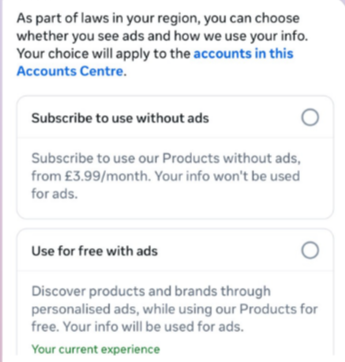
This year, users in the UK were given the same choice: use Meta’s products for free or subscribe to use them without ads. But only grudgingly, judging by the tone in the offer… “As part of laws in your region, you have a choice.”

As part of laws in your region, you have a choice
The ad-free option that has been rolling out coincides with the announcement of Meta’s premium subscriptions.

That ad-free option, however, is not what Meta is talking about now.

The newly announced plans are not about ads, and they are also separate from Meta Verified, which starts at around $15 a month and focuses on creators and businesses, offering a verification badge, better support, and anti‑impersonation protection.

Instead, these new subscriptions are likely to focus on additional features—more control over how users share and connect, and possibly tools such as expanded AI capabilities, unlimited audience lists, seeing who you follow that doesn’t follow you back, or viewing stories without the poster knowing it was you.

These examples are unconfirmed. All we know for sure is that Meta plans to test new paid features to see which ones users are willing to pay for and how much they can charge.

Meta has said these features will focus on productivity, creativity, and expanded AI.

My opinion

Unfortunately, this feels like another refusal to listen.

Most of us aren’t asking for more AI in our feeds. We’re asking for a basic sense of control: control over who sees us, what’s tracked about us, and how our data is used to feed an algorithm designed to keep us scrolling.

Users shouldn’t have to choose between being mined for behavioral data or paying a monthly fee just to be left alone. The message baked into “pay or be profiled” is that privacy is now a luxury good, not a default right. But while regulators keep saying the model is unlawful, the experience on the ground still nudges people toward the path of least resistance: accept the tracking and move on.

Even then, this level of choice is only available to users in Europe.

Why not offer the same option to users in the US? Or will it take stronger US privacy regulation to make that happen?


We don’t just report on threats – we help protect your social media

Cybersecurity risks should never spread beyond a headline. Protect your social media accounts by using Malwarebytes Identity Theft Protection.

Introducing Encrypt It Already

29 January 2026 at 19:17

Today, we’re launching Encrypt It Already, our push to get companies to offer stronger privacy protections to our data and communications by implementing end-to-end encryption. If that name sounds a little familiar, it’s because this is a spiritual successor to our 2019 campaign, Fix It Already, a campaign where we pushed companies to fix longstanding issues.

End-to-end encryption is the best way we have to protect our conversations and data. It ensures the company that provides a service cannot access the data or messages you store on it. So, for secure chat apps like WhatsApp and Signal, that means the company that makes those apps cannot see the contents of your messages, and they’re only accessible on your and your recipients. When it comes to data, like what’s stored using Apple’s Advanced Data Protection, it means you control the encryption keys and the service provider will not be able to access the data.  

We’ve divided this up into three categories, each with three different demands:

  • Keep your Promises: Features that the company has publicly stated they’re working on, but which haven’t launched yet.
    • Facebook should use end-to-end encryption for group messages
    • Apple and Google should deliver on their promise of interoperable end-to-end encryption of RCS
    • Bluesky should launch its promised end-to-end encryption for DMs
  • Defaults Matter: Features that are available on a service or in app already, but aren’t enabled by default.
    • Telegram should default to end-to-end encryption for DMs
    • WhatsApp should use end-to-end encryption for backups by default
    • Ring should enable end-to-end encryption for its cameras by default
  • Protect Our Data: New features that companies should launch, often because their competition is doing it already.
    • Google should launch end-to-end encryption for Google Authenticator backups
    • Google should offer end-to-end encryption for Android backup data
    • Apple and Google should offer an AI permissions per app option to block AI access to secure chat apps

What is only half the problem. How is just as important.

What Companies Should Do When They Launch End-to-End Encryption Features

There’s no one-size fits all way to implement end-to-end encryption in products and services, but best practices can support the security of the platform with the transparency that makes it possible for its users to trust it protects data like the company claims it does. When these encryption features launch, companies should consider doing so with:

  • A blog post written for a general audience that summarizes the technical details of the implementation, and when it makes sense, a technical white paper that goes into further detail for the technical crowd.
  • Clear user-facing documentation around what data is and isn’t end-to-end encrypted, and robust and clear user controls when it makes sense to have them.
  • Data minimization principles whenever feasible, storing as little metadata as possible.

Technical documentation is important for end-to-encryption features, but so is clear documentation that makes it easy for users to understand what is and isn’t protected, what features may change, and what steps they need to take to set it up so they’re comfortable with how data is protected.

What You Can Do

When it’s an option, enable any end-to-end encryption features you can, like on Telegram, WhatsApp, and Ring.

For everything else, let companies know that these are features you want! You can find messages to share on social media on the Encrypt It Already website, and take the time to customize those however you’d like. 

In some cases, you can also reach out to a company directly with feature requests, which all the above companies, except for Google and WhatsApp, offer in some form. We recommend filing these through any service you use for any of the above features you’d like to see:

As for Ring and Telegram, we’ve already made the asks and just need your help to boost them. Head over to the Telegram bug and suggestions and upvote this post, and Ring’s feature request board and boost this post.

End-to-end encryption protects what we say and what we store in a way that gives users—not companies or governments—control over data. These sorts of privacy-protective features should be the status quo across a range of products, from fitness wearables to notes apps, but instead it’s a rare feature limited to a small set of services, like messaging and (occasionally) file storage. These demands are just the start. We deserve this sort of protection for a far wider array of products and services. It’s time to encrypt it already!

Join EFF

Help protect digital privacy & free speech for everyone

Google Settlement May Bring New Privacy Controls for Real-Time Bidding

29 January 2026 at 18:11

EFF has long warned about the dangers of the “real-time bidding” (RTB) system powering nearly every ad you see online. A proposed class-action settlement with Google over their RTB system is a step in the right direction towards giving people more control over their data. Truly curbing the harms of RTB, however, will require stronger legislative protections.

What Is Real-Time Bidding?

RTB is the process by which most websites and apps auction off their ad space. Unfortunately, the milliseconds-long auctions that determine which ads you see also expose your personal information to thousands of companies a day. At a high-level, here’s how RTB works:

  1. The moment you visit a website or app with ad space, it asks an ad tech company to determine which ads to display for you. This involves sending information about you and the content you’re viewing to the ad tech company.
  2. This ad tech company packages all the information they can gather about you into a “bid request” and broadcasts it to thousands of potential advertisers. 
  3. The bid request may contain information like your unique advertising ID, your GPS coordinates, IP address, device details, inferred interests, demographic information, and the app or website you’re visiting. The information in bid requests is called “bidstream data” and typically includes identifiers that can be linked to real people. 
  4. Advertisers use the personal information in each bid request, along with data profiles they’ve built about you over time, to decide whether to bid on the ad space. 
  5. The highest bidder gets to display an ad for you, but advertisers (and the adtech companies they use to buy ads) can collect your bidstream data regardless of whether or not they bid on the ad space.   

Why Is Real-Time Bidding Harmful?

A key vulnerability of real-time bidding is that while only one advertiser wins the auction, all participants receive data about the person who would see their ad. As a result, anyone posing as an ad buyer can access a stream of sensitive data about billions of individuals a day. Data brokers have taken advantage of this vulnerability to harvest data at a staggering scale. Since bid requests contain individual identifiers, they can be tied together to create detailed profiles of people’s behavior over time.

Data brokers have sold bidstream data for a range of invasive purposes, including tracking union organizers and political protesters, outing gay priests, and conducting warrantless government surveillance. Several federal agencies, including ICE, CBP and the FBI, have purchased location data from a data broker whose sources likely include RTB. ICE recently requested information on “Ad Tech” tools it could use in investigations, further demonstrating RTB’s potential to facilitate surveillance. RTB also poses national security risks, as researchers have warned that it could allow foreign states to obtain compromising personal data about American defense personnel and political leaders.

The privacy harms of RTB are not just a matter of misuse by individual data brokers. RTB auctions broadcast torrents of personal data to thousands of companies, hundreds of times per day, with no oversight of how this information is ultimately used. Once your information is broadcast through RTB, it’s almost impossible to know who receives it or control how it’s used. 

Proposed Settlement with Google Is a Step in the Right Direction

As the dominant player in the online advertising industry, Google facilitates the majority of RTB auctions. Google has faced several class-action lawsuits for sharing users’ personal information with thousands of advertisers through RTB auctions without proper notice and consent. A recently proposed settlement to these lawsuits aims to give people more knowledge and control over how their information is shared in RTB auctions.

Under the proposed settlement, Google must create a new privacy setting (the “RTB Control”) that allows people to limit the data shared about them in RTB auctions. When the RTB Control is enabled, bid requests will not include identifying information like pseudonymous IDs (including mobile advertising IDs), IP addresses, and user agent details. The RTB Control should also prevent cookie matching, a method companies use to link their data profiles about a person to a corresponding bid request. Removing identifying information from bid requests makes it harder for data brokers and advertisers to create consumer profiles based on bidstream data. If the proposed settlement is approved, Google will have to inform all users about the new RTB Control via email. 

While this settlement would be a step in the right direction, it would still require users to actively opt out of their identifying information being shared through RTB. Those who do not change their default settings—research shows this is most people—will remain vulnerable to RTB’s massive daily data breach. Google broadcasting your personal data to thousands of companies each time you see an ad is an unacceptable and dangerous default. 

The impact of RTB Control is further limited by technical constraints on who can enable it. RTB Control will only work for devices and browsers where Google can verify users are signed in to their Google account, or for signed-out users on browsers that allow third-party cookies. People who don't sign in to a Google account or don't enable privacy-invasive third-party cookies cannot benefit from this protection. These limitations could easily be avoided by making RTB Control the default for everyone. If the settlement is approved, regulators and lawmakers should push Google to enable RTB Control by default.

The Real Solution: Ban Online Behavioral Advertising

Limiting the data exposed through RTB is important, but we also need legislative change to protect people from the online surveillance enabled and incentivized by targeted advertising. The lack of strong, comprehensive privacy law in the U.S. makes it difficult for individuals to know and control how companies use their personal information. Strong privacy legislation can make privacy the default, not something that individuals must fight for through hidden settings or additional privacy tools. EFF advocates for data privacy legislation with teeth and a ban on ad targeting based on online behavioral profiles, as it creates a financial incentive for companies to track our every move. Until then, you can limit the harms of RTB by using EFF’s Privacy Badger to block ads that track you, disabling your mobile advertising ID (see instructions for iPhone/Android), and keeping an eye out for Google’s RTB Control.

Malicious Chrome extensions can spy on your ChatGPT chats

28 January 2026 at 15:34

Researchers discovered 16 malicious browser extensions for Google Chrome and Microsoft Edge that steal ChatGPT session tokens, giving attackers access to accounts, including conversation history and metadata.

The 16 malicious extensions (15 for Chrome and 1 for Edge) claim to improve and optimize ChatGPT, but instead siphon users’ session tokens to attackers. Together, they have been downloaded around 900 times, a relatively small number compared to other malicious extensions.

Despite benign descriptions and, in some cases, a “featured” badge, the real goal of these extensions is to hijack ChatGPT identities by stealing session authentication tokens and sending them to attacker-controlled backends.

Possession of these tokens gives attackers the same level of access as the user, including conversation history and metadata.

In addition to your ChatGPT session token, the extensions also send extra details about themselves (such as their version and language settings), along with information about how they’re used, and special keys they get from their own online service.

Taken together, this allows the attackers to build a picture of who you are and how you work online. They can use it to keep recognizing you over time, build a profile of your behavior, and maintain access to your ChatGPT-connected services for much longer. This increases the privacy impact and means a single compromised extension can cause broader harm if its servers are abused or breached.

According to the researchers, this campaign coincides with a broader trend:

“The rapid growth in adoption of AI-powered browser extensions, aimed at helping users with their everyday productivity needs. While most of them are completely benign, many of these extensions mimic known brands to gain users’ trust, particularly those designed to enhance interaction with large language models.”

How to stay safe

Although we always advise people to install extensions only from official web stores, this case proves once again that not all extensions available there are safe. That said, installing extensions from outside official web stores carries an even higher risk.

Extensions listed in official stores undergo a review process before being approved. This process, which combines automated and manual checks, assesses the extension’s safety, policy compliance, and overall user experience. The goal is to protect users from scams, malware, and other malicious activity. However, this review process is not foolproof.

Microsoft and Google have been notified about the abuse. However, extensions that are already installed may remain active in Chrome and Edge until users manually remove them.

Malicious extensions

These are the browser extensions you should remove. They are listed by Name — Publisher — Extension ID:

  • ChatGPT bulk delete, Chat manager — ChatGPT Mods — gbcgjnbccjojicobfimcnfjddhpphaod
  • ChatGPT export, Markdown, JSON, images — ChatGPT Mods — hljdedgemmmkdalbnmnpoimdedckdkhm
  • ChatGPT folder, voice download, prompt manager, free tools — ChatGPT Mods — lmiigijnefpkjcenfbinhdpafehaddag
  • ChatGPT message navigator, history scroller — ChatGPT Mods — ifjimhnbnbniiiaihphlclkpfikcdkab
  • ChatGPT Mods — Folder Voice Download & More Free Tools — jhohjhmbiakpgedidneeloaoloadlbdj
  • ChatGPT pin chat, bookmark — ChatGPT Mods — kefnabicobeigajdngijnnjmljehknjl
  • ChatGPT Prompt Manager, Folder, Library, Auto Send — ChatGPT Mods — ioaeacncbhpmlkediaagefiegegknglc
  • ChatGPT prompt optimization — ChatGPT Mods — mmjmcfaejolfbenlplfoihnobnggljij
  • ChatGPT search history, locate specific messages — ChatGPT Mods — ipjgfhcjeckaibnohigmbcaonfcjepmb
  • ChatGPT Timestamp Display — ChatGPT Mods — afjenpabhpfodjpncbiiahbknnghabdc
  • ChatGPT Token counter — ChatGPT Mods — hfdpdgblphooommgcjdnnmhpglleaafj
  • ChatGPT model switch, save advanced model uses — ChatGPT Mods — pfgbcfaiglkcoclichlojeaklcfboieh
  • ChatGPT voice download, TTS download — ChatGPT Mods — območbankihdfckkbfnoglefmdgmblcld (original: obdobankihdfckkbfnoglefmdgmblcld)
  • Collapsed message — ChatGPT Mods — lechagcebaneoafonkbfkljmbmaaoaec
  • Multi-Profile Management & Switching — ChatGPT Mods — nhnfaiiobkpbenbbiblmgncgokeknnno
  • Search with ChatGPT — ChatGPT Mods — hpcejjllhbalkcmdikecfngkepppoknd

We don’t just report on threats—we remove them

Cybersecurity risks should never spread beyond a headline. Keep threats off your devices by downloading Malwarebytes today.

❌