Normal view

Websites with an undefined trust level: avoiding the trap

6 May 2026 at 11:30

Executive summary

  • A suspicious website is a web resource that cannot be definitively classified as phishing, but whose activities are unsafe. Such sites manipulate users, tricking them into voluntarily transferring money for non-existent services, signing up for hidden subscriptions, or disclosing personal data through carefully crafted terms of service. These include fake online stores, dubious crypto exchanges, investment platforms, and services with paid subscriptions.
  • Kaspersky has introduced a new web filtering category, “Sites with an undefined trust level,” into its security products (Kaspersky Premium, Android and iOS apps, etc.). The system analyzes the domain name and age, IP address reputation, DNS configuration, HTTP security headers, and SSL certificate to automatically detect suspicious resources.
  • According to Kaspersky data for January 2026, the most widespread global threat is fake browser extensions that mimic security products — they were detected in 9 out of 10 regions analyzed worldwide. Such extensions intercept browser data, track user activity, hijack search queries, and inject ads.
  • Kaspersky’s regional statistics reveal the specific nature of these threats: in Africa, over 90% of the top 10 suspicious websites are online trading scam platforms; in Latin America, fake betting services predominate; in Russia, fake binary options brokers and “educational platforms” with fraudulent subscriptions lead the way; in CIS countries — crypto scams and bots for inflating engagement.
  • Key indicators of a suspicious website to check: a strange domain name with numbers or random characters, cheap top-level domains (.xyz, .top, .shop), a recently registered domain (less than 6 months old according to WHOIS data), unrealistic promises (“100% guaranteed income,” “up to 300% profit”), lack of company contact information, and payments only via cryptocurrency or irreversible bank transfers.

Introduction

The online landscape is filled with various traps lying in wait for users. One such threat involves websites that can’t be strictly classified as phishing, yet whose activities are inherently unsafe. These sites often operate on the fringes of the law, even if they aren’t directly violating it. Sometimes they use a cleverly crafted Terms of Service document as a loophole. These agreements might include clauses such as no-refund policies or forced automatic subscription renewals.

Fake online stores, dubious financial platforms, and various online services that mimic legitimate business operations are all categorized as suspicious. Unlike actual phishing sites, which aim to steal sensitive data like banking credentials or passwords, these suspicious sites represent a far more cunning trap. Their goal is manipulation: tricking the victim into willingly paying for non-existent goods and services or signing them up for a subscription that’s nearly impossible to cancel. Beyond financial gain, these sketchy websites may also hunt for personal data to sell later on the dark web.

Our solutions categorize them as having an “undefined trust level”. This article explains what these sites look like, how to identify them, and what you can do to stay safe.

The dangers of shady websites

One of the biggest risks associated with making a purchase from an untrusted website that seems to be an online store is the financial loss and falling victim to fraud. Fake shops will entice you with attractive deals to get you hooked. After you pay, you may never receive what you paid for, or you may receive some cheap piece of unusable junk instead of the item you ordered. Investment or “guaranteed income” programs are another type of classic scam — they promise rapid returns, and once they take your deposits, they disappear without a trace.

Visiting or buying from untrusted suspicious websites can expose you to various risks that go beyond a single bad purchase. Fraudulent websites often collect your personal information even if you do not end up making a purchase. By completing a form or signing up for a “free offer”, you may be providing the scammer with access to your information.

Personal data collection can happen in a fairly straightforward and obvious way — for instance, through a standard order delivery form. In this scenario, attackers end up with sensitive information like the user’s full name, shipping and billing addresses, phone number, email address, and, of course, payment details. As we’ve previously discussed, fraudsters sell this kind of information, and there’re countless ways it can be used down the line. For example, this data might be leveraged for spam campaigns or more serious threats like stalking or targeted attacks.

Common types of suspicious sites

Let’s take a closer look at the different types of shady sites out there and how interacting with them can lead to financial loss, data leaks, the unauthorized use of personal information, and other consequences.

It’s worth noting that rogue websites can masquerade as legitimate ones in almost any industry. The first type of fraudulent site we’ll look at is fake online stores. These can appear as clones of real brand websites or as standalone stores. Usually, the scam follows one of two paths: the buyer either receives a counterfeit or poor-quality product, or they receive nothing at all. These sites lure victims in with suspiciously low prices and “exclusive” deals. Often, users are subjected to psychological pressure: the time to make a purchase decision is purposefully limited, provoking the victim, as with any other scam, into making an impulse purchase.

Another common type of shady site includes online exchanges and trading platforms. These primarily target cryptocurrency, as the lack of legislative regulation for digital currency in certain countries makes them a magnet for fraudsters. These suspicious sites often lure victims with supposedly favorable exchange rates or other enticing gimmicks. If the user attempts to exchange cryptocurrency, their tokens are gone for good. Beyond simple exchanges, rogue sites offer investment services and even display a fake balance growth to appear credible. However, withdrawing funds is impossible; when the victim tries to cash out, they’re prompted to pay some fee or fictional tax.
Subscription traps are also worth noting, offering everything from psychological tests to online video streaming platforms. The hallmark of these sites is that they deliberately withhold critical information, such as recurring charges, or hide the fact it even exists. Typically, the scheme works like this: a user is offered a subscription for a nominal fee, like $1. While that seems attractive, the next charge – perhaps only a week later – might be as much as $50. This information is intentionally obscured, buried in fine print or tucked away in the Terms of Service where it’s harder to find. Legitimate services always clearly disclose subscription terms and provide an easy way to cancel before a trial period ends. Scam services, on the other hand, do everything possible to distract the user from the actual terms of use and subscription.

Shady sites can also masquerade as providers of mediation services, such as legal or real estate assistance. In reality, the service is either never delivered or provided in a stripped-down, incomplete form. For example, a user might be prompted to pay for a service that’s normally provided for free. The danger here lies not only in losing money for non-existent services but also in the significant risk of exposing personal data, such as ID details, taxpayer identification numbers, social security numbers, or driver’s license information. Once in the hands of attackers, this data can become a tool for executing further scams or targeted attacks.

On the whole, suspicious sites are fairly difficult to distinguish from legitimate, trustworthy services. Masquerading as a legitimate business is the primary goal of these sites, and the fraudulent schemes they employ are not always obvious. Nevertheless, there are protective measures as well as certain indicators that can help you suspect a site is unsafe for purchases or financial transactions.

How to identify suspicious or fraudulent websites

Despite the increasingly convincing attempts to create fake shops, the majority of them still lack the quality of real online stores, and there are many signs that may give them away. Some of these signs can be caught by the eye while others require a bit of technical investigation. By combining visual inspection, technical checks, and trusted online tools, you can protect yourself from financial loss or data theft.

Visual and manual clues

You don’t need to be a cybersecurity expert to catch many red flags just by observing the site’s domain, visuals, language and behavior. For instance, scam sites often have strange or randomly generated names, filled with numbers, underscores, hyphens, or meaningless words, like best-shop43.com. In addition, such vague top-level domains as .xyz, .top, or .shop are also frequently used in scams because they’re cheap and easy to register.

Furthermore, most fake stores sites look unprofessional, with poor visuals, pixelated images, mismatched fonts, or copied templates. Many fraudulent websites borrow layouts or logos from other brands or free templates, which makes them appear generic and sketchy.

Another major giveaway lies in the content itself. Be aware of persuasive language, unrealistic promises, or emotional triggers such as No KYC, Risk-free returns, 100% guaranteed income, Up to 300% profit, or Passive income with zero effort. Unrealistic deals are another red flag. If the products are listed at extremely low prices, continuous countdown timers, and “limited time only” messages that are often used to pressure you into making a quick purchase, it’s a clear tell of a fraudulent website.

Legitimate businesses always provide verifiable contact details, such as a physical address, company name, and customer support. On the contrary, scam sites hide this information. You may also notice the non-functioning pages, broken or suspicious links leading to unrelated external sites which indicate poor maintenance or malicious intent.

Another important signal is the website’s social media presence. Legitimate online businesses usually maintain at least one active social media account to promote their products and communicate with customers. In most cases, these businesses have long-established social media accounts with harmonized posting history and engagement from real users, consistency between the brand website and social media profiles (same name, logo, and links). The links to social media profiles from the website are usually direct. In contrast, fraudulent or deceptive websites often lack any meaningful social media presence or display signs of superficial or artificial activity. This may include missing social media accounts altogether, social media icons that lead to non-existent, inactive, or unrelated pages, or recently created profiles with very few posts and minimal user engagement. In some cases, comment sections are disabled or dominated by spam and automated content, suggesting an attempt to avoid public interaction rather than engage with customers.

Lastly, the payment options offered by the site can also tell a lot about its legitimacy. Be extremely cautious if a website only accepts cryptocurrency, wire transfers, or third-party P2P payments. These payment methods are irreversible and are preferred by scammers. Legitimate e-commerce platforms typically offer secure and reversible payment options, such as credit cards or trusted payment gateways that include buyer protection policies.

However, the absence or existence of any of these factors alone does not necessarily indicate malicious intent. It should be evaluated in combination with technical, linguistic, and behavioral indicators, rather than treated as a standalone signal of legitimacy.

Technical indicators to check

Looking into technical signs can reveal whether a website is trustworthy or potentially fraudulent.

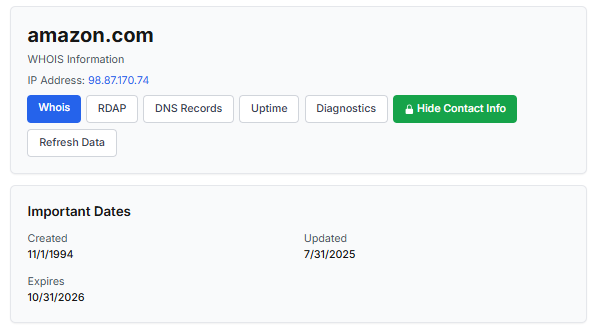
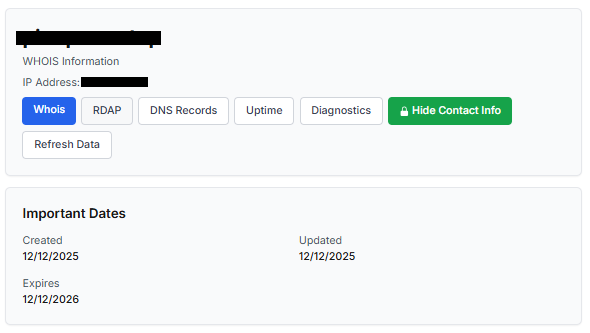
One of the first things to check is the domain age. Scam websites are often short-lived, appearing only for a few weeks or months before disappearing once users start reporting them. To check when the domain was created, use a WHOIS lookup. If it’s less than six months old, be cautious — especially for e-commerce or investment sites, where legitimacy and trust take time to build.

Let’s take a look at the registration details for the popular online marketplace Amazon. As we can see from the WHOIS information, it was registered in 1994.
Meanwhile, a reported suspicious online store was created a couple of months ago.
Legitimate websites usually operate on stable hosting platforms and remain on the same IP addresses or networks for long periods. In contrast, fraudulent websites often move between servers (in most cases using a cheap shared hosting service) or reuse infrastructure already associated with abuse. Checking the IP address reputation can reveal if the website or the hosting server has previously been linked to suspicious activities. Even if the website looks legitimate, a poor IP reputation can expose it.

In addition to that, looking at the infrastructure behavior over time can reveal patterns about its legitimacy. Websites associated with fraudulent activity often show short lifespans, sudden spikes in activity, or rapid appearance and disappearance, which indicates a coordinated campaign rather than a legitimate business.

Another important clue is hidden ownership. When the WHOIS details show “Redacted for Privacy” or leaves the organization name blank, it may indicate that the website owner is deliberately hiding their identity.
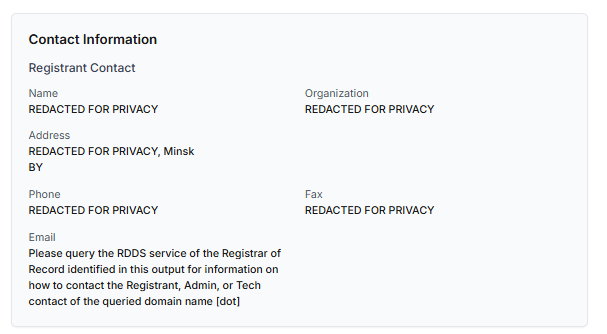
We should point out that while this can raise suspicion during investigations, hidden WHOIS data is not inherently malicious. Many legitimate businesses use privacy protection services for valid reasons. These may include protection from spam and phishing after public email addresses are taken from WHOIS databases, personal safety for small business owners, and brand protection to prevent competitors or malicious actors from targeting the registrant. This means that some businesses can use services like WHOIS Privacy Protection, Domains By Proxy, or PrivacyGuardian.org to remove the WHOIS data while still operating transparently on their websites through clear contact details, customer support channels, and legal pages (e.g. terms of use).

Therefore, hidden ownership should be treated as a contextual risk indicator, not a standalone proof of fraud. It becomes more suspicious when combined with other signals such as newly registered domains, and lack of legal information.

Next, you can check the security headers of the website. Legitimate websites are usually well maintained and include several key HTTP headers for protection. Some examples include:

  • Content-Security-Policy (CSP) provides strong defense against cross-site scripting (XSS) attacks by defining which scripts are allowed to run on the site and blocking any malicious JavaScript that could steal login data or inject fake forms.
  • HTTP Strict-Transport-Security (HSTS) forces browsers to connect to the site only over HTTPS. It ensures all communication is encrypted and prevents redirecting users to an insecure (HTTP) version of the site.
  • X-Frame-Options prevents clickjacking, which is a type of attack where a legitimate-looking button or link on a malicious page secretly performs another action in the background.
  • X-Content-Type-Options blocks MIME-type attacks by preventing browsers from misinterpreting file types.
  • Referrer-Policy controls how much information about your previous browsing (referrer URLs) is shared with other sites.

These headers form the “digital hygiene” of a website. Their absence doesn’t always mean a site is malicious, but it does suggest a lack of security awareness or professional maintenance — both strong reasons to be cautious.

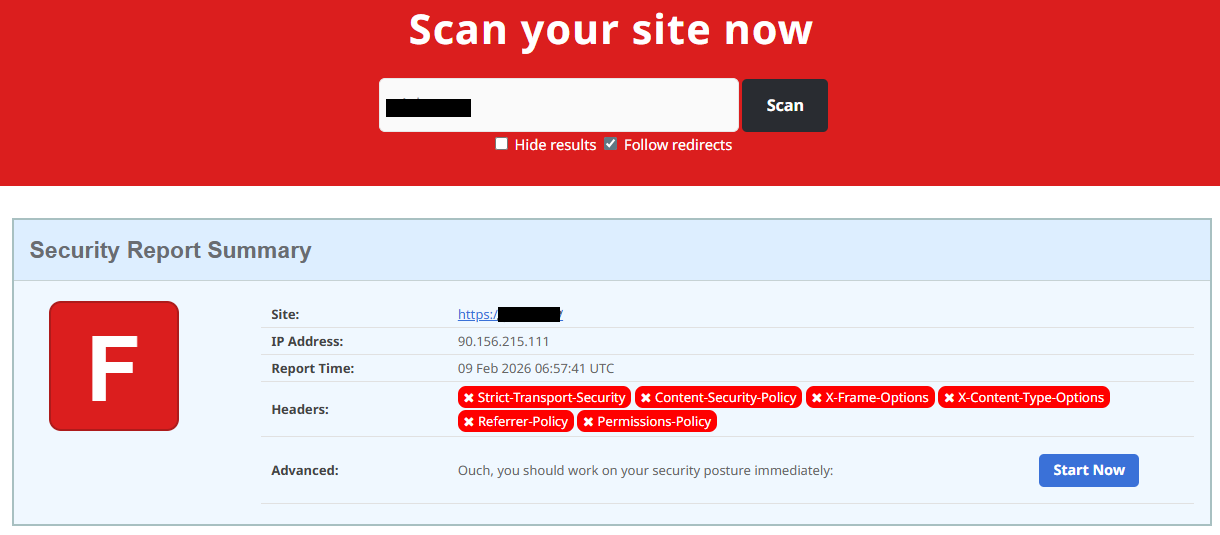
You should also check the SSL certificate. Scam sites may use self-signed or short-lived SSL certificates. You can inspect this by clicking the padlock icon in your browser’s address bar — if it says “not secure” or the certificate authority seems unfamiliar, that’s a red flag.

You can check the security headers and the SSL certificate by sending an HTTP request programmatically or by using some online service.
Another indicator that provides insight into how well a website is done and managed is DNS configurations. Legitimate businesses typically use reliable DNS providers and maintain consistent DNS records. Missing the name server NS or mail exchange MX records may indicate poor DNS configuration. In addition to NS and MX, reputable sites also configure SPF and DMARC records to protect their brand from email spoofing and phishing. Something scam website developers won’t bother with because they don’t intend to build a long-standing reputation.

You can check the configurations of DNS records either programmatically or by using an online service.

Another recommendation is to pay attention to website behavior. If there are frequent redirects, pop-up ads, or background requests to unknown domains, this may indicate unsafe scripting or tracking.

How to protect yourself

Tools and databases for detecting suspicious websites

We at Kaspersky have built an intelligent system for detecting suspicious web resources and added this new type of protection into many of our products, including Kaspersky Premium, Kaspersky for Android and iOS, and others. Our detection model is based on many factors, including but not limited to the following:

  • domain name and age,
  • IP reputation,
  • stability of the infrastructure used,
  • DNS configurations,
  • HTTP security headers,
  • digital identity and popularity of the web resource.

Kaspersky has been certified as a provider of effective protective technology for fake shop detection.

When a user tries to visit a site flagged as having an undefined trust level, our solutions show a warning to stop the visitor from becoming a victim of personal data leaks, financial losses or a bad purchase:
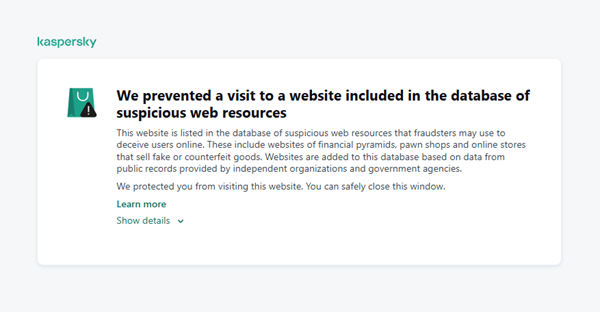
This component is on by default.

Moreover, there are several online tools and databases that can help assess a website’s legitimacy:

  • ScamAdviser analyzes trust based on WHOIS, server location, and web reputation.
  • APIVoid provides risk scoring using DNS, IP, and domain reputation databases.
  • National government databases often maintain official lists of fraudulent or blacklisted domains.

Preventive measures

To protect yourself from such threats, it might a good idea to take some additional preventive measures. Always double-check the URL and domain name, especially when you are about to click a link or make a payment. Make sure the site uses HTTPS and has a trusted certificate.

You can use standard browser tools to verify site security. For example, in Google Chrome, clicking the site information button (the lock or settings icon in the address bar) displays details about the connection security and the site’s certificate.
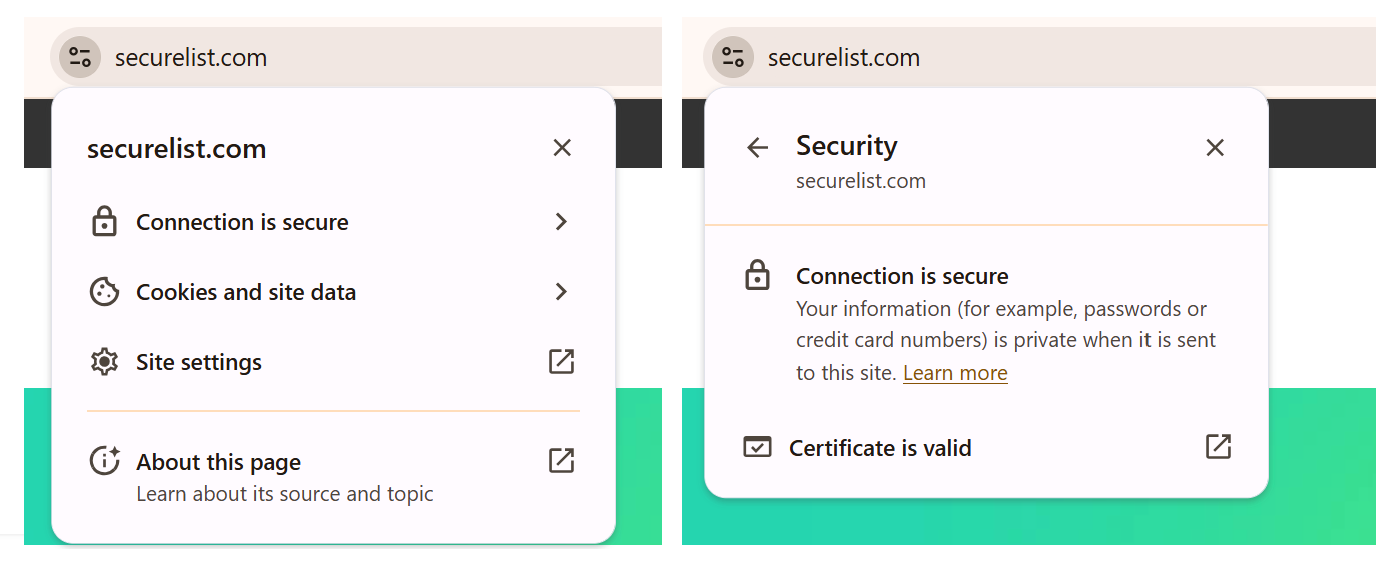
In the Security section, you can check whether the site supports HTTPS – it should say “Connection is secure” – and view the site’s digital certificate.
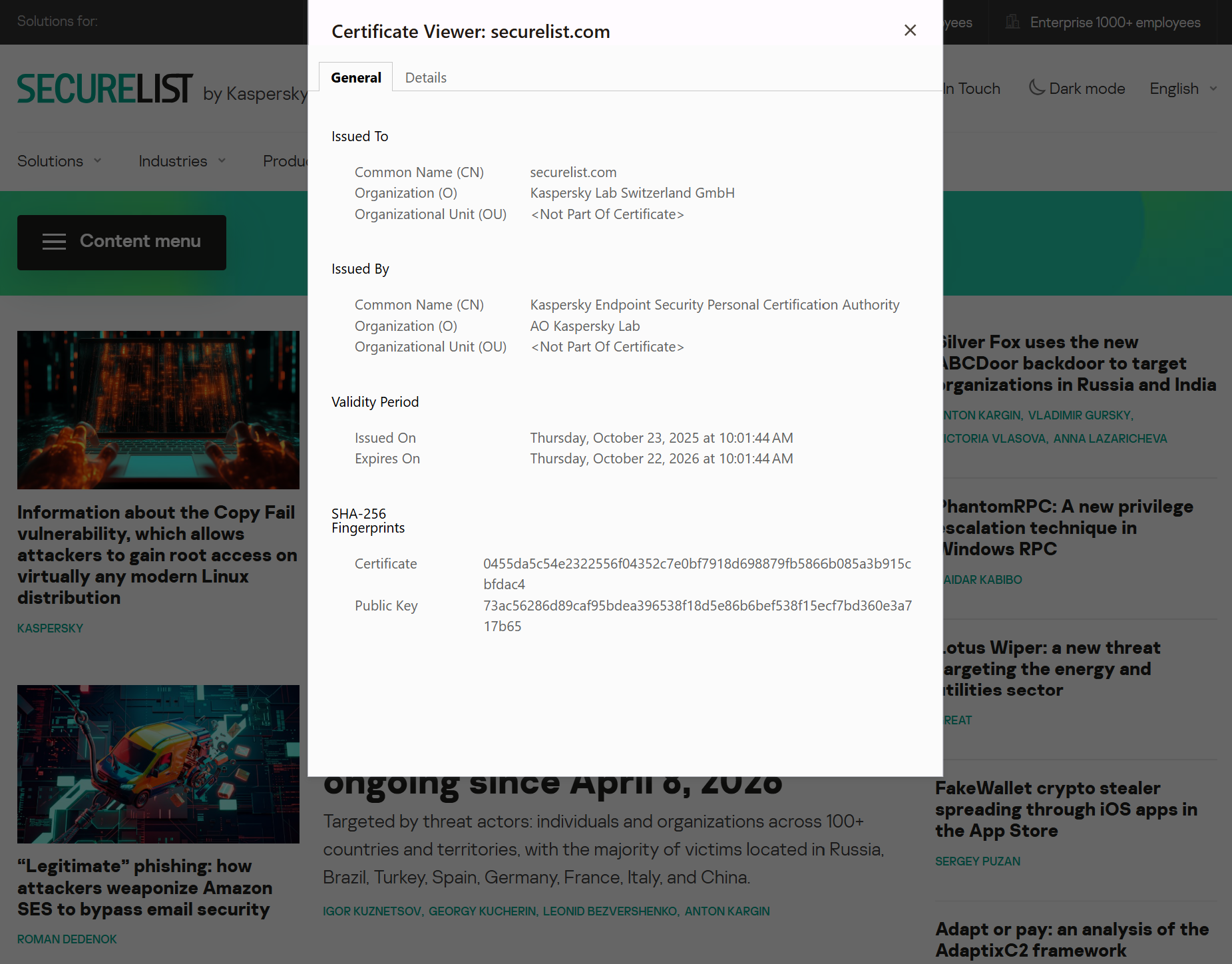
Additionally, keep reliable security software with real-time protection running on your device to stop you from accessing dangerous websites. Do not download any files or enter your personal information on websites that look unprofessional or suspicious. And finally, remember the golden rule: if a deal seems too good to be true, it often is.

If you realize that you’re on a scam website, it’s important to perform certain post-incident actions immediately. First, contact your bank or payment provider as soon as possible to block the transaction or card. Then, change your passwords for the services which might have been compromised, and run a full antivirus scan on your device to detect and remove any potential threats. Lastly, consider reporting the website to the cybercrime agency in your country or to the consumer protection agency. Sharing your experience online by leaving a review or warning will give notice to potential customers alike.

By staying careful and taking quick actions, you can significantly reduce the chances of being a target and help make the internet a safer place for everyone.

An overview of detection statistics for sites with an undefined trust level

To illustrate the types of suspicious sites prevalent in various regions around the world, we analyzed anonymized detection data from Kaspersky solutions for the “websites with an undefined trust level” category in January 2026. For each region, we identified the 10 most frequently encountered sites and calculated the share of each within that list. To maintain privacy, specific domains are not listed directly; instead, they’re described based on their functionality and characteristics.

Most visited suspicious sites

First, let’s examine the sites that appear across multiple regions, indicating a high prevalence.

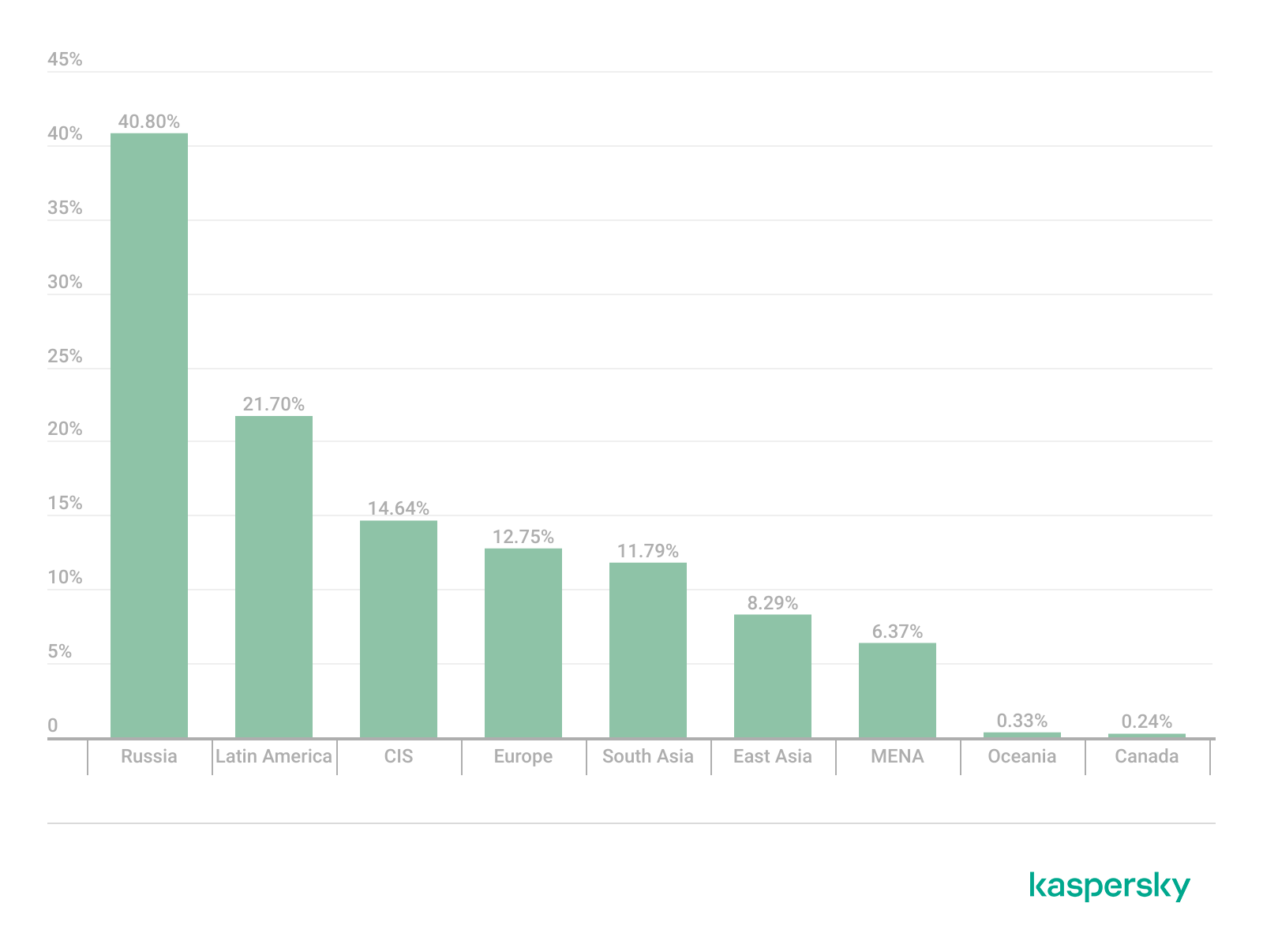
In 9 out of the 10 regions analyzed, we encountered a suspicious image processing platform (*a*o*.com). This site positions itself as a photo editing tool, but in reality, it serves as an intermediary server for uploading images used in phishing and other campaigns. By interacting with such a site, users risk exposing personal data under the guise of uploading images or falling victim to a phishing attack.

Percentage of the *a*o*.com domain detections by region, January 2026 (download)

This site has the largest share of detections in the Russian Federation, where it ranks first in the TOP 10 with a 40.80% share. It is also prevalent in Latin American countries (21.70%) and the CIS (14.64%), while it’s least common in Canada at 0.24%.

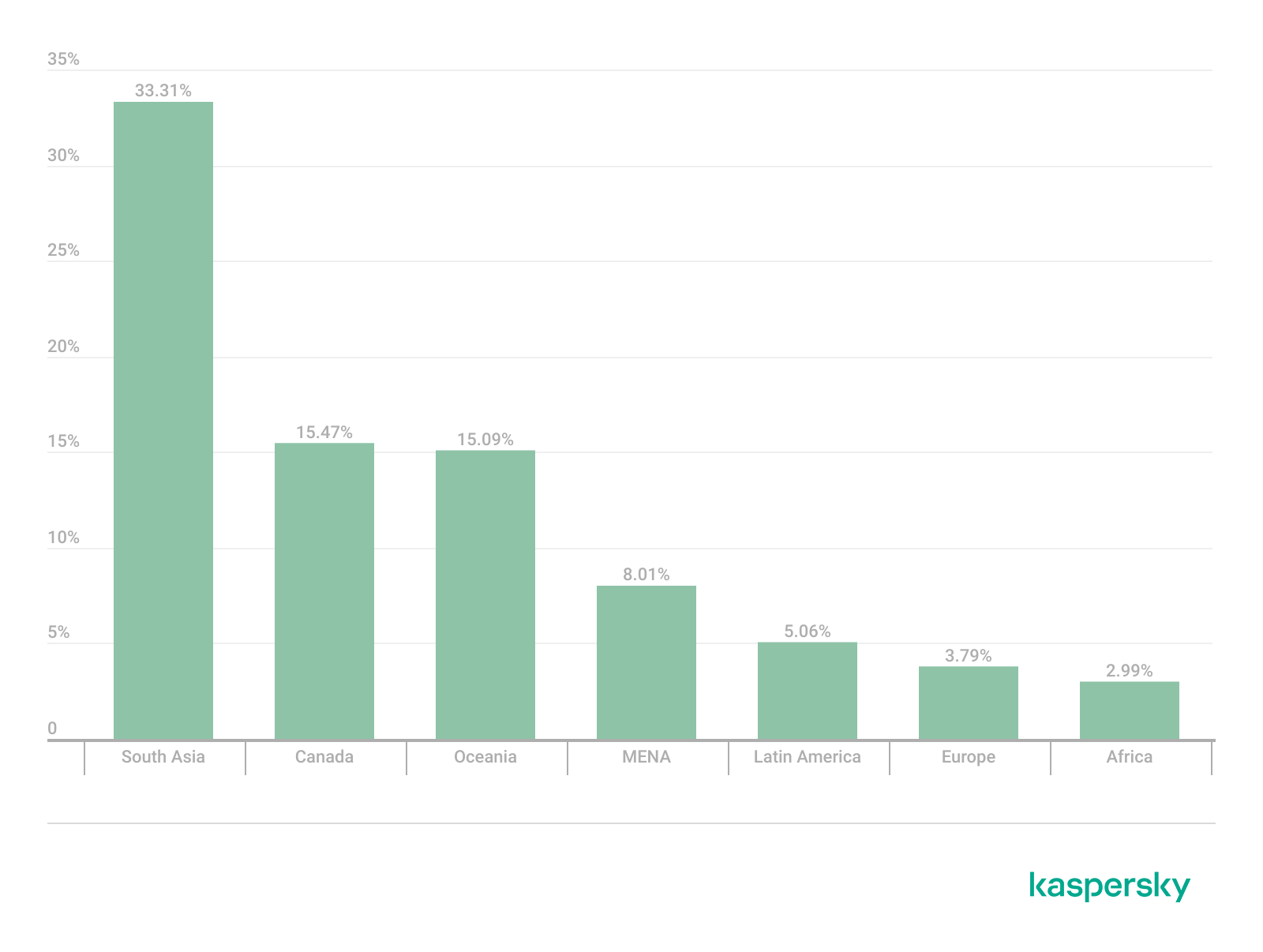
The next site appeared in 7 regions. It consists of a landing page for a fake antivirus solution presented as a browser extension (*n*s*.com). This extension redirects the user to a fake search engine page allowing it to collect data and track user activity, specifically search queries.

Percentage of the *n*s*.com domain detections by region, January 2026 (download)

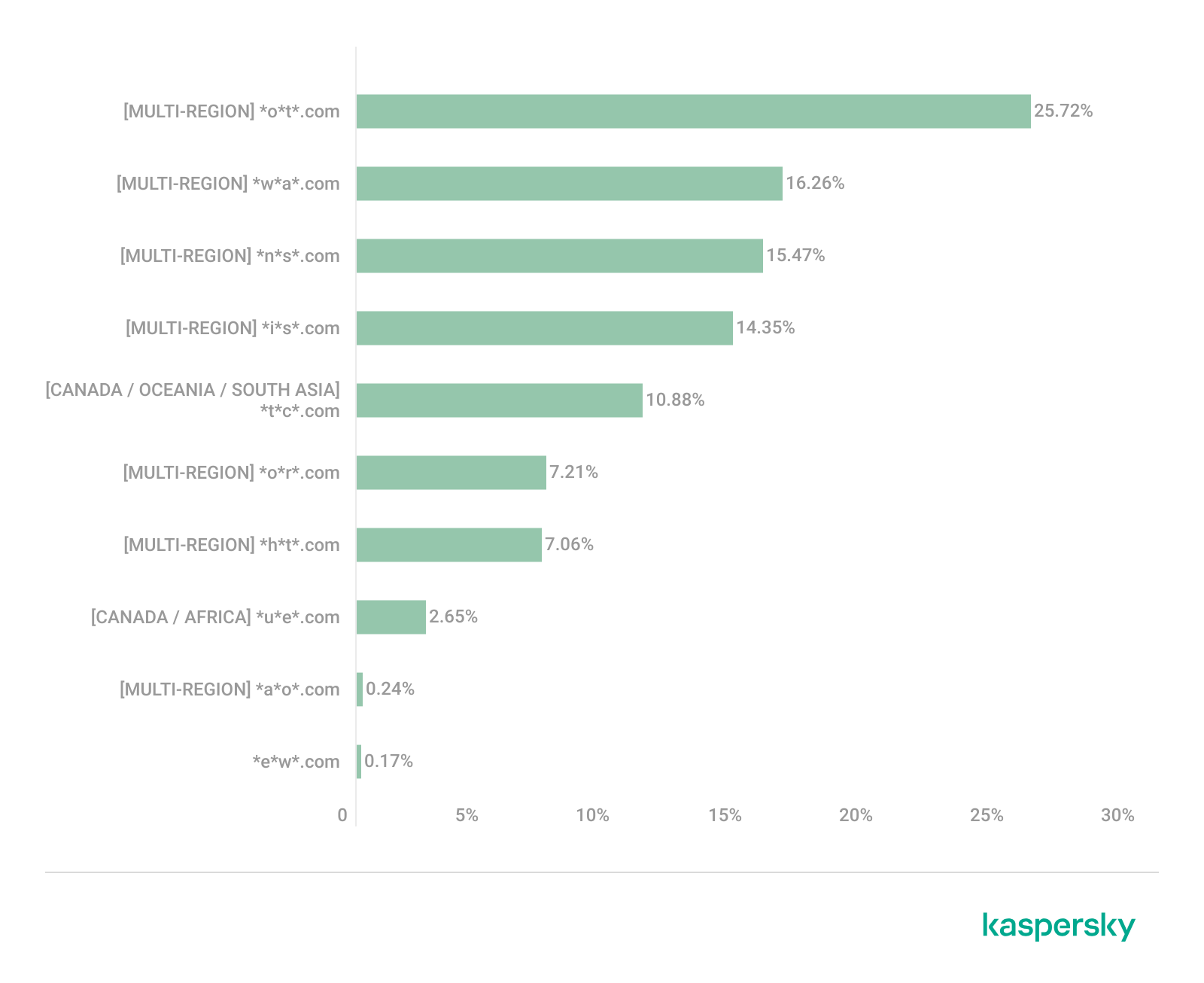
This site is most frequently detected in South Asia, with a share of 33.31%. Its presence in Canada and Oceania is roughly equal (15.47% and 15.09%, respectively). We recorded the lowest number of detections in Africa, at 2.99%.

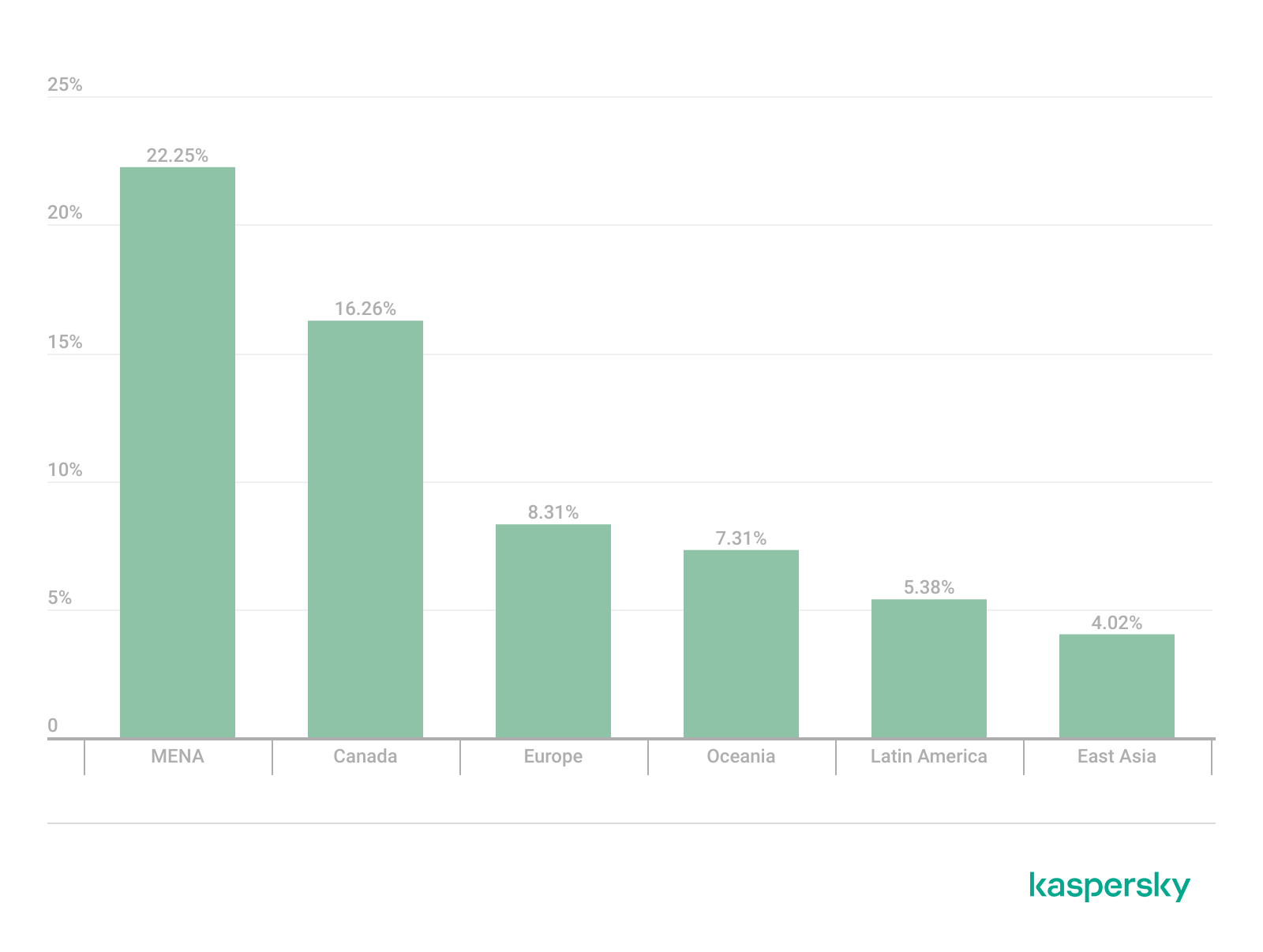
Another suspicious browser extension appeared in the TOP 10 in 6 out of the 10 regions. It’s a fake privacy-enhancing tool hosted at *w*a*.com. Instead of providing the advertised privacy features, this extension carries a high risk of intercepting browser data. It can modify browser settings, harvest user data, and swap the default search engine for a fake one. Furthermore, it maintains full control over all browser traffic.

Percentage of the *w*a*.com domain detections by region, January 2026 (download)

This “service” has its largest share, 22.25%, in the Middle East and North Africa, and is also quite common in Canada (16.26%). It’s least frequently encountered in Latin America (5.38%) and East Asia (4.02%).

The site *o*r*.com appeared in five regional rankings. It’s a fake security service promising to provide online safety by warning users about malicious sites and dangerous search queries. This extension has the potential to steal cookies (including session cookies), inject advertisements, spoof login forms, and harvest browser history and search queries. We noted that this site made the TOP 10 in Africa (0.59%), the MENA (Middle East and North Africa) region (4.57%), Europe (5.61%), Canada (7.21%), and Oceania (1.93%).

In 4 out of the 10 regions, we identified several other recurring sites. One of them (*n*p*.xyz) mimics a repository for creative AI image generation prompts while capturing browser data. The domain hosting this site exhibits several red flags: it was recently registered, and the owner’s information is hidden. This site reached the TOP 10 in Africa (0.51%), the MENA region (7.04%), Latin America (22.54%, ranking first in that region), and South Asia (5.91%).

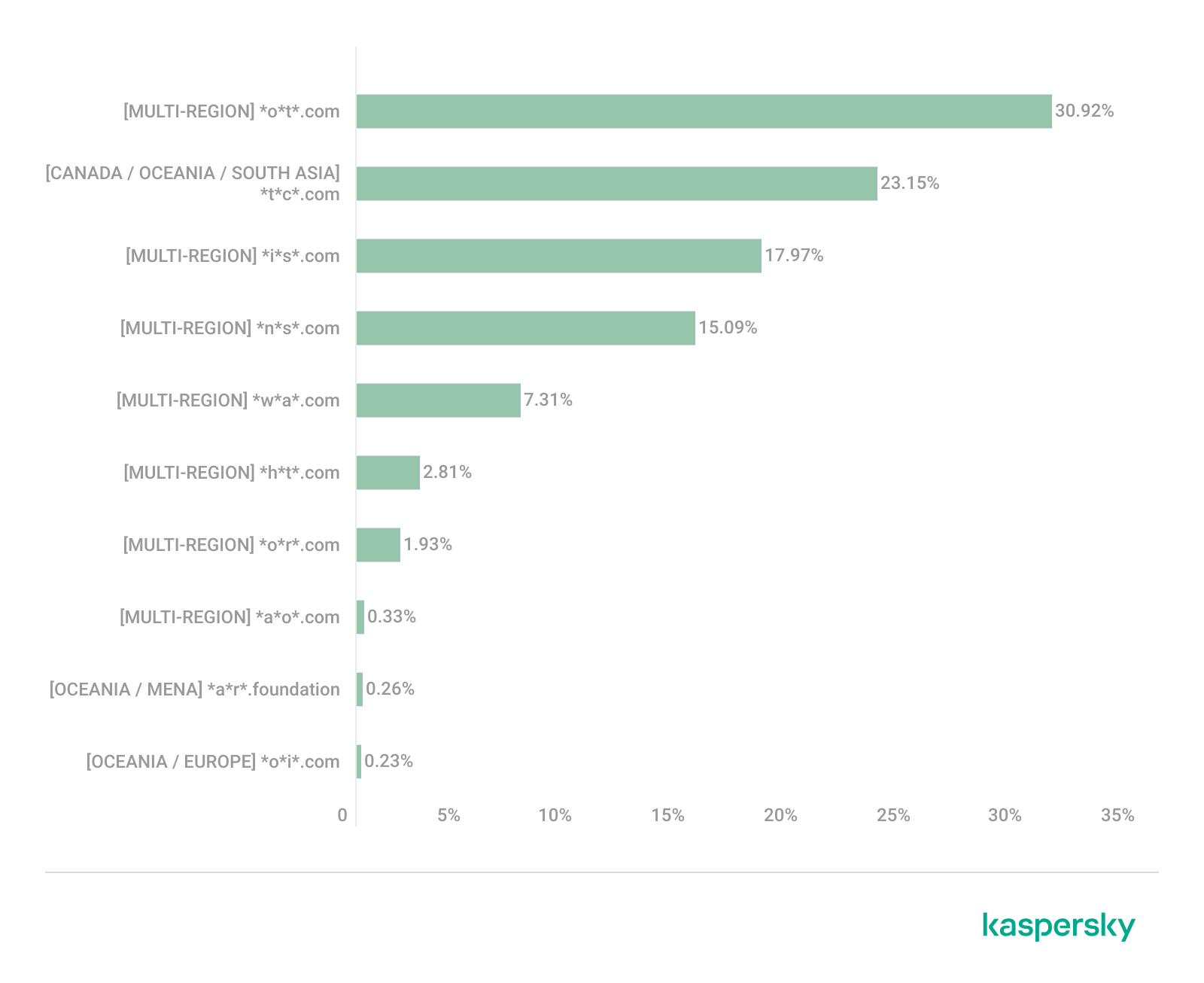
The second service (*i*s*.com) positions itself as a tool for safe searching, protecting the browser from threats, and verifying extensions. However, this is a typical browser hijacker, much like the others mentioned above. It made the TOP 10 in South Asia (8.03%), Oceania (17.97%), Europe (3.90%), and Canada (14.35%).

The third site (*h*t*.com) poses as a private browsing extension. In reality, it’s another potentially unwanted application designed for browser hijacking: it modifies settings, steals sensitive data (cookies, browser history, and queries), and can redirect the user to phishing pages. Users have specifically noted the difficulty involved in removing the extension. This site appears in the TOP 10 for the MENA region (10.17%), Canada (7.06%), Europe (3.81%), and Oceania (2.81%).

Another domain (*o*t*.com) that reached the TOP 10 in four regions is a service mimicking a browser extension for safe searching and web browsing. It’s dangerous because it injects ads and steals user data. It’s important to note that such extensions can be installed without explicit user consent – for example, via links embedded in other software. This service holds the number one spot in two regions: Canada (25.72%) and Oceania (30.92%), while also appearing in the TOP 10 for East Asia (8.01%) and Africa (0.88%).

Consequently, we can see that the majority of suspicious sites detected by our solutions worldwide are browser hijackers masquerading as security products. Nevertheless, other categories of sites also appear in the TOP 10.

Next, we’ll examine each region individually, focusing on descriptions of domains not previously covered. For clarity, the sites mentioned above will be marked as [MULTI-REGION], while those appearing in only two or three regions will include the names of those specific areas. We’ll observe several regional overlaps and similarities, allowing us to determine which types of suspicious sites are popular both within specific regions and globally.

Africa

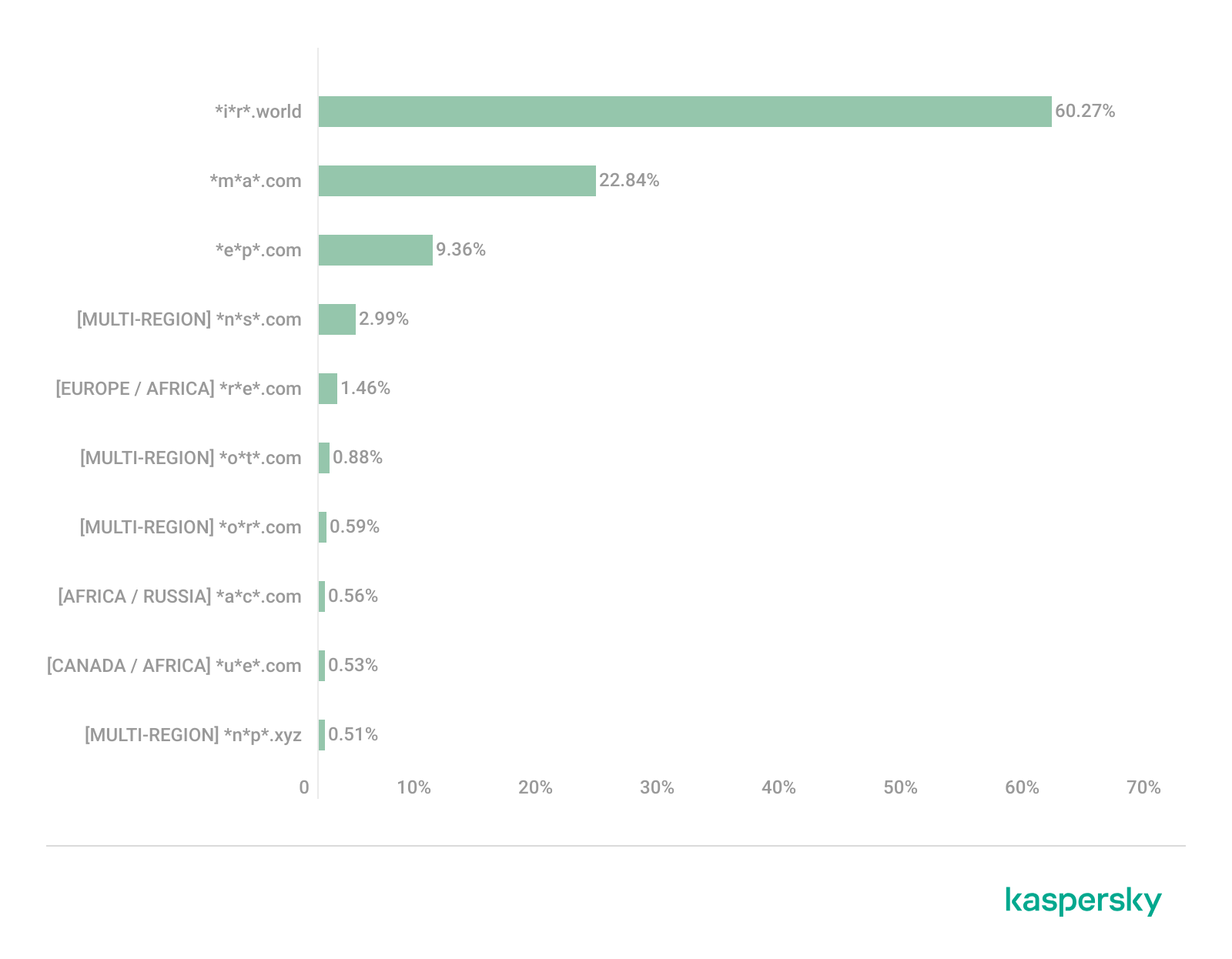
Distribution of the TOP 10 suspicious websites in Africa, January 2026 (download)

The three most prevalent domains in African countries are found exclusively in this region. All of them – *i*r*.world (60.27%), *m*a*.com (22.84%), and *e*p*.com (9.36%) – are potentially fraudulent online trading platforms suspected of using forged licenses. These sites employ classic scam schemes where it’s impossible to withdraw any alleged earnings. In fifth place is a domain we’ll also see in the European TOP 10, *r*e*.com (1.46%): a platform marketed as a tool for retail and semi-professional traders. It charges for services available elsewhere for free. Eighth place is held by a site that also appears in the Russian TOP 10: *a*c*.com (0.56%). This is a dubious AI tool that claims to offer free subscriptions to a premium graphics editor. In ninth place is a domain that also surfaces in the Canadian TOP 10: *u*e*.com (0.53%), a browser extension of the “web protection” variety that we’ve encountered previously.

In summary, the African region is dominated by financial scams within the online trading and brokerage sectors. These include fake platforms that make it impossible to withdraw funds and use fake licenses and classic schemes to steal users’ money. Additionally, Africa sees paid tools that duplicate free services and questionable AI-based subscriptions. The primary threat in this region is financial loss through fraudulent investment-themed sites.

MENA

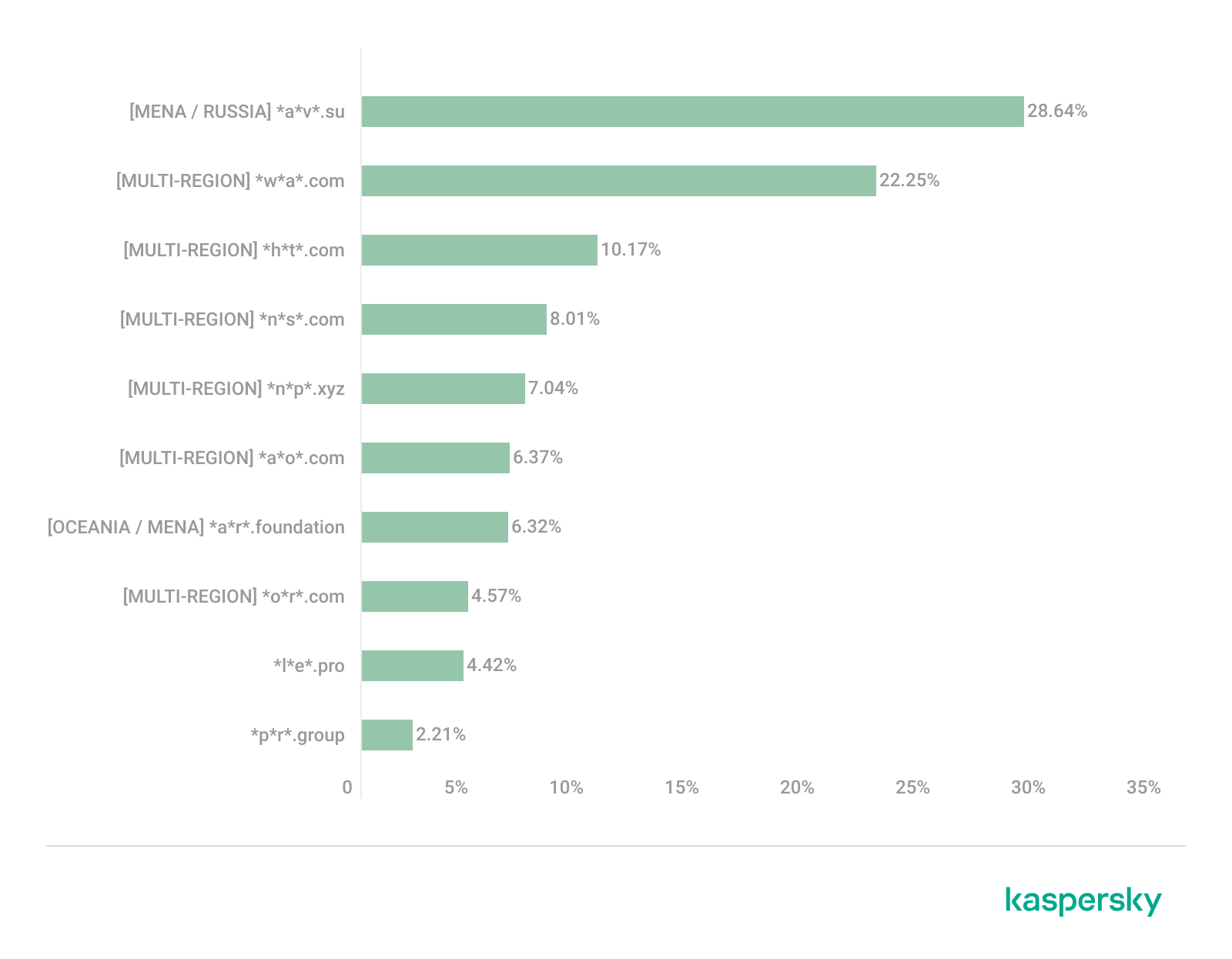
Distribution of the TOP 10 suspicious websites in the Middle East and North Africa, January 2026 (download)

In the MENA region, the site *a*v*.su holds the top spot with a 28.64% share; notably, this site also appears in the TOP 10 for Russia. It markets itself as a tool for building custom VoIP-PBX systems. However, it has an extremely low trust rating and is frequently associated with phishing, and hidden redirects. Using this service carries significant risks, including data leaks, and financial loss.

Ranked seventh is *a*r*.foundation (6.32%), an AI bot allegedly designed for trading, which we also identified in the TOP 10 for Oceania. This service has been flagged as an investment scam operating as a pyramid scheme with the hallmarks of a Ponzi scheme.

The ranking is rounded out by two domains not found in any other region. The first one, *l*e*.pro (4.42%), is a spoof of a popular betting service. The second, *p*r*.group (2.21%), is a clone of a well-known broker. Both sites are scams.

In the MENA region, the landscape is dominated by fake VoIP services as well as counterfeits of financial and betting platforms, which attackers use to conduct phishing attacks, and perform hidden redirects. A significant portion of suspicious sites consists of fake online privacy tools and browser hijackers masquerading as security extensions. Ponzi schemes and cryptocurrency scams are also prominent. The primary risks for the region are data theft, and financial loss.

Latin America

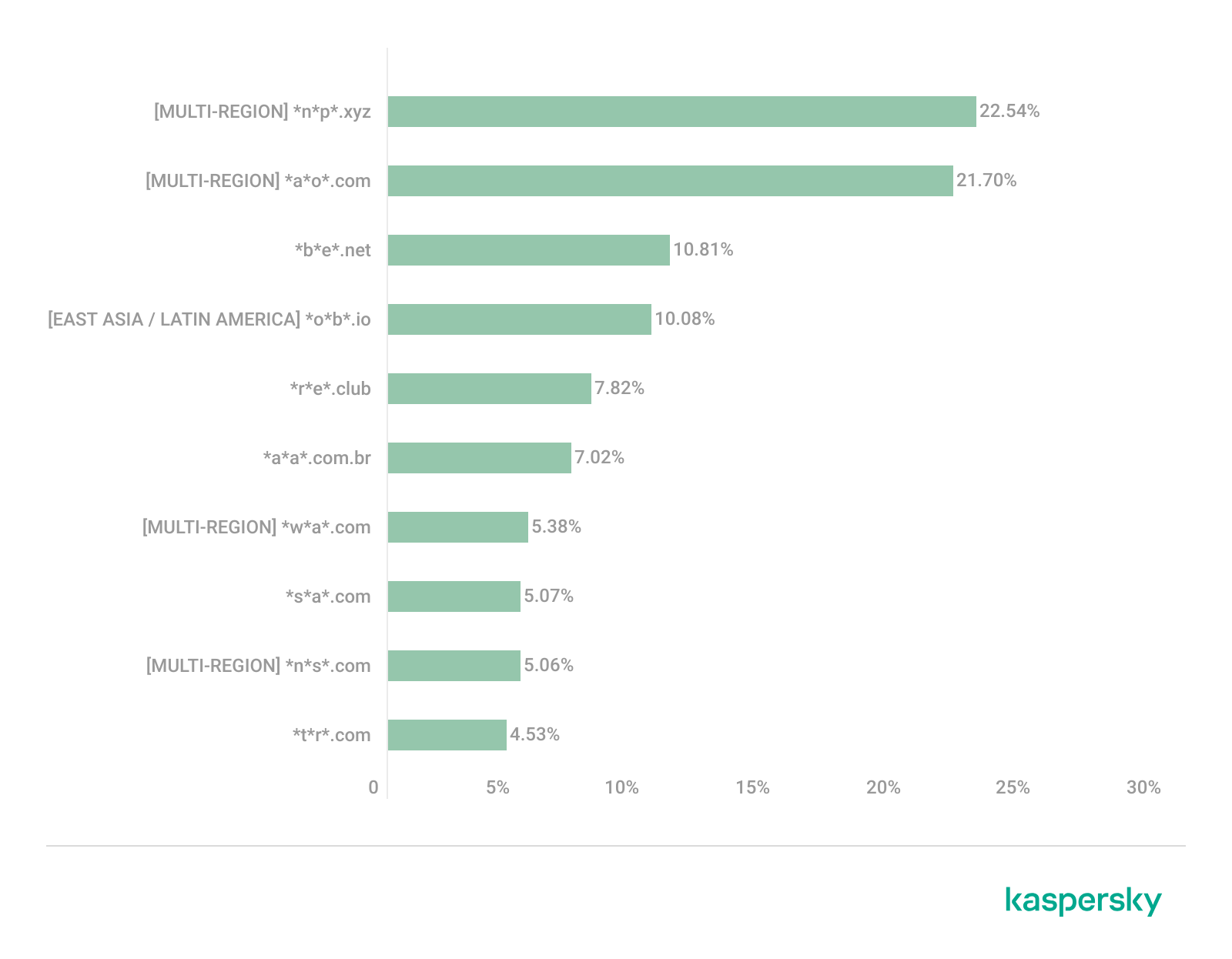
Distribution of the TOP 10 suspicious websites in Latin America, January 2026 (download)

In Latin America, we identified five popular suspicious sites specific to this region, which is unusual compared to other areas where more overlaps are typically observed. Ranking third with a share of 10.81% is the fake betting platform *b*e*.net. In fifth place is *r*e*.club, an illegitimate clone of a well-known bookmaker, with a share of 7.82%.

Further down the list of local threats are *a*a*.com.br (7.02%), a Brazilian Ponzi scam; *s*a*.com (5.07%), which offers dubious investment programs; and *t*r*.com (4.53%), a potentially dangerous trading platform.

In Latin America, the most-visited suspicious sites are betting-themed scams, including both clones of legitimate sites and those built from scratch. Also prevalent are Ponzi schemes, fake investment programs, and dubious online brokers. A significant portion of these sites consists of browser hijackers posing as crypto platforms and AI bots. The primary threats in Latin American countries include financial loss through gambling and Ponzi schemes, as well as the theft of NFTs and other tokens.

East Asia

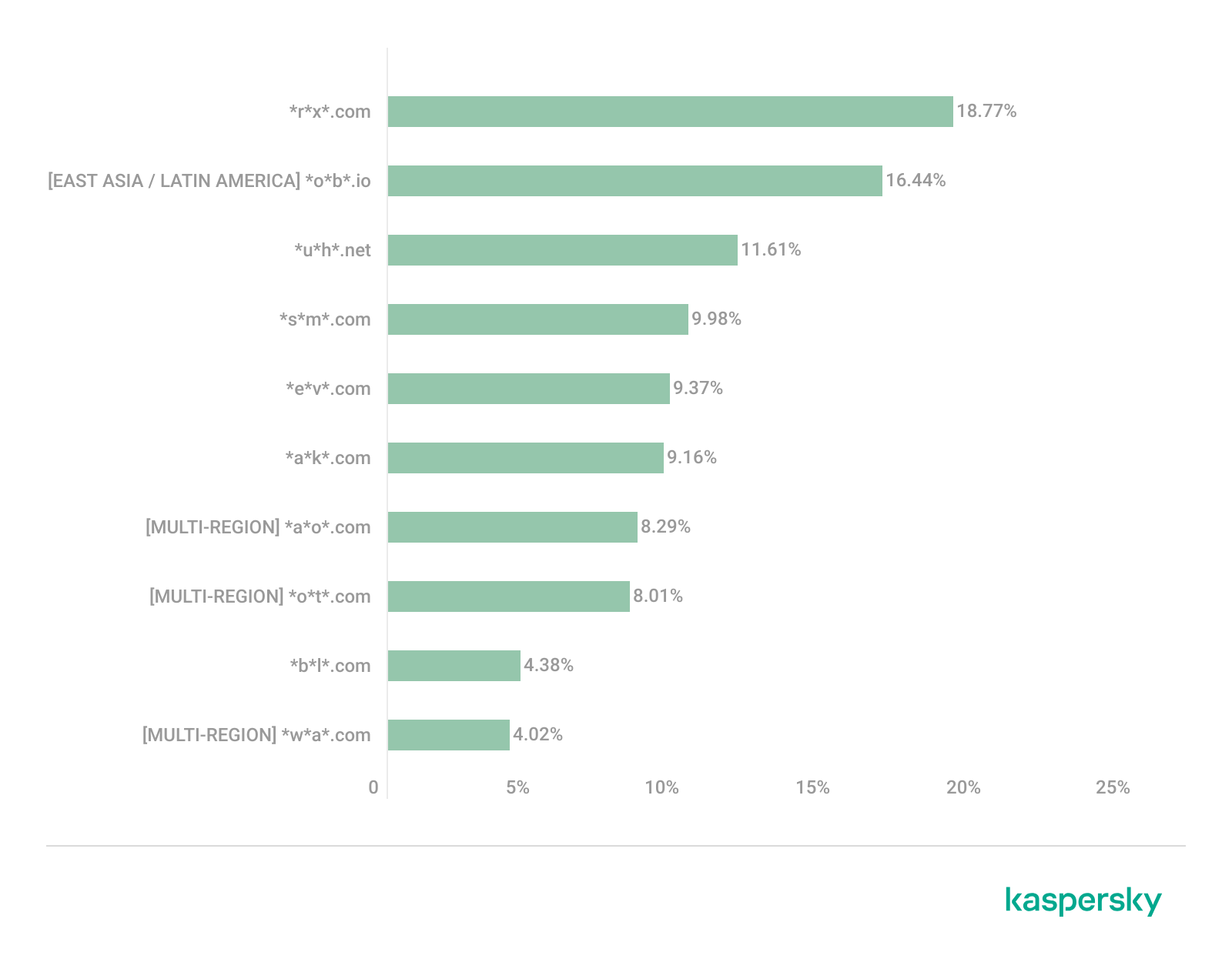
Distribution of the TOP 10 suspicious websites in East Asia, January 2026 (download)

In the East Asian TOP 10, we see the highest concentration of domains that are absent from other regional rankings.

In first place, with an 18.77% share, is the fake broker *r*x*.com, which can be used to steal personal data or funds. Second place is held by a crypto-gaming site (16.44%) that we previously encountered in the Latin American TOP 10. Visitors to this site risk losing NFTs and other tokens. In third place is the domain *u*h*.net (11.61%), used for redirects, which can hijack sessions. Following this is *s*m*.com (9.98%), a domain typically used as a browser-hijacking server and for phishing attacks, serving as a link in an infection chain.

Rounding out the local threats in East Asia are the following domains: *e*v*.com (9.37%), utilized in drive-by attacks; *a*k*.com (9.16%), an API-like domain associated with suspicious scripts and extensions; and *b*l*.com (4.38%), a domain potentially used for redirects.

East Asia has a high concentration of region-specific fake brokers, crypto gaming platforms, and NFT marketplaces. The primary threats for this region include the loss of financial data, NFTs, and other tokens, as well as session hijacking.

South Asia

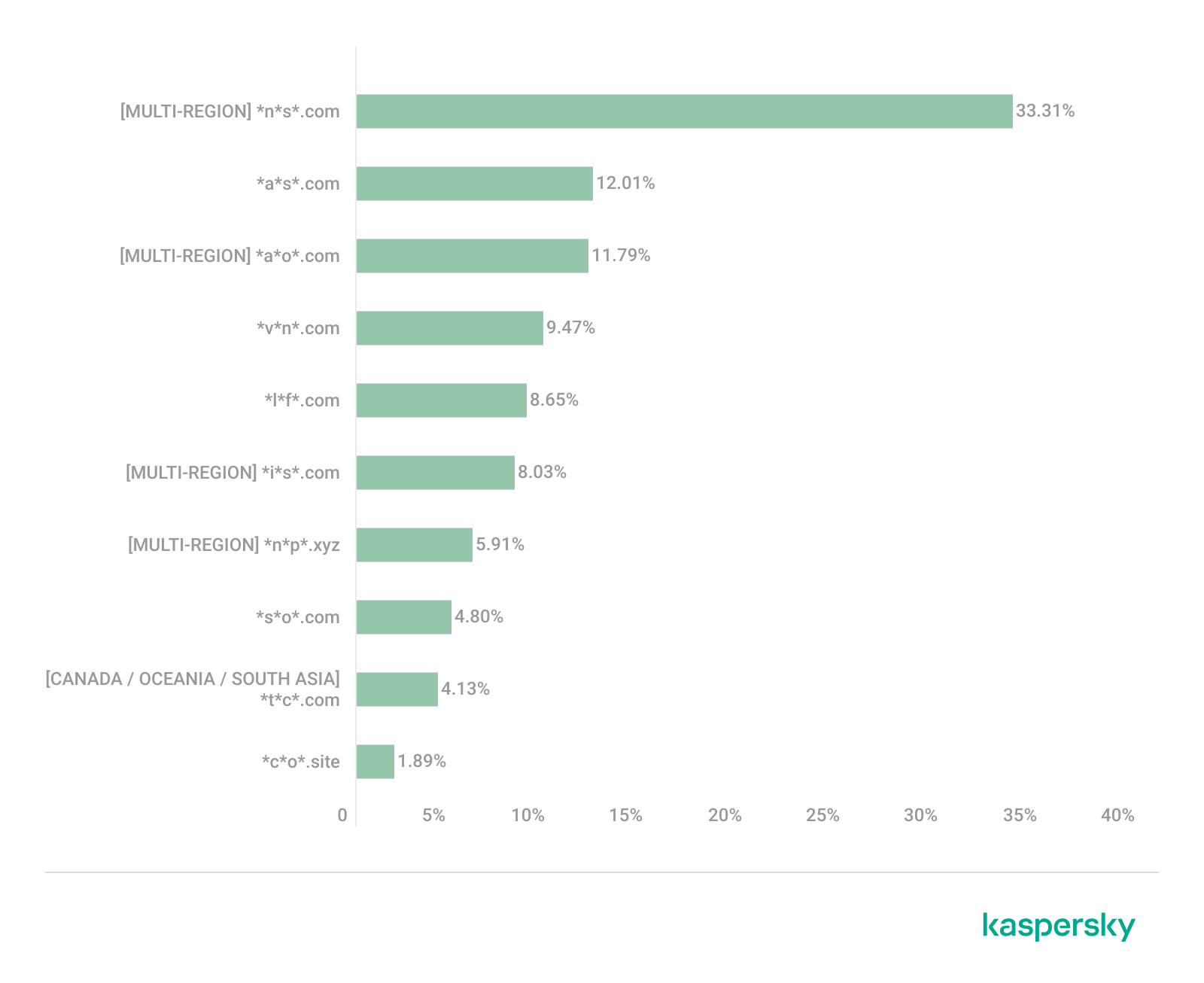
Distribution of the TOP 10 suspicious websites in South Asia, January 2026 (download)

In South Asian countries, we also observe a concentration of local suspicious sites specific to the region.

The second most popular site in the region is *a*s*.com (12.01%), a poor-reputation, high-risk microloan service typical of South Asia. By interacting with these sites, users risk not only losing significant funds but also compromising their overall security. Following this are *v*n*.com with a 9.47% share and *l*f*.com with 8.65%. These domains are employed in various fraudulent schemes, ranging from phishing to spam.

The TOP 10 also includes *s*o*.com (4.80%), a free video downloading service associated with a high risk of infection. The final site we analyzed in the South Asia region is *c*o*.site (1.89%), a pseudo-tool for local SEO optimization that carries the danger of data loss and a high risk of financial fraud through subscription sign-ups.

In summary, the region is dominated by fake antivirus extensions, microloan services, dubious video downloaders, and counterfeit SEO tools. The primary risks for South Asia include financial fraud, phishing and spam distribution, and data theft.

CIS

When analyzing statistics for suspicious sites in CIS countries, we treat Russia as a separate region due to the unique characteristics of its online space which are not found in any other CIS member states. However, we’ve placed these two regions in the same section, as we’ve observed overlaps between them that are not seen in other parts of the world.

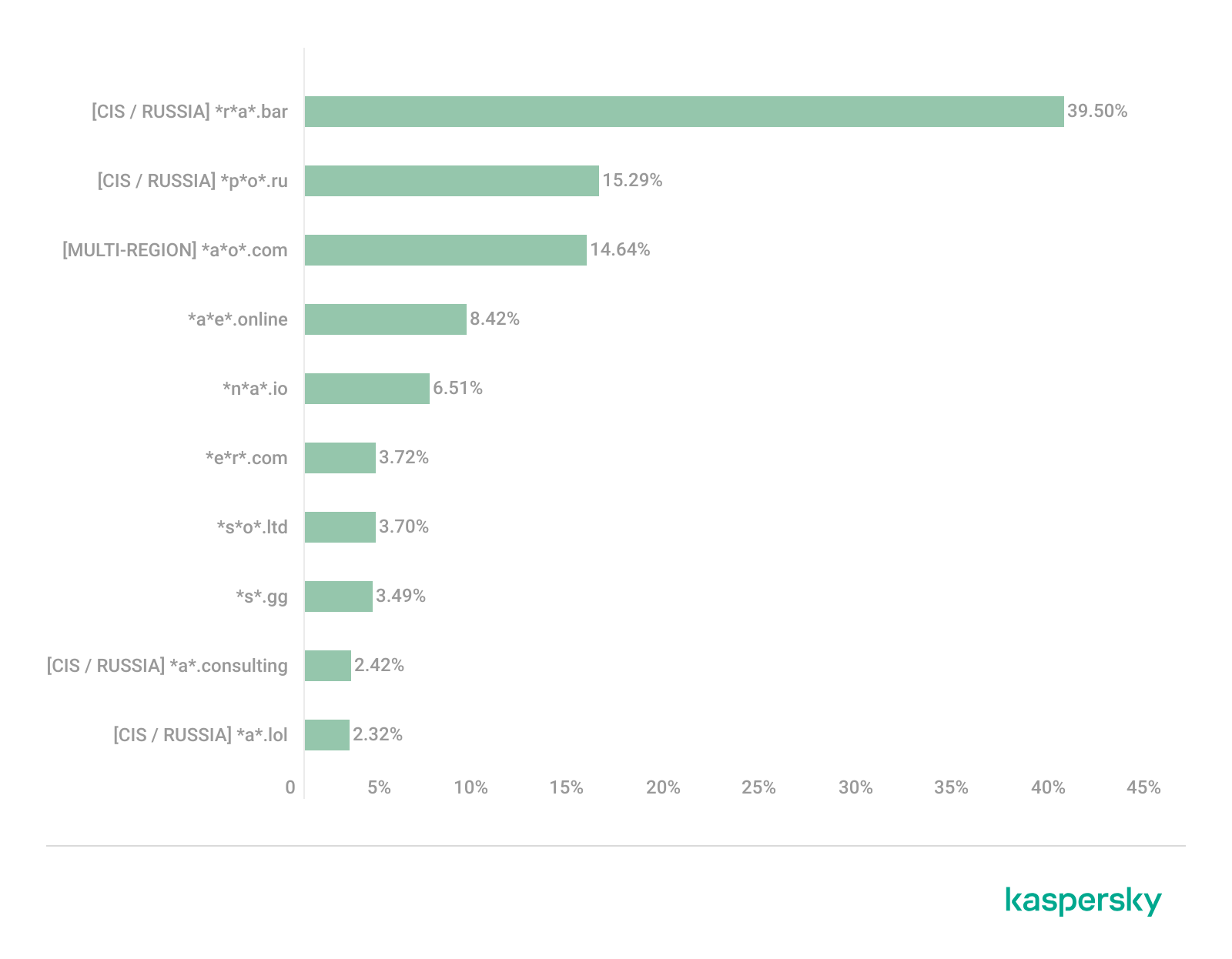
Distribution of the TOP 10 suspicious websites in the CIS, January 2026 (download)

The top two sites in the CIS TOP 10 also appear in the Russian TOP 10. The domain *r*a*.bar, which ranks first in the CIS (39.50%), holds the second spot in Russia (15.93%) and is a fake trading site. It’s worth noting that sites in the .bar domain zone are frequently used for scams. In second place in the CIS (15.29%) and sixth in Russia (3.75%) is the domain *p*o*.ru, which is often associated with bots for inflating follower counts and automating community management.

Domains from fourth to eighth place are specific only to the CIS region and don’t appear in the Russian TOP 10. These sites include:

  • *a*e*.online (8.42%): an online image editor that carries risks of data harvesting
  • *n*a*.io (6.51%): a high-risk cryptocurrency trading platform
  • *e*r*.com (3.72%): a site promising free cryptocurrency and posing the risk of compromising visitors’ private keys and digital wallets
  • *s*o*.ltd (3.70%): a domain with an extremely low trust rating
  • *s*.gg (3.49%): a scam site masquerading as a play-to-earn blockchain game

The ranking concludes with sites that overlap with the Russian region. *a*.consulting (2.42%) is a fake clone of a binary options site, and *a*.lol (2.32%) is a domain suspected of dubious activity.

The CIS landscape is dominated by fake trading platforms (particularly crypto exchanges), promises of easy profits, play-to-earn scams, and dubious investment projects. We also observe many bots for inflating social metrics and automation. The primary threat in the CIS is the theft of private keys, digital wallets, and funds through investment schemes and lures involving online promotion.

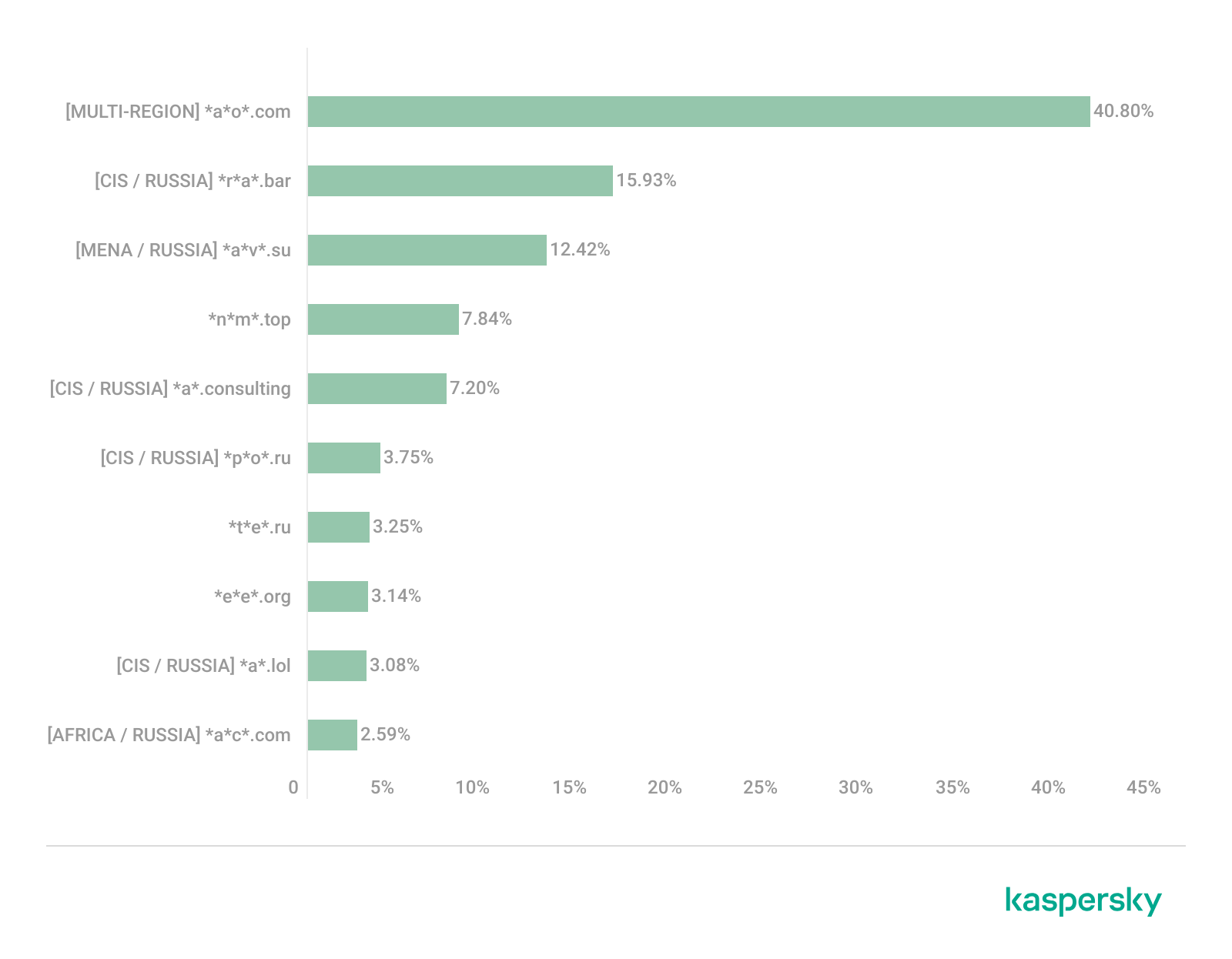
Distribution of the TOP 10 suspicious websites in Russia, January 2026 (download)

The Russian TOP 10 includes three unique domains not found in the rankings of other regions. The first, *n*m*.top (7.84%), is an imitator of a well-known binary options broker. This suspicious site was recently registered and has a tellingly low rating on domain verification services. The second, *t*e*.ru (3.25%), claims to be an educational platform and has a dubious subscription system with a high probability of fraud involving difficulties in canceling subscriptions. The third site, *e*e*.org (3.14%), positions itself as a tool for a popular media platform, but it’s actually a scam that fails to provide its stated services.

Overall, the Russian landscape is characterized by fake binary options brokers and sketchy sites with fraudulent subscriptions posing as e-learning platforms. There are also frequent instances of sites spoofing well-known legitimate services. The primary risks in Russia are scams related to the knowledge business sector, as well as the theft of money and personal data.

Europe

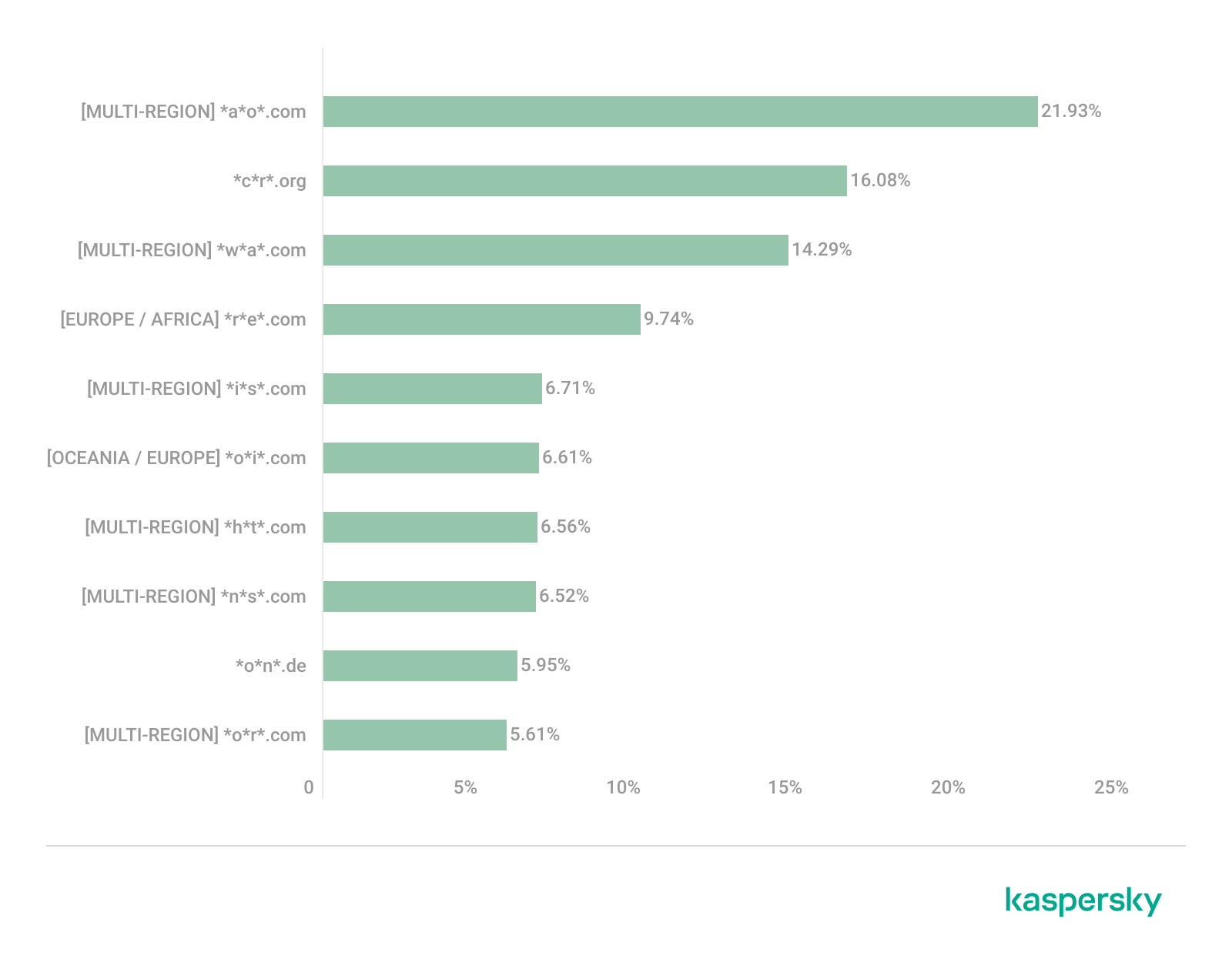
Distribution of the TOP 10 suspicious websites in Europe, January 2026 (download)

In the European region, we’ve found two unique domains. The first of these, *c*r*.org, has been identified as part of a chain for massive phishing and spam attacks. It accounts for a 16.08% share of the TOP 10. The second site, *o*n*.de, is an unofficial reseller with a poor reputation and a high likelihood of fraud. This domain ranks second to last in our statistics with a 5.95% share.

Among the sites not previously covered, the European TOP 10 includes one site that also appears in the Oceania TOP 10: *o*i*.com (6.61%). This is a classic cryptocurrency scam promising passive income.

A significant portion of suspicious sites in Europe consists of intermediary sites for phishing and spam, fake security extensions, and crypto scams. Unofficial sales services and paid trading tools are also on the list. The primary threats in the European region include session hijacking, data theft, spam, and investment fraud.

Canada

Distribution of the TOP 10 suspicious websites in Canada, January 2026 (download)

Canada has been designated as a separate region to illustrate prevailing trends within North America. The first four positions in the Canadian TOP 10 are held by multiregional domains discussed previously. In fifth place is *t*c*.com (10.88%), which also appears in the TOP 10 rankings for Oceania and South Asia. This is yet another browser extension masquerading as a security solution. Occupying the final spot is the domain *e*w*.com (0.17%), which is unique to the Canadian market. This site operates a dropshipping scam, offering products at prices significantly below market value. Customers typically either never receive their orders or get low-quality counterfeits.

The landscape of dubious websites in Canada is largely defined by fraudulent extensions capable of hijacking browser data, tracking user activity, spoofing search queries, harvesting cookies, and injecting ads. This is further compounded by dropshipping schemes involving counterfeit goods. The primary risks for users in Canada include data theft and financial loss from purchasing substandard products.

Oceania

Distribution of the TOP 10 suspicious websites in Oceania, January 2026 (download)

The final region under consideration is Oceania. Notably, we didn’t identify a single domain unique to this region. Every site appearing in the TOP 10 represents a global threat that’s already been detailed in previous sections. To summarize the findings for this region: the primary threats consist of fake security extensions and privacy products designed for browser hijacking, tracking user activity, displaying advertisements, and stealing data. There’s a minimal presence of crypto Ponzi schemes in this area. The main risk for users in Oceania is the loss of privacy and confidentiality through unwanted apps.

Conclusion

Suspicious websites are particularly dangerous because they often masquerade as legitimate sites with high levels of persuasiveness. They mimic online stores, subscription-based streaming platforms, repair firms, and various other services. Unlike standard phishing sites, they employ more sophisticated manipulations to deceive users, tricking them into voluntarily handing over their personal data and transferring funds.

By examining the TOP 10 suspicious sites across the world’s major regions, we can draw several conclusions. On average, the most prevalent threats globally are fraudulent extensions masquerading as security solutions and privacy services. Their true purpose is to hijack browser data, track user activity, and display ads. We also frequently encounter phishing platforms for image processing and financial scams involving trading, cryptocurrency, betting, and microloans. Our statistics demonstrate that these sites not only employ classic fraudulent schemes centered on easy money but also adapt to contemporary trends targeting younger audiences and specific regional characteristics. The primary risks for users interacting with these sites are a combination of privacy threats and financial loss.

To help protect users from these shady sites, we’ve introduced the category of “websites with an undefined trust level” as part of the web filtering features in our solutions. However, it’s important to note that user awareness and individual responsibility play a significant role in ensuring safe web browsing. It’s essential for users to be able to recognize suspicious sites and remain vigilant toward any that appear untrustworthy.

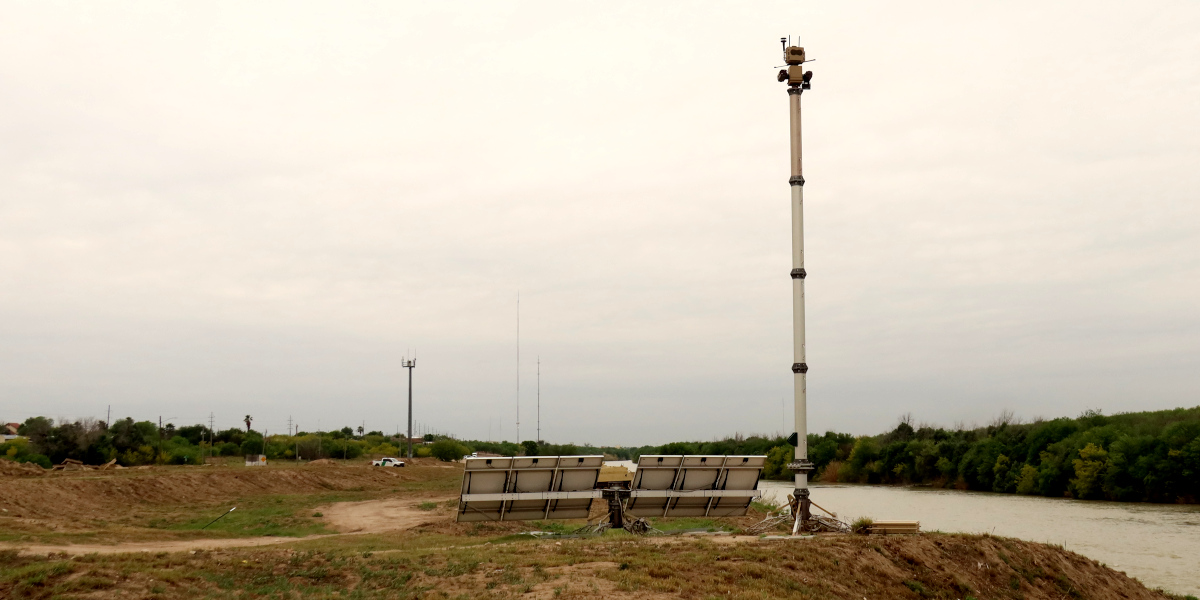
California Coastal Community Must Reject CBP's AI-Powered Surveillance Tower

24 April 2026 at 22:04

Customs and Border Protection (CBP) is seeking permission from the California city of San Clemente to install an Anduril Industries surveillance tower on a cliff that would allow for constant monitoring of entire coastal neighborhoods. 

The proposed tower is Anduril's Sentry, part of the Autonomous Surveillance Tower (AST) program. While CBP says it will primarily monitor the coastline for boats carrying migrants, it will actually be installed 1.5 miles inland, overlooking the bulk of the 62,000-resident city. By CBP's own public statement, the system–which combines video, radar, and computer vision–is "constantly scanning" for movement and identifying and tracking objects an AI algorithm decides are of interest. Depending on the model–the photos provided by CBP indicate it is a long range maritime model–the camera could see as far as nine miles, which would cover the entire city and potentially see as far as neighboring Dana Point.
Map of San Clemente showing 1.5 miles between the tower and the coast

"The AST utilize advanced computer vision algorithms to autonomously detect, identify, and track items of interest (IoI) as they transit through the towers field of view," CBP writes in a privacy threshold analysis. "The system can determine if an IoI is a human, animal, or vehicle without operator intervention. The system then generates and transmits an alert to operators with the location and images of the IoI for adjudication and response." 

On April 28, local residents and Oakland Privacy, a privacy- and anti-surveillance-focused citizens’ coalition, are holding a town hall to inform the public about the dangers of this technology. We urge people to attend to better understand what's at stake. 

"The planned deployment of an Anduril tower along a heavily used Orange County coastline 75 miles from the border demonstrates that the militarization of the border region is rapidly moving northwards and across the entire state," writes Oakland Privacy. 

City officials raised concerns about resident privacy and proposed that a lease agreement include a prohibition on surveilling neighborhoods. CBP rejected that proposal, instead saying that they would configure the tower to "avoid" scanning residential neighborhoods, but the system would remain capable of tracking human beings in residential areas. According to the staff report: 

In response to privacy concerns, CBP has stated the system would be configured to avoid scanning residential areas that fall into the scan viewshed, focusing the system on the marine environment. CBP has maintained the purpose of the system is specifically maritime surveillance, and the system would be singularly focused on offshore activities. However, there may be an instance in which there is an active smuggling event, detected by the system at sea, in which the subsequent smuggling event traverses through the residential neighborhoods. In such a case, the system may continue to track and monitor. To restrict this functionality would be contrary to the spirit and intent of the deployment. Therefore, they cannot make such a contractual obligation.

The Anduril towers retain a variety of data, including images and more. 

image of surveillance tower from public records

The proposed Anduril surveillance tower. Source: City of San Clemente

"The AST capture and retain imagery which occurs in plan view of the tower sites and is stored as an individual event with a unique event identified allowing replay of the event for further investigation or dismissal based on activity occurring," according to the private threshold analysis.

The document indicates a potential 30-day retention period for imagery, but then contradicts itself to say that data will be held indefinitely to train algorithms: "AST will also be maintaining learning training data, these records should not be deleted." This means that taxpayers would be paying for the privilege of having their data turned into fuel for Anduril's product.

In 2020 CBP said it would work with National Archives and Records Administration (NARA) to develop a retention schedule for training data (i.e., a timeline for deletion). However, when EFF filed a Freedom of Information Act (FOIA) with NARA, the agency said there were no records of these discussions. Likewise, CBP has not provided records in response to the FOIA request EFF filed with them seeking the same records. 

An Anduril surveillance tower at the borde fence with a Border Patrol vehicle.

Anduril Maritime Sentry in San Diego, where the border fence meets the ocean.

This would not be the first CBP tower placed along the coastline in California. EFF identified one in Del Mar, about 30 miles from the border, and another in San Diego County where the border fence meets the Pacific Ocean. CBP has also applied to place towers–although not necessarily the Anduril model–in or near several other coastal locations: Gaviota State Park, Refugio State Park, Vandenberg Air Force Base, Piedras Blancas and Point Vicente. The California coastline isn’t the only coastline dotted with surveillance towers. The Migrant Rights Network has also documented numerous Anduril towers along the southeast coast of England. Where the San Clemente tower would differ is that there is a substantial population between the tower and the beach, and because it's a 360-degree system, it can watch neighborhoods even further from the coast. 

However, this won't be the first time an Anduril tower has been placed next to a community. EFF has documented numerous Anduril towers in public parks along the Rio Grande in Laredo and Roma, Texas. In Mission, Texas, an Anduril tower was placed outside an RV park: the tower could not even see the border without capturing data from the community. Because AI can swivel the cameras 360 degrees, two churches were within the "viewshed" of that tower. 

Click here to view EFF's ongoing map of CBP surveillance towers.

Many border surveillance towers are placed on city or county property, requiring a lease to be approved by the local governing body–as is the case with San Clemente. In 2024, EFF and Imperial Valley Equity and Justice organized an effort to fight the renewal of a Border Patrol's lease for a tower next to a public park. The coalition lost narrowly after a recall election ousted two officials who were critical of the lease.

CBP is rapidly increasing the number of towers at the border and beyond, recently announcing the potential to install 1,500 more towers in the next few years–more than tripling what we've documented so far–at a cost of more than $400 million to the public for maintenance alone. This is despite more than 20 years of government reports that have documented how tower-based systems are ineffective and wasteful.

It's time to fight back. 

Hot Off the Press: EFF's Updated Guide to Tech at the US-Mexico Border

13 April 2026 at 19:35

When people see Customs & Border Protection's giant, tethered surveillance blimp flying 20 miles outside of Marfa, Texas, lots of them confuse it with an art installation. Elsewhere along the U.S.-Mexico border, surveillance towers get mistaken for cell-phone towers. And that traffic barrel? It's actually a camera. That piece of rusted litter? That's a camera too.

Today we are publishing a major update to our zine, "Surveillance Technology at the U.S.-Mexico Border," the first since the second Trump administration began. To help people identify the machinery of homeland security, we've added more models of surveillance towers, newly deployed military tech, and a gallery of disguised trail cams and automated license plate readers.

You can get this 40-page, full-color guide through EFF's Shop or download a Creative-Commons licensed version here.

"The Battalion Search and Rescue always carries the Electronic Frontier Foundation’s zine in our desert rig," says James Holeman, who founded the humanitarian group that looks for human remains in remote parts of New Mexico and Arizona. "We’re finding new surveillance all the time, and without a resource like that, we wouldn't know what the hell we're looking at.”

The original version of the zine was distributed nearly exclusively to our allies in the borderlands—journalists, humanitarian aid workers, immigrant advocates—to help them better identify and report on the technology they discover on the ground. We only made a handful available in our online shop, and they went fast.

This time, we've printed enough for our broader EFF membership. Even if you don't live near the border, you can support our work uncovering how the U.S. Department of Homeland Security's technology threatens human rights by picking up a copy.

The zine is the culmination of a dozen trips to the border, where we hunted surveillance towers and other tech installations. We attended multiple border security conventions to collect promotional and technical materials directly from vendors. We filed public records requests, reviewed thousands of pages of docs, and analyzed satellite imagery of the entire 2,000-mile border several times over. Some of the images came from local allies, like geographer Dugan Meyer and Borderlands Relief Collective, who continue to share valuable intelligence on the changing landscape of border surveillance.

The update is available in English, with an updated Spanish version expected later this year. In the meantime, we have reprinted the original Spanish edition.

If you want to know more, a collection of EFF's broader work on border technology is available here. And if you're curious exactly where these technologies are located, you can check our ongoing map.

SUPPORT THIS WORK

The game is over: when “free” comes at too high a price. What we know about RenEngine

11 February 2026 at 15:00

We often describe cases of malware distribution under the guise of game cheats and pirated software. Sometimes such methods are used to spread complex malware that employs advanced techniques and sophisticated infection chains.

In February 2026, researchers from Howler Cell announced the discovery of a mass campaign distributing pirated games infected with a previously unknown family of malware. It turned out to be a loader called RenEngine, which was delivered to the device using a modified version of the Ren’Py engine-based game launcher. Kaspersky solutions detect the RenEngine loader as Trojan.Python.Agent.nb and HEUR:Trojan.Python.Agent.gen.

However, this threat is not new. Our solutions began detecting the first samples of the RenEngine loader in March 2025, when it was used to distribute the Lumma stealer (Trojan-PSW.Win32.Lumma.gen).

In the ongoing incidents, ACR Stealer (Trojan-PSW.Win32.ACRstealer.gen) is being distributed as the final payload. We have been monitoring this campaign for a long time and will share some details in this article.

Incident analysis

Disguise as a visual novel

Let’s look at the first incident, which we detected in March 2025. At that time, the attackers distributed the malware under the guise of a hacked game on a popular gaming web resource.

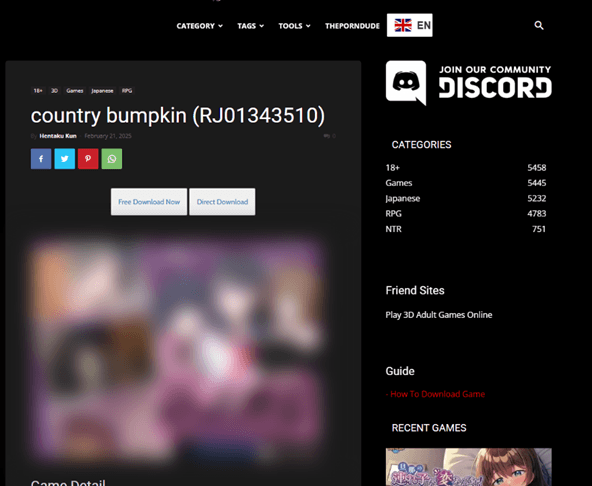
The website featured a game download page with two buttons: Free Download Now and Direct Download. Both buttons had the same functionality: they redirected users to the MEGA file-sharing service, where they were offered to download an archive with the “game.”

Game download page

Game download page


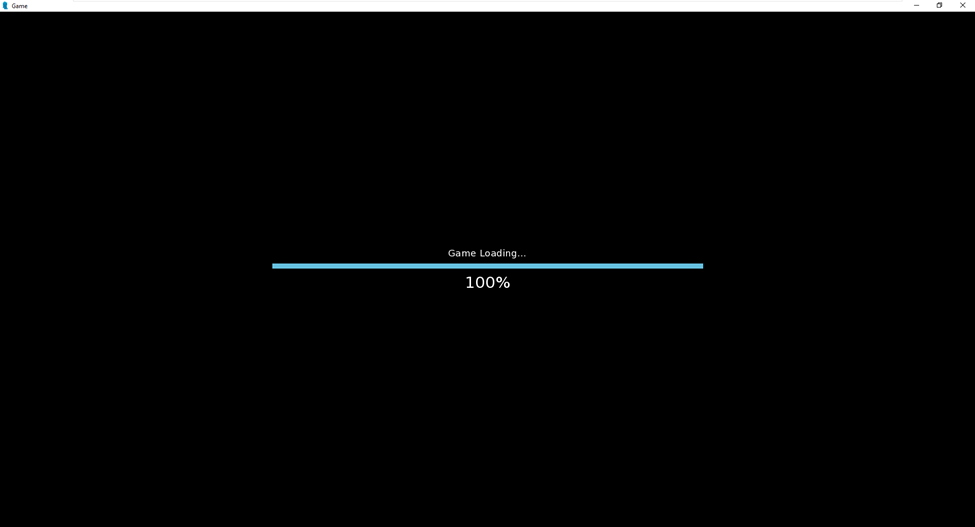
When the “game” was launched, the download process would stop at 100%. One might think that the game froze, but that was not the case — the “real” malicious code just started working.
Placeholder with the download screen

Placeholder with the download screen

“Game” source files analysis

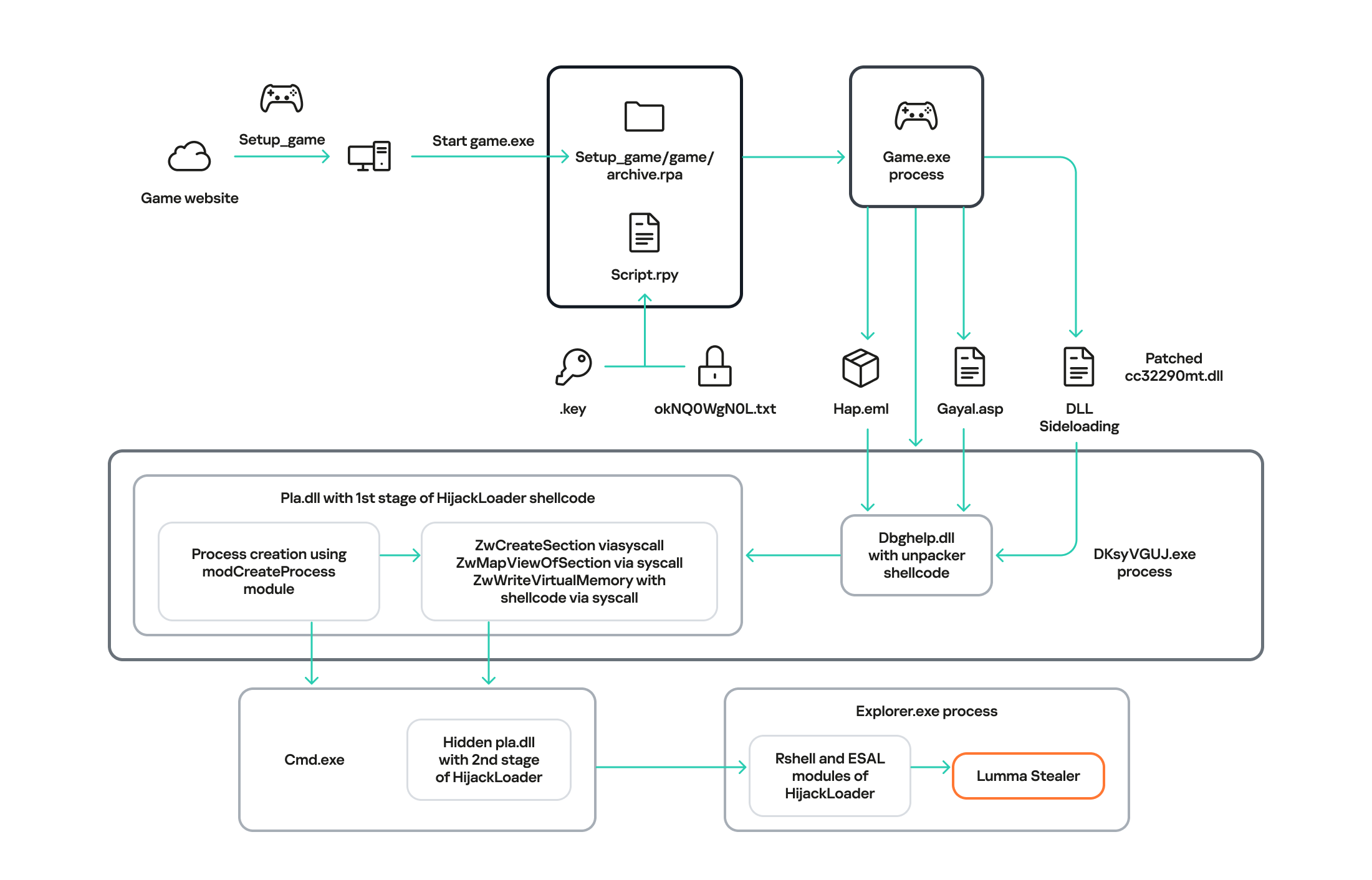
The full infection chain

The full infection chain


After analyzing the source files, we found Python scripts that initiated the initial device infection. These scripts imitated the endless loading of the game. In addition, they contained the is_sandboxed function for bypassing the sandbox and xor_decrypt_file for decrypting the malicious payload. Using the latter, the script decrypts the ZIP archive, unpacks its contents into the .temp directory, and launches the unpacked files.
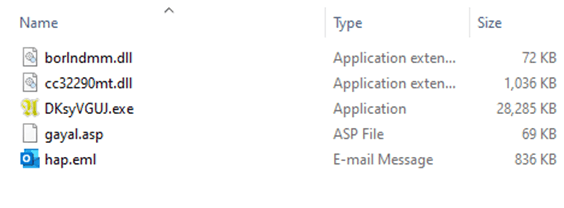
Contents of the .temp directory

Contents of the .temp directory


There are five files in the .temp directory. The DKsyVGUJ.exe executable is not malicious. Its original name is Ahnenblatt4.exe, and it is a well-known legitimate application for organizing genealogical data. The borlndmm.dll library also does not contain malicious code; it implements the memory manager required to run the executable. Another library, cc32290mt.dll, contains a code snippet patched by attackers that intercepts control when the application is launched and deploys the first stage of the payload in the process memory.

HijackLoader

The dbghelp.dll system library is used as a “container” to launch the first stage of the payload. It is overwritten in memory with decrypted shellcode obtained from the gayal.asp file using the cc32290mt.dll library. The resulting payload is HijackLoader. This is a relatively new means of delivering and deploying malicious implants. A distinctive feature of this malware family is its modularity and configuration flexibility. HijackLoader was first detected and described in the summer of 2023. More detailed information about this loader is available to customers of the Kaspersky Intelligence Reporting Service.

The final payload can be delivered in two ways, depending on the configuration parameters of the malicious sample. The main HijackLoader ti module is used to launch and prepare the process for the final payload injection. In some cases, an additional module is also used, which is injected into an intermediate process launched by the main one. The code that performs the injection is the same in both cases.

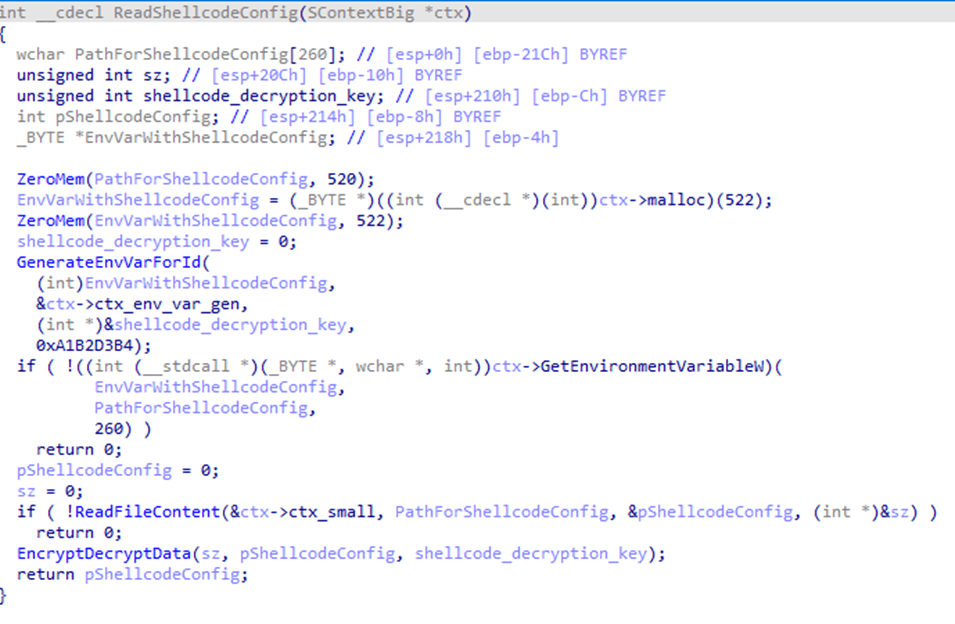
Before creating a child process, the configuration parameters are encrypted using XOR and saved to the %TEMP% directory with a random name. The file name is written to the system environment variables.

Loading configuration parameters saved by the main module

Loading configuration parameters saved by the main module


In the analyzed sample, the execution follows a longer path with an intermediate child process, cmd.exe. It is created in suspended mode by calling the auxiliary module modCreateProcess. Then, using the ZwCreateSection and ZwMapViewOfSection system API calls, the code of the same dbghelp.dll library is loaded into the address space of the process, after which it intercepts control.

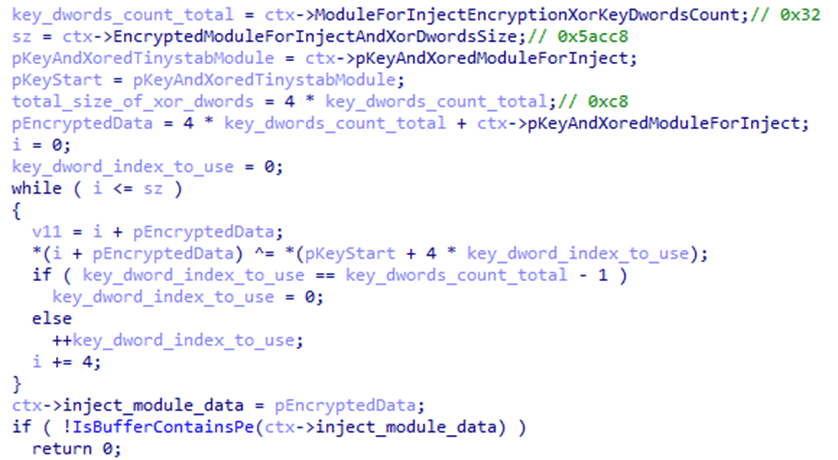
Next, the ti module, launched inside the child process, reads the hap.eml file, from which it decrypts the second stage of HijackLoader. The module then loads the pla.dll system library and overwrites the beginning of its code section with the received payload, after which it transfers control to this library.

Payload decryption

Payload decryption


The decrypted payload is an EXE file, and the configuration parameters are set to inject it into the explorer.exe child process. The payload is written to the memory of the child process in several stages:
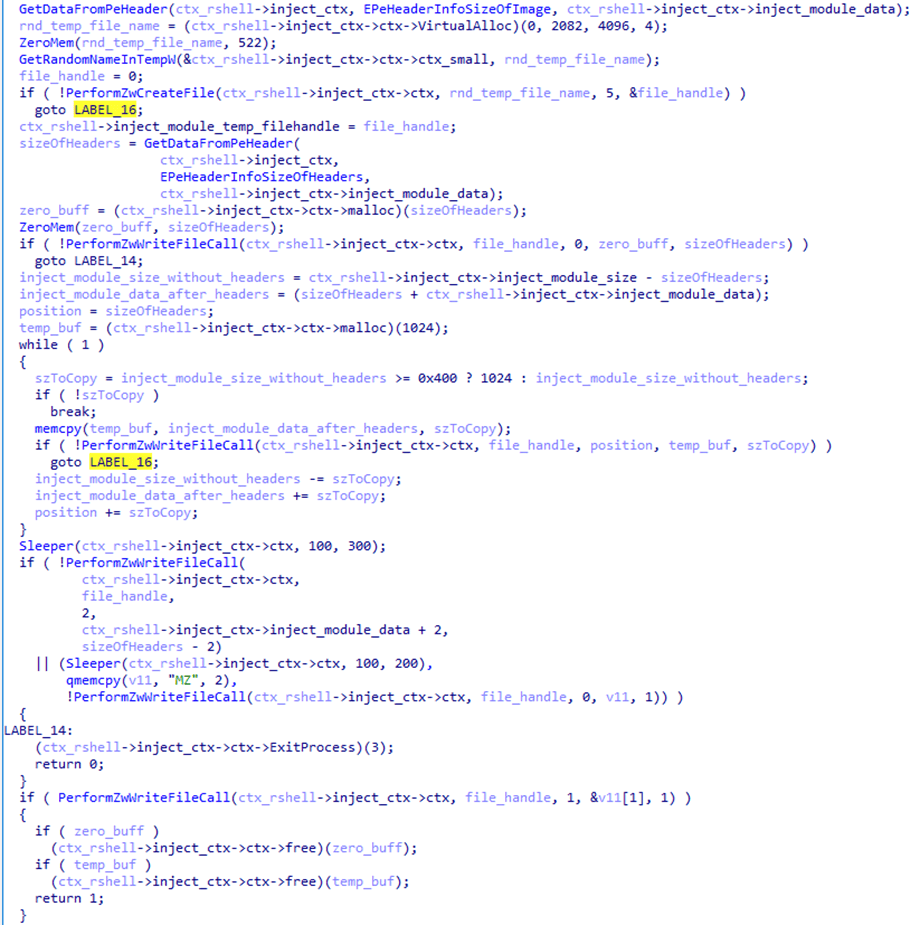
  1. First, the malicious payload is written to a temporary file on disk using the transaction mechanism provided by the Windows API. The payload is written in several stages and not in the order in which the data is stored in the file. The MZ signature, with which any PE file begins, is written last with a delay.
    Writing the payload to a temporary file

    Writing the payload to a temporary file

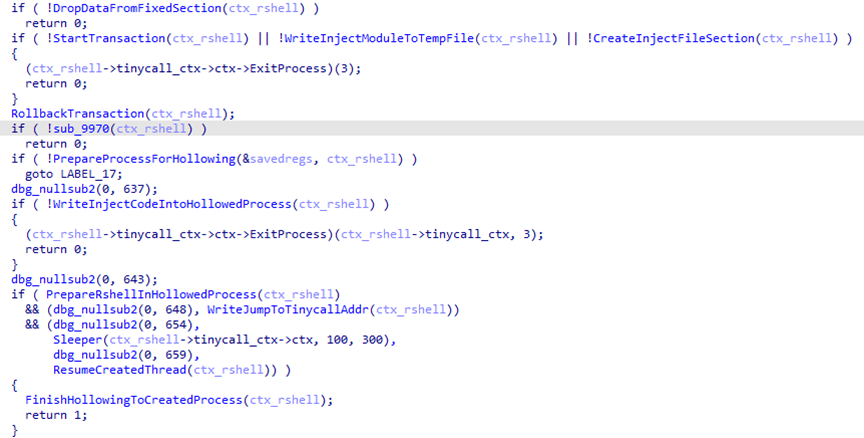
  2. After that, the payload is loaded from the temporary file into the address space of the current process using the ZwCreateSection call. The transaction that wrote to the file is rolled back, thus deleting the temporary file with the payload.
  3. Next, the sample uses the modCreateProcess module to launch the child process explorer.exe and injects the payload into it by creating a shared memory region with the ZwMapViewOfSection call.
    Payload injection into the child process

    Payload injection into the child process


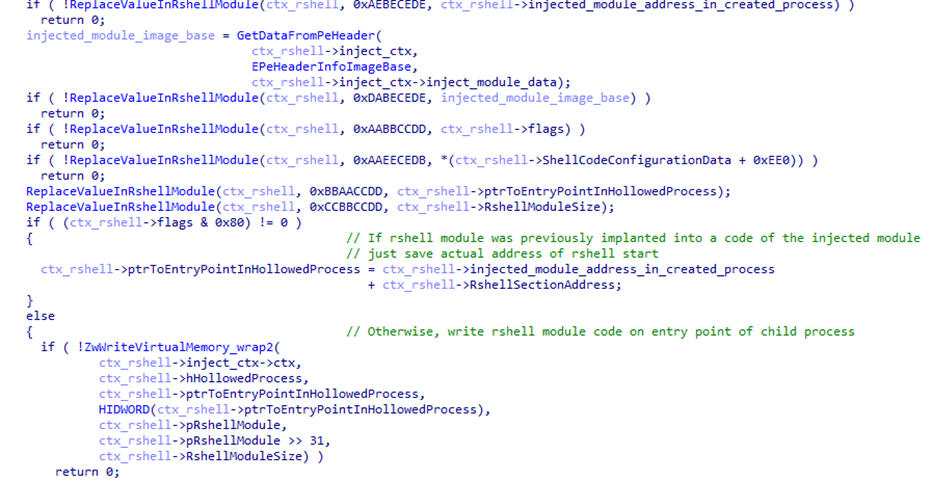
    Another HijackLoader module, rshell, is used to launch the shellcode. Its contents are also injected into the child process, replacing the code located at its entry point.
    The rshell module injection

    The rshell module injection

  4. The last step performed by the parent process is starting a thread in the child process by calling ZwResumeThread. After that, the thread starts executing the rshell module code placed at the child process entry point, and the parent process terminates.

    The rshell module prepares the final malicious payload. Once it has finished, it transfers control to another HijackLoader module called ESAL. It replaces the contents of rshell with zeros using the memset function and launches the final payload, which is a stealer from the Lumma family (Trojan-PSW.Win32.Lumma).

In addition to the modules described above, this HijackLoader sample contains the following modules, which were used at intermediate stages: COPYLIST, modTask, modUAC, and modWriteFile.
Kaspersky solutions detect HijackLoader with the verdicts Trojan.Win32.Penguish and Trojan.Win32.DllHijacker.

Not only games

In addition to gaming sites, we found that attackers created dozens of different web resources to distribute RenEngine under the guise of pirated software. On one such site, for example, users can supposedly download an activated version of the CorelDRAW graphics editor.

Distribution of RenEngine under the guise of the CorelDRAW pirated version

Distribution of RenEngine under the guise of the CorelDRAW pirated version


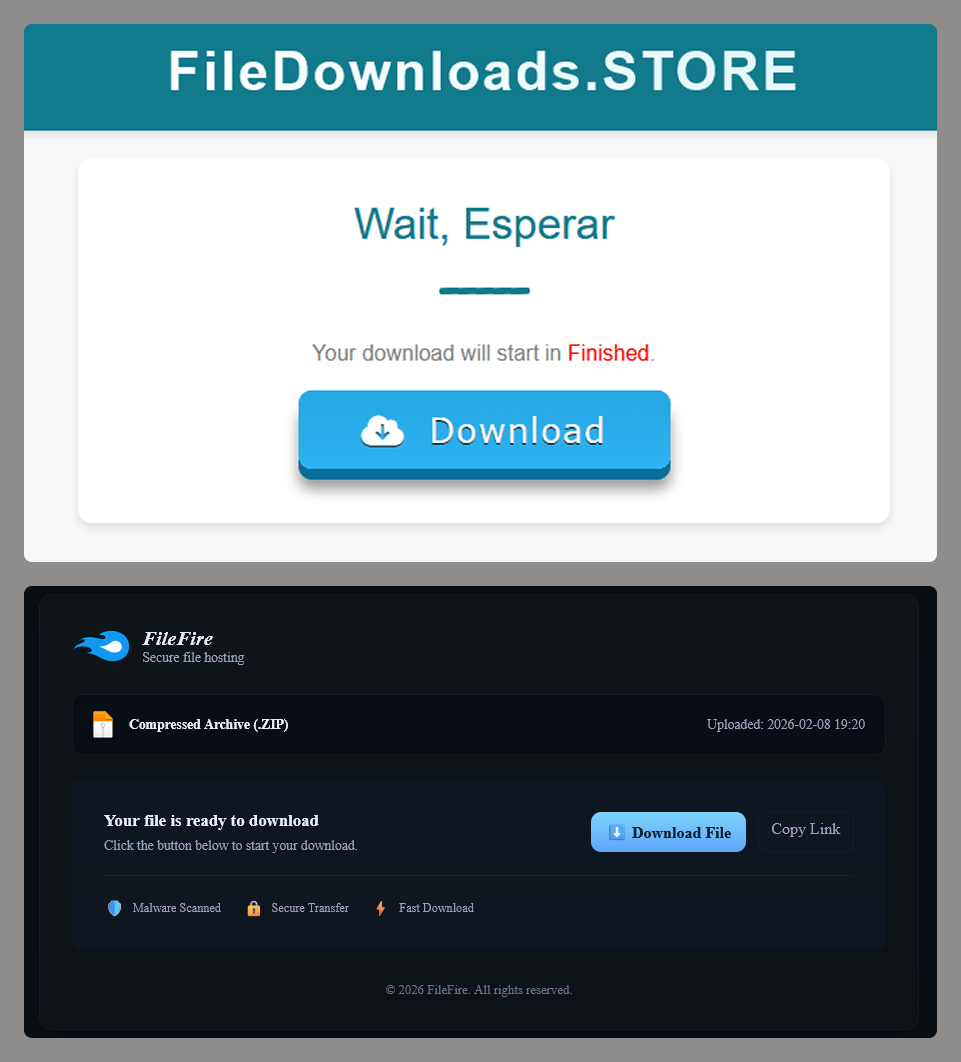
When the user clicks the Descargar Ahora (“Download Now”) button, they are redirected several times to other malicious websites, after which an infected archive is downloaded to their device.
File storage imitations

File storage imitations

Distribution

According to our data, since March 2025, RenEngine has affected users in the following countries:

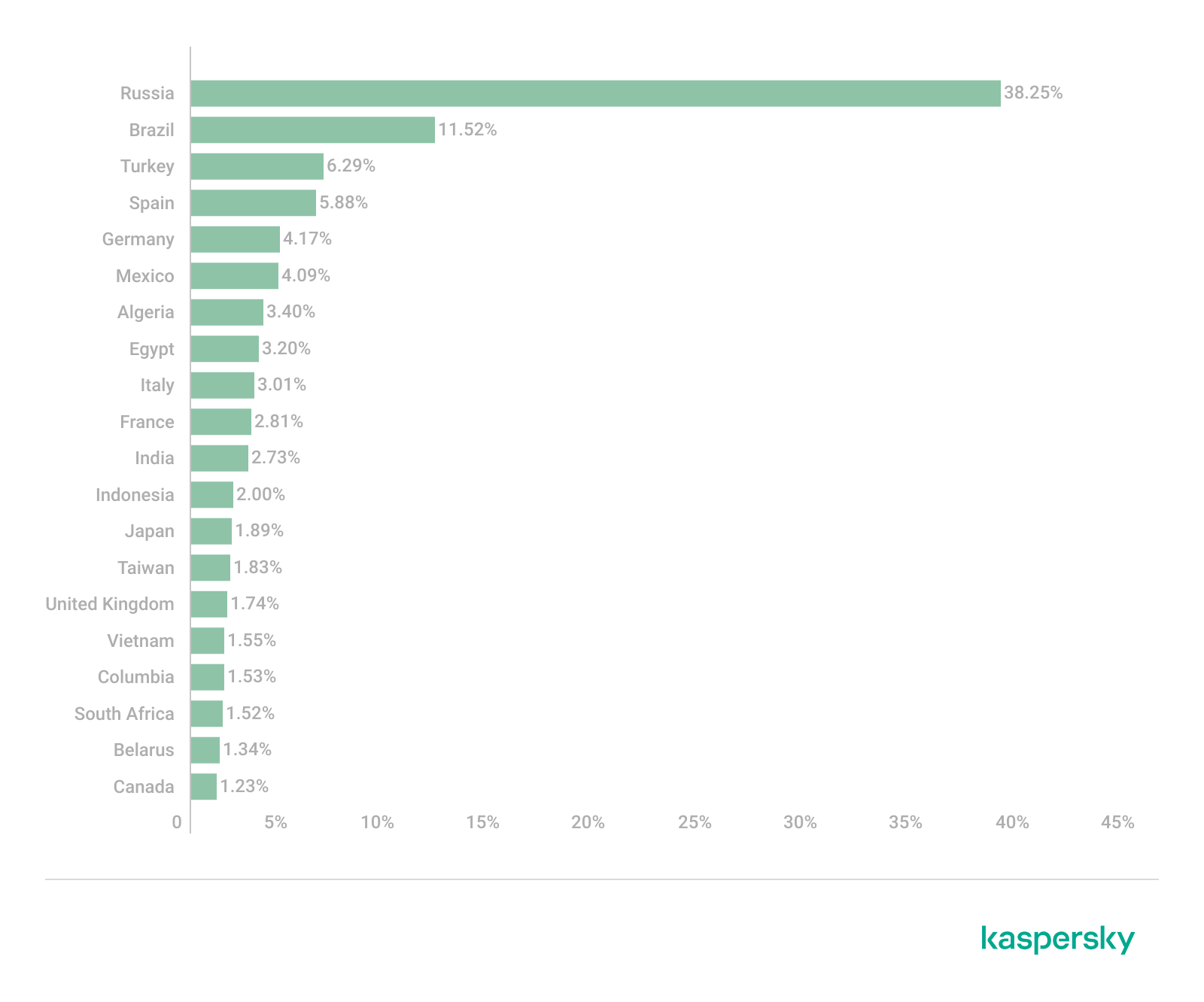
Distribution of incidents involving the RenEngine loader by country (TOP 20), February 2026 (download)

The distribution pattern of this loader suggests that the attacks are not targeted. At the time of publication, we have recorded the highest number of incidents in Russia, Brazil, Türkiye, Spain, and Germany.

Recommendations for protection

The format of game archives is generally not standardized and is unique for each game. This means that there is no universal algorithm for unpacking and checking the contents of game archives. If the game engine does not check the integrity and authenticity of executable resources and scripts, such an archive can become a repository for malware if modified by attackers. Despite this, Kaspersky Premium protects against such threats with its Behavior Detection component.

The distribution of malware under the guise of pirated software and hacked games is not a new tactic. It is relatively easy to avoid infection by the malware described in this article: simply install games and programs from trusted sites. In addition, it is important for gamers to remember the need to install specialized security solutions. This ongoing campaign employs the Lumma and ACR stylers, and Vidar was also found — none of these are new threats, but rather long-known malware. This means that modern antivirus technologies can detect even modified versions of the above-mentioned stealers and their alternatives, preventing further infection.

Indicators of compromise

12EC3516889887E7BCF75D7345E3207A – setup_game_8246.zip
D3CF36C37402D05F1B7AA2C444DC211A – __init.py__
1E0BF40895673FCD96A8EA3DDFAB0AE2 – cc32290mt.dll
2E70ECA2191C79AD15DA2D4C25EB66B9 – Lumma Stealer

hxxps://hentakugames[.]com/country-bumpkin/
hxxps://dodi-repacks[.]site
hxxps://artistapirata[.]fit
hxxps://artistapirata[.]vip
hxxps://awdescargas[.]pro
hxxps://fullprogramlarindir[.]me
hxxps://gamesleech[.]com
hxxps://parapcc[.]com
hxxps://saglamindir[.]vip
hxxps://zdescargas[.]pro
hxxps://filedownloads[.]store
hxxps://go[.]zovo[.]ink

Lumma C2
hxxps://steamcommunity[.]com/profiles/76561199822375128
hxxps://localfxement[.]live
hxxps://explorebieology[.]run
hxxps://agroecologyguide[.]digital
hxxps://moderzysics[.]top
hxxps://seedsxouts[.]shop
hxxps://codxefusion[.]top
hxxps://farfinable[.]top
hxxps://techspherxe[.]top
hxxps://cropcircleforum[.]today

EFF Statement on ICE and CBP Violence

27 January 2026 at 02:46

Dangerously unchecked surveillance and rights violations have been a throughline of the Department of Homeland Security since the agency’s creation in the wake of the September 11th attacks. In particular, Immigration and Customs Enforcement (ICE) and Customs and Border Protection (CBP) have been responsible for countless civil liberties and digital rights violations since that time. In the past year, however, ICE and CBP have descended into utter lawlessness, repeatedly refusing to exercise or submit to the democratic accountability required by the Constitution and our system of laws.  

The Trump Administration has made indiscriminate immigration enforcement and mass deportation a key feature of its agenda, with little to no accountability for illegal actions by agents and agency officials. Over the past year, we’ve seen massive ICE raids in cities from Los Angeles to Chicago to Minneapolis. Supercharged by an unprecedented funding increase, immigration enforcement agents haven’t been limited to boots on the ground: they’ve been scanning faces, tracking neighborhood cell phone activity, and amassing surveillance tools to monitor immigrants and U.S. citizens alike. 

Congress must vote to reject any further funding of ICE and CBP

The latest enforcement actions in Minnesota have led to federal immigration agents killing Renee Good and Alex Pretti. Both were engaged in their First Amendment right to observe and record law enforcement when they were killed. And it’s only because others similarly exercised their right to record that these killings were documented and widely exposed, countering false narratives the Trump Administration promoted in an attempt to justify the unjustifiable.  

These constitutional violations are systemic, not one-offs. Just last week, the Associated Press reported a leaked ICE memo that authorizes agents to enter homes solely based on “administrative” warrants—lacking any judicial involvement. This government policy is contrary to the “very core” of the Fourth Amendment, which protects us against unreasonable search and seizure, especially in our own homes 

These violations must stop now. ICE and CBP have grown so disdainful of the rule of law that reforms or guardrails cannot suffice. We join with many others in saying that Congress must vote to reject any further funding of ICE and CBP this week. But that is not enough. It’s time for Congress to do the real work of rebuilding our immigration enforcement system from the ground up, so that it respects human rights (including digital rights) and human dignity, with real accountability for individual officers, their leadership, and the agency as a whole.

Report: ICE Using Palantir Tool That Feeds On Medicaid Data

15 January 2026 at 21:30

EFF last summer asked a federal judge to block the federal government from using Medicaid data to identify and deport immigrants.  

We also warned about the danger of the Trump administration consolidating all of the government’s information into a single searchable, AI-driven interface with help from Palantir, a company that has a shaky-at-best record on privacy and human rights. 

Now we have the first evidence that our concerns have become reality. 

“Palantir is working on a tool for Immigration and Customs Enforcement (ICE) that populates a map with potential deportation targets, brings up a dossier on each person, and provides a “confidence score” on the person’s current address,” 404 Media reports today. “ICE is using it to find locations where lots of people it might detain could be based.” 

The tool – dubbed Enhanced Leads Identification & Targeting for Enforcement (ELITE) – receives peoples’ addresses from the Department of Health and Human Services (which includes Medicaid) and other sources, 404 Media reports based on court testimony in Oregon by law enforcement agents, among other sources. 

This revelation comes as ICE – which has gone on a surveillance technology shopping spree – floods Minneapolis with agents, violently running roughshod over the civil rights of immigrants and U.S. citizens alike; President Trump has threatened to use the Insurrection Act of 1807 to deploy military troops against protestors there. Other localities are preparing for the possibility of similar surges. 

Different government agencies necessarily collect information to provide essential services or collect taxes, but the danger comes when the government begins pooling that data and using it for reasons unrelated to the purpose it was collected.

This kind of consolidation of government records provides enormous government power that can be abused. Different government agencies necessarily collect information to provide essential services or collect taxes, but the danger comes when the government begins pooling that data and using it for reasons unrelated to the purpose it was collected. 

As EFF Executive Director Cindy Cohn wrote in a Mercury News op-ed last August, “While couched in the benign language of eliminating government ‘data silos,’ this plan runs roughshod over your privacy and security. It’s a throwback to the rightly mocked ‘Total Information Awareness’ plans of the early 2000s that were, at least publicly, stopped after massive outcry from the public and from key members of Congress. It’s time to cry out again.” 

In addition to the amicus brief we co-authored challenging ICE’s grab for Medicaid data, EFF has successfully sued over DOGE agents grabbing personal data from the U.S. Office of Personnel Management, filed an amicus brief in a suit challenging ICE’s grab for taxpayer data, and sued the departments of State and Homeland Security to halt a mass surveillance program to monitor constitutionally protected speech by noncitizens lawfully present in the U.S. 

But litigation isn’t enough. People need to keep raising concerns via public discourse and Congress should act immediately to put brakes on this runaway train that threatens to crush the privacy and security of each and every person in America.  

ICE Is Going on a Surveillance Shopping Spree

7 January 2026 at 19:59

Read more about how enterprising hackers have started projects to do counter surveillance against ICE, and learn how to follow the Homeland Security spending trail.

U.S. Immigration and Customs Enforcement (ICE) has a new budget under the current administration, and they are going on a surveillance tech shopping spree. Standing at $28.7 billion dollars for the year 2025 (nearly triple their 2024 budget) and at least another $56.25 billion over the next three years, ICE's budget would be the envy of many national militaries around the world. Indeed, this budget would put ICE as the 14th most well-funded military in the world, right between Ukraine and Israel.  

There are many different agencies under U.S. Department of Homeland Security (DHS) that deal with immigration, as well as non-immigration related agencies such as Cybersecurity and Infrastructure Security Agency (CISA) and Federal Emergency Management Agency (FEMA). ICE is specifically the enforcement arm of the U.S. immigration apparatus. Their stated mission is to “[p]rotect America through criminal investigations and enforcing immigration laws to preserve national security and public safety.” 

Of course, ICE doesn’t just end up targeting, surveilling, harassing, assaulting, detaining, and torturing people who are undocumented immigrants. They have targeted people on work permits, asylum seekers, permanent residents (people holding “green cards”), naturalized citizens, and even citizens by birth. 

While the NSA and FBI might be the first agencies that come to mind when thinking about surveillance in the U.S., ICE should not be discounted. ICE has always engaged in surveillance and intelligence-gathering as part of their mission. A 2022 report by Georgetown Law’s Center for Privacy and Technology found the following:

  • ICE had scanned the driver’s license photos of 1 in 3 adults.
  • ICE had access to the driver’s license data of 3 in 4 adults.
  • ICE was tracking the movements of drivers in cities home to 3 in 4 adults.
  • ICE could locate 3 in 4 adults through their utility records.
  • ​​ICE built its surveillance dragnet by tapping data from private companies and state and local bureaucracies.
  • ICE spent approximately $2.8 billion between 2008 and 2021 on new surveillance, data collection and data-sharing programs. 

With a budget for 2025 that is 10 times the size of the agency’s total surveillance spending over the last 13 years, ICE is going on a shopping spree, creating one of the largest, most comprehensive domestic surveillance machines in history. 

How We Got Here

The entire surveillance industry has been allowed to grow and flourish under both Democratic and Republican regimes. For example, President Obama dramatically expanded ICE from its more limited origins, while at the same time narrowing its focus to undocumented people accused of crimes. Under the first and second Trump administrations, ICE ramped up its operations significantly, increasing raids in major cities far from the southern border and casting a much wider net on potential targets. ICE has most recently expanded its partnerships with sheriffs across the U.S., and deported more than 1.5 million people cumulatively under the Trump administrations (600,000 of those were just during the first year of Trump’s second term according to DHS statistics), not including the 1.6 million people DHS claims have “self-deported.” More horrifying is that in just the last year of the current administration, 4,250 people detained by ICE have gone missing, and 31 have died in custody or while being detained. In contrast, 24 people died in ICE custody during the entirety of the Biden administration.

ICE also has openly stated that they plan to spy on the American public, looking for any signs of left-wing dissent against their domestic military-like presence. Acting ICE Director Todd Lyons said in a recent interview that his agency “was dedicated to the mission of going after” Antifa and left-wing gun clubs. 

On a long enough timeline, any surveillance tool you build will eventually be used by people you don’t like for reasons that you disagree with.

On a long enough timeline, any surveillance tool you build will eventually be used by people you don’t like for reasons that you disagree with. A surveillance-industrial complex and a democratic society are fundamentally incompatible, regardless of your political party. 

EFF recently published a guide to using government databases to dig up homeland security spending and compiled our own dataset of companies selling tech to DHS components. In 2025, ICE entered new contracts with several private companies for location surveillance, social media surveillance, face surveillance, spyware, and phone surveillance. Let’s dig into each.

Phone Surveillance Tools 

One common surveillance tactic of immigration officials is to get physical access to a person’s phone, either while the person is detained at a border crossing, or while they are under arrest. ICE renewed an $11 million contract with a company called Cellebrite, which helps ICE unlock phones and then can take a complete image of all the data on the phone, including apps, location history, photos, notes, call records, text messages, and even Signal and WhatsApp messages. ICE also signed a $3 million contract with Cellebrite’s main competitor Magnet Forensics, makers of the Graykey device for unlocking phones. DHS has had contracts with Cellebrite since 2008, but the number of phones they search has risen dramatically each year, reaching a new high of 14,899 devices searched by ICE’s sister agency U.S. Customs and Border Protection (CBP) between April and June of 2025. 

If ICE can’t get physical access to your phone, that won’t stop them from trying to gain access to your data. They have also resumed a $2 million contract with the spyware manufacturer, Paragon. Paragon makes the Graphite spyware, which made headlines in 2025 for being found on the phones of several dozen members of Italian civil society. Graphite is able to harvest messages from multiple different encrypted chat apps such as Signal and WhatsApp without the user ever knowing. 

Our concern with ICE buying this software is the likelihood that it will be used against undocumented people and immigrants who are here legally, as well as U.S. citizens who have spoken up against ICE or who work with immigrant communities. Malware such as Graphite can be used to read encrypted messages as they are sent, other forms of spyware can also download files, photos, location history, record phone calls, and even discretely turn on your microphone to record you. 

How to Protect Yourself 

The most effective way to protect yourself from smartphone surveillance would be to not have a phone. But that’s not realistic advice in modern society. Fortunately, for most people there are other ways you can make it harder for ICE to spy on your digital life. 

The first and easiest step is to keep your phone up to date. Installing security updates makes it harder to use malware against you and makes it less likely for Cellebrite to break into your phone. Likewise, both iPhone (Lockdown Mode) and Android (Advanced Protection) offer special modes that lock your phone down and can help protect against some malware.

The first and easiest step is to keep your phone up to date.

Having your phone’s software up to date and locked with a strong alphanumeric password will offer some protection against Cellebrite, depending on your model of phone. However, the strongest protection is simply to keep your phone turned off, which puts it in “before first unlock” mode and has been typically harder for law enforcement to bypass. This is good to do if you are at a protest and expect to be arrested, if you are crossing a border, or if you are expecting to encounter ICE. Keeping your phone on airplane mode should be enough to protect against cell-site simulators, but turning your phone off will offer extra protection against cell-site simulators and Cellebrite devices. If you aren’t able to turn your phone off, it’s a good idea to at least turn off face/fingerprint unlock to make it harder for police to force you to unlock your phone. While EFF continues to fight to strengthen our legal protections against compelling people to decrypt their devices, there is currently less protection against compelled face and fingerprint unlocking than there is against compelled password disclosure.

Internet Surveillance 

ICE has also spent $5 million to acquire at least two location and social media surveillance tools: Webloc and Tangles, from a company called Pen Link, an established player in the open source intelligence space. Webloc gathers the locations of millions of phones by gathering data from mobile data brokers and linking it together with other information about users. Tangles is a social media surveillance tool which combines web scraping with access to social media application programming interfaces. These tools are able to build a dossier on anyone who has a public social media account. Tangles is able to link together a person’s posting history, posts, and comments containing keywords, location history, tags, social graph, and photos with those of their friends and family. Penlink then sells this information to law enforcement, allowing law enforcement to avoid the need for a warrant. This means ICE can look up historic and current locations of many people all across the U.S. without ever having to get a warrant.

These tools are able to build a dossier on anyone who has a public social media account.

ICE also has established contracts with other social media scanning and AI analysis companies, such as a $4.2 million contract with a company called Fivecast for the social media surveillance and AI analysis tool ONYX. According to Fivecast, ONYX can conduct “automated, continuous and targeted collection of multimedia data” from all major “news streams, search engines, social media, marketplaces, the dark web, etc.” ONYX can build what it calls “digital footprints” from biographical data and curated datasets spanning numerous platforms, and “track shifts in sentiment and emotion” and identify the level of risk associated with an individual. 

Another contract is with ShadowDragon for their product Social Net, which is able to monitor publicly available data from over 200 websites. In an acquisition document from 2022, ICE confirmed that ShadowDragon allowed the agency to search “100+ social networking sites,” noting that “[p]ersistent access to Facebook and Twitter provided by ShadowDragon SocialNet is of the utmost importance as they are the most prominent social media platforms.”

ICE has also indicated that they intend to spend between 20 and 50 million dollars on building and staffing a 24/7 social media monitoring office with at least 30 full time agents to comb every major social media website for leads that could generate enforcement raids. 

How to protect yourself 

For U.S. citizens, making your account private on social media is a good place to start. You might also consider having accounts under a pseudonym, or deleting your social media accounts altogether. For more information, check out our guide to protecting yourself on social media. Unfortunately, people immigrating to the U.S. might be subject to greater scrutiny, including mandatory social media checks, and should consult with an immigration attorney before taking any action. For people traveling to the U.S., new rules will soon likely require them to reveal five years of social media history and 10 years of past email addresses to immigration officials. 

Street-Level Surveillance 

But it’s not just your digital habits ICE wants to surveil; they also want to spy on you in the physical world. ICE has contracts with multiple automated license plate reader (ALPR) companies and is able to follow the driving habits of a large percentage of Americans. ICE uses this data to track down specific people anywhere in the country. ICE has a $6 million contract through a Thomson Reuters subsidiary to access ALPR data from Motorola Solutions. ICE has also persuaded local law enforcement officers to run searches on their behalf through Flock Safety's massive network of ALPR data. CBP, including Border Patrol, also operates a network of covert ALPR systems in many areas. 

ICE has also invested in biometric surveillance tools, such as face recognition software called Mobile Fortify to scan the faces of people they stop to determine if they are here legally. Mobile Fortify checks the pictures it takes against a database of 200 million photos for a match (the source of the photos is unknown). Additionally, ICE has a $10 million contract with Clearview AI for face recognition. ICE has also contracted with iris scanning company BI2 technologies for even more invasive biometric surveillance. ICE agents have also been spotted wearing Meta’s Ray-Ban video recording sunglasses. 

ICE has acquired trucks equipped with cell-site simulators (AKA Stingrays) from a company called TechOps Specialty Vehicles (likely the cell-site simulators were manufactured by another company). This is not the first time ICE has bought this technology. According to documents obtained by the American Civil Liberties Union, ICE deployed cell-site simulators at least 466 times between 2017 and 2019, and ICE more than 1,885 times between 2013 and 2017, according to documents obtained by BuzzFeed News. Cell-site simulators can be used to track down a specific person in real time, with more granularity than a phone company or tools like Webloc can provide, though Webloc has the distinct advantage of being used without a warrant and not requiring agents to be in the vicinity of the person being tracked. 

How to protect yourself 

Taking public transit or bicycling is a great way to keep yourself off ALPR databases, but an even better way is to go to your local city council meetings and demand the city cancels contracts with ALPR companies, like people have done in Flagstaff, Arizona; Eugene, Oregon; and Denver, Colorado, among others. 

If you are at a protest, putting your phone on airplane mode could help protect you from cell-site simulators and from apps on your phone disclosing your location, but might leave you vulnerable to advanced targeted attacks. For more advanced protection, turning your phone completely off protects against all radio based attacks, and also makes it harder for tools like Cellebrite to break into your phone as discussed above. But each individual will need to weigh their need for security from advanced radio based attacks against their need to document potential abuses through photo or video. For more information about protecting yourself at a protest, head over to SSD.

There is nothing you can do to change your face, which is why we need more stringent privacy laws such as Illinois Biometric Information Privacy Act.

Tying All the Data Together 

Last but not least, ICE uses tools to combine and search all this data along with the data on Americans they have acquired from private companies, the IRS, TSA, and other government databases. 

To search all this data, ICE uses ImmigrationOS, a system that came from a $30-million contract with Palantir. What Palantir does is hard to explain, even for people who work there, but essentially they are plumbers. Palantir makes it so that ICE has all the data they have acquired in one place so it’s easy to search through. Palantir links data from different databases, like IRS data, immigration records, and private databases, and enables ICE to view all of this data about a specific person in one place. 

Palantir makes it so that ICE has all the data they have acquired in one place so it’s easy to search through.

The true civil liberties nightmare of Palantir is that they enable governments to link data that should have never been linked. There are good civil liberties reasons why IRS data was never linked with immigration data and was never linked with social media data, but Palantir breaks those firewalls. Palantir has labeled themselves as a progressive, human rights centric company historically, but their recent actions have given them away as just another tech company enabling surveillance nightmares.

Threat Modeling When ICE Is Your Adversary 

 Understanding the capabilities and limits of ICE and how to threat model helps you and your community fight back, remain powerful, and protect yourself.

One of the most important things you can do is to not spread rumors and misinformation. Rumors like “ICE has malware so now everyone's phones are compromised” or “Palantir knows what you are doing all the time” or “Signal is broken” don’t help your community. It’s more useful to spread facts, ways to protect yourself, and ways to fight back. For information about how to create a security plan for yourself or your community, and other tips to protect yourself, read our Surveillance Self-Defense guides.

How EFF Is Fighting Back

One way to fight back against ICE is in the courts. EFF currently has a lawsuit against ICE over their pressure on Apple and Google to take down ICE spotting apps, like ICEBlock. We also represent multiple labor unions suing ICE over their social media surveillance practices

We have also demanded the San Francisco Police Department stop sharing data illegally with ICE, and issued a statement condemning the collaboration between ICE and the malware provider Paragon. We also continue to maintain our Rayhunter project for detecting cell-site simulators. 

Other civil liberties organizations are also suing ICE. ACLU has sued ICE over a subpoena to Meta attempting to identify the owner of an account providing advice to protestors, and another coalition of groups has thus far successfully sued the IRS to stop sharing taxpayer data with ICE

We need to have a hard look at the surveillance industry. It is a key enabler of vast and untold violations of human rights and civil liberties, and it continues to be used by aspiring autocrats to threaten our very democracy. As long as it exists, the surveillance industry, and the data it generates, will be an irresistible tool for anti-democratic forces.

Join EFF

Help protect digital privacy & free speech for everyone

The Homeland Security Spending Trail: How to Follow the Money Through U.S. Government Databases

6 January 2026 at 18:08

This guide was co-written by Andrew Zuker with support from the Heinrich Boell Foundation.

The U.S. government publishes volumes of detailed data on the money it spends, but searching through it and finding information can be challenging. Complex search functions and poor user interfaces on government reporting sites can hamper an investigation, as can inconsistent company profiles and complex corporate ownership structures. 

This week, EFF and the Heinrich Boell Foundation released an update to our database of vendors providing technology to components of the U.S. Department of Homeland Security (DHS), such as Immigration and Customs Enforcement (ICE) and Customs and Border Protections (CBP). It includes new vendor profiles, new fields, and updated data on top contractors, so that journalists and researchers have a jumping-off point for their own investigations.

Access the dataset through Google Sheets (Google's Privacy Policy applies) or download the Excel file here

This time we thought we would also share some of the research methods we developed while assembling this dataset.

This guide covers the key databases that store information on federal spending and contracts (often referred to as "awards"), government solicitations for products and services, and the government's "online shopping superstore," plus a few other deep-in-the-weeds datasets buried in the online bureaucracy. We have provided a step-by-step guide for searching these sites efficiently and help tips for finding information. While we have written this specifically with DHS agencies in mind, it should serve as a useful resource for procurement across the federal government. 


1. Procurement Sites: FPDS.gov and USASpending.gov

Federal Procurement Data System - fpds.gov

Update Jan. 30, 2026: In mid 2026, FPDS.gov's functions will be transferred to SAM.gov. More info here.

The Federal Procurement Data System (FPDS) is the best place to start for finding out what companies are working with DHS. It is the official system for tracking federal discretionary spending and contains current data on contracts with non-governmental entities like corporations and private businesses. Award data is up-to-date and includes detailed information on vendors and awards which can be helpful when searching the other systems. It is a little bit old-school, but that often makes it one of the easiest and quickest sites to search, once you get the hang of it, since it offers a lot of options for narrowing search parameters to specific agencies, vendors, classification of services, etc. 

How to Use FDPS
To begin searching Awards for a particular vendor, click into the “ezSearch” field in the center of the page, delete or replace the text “Google-like search to help you find federal contracts…” with a vendor name or keywords, and hit Enter to begin a new search. 

The EZ Search landing page for FPDS.gov

A new tab will open automatically with exact matches at the top. 

A page of results for Google's contracts with the federal government.

Four “Top 10” modules on the left side of the page link to top results in descending order: Department Full Name, Contracting Agency Name, Full Legal Business Name, and Treasury Account Symbol. These ranked lists help the user quickly narrow in on departments and agencies that vendors do business with. DHS may not appear in the “Top 10” results, which may indicate that the vendor hasn’t yet been awarded DHS or subagency contracts.

For example, if you searched the term “FLIR”, as in Teledyne FLIR who make infrared surveillance systems used along the U.S.-Mexico border, DHS is the 2nd result in the “Top 10: Department Full Name” box. 

FDPS.gov results for FLIR with the agency full name sidebar highlighted.

To see all DHS contracts awarded to the vendor, click “Homeland Security, Department of” from the “Top 10 Department Full Name” module. When the page loads, you will see the subcomponents of DHS (e.g., ICE, CBP, or the U.S. Secret Service) in the lefthand menu. You can click on each of those to drill down even further. You can also drill down by choosing a company. 

Sorting options can be found on the right side of the page which offer the ability to refine and organize search results. One of the most useful is "Date Signed," which will arrange the results in chronological order. 

FPDS.gov results for FLIR with the sort by sidebar highlighted

You don't have to search by a company name. You can also use a product keyword, such as "LPR" (license plate reader). However, because keywords are not consistently used by government agencies, you will need to try various permutations to gather the most data. 

Each click or search filter adds a new term to the search both in the main field at the top and in the Search Criteria module on the right. They can be deleted by clicking the X next to the term in this module or by removing the text in the main search field.

FPDS.gov results with the sidebar for deselecting terms highlighted with an arrow.

For each contract item, you can click "View" to see the specific details. However, these pages don't have permalinks, so you'll want to print-to-pdf if you need to retain a permanent copy of the record. 

Often the vendor brand name we know from their marketing or news media is not the same entity that is awarded government contracts. Foreign companies in particular rely on partnerships with domestic entities that are established federal contractors. If you can’t find any spending records for a vendor, search the web for information on the company including acquisitions, partnerships, licensing agreements, parent companies, and subsidiaries. It is likely that one of these types of related companies is the contract holder. 

USA Spending - usaspending.gov

The Federal Funding and Accountability Act (FFATA) of 2006 and the DATA Act of 2014 require the government to publish all spending records and contracts on a single, searchable public website, including agency-specific contracts, using unified reporting standards to ensure consistent, reliable, searchable data. This led to the creation of USA Spending (usaspending.gov). 

USA Spending is populated with data from multiple sources including the Federal Procurement Data System (fpds.gov) and the System for Awards Management (sam.gov - which we'll discuss in the next section). It also compiles Treasury Reports and data from the financial systems of dozens of federal agencies. We relied heavily on Awards data from these systems to verify vendor information including contracts with the DHS and its subagencies such as CBP and ICE. 

USA Spending has a more modern interface, but is often very slow with the information often hidden in expandable menus. In many ways it is duplicative of FPDS, but with more features, including the ability to bookmark individual pages. We often found ourselves using FPDS to quickly identify data, and then using the "Award ID" number to find the specific record within USA Spending. 

USA Spending also has some visualizations and ways to analyze data in chart form, which is not possible with the largely text-based FPDS. 

How to Use USA Spending

To begin searching for DHS awards, click on either “Search Award Data” on the navigation bar, or the blue “Start Searching Awards”button. 

The landing page of USA Spending with arrows pointing to the search links.

On the left of the Search page are a list of drop down menus with options. You can enter a vendor name as a keyword, or expand the “Recipient” menu if you know the full company name or their Unique Entity Identifier (UEI) number. Expand the “Agency Tab” and enter DHS which will bring up the Department of Homeland Security Option.

USA Spending page with arrows pointing to the key search filters.

In the example below, we entered “Palantir Technologies” as a keyword, and selected DHS in the Agency dropdown:

Search results showing Palantir contracts

For vendors with hundreds of contracts that return many pages of results, consider adding more filters to the search such as a specific time period or specifying a Funding Agency such as ICE or CBP. In this example, the filters “Palantir Technologies” and “DHS” returned 13 results (at the time of publication). It is important to note that the search results table is larger than what displays in that module. You can scroll down to view more Awards and scroll to the right to see much more information. 

Scroll down outside of that module to reveal more info including modules for Results by Category, Results over Time, and Results by Geography, all of which can be viewed as a list or graph. 

USA Spending page with graphs and charts

Once you've identified a contract, you can click the "Prime Award ID" to see the granular details for each time. 

From the search, you can also select just the agency to see all the contracts on file. Each agency also has its own page showing a breakdown for every fiscal year of how much money they had to spend and which components spent the most. For example, here's DHS's page.

2. Contracting Opportunities  - SAM.gov  

So far we've talked about how to track contracts and spending, but now let's take a step back and look at how those contracts come to be. The System for Award Management, SAM.gov, is the site that allows companies to see what products and services the government intends to buy so they can bid on the contract. But SAM.gov is also open to the public, which means you can see the same information, including a detailed scope of a project and sometimes even technical details. 

How to Use Sam.gov

SAM.gov does not require an account for its basic contracting opportunity searches, but you may want to create one in order to save the things you find and to receive keyword- or agency-based alerts via email when new items of interest are posted. 

First you will click "Search" in the menu bar, which will bring you to this page: 

Search page on Sam.gov

We recommend selecting both "Active" and "Inactive" in the Status menu. Contracts quickly go inactive, and besides, sometimes the contracts you are most interested in are several years old. 

If you are researching a particular technology such as unmanned aerial vehicles, you might just type "unmanned" in the Simple Search bar. That will bring up every solicitation with that keyword across the federal government.

One of the most useful features is filtering by agency, while leaving the keyword search blank. This will return a running list of an agency's calls for bids and related procurement activities. It is worth checking regularly. For example, here's what CBP's looks like on a given day: 

Sam.gov results for Customs and Border Patrol

If you click on an item, you should next scroll down to see if there are attachments. These tend to contain the most details. Specifically, you should look for the term "SOW," the abbreviation for "Statement of Work." For example, here are the attachments for a CBP contracting opportunity for "Cellular Covert Cameras": 

Links for attachments

The first document is the Statement of Work, which tells you the exact brand, model, and number of devices they want to acquire: 

Line items for hundreds of Hyperfire cameras and related components.

The attachments also included a "BNO Justification." BNO stands for "Brand Name Only," and this document explains in even more detail why CBP wants that specific product:

Explanation of why the government wants to purchase this particular model of camera.

If you see the terms "Sole Source" in a listing, that also means that an agency has decided that only one product meets its requirements and it will not open bidding to other companies. 

In addition to contracting, many agencies announce "Industry Day" events, usually virtual, that members of the public can join. This is a unique opportunity to listen in on what contractors are being told by government purchasing officials. The presentation slides are also often later uploaded to the SAM.gov page. Occasionally, the list of attendees will also be posted, and you'll find several examples of those lists in our dataset.

3. The Government's "Superstore" - gsaadvantage.gov

Another way to investigate DHS purchasing is by browsing the catalog of items and services immediately available to them. The General Services Administration operates GSA Advantage, which it describes as "the government's central online shopping superstore." The website's search is open, allowing members of the public to view any vendors' offerings–including both products and services– easily as they would with any online marketplace. 

For example, you could search for "license plate reader" and produce a list of available products: 

Search results that show a license plate reader for sale for $995.

If you click "Advanced Search," you can also isolate every product available from a particular manufacturer. For example, here are the results when you search for products available from Skydio, a drone manufacturer.

Search results for 50 Skydio drone-related products

If you switch from "Products" to "Services" you can export datasets for each company about their offerings. For example, if you search for "Palantir" you'll get results that look like this:

Search results with companies offering Palantir-related services.

This means all these companies are offering some sort of Palantir-related services. If you click "Matches found in Terms and Conditions," you'll download a PDF with a lot of details about what the company offers. 

For example, here's a a screengrab from Anduril's documentation

A menu of surveillance towers with prices.

If you click "Matches Found in Price List" you'll download a spreadsheet that serves as a blueprint of what the company offers, including contract personnel. Here's a snippet from Palantir's: 

A spreadsheet with prices for various Palantir services.

4. Other Resources

Daily Public Report of Covered Contract Awards - Maybe FPDS isn't enough for you and you want to know every day what contracts have been signed. Buried in the DHS website are links to a daily feed of all contracts worth $4 million or more. It's available in XML, JSON, CSV and XLSX formats. 

DHS Acquisition Planning Forecast System (APFS) - DHS operates a site for vendors to learn about upcoming contracts greater than $350,000. You can sort by agency at a granular level,  such as upcoming projects by ICE Enforcement & Removal Operations. This is one to check regularly for updates. 

Results for a proposed contract for open source intelligence

DHS Artificial Intelligence Use Case Inventory - Many federal agencies are required to maintain datasets of "AI Use Cases." DHS has broken these out for each of its subcomponents, including ICE and CBP. Advanced users will find the spreadsheet versions of these inventory more interesting. 

Use case summary for surveillance towers

NASA Solutions for Enterprise-Wide Procurement (SEWP) - SEWP is a way for agencies to fast track acquisition of "Information Technology, Communication and Audio Visual" products through existing contracts. The site provides an index of existing contract holders, but the somewhat buried "Provider Lookup" has a more comprehensive list of companies involved in this type of contracting, illustrating how the companies serve as passthroughs for one another. Relatedly, DHS's list of "Prime Contractors" shows which companies hold master contracts with the agency and its components. 

List of resellers of Palantir technology

TechInquiry - Techinquiry is a small non-profit that aggregates records from a wide variety of sources about tech companies, particularly those involved in government contracting. 

Assessing SIEM effectiveness

23 December 2025 at 13:00

A SIEM is a complex system offering broad and flexible threat detection capabilities. Due to its complexity, its effectiveness heavily depends on how it is configured and what data sources are connected to it. A one-time SIEM setup during implementation is not enough: both the organization’s infrastructure and attackers’ techniques evolve over time. To operate effectively, the SIEM system must reflect the current state of affairs.

We provide customers with services to assess SIEM effectiveness, helping to identify issues and offering options for system optimization. In this article, we examine typical SIEM operational pitfalls and how to address them. For each case, we also include methods for independent verification.

This material is based on an assessment of Kaspersky SIEM effectiveness; therefore, all specific examples, commands, and field names are taken from that solution. However, the assessment methodology, issues we identified, and ways to enhance system effectiveness can easily be extrapolated to any other SIEM.

Methodology for assessing SIEM effectiveness

The primary audience for the effectiveness assessment report comprises the SIEM support and operation teams within an organization. The main goal is to analyze how well the usage of SIEM aligns with its objectives. Consequently, the scope of checks can vary depending on the stated goals. A standard assessment is conducted across the following areas:

  • Composition and scope of connected data sources
  • Coverage of data sources
  • Data flows from existing sources
  • Correctness of data normalization
  • Detection logic operability
  • Detection logic accuracy
  • Detection logic coverage
  • Use of contextual data
  • SIEM technical integration into SOC processes
  • SOC analysts’ handling of alerts in the SIEM
  • Forwarding of alerts, security event data, and incident information to other systems
  • Deployment architecture and documentation

At the same time, these areas are examined not only in isolation but also in terms of their potential influence on one another. Here are a couple of examples illustrating this interdependence:

  • Issues with detection logic due to incorrect data normalization. A correlation rule with the condition deviceCustomString1 not contains <string> triggers a large number of alerts. The detection logic itself is correct: the specific event and the specific field it targets should not generate a large volume of data matching the condition. Our review revealed the issue was in the data ingested by the SIEM, where incorrect encoding caused the string targeted by the rule to be transformed into a different one. Consequently, all events matched the condition and generated alerts.
  • When analyzing coverage for a specific source type, we discovered that the SIEM was only monitoring 5% of all such sources deployed in the infrastructure. However, extending that coverage would increase system load and storage requirements. Therefore, besides connecting additional sources, it would be necessary to scale resources for specific modules (storage, collectors, or the correlator).

The effectiveness assessment consists of several stages:

  • Collect and analyze documentation, if available. This allows assessing SIEM objectives, implementation settings (ideally, the deployment settings at the time of the assessment), associated processes, and so on.
  • Interview system engineers, analysts, and administrators. This allows assessing current tasks and the most pressing issues, as well as determining exactly how the SIEM is being operated. Interviews are typically broken down into two phases: an introductory interview, conducted at project start to gather general information, and a follow-up interview, conducted mid-project to discuss questions arising from the analysis of previously collected data.
  • Gather information within the SIEM and then analyze it. This is the most extensive part of the assessment, during which Kaspersky experts are granted read-only access to the system or a part of it to collect factual data on its configuration, detection logic, data flows, and so on.

The assessment produces a list of recommendations. Some of these can be implemented almost immediately, while others require more comprehensive changes driven by process optimization or a transition to a more structured approach to system use.

Issues arising from SIEM operations

The problems we identify during a SIEM effectiveness assessment can be divided into three groups:

  • Performance issues, meaning operational errors in various system components. These problems are typically resolved by technical support, but to prevent them, it is worth periodically checking system health status.
  • Efficiency issues – when the system functions normally but seemingly adds little value or is not used to its full potential. This is usually due to the customer using the system capabilities in a limited way, incorrectly, or not as intended by the developer.
  • Detection issues – when the SIEM is operational and continuously evolving according to defined processes and approaches, but alerts are mostly false positives, and the system misses incidents. For the most part, these problems are related to the approach taken in developing detection logic.

Key observations from the assessment

Event source inventory

When building the inventory of event sources for a SIEM, we follow the principle of layered monitoring: the system should have information about all detectable stages of an attack. This principle enables the detection of attacks even if individual malicious actions have gone unnoticed, and allows for retrospective reconstruction of the full attack chain, starting from the attackers’ point of entry.

Problem: During effectiveness assessments, we frequently find that the inventory of connected source types is not updated when the infrastructure changes. In some cases, it has not been updated since the initial SIEM deployment, which limits incident detection capabilities. Consequently, certain types of sources remain completely invisible to the system.

We have also encountered non-standard cases of incomplete source inventory. For example, an infrastructure contains hosts running both Windows and Linux, but monitoring is configured for only one family of operating systems.

How to detect: To identify the problems described above, determine the list of source types connected to the SIEM and compare it against what actually exists in the infrastructure. Identifying the presence of specific systems in the infrastructure requires an audit. However, this task is one of the most critical for many areas of cybersecurity, and we recommend running it on a periodic basis.

We have compiled a reference sheet of system types commonly found in most organizations. Depending on the organization type, infrastructure, and threat model, we may rearrange priorities. However, a good starting point is as follows:

  • High Priority – sources associated with:
    • Remote access provision
    • External services accessible from the internet
    • External perimeter
    • Endpoint operating systems
    • Information security tools
  • Medium Priority – sources associated with:
    • Remote access management within the perimeter
    • Internal network communication
    • Infrastructure availability
    • Virtualization and cloud solutions
  • Low Priority – sources associated with:
    • Business applications
    • Internal IT services
    • Applications used by various specialized teams (HR, Development, PR, IT, and so on)

Monitoring data flow from sources

Regardless of how good the detection logic is, it cannot function without telemetry from the data sources.

Problem: The SIEM core is not receiving events from specific sources or collectors. Based on all assessments conducted, the average proportion of collectors that are configured with sources but are not transmitting events is 38%. Correlation rules may exist for these sources, but they will, of course, never trigger. It is also important to remember that a single collector can serve hundreds of sources (such as workstations), so the loss of data flow from even one collector can mean losing monitoring visibility for a significant portion of the infrastructure.

How to detect: The process of locating sources that are not transmitting data can be broken down into two components.

  1. Checking collector health. Find the status of collectors (see the support website for the steps to do this in Kaspersky SIEM) and identify those with a status of Offline, Stopped, Disabled, and so on.
  2. Checking the event flow. In Kaspersky SIEM, this can be done by gathering statistics using the following query (counting the number of events received from each collector over a specific time period):
SELECT count(ID), CollectorID, CollectorName FROM `events` GROUP BY CollectorID, CollectorName ORDER BY count(ID)
It is essential to specify an optimal time range for collecting these statistics. Too large a range can increase the load on the SIEM, while too small a range may provide inaccurate information for a one-time check – especially for sources that transmit telemetry relatively infrequently, say, once a week. Therefore, it is advisable to choose a smaller time window, such as 2–4 days, but run several queries for different periods in the past.

Additionally, for a more comprehensive approach, it is recommended to use built-in functionality or custom logic implemented via correlation rules and lists to monitor event flow. This will help automate the process of detecting problems with sources.

Event source coverage

Problem: The system is not receiving events from all sources of a particular type that exist in the infrastructure. For example, the company uses workstations and servers running Windows. During SIEM deployment, workstations are immediately connected for monitoring, while the server segment is postponed for one reason or another. As a result, the SIEM receives events from Windows systems, the flow is normalized, and correlation rules work, but an incident in the unmonitored server segment would go unnoticed.

How to detect: Below are query variations that can be used to search for unconnected sources.

  • SELECT count(distinct, DeviceAddress), DeviceVendor, DeviceProduct FROM events GROUP BY DeviceVendor, DeviceProduct ORDER BY count(ID)
  • SELECT count(distinct, DeviceHostName), DeviceVendor, DeviceProduct FROM events GROUP BY DeviceVendor, DeviceProduct ORDER BY count(ID)

We have split the query into two variations because, depending on the source and the DNS integration settings, some events may contain either a DeviceAddress or DeviceHostName field.

These queries will help determine the number of unique data sources sending logs of a specific type. This count must be compared against the actual number of sources of that type, obtained from the system owners.

Retaining raw data

Raw data can be useful for developing custom normalizers or for storing events not used in correlation that might be needed during incident investigation. However, careless use of this setting can cause significantly more harm than good.

Problem: Enabling the Keep raw event option effectively doubles the event size in the database, as it stores two copies: the original and the normalized version. This is particularly critical for high-volume collectors receiving events from sources like NetFlow, DNS, firewalls, and others. It is worth noting that this option is typically used for testing a normalizer but is often forgotten and left enabled after its configuration is complete.

How to detect: This option is applied at the normalizer level. Therefore, it is necessary to review all active normalizers and determine whether retaining raw data is required for their operation.

Normalization

As with the absence of events from sources, normalization issues lead to detection logic failing, as this logic relies on finding specific information in a specific event field.

Problem: Several issues related to normalization can be identified:

  • The event flow is not being normalized at all.
  • Events are only partially normalized – this is particularly relevant for custom, non-out-of-the-box normalizers.
  • The normalizer being used only parses headers, such as syslog_headers, placing the entire event body into a single field, this field most often being Message.
  • An outdated default normalizer is being used.

How to detect: Identifying normalization issues is more challenging than spotting source problems due to the high volume of telemetry and variety of parsers. Here are several approaches to narrowing the search:

  • First, check which normalizers supplied with the SIEM the organization uses and whether their versions are up to date. In our assessments, we frequently encounter auditd events being normalized by the outdated normalizer, Linux audit and iptables syslog v2 for Kaspersky SIEM. The new normalizer completely reworks and optimizes the normalization schema for events from this source.
  • Execute the query:
SELECT count(ID), DeviceProduct, DeviceVendor, CollectorName FROM `events` GROUP BY DeviceProduct, DeviceVendor, CollectorName ORDER BY count(ID)
This query gathers statistics on events from each collector, broken down by the DeviceVendor and DeviceProduct fields. While these fields are not mandatory, they are present in almost any normalization schema. Therefore, their complete absence or empty values may indicate normalization issues. We recommend including these fields when developing custom normalizers.

To simplify the identification of normalization problems when developing custom normalizers, you can implement the following mechanism. For each successfully normalized event, add a Name field, populated from a constant or the event itself. For a final catch-all normalizer that processes all unparsed events, set the constant value: Name = unparsed event. This will later allow you to identify non-normalized events through a simple search on this field.

Detection logic coverage

Collected events alone are, in most cases, only useful for investigating an incident that has already been identified. For a SIEM to operate to its full potential, it requires detection logic to be developed to uncover probable security incidents.

Problem: The mean correlation rule coverage of sources, determined across all our assessments, is 43%. While this figure is only a ballpark figure – as different source types provide different information – to calculate it, we defined “coverage” as the presence of at least one correlation rule for a source. This means that for more than half of the connected sources, the SIEM is not actively detecting. Meanwhile, effort and SIEM resources are spent on connecting, maintaining, and configuring these sources. In some cases, this is formally justified, for instance, if logs are only needed for regulatory compliance. However, this is an exception rather than the rule.

We do not recommend solving this problem by simply not connecting sources to the SIEM. On the contrary, sources should be connected, but this should be done concurrently with the development of corresponding detection logic. Otherwise, it can be forgotten or postponed indefinitely, while the source pointlessly consumes system resources.

How to detect: This brings us back to auditing, a process that can be greatly aided by creating and maintaining a register of developed detection logic. Given that not every detection logic rule explicitly states the source type from which it expects telemetry, its description should be added to this register during the development phase.

If descriptions of the correlation rules are not available, you can refer to the following:

  • The name of the detection logic. With a standardized approach to naming correlation rules, the name can indicate the associated source or at least provide a brief description of what it detects.
  • The use of fields within the rules, such as DeviceVendor, DeviceProduct (another argument for including these fields in the normalizer), Name, DeviceAction, DeviceEventCategory, DeviceEventClassID, and others. These can help identify the actual source.

Excessive alerts generated by the detection logic

One criterion for correlation rules effectiveness is a low false positive rate.

Problem: Detection logic generates an abnormally high number of alerts that are physically impossible to process, regardless of the size of the SOC team.

How to detect: First and foremost, detection logic should be tested during development and refined to achieve an acceptable false positive rate. However, even a well-tuned correlation rule can start producing excessive alerts due to changes in the event flow or connected infrastructure. To identify these rules, we recommend periodically running the following query:

SELECT count(ID), Name FROM `events` WHERE Type = 3 GROUP BY Name ORDER BY count(ID)

In Kaspersky SIEM, a value of 3 in the Type field indicates a correlation event.

Subsequently, for each identified rule with an anomalous alert count, verify the correctness of the logic it uses and the integrity of the event stream on which it triggered.

Depending on the issue you identify, the solution may involve modifying the detection logic, adding exceptions (for example, it is often the case that 99% of the spam originates from just 1–5 specific objects, such as an IP address, a command parameter, or a URL), or adjusting event collection and normalization.

Lack of integration with indicators of compromise

SIEM integrations with other systems are generally a critical part of both event processing and alert enrichment. In at least one specific case, their presence directly impacts detection performance: integration with technical Threat Intelligence data or IoCs (indicators of compromise).

A SIEM allows conveniently checking objects against various reputation databases or blocklists. Furthermore, there are numerous sources of this data that are ready to integrate natively with a SIEM or require minimal effort to incorporate.

Problem: There is no integration with TI data.

How to detect: Generally, IoCs are integrated into a SIEM at the system configuration level during deployment or subsequent optimization. The use of TI within a SIEM can be implemented at various levels:

  • At the data source level. Some sources, such as NGFWs, add this information to events involving relevant objects.
  • At the SIEM native functionality level. For example, Kaspersky SIEM integrates with CyberTrace indicators, which add object reputation information at the moment of processing an event from a source.
  • At the detection logic level. Information about IoCs is stored in various active lists, and correlation rules match objects against these to enrich the event.

Furthermore, TI data does not appear in a SIEM out of thin air. It is either provided by external suppliers (commercially or in an open format) or is part of the built-in functionality of the security tools in use. For instance, various NGFW systems can additionally check the reputation of external IP addresses or domains that users are accessing. Therefore, the first step is to determine whether you are receiving information about indicators of compromise and in what form (whether external providers’ feeds have been integrated and/or the deployed security tools have this capability). It is worth noting that receiving TI data only at the security tool level does not always cover all types of IoCs.

If data is being received in some form, the next step is to verify that the SIEM is utilizing it. For TI-related events coming from security tools, the SIEM needs a correlation rule developed to generate alerts. Thus, checking integration in this case involves determining the capabilities of the security tools, searching for the corresponding events in the SIEM, and identifying whether there is detection logic associated with these events. If events from the security tools are absent, the source audit configuration should be assessed to see if the telemetry type in question is being forwarded to the SIEM at all. If normalization is the issue, you should assess parsing accuracy and reconfigure the normalizer.

If TI data comes from external providers, determine how it is processed within the organization. Is there a centralized system for aggregating and managing threat data (such as CyberTrace), or is the information stored in, say, CSV files?

In the former case (there is a threat data aggregation and management system) you must check if it is integrated with the SIEM. For Kaspersky SIEM and CyberTrace, this integration is handled through the SIEM interface. Following this, SIEM event flows are directed to the threat data aggregation and management system, where matches are identified and alerts are generated, and then both are sent back to the SIEM. Therefore, checking the integration involves ensuring that all collectors receiving events that may contain IoCs are forwarding those events to the threat data aggregation and management system. We also recommend checking if the SIEM has a correlation rule that generates an alert based on matching detected objects with IoCs.

In the latter case (threat information is stored in files), you must confirm that the SIEM has a collector and normalizer configured to load this data into the system as events. Also, verify that logic is configured for storing this data within the SIEM for use in correlation. This is typically done with the help of lists that contain the obtained IoCs. Finally, check if a correlation rule exists that compares the event flow against these IoC lists.

As the examples illustrate, integration with TI in standard scenarios ultimately boils down to developing a final correlation rule that triggers an alert upon detecting a match with known IoCs. Given the variety of integration methods, creating and providing a universal out-of-the-box rule is difficult. Therefore, in most cases, to ensure IoCs are connected to the SIEM, you need to determine if the company has developed that rule (the existence of the rule) and if it has been correctly configured. If no correlation rule exists in the system, we recommend creating one based on the TI integration methods implemented in your infrastructure. If a rule does exist, its functionality must be verified: if there are no alerts from it, analyze its trigger conditions against the event data visible in the SIEM and adjust it accordingly.

The SIEM is not kept up to date

For a SIEM to run effectively, it must contain current data about the infrastructure it monitors and the threats it’s meant to detect. Both elements change over time: new systems and software, users, security policies, and processes are introduced into the infrastructure, while attackers develop new techniques and tools. It is safe to assume that a perfectly configured and deployed SIEM system will no longer be able to fully see the altered infrastructure or the new threats after five years of running without additional configuration. Therefore, practically all components – event collection, detection, additional integrations for contextual information, and exclusions – must be maintained and kept up to date.

Furthermore, it is important to acknowledge that it is impossible to cover 100% of all threats. Continuous research into attacks, development of detection methods, and configuration of corresponding rules are a necessity. The SOC itself also evolves. As it reaches certain maturity levels, new growth opportunities open up for the team, requiring the utilization of new capabilities.

Problem: The SIEM has not evolved since its initial deployment.

How to detect: Compare the original statement of work or other deployment documentation against the current state of the system. If there have been no changes, or only minimal ones, it is highly likely that your SIEM has areas for growth and optimization. Any infrastructure is dynamic and requires continuous adaptation.

Other issues with SIEM implementation and operation

In this article, we have outlined the primary problems we identify during SIEM effectiveness assessments, but this list is not exhaustive. We also frequently encounter:

  • Mismatch between license capacity and actual SIEM load. The problem is almost always the absence of events from sources, rather than an incorrect initial assessment of the organization’s needs.
  • Lack of user rights management within the system (for example, every user is assigned the administrator role).
  • Poor organization of customizable SIEM resources (rules, normalizers, filters, and so on). Examples include chaotic naming conventions, non-optimal grouping, and obsolete or test content intermixed with active content. We have encountered confusing resource names like [dev] test_Add user to admin group_final2.
  • Use of out-of-the-box resources without adaptation to the organization’s infrastructure. To maximize a SIEM’s value, it is essential at a minimum to populate exception lists and specify infrastructure parameters: lists of administrators and critical services and hosts.
  • Disabled native integrations with external systems, such as LDAP, DNS, and GeoIP.

Generally, most issues with SIEM effectiveness stem from the natural degradation (accumulation of errors) of the processes implemented within the system. Therefore, in most cases, maintaining effectiveness involves structuring these processes, monitoring the quality of SIEM engagement at all stages (source onboarding, correlation rule development, normalization, and so on), and conducting regular reviews of all system components and resources.

Conclusion

A SIEM is a powerful tool for monitoring and detecting threats, capable of identifying attacks at various stages across nearly any point in an organization’s infrastructure. However, if improperly configured and operated, it can become ineffective or even useless while still consuming significant resources. Therefore, it is crucial to periodically audit the SIEM’s components, settings, detection rules, and data sources.

If a SOC is overloaded or otherwise unable to independently identify operational issues with its SIEM, we offer Kaspersky SIEM platform users a service to assess its operation. Following the assessment, we provide a list of recommendations to address the issues we identify. That being said, it is important to clarify that these are not strict, prescriptive instructions, but rather highlight areas that warrant attention and analysis to improve the product’s performance, enhance threat detection accuracy, and enable more efficient SIEM utilization.

Yet another DCOM object for lateral movement

19 December 2025 at 09:00

Introduction

If you’re a penetration tester, you know that lateral movement is becoming increasingly difficult, especially in well-defended environments. One common technique for remote command execution has been the use of DCOM objects.

Over the years, many different DCOM objects have been discovered. Some rely on native Windows components, others depend on third-party software such as Microsoft Office, and some are undocumented objects found through reverse engineering. While certain objects still work, others no longer function in newer versions of Windows.

This research presents a previously undescribed DCOM object that can be used for both command execution and potential persistence. This new technique abuses older initial access and persistence methods through Control Panel items.

First, we will discuss COM technology. After that, we will review the current state of the Impacket dcomexec script, focusing on objects that still function, and discuss potential fixes and improvements, then move on to techniques for enumerating objects on the system. Next, we will examine Control Panel items, how adversaries have used them for initial access and persistence, and how these items can be leveraged through a DCOM object to achieve command execution.

Finally, we will cover detection strategies to identify and respond to this type of activity.

COM/DCOM technology

What is COM?

COM stands for Component Object Model, a Microsoft technology that defines a binary standard for interoperability. It enables the creation of reusable software components that can interact at runtime without the need to compile COM libraries directly into an application.

These software components operate in a client–server model. A COM object exposes its functionality through one or more interfaces. An interface is essentially a collection of related member functions (methods).

COM also enables communication between processes running on the same machine by using local RPC (Remote Procedure Call) to handle cross-process communication.

Terms

To ensure a better understanding of its structure and functionality, let’s revise COM-related terminology.

  1. COM interface
    A COM interface defines the functionality that a COM object exposes. Each COM interface is identified by a unique GUID known as the IID (Interface ID). All COM interfaces can be found in the Windows Registry under HKEY_CLASSES_ROOT\Interface, where they are organized by GUID.
  2. COM class (COM CoClass)
    A COM class is the actual implementation of one or more COM interfaces. Like COM interfaces, classes are identified by unique GUIDs, but in this case the GUID is called the CLSID (Class ID). This GUID is used to locate the COM server and activate the corresponding COM class.

    All COM classes must be registered in the registry under HKEY_CLASSES_ROOT\CLSID, where each class’s GUID is stored. Under each GUID, you may find multiple subkeys that serve different purposes, such as:

    • InprocServer32/LocalServer32: Specifies the system path of the COM server where the class is defined. InprocServer32 is used for in-process servers (DLLs), while LocalServer32 is used for out-of-process servers (EXEs). We’ll describe this in more detail later.
    • ProgID: A human-readable name assigned to the COM class.
    • TypeLib: A binary description of the COM class (essentially documentation for the class).
    • AppID: Used to describe security configuration for the class.
  3. COM server
    A COM is the module where a COM class is defined. The server can be implemented as an EXE, in which case it is called an out-of-process server, or as a DLL, in which case it is called an in-process server. Each COM server has a unique file path or location in the system. Information about COM servers is stored in the Windows Registry. The COM runtime uses the registry to locate the server and perform further actions. Registry entries for COM servers are located under the HKEY_CLASSES_ROOT root key for both 32- and 64-bit servers.
Component Object Model implementation

Component Object Model implementation

Client–server model

  1. In-process server
    In the case of an in-process server, the server is implemented as a DLL. The client loads this DLL into its own address space and directly executes functions exposed by the COM object. This approach is efficient since both client and server run within the same process.
    In-process COM server

    In-process COM server

  2. Out-of-process server
    Here, the server is implemented and compiled as an executable (EXE). Since the client cannot load an EXE into its address space, the server runs in its own process, separate from the client. Communication between the two processes is handled via ALPC (Advanced Local Procedure Call) ports, which serve as the RPC transport layer for COM.
Out-of-process COM server

Out-of-process COM server

What is DCOM?

DCOM is an extension of COM where the D stands for Distributed. It enables the client and server to reside on different machines. From the user’s perspective, there is no difference: DCOM provides an abstraction layer that makes both the client and the server appear as if they are on the same machine.

Under the hood, however, COM uses TCP as the RPC transport layer to enable communication across machines.

Distributed COM implementation

Distributed COM implementation

Certain requirements must be met to extend a COM object into a DCOM object. The most important one for our research is the presence of the AppID subkey in the registry, located under the COM CLSID entry.

The AppID value contains a GUID that maps to a corresponding key under HKEY_CLASSES_ROOT\AppID. Several subkeys may exist under this GUID. Two critical ones are:

  • AccessPermission: controls access permissions.
  • LaunchPermission: controls activation permissions.

These registry settings grant remote clients permissions to activate and interact with DCOM objects.

Lateral movement via DCOM

After attackers compromise a host, their next objective is often to compromise additional machines. This is what we call lateral movement. One common lateral movement technique is to achieve remote command execution on a target machine. There are many ways to do this, one of which involves abusing DCOM objects.

In recent years, many DCOM objects have been discovered. This research focuses on the objects exposed by the Impacket script dcomexec.py that can be used for command execution. More specifically, three exposed objects are used: ShellWindows, ShellBrowserWindow and MMC20.

  1. ShellWindows
    ShellWindows was one of the first DCOM objects to be identified. It represents a collection of open shell windows and is hosted by explorer.exe, meaning any COM client communicates with that process.

    In Impacket’s dcomexec.py, once an instance of this COM object is created on a remote machine, the script provides a semi-interactive shell.

    Each time a user enters a command, the function exposed by the COM object is called. The command output is redirected to a file, which the script retrieves via SMB and displays back to simulate a regular shell.

    Internally, the script runs this command when connecting:

    cmd.exe /Q /c cd \ 1> \\127.0.0.1\ADMIN$\__17602 2>&1

    This sets the working directory to C:\ and redirects the output to the ADMIN$ share under the filename __17602. After that, the script checks whether the file exists; if it does, execution is considered successful and the output appears as if in a shell.

    When running dcomexec.py against Windows 10 and 11 using the ShellWindows object, the script hangs after confirming SMB connection initialization and printing the SMB banner. As I mentioned in my personal blog post, it appears that this DCOM object no longer has permission to write to the ADMIN$ share. A simple fix is to redirect the output to a directory the DCOM object can write to, such as the Temp folder. The Temp folder can then be accessed under the same ADMIN$ share. A small change in the code resolves the issue. For example:

    OUTPUT_FILENAME = 'Temp\\__' + str(time.time())[:5]

  2. ShellBrowserWindow
    The ShellBrowserWindow object behaves almost identically to ShellWindows and exhibits the same behavior on Windows 10. The same workaround that we used for ShellWindows applies in this case. However, on Windows 11, this object no longer works for command execution.
  3. MMC20
    The MMC20.Application COM object is the automation interface for Microsoft Management Console (MMC). It exposes methods and properties that allow MMC snap-ins to be automated.

    This object has historically worked across all Windows versions. Starting with Windows Server 2025, however, attempting to use it triggers a Defender alert, and execution is blocked.

    As shown in earlier examples, the dcomexec.py script writes the command output to a file under ADMIN$, with a filename that begins with __:

    OUTPUT_FILENAME = '__' + str(time.time())[:5]

    Defender appears to check for files written under ADMIN$ that start with __, and when it detects one, it blocks the process and alerts the user. A quick fix is to simply remove the double underscores from the output filename.

    Another way to bypass this issue is to use the same workaround used for ShellWindows – redirecting the output to the Temp folder. The table below outlines the status of these objects across different Windows versions.

    Windows Server 2025 Windows Server 2022 Windows 11 Windows 10
    ShellWindows Doesn’t work Doesn’t work Works but needs a fix Works but needs a fix
    ShellBrowserWindow Doesn’t work Doesn’t work Doesn’t work Works but needs a fix
    MMC20 Detected by Defender Works Works Works

Enumerating COM/DCOM objects

The first step to identifying which DCOM objects could be used for lateral movement is to enumerate them. By enumerating, I don’t just mean listing the objects. Enumeration involves:

  • Finding objects and filtering specifically for DCOM objects.
  • Identifying their interfaces.
  • Inspecting the exposed functions.

Automating enumeration is difficult because most COM objects lack a type library (TypeLib). A TypeLib acts as documentation for an object: which interfaces it supports, which functions are exposed, and the definitions of those functions. Even when TypeLibs are available, manual inspection is often still required, as we will explain later.

There are several approaches to enumerating COM objects depending on their use cases. Next, we’ll describe the methods I used while conducting this research, taking into account both automated and manual methods.

  1. Automation using PowerShell
    In PowerShell, you can use .NET to create and interact with DCOM objects. Objects can be created using either their ProgID or CLSID, after which you can call their functions (as shown in the figure below).
    Shell.Application COM object function list in PowerShell

    Shell.Application COM object function list in PowerShell

    Under the hood, PowerShell checks whether the COM object has a TypeLib and implements the IDispatch interface. IDispatch enables late binding, which allows runtime dynamic object creation and function invocation. With these two conditions met, PowerShell can dynamically interact with COM objects at runtime.

    Our strategy looks like this:

    As you can see in the last box, we perform manual inspection to look for functions with names that could be of interest, such as Execute, Exec, Shell, etc. These names often indicate potential command execution capabilities.

    However, this approach has several limitations:

    • TypeLib requirement: Not all COM objects have a TypeLib, so many objects cannot be enumerated this way.
    • IDispatch requirement: Not all COM objects implement the IDispatch interface, which is required for PowerShell interaction.
    • Interface control: When you instantiate an object in PowerShell, you cannot choose which interface the instance will be tied to. If a COM class implements multiple interfaces, PowerShell will automatically select the one marked as [default] in the TypeLib. This means that other non-default interfaces, which may contain additional relevant functionality, such as command execution, could be overlooked.
  2. Automation using C++
    As you might expect, C++ is one of the languages that natively supports COM clients. Using C++, you can create instances of COM objects and call their functions via header files that define the interfaces.However, with this approach, we are not necessarily interested in calling functions directly. Instead, the goal is to check whether a specific COM object supports certain interfaces. The reasoning is that many interfaces have been found to contain functions that can be abused for command execution or other purposes.

    This strategy primarily relies on an interface called IUnknown. All COM interfaces should inherit from this interface, and all COM classes should implement it.The IUnknown interface exposes three main functions. The most important is QueryInterface(), which is used to ask a COM object for a pointer to one of its interfaces.So, the strategy is to:

    • Enumerate COM classes in the system by reading CLSIDs under the HKEY_CLASSES_ROOT\CLSID key.
    • Check whether they support any known valuable interfaces. If they do, those classes may be leveraged for command execution or other useful functionality.

    This method has several advantages:

    • No TypeLib dependency: Unlike PowerShell, this approach does not require the COM object to have a TypeLib.
    • Use of IUnknown: In C++, you can use the QueryInterface function from the base IUnknown interface to check if a particular interface is supported by a COM class.
    • No need for interface definitions: Even without knowing the exact interface structure, you can obtain a pointer to its virtual function table (vtable), typically cast as a void*. This is enough to confirm the existence of the interface and potentially inspect it further.

    The figure below illustrates this strategy:

    This approach is good in terms of automation because it eliminates the need for manual inspection. However, we are still only checking well-known interfaces commonly used for lateral movement, while potentially missing others.

  3. Manual inspection using open-source tools

    As you can see, automation can be difficult since it requires several prerequisites and, in many cases, still ends with a manual inspection. An alternative approach is manual inspection using a tool called OleViewDotNet, developed by James Forshaw. This tool allows you to:
    • List all COM classes in the system.
    • Create instances of those classes.
    • Check their supported interfaces.
    • Call specific functions.
    • Apply various filters for easier analysis.
    • Perform other inspection tasks.
    Open-source tool for inspecting COM interfaces

    Open-source tool for inspecting COM interfaces

    One of the most valuable features of this tool is its naming visibility. OleViewDotNet extracts the names of interfaces and classes (when available) from the Windows Registry and displays them, along with any associated type libraries.

    This makes manual inspection easier, since you can analyze the names of classes, interfaces, or type libraries and correlate them with potentially interesting functionality, for example, functions that could lead to command execution or persistence techniques.

Control Panel items as attack surfaces

Control Panel items allow users to view and adjust their computer settings. These items are implemented as DLLs that export the CPlApplet function and typically have the .cpl extension. Control Panel items can also be executables, but our research will focus on DLLs only.

Control Panel items

Control Panel items

Attackers can abuse CPL files for initial access. When a user executes a malicious .cpl file (e.g., delivered via phishing), the system may be compromised – a technique mapped to MITRE ATT&CK T1218.002.

Adversaries may also modify the extensions of malicious DLLs to .cpl and register them in the corresponding locations in the registry.

  • Under HKEY_CURRENT_USER:
    HKCU\Software\Microsoft\Windows\CurrentVersion\Control Panel\Cpls
  • Under HKEY_LOCAL_MACHINE:
    • For 64-bit DLLs:
      HKLM\Software\Microsoft\Windows\CurrentVersion\Control Panel\Cpls
    • For 32-bit DLLs:
      HKLM\Software\WOW6432Node\Microsoft\Windows\CurrentVersion\Control Panel\Cpls

These locations are important when Control Panel DLLs need to be available to the current logged-in user or to all users on the machine. However, the “Control Panel” subkey and its “Cpls” subkey under HKCU should be created manually, unlike the “Control Panel” and “Cpls” subkeys under HKLM, which are created automatically by the operating system.

Once registered, the DLL (CPL file) will load every time the Control Panel is opened, enabling persistence on the victim’s system.

It’s worth noting that even DLLs that do not comply with the CPL specification, do not export CPlApplet, or do not have the .cpl extension can still be executed via their DllEntryPoint function if they are registered under the registry keys listed above.

There are multiple ways to execute Control Panel items:

  • From cmd: control.exe [filename].cpl
  • By double-clicking the .cpl file.

Both methods use rundll32.exe under the hood:

rundll32.exe shell32.dll,Control_RunDLL [filename].cpl

This calls the Control_RunDLL function from shell32.dll, passing the CPL file as an argument. Everything inside the CPlApplet function will then be executed.

However, if the CPL file has been registered in the registry as shown earlier, then every time the Control Panel is opened, the file is loaded into memory through the COM Surrogate process (dllhost.exe):

COM Surrogate process loading the CPL file

COM Surrogate process loading the CPL file

What happened was that a Control Panel with a COM client used a COM object to load these CPL files. We will talk about this COM object in more detail later.

The COM Surrogate process was designed to host COM server DLLs in a separate process rather than loading them directly into the client process’s address space. This isolation improves stability for the in-process server model. This hosting behavior can be configured for a COM object in the registry if you want a COM server DLL to run inside a separate process because, by default, it is loaded in the same process.

‘DCOMing’ through Control Panel items

While following the manual approach of enumerating COM/DCOM objects that could be useful for lateral movement, I came across a COM object called COpenControlPanel, which is exposed through shell32.dll and has the CLSID {06622D85-6856-4460-8DE1-A81921B41C4B}. This object exposes multiple interfaces, one of which is IOpenControlPanel with IID {D11AD862-66DE-4DF4-BF6C-1F5621996AF1}.

IOpenControlPanel interface in the OleViewDotNet output

IOpenControlPanel interface in the OleViewDotNet output

I immediately thought of its potential to compromise Control Panel items, so I wanted to check which functions were exposed by this interface. Unfortunately, neither the interface nor the COM class has a type library.

COpenControlPanel interfaces without TypeLib

COpenControlPanel interfaces without TypeLib

Normally, checking the interface definition would require reverse engineering, so at first, it looked like we needed to take a different research path. However, it turned out that the IOpenControlPanel interface is documented on MSDN, and according to the documentation, it exposes several functions. One of them, called Open, allows a specified Control Panel item to be opened using its name as the first argument.

Full type and function definitions are provided in the shobjidl_core.h Windows header file.

Open function exposed by IOpenControlPanel interface

Open function exposed by IOpenControlPanel interface

It’s worth noting that in newer versions of Windows (e.g., Windows Server 2025 and Windows 11), Microsoft has removed interface names from the registry, which means they can no longer be identified through OleViewDotNet.

COpenControlPanel interfaces without names

COpenControlPanel interfaces without names

Returning to the COpenControlPanel COM object, I found that the Open function can trigger a DLL to be loaded into memory if it has been registered in the registry. For the purposes of this research, I created a DLL that basically just spawns a message box which is defined under the DllEntryPoint function. I registered it under HKCU\Software\Microsoft\Windows\CurrentVersion\Control Panel\Cpls and then created a simple C++ COM client to call the Open function on this interface.

As expected, the DLL was loaded into memory. It was hosted in the same way that it would be if the Control Panel itself was opened: through the COM Surrogate process (dllhost.exe). Using Process Explorer, it was clear that dllhost.exe loaded my DLL while simultaneously hosting the COpenControlPanel object along with other COM objects.

COM Surrogate loading a custom DLL and hosting the COpenControlPanel object

COM Surrogate loading a custom DLL and hosting the COpenControlPanel object

Based on my testing, I made the following observations:

  1. The DLL that needs to be registered does not necessarily have to be a .cpl file; any DLL with a valid entry point will be loaded.
  2. The Open() function accepts the name of a Control Panel item as its first argument. However, it appears that even if a random string is supplied, it still causes all DLLs registered in the relevant registry location to be loaded into memory.

Now, what if we could trigger this COM object remotely? In other words, what if it is not just a COM object but also a DCOM object? To verify this, we checked the AppID of the COpenControlPanel object using OleViewDotNet.

COpenControlPanel object in OleViewDotNet

COpenControlPanel object in OleViewDotNet

Both the launch and access permissions are empty, which means the object will follow the system’s default DCOM security policy. By default, members of the Administrators group are allowed to launch and access the DCOM object.

Based on this, we can build a remote strategy. First, upload the “malicious” DLL, then use the Remote Registry service to register it in the appropriate registry location. Finally, use a trigger acting as a DCOM client to remotely invoke the Open() function, causing our DLL to be loaded. The diagram below illustrates the flow of this approach.

Malicious DLL loading using DCOM

Malicious DLL loading using DCOM

The trigger can be written in either C++ or Python, for example, using Impacket. I chose Python because of its flexibility. The trigger itself is straightforward: we define the DCOM class, the interface, and the function to call. The full code example can be found here.

Once the trigger runs, the behavior will be the same as when executing the COM client locally: our DLL will be loaded through the COM Surrogate process (dllhost.exe).

As you can see, this technique not only achieves command execution but also provides persistence. It can be triggered in two ways: when a user opens the Control Panel or remotely at any time via DCOM.

Detection

The first step in detecting such activity is to check whether any Control Panel items have been registered under the following registry paths:

  • HKCU\Software\Microsoft\Windows\CurrentVersion\Control Panel\Cpls
  • HKLM\Software\Microsoft\Windows\CurrentVersion\Control Panel\Cpls
  • HKLM\Software\WOW6432Node\Microsoft\Windows\CurrentVersion\Control Panel\Cpls

Although commonly known best practices and research papers regarding Windows security advise monitoring only the first subkey, for thorough coverage it is important to monitor all of the above.

In addition, monitoring dllhost.exe (COM Surrogate) for unusual COM objects such as COpenControlPanel can provide indicators of malicious activity.
Finally, it is always recommended to monitor Remote Registry usage because it is commonly abused in many types of attacks, not just in this scenario.

Conclusion

In conclusion, I hope this research has clarified yet another attack vector and emphasized the importance of implementing hardening practices. Below are a few closing points for security researchers to take into account:

  • As shown, DCOM represents a large attack surface. Windows exposes many DCOM classes, a significant number of which lack type libraries – meaning reverse engineering can reveal additional classes that may be abused for lateral movement.
  • Changing registry values to register malicious CPLs is not good practice from a red teaming ethics perspective. Defender products tend to monitor common persistence paths, but Control Panel applets can be registered in multiple registry locations, so there is always a gap that can be exploited.
  • Bitness also matters. On x64 systems, loading a 32-bit DLL will spawn a 32-bit COM Surrogate process (dllhost.exe *32). This is unusual on 64-bit hosts and therefore serves as a useful detection signal for defenders and an interesting red flag for red teamers to consider.

❌