Normal view

Nicole Ozer Named as Electronic Frontier Foundation’s Executive Director

24 March 2026 at 22:00
Ozer, With Decades of Experience in Technology and Civil Liberties Law, Will Succeed Cindy Cohn as Organization’s Leader

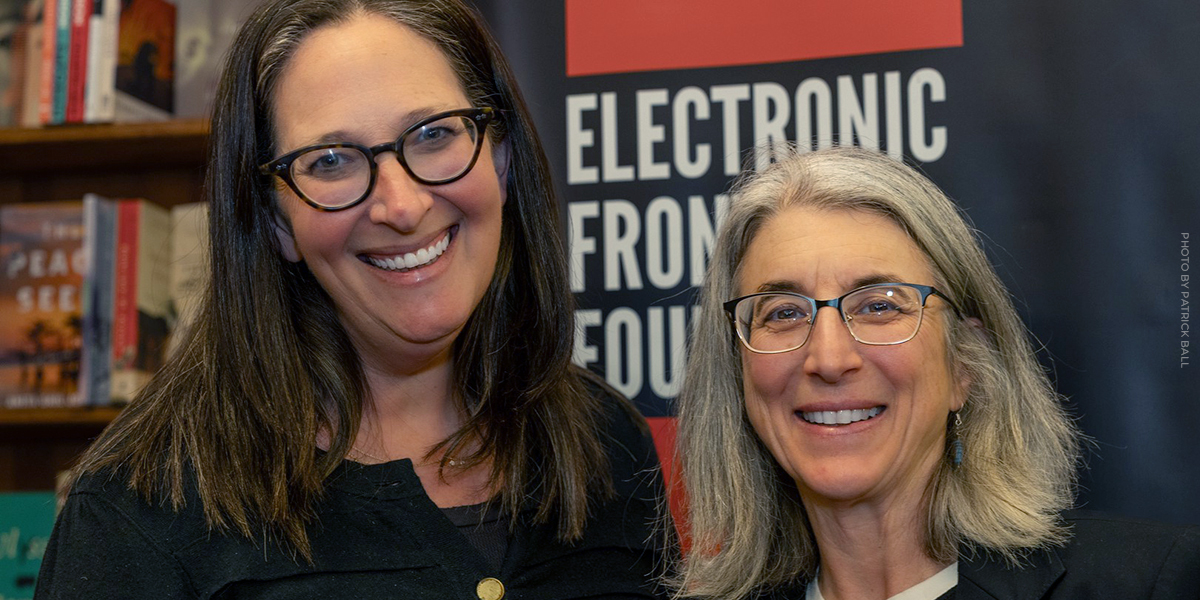
SAN FRANCISCO – Nicole Ozer has been appointed as executive director of the Electronic Frontier Foundation effective June 1. 

Ozer is a legal expert on privacy and surveillance, artificial intelligence, and digital speech. She currently serves as the inaugural executive director of the Center for Constitutional Democracy at the University of California College of the Law in San Francisco. From 2004-2025, she was founding director of the Technology and Civil Liberties Program at the American Civil Liberties Union of Northern California. Ozer will succeed Cindy Cohn, who has been with EFF for more than 25 years and served as its executive director since 2015. 

EFF champions user privacy, free expression, and innovation through impact litigation, policy analysis, grassroots activism, and technology development, with a mission to ensure that technology supports freedom, justice, and innovation for all people of the world. The organization celebrated its 35th anniversary in 2025. 

"I am honored to lead EFF forward in these critical times. EFF’s global work to defend and advance rights, justice, and democracy in the digital age is fundamental to the future of our countries, our livelihoods, and literally our lives,” Ozer said. “I am ready to hit the ground running with EFF’s exceptional staff, board, and broad base of supporters and ensure that EFF is stronger than ever. Together, we can meet this moment and build a future where technology works for the people.”  

“I couldn’t be happier to pass EFF’s reins over to Nicole,” Cohn said. “She has been our stalwart partner for many years in standing up for privacy, free speech and innovation online. I’m confident that she understands both the strong heart and the future potential of EFF especially as our work is more critical than ever.”   

“Nicole Ozer is the ideal person to lead EFF during this unprecedented time in our nation’s history,” said EFF Board Chair Gigi Sohn. “She possesses all of the qualities necessary to lead the organization: great vision, strong management skills and deep substantive knowledge. The fact that she has worked alongside EFF for over two decades is icing on the cake. The EFF Board is excited to welcome Nicole and begin a new chapter in our history.” 

Over her more than two decades leading public interest technology work, Ozer: 

  • spearheaded passage of the California Electronic Communications Privacy Act – the nation’s strongest electronic surveillance law, requiring a warrant for government access to electronic information;
  • modernized California law to protect reading records in the digital age by helping to craft the Reader Privacy Act requiring a “super warrant” for government access;
  • created a groundbreaking model law for local democratic oversight of surveillance systems which inspired 25 laws across the country that help safeguard the rights and safety of more than 17 million people;
  • litigated civil liberties cases and drafted influential amicus briefs on technology issues at all levels of state and federal court, including the U.S. Supreme Court and California Supreme Court; and
  • developed multi-year campaigns to strengthen the anti-surveillance policies related to social media surveillance and face recognition of major technology companies and foster stronger privacy and free expression protection for billions of people worldwide. 

Ozer is a lecturer at the University of California, Berkeley School of Law; was a 2024-2025 technology and human rights fellow with the Carr-Ryan Center for Human Rights Policy at the Harvard Kennedy School; and in 2019 was a visiting researcher at the Berkeley Center for Law and Technology and a non-residential fellow with the Digital Civil Society Lab at the Stanford Center on Philanthropy and Civil Society.  

Ozer's work has earned accolades including the Fearless Advocate Award from the American Constitution Society Bay Area, the James Madison Freedom of Information Award from the Society of Professional Journalists of Northern California, and a 2025 California Senate Members resolution commending her “unwavering dedication to defending and promoting civil liberties in the digital world.” Her writings on privacy and constitutional law have been published widely, and she regularly provides expert testimony for government proceedings, offers commentary in the press, speaks at academic conferences, and presents at national and global forums including South by Southwest and the Centre for European Policy Studies. She holds a law degree from the University of California, Berkeley School of Law and a bachelor’s in American Studies from Amherst College. 

"It is incredibly exciting to welcome Nicole Ozer as our new leader at EFF at a time when the organization's mission couldn't be more essential,” said entrepreneur, activist, writer, and EFF Board member Anil Dash. "Nicole's unique skills promise to build on the foundation that Cindy Cohn established as Executive Director, preparing EFF to serve an even more vital role in protecting privacy and innovation." 

Cohn first became involved with EFF in 1993 when EFF asked her to serve as the outside lead attorney in Bernstein v. Dept. of Justice, the successful First Amendment challenge to the U.S. export restrictions on cryptography. She served as EFF’s legal director and general counsel from 2000 through 2015, and as executive director since then. She also co-hosted EFF’s award-winning “How to Fix the Internet” podcast. Her memoir, Privacy’s Defender: My Thirty-Year Fight Against Digital Surveillance, was published March 10 by MIT Press, and she is now conducting a national book tour. 

EFF's Board of Directors last year assembled a committee which undertook a wide search for Cohn’s successor with assistance from leadership advisory firm Russell Reynolds Associates. 

Contact: press@eff.org

1K+ cloud environments infected following Trivy supply chain attack

24 March 2026 at 21:31

Crims 'creating a snowball effect' across open source projects

RSAC 2026  Thousands of organizations' cloud environments have been infected with secret-stealing malware as a result of the Trivy supply-chain attack last week, and now the crims that compromised the open source scanners are working with notorious extortion crews like Lapsus$.…

Lightning-fast exploits make it essential to patch fast, ask questions later

Here's where you ought to spend your security billable hours budget this year

Strengthen your MFA policies, double-down on anti-phishing training, and for Jobs' sake, patch all your vulns right away. The past year of intelligence collected by Cisco's Talos threat hunters suggests that attackers are moving faster to exploit vulns, and fooling more staff than ever into giving up their credentials. …

Smooth criminals talking their way into cloud environments, Google says

23 March 2026 at 16:00

Voice phishing is second most common initial access method across all IR probes, and top in cloud break-ins

RSAC 2026  Voice phishing surged last year to become the second most common method used by cybercriminals to gain initial access to their victims' IT estate – and the No. 1 tactic used when breaking into cloud environments.…

RSAC 2026: Uncle Sam backs out, and AI agents are everywhere

Infosec pros descend on San Francisco

kettle  When El Reg cybersecurity editor Jessica Lyons joins infosec industry colleagues in San Francisco for RSAC 2026 this week, she's expecting agentic AI to be on everyone's lips - at least those who aren't busy gossiping about the lack of presence from any representatives of the US federal government.…

The drone swarm is coming, and NATO air defenses are too expensive to cope

23 March 2026 at 11:14

Ukraine's battlefield lessons show quantity and affordability now trump exquisite hardware

NATO is unprepared to deal with attacks by cheap, mass-produced drones and urgently needs layered, affordable air defense systems to counter the threat, taking a cue from the experience gained by Ukrainian forces over the past four years.…

Russians are posing as Signal support to launch phishing attacks

22 March 2026 at 23:12

PLUS: US takes down Iranian propaganda sites; Marketing company asks 'Why Do We Have Your Information?' And more!

Infosec In Brief  Russian intelligence-affiliated parties are posing as customer support services on commercial messaging applications such as Signal to compromise accounts and conduct phishing attacks, the FBI and Cybersecurity and Infrastructure Security Agency (CISA) warned last Friday.…

Congress Is Dropping the Ball with a Clean Extension of FISA

20 March 2026 at 23:20

Two years ago, Congress passed the “Reforming Intelligence and Securing America” Act (RISAA) that included nominal reforms to Section 702 of the Foreign Intelligence Surveillance Act (FISA). The bill unfortunately included some problematic expansions of the lawbut it also included a relatively big victory for civil liberties advocates: Section 702 authorities were only extended for two years, allowing Congress to continue the important work of negotiating a warrant requirement for Americans as well as some other critical reforms

However, Congress clearly did not continue this work. In fact, it now appears that Congress is poised to consider another extension of this program without even attempting to include necessary and common sense reforms. Most notably, Congress is not considering a requirement to obtain a warrant before looking at data on U.S. persons that was indiscriminately and warrantlessly collected. House Speaker Mike Johnson confirmed that “the plan is to move a clean extension of FISA … for at least 18 months.” 

Even more disappointing, House Judiciary Chair Jim Jordan, who has previously been a champion of both the warrant requirement and closing the data broker loophole, told the press he would vote for a clean extension of FISA, claiming that RISAA included enough reforms for the moment.

It’s important to note RISAA was just a reauthorization of this mass surveillance program with a long history of abuse. Prior to the 2024 reauthorization, Section 702 was already misused to run improper queries on peaceful protesters, federal and state lawmakers, Congressional staff, thousands of campaign donors, journalists, and a judge reporting civil rights violations by local police. RISAA further expanded the government’s authority by allowing it to compel a much larger group of people and providers into assisting with this surveillance. As we said when it passed, overall, RISAA is a travesty for Americans who deserve basic constitutional rights and privacy whether they are communicating with people and services inside or outside of the US.

Section 702 should not be reauthorized without any additional safeguards or oversight. Fortunately, there are currently three reform bills for Congress to consider: SAFE, PLEWSA, and GSRA. While none of these bills are perfect, they are all significantly better than the status quo, and should be considered instead of a bill that attempts no reform at all. 

Mass spyingaccessing a massive amount of communications by and with Americans first and sorting out targets second and secretlyhas always been a problem for our rights.  It was a problem at first when President George W. Bush authorized it in secret without Congressional or court oversight. And it remained a problem even after the passage of Section 702 in 2008 created the possibility of  some oversight. Congress was right that this surveillance is dangerous, and that's why it set Section 702 up for regular reconsideration. That reconsideration has not occurred, even as the circumstances of the NSA, Justice Department, and FBI leadership, have radically changed. Reform is long overdue, and now it's urgent.  

Cryptographers engage in war of words over RustSec bug reports and subsequent ban

20 March 2026 at 22:07

Rust security maintainers contend Nadim Kobeissi's vulnerability claims are too much

Updated  Since February, cryptographer Nadim Kobeissi has been trying to get code fixes applied to Rust cryptography libraries to address what he says are critical bugs. For his efforts, he's been dismissed, ignored, and banned from Rust security channels.…

FCC Chair Carr’s Threats to Punish Broadcasters Are Unconstitutional

20 March 2026 at 16:08

EFF joined other digital rights and civil liberties organizations in calling out the unconstitutionality of Federal Communications Commission chair Brendan Carr’s recent threats to punish broadcasters for airing statements he disagrees with. 

Carr’s recent threats, like his past threats, are unconstitutional efforts to coerce news coverage that favors President Donald Trump. He wrongly claims that the FCC’s “public interest” standard allows him and the commission to revoke the licenses of broadcasters who publish news that is unflattering to the government is anathema to our country’s core constitutional values. 

The First Amendment constrains the FCC’s authority to force broadcasters to toe the government’s line, even though broadcast licensees are required to operate in the “public interest, convenience, and necessity.” Imposing restrictions on licensees’ speech, especially viewpoint-based limitations, are still subject to First Amendment scrutiny even if, in some circumstances, that scrutiny differs somewhat from that applied to non-broadcast media. And the “public interest” requirement, as it were, has never been interpreted to allow the type of viewpoint-based punishment that Carr has threatened here.  

Everyone agrees that news reporting should strive for accuracy, but Carr’s threats have little do with that. Instead, his allegations of "falsity" are a proxy for retaliation based on (1) Carr’s subjective policy disagreements; (2) any criticism of Trump and the administration broadly; (3) treatment of anything that is not the official US government line about the Iran War as “false.” 

We join the call for Carr to withdraw these threats.


❌