Login
Login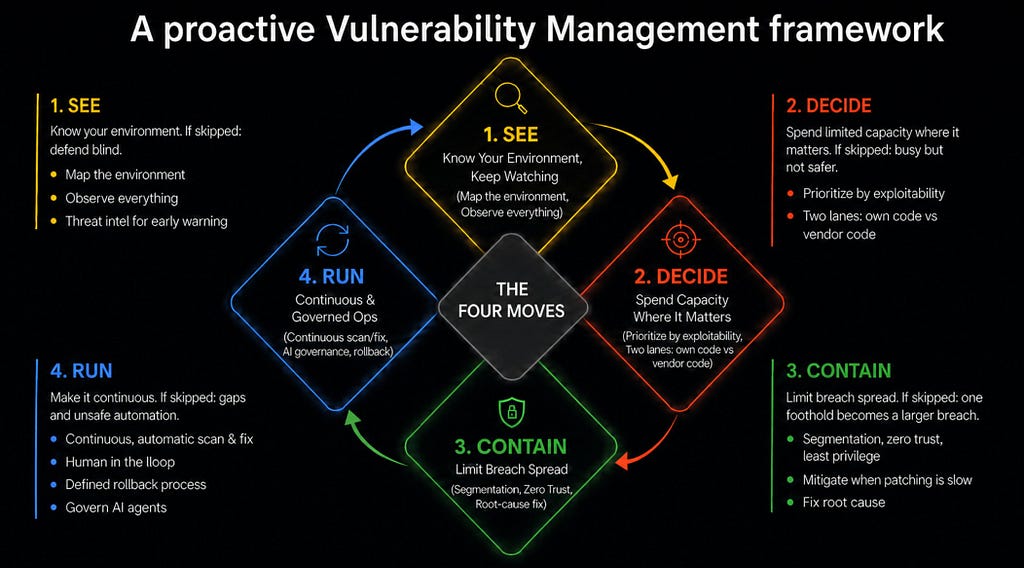


Beyond the Vulnerability Apocalypse: Scaling Your Basics and Vulnerability Management
Developed together with Usman Chaudhary @ Google for Public Sector (his post)
Let’s call it what some in the industry are calling it: the vulnerability apocalypse. For years, finding vulnerabilities was slow, expensive, specialized work. LLMs made it cheap — in its first weeks, one frontier model surfaced more than 23,000 issues across a thousand open-source projects, including a 27-year-old flaw in OpenBSD found for under $20,000 in compute. And when finding bugs gets cheap, attackers find more of them — and likely exploit more of them, faster than defenders can patch. This isn’t hypothetical: Google’s threat intelligence team has already reported the first zero-day exploit built with AI, caught being used in the wild. The deluge is real, and it’s here.
Breaking the Patch Sound Barrier: Your Vulnerability Remediation Will Not Keep Up With AI Exploit…
Since Mythos, AI-powered defenses have emerged just as fast: autonomous agents that find and fix vulnerabilities in source code, tools that rewrite code to eliminate whole classes of bugs, frontier models utilized by defenders.
But here’s what gets lost in the arms race: the fundamentals are more important now than they have ever been. When you can’t out-find or out-patch the machines, what saves you is the boring, durable work done well — knowing your environment, limiting how far a break-in can spread, fixing root causes. AI raises the ceiling on both attack and defense; it doesn’t change what good defense is made of. And defending against AI-speed attacks doesn’t always require AI — sometimes it just requires the fundamentals, done well at scale.
One new note to add. Recent incidents like this made some people state that “basics don’t matter, machines will find a way.” To me it means that basics do matter, but consistency and scale are MUCH more critical. After all, and this is a silly example, no machine can find a buffer overflow if you code in Rust. And, yes, sadly, this means you need to be “near perfect”, but hey good news — with the same machines you can. So this is not a boring “do the basics please” post, this is a reminder that you need to scale them with AI.
Why the urgency is real (and different this time)
Why act now, if you’ve heard “do the fundamentals” for twenty years? Because the gap between discovery and exploitation is effectively gone — according to some sources, high-severity flaws are now exploited within hours, sometimes before a public proof-of-concept exists, and the damage is material, widespread, and accelerating.
A program that assumes days or weeks to respond was built for a world that no longer exists. The fundamentals — visibility, segmentation, process — are what absorb the shock when patching inevitably falls behind. And this holds whether AI capabilities jump or improve gradually: the actions needed today are largely the same.
AI made finding vulnerabilities cheap. The attackers noticed. The answer isn’t panic — it’s the fundamentals done well at scale.
Breaking the Patch Sound Barrier Part 2: So Is The Apocalypse Coming and What Is It?
Start by reverse-engineering the impossible
Before any playbook, one exercise — because it does more to find your real gaps than any framework will.
Imagine you could patch any vulnerability within 15 minutes of its release, as if by magic. Now work backwards: what would have had to be true? You’d need to know instantly what you run and where it’s exposed. You’d need testing so automated that a fix ships safely in minutes. You’d need no legacy that resists change, and an architecture built to absorb it. You’d need to have already eliminated whole classes of bugs, so there were fewer to patch at all.
You will never hit 15 minutes across the environment — legacy systems guarantee it. But the gap between that fantasy and your reality is the most honest map you will ever get of where your program breaks. Every item in the playbook below is something that this exercise surfaces.
The Playbook: Fundamentals at AI Scale and Speed
Each of these is written as what to do and how to actually get it done — because the advice-to-adoption gap is where most programs die.

The four moves: SEE → DECIDE → CONTAIN → RUN
- SEE — know your environment, and keep watching
- The play: Map your environment (configuration graph) — what you run, what’s exposed to the internet, and how far one compromise can spread. Then keep watching: observability across your own environment, and threat intelligence for the outside view, so you know the moment a bug in vendor software starts being exploited in the wild.
- The advantage: The graph pays for itself immediately — dead code, unused open-source packages, and forgotten internet-facing servers you can simply remove — and it’s the asset list every other move depends on. Threat intel buys you early warning: you hear a vendor bug is being exploited when it’s announced, not when it hits you, so a compensating control can be in place before an attacker arrives.
- If you skip it: You defend blind — the breach starts at the asset you didn’t know you owned, and you learn about it from someone else.
2. DECIDE — spend your limited capacity where it matters
- The play: Prioritize by real exploitability, not raw severity — a “medium” on an internet-facing service one hop from customer data beats a “critical” on an isolated internal box (recently chains of Lows and Mediums were used in real compromises as well). Run two lanes: your own code you can fix, refactor, or rewrite; vendor code you can’t touch, so that lane is compensating controls and faster detection.
- The advantage: Your finite capacity goes to the few findings that could actually hurt you — and every flaw gets a response you can execute: a fix where you can, a shield where you can’t.
- If you skip it: Busy but not safer — capacity burned on findings no attacker could reach while the one exploitable path stays open, and months of exposure waiting on a vendor patch you could have mitigated in days.
3. CONTAIN — make sure one bug can’t become a breach
- The play: Segmentation splits the environment so a foothold in one place can’t reach the rest. Zero trust and least privilege make every person, service, and AI agent prove each request — and grant only the access it needs. When you can’t patch fast, mitigate: block the exploit path or take the exposed component offline. And when the same bug class keeps returning from the same code, fix the root cause — rewrite memory-unsafe components in a memory-safe language instead of patching the same flaw forever.
- The advantage: One exploited bug stays a contained incident instead of a company-wide breach — and containment keeps working even when patching can’t keep up.
- If you skip it: One bug becomes the whole environment — the first agentic ransomware ran its entire chain through doors these basics would have closed — and unfixed root causes bring the same bug class back every quarter.
4. RUN — make it continuous, and govern what runs it
- The play: Make scanning and fixing continuous and automatic, not quarterly — with the process defined before you accelerate: human-in-the-loop approval before fixes ship, a tested rollback path for when one goes wrong, and every AI agent wrapped in identity, least privilege, and human review from day one.
- The advantage: Machine-speed remediation that’s safe to run — and the whole playbook becomes a daily operating discipline instead of a one-time project.
- If you skip it: Quarterly scans mean months of exposure between runs; automation without approvals and rollback breaks production at machine speed; and an ungoverned agent becomes your newest insider threat.
None of these are new controls. What’s new is the bar. AI changed the speed and scale of the attacks, so the fundamentals have to run faster than they used to and cover everything with no exceptions.
The hard part isn’t technical
Every move above lands on someone else’s roadmap. Many are already on them, some for years. Segmentation changes how infrastructure operates; a continuous fix pipeline changes how developers ship; rewriting memory-unsafe components costs engineering quarters. Expect pushback — not because those teams don’t care about security, but because you’re asking to spend their time against their goals.
Three things buy the political capital: bring evidence, not mandates — the configuration graph and real exploitability data argue better than any policy memo; co-own the fix — show the risk and the trade-off, then let engineering own the how, because a rewrite they choose ships and a rewrite they’re ordered into stalls; and give leadership one number tying the work to risk reduced, so the effort defends itself at budget time.
Mandates breed quiet workarounds. Shared evidence and shared credit create movement.
The frontier agrees:
Anthropic, having surfaced the scale of the problem with Mythos, has focused on the fix: an automated pipeline that investigates, validates, and patches code vulnerabilities — delivered through Claude Code — with human review before anything ships.
Google frames it as AI threat defense: using AI across the whole vulnerability management lifecycle — finding, fixing, detecting, responding — wrapped in a framework and human review. The emphasis is on managing the end-to-end process, not any single tool.
OpenAI focuses on cyber-focused models — such as the GPT-5.6 series (including the Sol model) — which are designed to assist defenders with vulnerability identification, red teaming, and security validation, shifting the approach toward high-reasoning, specialized models capable of handling complex security tasks.
Different bets, same conclusion: none of them claims AI fixes vulnerability management for you — every one wraps the capability in process and human review.
The real reckoning
The vulnerability deluge is real, whatever you call it: AI made finding bugs cheap, and cheap discovery means more exploitation and more damage. But the reckoning isn’t that AI broke defense — it’s that the fundamentals matter more than they ever have. Use AI to find, to fix, and to move faster than you thought possible. But map your environment, limit how far a break-in can spread, fix the root causes, and keep a human on the decisions that matter.
Get the fundamentals right — that was always the strategy; now it’s the only one. Which of these is your program most under-invested in? That’s the conversation worth having…
P.S. This came out a bit too high-level, but this is admittedly for the high level audience…
Further reading and sources:
- “Breaking the Patch Sound Barrier” series
- Security incident disclosure — July 2026 (boring title award winner!)
- Google Secure AI Framework (SAIF)
- Google Threat Intelligence Group on the first AI-developed zero-day observed in the wild (2026).
- CoSAI Shared Responsibility for AI Security
- Anthropic — the post-Mythos code-patching pipeline via Claude Code
- Zero risk isn’t the job: a CISO’s guide to agentic AI
- First Take: OpenAI’s Hugging Face Hack — CISOs Must Focus on Fundamentals and Ignore the Hype (Gartner access required)
Beyond the Vulnerability Apocalypse: Scaling Your Basics and Vulnerability Management was originally published in Anton on Security on Medium, where people are continuing the conversation by highlighting and responding to this story.